It has been an ambition to bird the Sunshine State ever since some time in the 1990s when I watched a TV wildlife documentary about all the different Herons that are found there. So now the opportunity has arisen I have taken it with a three-week solo winter break. Since this is my first ever North American wildlife trip I came here with not much research and no particular agenda in terms of what to see. Almost everything would be new to me so everyday birds are just as interesting as scarcities and specialities. There is also some winter potential for butterflies and dragonflies, and of course Florida’s famous large reptiles to experience.
I adopted largely a site-specific approach, just seeing what might be found at each of them. To that end I did pre-research the various nature reserves and other birding places along the Florida Keys, the island chain running east to west from the southern tip of the mainland. The US-1 highway that runs through the Keys is 115 miles long with 43 bridges from Key Largo in the east to Key West at the far end.
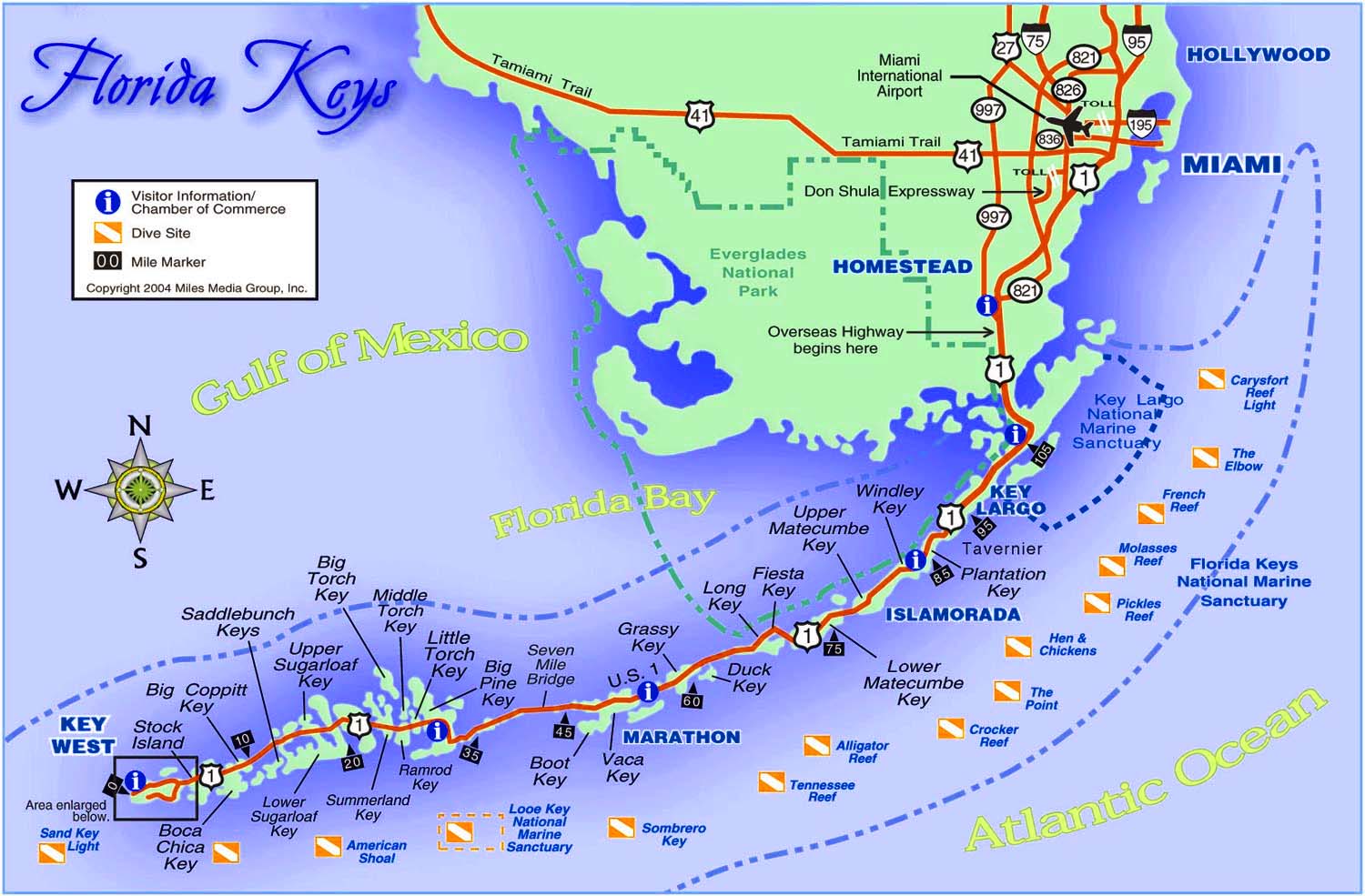
Wildlife sites in the Upper (eastern) Keys are mostly limited to State Parks (see here – same old populism). This end of the island chain is heavily developed. But extensive areas of two original habitats of tropical hammock and Mangrove forest remain and are now protected. The former comprises stands of hardwood trees with a dense under storey on higher land, usually no more than 100 metres above sea level that is firm enough to support this. The salt-tolerant Mangroves take over in tidal areas.
My base for the first part of the trip was the rather scruffy though fit for purpose Days Inn, Florida City. This large motel, currently under refurbishment lies very conveniently at the junction of the US-1 highway and the SR-9336 access road into the Everglades National Park. From here I set out south on Day 2 (9th) taking the Card Sound Road to Key Largo. Once on the island I drove on through several miles of undeveloped land collectively known as the Crocodile Lake Wildlife Management Area. The mind boggled as to what must be out there but there is no access as the outsourced image below shows.
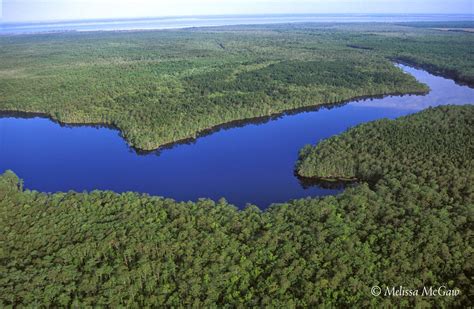
Crocodile Lake Wildlife Management Area
Just before the junction of this road and the US-1 lies the entrance to the elaborately named Dagny Johnson Key Largo Hammock Botanical State Park. This was the wildest of the parks I visited and is unmanned with no visitor facilities, so hence is the one I liked the best. There is a 2.5 mile figure of eight loop trail here through varied and interesting ecosystems. But the hardwood hammock habitat is very dense, with an often impenetrable tangle of shrubs and vines beneath a low canopy, and so birds are difficult to see. Neck craning is not my favourite form of birding,
The situation wasn’t helped by my unfamiliarity with a lot of the birds, and hence being reliant on getting recognisable photographs to check against a field guide. But that is why I have come to a new continent, to observe and learn. The stand-out birds at Dagny Johnson were a number of Northern Cardinal, Gray Catbird, Great-crested Flycatcher (all below) and as in most places I went subsequently wintering warblers that became rather irritating in their regularity.


I came across White Ibis for the first time here. This is a small, plain Ibis with a rather fussy and seemingly non-stop feeding action. They were a frequent sight throughout the trip in a great diversity of habitats. When encountered foraging in built-up locations I considered them a bit tramp-like and not especially attractive, though they became rather more appealing when observed in wilder settings.


Dagny Johnson is also known for it’s butterflies but conditions remained mostly overcast. So resolving to return on a sunny day I moved on after around four very enjoyable hours on site. The US-1 is a constant conveyor belt of traffic so stopping if something is spotted is not advisable. And since all the land with a water frontage is privately owned there was nowhere to watch sea birds before the next park. Most of the large fly-overs were either Brown Pelican or Turkey Vulture: there must be many thousands of each in southern Florida. The former is around 30cm shorter in stature than the White and Dalmatian Pelicans I had previously observed in northern Greece, and four plumages may be seen.


Next up came the slightly less lengthily named John Pennekamp Coral Reef State Park. This was much more of a public park than a nature reserve, with an emphasis on human activity particularly of the boatie kind. Some of the visitor facilities were still out of commission post-Hurricane Irma, as was the main nature trail. So the park was not too crowded though judging by the amount of car parking space it must be heaving in more normal times.
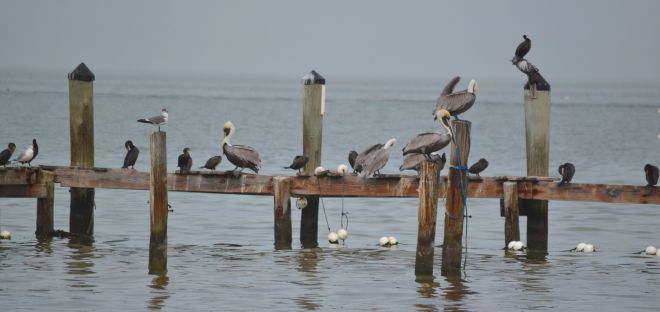
Florida Keys’ seabirds
I nonetheless found some common Florida birds by getting into quieter areas. Brown Pelican and Double-crested Cormorant were much in evidence offshore, and one of the trip’s oft encountered Northern Mockingbird (below, bottom left) posed nicely for the camera. There were a lot of warblers here that I took to be Yellow-rumped Warbler (below, top) by their chipping calls. This is Florida’s most abundant wintering warbler between October and April, but there are various similar ones that had to be puzzled over before I became sure of the ID.


This site was also where I began to notice Great Pondhawk (pictured above, right), a widespread though not usually abundant dragonfly occurring in the southern US from Florida westward into Texas, and southward as far as Argentina. I found these very attractive with their bright green thorax and green and brown banded abdomen. After light initially catches their metallic greenness in flight they seemed to display an uncanny ability to vanish once settled, and it took a long time to do them justice with the camera. This insect was a frequent encounter throughout my first week in Florida.
On Day 3 (10th) I moved on through the Upper to the Middle Keys. The latter were more like I had hoped things would be with narrower islands and roadside stopping places from where I observed the trip’s first Laughing Gulls, as well as Bonaparte’s Gull and American Royal Tern. The first of those was an important lifer because I have rather regretted missing the last two that graced England’s shores, through not wishing to make the tedious journeys involved.
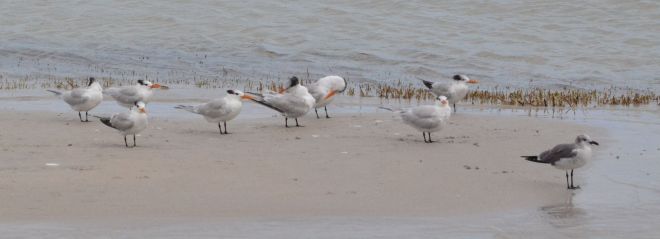
Royal Tern and Laughing Gull along the Middle Keys (above) + close-ups from other sites (below)


I had seen the African race of Royal Tern once before in Morocco but here the American equivalent is commonplace. Why grind it out to Dungeness, Guernsey or worst of all the strange separate planet that is Merseyside to chance seeing these birds when there are so many of them here, all waiting to be fitted into a convivial winter break? Double-crested Cormorant adorned overhead cables in large numbers and Brown Pelican often perched on offshore or bridge structures as I continued westward.
The latter were simply everywhere. Brown Pelican are common along all parts of the southern Florida coastline, and more widely from Nova Scotia to the Amazon and along pretty much the length of the Pacific coast of the Americas. These birds were often seen flying in twos or threes or loose V formations to and from feeding grounds where they splash dive for fish. In the breeding season they nest typically in colonies of several hundred individuals in secluded areas and on offshore islands.


Two more state parks awaited my inspection, both being neither as wild as Dagny Johnson or as commercialised as John Pennekamp. Both were also functioning only partially following the devastation of 2017’s hurricane season. At Long Key State Park (brevity at last) on the island of the same name, the Golden Orb Trail leads out through various plant communities to the shoreline. There in a secluded cove I enjoyed photo sessions with the trip’s first close Great Blue Heron and a large white heron with a bi-coloured pink and grey bill, the latter being an adult white-morph Reddish Egret (below left).


By way of something a little different I also enjoyed watching a Hermit Crab (pictured below) going about its business. I have often seen these creatures in wildlife documentaries and so was intrigued by this real life encounter. Outside of their second hand sea shells the soft, spirally curved abdomen of these crustaceans is vulnerable and the tip is adapted to clasp tightly to the inside. As they grow competition for suitable larger homes can be fierce and rivals may fight to the death. There are around 1100 different species in the world, most of which are nocturnal so I was possibly lucky to stumble upon this one.


At the fourth site, Curry Hammock State Park two quite different birds each allowed a very close approach. The first was a Ring-billed Gull, a Nearctic larid I have recorded twice before in England; and the second was the trip’s first Little Blue Heron that was feeding along the shoreline, largely unconcerned by my attentions.


Other state parks beyond this held little bird interest, were either closed or recovering from hurricane damage, and at one I was even discouraged from going in at the entry gate. Just occasionally I did turn off the US-1 to try to access some viewable shoreline, always without success. In one residential area I spotted an amusingly photogenic group of White Ibis perched on overhead wires, then shortly afterwards a gathering of Mourning Dove in the same pose. The latter is a common and widespread suburban and farmland bird in Florida, easily distinguished at first sight from the most abundant Eurasian Collared Dove by their long pointed tails.


Perched White Ibis (above) and Mourning Dove (below)


On day 5 (12th) I returned to Dagney Johnson hoping butterflies would be active in the sunny conditions. I did come across a spectacular Dryas Iulia (below, left), a few huge yellow Sulphurs and a Monarch – all as fly pasts – but left feeling this is most probably the lepidoptera low season in The Keys. As on my first visit birds were very difficult to observe, but ghostly Great Pondhawk were frequent once again and Band-winged Dragonlet were also flying in numbers. The latter looks a quite similar species to the African Banded Groundling that is expanding into southern Europe.


Band-winged Dragonlet was the most frequently seen species wherever I found dragonflies over the ensuing days. Though mature males (above, top right) are unmistakeable there appears to be tonal variation in females and immatures that I have not researched, and do not intend to do so yet given the limited range of Odonata observed on this first visit to the new world. The bottom row images (above) nonetheless brought out a subtlety that was pleasing to record in what I suspect by the grey eyes are immature males.
On day 8 (15th) I made the long trip along the “Overseas Highway” to the Lower Keys, beyond the Seven Mile Bridge, but didn’t find any good birding sites despite checking all the locations in my dated bird finding guide, the one by Bill Pranty (see here). An alternative site guide that I saw in some visitor centre shops was equally dated.
The US-1 follows the route of a former railway and two derelict sections of the original rail viaducts survive. One running parallel with the concrete civil engineering achievement of the modern road bridge is an impressive sight indeed, though haunting in it’s suggestiveness of times past as the outsourced images below convey.
The further west I went the more hurricane damage was evident. Much of it seemed organised with debris piled up by the roadside and gradually being removed, but there is clearly a lot of fly tipping going on as well as if people are taking advantage of the allowable dumping. In the wildlife management areas I visited on this day there were piles of white goods and mattresses well away from any storm damaged property. I came across one huge official dump where an apocalyptic looking mound of debris the size of a small block of flats was being loaded into a convoy of huge waiting skip trucks, presumably destined for landfill. I wanted to take pictures but doubted whether the attendant sheriff would have appreciated my stopping amongst all the trucks. The whole place is in a bit of a mess.
The recovery period that the Keys is clearly going through aside, I concluded this is not an easy place to bird in winter. There are some unique habitats but it could take a lot of time and painstaking effort to find much in them. The area comes into it’s own during passage seasons and has some notable breeding birds, but even then I suspect expert local guidance as to where to look and what might be there would be beneficial.
I was especially disappointed not to locate any concentrations of Nearctic waders, but the tide always seemed to be in and access to beaches was invariably through the private property of condominiums and resorts. Hence not all the pictures in this post were actually taken in The Keys. But I wanted to explore this chain of islands, I devoted three and a half days to doing so and now moved on.
 Ramblings and Scribblings