A newcomer’s impressions of southern Florida 5 – the best of the rest: 8 – 25th Jan

Herewith a round-up of some other locations visited and wildlife observed during my 19 days in Florida. I commented in part 4 on the lack of walkable countryside in the sunshine state. That perception changed on the last two days of this trip when I was pleased to at last find two big expanses of unspoilt original habitat with general access and mercifully no visitor facilities. So such places were out here after all.

Upon researching somewhere to go to fill my final day (25th) I became aware of the Babcock / Webb Wildlife Management Area some 15 miles to the north of Fort Myers. It sounded like a possible area in which to locate further birds I wanted to see in Florida, such as some more Woodpeckers, Blue and Scrub Jays, but most of all the enigmatic Limpkin. At the preserve entrance, just off the US-75 highway is a chain of water bodies known as Webb Lake and that was where I commenced my search.
DSC_0109

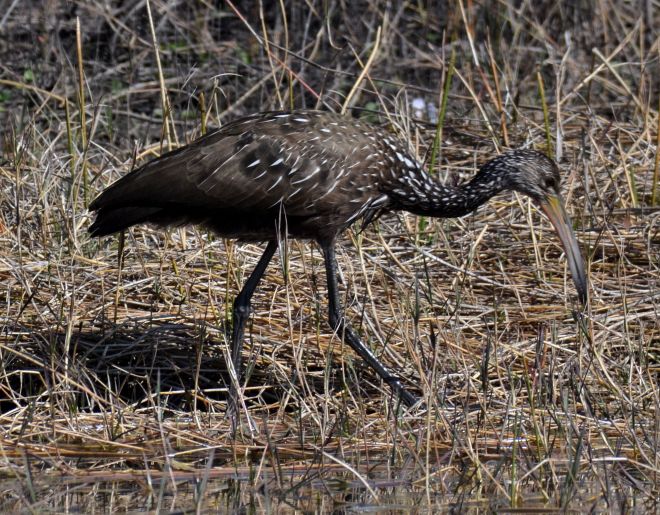
The enigmatic and mysterious Limpkin, a Florida speciality

The WMA’s only metalled road snaked between this feature and the nearby highway away to the west. It was clear most of the other interested parties here were anglers, but I had chosen well since at each likely looking stopping place I did indeed observe Limpkin. There was one by itself at my first stop, a group of four at the next, and three more on the return drive that were close enough to digiscope adequately. Two Sandhill Crane as a fly past provided a second welcome life list addition here.

Limpkin inhabits freshwater habitats including lake margins, swamps and water courses, where the diet is frogs, snails and insects. Its range within North America lies almost entirely within Florida. Sibley describes the species as an unusual bird, combining characteristics of a large Rail or small Crane. Well it would certainly be a very elongated Rail, with down-curved yellow bill and dark olive legs. The plumage colouration is generally brown with white flecking on the body and a buff toned head. These birds conveyed a certain out of the ordinary, even primeval quality and charm as they moved sedately through the marginal vegetation with a limping gait, hence their name.

Having seen my top target so well I then drove further into the WMA, finding it to be another of those places I so often get into abroad in which it seems possible to walk or even drive for hours in a single expansive habitat, most probably without noticing a lot. Of the few birds encountered, the only ones that didn’t fly up and into the sun ahead of my approaching vehicle were a group of Common Ground Dove.

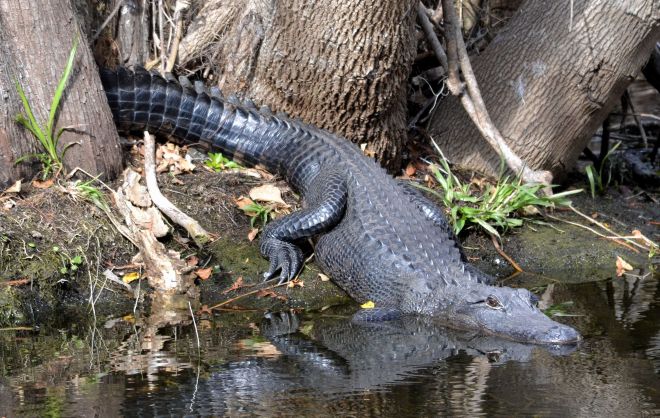
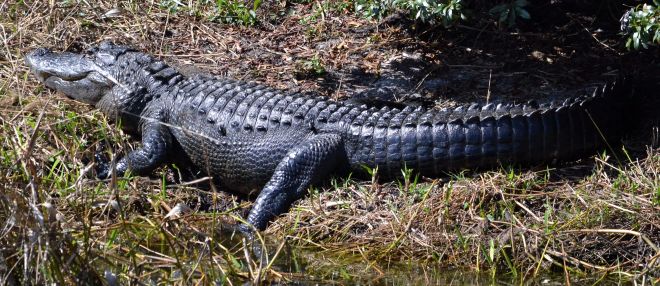
It struck me the best way to explore what seemed like interesting habitat would be by mountain bike. I am always wary of taking a hire car on dirt roads, so not wanting to tempt mishap and having forgotten to bring any food I decided not to persevere and so returned to base for a lunch break. That was not before encountering the trip’s final American Alligator (below), that like myself was contentedly on its own at the back of beyond.
DSC_0120

Babcock / Webb WMA Alligator, the last one of the trip

In the afternoon I paid a second visit in as many days to the Estero Bay State Buffer Preserve in Fort Myers. As if to confirm my earlier sentiments I came upon next to no birds, just a handsome Gopher Tortoise (below, left) but it still felt good to be walking in such a large expanse of natural habitat and to think it is being preserved as such smack in the middle of what is a highly developed district.

On my first visit the previous afternoon I had expected another public park but actually found a huge tract of original habitat that has been set aside as a buffer against development and to help preserve ecosystems. How refreshing, and now I knew what this part of suburban Florida must have looked like before all the condominiums, country clubs and golf courses were fashioned out of the landscape. I came across a Downy Woodpecker, the US’ smallest of the family, while a Loggerhead Shrike (above, right) hunting on territory was busy behaving as grey Shrikes do everywhere.

The wildlife interest that time was otherwise mainly butterflies, mostly the same as I had been finding all trip but three new ones as well. Pearl Crescent (above, left) is a common and widespread species throughout much of the US and Mexico, being found in a variety of non-specialised habitats. Cassius Blue (above, top right) is resident throughout the year in southern Florida, producing at least three broods. There are many and similar Skipper species in North America so I will not attempt to ID the one seen here (bottom, right).

On my first and last days in Homestead (8th and 18th) I visited Biscayne National Park on the coast to the east. Since 95% of it’s 172,971 acres is water, between the Mangrove swamp coastline and the offshore Florida reef system, much of the wildlife interest here is marine. But the park’s only land based area around its Dante Fascell Visitor Centre offers seabird watching over the bay. It was here after driving south from Miami on day 1 that I first encountered Brown Pelican, Royal Tern, Bonaparte’s Gull, Green Heron and the subsequently ubiquitous Yellow-rumped Warbler.

A private boat hire concession operates from here, allowing visitors to explore the mostly impenetrable Mangroves to the north and south where American Crocodile and Manatee can be found. But I have no experience of canoeing or kayaking and in any case was alone, so that otherwise attractive option was not possible.

Immediately south of the centre lies Homestead Bayfront Park, which is more a boating facility than a nature reserve. But the marina piers held an interesting accumulation of approachable seabirds (above and below) that on 18th were much easier to photograph than they had been in The Keys. Some of the pictures in part 1 were indeed taken here.

But perhaps the stand-out bird that morning was a rather impressive white-morph Great Blue Heron (below). Also known as Great White Heron, this largest of all American herons is found only in Florida where it is most prevalent in The Keys. Adult white and indeed blue-morphs here can be 10% larger than the norm for Great Blue (per Sibley), and exhibit a very heavy bill. Just look at that magnificent weapon!

My thanks are due to Oxon county recorder and north American bird authority Ian Lewington (see here), for kindly checking through these five Florida posts and putting me right on some of the trickier IDs, including this one.

Lastly, I didn’t include the following sequences in part 3 so as not to overload that post with Alligator pictures. These were all from the Oasis visitor centre on the Tamiami Trail that held the largest concentration of the reptiles I came across during this trip. It seems fitting the series should end with a further celebration of these magnificent creatures that together with all the Herons were my prime reasons for wanting to take a winter break in Florida this year.

I can only proclaim once more, as often before in this journal that I love all reptiles. And these big and beautiful beasties most certainly didn’t disappoint. This trip was the realisation of a long held ambition. Whether I will re-visit Florida in the future remains to be decided, but hey I’ve done it and the memories cannot be erased.

A newcomer’s impressions of southern Florida 4 – Gulf Coast and Corkscrew Swamp Sanctuary: 20th – 23rd Jan

On my first day in Fort Myers I visited Sanibel Island that lay conveniently close to my hotel. This is clearly a popular weekend playground, chock full of people and cars, so much so that traffic marshals were out directing things at busy road junctions and shopping centres. But there is a relative oasis amidst all the human activity that offered up another feast of Florida wading birds and now I effectively completed my set.

On the north shore of the island lies the J D Darling National Wildlife Refuge (see here), that is administered by the US Fish & Wildlife Service. This is a large wetland site with a five-mile, one-way wildlife drive ($5 /day) offering views over several inshore lagoons. I was moving in convoy with many other vehicles the whole time, which was a novel mode of birding. At intervals whenever a birdy area came into view vehicles would all pull over and disgorge their occupants to jostle and chatter some more. It had to be tolerated.

The first wading bird I noticed was at last a confirmed Reddish Egret (above) for the trip, that once seen as I had expected was quite different from anything else recorded previously. This instantly became my favourite Florida heron, having a kind of dancing jizz as it ran through the water and often going into the posture of shading the water with its wings held aloft.

This was quickly followed by close encounters with each of the Little Blue and Tricolored Heron (pictured above) that I had been confusing Reddish Egret with up until now. A few Yellow-crowned Night Heron (below) soon followed, being new here and so the only herons I missed on the trip were the two Bitterns, American and Least. YCNH was a welcome life list addition since it is found only in the Americas, while I have previously recorded Black-crowned at home and in various countries of southern Europe.

I had had to be patient to gain publishable pictures of the exotically plumaged Roseate Spoonbill on this trip, and now at this site there were two good opportunities. Having suffered drastic declines due to plumes hunting in times past, this unmistakeable wading bird now breeds in several large Florida Bay colonies. The light pink wings and backs of immature birds deepen gradually over three years, then the much richer-toned adults display an orange tail, bright red rump, shoulders and chest patch, and black skin on the neck. These winter plumage birds (below) were active in rather contrasty light but were still a joy to behold.

Most of the ducks were Blue-winged Teal (below, left) with some Lesser Scaup, and there were several Pied-billed Grebe (right) sightings. The third of those is a widespread water bird in Florida and I found them at several sites. A large group of American White Pelican (bottom) stood out at one stopping place, all sleeping or preening and presenting an untidy jumble of limbs and bills in the same way that Flamingos do.


Just as I was starting to feel hungry shorebirds began to appear rather distantly. So after a sandwich break I went back and drove round again with those in mind. The commonest again was Willet, with Dowitchers mixed in that American birders confirmed were Short-billed. Other shorebirds seen were all the same species we get on our side of the pond.

Also at this location, the day’s second photogenic group of Roseate Spoonbill resembled a cast of backstage ballerinas getting ready in the dressing room (below). The pale pink and fluffy juvenile (bottom row) looked especially charming in its own particular tutu. Musing, I hoped the sleeping birds might wake up  before the performance begins.

On the next two afternoons I visited the National Audubon Society’s Corkscrew Swamp Sanctuary (see here) about an hour’s drive to the south-east. This preserves the largest remaining Bald Cypress forest in North America, having been saved from the logging trade that removed most of this habitat from Florida in times past. A 2½ mile boardwalk snakes its way through various mostly swamp habitats in which small birds were generally difficult to identify, as in the Keys and Everglades.

Red-shouldered Hawk (below, centre) are resident and announced themselves raucously at intervals, as did equally loud though considerably smaller Carolina Wren. The chuckling calls of Red-bellied Woodpecker, (below, right) the eastern US’ most common of the genus, issued from all around as I progressed. On occasion the louder drumming of Pileated Woodpecker (below, left) would pre-announce the appearance of these large black and red peckers that go by the affectionate name of “Woodies” after the cartoon character.
A lot of small passerines would move through at intervals, though due to my unfamiliarity with species and calls these were always difficult to distinguish from one another. Some that I did recognise were more Yellow-rumped, Pine and Black and White Warblers; Gray Catbird, Blue-gray Gnatcatcher, and most notably Summer Tanager that as it’s name suggests is a scarce sighting for Florida in winter. Great Crested Flycatcher (below, centre), being a widespread and common woodland resident in Florida, was a bird I came across many times on this trip.

This was a gem of a place in terms of habitat but ultimately the experience involved too much neck craning and unknowledgeable company to ultimately be satisfying. A few different snakes were listed on the sightings boards but the only one I actually saw here was Banded Water Snake, (pictured below) an inhabitant of freshwater habitats that is endemic to the central and south-eastern US. Though non-venomous this reptile is said to have a prickly disposition, and releases a foul smelling musk when threatened, but I didn’t get that close to find out.

My final image from this fascinating though rather too busy site is of an Anhinga nest (above) upon which a scope was trained at one point along the boardwalk. January is very early in the season for breeding to be taking place and so this attraction was manned by volunteers and a popular draw with passers by. Enough said.

Now, having done justice to wading birds but been so often frustrated by passerines, I needed to pay some attention to shorebirds. First light on 22nd found me at Bunche Beach Preserve on the landward side of the Sanibel causeway, that is said to be one of the better shorebird sites on this coast. There is a beach car park ($2 /hour) so it is possible to walk straight onto the exposed flats. It seemed like the wild and unspoilt end of the local beach district with off white sand that is characteristic of the region and an abundant litter of sea shells.

Here I quickly identified Semipalmated Plover and Wilson’s Plover (both above), that are like Ringed Plover with yellow / orange and dull pinkish legs respectively, and the latter has a thick black bill. Both are lifers with the first being especially pleasing since I didn’t bother to go for one that turned up on the Sussex coast a few years back, a decision I would not make now. Semipalmated is the most numerous small Plover of eastern North America, being the counterpart of Palearctic Ringed Plover.

DSC_0252_01

Western Sandpiper (central bird) amongst Sanderling (record shot)

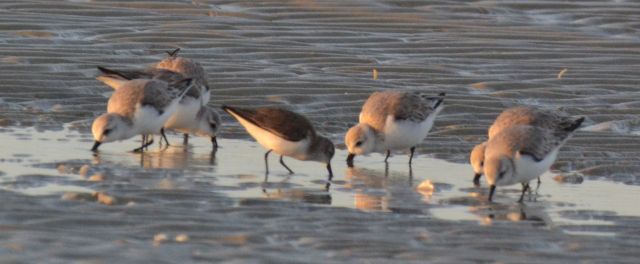
A third lifer I had hoped to observe here and now found was Western Sandpiper (above), another important one since it is a fairly regularly occurring autumn vagrant in Britain that I had yet to record. These were often running around amongst Dunlin and Sanderling, emphasising just how small they are. All three of these life list additions are regular at the site.

Everywhere else I went further south in Fort Myers Beach it was developed holiday resorts, but I did see the trip’s only Bald Eagle flying over Hickory Island and got close to some more fearless Western Willet (below). It would hardly do to have come to the United States of America and not seen the former. The previously conspecific Eastern and Western Willet were split recently. The first of those is strictly coastal and winters in South America, being replaced in Florida by the inland breeding Western counterpart.

DSC_0347

Windswept Western Willet

A day later I visited Tiger Tail Beach Preserve on a third local playground, Marco Island. This has the reputation for being one of the best sites for viewing shorebirds on the entire Gulf Coast. After a tedious and congested drive out my spirits initially sank upon pulling into the almost full parking lot ($8 / day) of another public park. But boundless goodies were in store here and this was possibly the best single day of the entire trip.

The site has a long lagoon lying between an inner beach and an outer sand spit that runs to the north. The quick way out to the birding area is by wading through a shallow part of the lagoon, but I wasn’t dressed for that and so walked the long way around. On the inner beach I quickly began to see the three new shorebirds from a day earlier and also a first Least Sandpiper (above, left) for this trip, the last-named being a bird I have recorded twice previously at home.

These birds all seemed unphased by my presence, letting me walk amongst them with the camera, but this is a very popular beach area so they must be used to people. When I eventually reached the birding area on the far side of the lagoon things just got better and better and I ended up staying for about five hours. Semipalmated Plover and Short-billed Dowitcher were present in large numbers, putting into perspective the stir that occurs when just one of either turns up at home with rarity status.

Now there were two must-see shorebirds for this part of the world still to locate. Piping and Snowy Plover are both uncommon and localised in the region, though the latter is a resident along the Florida Gulf Coast. The world populations of these two lifers are just 10 and 25k respectively. They are typically encountered on open, sandy beaches such as this. Eventually there one of them was feeding busily along the lagoon edge, a dainty and diminutive Piping Plover (below, right) looking splendid in the midday sunshine.

On the return walk I came across a close group of eight Short-billed Dowitcher (below), the latter being a bird I had recorded just once previously in Great Britain. It was that good. This experience became a roll call of Nearctic shorebirds twitched at home in recent years, plus a few new species as well, which was exactly what I had hoped for during this trip. All the shorebirds in this post are pictured in adult winter plumage.

When I got back round to the inner beach, mid afternoon more Western Sandpiper (below, right) had joined the small shorebirds observed upon setting out earlier. It was good to get so close to Least Sandpiper (left), marginally the world’s smallest shorebird, here. Finally the easily distinguished Wilson’s Plover (centre) stood out as before by their impressive bills.

This whole exercise was very educational in terms of familiarising myself with numbers of Nearctic shorebirds in their own region. At home I would mostly have relied on other birders to point out the single vagrants being twitched, that is not so satisfying. What of other birds on Marco Island? All the while Brown Pelican fished the lagoon, Royal Tern were moving up and down offshore and Ring-billed Gull (below) loitered on the beach, but unfortunately no Magnificent Frigatebirds were passing by.

DSC_0333

“Gosport? Are you kidding me buddy?” … “Say fella, ain’t that some kinda English hell town?”

The site is also a hotspot for Reddish Egret and on the walk back I enjoyed a picture session with one that let me walk right up to it. This remains my favourite Florida wading bird. I just love their fluffiness, rakish demeanour and dancing jizz. And thus the post ends as it began with a second collage of this wonderful bird.

My spirit was lifted and my heart gladdened in this superb place. I say that because it was just so good to be approaching birds on foot that could be properly observed and photographed, without having to crane my neck, think about passing traffic or being jostled on boardwalks. Outside of the national parks it seems there is little walkable countryside in which to lose myself in Florida; more a flat, uninteresting landscape upon which trespass is not tolerated. Hence birding means being channelled into public facilities, typically with over-peopled boardwalks and trails. At least on this day Tiger Tail beach was one location where the right sort of balance could be achieved.

A newcomer’s impressions of southern Florida 3: Big Cypress National Preserve – 19th Jan

On Day 12 (19th) I headed back up the Miami Turnpike from Homestead. This giant eyesore of a toll road proclaims itself as “The Less Stressway” which it could be were it not for more or less constant construction works along it’s length. But after just one wrong turn into the Miami rush hour, though without actually getting lost, I found myself driving west along the US-41 road to Fort Myers, my base for the second phase of this trip.

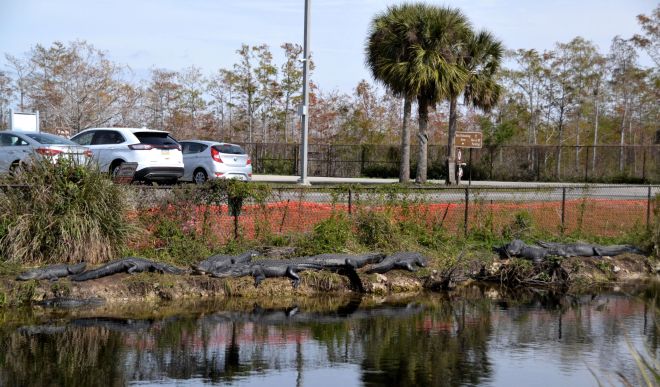
This road is the Tamiami Trail of birding legend, so called because it was built to connect Tampa Bay and Miami in 1928. The first part of US-41 skirts the northern edge of the Everglades. Access here is only possible by boat and there are numerous privately-owned roadside facilities offering air boat rides to tourists, and commercial “wildlife parks” guaranteeing Gators. Whilst I have no experience of air boats, rushing around in a noisy boat full of people does not suggest itself as an especially effective way of observing birds. And there was no need to pay to see semi-captive Alligators along this route where they more than matched the expected earlier scenario at Park Royal.

DSC_0163

Drive-past Alligators galore along the Tamiami Trail

So I drove stoically onward, also ignoring Shark Valley visitor centre that is administered by the National Parks Service. This location has the reputation for offering close encounters with the wading birds I wished to experience, but in the ambience of an open air zoo. I have read that on busy days it may be necessary to park a mile away and walk. Photographers might no doubt enjoy this, but for myself as a birder who takes pictures there would be plenty of opportunity to observe and record more naturally occurring wildlife further along the trail.

Just past Shark Valley I noted a first large concentration of Herons, around a pond by Bridge 512-A. For the first time on this trip the mix there included Black-crowned Night Heron. But this encounter, that surpassed anything experienced in the Everglades was a mere foretaste. Shortly afterwards the Tamiami Trail entered a second national park, the Big Cypress National Preserve. Around 10 miles on is sited the Oasis Visitor Centre, and at the western edge some 20 miles (approx) further still the Big Cypress Swamp Welcome Centre.

What transpired here was possibly the best wildlife spectacle I have ever witnessed. An overgrown canal that runs along the north side of the road, and the wall of vegetation behind it, just teems with Herons and other wading birds, Anhingas and dozing Alligators. Most of the large water birds were in there if I looked hard enough. On this day they included Great and Snowy Egrets, Great and Little Blue Herons, Tricolored Heron, Green Heron, White Ibis, Wood Stork, Roseate Spoonbill and the aforementioned Night Heron.

So this at last was a realisation of the ambition that brought me to Florida, and dwarfed anything experienced in the Everglades. If these birds are in decline there they are certainly thriving in Big Cypress. Numbers of Anhinga also put to shame the trail of the same name at Park Royal in the Everglades. This brown-necked female (below) was engaged in an exercise routine while drying her wings and practising her poses, as all Anhingas do.

This slideshow requires JavaScript.

I got into a routine of spotting a required or photogenic bird then doing a U-turn, parking on the opposite grass verge and seeing how close I could get. I was probably the only person on the trail who was behaving in this way, American motorists striking me as above averagely safety conscious. Perhaps I got spoilt in my previous wintering ground of Portugal, where mine was often the only vehicle on the road in wilder places.

Little Blue Heron and Tricolored Heron (above) soon took their places in the much desired celebration of Florida wading birds presented here, along with more White Ibis (below, left). Most of the time the birds co-operated, the exception being unrelated Belted Kingfisher that throughout this trip would always see me coming and fly off. It took until my return drive to Miami International Airport on 26th to secure the image below right.

One by one I was gaining close up picture sessions with all my key Florida birds. Indeed I was like a child in a sweet shop! The star performers this time were perhaps Wood Stork and Green Heron, though Roseate Spoonbill had to wait for the next post. The picture below, right was taken at Oasis visitor centre, the first of three good opportunities with that smallest of the Herons on this day.

There are several stopping places in Big Cypress, all administered by the National Parks Service. They typically had boardwalks from which it was possible to observe everything over again, away from passing traffic. And these facilities were where other visitors would stop. The most interesting of these locations was Kirby Shorter Roadside Park, where the day’s second Green Heron session produced these images (below).

At Kirby Shorter a half-mile long boardwalk leads first through dwarf Cypress forest and then swamp forest out to what is described as a Gator hole. The information boards here explain such depressions are actually excavated by the Alligators but my immediate impression was in that case it must have been a lot of work for those reptiles. This was a beautiful spot that I thought would repay inspection for small birds had I had more time in which to look. The image below, captured at the next site west, conveys the quality of encounter to be enjoyed here.

DSC_0395

Green Heron at H P Williams roadside park

As the birds were plentiful, so too were the Alligators. At Oasis I counted 42 of various sizes basking below a boardwalk along its length. Then I kept seeing the big reptiles along the canal and wherever I stopped to photograph the seemingly unconcerned birds. Here (below) are some of my better roadside pictures.

american alligator.1841 big cypress

American Alligator

Big Cypress owes its name to the hundreds of thousands acres of Cypress trees within its boundaries. The National Preserve was created by Congress in 1974 to protect the natural flow of fresh water through southern Florida from this largely inaccessible 725,566 acre swamp into the Everglades and on to the Gulf of Mexico. This followed the overthrow of a major airport proposal that would have had devastating consequences for the ecosystems concerned. The whole area has since remained true wilderness and is one of the most amazing, evocative and wildlife rich places I have ever visited.

Such a pity then that on getting back to “civilisation” I spent a wearing two hours moving slowly through Friday rush hour traffic along the US-41 into Fort Myers. Everything is traffic signal controlled here and they always seem to turn red against the main road and give priority to the cross routes. At journey’s end my accommodation was at the other end of the scale from the dingy motel that had been my base in Homestead, and six more days lay ahead.