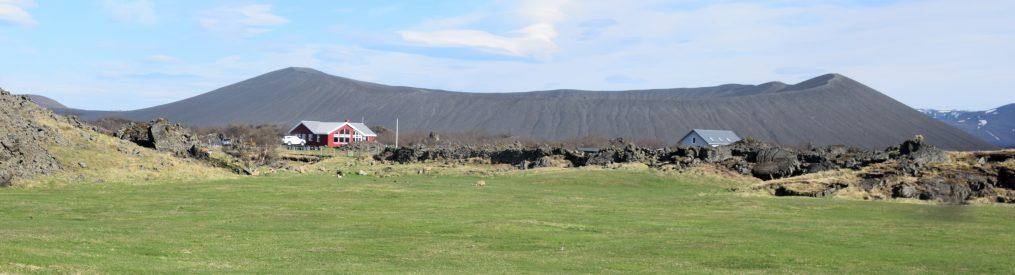
On Day 12 (19th) I headed back up the Miami Turnpike from Homestead. This giant eyesore of a toll road proclaims itself as “The Less Stressway” which it could be were it not for more or less constant construction works along it’s length. But after just one wrong turn into the Miami rush hour, though without actually getting lost, I found myself driving west along the US-41 road to Fort Myers, my base for the second phase of this trip.
This road is the Tamiami Trail of birding legend, so called because it was built to connect Tampa Bay and Miami in 1928. The first part of US-41 skirts the northern edge of the Everglades. Access here is only possible by boat and there are numerous privately-owned roadside facilities offering air boat rides to tourists, and commercial “wildlife parks” guaranteeing Gators. Whilst I have no experience of air boats, rushing around in a noisy boat full of people does not suggest itself as an especially effective way of observing birds. And there was no need to pay to see semi-captive Alligators along this route where they more than matched the expected earlier scenario at Park Royal.
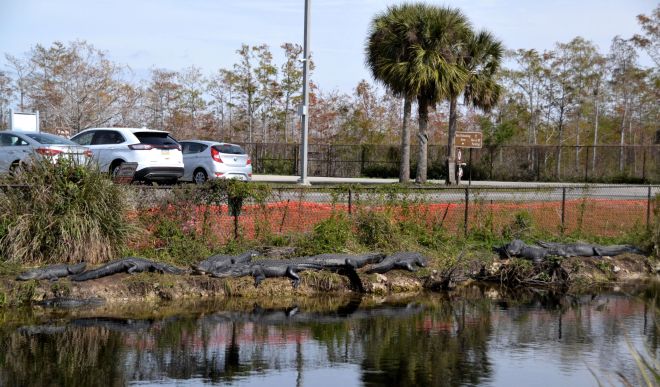
Drive-past Alligators galore along the Tamiami Trail
So I drove stoically onward, also ignoring Shark Valley visitor centre that is administered by the National Parks Service. This location has the reputation for offering close encounters with the wading birds I wished to experience, but in the ambience of an open air zoo. I have read that on busy days it may be necessary to park a mile away and walk. Photographers might no doubt enjoy this, but for myself as a birder who takes pictures there would be plenty of opportunity to observe and record more naturally occurring wildlife further along the trail.
Just past Shark Valley I noted a first large concentration of Herons, around a pond by Bridge 512-A. For the first time on this trip the mix there included Black-crowned Night Heron. But this encounter, that surpassed anything experienced in the Everglades was a mere foretaste. Shortly afterwards the Tamiami Trail entered a second national park, the Big Cypress National Preserve. Around 10 miles on is sited the Oasis Visitor Centre, and at the western edge some 20 miles (approx) further still the Big Cypress Swamp Welcome Centre.


What transpired here was possibly the best wildlife spectacle I have ever witnessed. An overgrown canal that runs along the north side of the road, and the wall of vegetation behind it, just teems with Herons and other wading birds, Anhingas and dozing Alligators. Most of the large water birds were in there if I looked hard enough. On this day they included Great and Snowy Egrets, Great and Little Blue Herons, Tricolored Heron, Green Heron, White Ibis, Wood Stork, Roseate Spoonbill and the aforementioned Night Heron.
So this at last was a realisation of the ambition that brought me to Florida, and dwarfed anything experienced in the Everglades. If these birds are in decline there they are certainly thriving in Big Cypress. Numbers of Anhinga also put to shame the trail of the same name at Park Royal in the Everglades. This brown-necked female (below) was engaged in an exercise routine while drying her wings and practising her poses, as all Anhingas do.
I got into a routine of spotting a required or photogenic bird then doing a U-turn, parking on the opposite grass verge and seeing how close I could get. I was probably the only person on the trail who was behaving in this way, American motorists striking me as above averagely safety conscious. Perhaps I got spoilt in my previous wintering ground of Portugal, where mine was often the only vehicle on the road in wilder places.


Little Blue Heron and Tricolored Heron (above) soon took their places in the much desired celebration of Florida wading birds presented here, along with more White Ibis (below, left). Most of the time the birds co-operated, the exception being unrelated Belted Kingfisher that throughout this trip would always see me coming and fly off. It took until my return drive to Miami International Airport on 26th to secure the image below right.


One by one I was gaining close up picture sessions with all my key Florida birds. Indeed I was like a child in a sweet shop! The star performers this time were perhaps Wood Stork and Green Heron, though Roseate Spoonbill had to wait for the next post. The picture below, right was taken at Oasis visitor centre, the first of three good opportunities with that smallest of the Herons on this day.


There are several stopping places in Big Cypress, all administered by the National Parks Service. They typically had boardwalks from which it was possible to observe everything over again, away from passing traffic. And these facilities were where other visitors would stop. The most interesting of these locations was Kirby Shorter Roadside Park, where the day’s second Green Heron session produced these images (below).


At Kirby Shorter a half-mile long boardwalk leads first through dwarf Cypress forest and then swamp forest out to what is described as a Gator hole. The information boards here explain such depressions are actually excavated by the Alligators but my immediate impression was in that case it must have been a lot of work for those reptiles. This was a beautiful spot that I thought would repay inspection for small birds had I had more time in which to look. The image below, captured at the next site west, conveys the quality of encounter to be enjoyed here.

Green Heron at H P Williams roadside park
As the birds were plentiful, so too were the Alligators. At Oasis I counted 42 of various sizes basking below a boardwalk along its length. Then I kept seeing the big reptiles along the canal and wherever I stopped to photograph the seemingly unconcerned birds. Here (below) are some of my better roadside pictures.


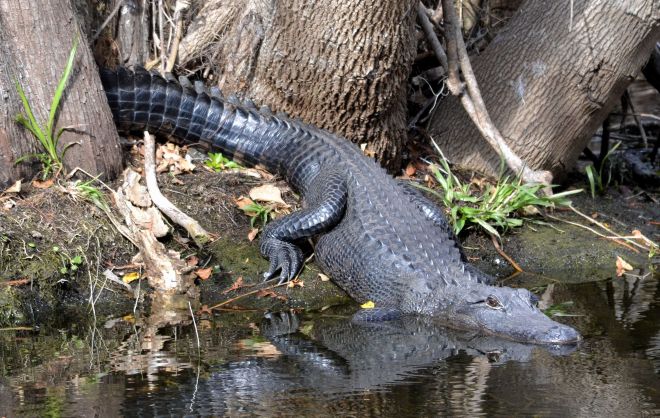
American Alligator
Big Cypress owes its name to the hundreds of thousands acres of Cypress trees within its boundaries. The National Preserve was created by Congress in 1974 to protect the natural flow of fresh water through southern Florida from this largely inaccessible 725,566 acre swamp into the Everglades and on to the Gulf of Mexico. This followed the overthrow of a major airport proposal that would have had devastating consequences for the ecosystems concerned. The whole area has since remained true wilderness and is one of the most amazing, evocative and wildlife rich places I have ever visited.
Such a pity then that on getting back to “civilisation” I spent a wearing two hours moving slowly through Friday rush hour traffic along the US-41 into Fort Myers. Everything is traffic signal controlled here and they always seem to turn red against the main road and give priority to the cross routes. At journey’s end my accommodation was at the other end of the scale from the dingy motel that had been my base in Homestead, and six more days lay ahead.
 Ramblings and Scribblings