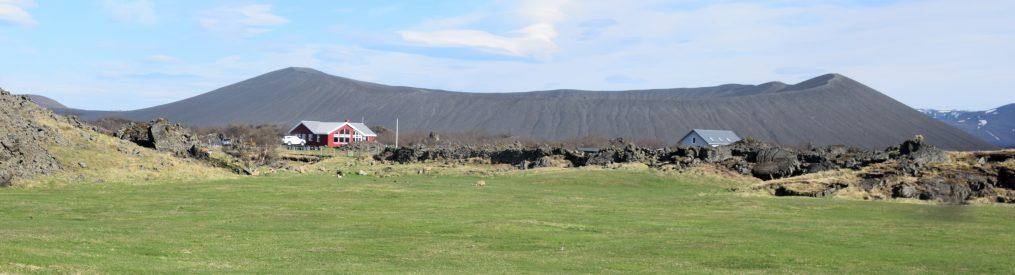
Where “Pearls” are concerned one site has been receiving a lot of attention in the current season, Rewell Wood near Arundel in Sussex. I had observed this butterfly before only at Bentley Wood on the Hants / Wilts border, and this year wanted to go somewhere different. And so it was to this new (for me) place that my attention turned.
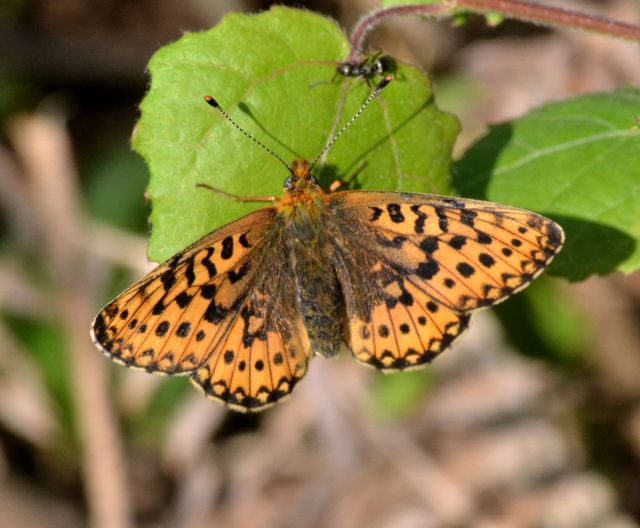
Pearl-bordered Fritillary (male) and friend
The exact location within the extensive mixed woodland was not easy to find and in the event took me three attempts. BC’s Sussex branch web site (see here) says these butterflies are active along the main west-east ride, but there are two such tracks so which one was it? After my 9th May visit to Heyshott Down (see previous post) I ended the day by checking out the more northerly ride that is accessed from a lay-by on the A29 (SU98310 09079). Crossing Fairmile Bottom LNR then making a steep uphill climb brought me to an area of clear fell in which there was abundant blooming Bugle (Ajuga) on which Pearl’s’ nectar. But there were no butterflies there and after a brief look around the woods that turned up no more suitable areas I left.
The next day I returned with Ewan following our visit to Noar Hill. We spent a good couple of hours in the clearing, but once again despite the seeming suitability of the habitat no butterflies were encountered. We again walked to some other parts of the woods but without success. Then over the intervening weekend large numbers of PBF were reported on-line, so it seemed most likely we had been in the wrong place and an injection of local knowledge was required.
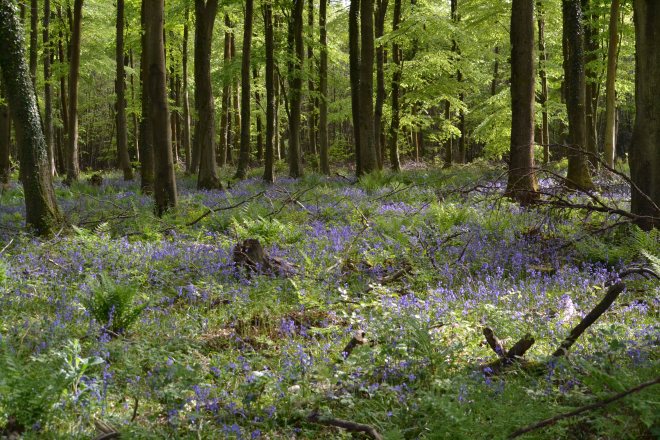
A walk through Rewell Wood: the joy of an English Bluebell woodland in May
Today (15th) we investigated the southern ride that may be accessed from two points. The first is a metalled track from the A27 trunk road, but there are just two parking spaces there within a private facility of the Duke of Norfolk’s estate, so BC asks visitors to find alternatives. A public bridleway close to Shellbridge Road south of Slindon (SU97727 06987) also leads up into Rewell Wood and getting there involves walking for 100 metres along the verge of the A27 trunk road, that may not appeal to everyone.
Once we were on the latter right of way I followed my intuition that this time did not let us down. Turning right when we joined the west-east ride, we reached a more open area in which Pearl-bordered Fritillary soon became visible at the ride edges, zooming low across the ground and rarely settling as is their wont. Having such a short adult life span of no more than a few weeks this butterfly is seemingly always in a hurry. The males spend most of their day searching for newly emerged females, that once mated spend the rest of their own flight period keeping a low profile whilst egg laying and avoiding further contact with males.
We had of course arrived on site approaching the warmest part of the day when the PBF are at their most hyperactive. I am not ever likely to obtain better pictures of this species than in Bentley Wood in May 2015 (see here) but those were of inactive insects in cool conditions. In today’s sunshine and in this habitat, gaining uncluttered images of the standard I seek was always going to be more difficult. At first and with perseverance most of the more acceptable results were under-wing studies (below).


Pearl-bordered Fritillary (above and below)


It is very important that visiting observers, especially those with cameras do not chase the fast moving PBF around. Doing so will not make them stop and is likely to result in habitat being trampled with loss of pupae, newly-deposited eggs and even adult insects. Standing in one place and waiting for them to approach and settle is likely to be far more effective. The better picture opportunities are near the beginning and end of the day when the PBF are more inclined to rest for longer and nectar.
In the early afternoon we were fortunate enough to run into the estate ecologist and Sussex butterfly authority Neil Hulme, who readily shared his extensive knowledge of all things PBF and this site’s management for them. We were indeed in a conservation area where rotational coppicing is being practiced with the intention of meeting the species’ finely balanced habitat needs and boosting its numbers all along the ride year on year. The other spot that so distracted us is on a neighbouring estate and had been felled commercially since the last breeding season. Mystery solved!


There was now an interval to fill before conditions would start to cool again after 4pm, and so we went on to Kithurst Hill (TQ070125) on the South Downs escarpment to seek out some different spring butterflies. Just below the hill top is a meadow managed by the National Park Authority and Butterfly Conservation to encourage the spread of plant and insect species that were once much more common. Here I recorded my season’s first Dingy Skipper, Common and Small Blue; as well as Duke of Burgundy at a fourth site, and Green Hairstreak.


Despite a somewhat busy ambience, these butterflies offered images with the kind of diffused backgrounds and pastel shades I prefer. One Duke (pictured above, right) provided an underwing study to match my recent improved top-side shots. Several Dingy Skipper (below) gave a reminder there is no such thing as a mundane butterfly, and a Small Blue showed just why it is one of my favourites. The normally photogenic Grizzled Skipper, unfortunately could not be found so I have still not seen one this year.


We returned to Rewell Wood before 5pm and met up again with Neil who had told us where those two parking spaces were. He was busy recording Pearl-bordered Fritillary numbers along the conservation ride. It can be seen here how relatively small areas are coppiced in succession, so a brood emerges from one cut patch then females disperse into another to lay their eggs. Our priority now was top-side pictures but it was still some time before the PBF showed signs of slowing down.
There was plenty of other insect life in this woodland, with recently emerged Broad-bodied Chaser in particular (below, centre and right) encountered frequently. By way of something a little different Dark-edged Bee Fly (below left) had been abundant in the newly felled clearing of our earlier visit, hovering over spring flowers in sunny spots. This intriguing creature is so-called because of it’s furry appearance and sucks nectar from plants through a rigid black proboscis. I instantly formed a liking for them, hence their inclusion herein.


Whilst appreciating the benefits of company I was by this time beginning to yearn for the solitude that would allow a proper communion with the dancing, restless Pearls. And so I wandered off, finding a few late flying individuals still nectaring on Bugle (below). All the pictures in this new post are quite different from those premium treatments of three years ago (see here), but still as satisfying in their way.


Two further encounters were yet to stand out. First Neil spotted a mating pair (below, left) fairly high up, assuring us this was late in the day at 6:30pm for such an occurrence. The female must have emerged well into the afternoon. He was also concerned to find us a roosting individual, since there is no way that PBF will move once they’ve “gone to bed”, and eventually he did. In the failing light it was difficult to find the right camera setting, but after much cursing I got to manage something half decent (below right).


It had been a thoroughly rewarding if long and tiring day, thanks in no small measure to the very personable and knowledgeable Neil, and so we two Oxon visitors headed home. As Ewan remarked, it makes such a difference to be with someone who knows what they are talking about. Like Duke of Burgundy I now feel I have done justice to Pearl-bordered Fritillary in the 2018 butterfly season, and their immediate future at this site at least looks to be assured.
 Ramblings and Scribblings