This (pictured below) is one of Europe’s rarest butterflies. Chelmos Blue flies only for a few weeks each year high on the mountain of the same name in Peloponnesian Greece. Collectors come from far and wide to steal it from the wild because though the species also occurs in Turkey and eastward into Asia they (the collectors) all covet a Chelmos from Mount Chelmos. Lying a little to the south of the Gulf of Corinth, this is one of Greece’s most well known butterfly locations in which the range of habitats can yield more than 50 species in one day.
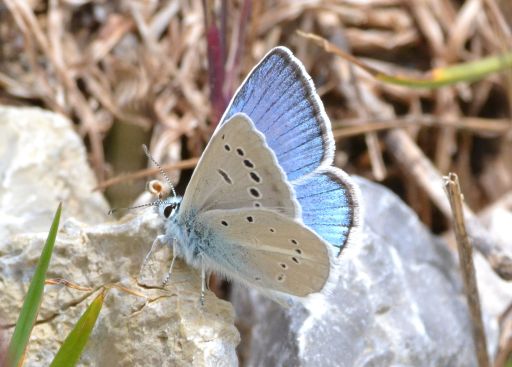
Chelmos Blue (male)
I now have Chelmos Blue in my butterfly picture collection, a rather more eco-friendly way of going about things, after self-finding this individual during a Naturetrek tour of two centres in southern Greece from 17th – 22nd June. As the group searched one gulley near the mountain’s summit, I walked back to the roadside after a while and noticed a different looking, fairly bright butterfly very close to our minibus. Nobody else was near and so I set about taking pictures without being sure what it was.
Chelmos Blue has a greyish underside with an arrangement of dark spots, and the broad white stripe on the lower hind-wing is a key diagnostic. On showing the above image to our tour leader on his return he confirmed I had indeed stumbled upon what was our top trip target. We then decided to stay at the spot for our picnic lunch and the butterfly appeared again so everyone got to see it in the end.


After lunch we moved on to search out Odd-spot Blue. This tiny species entails even more of a challenge since not only does it occur in Europe at just two Greek mountain top sites, but on Mount Chelmos only on a particular rocky slope, above a certain elevation where the larval food plant grows. Colonies are typically this small. Fortunately the tour leader knew exactly where to look, that after all is a pretty essential skill for a guide.
I am aware that the image cropping I employ often makes butterflies presented in this journal appear larger than life size. Odd-spot (pictured below) is a Small Blue-sized species that takes it’s name from the prominent arrangement of dark spots on the upper hind-wing. We had searched in vain a day earlier in rather too cool and damp conditions, but the second attempt was in sunshine. Having climbed all the way to the top once I opted to let others do the work this time and sat down to rest half way up.


When the sighting was called a sudden surge of adrenalin nonetheless propelled me to the higher elevation. There two males and a female had been located, this being a fast-moving insect that darts about and so tends to go out of view then appear again. The two species featured above were quite a double for our day, since no more than three of each had been found by Naturetrek groups in any previous year.
I joined this trip on the recommendation of its leader Philip Thompson, with whom I had been to the Macedonian region of northern Greece in May 2017. Noticing my interest in butterflies on that occasion he told me this June tour usually returns 80 plus species. In the event, despite untypically cool (by Greek standards) and showery conditions for the time of year, we found 86 different butterflies that for myself included a respectable 30 lifers. Happy bunny then! This tour delivered its itinerary.
The default Blue species at altitude here are Common and Silver-studded Blue (pictured below) that are both present in their thousands. In normal summer weather conditions of constant 35+ degree heat large concentrations of butterflies occur around water sources such as mud puddles, natural springs and livestock water troughs. Identification is then a matter of painstakingly picking out the specialities from the commonplace. But 2018 has been a wet summer in Greece and with much more damp ground available butterflies naturally disperse into it. In the event we still did rather well and were only actually rained off on the first day.


The other prizes high on Mount Chelmos are Pontic and Greek Marzarine Blue, but neither of these were found. It would be very unusual to record all four speciality Blues in one visit, since emergence times vary from year to year. A third new Blue for me here was Zephyr Blue (pictured below) that was present in good numbers, the easiest diagnostic being black dots along the hind-wing bottom edges. This butterfly occurs in dry habitats from Spain through Alpine regions and as far east as Iran. It is said to resemble Silver-studded Blue in appearance but is larger, and there are a number of sub-species.


Also encountered in similar numbers was Escher’s Blue (Agrodiaetus ainsae) that I had observed previously in Les Cevennes, France (see here). This largish Blue is patchily distributed across Europe south of the Alps, flying in flowery and often rocky places. But here in south-eastern Europe there is a different sub-species A e dalmaticus that appears brighter and more iridescent and that is what I saw this time. I also found my first ever female Escher’s on this trip that are encountered far less frequently than males.


The Blues are of course a highly complex group of often similar species, so I am open to correction if I have got anything wrong in this post. One lesson of this trip is that to continue to advance with butterfly identification I will eventually need a net, a lepidopterist’s jar with magnifying glass in the lid, and a copy of the out of print 2004 Lafranchis field guide. This after all is how things are done by true experts in the field, whatever some others might think about netting. Lafranchis details the exact fine diagnostics that should be matched to close inspection of every European species. Copies now change hands for large amounts of money and Naturetrek owns one that it issues to its tour leaders.
At lower elevation, in meadows and roadside habitat as we drove up to the summit, I was pleased to gain good underside pictures of Chapman’s Blue for the first time. This widespread central and southern European species is most easily distinguished by the large white patch mid-way along the array of orange sub-marginal spots. Their upper side is very similar to Common Blue, but to me the underside appears much brighter and for the Lafranchis devotee there is no cell spot. The top right hand picture is of a roosting individual on the day that was rained off, and I rather like the wet effect.


Moving on to some common larger butterflies of Mount Chelmos, one of the most plentiful encounters was with Balkan Marbled White (pictured below). I now have several European MW species in my picture collection and this south-eastern one has rather more smoky tones than the others. The often cool conditions gave rise to excellent picture opportunities of less flighty than usual and sometimes roosting individuals. Familiarity certainly didn’t breed contempt since this was one of my favourite butterflies of the trip and always good value.


Black-veined White was fairly frequent though not generally inclined to settle, as is their wont. For the first time I distinguished and captured pictorially females of this species that have a translucent quality, while some exhibited brown-toned veining by comparison with the males.


There are several Grayling species in Greece, the biggest and most often seen of which was Great Banded Grayling (below, left). Though this handsome butterfly might at first appear to resemble White Admiral in flight, upon settling the jizz and cryptic underwing patterning of the Grayling group is all too apparent. Our tour leader identified the right hand butterfly (below) as Woodland Grayling, one of three others of the genus that can only be separated reliably by close examination of the genitalia. Yes, a bits job!


On 17th, after poor weather had driven us down from the summit, I self-found another of the Graylings named simply The Hermit (pictured below) in a sunnier valley area that we headed for. This butterfly had a pale top side band like Great Banded but was smaller and when settled on stony ground the underwing pattern was totally different. I was told it was quite a scarce record for this Naturetrek tour, but like the Chelmos Blue it was relocated so all the group saw the Hermit too. That wasn’t always so easy since like all Graylings this one was a master of camouflage against both stony ground and leaf litter.


Having spent much of the first two days around the summit of Mount Chelmos, on 19th we turned our attention to some lower locations that held various species of note, closer to our base of Kalavrita. The first of those was Lattice Brown that I had seen just once previously in northern Greece in May 2017 (see here). This large and striking Brown has a long flight season from April to October, occurring locally across south-east Europe and the near East. It is known for concealing itself in dense shade so I was pleased that one individual here struck up a nicely back-lit pose before relocating to a metal gate (pictured below).


Later that morning we visited the monastery garden of Aghia Lavra that has already featured in the previous post about Hairstreaks. Amongst the mix of butterflies here were Lattice Brown again, Clouded Yellow, Southern White Admiral, Sloe and Ilex Hairstreak, Grecian and Lesser Fiery Copper, and Ripart’s Anomalous Blue; producing collectively one of the highlights of the trip. I have saved the best Ilex Hairstreak nectaring on Mint pictures (below) for this post, and things do not get much better.


That having been said, after the Ripart’s Anomalous Blue appeared it too set up as captivating poses on the monastery garden Mint. My insect pictures involve no props, no bait and with few exceptions are captured with entry level equipment in completely natural and uncontrived circumstances. What an absolute pleasure it is that butterflies and other insects allow for such an approach but then I do not regard myself as a photographer, merely a wildlife enthusiast who enjoys taking pictures as records of what I observe. To my mind that is the best sense of priorities, rather than an insect or bird being a subject for the complex technicality that is a “photograph”, and for this reason I now try to avoid using that last term altogether.


The Anomalous Blues are something of an enigma since both males and females are plain brown on the top side. Collins lists nine different European species, most of which are very tricky to separate and limited to highly localised geographical ranges. Three of these were on the wish list for this trip but Ripart’s was the only one we located. This butterfly is rather powdery in tone on the underside of both wings, has strong marginal markings, and males have a prominent white unh stripe very like the Chelmos Blue that headed this post.


The last of the “Mint specialists” was Grecian Copper (pictured above), the most frequent of the Coppers we came across through the week as well as the most vividly coloured. Our next stop after the monastery was a walk along the nearby River Strimonas where that fiery little native of the southern Balkans, Greece and Turkey was again present in good numbers. Females of this species tend to keep a low profile after pairing, so I was pleased to record one here (below, right). Another sighting of note in this location was egg laying Iolas Blue but I didn’t attempt pictures in the glary light and shade conditions, and in any case had captured the species well in Macedonia.


In the afternoon we headed higher up again, taking a very winding road above Kalavrita to a remote and scenic second home village, Souvardo. A walk onwards from there along a high track produced two more Blues for my life list and another Grayling. Meleager’s Blue (pictured below) is an attractive species with a bright blue top side and subtle, pale-toned marginal markings and dark grey spots on the underwings. It ranges fairly widely through eastern and southern Europe.


Having in the past self-found Baton and Panoptes Blues in France and Portugal, I was now pleased to record a third member of their diminutive group Eastern Baton Blue (pictured below) at this location and along a second lower track . This one is by far the most widely distributed of those three Small Blue-sized species, occurring across the eastern half of Europe from southern Finland down to Turkey then across southern Asia to China.


There are a number of very similar Grayling species in south-eastern Europe. This one (below) matches the Delattin’s Grayling illustration in Collins nicely, and I can see it is also different from the slightly smaller Southern Grayling that I observed in Corsica last autumn. Our group leader assured us Delattin’s is a good enough ID since separating it from Balkan Grayling that Lafranchis also lists (but not Collins) is another bits job.


Lastly there were the Skippers. Various Grizzled Skipper-like species were experienced during the trip but I thought of this group as too tricky to attempt to get my head around, especially as the illustrations in Collins are not of the best. Fortunately my tour colleague Paul Selby and our group leader were both very good at distinguishing them from one another. I am indebted to them both for the following IDs, and so am now getting my eye in too.


On 20th we took a walk around countryside just to the south of Kalavrita, following a track from the River Vouraikos through smallholdings and arable fields into the low hills nearby. Here butterflies of interest included Silver-washed Fritillary, Southern White Admiral and the third brood form of Small Copper. The last of those (below right) is much darker toned than the form seen at home, and some individuals can be smaller due to premature pupation.


I found Kalavrita to be a pleasant if touristy town, tucked into a verdant river valley below the slopes of Mount Chelmos in which the pace of life seemed unhurried and largely unchanged from times past. It lies at the head of a famous funicular railway dating from the late 19th century. Foreign visitors here mostly arrive by the coach load, not usually staying for more than one night so a longer remaining group such as ours was good trade for local hoteliers and restaurant owners.
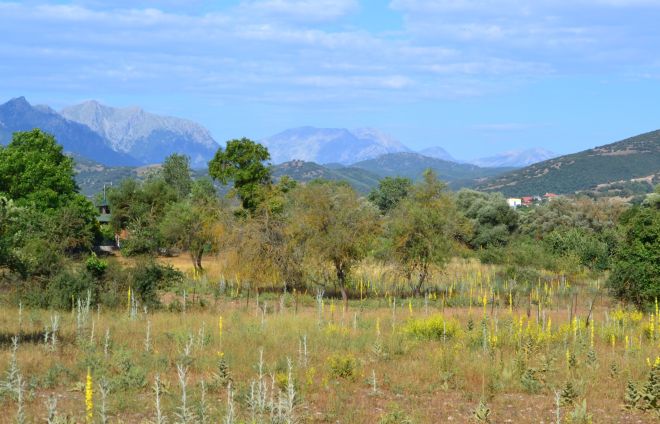
Landscape near Kalavrita with many Mulleins
After these three and a bit days described above we relocated from here to our second centre, the as notable butterfly location of Mount Parnassos across the Gulf of Corinth to the north. That second stage of this trip will be the subject of a further post in due course.
 Ramblings and Scribblings