After the relative failure of my recent week in Sardinia (see here) I was glad of securing a further dragonfly life-list addition on this second June trip to Greece. Just about the only odonata-oriented location on our butterfly dominated agenda was the Strimonas valley near Kalavrita and it was there that Turkish Clubtail (pictured below) was located.
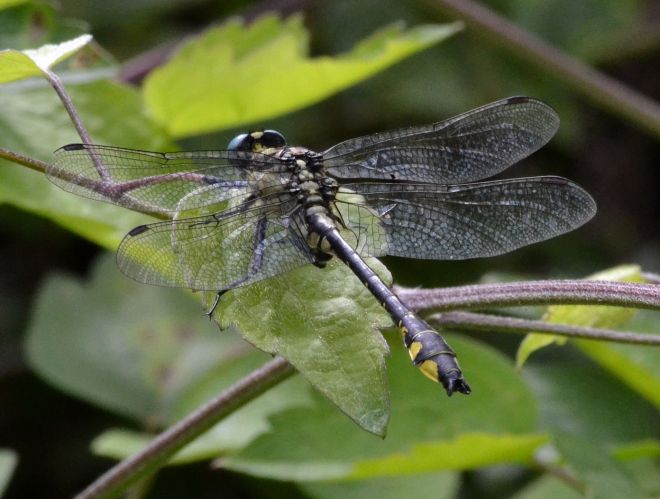
Turkish Clubtail (male)
This dragonfly (Gomphus schneiderii) replaces the far more widespread Common Clubtail (G. vulgatissimus) in the southern Balkans, Greece and as the name suggests Turkey. Its range also extends into the Caucasus, Lebanon and Iran. The overlap of the two species in Greece is poorly understood. Turkish Clubtail is generally smaller and more slender than Common, and in mature males the eyes are much bluer, not green as the pictures in this post show clearly.
The Dijkstra and Lewington field guide states that other differences between the two species are minor, but to me these Greek specimens looked much blacker than Common Clubtails at home in England. But that could be because I have only previously observed newly emerged individuals (see here). I also wondered if the Turkish variety is less prone to taking to the tree tops immediately after emergence, never to be seen again by frustrated odo hunters, since some of those in the riverside vegetation were quite ragged (pictured below).


2018 was an above average year for Common Clubtail sightings in Oxfordshire (see here), but I myself only had time to look for them once and did not repeat my success of a year ago. Six more Clubtail species in Europe all have limited or highly localised ranges. But I have now experienced all of the three that occur more widely, having self-found Western Clubtail (below, right) in Portugal in May 2014. These (below) are both archive pictures.


The main other odonata interest along the River Strimonas in Greece was Blue Featherleg, or White-legged Damselfly as the species is known in Great Britain. I was pleased to capture images of some new colour forms here, since most of those I had come across before in England were immature or maturing males. The blue mature male form (below, left and top right) is really quite striking and just look at those splendid white legs. The immature female (bottom right) was another pleasing new find.


The default Demoiselle in the areas we visited appeared to be Beautiful Demoiselle (pictured below, top) that was abundant along both the Strimonas and Vouraikos rivers close to Kalavrita. This largest and darkest of its genus is always photogenic with entirely metallic cobalt blue wings in males and transparently greenish to dark ebony tones in females. Some Banded Demoiselle (below, bottom) were also present here. Both species are common and abundant throughout Europe.


A purely chance sample of other insects now follow that caught my attention during the week under review. I can always find space for Grasshoppers and Crickets in this journal. Greece is especially blessed with this order since the majority of its 17,000 known European members are confined either there or in the Iberian peninsula. Only around 250 species extend into central Europe while the British isles have just 30. Given those numbers I can rarely match what I find on my travels to field guides and so have no idea of what species the individuals pictured below actually are.


The top left picture is of the biggest Grasshopper I have ever encountered, while the colourful Bush Cricket was seen a number of times. I am intrigued as to whether some of these insects can alter their colouration to blend with their surroundings, having previously seen a red-toned grasshopper against red soil in Portugal (below left) and now this blue-toned individual (below right) here in Greece. The two do look superficially similar in size and shape.


Ant-lions, Ascalaphids and Lacewings are another complex order that no field guide appears to do justice to. These are soft-bodied flying insects with membranous wingspans ranging from about 3mm to more than 100mm. The large Ant-lion species pictured below left confused proceedings a number of times by resembling a dragonfly at first sight, but they are much narrower bodied and once settled pull their wings in tightly and so are then difficult to pick out from the vegetation in which they rest.


Lastly Ascalaphids provided variety on a number of times here as in Sardinia. The right hand picture is of the only one I managed to capture adequately. These fast flying relatives of the Ant-lions are generally shorter and stouter with long clubbed antennae. There are 15 European species occurring mainly in the south.
 Ramblings and Scribblings