Since 22nd June a newly revealed colony of Southern Emerald has been reported in the British Dragonfly Society (BDS) online sightings log. This is in Buckinghamshire close to the M40 motorway. I first heard about it a week ago when Adam told me he had obtained precise location details and invited me to go with him to check things out at the site. On Thursday (19th) his work commitments allowed us to do that.
Two years ago I wrote in this journal of finding my last regularly occurring English damselfly, Scarce Emerald at a site on the Thames estuary in Essex (see here). Then a year later I observed many more of that very localised species at Canvey Island in the same county (see here). Southern Emerald is much rarer in the British Isles, with (as I understand) just two established populations in Kent and the Isle of Wight and small numbers seen occasionally elsewhere. So the emergence of this new colony is attracting much interest amongst odonata enthusiasts.
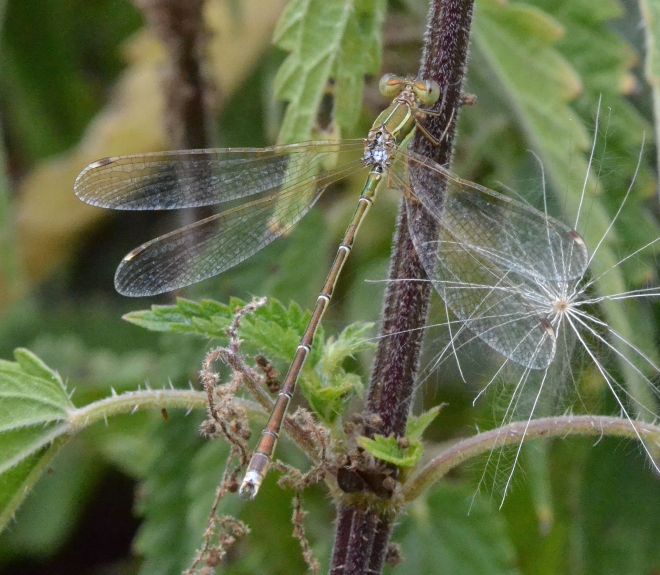
Southern Emerald (note the cream and brown two tone pterostigma)
We followed a public right of way towards a woodland where Adam had been advised to start looking for these insects, and once there it wasn’t long before he spotted a first damselfly in the trackside vegetation, then another and another. Yes they were Emeralds and yes they had bi-coloured cream and brown pterostigma (wing tags), the easiest diagnostic for Southern Emerald. Mission accomplished! Then we met another Oxon naturalist making his way back, who said there were many more of them a little further along the track.
At that hotspot I took the pictures in the next two collages. One entry on the BDS sightings page quoted 50+ and another 100+, and there were certainly plenty. Southern Emerald is about the same size as Common and Scarce Emerald, and smaller than Willow Emerald (see here); these being the four of their genus that occur in the British Isles. Southern is the only one of this metallic green quartet with bicoloured pterostigma. The lower rear of the head is entirely yellow, the thorax exhibits broad, pale anti-humeral stripes; and yes males can be distinguished by their diverging inferior anal appendages. Don’t forget that last one!


It was striking at this spot how many mating pairs were on the wing (pictured below). To quote Brooks and Lewington, eggs are laid by solitary females or tandem pairs into emergent aquatic plants or the branches of waterside trees and shrubs; and there was plenty of evidence of that. The egg is the over-wintering stage and larvae emerge the following spring.


This is a widely distributed species throughout central and southern Europe, except in Alpine regions. It is more common in the southern part of it’s range, but has been expanding north since the late 1980s. My own first record was in Sardinia in June of this year (see here). The discovery of a new colony so close to Oxford begs the question of how many more might be out there nationally, awaiting the sharp eyes of intrepid odo hunters.
The situation strikes me as another of those open secrets, that is meant to be kept quiet but which everyone with an interest knows about. The BDS requests that visitors respect limited roadside parking and public rights of way at the Bucks site, and pay due attention to personal safety. But the society is not consistent since in it’s log people are urged not to visit, then a few posts later a contributor gives away the exact location. So I have chosen not to do that, but working things out is a matter of common sense on consulting the BDS sightings page.


Three days later (22nd) I went back to this place to try to obtain less cluttered pictures. The two above were amongst my better results until the walk back, when I was able to capture Southern Emerald in the long yellowing grass by the trackside. The images below are more like what I seek in recording insects and made this return visit well worthwhile.


Far fewer insects were on the wing this time, so perhaps their emergence had peaked at around the time of our first visit and hopefully some of them might have dispersed. In the interim one contributor to the BDS sightings page had spoken of tandem pairs rising in clouds from his footfall. There were still some pairs propagating their species on this day, and I managed a few more pictorial records (below).


A few years ago a small number of Blue-eyed (or Southern Migrant) Hawker dragonflies arrived in Britain in the same area of Essex as the Scarce Emeralds referred to at the start of this post. That colony is now thriving, and as of today BEH has also been reported in 2018 from Kent, Sussex, Cambridgeshire, Hampshire, Dorset, Somerset, Gloucestershire and even as far south-west as Cornwall. I do hope this latest continental European migrant, Southern Emerald damselfly is as successful in expanding it’s own range and that before too long we might find them just up the M40 motorway in Oxfordshire.
 Ramblings and Scribblings