There has been a seeming glut of southern English records of Ortolan Bunting in the first half of September, but none of these birds stuck around for long enough to be twitchable from Oxford. Needing this passage passerine for my British list I kept an eye on things as more and more sightings came in from Kent, Sussex, Hampshire and Gloucestershire; but time and again a negative would go out on RBA after the initial report. And as some of these migrants were being noted at well watched coastal locations, they were being identified only as fly-overs on call and sometimes at night using sonogram equipment.
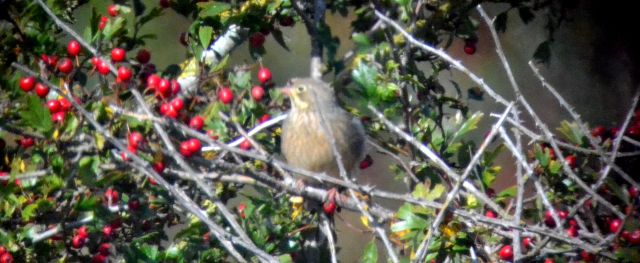
Distant, blurry Ortolan Bunting, but hey I’ve ticked one for Blighty
Yesterday evening, I fixed on RBA postings from a site on the South Downs just to the north of Portsmouth, where an Ortolan (pictured above) was first reported at 2:45 and was still being watched at 6pm. This sounded like it could be my bird and I decided if it was still there in the morning I would go to see it. Today I noticed the first report at around 7:15 and 45 minutes later I hit the road. That’s quite quick for me!
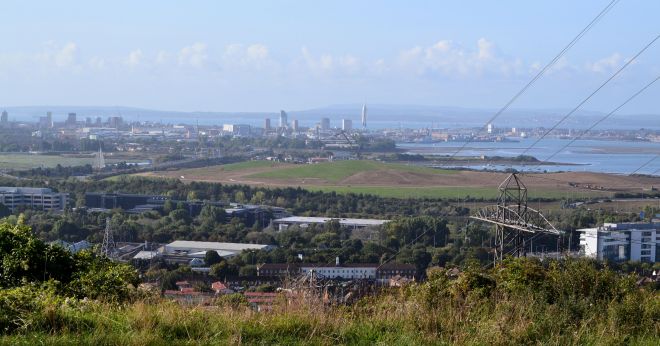
Portsmouth and harbour featuring the Spinnaker Tower (centre) and Mordor (top right)
From the M27 I drove through the Portsmouth suburb of Cosham then up a road to Ports Down (SU648067) from where the views to the south were worth capturing. Arriving on site at around 9:20 I made a reconnoitre of Pigeon House Lane, and on finding a sizeable group of birders all intensely focusing on a corner of the field in question, assumed they must be onto the Ortolan. So I parked on the end of the closest line of cars, to be told my quest had last been seen around 20 minutes previously, showing well on a Hawthorn beneath an electricity pylon.
Joining the twitch line I was greeted once more by Adam who this time had not arrived in the nick of time and so had yet to see the bird himself. A patient wait then ensued until after an hour with no views a group of birders made the decision to flush the bird with the approval of the gathering. Given this nudge the concealed Ortolan Bunting, an adult male (I assume) then broke cover from long grass on the far side of the field to perch prominently anew in the same Hawthorn to which the day’s earlier reports had referred.


Our bird remained there for some time, taking in it’s surroundings and all the attention it was attracting. In the right hand picture (above) it is just visible to the left of the hazard warning sign on the pylon (click to enlarge). I was hardly likely to gain good images but the digiscoped records below are still clear enough to present what I had observed today. The medium-sized Bunting’s diagnostic greenish-grey head, pink bill and pale yellow moustachial stripe and throat are all discernible.


Eventually the Bunting dropped down into the ground level vegetation below the pylon again, presumably to resume feeding on insects and seeds. I at once wondered if this behaviour could be the reason why so many earlier reported birds had not been seen subsequently, since they clearly spend a deal of their time keeping out of sight.
Ortolan Bunting breeds across much of continental Europe and parts of western Asia, but not in the British Isles. Across that range it is a not uncommon inhabitant of agricultural land, woodland and upland areas. Since Roman times the bird has been regarded as a culinary delicacy, especially in France, resulting in huge losses from the wild each season. Despite a 1999 EU directive banning hunting up to 50,000 birds each year continued to be slaughtered on autumn migration in that country alone, until at least 2007 when stricter enforcement was said to have been put in place.


The species, that I had recorded myself once before in Cyprus in April 2012, winters in tropical Africa. Closer to home I had tended until now to regard this passerine as a migrant reported mostly from remote offshore islands far beyond my preferred range, or heard flying over the Portland Bird Observatory. So to gain this very positive experience, my 345th British bird, just 90 miles from home was very pleasing.
Observing new birds in Great Britain remains a diminishing return, given my reluctance to travel very long distances. But I keep on chipping away, and three species – Roseate Tern, Marbled Duck (if accepted) and now Ortolan Bunting – within range in the 2018 return passage season so far is not a bad tally. Hopefully there will be one or two more long-sought British or even life list additions in the weeks ahead.
 Ramblings and Scribblings