2018 has produced a plentiful autumn passage for Pectoral Sandpiper with more than 30 records in some weeks throughout the British Isles. This is perhaps the most frequently recorded Nearctic wader at this time of year, but has not featured before in this journal. One bird that caught my eye, due to its closeness to home, has been present at a National Trust estate, The Vyne just north-east of Basingstoke since 23rd September.
When first reported I feared this would be a difficult location to access since it looked like private land adjacent to the NT house and park. But subsequent posts on RBA mentioned a bird hide, which sounded promising. When the “Pec Sand” was still there a very wet day ago I resolved to go and explore the site this fine and sunny morning. So at 9am I parked by an entrance to the estate (SU 62476 57256) in Morgaston Wood near a village Sherborne St John.
The directions on RBA had been typically vague, merely saying walk through the woods. So I followed the only public right of way that was marked on the historical anachronism I prefer to take on any twitch (often to the mild amusement of other birders), an OS map print-out from Streetmap.co.uk. This route skirted the edge of the woodland but at a point from which it continued over open country there was no way across to the water meadows.
I then enquired of a jogger who said the entire wood is part of the NT estate and hence open access land through which a number of visitor trails run. My mind was thus set at rest over any potential trespass on my part and I followed one such path eastward through the wood. It led to a downward board walk at the foot of which was the bird hide. And before that rather well appointed facility stretched the said Vyne Water Meadows (pictured below).
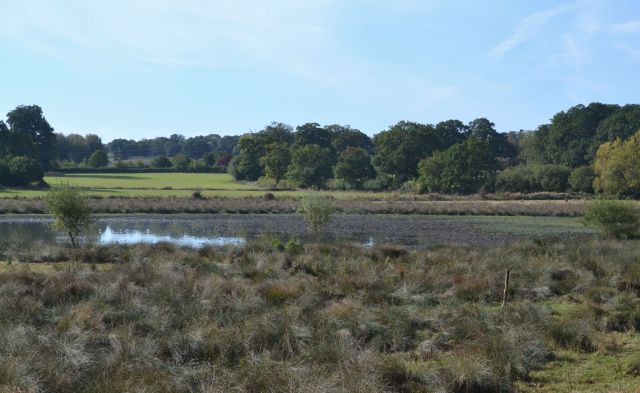
The Vyne Water Meadows: there’s a Pec Sand out there somewhere
For the next hour, looking into the light, I scanned the patchwork of glistening mud and sunlit water. I was the only person in the hide, hence finding this bird for myself held much appeal. There were a small flock of Lapwing, scattered Moorhen here and there, a few Gulls and two Grey Heron; but my quest was nowhere visible. Then at 10:25 suddenly, fairly close inshore to the left of the central small Willow in the picture was a small and bright looking buff and white wader: the Pectoral Sandpiper.
This was my third career record and I will admit the other two were more a name that I needed rather than a bird I knew much about. But this time I had read up thoroughly on the species a day earlier, and knew exactly what to look for and how to identify this Nearctic vagrant. Pec Sand is a medium-sized wader slightly larger than Dunlin, with a rather elongated, pear shaped stature and long primary projection. The legs are yellowish, while the bill is slightly de-curved.
Other diagnostics in passage juveniles are a weak split supercilium, a white V on the mantle edges; and the neat, finely streaked “pectoral” breast band that ends sharply against the white belly. The bird I was observing was too distant for much of this to be clear, but at all times the bright white underparts and clearly demarked border between the breast band and belly stood out. To continue quoting my sources, juveniles that make up the vast majority of autumnal vagrants are generally more finely patterned than adult summer birds, and the crown and upper parts are fringed chestnut, white and buff. Since the post-breeding moult takes place in the wintering grounds, adult winter plumage is rarely seen in western Europe.
These archive pictures (below), taken by Adam in Cornwall in the autumn of 2011, show the plumage detail described. My thanks are due to him for kindly allowing me to use them here.


I watched the Vyne bird for around 30 minutes. When amongst other waders such as Dunlin, Pec Sand feeds just like them in an active and mobile fashion. But solitary birds are often slow, furtive and inconspicuous, creeping around on flexed legs with the head down and a constant, rapid, vertical picking action. My bird remained alone for most of the time but would also wander amongst the Lapwing that were completely tolerant of it’s presence.
This is a very long distance migrant. The breeding range spans the far-northern Arctic tundra, being spread across Siberia and North America. The greater part of the population winters in South America, largely via a migratory route over the west Atlantic, though a small number of Siberian breeders head to Australia and New Zealand. Adults begin their southward dispersal in June, to be followed by juveniles from early August. Strong westerly winds in September and October bring juveniles regularly to western Europe.
Today’s bird seems settled at the site, and why shouldn’t it be given the habitat? Getting pictures of it was pretty much out of the question, given the distance and I was also looking into the sun. Indeed no pictures of this particular individual have appeared on RBA so far. For their gallery of Pec Sand at other British sites this autumn see here.
The exercise desribed here has been a good education on the species and I would now expect to identify Pectoral Sandpiper at once should I see more of them in the future. My previous experiences were at Keyhaven, Hants (Aug 1997); and Eton Wick, Berks (Sep 2012).
 Ramblings and Scribblings