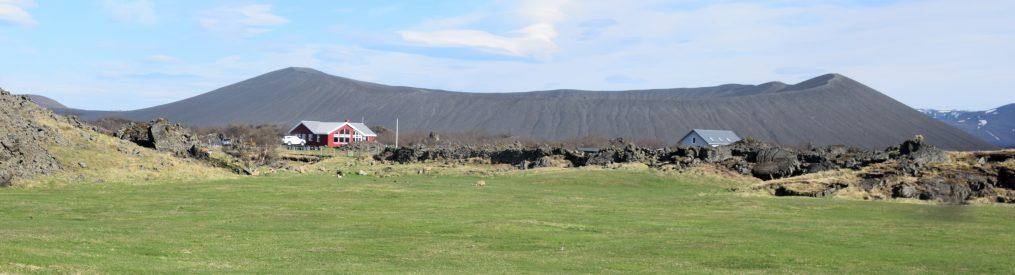
Since my first visit to Atlantic Morocco in December 2015 I have regarded a then close-up encounter with these much sought birds as possibly my best ever self-found birding moment (see here). Now following an uncannily similar experience last week (10 – 16th) I wonder if such occurrences are in fact not so unusual there. At any rate, during this repeat tripette lightning certainly chose to strike twice in more or less the same place.
Northern Bald Ibis
The Parc National de Tamri lies 60 km north of Agadir, and just south of the coastal town of the same name. One of the region’s two historic Northern Bald Ibis flocks may be found anywhere around the large promontory of Cape Rhir and is also now expanding north of the town. All the wildlife tour operators and their clients come here to see them, and that is where I headed on my first day with a hire car (11th) this time around.
I stopped first at the location where the N1 coast road turns sharply inland towards Tamri (pictured below). Here there is a small parking area from where the Oued Tinkert estuary can be scanned. This bay can hold large concentrations of Gulls, but I could not locate Audouin’s, my favourite Gull this time. But two larger black items flying away high to the north could only have been Bald Ibis. Feeling relieved that the viewpoint was free of hustlers on this occasion, I then drove on to the town itself to take pictures in it’s Souk (market).
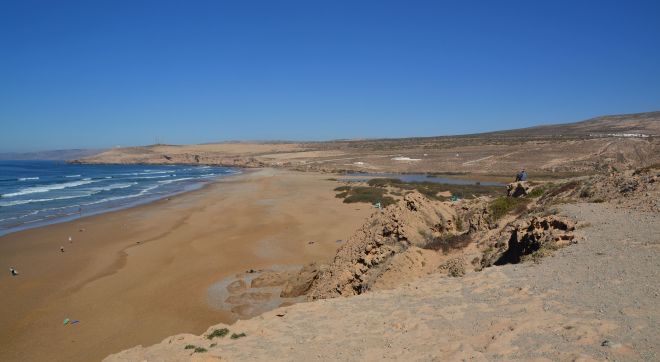
The mouth of the Oued Tinkert at Tamri
Three years ago coming here had been my first experience of driving in Morocco but I had not taken the time then to record ordinary street scenes of daily life. Doing so was something I very much wanted to add to the trip experience this time. Nobody seemed too bothered by a foreigner walking around pointing a camera at them, though I suppose the locals must be used to it. Neither was I pestered as is the norm in Agadir, or indeed Oxford.
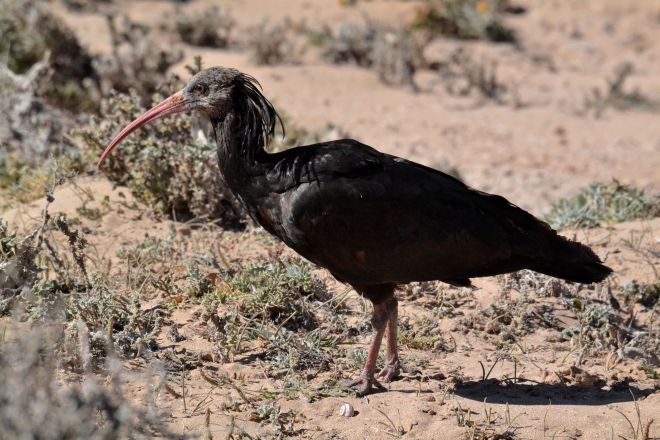
After this I headed back south along the coast road, stopping at a random place and there were the birds, 30-something of them all grazing the land that sloped away from the roadside down to the shoreline. Just as in 2015 I stayed inside the car and the Northern Bald Ibis all walked towards and then past me, the nearest birds feeding just metres from my vehicle. Their purple and green iridescence shimmered as they moved in the bright sunlight while they probed deeply into the soft ground with their long, down-curved bills. It was difficult to believe I had been this lucky not only at the first attempt now but also twice in two visits here.
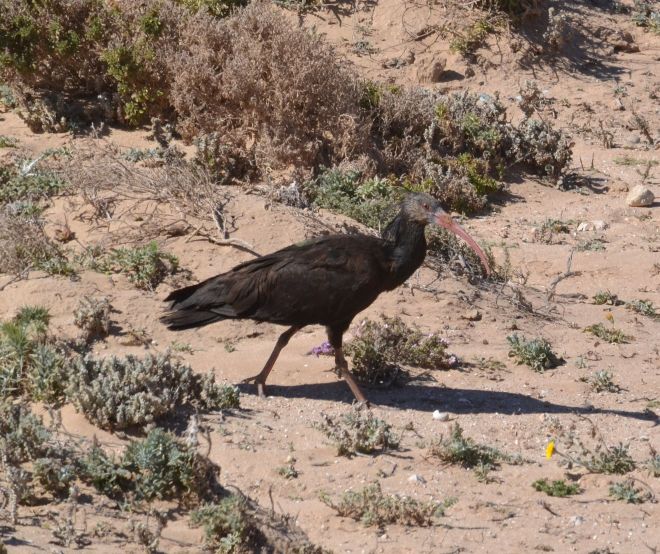
Northern Bald Ibis from my hire car window
After a while three birds actually began to walk across the metalled road. A speeding truck sent this lead group into the air, at which many more Ibis went up from the ground away to my right and most of the flock re-settled away to the other side of the road. They were now into the sun so I crossed over myself and got out of the car. A youth then approached noisily along the road towards me, shouting and waving his arms as if he was showing me the birds, and putting up even more. The locals here are all primed to take their chance with any foreign birders they might come across.
When my assailant did eventually ask for money, rather late in the proceedings by Moroccan norms, he didn’t get because I had self-found the NBI flock again, not him. After two such easy connects I must assume these birds are not difficult to locate here, and the youth told me they graze along the N1 road here all day, every day. So if observers move carefully along the coast around Cape Rhir scanning from all likely looking vantage points in turn, these most sought NBI are likely to drop in at one time or another.


When I first came here in Dec 2015, Northern Bald Ibis was still regarded as one of the world’s rarest birds. Since then they have enjoyed something of a renaissance and in 2018 the species was removed from the IUCN critically endangered list, now being classified as endangered. In that year Morocco’s two viable wild colonies (at Tamri and in the Souss-Massa National Park south of Agadir) reached a record number of 780 birds, up from 590 in 2017. Amongst those 147 breeding pairs fledged 170 chicks. At Tamri 66 breeding pairs produced 60 chicks, with a success rate of 30%. For further detail see here.
Studies also indicate that the southern Moroccan population is enjoying a breeding range expansion. In 2017 two new breeding colonies and a third roosting colony were found between 30 and 35km north of the Tamri stronghold (see here). North-west African (or Maghreb) conservation bodies regard this recent revival as quite exceptional.

“Who says only our mothers love us?”


I didn’t go on this trip with any well-defined wildlife agenda. The dual purpose was more to see whether re-visiting places can be motivating, and to break up the remaining time before English summer time resumes. That lack of an intensive itinerary allowed me to spend more time on some of the things I had done in Dec 2015, as well as simply experiencing daily life around Agadir, without the pressure of working through a trip wish list. Most of the birds I gained acceptable pictures of were common species of the Maghreb (NW African) region.
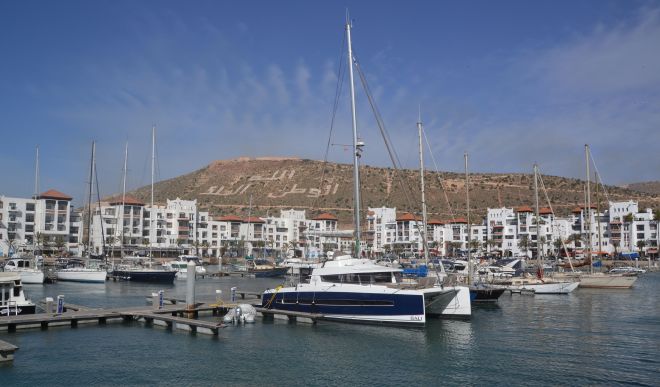
The Kasbah from Agadir Marina
The Kasbah Hill just to the north of Agadir and its environs seemed as good a place as any to watch birds, and many of this post’s remaining pictures were taken there. Since I also devoted some effort to capturing images of tricky little butterflies, birds would also enter the mix at intervals and offer good opportunities. Moussier’s Redstart (below) was a case in point. Several times through the week they would suddenly announce themselves then appear out of nowhere, usually perching quite prominently. This stylish and classy looking item probably remains my favourite Maroc passerine.


Busy and playful, not to mention noisy Common Bulbul were plentiful everywhere. This is a widespread and successful resident breeder across much of Africa, often being encountered in pairs or small groups. The pictures below were taken from my hotel balcony.


Two more frequent urban species are House Bunting and Maghreb Magpie. The former (below, left) behaves very much like Sparrows at home, mopping up the detritus of human activity and getting around people’s feet in pavement cafés for instance. But despite their abundance in Morocco I only came across two around Agadir all week. The latter (below, right) that is characterised by it’s blue ear patches, was split as a species during 2018.


The Southern Grey Shrike (ssp algeriensis) in these pictures (below), one of what looked like a resident pair below the Kasbah, allowed a very close approach. In that location there is a complex road junction with drainage channels running through it, that I have found to be a good spot for local birding during both my Agadir-based trips. The white orbs on the bush in the lower sequence are snails not fruit.


Laughing Dove is my favourite of that genus, since I find their subtly blended tones highly attractive. This smaller, rather slim species would stand out sometimes from the far more plentiful city Collared Doves and Feral Pigeons, as in these pictures (below) also taken at the Shrike location below the Kasbah.


Lastly, Crested Lark is such a commonplace bird wherever I go abroad that I rarely pay much attention to them. But a number of times this week, whilst I was otherwise pre-occupied, they would come so close and present such photogenic opportunities that I did bother to boost my collection with a few more pictures (below) of them.


The answer to whether retro-tripettes can be motivating was “partially”, since for me a specific wildlife agenda is the main factor in avoiding feelings of loneliness or anxiety when travelling solo (in case anyone ever wonders); and the more that is new and different the better I cope. I was in no way expecting to cover the classic and mainly desert species that most usually bring foreign birders to Morocco, since those were all much too distant from my base. Indeed I at no time intended to stray very far from Agadir.
The length of time it takes to get anywhere in this country is a significant issue, and there are various pitfalls for the unwary when driving. Low speed limits, slow moving local vehicles, long stretches of road where overtaking is prohibited and police everywhere all serve to make journeys last far longer than expected. Add to that pot holes, hazardous carriageway margins, punctures and issues I had with local hire company shenanigans, and this could hardly be described as an especially relaxing trip.

Greater Flamingo along the Souss estuary south of Agadir


If I go to Morocco again it will probably be on an organised group trip with one of the wildlife tour operators, if I can at length face up to the prospect of hours couped up in mini-buses with elderly convenience company over such long distances. But hey, all this beat another cold, dull and largely birdless week at home as winter moved towards its close in Blighty.
 Ramblings and Scribblings