Despite my oft-stated predilection for the new and different, one thing I always do each spring is seek out that most subtle, delicate and ever charming little butterfly, the Green Hairstreak. This is because for me the first sightings of any new season are a heart gladdening and soul quenching experience the like of which is difficult to match in the insect world.
“We are from the future not the past. We are not static, we evolve” – Robert Plant, 1995
The singer’s sentiment above, expressed when I saw Page and Plant at the NEC Arena in 1995, is something I have identified with quite closely since. And it certainly equates with my year on year approach to observing wildlife as reported in this journal. Easter at home provided what were lauded as record breaking temperatures for the holiday weekend. So two fair weather days were the cue to set out again on Easter Monday and re-find if not re-define one of my most favourite of butterflies that were beginning to be reported.
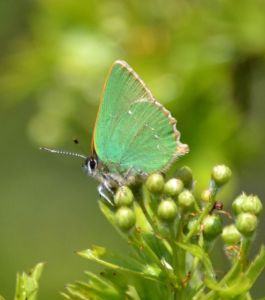
Green Hairstreak at Linky Down, Oxon
My choice of location as usual was Aston Rowant NNR on the Chilterns escarpment. The reserve is split in two by the M40 motorway, and I visited the northern side first, known as Beacon Hill that has been the more reliable GH location in recent years. There in the margin between the chalk hillside and the wooded slope of the “sunken way” trail I located about six butterflies, and a mild buzz from the satisfaction of a new season’s communion coursed through me as in every April. But that habitat is low lying and faces into the sun, so composing acceptable, properly lit and contrasted pictures would be difficult.

Hence I moved across to Linky Down, on the reserve’s southern section that is possibly my favourite site of all for the species. Here Hawthorn hedges and scrub are re-generating after being cut severely by English nature in recent year’s as part of its management plan. The sun would be behind me now and I hoped to encounter Green Hairstreak posing higher up. That is exactly what happened as I walked downhill and came across a specimen perched on soon to open Hawthorn blossom at eye level. All the images in this post were captured at this spot, and probably match my better past results.
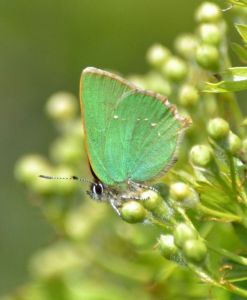
After a first picture session, during which the butterfly kept stock still for periods and allowed a close approach with my macro lens, I rambled on along the path. Four more GH were flying lower down, after I had stopped to talk to a birder who had located a female Ring Ouzel on the slopes below. The site is a well-known staging post for those migrant upland thrushes, and it was my second record of the bird there this spring. Seeing so many Hairstreaks was reassuring as they have been much more difficult to find at this once classic site since the habitat was cut.
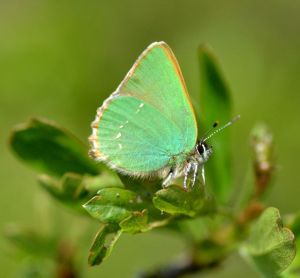
Returning to the aforementioned Hawthorn on the way back, after stopping to watch the “Rouzel” for a while, a second Green Hairstreak was now present and competing for the space with my original subject. Hence the butterflies were both more restless and flighty so gaining comparable images proved difficult to achieve. This (below) was the only one worth retaining from the second session. So after spending more time there I headed home at around 4pm feeling largely satisfied with my first home outing of the new butterfly season.
I am of course not a photographer and possess only obsolete, entry level equipment that I cannot get my head around the technicality of. But the picture collection additions acquired today are nonetheless pleasing enough in their way, if a little “soft focus” and continued improvement is always the aim. New birds to see in Britain are more and more a diminishing return, and March was the first month without a post in this journal since I started compiling it. So the new insect season is very welcome and in the months ahead I intend to do as much work as evolved treatment of past material might allow. Watch this space.
 Ramblings and Scribblings