The first months of each new odonata season afford the opportunity to study and record different damselfly colour forms as newly hatched specimens begin to mature. That is now something of a motivation since I have observed every regularly occurring English insect of this group in the past. This year through May and into June I have spent time at two local sites in Oxfordshire, where some of the more frequent blue species and their various, often attractive forms did not disappoint.
My earliest visits to Orchard Lake, Radley (SU 519970) realised the first such reward, as large numbers of paler-toned male Common Blue Damselfly (below, centre top) were flying there. A month later it was noticeable how the still emerging males were of a drabber brown tone (centre bottom), though I expect this is a more immature form still. The latter appear quite ghostly and weak flying when disturbed. The right hand sub-adult male appears to be between the two in colouration and hence maturity.


The sequences here illustrate how interest can be found in picking out all these forms of frequently seen damselflies and attempting to gain pictorial records of those I might not have captured before. There are both blue and drab forms of female Common Blue to complete the range of varieties to be identified and these go through stages of colouration as well. To complicate things further some individuals exhibit mixed colouring of both forms so maybe hybridisation occurs. This is all fascinating stuff, at least to an odo enthusiast and I hope I have got everything right.


Amongst the trillions of blue damselflies to be experienced at this time of year the other most frequent species is Azure Damselfly (pictured below). This is more straightforward to identify as it has far fewer colour forms than the as numerous Common Blue. The most obvious difference lies in the arrow shaped brown abdominal markings on Common by comparison with the slimmer, cleaner looking Azure.


Mixed in with both these will usually be the possibly more striking Blue-tailed Damselfly. Females of this species exhibit markedly different pink, purple or green colouration to the thorax; while in males that might be either green in sub-adults or blue in adults. So there is quite a colour spectrum involved in seeking out the various forms. These (below, both rows) are the ones I have recorded in this review period.


Red-eyed Damselfly (below) also exhibits quite striking forms and can also be colourful at its immature stage. So I look upon the two species described immediately above as the stand-outs when scanning any area of vegetation that might be teeming with all these insects.
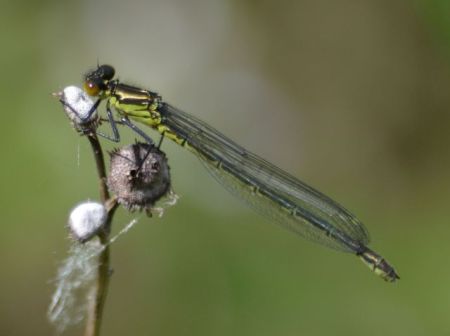
Immature Red-eyed Damselfly (above) and adult forms (below)


The second local site by the River Thames in Abingdon is Barton Fields (SU511971) that in recent years has become a stronghold for the rather more scarce Variable Damselfly. This blue species is most easily identified by the “exclamation mark” stripes on the thorax and a “wine glass” pattern on abdominal segment two. I observed the insect here and secured pictures (below) twice during May 2019. Hairy Hawker and Downy Emerald dragonflies are also now regular at the location and Common Clubtail have been recorded very occasionally.


Teneral (newly hatched) damselflies are a further minefield to be negotiated, mostly appearing bland and ghostly upon emergence. But I am glad to have gained a better understanding of so many immature and sub-adult colour forms through the exercise presented in this post. It is also pleasing to have recorded most of these by returning over and again to the same areas of just two sites. All this is out there in the countryside awaiting those who go to look, and I hope this guide may be of use to less experienced observers who might care to do so.
 Ramblings and Scribblings