Having gone into 2020 with a specific wildlife agenda the spring part of which is now on hold for another year, on the first day of summer I was able to get out and convert one item of it. This is the earliest date on which the mystical and fabled aurantiaca, the teneral female Scarce Blue-tailed Damselfly was recorded in 2019 by one of the leading British odo bloggers.
Today was my own third attempt at experiencing the quite beautiful, orange and black-toned colour form in what is a brief window of opportunity. A year ago I had to abandon my search in overcast conditions, and in 2018 I just didn’t see any. Thus it was that at around 11am I came back to one of my favourite New Forest odo sites, Latchmore Brook (SU182124). The parking area was by necessity closed and walking in from a discreet distance to respect appeals from local residents I felt pleased there would be rather less general public than usual here.
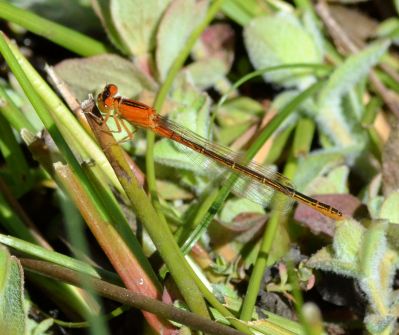
Scarce Blue-tailed Damselfly, imm fem aurantiaca phase
Scarce Blue-tailed Damselfy (SBT) has a marked preference for shallow water conditions with little vegetation, that occur in heathland valley mires such as one to the immediate north of Latchmore Brook. I was concerned that after such an exceptionally hot and dry May the bog here might have dried out, but on arrival found plenty of surface water (pictured below). After walking about at random for a while I waded into what seemed from past experience of the site a promising looking piece of mire. Then on turning around to keep my footing, there right behind me was an aurantiaca in all her bright finery. What a moment!
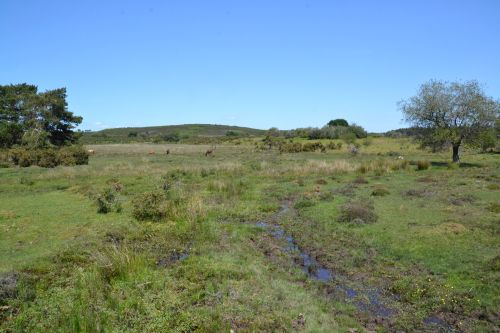
Lowland valley mire habitat at Latchmore Brook
Normally I am perhaps too sensitive over going into odo sites and possibly damaging habitat. But here the mire was already greatly pitted and trampled by grazing cattle and ponies, so I did not feel my usual compunction at doing more of the same. Indeed a degree of such habitat disturbance creates favourable conditions for SBT (per Brooks and Lewington). I was surprised by how still my quest kept for much of the time as I captured the images herein, so she was not bothered by my presence. She really is a rather special damsel, is she not?
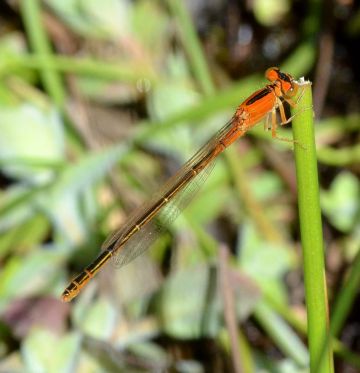
Scarce Blue-tailed Damselfly, imm fem aurantiaca phase
The same degree of tolerance was not evident from the human company today. Another odo hunter on site ignored me studiously through an hour before the blogger himself arrived and blanked me too, not for the first time in the field. But I had already self-found my quest, and not one for being rabbited at myself never attempt to make others engage if they do not wish to. I sought out more aurantiacae through a further hour or so here but without success. Mission had been accomplished early on this visit.
SBT’s emergence period typically begins in late May, peaks in June and continues through to July. Emergence occurs throughout the morning under favourable conditions, so my own timing seemed to be appropriate. But when delayed by cooler, overcast conditions a sudden sunny spell will trigger activity at other times of day. Freshly emerged adults, of which I noticed some here are dull brown but develop brighter colours by the following day. Females progress from this initial bright orange phase to greenish brown as they mature. The flight season lasts until early September.


I possibly owed success today to the relative shallowness of the mire in the present prolonged dry weather period. On past visits here I can recall misplaced steps causing me to sink in to knee level and so would have been far more cautious, but today there were no such mishaps. I doubt whether odo royalty secures its images by always staying on the perimeter. Having gained these pictures so early I wondered what to do next and the best answer seemed to be secure an acceptable one of a male. I located several moving low down in the mire vegetation, of which only this study (below) adequately shows the diagnostics.
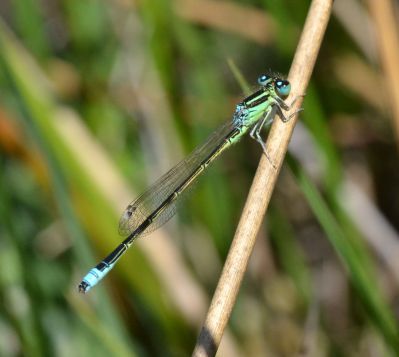
Male Scarce Blue-tailed Damselfly
First impressions are of a smaller, weaker flying blue damselfly than regular Blue-tailed. The “blue tail” itself extends over the lower part of segment 8 and there are two black dots on segment 9 that are just about discernible in the above image. Markings on the thorax develop through green and turquoise to deep blue as males mature. They spend their time lying in wait for passing females, being quick to investigate then pursue any likely mate.
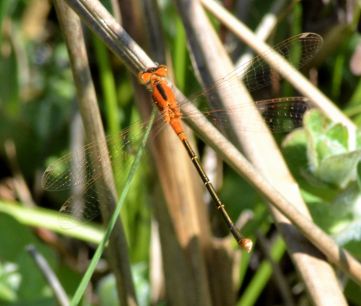
Scarce Blue-tailed Damselfly, imm fem aurantiaca phase
But today was all about the female Scarce Blue-tailed Dameslfly. There is very little for me still to experience where English odonata are concerned. To have now successfully searched out this highly attractive colour form after two years of trying was immensely satisfying.
 Ramblings and Scribblings
Well done! It’s certainly a stunning looking damselfly
LikeLike