At this time of year when the daylight hours are at their longest I tend to wake with the light. So on this particular sunny early morning, having completed some early chores I opted to re-experience a British butterfly I have avoided since 2015. Two Oxon wildlife colleagues had made the same tripette ahead of me without reporting the circus that had so put me off on my previous visit to Daneway Banks. So I took a chance both on presently unpredictable weather conditions and another disagreeable outcome.
After arriving on site (SO939036) around 10 am I headed up to its highest part where I had been told my quest might still best be located. In the by now lightly overcast, mild and calm conditions this reserve simply teemed with seasonal butterflies – Marbled White, Meadow Brown, brown Skippers and a few Ringlet – but it didn’t take long to notice a first Large Blue in the grass to one side of my footfall. There was company, but thankfully those other observers were all genuine butterfly enthusiasts.
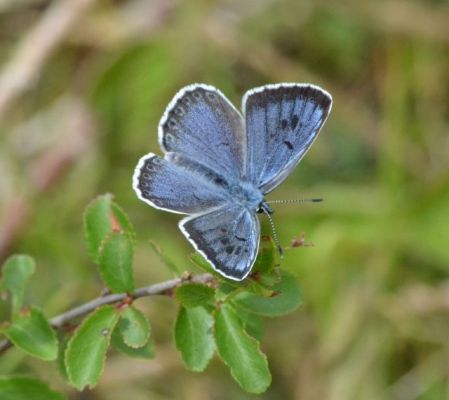
Large Blue
Thereafter, as I walked on something else distinctly blue would stand out every so often from the more commonplace fayre. And each Large Blue I encountered seemed to pose a little more pleasingly than the previous one. On the hilltop there is a cordoned off area to prevent breeding habitat from being trampled, but in the accessible margins around it, where there was plenty of the food plant Wild Thyme, I eventually estimated self-finding 14 individuals. For much of the time I had those to myself and was able to enjoy true communion with them, unlike on that 2015 visit.


Daneway Banks is owned jointly by Gloucestershire Wildlife Trust and The Royal Entomological Society, who work in partnership to manage it as a nature reserve and a place for ecological study. A steep, south-east facing hillside above a dry valley on the north side of the River Frome, the upper slopes of the 17 hectare (42 acre) site are an example of prime limestone grassland. That habitat and areas of ancient Beech, Yew, Hawthorn and Hazel woodland have long been considered exceptional for biodiversity even by the high standards of Cotswold grasslands. SSSI status arises from the great plant variety including calcareous-specific species.
The main sward is interspersed with patches of scrub and woodland, occasional cliffs and scree from small abandoned quarries. Across the lower parts of the hillside, Jurassic limestone soils are replaced by neutral Fullers Earth clays on which fewer wildflowers grow. Up to 10 different Orchids bloom here at different times of the year, as well as regionally rare plants including Angular Solomon’s Seal and Mountain Bedstraw, and two national rarities Cut-leaf Selfheal and Cutleaf Germander.
From mid-autumn to spring the site is grazed by sheep and ponies, so by late winter the sward is predominantly short with scattered taller patches. The land is then left un-grazed through spring and summer, allowing a succession of wild plants to bloom and set seed, and for insects to breed. Thousands of Yellow Meadow Ant hills, known locally as “Emmett Casts” are a prominent feature.


But it is the now thriving population of Large Blue (pictured above) in June and July that attracts most visitors to this remote and scenic location. The Cotswolds was one of three main regions where the butterfly bred before its extinction as a British species in 1979. In tandem with appropriate habitat restoration by a consortium of scientific and conservation organisations, re-introduction then commenced of a near identical Swedish race into Devon from 1983 then Somerset and Gloucestershire from 1992. Over 25-years these butterflies spread to more than 30 sites, mainly in Somerset. Although most were small satellite colonies, the core populations were very large for this rarity, exceeding known numbers anywhere else in the world.
In the Cotswolds this re-colonisation struggled, however, The earliest introductions at Butterfly Conservation’s Rough Bank reserve (SO913087) and Barnsley Warren SSSI failed because the adult butterflies emerged too late to synchronise with flower-bud production of Wild Thyme. So ovipositing females had to rely on occasional late-flowering plants growing in the coolest spots within sites. In Somerset spring and summer local climates more closely matched the source sites in Sweden, so the synchrony was imperfect but adequate. In the Cotswolds, where temperatures were a further half degree cooler, it was not. Such is the fineness of the tolerances that were involved.


So the story goes this is a tale that must be told … and all that. Large Blue larvae famously grow as parasites within the nests of a particular species of red Ant. After some initial development on Thyme and attaining the minute proportions of their Ant counterparts they are “adopted” by foraging Ants that are tricked into taking them home. This is achieved by emitting a secretion to attract Ants who think they are their own larvae. Once in the nest the butterfly larvae feed on the Ant grubs, often destroying entire host colonies.
At Daneway Banks, despite under-grazing by livestock in the 1970s and 80s sufficient Wild Thyme remained to support increased populations of the said Ant, with appropriate habitat management. So the site was identified as a more promising one for restoration than its Cotswold predecessors, and through the early years of this century Ant densities increased and Thyme spread under targeted grazing. I am being brief in this summary. For more detail in the Royal Entomological Society source article by Prof Jeremy Thomas see here.


From 2010 continued re-introduction of the European Large Blue at Daneway Banks has been more successful still. The site now supports one of the largest populations of this globally endangered butterfly anywhere across its range, and is widely regarded as one of the best places to see the iconic species. I came back six days later on 23rd to fully explore this beautiful reserve. In much sunnier conditions the Large Blues were far more flighty and less inclined to perch openly, but I still gained some more images (above).


I also paid some attention this time to Daneway Banks’ more common butterflies. It is difficult ever to tire of attempting more under-side studies of Marbled White as they display their geometric intricacy atop as attractive flower heads. But one of the morning’s better picture opportunities was a little Meadow Brown dinner party (above right).
The evidence of these two excursions was that a more peaceful co-existence is now being achieved regarding visitor pressure than the situation that so discomfited this particular observer five years ago. So these were the most positive of my own five national Large Blue experiences to date, and ones that I thoroughly enjoyed.
 Ramblings and Scribblings