
Essex Skipper is possibly one of the easier butterflies to overlook in a British season unless the observer is going for the full species set, since it is both rather nondescript and tricky. To my mind closely examining every brown Skipper I might come across in high summer, except at known Essex sites is a bit of a chore. But being in need of a wildlife project on this mainly sunny morning I set off for a regular local site in order to present a first appreciation of the species in this journal since 2015 (see here).
On the way a profusion of bright pink flowers caught my eye at a field entrance besides the Wallingford southern by-pass (SU 592901), and I stopped to investigate. They turned out to be Sweet Pea, presumably of cultivated origin, but then I noticed my season’s first Gatekeeper butterfly and went to retrieve my camera for a record shot. Close to where that insect had been was now none other than a perfectly posed Essex Skipper that allowed a point blank approach, so I was able to capture (below) a diagnostic image.
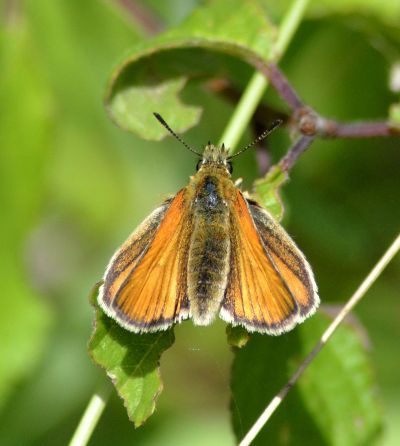
Essex Skipper at Wallingford, Oxon
Several years ago now I was advised by the former Butterfly Conservation Upper Thames Branch then national chair Dr Jim Asher to look at brown Skippers head on when attempting to separate Essex. The lozenge-like antennae are inky black tipped and shaped rather like Cotton Bud swab sticks. A thin black line through the centre of the fore-wing in males, parallel to the leading edge is a further diagnostic. In Large Skipper the antennae can also appear black when viewed from a certain angle, but the tips are sharply down-turned and pointed. The following pictures illustrate this, but being point blank macro lens studies the intent is to highlight the diagnostic and not for the whole insect to be in focus.


Feeling pleased with having recorded another 2020 butterfly locally at a new location I then drove on to the regular annual site of Hagbourne Railway Embankment (SU 521882). A brisk wind was blowing but at the first sheltered spot I reached walking south from an access point near East Hagbourne cemetery I came across three more Essex Skipper that also enabled close scrutiny (pictured below).


Here there were also Large and Small Skipper for comparison. In Large (below left) the antennae are black below and golden brown above, and as stated earlier the tips are markedly hooked. In Small Skipper (below right) that brown toning is more noticeable and the antennae tips though still quite pointed appear less hooked. The upper wing patterning of Large Skipper is also much bolder than the other two species with a prominent black sex-brand in males on each fore-wing, and the flight and all round jizz is just heavier.


So there it is … a brief and simple Rn’S guide to brown Skipper ID. It is presented in anticipation of less seasoned butterfly watchers accessing this post via web searches, and does not attempt to preach to the converted. For the former it’s all a matter of practice and once the observer has their eye in things become much simpler.
Why this butterfly has its name is one of those entomological anomalies surviving from the 19th century. It was first recognised as a separate British species from Small Skipper in 1889 and the last resident species to be described, but has no special association with the English county of Essex. The complete range is from southern Scandinavia through continental Europe to north Africa, and east to Central Asia. ES was introduced into north America in the early 20th century, where it now occurs across southern Canada and several northern US states and is known as the “European Skipper”.
In the British Isles Essex Skipper is found over much of the southern half of England below a line from Lincolnshire to Dorset. Flying in July and August, it can be very common locally, typically forming colonies varying from small numbers up to several thousands. Preferred habitat is in a variety of open sunny situations, especially roadside verges, woodland rides and grasslands as well as coastal marshes.


National distribution is acknowledged to have more than doubled in the last few decades, a spread that is thought to be assisted by trunk road embankments acting as wildlife corridors. This butterfly was first recorded in Wales in 2000 and reached south-eastern Ireland in 2006. But due to the similarity with Small Skipper, Essex has always been under-recorded so I have not been alone in neglecting this butterfly over the years.
Hagbourne Railway Embankment (see here) formerly carried a line from Didcot to Newbury and Southampton, and is now a focus for both recreational activity and wildlife study. A designated and well-used cycle route, it also starts from a large housing estate and so is something of a playground for local people. But despite all that the site is exceptionally wild flower rich along its entire length, a route between the villages of East and West Hagbourne, and Upton to the south.
Common seasonal butterflies are all present in good numbers, amongst which are site specialities of Essex Skipper and Small Blue. It was a very enjoyable couple of hours that I spent in this wildlife haven today. And with most remaining Covid-19 restrictions having been lifted in England a day earlier the general public too seemed in ebullient mood. Devoting a little attention to an often overlooked British butterfly proved to be a very worthwhile exercise indeed. They are out there to be found if looked for.
 Ramblings and Scribblings