This day’s events demonstrated again how despite my lack of birding in 2020 I will still get up and go quickly enough if there is something to see at reasonable distance and with a purpose. One of the most newsworthy and popular rarities around England this summer and autumn has been a roaming first summer Lammergeier (or Bearded Vulture) that has strayed from a re-introduced Alpine population. So when that bird turned up in an easily accessible location just 110 miles or something over two hours from home … well, I got up and went.
My adventure began mid-morning with a message from the county birding colleague who, quite by chance on 21st September while hanging out the washing in her mother’s back garden, had seen this bird pass over her village to the west of Oxford. I now learned that “her bird” was in Lincs and she was concerned that it might not be very well. Checking RBA I found the vulture had been present since early morning in a tree beside a school in the village of Moulton Chapel just to the south-east of Spalding, having roosted overnight.
A Radde’s Warbler had also been reported for a second day 10 miles away so the prospect of twitching both birds made the journey seem worthwhile. It felt good to be on the road again, as usual on these occasions, and as I drove a familiar route past Northampton, Wellingboro’ and Oundle I felt a distinct cleansing of the system after so much time spent at home recently.
At the Radde’s site just north of Peterborough that other bird had not been re-found since the earlier report, none of the 10 birders present had any idea where it was and there was a huge amount of habitat in which it might be. The time was now 14:30 pm and a typical warbler twitch was clearly in progress, so it made sense to prioritise the Lammergeier, it being a lifer. I had a RW once before in Norfolk in October 2016 (see here). Today’s was not seen again.
After moving on the short distance northward, the issue was where exactly to go. The vulture had flown west later in the morning and the most recent report cited: “in field just E of the A16 from Queen’s Bank”. So often directions put out by birders are in this kind of rather localised shorthand that only people living nearby are likely to understand. What was Queen’s Bank? A road, a flood defence, a sports centre … no as far as I was able to learn a farm. There was no post code, grid reference, access instructions or anything that might assist first time visitors to the area.
So I drove north along the A16 taking each eastward turn in search of parked cars and birders. Eventually I reached a road called Drain Bank N at the end of which a rough track ran south-eastward parallel to the trunk road. Following that I caught sight of what looked like a large raptor flying in the middle distance then from the end of the track at TF 25954 19089 there was a second sighting. But I could not be sure whether either had been of my quest, and both soon dropped below the tree line.
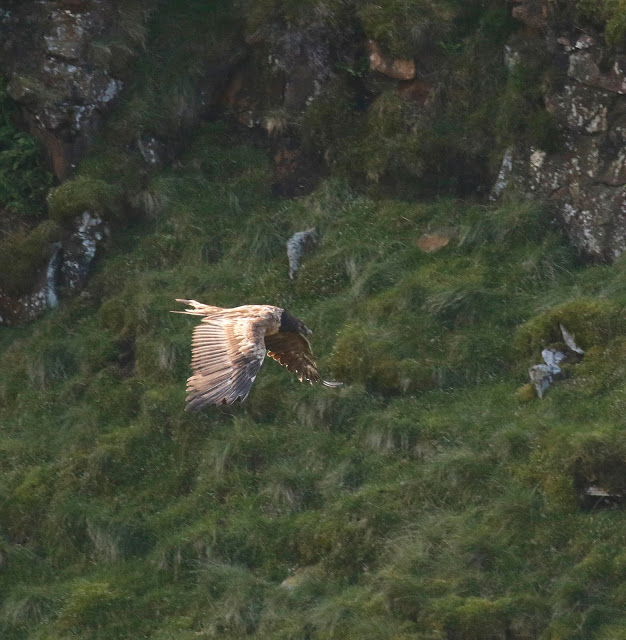
I now called RBA to seek clearer guidance that was indeed forthcoming. The vulture had last been reported flying towards the next village of Cowbit, that was recognised by both my SatNav and Google maps so I knew I was not too far away. Driving back along the track to a more open area I stopped the car and at once saw a raptor drifting west to east above the tree line that was so big it had to be the Lammergeier.
This is a jinx bird that had eluded me in a number of locations abroad. So I felt pleased my first experience of it was now self found. I set up my scope and waited but it did not re-appear. At 15:40 pm I checked RBA again and the bird had just landed in a tree in Cowbit. This time there was both a street name and post code, and I headed straight there. All doubt, as I like to feel was about to be removed.
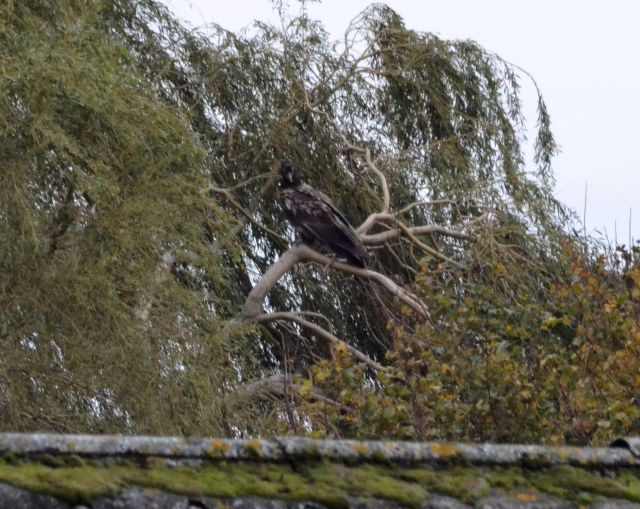
When I arrived on site along a road Barrier Bank the parked cars and assembled birders could not be missed. The Lammergeier was indeed perched in a Willow tree at around 200 metres, behind the roofs of Ashtree Nursery PE12 6AQ (TF256181). I gasped out loud on first beholding this bird’s huge, dark, brooding presence as it turned it’s head slowly from side to side, then continued watching it for maybe 20 minutes.
Unfortunately and as so often happens, a few people just had to try to get closer and walked around to the far side of the nursery, flushing the bird. It then flew off to land in the top of the tallest tree on the horizon, to be instantly mobbed by the local corvids but the interloper seemed unconcerned by their attentions. It was still readily viewable from the road at that distance and remained there after my own departure until dusk, roosting overnight.
The movements around England of this extraordinary visitor have been well documented. But to recap it was first seen over a West Midlands garden on 26th June, then settled in the Peak District of Derbyshire, initially in the north-east of the National Park to the west of Sheffield, and later in the north-west near Glossop above Manchester. There were fears for the young bird’s safety in this adopted home, being prime grouse shooting country in which illegal raptor persecution is prevalent. But the level of publicity surrounding the star visitor by all accounts contributed to dissuading gamekeepers from blasting a carrion feeding vulture from the skies.
Anxiety nonetheless grew when reports ceased in early September, but it was viewed again on 20th heading south over Leics, and a day later came the Oxon sighting. It was then expected to return to the European mainland but instead diverted to Norfolk around which it was seen a number of times towards month’s end. Current concerns over the bird’s health arise from the possible unsuitability of the flat expanses of agricultural land it now chooses to remain in, where there may not be enough carrion for it to feed on.
The British Ornithologist’s Union Records Committee (BOURC) does not recognise the bird, deeming it as coming from a population that is not in their interpretation self sustaining. But this is a matter of contention amongst many of the British birders who have taken the opportunity to connect with what is only the second Lammergeier to occur nationally.
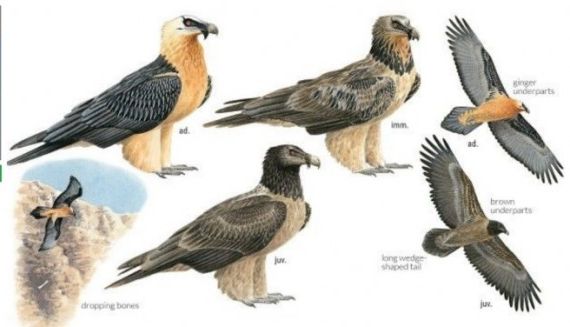
I myself felt reluctant to travel the required distance earlier in the year, given this vulture’s cited lack of provenance, rather ragged appearance until more recently, and the wildness of its frequented locations. But it was one of only four regularly occurring species in south-west Europe I still needed for my life list. So I am making that addition now until such time as I might encounter a fully kosher item abroad, and what a magnificent sight it was. This is also my 360th British bird, none of which were recorded in Scotland or the Scillies.
Footnotes:
- By lunch time on 9th, after much searching of online mapping resources, I found that Queen’s Bank and the farm of the same name are actually to the south of both Moulton Chapel and Cowbit, there is no direct access from the A16, and that finding it must require a familiarity with local minor roads. So given the vagueness of the directions that actually went out I feel even more satisfied to have self found my first ever Lammergeier in a different location, ahead of all doubt eventually being removed.
- On 13th October the results were published of genetic research into this bird’s origins (see here). This shows it is indeed a first summer female that hatched in a wild nest in a re-introduced population in the French Alps. The hugely popular bird departed these shores near Beachy Head in Sussex at 14:00 pm on Thursday 15th.
 Ramblings and Scribblings
You mention a first UK record on 26 June. In fact I saw it over Blenheim, Oxon on the 23rd – duly reported to Ian Lewington (county recorder) and the BBRC, though not till two months later, when I realised via published reports what I’d all too briefly seen, the huge size and missing tail being a giveaway, but who’d think Lammergeier in normal circumstances ? – so it actually appeared in Oxfordshire twice – Anthony Cheke.
LikeLike