Here is another of those “eventually I got up and went” scenarios. Normally I prefer this journal to be about the wildlife I observe rather than myself and what I do. But what can I add to all that has been published on-line concerning this bird over the past week? So I will instead indulge myself a little, which seems the best way to make a story out of all this.
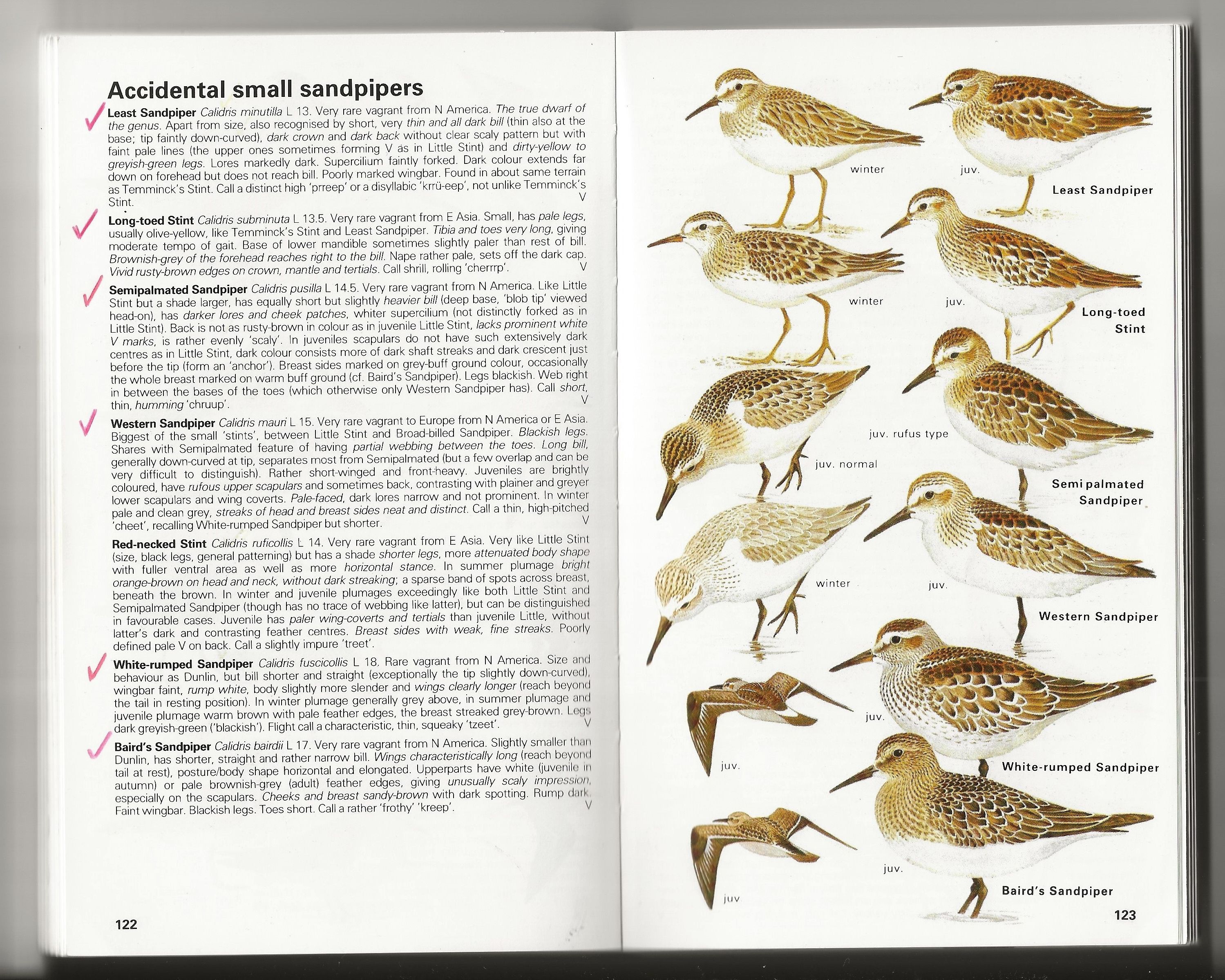
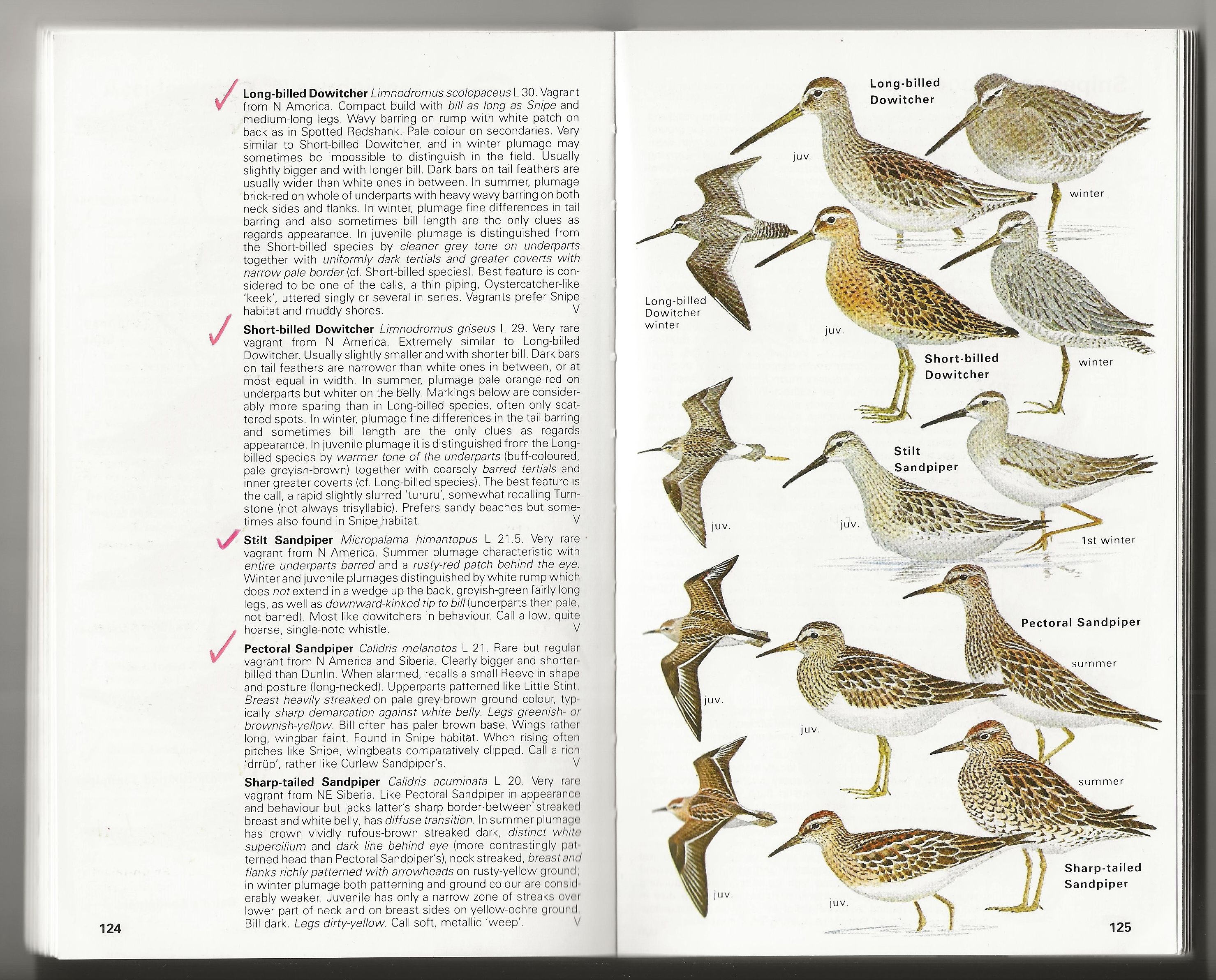
In BirdGuides’ weekly review (see here) today’s item was described as a “true ‘giga’ rarity”, a phrase I had not heard before. It had been confirmed as the uber-scarce east Asian vagrant Long-toed Stint seven days ago on the evening of my previous twitch for the Hants’ Western Sandpiper. My own wish-list of still required European lifers is derived from their inclusion in the Hamlyn pocket field guide I used in my first phase of serious birding in the 1980s and 90s. I have two copies, one of which is marked up as my British and the other my European bird list. These prized personal relics include two pages of what the book terms “Accidental small sandpipers”, comprising some 12 species of which I still require just two.
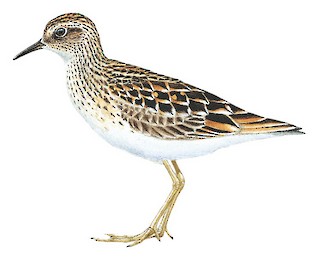
The two most recent conversions illustrate just how rare some of these “peeps” as small waders are also known are. Western Sandpiper is cited by Collins (that like most birders I now use) as one of the group’s rarest visitors to Europe, five individuals so far in 2021 being a year record. The Long-toed Stint at St Aidan’s RSPB “nature park” in West Yorkshire (LS26 8GE – SE 399286) is the third for Great Britain and just 13th for the Western Palearctic. The first accepted national record was in June 1970 and a possible Sep 2011 record in Sussex is still in circulation with the BBRC. The Yorkshire bird is the first twitchable one since Aug 1982, meaning every British travelling birder would wish to connect.
My own concerns when the news broke were two-fold. Firstly I dislike and avoid heaving mass twitches, so would wait for things to calm down a bit. Secondly I wanted to gauge how distantly the bird was being viewed and how different from a Little Stint it might look at that range. When visual matter and other Oxon birders’ blogs began to appear online earlier this week my mind was put at rest concerning the latter. For the RBA gallery of this bird see here, including some images that capture the elongated middle toe that gives this Stint its name. The five minute video in the BirdGuides review linked higher up this post is most excellent, revealing a truly distinctive appearance and jizz.
By now I appreciated this might be my only opportunity to record a LTS and so one that warranted going to the extended 180-mile limit of my preferred driving range. When the RBA and BG weekly reviews landed in my inbox midweek they contained tales of thousands strong twitch lines and how the cream of British hard-core had relocated en masse from abandoned early October sojourns in Shetland and the Scillies. The removal of this “blocker” for a whole generation of birders had indeed inspired a huge national event.
It remained to actually feel motivated to make the conversion and my gut feel was that like the still present White-tailed Lapwing at RSPB Blacktoft Sands this latest bird would be a long stayer. I need to be in a particular frame of mind to take the road, which though not a precise condition usually involves pent up energy to burn. On waking this morning (14th) at 2:30 am there was a choice of spending time on the computer until sleepy again or getting out of the door. The moment had come to embark upon the four hour journey north.
Arriving on site at 8:30 I made my way out to it’s eastern reed bed where maybe 20 birders were already in place. I was put onto the Long-toed Stint straight away, which was some way off amongst a group of Northern Lapwing and Dunlin. Like last week’s Western Sandpiper this looked distinctive in both appearance and jizz, both small birds being restless and busy in their feeding behaviour and not at all like Little Stint. I then watched the visitor going about its business for around an hour before proceedings began to get a little too crowded for my liking.
LTS is a Tundra breeder and considered to be the Eastern Palearctic equivalent of the Nearctic region’s very similar Least Sandpiper. Most winter in south-east Asia with smaller numbers reaching Australia and possibly east Africa. To quote the Helm guide to confusion species Long-toed at a distance can look quite square-headed, flat-backed and pot-bellied, with a straight bill and rather truncated rear end. The relatively long, yellowish legs appear about equal to the body depth, and the bird often tilts forward when feeding. Close up the most obvious diagnostic is the strikingly long central toe of the species’ name.
As more and more observers arrived after 10 o’clock, all asking for and receiving directions as I had done, things became both repetitive and confusing compared to earlier and so I chose not to extend my stay. I could only imagine what the constant chorus of “just right of the Lapwing”, “moving in front of a Dunlin”, “there’s a Moorhen next to it now” and similar utterances must have sounded like over the previous weekend. Likewise, back at the car park I considered just how the facility might have coped with visitor numbers then, though the roadside verges for some way outside bore ample testimony to that.

The 400 hectare (990 acre) expanse of St Aidan’s Nature Park, also known as Swillington Ings covers a former open cast coal mining complex in the Aire Valley to the south-east of Leeds. Visiting it today provided an insight into this country’s industrial past that southerners such as myself possibly do not usually get the opportunity to appreciate. One thing I didn’t notice so much in this part of the world is the blanket over-development with characterless, high density housing around every small town and village that to my mind blights my native south-east of England, and which I personally detest.
Coal extraction in this area began in the early 1940s and continued at the St Aidan’s site until March 1988 when a major landslip alongside the River Aire caused the surface mining workings to flood over four days creating an extensive lake. It was 10 more years, during which the river’s course was diverted, before work could recommence to dig out the remaining coal reserves. Once that was complete ownership passed to Leeds City Council which created a charitable trust to re-wild the land. The present nature park opened in 2013 and four years later was leased to the RSPB which now manages the site for both wildlife and recreational activity. Habitats here include wetland, reed bed, meadows and woodland.
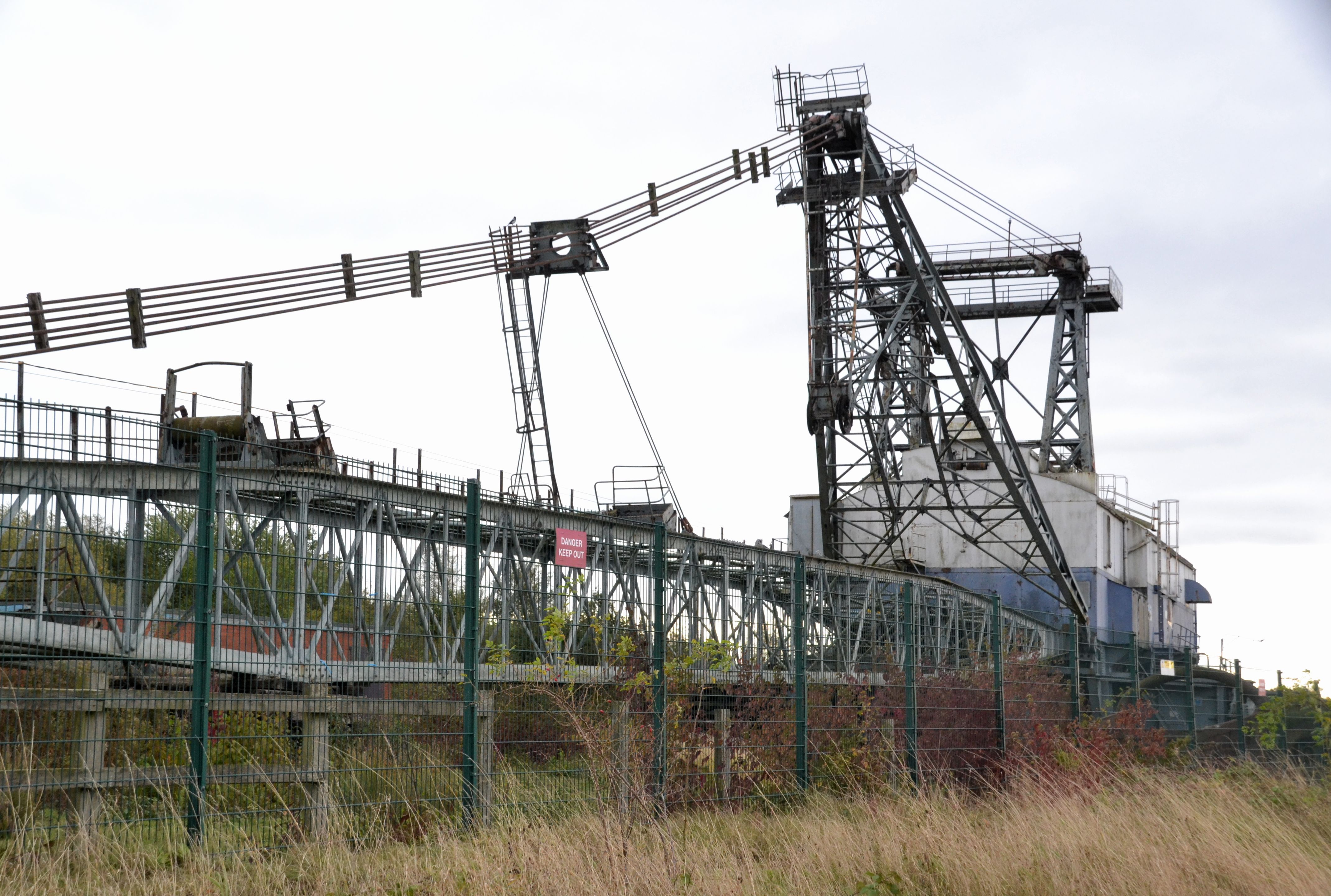
Before leaving today I took the opportunity to appreciate a prominent local landmark. The big brooding beastie (pictured above) is variously claimed to be Europe’s oldest or only preserved large walking drag-line excavator and the first I can ever recall seeing. These gargantuan products of heavy engineering were the main workhorse in open cast mining for around 50 years through the second half of the 20th century, before becoming superseded by newer technology. Electrically driven, they walked by means of rotating cam-driven feet, one on either side that lifted the structure off the ground and moved it forward at a rate of two metres a minute.
Manufactured in the US in 1946, this Bucyrus Erie 1150-B was one of three such machines purchased by the National Coal Board in 1953. Taking in it’s huge bulk my mind boggled at their being lifted onto and off the vessels that shipped them to Blighty, and how this one was partially dismantled and moved between three sites here through it’s working life. Presumably the heavy lifting and haulage technology of the day could cope since I doubt if it walked all the way! “Oddball” as the pictured machine is nicknamed weighs 1200 imperial tons and was operational at St Aidan’s between 1974 and the site closure of 1988. It is now maintained by a charitable trust (see here) aided by National Lottery and other grants.
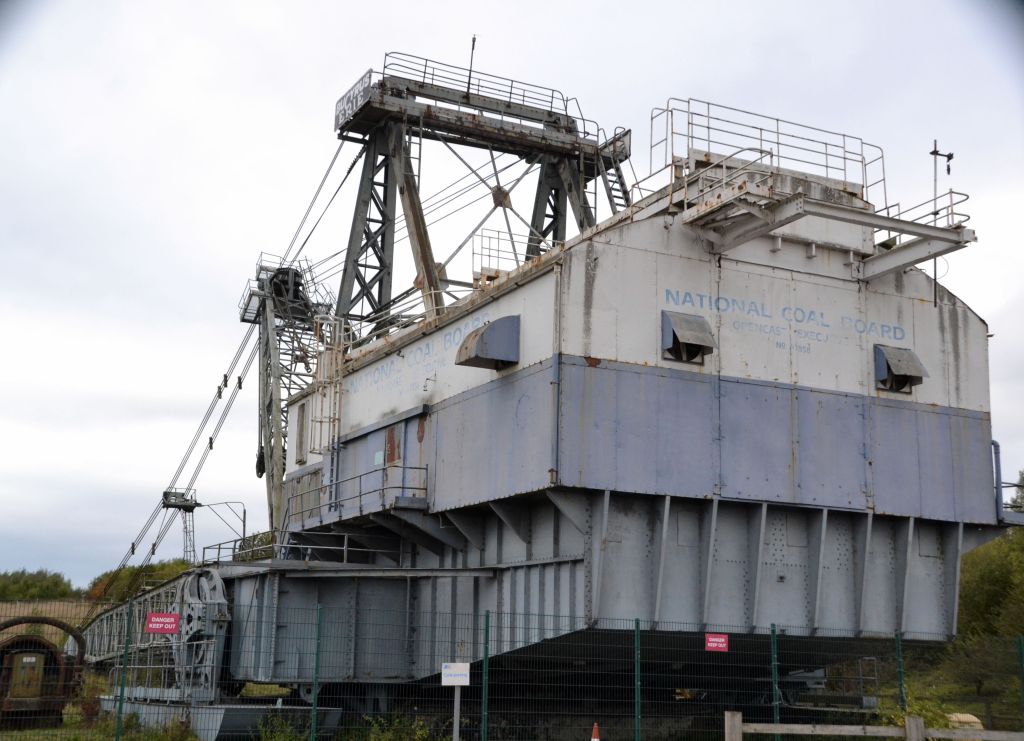

Having become fascinated by this historical item I am happy to include it here, as I like to do in my mainly wildlife journal from time to time. Moving swiftly on and returning to birding matters it next seemed sensible being so close to go back for second helpings of the White-tailed Lapwing that has become a fixture 40 miles away at Blacktoft Sands since my first visit there on 28th August (see here).
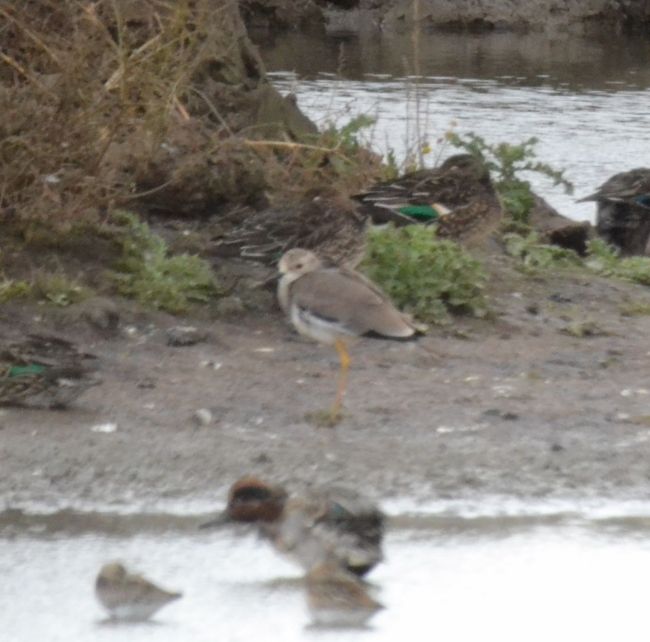
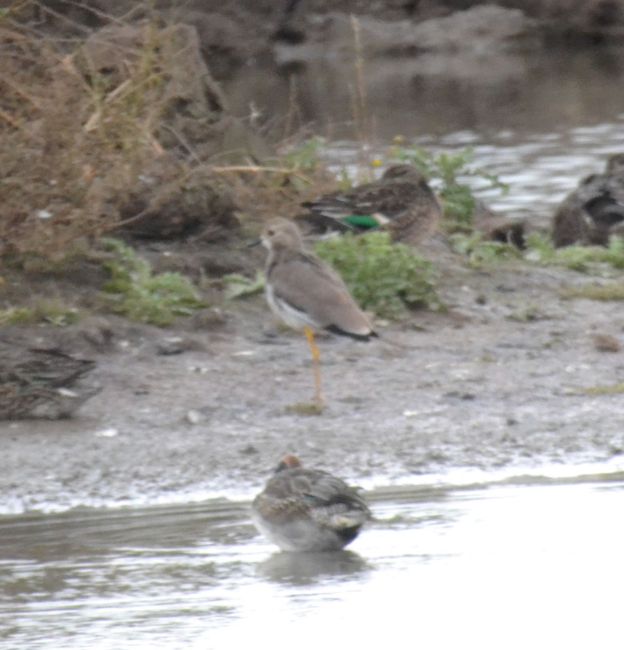
Today the bird had been present in front of one of the reserve’s hides for quite some time prior to my arrival. When I got there in the early afternoon it was easy to pick out dozing it’s time away in the middle distance. The gloomy light at both sites might have suited the redundant presence of the walking drag-line, but definitely not my efforts at capturing pictorially this excursion’s second avian celebrity (below) any more than the first.
Some fairly local birders then told me about a Baird’s Sandpiper seen earlier just 27 miles in my own direction home. So after the Lapwing eventually went walkabout and I had become satisfactorily re-acquainted with it I opted to attempt a third item on what was becoming a busy day. But what would have been my second career Baird’s proved a step too far as it was not reported again in the afternoon and I didn’t locate it either.
And so I headed back south to complete a solo round trip of 410 Velvet Revolver, Thunder and RHCP-accompanied miles; nothing to proper hard-core birders of course, whatever their choice of in-car entertainment but not a distance I attempt too often myself. Worth it though? … Given the energy to burn mind-set of this particular day, I should say so!
 Ramblings and Scribblings