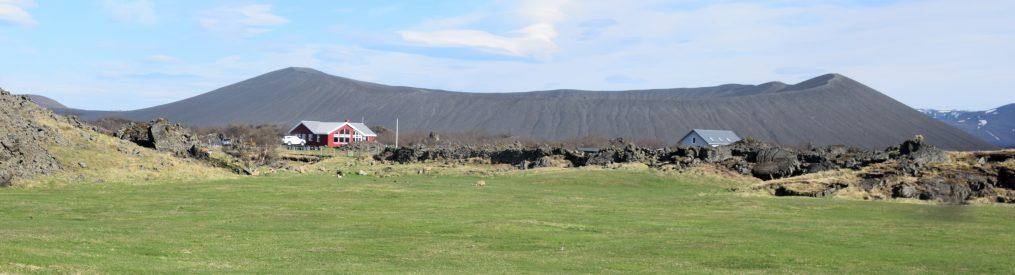
This seemed worth doing. As in 2021 my year’s opening national and WestPal bird list addition is a Nearctic vagrant. Then it was a White-throated Sparrow in early April (see here). This time, on checking the distance it was only 126miles, so a sunny Friday forecast was enough to tempt me out. I’ve not been inactive during the interval since the previous item herein, having dipped the Somerset Baikal Teal in January then connected with the nearby Penduline Tits. Other than that it’s been mostly local birding, which several notable sightings including Pallas’s Warbler aside does not fall within this journal’s remit.
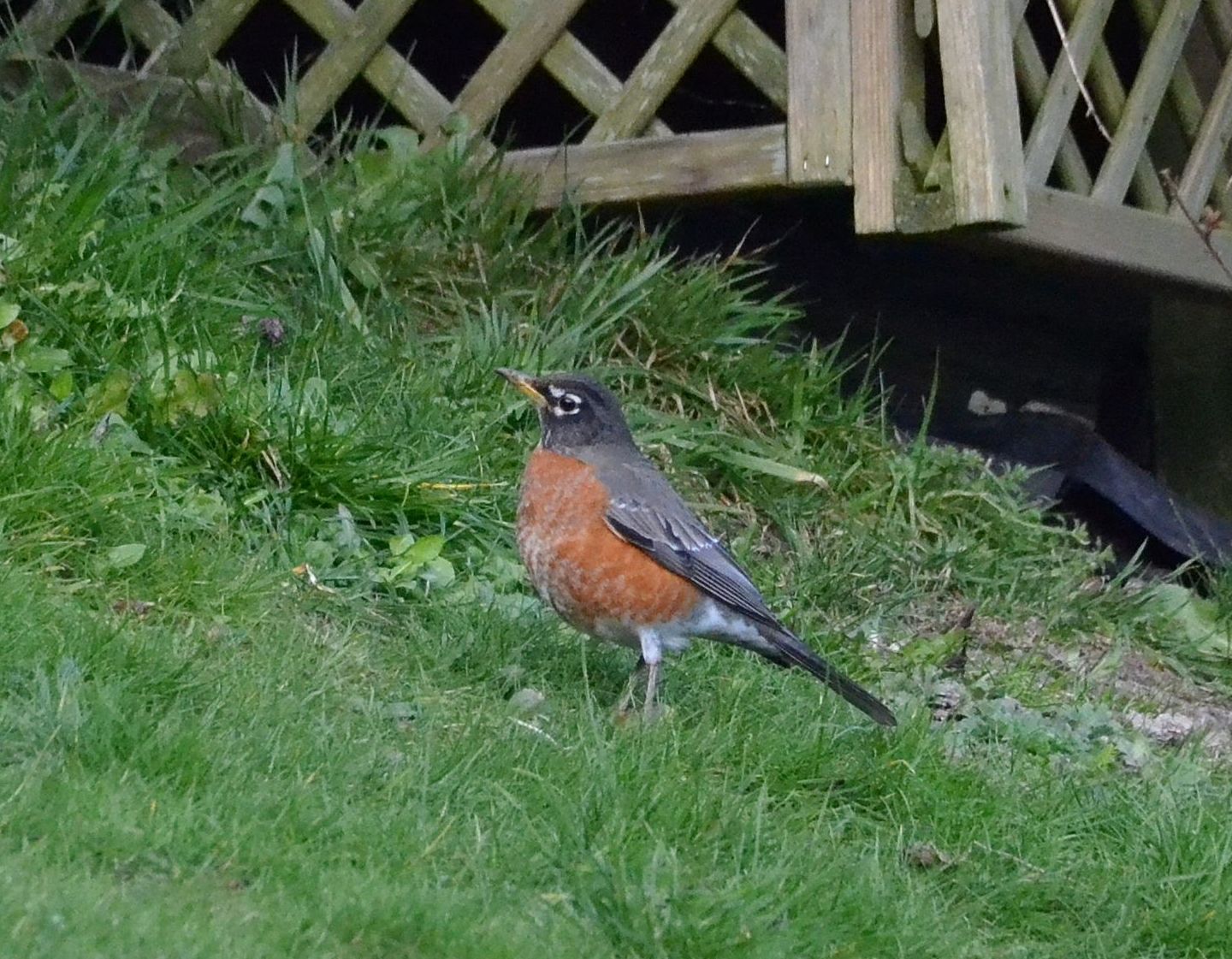
This lifer is of course not a Robin at all, but a species of Thrush. The misnomer is said to have arisen from early settlers in north America welcoming the comforting sight of a red-breasted bird and relating it with the favourite from back home. Though a rare vagrant to Europe this is actually the most numerous bird (c370 million) across the US and Canada, where it frequents gardens, parks, open farmland and woodland edges. It resembles familiar British Thrushes such as Blackbird and Fieldfare in shape, behaviour, jizz and calls.
The Eastbourne bird, either the 25th, 29th (or is it 33rd?) British record was first reported three days previously on Tuesday 8th but is said to have been present for rather longer. As the first twitchabIe one since 2010 it is proving to be very popular. I arrived on-site around midday, after a three hour drive despite the modest distance, and parked in the residential cul-de-sac cited on RBA as soon as I saw birders up ahead. Then, on going to investigate, I came upon a 50-plus crowd (pictured below) that included several familiar faces.

I was approached at once by Adam (Gnome), who had been expecting me since we usually seem to meet on the same twitches. He said this bird had not been seen for around 45 minutes, hence the build-up in hopeful observers, and pointed out two favoured locations on its feeding circuit. Then the American Robin re-appeared on a downland hillside just beyond the cul-de-sac. After Adam left to try for a nearby Hume’s Leaf Warbler, my quest settled quite prominently in the same area and I was able to discern all its features.
Over the ensuing two hours I gained more good though restricted views. The bird was mostly alternating between two locations that could only be viewed effectively by a few people at a time and hardly facilitated RBA’s request to respect the privacy of residents. It wasn’t rocket science to surmise the number of people present was diverting the visitor from the berry-laden spots of the previous days’ RBA gallery (see here). I also heard tales and was shown back of camera images of how it had posed openly earlier.
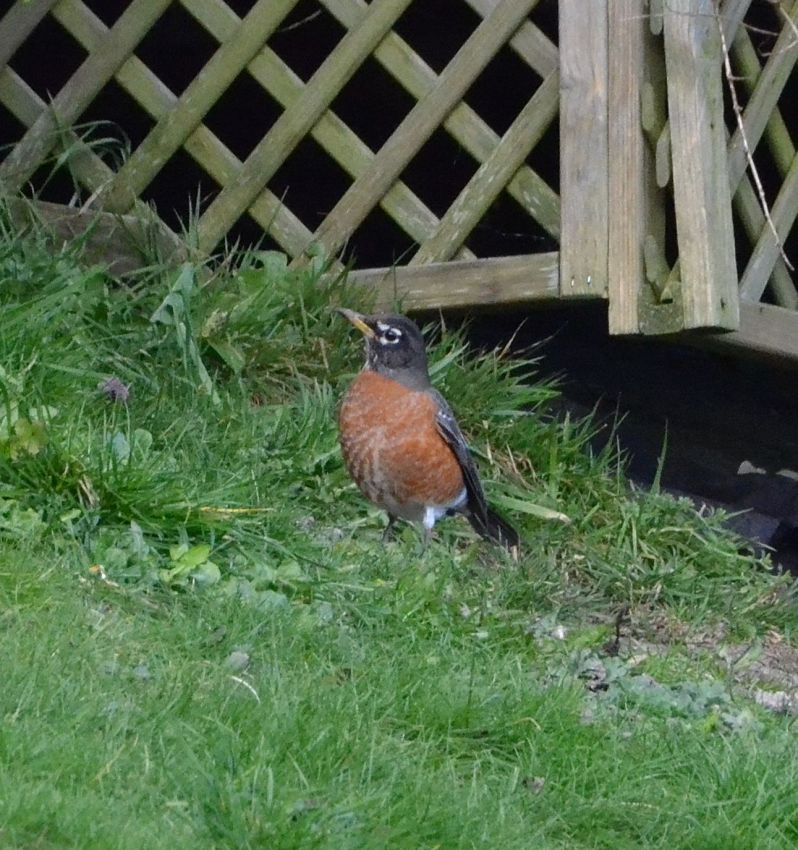
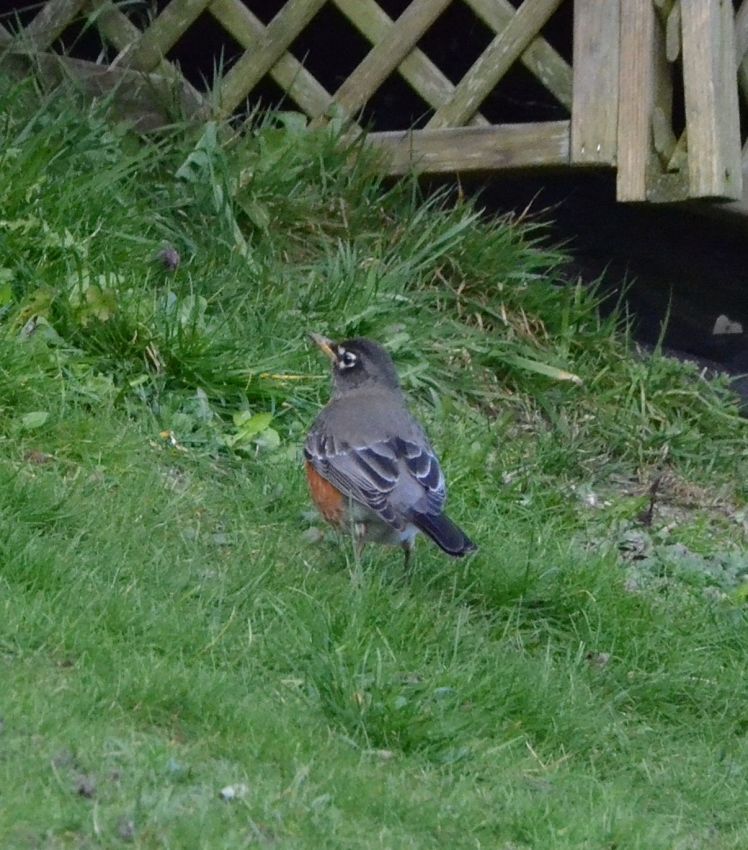
This first-winter bird has paler and speckled orange underparts by comparison with the rusty red of an adult male, lighter grey head tone and darker bill. Otherwise it shares the slate grey upperparts and prominent white eye ring displayed in all plumages. American Robin is quite heavily built, with long wings and tail, and strong feet.
Eventually I called Adam to see how he was faring with East Sussex’s alternative avian attractions. The Hume’s Warbler had not performed well, and I didn’t need it anyway having had a good experience not too far away in Newhaven three years ago (see here). But he was currently seeking out and finding a Hooded Crow around a service area just out of town on the A27. That was a potential second national list addition of the day for me, and an opportunity too good to miss.
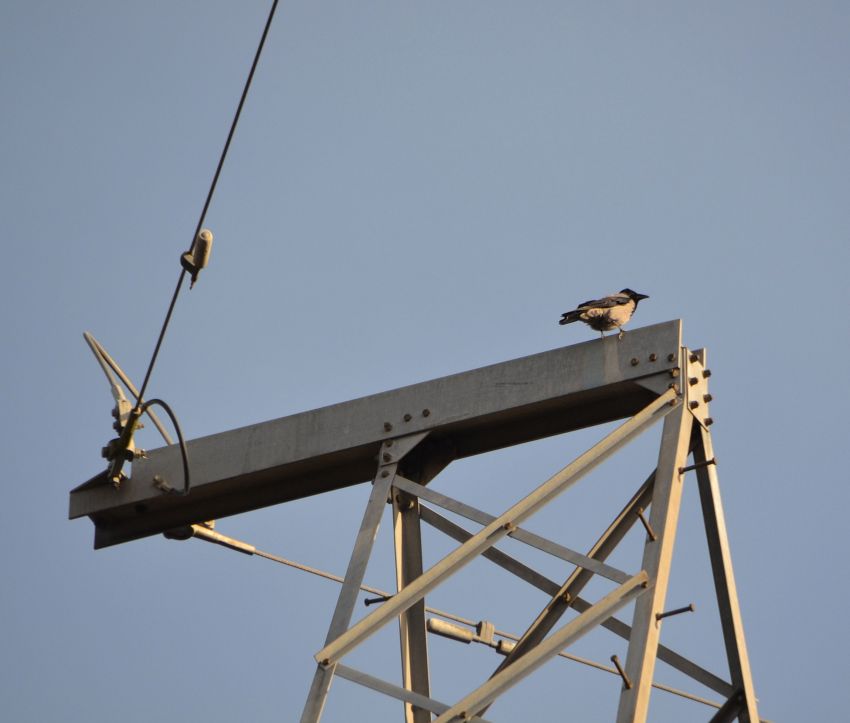
Hence I relocated to Polegate (TQ 578057) where my colleague put me onto the corvid in trees close by the A27. I only needed to tick the thing for Blighty, having seen any number of these abroad in areas where this two-toned grey and black species replaces the all-black Carrion Crow. But I retrieved my car from the service area to drive closer through an underpass and try to get a picture. There another birder pointed out the “Hoodie” perched atop a pylon (above) and that was job done.
It being 2:30pm I didn’t want to negotiate an early Friday rush hour on the dreaded south-western section of the M25. So I opted to return to the first location hoping that with fewer birders in attendance the American Robin might pose on those berry bushes at the end of Hill Road (BN20 8SN – TQ 583004). Back there I engaged with a photographer I know from previous twitches who had been staking out one of the favoured spots for six hours since the bird had last thus obliged.
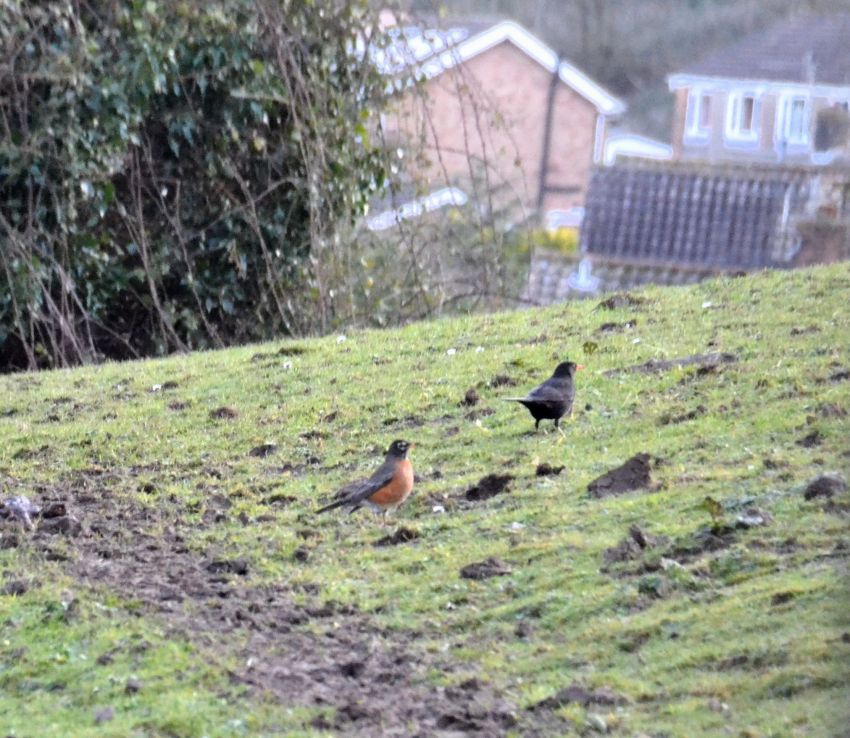
Soon the star attraction became visible again on the hillside behind the houses. This time I was one of the first to reach the end of a passage between two bungalows, managing to get an image of a kind (above). I am never comfortable about birding in residential streets, but here as on other occasions when I have done so the local residents were good humoured and tolerant, generally taking an interest in the bird themselves. When we walked back to the earlier spot the irony was not lost on my companion that several lenses were now trained upon the bush he had so recently abandoned.
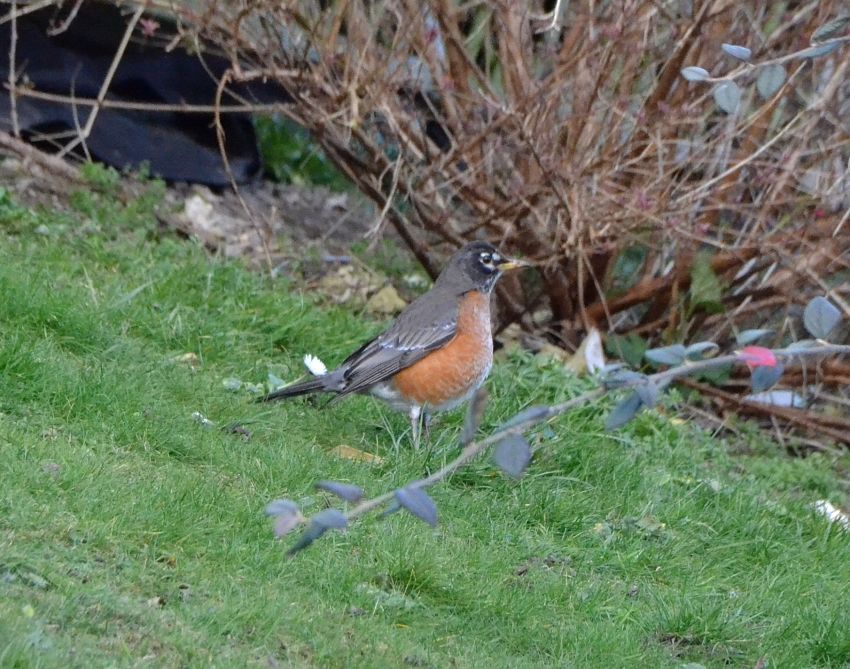
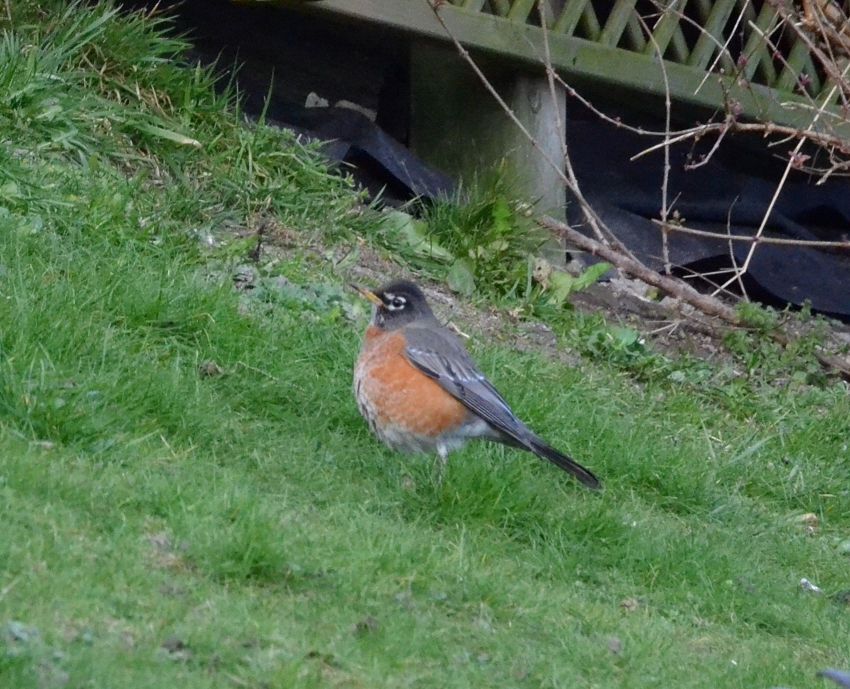
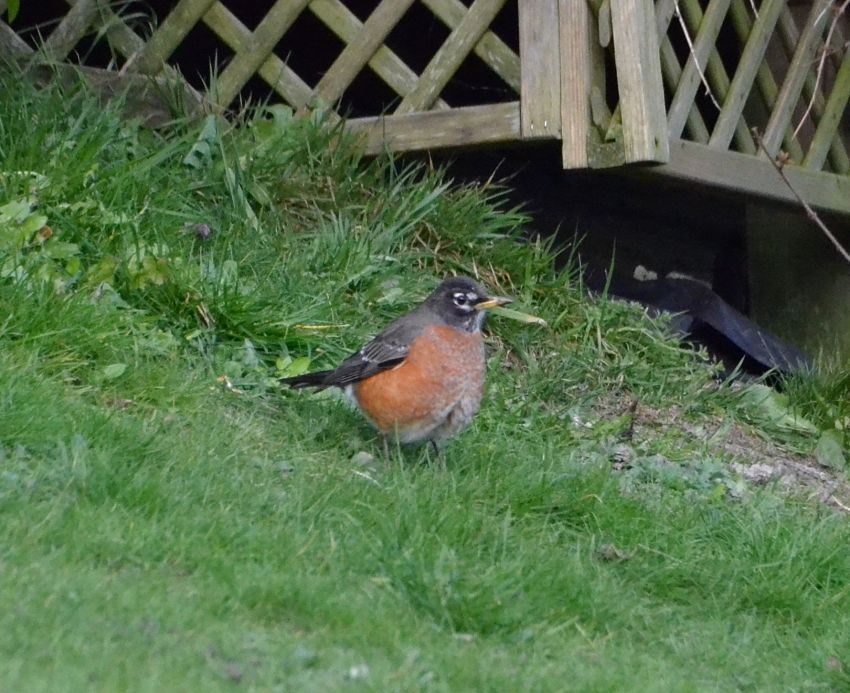
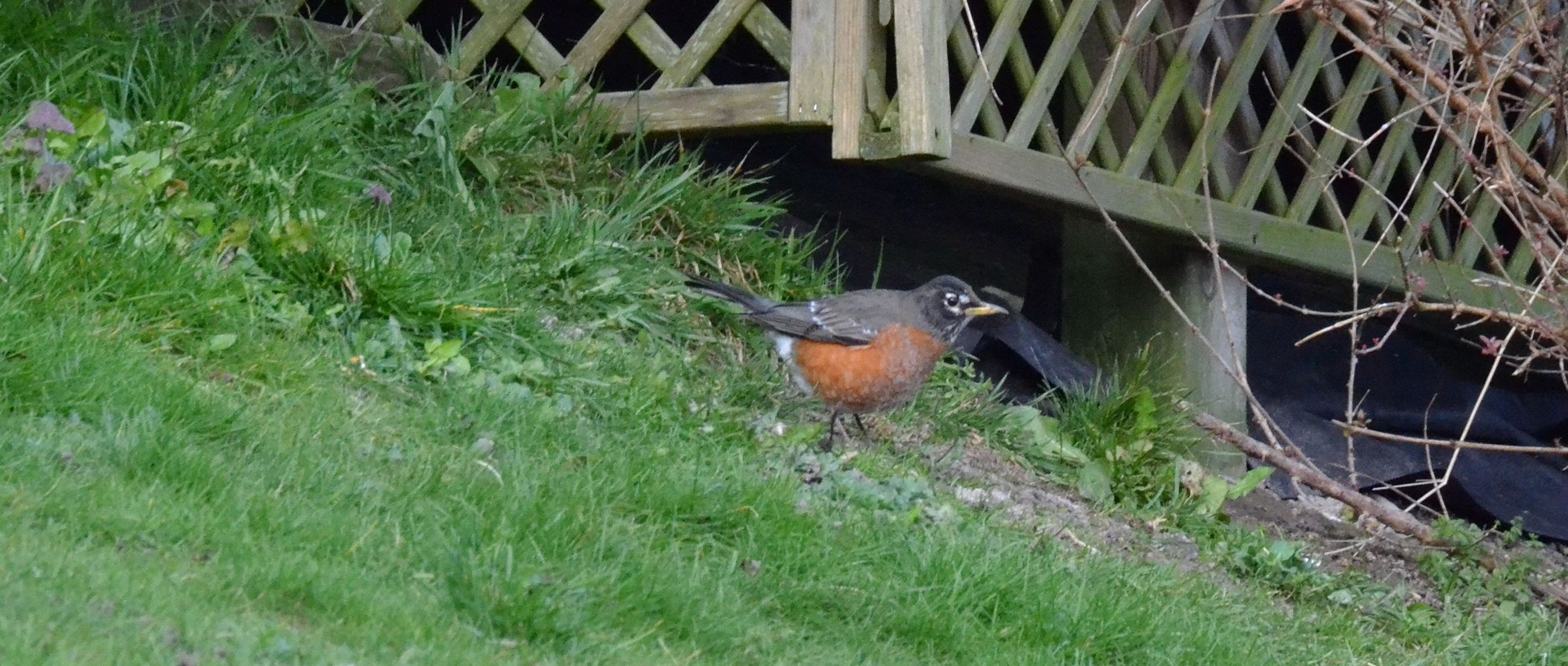
Things do not get better than what next played out (pictured above). The American Robin fed on the ground, digging for invertebrates just beyond that bush for around 20 minutes. In company with several other birders and photographers I walked around some garages to where there was a clear view, and everyone kept a sensible distance from our subject. Once the show was over the big lens contingent all began to chimp amongst themselves, dismissing as “crap” any back of camera image that wasn’t absolutely pin sharp and perfect, and showing their best results around. For myself I was delighted with the images I had gained. This was by any measure a cracking bird.
It was now 4pm, the light was declining and more new birders began to arrive after work. I hoped it wasn’t too early to brave the M25 and so headed home. If my outward journey had been tedious the return was horrendous, emphasising fully why I normally choose not to bird in East Sussex or Kent. Due to road works on the A27, motorway congestion and three leg stretching stops to counter muscular pain I have been experiencing this winter, the “manageable distance” took four hours to complete. To top everything even the in-car entertainment of a new SMKC album released today largely disappointed, something I couldn’t have imagined ever having to say. But I was returning home with life totals of 375 British and 513 WestPal birds, and nothing could take the shine off that.
 Ramblings and Scribblings
I’m pretty sure that I saw one on Nov. 6th 2024 of this week. I live in Polegate. I just happened to look out of my window when a bird landed on our car. At first I thought it was female blackbird, but something didn’t look quite right. It then turn towards me and it had a reddy brown chest. I knew it wasn’t any common bird that I know. I reach for my mobile to take a photo but my movement spooked him and he flew off. I immediately did a Google search and found this page. And the photos confirmed what I had seen.
LikeLike
This will not be the same bird I and many others saw in early 2022, but American Robin is a fairly regular winter vagrant from north America. You should in the first instance inform your Sussex county bird recorder: recorder@sos.org.uk
LikeLike