Could I squeeze a fourth meaningful wildlife experience out of the Canary desert island? Being unable to think of anywhere else to head for a deep-winter break, my assessment was possibly if I focused on the location’s most notable arid habitat birds – Houbara Bustard, Cream-coloured Courser and Black-bellied Sandgrouse.
I had observed Houbara Bustard on each of my three previous visits to the island (see here), but without the kind of crossing the road in front of the car or displaying at close quarters (here) experiences that other birders recount. CCC and BBS had each been encountered once previously. So this time I hired self-catering accommodation close to a prime area for all three birds of Tindaya Plain, with the evolved purpose of majoring on the Fvta speciality residents and hopefully gaining better pictures.
The proposed itinerary was similar to my most recent tripette to Alicante last September in allowing three full days of birding to accomplish a specific quest. That exercise was the best thing I did in 2022 by a distance. There can be little doubt that January in Blighty is dour, but winter breaks must never become repetitive and for their own sake any more than wildlife watching as a whole. Hence another successful seeking out of convenient flights and affordable accommodation saw me arriving at Aeropuerto de Fuerteventura in the late afternoon of 5th to test whether the foreign travel regime of four to six years ago could work anew.
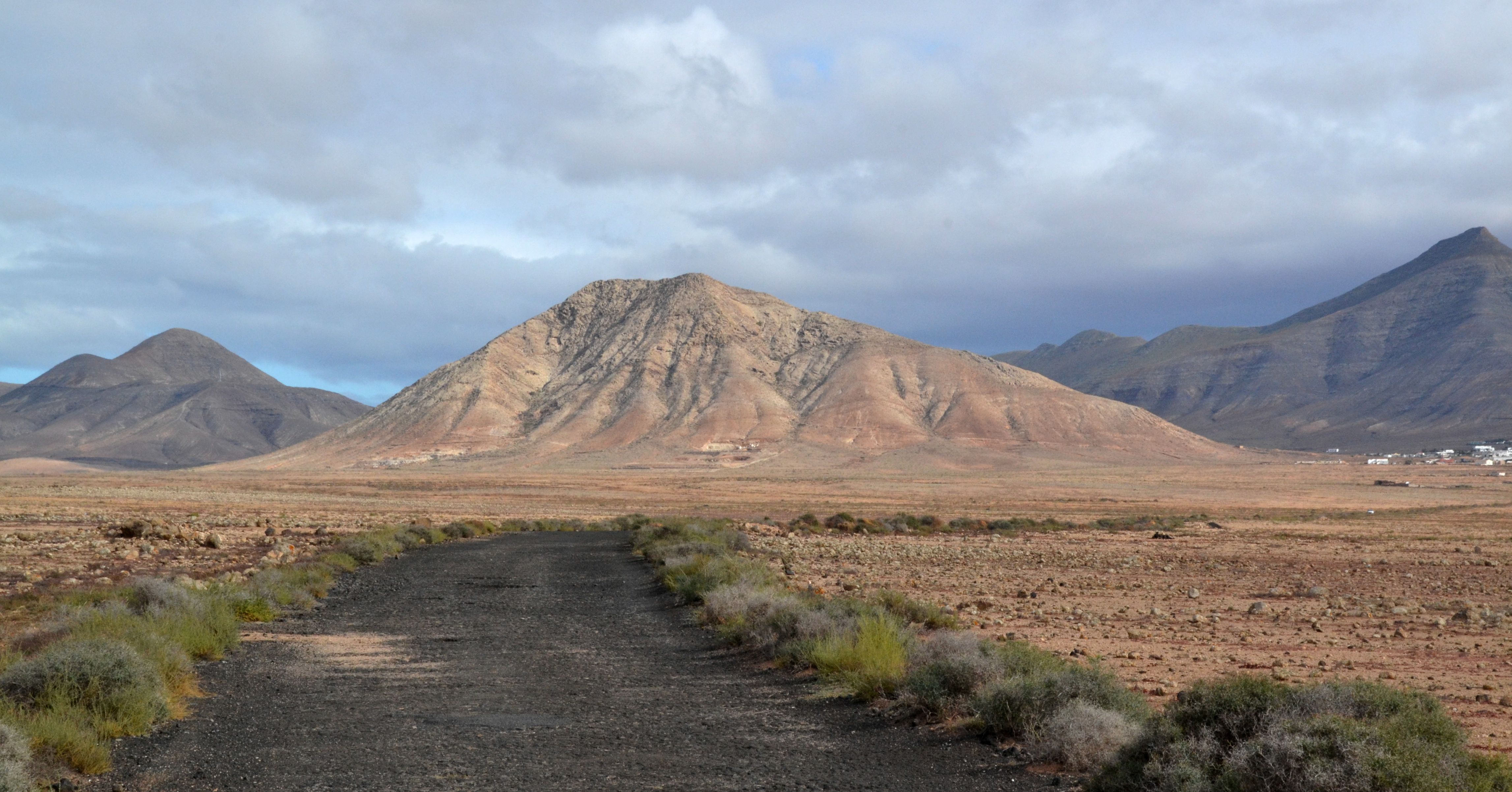
Tindaya Plain lying just west and north-west of the village and sacred mountain (pictured above) of the same name, is a flat expanse of semi-arid habitat with scattered vegetation, criss-crossed by a network of dirt tracks that are quite passable without a 4×4 vehicle. The technique is to drive slowly around using the car as a hide, scanning from side to side and stopping at intervals. This was where the displaying Houbara images of my January 2019 post were gained at 50 metres by another birder I met on that trip and I was seeking similar close encounters. Plenty more pictures and videos may be found online.
On the two mornings of 6 & 7th I got to site around 7:30am, soon after first light and spent the next few hours making a thorough exploration. This location was 15 – 20 minutes from my base. The highlight of these sessions was a career second sighting of Cream-coloured Courser. I have spent hours driving around and scanning moonscapes through my four visits to Fvta, hoping that one of the trillion-fold rocks that stretch away all around will suddenly move and morph into this desert wader. But when one is chanced upon they do stand out at once.

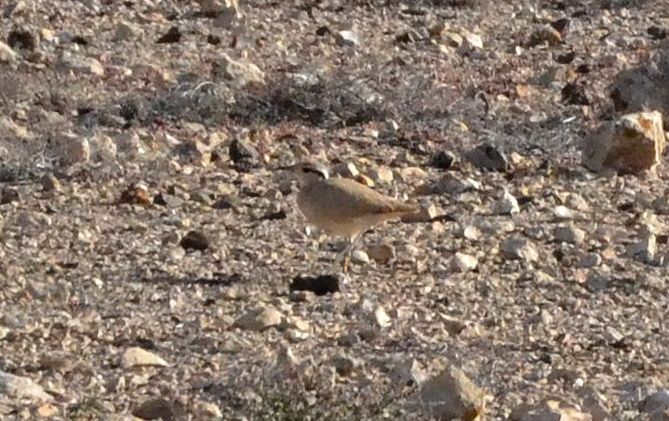
These are hyperactive birds that constantly run around as they seek out invertebrate and seed prey. The slim, upright, long-legged profile and bobbing jizz struck me as quite distinctive. On this occasion the blue back of head framed by a white and black stripe meeting at the nape was very noticeable, contrasting with the bird’s sandy-toned body and creamy underparts. The bill is slightly down-curved and used to dig for concealed food. Today’s bird would stop and watch around itself on occasion holding its head high, a further characteristic habit.
CCC has the most northerly distribution of a nine-strong genus (see here), being found all across northern Africa, through the Middle East and as far east as Pakistan. Six other Courser species occur in sub-Saharan Africa, and two on the Indian sub-continent. The Canary Islands CC population, which breeds from February to July, is one of four races. Unfortunately this 10 am Monday connect was the only one over my three days here.
By late morning on Tuesday I had become concerned and frustrated by a total lack of Houbara sightings, wondering if there was some reason why they were not showing themselves at present. After all I had observed them on previous visits to Fvta in each of December, January and February. If any reader can shed light on that in comments it would be appreciated. And so in the afternoon I relocated to El Cotillo Plain, which extends to the north of its Tindaya counterpart, so see if Houbaras might be about there later in the day.
I had not previously worked out how the two plains are linked, but now I realised Mt Tindaya is visible from the dirt track that leads south from El Cotillo itself. The two are separated by a Barranco that is visible in the picture below, and the connecting track runs along it for a short distance. When I reached that point I stopped, recalling I had turned back here on previous visits. I could see the point on the Tindaya side at which I had also turned back and so resolved to come back in the morning to assess the risk of driving through. This plan would allow me to test out both sites at different times from today. Returning to El Cotillo I once again crossed paths with no Houbara Bustards.
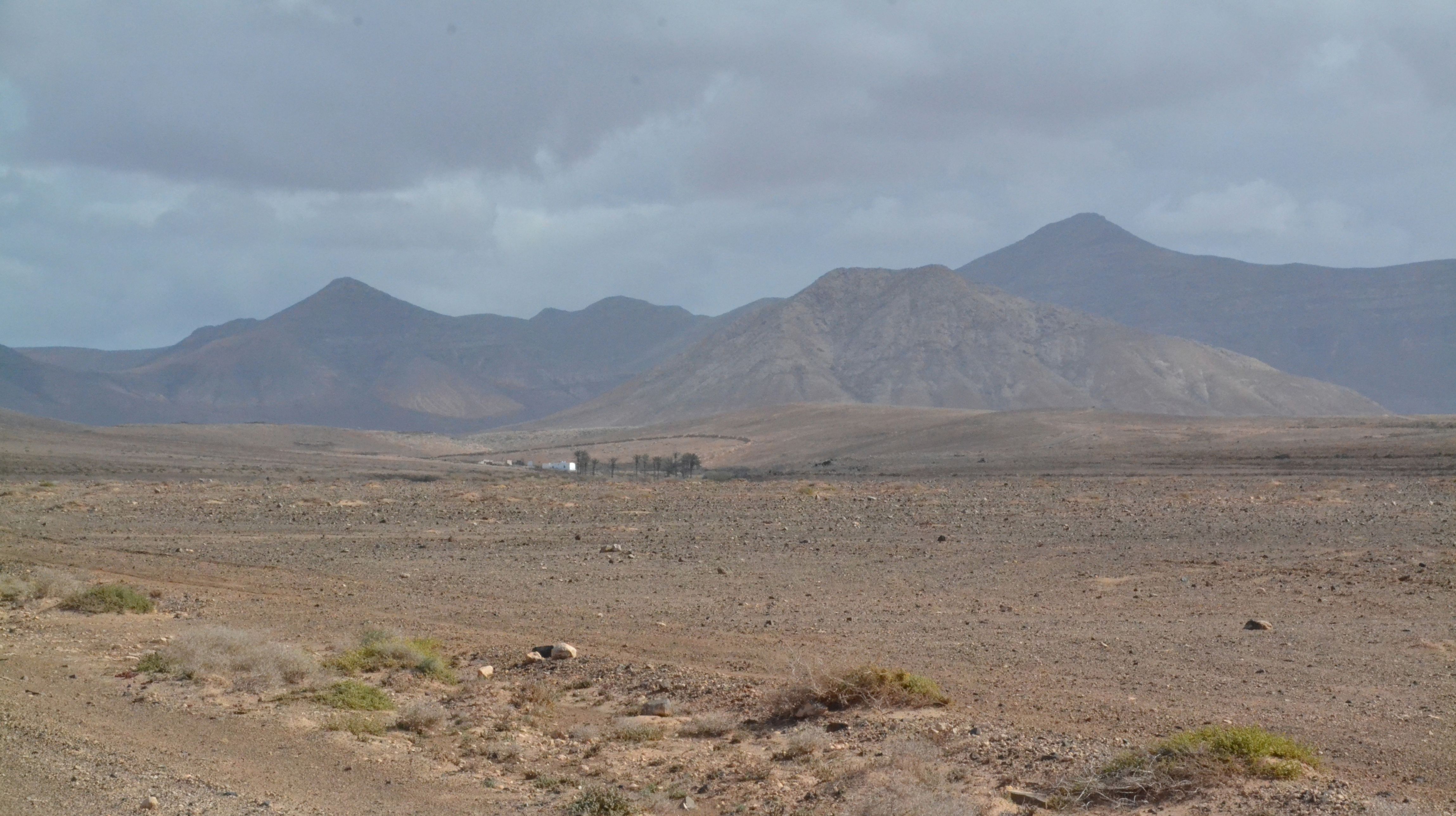
Just after dawn on Wednesday morning (8th) I drove out along the familiar route I had followed in 2015 and 17. The start point was just five minutes from my base and I paid particular attention to the hot-spot of three Houbara encounters on those occasions. Once again I drew blank, even there. On reaching the Barranco I walked ahead to inspect the road. It would have been passable but for one small, dangerous looking collapse. Some other vehicles were going through but I was not prepared to risk things in a hire car. That gave me a return attempt at Houbaras to the north but once again I drew blank.
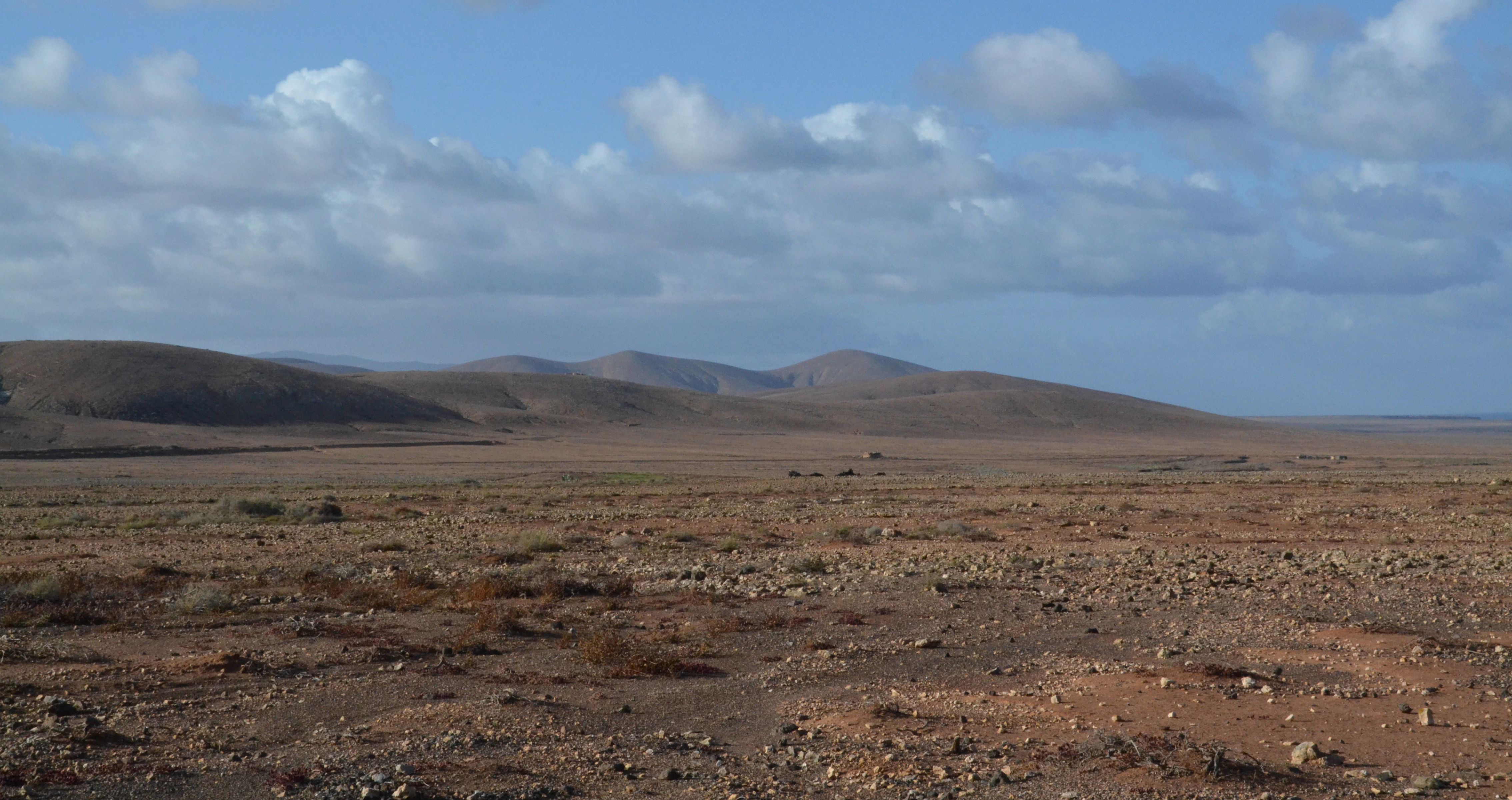
After going the long way round to Tindaya Plain I spent the rest of the day re-covering previous ground. At around 2:30 pm I headed out along a long track towards the coast, nearly to the end. In the middle distance away to the right was a green area that I scanned and picked out three long-necked birds walking into cover that could only be Houbara Bustard. It may not be apparent from the picture below but this vegetation was actually tall and dense enough to conceal the birds. I sat in the car scanning the area through my scope and 17 minutes later at 15:19 the sighting was confirmed.

My immediate reaction was if that is the sort of cover these birds keep to when not strutting their stuff it could explain why it had taken so long to find any. I had not come across too much habitat like it over the three days. Of course it is never known exactly how images and videos posted online are gained. Did the birders concerned go off piste and have mobile hides for instance, and if so how many days did it take to get their results? But there are enough accounts of roadside encounters with all three of my targets to suggest this expedition had produced a very meagre outcome.
By this time I was relieved to have gained any sighting at all, and it is always very fulfilling to self-find birds at the back of beyond. Being my first afternoon record and a first of Houbaras in cover it was also an evolved sighting in its way. The whole exercise was very hard work though and emotionally exhausting, so I cannot look back upon the experience with the required warm glow.
There is a fine line in solo travel between what works and what doesn’t, especially if the wildlife agenda is being largely dipped. For reasons not of interest to visiting readers this exercise fell below that line. So the answer to the question that opened this post is no. Like my attempt at a fourth winter break in southern Portugal in 2016 this was a tripette too far.
For more information on Houbara Bustards themselves follow the links in the second paragraph and below.
 Ramblings and Scribblings