This was as easy a twitch as any I can remember. Upon my rising today news of a potential British list addition within 80 miles of home was very welcome. Day after grey, damp, dismal day of late (when I am not working) has been spent largely at home and not finding much motivation for the same-old, same-old prospect of another local wildlife season. So this little diversion was enough to get me out of the door albeit with a fairly low-key, “tick it for Blighty” expectation.
I had observed Alpine Swift previously in Liechtenstein (2009), Provence (May 2012) and Greek Macedonia (Apr 2017). There are some British records in most years, and this week after south-westerly gales a 7-strong cluster in Ireland has been followed up by more occurrences in Cornwall, Devon, “briefly” in Merseyside (perhaps understandably), North Wales and Scotland. At just before 1pm yesterday what at once became a popular draw was found at an ageing nuclear power station on the Severn estuary, no doubt attracted by the insect-rich micro-climates that such facilities generate.
This item was confirmed as still being on-site at first light today, and early arriving observers videoed it roosting on the power station structure. I myself waited for rush hour traffic around both Oxford and Gloucester to subside before hitting the road westward in search of my 378th national bird, reaching Oldbury Power Station (ST607941) at just before midday.
On the approach road to the plant there was a lay-by containing several cars that I presumed belonged to birders. I was expecting to have to walk around the site to observe my quest from the north, but four birders with big lens cameras were stationed just a little back from the roadside. I enquired: “Surely you’re not seeing the Swift from here?”, and was told it would soon re-appear above trees on the opposite side of the road. Indeed it did and things today really were as instant and simple as that.
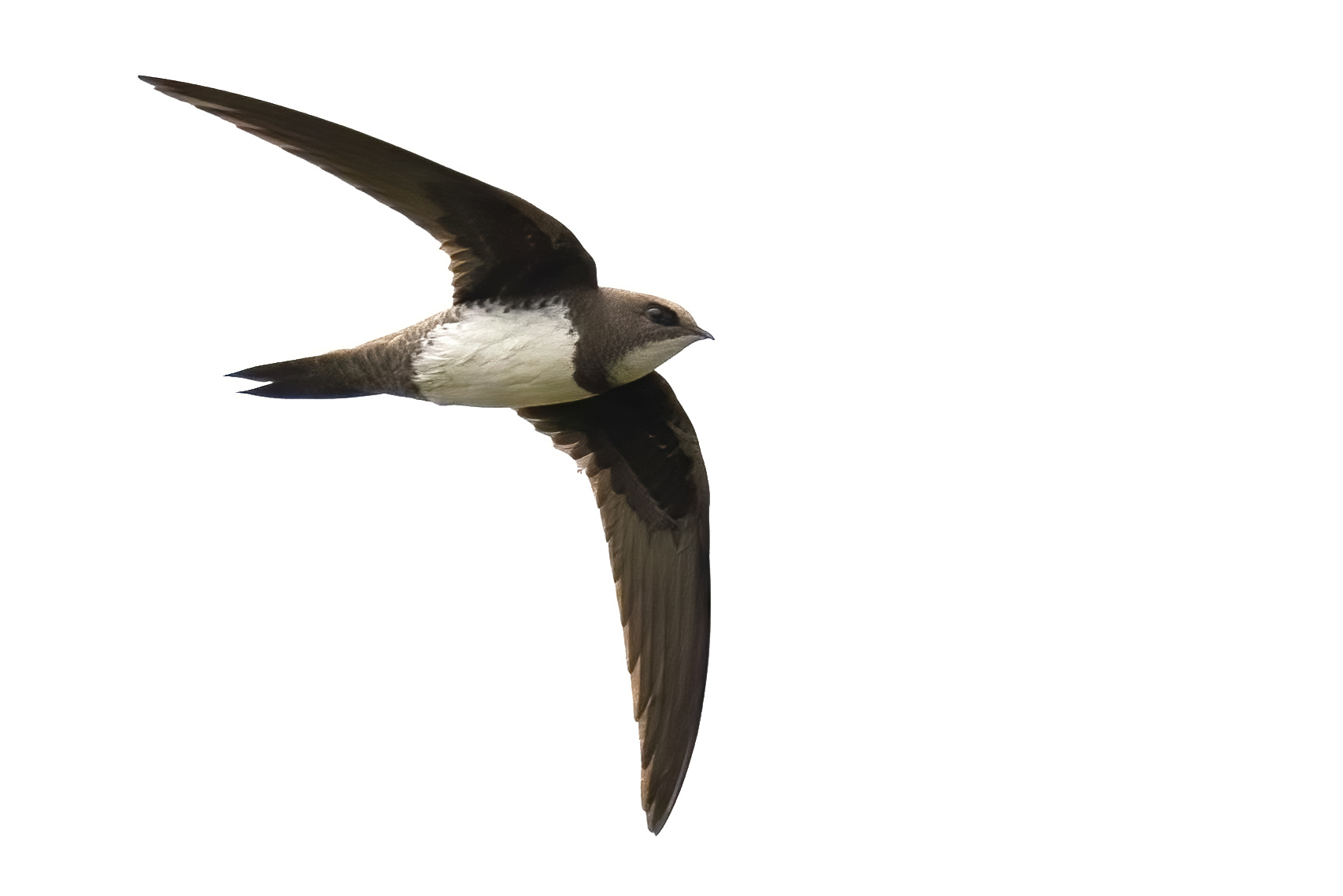
At 20-23cm this bird is up to 6cm longer in the body than our more usual Common Swift and has a maximum wingspan of up to 58cm compared to Common’s 44cm. That size differential was immediately apparent as my quest hawked for insects overhead, as were the white belly and brown breast band. A few Sand Martin were also on the wing here, offering a size and jizz comparison that served to emphasise just how big the Alpine visitor is. AS also has a markedly slower wing action with deeper scything wing beats compared to other Swifts.

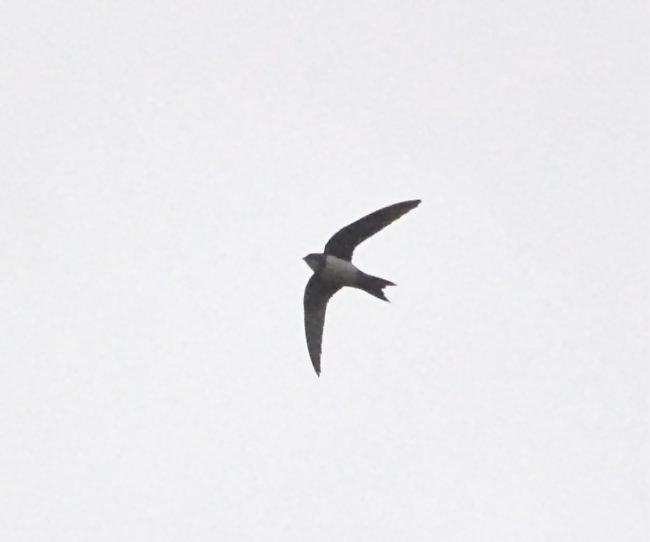
So this was a much more meaningful connect than I had anticipated, indeed as good an encounter as any of those previous ones. Alpine Swift breeds across southern Europe and north Africa on tall buildings, cliffs and rock faces; wintering in southern Africa. It seemed rude to not at least attempt some pictorial records with my equipment that I knew would not be adequate in the conditions. So I did and these (above) are the outcome.
Some of the other birders then followed a path into the wooded area opposite, leaving me with just one other person. I continued to watch the bird circling round and round, constantly on the wing as Swifts do, all the while just enjoying how unexpectedly close it was coming and what a complete species portrait it was offering. A birder then re-appeared in the gateway and called there was even better viewing from a field just through the narrow wooded strip. So I went through joining several big lens toters who were all trying to gain acceptable images in the damp and overcast conditions, then continued to commune with this superb bird.
In all I remained on site for around an hour before rainfall became steadier and I headed back home. The bird roosted overnight again on the power station and left during the morning of 17th. Through that day there were other national sightings of Alpine Swift in Cornwall, Dorset, Northumberland, north Devon and lastly Somerset in the early evening. And what became a record breaking influx continued over several more days. This was a very agreeable British tick twitchette as I edge ever closer to my lifetime target of 400 birds, the majority of which have been within 180 miles of home.
 Ramblings and Scribblings