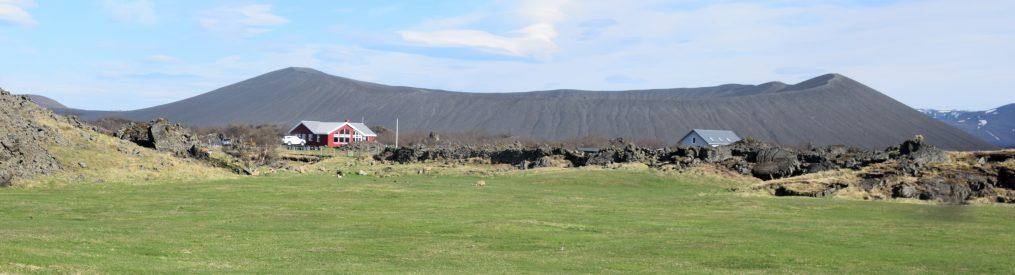
My wish list for this trip was compiled from missed trip targets on the 2019 Greenwings Clouded Apollo tour. In attempting to research where to find them I consulted what trip reports from wildlife tour operators I could find online, but those understandably do not give away precise site locations. But the town of Siatista is a centre for some tours and above it is a range comprising Mounts Stalos, Askio, Pyrgos, Sideras and Skopia, the last of which is cited as a location for some species I was seeking this time. So that is where I decided to concentrate my search.
Just outside Siatista on the road to Galatini a right turn goes up into those mountains along an unmade road that is perfectly passable without a 4WD. I had imagined this led into the foothills but it is actually a service road to a wind farm and so runs along the heights to where the turbines are located. Cloud of course sits on mountain tops, colder winds blow up there than below and weather patterns can change very quickly, none of which is especially butterfly friendly; so this was going to be another challenge.
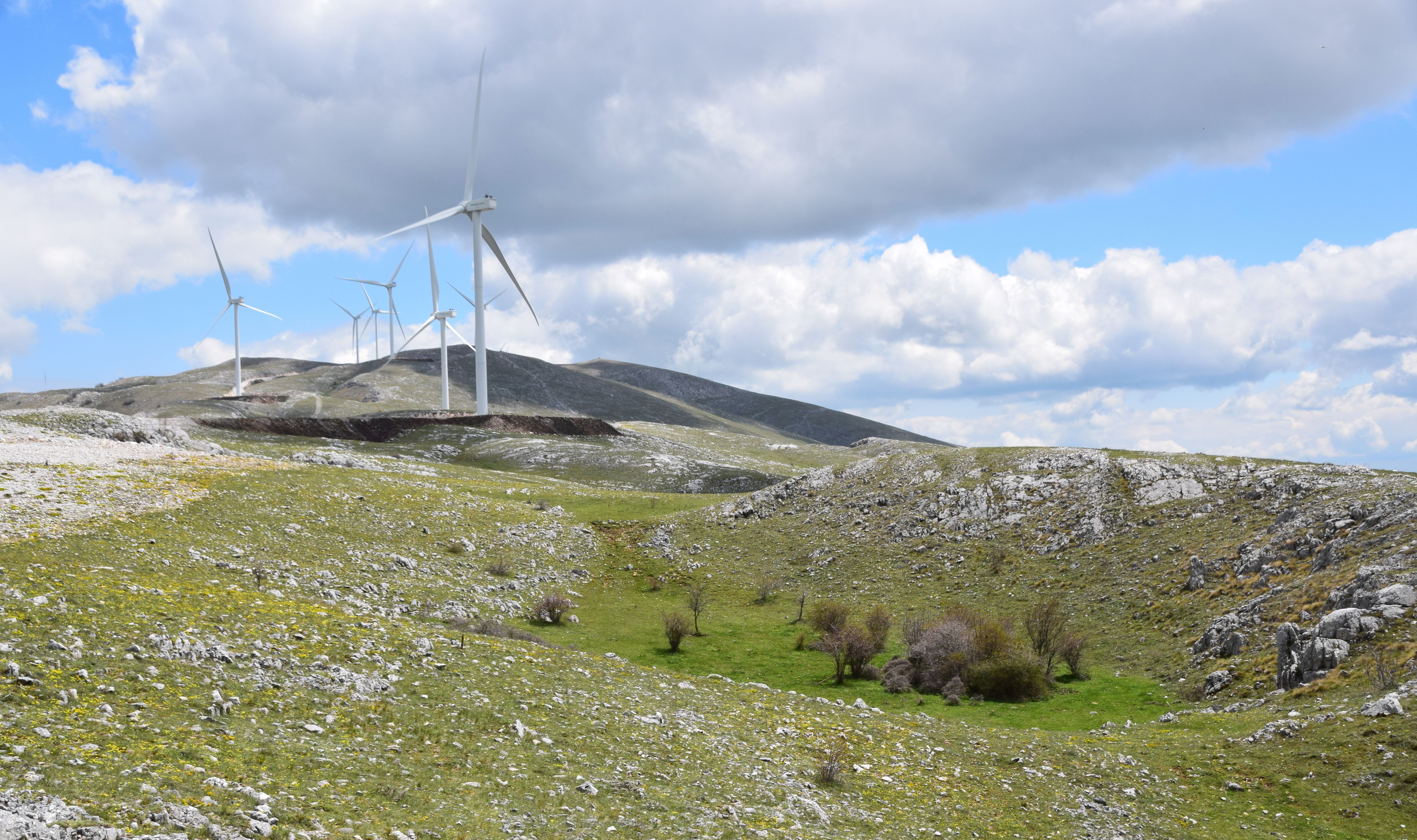
The wet weather finally relented on Friday (5th), but cloud still prevailed and I was expecting nothing more than a typical butterflying day (such as at home) of waiting for sunny interludes. After exploring the length of the route in mainly misty conditions I decided to come back later, but on the descent noticed butterflies for the first time in a sheltered gully above the road. Stopping to investigate, both Eastern Wood White and Grüner’s Orange Tip were immediately apparent on the wing. Some mysterious, larger, dark butterflies were also flying fast further up the slope but I couldn’t get close to them. Peacock perhaps or could they be the trip target Dalmatian Ringlet?
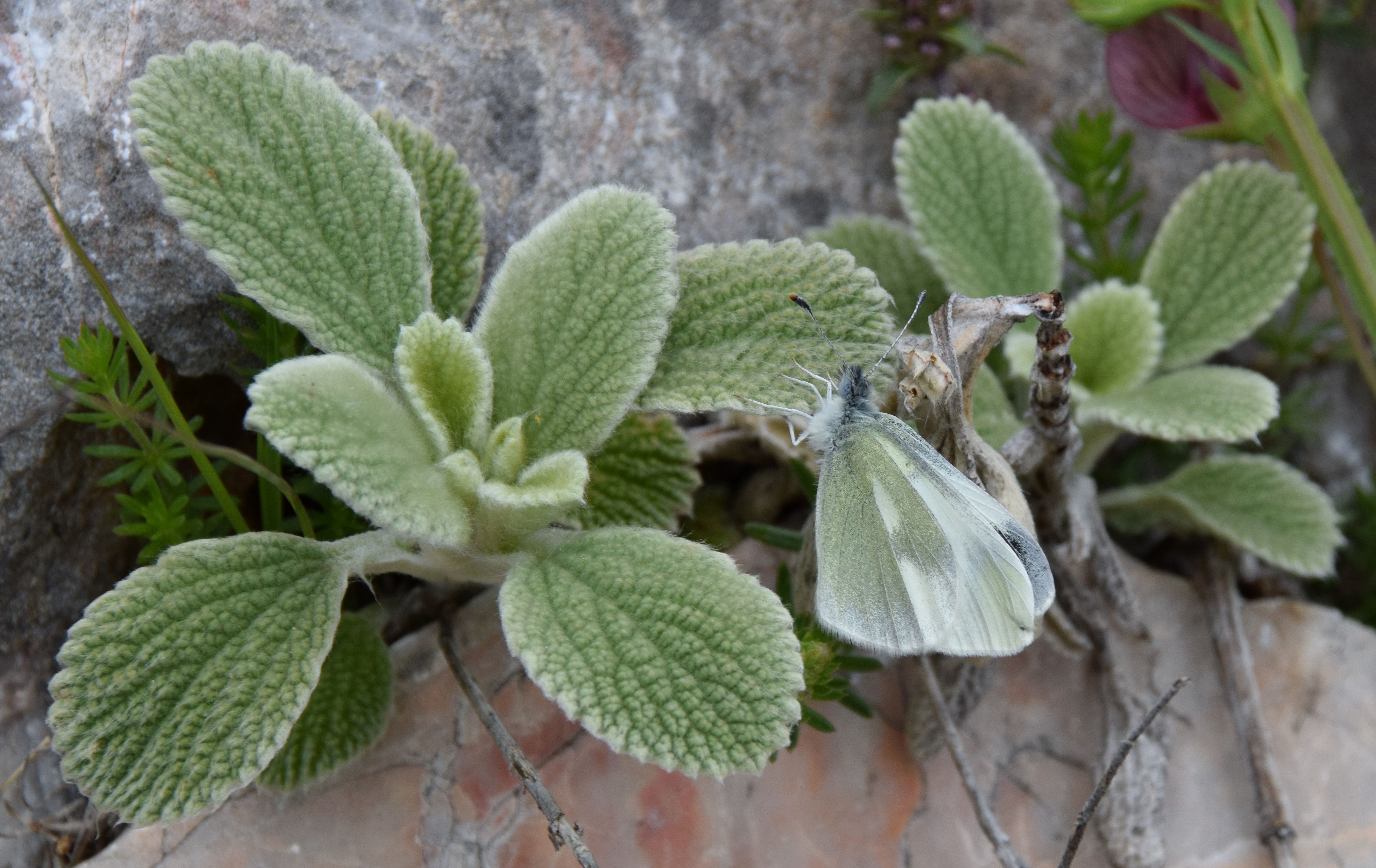
Eastern Wood White (first brood)
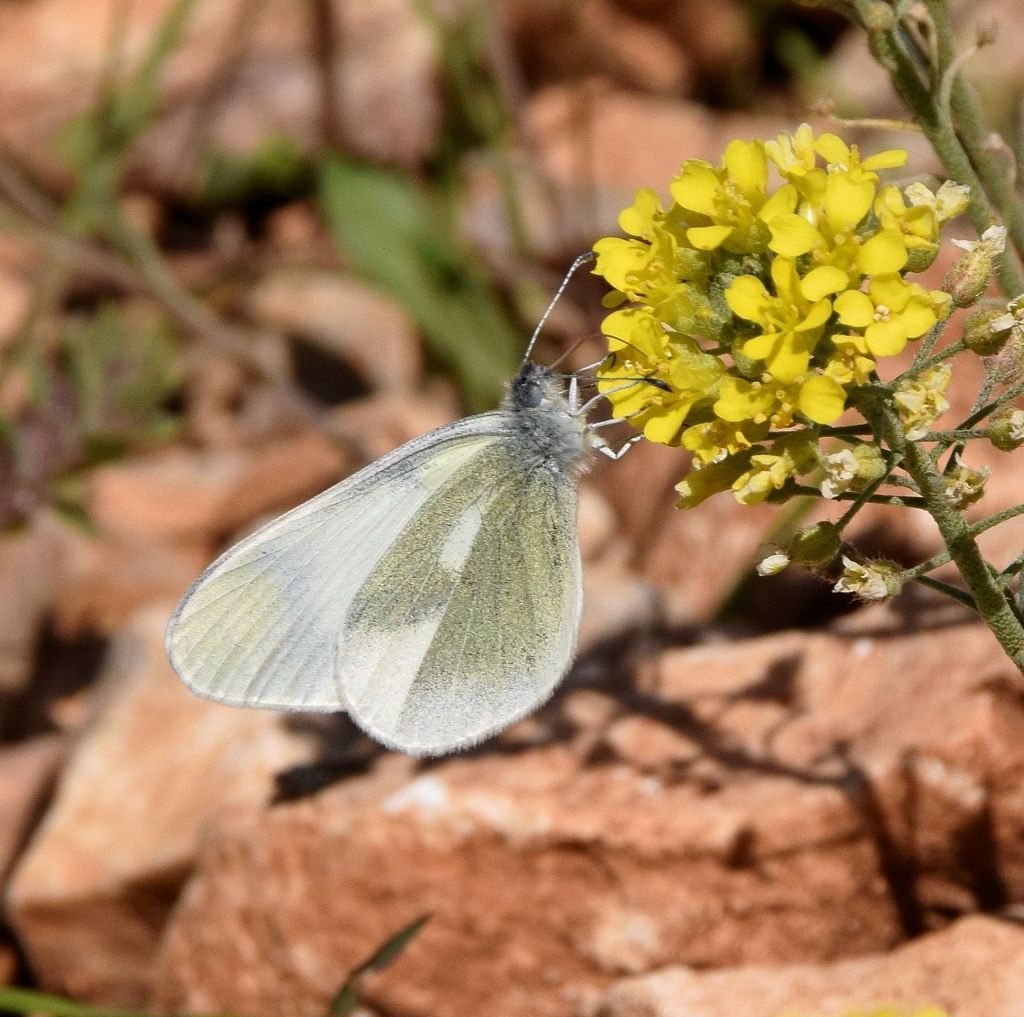
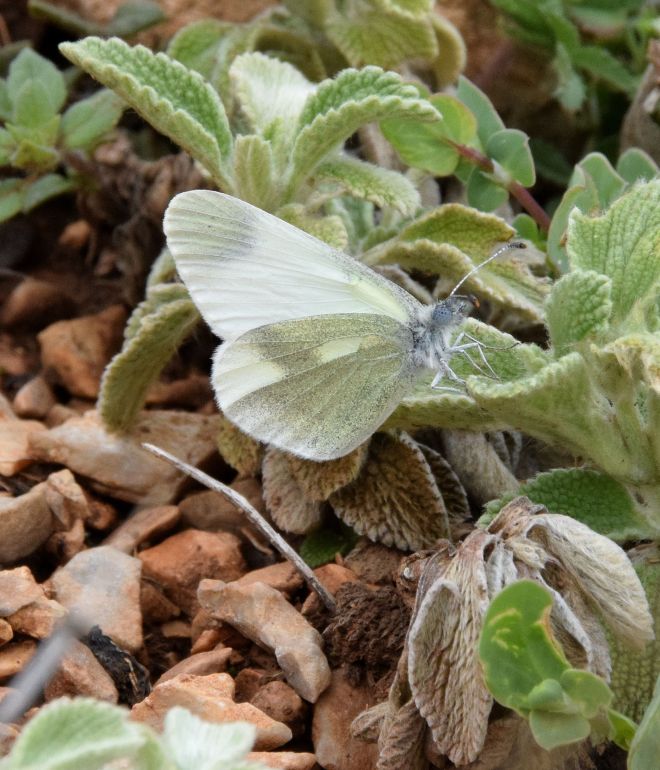
The first of those (Leptidea duponicheli) – see here), which I had observed twice previously in northern Greece, from where its range extends through the Balkan region, occurs in a range of habitats including open scrub such as here. But on receiving an accurate ID for my observation I was surprised to have encountered a Wood White sp at such altitude. Eastern Wood White is easier to identify in the first than its two subsequent broods, the unh markings being green when fresh, fading to grey with wear. A detailed guide to separating it from Wood White (Leptidea sinapis) may be found here. I believe the rectangular white marking on the unh wing that these pictures show is one diagnostic.
The Grüner’s (pictured inconclusively below, top left) seemed paler-toned than those I had observed in Greece’s Rodopi Mountains in April 2019 (see here), and like all Orange Tips were difficult to gain adequate pictures of. But the yellowish ground colour of this localised species was more apparent in the field than in sub-standard images that I managed. Other butterflies seen in this post’s location over the two days were Dingy and Grizzled Skipper, Green Hairstreak, Green-veined White, Small Copper, Common Blue, Small Heath, Wall Brown and a solitary Spotted Fritillary.
Three Southern Festoon (below right) in the gully described above added a little more of a regional flavour to the list, which as at this trip’s first centre could only be described as very modest. And then there were those elusive, dark, fast flying numbers … what were they?


My final day in Siatista, Saturday 6th was to begin with the sunniest of the four. After checking out the same gully again without better results than a day earlier, I went all the way up to the aforementioned Mt Skopia but the wind was just too strong and cold up there for butterflies to be active. Hence I moved back down again systematically checking out the more sheltered hollows and gullies noted on the ascent. Still just one Grüner’s was the only butterfly encountered until in the spot featured in this post’s lead image one of those dark fast flyers landed on the ground close by. Conditions being momentarily overcast this item kept still and was indeed Dalmatian Ringlet (pictured below), of which several were active in the same hollow.
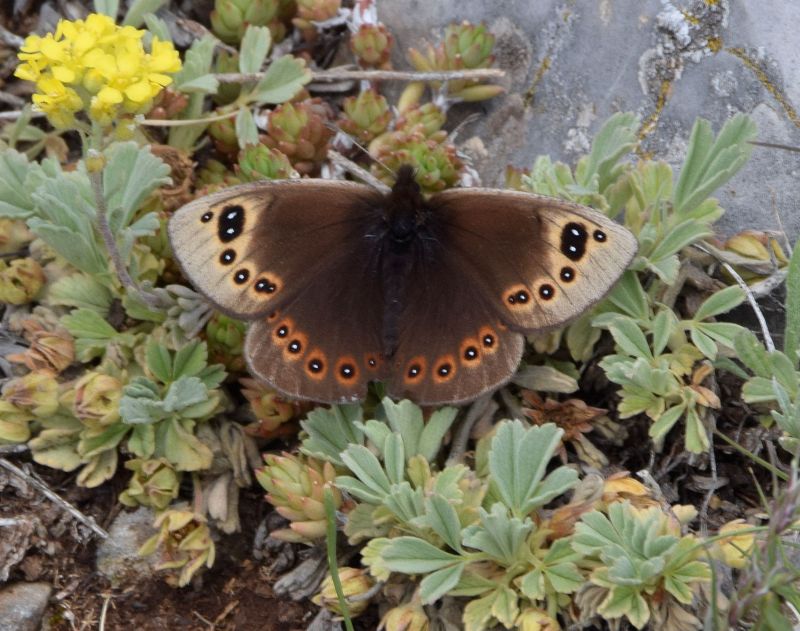
A huge wave of relief swept through me as I acquired unsatisfactory pictures of the third trip lifer. It is the only Ringlet to fly here in late April through May, and was bigger than I had expected. A distinctive member of the extensive Ringlet genus, it occurs only in a small area of north-west Greece as well as along the Croatian coast; and though very localised can be quite numerous where it is found. This butterfly favours warm, dry, grassy, rocky slopes, on which it flies just above ground level with an undulating jizz. As I had experienced over these two days their large, black forms are highly visible from quite a distance.
It was now the sunniest part of the day but I was very hungry, so with the journey back to the airport for a late departure ahead of me I went back to Siatista for a sandwich break. On the descent the tell tale presence of Krueper’s Small White and Dalmatian Ringlet were visible in more roadside gullies similar to the one I had spent time in. Then below that favourite spot I noted several Dalmatian Ringlet at the roadside that had dispersed when I reached them with the camera. The rocky slope above was alive with their dark, hyperactive forms. There are certainly a lot of this local speciality in these mountains.
Alas, when I came back with food the grey stuff had returned with me and the rest of the afternoon was far less productive than the morning. Butterflying, being so weather dependent is rarely easy and I had gained just three of my 15 mostly difficult trip targets on only one fully and three partially suitable days out of six. I had already decided to do Orchids at home for the first time as a project this coming season, which is perhaps just as well with the weather outlook for Blighty looking little better than in Greece. But unlike 2023’s earlier trip abroad to Fuerteventura, this first solo exercise in a country I like very much had on the balance of things been worthwhile.
 Ramblings and Scribblings