As things have transpired, this wildlife year has concluded as it began (see here), with twitching a vagrant Nearctic passerine. It has been a number of mid-winter seasons since something truly diverting in the birding sense has been available over the festive period, but now a probably storm-blown and surviving earlier autumn migrant had announced itself on 24th just under 100 miles from home. I imagined I was giving things a couple of days to calm down, but could not have been more wrong.
During the former time when I started birding in the 1980s, I recall there was a thing called the ‘UK 400 Club’ of people who had recorded that total of species nationally. Nowadays such leading twitchers are well into the 500s, amongst them some close birding colleagues. But I have never been hard-core and so have retained 400 as a lifetime’s ambition, whilst keeping largely to a 150-mile or exceptionally greater driving distance from home. There remains a small wish list of Westpal lifers I might yet travel to see, but stray megas from either east or west within manageable range can also mobilise my interest.
Hence on the appointed morning I arrived in an industrial estate at Snodland (51°19’35.4″N 0°26’56.8″E) to the south-west of Rochester at around 11am, and stopped amidst a tell-tale accumulation of parked cars. Then I walked out along a track by a stream between a former gravel pit complex and a modern-day sewage facility. Seasonal family duty and the wish to avoid divorce had clearly held sway up until today, but as things turned out this was to be one of the biggest twitches I have ever attended (pictured below). As has become customary since we usually go for the same birds, I kept in touch with Adam who had been with relatives more locally and so went out to connect on the previous day (see here). Another Oxon birder had quite fortuitously been even closer on 24th (here).
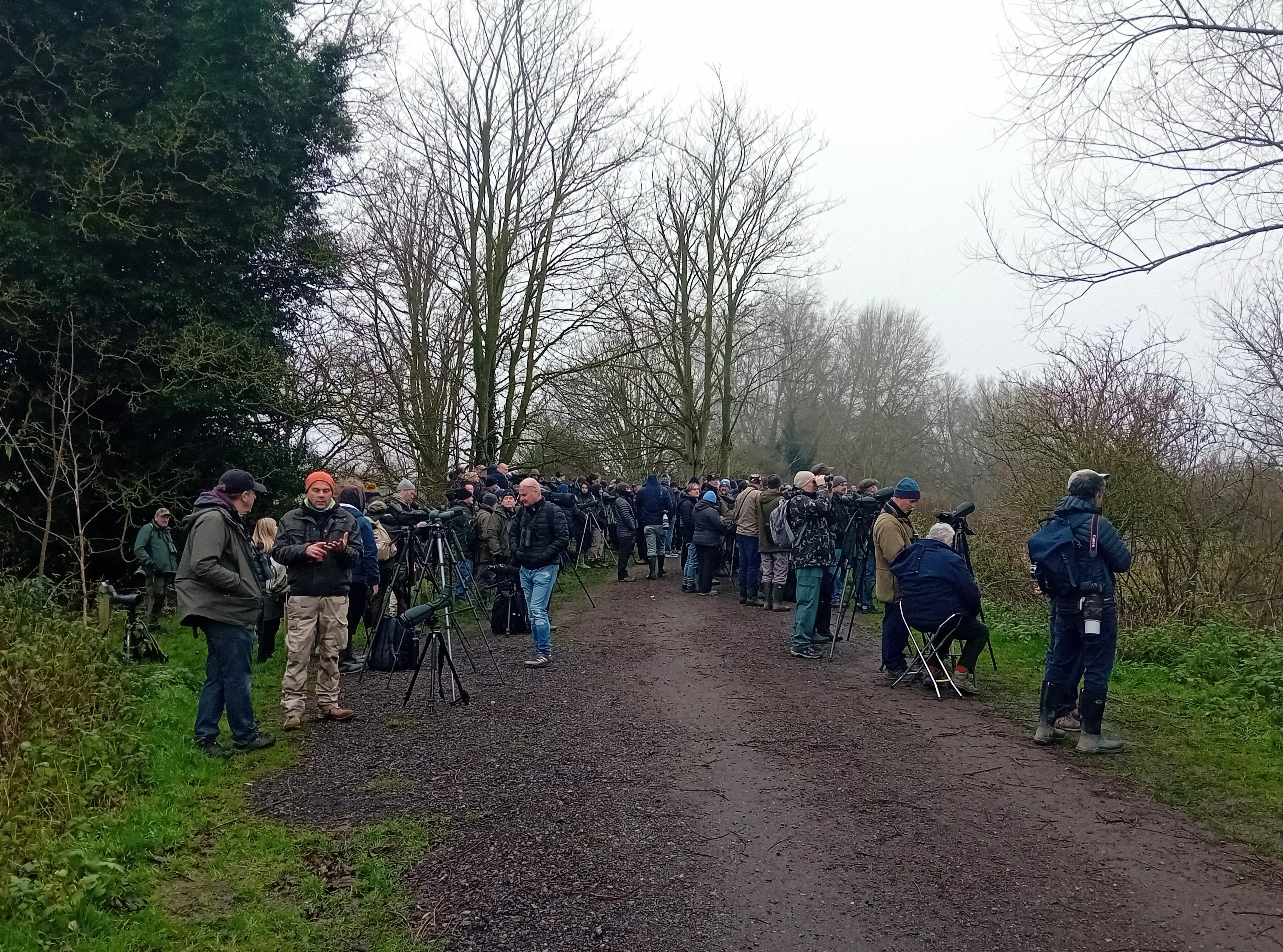
I timed my own arrival to coincide with when the bird had become most active in each of the preceding two days. Then it had also been seen once earlier in the day, but not this time and some of the 300-strong assembly had been present since first light. I took up a good position opposite a group of five Alders across the stream that was cited as the most reliable spot on my quest’s feeding circuit. Around 90 minutes later there was a sudden rush further along the path which I followed, getting there to mutters of: “Someone says he heard it.” Then the focus of attention switched immediately back to where I had hitherto been waiting.
I should have stayed put. Now the Yellow Warbler was in the Alders and various people around me were issuing directions as to its movements. I was standing behind someone who was actually on it, but I couldn’t pick it out. All was over in a matter of seconds as the bird flew into the sewage works. Someone else remarked it would be warm in there with lots of insects, and that is why the vagrant was here. My understanding is that conditions needed to become suitably benign for it to emerge from that comfort and fly-catch in the surrounding trees. In the immediate aftermath human numbers seemed to swell to possibly double those on my arrival.
This was not my scene at all, and a situation I usually seek to avoid. Waiting for almost two hours more, I reflected ruefully on why I prefer to be butterflying alone on southern European mountainsides, or as engrossed crawling around on all fours taking macro pictures of fungi or wild plants. I didn’t doubt I was in A-list twitching company, but actually saw very few familiar faces. Then at 14:20 several people behind me as one pronounced: “It’s calling.” The Yellow Warbler was back in the Alders, and directions were issuing from all around. Fortunately I was positioned next to someone who was very good at it, and the familiar surge of relief that comes when a long, frustrating wait ends soon coursed through me.
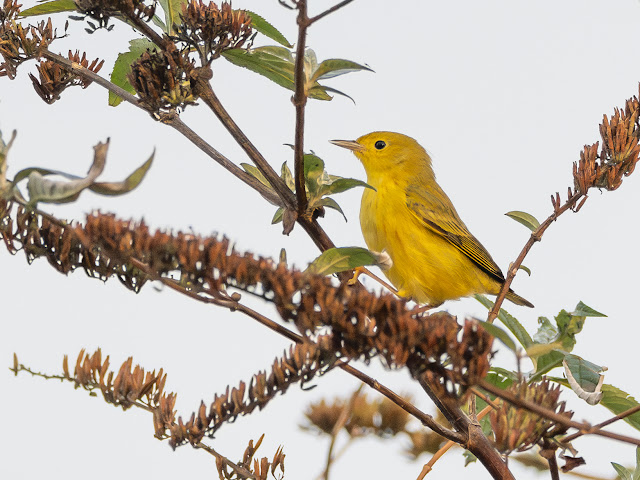
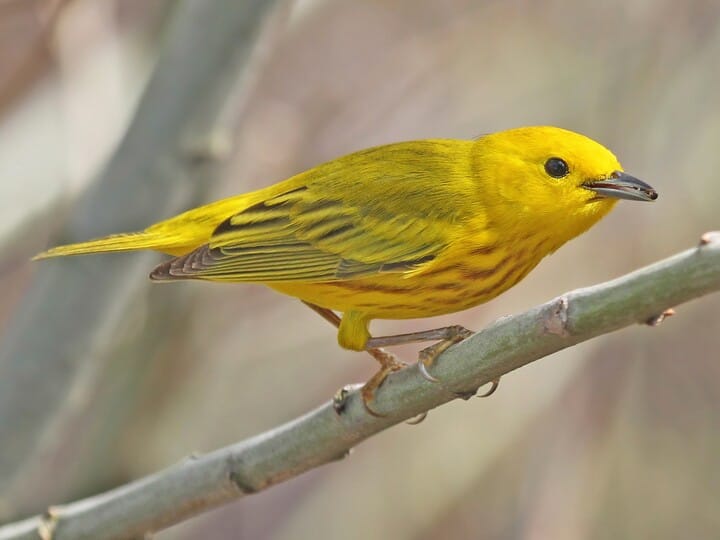
Despite being a very common Warbler throughout the Americas this is an extremely rare vagrant to the British Isles. Though there are said to be five historic records, it was added to the British list only in 2017 when an individual was located for less than one August day on Portland, Dorset (see here). I remember the occasion well having been on site with Oxon colleagues Ewan and the Wickster at first light the following morning. The major Nearctic landfall of 2023 brought three more to Shetland and Argyll. This post’s far more accessible bird is the first ever in winter, and making up for a previous dip is always satisfying.
My initial views had been good enough but better was to follow. The crowd moved back up the track, and hence in my direction out of there, stopping before a particular tree. Then at close range in my bins I re-found this male bird, perched momentarily in all its bright yellow and green-tinged finery against the trunk. It flew off to one side, some people followed, while others like myself headed for the parking area. By the time I got back to my own car a little further on, a steady stream of birders were leaving site, all smiling and chatting with the satisfaction of a successful twitch. A newly discovered Scops Owl around 50 miles further east at Broadstairs was no doubt awaiting some of their collective attention, but the night drive home from there was not something I wished to consider.
In the event the journey back to Oxford was horrendous enough. Google Maps announced two hours and 40 minutes for the mere 98-miles, so I headed for the Dartford crossing instead to encounter a six-mile tailback. As I escaped and turned back at the A2 interchange traffic was stationary beyond it. Things were then not too bad until I reached that familiar stretch of the M25 parking lot where the M3, A30 and M4 successively disgorge quantities of traffic onto the London orbital; while the ‘savvier’ leave the main carriageway before those junctions and rejoin afterwards, which perhaps might be a little quicker at least for them. Once I gained the relative sanctuary of the westbound M40, the sheer volume of slow moving traffic in the opposite direction served to speed me on my relieved way home; as so often seems to be the case when I might venture out on a Sunday.
Someone had yet contrived to break down in the outside lane as I passed through the Chiltern escarpment on re-entering God’s own county Oxon, to offer the day’s final obstacle. All this reminded me of why I no longer do much twitching, but hey … my 384th British bird was in the bag and that result was all that now mattered. I can easily make up my career goal’s remaining 16 records if I perhaps get around to and find suitable company for a Scilly pelagic and more productive Scottish highland experiences than my 2019 trip. Or I can just carry on picking off randomly occurring and realistic targets such as this day’s.
 Ramblings and Scribblings