I cannot recall ever having observed Slavonian Grebe in their very striking summer plumage, and definitely have no past pictorial record of one. So when at 8:30 this morning the Oxon WhatsApp scarcities alert announced an early Farmoor regular had found a pair in their full breeding finery, it was a “get out the door” moment. It takes something a bit special to draw me out birding locally now, but the buzz and sudden sense of motivation that at once seized me was just the same as it had ever been.
Not quite so when an hour later I arrived at the cited corner of F2 to find neither birds nor birders, just two boats manned by fee-paying anglers. My quest had clearly been flushed elsewhere and another alert at once revealed the new location, which was as far from the former as it could possibly be. Cue a stomp that doubled as a respiratory health check, until I met up with a small group that included both Ewan and Badger. They were watching the two drifting Slavonian Grebe as distantly as another birder who had shown them to me in his scope on my way, and I picked them up in my own bins. That proved to be the scenario for the ensuing five hours that I spent here today.
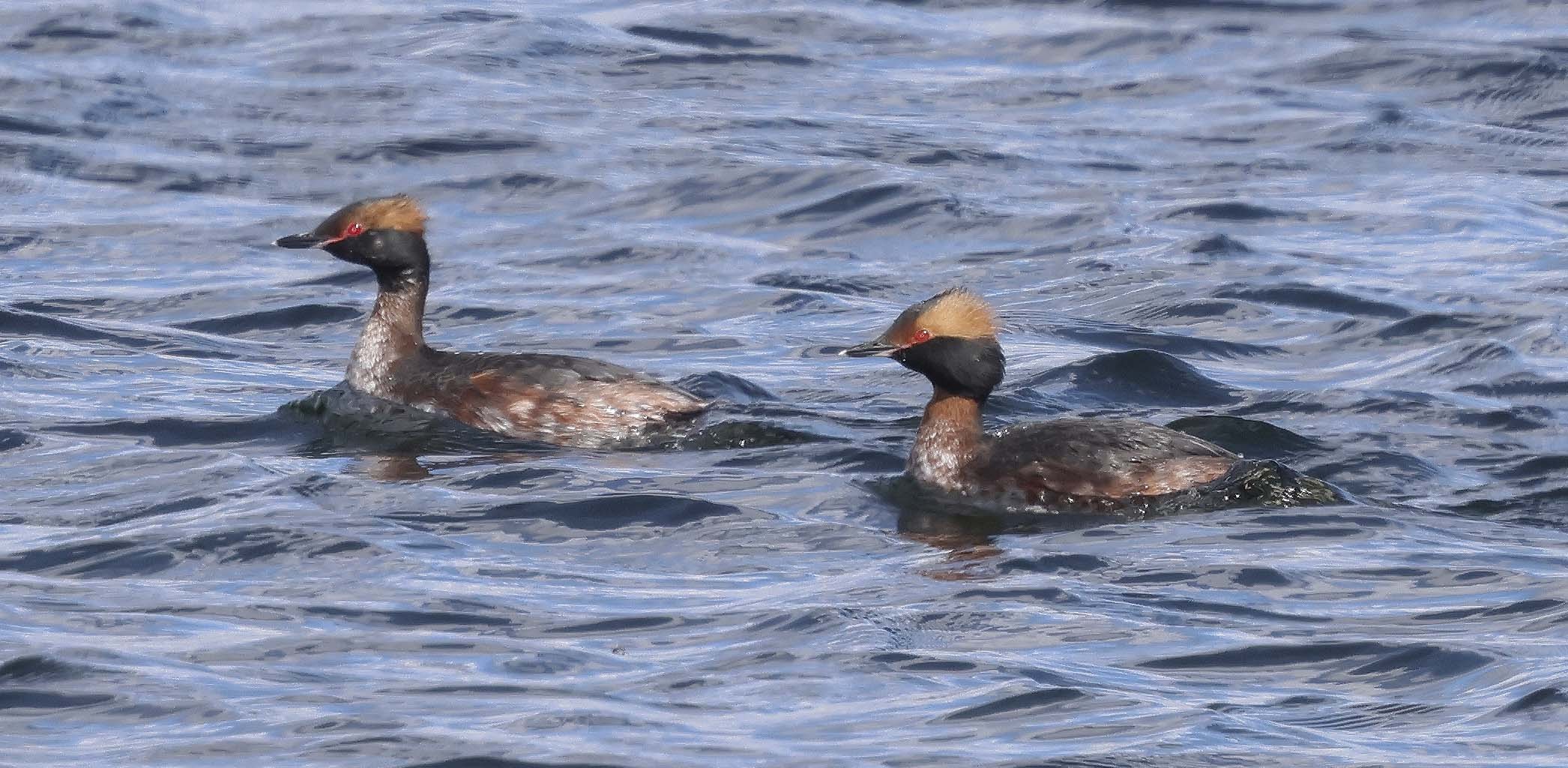
This initial gathering dispersed, while Ewan and I repaired to the sailing club café to await developments. Suitably revived we decided to tramp the opposite way around F2’s breezy two-mile perimeter, in the hope that now active wind surfers or other recreational activity might displace the birds into a safer and more sheltered corner. Eventually, with the help of another birder, we tracked them back almost to where they had first been reported. Then, after offering some quite reasonable views, they drifted back out to the middle of the reservoir.
These birds were noticeably fast swimmers, and at intervals would take flight from speedily approaching wind surfers and relocate even further away. But for a second time they did move closer inshore, though never near enough for the quality of pictures I or others were seeking. We managed to persuade passing less-experienced bird watchers and general public agreeably to keep back from the wave wall, but still the wary Slavs would only get so close before drifting quickly away again.
The pair would have been moving north, probably to breeding grounds in Scotland, Scandinavia or possibly beyond. The small and now declining British breeding population of Slavonian Grebe is restricted to a few lochs in the eastern highlands of Scotland. They winter either in more sheltered Scottish waters or around the English coast mainly from East Anglia to Cornwall. Further afield, the Eurasian sub-species is distributed over most of northern Europe and northern Asia. Range losses have occurred across much of Europe and this item is consequently listed as vulnerable on the Global IUCN Red List.
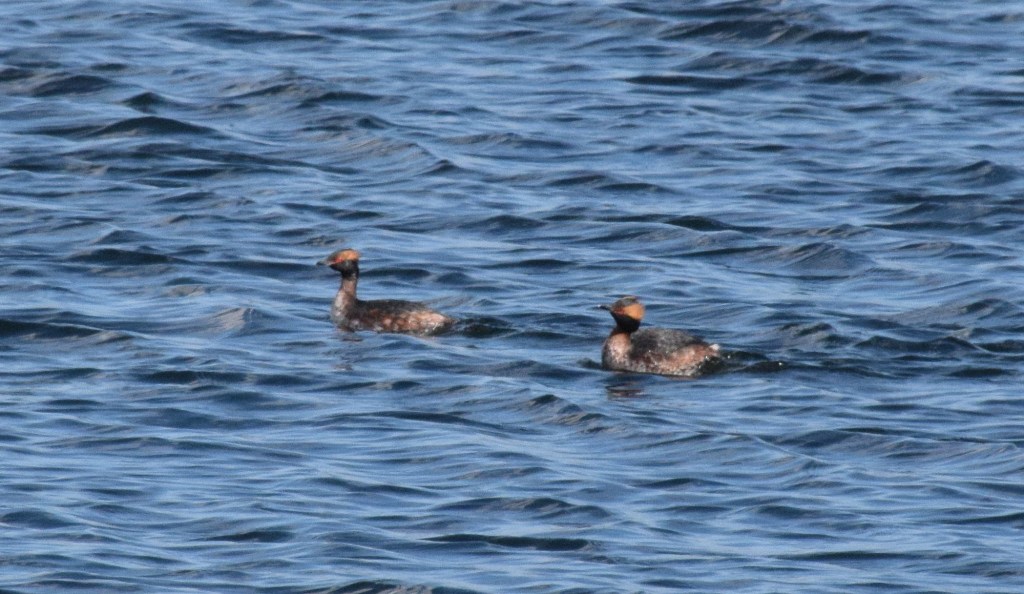

We must have walked over five, even six miles pursuing today’s birds, and the longer it went on the more mobile they seemed to become. I was surprised by how few of Oxon’s finest were present in the morning, but as we left in mid-afternoon a steady stream of birders was moving in the opposite direction. The above record shots are my own first of this plumage, to realize that ambition in kind. In the prevailing light conditions nobody seemed to be getting anything really good, but this post’s images do show how these scarce Grebes were actually seen. It was an enjoyable day doing something new and different in Oxfordshire, and overnight the birds went on their way.



 Ramblings and Scribblings