I think it is reasonable to state that recording the subject of this post in the British Isles must involve ascending above the snowline on Scottish Highland mountains at certain times of year. Indeed I recall when that appeared to be a popular pursuit amongst some fellow Oxon birders early in the previous decade. So when upon reading the gallinaceous item also occurs in the Lake Mývatn area I added a third potential lifer to my Iceland trip wish list.
One thing I overlooked in preparing for the featured May adventure is that it does not get properly dark so far north at this time of year. So there is potential to bird at silly o’clock from around 3am in the morning, and discover what is going on. On my final day at Mývatn I compromised ahead of the journey home with a 6am start at Kálfaströnd in the lake’s south-eastern corner. The intent was to re-connect with Ptarmigan, that I had first encountered there unsatisfactorily two days previously. Not so on this occasion.
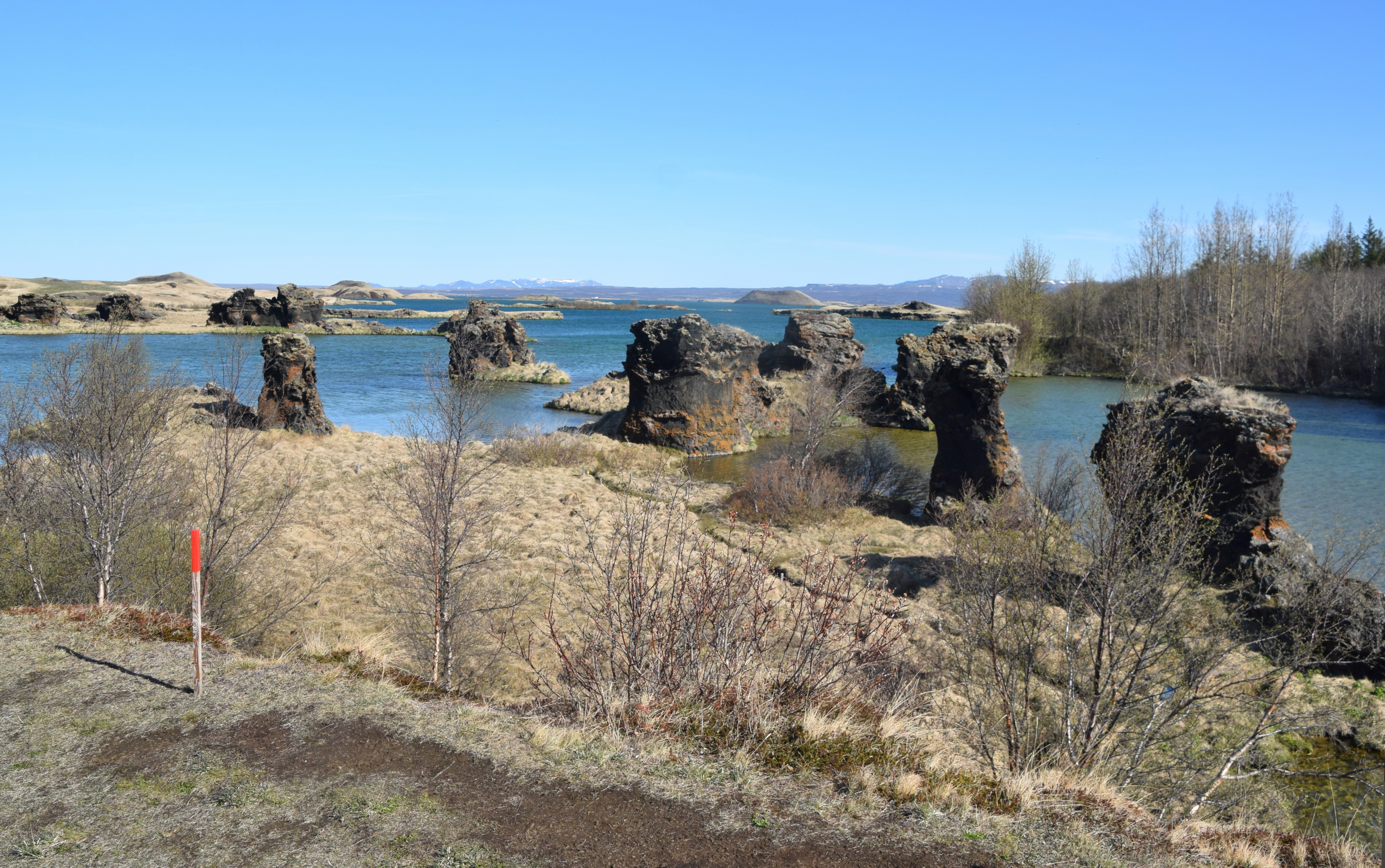
At Kálfaströnd a circular trail leads around an irregular shaped peninsula that extends into the lake, enabling viewing over secluded and in places enclosed waters. Then it crosses the area’s higher interior expanse. The tranquil location is noted for it’s volcanic rock formations (below).
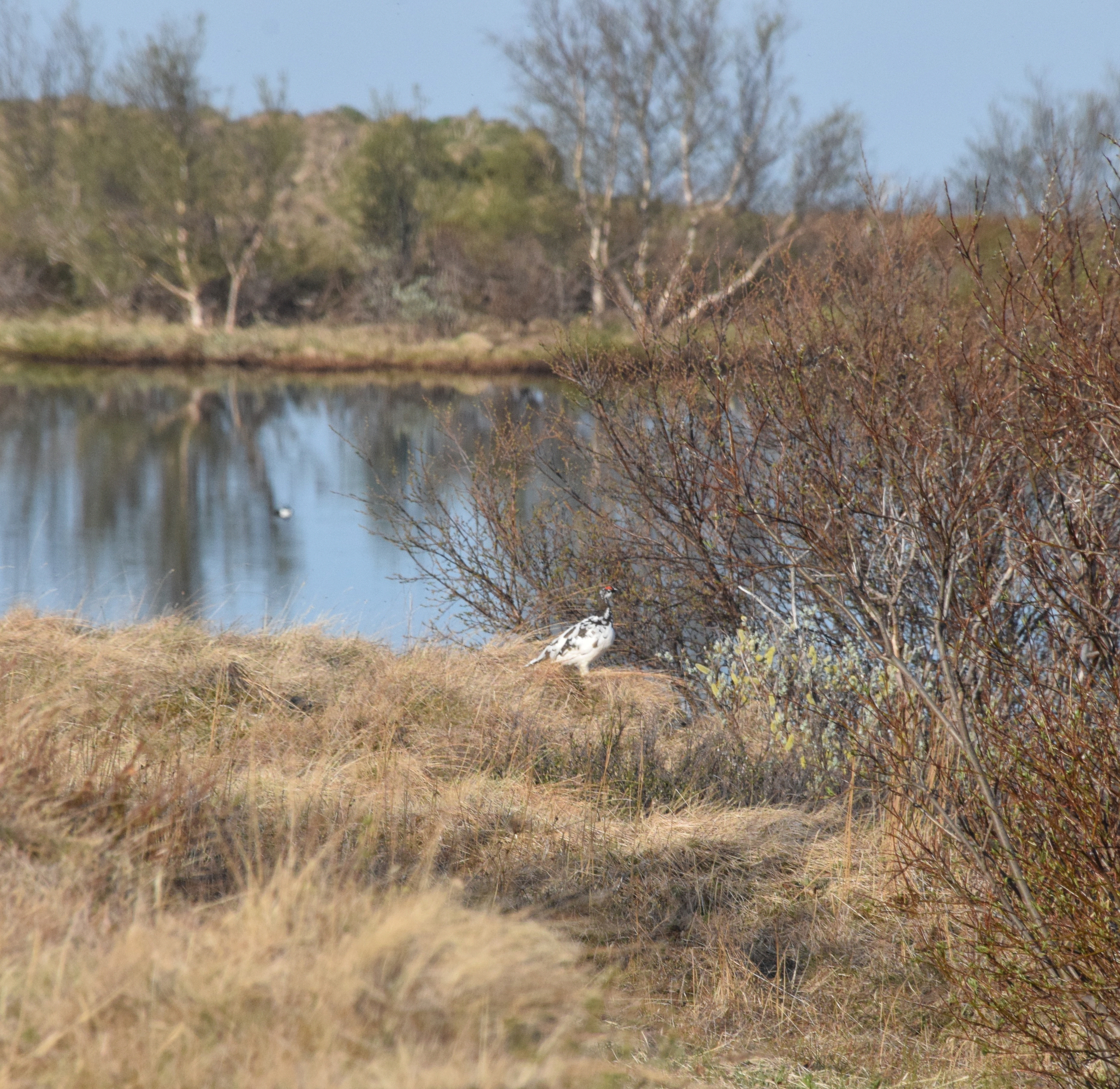
On 16th, as soon as I got out of my hire-car a cock Ptarmigan announced itself from the start point of the trail, but it flew off some distance upon noticing me. This time I made a complete circuit of the Klasar trail and the open, hilly land of it’s homeward stretch proved to be a prime location for encountering my quest. Being bright white these birds stood out readily in the landscape. The white dot in the centre of the next picture, for instance is one. I watched this almost pure white cock for some time, while it sunned itself in the early morning air. There was a nesting hen to its left in cover, then when I walked further along the track a second female flew up then across to join the other two birds. At that point the cock went out of view.


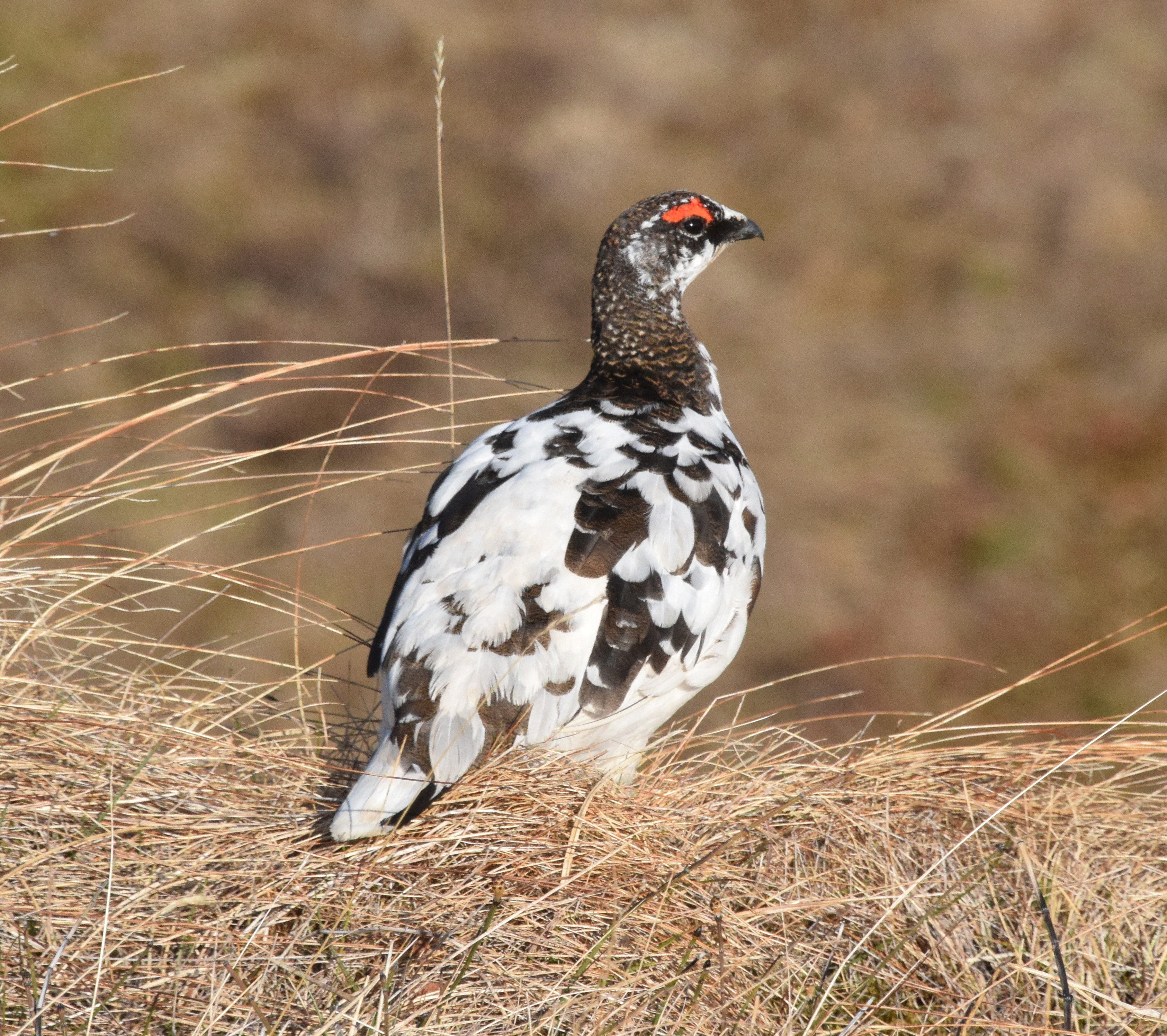
Then I noticed another cock further on along the trail (above right), and setting down my scope walked forward to see how close I could get to it, taking pictures all the while as I went. To my astonishment this bird let me walk right up to it. The lead image and the next two (below) were captured at just a few metres from the subject that even then kept stock still. I have never been able to approach Partridges in the same way, that invariably go up before I see them, but am told by a more experienced colleague that such confiding behaviour is not unusual in Ptarmigan. This was perhaps the ultimate close encounter of a week filled with such. The bird did not fly until I began to walk away.
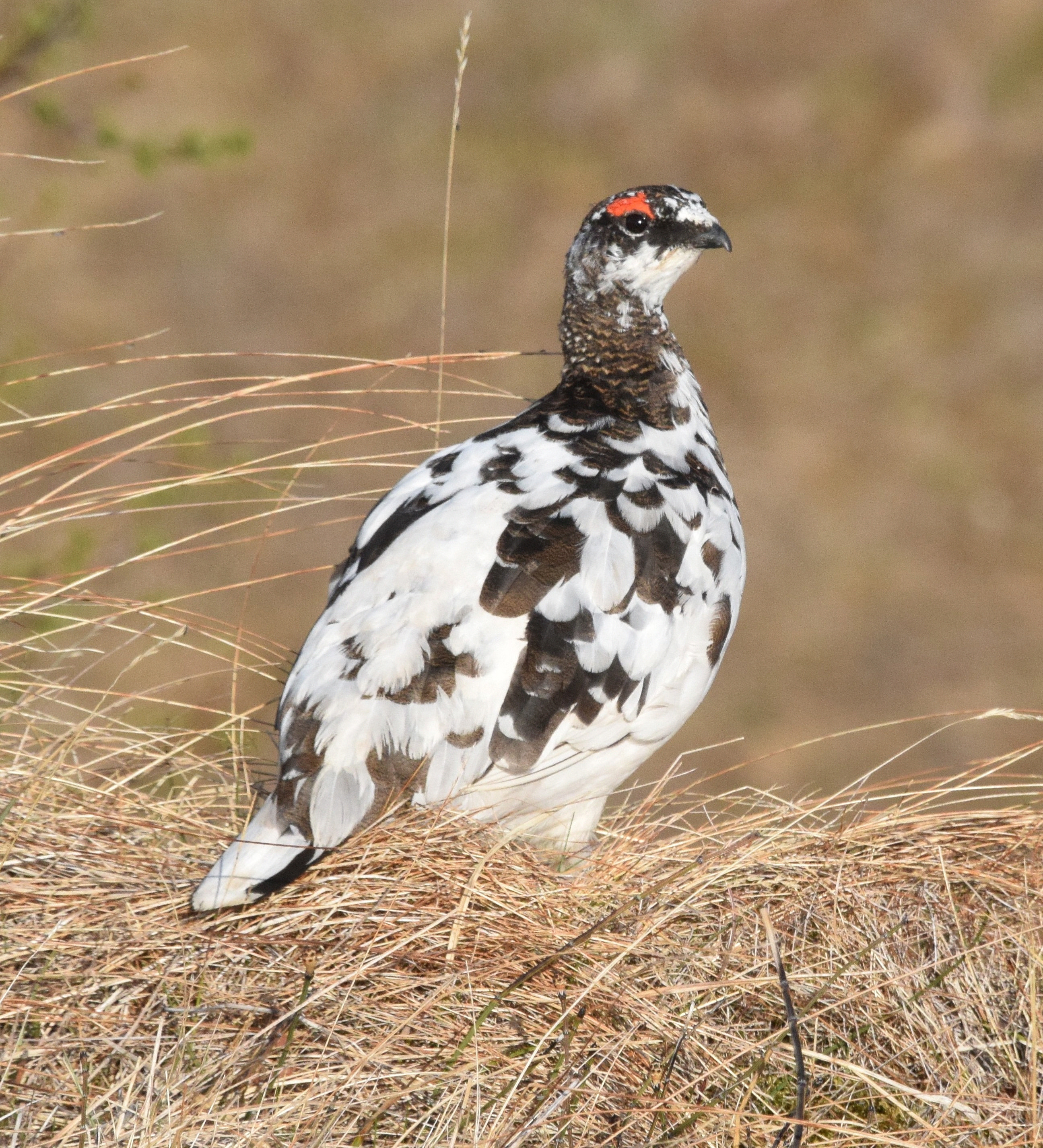
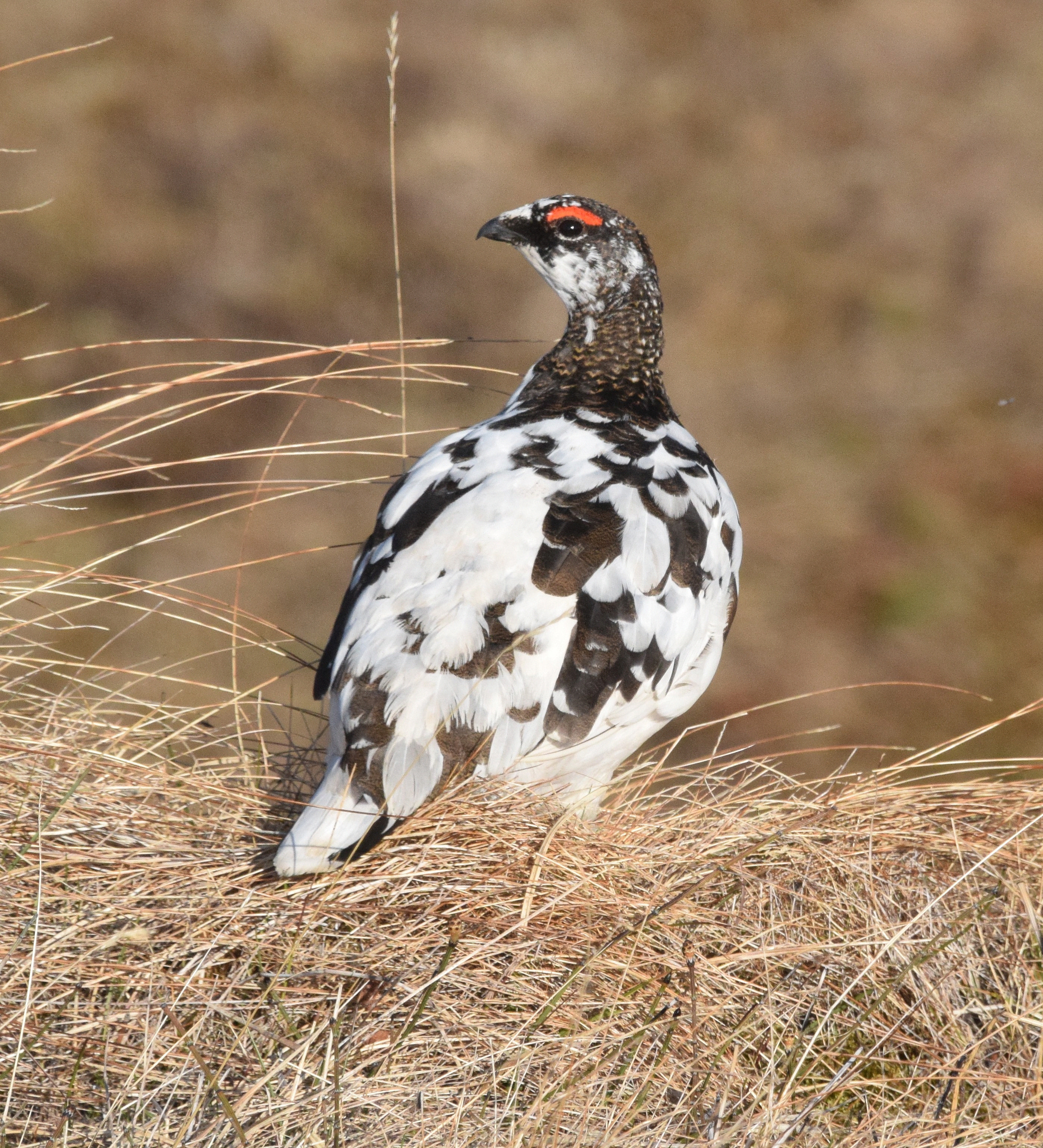
Rock Ptarmigan is the only upland game bird of Iceland, with a sedentary population currently estimated at around 300,000 birds. Numbers have fluctuated greatly historically in relation to climatic factors, breeding success and hunting pressure. Due to long-term decline, the species is red-listed nationally as near threatened, but numbers can be significantly larger by the end of each breeding season. A hunting moratorium introduced in 2002 sought to address that decline, and since 2005 hunting has been permitted only within a set period through November for personal consumption. In Iceland Ptarmigan is a traditional Christmas dish. The population is monitored annually to ensure a sustainable harvest.
Cocks establish territories in spring on grassland and heathland, and research shows the gender distribution within breeding populations is roughly equal. Ptarmigan feed on berries, buds, germinating seeds and insects when available; and their chief predators have historically been Gyrfalcon and wintering Snowy Owl. In winter the plumage is all white, turning to that in this post’s close-up pictures from late spring.

My initial sighting came two days previously while I was tracking Barrow’s Goldeneye. Suddenly a crackling sound I had researched issued from the middle distance where a cock Ptarmigan was standing on top of a rock stack (pictured above). I communed with this bird for some time from a distance, but during this the focus ring fell off my binoculars, which really shouldn’t happen on a birding trip. After it flew I crossed paths with the same bird while walking back to the car, then it went up again for some distance to high ground.
NB If visiting this site be sure to use insect repellent on all exposed skin
Rock Ptarmigan is now one less game bird I need to think about going to Scotland to observe; having recorded both Red and Black Grouse there in May 2023, and Capercaillie in Estonia in April 2017. Willow Grouse and Hazel Hen in Scandinavia remain on the wish-list that prompted this post’s trip. Having gained a third lifer for the week my career western Palearctic bird list now stands at 526.
 Ramblings and Scribblings