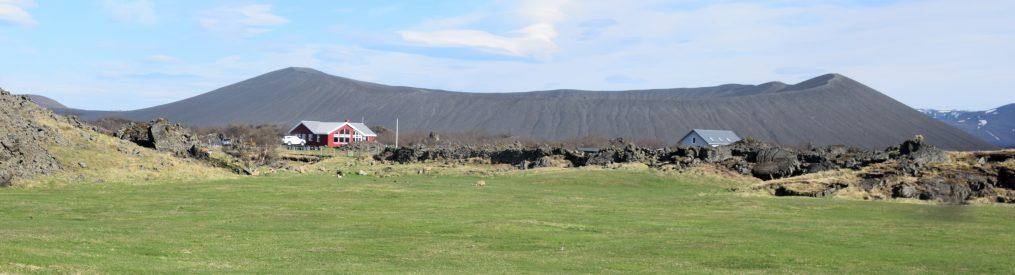
At this time of year evolved Orchid experiences just keep on coming. When I learned of an opportunity to visit the first of this post’s subjects, led as a personal initiative by one Hardy Orchid Society member, I enrolled then interested Adam in coming with me. The proposed agenda would also allow us to record one of the rarest of all British Orchid forms at a nearby location, the prospect of which appealed to me greatly. Our would be guide fell ill but there was no reason not to fulfill the mission under our own steam, since the first site is open to the public at select times and the second is generally accessible.
The provenance of Tongue Orchid (genus Serapias) nationally is subject to conjecture, since there is no certainty that any of three known colonies are genuinely wild. Those are at today’s location in Suffolk, a second near Colchester in Essex and reportedly a City of London rooftop garden. This group of plants (see here) is native to Mediterranean Europe from the Iberian peninsula, through France, Italy and the Aegean region to Turkey. There are several species and more sub-species, so hybridisation is commonplace.
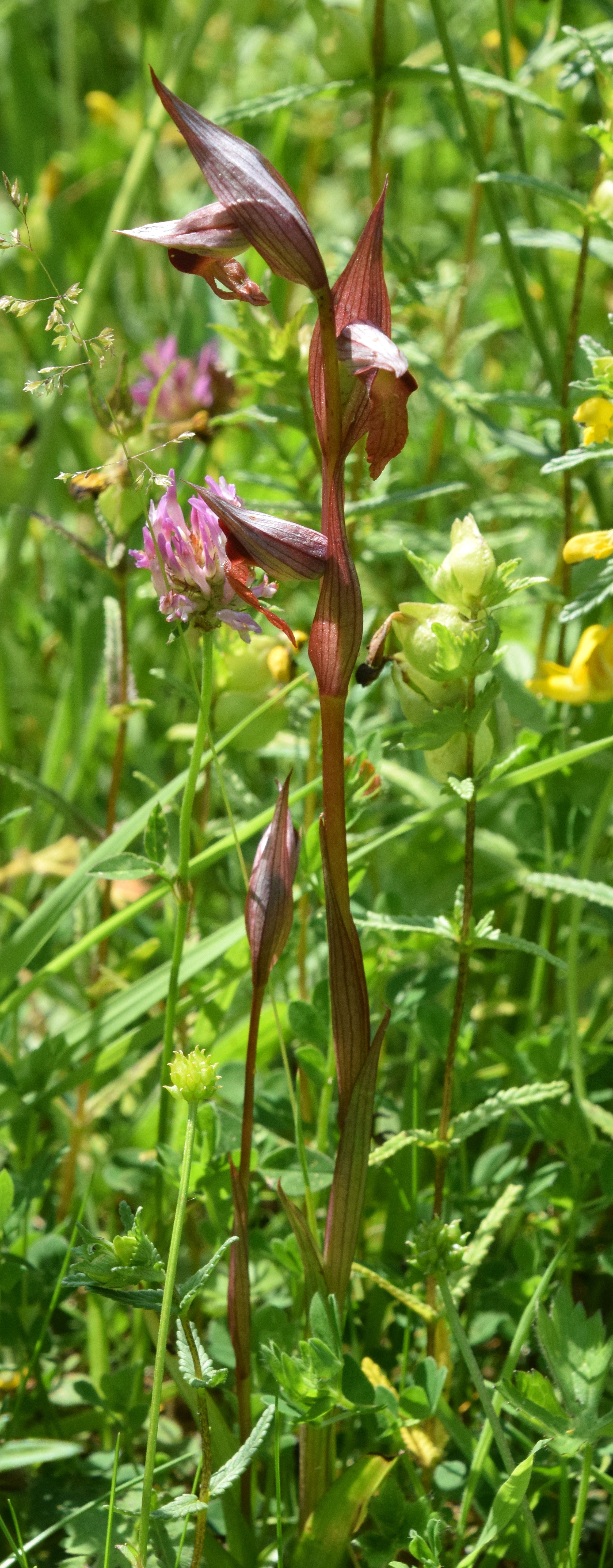
In 2021 a specimen was found within the site featured herein that was at first assumed to have been planted. But after ongoing assessment by eminent botanists and Kew Gardens, by 2023 it became accepted that was unlikely since it grows on private land with limited public access, though it remains unknown where the now three stems could have originated from. A conspiracy theory that someone must have sneaked in out of hours and planted the original item has been dismissed.
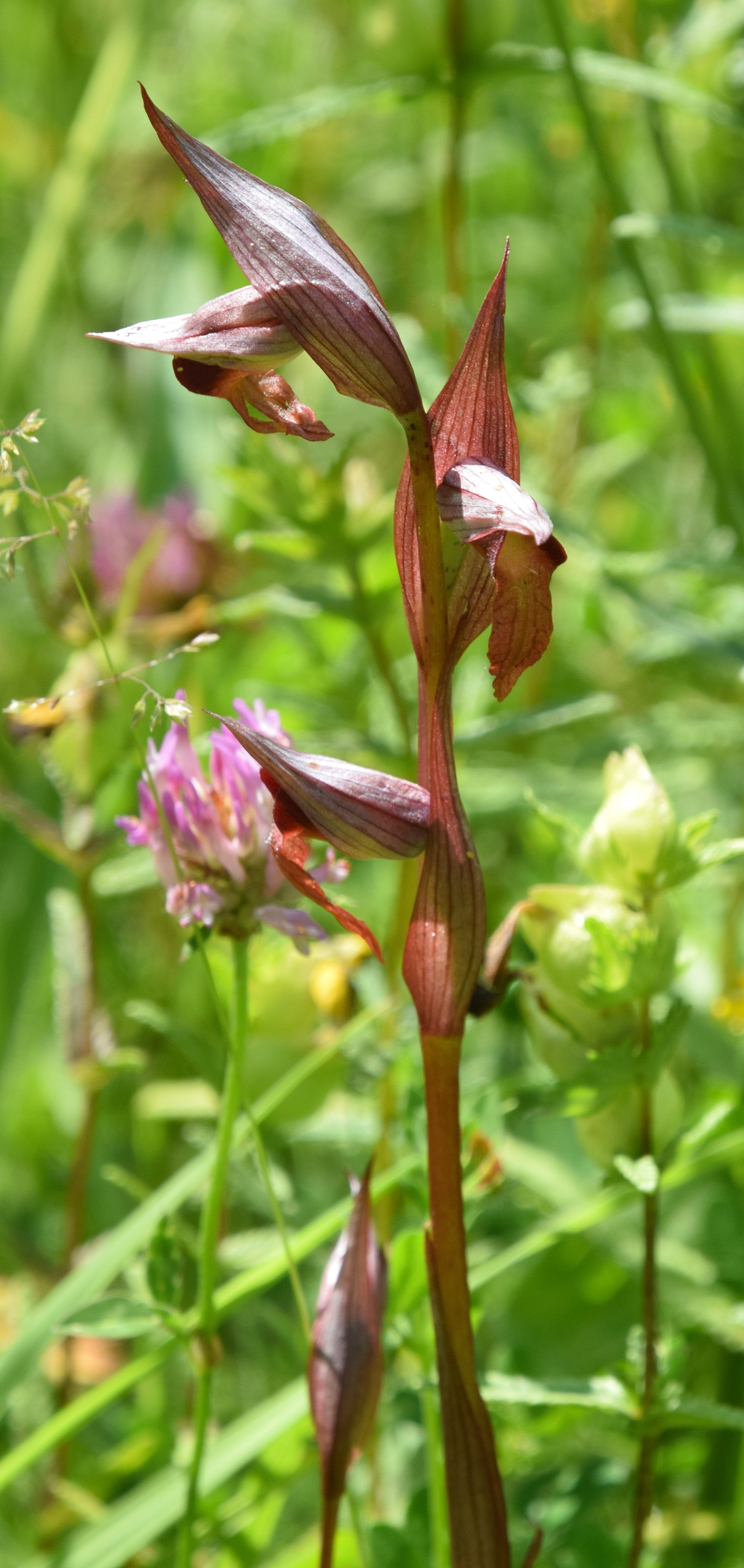
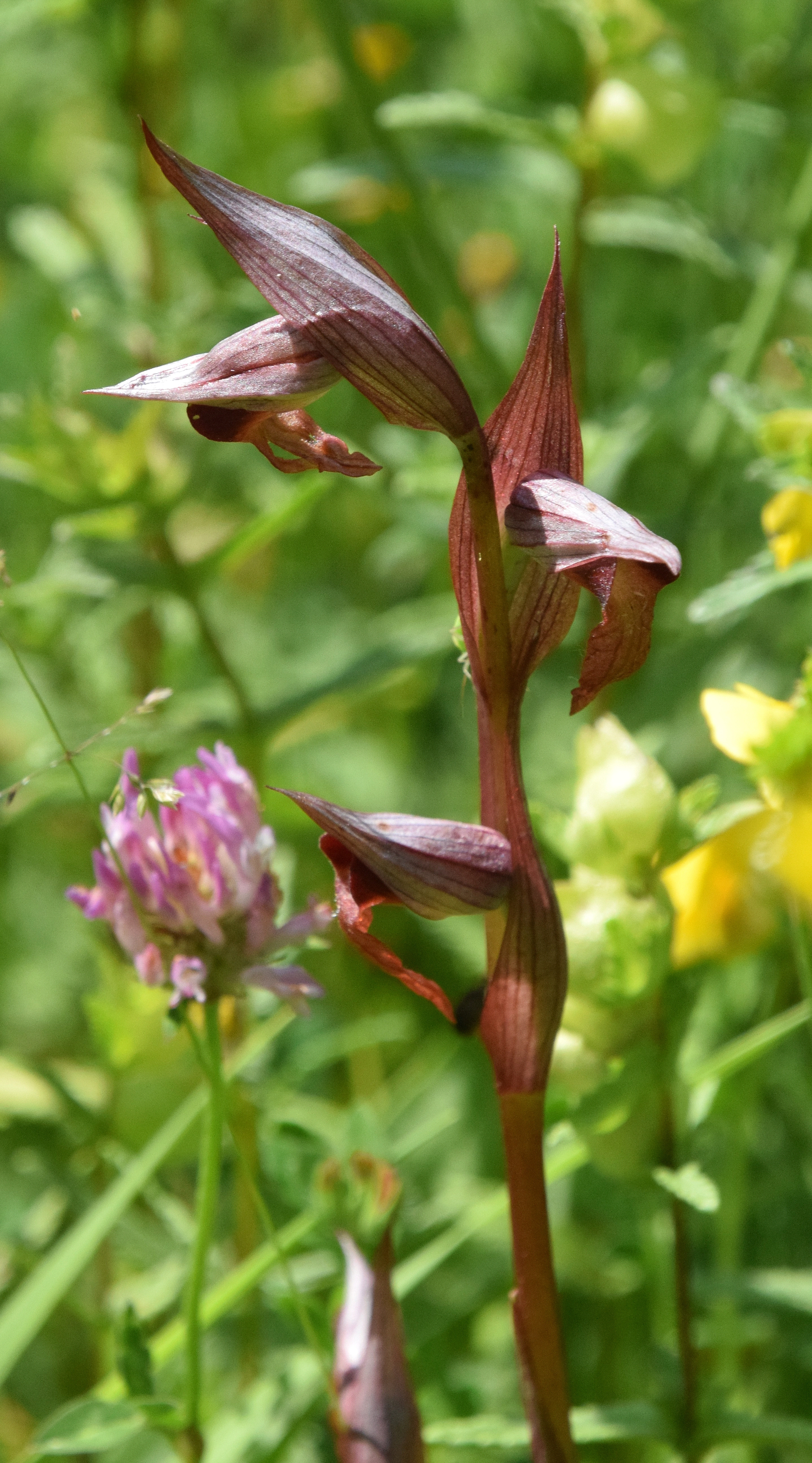
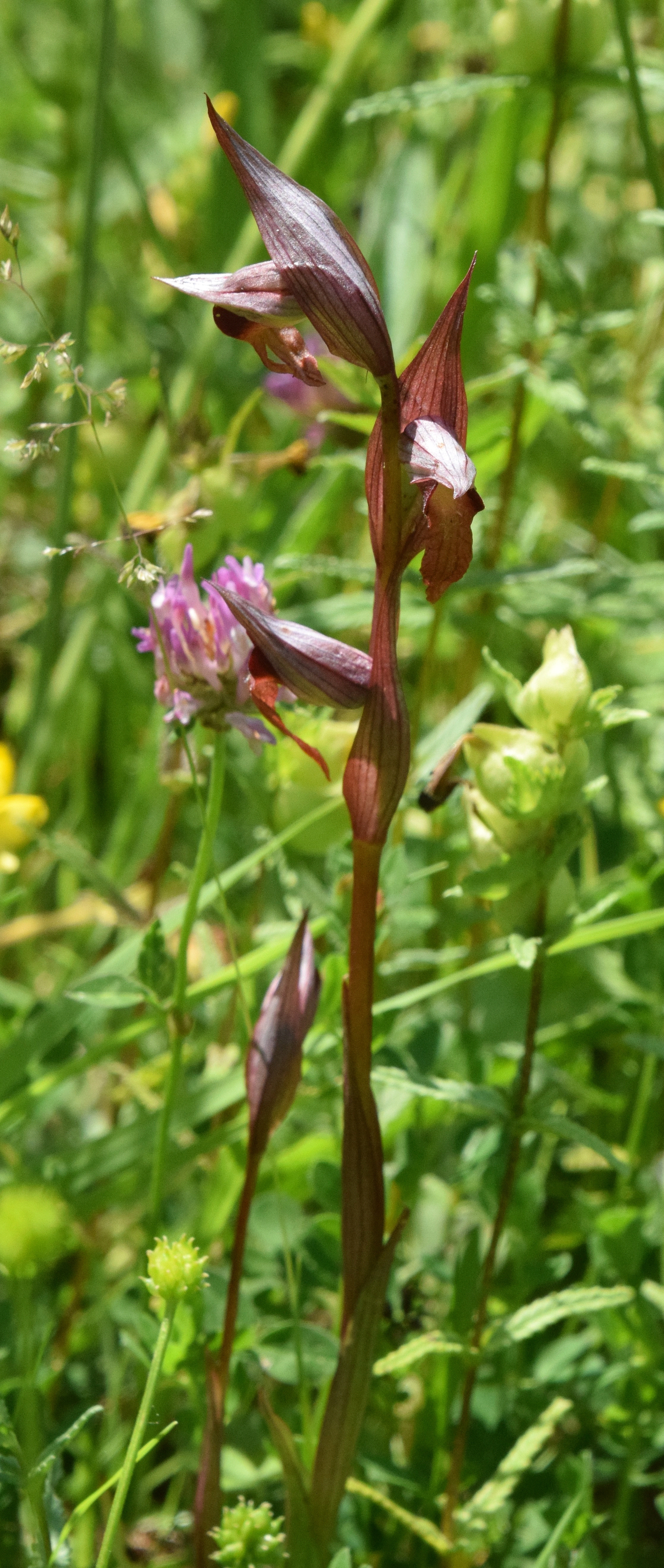
One Tongue Orchid stem had gone over, but the second was in pristine condition (pictured below) with a very small third stem alongside it. My understanding is these particular plants are cited as Serapias bergonii (see here), for which there appears to be more than one common name if indeed consensus has been reached. I will not go into the detail. Each stem can grow to 50cm, along which are up to 12 streaked, deep red bracts containing the lax flowers of varying tone. Those are hairy in the centre with lips up to 30mm. At the time of our visit it was only possible to take pictures looking into the sun, but that is how the plant was experienced.
We were now conveniently placed to observe the critically endangered var ochroleuca form of Early Marsh Orchid (Dactylorhiza incarnata). In this area of northern Suffolk a network of remnant valley fens survives, preserving a habitat that has long been lost more widely to modern agriculture. Amongst these, that I cannot disclose herein, is one of just two remaining sites for our day’s second quest. As soon as I researched this great rarity, it was something I just had to see. Equipped with a GPS from our original source, we located nine plants here that were all in immaculate condition, in a spiritually uplifting, spring-fed landscape from a long-past age that as so often when Orchid hunting no longer exists in the normal run of things.
Suffolk Wildlife Trust describes these fens as being “strung like a beautiful necklace around the throat of north Suffolk”. This one offered my third var ochroleuca, the others being Marsh Helleborine (see here) and Fly Orchid (previous post). These forms lack the coloured pigments typically found in the three species, resulting in a lighter, often cream-green or yellowish-green appearance. Care must be exercised in identification, since two white forms of EMO also exist. But a botanist we met at the earlier site matched them to the Cole and Waller field guide he brought with him, so we were all satisfied these plants today were genuine.

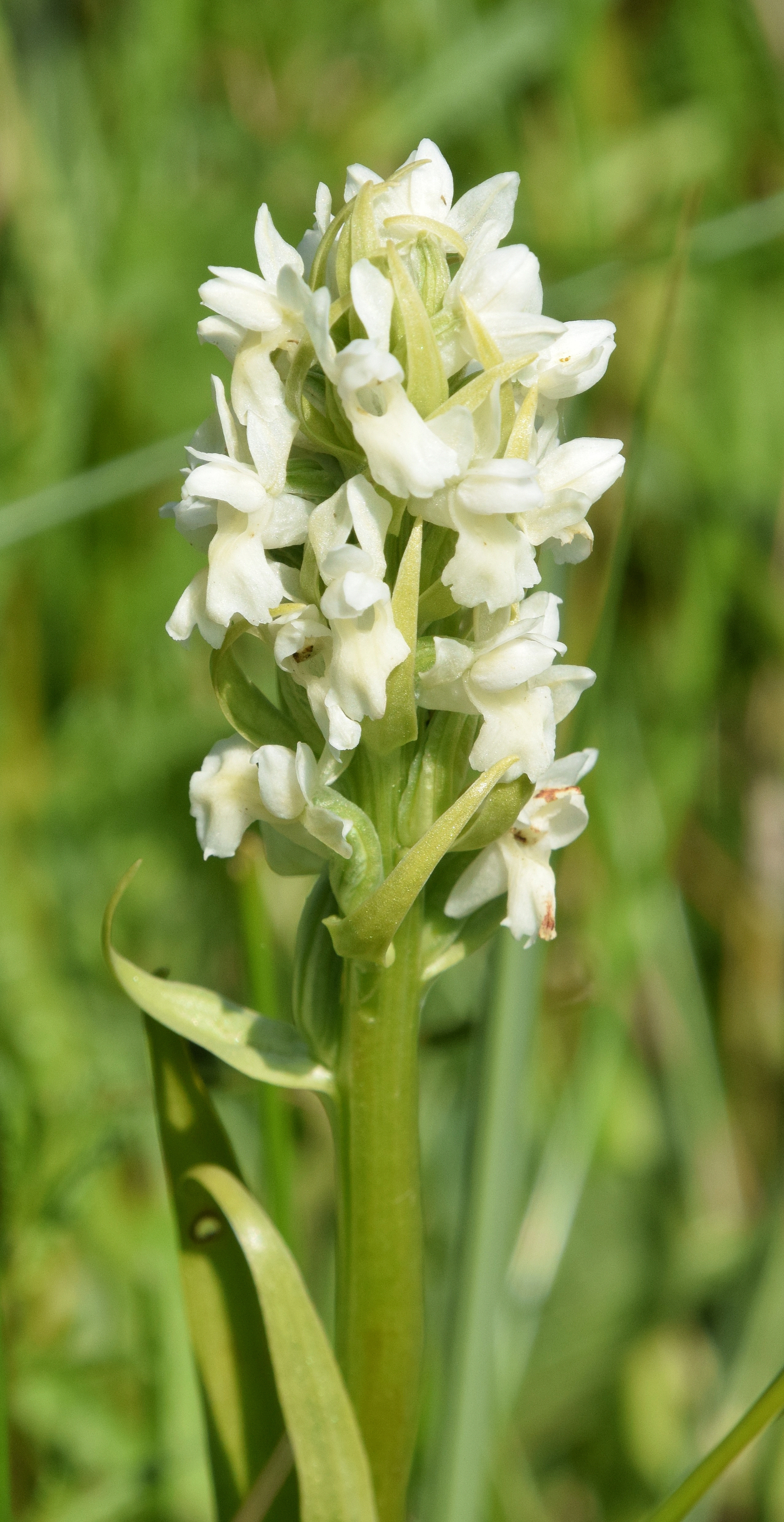
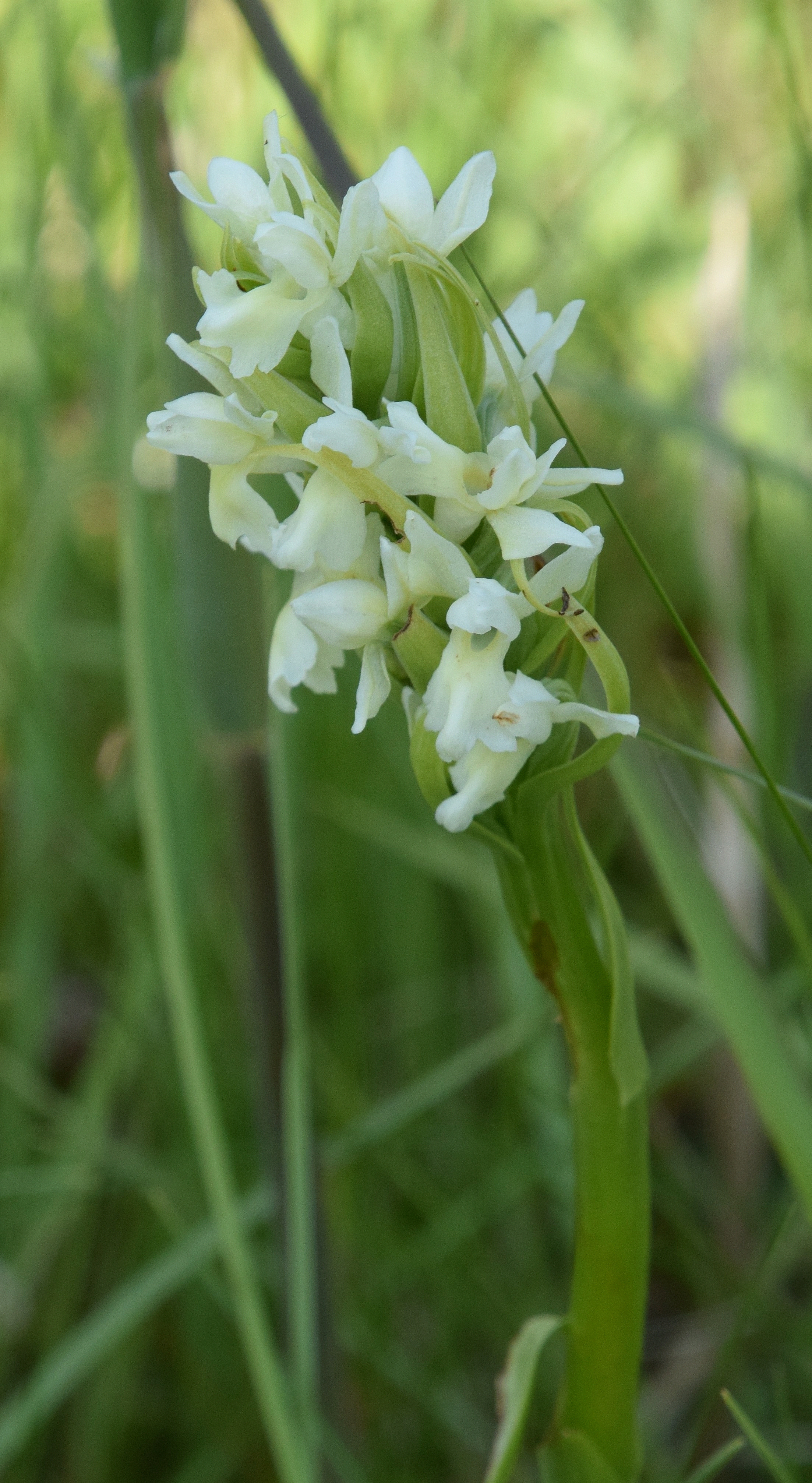
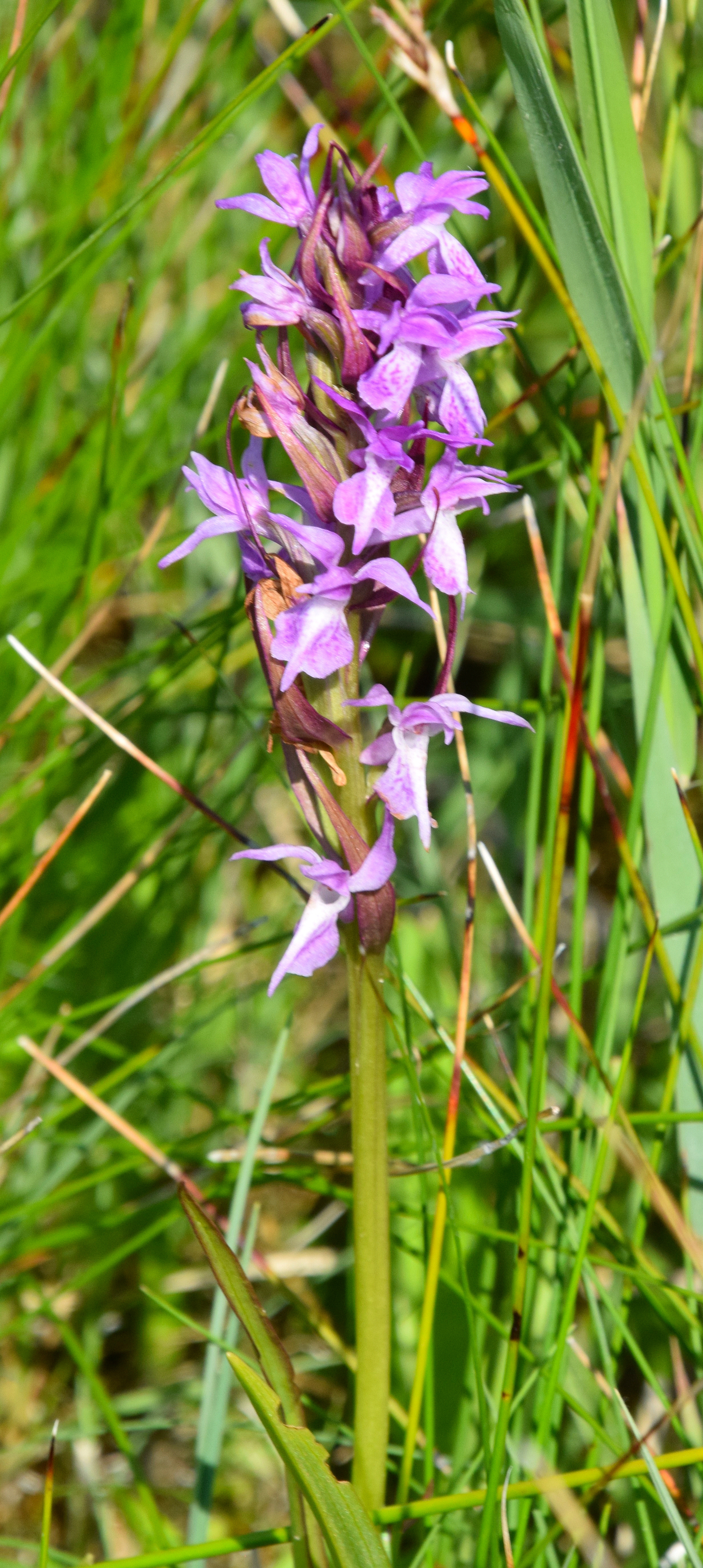
Early Marsh Orchids var ochroleuca and Southern Marsh ssp schoenophila (far right)
Amongst the many Marsh Orchids here were some Southern Marsh Orchid (Dactylorhiza praetermissa ssp schoenophila). This is the sub-species formerly classified as Narrow-leaved or Pugsley’s in southern England, for which this Suffolk site is a known location. Their stems are thinner and weaker than SMO, the leaves narrower, and the flower spike has a delicate, rather ragged character. I myself have observed schoenophila once before in Hants (here), and that post from last July contains more of the taxonomic background.
One Orchid I have yet to include in this journal’s coverage of the last three seasons is the familiar but often inconspicuous Bee Orchid (Ophrys apifera – pictured below), simply because I find them in the field so infrequently. The flowers resemble plump, furry bumblebees, and there may be between two and seven per stem. Whenever I do cross paths with them I am always charmed by their attractive fine detail. Plants may appear in a wide variety of habitats where wildflowers flourish, including garden and park lawns and grass verges. Earlier this week I was very pleased to find four stems growing in the car park of my part-time workplace, so the omission can now be remedied.
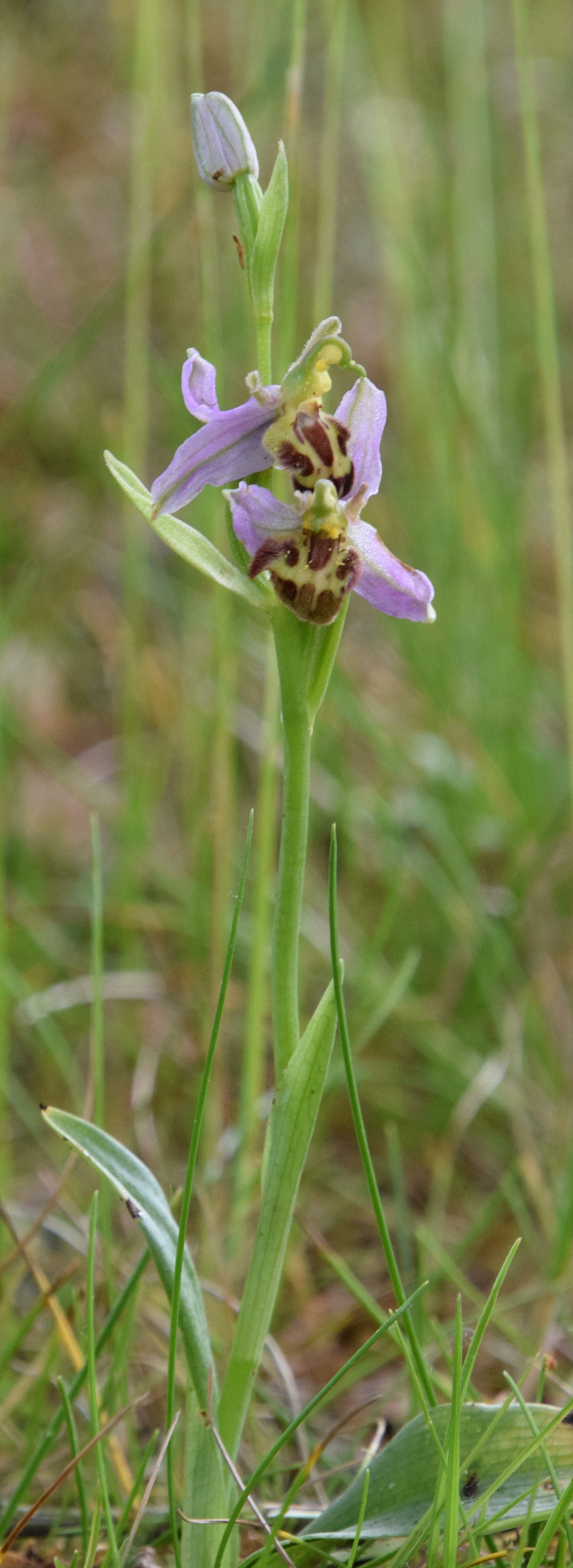

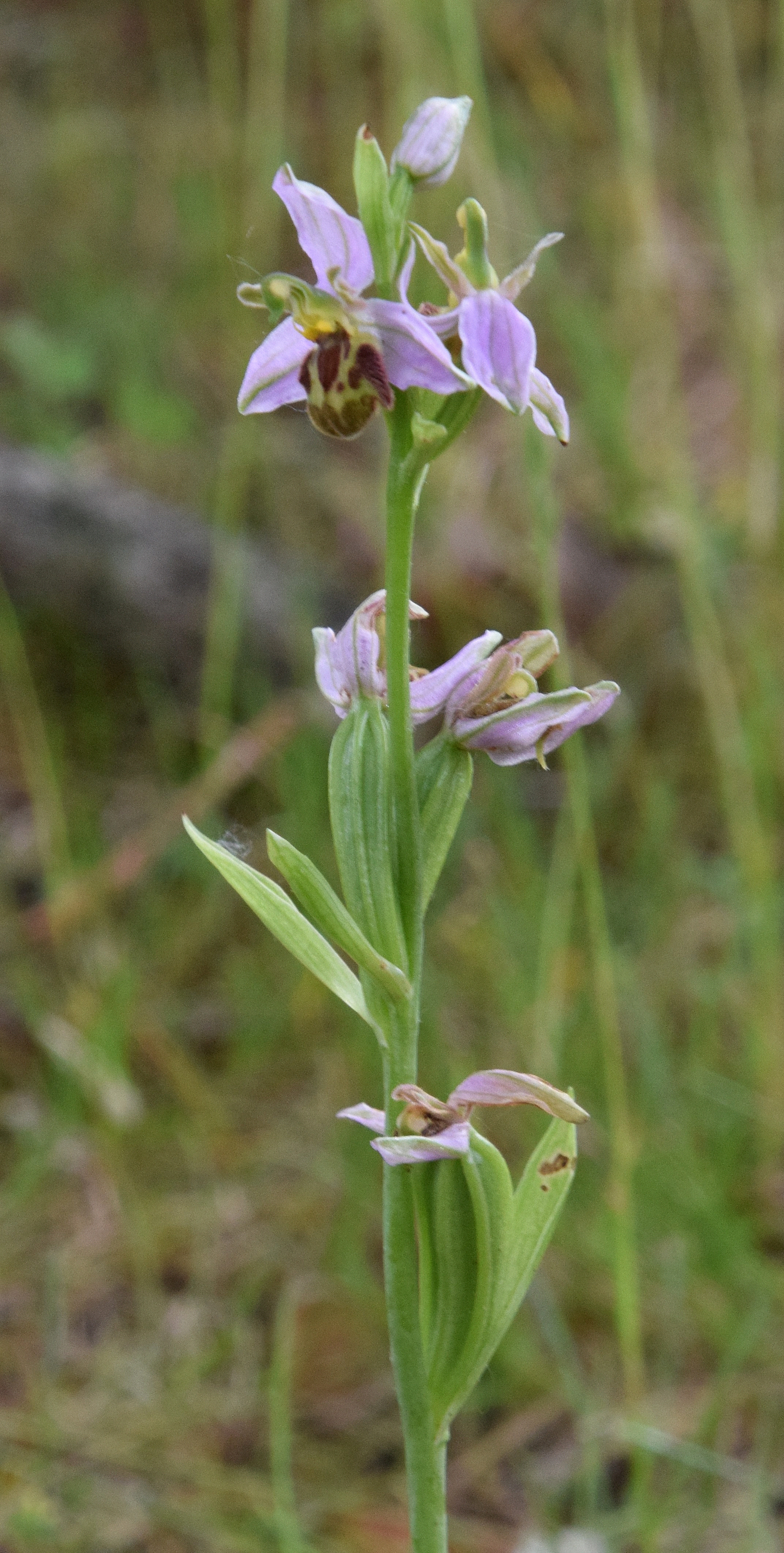
Bee Orchid var belgarum (left) and regular Bee Orchids at Nuneham Courtenay, Oxon
I am reliably informed that the specimen in the left hand picture, and possibly the right are an uncommon form var belgarum, (see here for detail). This variant was first discovered on a roadside verge near Winchester in 1998. Though initially thought to be restricted to that area of Hants chalk downland, it is now known from several other locations in England and Wales; but is extremely rare in continental Europe. When Ian followed up on Friday (13th) the left hand plant had been partly eaten.
 Ramblings and Scribblings