
The following is a checklist of Arum plants in the past King’s Copse Park Botanical Gardens (KCP BG) Aroid collection, some of which still survive. Most of our other Aroids are now long gone and that project is dormant. The former Aroids tab has thus been removed from this journal but this particular archive content will be useful to retain herein for future reference.
Arum is a genus of 26 accepted species occurring from western through central Europe and across central Asia, and also in north Africa. The blooms of different species vary in colour from pale green through yellow, rusty red, deep purple and black. Most produce foliage in the autumn and over-winter in the green state, being cold resistant and becoming deep seated in the ground, but they are not necessarily hardy in pots.
Arum apulum
Status: Sourced from RarePlants.co.uk as a cultivated tuber in October 2020, this Italian endemic bloomed on 22nd February 2021, wilting three days later, but not in 2022. Then after being transferred to the outside trough the tuber was lost to severe frosts during the following winter.
In the wild this shade loving plant occurs only across a limited area of south-eastern Italy’s central Apulia region, around the towns of Bari and Taranto. There habitat encroachment by commercial development has contributed to the plant acquiring critically endangered status.
Normally blooming in early summer, the large spathe can be deep purple-red inside, toning to paler violet at the very centre around a deep purple-red spadix (below, right). But other specimens such as my own (left) are pale lime-green with maroon overtones and a brownish-maroon spadix. So having selected this addition item for that attractive colouration this result (below left) actually resembled a rather firmer Cuckoo Pint. The compact and robust foliage (centre) is dark green and unspotted.
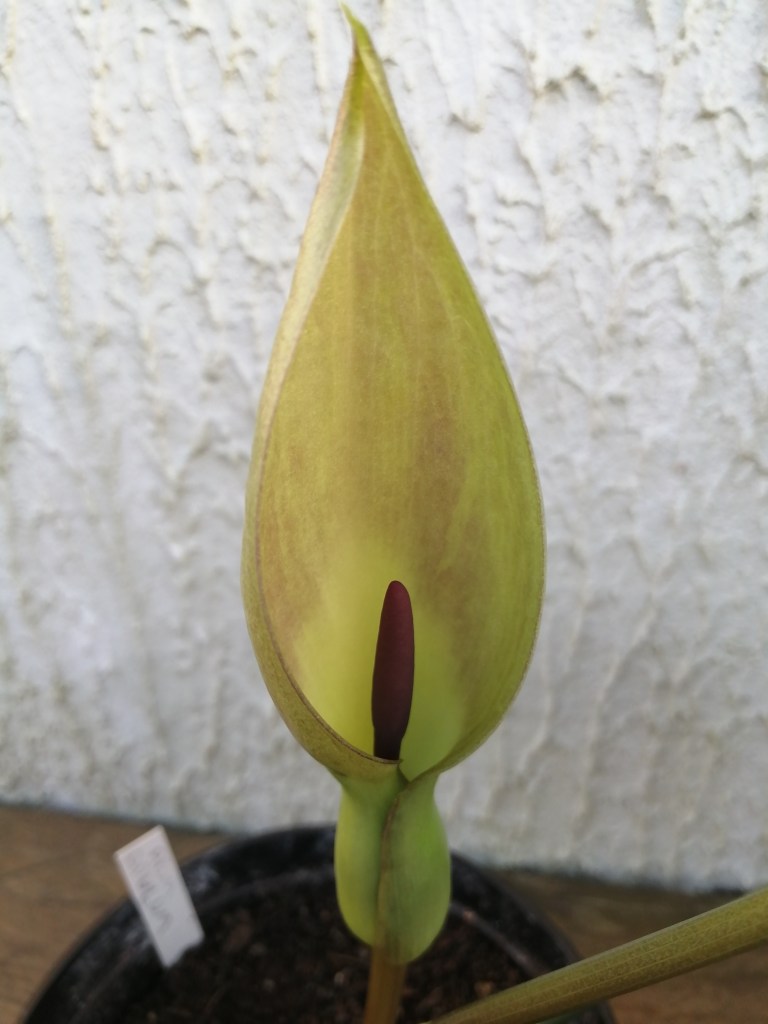
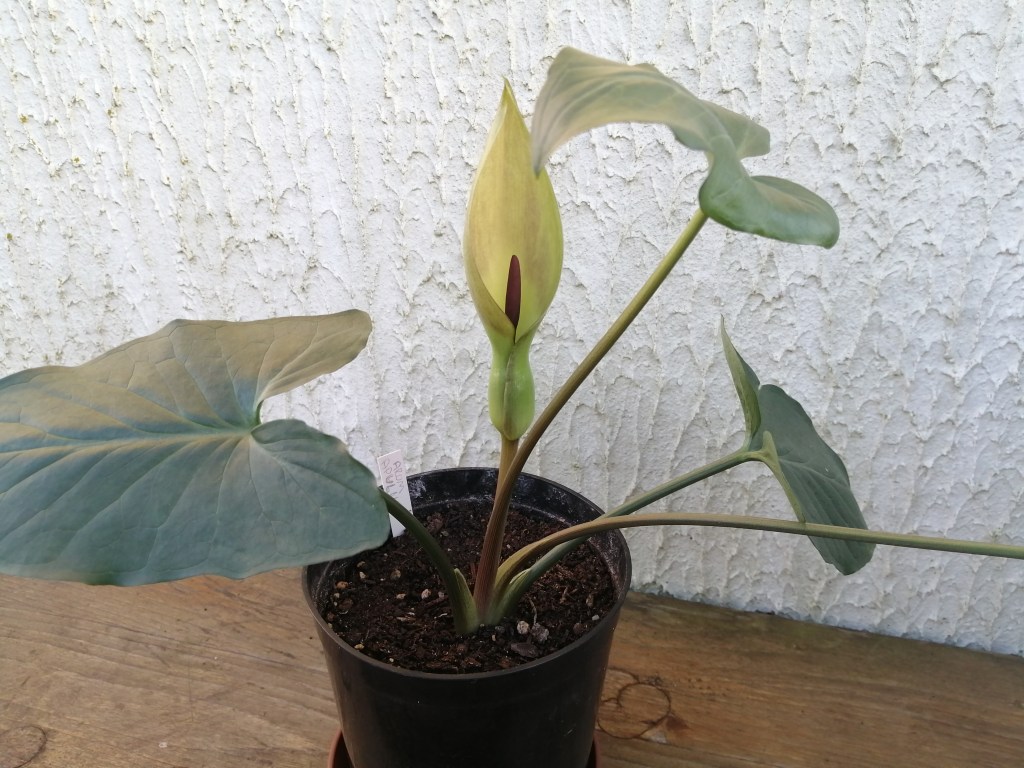
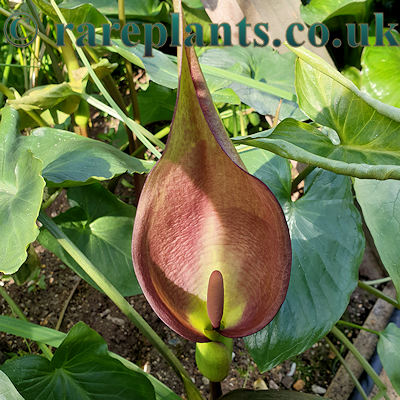
A apulum rarely reaches more than 30cm in height. The pollinator attracting odour is reputedly more manageable for indoor cultivation than others of the genus, and our specimen bore that out smelling only slightly for its first evening in bloom.
Arum concinnatum
Status: Sourced from Adventurous Plants (x3) in September 2019, I expected this to be similar to A italiacum in habit, being in leaf throughout the winter and blooming in late spring to early summer. After being planted in plastic pots to over-winter outside they did not bloom in spring 2020. When lifted in August two of the tubers had multiplied readily, allowing several plants to be re-potted in gritty, loam-based compost to grow through the winter in my cold frame. Just of these bloomed on 12th April 2021 (pictured below, left). The entire stock was then re-planted either in the ground or a plastic trough in compost, of which two more bloomed in May 2024.

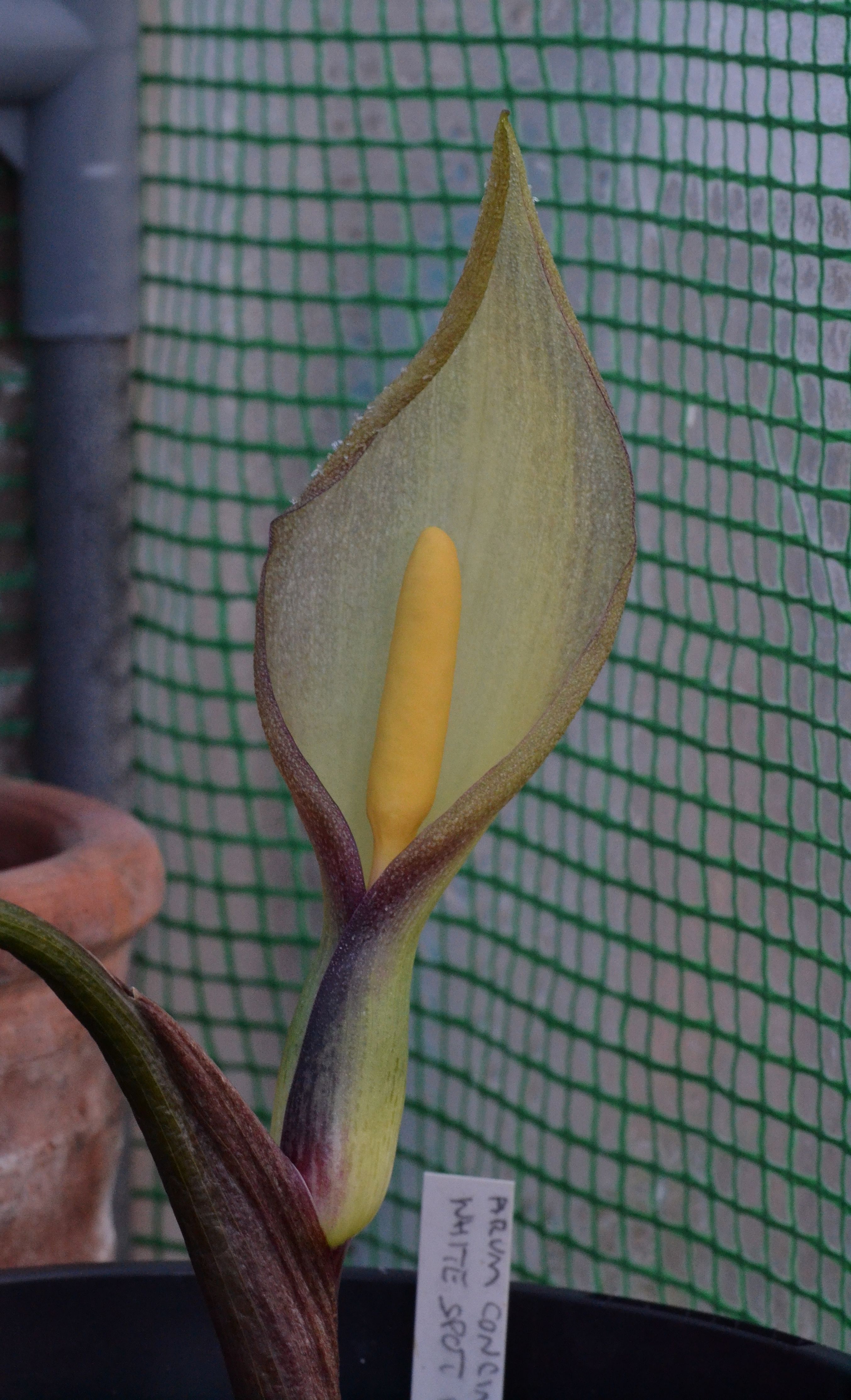
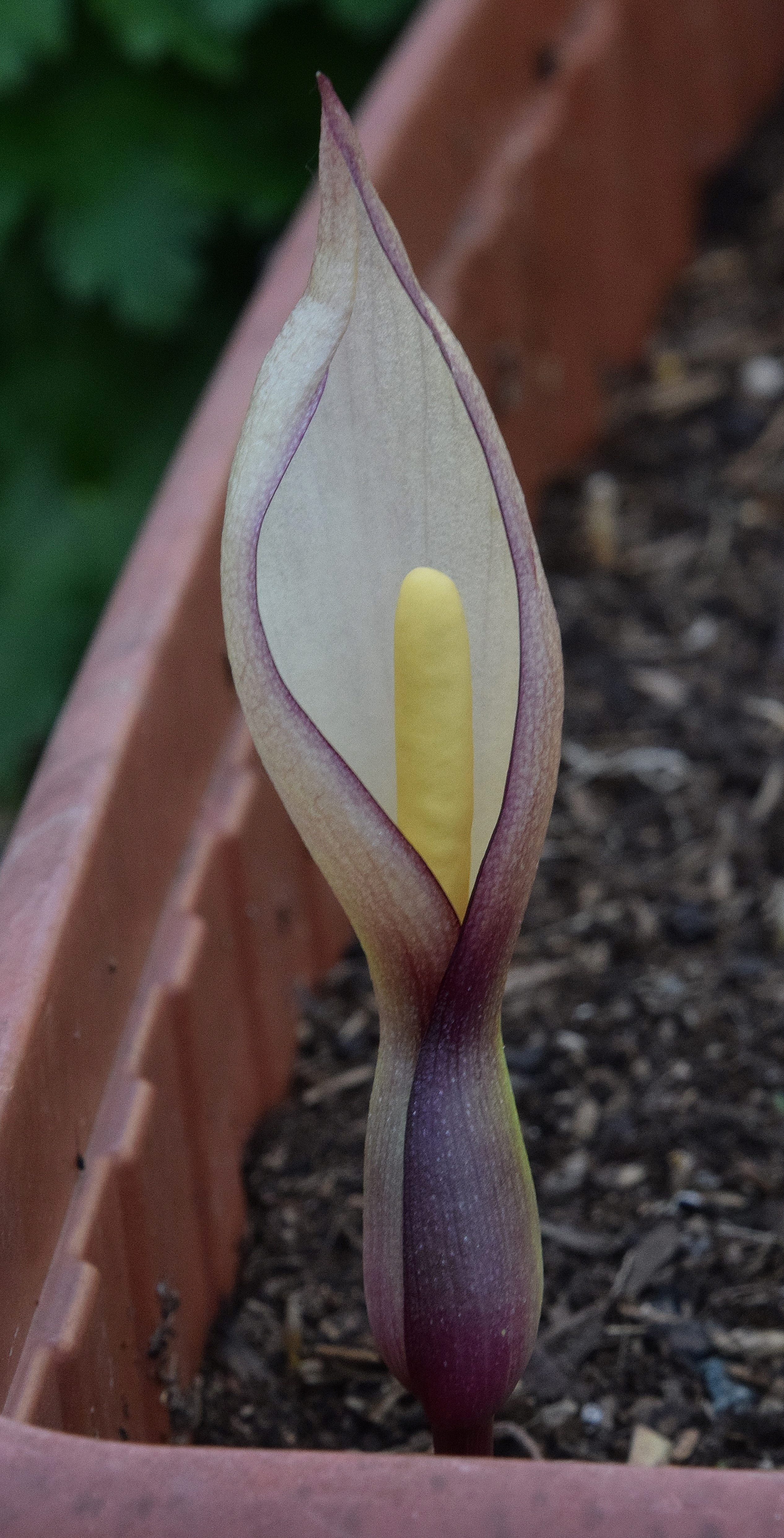
Native to the Aegean region of the Mediterranean and fully hardy in British conditions, this is one of the largest of the Arums capable of reaching almost a metre in height when fully established and mature. It is large leaved and bears an inflorescence with a greenish-yellow spathe and thick yellow spadix. The spathe that smells of animal excrement in the initial stages of flowering can be variable in colouration, sometimes with a purplish tinge and usually has a purple margin. This plant is summer dormant, the foliage appearing in autumn then is maintained through frost, forming a large clump. The blooms appear in mid-Spring.
Arum discoridis syriacum
Status: Sourced from Adventurous Plants in autumn 2019, I expected this like A concinnatum to be in leaf throughout the winter, blooming in late spring to early summer, followed by fruit spikes in the autumn. Planted in an 18cm plastic pot for growing outside, it did not flower in 2020. Then lifting the tubers in August, I cultivated multiple plants in the cold frame through the winter in sandy, loam-based compost but none of them bloomed in 2021. So these were transferred to a terra cotta pot for 2022, eventually producing a single inflorescence on 24th May (pictured below right). After the entire stock was replanted in the ground and a plastic trough, another bloomed on 3rd June 2023 (left) then a third in the trough on16th May 2024 (centre).
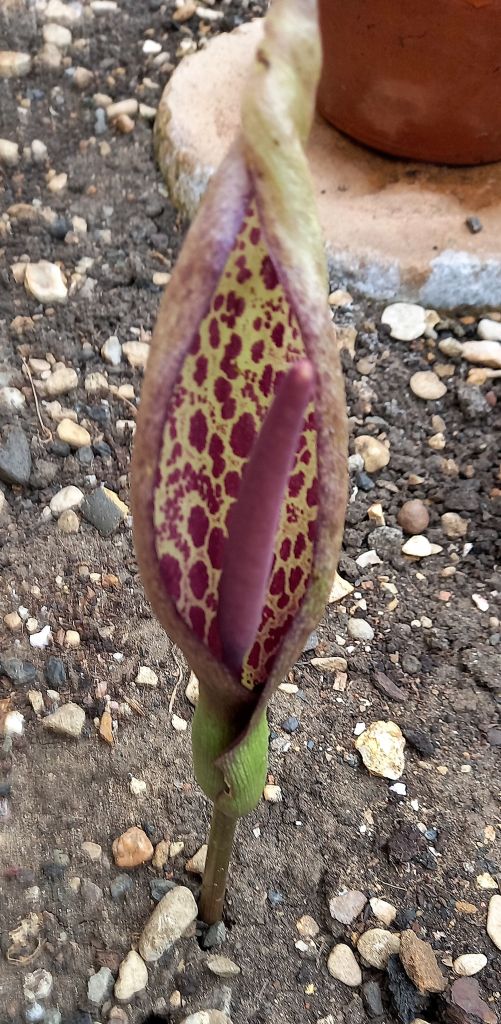

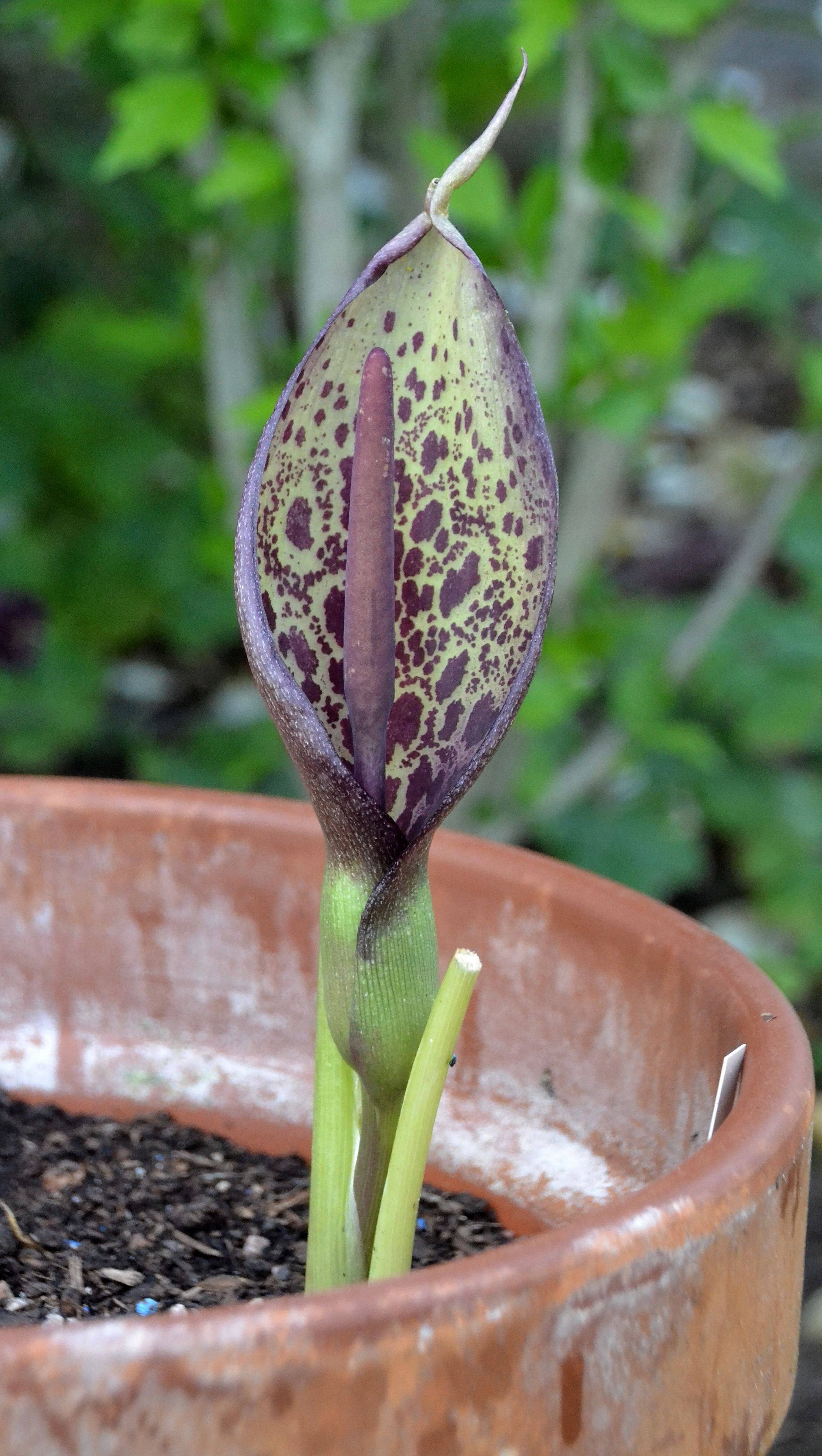
A discoridis is a variable and widespread genus, native to forests in the eastern Mediterranean and Middle East regions. This one is endemic to central southern Turkey and north-west Syria, having a distinct pattern of maroon blotches to the inside of the pale green spathe, and a maroon spadix. Also known as “Spotted Arum”, variation exists not just from plant to plant but from flower to flower on the same plant. It grows up to 60cm in height, with spathes to 38cm when mature, and is said to do particularly well if grown under glass. More varieties are available from British suppliers.
Arum euxinum
Status: Sourced from RarePlants.co.uk in October 2020, this bloomed on 11th March 2021 but not in 2022 before also being lost to severe winter frost. The scarcity originates from the Black Sea coast of northern Turkey, but the stock is from seed distributed by Gothenburg Botanic Gardens. In the wild this item occurs in mountainous regions and normally blooms in May.
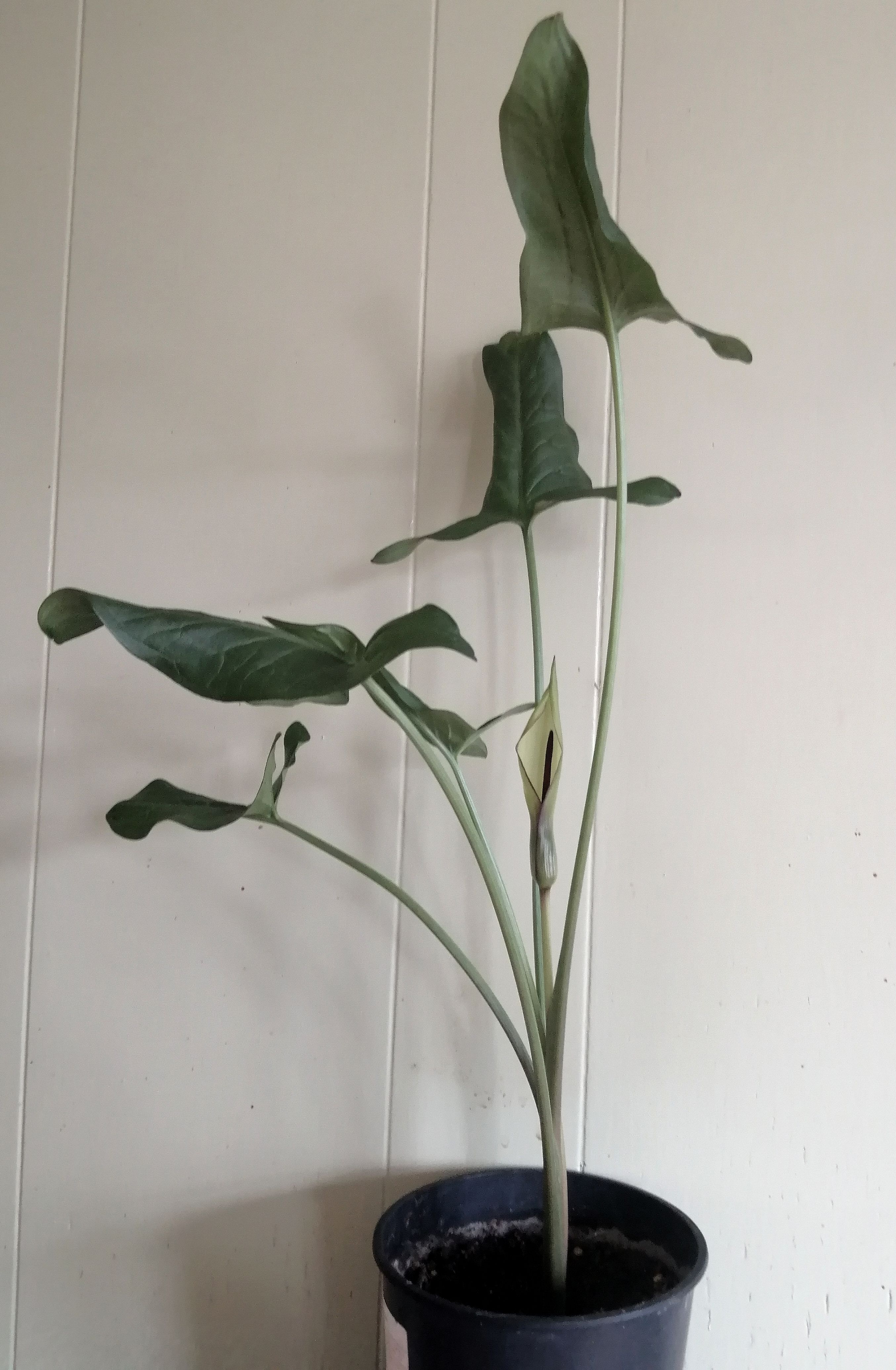

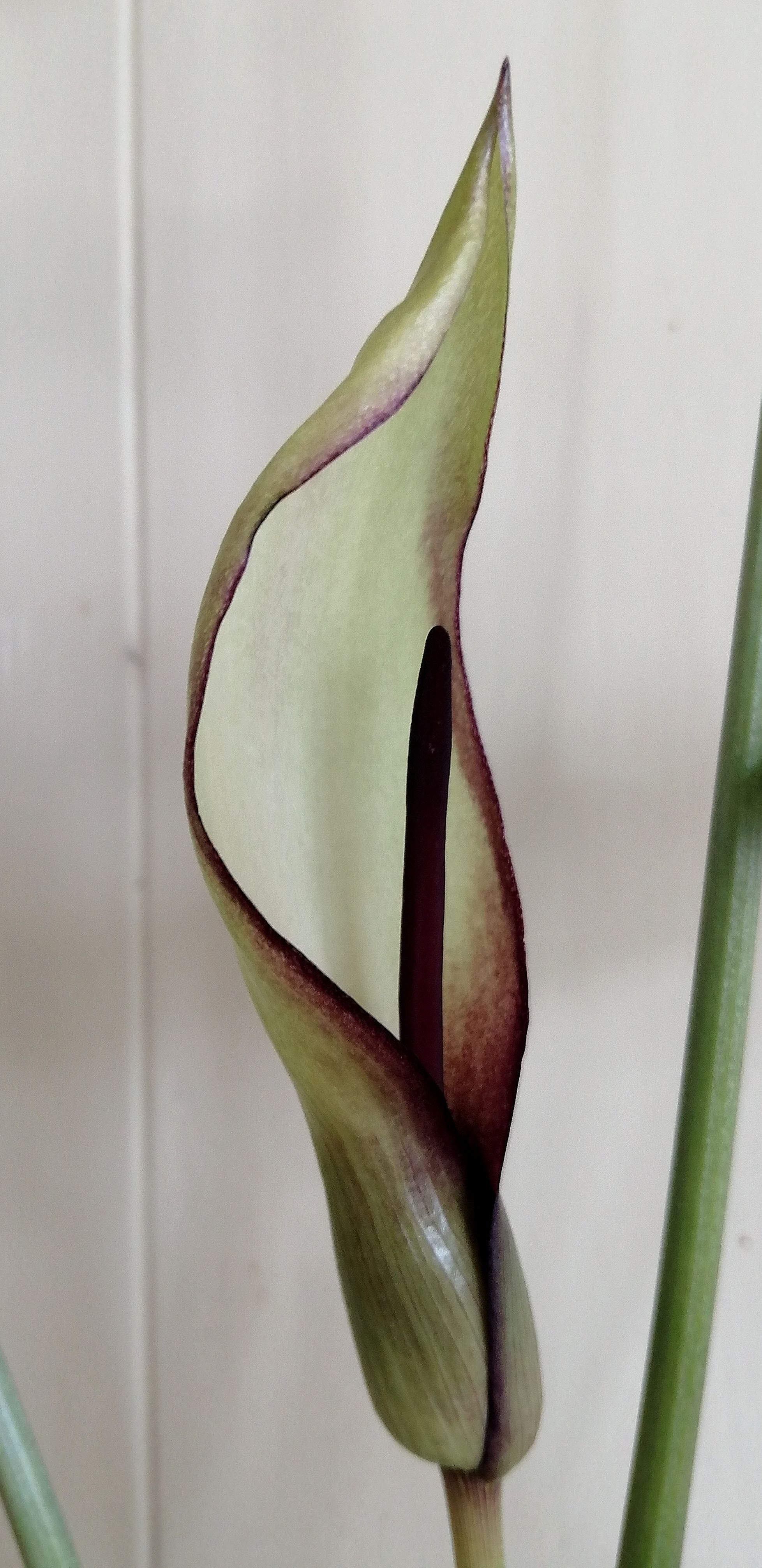
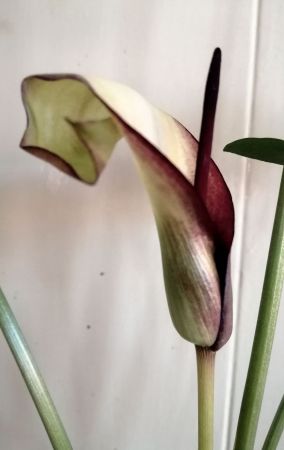
Upon unfolding, the odourless, pinched bloom (above righf) appeared quite similar to the early-flowering middle eastern A hygrophylum. But euxinum is somewhat taller and much more robust. The plain, dark green foliage is very attractive and the entire plant a pleasing shape (above left). The 40 – 60cm tall spathe is compact, scentless and pinched into a waist. The colouration is described as very pale green stained purple at the edges, top and base, with an interior of pale cream or white marked with rich purple towards the tip.

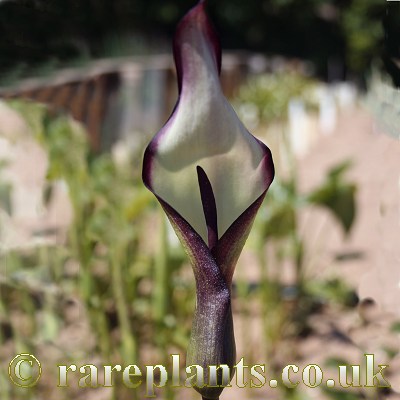
Whether or not the colouration would evolve with age remained to be seen. Through day one the increasingly firm and waxy spathe did acquire more of the shape of the supplier’s picture (above centre). Then from day two more of the anticipated delicate purple toning seemed to intensify in tandem with the allurement A euxinum came to offer.
The left hand picture below is from day two and the other two day three. By then I could fully concur with the supplier’s description. Later on day three the inflorescence deformed (below right) becoming more purple all the while. This had become perhaps the most subtly intriguing aroid ever cultivated here. Wilting began on day 5.

Arum hygrophylum
Status: Sourced from Adventurous Plants in autumn 2018, this was initially kept indoors in its supplied pot, producing a single January bloom (below left). Having gained this experience it was planted at the front of the Aroid bed for 2019/20, where it produced blooms in February and April. In it’s third season this item bloomed again (centre) on 20th April 2021. In 2022 (right) the now mature clump produced a succession of eight blooms, then12 in 2023; but it has failed in each of the next two seasons..
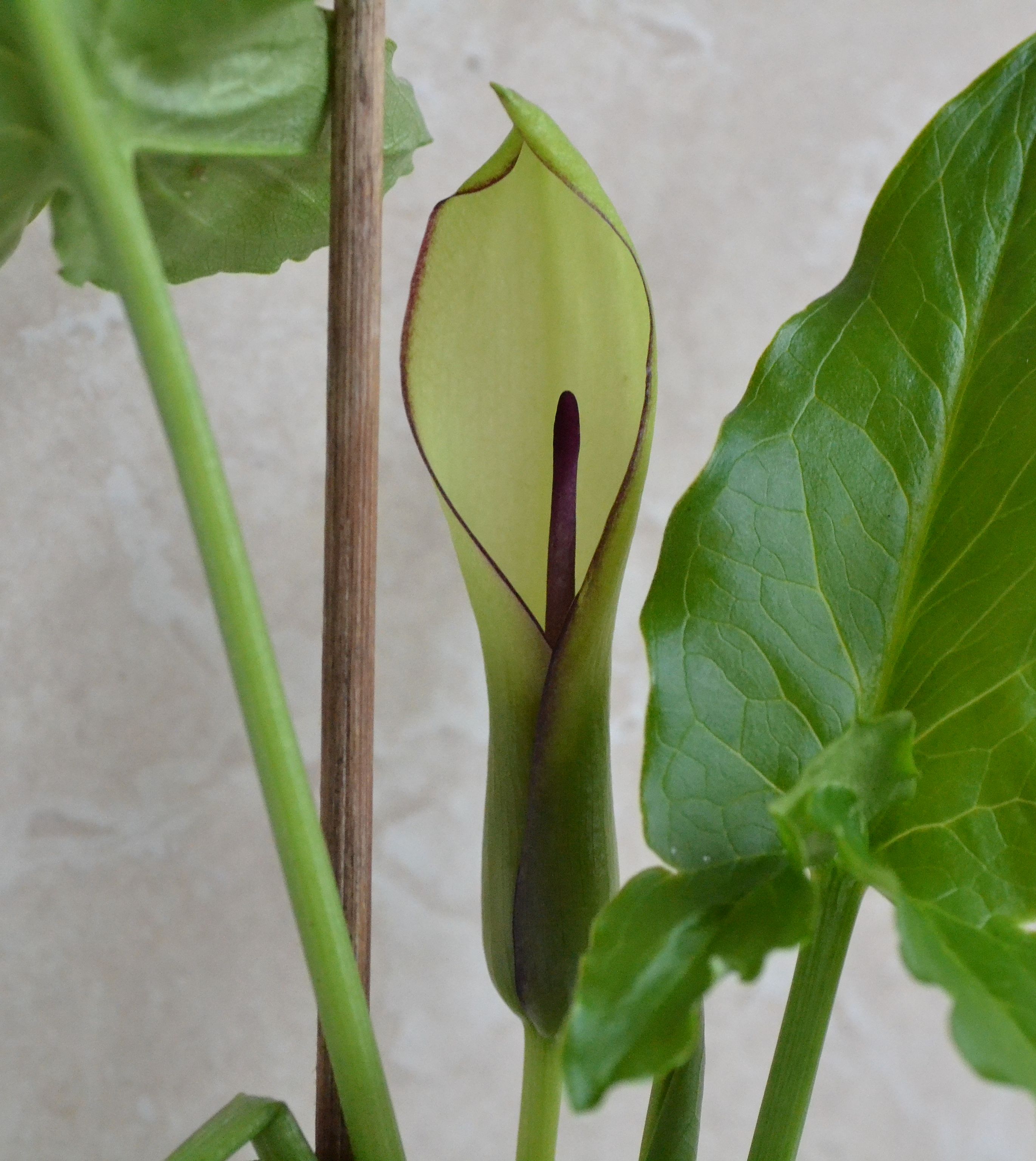
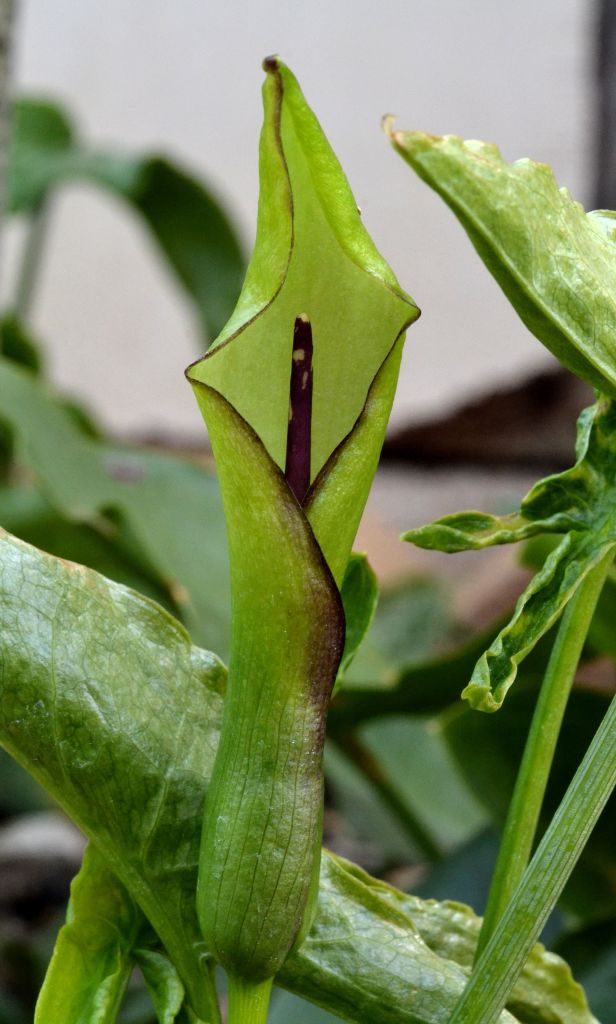
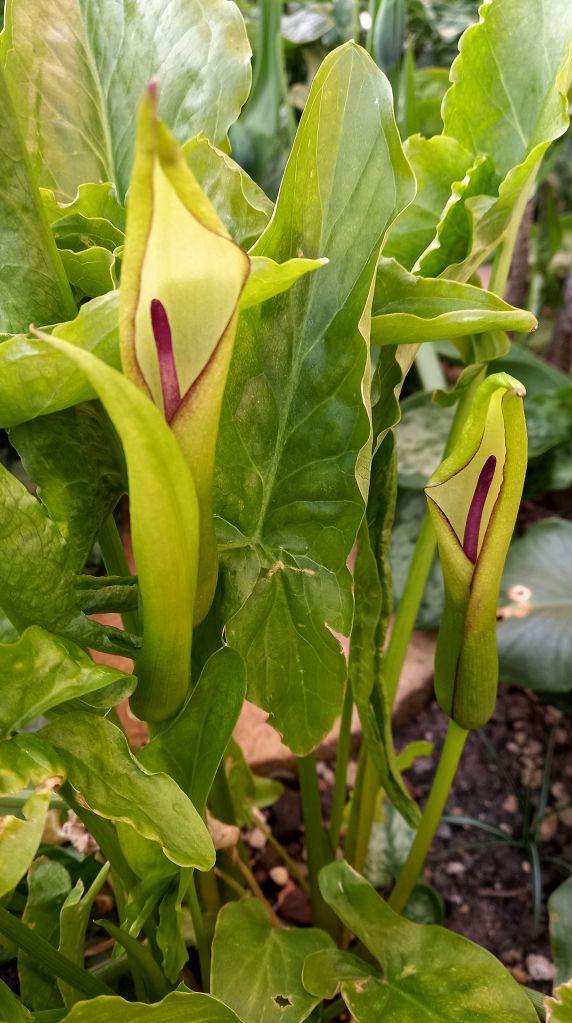
This plant, also known as “Water Arum”, is native to the Middle East from Syria to Jordan, and also Morocco. It is summer dormant with leaves up to 60 cm long appearing in autumn, followed by the narrow “waisted” inflorescence by early spring. The creamy green spathes are edged with maroon and the slender spadices are pale purple. I was a little disappointed with the 2019 bloom (above left) that did not seem markedly different from wild Cuckoo Pints, but in subsequent seasons the slender pinched form more closely matched published pictures.
Despite a reputation for being tender A hygrophylum is said to be hardy if given a sheltered position from the worst of wind and frost. It thrives left to its own devices planted out in moist soil and, as I found tends to struggle when grown in pots. It will often try to flower in January, as was also my experience. But cold will knock back the early flowers outside, and my plant suffered a real battering in the strong, cold winds of Jan and Feb 2020.
Arum italicum
These are pretty much the Mediterranean equivalent of our own Cuckoo Pints. Two varieties sourced from a small nursery near Wantage have over the last 18 years or so colonised, or perhaps invaded KCP BG quite successfully.
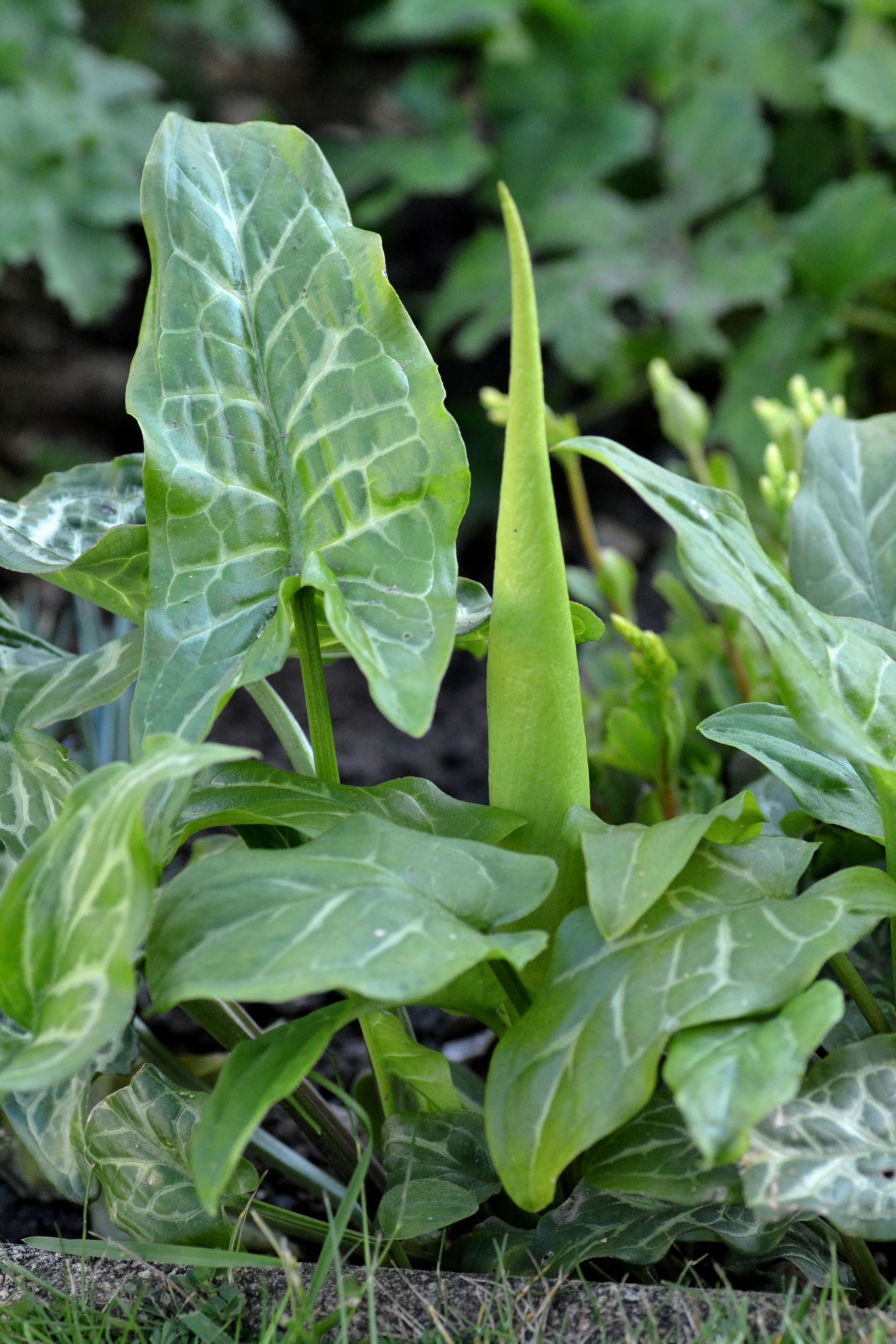
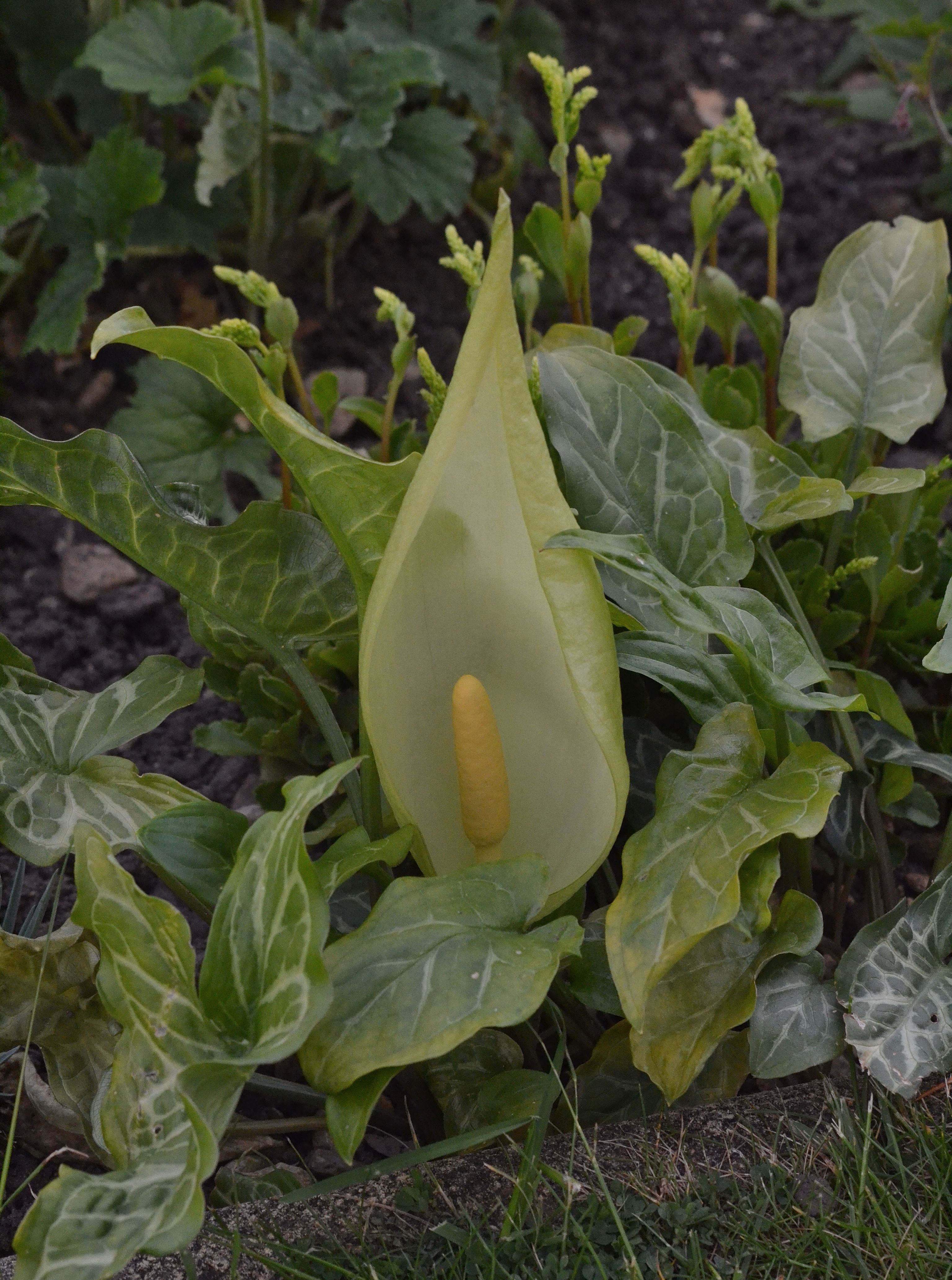

They have twin advantages that bold and shiny, arrow-shaped leaves appear in autumn and resist all attention from frost throughout the winter. Then after the foliage withers the subtle creamy blooms turn into equally striking spikes of brightly coloured fruits through the summer. So this is a truly eye-catching plant in all its stages (pictured above).
In most seasons the blooms tend to be rather submerged within the foliage of the many clumps in KCP BG. But in 2020 strong wind and rain through January and February followed by mostly quite exceptional fair weather from late March to early May caused the foliage to wilt earlier than usual. The many large inflorescences were thus much more visible, as these pictures (below) show.


Arum maculatum
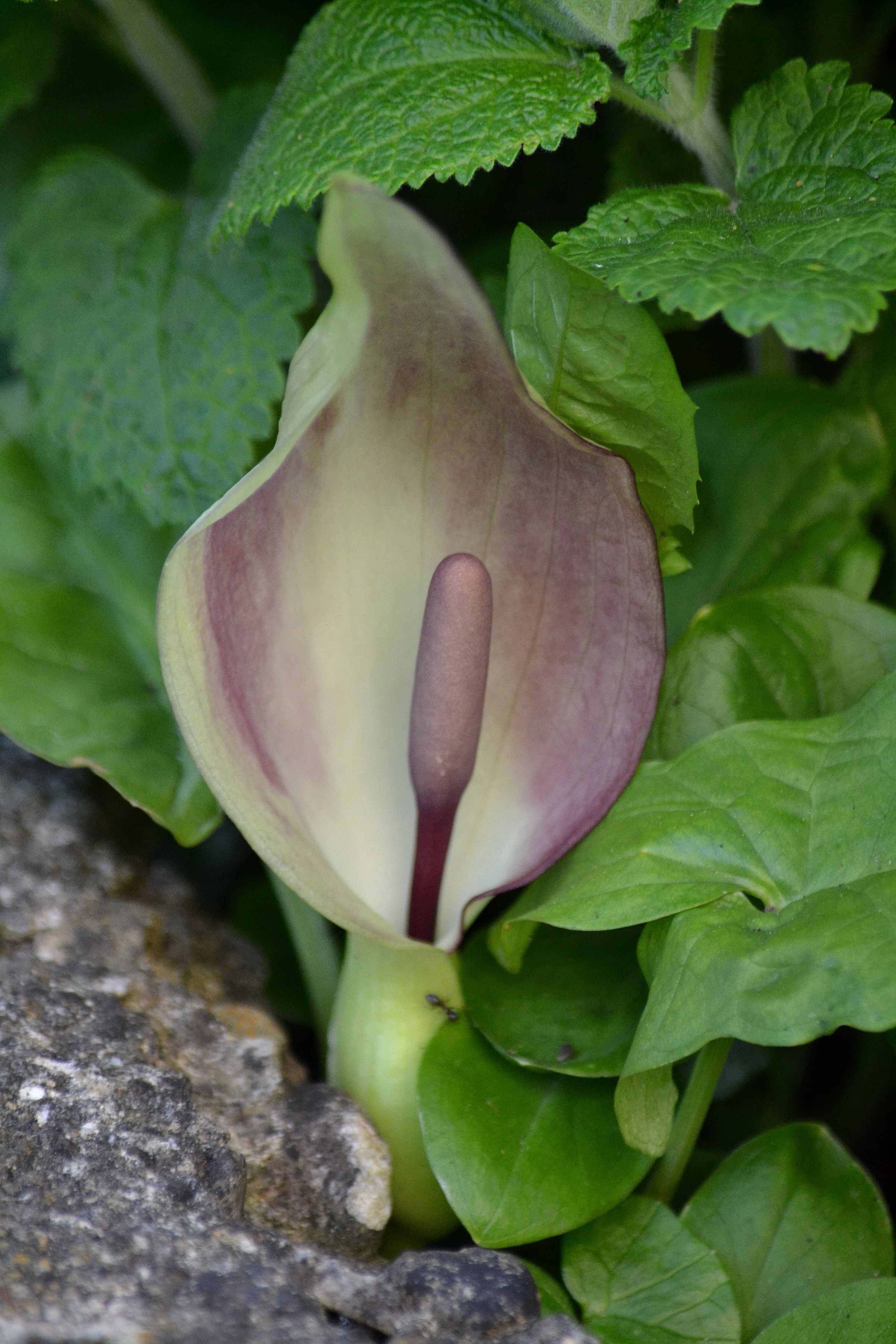
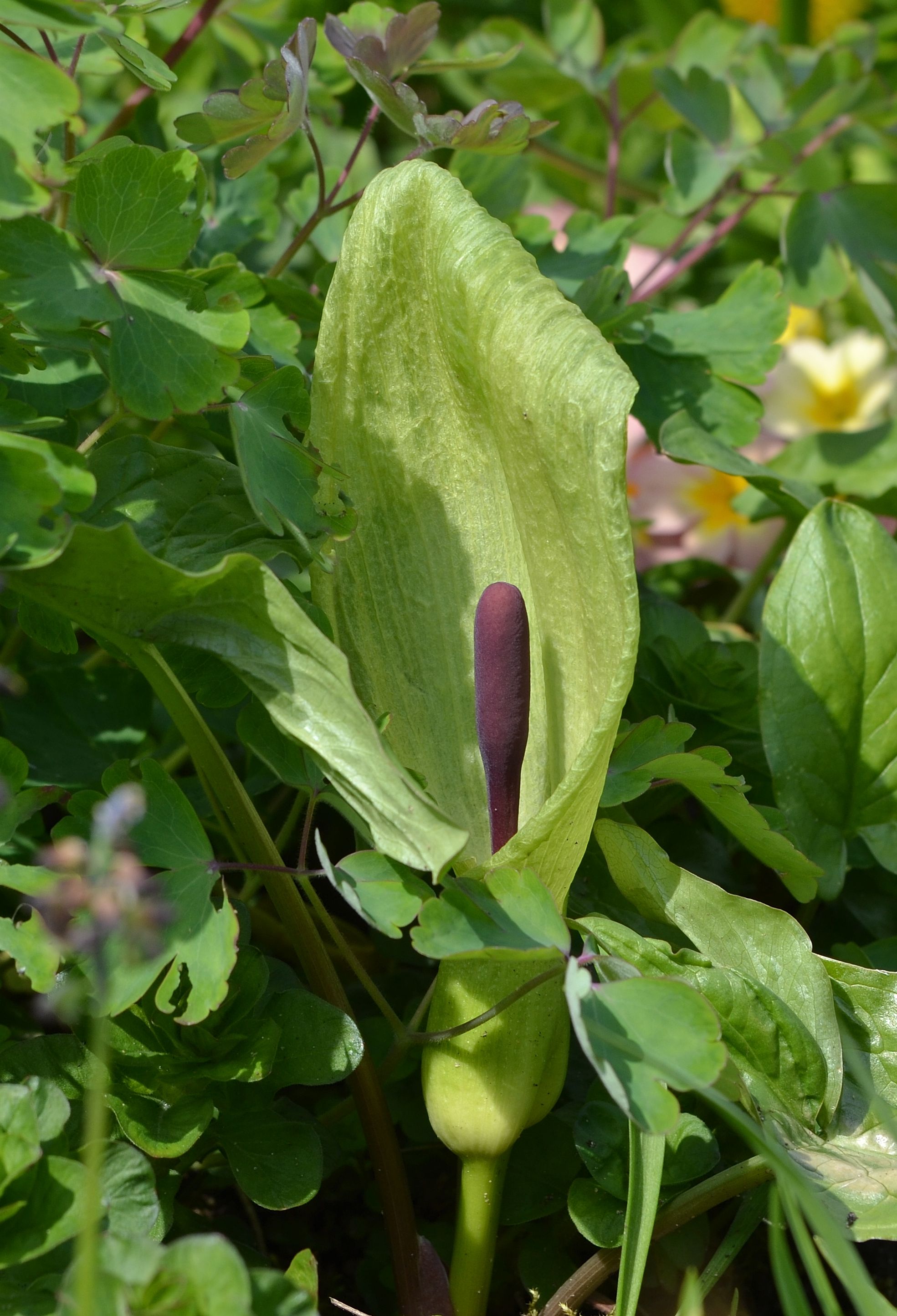
These spring flowering wild Aroids are a common and widespread woodland plant across much of Europe and occur naturally around the margins of KCP BG. The glossy, spear-shaped leaves appear in mid-winter, followed by blooms in April (below) that last for little more than a day. Then the whole plant quickly wilts and later in the season the stems turn into spikes of orange berries. There are a host of colloquial names but the one I prefer is “Cuckoo Pint”.
Complete checklist of the genus Arum
In addition to these 26 accepted species, there are a number of synonyms and unresolved items that differ according to various authorities. But as far as I can ascertain, this (below) is the general picture. Asterisks denote species formerly cultivated at KCP BG. Survivors are marked **
- apulum *
Endemic to central Apulia in SE Italy and related to A nigrum from the Balkans. Blooms in April. - balansanum
Native to Turkey. - besserianum
Native to S Poland and the Ukraine. - concinnatum **
Native to the southern Peloponnese of Greece, most Aegean islands and SW coasts of Turkey. One of the largest Arums, capable of reaching a metre in height. Exhibits various leaf forms. Blooms (foul smelling) in mid-spring. Also known as: byzantinum or nickelii. - creticum *
Native to the mountains of Crete, Greece and a few places in SW Turkey.
Blooms (scented) in April / May. - cylindraceum
Widespread from southern Sweden to Crete and from Portugal to Turkey. Also known as alpinum and lucanum. - cyrenaicum *
Rarity from SW Crete and NE Libya. Blooms in late spring / early summer. - discoridis **
Occurs widely across eastern Mediterranean region, with different forms:
var cyprium
var philistaeum
var syriacum – central southern Turkey and NW Syria. - euxinum *
Rarity from mountains around the Black Sea coast of northern Turkey. Blooms (scentless) in May. - gratum
Native to NW Turkey, Syria and Lebanon. Blooms scented) May – June and rarely into July. - hainesii
Native to eastern Iraq. Blooms in May. - hygrophilum *
Occurs in NE Morocco, E Cyprus, SW Syria and W Jordan. Blooms (scentless) in late winter or early spring. - idaeum
Rare endemic to the highest Cretan mountains. - italicum **
Widespread in woodland and hedgerows throughout Europe, N Africa and Asia Minor. Exhibits various leaf forms:
ssp albispathum
ssp canariense - jacquemonti
Occurs from NE Iran through Central Asian region to W China. Blooms April – May. - korolkowii
Occurs in N Iran, Afghanistan and through central Asia to NW China. - lucanum
S Italian rarity occurring in high elevation habitats above 1000 metres. - maculatum **
Common and widespread in woodland and hedgerows across much of Europe. The English Cuckoo Pint (see here). - megobrebi
Recently described species from mountains between Turkey and Georgia. Blooms in late spring. - nigrum
Native to the Balkans, blooming in May – June. - orientale
Occurs from Austria and Poland through eastern central Europe to NE Turkey, the Crimea and W Caucasus. Blooms May – June. Also known as alpinariae and elongatum. - palaestinum
Occurs in Israel, W Syria, Lebanon and Jordan. - pictum
Occurs in rocky habitats of the Tyrhennian and Balearic islands, and is the only autumn flowering (foul smelling) member of the genus. - purpureospathum
Endemic to Crete. - rupicola (or conophalloides)
Occurs from eastern Aegean islands to Israel and Iran. Blooms from April to late June, and into July in cultivation. - sintenisii *
Native to northern Cyprus. Blooms (scented) in spring.
 Ramblings and Scribblings