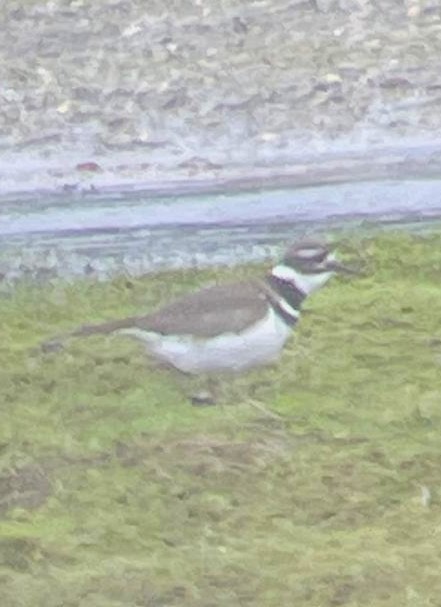
A mainland Nearctic wader as close to home as Hampshire was a national and Westpal tick not to miss, and likewise Adam’s offer to Ewan and myself to do the driving when news broke a day earlier. The location was an agricultural irrigation facility on farmland between Ringwood to the north and Christchurch on the coast. That site has a niche reputation in local county birding for producing occasional quality records, and this Killdeer must be it’s finest moment to date.
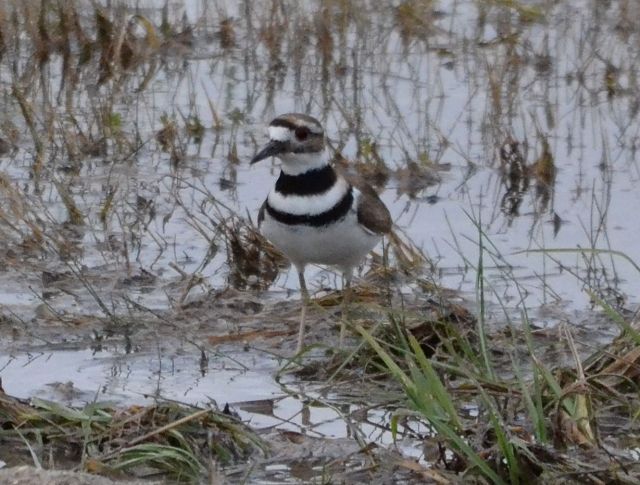
Killdeer (archive picture from Florida, Jan 2018)
Ripley Farm Reservoir (50.7924,1.7741 – SZ158994) is viewable from a public right of way running westward from a hamlet of the same name. We arrived in the early afternoon to join around 30 other birders and our quest was visible distantly but clearly, hunched on the ground looking away from us and to one side. It had been quite still there for more than an hour but before too long got up and walked around, offering good views. The double breast band and long tail clearly distinguish this species on the ground from Ringed Plover for instance, and today’s bird preened at times to reveal its as distinctive bright rufous-brown rump. This is a very common shorebird in its home range, much more likely to occur in western or northern offshore locations here. So to observe one inland in southern England is quite special.
Killdeer is an abundant resident across north America (see here) where it breeds in similar grassland habitats to Northern Lapwing in Europe. It owes the rather brutal sounding name to its sharp and often repeated alarm call, a classic example of onomatopoeic bird nomenclature such as Kittiwake, Cuckoo, Chiffchaff or Bobolink. This post’s sighting is the 22nd in the British Isles so far this century, and there are typically only between two and five records each year across western Europe as a whole.
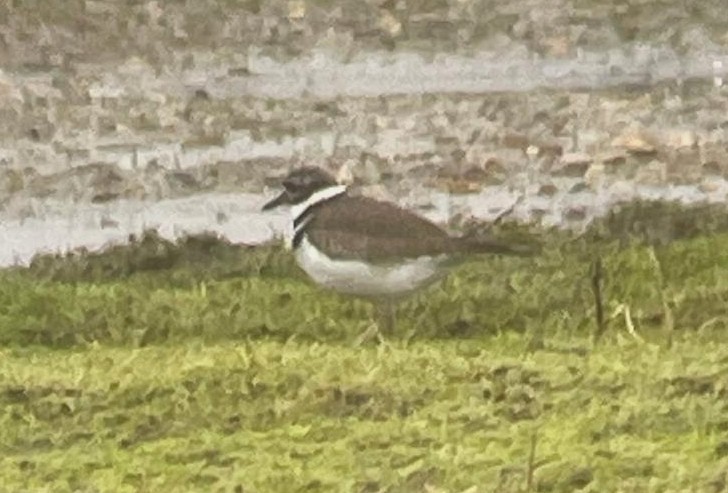
Adam was able to digiscope the above records of the sort of clarity everyone present must have been gaining in continuous light rain. At one point while the assembly was waiting for the main attraction to stand up and perform, a White-tailed Eagle from the Isle of Wight release scheme drifted by giving everyone a bonus bird for the day.
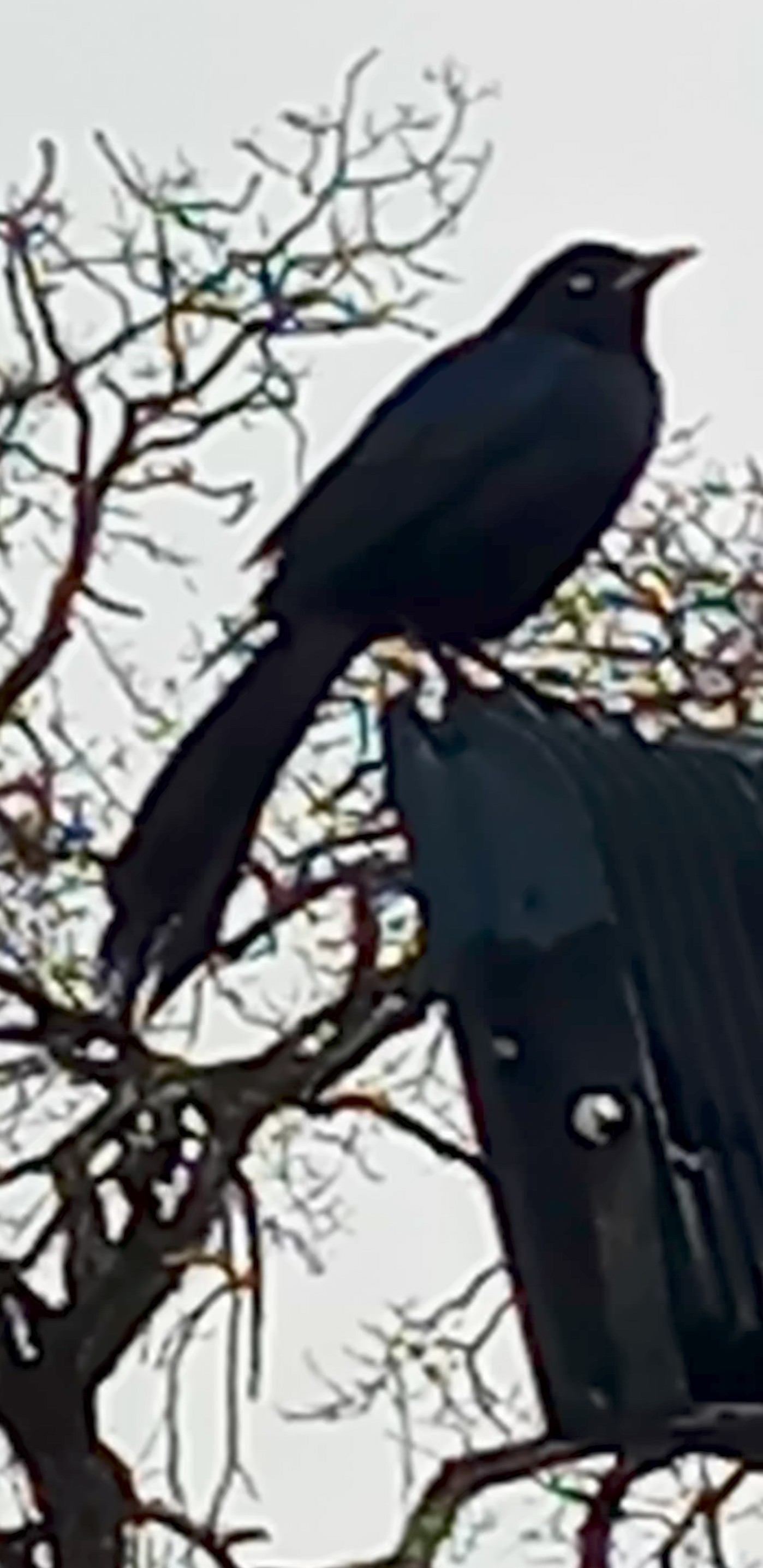
Had I done this twitch alone I would have combined it with converting the ship-assisted Great-tailed Grackle that has been present in Hampshire this winter since early November. And fortunately my two companions, though having seen it previously were of the same mind. After making landfall at Calshot near the mouth of Southampton Water this bird settled in a residential street at Holbury, close by the brooding presence of Fawley oil refinery, Great Britain’s largest that supplies around 20 per cent of national capacity. There it has been much-twitched on a daily basis ever since.
Team Grackle and the pole-top bird, with guidance from the late, great (cheat) Diego Maradona
As soon as we arrived at the street in question, Adam pointed and said: “There it is.” And there indeed the Grackle was, perched atop a structure in the nearest garden. It then moved from one telegraph pole to another around us, but being no doubt well fed here it wasn’t tempted down to the ground so late in the day by Adam’s offering of flapjack. The light was terrible so I could only gain blurred records with my phone (above, left), and the subject looked some way short of its usual smart self on such a wet day. But when conditions brightened a little I could discern the celebrity visitor’s metallic, midnight-blue sheen, reminiscent perhaps of my own, much-loved Vauxhall Corsa. For the RBA gallery of this bird see here.
Being extremely approachable I had not considered devoting a special trip to this second Nearctic item, waiting instead for something to combine it with, and now that opportunity had been realised. As a non-purist I am content to add it to my British list as a non-BOU record. And having seen only Boat-tailed Grackle of three related species, that this bird was initially identified as, during my past trip to Florida I see no reason not to consider it a lifer too. Hence I counted my 528th Western Palearctic bird on a very enjoyable if rainy day out.
In recent days two stable and twitchable western Palearctic birds have prompted me to pay some attention to my national list, that still hovers a little way within my career ambition of 400 species. A Lesser Crested Tern from Africa or beyond arrived in Devon’s Exe estuary on 3rd, then three days later a vagrant Scops Owl was discovered at a suburban recreation ground in Swansea. Both items appeared to find their adopted surroundings to their liking, having provided daily observations on the bird information services each day since.
My beloved park home has undergone extensive refurbishment during November, and I have been pre-occupied with related DIY matters of late. But having reached a convenient pausing point in all that whilst feeling a certain degree of pent-up energy, I elected to burn some of it off through a 478-mile round trip to convert these birds for Blighty. I had recorded the Tern once previously in Morocco (2015) and Scops Owl twice in Sardinia (2018) and Turkey (2019).
The logical itinerary was to try for the Owl (pictured above) first. Then in the morning the round trip’s shortest leg would get me to the Tern at high tide, in a spot where my second quest had become reliable. The outward journey grew stressful when I lost both Bluetooth connectivity and a stable internet signal along the South Wales M4, then Google Maps guided me through the centre of Swansea in the rush hour and back out via a rather tortuous shortest route, with phone balanced upon knee. How dependent I am for my well being upon such technologies I reflected once again. But when I arrived on site at Dunvant Park (SA2 7QU – 51.6197,-4.0221) shortly after 5pm the Owl had yet to be seen.
I joined a group of around 20 hopeful observers, amongst whom was Adam (see here) as arranged. The gathering was very well marshaled by local birders and everyone behaved sensibly. The initial strategy was to all keep together in one place and hope the bird would come to us, while those equipped with thermal imagers scanned for it, rather than walking around randomly. But after an hour by 6pm the lead marshal suggested we split into smaller groups and keep in touch. Fortunately I joined the one that took the driest path and soon put up the foraging Scops Owl on the ground amongst trees.
By now the initial numbers of birders had probably doubled. It had been agreed that when located the bird would be lit up for no more than 30 seconds then given sufficient time and space to continue feeding before being disturbed again. The lead marshall shone a torch just below the Owl as it perched in a small tree so everyone saw it well as in this post’s lead picture, then a proportion of observers including myself dispersed. All this had certainly been a quite different kind of and unusual birding experience. I had expected to be searching up in tall tree tops, but this particular Scops Owl kept lower down.
The diminutive Eurasian Scops Owl breeds from southern Europe eastwards to southern Siberia and the western Himalayas. Europe forms approximately 57% of that total range, holding between 226,000 and 380,000 pairs. The species inhabits open woodland, parks and gardens, often nesting in suitable holes in trees or walls; and normally winters in sub-Saharan Africa. At 19 – 21cm in length it is slightly smaller than the familiar, British resident Little Owl. Largely nocturnal it feeds mainly on insects, worms and other invertebrates. The Swansea bird is the 44th accepted British record, and 13th so far this century.
My thanks are due to Mark Hipkin for marshaling the twitch so expertly and responsibly, without which I would certainly not have made this connection. Also to Jim Hutchins, the Standlake Birder (see here) for kindly granting me permission to illustrate this post with his own best record that shows exactly how I too observed this bird.
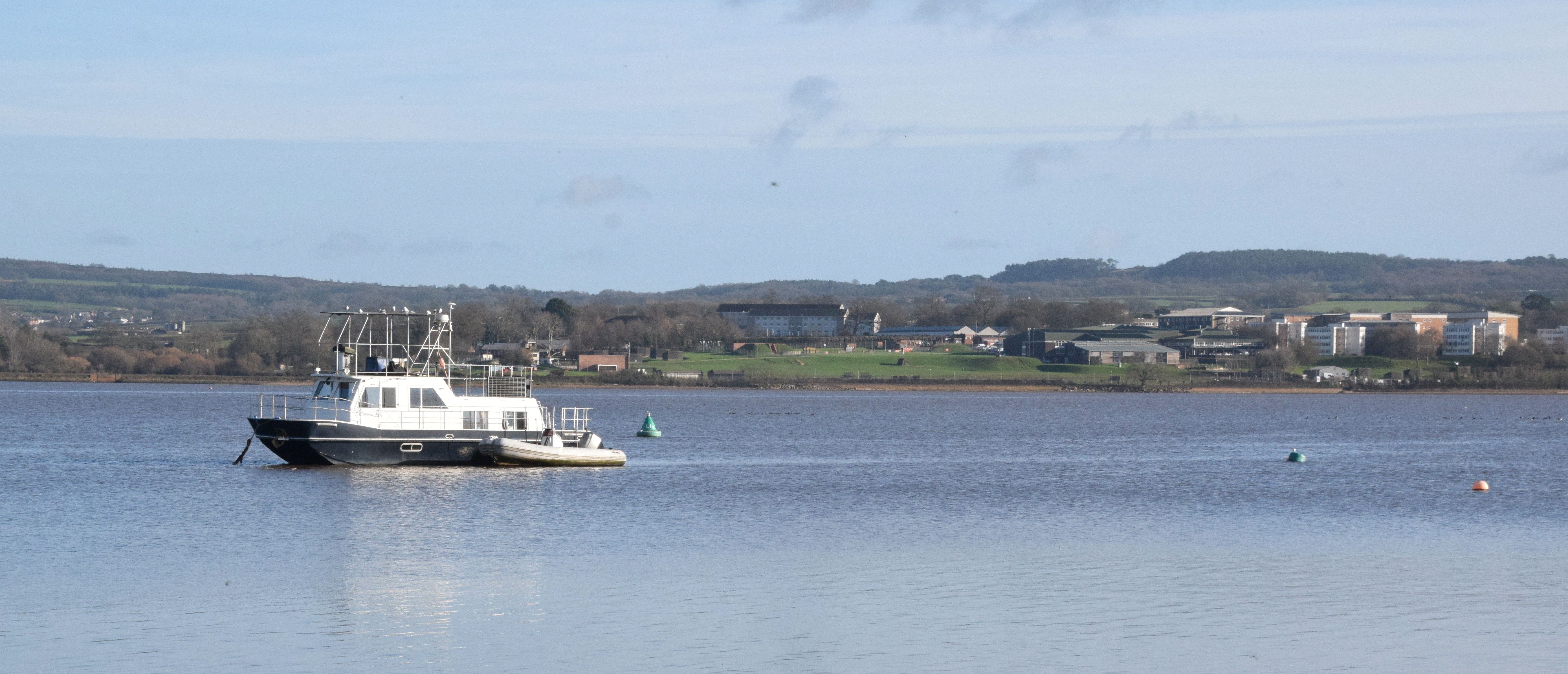
Friday morning (12th) in Devon offered refreshingly cool and sunny conditions, and the 137-mile run from my overnight stay in Port Talbot to the Exe estuary was congestion free. From the parking area at RSPB Exminster Marshes (50.67618, -3.46883 – SX 963873) I walked south for about a kilometre along the Exeter Canal towpath to Turf Lock (50.66489, -3-46760 – SX 964859) that gives access to the waterway from the estuary. Beyond is a hotel / pub and a flat spit of land from where my quest had been viewed for most of this week. Here it perched on offshore buoys at high tide, fed on the mud at low tide and often roosted on a pontoon.
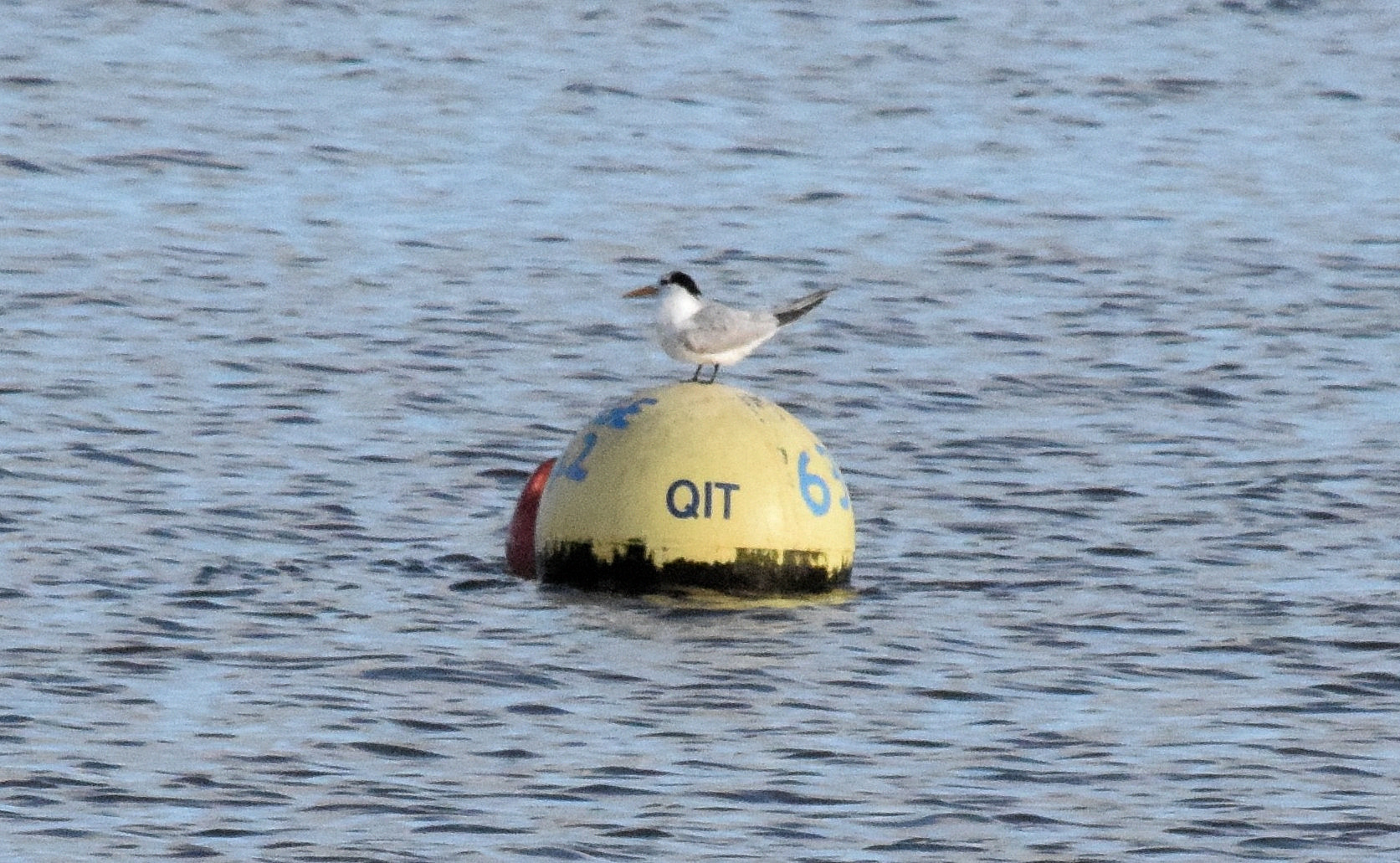
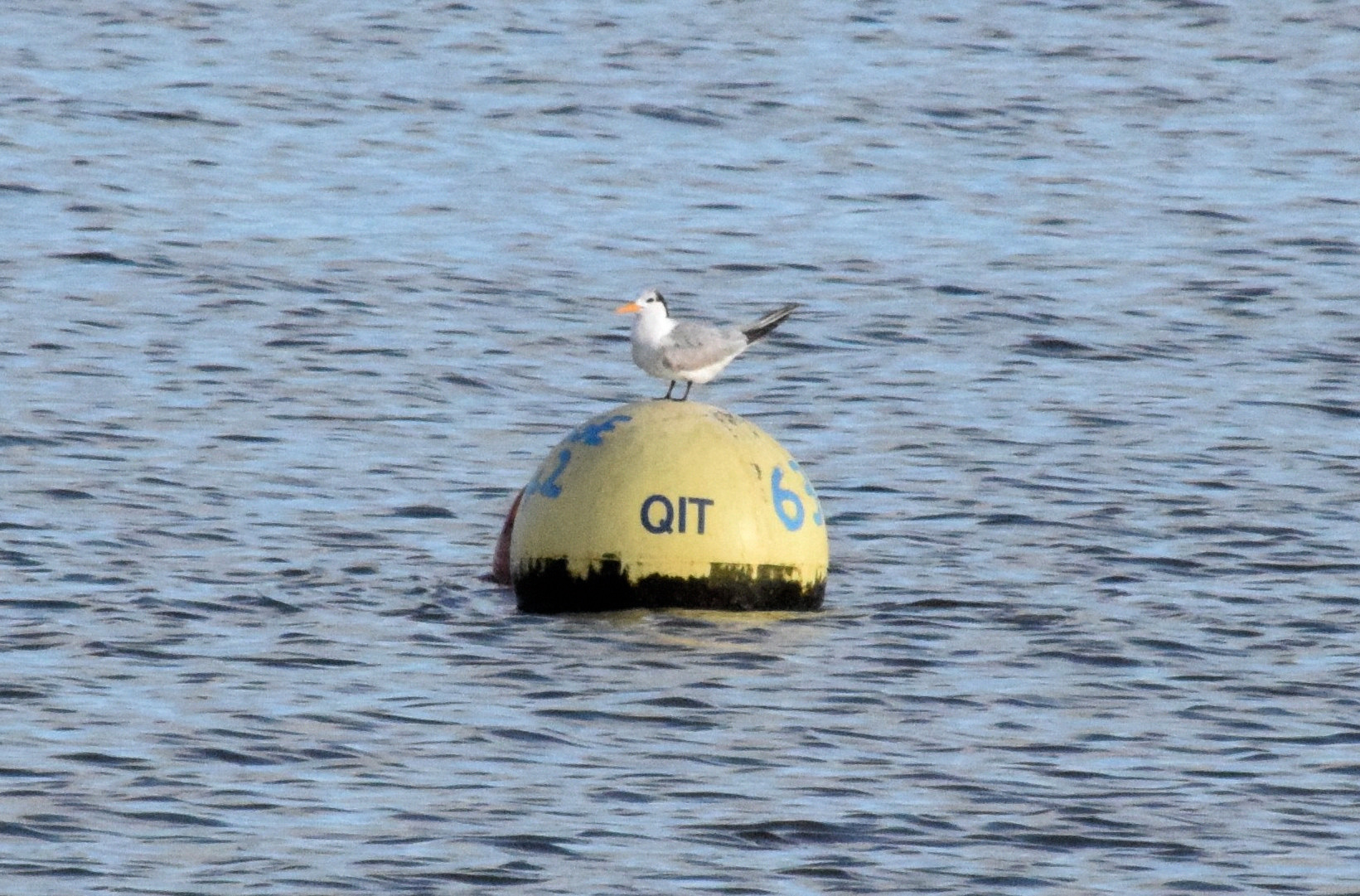
When I arrived at around 11:30 am the Lesser Crested Tern was atop the second green buoy to the right of the boat in the above picture, the visible white dot. And there it contentedly remained, alternately preening, dozing and looking about itself for the next hour. Then it was put up by a passing fast boat and after a fly around re-located to a closer buoy, and I gained some recognizable record shots (below). When after 30 more minutes it was flushed again by a group of paddle boarders, I opted to start the 160 mile journey home. But even as I left the bird had returned to the same buoy.
Lesser Crested Tern is one of three similar, orange-billed species that occur in north-west Africa, and also breeds in parts of the Mediterranean, Red Sea, Arabian Gulf and Indian Ocean. The most significant wintering grounds are east African coasts, the Arabian peninsular and the western Indian sub-continent. A very rare vagrant this far north, the Exe estuary bird is only the second British record this century and just the ninth accepted national record, one of which was famously serial over 14 breeding seasons.
My time spent with it was very relaxed in a pleasant, scenic setting – the epitome of winter coastal birding! Walking back to my car I scanned here and there plentiful arrays of wildfowl and waders across the pleasingly lit floods of Exminster Marshes, to complete the hoped for restorative effect of this entire exercise.
NB. My British bird list now stands at 387. I appear to have acted just in time as neither of these birds was seen on 13th or 14th, or indeed in these locations since.
As the fungi season wound down for another year, the prospect of a full fair weather day on 13th, ahead of a washout Friday and working weekend, sent me out again to track more autumn subjects. But with leaf fall nearly complete finding anything on the forest floor would be difficult, so I headed out to a Chilterns’ site that usually yields some interesting deadwood rotters. Those I had in mind were Wrinkled Peach and the deadly poisonous Funeral Bell, but on my way up to where I had recorded those items previously I stumbled upon a quite spectacular prospect.
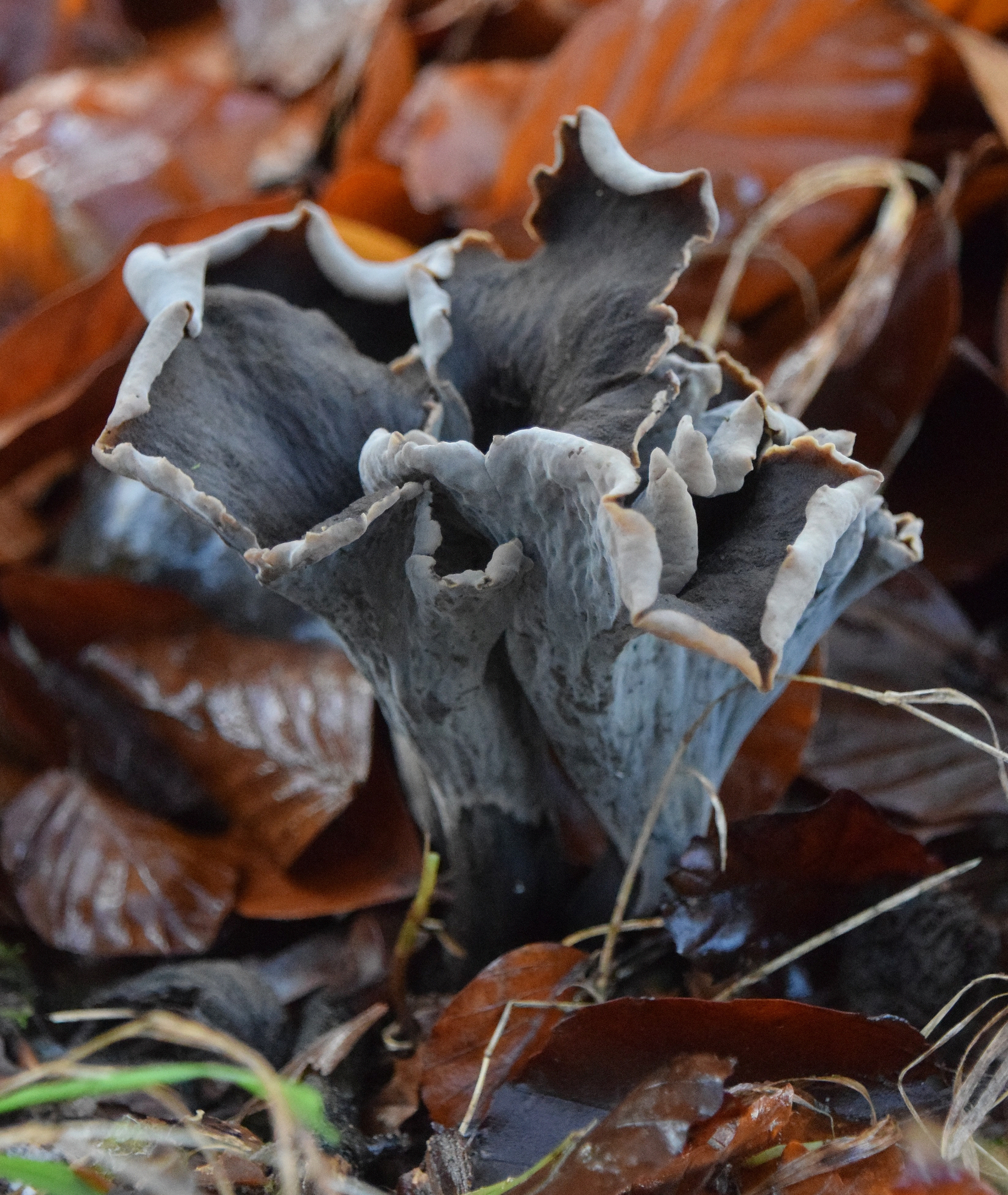
The Horn of Plenty
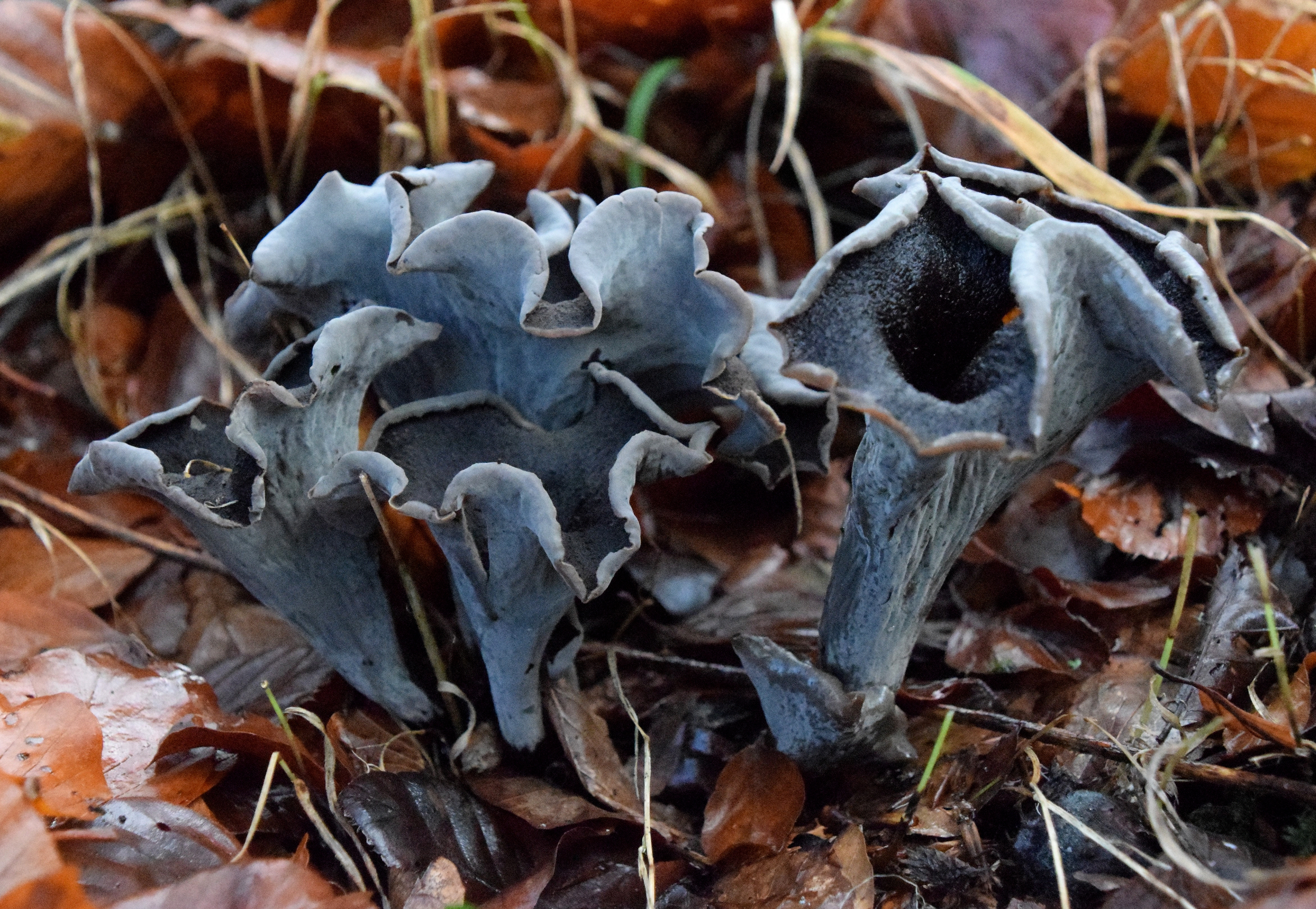
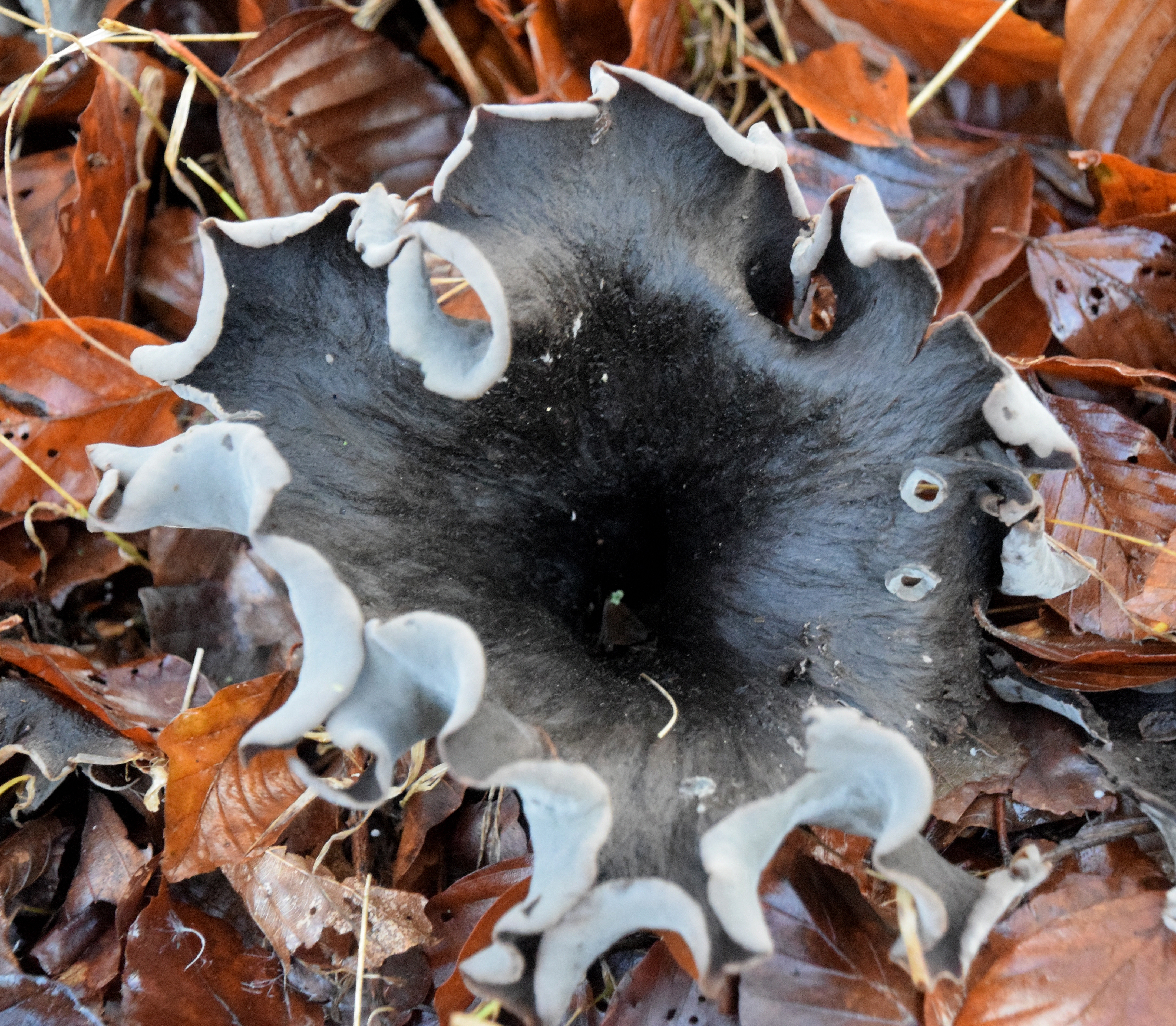
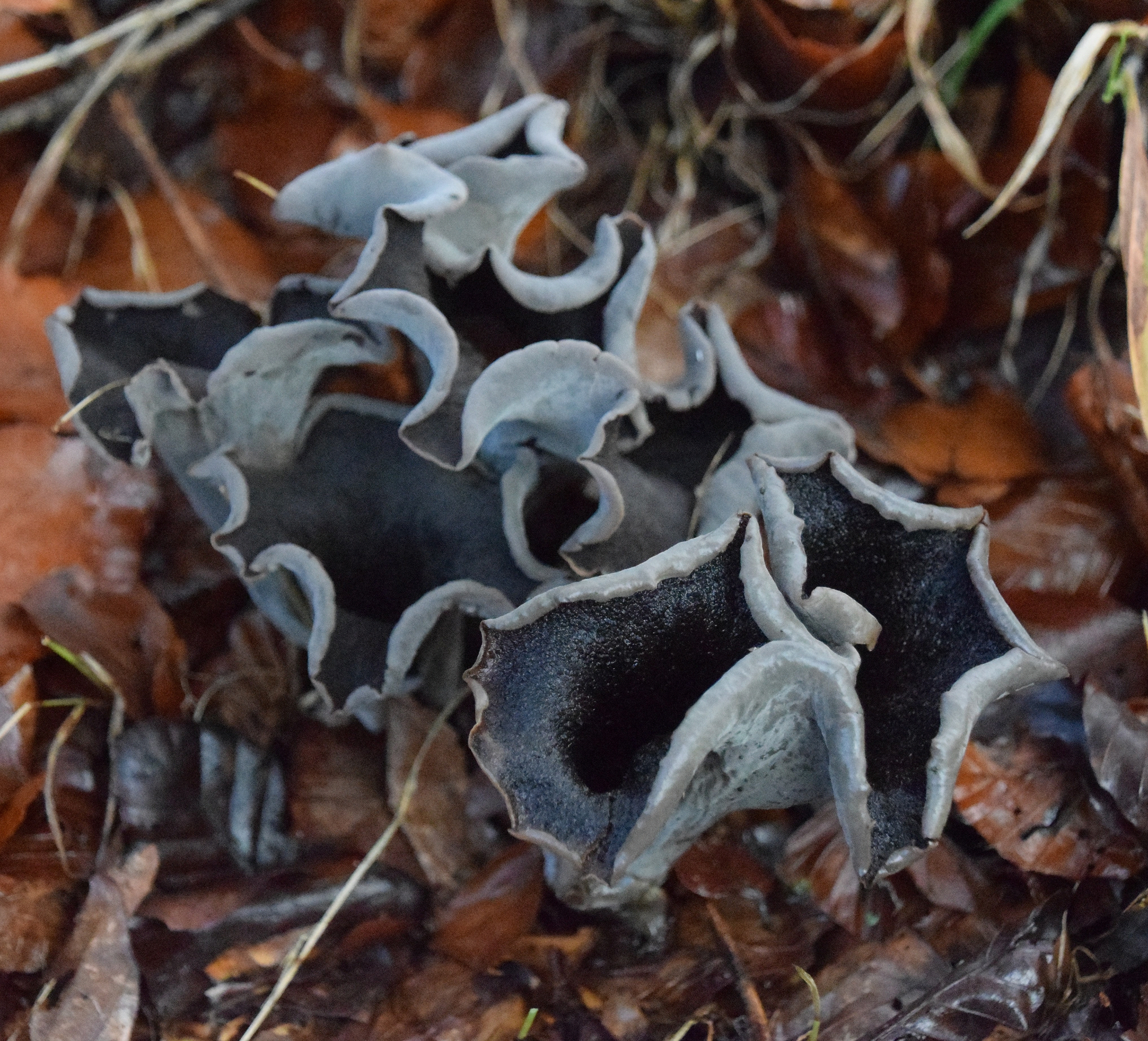
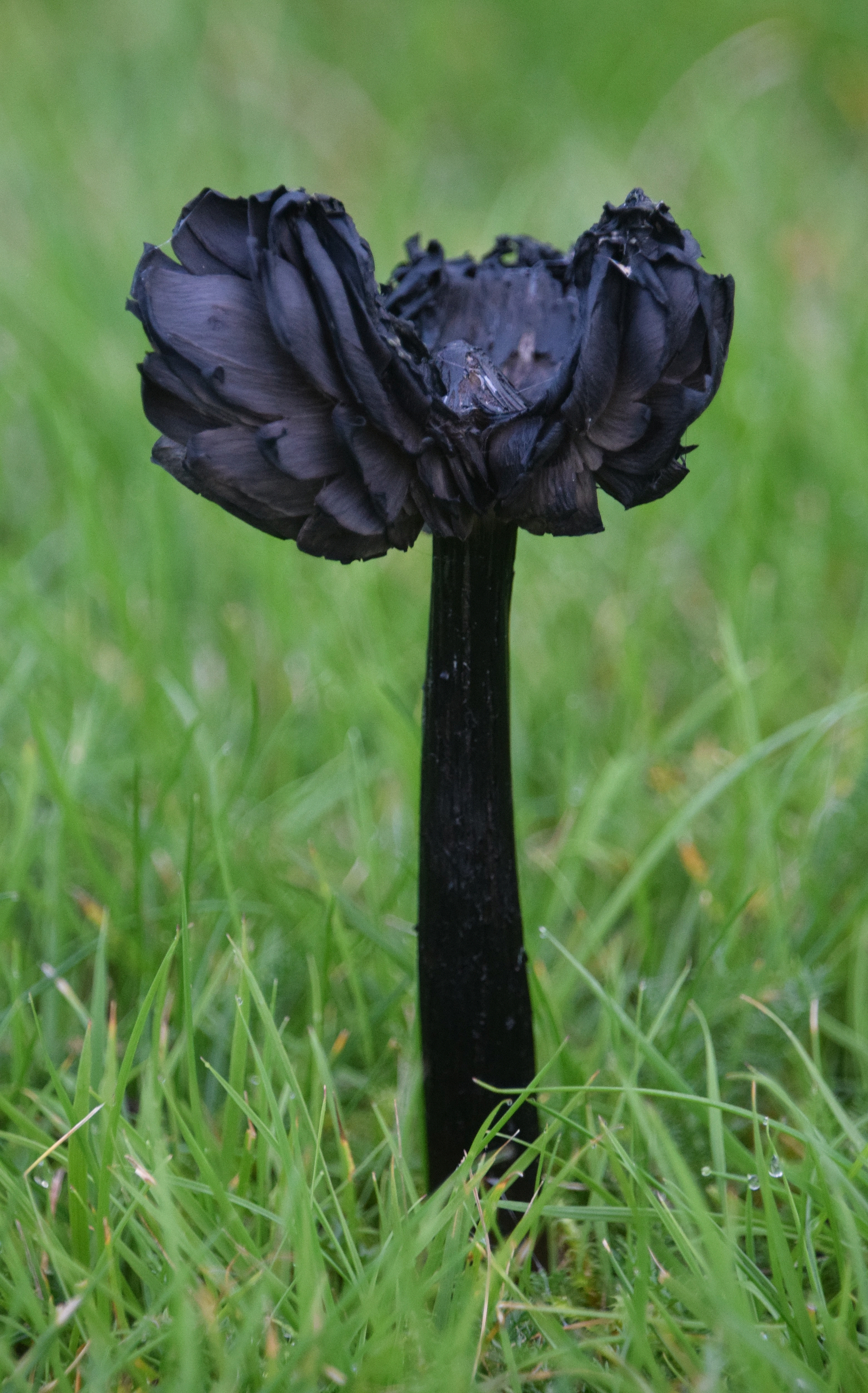
Stopping to check out a gone-over coral fungus on a fallen log, I noticed numerous large, dark shapes partially hidden but nonetheless emergent out of the omnipresent leaf litter in the ground beyond. These were as I suspected Horn of Plenty (Craterellus cornucopioides) that is described as not uncommon but localised, and often abundant where it does occur. The last was certainly true as looking around I detected more and more of them, having previously encountered this fungus on just two occasions. They are robust and can be difficult to detect, since though fruiting at all times of year they last very late in the season when leaves are down.
Once seen this remarkable mushroom’s distinctive grey and black tones and subtle, intriguing contours set it apart from all others. It is most often found under Beech trees as here, but is also associated with Oaks. The alternative name used in France, “Trompette de la Mort” (Trumpet of Death), seems incongruous since these are a highly desirable edible mushroom; hence I will not name the site. Death references in fungal common names usually denote highly toxic items, but the explanation here lies in ancient folklore where the fruiting bodies’ dark and sinister tones were attributed to the buried dead connecting with the living by playing these trumpets emerging from the ground. In North America the common name is “Black Trumpet”. This fungus has a worldwide distribution.
If the dead really did play trumpets from under the ground it might look something like this
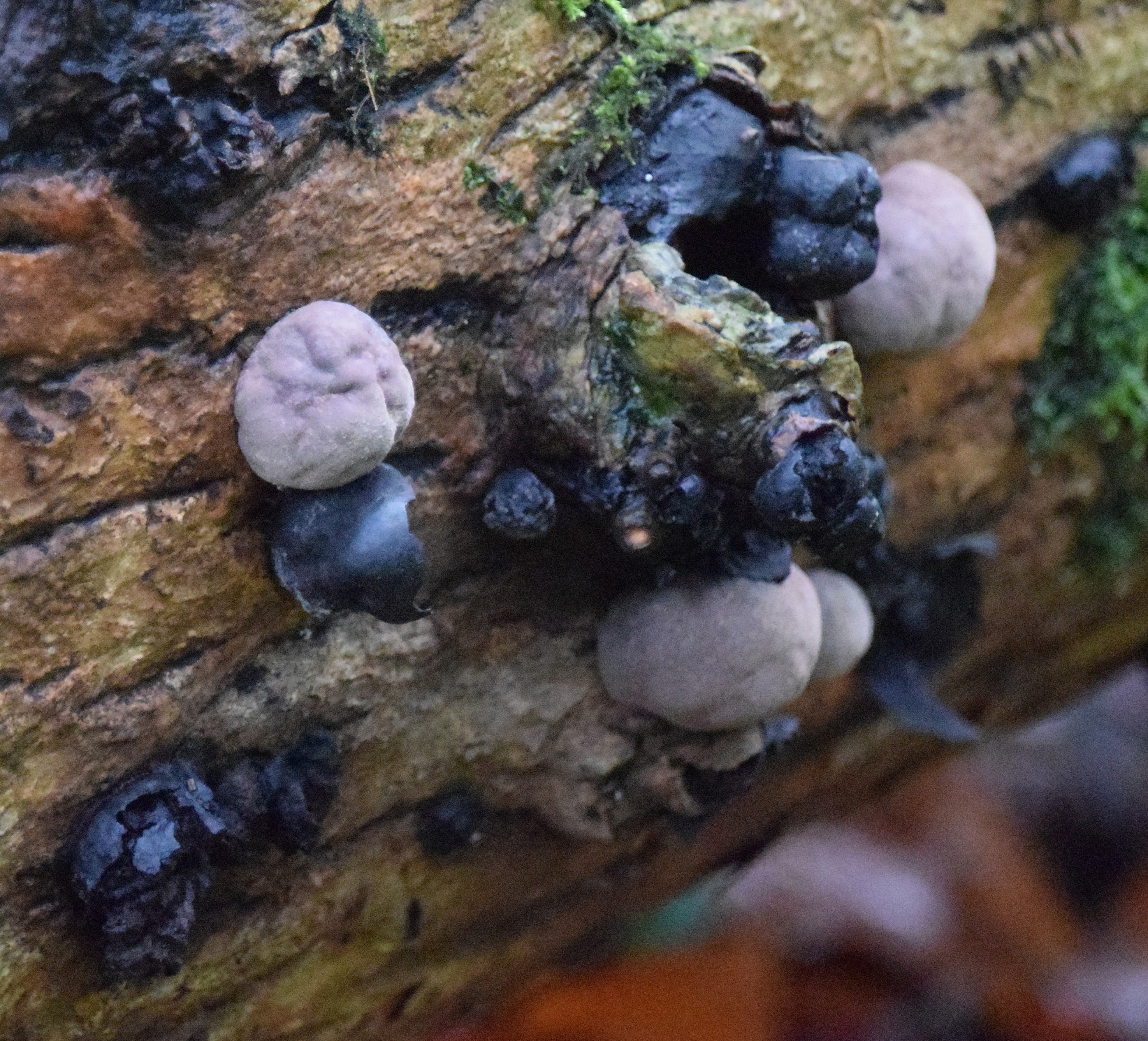
I messaged two associates and Ewan, being quite near while having an unproductive morning’s birding, came to join me (see here). In the meantime I had located a large fallen log that was adorned by large numbers of King Alfred’s Cakes (Daldinia concentrica). These saprobic fungi (ie deadwood rotters) were in both the young mauve form and black, burnt state that gives them their common name, all mixed together. This was a find I had been hoping to make all autumn, and my most profuse to date.
King Alfred’s Cakes
These hard, inedible fungi are also known as “Cramp Balls”. since carrying them was once thought to be a cure for cramp attacks. The pale specimens shown above are still growing, and during this asexual stage they develop and release spores over a long period. Once fully grown the fruit bodies turn black, hence the likeness to the hapless king’s burnt cakes in that old folk tale. Quantities of spores are released at this stage that typically blacken the surrounding host deadwood (above right). All saprobic fungi such as this feed upon and hence break down decaying organic material then recycle nutrients into the surrounding ecosystem.
When mushroom hunting I always get a special buzz if I find something that my phone app ID’s as deadly. I have possibly located the quite scarce but highly toxic Funeral Bell (Gallerina marginata – pictured below on 21st Oct) at this site in each of the last two seasons. The name tells all that needs to be known, since this item contains the same lethal toxins as the infamous Deathcap (Amanita phalloides – see here), that accounts for more than 90 per cent of fungus-related poisoning fatalities in Europe.
Probable Funeral Bell
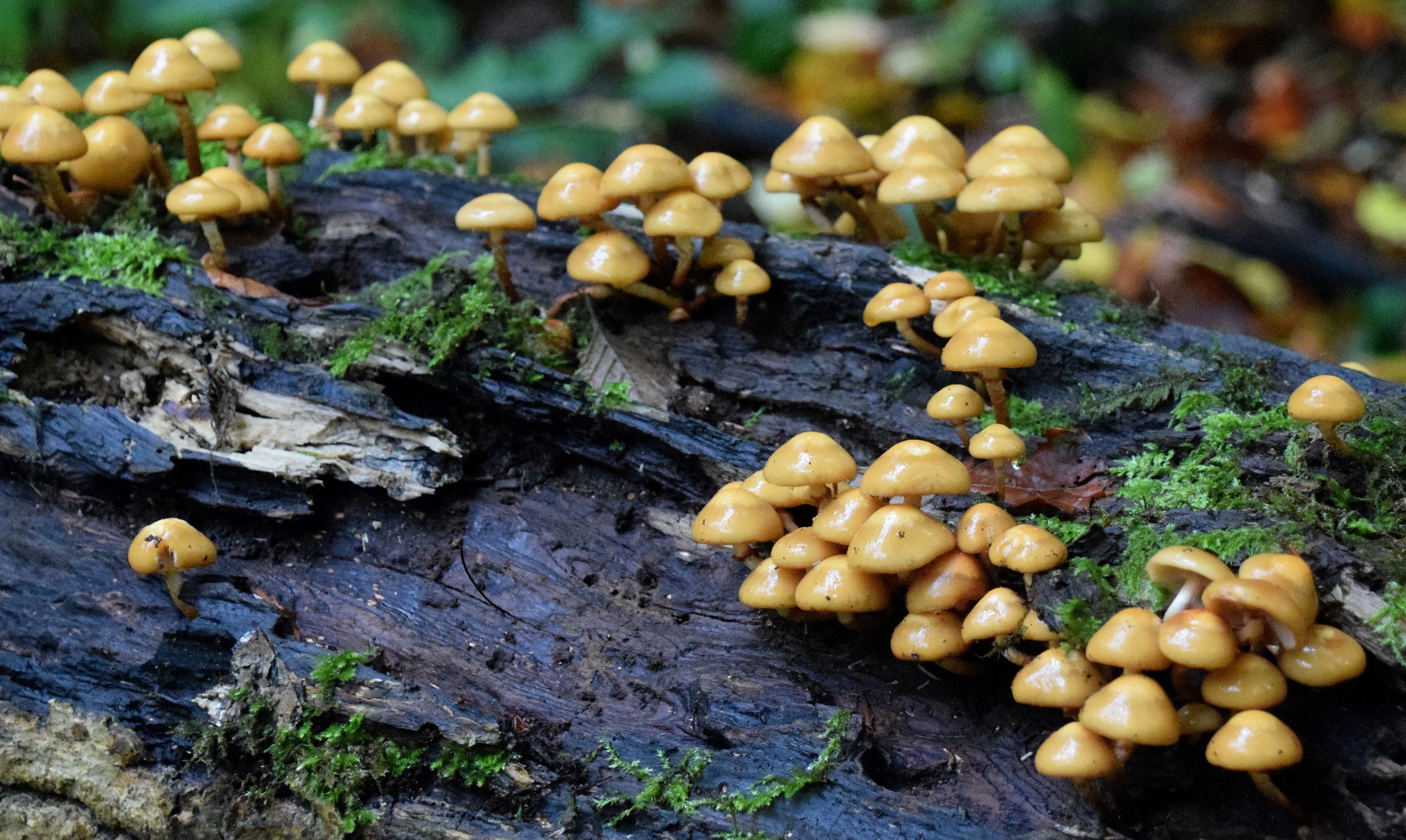
A profusion of Sheathed Woodtuft
The catch is that Funeral Bell closely resembles an edible deadwood rotter Sheathed Woodtuft (Kuehneromyces mutabilis – above), also known as “Brown Stew Fungus” that is collected by some brave foragers and also abounds at this site. So my FB ID may not be accurate and in the absence of due scientific analysis I am open to correction. But I would not wish to test the more definite way of separating the two. Intriguing fungi indeed!
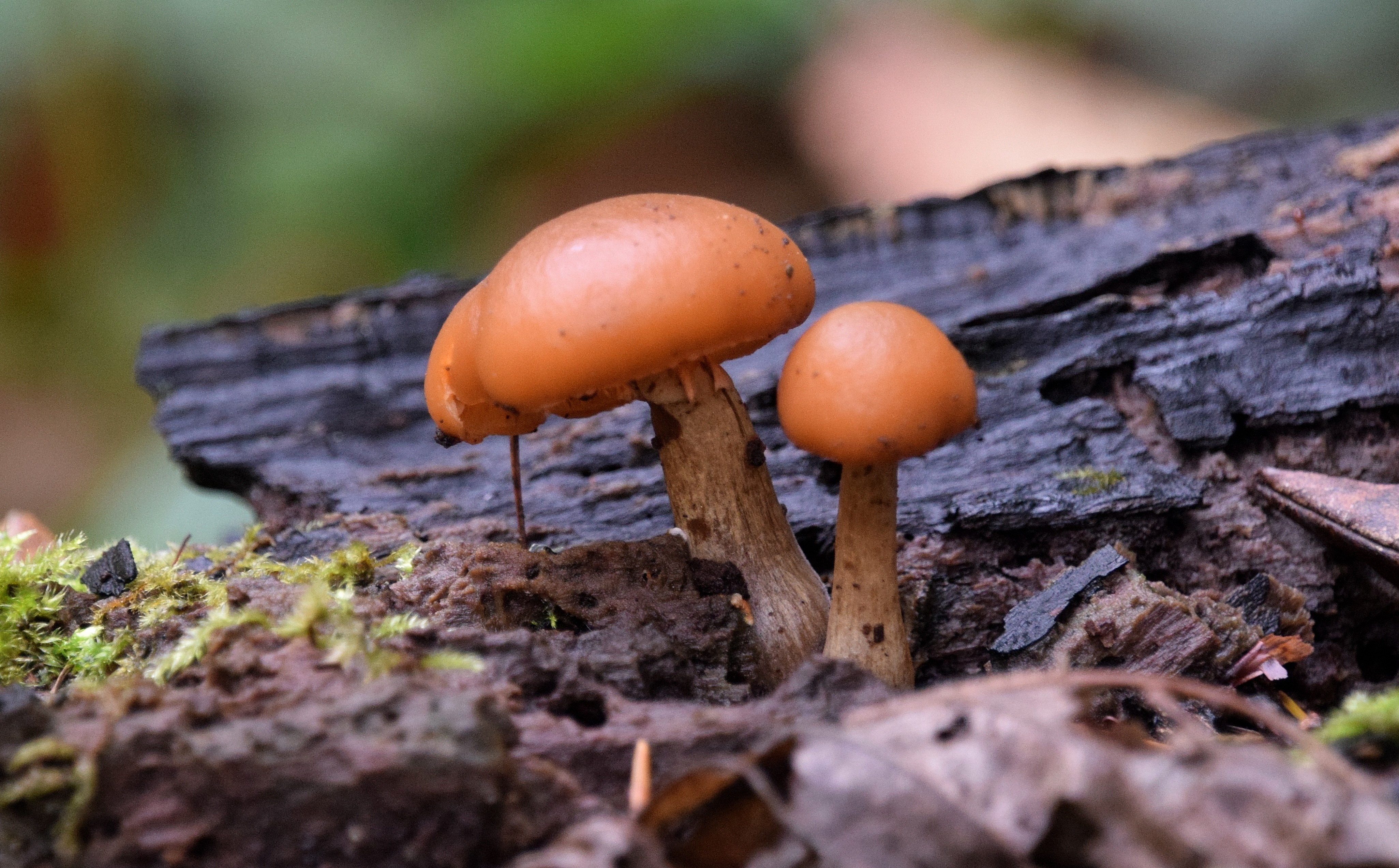
On a brighter note, I have also located Wrinkled Peach (see here for detail) whenever I have visited this Chilterns’ Beechwood. On 21st October I Iocated some typical clusters on the same fallen, presumably Elm logs as previously. By 13th November what remained was no longer really worth looking at, but this is always an attractive find due to its very particular colouration and growth habit.
Wrinkled Peach
Blackening Waxcap on 6th (left) and 13th (right) November, with Meadow Waxcaps (centre)
Having had our fill from the Horn of Plenty on 13th Ewan and I moved on to Nettlebed Churchyard in the Oxon Chilterns (see here), where given this autumn’s more limited available time I have maintained my interest in Waxcaps, sometimes referred to as the “Orchids of the fungi kingdom”. There one particularly fine Blackening Waxcap (Hygrocybe conica – pictured above), that I had tracked twice previously and what a stunner, made an apt tailpiece to this journal’s 2025 fungi content and it’s variously dark, purple and mysterious themes.
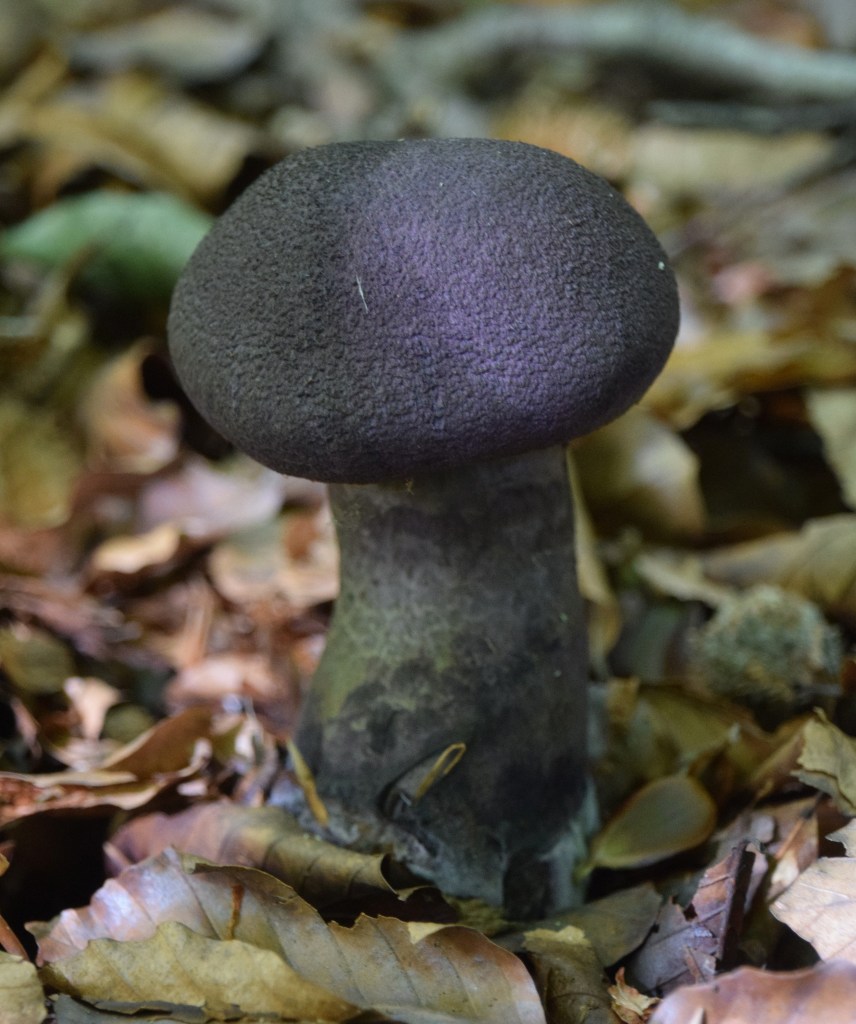
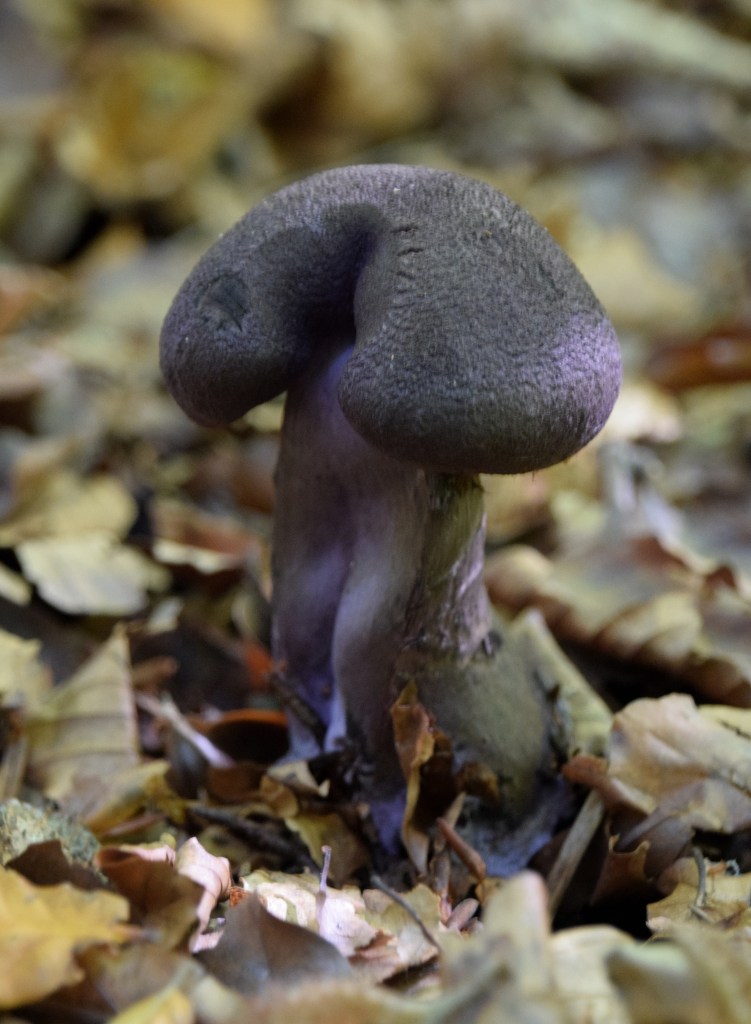
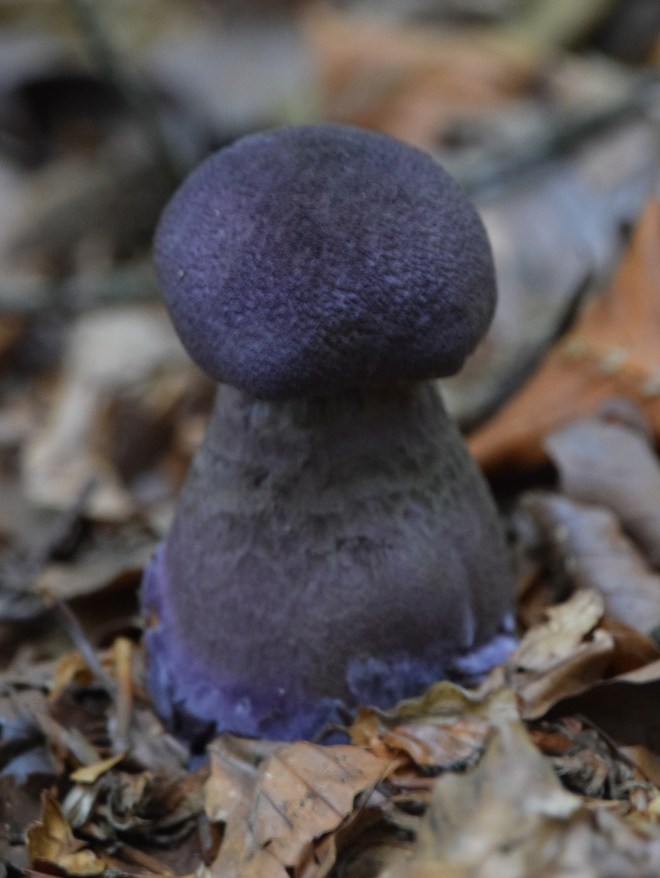
The stand-out experience of this year’s autumn fungi season has been my self-location and subsequent tracking of two uber-scarce Violet Webcap mushrooms (Cortinarius violacea) at one of just a few ancient woodland sites in the Chilterns where they are considered a notable find. I had recorded one there previously in each of 2020 and 21 but not since, despite searching. Now on 7th Oct I found and immediately felt attached to a pristine emerging specimen, and resolved to monitor its progress in the weeks ahead.
In the British Isles this is described as a rare entity, growing in calcareous woodland habitats mainly under Beech but also other broadleaf trees. It is considered a striking and unusual fungus, being dark purple in tone when young, with fibrous stems, and caps reaching 15cm at maturity on up to 12cm stems. I have corresponded with the mycologist who first recorded the species at this site, who said it caused quite a stir at the (unspecified) time when a specimen was sent to RHS Kew. Since then it has re-occurred at intervals but not in every calendar year.
Young Violet Webcap #1
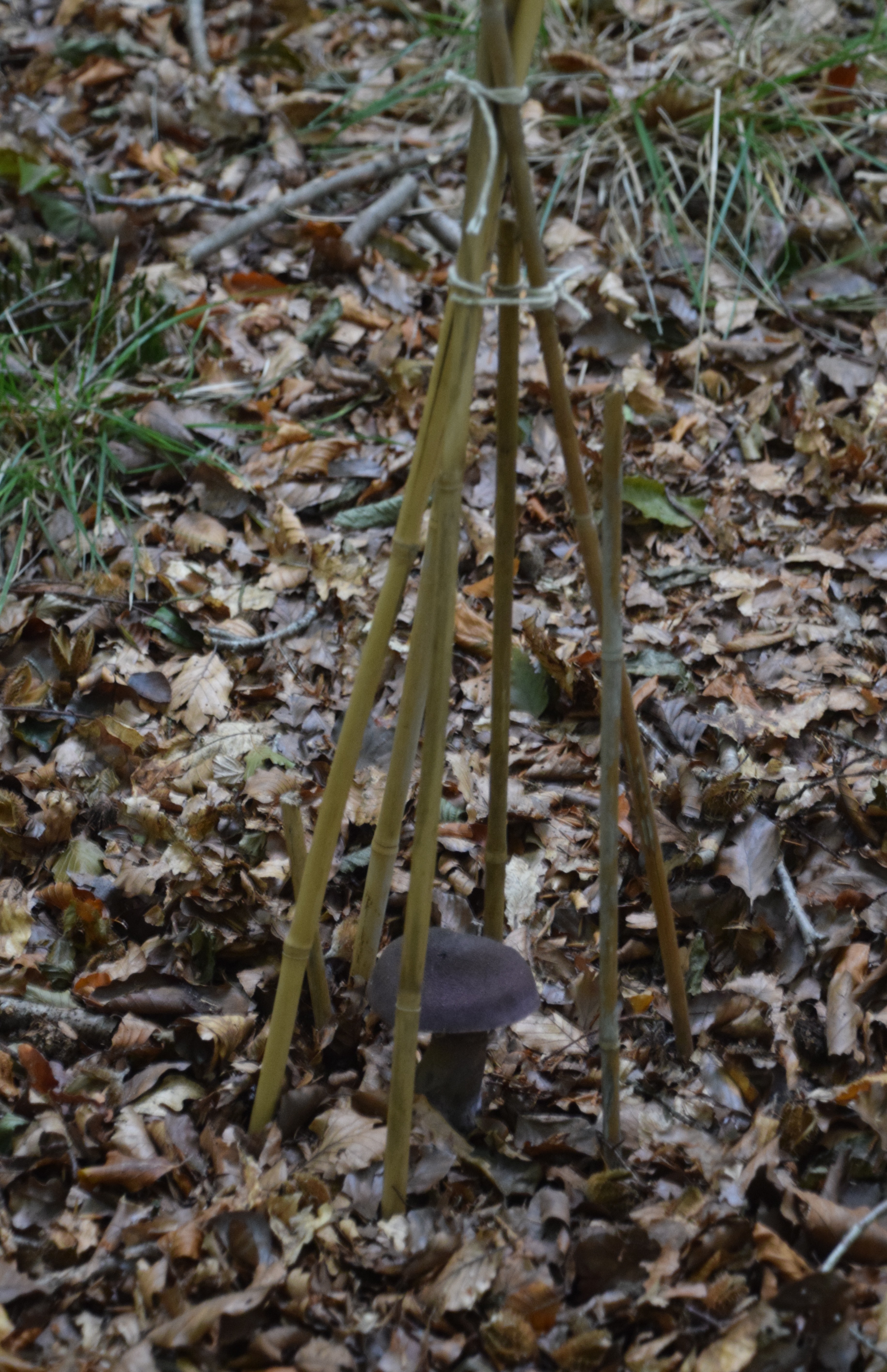
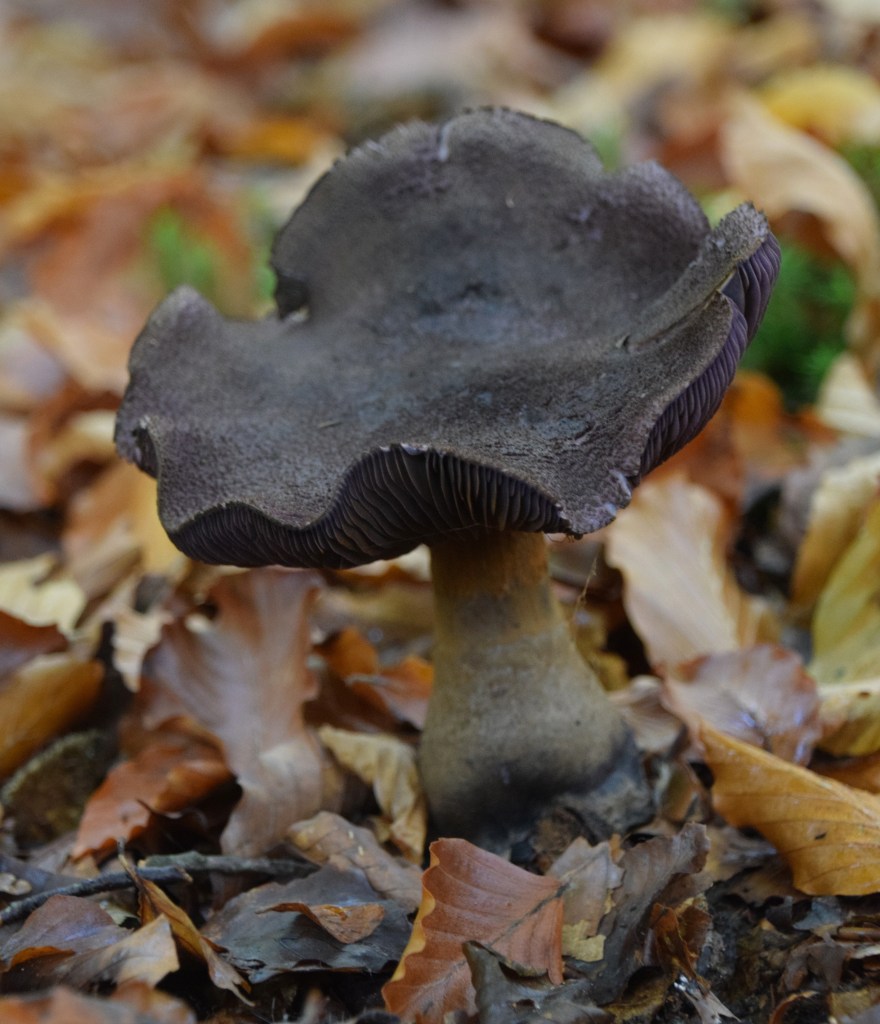
My first specimen when young had a certain suggestive quality when viewed from one side, such as I rather like to emphasise herein, reminiscent perhaps of a bare-buttocked garden fountain figure (above right). Returning three days later on 10th a second fruit had emerged nearby, while the now mature first had reached the round-headed convex stage (pictured below). As it matures this fungus typically develops a distinctive lump in the centre of the cap. I made protective “wigwams” around both my finds (centre) with garden canes and twine, and through the remainder of this post’s duration, quite remarkably neither specimen was troubled either by mollusc munching or human hands.
Mature Violet Webcap #1
As with various other mushrooms featured in this journal, past posts that are becoming increasingly well referred to, I attempted to record the full fruiting cycle through a series of visits over 24 days. The following gallery presents this for the second specimen, showing a typical sequence of shapes to those other described subjects. By 30th Oct both my adopted mushrooms had lost their special violet lustre and were beginning to go over.
Violet Webcap #2
Cortinarius violacea occurs throughout Europe, where it is widespread but nowhere common, and is listed as endangered nationally. Other populations are distributed across the northern hemisphere in North America, mostly associated with coniferous trees, and Asia. Everywhere they are associated with acidic ground and form ectomycorrhizal relationships (see here) with the roots of various trees and shrubs. For further scientific detail on the species see here.
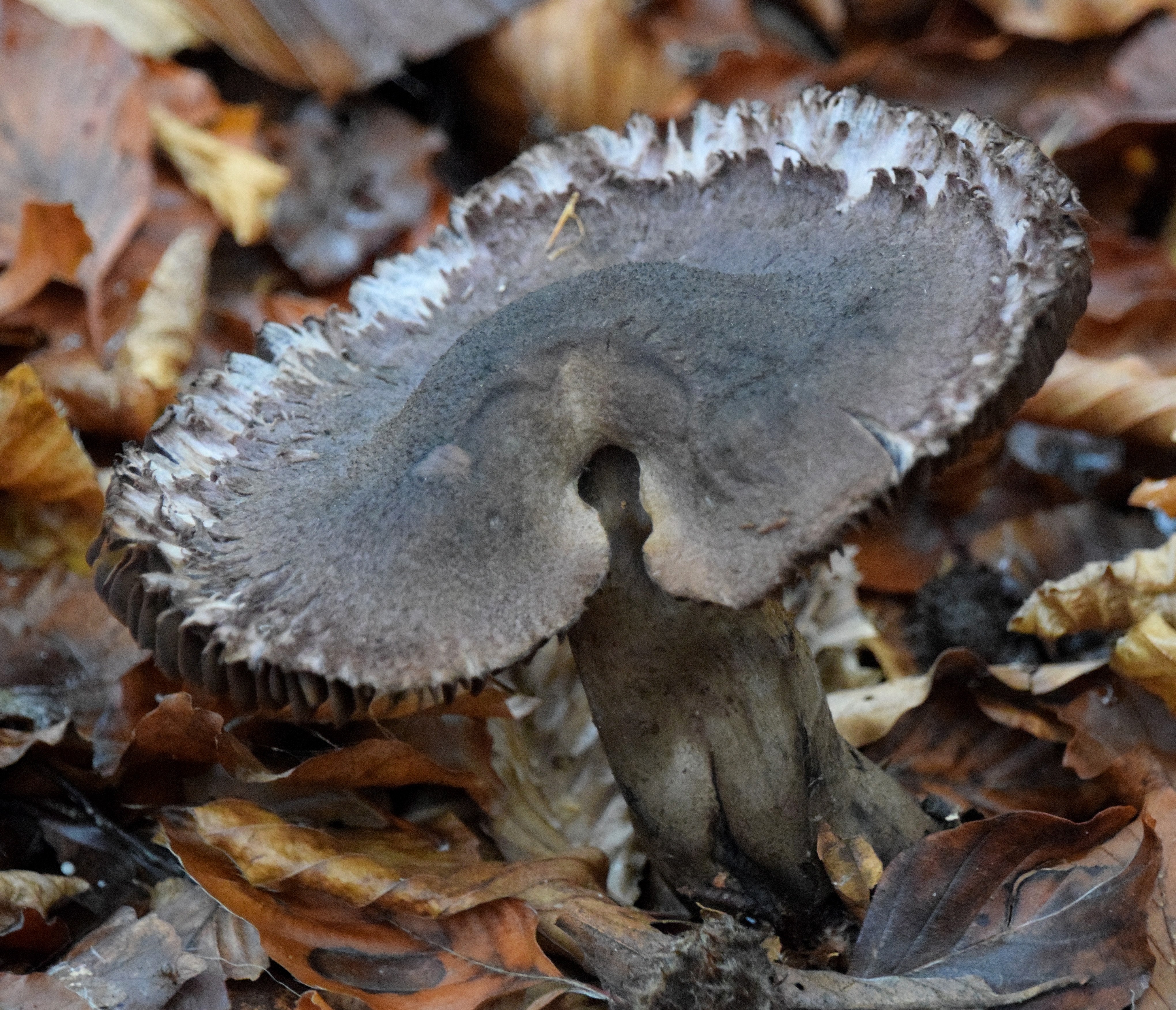
My final visit to the Chilterns’ site was on 6th Nov, by when both the objects of my past 30 days’ attention were in a collapsed state (pictured below). Autumn leaf fall from the tree cover was well advanced, and not much presentable fungi was still visible on the forest floor. I gathered up my makeshift wigwams and went upon my way for another year. The entire fruiting cycle of an extraordinary mushroom had thus been duly recorded and without interference. I expect I may return here in 2026.
#1#2
This has at length given me something to blog about. In case fellow Oxon naturalists might have wondered where I’ve got to recently, I have been working part-time for up to four days a week in retail since late August, which might possibly help to fund park home improvements and future travel. I will never fill out this journal with repetitive content for its own sake. Things must evolve. I have managed to put a meaningful wildlife agenda in place once more for spring and early summer 2026, as in the quite exceptional first half of this year. Watch this space!
The following is a checklist of Arum plants in the past King’s Copse Park Botanical Gardens (KCP BG) Aroid collection, some of which still survive. Most of our other Aroids are now long gone and that project is dormant. The former Aroids tab has thus been removed from this journal but this particular archive content will be useful to retain herein for future reference.
Arum is a genus of 26 accepted species occurring from western through central Europe and across central Asia, and also in north Africa. The blooms of different species vary in colour from pale green through yellow, rusty red, deep purple and black. Most produce foliage in the autumn and over-winter in the green state, being cold resistant and becoming deep seated in the ground, but they are not necessarily hardy in pots.
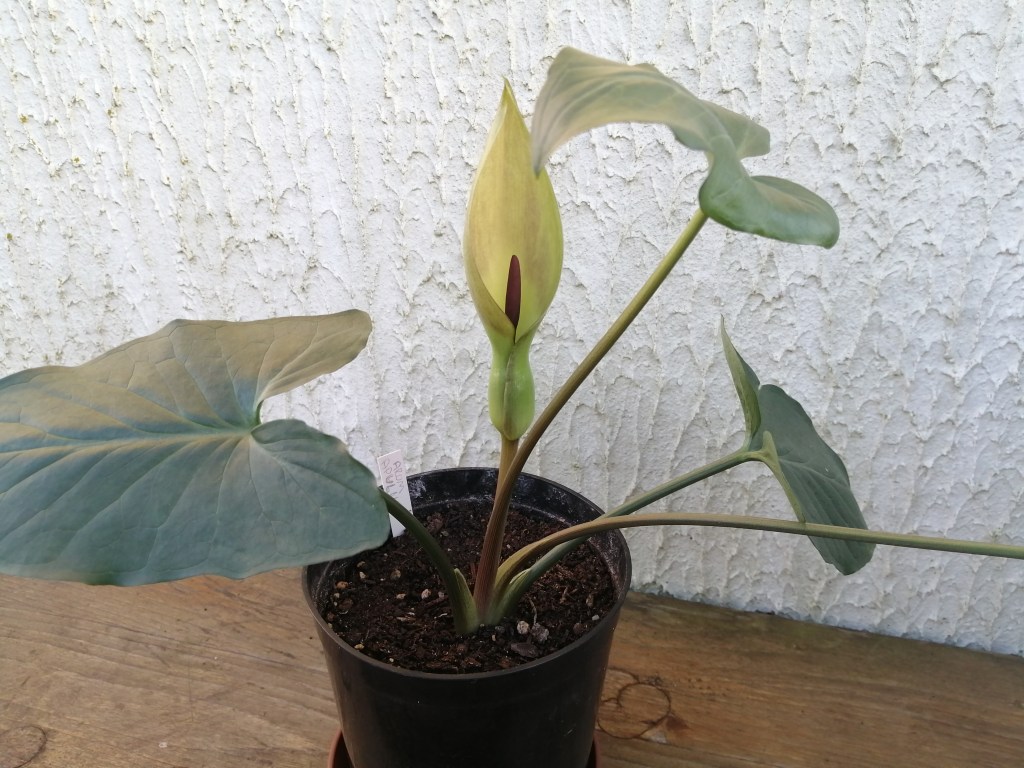
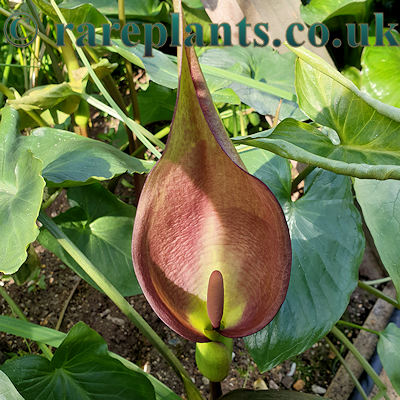
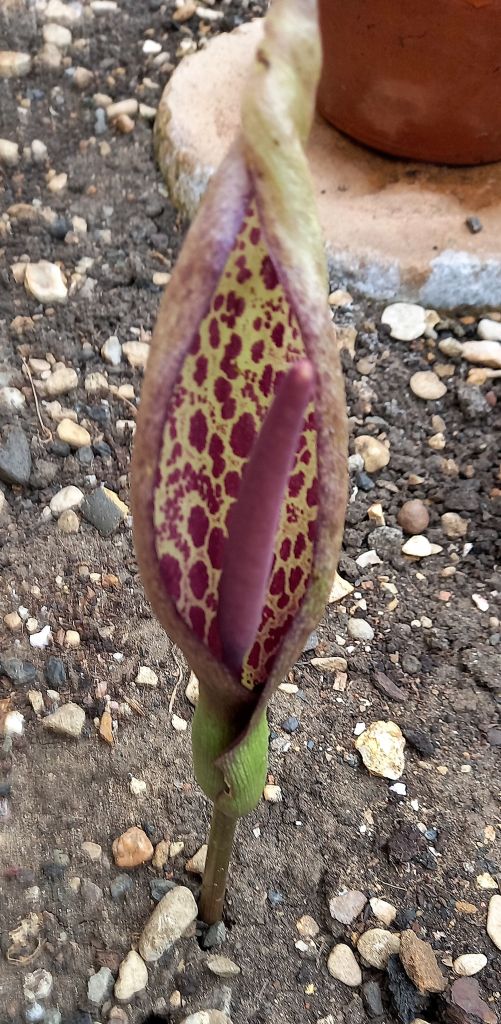
Arum apulum Status: Sourced from RarePlants.co.uk as a cultivated tuber in October 2020, this Italian endemic bloomed on 22nd February 2021, wilting three days later, but not in 2022. Then after being transferred to the outside trough the tuber was lost to severe frosts during the following winter.
In the wild this shade loving plant occurs only across a limited area of south-eastern Italy’s central Apulia region, around the towns of Bari and Taranto. There habitat encroachment by commercial development has contributed to the plant acquiring critically endangered status.
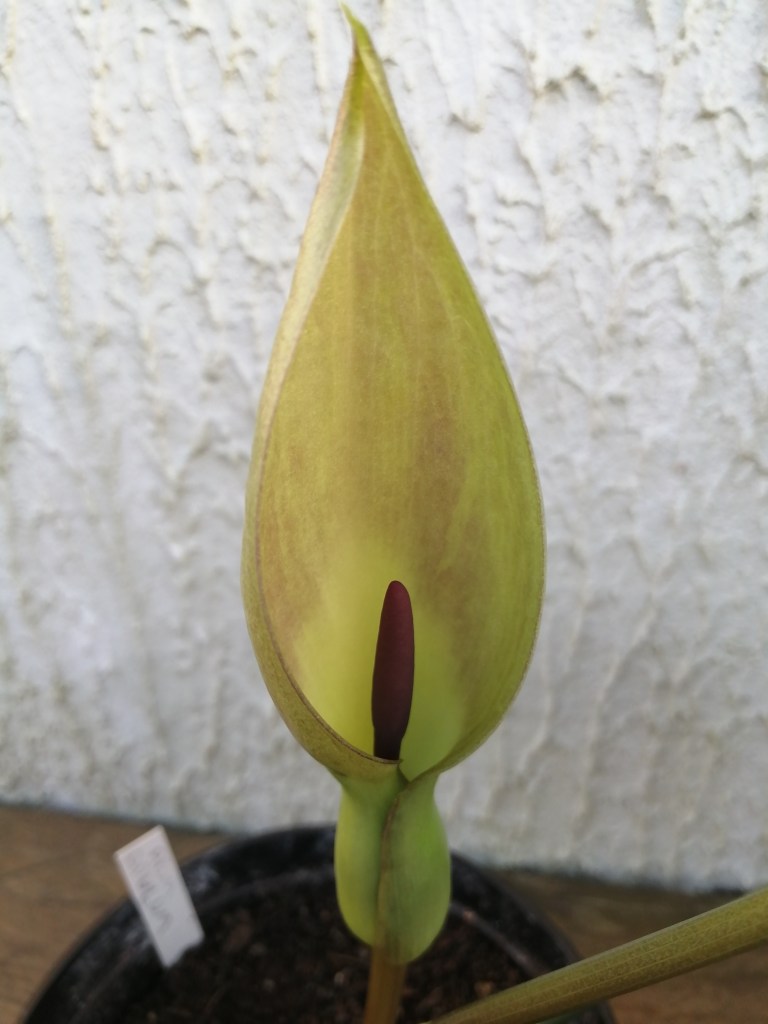
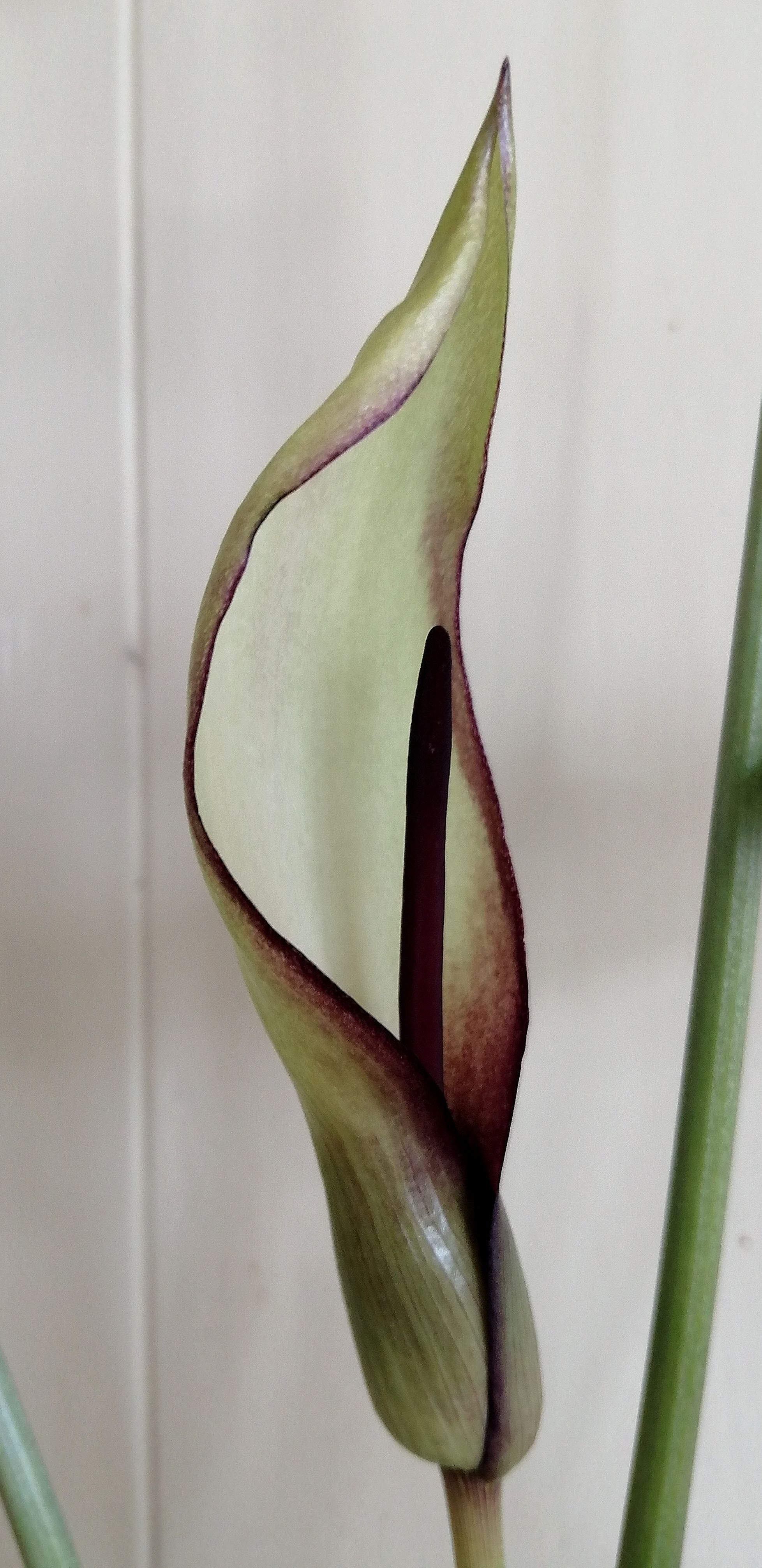
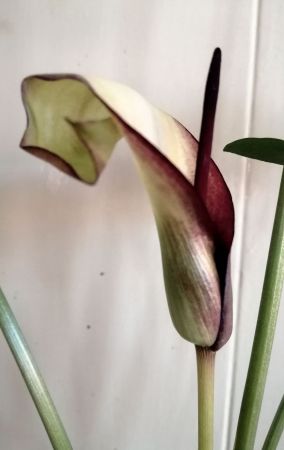
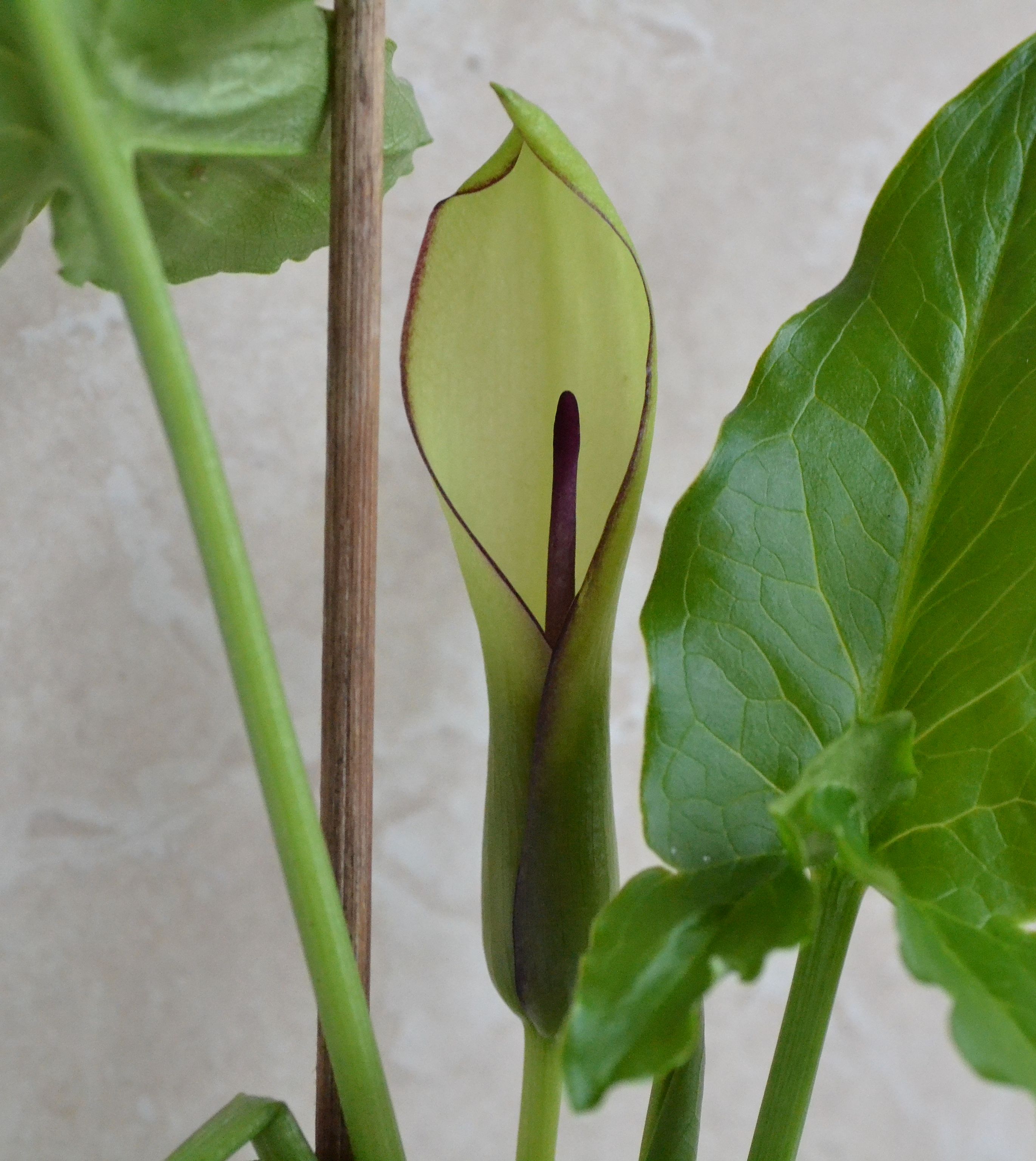
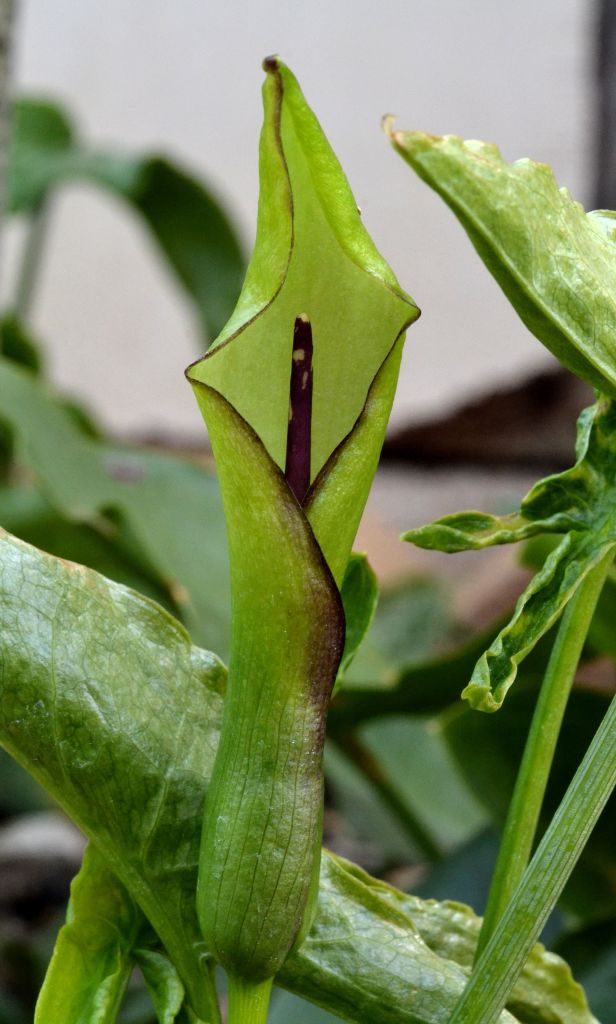
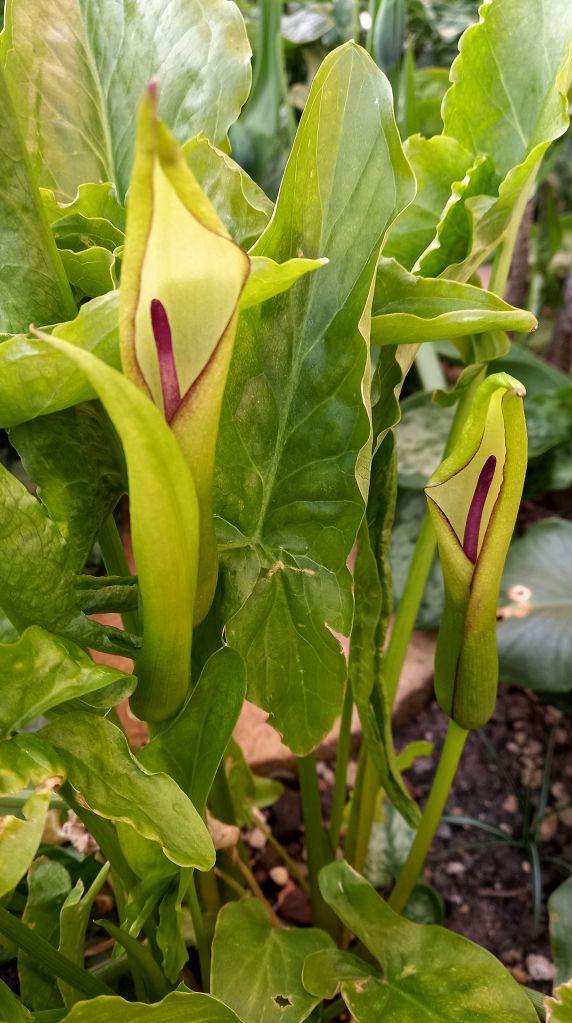
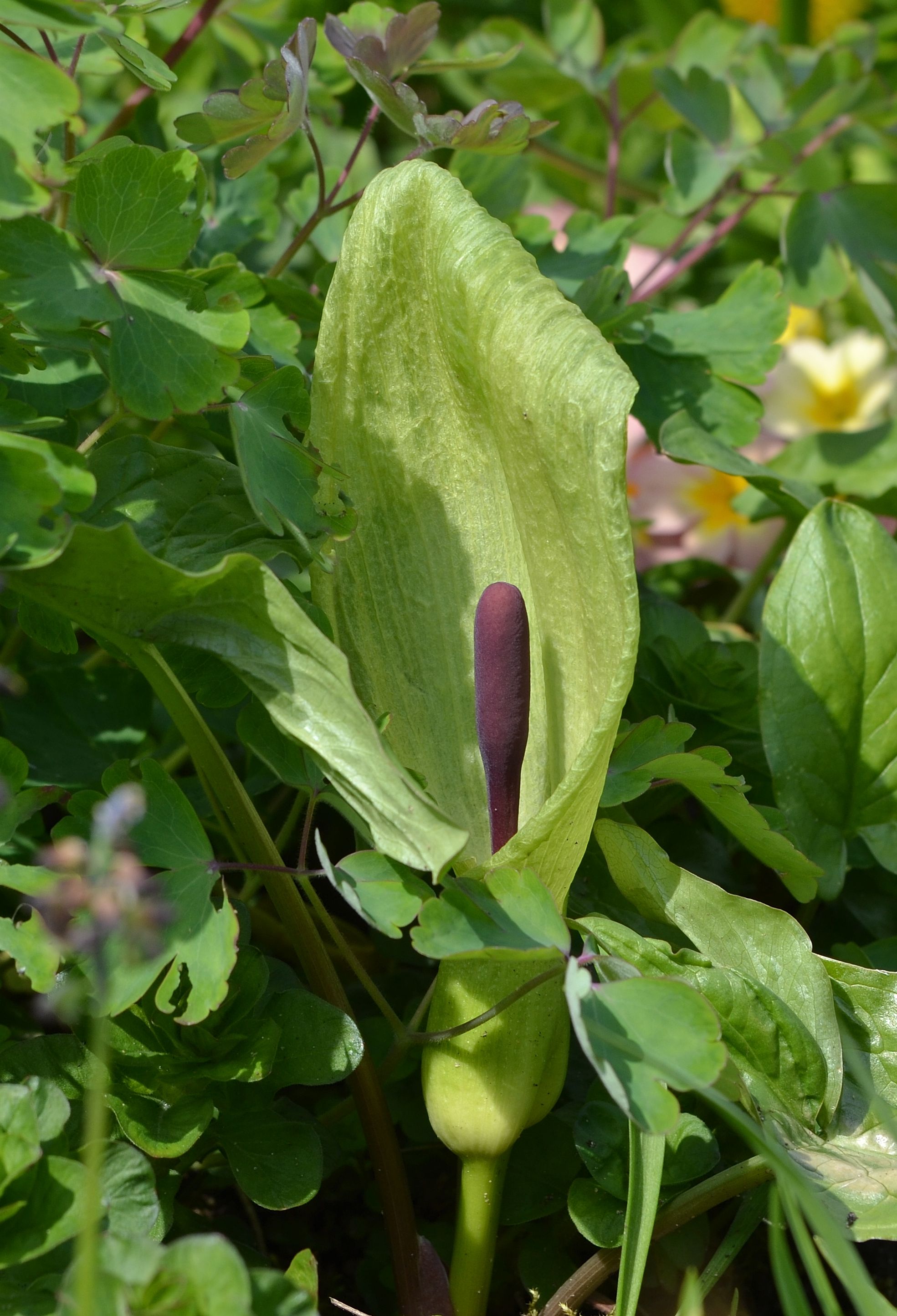
Normally blooming in early summer, the large spathe can be deep purple-red inside, toning to paler violet at the very centre around a deep purple-red spadix (below, right). But other specimens such as my own (left) are pale lime-green with maroon overtones and a brownish-maroon spadix. So having selected this addition item for that attractive colouration this result (below left) actually resembled a rather firmer Cuckoo Pint. The compact and robust foliage (centre) is dark green and unspotted.
A apulum rarely reaches more than 30cm in height. The pollinator attracting odour is reputedly more manageable for indoor cultivation than others of the genus, and our specimen bore that out smelling only slightly for its first evening in bloom.
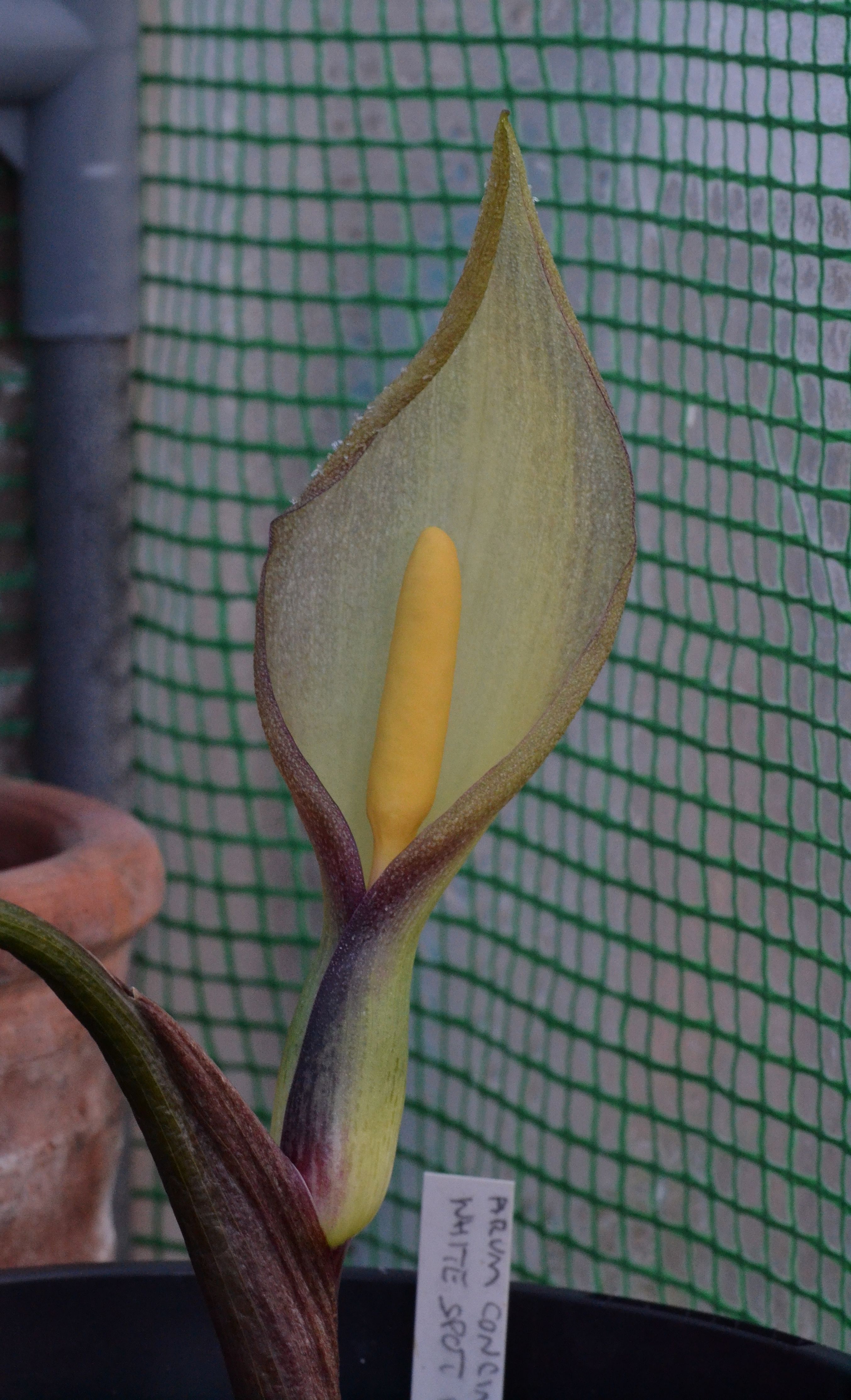
Arum concinnatum Status: Sourced from Adventurous Plants (x3) in September 2019, I expected this to be similar to A italiacum in habit, being in leaf throughout the winter and blooming in late spring to early summer. After being planted in plastic pots to over-winter outside they did not bloom in spring 2020. When lifted in August two of the tubers had multiplied readily, allowing several plants to be re-potted in gritty, loam-based compost to grow through the winter in my cold frame. Just of these bloomed on 12th April 2021 (pictured below, left). The entire stock was then re-planted either in the ground or a plastic trough in compost, of which two more bloomed in May 2024.
2021 Arum concinnatum on day 12021 Arum concinnatum on day 22024 Arum concinnatum
Native to the Aegean region of the Mediterranean and fully hardy in British conditions, this is one of the largest of the Arums capable of reaching almost a metre in height when fully established and mature. It is large leaved and bears an inflorescence with a greenish-yellow spathe and thick yellow spadix. The spathe that smells of animal excrement in the initial stages of flowering can be variable in colouration, sometimes with a purplish tinge and usually has a purple margin. This plant is summer dormant, the foliage appearing in autumn then is maintained through frost, forming a large clump. The blooms appear in mid-Spring.
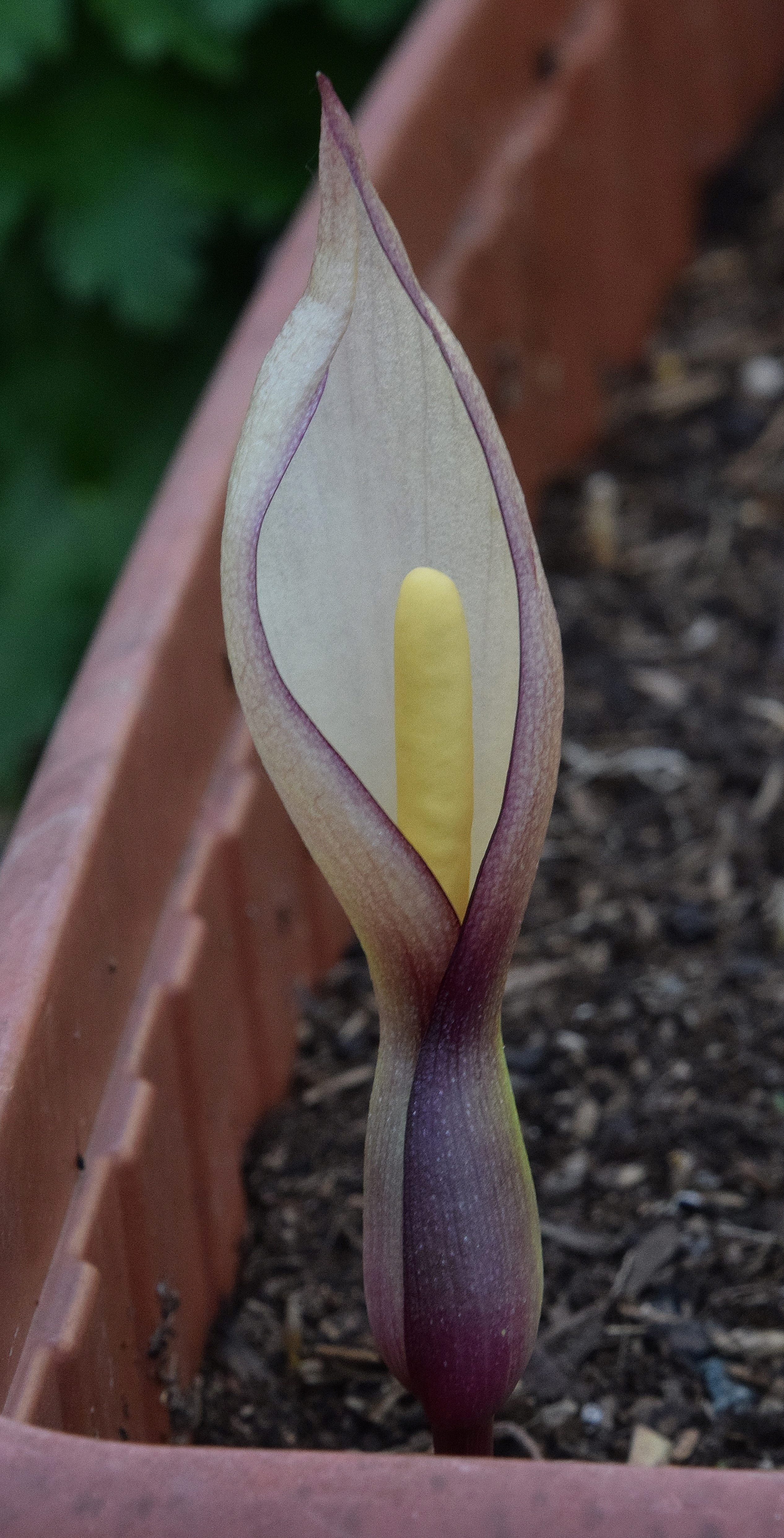
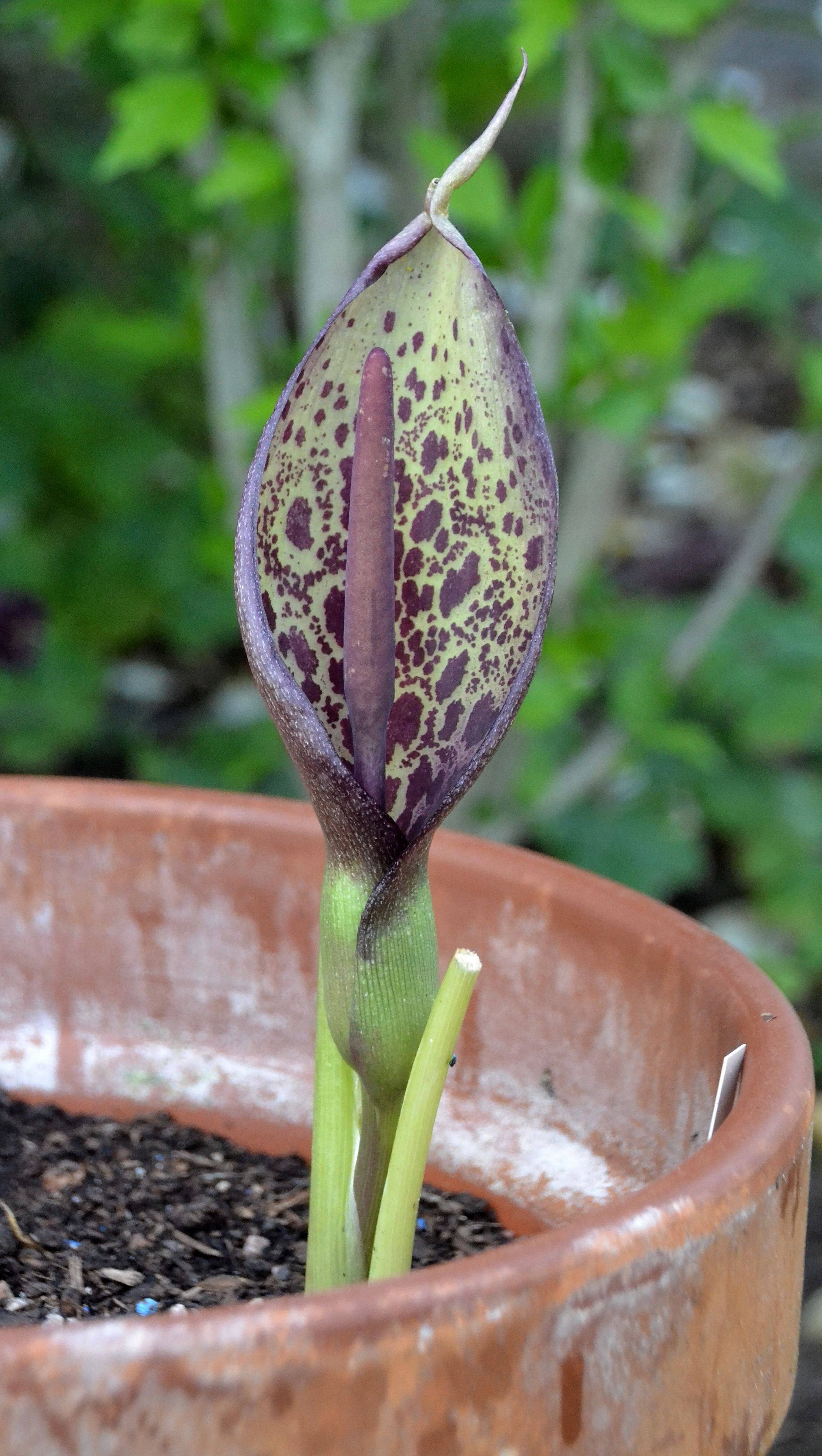
Arum discoridis syriacum Status: Sourced from Adventurous Plants in autumn 2019, I expected this like A concinnatum to be in leaf throughout the winter, blooming in late spring to early summer, followed by fruit spikes in the autumn. Planted in an 18cm plastic pot for growing outside, it did not flower in 2020. Then lifting the tubers in August, I cultivated multiple plants in the cold frame through the winter in sandy, loam-based compost but none of them bloomed in 2021. So these were transferred to a terra cotta pot for 2022, eventually producing a single inflorescence on 24th May (pictured below right). After the entire stock was replanted in the ground and a plastic trough, another bloomed on 3rd June 2023 (left) then a third in the trough on16th May 2024 (centre).
A discoridis is a variable and widespread genus, native to forests in the eastern Mediterranean and Middle East regions. This one is endemic to central southern Turkey and north-west Syria, having a distinct pattern of maroon blotches to the inside of the pale green spathe, and a maroon spadix. Also known as “Spotted Arum”, variation exists not just from plant to plant but from flower to flower on the same plant. It grows up to 60cm in height, with spathes to 38cm when mature, and is said to do particularly well if grown under glass. More varieties are available from British suppliers.
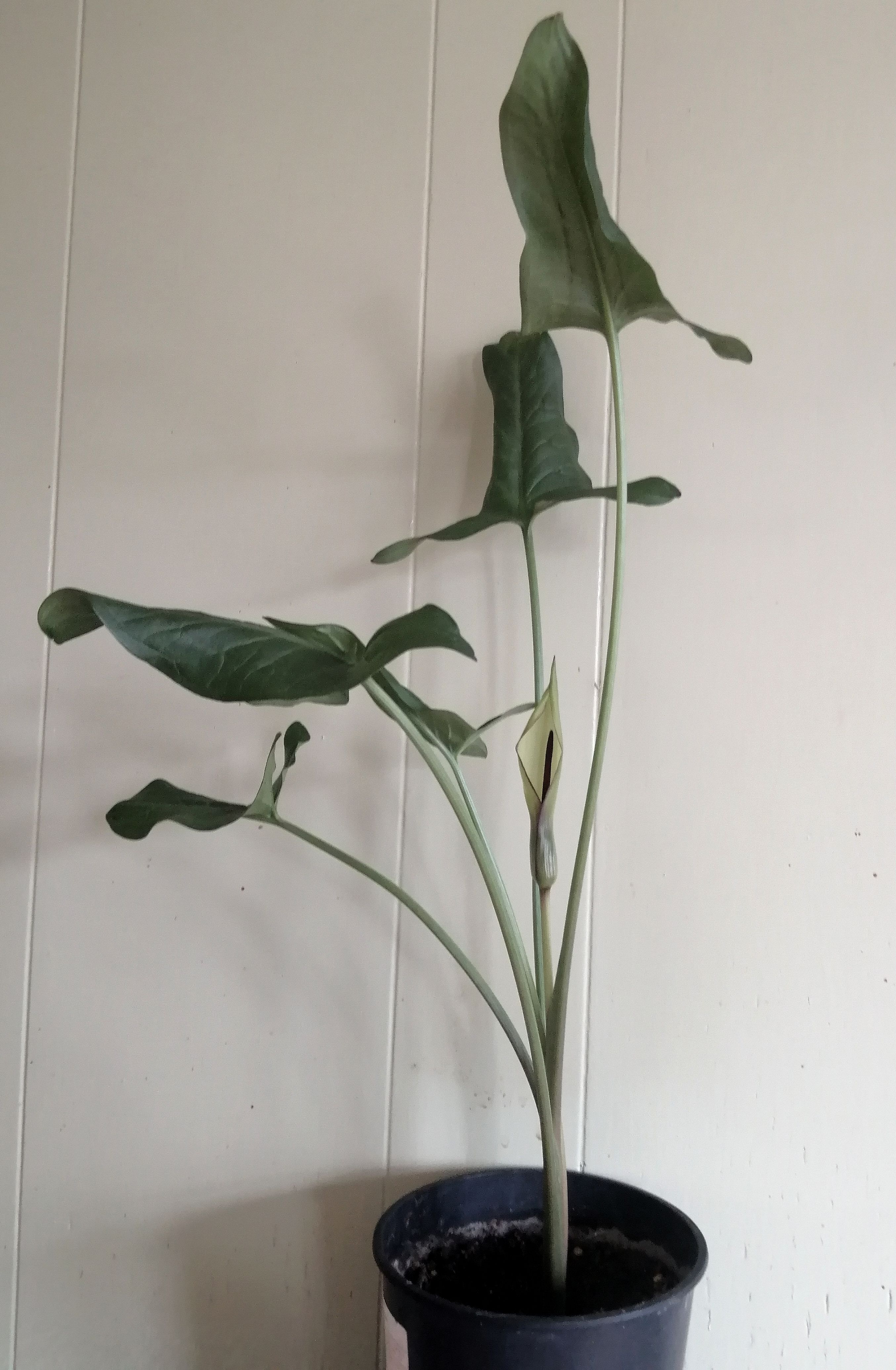
Arum euxinum Status: Sourced from RarePlants.co.uk in October 2020, this bloomed on 11th March 2021 but not in 2022 before also being lost to severe winter frost. The scarcity originates from the Black Sea coast of northern Turkey, but the stock is from seed distributed by Gothenburg Botanic Gardens. In the wild this item occurs in mountainous regions and normally blooms in May.
Upon unfolding, the odourless, pinched bloom (above righf) appeared quite similar to the early-flowering middle eastern A hygrophylum. But euxinum is somewhat taller and much more robust. The plain, dark green foliage is very attractive and the entire plant a pleasing shape (above left). The 40 – 60cm tall spathe is compact, scentless and pinched into a waist. The colouration is described as very pale green stained purple at the edges, top and base, with an interior of pale cream or white marked with rich purple towards the tip.
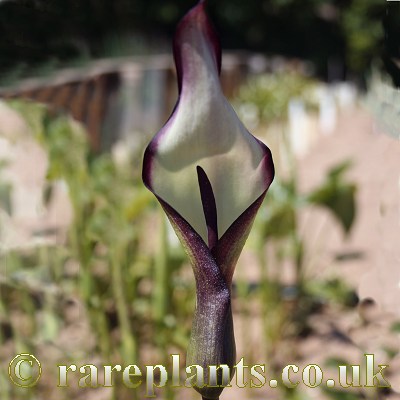
Arum euxinum on day 1Arum euxinum (supplier’s image)
Whether or not the colouration would evolve with age remained to be seen. Through day one the increasingly firm and waxy spathe did acquire more of the shape of the supplier’s picture (above centre). Then from day two more of the anticipated delicate purple toning seemed to intensify in tandem with the allurement A euxinum came to offer.
The left hand picture below is from day two and the other two day three. By then I could fully concur with the supplier’s description. Later on day three the inflorescence deformed (below right) becoming more purple all the while. This had become perhaps the most subtly intriguing aroid ever cultivated here. Wilting began on day 5.
Day 2Day 3Day 3
Arum hygrophylum Status: Sourced from Adventurous Plants in autumn 2018, this was initially kept indoors in its supplied pot, producing a single January bloom (below left). Having gained this experience it was planted at the front of the Aroid bed for 2019/20, where it produced blooms in February and April. In it’s third season this item bloomed again (centre) on 20th April 2021. In 2022 (right) the now mature clump produced a succession of eight blooms, then12 in 2023; but it has failed in each of the next two seasons..
Arum hygrophylum 202020212022
This plant, also known as “Water Arum”, is native to the Middle East from Syria to Jordan, and also Morocco. It is summer dormant with leaves up to 60 cm long appearing in autumn, followed by the narrow “waisted” inflorescence by early spring. The creamy green spathes are edged with maroon and the slender spadices are pale purple. I was a little disappointed with the 2019 bloom (above left) that did not seem markedly different from wild Cuckoo Pints, but in subsequent seasons the slender pinched form more closely matched published pictures.
Despite a reputation for being tender A hygrophylum is said to be hardy if given a sheltered position from the worst of wind and frost. It thrives left to its own devices planted out in moist soil and, as I found tends to struggle when grown in pots. It will often try to flower in January, as was also my experience. But cold will knock back the early flowers outside, and my plant suffered a real battering in the strong, cold winds of Jan and Feb 2020.
Arum italicum These are pretty much the Mediterranean equivalent of our own Cuckoo Pints. Two varieties sourced from a small nursery near Wantage have over the last 18 years or so colonised, or perhaps invaded KCP BG quite successfully.
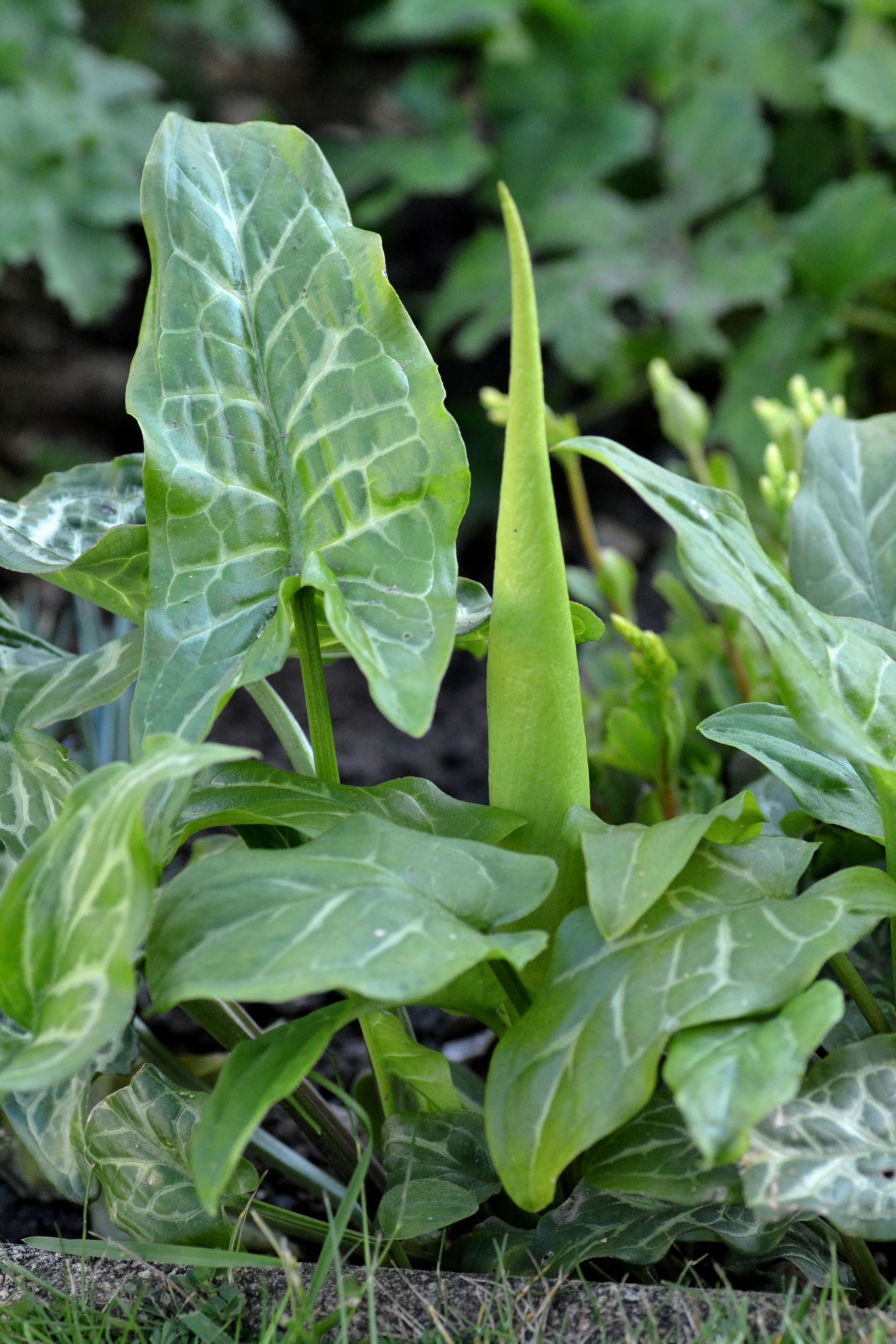
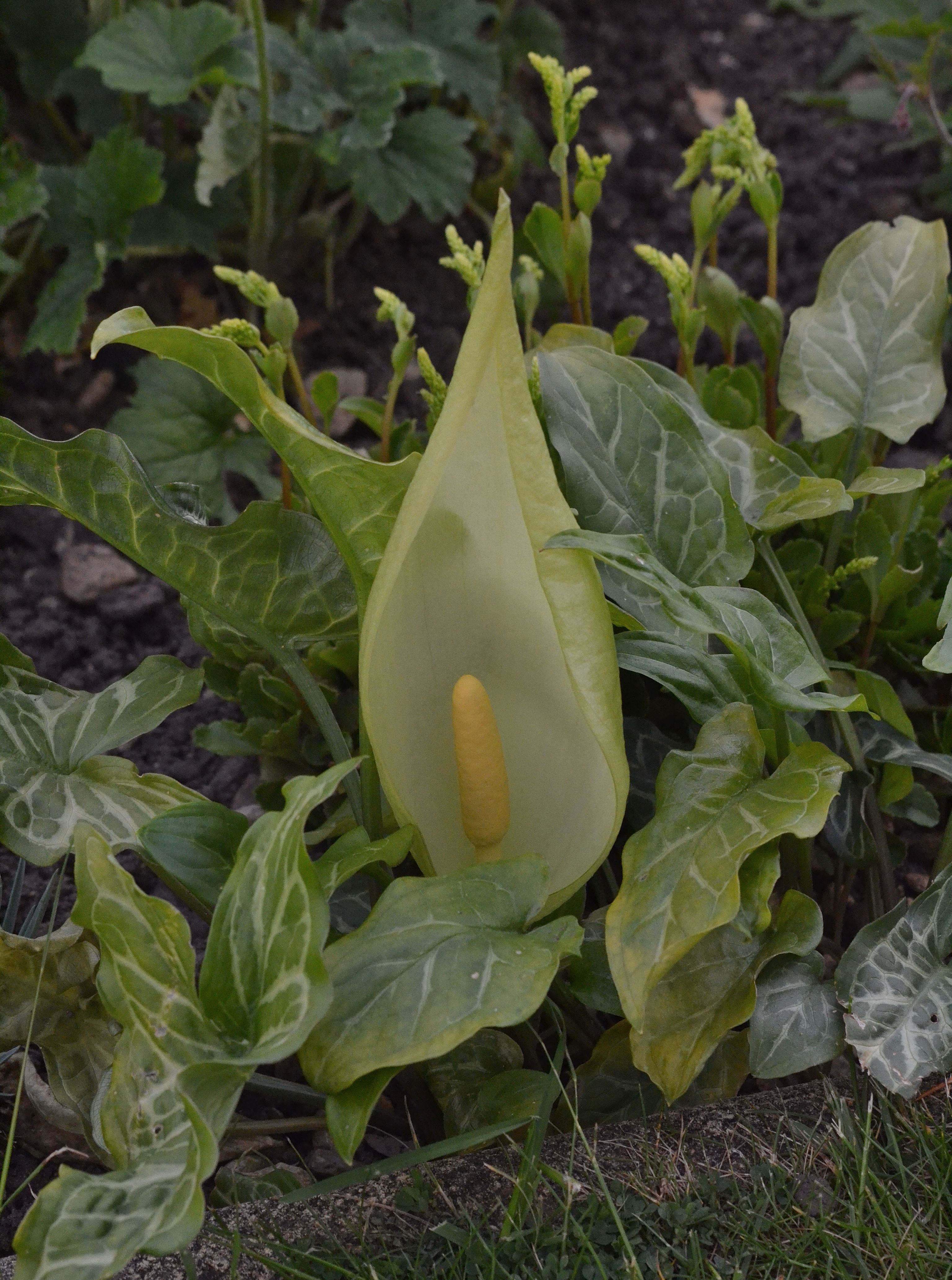
They have twin advantages that bold and shiny, arrow-shaped leaves appear in autumn and resist all attention from frost throughout the winter. Then after the foliage withers the subtle creamy blooms turn into equally striking spikes of brightly coloured fruits through the summer. So this is a truly eye-catching plant in all its stages (pictured above).
In most seasons the blooms tend to be rather submerged within the foliage of the many clumps in KCP BG. But in 2020 strong wind and rain through January and February followed by mostly quite exceptional fair weather from late March to early May caused the foliage to wilt earlier than usual. The many large inflorescences were thus much more visible, as these pictures (below) show.
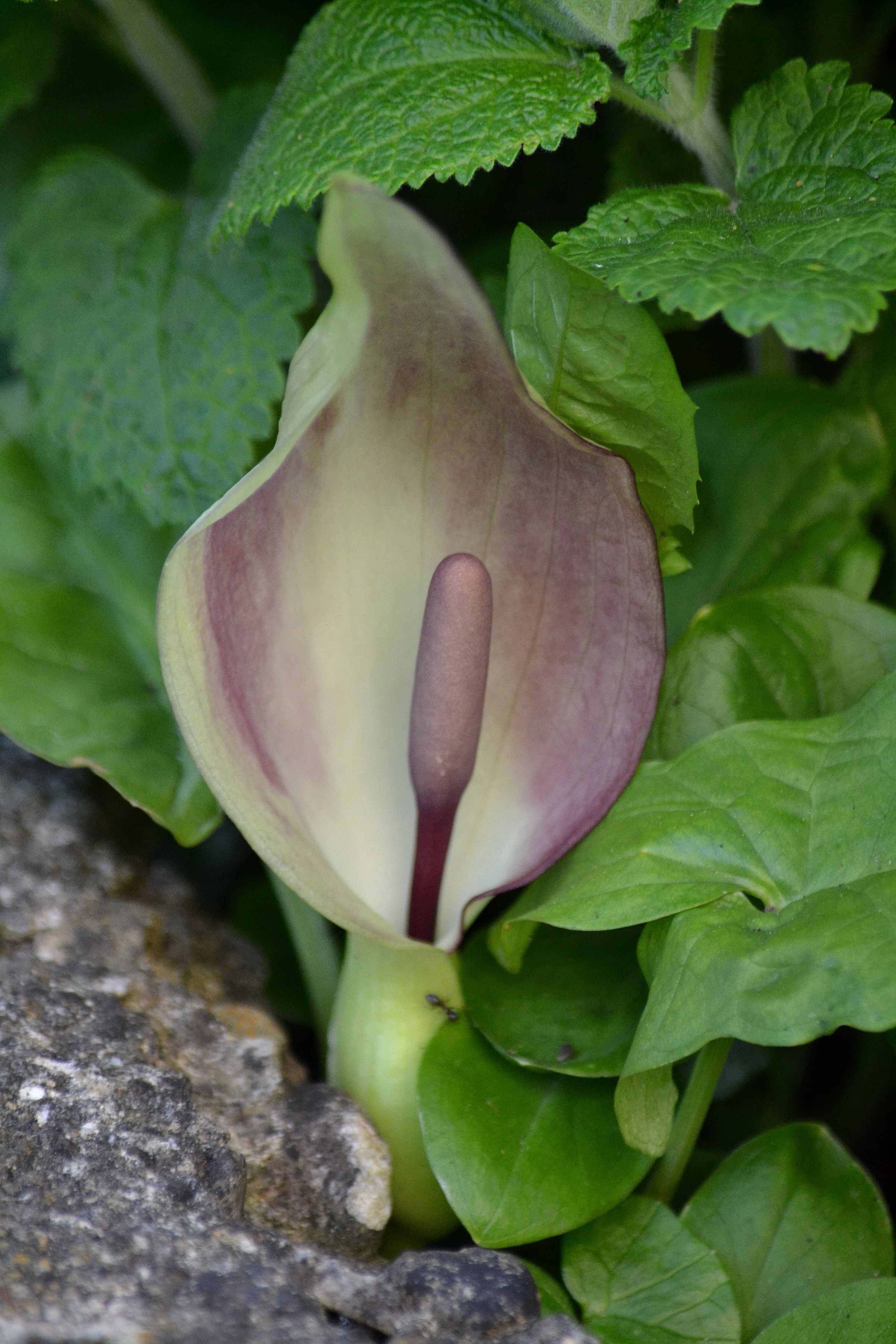
Arum maculatum These spring flowering wild Aroids are a common and widespread woodland plant across much of Europe and occur naturally around the margins of KCP BG. The glossy, spear-shaped leaves appear in mid-winter, followed by blooms in April (below) that last for little more than a day. Then the whole plant quickly wilts and later in the season the stems turn into spikes of orange berries. There are a host of colloquial names but the one I prefer is “Cuckoo Pint”.
Complete checklist of the genus Arum
In addition to these 26 accepted species, there are a number of synonyms and unresolved items that differ according to various authorities. But as far as I can ascertain, this (below) is the general picture. Asterisks denote species formerly cultivated at KCP BG. Survivors are marked **
apulum * Endemic to central Apulia in SE Italy and related to A nigrum from the Balkans. Blooms in April.
balansanum Native to Turkey.
besserianum Native to S Poland and the Ukraine.
concinnatum ** Native to the southern Peloponnese of Greece, most Aegean islands and SW coasts of Turkey. One of the largest Arums, capable of reaching a metre in height. Exhibits various leaf forms. Blooms (foul smelling) in mid-spring. Also known as: byzantinum or nickelii.
creticum * Native to the mountains of Crete, Greece and a few places in SW Turkey. Blooms (scented) in April / May.
cylindraceum Widespread from southern Sweden to Crete and from Portugal to Turkey. Also known as alpinum and lucanum.
cyrenaicum * Rarity from SW Crete and NE Libya. Blooms in late spring / early summer.
discoridis ** Occurs widely across eastern Mediterranean region, with different forms: var cyprium var philistaeum var syriacum – central southern Turkey and NW Syria.
euxinum * Rarity from mountains around the Black Sea coast of northern Turkey. Blooms (scentless) in May.
gratum Native to NW Turkey, Syria and Lebanon. Blooms scented) May – June and rarely into July.
hainesii Native to eastern Iraq. Blooms in May.
hygrophilum * Occurs in NE Morocco, E Cyprus, SW Syria and W Jordan. Blooms (scentless) in late winter or early spring.
idaeum Rare endemic to the highest Cretan mountains.
italicum ** Widespread in woodland and hedgerows throughout Europe, N Africa and Asia Minor. Exhibits various leaf forms: ssp albispathum ssp canariense
jacquemonti Occurs from NE Iran through Central Asian region to W China. Blooms April – May.
korolkowii Occurs in N Iran, Afghanistan and through central Asia to NW China.
lucanum S Italian rarity occurring in high elevation habitats above 1000 metres.
maculatum ** Common and widespread in woodland and hedgerows across much of Europe. The English Cuckoo Pint (see here).
megobrebi Recently described species from mountains between Turkey and Georgia. Blooms in late spring.
nigrum Native to the Balkans, blooming in May – June.
orientale Occurs from Austria and Poland through eastern central Europe to NE Turkey, the Crimea and W Caucasus. Blooms May – June. Also known as alpinariae and elongatum.
palaestinum Occurs in Israel, W Syria, Lebanon and Jordan.
pictum Occurs in rocky habitats of the Tyrhennian and Balearic islands, and is the only autumn flowering (foul smelling) member of the genus.
purpureospathum Endemic to Crete.
rupicola (or conophalloides) Occurs from eastern Aegean islands to Israel and Iran. Blooms from April to late June, and into July in cultivation.
sintenisii * Native to northern Cyprus. Blooms (scented) in spring.
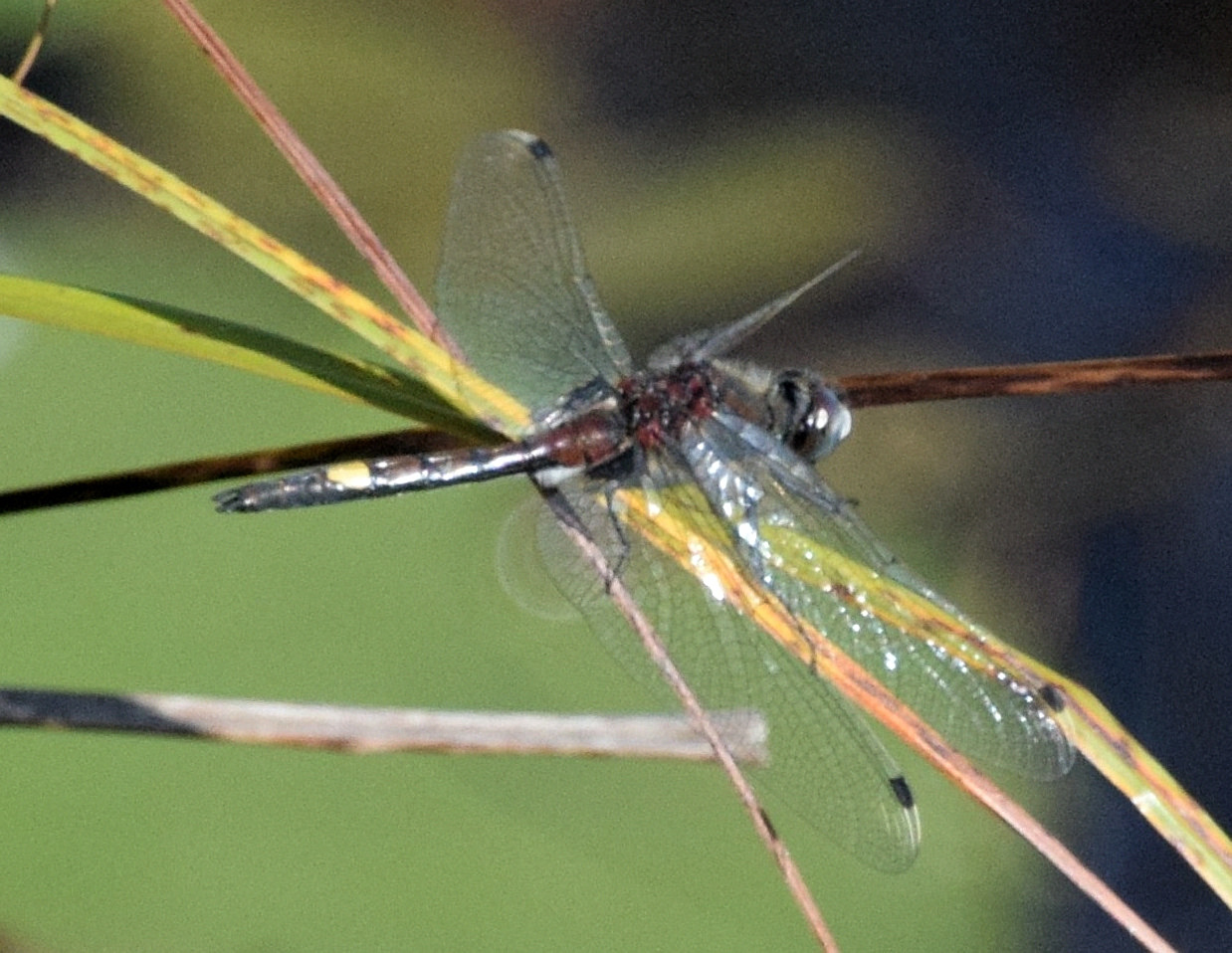
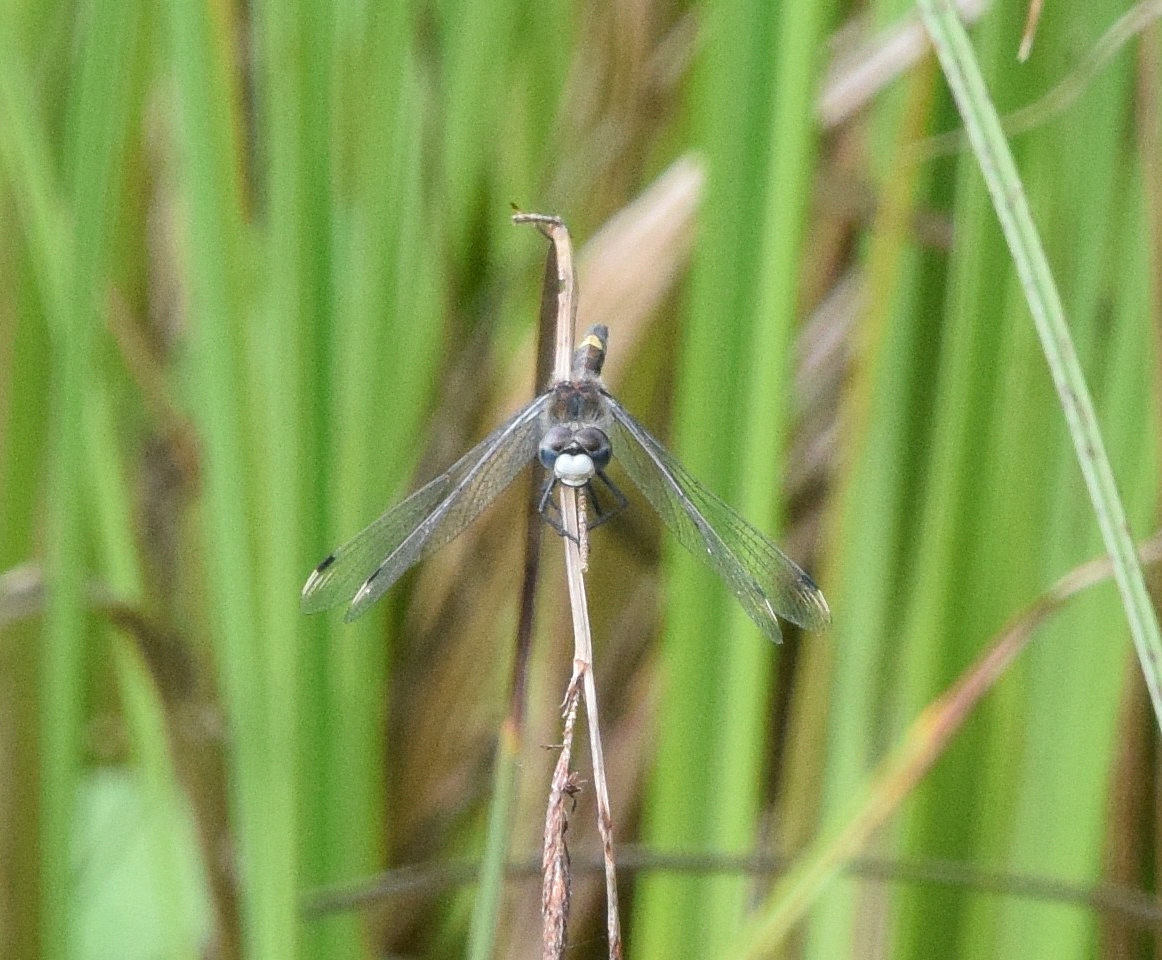
This post’s lead picture feels something like the humane equivalent of a hunting trophy. Nowhere near the standard of dragonfly images I usually seek to attain, it represents the outcome of a lot of effort, frustration and perseverance over three years. I first visited this fascinating location in 2023 (see here), my main interest then as now being to track down Yellow-Spotted and Lilypad Whiteface dragonflies.
La photo principale de ce post ressemble en quelque sorte à l’équivalent humain d’un trophée de chasse. Elle n’atteint pas du tout le niveau des images de libellules que je cherche habituellement à obtenir, mais elle représente le résultat de beaucoup d’efforts, de frustrations et de persévérance sur trois ans. J’ai visité cet endroit fascinant pour la première fois en 2023, mon principal intérêt alors et maintenant étant de retrouver les libellules Leucorrhine à gros thoraxet Leucorrhine à large queue.
Yellow-spotted Whiteface, or Large White-faced Darter (male) / Leucorrhine à gros thorax
Attributing my failure then to lack of dry viewing points around the bog pool habitat, I resolved to come back with angling waders and so acquired a cheap and cheerful pair. But dragonfly hunting requires jumping on a plane at short notice if the weather is right, and last year the very low Ryanair walk-on fare from Stansted to Poitiers increased five-fold in the days leading up to the departure. This year I decided I was willing to lose that £45 if needs be and booked early, then when decision time came a suitable weather window indeed beckoned. The waders fitted neatly into an under seat bag and I travelled light with just a second cabin bag.
Attribuant mon échec à un manque de points de vue secs autour de l’habitat de la mare tourbeuse, j’ai décidé de revenir avec des cuissardes de pêche et j’en ai donc acquis une paire bon marché et joyeuse. Mais la chasse aux libellules nécessite de prendre un avion à la dernière minute si le temps est clément, et l’année dernière, le tarif très bas de Ryanair pour un passage à Stansted vers Poitiers a augmenté cinq fois dans les jours précédant le départ. Cette année, j’ai décidé que j’étais prêt à perdre ces 45 £ si besoin et j’ai réservé tôt, puis, lorsque le moment de la décision est venu, une fenêtre météo adéquate se profilait effectivement. Les cuissardes rentraient parfaitement dans un bagage sous le siège et j’ai voyagé léger avec juste un deuxième bagage à main.
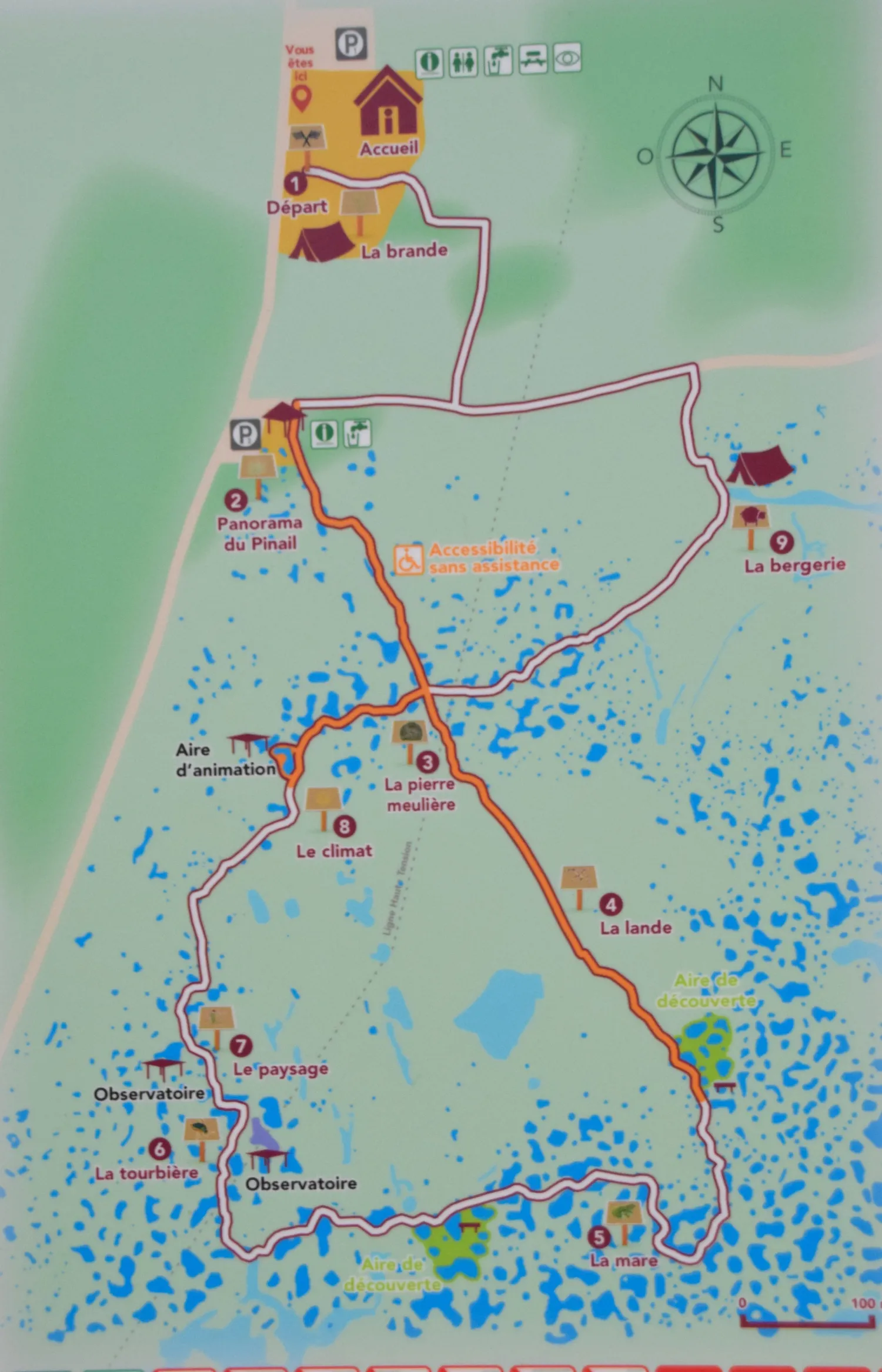
Pinail visitor trail plan / Plan du sentier des visiteurs de Pinail
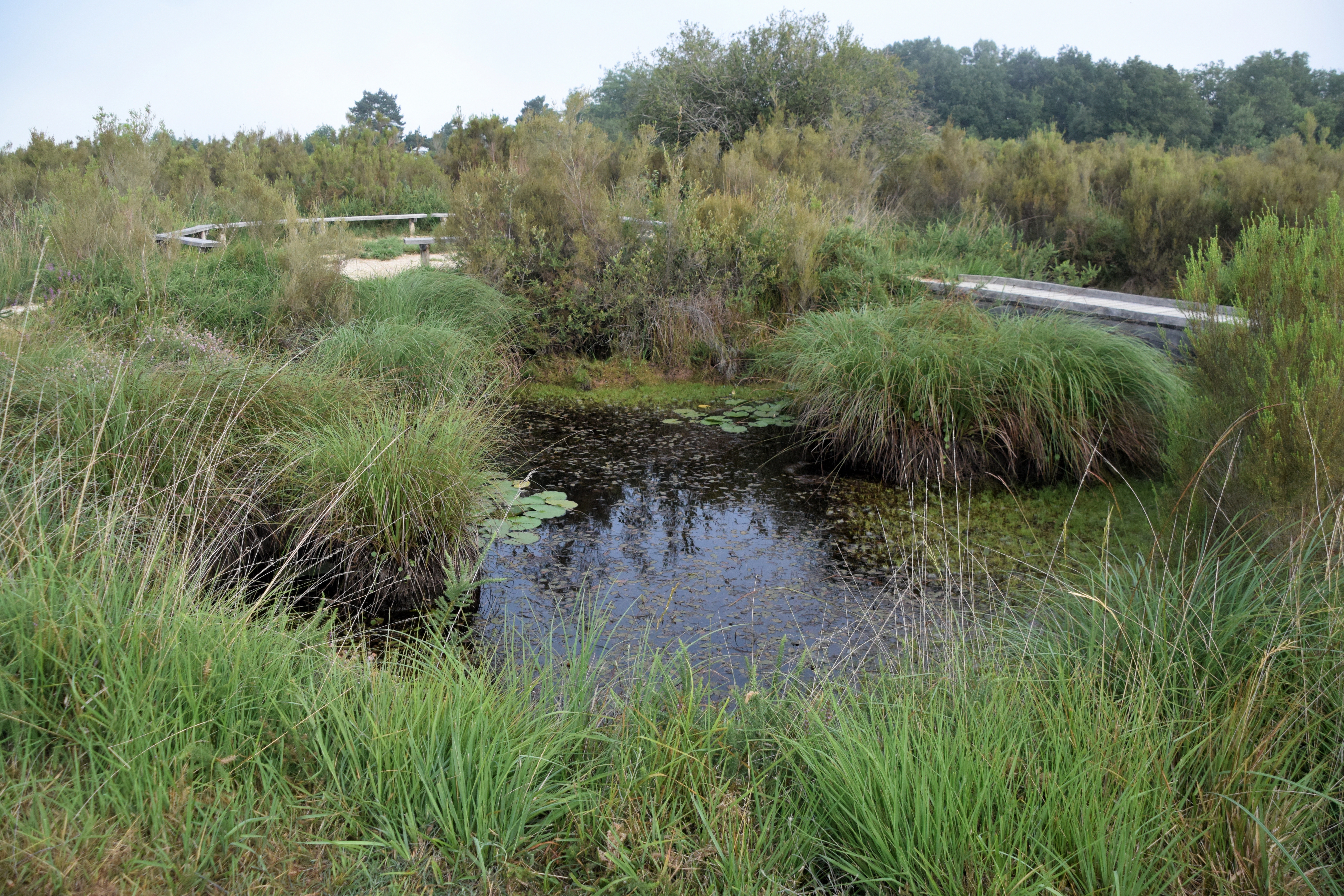
The 142 ha (350 acre) peat bog of Réserve Naturelle Nationale du Pinail (see here and here) contains more than 3000 water-filled hollows formed by past quarrying (pictured below). It is a known annual location for the twin lifers I wished to observe, those being outlier populations of species that mostly occur further north and east in mainland Europe and as far as Siberia. On Wednesday (25th) I made two circuits of the visitor trail, taking two and a half hours over the first of those in the morning. The angling waders proved not to be necessary, since I was able to look closely over numerous pools. I must assume a lot of habitat management work has been done here to open things up during the interval since my first visit.
La tourbière de 142 ha de la Réserve Naturelle Nationale du Pinail (voir ici et ici) contient plus de 3000 dépressions remplies d’eau formées par l’exploitation passée (illustré ci-dessous). C’est un lieu annuel connu pour les espèces jumelles que je souhaitais observer, à savoir des populations atypiques d’espèces qui se trouvent principalement plus au nord et à l’est en Europe continentale et jusqu’en Sibérie. Mercredi (25), j’ai effectué deux circuits du sentier des visiteurs, prenant deux heures et demie pour le premier d’entre eux le matin. Les cuissardes de pêche se sont avérées inutiles, puisque j’ai pu examiner de près de nombreux étangs. Je dois supposer qu’un grand nombre de travaux de gestion des habitats ont été réalisés ici pour ouvrir l’espace depuis ma première visite.
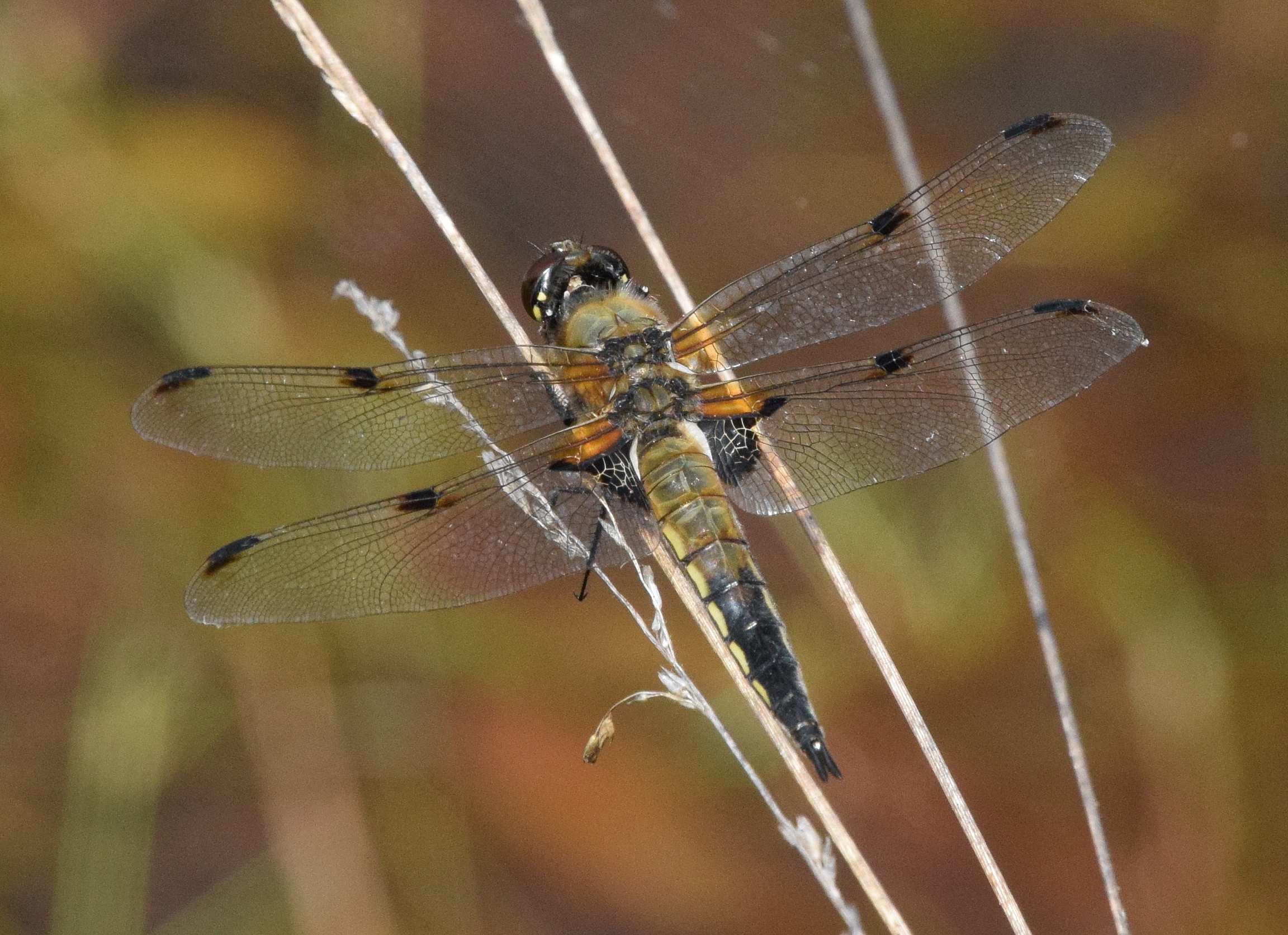
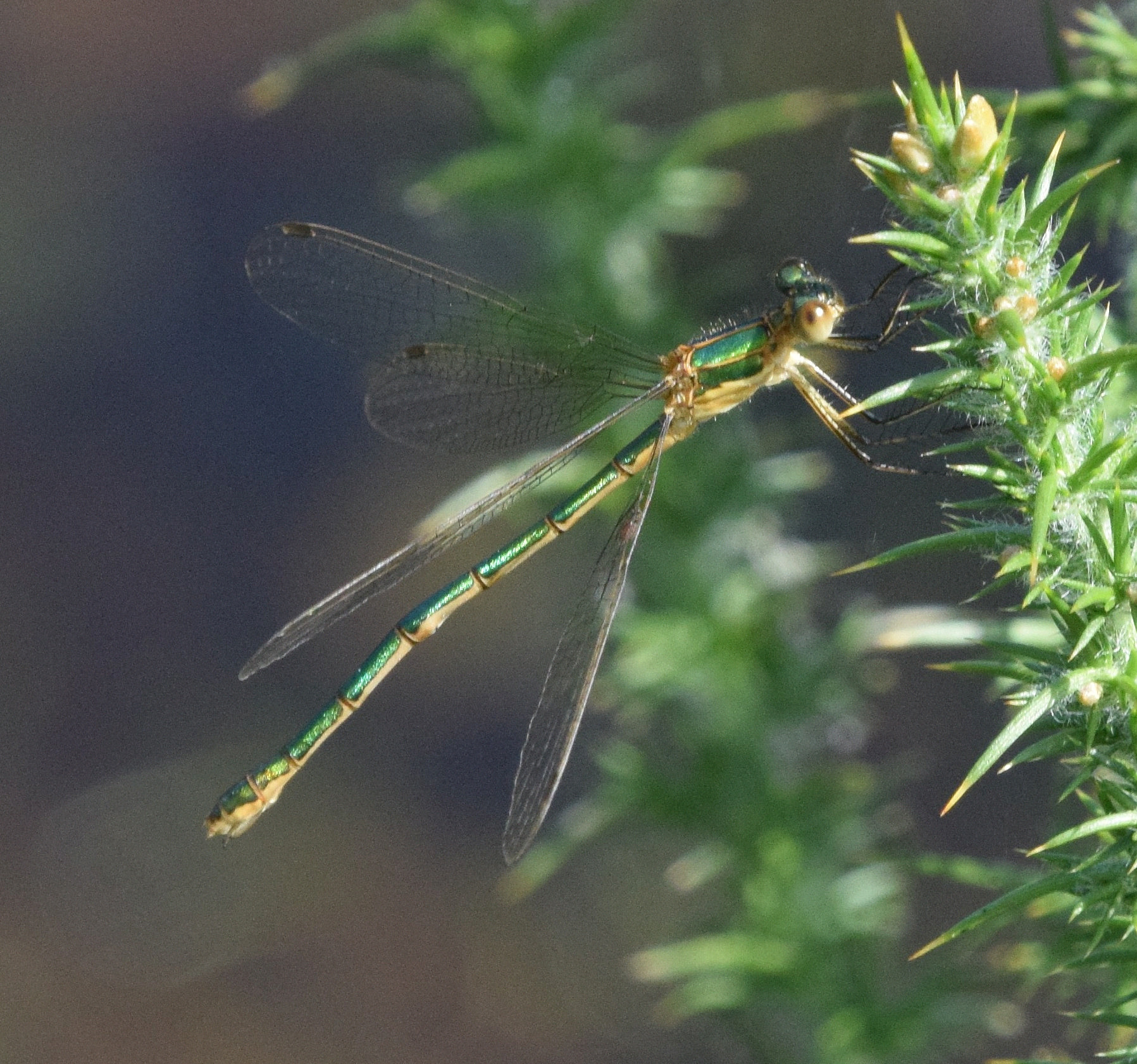
Most pools had one or more Blue Emperor, a few held (presumably Downy) Emeralds that as ever didn’t perch, Four-spotted Chaser announced themselves at intervals, and Broad Scarlet (or Scarlet Darter) flew out regularly from the marginal vegetation. Common and Ruddy Darter, Large Red and various blue damsels were all present, and a single male Migrant Spreadwing (or Southern Emerald Damselfly) was a more unusual find. But of my twin quest there was no sign. With 3000 pools to select from, just where should the visitor start to look? The answer probably is as many as possible.
La plupart des bassins avaient un ou plusieurs Anax empereurs, quelques-uns abritaient des Émeraudes (presque certainement velue) qui, comme d’habitude, ne se posaient pas, des Libellules à quatre taches se manifestaient par intervalles, et la Libellule écarlate sortait régulièrement de la végétation marginale. Un seul mâle Leste sauvage était une découverte plus inhabituelle. Mais il n’y avait aucun signe de ma quête jumelle. Avec 3000 bassins à sélectionner, par où le visiteur devrait-il commencer à chercher? La réponse est probablement le plus possible.
Four-spotted Chaser / Libellule à quatre taches, Broad Scarlet / Crocothémis écarlate, and Migrant Spreadwing / Leste sauvage
In the afternoon my energy and enthusiasm waned in the 35 degree heat, and I was less thorough on the second circuit. The Emeralds were all keeping in cover now, leaving the numerous Emperors to reign supreme, while the vivid red sentinels of the pool margins still stood out. So if those Scarlets were active, why not the Whitefaces? The feeling grew in me that the best chance of success might come earlier as the day warms up.
Dans l’après-midi, mon énergie et mon enthousiasme ont diminué sous la chaleur de 35 degrés, et j’étais moins minutieux lors du deuxième circuit. Les Émeraudes se mettaient toutes à l’abri maintenant, laissant les nombreux Empereurs régner en maître, tandis que les vifs sentinelles rouges des marges de la mare se démarquaient encore. Alors, si ces Écarlates étaient actifs, pourquoi pas les Leucorrhines? Le sentiment grandissait en moi que la meilleure chance de succès pourrait venir plus tôt, à mesure que la journée se réchauffe.
Hence I returned at 8am on Friday (27th), after an intervening day butterflying at a woodland location in La Brenne Parc Regional. Now luck was with me as a film crew were meeting with two rangers in the car park. It always helps considerably to engage with suitably informed and willing rangers, and one of these explained that the Whiteface flight season is now nearly over. That is earlier at Pinail than other more northerly sites, but she gave me the exact location where a YSW had been seen a day earlier.
Ainsi, je suis revenu à 8h le vendredi (27), après une journée d’observation des papillons dans un bois à La Brenne Parc Régional. Par chance, une équipe de tournage se rencontrait avec deux rangers dans le parking. Il est toujours très utile de discuter avec des rangers informés et disposés, et l’un d’eux a expliqué que la saison de vol des Leucorrhines est presque terminée. Cela arrive plus tôt à Pinail que dans d’autres sites plus au nord, mais elle m’a donné l’emplacement exact où un YSW avait été aperçu un jour plus tôt.
The partly weed-filled pool with well developed margins
Now I went to l’Aire d’animation (pictured above), a short distance anti-clockwise along the circular trail from it’s start point, and waited for the sun. At 9:15 two male dragonflies suddenly flew out and jousted territorially around the pool in front of me. One of them looked unusual, and indeed it was the white face of my quest that was attracting my notice. The second antagonist was a Four-spotted Chaser, and unusually where the bullying latter are concerned my Yellow-spotted Whiteface won, the opponent keeping a lower profile thereafter.
Maintenant, je suis allé à l’Aire d’animation, à une courte distance dans le sens inverse des aiguilles d’une montre le long du sentier circulaire depuis son point de départ, et j’ai attendu le soleil. À 9h15, deux libellules mâles ont soudainement volé et se sont affrontées territorialement autour de la piscine devant moi. L’une d’elles avait l’air inhabituelle, et en effet, c’était le visage blanc de ma quête qui attirait mon attention. Le deuxième antagoniste était un Mésange à quatre taches, et de manière inhabituelle, en ce qui concerne le harcèlement, mon Leucorrhine à gros thoraxa gagné, l’adversaire gardant ensuite un profil plus bas.
Once the contest was settled the victor perched for a while quite near to where I was standing with the sun behind me, though not close enough for a clearer lead picture. After that it kept to the far end of the pool, largely concealed for much of the time. The film crew and rangers walked past again and one of them picked out the YSW looking straight at us (below). By 10am cloud set in once more and I decided to move on.
Une fois le concours terminé, le vainqueur s’est perché pendant un moment assez près de l’endroit où je me tenais avec le soleil derrière moi, bien qu’il ne soit pas assez près pour une image de tête plus claire. Après cela, il est resté à l’autre bout de la piscine, largement dissimulé pendant la majeure partie du temps. L’équipe de tournage et les rangers sont passés à nouveau et l’un d’eux a repéré le YSW nous regardant droit dans les yeux (ci-dessous). Vers 10 heures, les nuages se sont à nouveau installés et j’ai décidé de passer à autre chose.
“Just look at my white face and pterostigma“ “Regarde juste mon visage blanc et mon ptérostigmate“
This is the largest of five Whiteface species occurring in Europe, at 32 – 39mm long with a wingspan of 60 – 70 mm. The prominent yellow spot that gives the species its name is on the seventh abdominal segment. It is found in boundary moorland areas, transition bogs and forested moors. Populations are usually small, localised and difficult to observe in the field. Reproduction requires moderately acidic and low to moderately nutrient-rich waters with pondweed and water lilies, as at this particular Pinail pond. There have only ever been three records from the British Isles.
C’est la plus grande des cinq espèces de Leucorrhine présentes en Europe, mesurant de 32 à 39 mm de long avec une envergure de 60 à 70 mm. La tache jaune qui donne son nom à l’espèce se trouve sur le septième segment abdominal. Elle se rencontre dans les zones de landes frontalières, les tourbières de transition et les landes boisées. Les populations sont généralement petites, localisées et difficiles à observer sur le terrain. La reproduction nécessite des eaux modérément acides et pauvres à modérément riches en nutriments, avec des plantes aquatiques et des nénuphars, comme dans ce particular étang de Pinail. Il n’y a eu que trois observations provenant des îles britanniques.
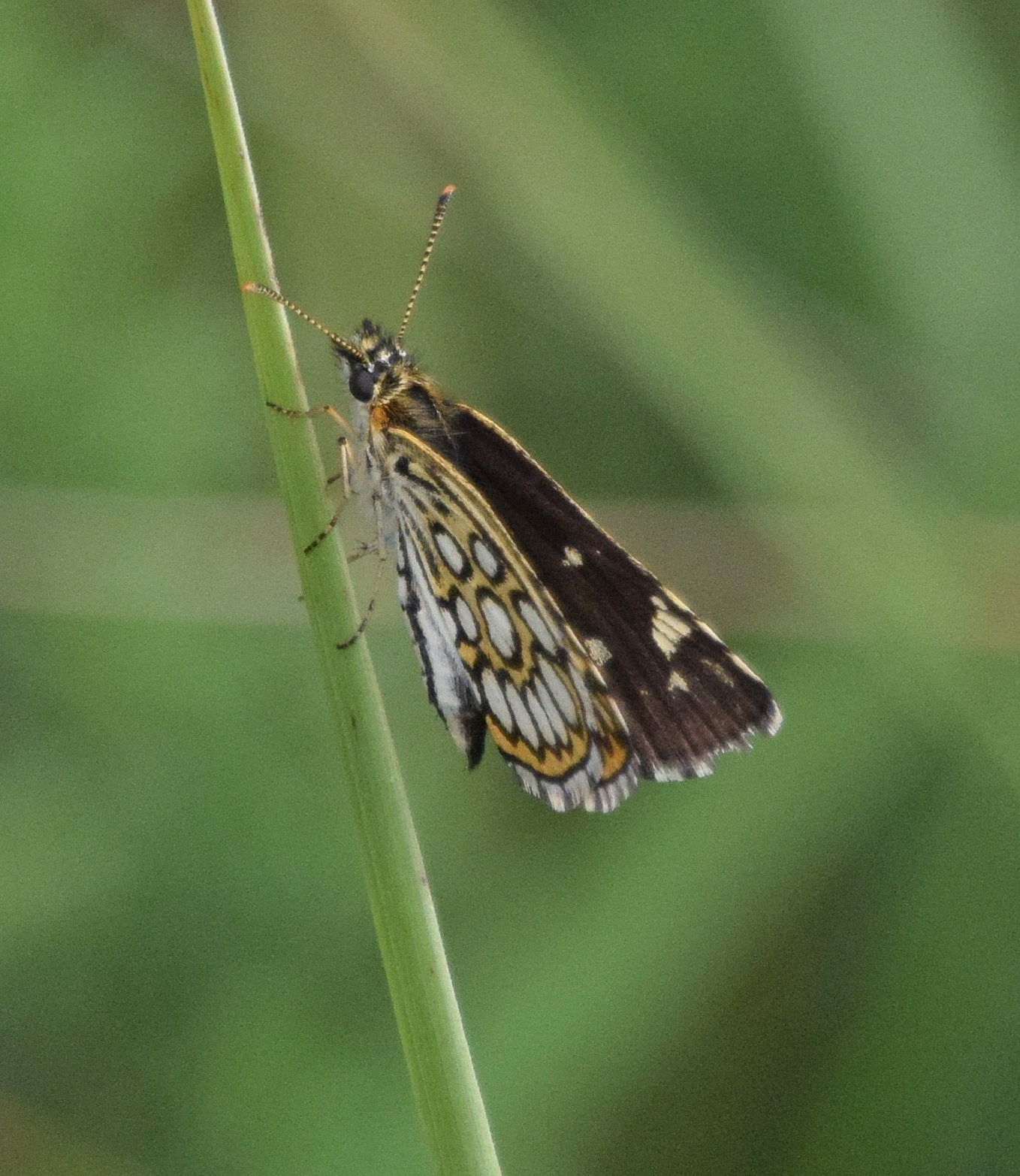
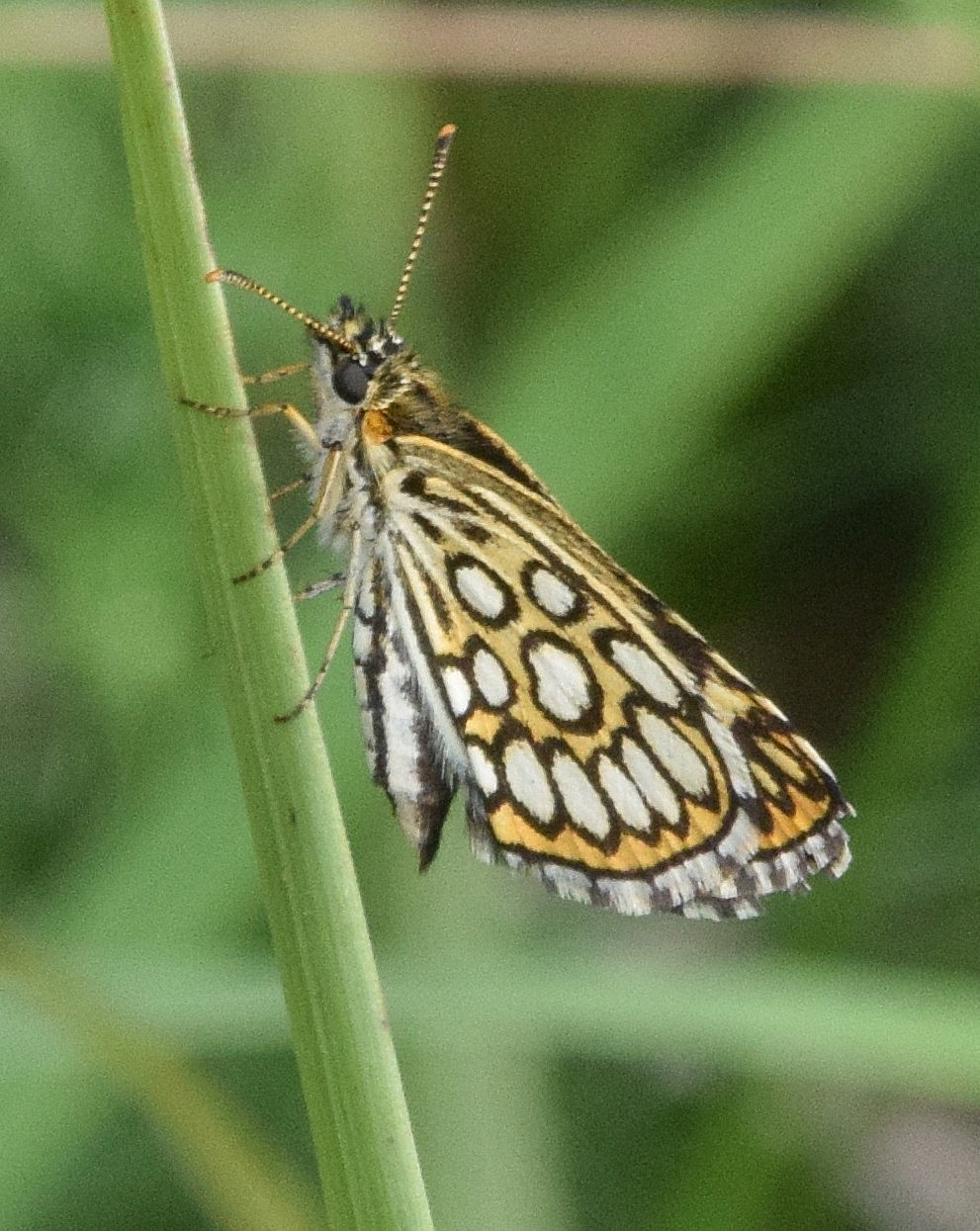
Large Chequered Skipper / le Miroir (fem)
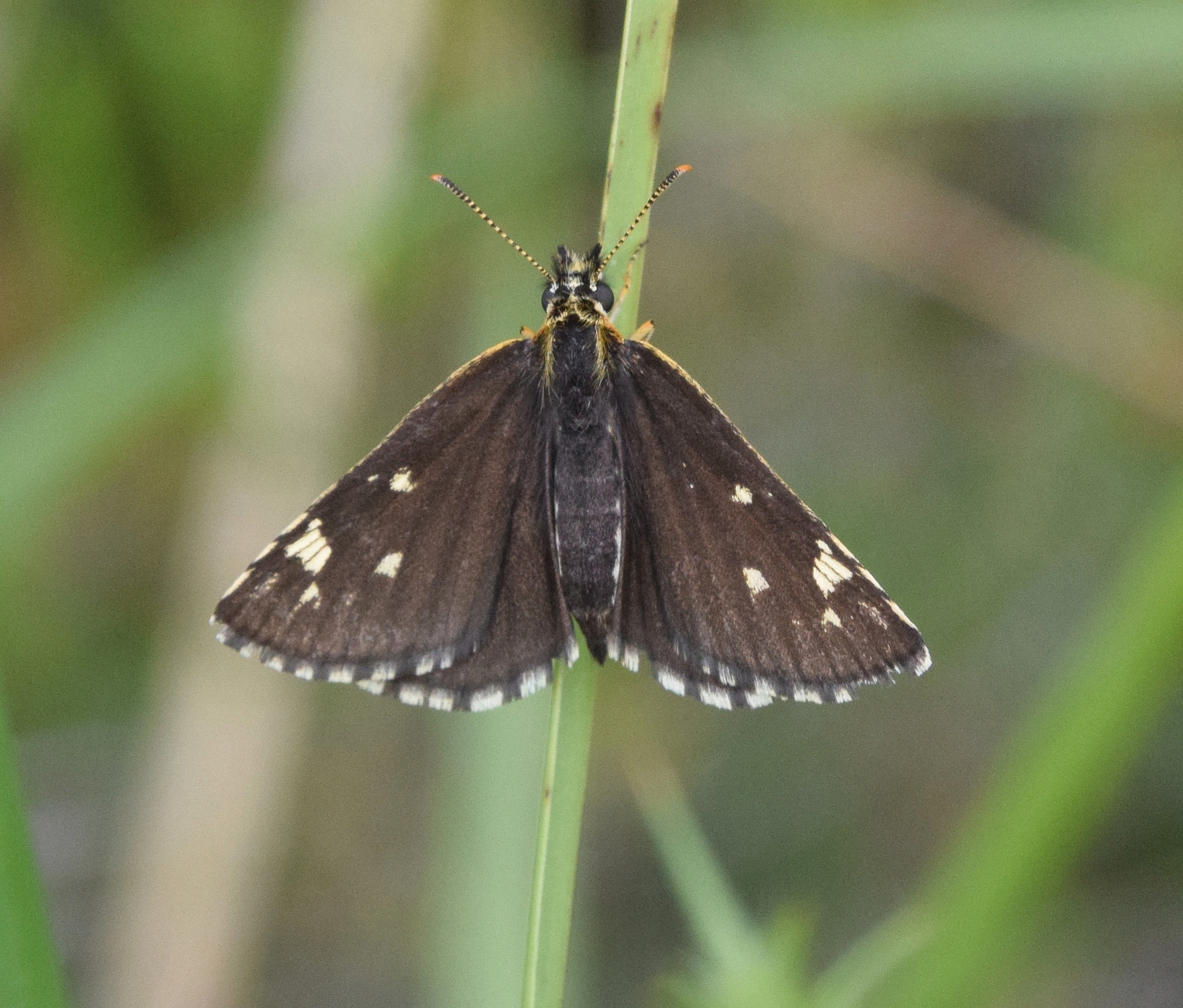
Where butterflies were concerned, the highlight of the two days was a trail-side encounter with a female Large Chequered Skipper (pictured above), the species being something of a Pinail specialty that was a lifer for me here two years ago. This time the heat seemed to be slowing the flight pattern of several individuals I crossed paths with. Those observed in 2023 had all been bouncing around as if pogo-sticking on invisible threads of elastic. To a non-butterfly enthusiast this LBJ may not seem especially exciting, at least when viewed from above, but as she warmed up in the early morning my individual yielded personal first open-winged, top side studies. Other species that caught my attention at random while searching for the Whitefaces are presented in the next sequence.
En ce qui concerne les papillons, le point culminant des deux jours a été une rencontre en bordure de sentier avec une femelle Miroir (voir ci-dessus), l’espèce étant quelque peu une spécialité des Pinails et c’était un premier pour moi ici il y a deux ans. Cette fois, la chaleur semblait ralentir le rythme de vol de plusieurs individus que j’ai croisés. Ceux observés en 2023 avaient tous rebondi comme s’ils faisaient du pogo sur des fils élastiques invisibles. Pour un non-enthousiaste des papillons, ce peut ne pas sembler particulièrement excitant, du moins vu d’en haut, mais alors qu’elle se réchauffait tôt le matin, mon individu a fourni des études personnelles en première instance sur ses ailes ouvertes, côté supérieur. D’autres espèces qui ont attiré mon attention au hasard en cherchant les Leucorrhines sont présentées dans la séquence suivante.
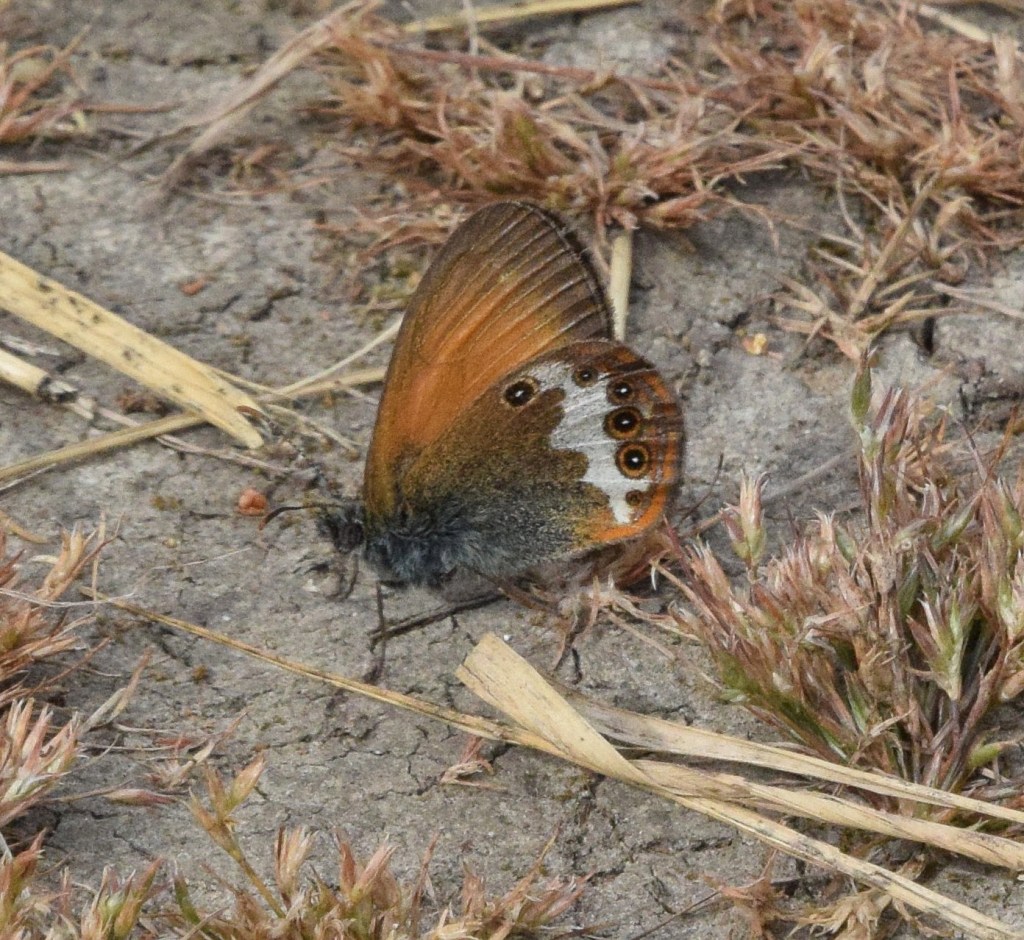
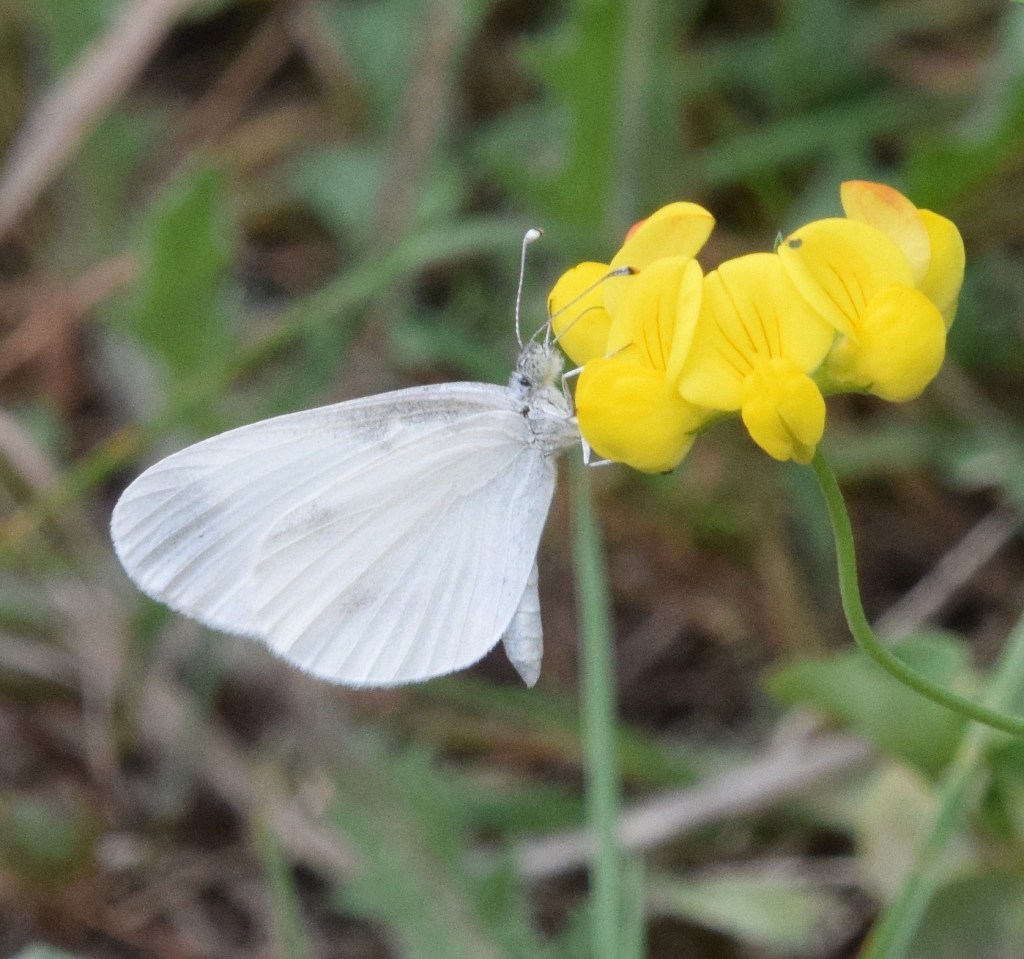
De la gauche: le Céphale / le Blanc-verdâtre / Tircis (aegeira)
Now I may have to do this all over again, earlier in another year if I can take more punishment, for Lilypad and hopefully more Yellow-spotted Whitefaces of both genders. This has been a very difficult task through three visits, and I have yet to read of anyone or any tour group that things were easier for. I also appreciate I would not have made an initial conversion without the ranger’s assistance. She told me of one regular visitor to the reserve who has yet to connect after multiple attempts. The programme being filmed here will air on French regional TV, and may even contain footage of yours truly scanning the pool with my binoculars.
Maintenant, je devrais peut-être tout recommencer, plus tôt dans une autre année si je peux supporter plus de punition, pour Lilypad et j’espère d’autres Blanches à taches jaunes des deux sexes. Cela a été une tâche très difficile à travers trois visites, et je n’ai pas encore lu sur quelqu’un ou un groupe de tourisme pour qui cela aurait été plus facile. J’apprécie également que je n’aurais pas fait de conversion initiale sans l’assistance du ranger. Elle m’a parlé d’un visiteur régulier de la réserve qui n’a pas encore fait de connexion après plusieurs tentatives. L’émission qui est filmée ici sera diffusée à la télévision régionale française et pourrait même contenir des images de moi scrutant la piscine avec mes jumelles.
NB: As usual when describing Odonata, I have referred to species herein by standard international names, with British Dragonfly Society equivalents in parentheses / Comme d’habitude lors de la description des Odonates, je me suis référé aux espèces ici par leurs noms internationaux standards, avec les équivalents de la British Dragonfly Society entre parenthèses.
At this time of year evolved Orchid experiences just keep on coming. When I learned of an opportunity to visit the first of this post’s subjects, led as a personal initiative by one Hardy Orchid Society member, I enrolled then interested Adam in coming with me. The proposed agenda would also allow us to record one of the rarest of all British Orchid forms at a nearby location, the prospect of which appealed to me greatly. Our would be guide fell ill but there was no reason not to fulfill the mission under our own steam, since the first site is open to the public at select times and the second is generally accessible.
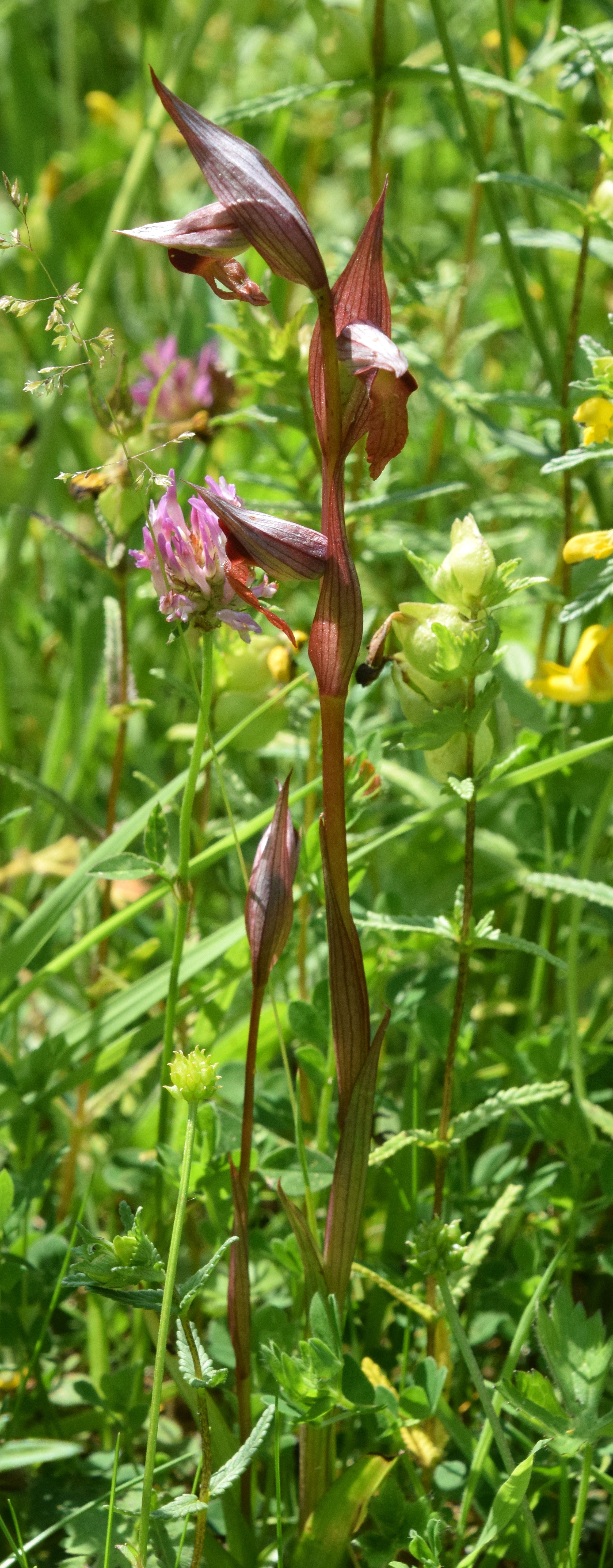
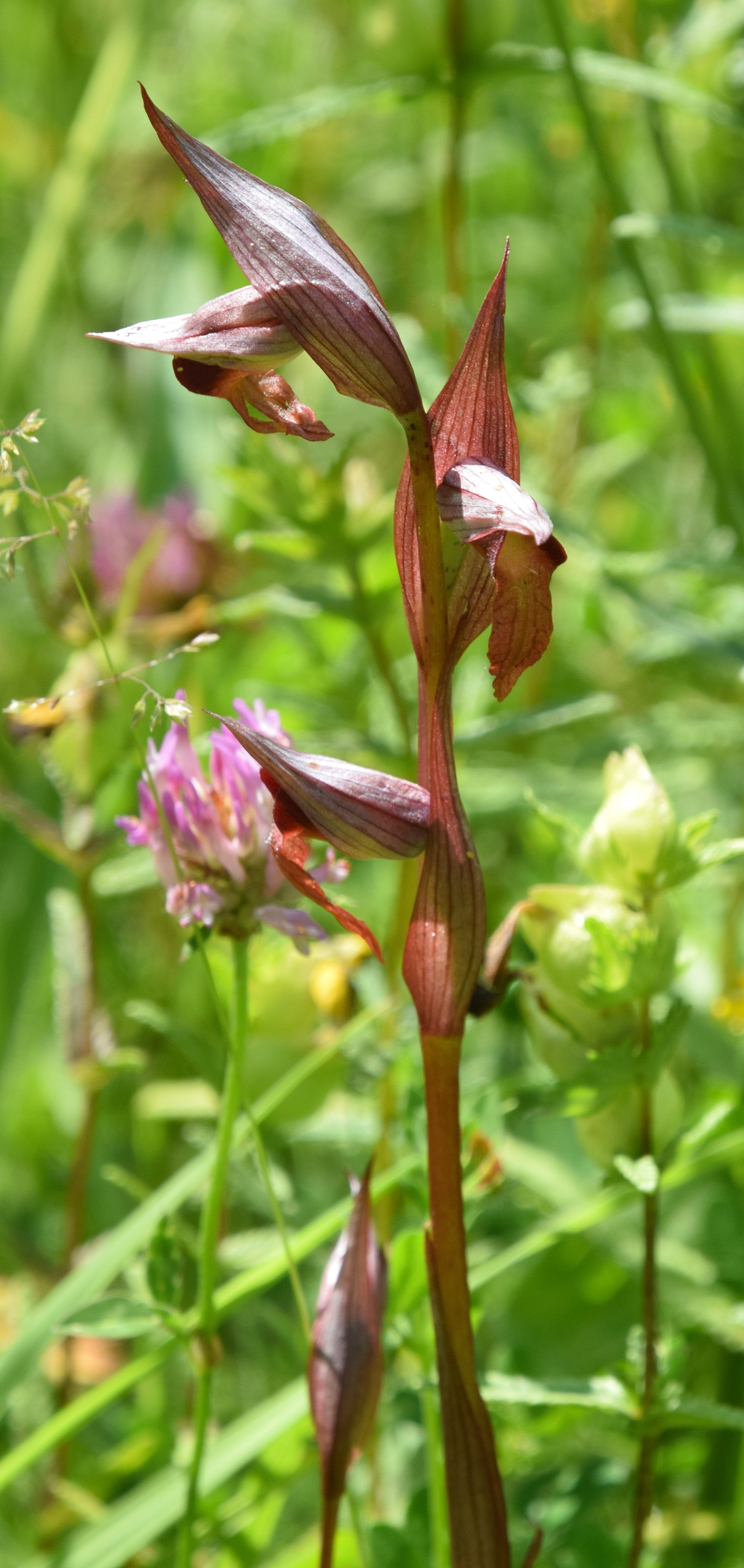
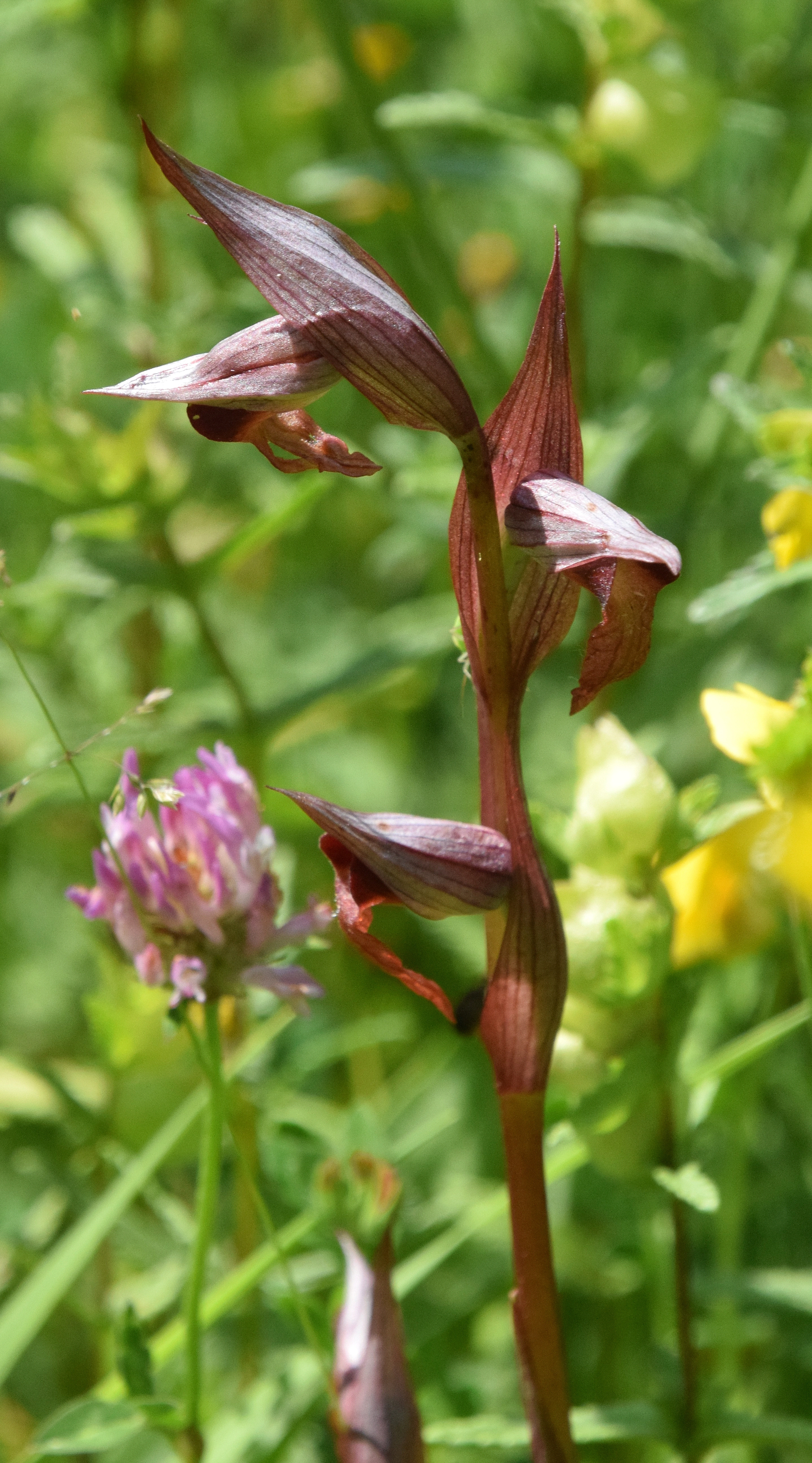
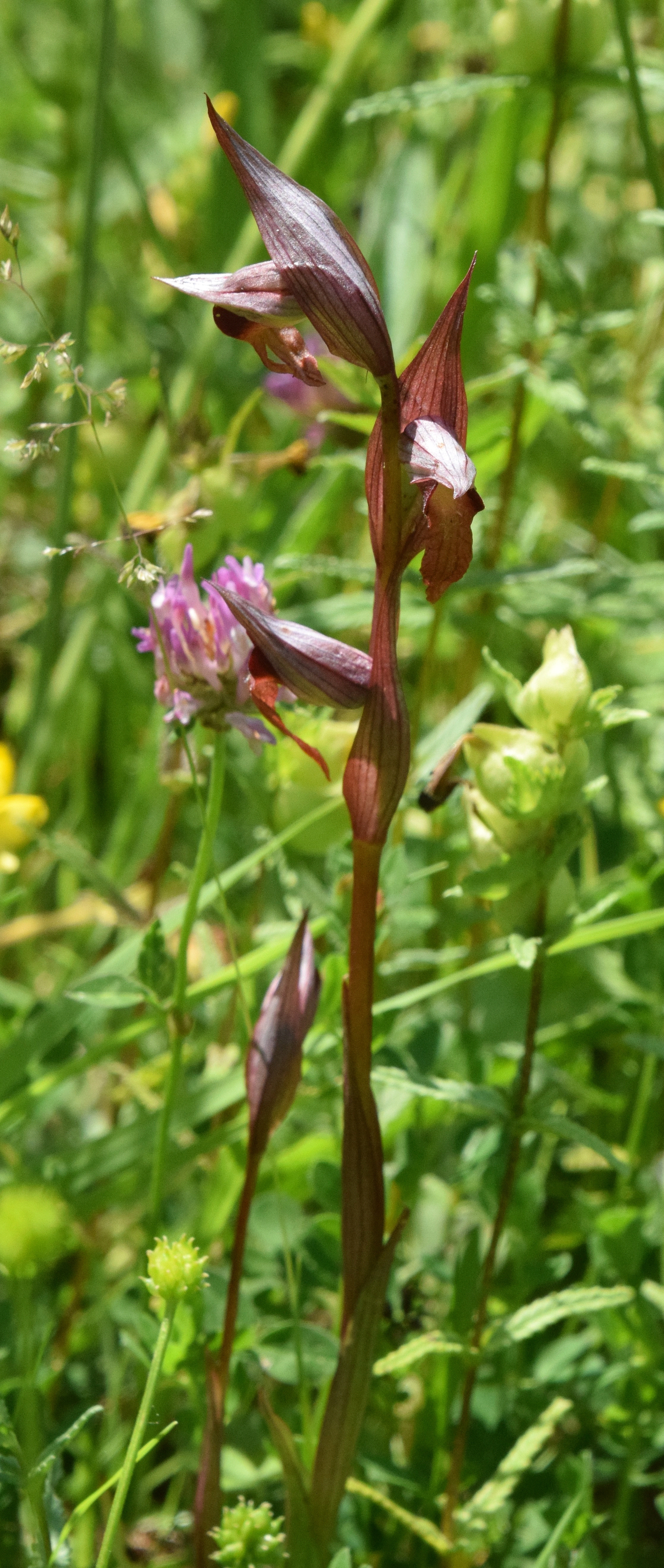
The provenance of Tongue Orchid(genus Serapias) nationally is subject to conjecture, since there is no certainty that any of three known colonies are genuinely wild. Those are at today’s location in Suffolk, a second near Colchester in Essex and reportedly a City of London rooftop garden. This group of plants (see here) is native to Mediterranean Europe from the Iberian peninsula, through France, Italy and the Aegean region to Turkey. There are several species and more sub-species, so hybridisation is commonplace.
Tongue Orchid
In 2021 a specimen was found within the site featured herein that was at first assumed to have been planted. But after ongoing assessment by eminent botanists and Kew Gardens, by 2023 it became accepted that was unlikely since it grows on private land with limited public access, though it remains unknown where the now three stems could have originated from. A conspiracy theory that someone must have sneaked in out of hours and planted the original item has been dismissed.
One Tongue Orchid stem had gone over, but the second was in pristine condition (pictured below) with a very small third stem alongside it. My understanding is these particular plants are cited as Serapias bergonii (see here), for which there appears to be more than one common name if indeed consensus has been reached. I will not go into the detail. Each stem can grow to 50cm, along which are up to 12 streaked, deep red bracts containing the lax flowers of varying tone. Those are hairy in the centre with lips up to 30mm. At the time of our visit it was only possible to take pictures looking into the sun, but that is how the plant was experienced.
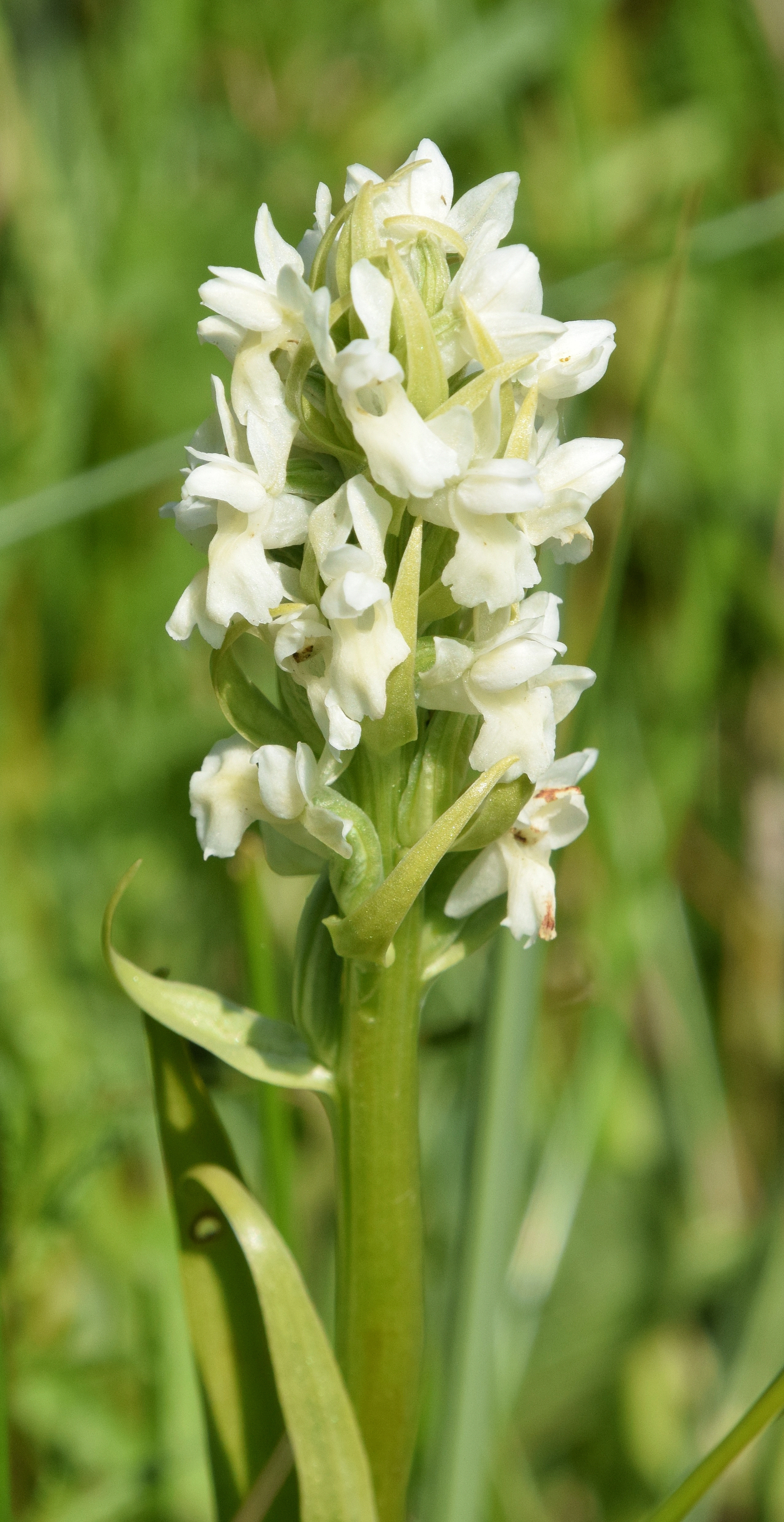
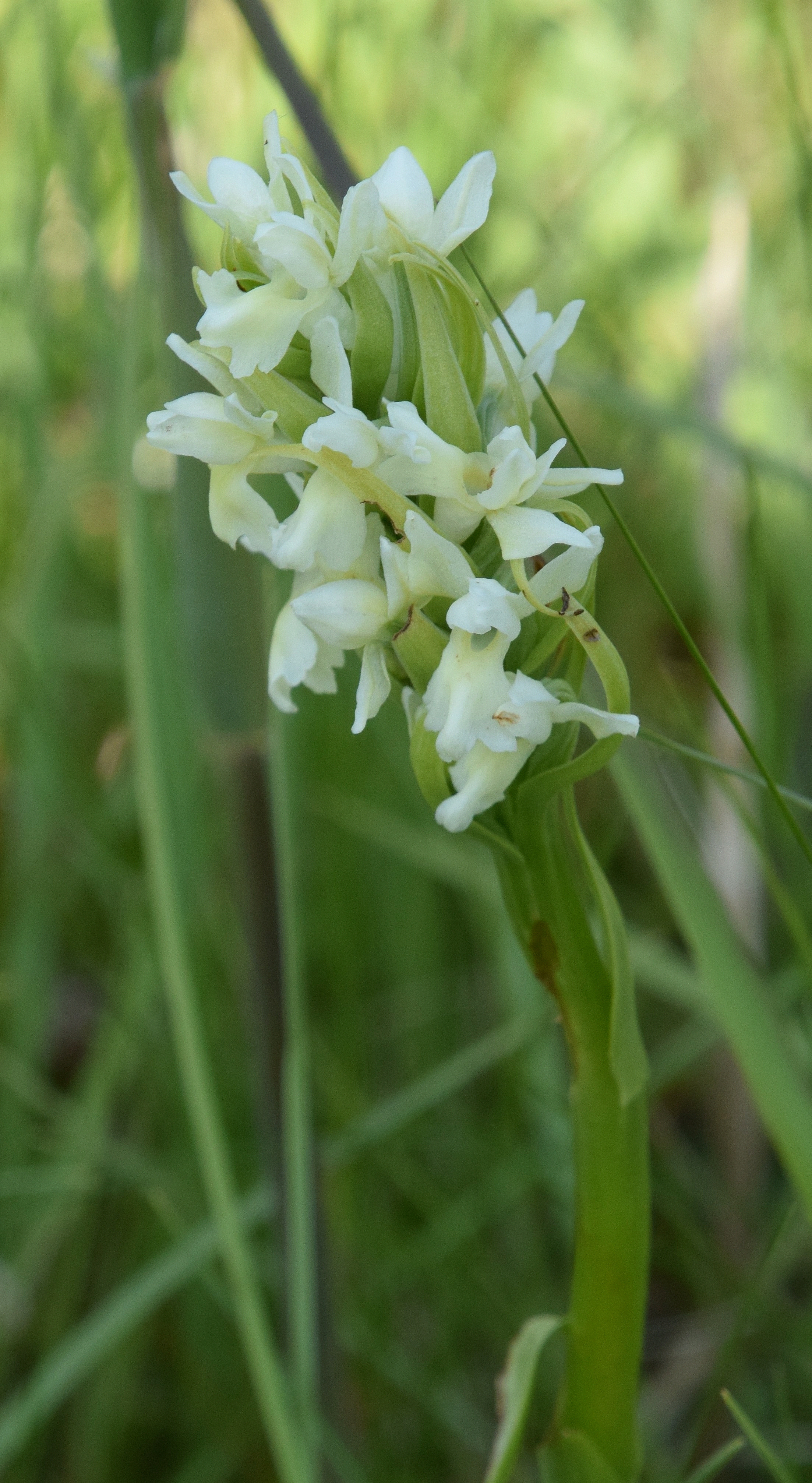
We were now conveniently placed to observe the critically endangered var ochroleuca form of Early Marsh Orchid (Dactylorhiza incarnata). In this area of northern Suffolk a network of remnant valley fens survives, preserving a habitat that has long been lost more widely to modern agriculture. Amongst these, that I cannot disclose herein, is one of just two remaining sites for our day’s second quest. As soon as I researched this great rarity, it was something I just had to see. Equipped with a GPS from our original source, we located nine plants here that were all in immaculate condition, in a spiritually uplifting, spring-fed landscape from a long-past age that as so often when Orchid hunting no longer exists in the normal run of things.
Suffolk Wildlife Trust describes these fens as being “strung like a beautiful necklace around the throat of north Suffolk”. This one offered my third var ochroleuca, the others being Marsh Helleborine (see here) and Fly Orchid (previous post). These forms lack the coloured pigments typically found in the three species, resulting in a lighter, often cream-green or yellowish-green appearance. Care must be exercised in identification, since two white forms of EMO also exist. But a botanist we met at the earlier site matched them to the Cole and Waller field guide he brought with him, so we were all satisfied these plants today were genuine.
Early Marsh Orchids var ochroleuca and Southern Marsh ssp schoenophila (far right)
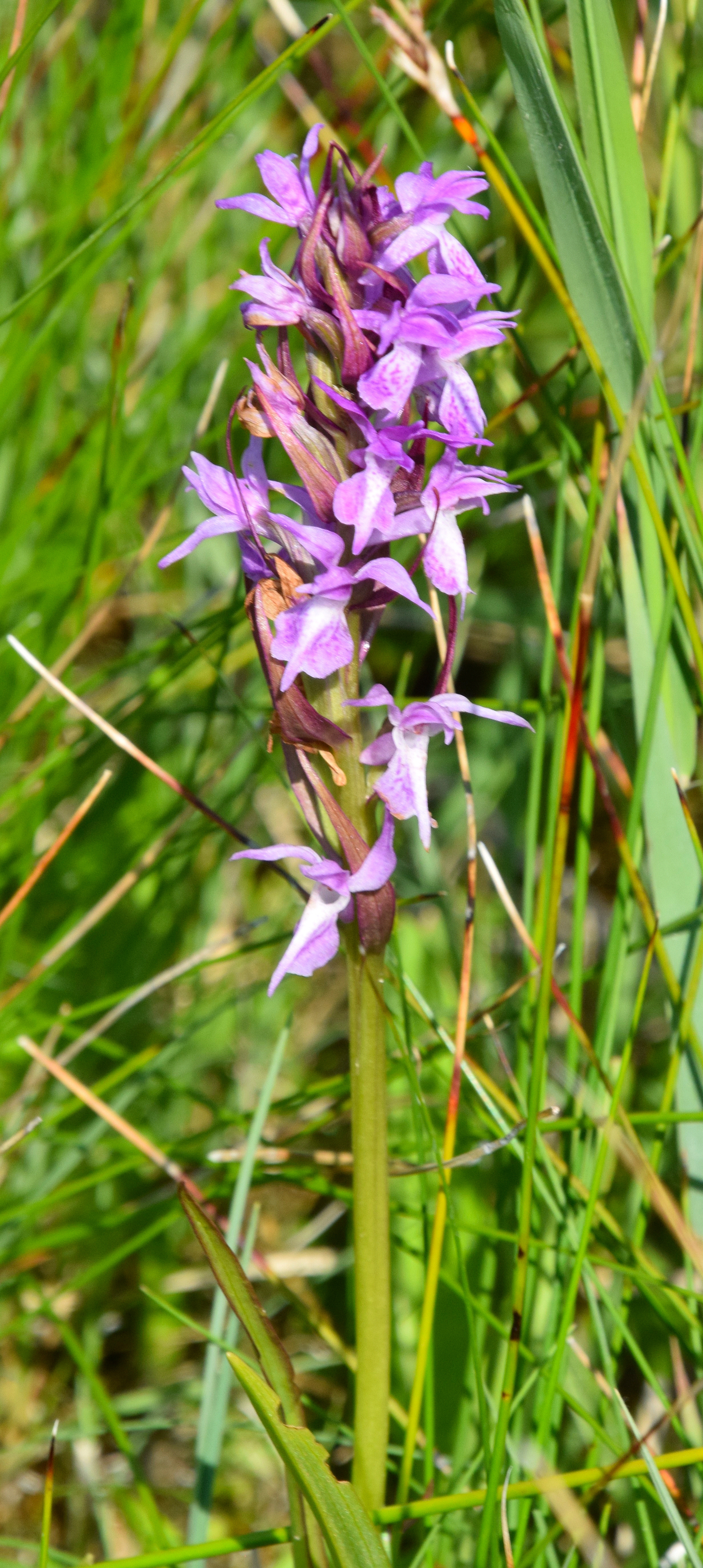
Amongst the many Marsh Orchids here were some Southern Marsh Orchid (Dactylorhiza praetermissa ssp schoenophila). This is the sub-species formerly classified as Narrow-leaved or Pugsley’s in southern England, for which this Suffolk site is a known location. Their stems are thinner and weaker than SMO, the leaves narrower, and the flower spike has a delicate, rather ragged character. I myself have observed schoenophila once before in Hants (here), and that post from last July contains more of the taxonomic background.
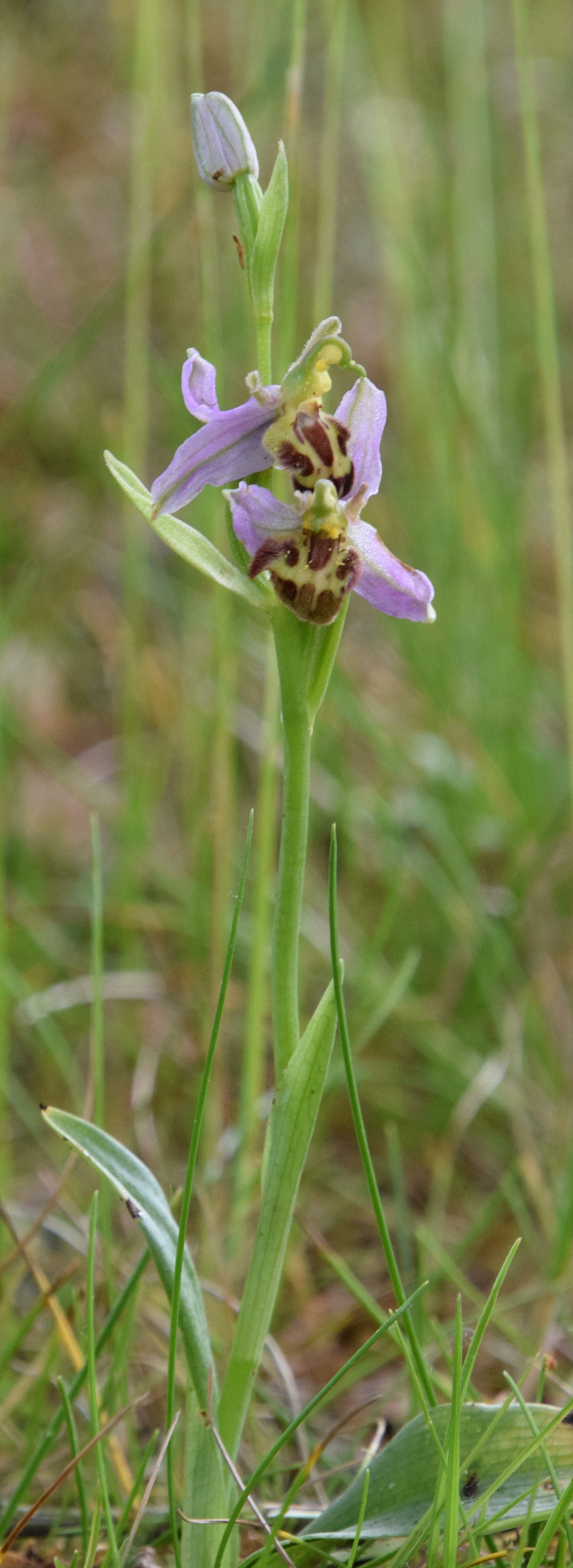
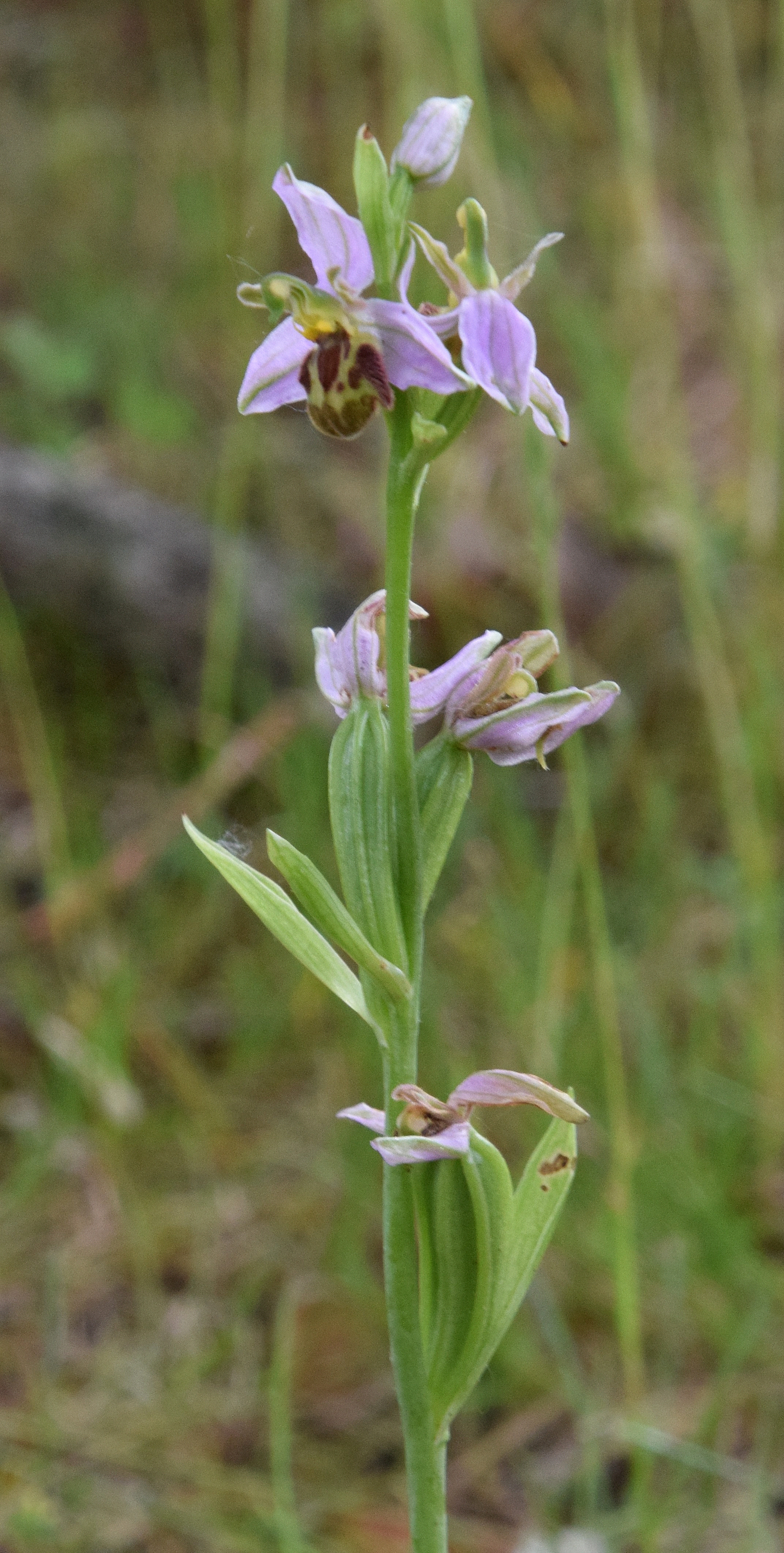
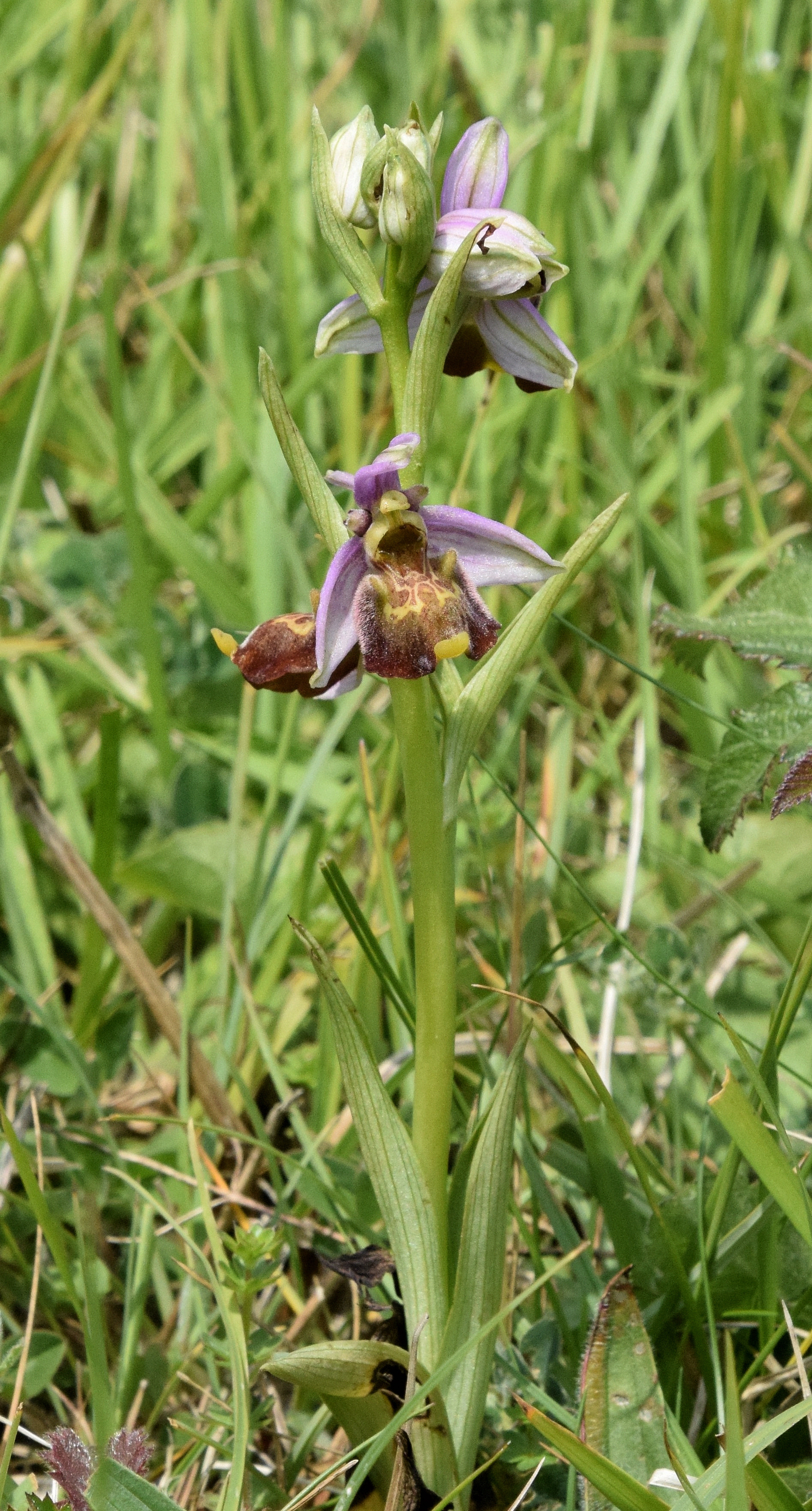
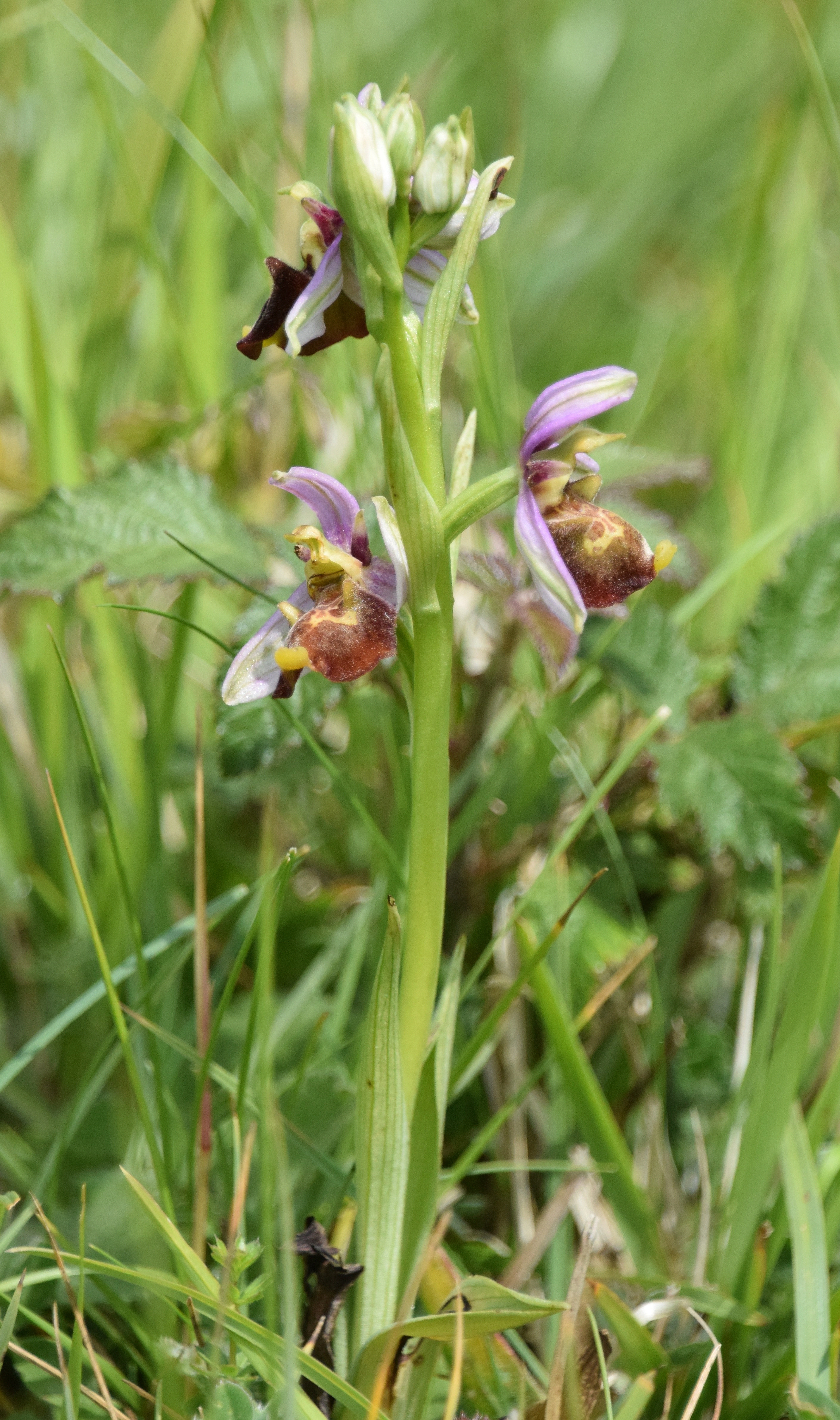
One Orchid I have yet to include in this journal’s coverage of the last three seasons is the familiar but often inconspicuous Bee Orchid (Ophrys apifera – pictured below), simply because I find them in the field so infrequently. The flowers resemble plump, furry bumblebees, and there may be between two and seven per stem. Whenever I do cross paths with them I am always charmed by their attractive fine detail. Plants may appear in a wide variety of habitats where wildflowers flourish, including garden and park lawns and grass verges. Earlier this week I was very pleased to find four stems growing in the car park of my part-time workplace, so the omission can now be remedied.
Bee Orchid var belgarum (left) and regular Bee Orchids at Nuneham Courtenay, Oxon
I am reliably informed that the specimen in the left hand picture, and possibly the right are an uncommon form var belgarum, (see here for detail). This variant was first discovered on a roadside verge near Winchester in 1998. Though initially thought to be restricted to that area of Hants chalk downland, it is now known from several other locations in England and Wales; but is extremely rare in continental Europe. When Ian followed up on Friday (13th) the left hand plant had been partly eaten.
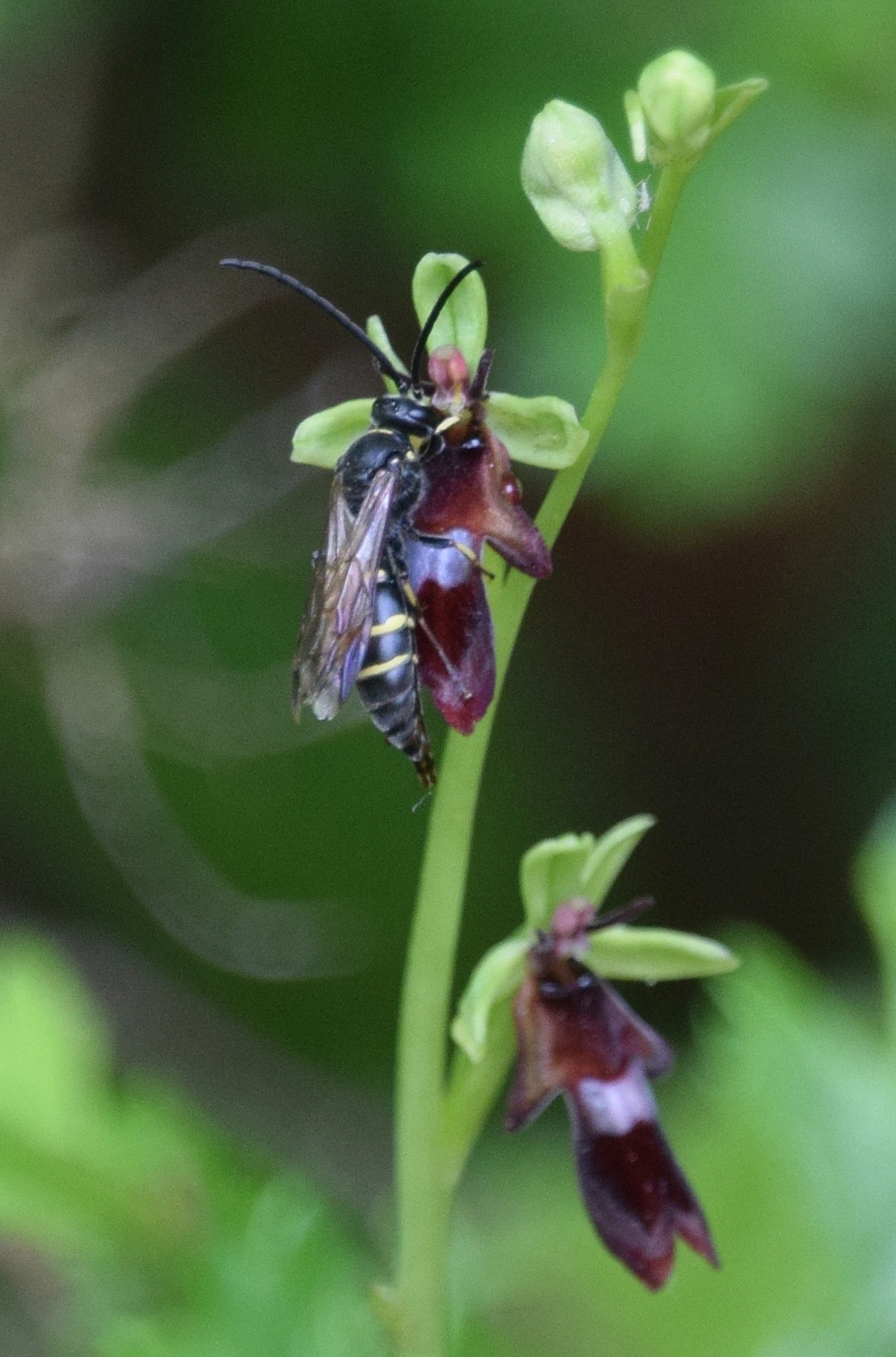
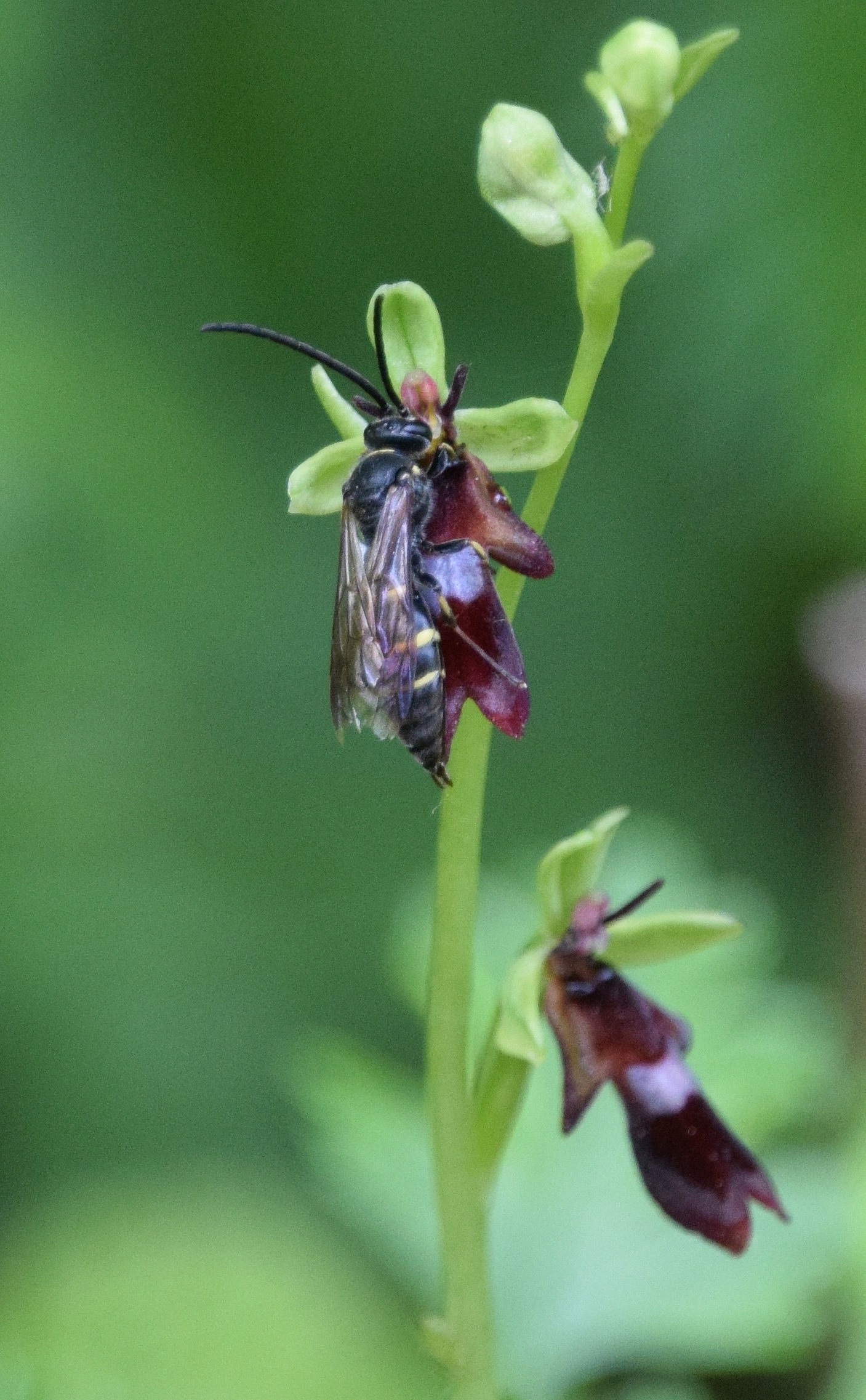
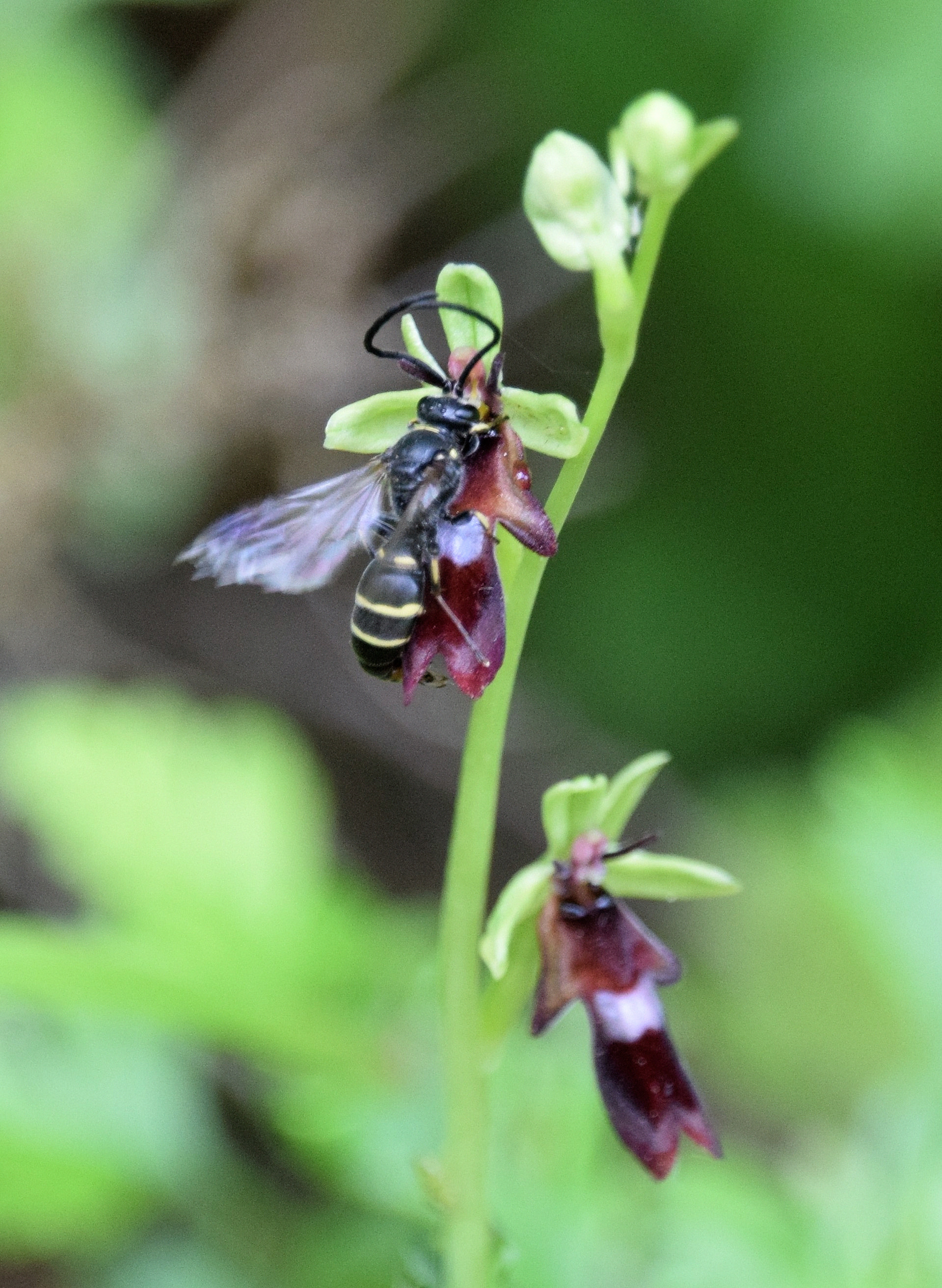
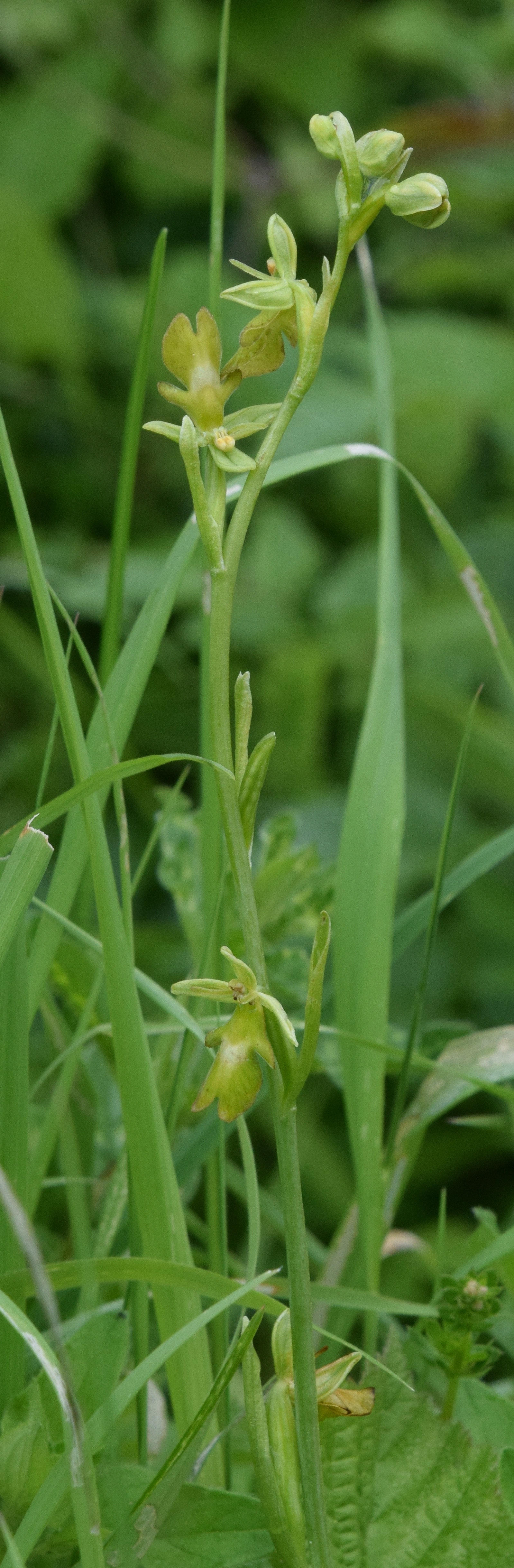
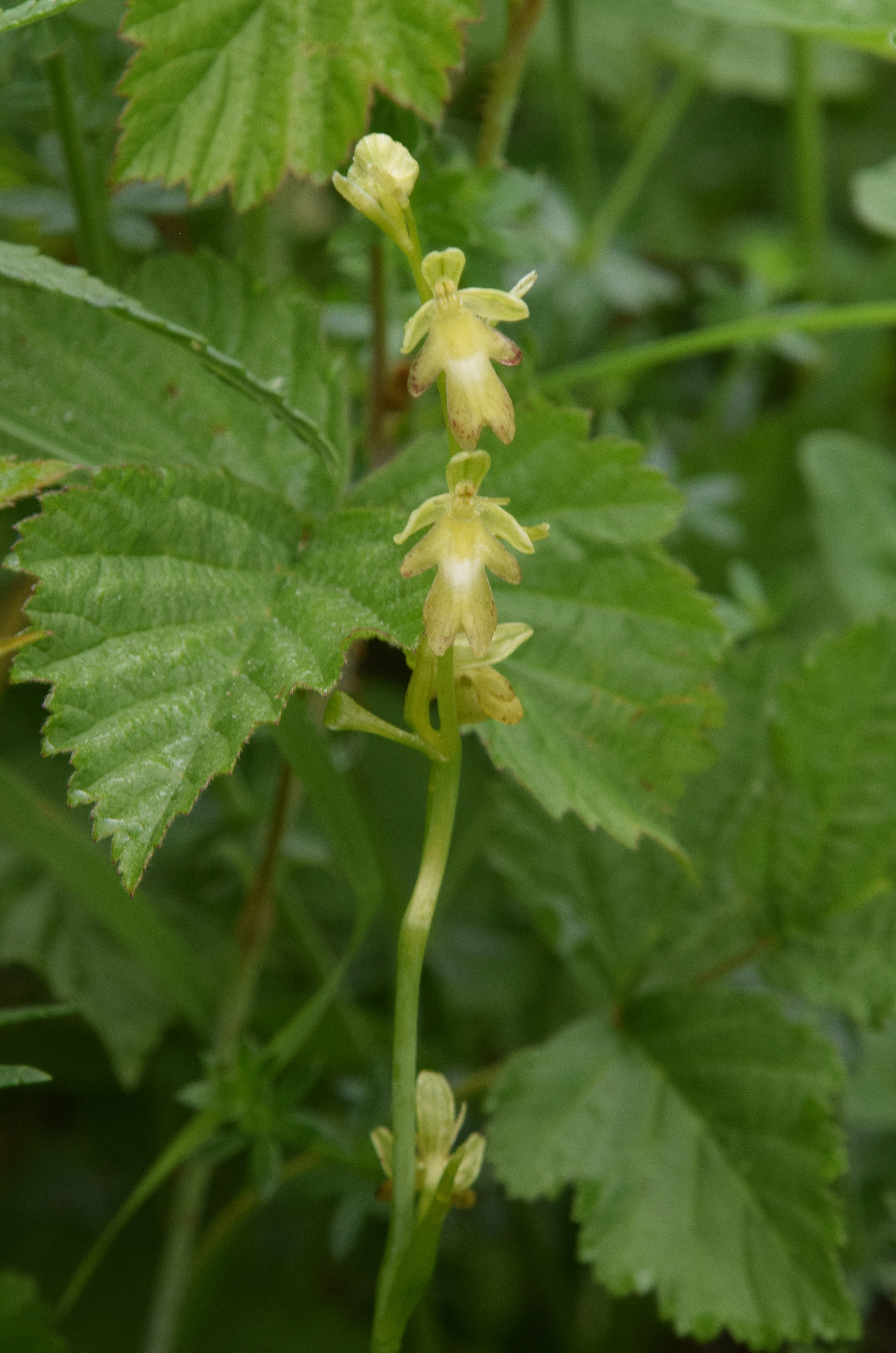
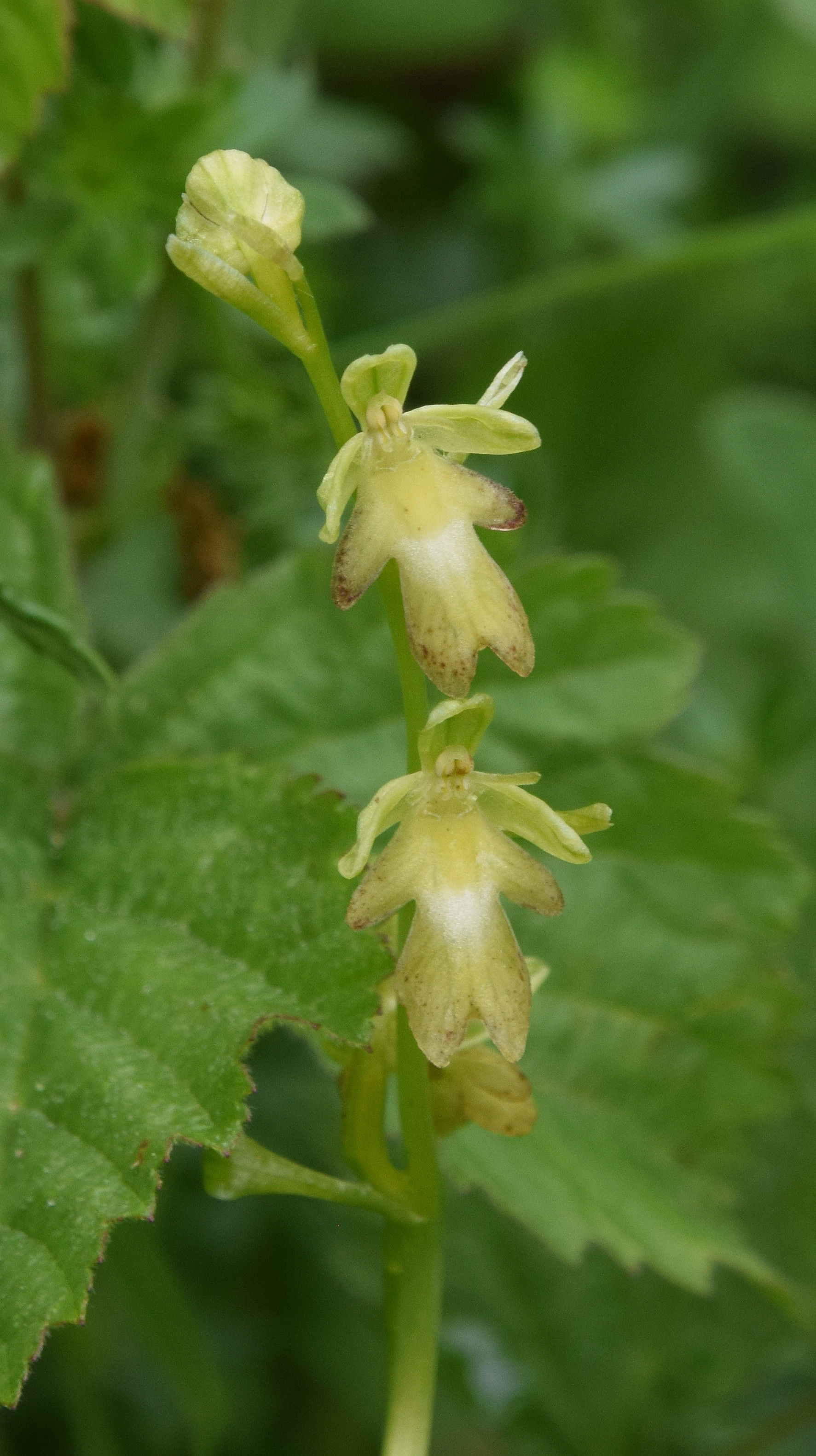
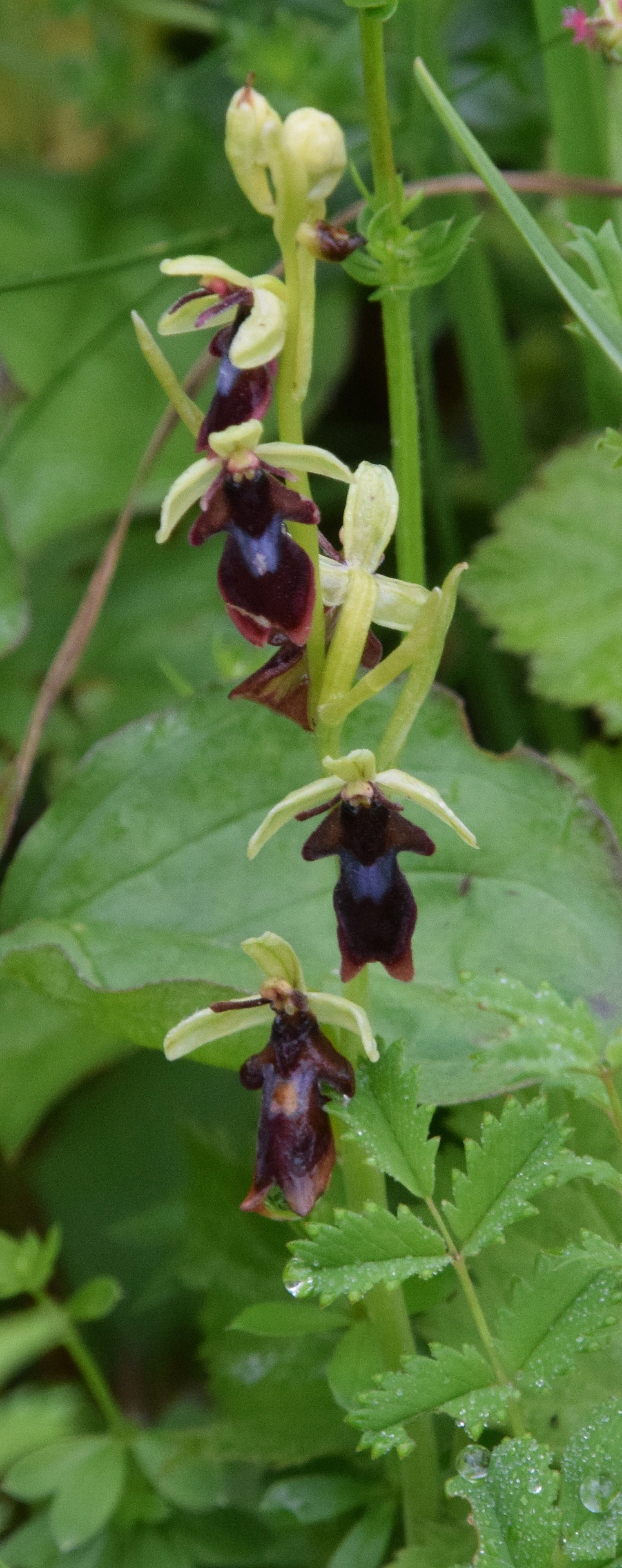
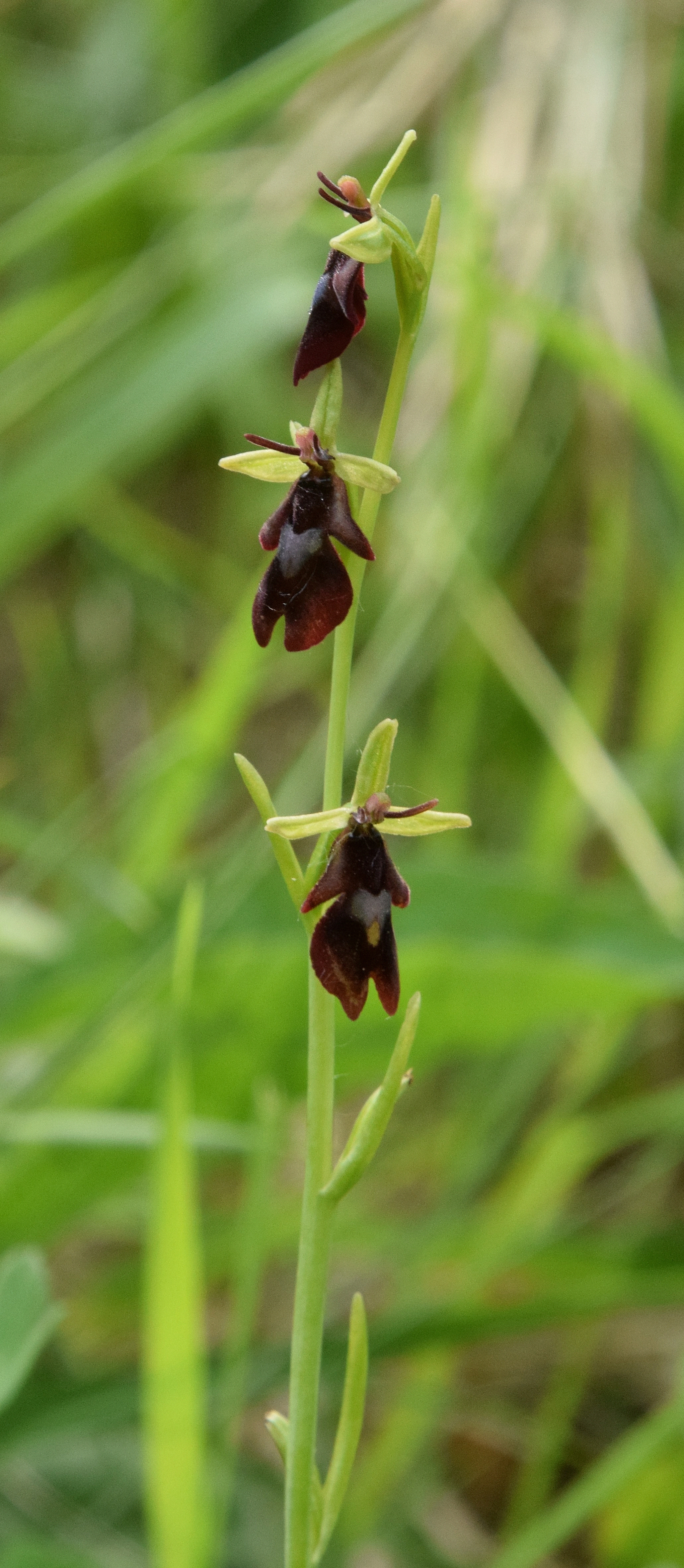
I have until now felt a little underwhelmed when encountering the undeniably delicate beauty of Fly Orchids, the plants being so skinny and the flowers so tiny, but what I will now describe has rather altered that. Twice in the course of four days a week ago I was fortunate enough to gain two quite exceptional records (pictured below).
As the Mariposa tour group I joined was leaving Bonsai Bank on 1st an excited shout went up from one guide Richard Bate to the other, Jon Dunn. Richard had found a Wasp attempting to mate with a Fly Orchid flower, something that is rarely actually witnessed in the field. Indeed both guides had observed this just a couple of times each before. Richard called participants forward to take pictures under supervision, then when he judged the insect was not bothered by our attentions I moved a little closer. By now I was lying on the ground while others stood around me getting their own pictures using the back of camera technique. I always look through the viewfinder. I had no idea whether I was getting anything decent, given glare on the camera screen and since I wear varifocals, but was eventually pleased with the outcome.
The process of pollination through sexual mimicry by Ophrys (Bee, Fly and Spider) Orchids is known as pseudocopulation. As well as the visual deception the plants also replicate the sexual pheromones (scent) of the pollinator species, which can be more attractive to male insects than that of females of their kind. In falling for the deception male wasps or bees contact the plants’ pollen sacs which attach to their bodies and are then transferred to the next flower they visit. To ensure reproductive isolation each Ophrys species, of which there are many abroad targets separate pollinators upon which they are completely dependent for their survival, though hybridisation of course does occur (see here). Pollination of around 10 per cent of an Ophrys population is sufficient to preserve it, since each plant can produce up to 12,000 minute seeds.
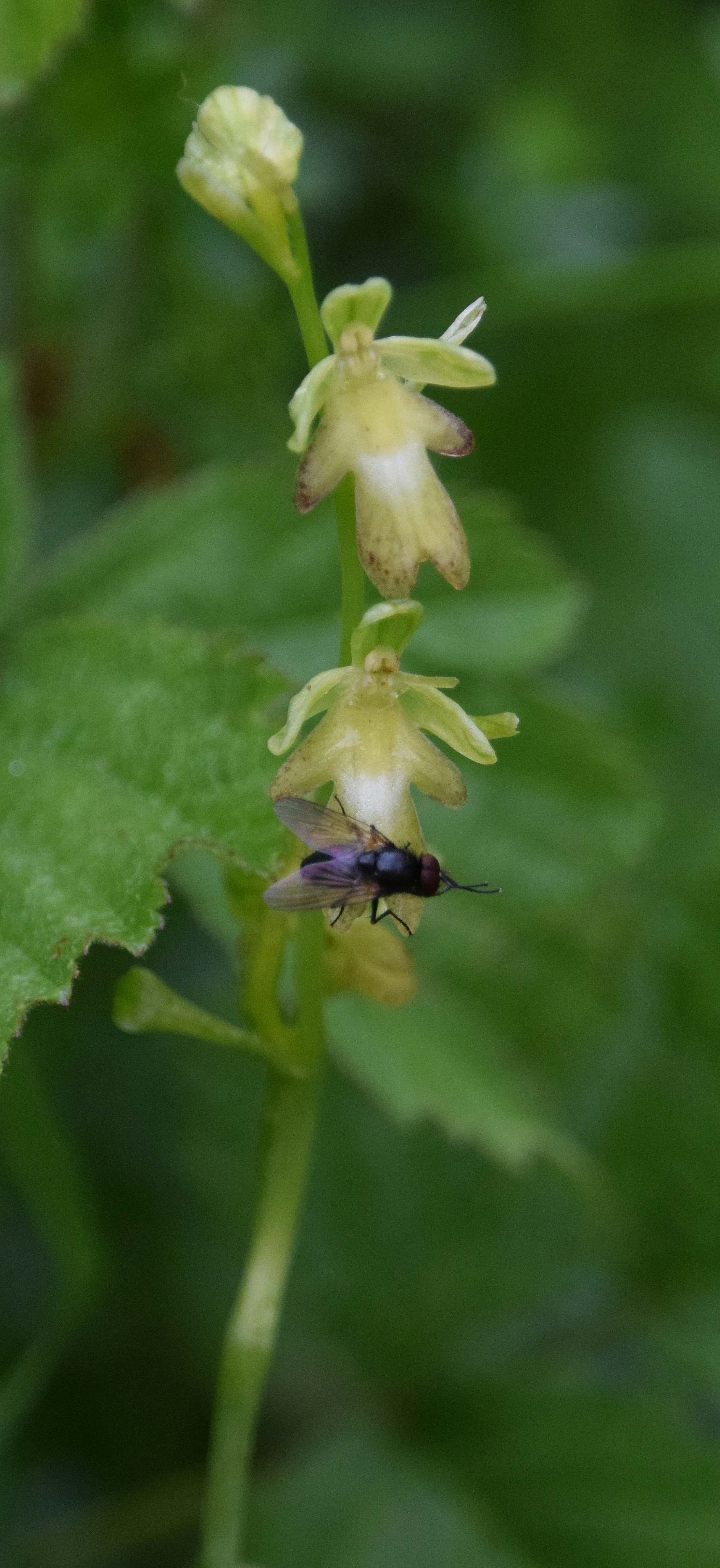
On the morning after that tour I was tipped off about a location in Hampshire for the rare green colour form of Fly Orchid, designated var ochroleuca. This seemed well worth going to see, Tuesday was a wet day, but I made an early start on 4th arriving on site at 9am. The two stems took some finding, as I paced up and down at the foot of a steep and densely vegetated former chalk pit side, trying to bring the cursor on my phone screen into my quest’s w3w square. Then all of a sudden there they were, a classic case of getting my eye in. The term ochroleuca refers to pale yellow or creamy-white forms of Orchids, that occur in some genera and are usually highly localised. I had previously encountered this in Marsh Helleborine (see here), while a form of Early Marsh Orchid occurs at just two sites in Suffolk and Cambs.
Though I often state that self-found things are the best, I am of course indebted to others for locating the twin subjects of this post. My thanks are due to Ian Lewington who spent hours searching for the second item, then very kindly gave me the precise location. As is customary when reporting on rare and vulnerable variant Orchids I cannot disclose that detail herein.
The first of these rarities, being a lifer was my top target for the featured Mariposa Kent Orchid tour (see here). And having already recorded Early Spider Orchid in Dorset earlier this year (here), its later flowering relative was top of my remaining wish-list. I had only previously observed just a few Monkey Orchids at BBOWT Hartslock and in les Cévennes, France; so as in the previous post the opportunity to experience them in greater numbers was a third reason for my participation.
In the afternoon we were taken quite briefly to a location that at the request of the tour guides I will not name. Here there were just two Late Spider Orchid in bloom, during what is cited as a poor year for them due to drought. My understanding is this very vulnerable item occurs at the far northern edge of it’s European range in just a few locations in Kent, all of which are highly protected. I assume there was some valid reason for not visiting the most well known option, possibly lack of parking space for a tour minibus and following car, or group footfall.
Late Spider Orchids (#1 left and centre, #2 right)
The specimens pictured above were nonetheless in pristine condition, which could possibly be a third reason. This orchid grows to between 10 and 50cm in height and each stem carries up to 10 large flowers, the quite distinctive lips of which are large and square with complex patterns that stand out against dark brown velvety backgrounds. The plant grows only in calcareous soils, and at these managed Kent sites the sward must be mown or grazed appropriately to meet their very particular needs. Further afield LSO is found throughout western and central Europe, but is in steep decline across much of its range due to ongoing habitat destruction.
After two more stops to build the trip list we ended the day at the rather remote Park Gate Down (CT4 6NE – TR168459 – see here), a 7ha (17 acre) ancient chalk grassland reserve on the east side of a dry valley. This is the best site nationally to observe my third trip target, Monkey Orchid, and good numbers soon announced themselves as we walked along the slope, albeit in a rather stunted and scorched state in the current drought year.
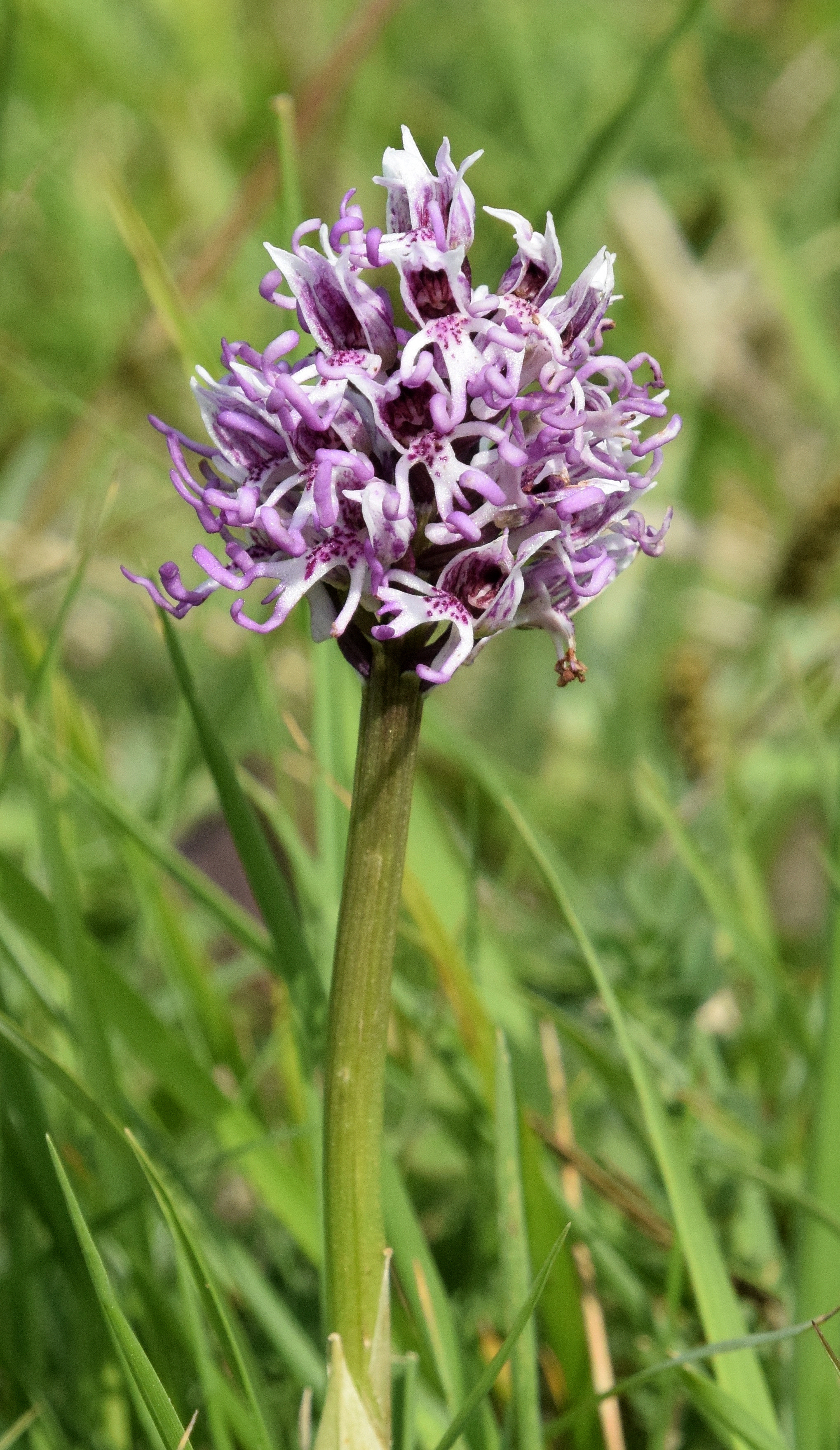
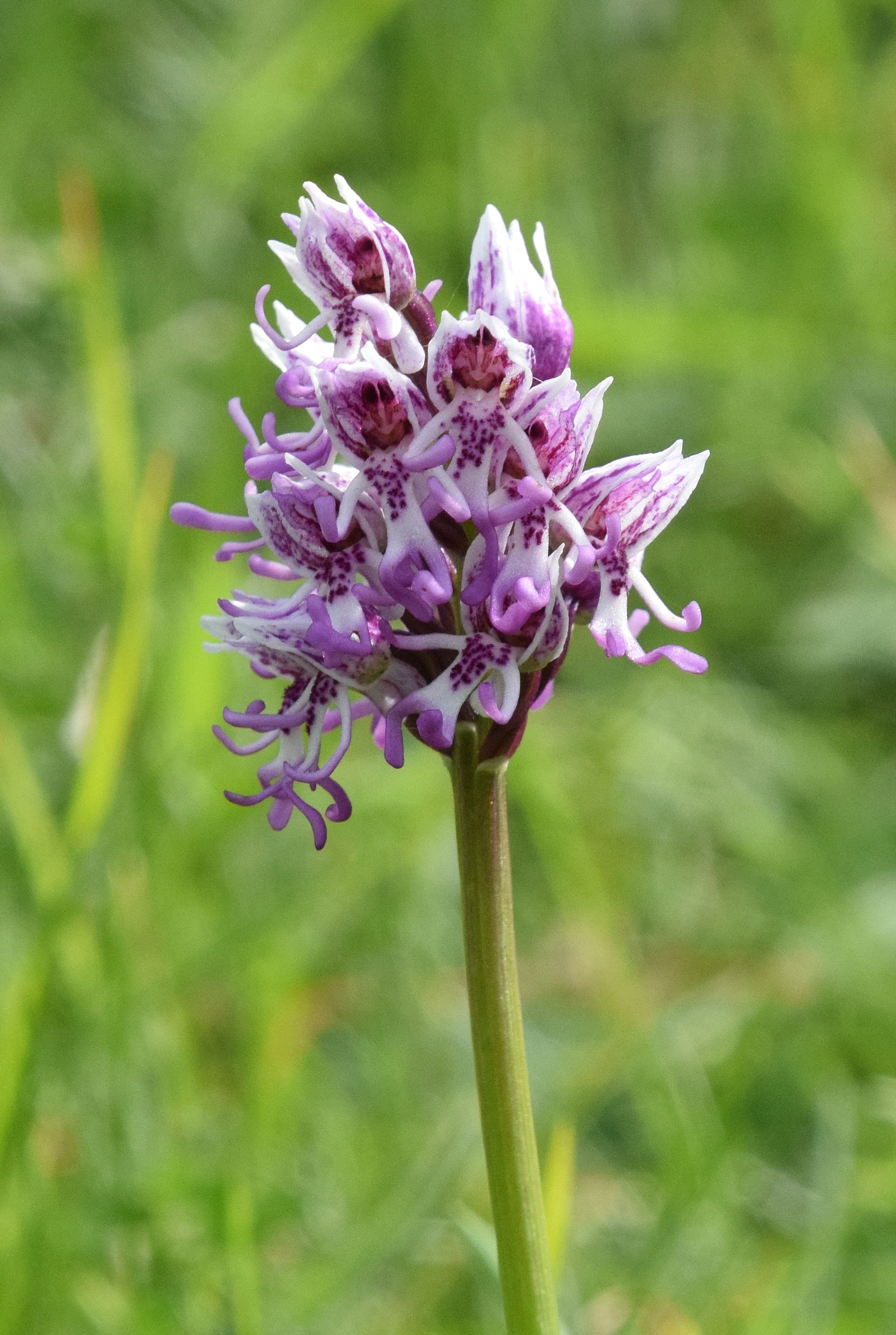
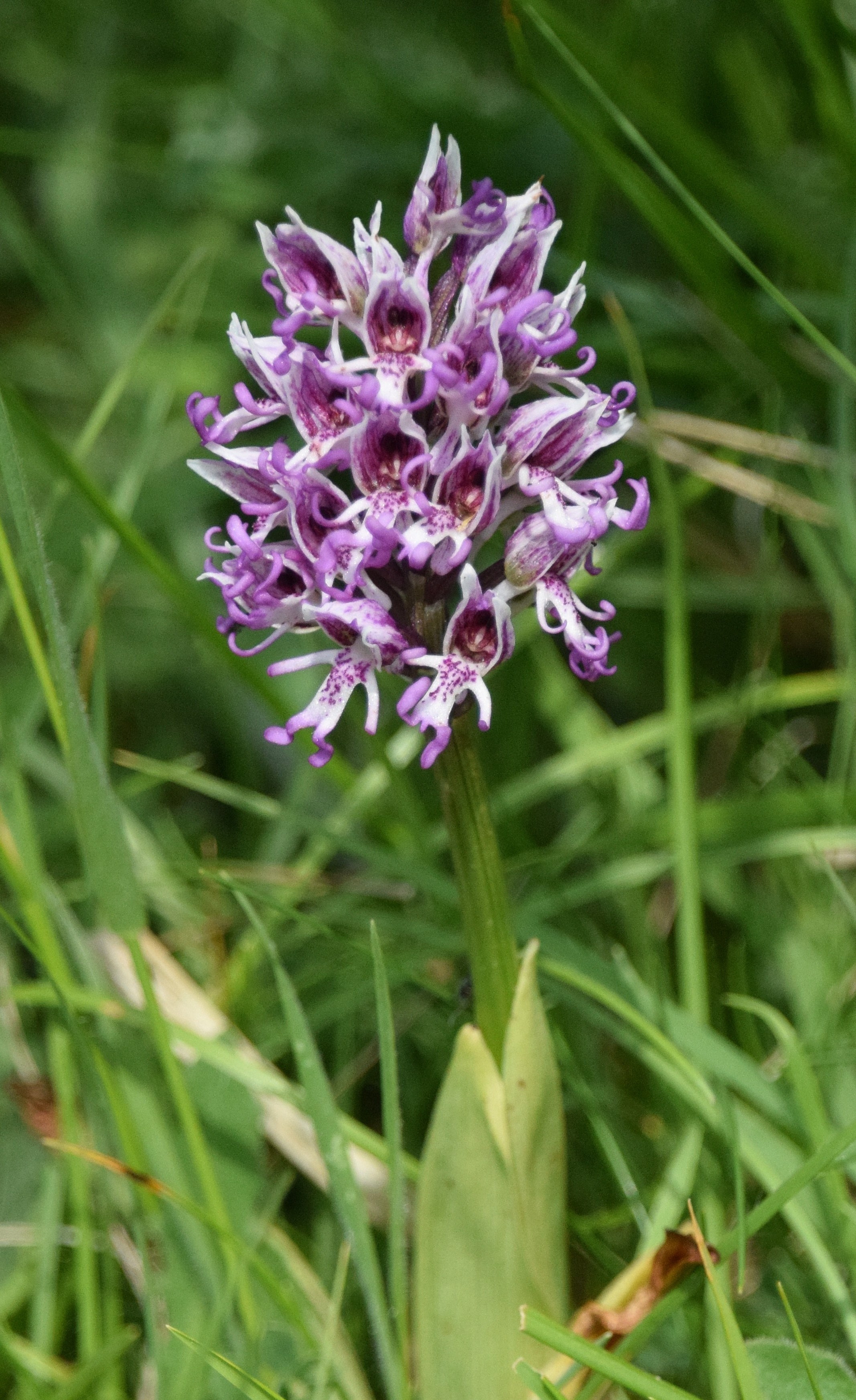
Monkey Orchids
This is a national rarity that occurs naturally in just three places in southern England, two of which are in Kent. The name comes from the pinkish-purple flowers’ resemblance to little monkeys hanging by their hands and feet. These flowers have an unusual hairy or furry appearance caused by papillae, long hair-like projections on the sepals and petals. And the particular arrangement of those mimics a monkey’s face, complete with eyes, nose and muzzle. The plant is also unique amongst British orchids in the flowers opening from the top downwards, creating a rather ragged appearance. But since the mildly vanilla-scented flowers open in quick succession, the spike is at its best for only a short time.
As with Lady Orchid, the county of Kent’s specific blend of mild climate and low-nutrient calcareous soils especially suits Monkey Orchid. But to thrive the second species also requires open but sparsely vegetated chalk and limestone grassland habitat that has become increasingly fragmented in southern England over time. At this site the Kent Wildlife Trust has long maintained those conditions through a careful grazing regime and removal of more aggressive plants, so these orchids are not crowded out as they otherwise would be. That conservation effort was founded by former KWT chair Hector Wilks, after whom this reserve is now named. The openness of the habitat was very noticeable as we walked around. Late Spider Orchid also occurs here in some seasons (see here).
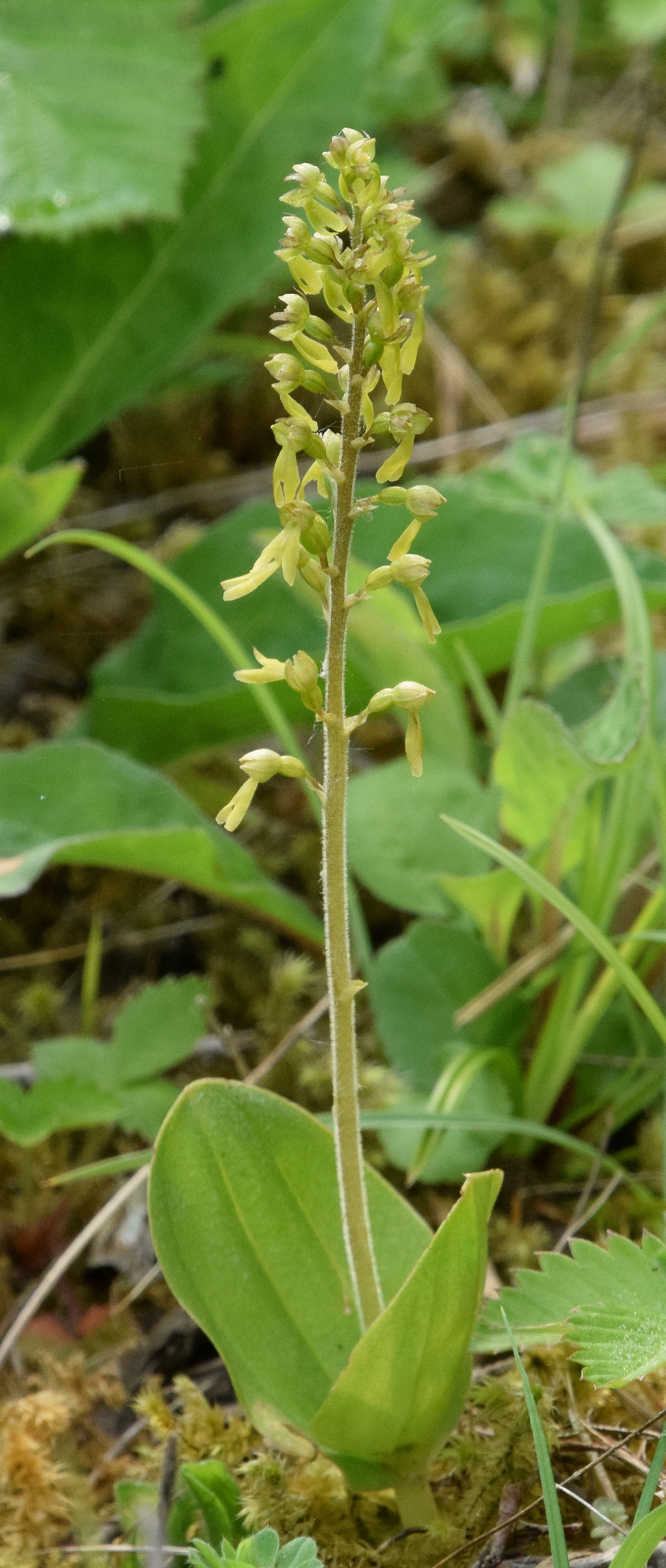
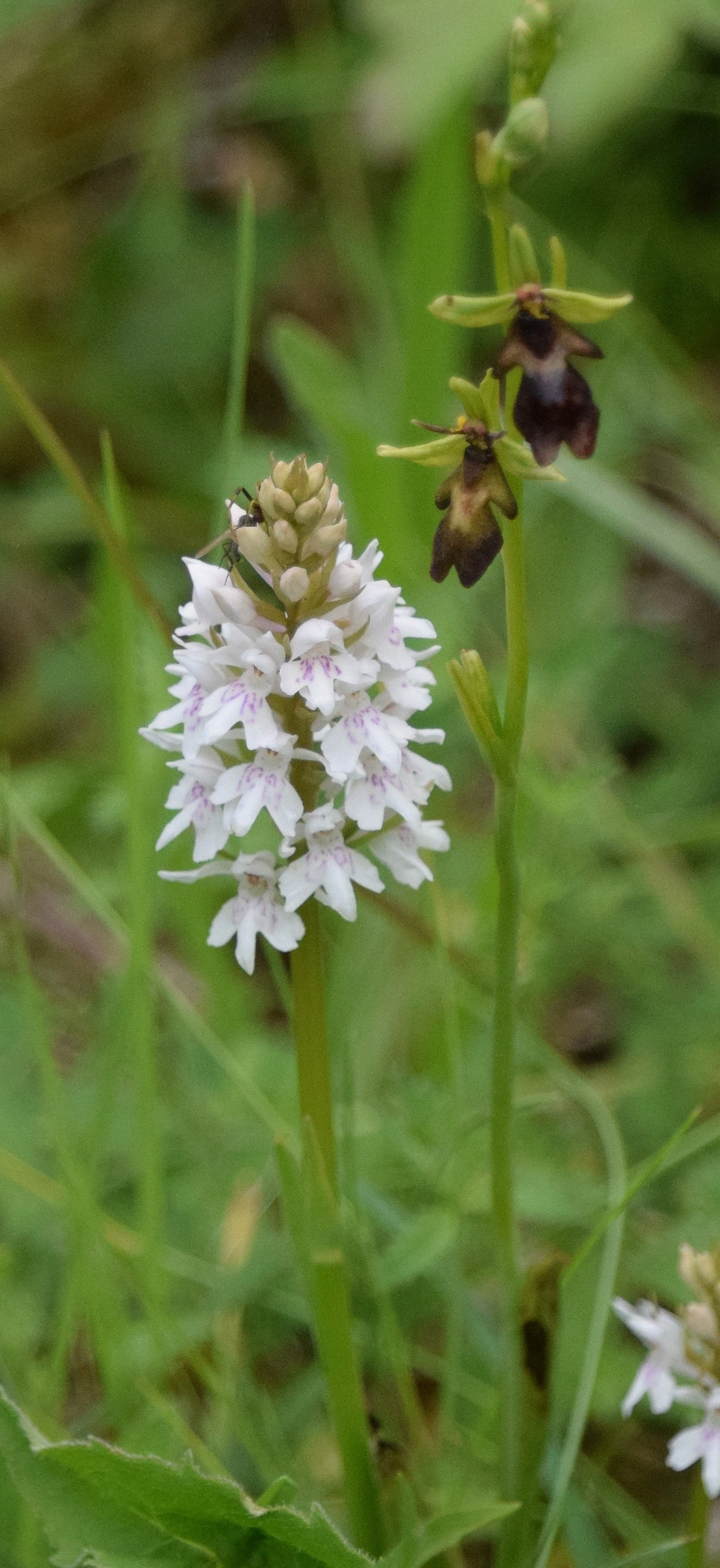
Around 25 of the 52 orchid species found in Great Britain can be located in the Kent Downs National Landscape. We observed eight other Orchids at Park Gate Down today: Common Spotted Orchid, Chalk Fragrant Orchid, Pyramidal Orchid, plentiful Common Twayblade, good numbers of Greater Butterfly Orchid, a few Fly Orchids, and single Lady and Musk Orchids. The Monkey Orchids being some way below their best this year, I will have to re-visit in a more typical season.
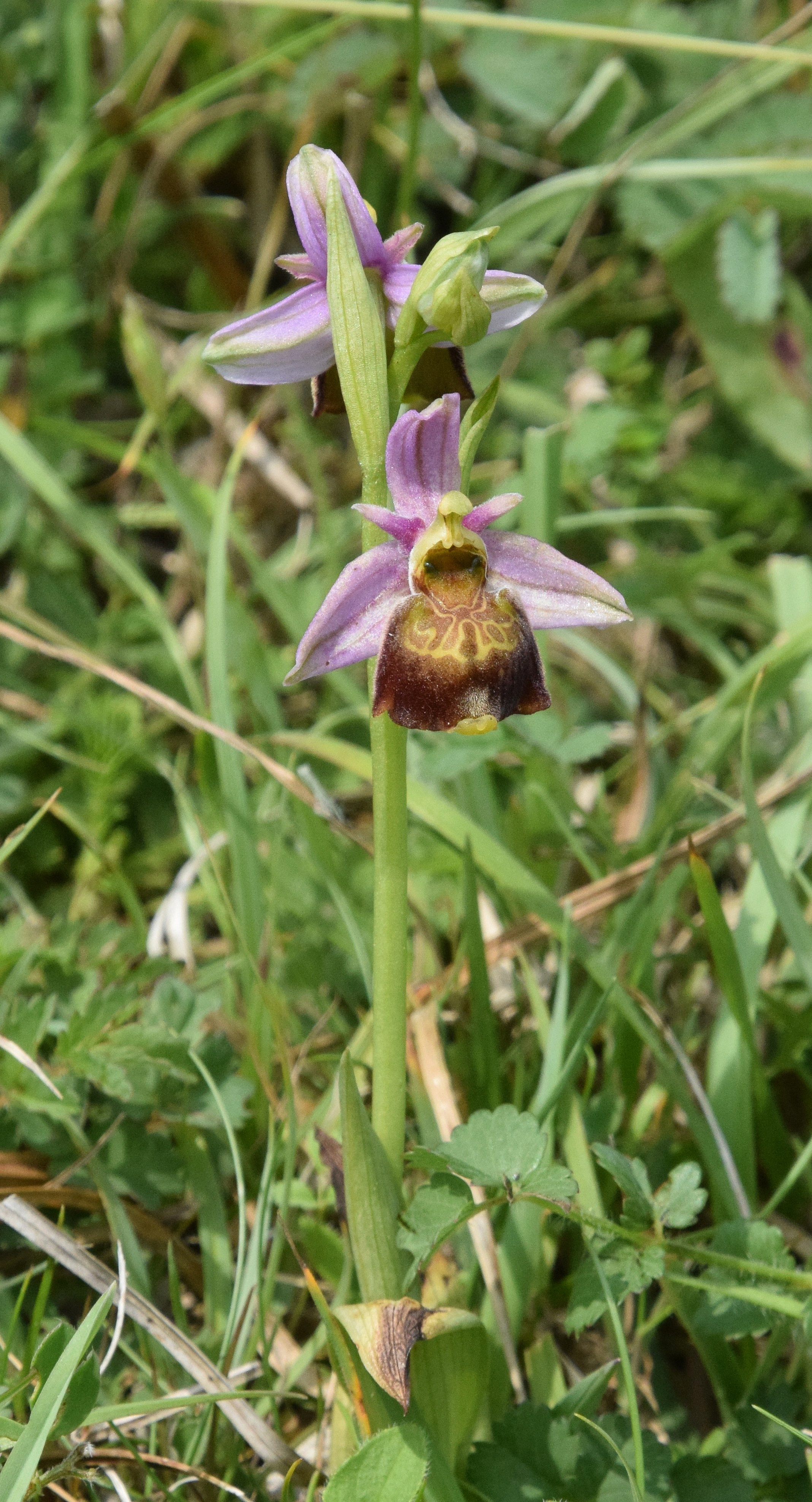
I place this post’s lead item amongst the most attractive of Orchids. But nationally I had only recorded the now lone parent plant of BBOWT Hartslock’s Lady X Monkey colony in Oxon (see here), and some in les Cévennes, France. Hence I wanted to enjoy them in greater quantity within their Kent strongholds, and so booked onto one of Mariposa’s twin Orchid tours over this weekend. What transpired in the morning here greatly exceeded my expectations.
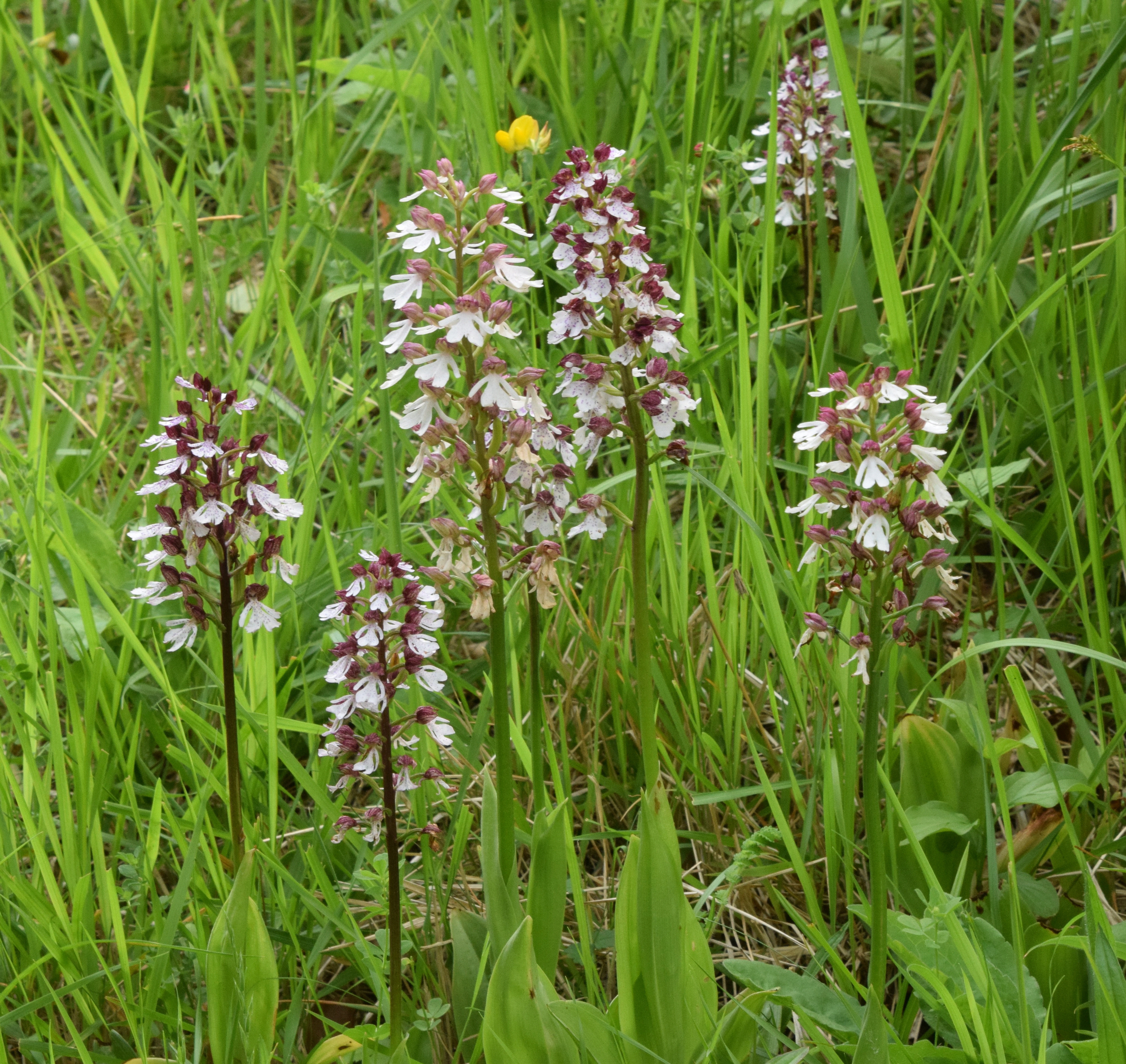
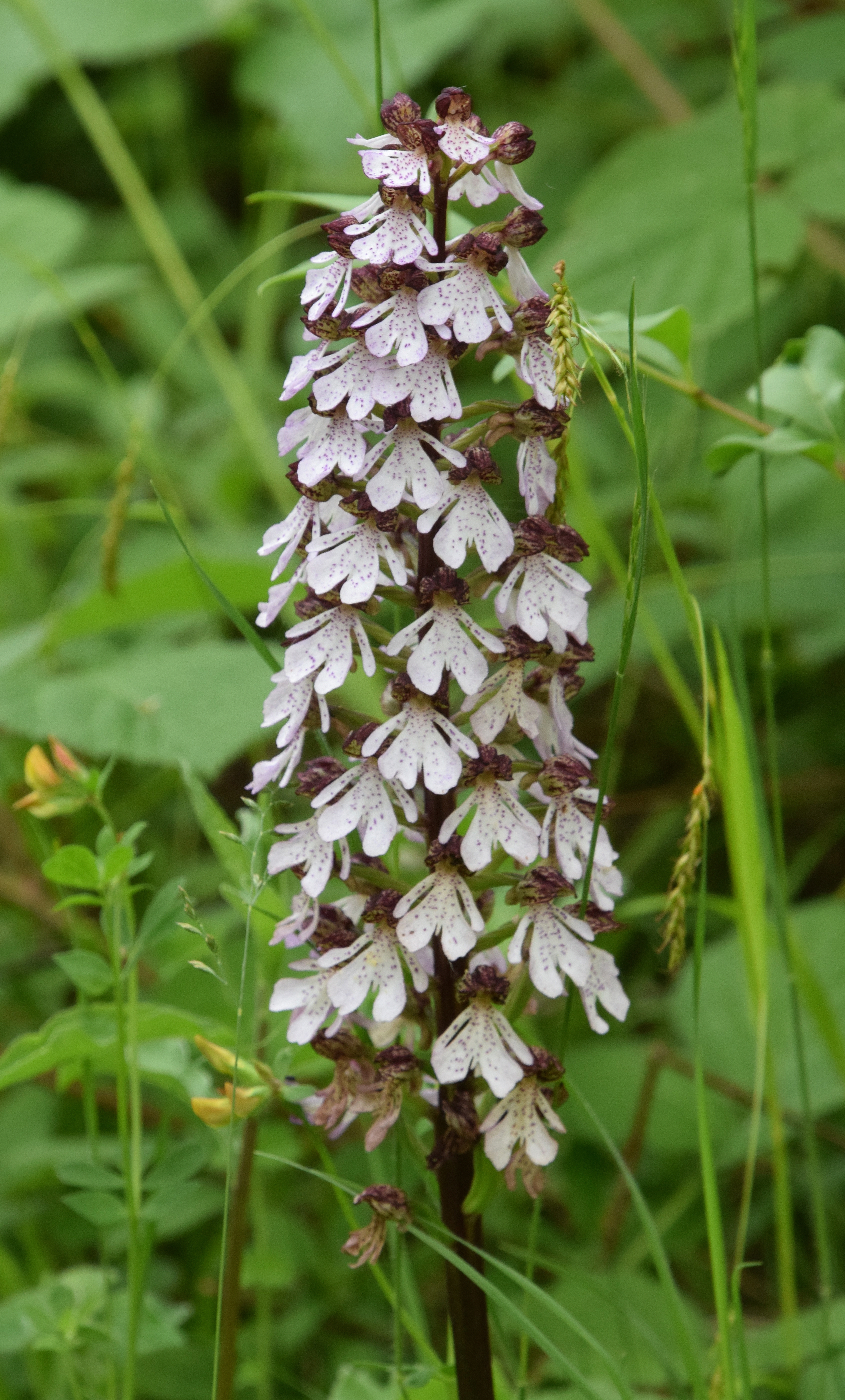
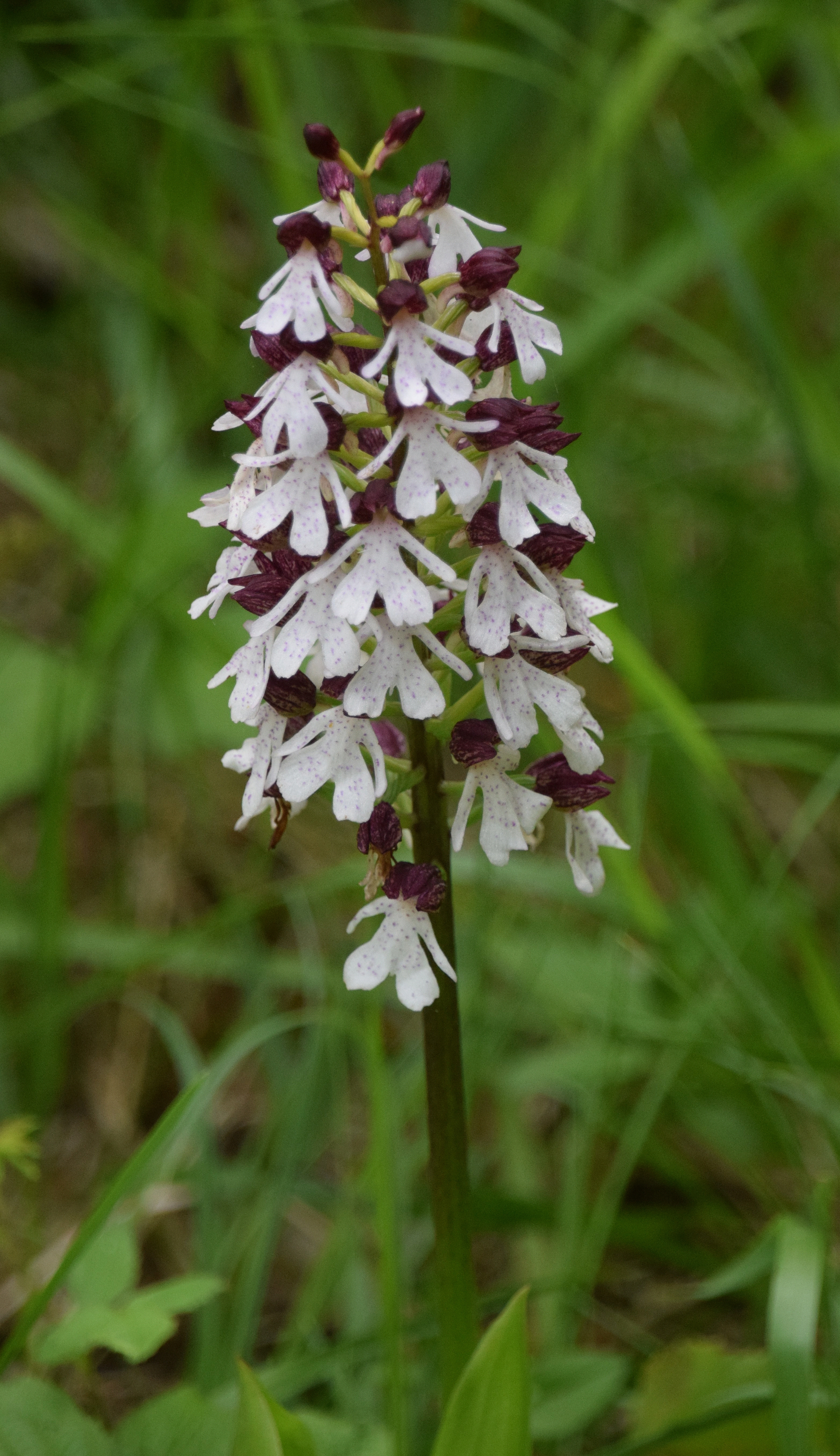
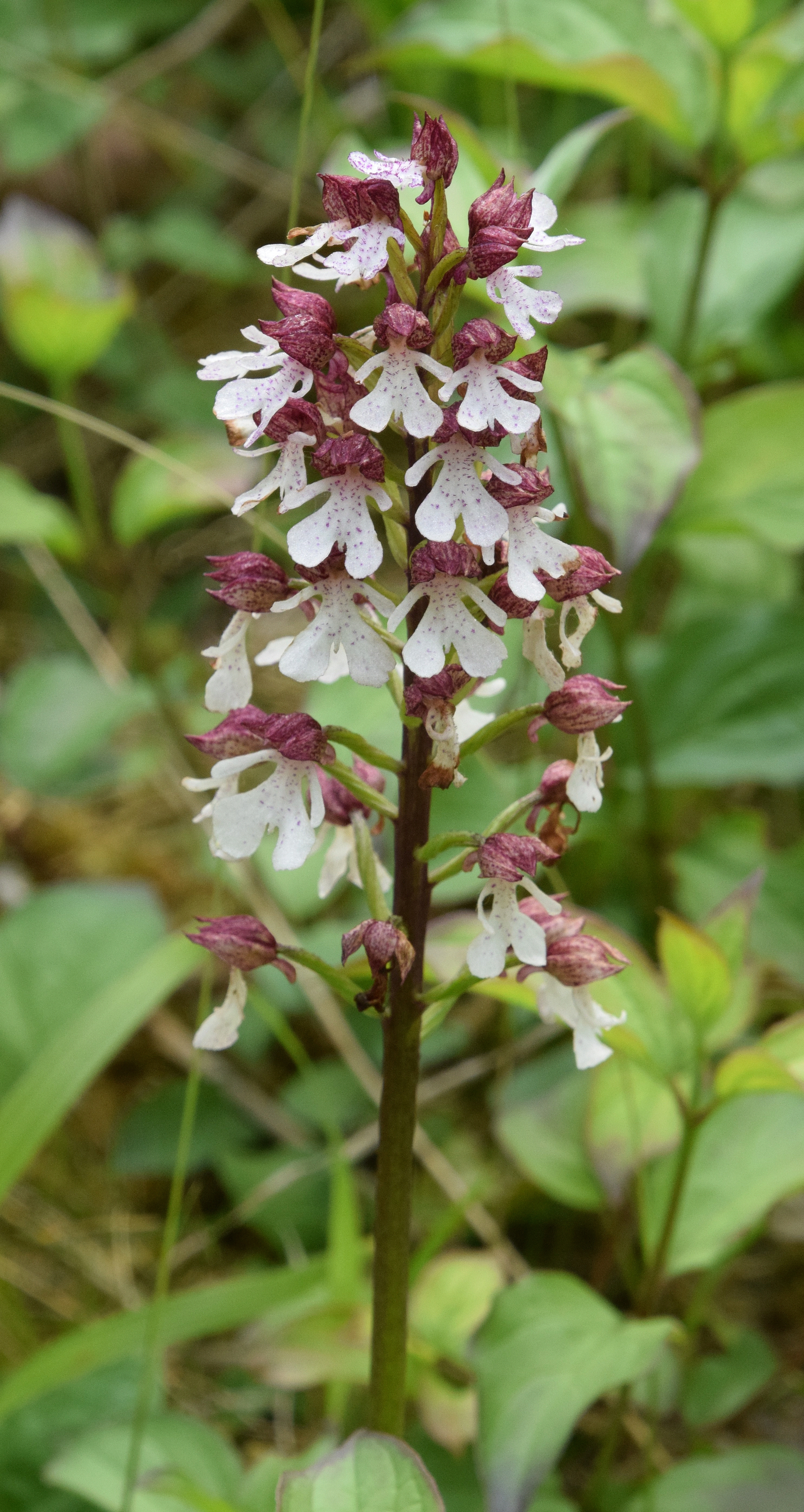
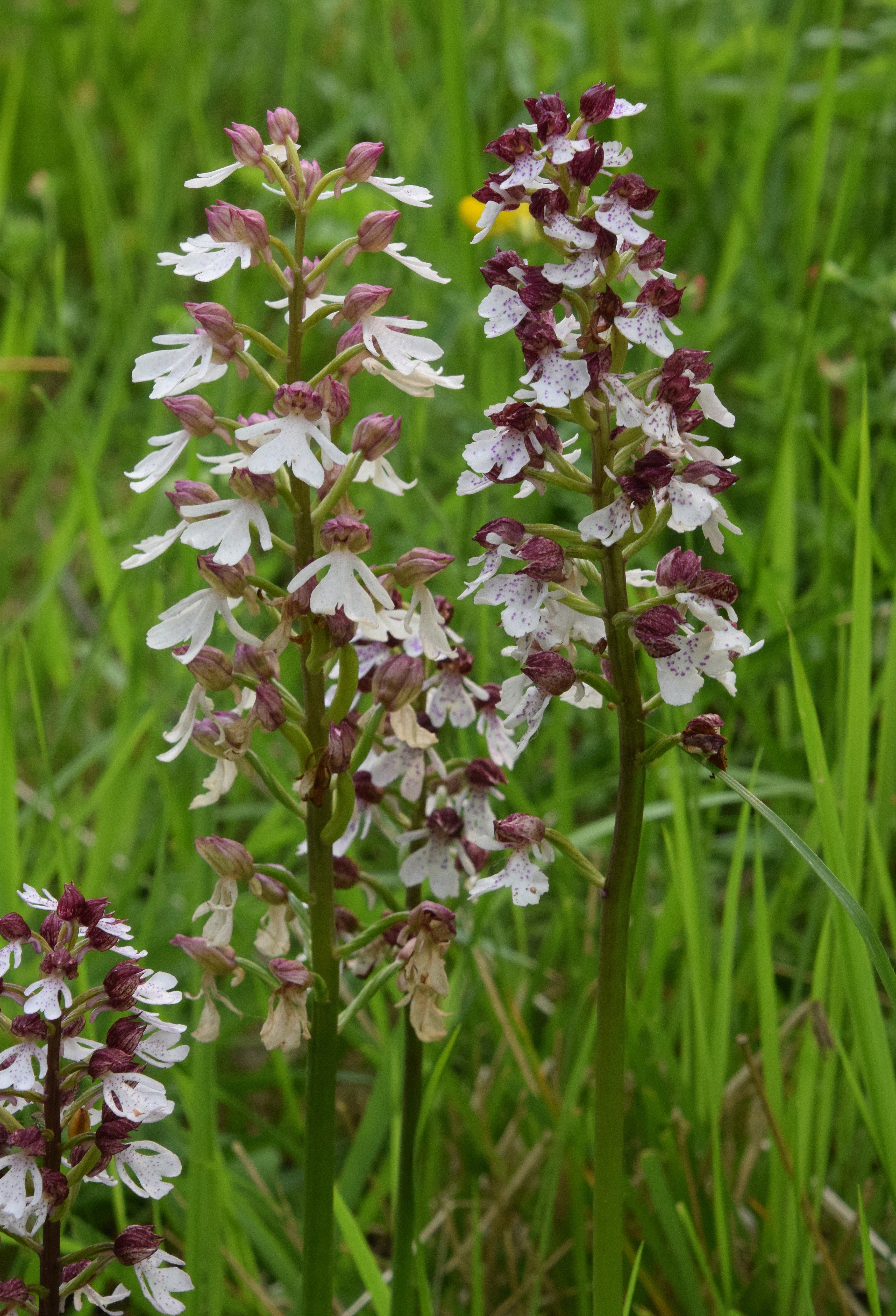
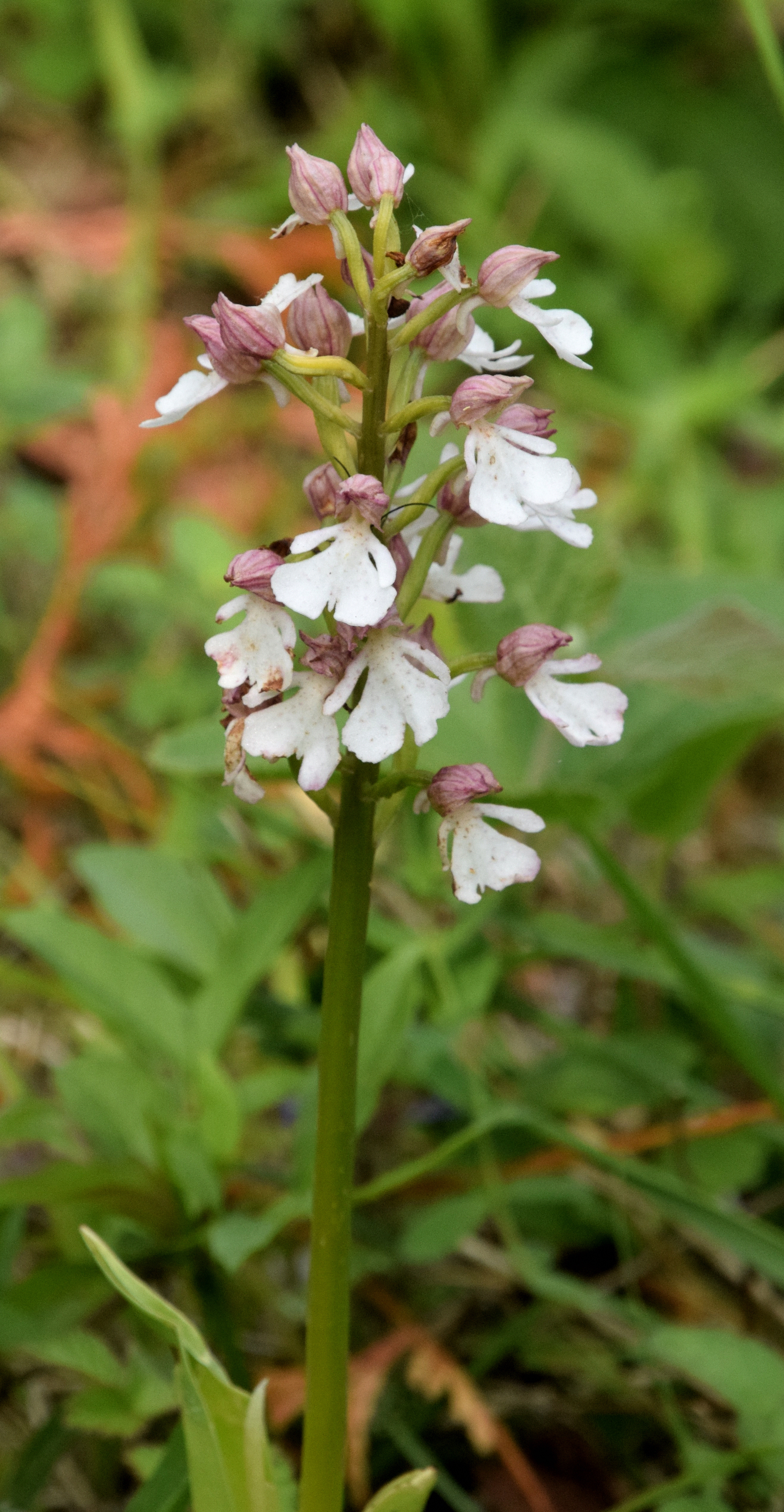
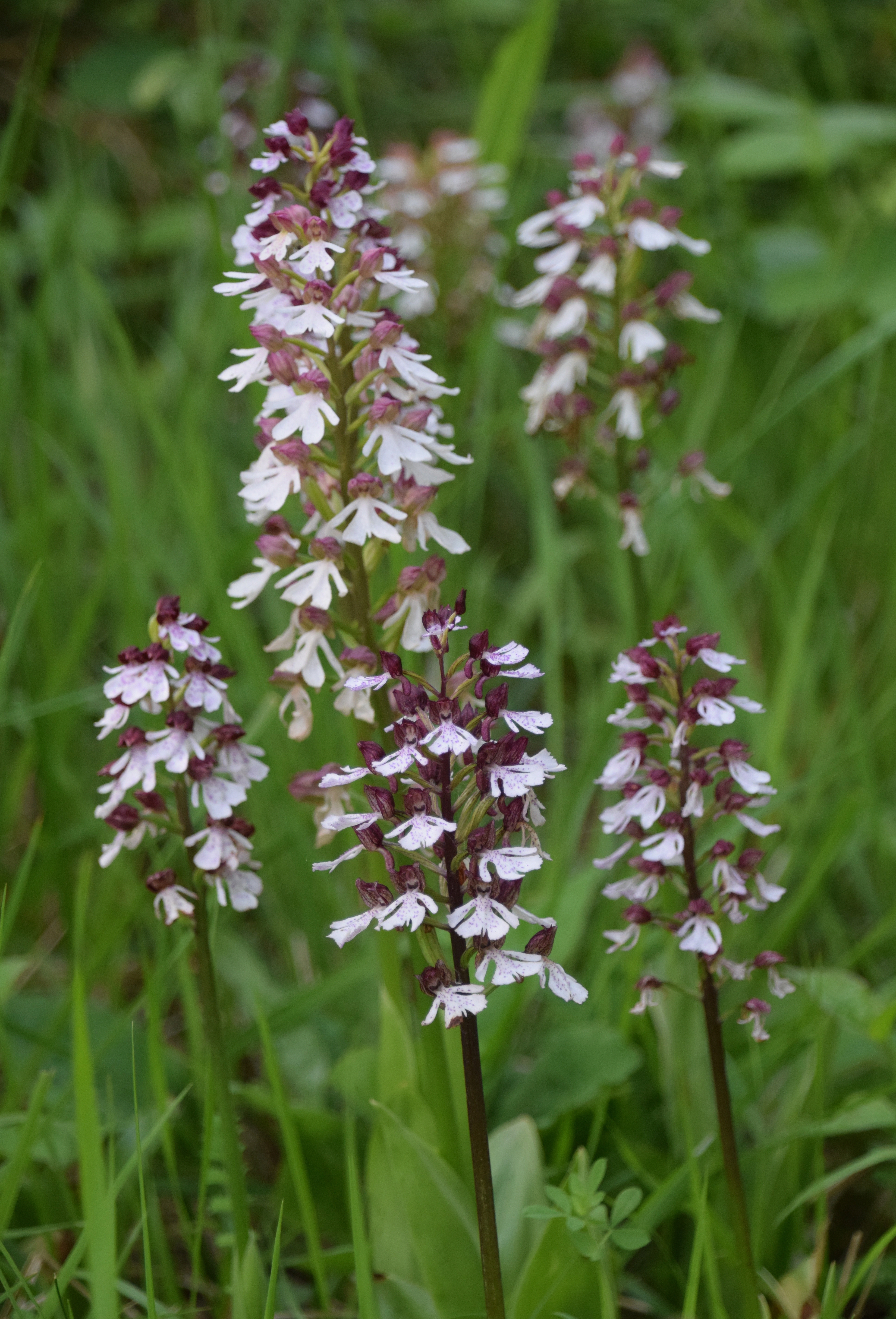
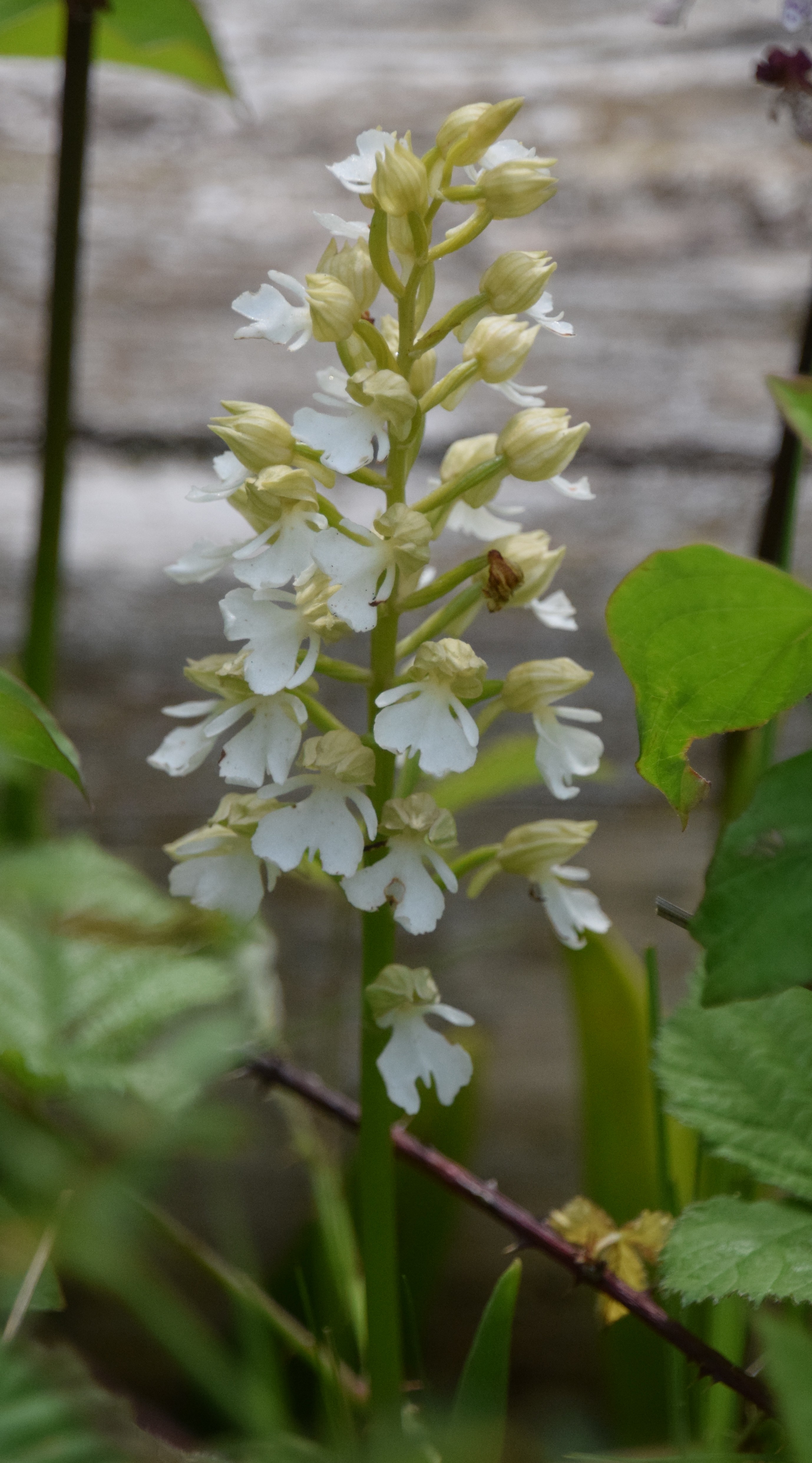
Lady Orchids
Bonsai Bank (CT4 7EZ – TR102507) is a large former chalk quarry within Denge Wood, an extensive ancient and semi-natural woodland to the south-west of Canterbury, owned by Forestry England and managed by the Woodland Trust. It is so-named because conifers planted in the past have not grown as normal and so are all rather stunted. Double-figured species of Orchid abound here, amongst which and most prominent are thousands of my sought Lady Orchid. Our guides, Jon Dunn and Richard Bate, said those have never looked better than in this dry and often difficult season in so many other places. The almost two hours spent on site were without doubt the best part of this day.
This spectacular site’s most eye-catching resident, the stately Lady Orchid is so named because the up to 50 flowers per stem suggest figures wearing a bonnet and gown. The most frequent colour form is deep red (pictured above), but I was captivated here by the different variations (below). The top prize today was a white and yellow form, var alba (bottom right).
Lady Orchid is nationally scarce, no longer surviving in around 60 per cent of its historic range due to changes in woodland management, particularly lack of coppicing. This is because the plant prefers well-lit but sheltered areas along paths and rides, in open woodland on calcareous soils. Kent’s geological and climatic blend, in conjunction with sympathetic habitat management, suits them perfectly. Bonsai Bank offers a prime example of these conditions.
Well-drained, chalky soils low in nutrients, which prevents root rot and reduces competition from more aggressive plants,
Relatively warm and dry climate, that creates favourable conditions for blooming and germination,
Traditional woodland coppicing that creates dappled light and open areas, without exposing the plants to scorching sun,
Undisturbed, stable ground that maintains the orchids symbiotic relationship with specific ectomycorrhizal fungi. This refers to mutually beneficial associations between fungi and the root systems of particular plants from which they draw nutrients. In return the mushrooms contribute to their hosts’ growth and survival in various ways.
Greater Butterfly Orchids
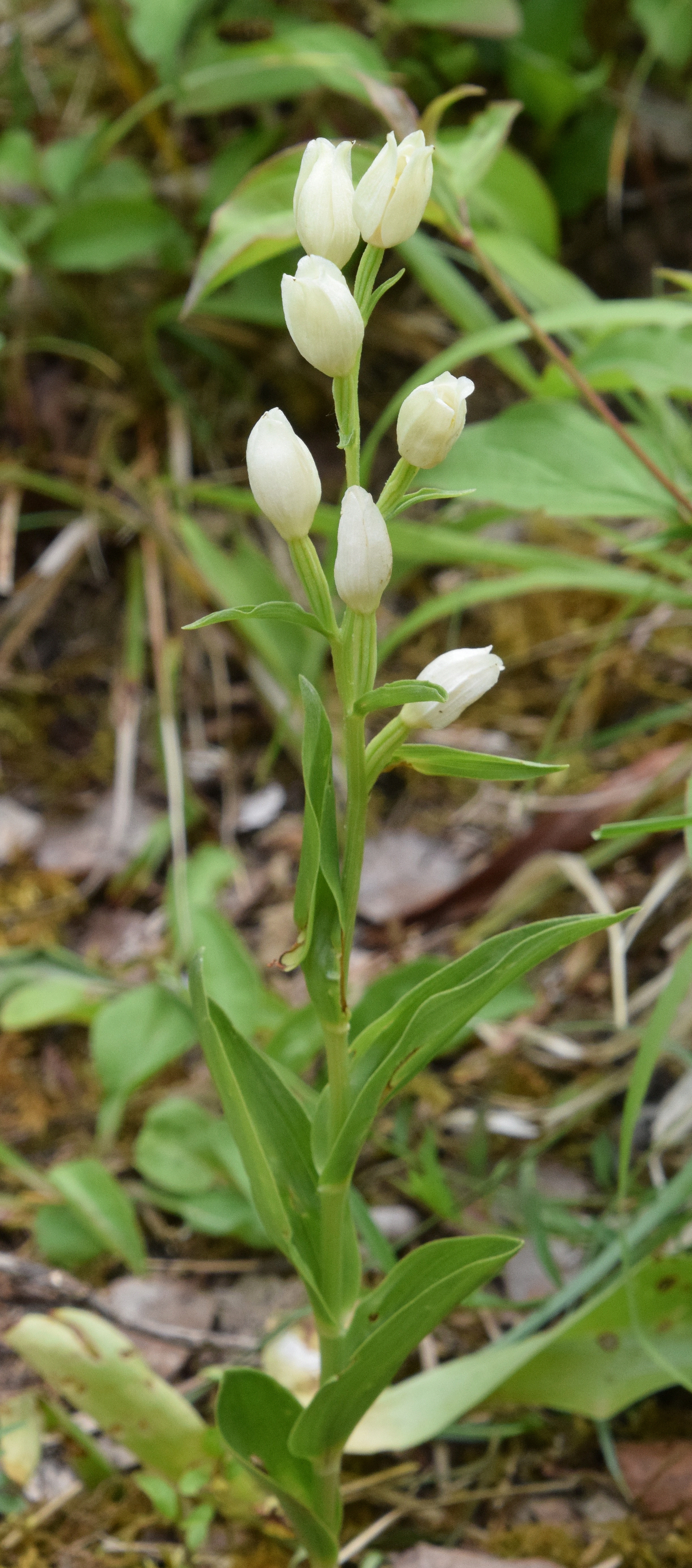
In all we recorded seven other Orchid species flowering here today. In the above sequences these are in the top row (from left) Fly Orchid, Common Twayblade that were particularly profuse, White Helleborine and Common Spotted Orchid. Chalk Fragrant and fading Early Purple Orchids were also present. There were good numbers of Greater Butterfly Orchids (second row) along the rides mixed in with the Ladies, amongst which was an attractive aberration (right hand picture). Jon Dunn described Bonsai Bank as one of his favourite of all Orchid locations, and after this magical experience I can sincerely endorse his sentiment.


























 Ramblings and Scribblings