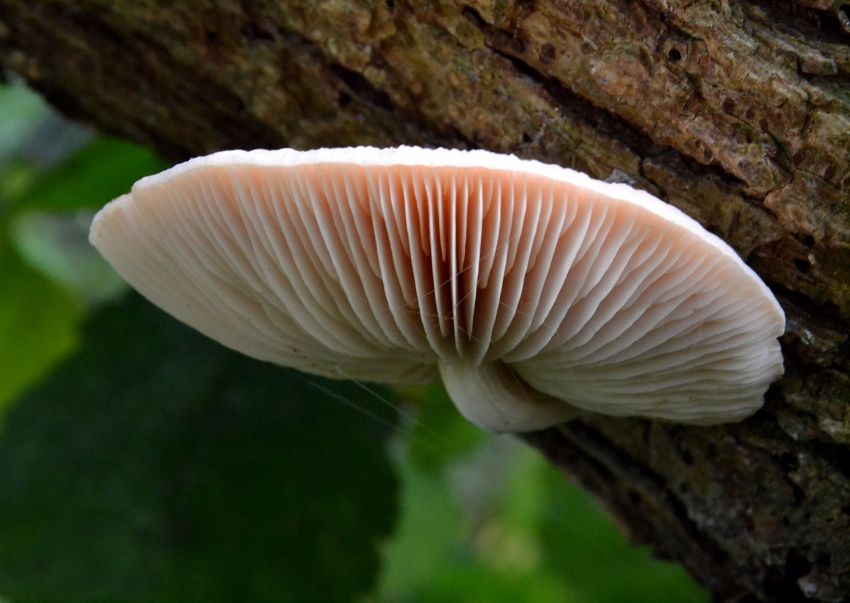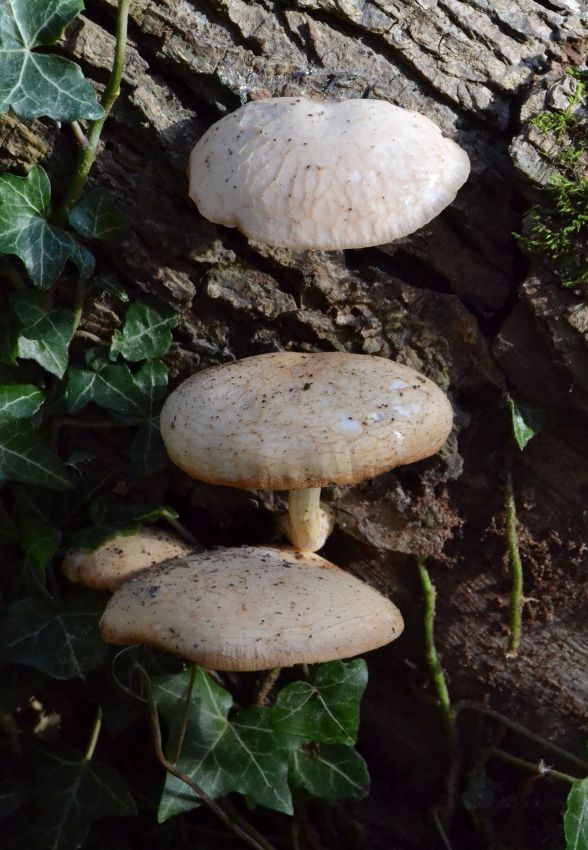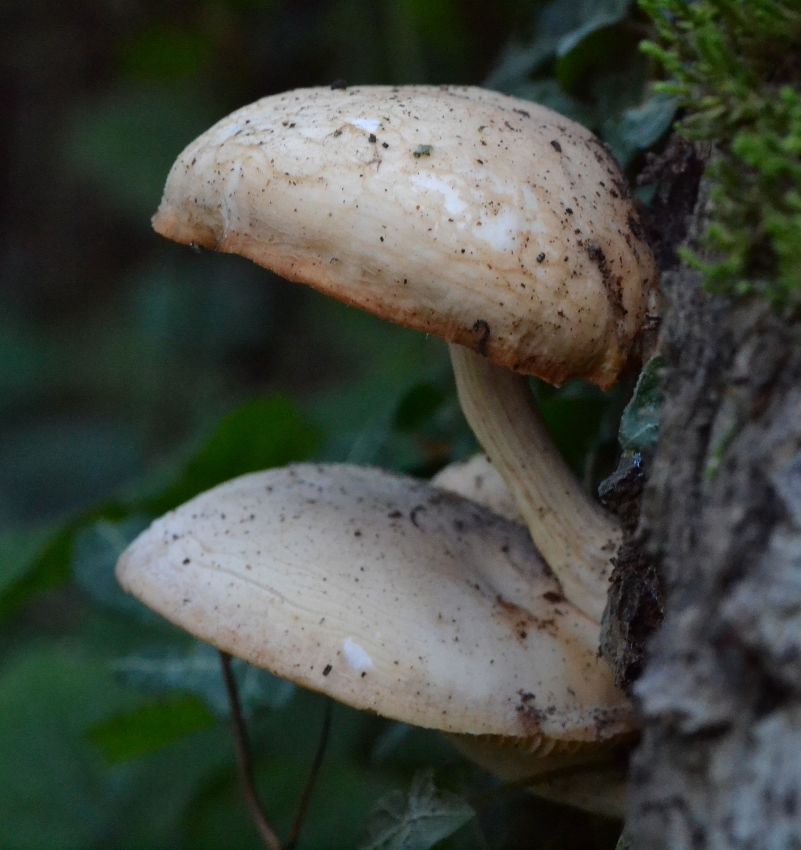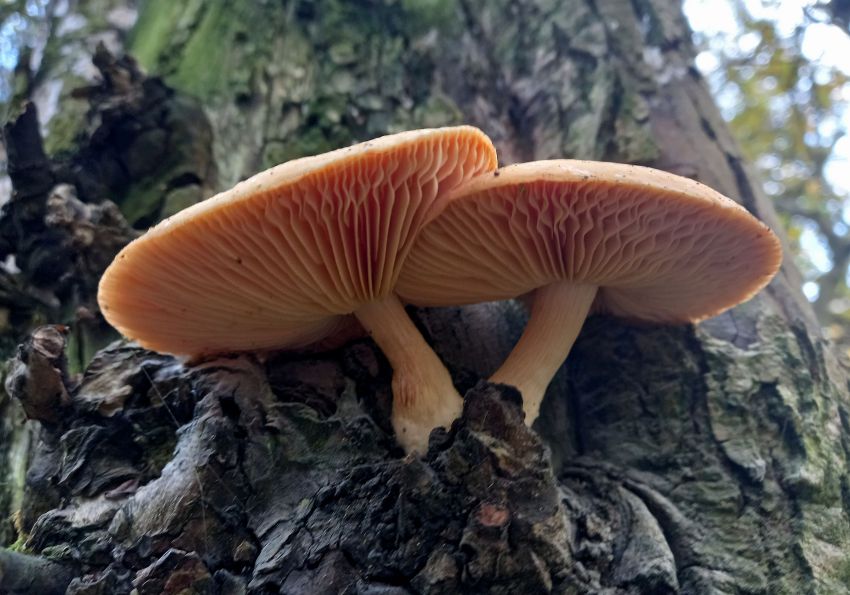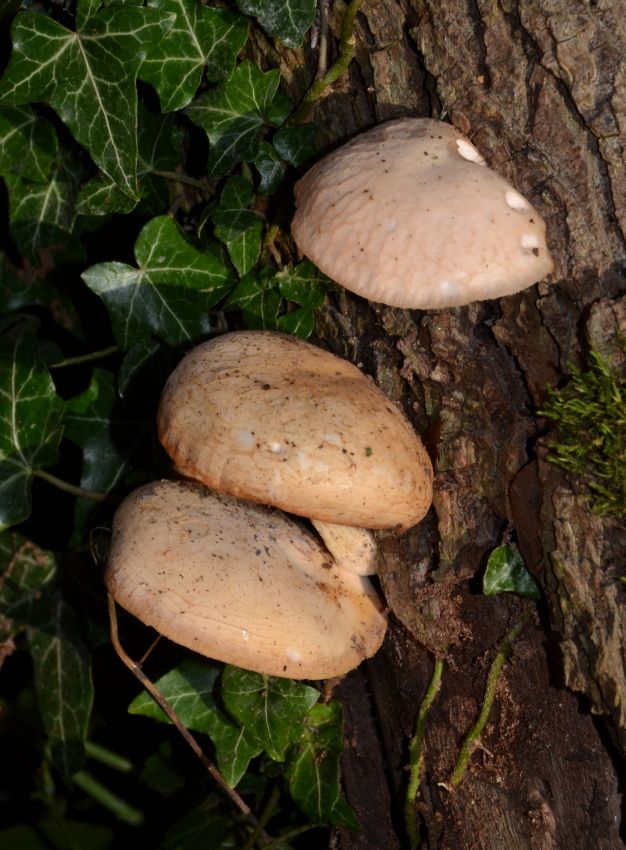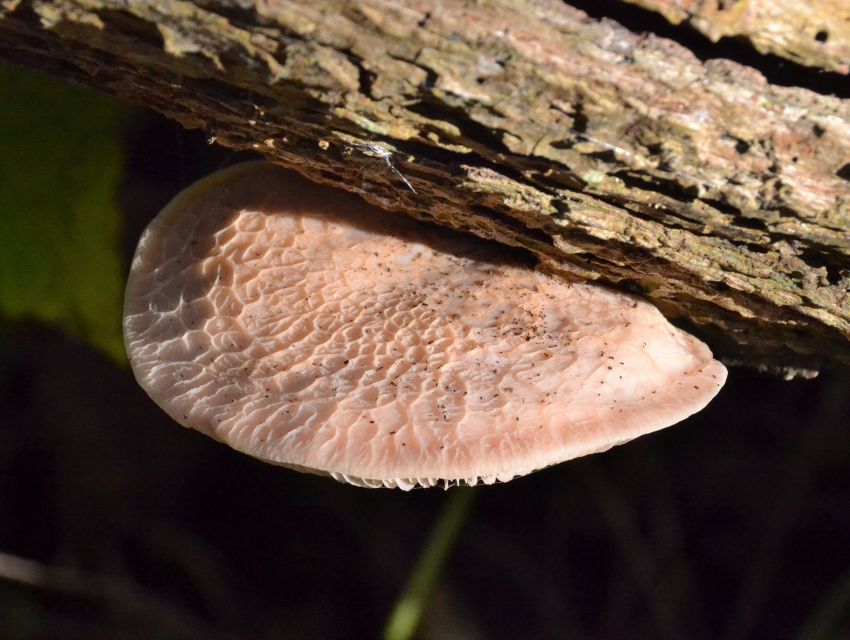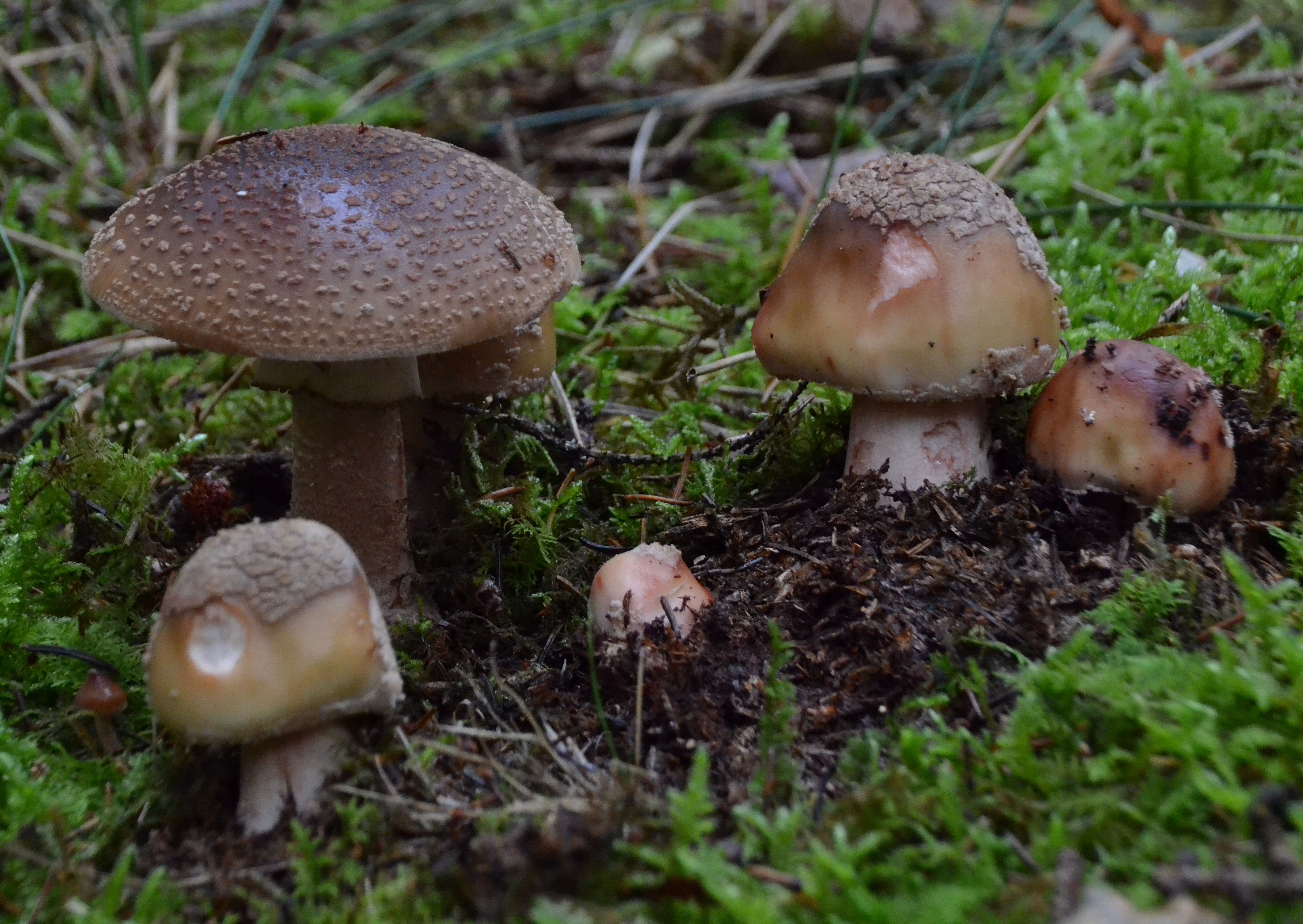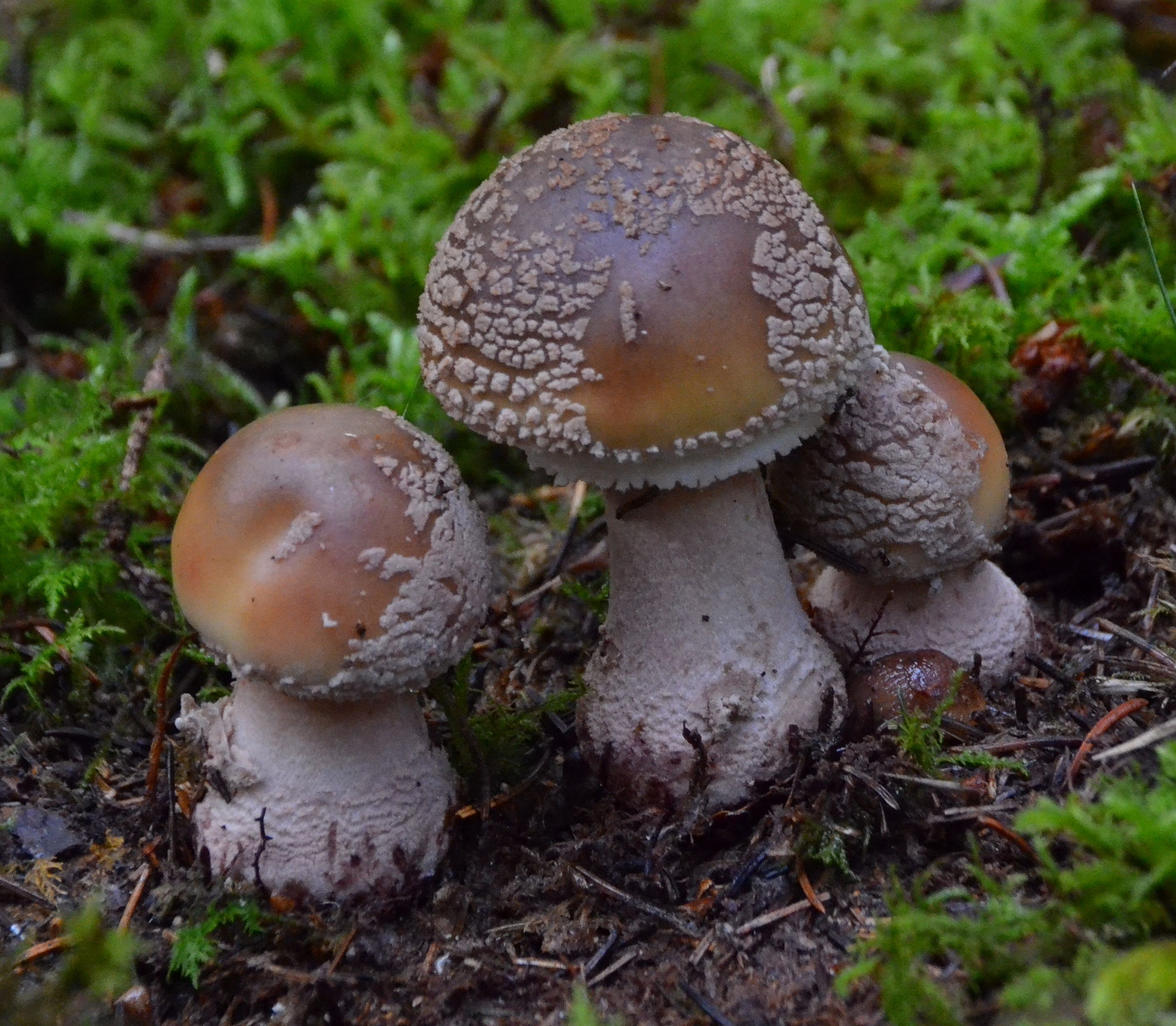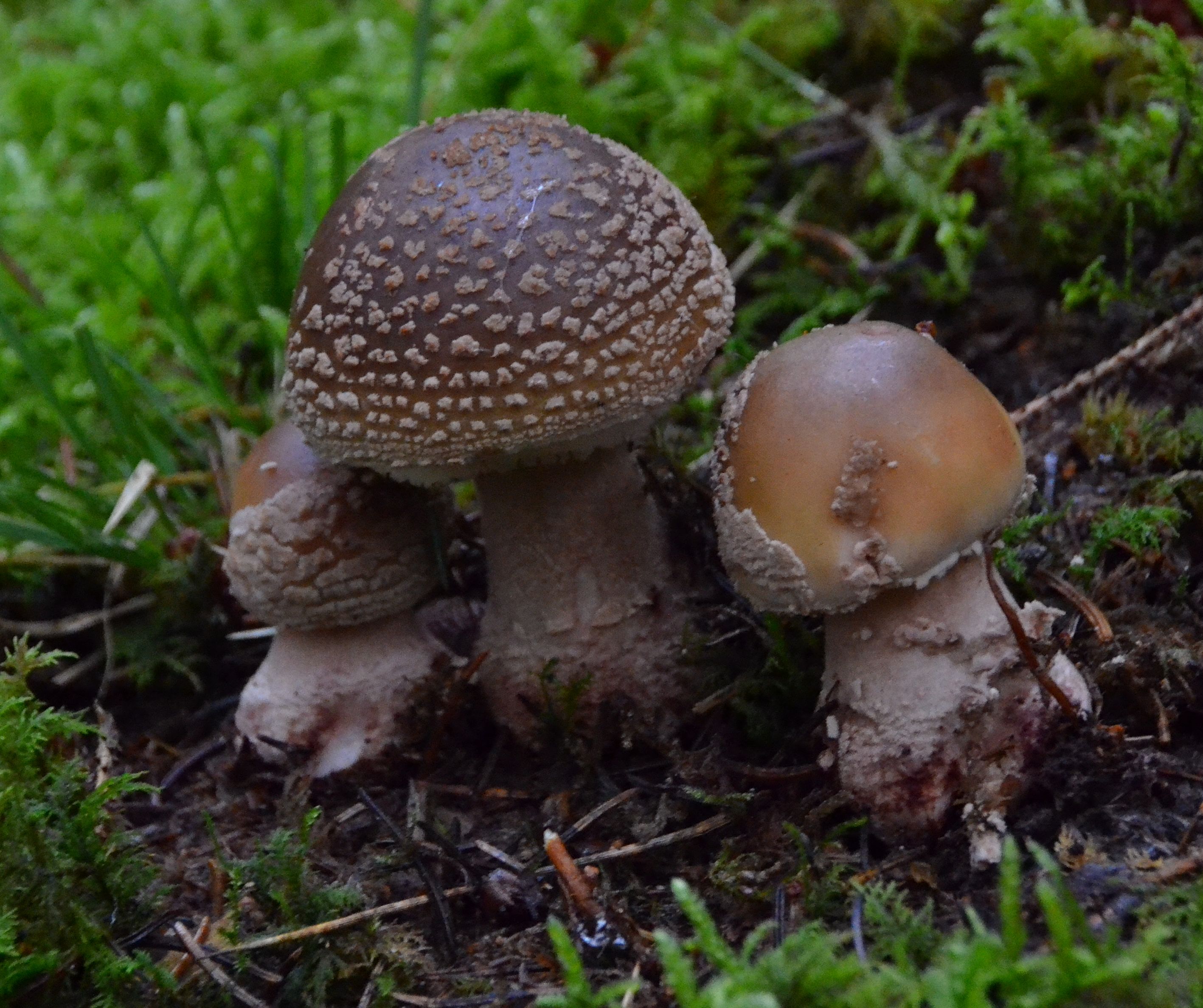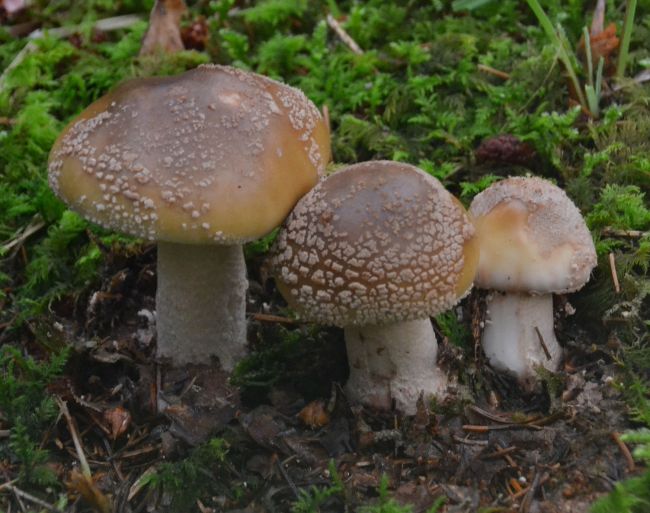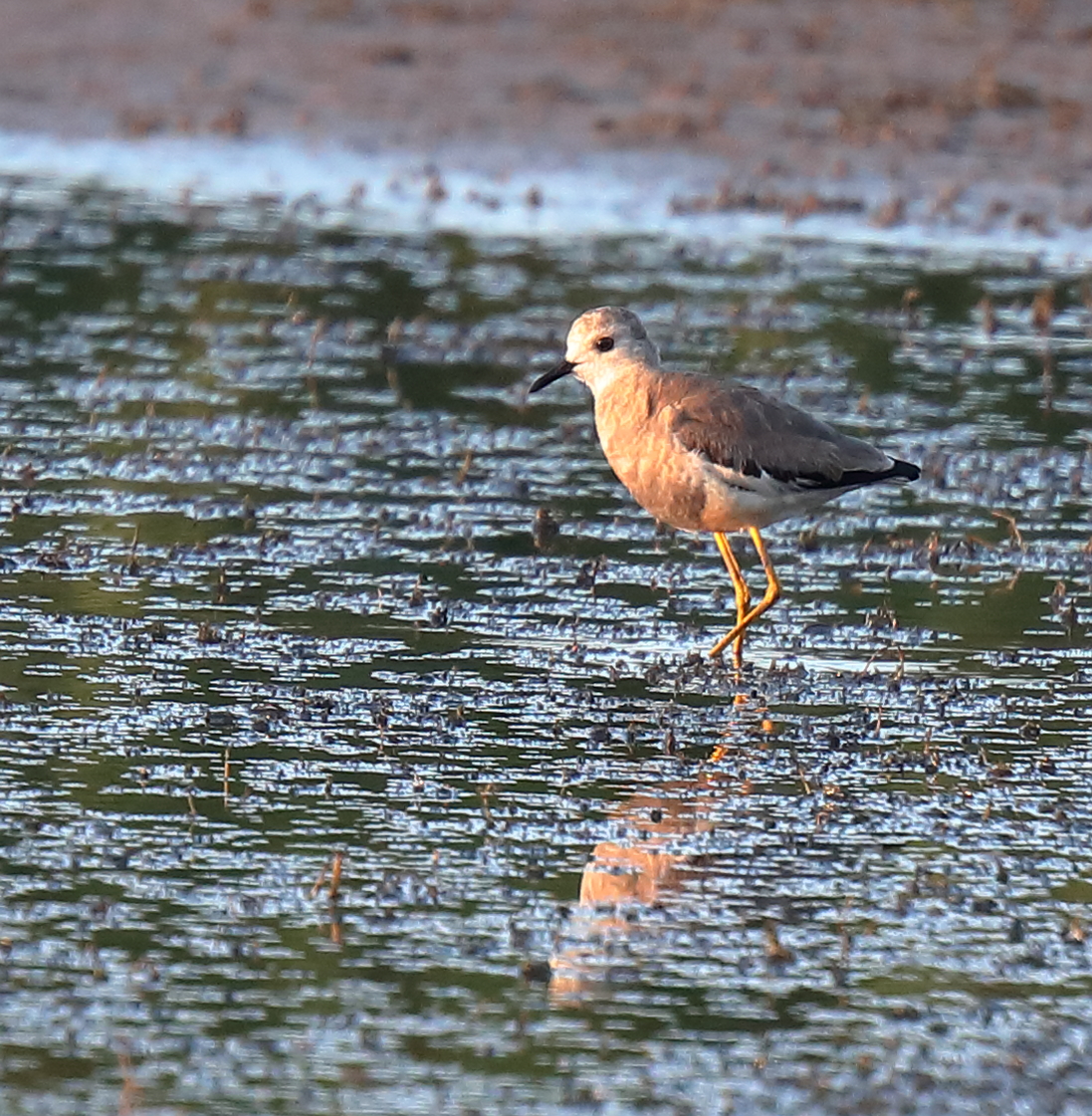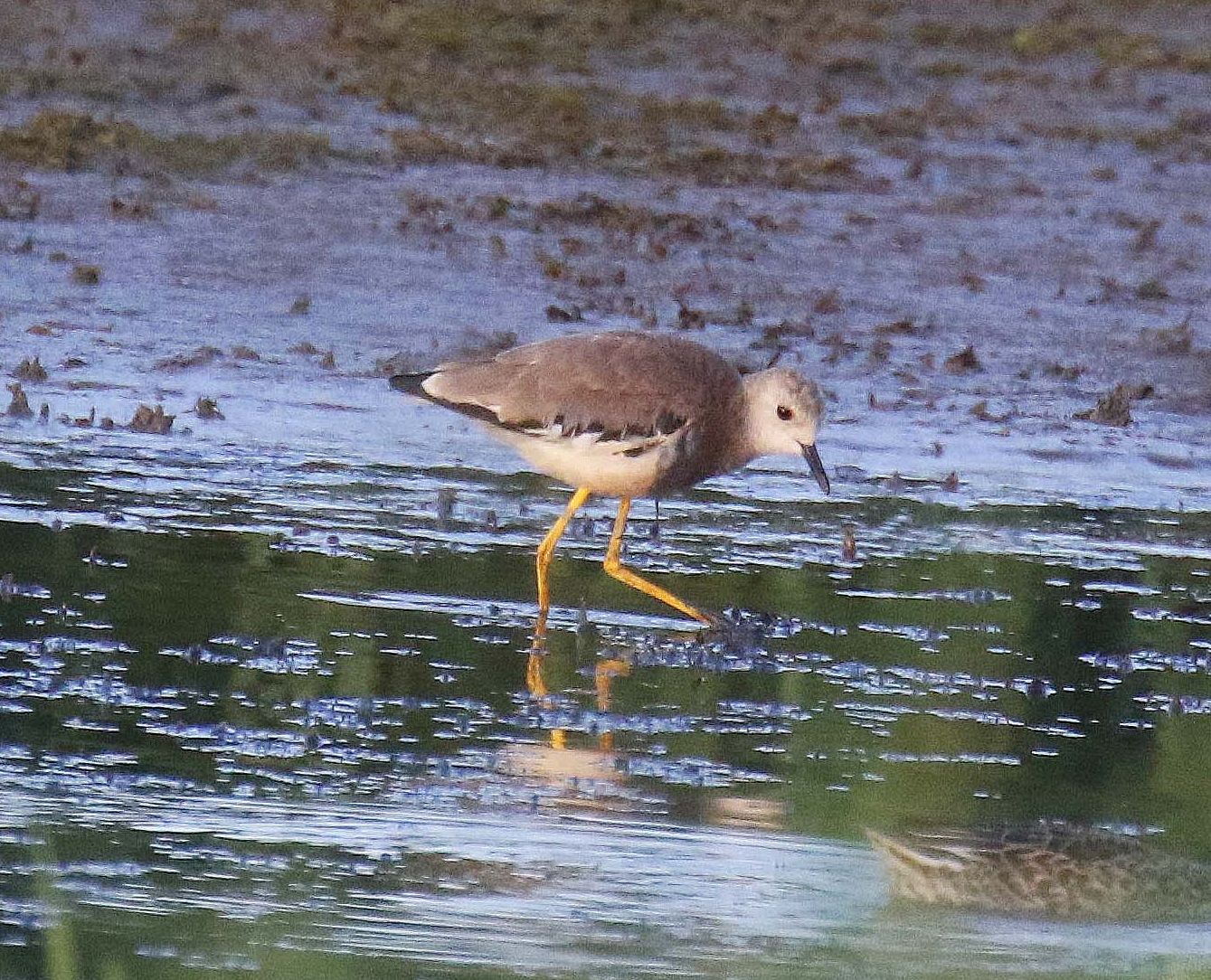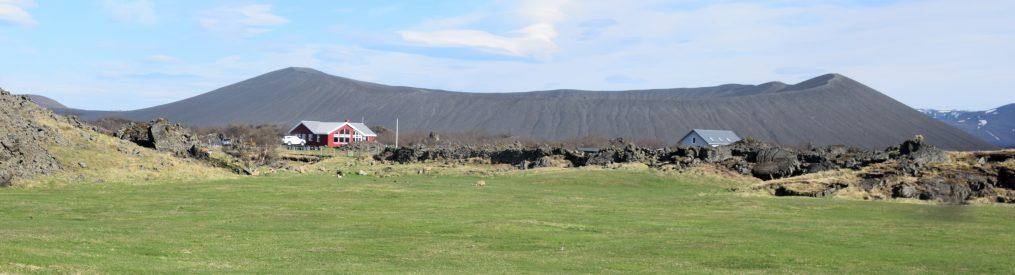
Comparing Panther Cap and Grey Spotted Amanita with The Blusher at Highmoor Common, Oxon – 10th Nov

Continuing with the Amanita theme of this journal’s autumn fungi content, The Blusher of the previous post has a number of quite similar, commonly occurring relatives of which we located two today. For foragers some care is required in distinguishing between the group, since those featured herein are not exactly good to eat, and for myself comparing all three has provided a further valuable mycology lesson.

Panther Caps

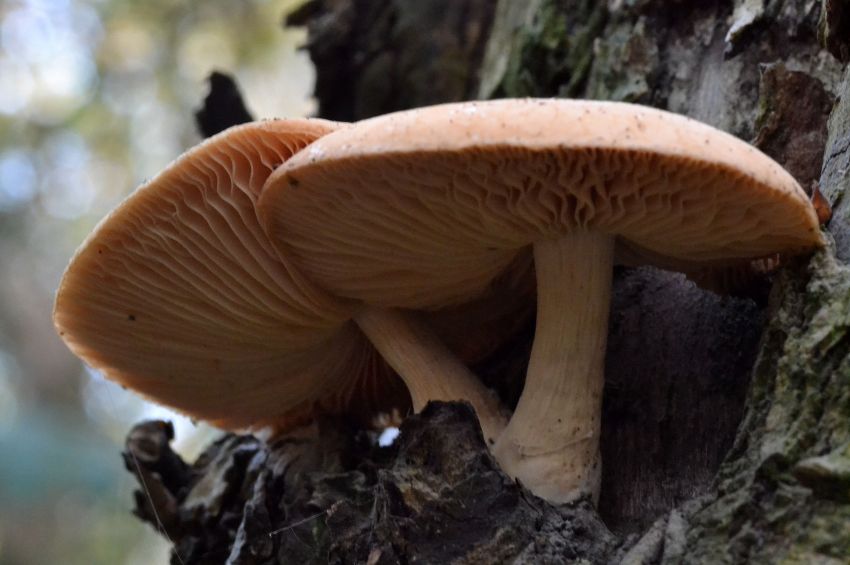
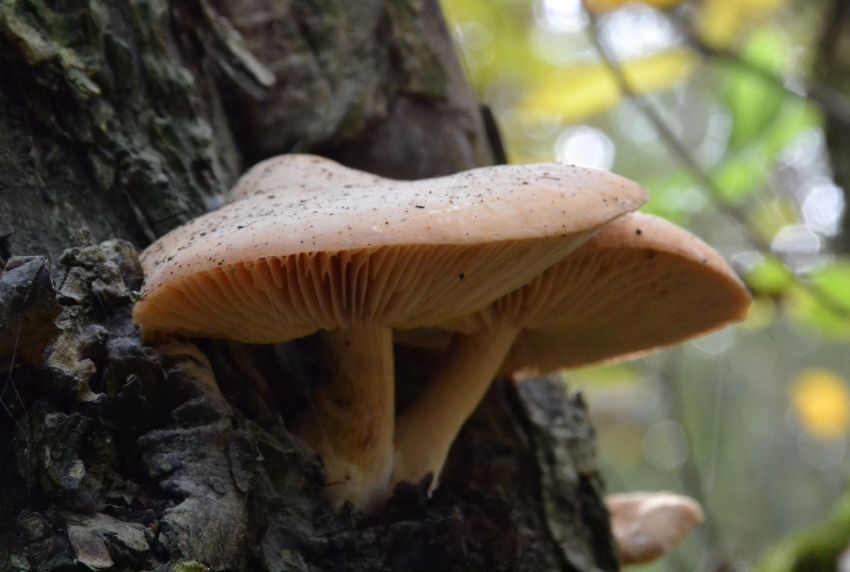
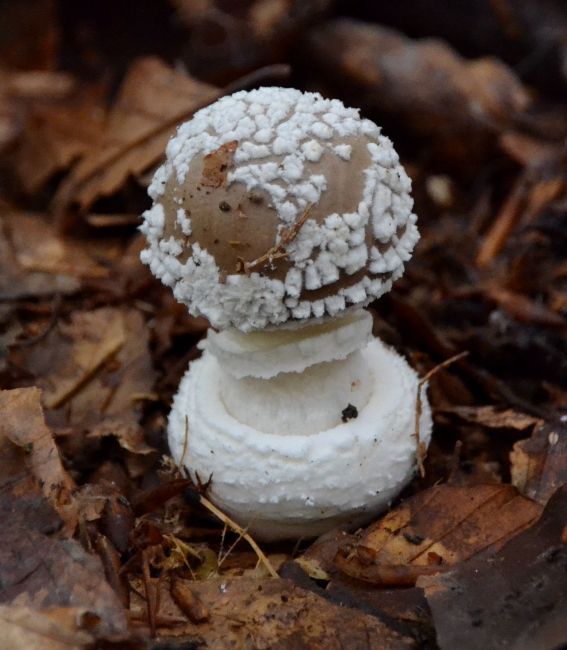
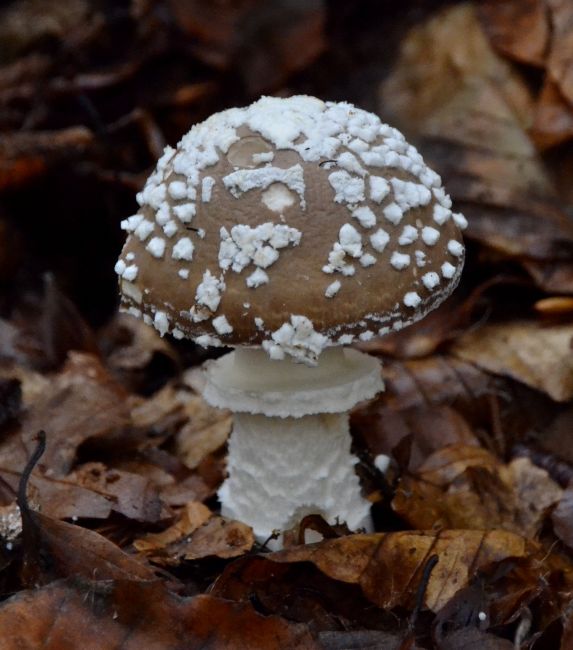
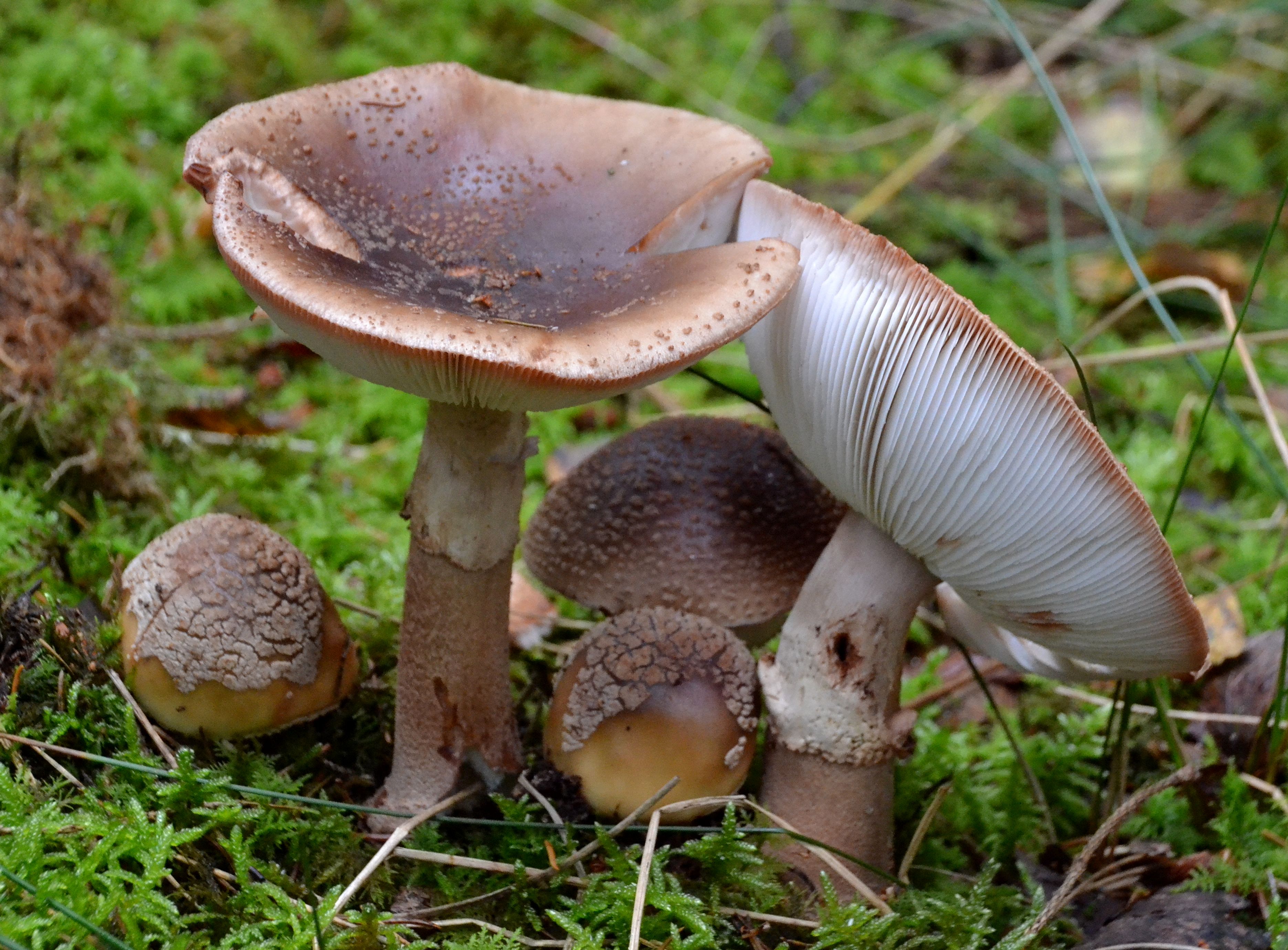
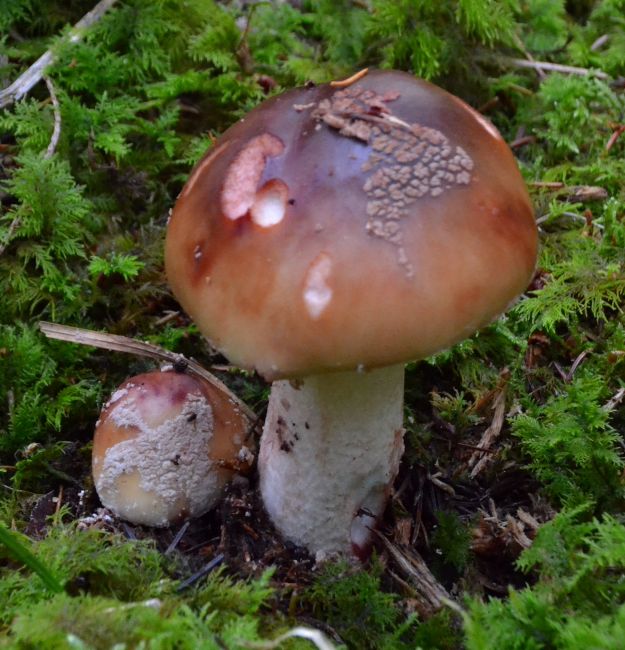
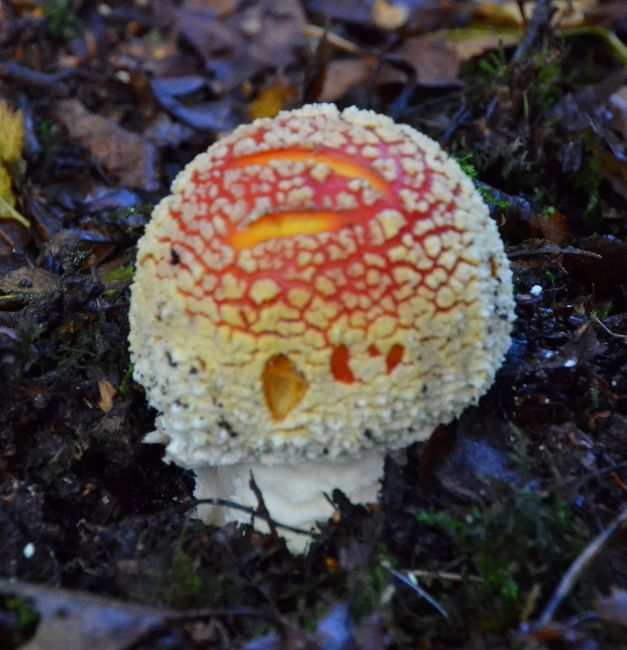
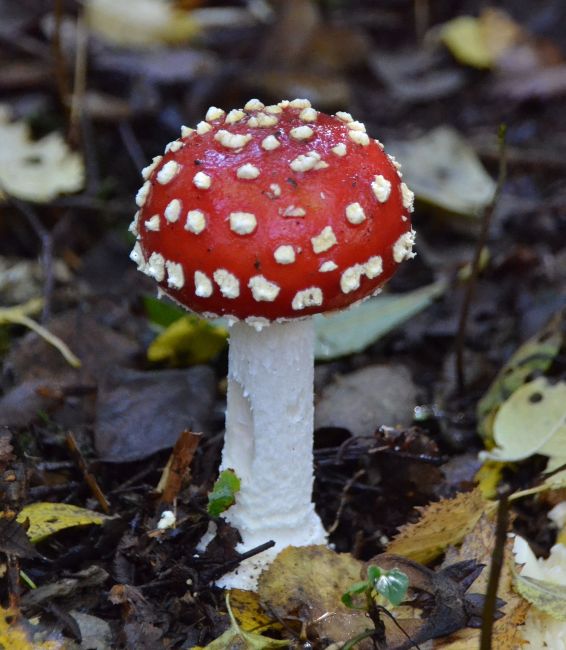
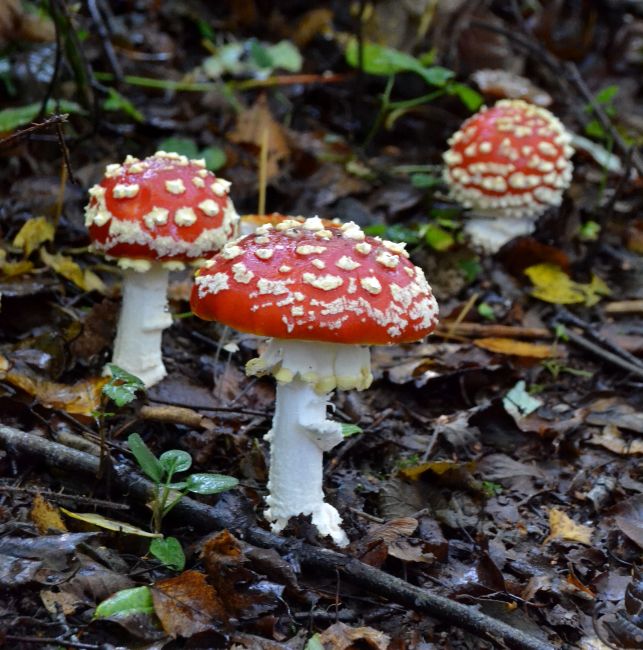
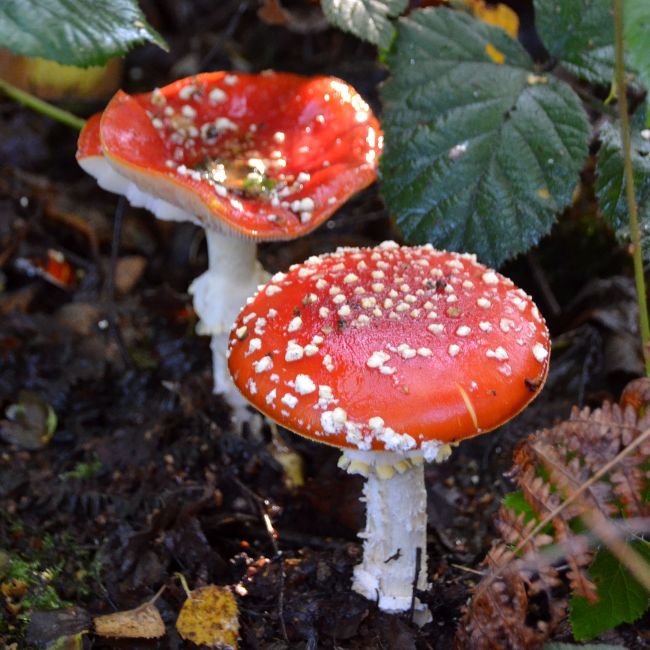
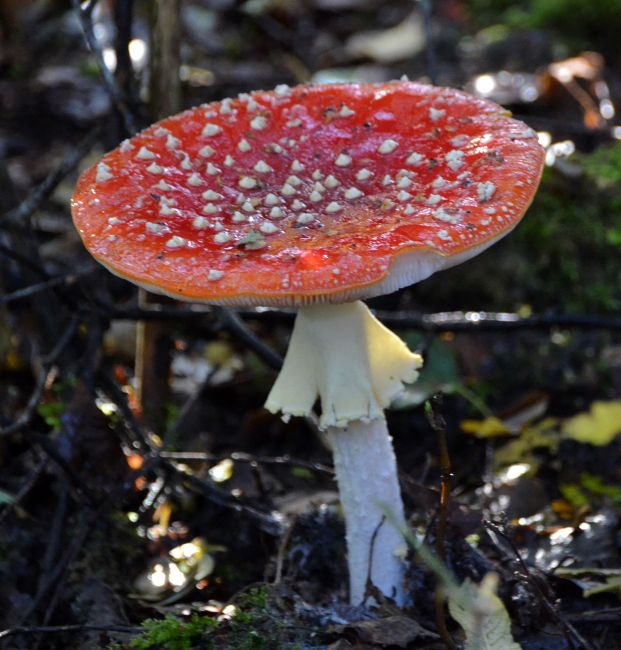
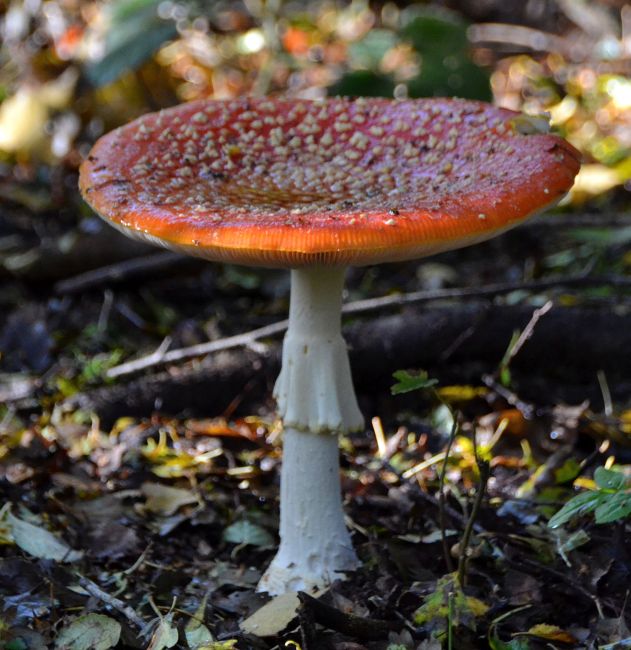
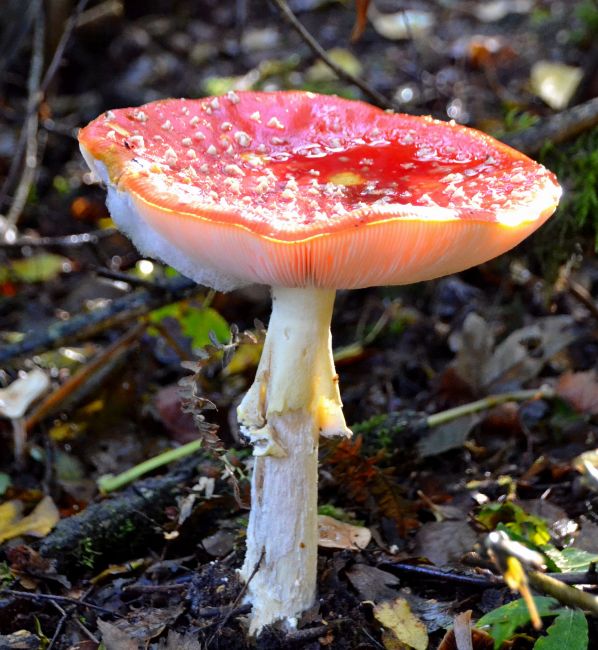
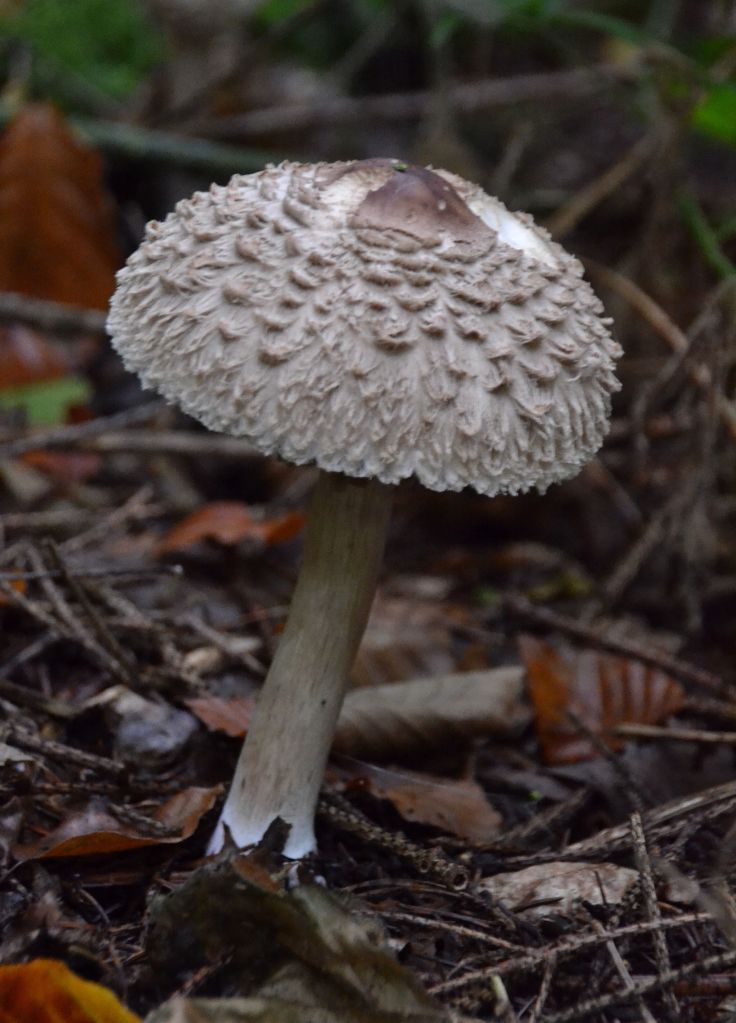
Panther Cap (Amanita pantherina – pictured above) has a quite variably-toned, ochre-brown cap covered in pure white “universal veil fragments”, a mycological term referring to the membranous veil that encloses new fruits when they first emerge. As the fruit body grows and evolves in shape part of that veil turns into the pale cap warts exhibited by all the Amanitae I have featured so far. The remainder accumulates around the slightly swollen stem base as in the right hand specimen in the lead picture, just above which are two concentric rings known as a “volva”.

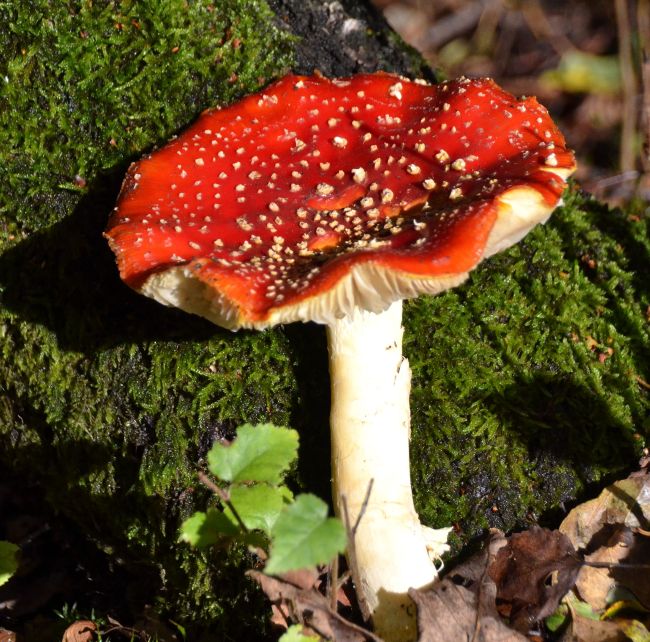
The 5 – 12 cm cap is once again domed at first but may flatten as the fruit matures. The stem ranges from 6 – 12cm in height and the gills are white. The left hand specimen in the picture above has a well developed upper stem collar that itself forms from the remnants of a second “partial veil” that covers the gills of immature fruits. A quite scarce mushroom in the British Isles, this Amanita grows in association with Beech as at today’s site, Oak or less often other hardwood trees. It is poisonous, containing toxins similar to those in the Fly Agaric (Amanita muscariasee here).

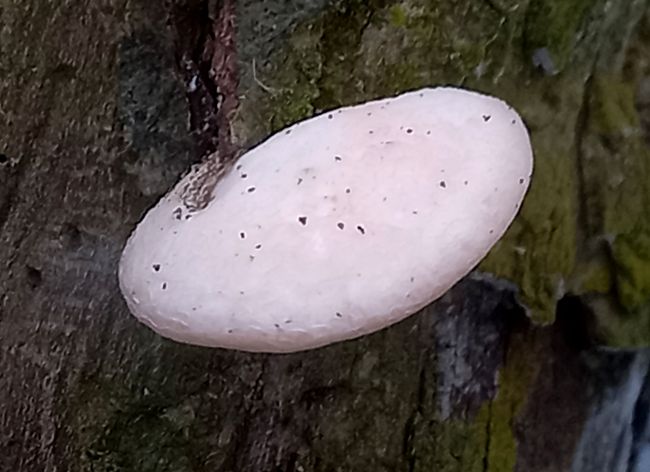
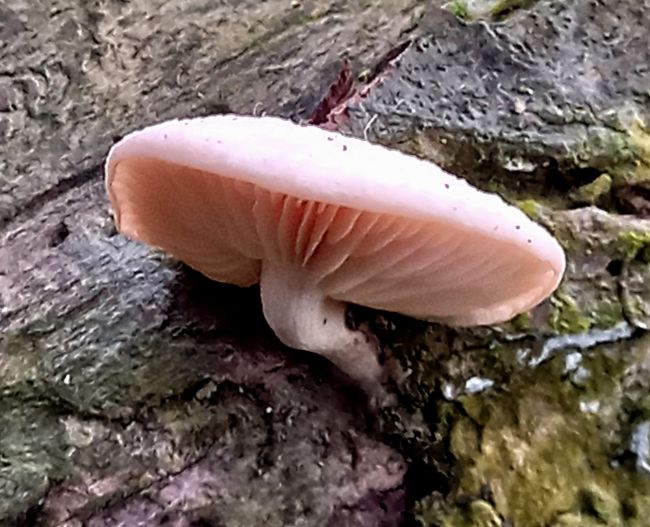
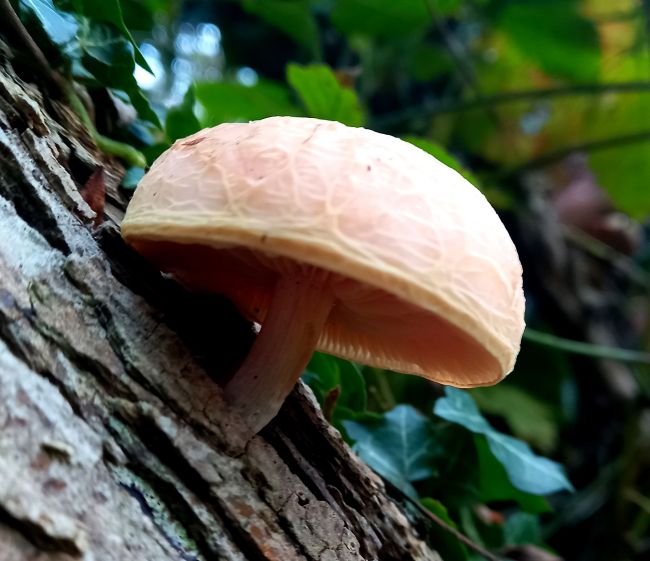
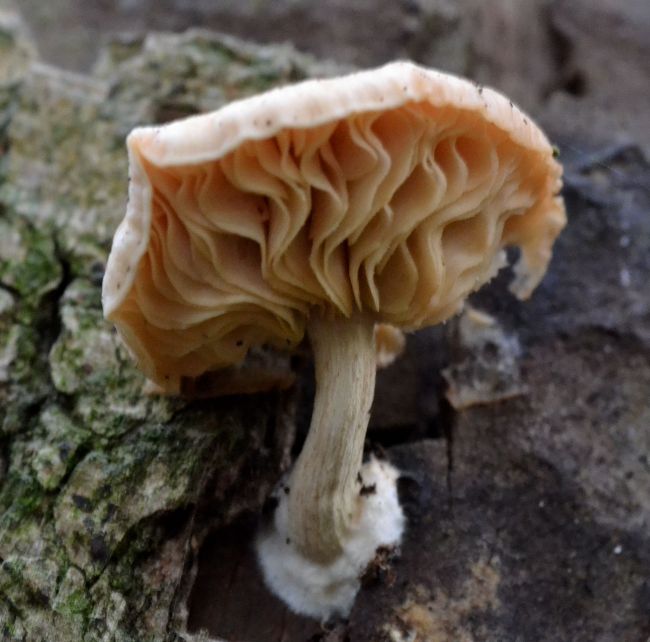
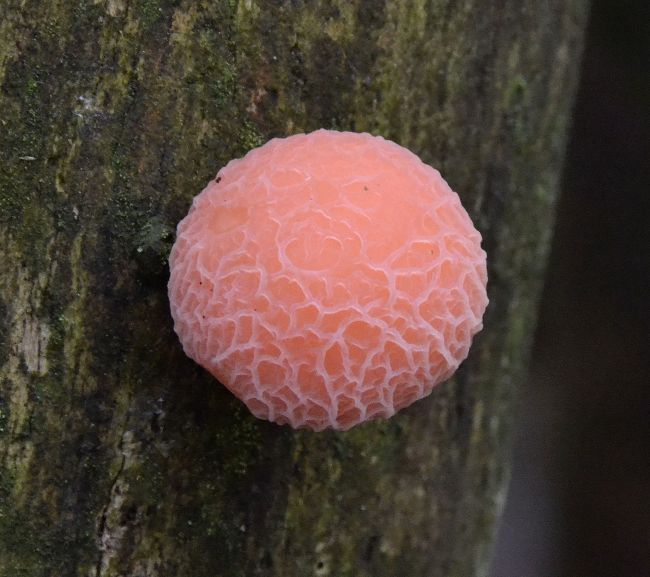
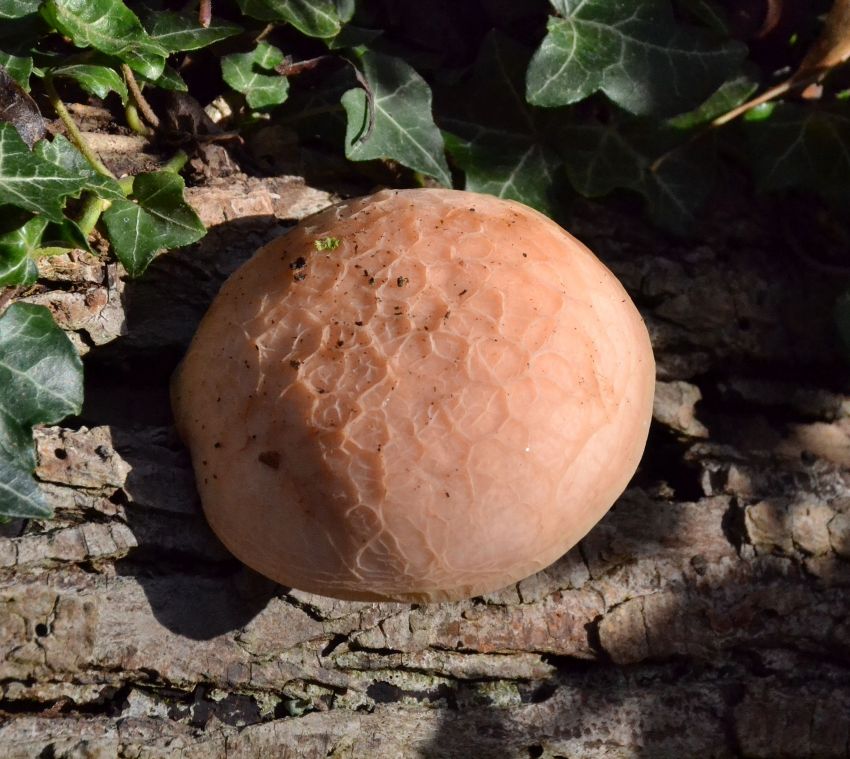
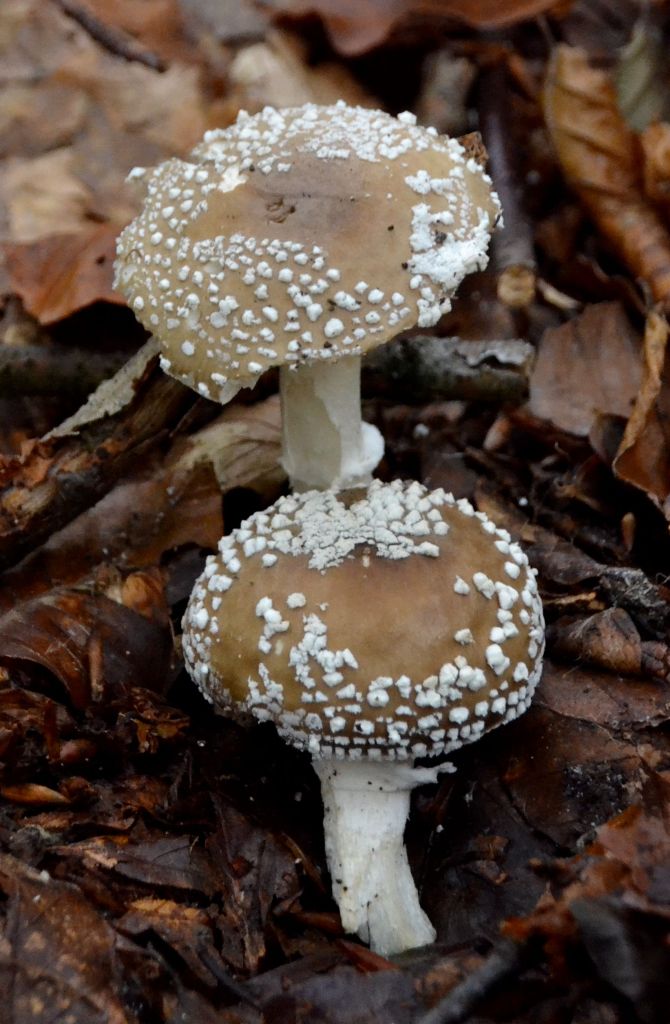
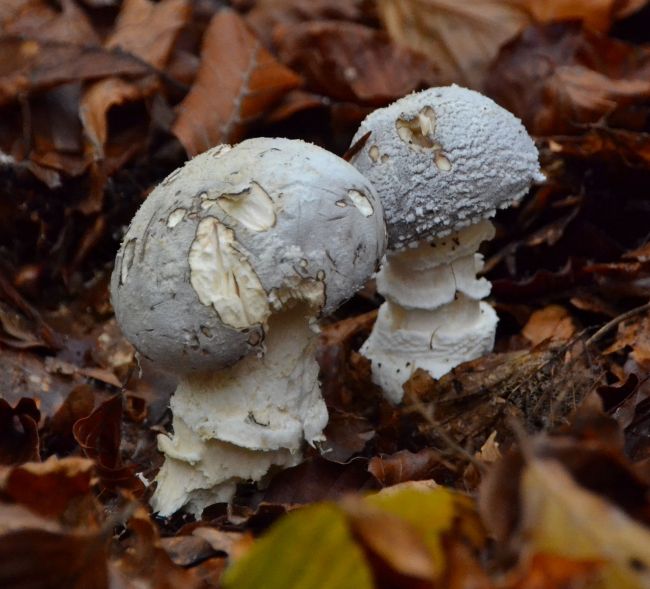
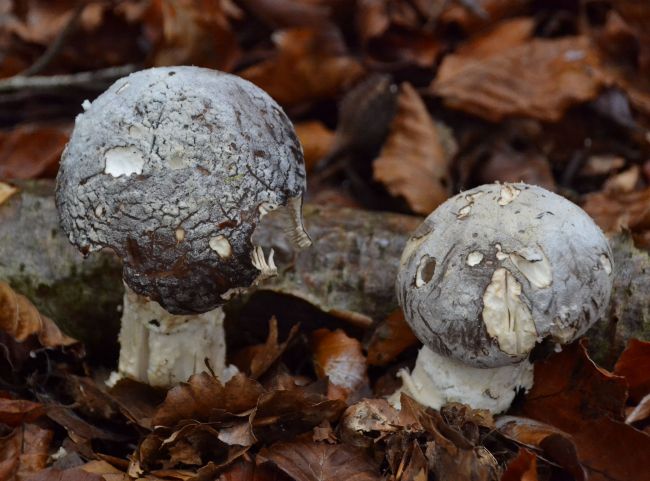
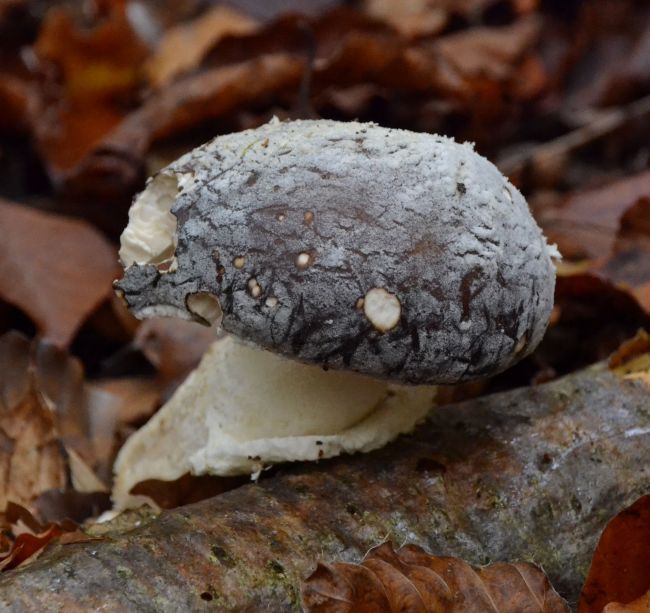
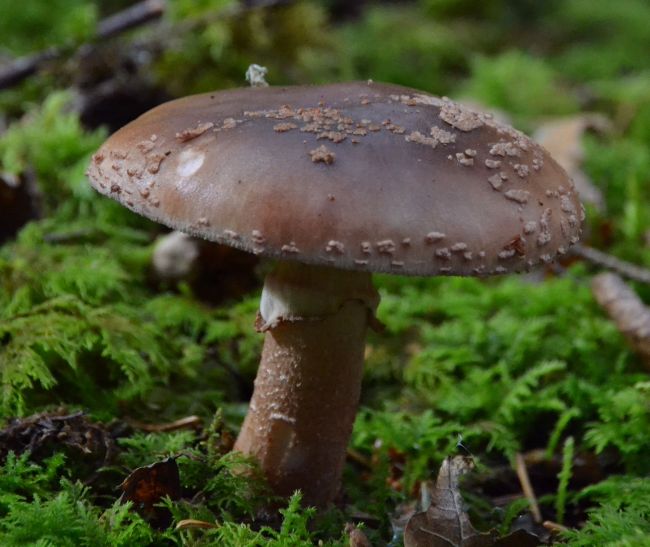
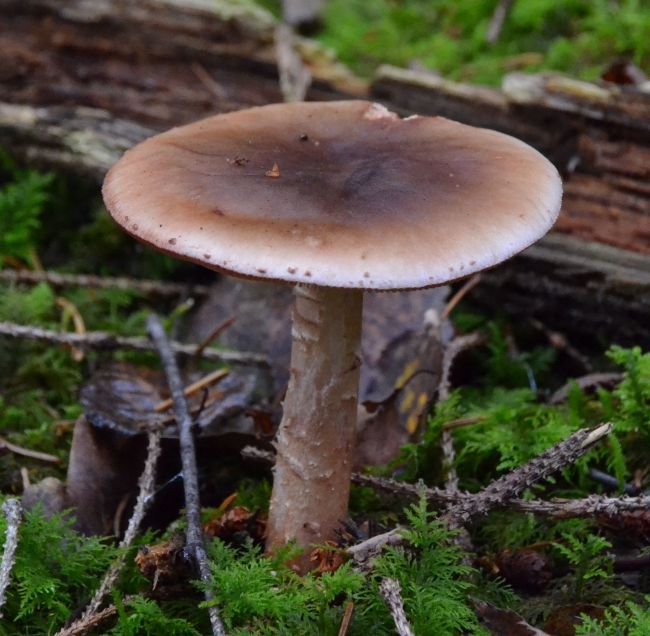
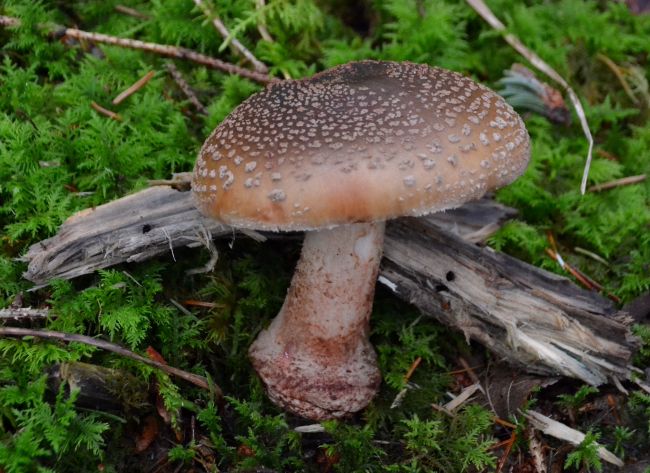
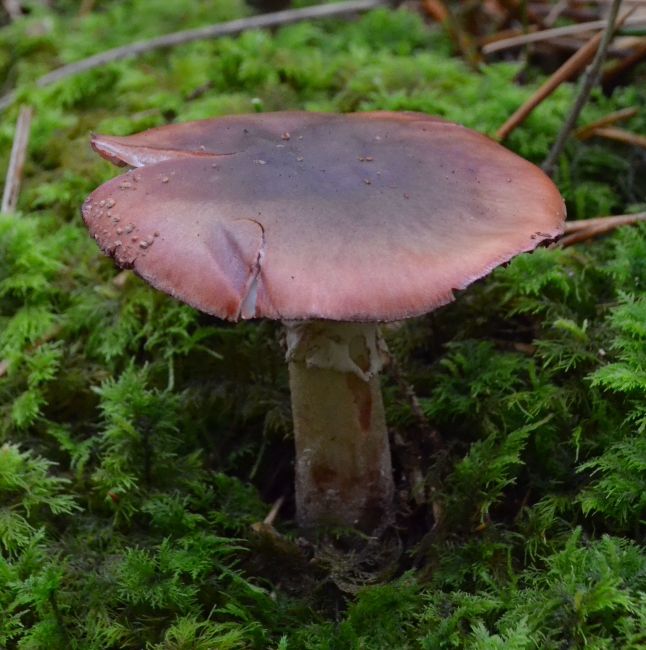
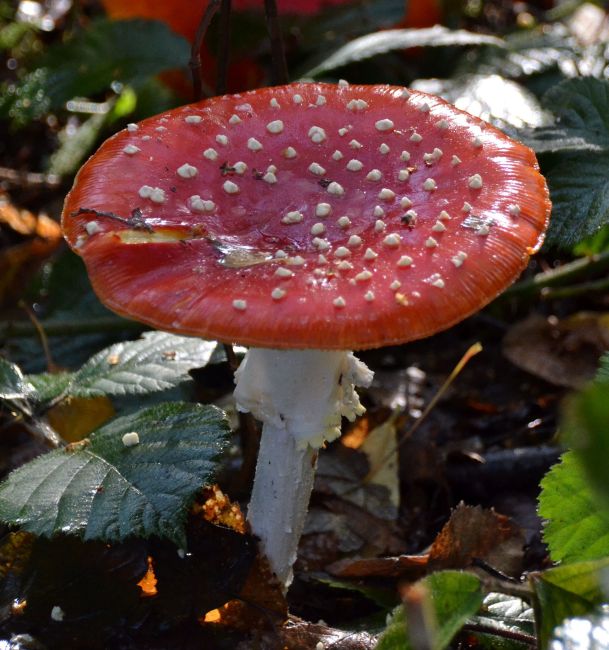
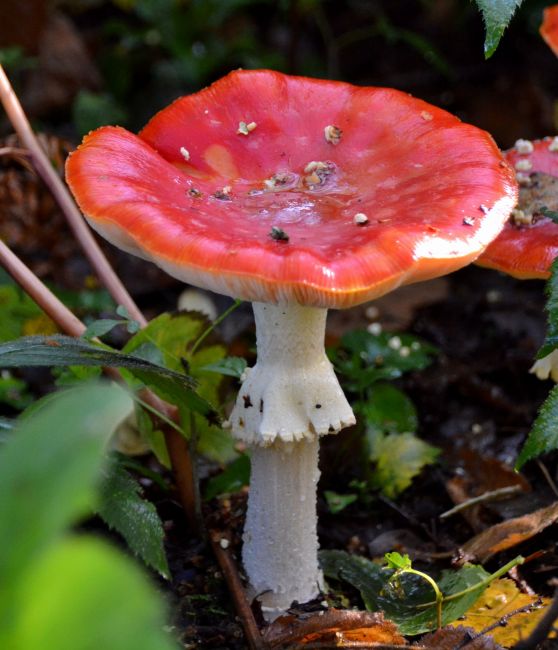
Grey Spotted Amanita (Amanita excelsa) is said to be rather more common than Panther Cap, but today we found just one small clump compared to two sprawling groups of the latter. The fallen fruits in the pictures below were already in very poor condition and needed to be propped up to capture the images, but I believe they show enough to clinch the ID. In this species the universal veil fragments are described as being grey, compared to the purer white of A pantherina, so unless the pictured specimens are infested with a white mould I believe they are diagnostic enough to clinch the ID. As always I am open to experienced guidance if I am wrong.

This Amanita grows in association with both hardwood and softwood trees and is often most abundant near the edge of mixed woodland where it fruits between July and November. The 8 – 15cm diameter, brown or grey-brown cap is initially domed, becoming almost flat or occasionally slightly concave at maturity. The stem, from 8 – 12cm long and 1.5 – 2.5cm in diameter, shares the swollen base of A pantherina but not the latter’s diagnostic volva.

Grey Spotted Amanita (all pictures)

Out of all British and European mushrooms and toadstools, the Amanitae are possibly some of the most recognizable and stately, and so a fitting genera with which to progress from my initial fascination with Magpie and Shaggy Inkcaps. There are 50 members of the former, of which about 15 may be considered widespread. For a guide to separating the entire genus see here.

I returned to this same site a day later to attempt to locate more of the two species featured above, but without success. Wherever I trod, apart from the ubiquitous and bland Russet Toughshanks, Butter Caps and declining Clouded Funnels, I seemed to find mostly the ruined states of various other mostly unidentifiable mushrooms. Concluding that this autumn’s fungi season must now have peaked, I resolved to if possible keeps things going for another week then settle down to the mid-winter project that making further sense out of all this could become.

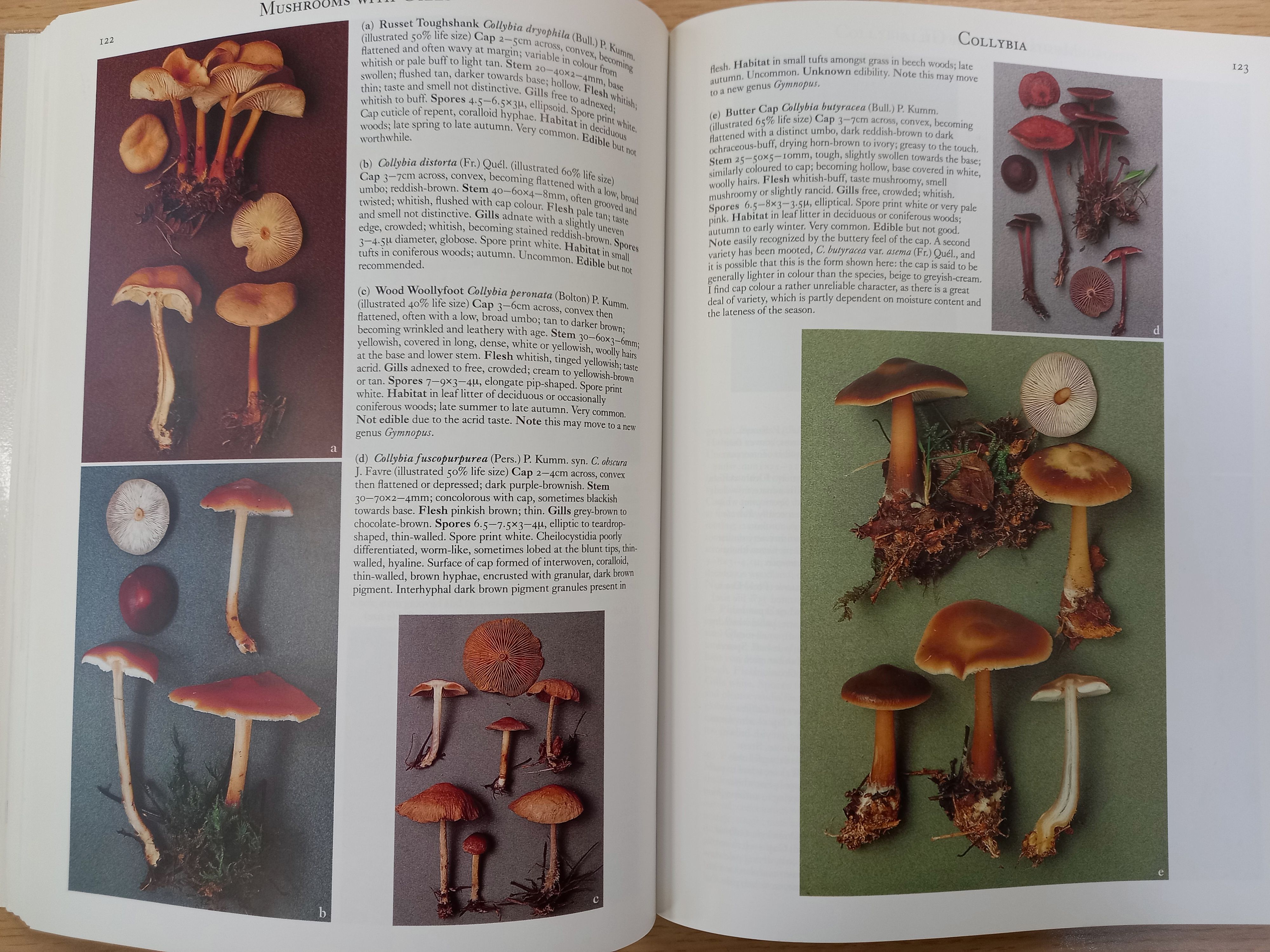
To that end I have now invested in a copy of the most excellent reference book pictured above. In working through and attempting to ID the many fungi images I have collected in the field over the past six weeks, it became clear that only a field guide illustrating all of the forms through each fruiting body’s cycle could be considered adequate. That seemed like a monumental task, I wondered if such a work existed and indeed it does. As first published in it’s present format by Macmillan in 2006, this volume represented the culmination of 30 years work by the now 89-year old author Roger Philips, assisted by other leading British mycology authorities.

In that time some 35,000 specimens of 1250 species were collected and photographed under studio conditions, as exemplified by the pages illustrating Russet Toughshank and Butter Cap (above right). By comparison, photographic field guides as with birds, insects or other wildlife typically contain just one or two representations of each species that so often may be difficult to match to actual observations in the field. This book also uses common, not just Latin names and is written to present a simple and concise rather than learned level of detail. So to any other newly enthused fungi freak such as myself I would strongly recommend buying it (see here).

A celebration of “The Blusher” from Oakley Wood, Bucks – 4 & 5th Nov

Another mushroom I have wished to experience in my debut fungi season is the perhaps rather quaintly named Blusher (Amanita rubescens). A member of the same genus as the previously featured Fly Agaric (A muscariasee here), this post’s lead exhibits the same progression of shapes through it’s fruiting cycle and the multiple white warts that may be washed off by heavy rain. The Blusher’s cap colouration may actually be highly variable from near-white through various shades of pink and brown to almost black. What all forms share in common is that when damaged, bruised or cut the flesh turns deep pink or dull red, hence the colloquial name.

Blushers in three different fruiting cycle forms

In my newest wildlife interest, as with birds and insects I need progression and to evolve. So having so far this autumn covered several Oxon sites I ventured just across the county border to Oakley Wood (SP612118) in search of things new and different. Having visited this part of the Bernwood Forest complex previously and quite regularly for high summer butterflies, it now felt good to be there again at a later time of year with evolved purpose. Most of the spaced out Blusher clump I located then re-found over these two days were caramel pudding-toned (pictured above and below), though some were pinker.

This mushroom is common and widespread for those who know where to look throughout the British Isles and mainland Europe. They are most abundant in Oak, Pine and other coniferous woodlands where they occur in small groups more often than singly. Blusher stems are usually between 7 and 15cm tall and caps range from 5 – 20 cm in diameter. From June to October is their main season, though in mild weather they may continue as late as December. The Amanita genus contains similar species some of which are toxic, but this one can always be singled out by its trait of bruising and staining reddish if scratched.

On Friday (5th) the larger fruits in the lead picture had fallen, so removing them I set about recording each individual and clump in the entire group (pictured below). It may now be possible to detect where I have been in any woodland by the gardened around picture subjects that might be found here and there. The images in this post capture the complete fruiting cycle of The Blusher, such as I have presented previously for Magpie and Shaggy Inkcap, Fly Agaric and other mushrooms.

In the continued absence of foreign travel, mushroom hunting has been a quite welcome substitute with which to bridge the transition into another detested dark season. In just the same way as during my past lone wanderings in southern Portugal, the south of France and Morocco I am getting out into wild places to enjoy total communion with the subjects of the pictorial records I collect. Having recorded every English dragonfly and damselfly and all bar two butterflies, fungi has become a fascinating and wonderfully occupying new wildlife group with which to get better acquainted.

The Fly Agarics of North Leigh Common, Oxon; with some folklore, cultural and psychedelic anecdotes – 20th Oct

As a mycology beginner this arguably most iconic of mushrooms was high on my wish list of species to experience in the present season. These are the bright red pedestals with white spots upon which for long years past faeries have sat cross-legged in children’s book illustrations. And they are still one of the most recognizable and widely encountered fungi of popular culture, including literature, art and film. Worldwide the Fly Agaric (Amanita muscaria) is native to conifer and deciduous woodlands across the northern hemisphere, but I myself had not located any so far this autumn prior to today.

Late morning I received a tip off that huge numbers are currently fruiting at a location to the west of Oxford. North Leigh Common (SP399136) is a remnant of historic heathland that is now managed by West Oxfordshire District Council to maintain a range of wildlife habitats. Amongst the site’s specialities are a splendid annual crop of my wished for mushroom that I set out in the early afternoon to record. To say I wasn’t disappointed is an understatement.

The Fly Agaric (Amanita muscaria) here occur in bracken beneath Silver Birch. On locating such an area there were dozens, probably hundreds of fruiting bodies all around and of various shapes and sizes, so how many thousands there must be across the entire site could only be imagined. As I approached an apparent hot spot, where most of the pictures herein were taken, a first large red shape was visible ahead that upon being reached was indeed a saucer-sized specimen (pictured above). It was lying on one side having fallen so I picked it up wearing a petrol station glove and re-positioned it to photogenic advantage.

This perhaps most conspicuous and iconic of all mushrooms is typically numerous where it occurs, in Beech or coniferous woodland, or in association with Silver Birch as here. Looking around I next sought out specimens in good condition that represented the succession of forms in this mushroom’s fruiting cycle. After emerging from the ground looking like white eggs (below left) the caps become covered with small white to yellow pyramid-shaped warts that thin out as they grow into the medium sized convex form (bottom row) in the following sequence.

As the fruiting body develops and matures the cap shape evolves further from globular through hemispherical and plate-like to flat. Fully grown caps may reach 20 cm in diameter, though still larger specimens are known. The next picture sequence shows three mature specimens (top row). Heavy rain may wash the white spots off eventually (bottom row, left), before like many mushrooms the flatter stage turns up at the edges (bottom left) as the fruit crinkles before ultimately dissolving. Amongst all the pictured items the bracken covered ground was littered with many more deformed, fallen or slug-attacked Fly Agarics.

The Fly Agaric occurs naturally across much of the northern hemisphere and has been introduced widely in Australasia, South Africa and South America. As the bright colouring suggests it is poisonous though not deadly, and also has psycho-active components that cause hallucination and psychotic reactions if digested in small quantities. Indeed it has been used in shamanic rituals in some past northern Fennoscandian and Siberian indigenous cultures, and in ancient times may have been the hallucinogenic ingredient of a sacred ritual drink called Soma in India and Iran.

The only reported past narcotic use in Europe was of being consumed mixed with Vodka during Lithuanian wedding feasts, which sounds pretty potent! But long ago the Vikings were reputed to have used A muscaria to induce their “berserker” rages when going into battle. It is possible to detoxify Fly Agaric but culinary use across its range has been very limited. Since this mushroom contains ibotenic acid that attracts and kills flies it has also been utilised traditionally as an insecticide by breaking up the cap and sprinkling it into saucers of milk, hence the common name.

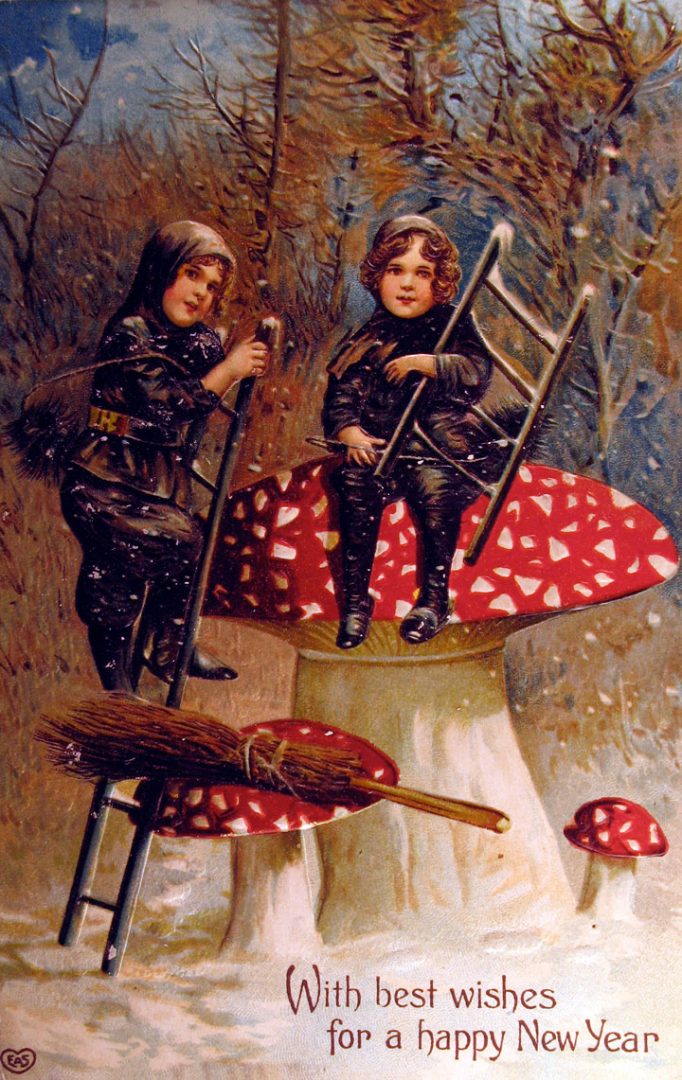
Cultural depictions have been widespread, such as in children’s faery tales, other literature notably Lewis Carroll’s Alice in Wonderland, the 1940 Disney film Fantasia and the Super Mario video game franchise. Depiction was common on Christmas cards in Victorian and Edwardian times (below) as a symbol of good luck, and Fly Agaric’s colouring is thought to have been the inspiration for Santa Claus’ red and white suit!

Quite widespread association of A muscaria with Christmas folklore may be rooted in the mushroom’s historic narcotic use by tribal shamans in Lapland, Finland and Siberia (see here). Consider now the following:

  • The shamans moved around by means of Reindeer-drawn sleds in winter. Reindeer are known to eat and become intoxicated by Fly Agaric, one of the most common psychedelic sensations of which is flying – hence Santa Claus’ mode of transport.
  • Living in such a cold region the shamans would wear thick layers of clothing dyed red and white that matched the mushroom’s colouration – hence Santa’s suit.
  • The indigenous cultures that consumed Fly Agaric were all in far northern regions – hence Santa living at the north pole.
© rights of owner reserved

“Curiouser and curiouser” as Alice herself might have said in Wonderland. Certainly no fungus may ever have captured the popular imagination and held its attention quite so much as the most attractive and enchanting Fly Agaric.

Footnote: In both 2022 and 2023 the bracken in which the wildlife spectacle of this post occurs was cut by WODC at the height of the Fly Agaric season, destroying all the fruiting mushrooms in “full bloom”. WHY? Surely this is a local treasure that should have been left for visitors to enjoy, whatever it says on the job sheet.

The fruiting cycle of the Shaggy Inkcap + the Shaggy Parasol mushroom – 18th Oct

Having a year ago presented a one-off study herein of the quite beguiling fruiting cycle of the Magpie Inkcap mushroom, I have sought in the present autumn fungi season to locate and compare that of the related Shaggy Inkcap. And today on a fungus foray to Cowleaze Wood (SU727956) in the Oxon Chilterns we came across a six-strong group of the latter that allowed me to record pictorially the entire sequence.

Day 2 (left) and emergent (right) Shaggy Inkcaps

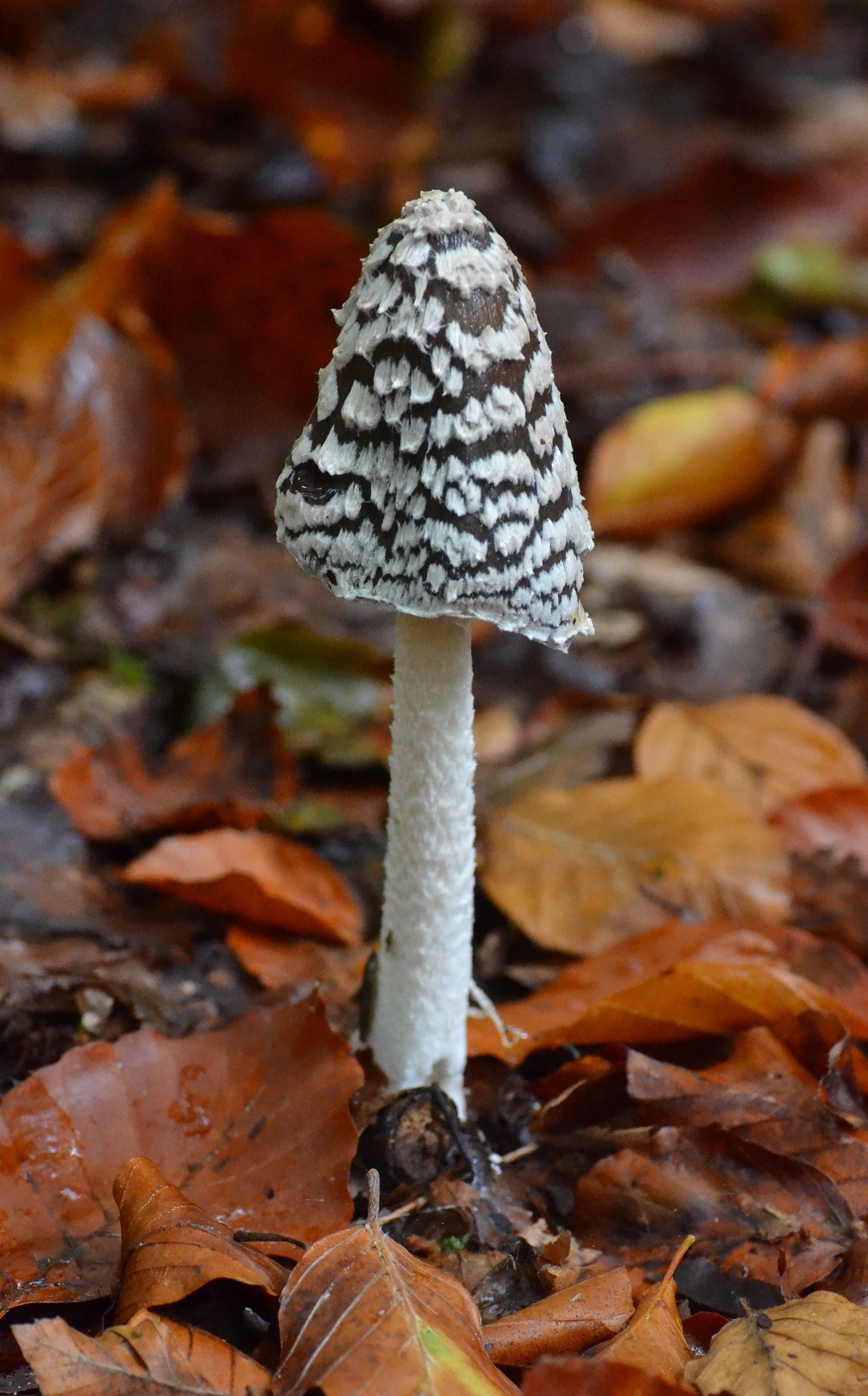
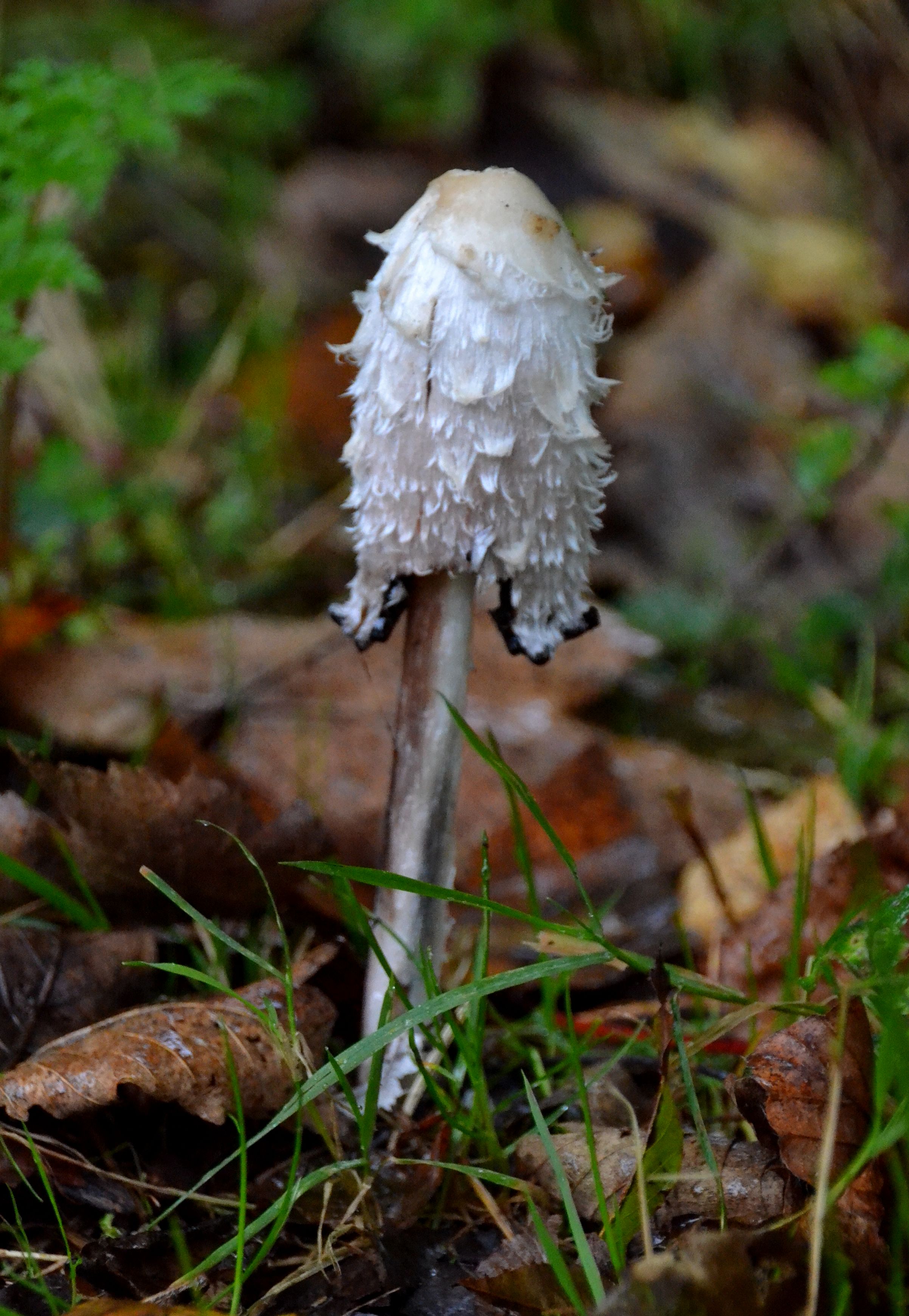
The distinctive and shapely Shaggy Inkcap (Coprinus comatus – pictured above), also known as “Lawyer’s Wig” and “Shaggy Mane”, is described as widespread and common in the British Isles; whereas my understanding is the Magpie equivalent (Coprinopsis picacaea) is less frequent and restricted to Beech woods. But I had observed far more Magpies than Shaggies prior to today. The latter is said to be found in a wider range of habitats, such as meadows, woods not just of Beech, parks, gardens and roadside verges. My researches also suggest Magpie Inkcaps mostly occur singly or at least are well spaced, while Shaggies are more likely to be found in groups such as that encountered today.

The name derives from the notably scaled surface of the white cylindrical cap that adorns a tall smooth white stem. Not having observed this mushroom in the field before today I had wondered whether its fruiting body evolves in the same four part, four day sequence as the Magpies (see here) by which I became so fascinated last season. Now, together in one cluster was all the evidence I was seeking.

Shaggy Inkcaps

In the above sequence the left hand image is an egg-shaped emergent specimen that once lifted by the stalk will resemble the fruit in this post’s lead picture. The centre left item (above) is beginning to assume the bell shape of the next stage form (centre right), that eventually dissolves from the rim upwards (right) before the stalk collapses and the fruiting sequence and spore dispersal are over for another season. Below is the equivalent sequence in some Magpie Inkcaps found this autumn in Oxfordshire Beech woods at Highmoor Common (days 1, 2 and 4) and Stonesfield (day 3).

Magpie Inkcaps

On first finding the specimen in the left hand picture above I wondered if it might be a Shaggy, but soon realised it’s true identity as through my time on site the dark background of a Magpie increasingly showed through the white scales. Shaggy’s cone colouring may be described as white with off-white / pale tan scales turning grey black, and with a pink tinge. The initially white gills turn pink and then grey to black when they start to ‘melt’ from the edges. The fruiting body secretes a black liquid filled with spores, hence the ’inkcap’ name.

This is a very edible mushroom if picked before the caps start to open, but quite tricky to prepare correctly without dyeing everything around black. But it is also possible to make good ink out of such an outcome by heating the gunge with cloves. Another interesting anecdote I have uncovered is of a Shaggy Inkcap once having lifted a 75 by 60 cm paving slab 4 cm in 48 hours. It has been known for hundreds of these mushrooms to appear on prepared ground such as playing fields if suitably composted, and they are also prone to forming sizeable fairy rings.

Shaggy Parasol

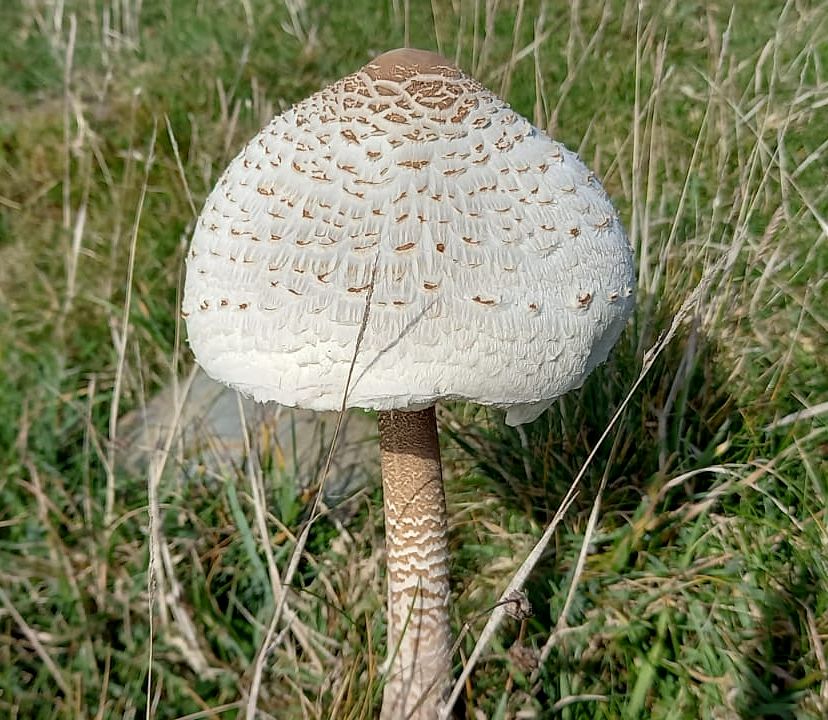
It turned out the season’s high target just described was not this day’s only potential for innuendo in Cowleaze Wood, as a second good find was an impressive cluster of Shaggy Parasol (Chlorophyllum rhacodes – pictured above). A smaller relative of the stately Parasol (Macrolepiota procera – below right) that itself is found mainly in open grassland locations, this fairly common woodland mushroom shares the aforementioned Inkcap’s large, legal wig-type scaling whilst lacking the regular Parasol’s snakeskin patterning.

The Shaggy’s cap is initially bun-shaped (pictured above, left), expanding to turn convex (centre) but only rarely opening out to become flat. When mature, the cap diameter ranges from 5 to 15cm. The 1.8 – 2.4cm diameter stem is white, tinged with red-brown, rising from a large bulbous base.

As a mycology beginner this new wildlife interest of the last two autumns is proving both fascinating and completely occupying, both out in the field and back at home trying to make sense of pictures and puzzling over IDs. Through October and into November fruiting fungi are there to be sought out in all weathers, not just when the sun shines, and they don’t relocate like birds. What is there not to like?

Some personal perspectives on the St Aidan’s Long-toed Stint, Yorks and associated matters – 14th Oct

Here is another of those “eventually I got up and went” scenarios. Normally I prefer this journal to be about the wildlife I observe rather than myself and what I do. But what can I add to all that has been published on-line concerning this bird over the past week? So I will instead indulge myself a little, which seems the best way to make a story out of all this.

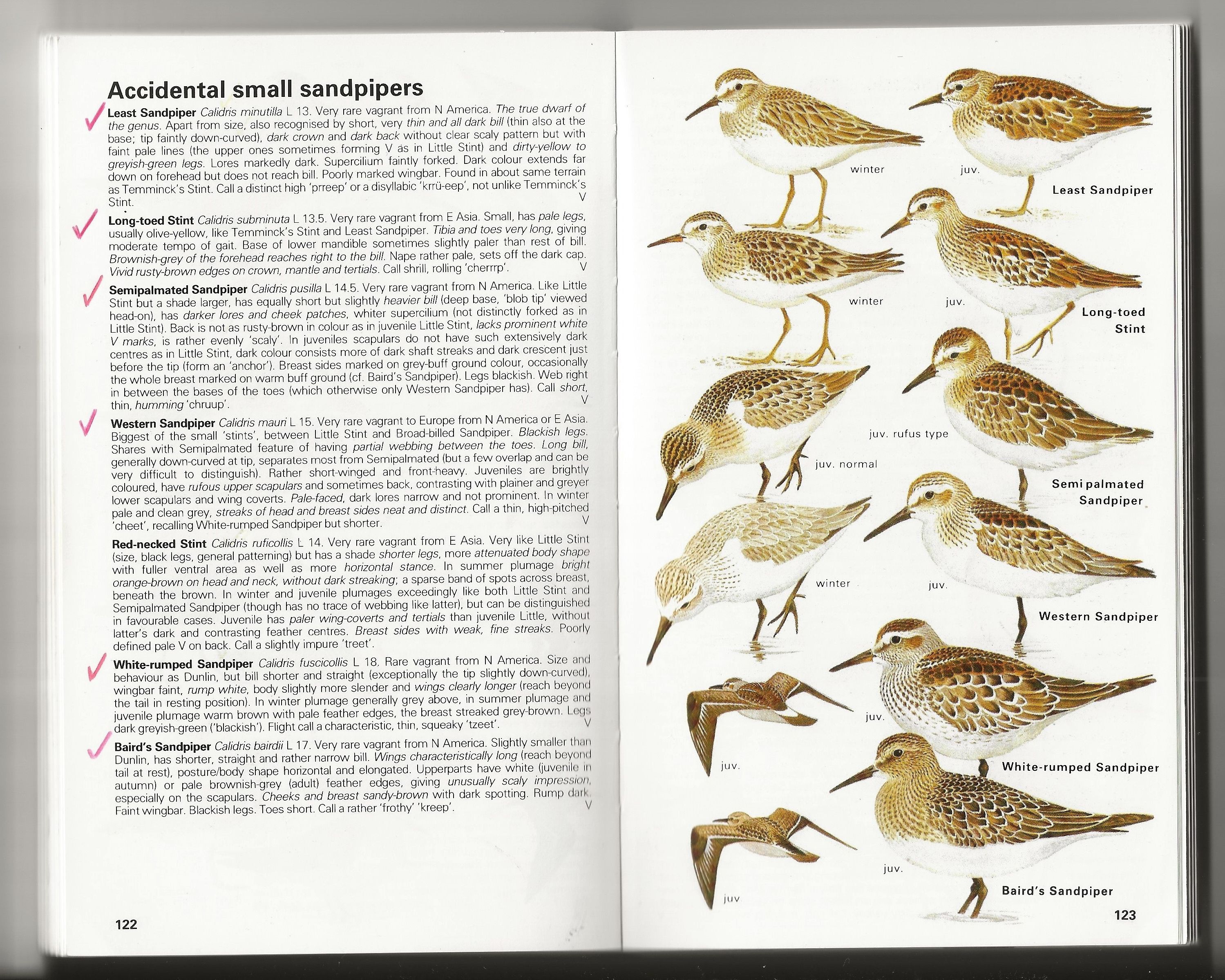
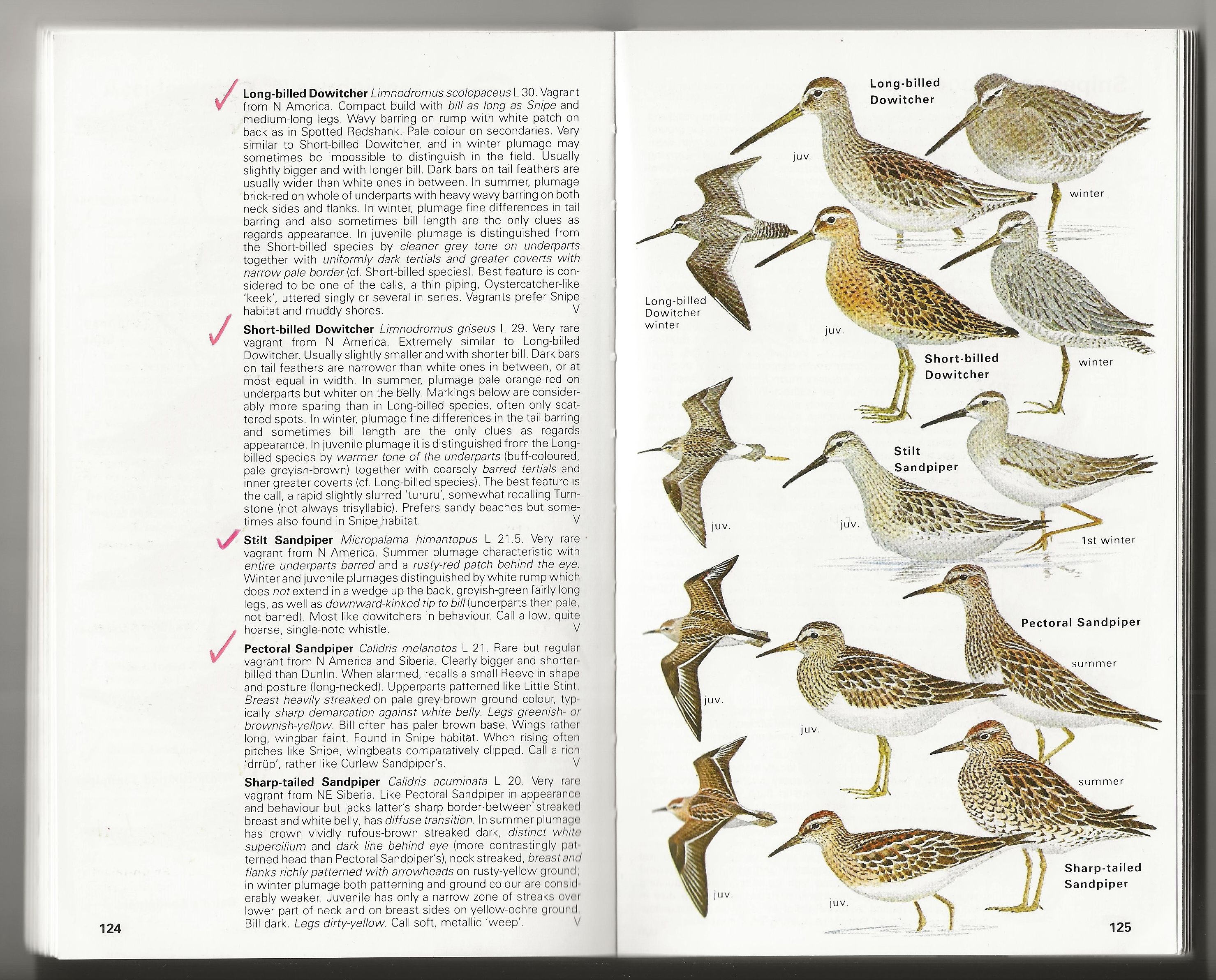
In BirdGuides’ weekly review (see here) today’s item was described as a “true ‘giga’ rarity”, a phrase I had not heard before. It had been confirmed as the uber-scarce east Asian vagrant Long-toed Stint seven days ago on the evening of my previous twitch for the Hants’ Western Sandpiper. My own wish-list of still required European lifers is derived from their inclusion in the Hamlyn pocket field guide I used in my first phase of serious birding in the 1980s and 90s. I have two copies, one of which is marked up as my British and the other my European bird list. These prized personal relics include two pages of what the book terms “Accidental small sandpipers”, comprising some 12 species of which I still require just two.

Long-toed Stint © rights of owner reserved

The two most recent conversions illustrate just how rare some of these “peeps” as small waders are also known are. Western Sandpiper is cited by Collins (that like most birders I now use) as one of the group’s rarest visitors to Europe, five individuals so far in 2021 being a year record. The Long-toed Stint at St Aidan’s RSPB “nature park” in West Yorkshire (LS26 8GE – SE 399286) is the third for Great Britain and just 13th for the Western Palearctic. The first accepted national record was in June 1970 and a possible Sep 2011 record in Sussex is still in circulation with the BBRC. The Yorkshire bird is the first twitchable one since Aug 1982, meaning every British travelling birder would wish to connect.

My own concerns when the news broke were two-fold. Firstly I dislike and avoid heaving mass twitches, so would wait for things to calm down a bit. Secondly I wanted to gauge how distantly the bird was being viewed and how different from a Little Stint it might look at that range. When visual matter and other Oxon birders’ blogs began to appear online earlier this week my mind was put at rest concerning the latter. For the RBA gallery of this bird see here, including some images that capture the elongated middle toe that gives this Stint its name. The five minute video in the BirdGuides review linked higher up this post is most excellent, revealing a truly distinctive appearance and jizz.

By now I appreciated this might be my only opportunity to record a LTS and so one that warranted going to the extended 180-mile limit of my preferred driving range. When the RBA and BG weekly reviews landed in my inbox midweek they contained tales of thousands strong twitch lines and how the cream of British hard-core had relocated en masse from abandoned early October sojourns in Shetland and the Scillies. The removal of this “blocker” for a whole generation of birders had indeed inspired a huge national event.

It remained to actually feel motivated to make the conversion and my gut feel was that like the still present White-tailed Lapwing at RSPB Blacktoft Sands this latest bird would be a long stayer. I need to be in a particular frame of mind to take the road, which though not a precise condition usually involves pent up energy to burn. On waking this morning (14th) at 2:30 am there was a choice of spending time on the computer until sleepy again or getting out of the door. The moment had come to embark upon the four hour journey north.

The dwindling wish-list targets of my Hamlyn pocket guide (above and below)
Just two to go plus Upland and Terek Sandpipers in this group

Arriving on site at 8:30 I made my way out to it’s eastern reed bed where maybe 20 birders were already in place. I was put onto the Long-toed Stint straight away, which was some way off amongst a group of Northern Lapwing and Dunlin. Like last week’s Western Sandpiper this looked distinctive in both appearance and jizz, both small birds being restless and busy in their feeding behaviour and not at all like Little Stint. I then watched the visitor going about its business for around an hour before proceedings began to get a little too crowded for my liking.

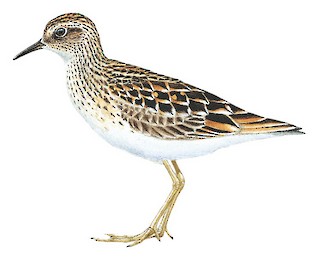
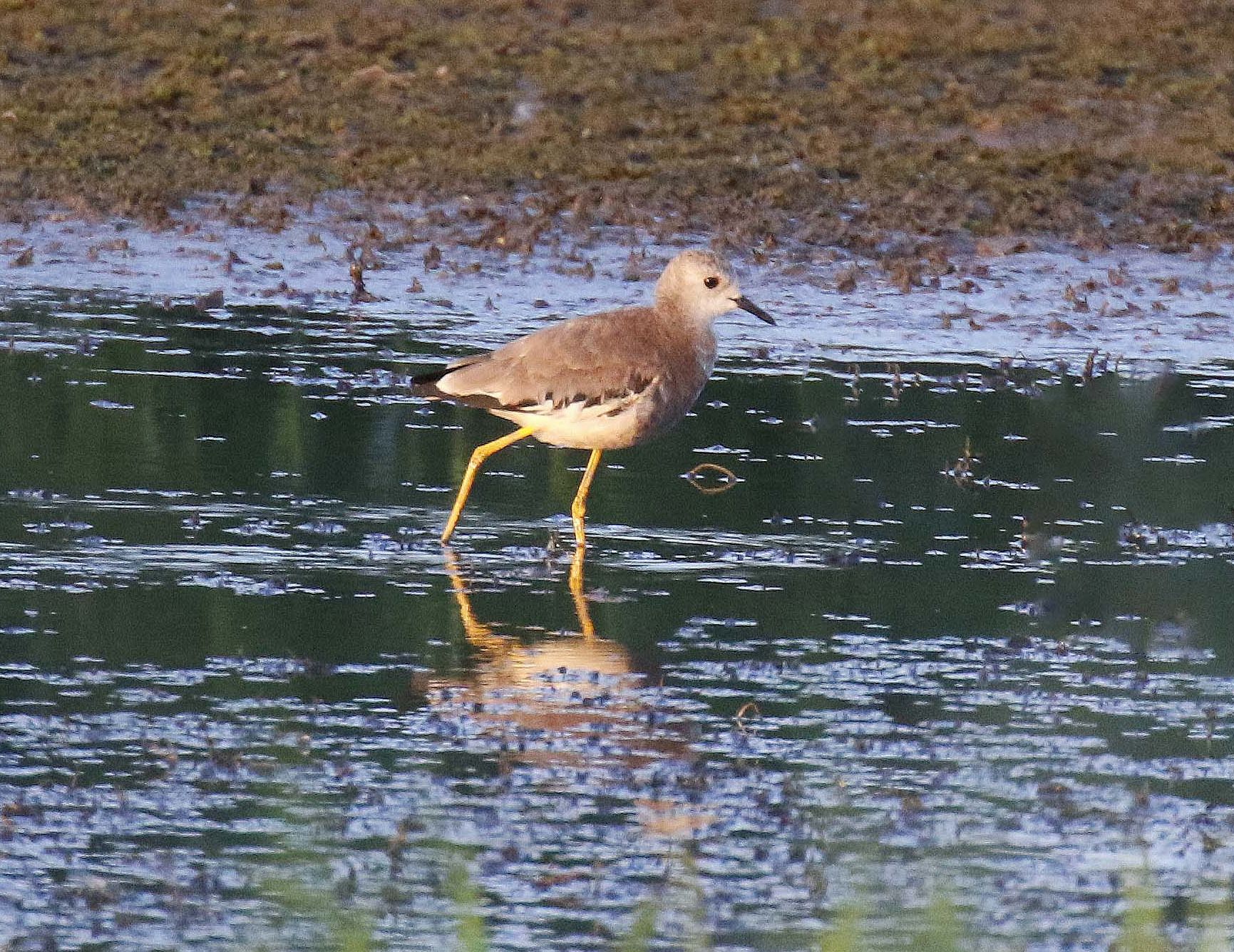
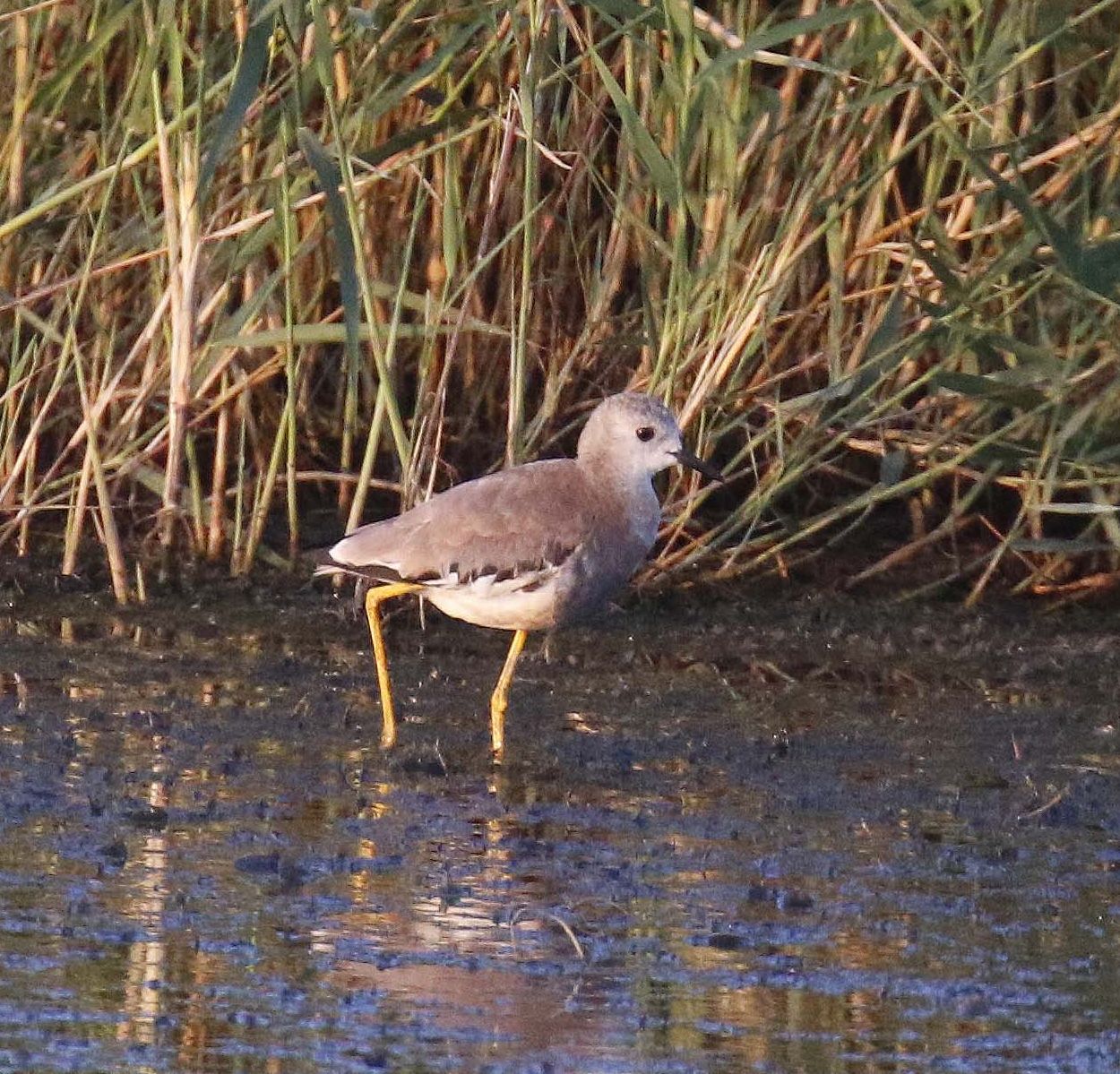
LTS is a Tundra breeder and considered to be the Eastern Palearctic equivalent of the Nearctic region’s very similar Least Sandpiper. Most winter in south-east Asia with smaller numbers reaching Australia and possibly east Africa. To quote the Helm guide to confusion species Long-toed at a distance can look quite square-headed, flat-backed and pot-bellied, with a straight bill and rather truncated rear end. The relatively long, yellowish legs appear about equal to the body depth, and the bird often tilts forward when feeding. Close up the most obvious diagnostic is the strikingly long central toe of the species’ name.

As more and more observers arrived after 10 o’clock, all asking for and receiving directions as I had done, things became both repetitive and confusing compared to earlier and so I chose not to extend my stay. I could only imagine what the constant chorus of “just right of the Lapwing”, “moving in front of a Dunlin”, “there’s a Moorhen next to it now” and similar utterances must have sounded like over the previous weekend. Likewise, back at the car park I considered just how the facility might have coped with visitor numbers then, though the roadside verges for some way outside bore ample testimony to that.

Swillington Ings © rights of owner reserved

The 400 hectare (990 acre) expanse of St Aidan’s Nature Park, also known as Swillington Ings covers a former open cast coal mining complex in the Aire Valley to the south-east of Leeds. Visiting it today provided an insight into this country’s industrial past that southerners such as myself possibly do not usually get the opportunity to appreciate. One thing I didn’t notice so much in this part of the world is the blanket over-development with characterless, high density housing around every small town and village that to my mind blights my native south-east of England, and which I personally detest.

Coal extraction in this area began in the early 1940s and continued at the St Aidan’s site until March 1988 when a major landslip alongside the River Aire caused the surface mining workings to flood over four days creating an extensive lake. It was 10 more years, during which the river’s course was diverted, before work could recommence to dig out the remaining coal reserves. Once that was complete ownership passed to Leeds City Council which created a charitable trust to re-wild the land. The present nature park opened in 2013 and four years later was leased to the RSPB which now manages the site for both wildlife and recreational activity. Habitats here include wetland, reed bed, meadows and woodland.

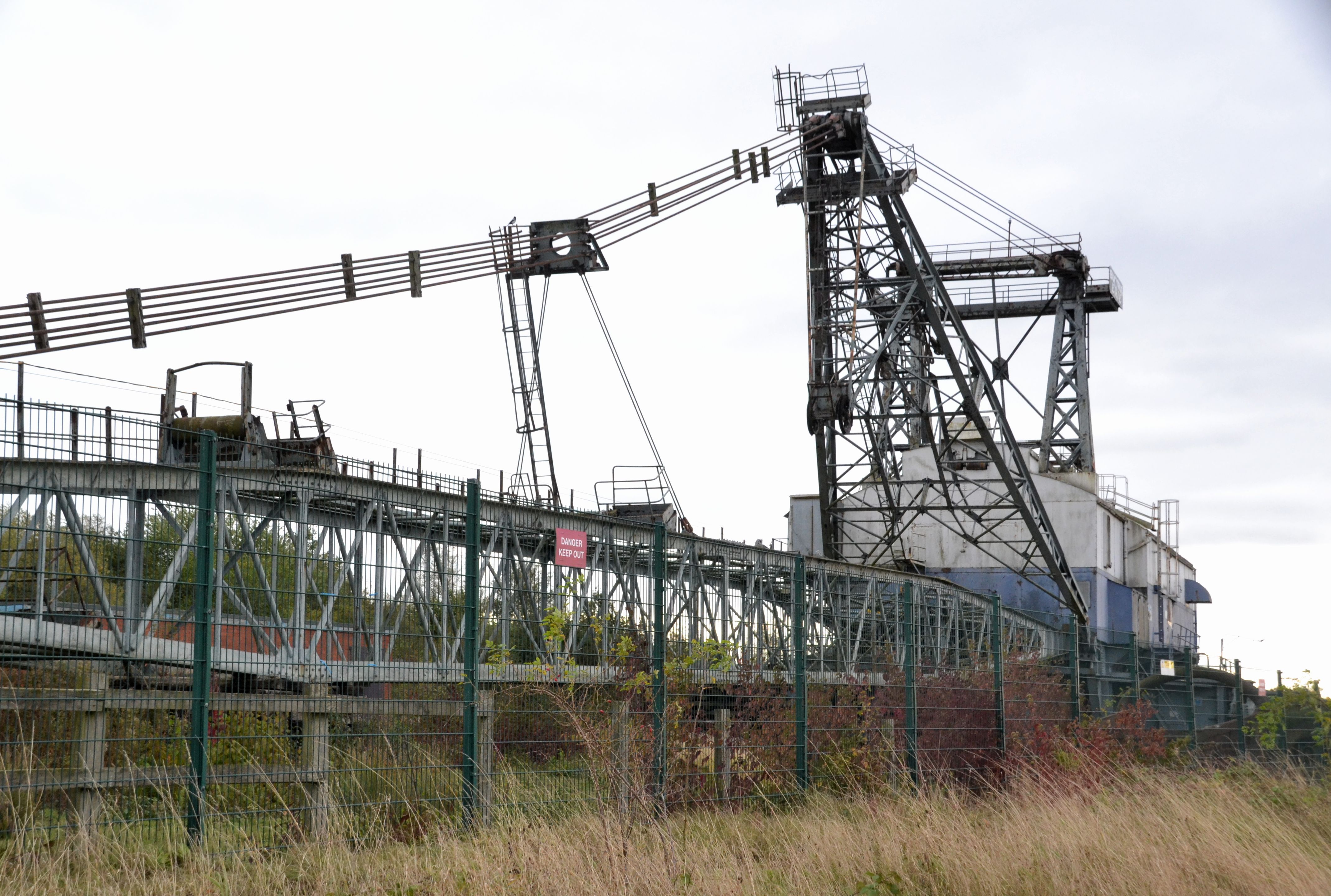
Bucyrus Erie 1150-B walking drag-line excavator

Before leaving today I took the opportunity to appreciate a prominent local landmark. The big brooding beastie (pictured above) is variously claimed to be Europe’s oldest or only preserved large walking drag-line excavator and the first I can ever recall seeing. These gargantuan products of heavy engineering were the main workhorse in open cast mining for around 50 years through the second half of the 20th century, before becoming superseded by newer technology. Electrically driven, they walked by means of rotating cam-driven feet, one on either side that lifted the structure off the ground and moved it forward at a rate of two metres a minute.

Manufactured in the US in 1946, this Bucyrus Erie 1150-B was one of three such machines purchased by the National Coal Board in 1953. Taking in it’s huge bulk my mind boggled at their being lifted onto and off the vessels that shipped them to Blighty, and how this one was partially dismantled and moved between three sites here through it’s working life. Presumably the heavy lifting and haulage technology of the day could cope since I doubt if it walked all the way! “Oddball” as the pictured machine is nicknamed weighs 1200 imperial tons and was operational at St Aidan’s between 1974 and the site closure of 1988. It is now maintained by a charitable trust (see here) aided by National Lottery and other grants.

Having become fascinated by this historical item I am happy to include it here, as I like to do in my mainly wildlife journal from time to time. Moving swiftly on and returning to birding matters it next seemed sensible being so close to go back for second helpings of the White-tailed Lapwing that has become a fixture 40 miles away at Blacktoft Sands since my first visit there on 28th August (see here).

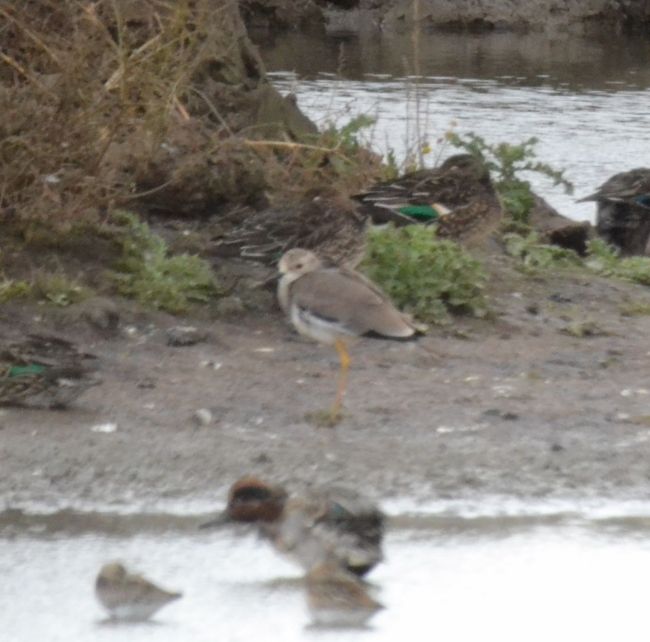
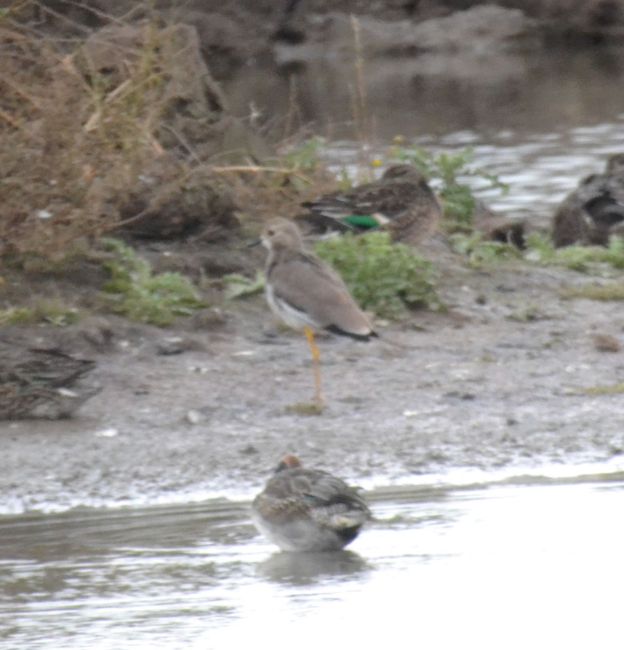
Today the bird had been present in front of one of the reserve’s hides for quite some time prior to my arrival. When I got there in the early afternoon it was easy to pick out dozing it’s time away in the middle distance. The gloomy light at both sites might have suited the redundant presence of the walking drag-line, but definitely not my efforts at capturing pictorially this excursion’s second avian celebrity (below) any more than the first.

Some fairly local birders then told me about a Baird’s Sandpiper seen earlier just 27 miles in my own direction home. So after the Lapwing eventually went walkabout and I had become satisfactorily re-acquainted with it I opted to attempt a third item on what was becoming a busy day. But what would have been my second career Baird’s proved a step too far as it was not reported again in the afternoon and I didn’t locate it either.

And so I headed back south to complete a solo round trip of 410 Velvet Revolver, Thunder and RHCP-accompanied miles; nothing to proper hard-core birders of course, whatever their choice of in-car entertainment but not a distance I attempt too often myself. Worth it though? … Given the energy to burn mind-set of this particular day, I should say so!

Western Sandpiper at Normandy Lagoon, Lymington, Hants – 8th Oct

This was a very satisfying British and WestPal list addition, especially as I had dipped the same species at Snettisham in Norfolk already this year. Checking national bird news on Thursday evening (7th) I found a vagrant Nearctic wader present on the Hampshire Solent for the previous three days had been confirmed as one of the required conversions on my dwindling wish list of more regularly occurring British passage scarcities.

Western Sandpiper (archive picture)

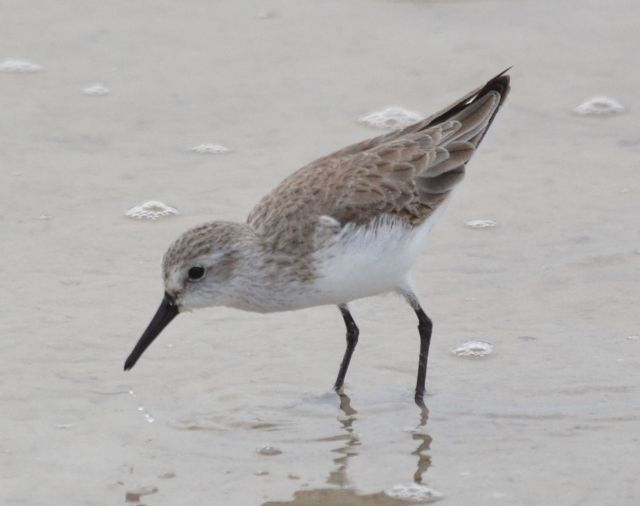
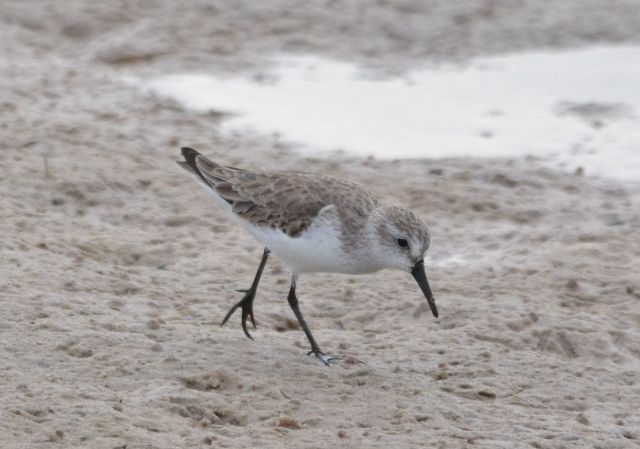
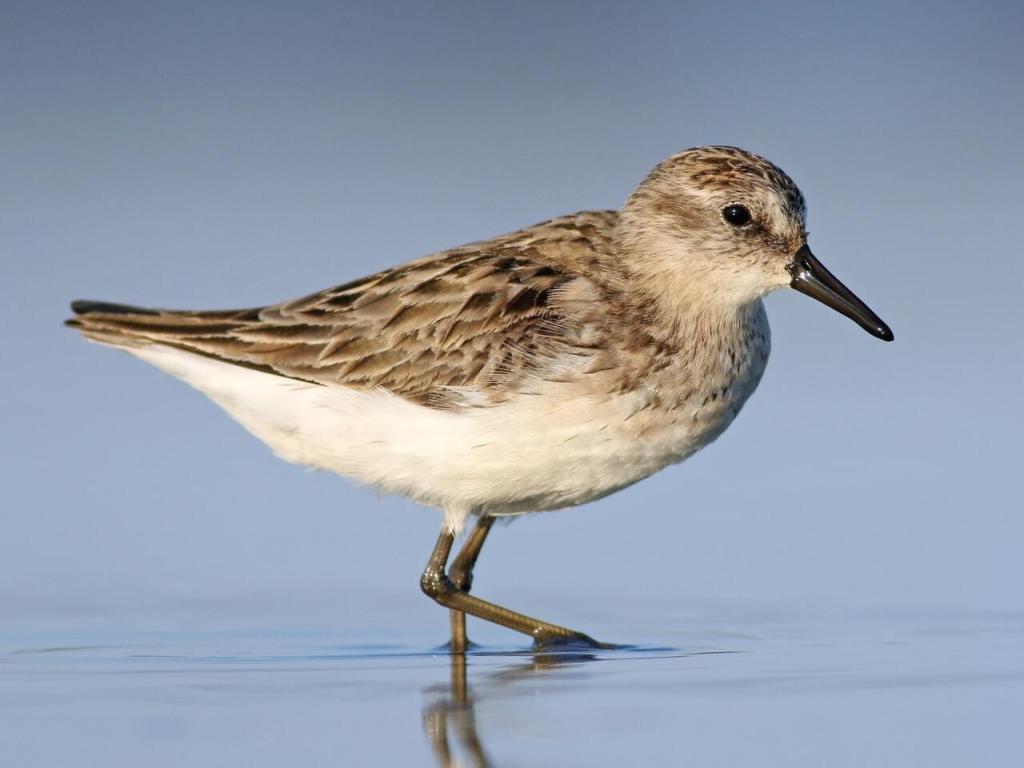
The adult bird in question had been cited as either Semipalmated or Western Sandpiper that are closely related and very similar. I had observed the first of those twice previously – at nearby Keyhaven Marsh (Sep 2013) and Slimbridge WWT, Glos (Oct 2015 see here) – but the second only on my January 2018 visit to Florida. Now it seemed the great and good of Hants birding society had settled opinion in favour of the species I needed nationally, and I at once resolved to go for it in the morning.

Notes attached to an entry on Hants Going Birding explained the local birders’ decision as being “based on posture, position of the legs, body shape, jizz when walking around, and thin-tipped bill shape.” The previous archive picture of my own (below, left) and outsourced image (right) possibly support all that, and having experienced Western at close range previously I felt reasonably confident of being able to recognise it again.

My quest was being reported each day after 10am and so I opted to arrive on site around an hour earlier. In the event parking without causing obstruction was easy at the junction of Maiden and Normandy Lanes to the south of Lymington, where there are several roadside car spaces. Walking out from there onto the sea wall, small groups of birders were at once visible scanning Normandy Lagoon (SZ 332938). On joining them the scarcity had not been viewed yet so it was a matter of waiting for carrier flocks to fly in with the incoming tide.

Time passed and more birders congregated in two main groups at different points on the sea wall as roosting wader numbers built up. Just before 10:50am a nearby pager owner announced the day’s first news on RBA, so the bird must have been seen by the other group. I headed over straight away but on joining them only two of their number were confident of the sighting. Some discussion then ensued as people confused two Little Stint, an adult and a juvenile, with what we all sought. And so the excitement subsided and a need for patience set in once more.

Nobody was locating the object of our intent in the nearest wader roost, but maybe it was amongst other large congregations too far away to be picked out. Another hour passed then a pair of Peregrine entered proceedings, putting up all the waders around the lagoon. After the latter re-settled a clearly knowledgeable birder standing right next to me began to issue very good directions concerning a bird on the nearest island … and there was the Western Sandpiper that to my mind immediately stood out.

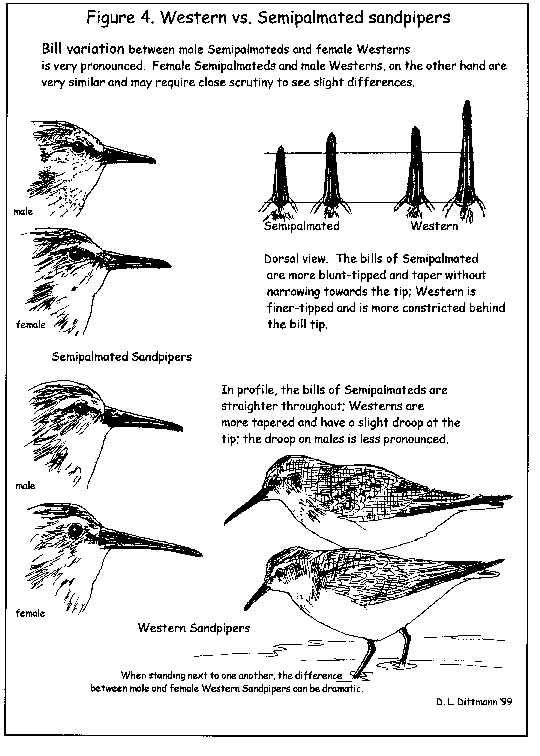
For me the most telling features were this bird’s dainty jizz, strikingly black slim legs and bill, and fine-tipped bill shape. All that was quite distinctive as it moved around amongst numbers of larger Dunlin and Ringed Plover in the middle distance, while the short bills and rounded shape by comparison of the two Little Stints people had kept calling earlier were equally plain to see. This outsourced graphic (below) presents more detail on separating Western from Semipalmated Sandpiper, with emphasis on bill characteristics.

© rights of owner reserved

More in line with my own experience today, the Helm guide to confusion species advises observers to think of Western Sandpiper as a miniature Dunlin. The two species are similar in shape and share other characteristics, most notably the down-curved bill. WS is a Tundra breeder in eastern Russia and Alaska, winters on both the US eastern and Pacific coasts, and is one of the rarest visitors to Europe in its group. 2021 has been a record year for the species, with the bird at Snettisham and another on the south coast of Ireland in July and at least two elsewhere on the continent.

This has been a very good national birding year for me personally with 10 list additions so far of which six are lifers. Those are White-throated Sparrow, River Warbler, Blyth’s Reed Warbler, Pacific Golden Plover, Black-browed Albatross and White-tailed Lapwing. The British list additions are Whiskered Tern, Great Reed Warbler, Black Stork and today’s bird that is number 370 on my British and 510 on my Western Palearctic lists. Still not having been to either Scotland or the Scillies, if I wait patiently and scan the daily bird news these things keep turning up within manageable range. So what remains for me to record nationally keeps getting whittled down … onward then!

A Purple Heron in Blenheim Park, Oxon – 17 & 20th Sep

This local item has provided some welcome motivation in the present autumn wind-down to the dreaded and detested dark season. A “probable” Purple Heron was first reported on Going Birding from Blenheim Palace’s grand water features on 14th September, then again two days later. That prompted my ever restless birding colleague Ewan to make an early conversion on Friday 17th (see here), and in contact with him I visited a little later on the same morning.

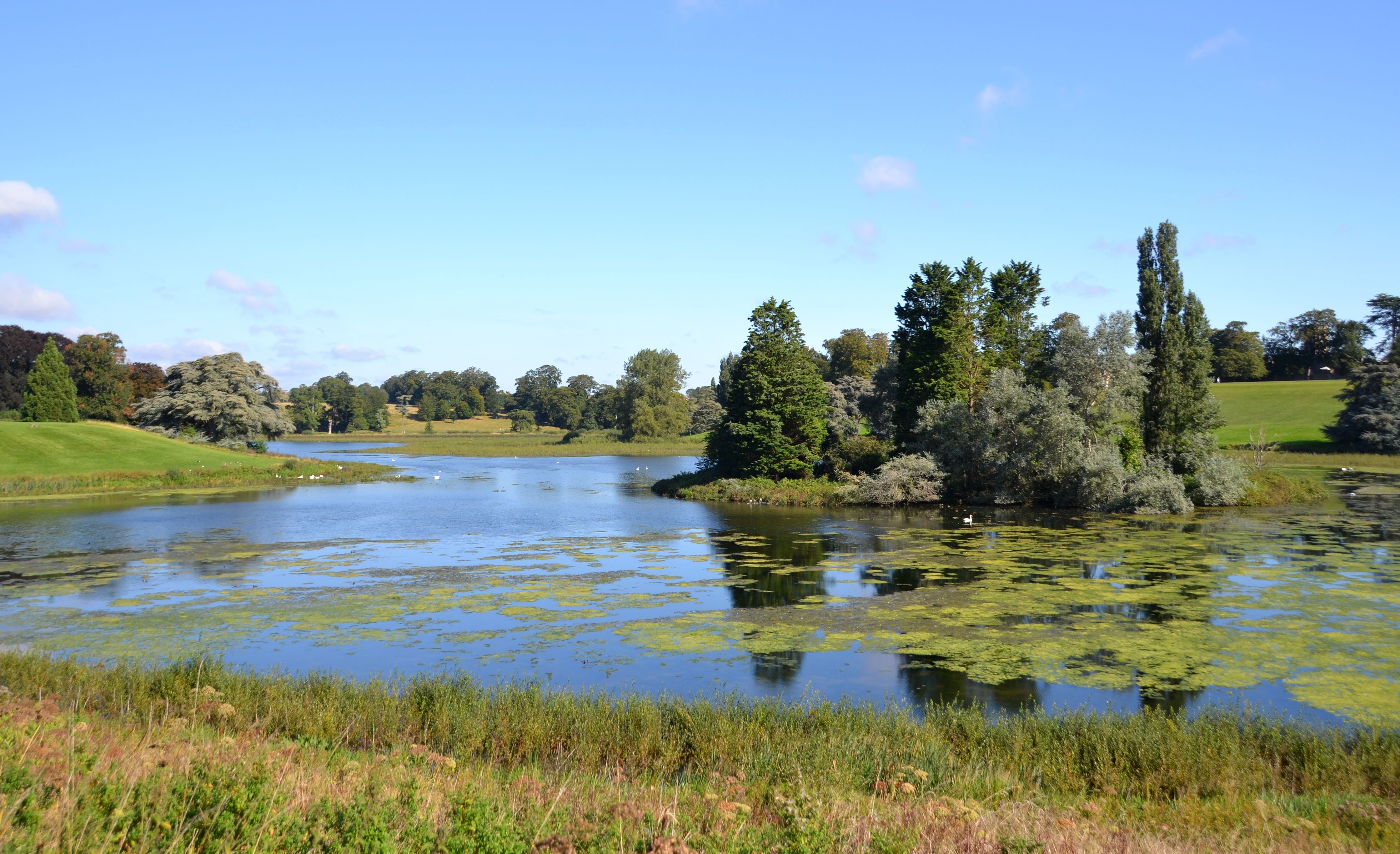
Queen Pool and its island Heronry

Ewan and another birder had located this juvenile wanderer in Willow scrub along one shore of the estate’s Queen Pool (SP440164). Having moved on he had asked his fellow to wait for myself and other Oxon birders to arrive. But as I approached there, two disappointed departees told me my quest had been chased off by Grey Herons onto the adjacent Lake. Another phone call revealed the likely viewing point and so I joined several birders scanning a particular area of reeds on the far side of Capability Brown’s watery creation.

Cue a patient wait for something to flush what is a notoriously skulking large bird. Horse riders were visible through the cover beyond and fly-by Grey Herons were also willed by all present to shorten our sojourn. Eventually a commotion between two Mute Swans erupted close to the area under scrutiny. The consensus was they were getting it on and fortunately their ardour spilled over into the part of the reed bed we were all watching. How fortunate!

Yes, up then indeed popped a very brown-toned Heron that perched in a lakeside tree for a few minutes before flying off to the far end of The Lake. Thus I had observed my third national Purple Heron; the others, both autumn juveniles having been at RSPB Ouse Washes (1997) and RSPB Otmoor (2016). I remained in position for the rest of the morning without viewing the Blenheim bird again, and it was not reported subsequently until early evening.

The weekend was the occasion of the Blenheim International Horse Trials so was not a good time for on-site birding. Some intrepid Oxon birders nonetheless connected again early on Sunday (see here). Having endured a motivationally low weekend I now elected for an early start of my own, returning at 7:30 am on Monday 20th. On arrival I found myself at first to be the only birder present, then scanned the margins of both water features without success as well as tall trees on the island in Queen Pool. First impressions were of looking more or less directly into the rising sun, which didn’t help.

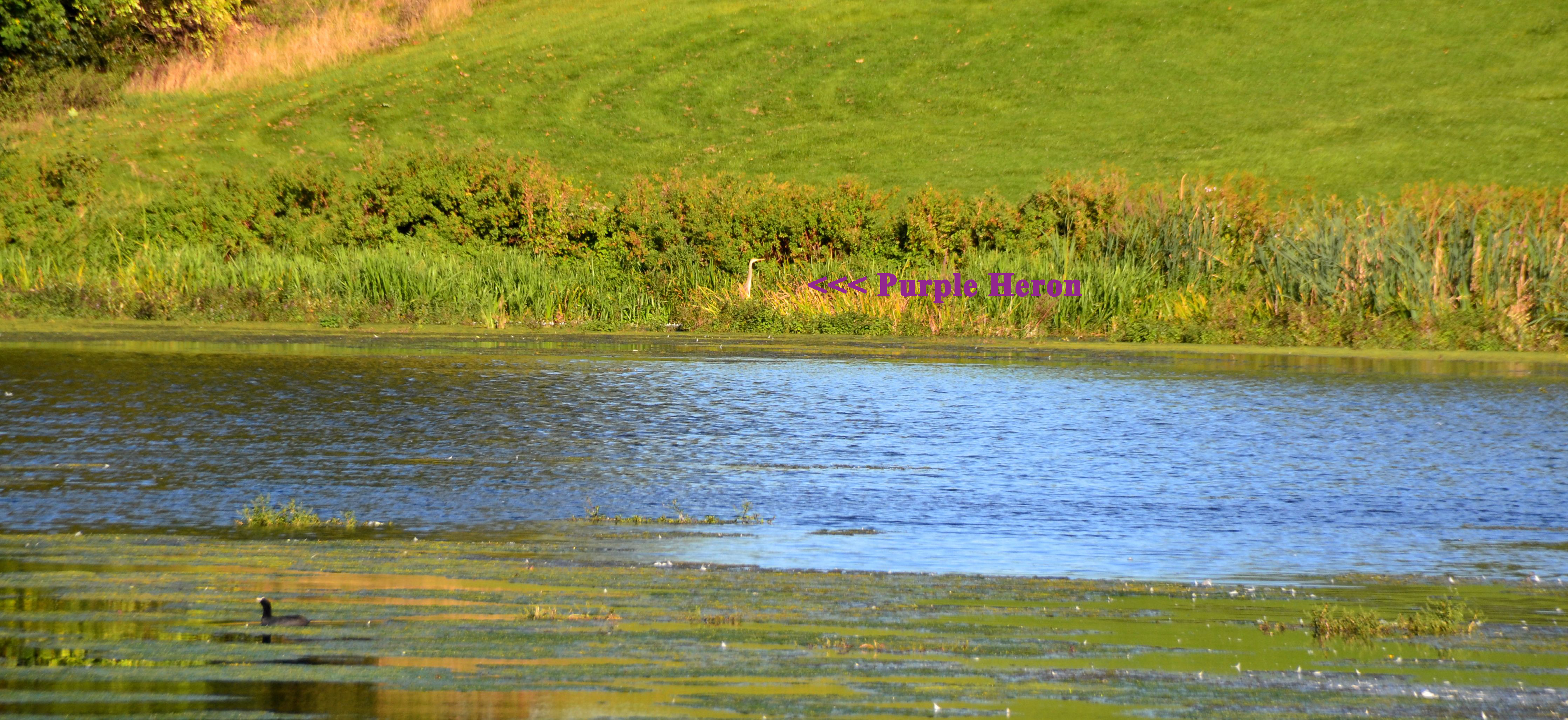
Having arranged to meet another of my more regular wildlife colleagues Sally, when the phone next rang she was heading for a picnic area on the far side of Queen Pool. Rendezvousing there we found the best possible vantage point to watch both the island and margins and so time progressed as we settled in and waited patiently. Shortly before 9am a brown looking Heron flew in from one side then over us to land on the far shore to one side of the Grand Bridge (pictured above). And so, stopping my talkative companion in full flow I announced: “That’s it!” Cue a pre-agreed call to other on-site Oxon birders who could not yet see it and the Purple Heron was re-announced to the airwaves.

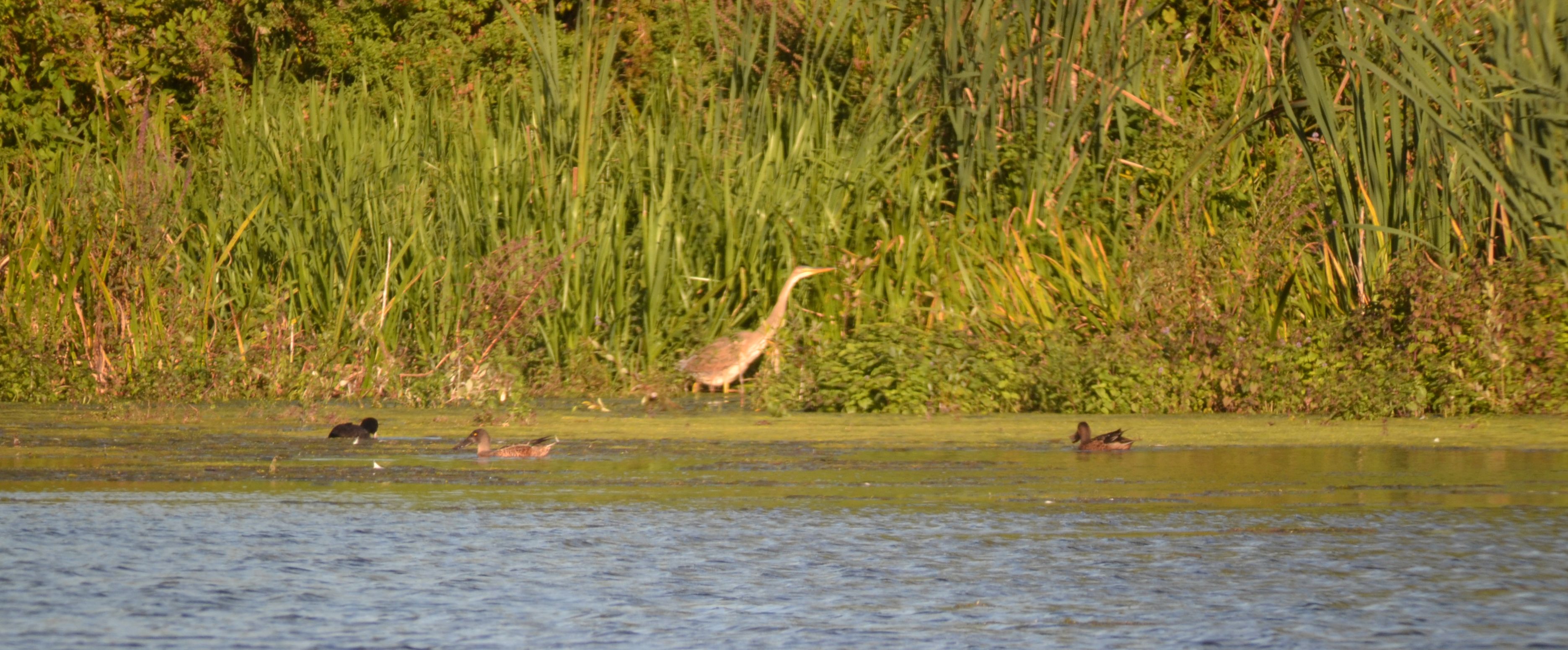
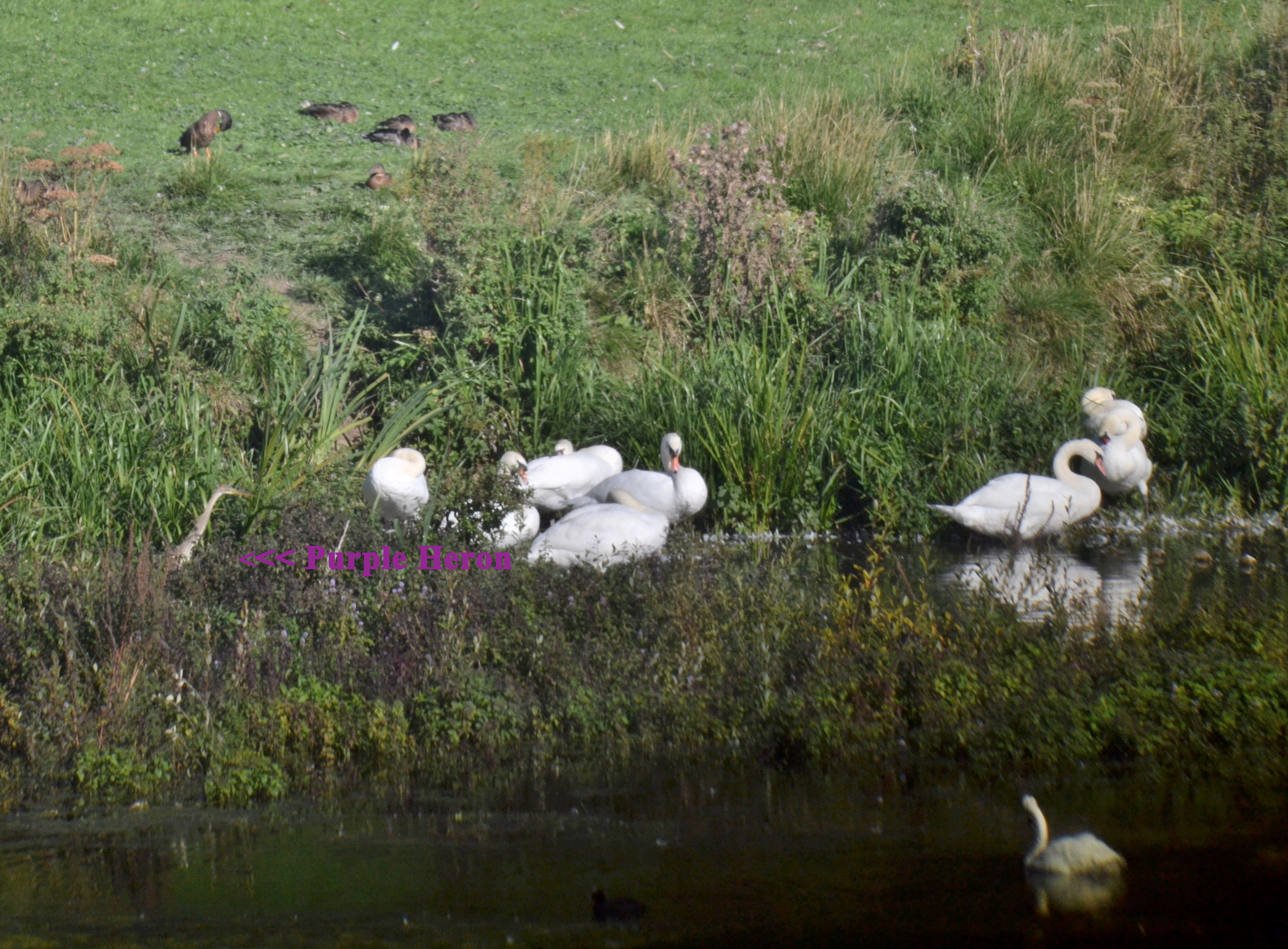
Through the next hour this county and national scarcity offered very good value as mostly showing well it foraged in the marginal vegetation (above). Achieving adequate pictures at the distance was hardly likely though, but those herein convey how this bird was seen by myself and so must suffice. The juvenile bird’s onward path took it ever closer to a largish group of Mute Swans (below) and so we waited for the inevitable to happen. Sure enough the resident Swans took exception to the interloper and went into the threat posture, at which the Purple Heron took off and flew to the opposite shore, and so we followed.

More birders and interested general public gathered round as we then watched the Purple Heron’s neck and head moving and foraging through deeper cover (see here). There seemed little reason for the bird to re-locate from there unless it was spooked by something, and so in late morning we went on our separate ways. This Oxon rarity had without doubt put on its best show to date this morning. It was one of a small September influx nationally with other individuals occurring in Norfolk, Essex, West Sussex, Kent and Somerset.

Recent “neglect” of the Blenheim lake margins has undoubtedly enhanced their quality as wildlife habitat, which is currently evidenced by the presence of five different Heron species in the park. Earlier this year Cattle Egret bred in Oxfordshire for the first time ever in the island heronry and Great White Egret are regular at the site in autumn and winter. But Queen Pool is due to be drained and dredged soon, the work having been postponed through the Covid pandemic, so how the “wildlife friendliness” here may then be affected remains to be seen. Right now I just feel pleased to enjoy the situation while it lasts.

My first national Black Stork is nailed at the third attempt in Lincs – 7th Sep

After three recent bird lifers – Pacific Golden Plover, Black-browed Albatross and White-tailed Lapwing – I have now completed what I regard as the “regional set” for Lincolnshire and East Yorkshire for this late summer. A long staying juvenile Black Stork in the first of those counties has been bugging me for some time.

This long-legged bird visited RSPB Frampton Marsh briefly while I was connecting with the PGP’s on 14th August (see here). Then I spent four hours searching for it on 22nd at nearby RSPB Freiston Shore, a day on which it went temporarily AWOL. But in between and since those dates it has been reported regularly from one reserve or the other. So on not sleeping past 4am this morning I upped and went to try to get the job done properly.

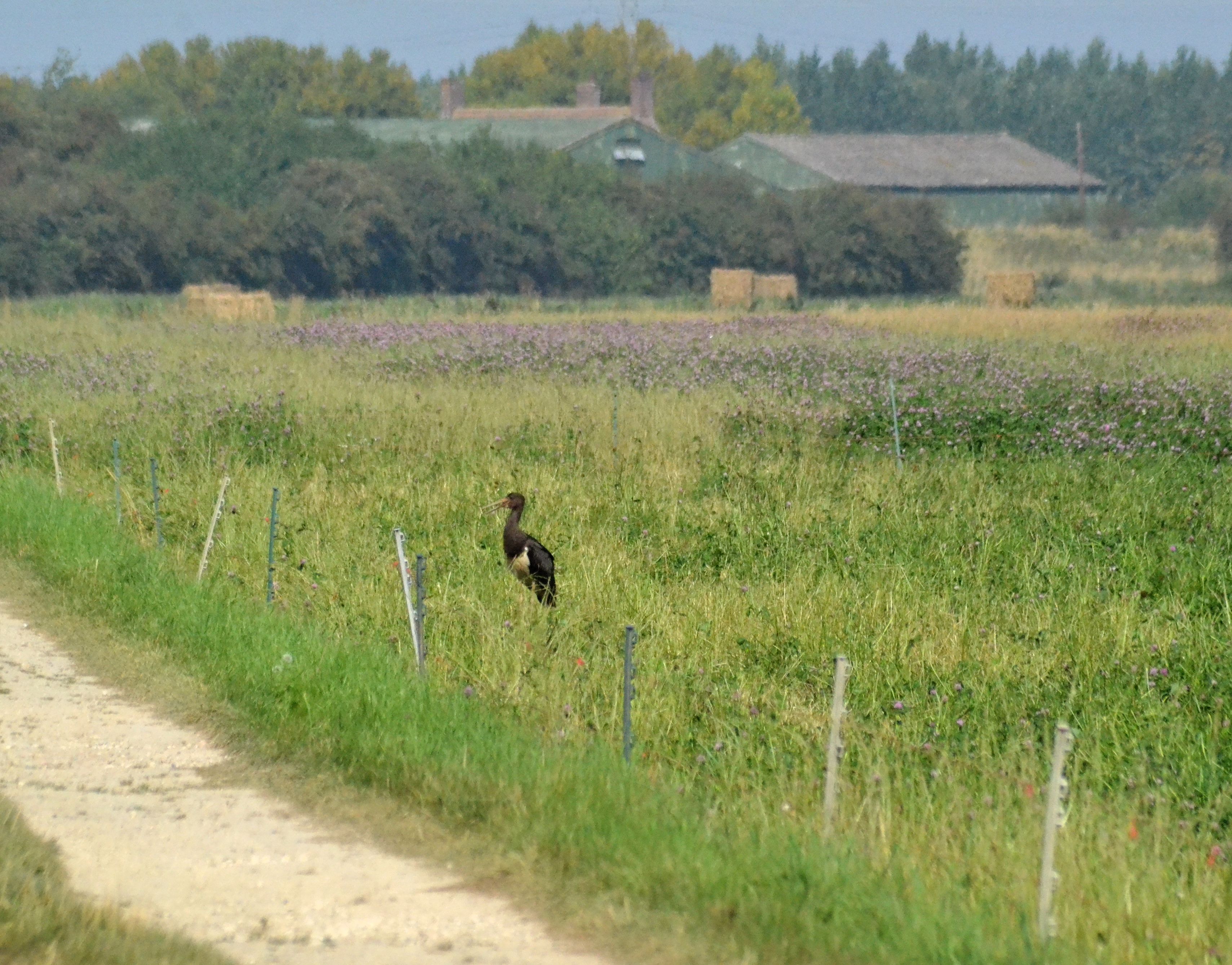
Black Stork (juv) in heat haze

This was forecast to be a very hot “Indian summer” day, and what a contrast to my previous attempt it produced! Arriving on site at 8:45am I opted to first check out the location of my quest’s last report on RBA the previous evening. That was a field just to the north of Frampton Marsh with a grid reference TF355398. Parking at the top of an access track into it, I set out to scan Wyberton Marsh towards the sea and what should be standing there right ahead of me and directly into the sun (pictured below) but the Black Stork of my intent.

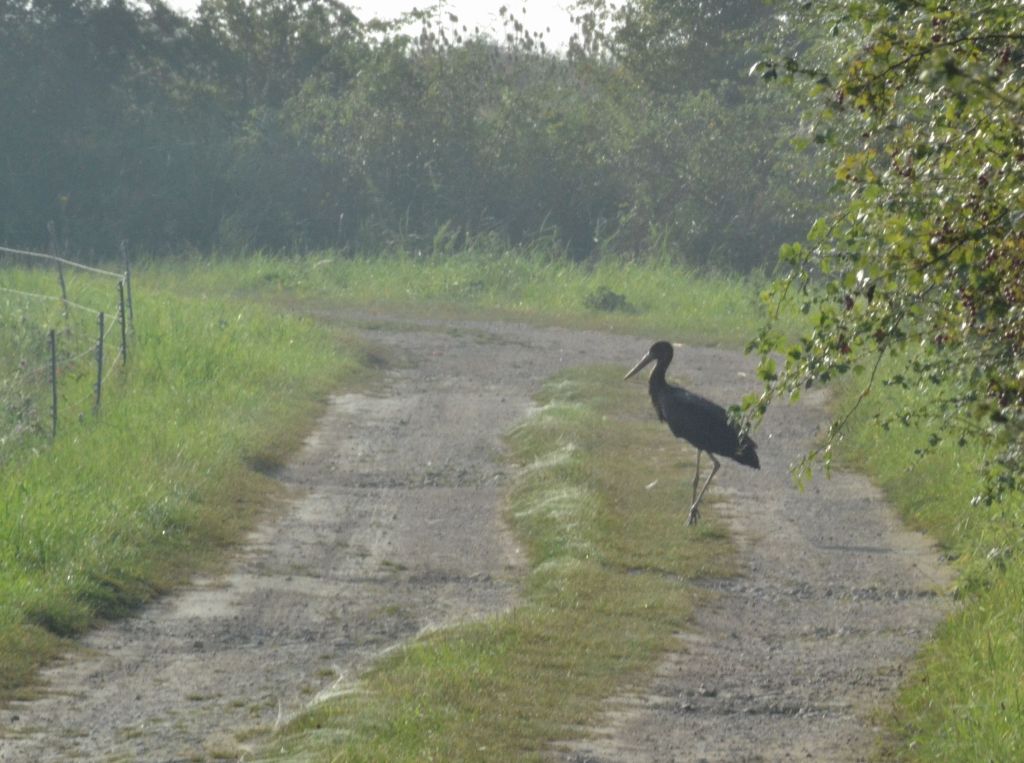
The initial connect today was as simple as that. There was already a significant heat haze that combined with glare throughout the morning to come rendered all the images in this post no more than “record shots” that show I am not making all this up. For the RBA gallery of this bird, which has wandered East Yorks and more especially Lincs since 7th August see here.

I will admit to then putting the bird up, since I was not as careful in my approach than if other observers had been present. But whether people might have been watching from afar and so witnessed my misdemeanour I didn’t know. So moving on to RSPB Frampton Marsh (PE20 1AY – TF357390) I kept quiet. But I was soon exonerated as the Black Stork flew in, making a low aerial pass in front of the visitor centre before settling in the middle distance.

Hence every birder in the vicinity enjoyed very good views. When the Stork next took flight it circled overhead before heading back towards where I had first stumbled upon it. The idea formed in my mind of sneaking back out there away from the crowds, but I hung around a while longer. And when a birder walking back from that direction said: “It was on the farm track just near me in that field where the sheep are 15 minutes ago,” things sounded familiar.

Continuing along the visitor trail I noticed an open gate through the reserve boundary. Then checking out the farm track beyond it I realised I was back where my visit here had begun, but at first there was no sign of what I sought. Then the Black Stork flew in again (pictured below) to settle on the track away to the right, before relocating on my left at 300 metres.

Maybe this had become a favoured location for the wanderer. Now I took much more care over not spooking it and began to attempt pictures keeping in semi-cover, but I soon had company. As visitors walking the trail noticed the open gate, more and more came and went as numbers reached double figures at times over the next hour and a bit. For all that time the Stork just stood unconcerned in the same spot, panting in the heat and occasionally preening.

Having by this stage attempted endless unsatisfactory images I actually hoped someone might flush the bird so I could get flight studies, but it fell to the grazing sheep to eventually do the deed. Thus irritated the Black Stork at length took off again, circling ever higher before flying off north, and my own submission at that point was the last on RBA today.

I had observed Black Storks previously in Holland (Aug 1988), Greece (Apr 2017) and Turkey (June 2019). The species breeds in forested regions and marshy wetlands of east and south-eastern Europe and western Asia, wintering in tropical Africa, India and south-east Asia. Today, after those recent frustrations, this much chased British list addition (369) served extra helpings over and again on my third attempt for it, and is now well and truly dealt with.

White-tailed Lapwing at RSPB Blacktoft Sands, Yorkshire – 28th Aug

I don’t usually do madcap, through the night twitches to jostle for elbow room at first light in cramped hides with scores of grumpy, hairy, ugly men – but for an Asian Plover species I am prepared to become a proper birder for the day. That group of birds holds a special fascination for me and one of it’s number, a White-tailed Lapwing turned up on south Humberside two days ago. This was a must-see.

Being both a local and national mega and the first in Great Britain for 10 years the bird on its first two days attracted huge crowds to the RSPB’s Blacktoft Sands reserve (DN14 8HR – SE843232), and more of the same could be expected today. Tales abounded on social media of long queue’s for limited viewing time in two different hides. All this was tolerantly and well organised by the RSPB in the populist charity’s now more enlightened stance towards those of it’s traditional membership and support who wish to observe particular rare birds.

Today’s White-tailed Lapwing © and courtesy of Ewan Urquhart

As things transpired, my twitch leader Mark’s strategy was to get here later in the day by when numbers of people would have subsided and the light might hopefully be better for taking pictures. And after our near seven-hour vigil for the Black-browed Albatross at our first stop, we did not arrive on site until 16:30. Greeted by the reception staff we were at first able to gain brief, unsatisfactory views from there of my day’s second lifer the White-tailed Lapwing (or Plover). The question then was which of two hides to attempt proper observation from.

The bird had commuted through the day between two of the reserve’s six shallow brackish lagoons, in front of the Xerox and Townend hides that are around 350 metres apart. Ewan and Mark reasoned it would be preferable to wait for it to return to the latter where better views might be gained. I joined them at first but before long it seemed sensible to split up and stake out both hides, so I transferred to the Xerox. En route I was told our quest was on view from there but when I walked in it had just moved behind a large, reed-covered island. Ho hum, such is birding.

Feeling a little disgruntled with how things seemed to be turning out I sat down and waited, while enjoying the variety of other waders present – Black-tailed Godwits, Ruff, Greenshank, Common Snipe, Green Sandpiper and a Spotted Redshank. I learned that the star visitor prefers to feed in sheltered locations rather than out in the open. Things did not look good but eventually something flushed more ducks and waders from behind the island. Now on the far side of the lagoon before me, of a sudden and in all its sublime elegance stood the White-tailed Lapwing of my intent. I alerted Ewan then scoped the quite delightful Plover as it moved along the reed edge back towards the island.

White-tailed Lapwing © and courtesy of Ewan

This slender and graceful, even dainty looking Lapwing may be described as having rather plain beige upperparts, greyish breast and creamy brown belly; with a pale brown crown, short black bill, large black eyes and strikingly long, bright yellow legs. It breeds in former Soviet central Asia west to Iran and Iraq, and normally winters in the Indian sub-continent and north-east Africa. Very small numbers may migrate to south-eastern Europe.

In it’s home range this is the only Lapwing likely to be seen feeding persistently in deep water or submerging it’s head while doing so. It is rarely found far from the margins of still or slow-flowing water, preferring well vegetated river or canal edges and either saline or fresh water pools rather than open mud flats. By comparison with the familiar Northern Lapwing this distant cousin is rather skulking with a preference for cover. A very scarce vagrant to western Europe, today’s bird is just the seventh ever British record.

White-tailed Lapwing © and courtesy of Mark Rayment

I had got lucky today, then my own earlier experience was repeated as my two colleagues arrived just after the bird became lost to view again. So we all settled down and waited for it to emerge from its hiding place once more. Fortunately two Marsh Harriers were active over the reed bed beyond the lagoon and other large birds, Herons and Egrets that might flush waders would fly through the channel behind the island at intervals. Two more instances occurred without the WTL appearing again, so was it still there or had it headed in the other direction?

After another flush that question was answered and our day became complete. Now the White-tailed Lapwing was much closer to the hide than earlier and commenced to go walkabout around the lagoon, offering decent enough picture opportunities in the fading light. But my own camera was ineffective at the distance in those conditions, so I am indebted to my two companions for the images in this post. For the RBA gallery of this bird see here.

White-tailed Lapwing © and courtesy of Ewan

It was now early evening and so we set off on the four hour journey home in a contented frame of mind. It had been a very long but ultimately successful day. As a back seat passenger of two real birding “professionals” I had gained two mega life list additions beyond my own preferred twitching range and without the scenario of this post’s opening paragraph that also normally puts me off. My grateful thanks are due to Mark for doing the driving today and to Ewan for inviting me along in the first place. My British bird list now stands at 368, and my western Palearctic list at 509.

A six and a half hour wait for Albert the Bempton Albatross – 28th Aug

There is nothing I can really add to what has already been published online about this bird. So here I will merely recount my own day spent catching up with what is possibly Great Britain’s most popular rarity of 2021. Since his arrival there on 28th June the seasoned Black-browed Albatross commonly known as “Albert” has drawn thousands of admirers, both birders and general public to RSPB Bempton Cliffs in Yorkshire. I have waited for an opportunity to observe him without driving beyond my preferred range, and that came today.

THAT Black-browed Albatross at RSPB Bempton Cliffs

Arriving on-site (TA 197739) at 6am, in company with Ewan and his regular long-distance twitching buddy Mark, we headed out to the Staple Nook viewpoint. There Albert likes to wile away his time loafing amongst the breeding Gannets before putting on impressive flight displays when the mood takes him. Between them my day’s 500+ British list colleagues have successfully converted almost every new national mega of recent years, including this one twice before, so I had chosen my carriers consciously. On taking up position with something-teen other early birders we learned our quest had flown in to the cliff face around 20 minutes previously, but was now out of sight somewhere below us all.

Cue a wait for the show to commence … quite a time as things transpired. The longest I have ever waited for a bird to take the stage was seven hours for a Baillon’s Crake at Rainham Marsh, Essex in September 2012. Then I concluded that other lifer must have been a female exercising her prerogatives. Being a chap, the reputed half-centurion Albert really ought to have known better. He has not been noted for spending such lazy mornings as today too often, but local birders around me said his routine is never predictable. And so we waited for flight to commence … on and patiently on.
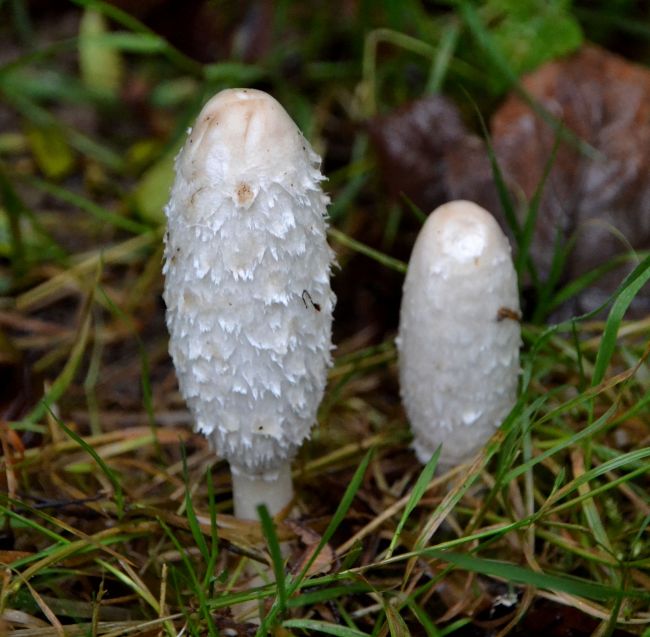
After three hours word came through that Albert was visible on the cliffs from 500 metres or so away to our right, where some birders had picked him out. This being a lifer for me but not my two colleagues, I went over while they stayed behind. I was put onto a rather indistinct grey form nestled amongst the Gannets someway down the sharp top edge from the viewpoint I had vacated, that I was assured was Albert’s back. Eventually this blob raised the white head and pink bill of the Black-browed Albatross I had seen so many images of online, while he alternately dozed and preened. So I thus added this nationally famous mega rarity to my life list … first priority achieved!

Returning to the Staple Nook viewpoint in relaxed mode I then chatted to other birders and friendly volunteer wardens around me, while Albert lazed his time away below and, yes upon checking quite definitely out of sight. Three more hours on at 12:18 the shout at last went up as the BBA got his act together and headed out to sea, landing on the water’s surface. At this stage I was informed by a regular local birder standing nearby this was what he usually does on first taking flight, and he was likely to fly inshore again soon. And so it transpired.

Cue an eventual aerial display that had my trip’s new colleague and ace photographer Mark Rayment enthusing for the rest of the day. Over the next 20 minutes or so Albert performed to his adoring audience like we had all been waiting to see, gliding around and banking on those huge outstretched wings. First out to sea, then close in to the cliff face, out of sight away to the left and around all over again. Since that early arrival here I had been assured this was what the bird would sooner or later do.
Though I will not be entering any of them into competitions, I am frankly astounded at having gained such half-decent images of my own for this post. With my ancient “photographic” artefact these were as usual achieved through altering the basic settings as I went along and hoping for the best. Mark told me the underside studies are the most difficult to achieve, and were the main reason he had wanted to come here again today.

Thus sated the by then hungry and thirsty gathering at Staple Nook mostly dispersed, the three of us included. It being just past midday on a bank holiday weekend, lots of general public who all seemed to know about the Albatross had joined the earlier birders on the cliff top to enjoy his eventual flight spectacular. My own party had a second mission for this day, a mega-rare Asian Plover, White-tailed Lapwing also in Yorkshire around 90 tortuous local driving minutes to the south. And so we went on our way.

Through our seven hour sojourn here we of course had the spectacle of Great Britain’s largest mainland Gannetry to keep us entertained. My best pictures of the morning are presented below. Though the other breeding seabirds have now dispersed, small numbers of Guillemot, Kittiwake and Shag were still active offshore. This was also the first occasion on which I have managed to capture Fulmar pictorially, and at one point two Porpoises swam past.

For the record, the Black-browed Albatross, whose home range is the oceans of the southern hemisphere, is thought to be the same individual that has wandered the North and Baltic Seas visiting coasts in Germany, Scandinavia and Great Britain since the 1960’s. No spring chicken now, Albert is likewise thought to be the only one of his kind in European waters and might survive for another 15 years into his seventies as this species often does.

If indeed the same bird he first visited Bempton Cliffs in 2014, then again in 2017 and 2020 always briefly, but this summer has been more or less a fixture for almost nine weeks. Though eternally lost throughout his long life to date, he must clearly feel very much at home here and I feel glad to have belatedly made his acquaintance on this day.