Essex Skipper at south Oxon sites: Wallingford and Hagbourne (with Essex / Large / Small Skipper ID guide) – 5th July

Essex Skipper is possibly one of the easier butterflies to overlook in a British season unless the observer is going for the full species set, since it is both rather nondescript and tricky. To my mind closely examining every brown Skipper I might come across in high summer, except at known Essex sites is a bit of a chore. But being in need of a wildlife project on this mainly sunny morning I set off for a regular local site in order to present a first appreciation of the species in this journal since 2015 (see here).

On the way a profusion of bright pink flowers caught my eye at a field entrance besides the Wallingford southern by-pass (SU 592901), and I stopped to investigate. They turned out to be Sweet Pea, presumably of cultivated origin, but then I noticed my season’s first Gatekeeper butterfly and went to retrieve my camera for a record shot. Close to where that insect had been was now none other than a perfectly posed Essex Skipper that allowed a point blank approach, so I was able to capture (below) a diagnostic image.
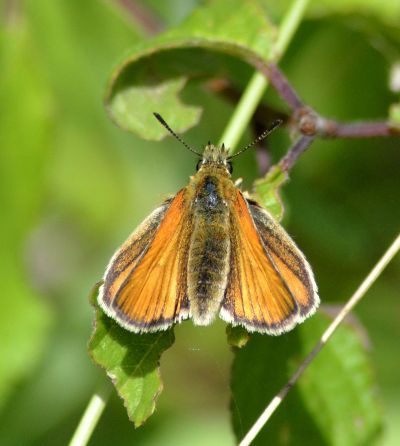
essex skipper.2001 wallingford

Essex Skipper at Wallingford, Oxon

Several years ago now I was advised by the former Butterfly Conservation Upper Thames Branch then national chair Dr Jim Asher to look at brown Skippers head on when attempting to separate Essex. The lozenge-like antennae are inky black tipped and shaped rather like Cotton Bud swab sticks. A thin black line through the centre of the fore-wing in males, parallel to the leading edge is a further diagnostic. In Large Skipper the antennae can also appear black when viewed from a certain angle, but the tips are sharply down-turned and pointed. The following pictures illustrate this, but being point blank macro lens studies the intent is to highlight the diagnostic and not for the whole insect to be in focus.

Feeling pleased with having recorded another 2020 butterfly locally at a new location I then drove on to the regular annual site of Hagbourne Railway Embankment (SU 521882). A brisk wind was blowing but at the first sheltered spot I reached walking south from an access point near East Hagbourne cemetery I came across three more Essex Skipper that also enabled close scrutiny (pictured below).

Here there were also Large and Small Skipper for comparison. In Large (below left) the antennae are black below and golden brown above, and as stated earlier the tips are markedly hooked. In Small Skipper (below right) that brown toning is more noticeable and the antennae tips though still quite pointed appear less hooked. The upper wing patterning of Large Skipper is also much bolder than the other two species with a prominent black sex-brand in males on each fore-wing, and the flight and all round jizz is just heavier.

So there it is … a brief and simple Rn’S guide to brown Skipper ID. It is presented in anticipation of less seasoned butterfly watchers accessing this post via web searches, and does not attempt to preach to the converted. For the former it’s all a matter of practice and once the observer has their eye in things become much simpler.

Why this butterfly has its name is one of those entomological anomalies surviving from the 19th century. It was first recognised as a separate British species from Small Skipper in 1889 and the last resident species to be described, but has no special association with the English county of Essex. The complete range is from southern Scandinavia through continental Europe to north Africa, and east to Central Asia. ES was introduced into north America in the early 20th century, where it now occurs across southern Canada and several northern US states and is known as the “European Skipper”.

In the British Isles Essex Skipper is found over much of the southern half of England below a line from Lincolnshire to Dorset. Flying in July and August, it can be very common locally, typically forming colonies varying from small numbers up to several thousands. Preferred habitat is in a variety of open sunny situations, especially roadside verges, woodland rides and grasslands as well as coastal marshes.

National distribution is acknowledged to have more than doubled in the last few decades, a spread that is thought to be assisted by trunk road embankments acting as wildlife corridors. This butterfly was first recorded in Wales in 2000 and reached south-eastern Ireland in 2006. But due to the similarity with Small Skipper, Essex has always been under-recorded so I have not been alone in neglecting this butterfly over the years.

Hagbourne Railway Embankment (see here) formerly carried a line from Didcot to Newbury and Southampton, and is now a focus for both recreational activity and wildlife study. A designated and well-used cycle route, it also starts from a large housing estate and so is something of a playground for local people. But despite all that the site is exceptionally wild flower rich along its entire length, a route between the villages of East and West Hagbourne, and Upton to the south.

Common seasonal butterflies are all present in good numbers, amongst which are site specialities of Essex Skipper and Small Blue. It was a very enjoyable couple of hours that I spent in this wildlife haven today. And with most remaining Covid-19 restrictions having been lifted in England a day earlier the general public too seemed in ebullient mood. Devoting a little attention to an often overlooked British butterfly proved to be a very worthwhile exercise indeed. They are out there to be found if looked for.
Oxon’s first Blue-eyed Hawkers in the Otmoor basin: a successful dragonfly twitch – 22nd June

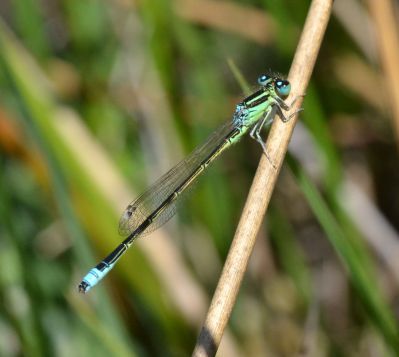
Since it’s arrival nationally along the Thames estuary in 2010, Blue-eyed (or Southern Migrant) Hawker has colonised the British Isles widely and rapidly. It seemed only a matter of time before the first records occurred for my home county of Oxfordshire and that has now transpired. The event has prompted great interest in local natural history circles, and the dust having settled since the initial discovery on 15th June I myself have been to take a look.

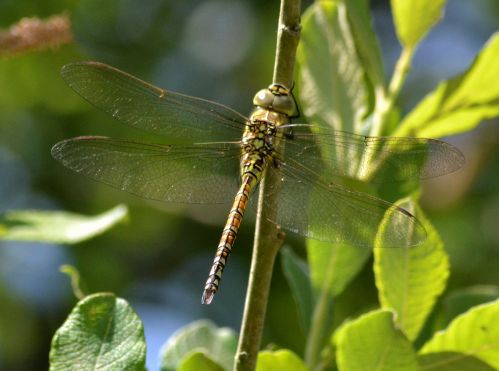
Later in this day (22nd) it was confirmed there are now three individuals, two males and a female (see here) at the location along the old River Ray near the village of Oddington in the Otmoor basin (SP 5523 1404). In the morning I had met Ewan at Bucknell Wood, Northants to progress that part of the annual national butterfly agenda that involves Purple Emperor and White Admiral. When I said I was stopping at Otmoor on the way home he came along too, then on our arrival Badger (Oxon Birding web administrator Jason Coppock) was already in place ahead of us filming our quest (pictured below) that he put us straight onto. Things today were as simple as that.

blue-eyed hawker.2001 imm oddington

Blue-eyed Hawker (immature male) near Oddington, Oxon

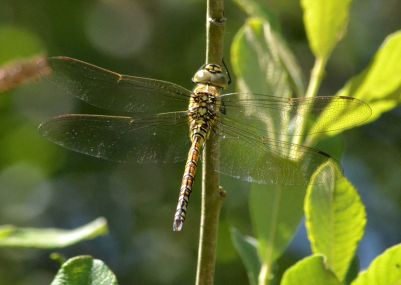
I had previously observed adult Blue-eyed Hawker in Essex at Wat Tyler Country Park, Basildon (Aug 2015 – see here) and Canvey Island (July 2017 – see here). The opportunity to experience the immature colour form on offer locally now appealed to me considerably. I am unsure whether my picture shows a male or female and would be grateful if more skilled county colleagues could gender it for me in comments. By way of explanation I prefer to use standard international dragonfly names, in this instance “Blue-eyed” Hawker over their sometimes rather idiosyncratic British Dragonfly Society (BDS) equivalents of which “Southern Migrant” Hawker is one.

The history of this species in Great Britain goes something like this. After a single confirmed record during the 20th century, four individuals were found in southern England during 2006. In 2010 many more were observed in south Essex and north Kent, with egg laying being noted at two sites (per BDS). Since then, what had previously been a dragonfly associated with the Mediterranean region of southern Europe has been recorded as far afield from its British entry point as Cornwall and Yorkshire, as well as many other places in between.

blue-eyed hawker.2002 imm oddington

Blue-eyed Hawker (immature male)

Once my two companions had gone their separate ways today I took a little time over taking pictures of some other dragonflies along the bridleway back to the village of Noke, where I prefer to park discretely if visiting Otmoor. The area around the old River Ray weir, just west of the RSPB reserve is especially productive for Odonata and teemed with maturing Ruddy Darter (pictured below) and blue Damselflies on this occasion, while occasional Brown Hawker and Blue Emperor also buzzed by. It was close to here that another county first record, that of Blue (or Scarce) Chaser occurred in July 2014, so the location has some form locally.

The yellow-toned studies above show immature Ruddy Darters, while the redder individuals in the bottom row are some way to acquiring their adult colouring. There are huge numbers of this dapper little dragonfly in the Otmoor basin each season. It is one that I always find especially attractive and photogenic, and so never tire of attempting more pictures of.

In the morning at Bucknell Wood (SP654450) we did not come across any Purple Emperor, though the first Oxon records for this season had occurred at two sites a day earlier. Pristine White Admiral were indeed a feature, but like the Blue-eyed Hawker could only be captured pictorially (below) looking into the light.

Still fresh Wood White (above) were again plentiful at the Northants site that is a stronghold for them (see here). I cannot recall having observed them so late in June previously, not having made the effort to do so. This is a site I intend to pay more attention to in the weeks ahead to track the progress of Wood White through its second brood. Today had been quite an energetic step in that direction.

Daneway Banks SSSI, Glos re-visited for Large Blue butterflies – 17th & 23rd June

At this time of year when the daylight hours are at their longest I tend to wake with the light. So on this particular sunny early morning, having completed some early chores I opted to re-experience a British butterfly I have avoided since 2015. Two Oxon wildlife colleagues had made the same tripette ahead of me without reporting the circus that had so put me off on my previous visit to Daneway Banks. So I took a chance both on presently unpredictable weather conditions and another disagreeable outcome.

After arriving on site (SO939036) around 10 am I headed up to its highest part where I had been told my quest might still best be located. In the by now lightly overcast, mild and calm conditions this reserve simply teemed with seasonal butterflies – Marbled White, Meadow Brown, brown Skippers and a few Ringlet – but it didn’t take long to notice a first Large Blue in the grass to one side of my footfall. There was company, but thankfully those other observers were all genuine butterfly enthusiasts.

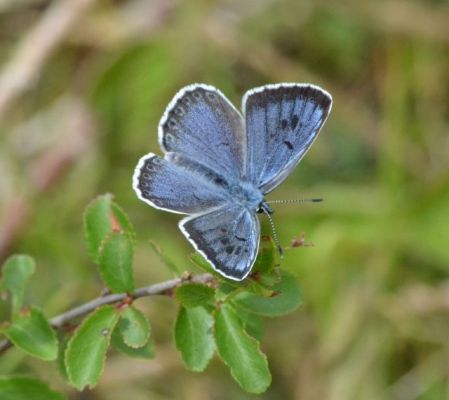
large blue.2003_01 daneway banks

Large Blue

Thereafter, as I walked on something else distinctly blue would stand out every so often from the more commonplace fayre. And each Large Blue I encountered seemed to pose a little more pleasingly than the previous one. On the hilltop there is a cordoned off area to prevent breeding habitat from being trampled, but in the accessible margins around it, where there was plenty of the food plant Wild Thyme, I eventually estimated self-finding 14 individuals. For much of the time I had those to myself and was able to enjoy true communion with them, unlike on that 2015 visit.

Daneway Banks is owned jointly by Gloucestershire Wildlife Trust and The Royal Entomological Society, who work in partnership to manage it as a nature reserve and a place for ecological study. A steep, south-east facing hillside above a dry valley on the north side of the River Frome, the upper slopes of the 17 hectare (42 acre) site are an example of prime limestone grassland. That habitat and areas of ancient Beech, Yew, Hawthorn and Hazel woodland have long been considered exceptional for biodiversity even by the high standards of Cotswold grasslands. SSSI status arises from the great plant variety including calcareous-specific species.

The main sward is interspersed with patches of scrub and woodland, occasional cliffs and scree from small abandoned quarries. Across the lower parts of the hillside, Jurassic limestone soils are replaced by neutral Fullers Earth clays on which fewer wildflowers grow. Up to 10 different Orchids bloom here at different times of the year, as well as regionally rare plants including Angular Solomon’s Seal and Mountain Bedstraw, and two national rarities Cut-leaf Selfheal and Cutleaf Germander.

From mid-autumn to spring the site is grazed by sheep and ponies, so by late winter the sward is predominantly short with scattered taller patches. The land is then left un-grazed through spring and summer, allowing a succession of wild plants to bloom and set seed, and for insects to breed. Thousands of Yellow Meadow Ant hills, known locally as “Emmett Casts” are a prominent feature.

But it is the now thriving population of Large Blue (pictured above) in June and July that attracts most visitors to this remote and scenic location. The Cotswolds was one of three main regions where the butterfly bred before its extinction as a British species in 1979. In tandem with appropriate habitat restoration by a consortium of scientific and conservation organisations, re-introduction then commenced of a near identical Swedish race into Devon from 1983 then Somerset and Gloucestershire from 1992. Over 25-years these butterflies spread to more than 30 sites, mainly in Somerset. Although most were small satellite colonies, the core populations were very large for this rarity, exceeding known numbers anywhere else in the world.

In the Cotswolds this re-colonisation struggled, however, The earliest introductions at Butterfly Conservation’s Rough Bank reserve (SO913087) and Barnsley Warren SSSI failed because the adult butterflies emerged too late to synchronise with flower-bud production of Wild Thyme. So ovipositing females had to rely on occasional late-flowering plants growing in the coolest spots within sites. In Somerset spring and summer local climates more closely matched the source sites in Sweden, so the synchrony was imperfect but adequate. In the Cotswolds, where temperatures were a further half degree cooler, it was not. Such is the fineness of the tolerances that were involved.

So the story goes this is a tale that must be told … and all that. Large Blue larvae famously grow as parasites within the nests of a particular species of red Ant. After some initial development on Thyme and attaining the minute proportions of their Ant counterparts they are “adopted” by foraging Ants that are tricked into taking them home. This is achieved by emitting a secretion to attract Ants who think they are their own larvae. Once in the nest the butterfly larvae feed on the Ant grubs, often destroying entire host colonies.

At Daneway Banks, despite under-grazing by livestock in the 1970s and 80s sufficient Wild Thyme remained to support increased populations of the said Ant, with appropriate habitat management. So the site was identified as a more promising one for restoration than its Cotswold predecessors, and through the early years of this century Ant densities increased and Thyme spread under targeted grazing. I am being brief in this summary. For more detail in the Royal Entomological Society source article by Prof Jeremy Thomas see here.

From 2010 continued re-introduction of the European Large Blue at Daneway Banks has been more successful still. The site now supports one of the largest populations of this globally endangered butterfly anywhere across its range, and is widely regarded as one of the best places to see the iconic species. I came back six days later on 23rd to fully explore this beautiful reserve. In much sunnier conditions the Large Blues were far more flighty and less inclined to perch openly, but I still gained some more images (above).

I also paid some attention this time to Daneway Banks’ more common butterflies. It is difficult ever to tire of attempting more under-side studies of Marbled White as they display their geometric intricacy atop as attractive flower heads. But one of the morning’s better picture opportunities was a little Meadow Brown dinner party (above right).

The evidence of these two excursions was that a more peaceful co-existence is now being achieved regarding visitor pressure than the situation that so discomfited this particular observer five years ago. So these were the most positive of my own five national Large Blue experiences to date, and ones that I thoroughly enjoyed.

A Marsh Warbler at King’s Meads in Ware, Herts – 8th June

It was a huge relief to hit the road this morning on a birding twitch, for the first time since mid-March. There are not too many of what I term “annually occurring” small migrant European passerines that I still require for my life list, and I scan the national bird information services each spring and autumn in the hope of gaining such records. Amongst those birds in recent seasons have been Aquatic, Blyth’s Reed, Greenish and Marsh Warblers; so when the last of those turned up just 70 miles from home over the weekend it was a must see.

Marsh Warbler disappeared as a national breeding species through the latter part of the 20th century, and must now be regarded as a rare and local annual visitor. By the 1970s it bred in significant numbers only in Worcestershire, where 40-70 pairs were recorded annually. A very small population then developed slowly in south-east England and especially Kent, but both these clusters were effectively extinct by the turn of the century. Most records in the British Isles now occur in early summer and this post’s bird was one of 17 individuals logged in the British Isles over the previous seven days.

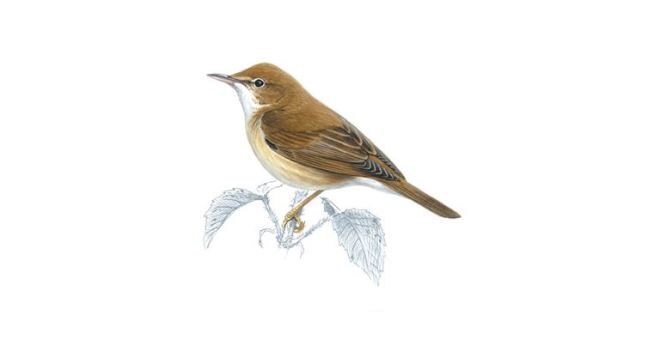
marsh-warbler_1200x675

Marsh Warbler © rights of owner reserved

MW breeds in rank herbaceous vegetation, often besides water courses and ditches or on damp wasteland, and sometimes on the fringes of reed beds. It occurs through middle latitudes of continental Europe from eastern France and into western Asia. This bird is very similar to Reed Warbler in appearance but the song is quite distinctive (see here). Collins describes this as “a stream, broken by brief pauses of whirring, excitable and whistling notes with for the most part high voice and furious tempo”. Singing males are notable for expert mimicry of as many as 75 other European and African bird species. On closer study these prove to have been learned in their first summer and are not added to in subsequent years.

Today’s individual was first reported on Saturday evening (6th) but I thought better of going for it on a Sunday when the site might likely have been crowded with non-birders. Having listened to the song on-line, I recognised it as soon as I arrived at King’s Meads (TL351139) around 7:50 am this morning. The sound was coming from water meadows between a canal towpath and the River Lea, in which I could see just two birders. They were standing in a spot that had been flattened by presumably many more a day earlier and so I went to join them, being careful to tread only where others had before me.

The song continued to issue from a bush (pictured above) a short distance before us, but I suspected the bird itself was on the far side. Three more birders then approached along the towpath and soon their body language suggested they had located it. One of them indeed beckoned and so we went to join them. Before too long the Marsh Warbler sat up singing in the top of the bush, and my mission for today was thus accomplished. Things were as simple as that. For the RBA gallery of this bird see here.

King’s Meads (see here) comprises 96 hectares (237 acres) of grazed riverside flood meadows, criss-crossed by water courses and ditches. The site lies between the neighbouring towns of Hertford and Ware, and is maintained as a nature reserve by Herts and Middlesex Wildlife Trust. I remained there for around an hour, during which my quest showed well on and off in the top of it’s adopted home, pouring out that rich and curious song throughout.

So now the dwindling residue of bird lifers that I might realistically encounter within my preferred range nationally has been reduced by one more item. A second Marsh Warbler for Herts turned up at Stocker’s Lake (TQ046937), Rickmansworth later on this day, but I had already heard and seen my lifer well in Ware and so was satisfied.

A celebration of the Dark Green Fritillary at Chiltern escarpment sites, Oxon: 2nd – 9th June

In a season of BT Sport-style repeats where this journal’s butterfly content is concerned, it seems appropriate to cover this bold larger Fritillary of early summer for the first time since 2015. Evolution and hence motivation are coming in part from observing local species at new sites, and my first location of choice this year was the south-facing slopes of Watlington Hill NT (SU702932).

A personal first site record of two Dark Green Fritillary was gained on 29th May, along what I term the “back way trail” that runs downhill from the NT car park. That is a sheltered route that can be very butterfly rich in high and late summer, and is less used for recreational activities than the hill top and its west and north-facing sides. In 2020 I have also secured site firsts of Dingy and Grizzled Skipper, Green Hairstreak and Adonis Blue here.

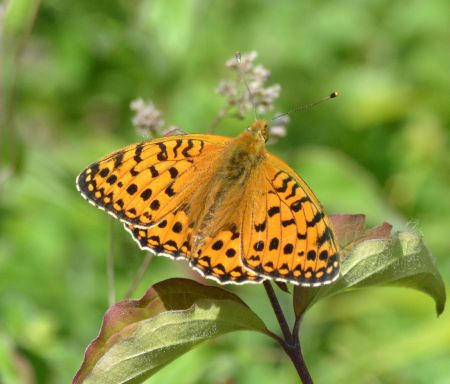
dark green fritillary.2001 watlington hill

Dark Green Fritillary at Watlington Hill, Oxon

Returning on 2nd June as the day warmed up, it didn’t take long to come across what I assumed might be the same two DGF again posing nicely in the very well-managed track-side habitat. These were offering mainly under-side studies as the following sequence shows. Then walking around the open chalk hillside above the trail I estimated counting around 14 individuals in all, though no doubt more were present across the entire site.

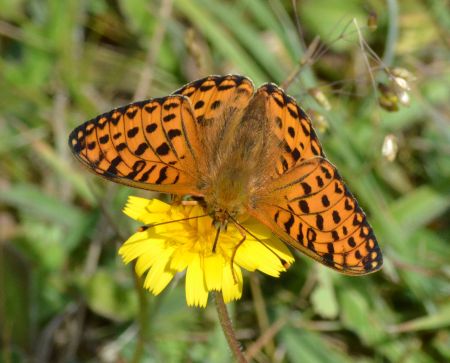
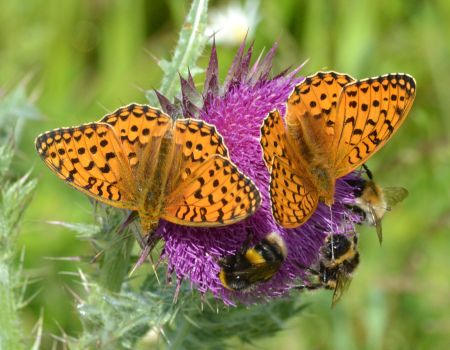
It is the under-side patterning (pictured below) that gives this butterfly its name. The whole of the background to the inner two-thirds of the hind-wing is flushed with an attractive olive green, the intensity of which may vary between individuals. The silver patches around the hind-wing edges are also bordered with green crescents.

The next day, the prolonged spell of unseasonably fair weather that had accompanied the Covid-19 crisis in Great Britain, almost like a parallel “Act of God” to make things more bearable for the incarcerated populace, abruptly changed. In the interval between this post’s two dates temperatures halved, while overcast conditions, strong cold winds and at last some rain was welcome respite for my garden at home but hardly butterfly friendly.

On 7th the first few hours of morning were forecast to be sunny again and so I headed for another Chiltern escarpment site to the north of that first choice. Bald Hill is part of Aston Rowant NNR (SU723959) and classic chalk downland habitat. Both Ewan (see here) and another wildlife colleague had come here to observe DGF before the weather changed, so from their reports I was expecting good numbers of butterflies on my own visit.

Arriving around 9:30am for the usual reason that my quest might be warming up with the morning, the first large Thistles I came upon were adorned with two pristine Dark Green Fritillary. This is a superbly photogenic butterfly and given to posing openly, especially when fuelling up for its day on the nectar of an equally photogenic wild plant. But it was just as well I captured acceptable under-side studies at that previous site, because today my subjects just were not offering them.

Over two and a half hours on site I made a slow circuit of the hill. At the next large clump of Thistles three more DGF (pictured above) were posing as nicely as those earlier two, and in all I may have counted up to 20 individuals. But the showy Thistles were not their only nectar source of choice and some butterflies also offered ground level portraits.

dark green fritillary.2025 bald hill

Dark Green Fritillary

Dark Green is cited as the most common and widespread Fritillary across the British Isles. As well as unimproved chalk and limestone hillsides, the species occurs in almost any flower-rich open habitat, especially where the sward is regularly disturbed by grazing animals then left to recover. Such places might include rough pasture, woodland clearings and rides, moorland, or coastal dunes and under-cliffs. Better colonies might comprise a few hundred adults though the best sites may contain several thousand.

Once they have warmed up male DGFs are restless and elegant flyers, spending much of every sunny day on the wing scanning their environs for females. The latter remain hidden low down in tussocky grass for much of their own time, and so may be located on scent. Mating then occurs in cover (pictured below), after which the females maintain a low profile until their eggs ripen and laying can begin on the Violet food plants. The eggs hatch two to three weeks later, after which the caterpillars immediately hibernate, re-emerging the following spring.

Climbing back to the top of Bald Hill I at least doubled my morning’s tally of DGF and that was the most productive area. But by 11 am conditions had become lightly overcast and having warmed up sufficiently already the flying males were far less prone to settle when active. So I resolved to return on another fair weather day and start in this location to enjoy a second course of this Fritillary feast.

As in the past I found my second site of choice for this season to be one of the less visited areas of the Aston Rowant complex, and on this day at least especially uplifting spiritually. In my experience most general public does not stray too far from parking areas and is certainly less inclined to clamber around steep chalk hillsides than butterfly enthusiasts. When I walked through one of the car parks to reach where I had left my own car it was bursting with vehicles and people, but where they might all be heading I could not tell. It had been a simply superb Sunday morning here.

dark green fritillary.2035 bald hill

Dark Green Fritillaries and friends

I did indeed return two days later on 9th, but in hazy sunshine DGFs were less active in the area I most wanted to re-scrutinise at the top of the hill. Hence I ended up doing another full circuit of the site, gaining personal first records here of Adonis Blue and also finding my first Small Skippers of the season. As the sun came out fully I reached one of the Thistle patches featured above and three butterflies were again nectaring. So even more pictures were taken as these bravura butterflies put on an encore performance.

I can rarely remember one butterfly species producing as many images of the quality I seek as Dark Green Fritillary over these two days on the Chiltern escarpment. A celebration indeed.

My first Aurantiaca Damselfy is tracked down in the New Forest, Hants – 1st June

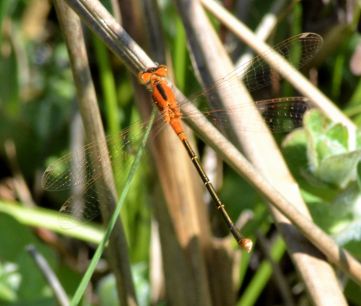
Having gone into 2020 with a specific wildlife agenda the spring part of which is now on hold for another year, on the first day of summer I was able to get out and convert one item of it. This is the earliest date on which the mystical and fabled aurantiaca, the teneral female Scarce Blue-tailed Damselfly was recorded in 2019 by one of the leading British odo bloggers.

Today was my own third attempt at experiencing the quite beautiful, orange and black-toned colour form in what is a brief window of opportunity. A year ago I had to abandon my search in overcast conditions, and in 2018 I just didn’t see any. Thus it was that at around 11am I came back to one of my favourite New Forest odo sites, Latchmore Brook (SU182124). The parking area was by necessity closed and walking in from a discreet distance to respect appeals from local residents I felt pleased there would be rather less general public than usual here.

scarce blue-tailed.2010 imm fem latchford brook

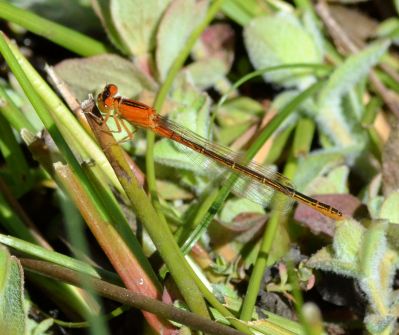
Scarce Blue-tailed Damselfly, imm fem aurantiaca phase

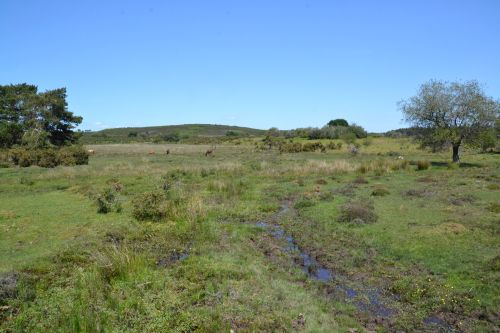
Scarce Blue-tailed Damselfy (SBT) has a marked preference for shallow water conditions with little vegetation, that occur in heathland valley mires such as one to the immediate north of Latchmore Brook. I was concerned that after such an exceptionally hot and dry May the bog here might have dried out, but on arrival found plenty of surface water (pictured below). After walking about at random for a while I waded into what seemed from past experience of the site a promising looking piece of mire. Then on turning around to keep my footing, there right behind me was an aurantiaca in all her bright finery. What a moment!

DSC_0114

Lowland valley mire habitat at Latchmore Brook

Normally I am perhaps too sensitive over going into odo sites and possibly damaging habitat. But here the mire was already greatly pitted and trampled by grazing cattle and ponies, so I did not feel my usual compunction at doing more of the same. Indeed a degree of such habitat disturbance creates favourable conditions for SBT (per Brooks and Lewington). I was surprised by how still my quest kept for much of the time as I captured the images herein, so she was not bothered by my presence. She really is a rather special damsel, is she not?

scarce blue-tailed.2014 imm fem latchford brook

Scarce Blue-tailed Damselfly, imm fem aurantiaca phase

The same degree of tolerance was not evident from the human company today. Another odo hunter on site ignored me studiously through an hour before the blogger himself arrived and blanked me too, not for the first time in the field. But I had already self-found my quest, and not one for being rabbited at myself never attempt to make others engage if they do not wish to. I sought out more aurantiacae through a further hour or so here but without success. Mission had been accomplished early on this visit.

SBT’s emergence period typically begins in late May, peaks in June and continues through to July. Emergence occurs throughout the morning under favourable conditions, so my own timing seemed to be appropriate. But when delayed by cooler, overcast conditions a sudden sunny spell will trigger activity at other times of day. Freshly emerged adults, of which I noticed some here are dull brown but develop brighter colours by the following day. Females progress from this initial bright orange phase to greenish brown as they mature. The flight season lasts until early September.

I possibly owed success today to the relative shallowness of the mire in the present prolonged dry weather period. On past visits here I can recall misplaced steps causing me to sink in to knee level and so would have been far more cautious, but today there were no such mishaps. I doubt whether odo royalty secures its images by always staying on the perimeter. Having gained these pictures so early I wondered what to do next and the best answer seemed to be secure an acceptable one of a male. I located several moving low down in the mire vegetation, of which only this study (below) adequately shows the diagnostics.

scarce blue-tailed.2001 latchford brook

Male Scarce Blue-tailed Damselfly

First impressions are of a smaller, weaker flying blue damselfly than regular Blue-tailed. The “blue tail” itself extends over the lower part of segment 8 and there are two black dots on segment 9 that are just about discernible in the above image. Markings on the thorax develop through green and turquoise to deep blue as males mature. They spend their time lying in wait for passing females, being quick to investigate then pursue any likely mate.

scarce blue-tailed.2011 imm fem latchford brook

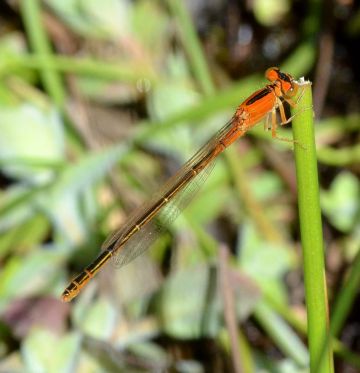
Scarce Blue-tailed Damselfly, imm fem aurantiaca phase

But today was all about the female Scarce Blue-tailed Dameslfly. There is very little for me still to experience where English odonata are concerned. To have now successfully searched out this highly attractive colour form after two years of trying was immensely satisfying.

The first precious jewels of summer 2020: a further celebration of the Black Hairstreak – 31st May

Observing oft-recorded British butterflies in new places has been one theme of this most unusual spring of 2020, but on its final day my going back to where it all began for one very special species proved to be even more satisfying. Overnight I had learned that Black Hairstreak were now flying in a particular place to the north of Oxford. So I contacted Ewan who had already checked our own recent location of choice twice this season where none had yet emerged, and we met at the second site just before 9:30am.

When I joined Butterfly Conservation in 2010 and participated in various field trips, today’s location was an acknowledged hot spot for a butterfly that is one of Great Britain’s most threatened and hence sought after in equal measure. The group leader explained how an issue had arisen there with egg collection and that if participants were to return in the autumn we might likely come across a degree of trimming of the Blackthorn food plant hedges.

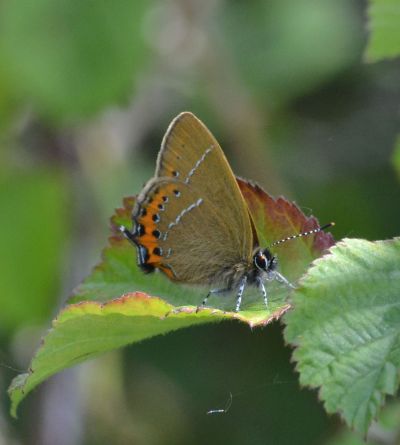
black hairstreak.2002

Black Hairstreak

This particular colony indeed declined over the ensuing years, during which the centre of attention for Black Hairstreak and its attendant, social media-inspired circus moved first to the M40 Compensation Area of Bernwood Forest, then Whitecross Green Wood in Oxfordshire. Most recently another population, close to a long-standing stronghold that had been put off limits to genuine butterfly enthusiasts by HS2 construction works, came under the same visitor pressure with habitat being roundly trashed once again. But no matter where else I went for this particular record, I made a point of still checking today’s site, mostly finding no more than a few individuals and in some years none at all.

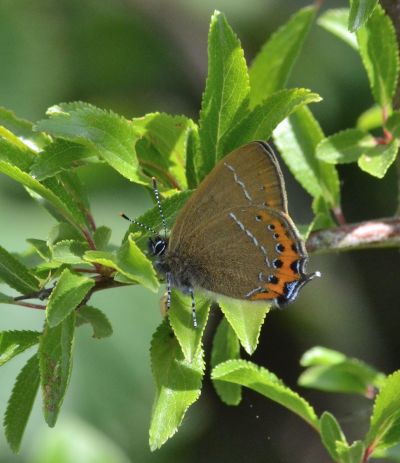
black hairstreak.2003

Black Hairstreak

All this harassment of an endangered species and habitat pressurisation progressed with the apparent blessing of conservation charities, as they persisted with the folly of prioritising hands in new members’ pockets over servicing their core interest groups and support, as all now seem to do. So perhaps no wildlife species symbolises that ongoing misplacement of loyalties better than the Black Hairstreak butterfly.

black hairstreak.2004

Black Hairstreak

Today we found a cluster of up to a dozen Black Hairstreak at the same spot I had first visited on a BC field outing 10 years previously. These were mostly keeping near the tops of the Blackthorn hedges since there were no flowering wild plants such as Bramble or Privet to bring them lower and so offer the kind of point blank communion we had enjoyed at other sites in recent years. But every so often an individual would indeed pose agreeably enough for acceptable pictures to be obtained.

black hairstreak.2001

Black Hairstreak

I do not really need more images of any previously recorded British butterfly in this current season, having an extensive collection already. But being unable like everyone else at present to travel abroad and widen my butterfly experience I must be content with repeat exercises such as this. My policy is to get in and out early where Black Hairstreak is concerned, before the circus arrives back in town.

Having recorded the species for 2020 and gained the studies presented in this post, some of which do seem a little evolved from those of other years, I now feel less need to visit other sites. That things have turned full circle for Black Hairstreak in a former stronghold where it appears to be thriving once more is especially gladdening. And so I intend to leave this most beleaguered of our butterflies in peace to see out it’s brief June flight season free from my own further attentions.

Wyre Forest, Worcs re-visited for Small Pearl-bordered Fritillary – 27th May

My present national butterfly agenda includes one site visit for each of the early season Fritillaries, so today I returned to the ancient Oak woodland of Wyre Forest at Bewdley that I first visited in this same week 12 months ago (see here). Meeting Ewan at the usual start time of 10am in that site’s Dry Mill Lane car park (SO771762), our quest was Small Pearl-bordered Fritillary of which this NNR hosts a healthy population.

small pearl-bordered fritillary.2005 wyre forest

Small Pearl-bordered Fritillary

We first walked westward along the hard-surfaced access route of a former railway line. This was being very well used by family groups, dog walkers and cyclists, and every day in the countryside seems like a Sunday at the moment in the still surreal post lock-down climate. In track-side areas that must be managed for them we soon began to notice Pearl-bordered Fritillary, amongst which some individuals (pictured below) were still quite fresh. But how aware of this local treasure the human footfall all around us may have been I cannot say.

Those butterflies are now nearing the end of their flight season, but that of Small PBF is just beginning. So we turned off this busy thoroughfare and took a path steeply down into the valley of Dowles Brook that adjoins the northern edge of the reserve. In the rather idyllic setting of stream-side meadows at our trek’s end we encountered much richer brown and faster flying Fritillaries that at once stood out from the still present Pearls, and that was what we had come here to find.

The easiest way to separate Small Pearl-bordered Fritillary through binoculars on first encountering them is to pick out the black chevrons surrounding both underside wing edge pearls, a prominent black dot near the centre of the hind-wing, and markings along the top-side edge of the fore-wing that appear to spell the letters 730. The two sequences above illustrate those diagnostics quite clearly.

The two butterflies are also quite different on jizz once the observer has their eye in. On this sunny morning the presumably male Small Pearls we found here were all very hyperactive, patrolling endlessly in search of mates. On settling they would most usually keep tumbling around their flower heads of choice which made gaining acceptable images of them quite difficult to achieve. But I persevered and there were quite a few more butterflies to choose from here today than during my previous 2019 visits.

A year ago I did rather better for top-side than underside studies, but today that situation was reversed. The above collage presents my better results. We remained at this place for around an hour and for much of that time had it to ourselves. I would fear for the lush habitat here if this tranquil spot ever acquired the popularity for SPBF of Bentley Wood in Hants, hence my vagueness as to the precise location. My better top side studies are presented below.

After moving on in the early afternoon we birded the woods on the valley sides, encountering two Pied Flycatcher and finding a Great Spotted Woodpecker nest. Common Redstart and Wood Warbler also breed on this reserve but we did not find any today. Lastly we walked back along the main access track, and some Small Pearls were now also active amongst the Pearls in the managed areas viewed in the morning. The under-wing images herein featuring Horseshoe Vetch were all captured in that second location.

I dealt with SPBF in detail in the two posts published in this journal in 2019, so this account of a follow up visit is a briefer, picture-based treatment. Much of the specific wildlife agenda I went into this present remarkable year with has had to be abandoned, but re-experiencing these two little treasures of any British spring was always going to be part of the plan.

Bucknell Wood, Northants re-visited for 2020 Wood White – 23rd May

I had not visited this classic Wood White site for five years since the previous, brief post in this journal as part of my 2015 British butterflies series (see here). Indeed I have not recorded the species nationally during that interval, so given my current re-working of the British list, when Ewan asked me to accompany him there today I opted to join him.

wood white.2006 bucknell wood

The courting dance of springtime Wood White today

My own access point to Bucknell Wood outside the village of Silverstone has been along a track at its southern end (SP 65882 44750), from where I have usually found this butterfly immediately. But on arriving there at around 10am my colleague was in the main Forestry Commission car park a little to the north, and neither of us knew of the alternative locations. So through the course of this exercise we both became aware of a second option, which was perhaps apt at the present time with many times the usual numbers of people visiting the countryside and parking areas being under pressure.

At first I set out along my usual past route, but as it was overcast and windy it was plain I would not find any butterflies yet. So I went up to the other access point and belatedly our paths crossed. The conditions remained distinctly butterfly unfriendly for the next hour, and then we had to shelter as best we could from a minor soaking. But as that weather front drifted eastward across the wood, extensive clear blue sky followed behind it. Such a scenario seemed perfect for accomplishing our mission as butterflies would emerge again as the late morning warmed up, and so things transpired.

Though the site was now sunlit strong wind was still afflicting the main rides, but along a more grassy and sheltered track I eventually came across a first roosting Wood White on an exposed perch. This was presumably a female since a second butterfly arrived on the scene and proceeded to dance around the first (pictured above, right). But the latter appeared to be getting the old cold shoulder and so presumably “he” flew off. Before too much longer we were encountering several of these ghostly waifs (pictured above) and two maturing Broad-bodied Chaser dragonflies (below) across the same area.

The Wood White displays a noticeably dainty jizz compared to Small or Green-veined Whites, having one of the slowest and most delicate flights of any British butterfly. The smallest of those three, they indeed flap their oval wings so under-statedly as they glide about that the distinctive faint patterning is readily visible, and always rest with wings closed. Unlike other whites these live in self-contained colonies of a few dozen and largely remain faithful to their breeding area in English woodlands.

Adults in southern sites typically begin to emerge in late April, peaking in May and lasting into June before dwindling through that month. The average life-span is eight days, though some individuals can last for up to three weeks. There is usually then a second brood in which males display smaller, darker wing tips. Numbers can then be as high again after a warm spring such as the present one, flying from mid-July to late August.

Males spend their time patrolling up to a metre above the ground in their search for mates, checking out any white object they come across. If that turns out to be a newly emerged female they begin the distinctive head-to-head courtship dance captured in this post’s lead image. Our first sighting today must have been less fresh as she appeared to reject the suitor concerned. Females fly only half as much as males and when observed are usually nectaring on plants such as Bugle, Ragged Robin or Birds-foot Trefoil. Males may nectar less on flowers and supplement their diet by mud-puddling for mineral salts if the conditions are right.

Wood White was one of the fastest declining native butterflies over the last 30 years of the 20th century, and in 2007 became a priority species in the UK National Biodiversity Action Plan. Mounting concern over its plight led to the development of a recovery project led by Butterfly Conservation. By 2010 only 50 extant sites were identified, of which 13 were thought to have already lost their colonies.

Bucknell Wood is one of a complex of six forest sites in Northamptonshire and north Bucks that hold 20% of the species’ national total. The others are Hazelborough Forest, Whitefield Wood, Sywell and Hardwick Woods, and part of Yardley Chase. Five of those are managed by the Forestry Commission which has worked with BC staff and volunteers to create the sunny rides and clearings that Wood White requires to survive.

After leaving here we paid a brief visit to nearby Hazelborough Forest (SP659431) where in the area we accessed the difference in habitat to that required by Wood White was quite apparent. The next heavy rain belt was also approaching and so we did not linger. But I returned here two days later and indeed found more butterflies in suitable habitat along the main ride and a side track from it. The second brood of the enigmatic Wood White is one I have yet to experience in Great Britain, so a further visit to this area seems quite likely.

The Marsh Fritillaries of Strawberry Banks SSSI, Glos – 21st May

The reserve of Strawberry Banks is one I have wanted to experience for some years now, so doing so today gave me an evolved way of recording Marsh Fritillary for the 2020 season. An “unimproved” limestone grassland in the Cotswold AONB, it is privately owned and managed in a traditional way, until recently by the Gloucestershire Wildlife Trust. The most well-known butterfly here each year was my quest for this visit. Famously in May 2011 there was an explosion of 15,000 at the site, though in most years numbers are far more modest.

marsh fritillary.2001_01 strawberry banks

Marsh Fritillary

The reserve (see here) is accessed from a minor road between Oakridge Lynch and Chalford in the highly picturesque Frome Valley to the east of Stroud, Glos. From there (SO 91164 02938) rights of way lead uphill through the ancient Cotswold Beech woodlands of Three Groves Wood on the right and Oldhills Wood on the left. The SSSI itself comprises two steep and wildflower rich pastures on the eastern side of the minor valley of a Frome tributary that flows between those two woodlands.

Once I arrived on site at around 10am it wasn’t long before a first Marsh Fritillary crossed my path, before doing what this species invariably does by posing nicely on a raised stem. All the butterflies I observed today were along the lowest edges of both meadows, and often displayed a preference for nectaring on Buttercups. But the main food plant is Devil’s-bit Scabious. Over the years I have noted some size variation between different populations observed in Great Britain and continental Europe, and today was struck by the relative smallness of this particular cluster.

Though once widespread in the British Isles the Marsh Fritillary declined severely through the 20th century. Having acquired threatened status the species has been the subject of much conservation effort over the past two decades and more recently has enjoyed something of a revival. This Gloucestershire breeding colony is a long established one but populations in general are highly volatile and long term survival will depend upon the maintenance of suitable low-intensity grazed habitats.

There are three main habitat types: damp grasslands dominated by tussock forming grasses, ancient calcareous grasslands usually on west or south-facing slopes in England, and shorter coastal grasslands in other parts of the British Isles. Temporary colonies can also occur either in larger woodland clearings or other grasslands. Smaller isolated clusters are easily impacted by sudden changes to habitat.

Having become extinct here in Oxfordshire during the 1990s, small numbers of MF have in the last two years been recorded on the South Oxon Downs and at Cholsey Marsh in the Thames Valley, though whether this is due to releases remains unclear. The species has also returned to its last known BC UTB location of Seven Barrows on the Berkshire Downs in the current flight season. And a project is now underway to restore Marsh Fritillary to the damp grassland fields of RSPB Otmoor just to the north-east of Oxford (see here).

I feel pleased to have got around to visiting one of the most constant MF populations in southern England in this scenic and uplifting location of Stroud’s “Golden Valley” (see here). Recording scarcer butterflies in new locations is always satisfying as the ongoing pattern of this most unusual of years continues to confirm.


For new visitors to this blog who might have been directed via a specific species search, the different posts presented herein on British Butterflies are regularly referred to. The most consulted items to date are:

Glanville Fritillary @ Hutchinson’s Bank, Surrey – 1066 views

Marsh Fritillary et al @ Cotley Hill, Wilts – 621 views

Large Heath @ Whixall Moss, Shropshire – 408 views

Wood White @ Bucknell Wood, Northants – 254 views

Marsh Fritillary et al @ Battlesbury Hill, Wilts – 228 views

Duke of Burgundy @ Noar Hill, Hants – 225 views

Large Blue @ Daneway Banks, Glos – 222 views

Black Hairstreak @ Whitecross Green Wood, Oxon – 214 views

Heath Fritillary @ East Blean Wood, Kent – 193 views

Pearl-bordered Fritillary @ Bentley Wood, Hants – 186 views

Pearl-bordered Fritillary @ Rewell Wood, Sussex – 178 views

Purple Emperor et al @ Bernwood Forest, Bucks – 168 views

Duke of Burgundy at Noar and Butser Hills – 132 views

Adonis Blue @ Aston Rowant NNR, Oxon – 127 views