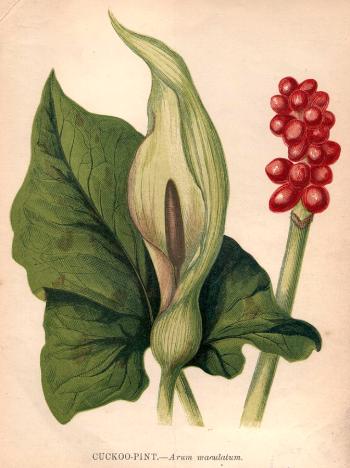
A selection of anecdotes concerning the English Cuckoo Pint (Arum maculatum) – April 2020

The only English Aroid enjoys a place in national folklore like few other native wild plants. Having been unable to resist the little irony at the close of my previous post, I soon began to notice imminent Cuckoo Pint blooms in those unkempt corners of my garden that I retain at least partly for their benefit. Everywhere I have walked in the local countryside so far this year there has been a profusion of Arum maculatum foliage. Now these rampant, quintessentially English plants of shady places everywhere are revealing their very particular character.

DSC_0008

“Lords and Ladies” in Toot Baldon, Oxon

Thus having searched on-line for whatever mildly entertaining trivia might be forthcoming, I now present it herein. Folk-tales and herbal remedies a-plenty have been associated with the Cuckoo Pint over the centuries. Estimates of the number of other colloquial names for it range from 90 to upwards of 150, more than any other native English plant. Many of them and especially the gender-related ones arise from the brief April bloom’s suggestive quality. Consider: Lords and Ladies, Cows and Bulls, Stallions and Mares, Devils and Angels, Adam and Eve, Soldiers Diddies, or most to the point the Willy Lily.

cuckoo pint.01

So what’s in a name? I was possibly slow to realise, until researching this piece, that if all but the first two and last two letters of “Cuckoo Pint” are removed … I’ll stop there. So perhaps the term is a quaint folklore equivalent of rhyming slang, or similar play on words, but I have yet to find anything else on-line which is so impolite as to confirm that. Moving swiftly on, if not merely a euphemism the “Cuckoo” half of the name may refer to the time of year when both those birds and the Arum blooms first appear in the countryside. “Pint” is widely agreed to be a shortening of the old-English word “Pintle” meaning … well, can you guess? “Priest’s Pintle” is yet another of the vernacular names

But the wild Arum known as “Cuckoo Pint” possessed an ability to stir the rustic English imagination in more diverse ways. Beholders of the inflorescence who might prefer religious interpretations may choose from Friar’s Cowl, Jack in the Pulpit, or Parson and Clerk. Other non-smutty alternatives might be Soldier in a Sentry Box, Bloody Man’s Finger, Wake Robin, Tender Ear, Cheese and Toast, and many more besides. Two of the longer winded ones are “Sonsie Give Us Your Hand” or even “Kitty Come Down the Lane, Jump Up and Kiss Me”; or so my researches suggest.

Cuckoo Pints around Toot and Marsh Baldon, Oxon

Given it’s more obvious amorous associations it is hardly surprising that historically the Cuckoo Pint has enjoyed a reputation for possessing aphrodisiac powers. Any country names with “Cuckoo” in them tend to have such meanings. A PDF published by Fareham Borough Council in 2019 (see here) states that in some areas it was believed girls could get pregnant simply by looking at this plant, yes really! Well there’s an excuse for frolicsome wenches of the day. I wonder if anyone believed them?

More credibly, this plant has been put to an astonishing range of uses over the centuries. In folk medicine the leaves of A maculatum were squeezed to extract the juice that was then used to burn off warts and other growths on the skin. This practice was particularly popular during the mid-17th century. The roots of the plant were also dried and made into a powder, used to alleviate rheumatism or paralysis. In the 18th century, the leaf juice was distilled and applied to the face as an anti-ageing treatment; while that of the root was applied to treating asthma, ruptures, scurvy and wind. Herbalists largely stopped using it at the start of the 20th century.

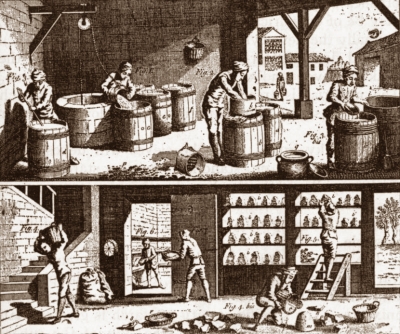
starchmakers

17th century starch makers

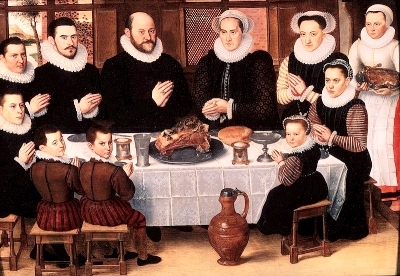
Away from “medicine”, it was noted that root tubers contained starch that during the Elizabethan period was used to stiffen linen, especially the then fashionable long ruffs (collars). The 15th century nuns of Syon Abbey used the roots to make starch for altar cloths and other church linens. Hence “Starchwort” was then yet another colloquial name. But due to the high corrosive properties of the juice, these practices didn’t last as people tasked with laundering the clothing could suffer painful effects.

Flemish ruffs c1585

“The most pure and white starch is made of the rootes of the Cuckoo-pint, but most hurtful for the hands of the laundresse that have the handling of it, for it chappeth, blistereth, and maketh the hands rough and rugged and withall smarting”.
Gerard’s Herbal, 1633

All parts of the plant may produce allergic skin reactions. But there are nonetheless reports in past published herbals of Arum starch being used in skin cosmetics in 19th century Paris, and also for removing freckles in Italy at that time. An ointment made by stewing the juice of fresh sliced tubers with lard was in places cited as an efficient cure for the fungal skin infection Ringworm, despite causing blistering when applied.

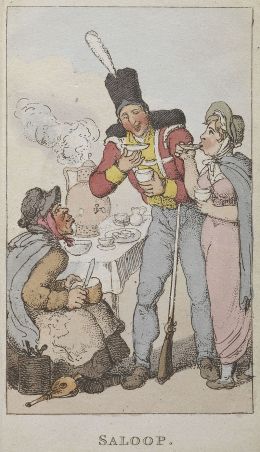
Cuckoo-pint root if washed and roasted well is edible, and when ground was once traded under the name of “Portland Sago”. This flour was used to make “Saloop”, a hot drink popular amongst the lower orders of 18th and 19th century society as a lower-cost alternative to tea or coffee. It was said to be very refreshing, and was served in the same way with milk and sugar, but if prepared incorrectly could be highly toxic. The beverage was also considered a remedy for various ailments as well as hangovers. But its popularity is said to have declined on becoming associated with treating venereal disease, after which drinking it in public was deemed shameful. Saloop street vendors in London then became replaced by coffee stalls.

Saloop

Moving on to botanic matters the glossy, spear-shaped leaves appear very early in the year, followed by the blooms at this time of writing. Pollinators are attracted by an odour and raised temperature generated in the early evening. Minute flies visiting the plant enter the floral trap of the spathe through a zone of bristles, then fall into a smooth-walled floral chamber from which they cannot escape. Gorging themselves on a secretion produced by the female flowers at the base of the spadix, the trapped flies effect cross-pollination if they have previously visited another Cuckoo Pint. All the while the male flowers, situated much higher on the spadix, rain pollen down onto their guests. The next day, when smell, heat, and food are gone, those pollen-laden insects are allowed to escape by a wilting of the bristles. Thus released they are then as often as not recaptured by other inflorescences still in the smelly receptive stage, and so things continue.

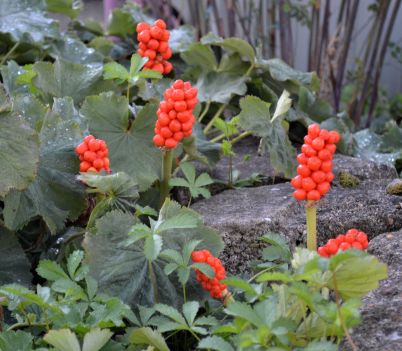
As with many Aroids the blooms last for little more than a day, then the whole plant quickly wilts. Later in the season the stems turn into erect spikes of bright orange berries that are a highly attractive and long lasting feature wherever Cuckoo Pints occur. But as always in nature such a colouration indicates that the fruit is toxic if eaten. Doing so causes irritation in the mouth and throat, leading to swelling and pain and can affect breathing. Though that is not strictly poisonous, places where this post’s pictures were taken are best avoided by dog walkers, and children should be warned against touching the fruits.

cuckoo pint fruit.01

Arum maculatum fruit in my garden (undated)

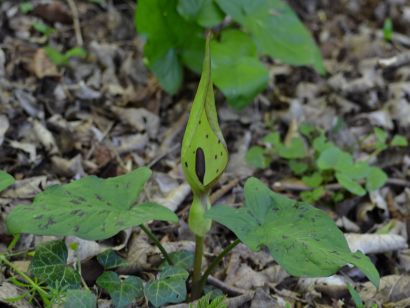
There is some variation in form between different wild Arums I am encountering around the Baldons on my Oxon green belt patch walks. The cream-coloured spadices of these ghostly, quasi-religious looking plants (below, top row), captured at dusk suggest a degree of hybridisation, being more like those of the continental Arum italicum than our own A maculatum. The former is grown in gardens such as my own, so maybe those aforementioned pollinators are ranging more widely. Some leaves also display a brown-blotched appearance, and in one case even the spathe (below, bottom).

cuckoo pint.2026 the baldons

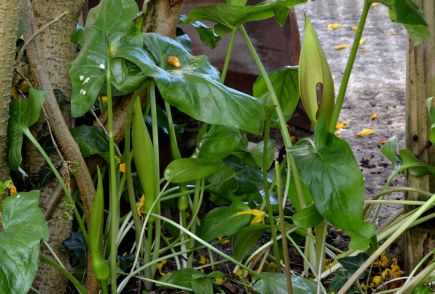
Cuckoo Pints are always invasive. It is one of the wild plants that persist in my garden – like Bluebells, Euphorbia, Lily of the Valley and the ubiquitous Celandines – that however much I might try to reduce them are always back in force the following spring. Wild Arums are not robust, so if growth is removed after flowering there will be no visible trace through summer, autumn and early winter. Then new glossy green foliage will issue from the soil again as the end of winter beckons a new spring season and the renewed life then forthcoming.

arum maculatum or cuckoo pint.2001

Cuckoo Pints in a neglected corner of my garden

Now is the time to see and enjoy the sole English Aroid in bloom in our countryside, and if sought out there are plenty of them to be found. But these suggestive, evocative, even haunting symbols of simpler past ages and pleasures, that have been held in popular fascination for so long are in themselves far more transient. What thing of such strange, alluring beauty does not have the right to be so? Such is the mystery of Aroids and such, perhaps is life.

A celebration of the Orange Tip and other early season British butterflies – 12th Apr

It is an oft-repeated mantra among wildlife enthusiasts at present that whatever the plight of the human populace, the endless rhythm of life in the natural world continues. In this period of national lock-down to counter Covid-19 I have on most days been walking the local right of way network between my own and nearby villages. Despite living here for 20 years I had only done that in part previously. The past three weeks since emergency measures were announced have seen me explore it all. Now, having identified the better looking wildlife corridors, I may attempt to patch watch them for as long as current restrictions continue.

As of this Easter Sunday I have recorded all 10 of the common butterfly species that can be expected by this time of the new season. Upon coming across my first Orange Tips four days ago my priority at once became to acquire better portraits of a very difficult subject to capture well. Surely this exquisite symbol of annual renewal in nature is one of our most delicately beautiful butterflies. But they are typically very restless, and fly a long way between settling if doing so at all, especially in the full heat of the day.

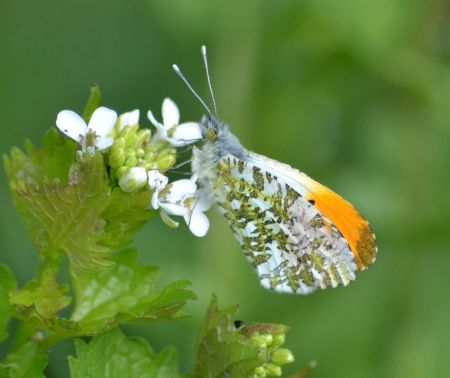
j preview2

Resting male Orange Tip on Garlic Mustard

On this once again sunny morning I set out to walk the Thame valley north of the next village of Chiselhampton. On reaching a wooded feature known as The Jenet (SP606004) at some time before 10am I noticed a resting Orange Tip on vegetation by the track side, and more soon appeared. Perhaps this is a roost site. In any case the wild plant-rich margin of the tree belt, carpeted with flowering Nettles and Garlic Mustard, looked very butterfly friendly. The day was just beginning to warm up and my quest were perching on flower heads while keeping quite still. This is in my experience a not too frequent opportunity to achieve what I was seeking, and I was clearly in a good place at the right time.

little milton.2002 the jenet

The Jenet, near Little Milton, Oxon

I have already referred to the constantly on the move character of male Orange Tips, that are a familiar springtime sight across much of the British Isles along hedgerows and woodland edges, as well as in parks and gardens. Thomas and Lewington describes them as “a patroller par excellence“, wandering the countryside through much of the day searching every shrub and tussock for mates. The less conspicuous females are more elusive, concealing themselves in bushes for hours on end.

That reference book also cites males as being “fine examples both of warning colouration and camouflage”. The distinctive wing tips in flight alert predators that this butterfly is distasteful, their bodies containing quantities of bitter oil accumulated during the larval stage from Garlic Mustard, the principal food plant. Birds will rarely take them more than once. When at rest the upper wings are lowered and blending in becomes the best form of self protection.

The Orange Tip’s wandering lifestyle takes it into a great variety of habitats and they are widespread in gardens from April onward. There they are attracted by cultivated plants such as Honesty, Sweet Rocket and Lady’s Smock. But these consummate nomads rarely linger in any place for long. Numbers peak during May and flight continues into June, with a second brood occurring in the earliest flight seasons.

Females have grey rather than orange wing tips but share the attractive underside patterning of males, the hind-wings being mottled delicately with lichen-like green. Old fashioned, colloquial names for them included “Lady of the Woods” or simply “Wood Lady”, those being possibly a little more evocative than the modern day equivalent. I found one (pictured below, right) in another small woodland along my Easter Sunday morning route at SP608007.

The other butterflies seen so far on my new patch are the early season staples Peacock, Small Tortoiseshell, Comma, Small, Large and Green-veined Whites; Brimstone, Speckled Wood and Holly Blue. I have been especially impressed by the numbers of Peacock everywhere I tread, the newly emerged hibernators seeming quite widespread after the mild winter just past. As Orange Tip is perhaps one of our most delicate, surely the Peacock (below, top row) is one of our boldest butterflies. The other two new season’s hibernators are in the bottom row.

My own lock-down routine is mostly to exercise in the mornings then spend the rest of the day in the garden at home. The local footpath network may be accessed from selected points on my way back from visiting local convenience stores, or else I walk from home. I prefer to go out early as the only people I need to distance from then (as they do me) are just a few joggers, dog walkers or other hikers. Almost everyone I pass is pleasant and friendly, being out for the same reasons as myself, though for much of the time I barely see a soul.

The present situation is altering my outlook in different ways. Not least when I recall the tranquillity I sought and found butterflying in the south of France last July, I now realise I can achieve that within a short distance of my doorstep. I was wondering how to motivate myself in the coming local wildlife season, so if needs must patch working could be the answer. Importantly, my near three-stone (19 kg) weight loss in just over 12 months and continued high protein diet appear to be giving me boundless energy.

A year ago I was experiencing joint pain from walking just short distances. Now I enjoy the local countryside for up to six or seven miles at a stretch, drawing on seemingly re-found reserves. On that note I’ll end with an image of my season’s first blooming Cuckoo Pint (below) also from this morning’s walk – perhaps another symbol of spring-time renewal in nature.

rtdactw

“Rise today and change this world” *

* (Lyric © Alter Bridge, 2007)  Were I a photographer, as I often stress I’m not, I might perhaps find all kinds of fault with the half decent Orange Tip images this post contains. Likewise I might not have made too much effort to capture them pictorially in more usual butterfly seasons, and so have just a small number of previous studies in my collection. But the opportunity to witness and record the re-emergence of the precious jewel that is Orange Tip has never seemed more uplifting, refreshing and welcome than now.

Filling the day: A Laughing Gull at roost in Avon after a dawn Dipper in Bucks – 14th Mar

Today was mostly about its early morning and late afternoon, less about the time in between, and also about recording my career 500th bird for the Western Palearctic region. That personal landmark was reached courtesy of a Laughing Gull that over the previous four days (since Tuesday 10th) had been logged coming in to roost at Chew Valley Lake (ST565606) just south of Bristol, then flying out again at up to 10 o’clock in the mornings.

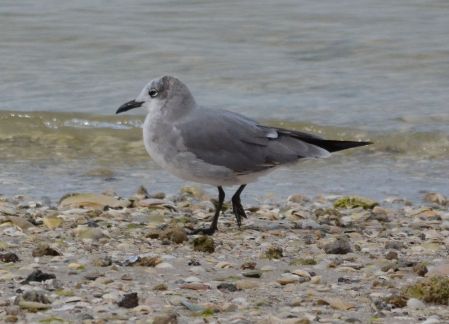
I find this common and widespread Nearctic Gull attractive, having experienced many in various plumages two years ago in Florida. In the British Isles it is a rare vagrant. The two mainland opportunities I recall prior to that 2018 life’s great adventure – at Dungeness (Jun 2016) and on Merseyside (Apr 2015) – were both in what I considered unappealing locations and rather too far to drive. So when this latest individual, a first winter bird turned up at just over 90 miles from home I immediately felt interested.

laughing gull.1814 1w sanibel island

First winter Laughing Gull in Florida (Jan 2018)

But picking one Gull out of a possibly distant roost is not a birding activity I have ever relished. So I waited to see whether any pattern might emerge that could ease my task. Now, given the absence of the usual Saturday afternoon filler of live football on TV and radio, I considered my motivational options at around midday then hit the road.

I arrived on-site mid-afternoon and pulled into a shore-side lay-by alongside CVL’s Heron’s Green Bay. There I engaged with two friendly local birders who said it was as good a spot as any to seek my quest. Though I at once thought any sighting from there would be distant, it became apparent they were in contact with colleagues stationed at the various locations where the Gull had been viewed thus far, so I stuck with them.

By 4:20pm nature’s necessities prompted my relocation to Woodford Lodge, the visitor centre and cafeteria where the required facilities might be found. That had also been the most oft-cited spot from which to scan the Gull roost over the preceding days, and on getting there I found rather more developed twitch lines. Now it was a matter of tagging along, letting other birders do the harder work as is my preference, and seeing what transpired.

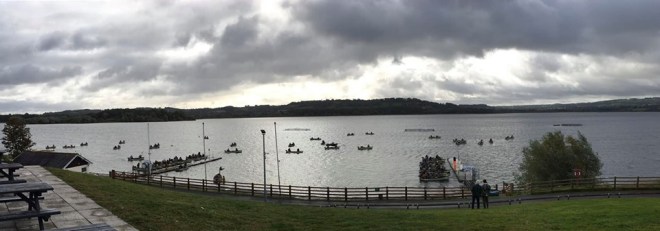
chew valley lake

The outlook across Chew Valley Lake from Woodford Bank © rights of owner reserved

At some time after 5pm a ripple and murmur enveloped the gathering as various people simultaneously called: “It’s there, with the Common Gulls”. The safest option was to ask a nearby birder to put me on the Laughing Gull in my own scope, which bird then stood out at once by it’s dark tone, black bill and relatively slim build. Having been thus assisted it was quite easy to re-find a number of times. I was impressed by the youth of more than a few of my companions and just how knowledgeable they were, and so might keep trying myself. One Cornish 20-something had also reached and passed 500 WestPal today, or so he said.

The Gull thereafter seemed unlikely to move in any closer, drifting ever sideways out in the mid-to-far distance. But I had ticked it for Blighty and thus satisfied opted to head for home with the warm glow of a successful twitch within me. As I drove away most of the other birders had also departed or else were doing so. It would have been impossible to gain pictures today. For what has been posted on RBA so far see here.

My day had begun with a short drive the other side of Oxford to a public park, The Rye (SU 875921) in High Wycombe, Bucks. There a Black-bellied Dipper had been reported on RBA early on Friday morning on a rocky water feature at the outfall from a long ornamental lake known as “The Dyke”. Amongst sub-species of Eurasian Dipper the one resident to the British Isles has a chestnut coloured band on the darker brown / black belly. The more widely distributed continental European Ssp does not, the underparts being uniformly darker, hence the citation “black-bellied”. Small numbers of these are reported nationally each winter but I had yet to observe one here.

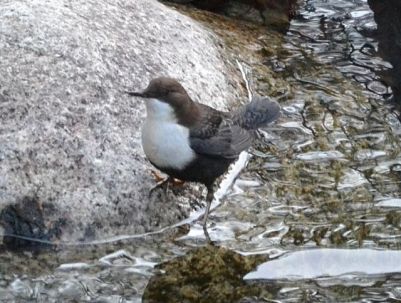
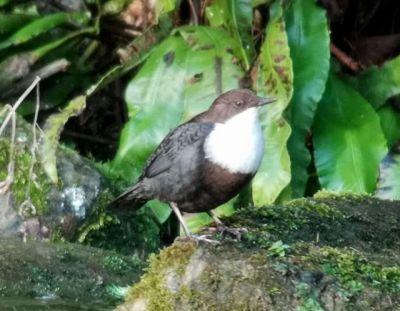
dipper.1701 black-bellied corsica

Black-bellied Dipper in Corsica, Sep 2017

When one turned up in another public park outside Northampton for a few days at the beginning of March I looked back through my picture archives and found I had recorded a BBD in Corsica in September 2017 (pictured above). On the day I planned to go for the Northants bird it moved on, so now I was interested to try for this latest, even closer one to home. On 13th I had arrived mid-morning to find several people standing right at the waters edge and yapping dogs on the path above the waterfall, which hardly looked promising.

I then heard a tale of how a dog walker had allowed his pet to scare off the Dipper, then two birders “had a go” at him, he “got the hump” and sent the dog into the water again. Such are the pitfalls of trying to bird in a public park. It was not rocket science to surmise the Dipper was hardly likely to come back with a posse of optics toters now in such close attendance. Hence I searched the water course that flows through the park for as far as I could walk, downstream then up but without success and so gave things up for the day.

In the afternoon I was contacted by a local birding friend who said colleagues would be looking for the Dipper again both at dusk and first light today (14th), so I would be kept informed. It was not seen again on Friday but the dawn tripette still seemed worth making. As I turned off the M40 a message came in to say the Dipper was back, which sort of tip-off is always helpful. So all I had to do was arrive on site in confident mood and walk over to where people were gathered. Things this time were as easy as that.

dipper.2001 black-bellied high wycombe

Black-bellied Dipper in High Wycombe

Now eight birders were standing at a sensible distance and the Black-bellied Dipper (pictured above) was moving around the water feature. The aforementioned colouration was quite obvious, and I watched it going about it’s business for around 15 minutes. At just after 6:50am if flew off towards the long lake of it’s own volition, then after hanging around myself for another 20 minutes or so I decided to go on my way. The bird did return, and was reported on and off right through Saturday, but I suspect a bit of a circus might have developed later.

As the country is now in the grips of worldwide hysteria concerning the Covid-19 outbreak I feel glad to have both birding and gardening as interests should normal life be suspended. With many people stockpiling supplies and stripping out supermarkets, on my way home from Wycombe I took advantage of the still early hour to acquire a small stash of my own before pandemonium broke. So now I need not go out too much in public for a few weeks if that is what we are all instructed to do. There could be more days like this to fill in the time ahead. Today I did that quite successfully.


Blue-winged Teal at Man Sands Wetland, Devon – 12th Feb

As February lurches back towards the mundane I opted to try for a British and WestPal bird list addition that I had recorded previously only in Florida two years ago. A first-winter drake Blue-winged Teal, of genuine cited provenance has been over-wintering on these shores in the southern part  of the “English Riviera” in south Devon through much of the current season.

Though at 180 miles this vagrant Nearctic duck was beyond my past preferred range, I had been considering taking another step on that slippery slope for a while now. Earlier in the winter it (the BWT) could perhaps have been described as rather nondescript, but more recently a few recognisable pictures had begun to appear online. And some other Oxon birders had hence made the same journey as spring approaches, ahead of myself.

DSC_0063

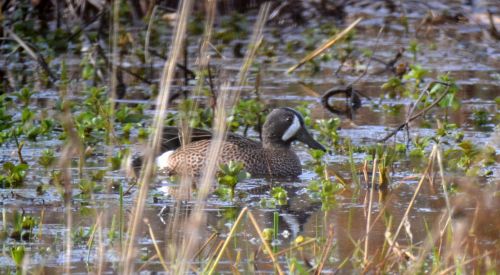
Today’s best effort … Blue-winged Teal (imm male)

I arrived on site at the tiny and highly picturesque NT Man Sands Wetland to the south of Brixham just before 9:00am, feeling a little flat perhaps a week on from GGOslo, though that is something about which I should not complain. From a car park at SX 91311 53068 an unmade road leads steeply down to the shoreline behind which lie some man made lagoons. In the cold, clear morning light it was at once plain I had gotten somewhere above averagely pleasant, and with bird sounds filling the air and their sources active in the hedgerows my dulled spirits began to revive.

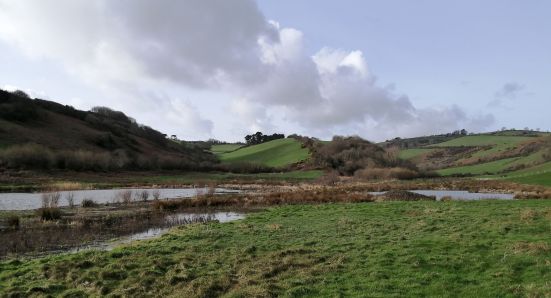
The wildlife habitat here has been created by the National Trust (see here) since 2005, by removing old sea defences and field drainage to create a series of pools of standing water and marshland. A well established reed bed has now developed and the whole complex attracts common wildfowl and other water birds, wintering waders such as Snipe, and more. Today Cettis Warbler announced themselves here and there, while Stonechat were prominent in the surrounding fields. A Black Redstart has also over-wintered around a redundant lime kiln at the site though I wasn’t able to locate it.

man sands wetland.2001

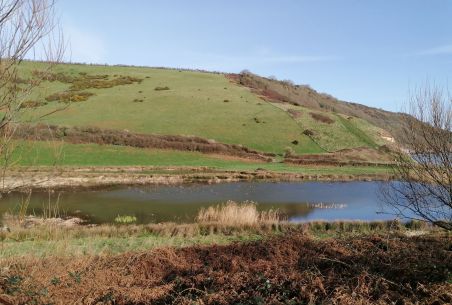
Man Sands Wetland looking towards the sea

On the landward side of the wetland is a small, elevated bird hide. My quest had been absent from RBA over the previous three days, though having been resident in the locality for quite some time it has become less newsworthy. Would it still be here? I scoped around the scene before me picking out small numbers of Gadwall, Mallard, Tufted Duck, Moorhen and Coot … and then the unmistakable form of the Blue-winged Teal. It was now 9:30 am and mission had already been accomplished.

The most noticeable features at that range of a BWT drake are possibly the broad white facial crescent and a bill that is much larger than those of Eurasian and other Teal species. This maturing individual was certainly an attractive sight as it dabbled continuously in the marshy vegetation of its adopted abode. The home range is north America where they occur almost throughout the continent, and British records average around four a year.

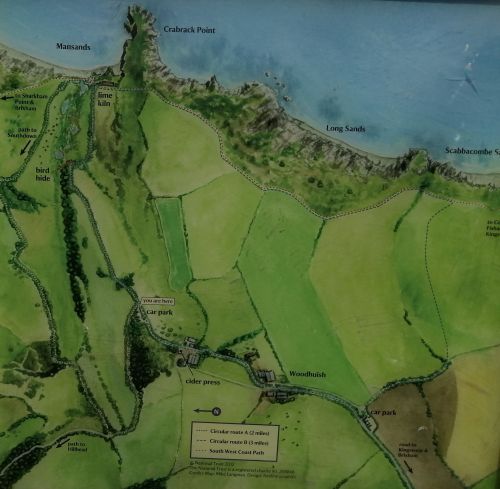
man sands wetland.2003 map

Man Sands Wetland and environs (site plan)

From the hide I noticed occasional walkers on the South West Coast Path between the lagoons and the beach here. Gaining any recognisable pictures from where I was seemed unlikely and so I walked down to the shoreline to try my luck closer in. Indeed better results were then attainable though nothing of any quality. At all times this otherwise delightful duck seemed intent on keeping to semi-cover and making acceptable pictures of itself as difficult as possible to acquire. These records (below) are all digiscoped.

I hadn’t especially wanted to come here today but the longer I lingered in this remote, even idyllic location the more I was drawn in by its natural beauty and tranquillity. And so as on many occasions in even more off the beaten track parts of the world I came to evaluate the seclusion of my situation. It was just me again in communion with this other lone wanderer, not unlike that with the Dwarf Bittern on Fuerteventura a year ago. This is what I know and it would be churlish not to appreciate that I can do these things.

man sands wetland.2002

Man Sands Wetland looking inland

After two hours on site hunger pangs prompted my departure, then I drove into Brixham to seek a pasty shop. Earlier in the hide I had taken an opportunity to take pictures of several Bullfinch that were attracted to feeders placed just outside. The pictures (below) are impacted by having been captured through a none too clean, non-lift-able window.

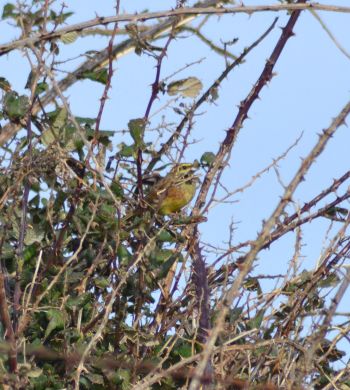
Cirl Bunting has become something of a staple during my more recent travels in southern Europe, but in the British Isles is present only in south Devon that represents a kind of outpost in the species’ European range. My first career record was in November 1988 at Lannacombe Bay, south of where I was today, at which I believe Cirls are now rather more occasional. 16 miles north of Man Sands lies RSPB Labrador Bay (SX 930703), a small coastal reserve that is managed for the species and is now cited as the best site to observe them nationally.

cirl bunting.2001 labrador bay

Cirl Bunting

It seemed a pity not to take such an opportunity when I was nearby, so that is where I headed in the afternoon. It didn’t take long to locate some Cirls (pictured above) and I found just three. An information board quoted 34 pairs on territory, but there was a lot of very steep habitat to search and by now I was feeling quite tired. So contenting myself with a reconnoitre of the site I spent just an hour there, filed it away for future reference then headed home.

The bottom line today was I gained a career 355th British and 499th WestPal bird. 180 miles indeed seems to be the new 150 where travelling is concerned, and time on the road passed easily enough. But it’s not all about numbers as a very wise Oxon birding colleague once chided me. The snap decision upon waking too early to plug a little gap in the field guide had produced an interesting and worthwhile outing.

Oslo re-visited for Great Grey and northern Hawk Owls + Pine Grosbeak again – 5 & 6th Feb

Since mid-December the Norwegian capital city of Oslo has held a second outstanding opportunity for pan-European and western palearctic bird listers. In that time local guide Simon Rix (see here) has been tracking up to five Great Grey Owls just outside the city and more recently two northern Hawk Owl as well. Ewan has followed the situation with interest since the first of those is a very much desired lifer for him, so when he told me he was going this week I opted to join him.

The Great Grey Owls are wintering in the forested Maridalen area to the immediate north-west of greater Oslo. They favour partially felled clearings in which their small furry mammal prey is most numerous. It is a return to such a mode of forestry in recent years, instead of the more industrial scale logging of times past, that has led to a recovery of the GGO population in southern Scandinavia; along with greater provision of nesting platforms. The food source in this habitat reaches its peak around 12 months after felling, then the Owls just arrive and find it – no-one really understands quite how.

DSC_0312

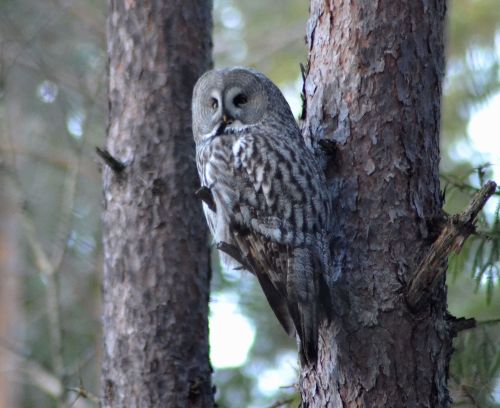
Great Grey Owl (adult female)

Great Grey Owl’s core Westpal range is northern Fennoscandia eastward through Siberia, in which they are year round residents. But two sub-species, attributed with being the world’s largest in length though of lighter weight than Eurasian Eagle Owl, also occur throughout the taiga zone of the northern hemisphere. Actual size can be deceptive, since GG’s feather mass, large head and long tail belie a body that is lighter than other large Owls. Breeding habitat, in which they mostly re-use old raptor nests or broken-topped trees, is dense coniferous forest with some deciduous tree content mixed in.

As in December, our guide met us from the 9:30 am Ryanair arrival from London Stansted. Like Short-eared and Barn Owls at home the GGs are a very popular draw with photographers, and some Maridalen locations have been staked out daily since 15th December when the first Owl was discovered here. Simon has since found more locations to which he takes his clients and we now searched habitat such as this (below) in a number of those.

This slideshow requires JavaScript.

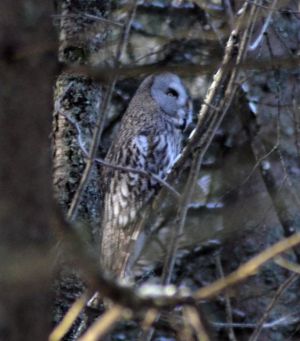
Late morning is potentially the least productive time of day for encountering hunting birds, however and so it now proved. The surroundings were nonetheless stimulating in the cold, clear winter light with a moderate snow cover. Eventually we came across some toggers who had found a Great Grey Owl that was partially concealed within fairly deep cover due to being harassed by Ravens. This (below) was my best result from an initial picture session.

DSC_0015_01

Step one: see the bird, get any kind of picture

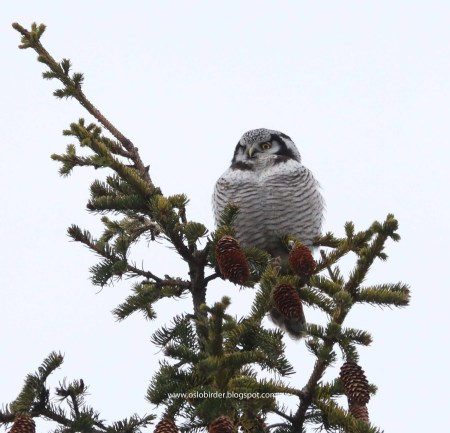
We then decided it would be best to come back later in the day when GGs should be more active again, and so went to seek the second trip target. In recent weeks a pair of northern Hawk Owl have taken up residence in an agricultural area about 30 minutes drive from Maridalen. Upon our arrival there one of these birds was atop a Spruce tree at some distance. On our reaching that spot the Owl remained steadfastly on its perch as we attempted to capture it pictorially from below. Now both my own sought lifers for this tripette had been secured, the only regularly occurring European Owl I still require is Tengmalm’s, and my wish-list of northern birds otherwise continues to shrink.

Northern Hawk Owl occupies a similar geographic range to Great Grey, with which it shares and breeds in taiga forest habitat, but is active only during daylight. This generally low density species is non-migratory though there can be southward irruptions in some years. It actually is quite hawk like in appearance and jizz, flying in a similar way to Sparrowhawk for instance but with a noticeably larger head. Today’s bird has been known to offer close, lower level views at this site, but we saw it only in the tree tops.

hawk owl IMG_9939 copy

Today’s northern Hawk Owl © and courtesy of Simon Rix

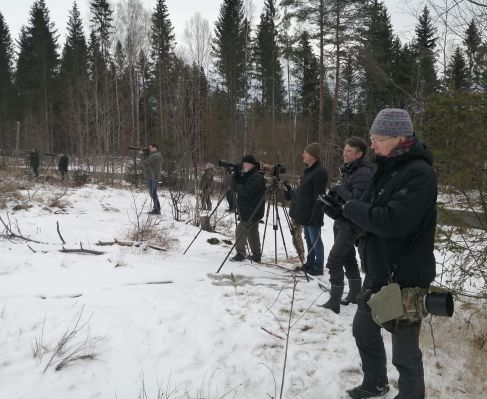
Later in the afternoon we returned to Maridalen to resume our quest for Great Grey Owl. Once more they were just not playing ball in the places where Simon would have preferred us to see them. Then he received a call to say one had been located at the rear of a clearing back by the road. On our reaching that spot various of the toggers were there ahead of us but the rules of engagement were very orderly.

Out in the middle distance was the stately, brooding shape of the large northern Owl that had brought me back to Oslo. For the next hour or so the bird just sat on its perch in classic pose, surveying the area before it from that magnificent radar dish of a face, swivelling it’s head from side to side or looking straight in front but not actually taking flight to catch prey. This one’s large size suggested it was an adult female, since males can be somewhat smaller.

oslo.2005 maridalen

We join local birders and photographers to watch the top row GGO

More cars and their occupants arrived, everybody knew one another and the gathering was all quite good natured. It had been a most successful first day. We stayed overnight at the very reasonably priced Anker Hotel in central Oslo where I slept soundly after a long day. Breakfast was once again superb, as all Norwegian hotels pride themselves upon. Having observed and taken pictures of a kind of both trip targets, the objective for day two would be to secure a close encounter with Great Grey Owl and gain more acceptable studies … and that was just how things turned out.

In the morning we returned to Maridalen at 8:30am where two local birders who were already on site had relocated the large female. She was now actively hunting in roughly the same area (pictured below) where she was perched the previous afternoon. When she landed atop a sawn off Silver Birch, we thus encountered this desired pose for the the first time. Eventually she flew off deeper into the forest and Simon had a good idea to which spot she was heading. We followed him there and so the end game came to be enjoyed.

The pictures in this post so far are not intended for judging as “photographs”, but included to illustrate how my experience here unfolded over time. Now the sought after close encounter and culmination of why we had travelled here arrived and what an event it was. There before our most appreciative eyes sat an impressive Owl indeed, more normally viewable in the taiga wastes many hundreds of miles further north. Ewan was purring, describing the bird before us as one of his career greatest must-sees that he didn’t expect ever to observe quite like this. Me? … Well I just ticked it … or such perhaps is my reputation back home in Oxfordshire.

These half-decent sequences were captured over the ensuing 90 minutes of highest quality communion, indeed delight for both of us. There she sat turning her large and lovely head from side to side, alternately looking away from, then towards us always unconcerned by our raising camera lenses as soon as she did so. Each time she would cast her attention in the opposite direction again, almost disdainfully as if to say: “More toggers, is there ever a day here without them?”

It was noticeable how our quest had a kind of squint in the left hand eye. But the striking, bright yellow colouration of both eyes is discernible in some of the pictures. Simon described how GGOs can be even more confiding than this and that he has actually stood right beneath such a tree containing one. But we elected to keep a safe distance, and so thankfully did all the other local birders and camera toters who came and went. It is difficult to keep a secret where GGO is concerned in Oslo.

Like many Owls this one could rotate her neck almost through 360 degrees but without of course going full circle. The above left picture shows this. Sometimes she would look upwards if a raptor caught her eye or she heard a Raven that are prone to harassing Owls. All of this was interspersed with occasional bouts of preening and there she remained in all her grandeur conveying an aura of primeval isolation and mystique, despite the presence of her adoring human audience.

When this bird eventually departed we went for the Hawk Owl again, but the connect was much the same as a day earlier with tree top views only. Then on our way back to the airport we stopped at the last location in urban Oslo where Pine Grosbeak are still being reported regularly. The streets of this suburb are lined with berry bearing Whitebeam trees that have been catering for the sustenance of a flock of 15 “Grozzers” for the past few weeks.

How good it was to re-acquaint ourselves with these superlative Arctic finches and thus complete a tripette triple that are so rarely seen this far south and certainly not in a single day. The party of four we recorded just in front of an apartment block contained one adult male that allowed me to add to my picture portfolio from last autumn when the red-toned stunners had been quite difficult to capture well. Also very pleasing was a young male moulting into adult plumage (below, left and right) that had not been available on that early November visit.

I look upon having negotiated this current dark season, and especially January without either seasonal adjustment issues or the remedy of a mid-winter break, as a real positive. Since my circumstances allow it, the contribution to well being that new and different wildlife to find and see makes, either in company or by my own devices remains as potent as ever. There has not been too much scope for that in recent months but fortunately, what might have been a dour February has now been thus enriched.

In a related sense, not much for me is more motivating than jumping on a plane and going somewhere. I have been surprised by just how few British birders followed myself and Ewan’s lead in visiting Oslo to experience Pine Grosbeak (see here) this winter. Now as exceptional encounters with the northern Owls of this post are available there. The walk-on air fare from London Stansted to Oslo can be as low as £10 each way. All I can say to anyone with an interest who can is get out of the door and G GO (see here).

A double dip day produces Eastern Yellow Wagtail at Sedgeford, Norfolk – 10th Jan

After I left it a little too late to connect with East Anglia’s previous long staying Eastern Yellow Wagtail last November, I expected it would not be too long before I recorded this new species. In the event the opportunity came quite soon when another individual arrived on farmland near Snettisham just before Christmas, but again I waited until there could be two or more targets for any day trip I might make.

_MG_5471

Blue-headed Eastern Yellow Wagtail © and courtesy of Ewan Urquhart

The bird I most want to see in Norfolk this winter is a Lesser White-Fronted Goose that was first reported on 21st November and has ranged widely whilst remaining elusive ever since. Only twice has that huge potential lifer been observed for longer in one place than it would take to drive there. The first time it was flushed before dusk but two days ago on 9th January it was still present at nightfall at a location to the west of King’s Lynn (see here).

Things at last seemed right to make a dawn start at the Goose site on my way to trying for the EYW. And so it was that at just after 8:00 am I arrived at what looked to be a rather muddy and unpromising field near the village of Walpole St Andrew. Just five birders were staking things out but there were no Geese on the ground. Over the next 30 minutes several skeins of Pink-footed Geese flew in, circled around and moved on. The consensus amongst the other birders was that with overnight rain the preferred grazing site of a day earlier was now too wet for the possible LWFG carrier flocks’ liking.

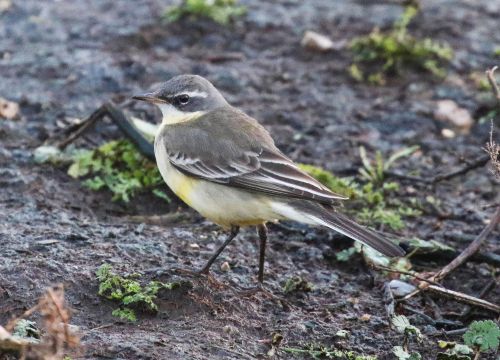
After those birders all gave up and left I too moved on to rendezvous with Ewan at the EYW site. The individual is of a sub-species within the new taxon (nominate form tschutchenshis) that is variously referred to as Blue-headed or Alaskan Eastern Yellow Wagtail. The preceding sentence possibly indicates just how complex the entire Yellow Wagtail taxon has now become (see here). Today’s bird, a first year male has remained faithful to some manure piles along a farm track at TF714380.

Ewan had been there since first light (see here) and already observed the bird very well. But it had not been seen since for over an hour and between 20 and 30 birders were now waiting patiently for it’s re-appearance. After another 30 minutes or so our quest flew in again to a muddy field across the track from the manure piles (pictured above) and all of us were soon satisfied. The EYW then relocated to it’s more usual spot and many more pictures were taken, but in the poor light my own efforts (below) might best be termed record shots. This was certainly a rather striking looking bird. My thanks are due to Ewan for kindly allowing me to use his pictures in this post.

After a late breakfast at a beach café in nearby Heacham we went our separate ways. The LWF Goose not having been relocated, I tried for and dipped eight Smew at the developing RSPB / Hanson Ouse Fen NR (see here) near St Ives, while Ewan had priorities of his own. When complete, the very impressive Ouse Fen will be the largest reed bed anywhere in the UK, if presently very difficult to locate Smew in. Exploring the place today I appreciated the massive potential it has, and once again what incredible habitat creation work the RSPB carries out with projects such as this and Wallasea Island. But as ever I baulk at the mass market populism that is deemed necessary to sustain it all.

Mild winters such as we are presently experiencing mean Smew are less likely to occupy the far western reaches of their winter range that the British Isles represent. This has so far been a poor season for the iconic Sawbill that I devoted some time and effort to a year ago, and unless there is a cold snap that looks set to continue. For an interesting assessment of the current national status of wintering Smew see here. Meanwhile a latest national photographic competition over one bird continues to emanate from Whipsnade Zoo, and my own previous post is one of the quickest ever to pass 100 referrals.

This is just a brief treatment of today’s EYW, since many birders have seen and blogged it already and I prefer if possible to add something  to what has been published already on the wildlife presented in this journal. But Eastern Yellow Wagtail is my second bird lists addition of the new year, following last week’s announcement that Hudsonian Whimbrel has been reinstated as a full species by the International Ornithological Congress (IOC) and hence the BOURC (see here). So my British list now stands at 354 and my WestPal list 496.

Black-throated Thrush at Whipsnade Zoo, Beds – 14th Dec

It took a little effort to warm to the idea of twitching a very attractive lifer in a public zoo, and beside a children’s play area just before Christmas, but after a couple of hours’ deliberation I opted to go. The location was only 36 miles from home, and the entry cost would most likely be less than that of reaching any alternative future occurrence.

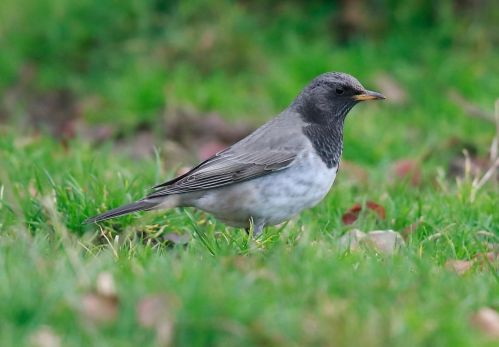
A Black-throated Thrush had first been reported here on RBA three days earlier. Though not re-found on Thursday (12th) on which I kept an eye open, it had “shown well” on and off a day later when I wasn’t paying attention. This was a first record for Bedfordshire, yet another instance of an autumn or winter scarcity from a nearby county that seemingly in Oxon fears to tread. So on rising today the more usual Saturday morning option of checking out Farmoor Reservoir slipped down my to do list.

thumbnail (1)

The Whipsnade Black-throated Thrush © and courtesy of Mark Rayment

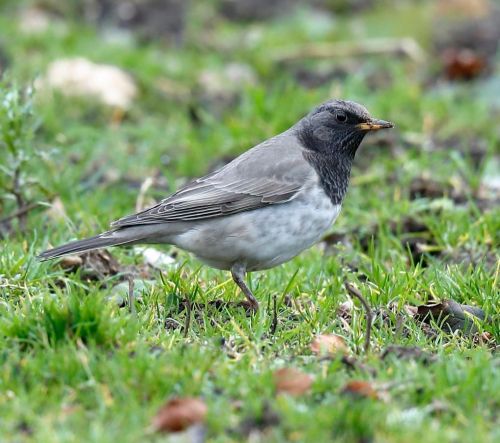
The first RBA pictures (see here) were persuasive in reaching that decision. This one (above) taken on 13th is rather better, and I believe has since won BirdGuides photo of the week. The taiga breeding Black-throated Thrush inhabits coniferous forests across European Russia eastward through central Siberia and towards north-western Mongolia. Further non-breeding populations occur from the Middle East through central Asia to western China. They may winter between and around those core ranges and when vagrants stray to western Europe it is usually in carrier flocks of Redwing and Fieldfare.

BTT is one of a closely related group of Asian thrushes including Naumann’s, Red-throated and Dusky (see here) Thrushes in which inter-breeding commonly occurs. This can complicate identification of individuals and especially first winter birds that might turn up further afield. But no such issues were likely with today’s quest, an adult male and that made connecting with it an even more exceptional opportunity. All ways up this was a must see.

I contacted Ewan who as it happened was just setting off himself and so he collected me from home. We arrived at Whipsnade ZSL Park at 9:30am in heavy rain and most of the vehicles in the car park looked like they contained birders. There had been just several observers on site a day earlier but there was now clearly going to be quite a crowd. A lot of those present headed inside at the opening time of 10am but electing to avoid a drenching ourselves we chose to wait for news to go out. That took just 20 minutes by which time the rain was already easing.

It transpired that first sighting had come from Friday’s location, upon our arrival at which the conditions had turned sunny and cold. Before too long a mass movement occurred to another place but when we got there it was clear nobody knew where the bird might actually be. So we retraced our steps then a friend of Ewan’s, who has very kindly allowed me to use the pictures in this post, arrived and they decided to stake out that spot where a Rowan tree would offer further good opportunities. But then most people present rushed off again.

thumbnail (2)

Something like how I saw the bird today © and courtesy of Adrian Webb

I eventually decided to follow and this time it was plain the crowd was on their target. Before too long I was directed to a “very pale shape” in some more berry bearing trees in the middle distance, and that indeed was the Black-throated Thrush. Having thus gained acceptable views I called Ewan and when he arrived the bird was showing better still if some way off. I was surprised by just how well it stood out amongst the Redwings feeding on the berries there.

An adult male such as today’s bird is unmistakable, with a grey back, white belly, and a pitch-black throat and chest. The contrast between that black and the relatively unmarked underparts was very noticeable at the range I observed today’s bird. And there it perched for long periods amongst the more hyperactive Redwings, serenely surveying the space before it. Occasionally it dropped down to ground level amongst some miniature railway sidings before being lost to view again.

thumbnail

Adult male Black-throated Thrush © and courtesy of Mark Rayment

In the circumstances things not unnaturally became a little fraught at times. Two things that I can do without on twitches are individuals who must not have their line of sight obstructed however accidentally, and others who wish to steward and judge their less well positioned birders’ behaviour. I myself neither intentionally block others or reproach people who might get in my way, nor see why non-birders should not be inconvenienced briefly at the crucial moments. At one point it became necessary to stand up for myself against the self-righteous puritans. All that’s ever needed is a polite request.

By early afternoon most of the birders at the railway sidings had moved on, presumably satisfied with their views. But conditions were now bitterly cold with a biting wind. So we returned to the first location where Ewan’s friend and some other photographers were still staking out its favourably lit Rowan in the hope of gaining some good shots. But the BTT had not returned there, so we repaired to the warmth of the nearest cafeteria then the tropical butterfly house, before heading on home.

This was another immensely satisfying day, producing as it did my fourth bird life list addition of early winter. November and December so far have been quite a contrast to what was a frustrating autumn and hence I keep on chipping away. Black-throated Thrush is not a lifer I could have imagined gaining before this particular one materialised so close to home, but it will do nicely thank you. After all, one never knows what the next bird might be and hence I continue to evolve and progress.

A visit to Donna Nook Grey Seal colony, Lincs for my first Pomarine Skua – 29th Nov

When Wednesday’s BirdGuides review of the week told of this bird making an extended stay within an Atlantic Grey Seal colony on the north Lincs coast it seemed like an unmissable opportunity to connect with the only British Skua I had not observed previously. Settled ones on land do not occur too often, so though 180 miles from home is further than my preferred driving distance I at once resolved to go. Like my first Little Auk in Oslo earlier this month, making the trip would be greatly preferable to trying to sea watch fly-bys somewhere.
Personal records of the three other Skua species had all come locally from Oxford’s Farmoor Reservoir: Great in October 2017 (see here), Arctic (Nov 2013) and Long-tailed (Sep 1995). But it would be very unusual for a “Pom” to turn up at such an inland location, and thus lingered a rather glaring omission from my national and life lists. Earlier this autumn another land-bound individual was found early in the day at Langstone Harbour in Sussex, but when I arrived there it had flown off not to be seen again.

pomarine skua.1901 donna nook

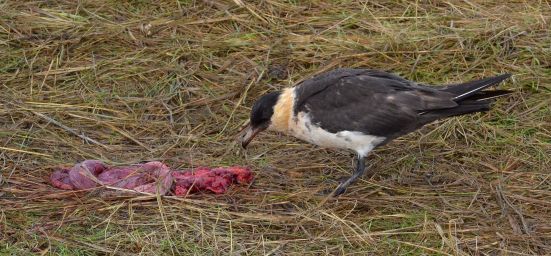
Today’s Pomarine Skua (adult)

The weather was due to change for the better on Friday and so at around 9:30am I arrived at Donna Nook NNR in cold and clear conditions. One of the car park volunteers said the bird was still present, and on enquiring of a departing birder I was pointed towards a spot where the presence of green clad optics carriers indicated where my quest must be. And there, sitting out on the salt marsh alternately dozing and preening, was my first ever Pomarine Skua – things this time were as simple as that.

Numbers of these seabirds are seen on migration around British coasts in both spring, when I understand a particular wind direction is needed to encounter them, and autumn. This one has possibly reasoned that the all day, as much as it likes buffet offered here by the plentiful placentae that litter such a large breeding seal colony is preferable to moving on. But rather worryingly it is also said to have an injured leg and so may just have been left behind.

Before long the Pom took to the air then landed besides a placenta a few metres within the viewing area boundary fence, a brute of a bird. This was a picture opportunity such as all the birders present craved, and the object of our attention set about tearing at its meal with typical Skua-like relish. A lady standing next to me said if she photo-shopped out the after birth she would then have a nice picture. I have since seen the same view expressed on another Oxon blog and must confess to not seeing what the sensitivity is here.

DSC_0173

Were I a photographer these are definitely the “shots” I would want. The food source is after all why the bird was here offering such exceptional views of itself. I am also not either a doctor or biologist and so open to correction, but were we not all once followed into the world by one of these perfectly natural items that nourished and allowed us to breathe in the womb? No … there’s nothing wrong with a nice bit of placenta, as this Pom clearly agrees.

Having gained such acceptable studies of this latest life list addition, I next turned my attention to its hosts. The seals were possibly the most awe inspiring wildlife spectacle involving large animals I have enjoyed since experiencing Florida’s Alligators in January 2018. An information board today announced a recent count of 469 bulls and 1629 cows on site, while 1554 pups have been born so far in the current season.

Donna Nook NNR is one of four Atlantic Grey Seal colonies on the English east coast, the others being Blakeney and Horsey in Norfolk, and the Farne Islands. The Lincs Wildlife Trust administered site covers around 10 km of coastline and consists of dunes, slacks and inter-tidal areas. Deposition of material from the River Humber has resulted in mud flats offshore, and the advancing dunes have trapped areas of salt marsh behind them. Every November and December large numbers of seal cows come ashore to give birth, before being mated again by the waiting bulls.

This slideshow requires JavaScript.

The first pups are born in early November, with numbers peaking around the time of my visit. How rapidly these grow was all too apparent today, and after 18 days the young seals are weaned and the cows return to sea. After moulting into their first adult coat the juveniles follow and by January the beach is empty again. Lesser numbers of the smaller Common Seal also breed at Donna Nook.

The uniformly dark-toned bulls are impressive beasts indeed, up to 2.2 metres in length and weighing up to 300 kg. Here and there I observed them halfheartedly sparring or attempting to mate, but mostly they just slumbered their time away. Some bore the kind of battle scars I have grimaced at in many a wildlife documentary. There seemed to be a concentration of very large bulls out on the tide-line. Cows are pale with darker patches, growing to 1.8 metres long and weighing up to 150kg, and mostly give birth to a single pup each season.

It was of course the pups (pictured above) that stole the show. Like many of the adults they seemed to prefer lying on their backs in variously comical poses, and would roll around, smile and chuckle just like human babies. Their “cute factor” is understandably what brings large numbers of visitors to this NNR, necessitating a one-way system through lanes out from the nearest village of North Somercotes and back. Parking on site is £4 / vehicle and must be a very welcome source for funding reserve management.

Around midday I returned to my car for a sandwich and to retrieve money for the donations box. Many more general public were now arriving and I was amused by the perfectly white pumps heading in the other direction into a muddy area behind the sea wall that had been flooded just a day earlier. A few ladies were attired straight from the high street or possibly somewhere more exclusive, and two fellow multi-layered welly wearers I joked with said they had seen a man dressed in running shorts in the very chill wind.

Returning to the viewing area I sought out the Pomarine Skua again and soon relocated it. The light had improved somewhat and it was now that the lead image in this post and those immediately above were gained. Then at around 1 pm I headed for home, completing the four-hour return journey without even a loo stop or batting an eyelid. Maybe I should go beyond range more often, and this had certainly been an uplifting day out.

A mini-celebration of Snow Bunting from Walberswick, Suffolk – 20th Nov

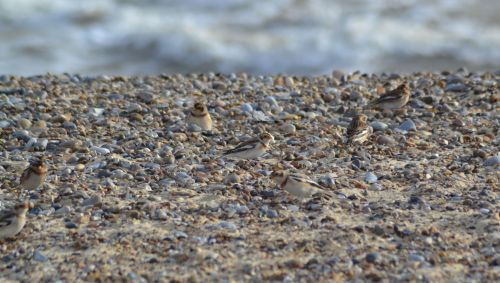
Today I gained my best ever experience and pictures of one of the regular wintering passerines that occur around the East Anglian coast. Whilst staying with friends in Suffolk for a couple of days, my birding time out at this site was to try a little late for what by now was a long staying Eastern Yellow Wagtail. That bird wasn’t seen but an attractive flock of Snow Bunting coming and going continuously during my 4½ hours on site was a pleasing diversion.

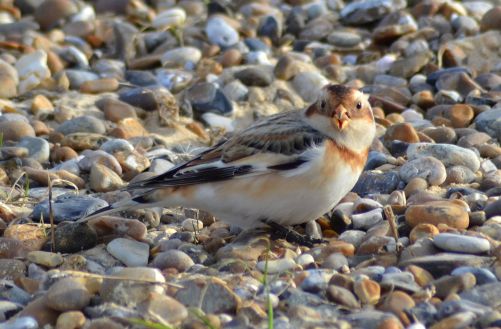
snow bunting.1907 winter male walberswick

Winter male Snow Bunting

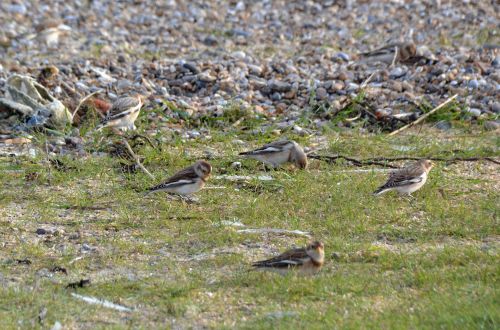
The 20-something Buntings were particularly attracted to a patch of grass on the shingle beach (pictured below) where seed must have been put down for them by birders twitching the EYW on previous days. Some of my pictures indeed show them eating what doesn’t look like a natural food source.

snow bunting.1923 walberswick

These birds tolerated a very close approach and I was able to get within feet of them at times without causing them to scatter. I hope I have identified  the various individuals correctly as to gender and age (below), but if not am open to correction.

Last winter I had twice observed a Snow Bunting flock in very windy conditions on the north Norfolk coast at Holkham Bay (see here). Due to the closeness of today’s encounter I enjoyed it that bit more. Other past personal records were from Reculver in Kent (Nov 2014), Cley in Norfolk (Oct 2014), locally at Farmoor Reservoir  (Feb 2012), Walberswick again (Feb 1986); and twice as a teenager in the family home back garden in eastern Greater London – yes really!

snow bunting.1922 walberswick

Today’s Snow Bunting flock at Walberswick

Where the Eastern Yellow Wagtail was concerned, I agree with the day’s only post from the site that it was not seen. But others amongst the observers present kept calling it confidently from the briefest of glimpses, something that not being a proper birder myself I am always dubious about. Some trusted Oxon birding colleagues had been here before me so I knew exactly what to look for (see here), and also came armed with a printed picture. It is mostly only possible to make subjective judgements about how knowledgeable people I meet in the field are, but some of the things being said here just did not tally. And when the bird being called eventually showed itself clearly mid-afternoon it was a first winter regular Yellow Wagtail (pictured below). Neither bird was reported on the following day (21st).

I am not greatly enthused by new splits that might only be distinguishable on call or by DNA analysis of faecal samples. But these are “tickable” and so in my current low state of national birding motivation this one seemed worth a look. The Eastern Yellow Wagtail had been present at Walberswick Corporation Marshes on the Suffolk coast since 28th October, and was confirmed as such from a sound recording on 9th November.

I expect there will be more opportunities since, as familiarity with the new species grows, proper birders are likely to identify others. That will have to wait, but here and now the wintering Snow Buntings at this site had made for a worthwhile visit. I nonetheless returned home thinking it may have to be something a bit special to tempt me out again nationally this winter.

A short visit to Oslo to experience a Pine Grosbeak irruption – 6 & 7th Nov

When I read about this on BirdGuides it was something I just had to do. Late October had seen the largest south-westward movement of Pine Grosbeak since 1976. This had already eclipsed an irruption in 2012 when one bird reached Shetland, and numbers were expected to multiply further in southern Scandinavia through early winter (see here). With 60-something regularly occurring species still required for my pan-European bird list, a spring trip to Sweden is on my next-up agenda. But the iconic far-northern Finches are not on the target list for the tour I am considering, so this at once seemed my best chance of recording them.
There is some anticipation amongst British birders presently as to whether PG will arrive on these shores again in the near future. But after such a dull autumn within my range at home I felt that getting to southern Norway from London Stansted airport would be rather easier and more affordable than reaching such far flung locations as offered the British Isles’ hardcore birding interest through October. So thus it was that on Wednesday (6th) Ewan and myself stepped off a 9:30am Ryanair at Oslo’s Gardermoen Airport to meet our guide Simon Rix then go in search of PG and some other rather special regional birds.

DSC_0489

Pine Grosbeak (adult male)

Simon cited two hill-top locations on the northern edge of suburban Oslo at which he had observed groups of Pine Grosbeak in recent days. At the first, Grefsenkollen he had been interviewed at first light on national radio, such is the interest that thousands of these birds moving through Norway each day is generating. When we arrived there a number of his local birding colleagues were staking out the site, but no “Grozzers” had been seen again since 8am. So after a brief look around ourselves we moved on.

Now we went to the area around Holmenkollen ski jump, an up-market residential district that commands panoramic views over the city and Oslo Fjord. It was a cold, clear and crisp early winter’s day and we drove around checking the stands of berry bearing mountain ash or Rowan (sp) trees that grow here. These provide a ready food source for the taiga breeding avian visitors in what is an exceptional berry year, and the birds are likely to start high up then work their way down to lower areas of the city as the fruit is stripped.

Before too long our quest was located in good light, a flock of seven then 17 more flew over. The first group contained just one red-toned adult male, whilst females and first winter birds are difficult to tell apart. These are Redwing-sized and often extend their necks downward into elongated postures when feeding, before stripping the berries of their skins and digesting the pulp within. In doing so their acrobatic jizz is reminiscent of Waxwings, but my favourite trait is when they shimmy sideways on their twig and branch perches to re-position themselves. What absolutely stunning beauties they are … words such as captivate, enthral and allure, or derivations thereof, barely do them justice!

These birds alternated between feeding on the Rowan berries and the buds of Spruce trees, moving regularly between the two food sources. When in the berry trees the PG were quite fearless of human presence, allowing us to approach very closely. But they were much more sensitive to the threat from above and with Sparrowhawk active at the site would scatter at intervals. At one point a Pygmy Owl even flew through fast, though only Simon noticed it.

We stayed here taking pictures for around two hours. Rather noisy machines were busily creating snow cover for cross country ski tracks just below us, causing a constant fine spray to drift through proceedings. This served to interfere with camera settings and lowered the air temperature that would naturally have been a couple of degrees below zero. Eventually something spooked the Grosbeaks and they all flew off, but after a brief drive around checking other locations we returned to find a new flock of a further 10 birds. Now the quality of picture on offer took a turn for the better, including most of those that appear above and below.

Pine Grosbeak’s breeding range is in the mature, undisturbed taiga forests of northern Fennoscandia and Russia. There in contrast to their bold behaviour when feeding in winter they are unobtrusive and retiring. This present irruption is somewhat earlier than is typical and unusually high numbers have also penetrated Denmark. But they are not known for making long sea crossings, so multiple arrivals in Great Britain would be truly exceptional.

guiding IMG_0120 copy

Myself and Ewan (right) at Holmenkollen, courtesy of Simon Rix

In the early afternoon we relocated to Forneba, another exclusive residential district on the shore of Oslo Fjord, to seek out Little Auk. Recent weeks have seen numbers of them moving down eastern British coasts, as is usual in any autumn when birds from huge Arctic breeding colonies migrate to their north Atlantic wintering grounds. Some southward bound Auks stray into Oslo Fjord especially after squalls at sea. So as with the main target, being guided to this second lifer for the trip in Norway seemed like a safer option than trying to guess a good sea watching point then hoping they pass by at home.

As things turned out it was myself who called the single individual we found here (below left), which proceeded to offer exceptional views as it made long dives close in along the shoreline. This experience was greatly preferable to trying to sea watch one in England, a type of birding that has never appealed to me given the distance at which passing birds are mostly seen. We also observed three Guillemot (below right) at Forneba, which upon checking I find was my first sighting anywhere since 1991; but I haven’t been looking.

We ended the daylight hours by trying for a Great Grey Owl that had been reported along a forested road near the airport. But now our luck on what had been a superb day in Oslo ran out, then we did not find the long shot again on the morning and late afternoon of 7th. It could have been a lifer for both Ewan and myself, but not this time.

Overnight we stayed at the excellent Thon Hotel Gardermoen four miles from the airport, that itself is a 40-minute drive from Oslo. Here an adequate evening meal and superb breakfast were both included in the room rate, being real value in a country I concluded is prohibitively expensive due to its very high economic level. For that reason I feel disinclined to bird in Norway again, other than on one or two day trips such as this.

oslo.1907 holmenkollen snowscape

Holmenkollen on day two

Thursday (7th) fell a little flat by comparison with our superlative first day. In the morning we visited the forest park of Lindenkollen from where Simon had recently published video of a Hazel Grouse on his blog (see here). I particularly wanted to see this species as it was an only trip target not gained on the April 2017 tour I joined in Estonia. Our guide re-located the bird and heard it calling several times but it just would not show itself, possibly because it was watching the three of us and so was very wary. This was a repeat of my experience in Estonia with the guide knowing a bird was present nearby that I didn’t see.

Whilst in that forest we also observed three Nutcracker and parties of Parrot Crossbill and Willow Tit (record shots above). But we all wanted some more Pine Grosbeak action and so returned to Holmenkollen in the afternoon. Now the weather had deteriorated and light conditions were poor. The snow machines had also succeeded in covering the area with a light dusting. And once again we came across another PG flock of 18 birds that this time contained three adult males.

We thus estimated having seen 34 of the main trip target at this site over the two days. The latest contingent proceeded to entertain us just like the previous day’s birds. At one point a similar number of Waxwing flew in and the two species fed communally in the same Rowan trees, which was quite a novel experience.

DSC_0535

Pine Grosbeaks and Waxwings

Ultimately it was disappointing to have converted just two of the four trip targets, but the Pine Grosbeaks of our main intent were absolutely superb value. They have some competition to be my birds of the year – including Allen’s Gallinule and Dwarf Bittern in Fuerteventura, the Cape Rhir Bald Ibis flock again in Morocco, and everything I saw on June’s Wildwings tour of Turkey – but I think these Scandinavian stunners probably make it. Very important is the trail blazing aspect of this visit to “Groslo” since myself and Ewan are the first British birders to undertake it. So all in all it was a highly worthwhile and unforgettable exercise. Cue a fade out …

DSC_0501

For Simon Rix’s own account of these two days see here