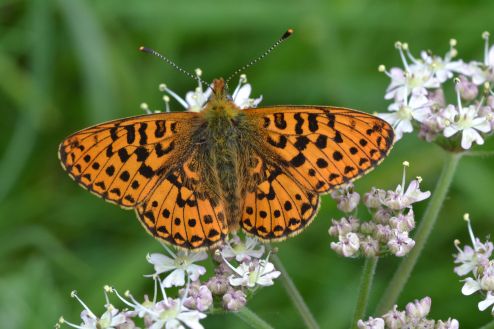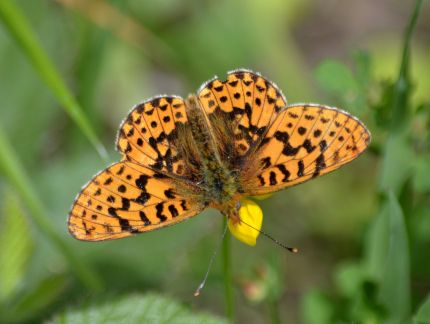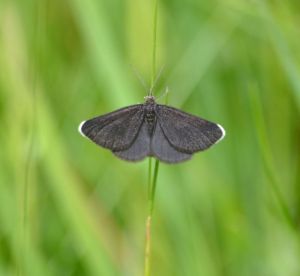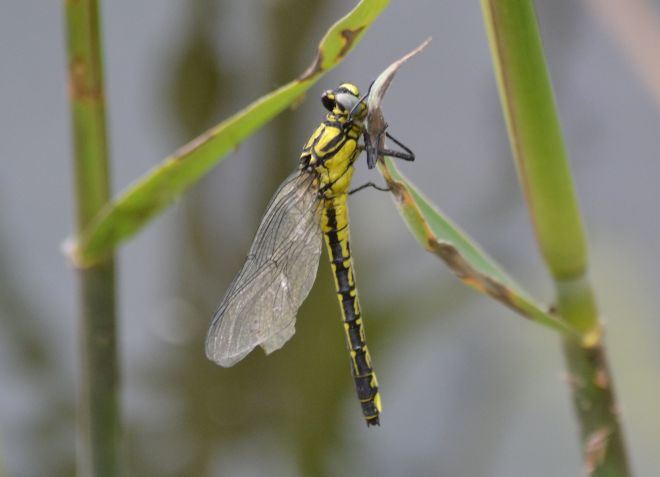
Some Anatolian blue and other butterflies in southern Turkey: 16 – 20th June

During my recent Wildwings birding tour I naturally enough took some time out for butterflies when the opportunity arose. The highlight came while we were exploring the Emli Valley in Aladaglar National Park, when I came across clusters of mud puddling blue butterflies that contained a number of new (for me) regional species. I had witnessed this phenomenon before in les Cévennes, France but not In Greece last July where ground conditions were wetter than usual and so catered for butterflies more widely.

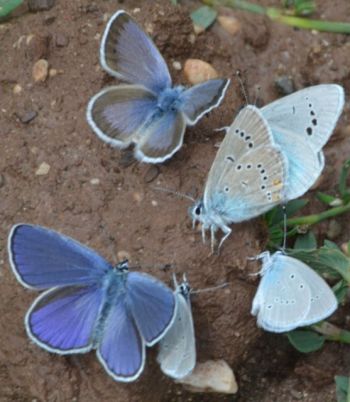
turkish blue medley.1901 emli valley

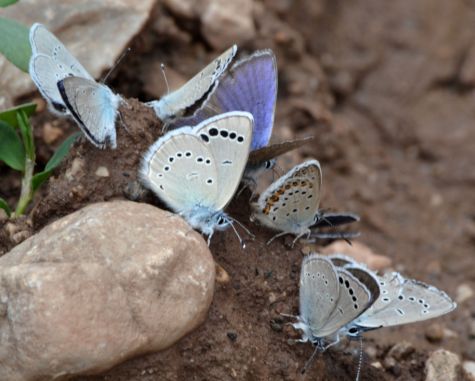
Anatolian Black-eyed (centre ) and a medley of mud puddling Blues

Encountering “mud puddling” is a very good way of observing then separating a mix of Blues. In dry country these butterflies will all congregate around wet patches caused by small scale flooding, natural springs or leaking livestock feeding troughs. The one that most stood out here was Anatolian Black-eyed Blue (pictured below) due to the very prominent row of black dots on the underside fore-wing.

anatolian green-underside blue.1901_01 top right emli valley

Another medley containing (clockwise) Anatolian Black-eyed Blue, unknown item, Anatolian Green-underside Blue, Osiris Blue (x2) and Mazarine Blue

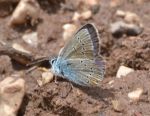
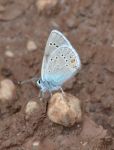
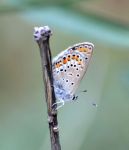
Anatolian Green-underside Blue is rather similar and I believe the partially hidden butterfly at the top right of the above group is one. Other regional species that I have managed to identify were Anatolian Zephyr Blue (below, top row) and Small Anatolian Blue (bottom row). The name Anatolia as a region refers to the westernmost protrusion of Asia, also known as Asia Minor that makes up the majority of modern-day Turkey. It’s endemic butterflies lie outside the range covered by the Collins European field guide.

Fortunately the pension where we stayed had a copy of the only print field guide to Turkish butterflies, by Ahmet Baytas (see here). This presents one or two pictures of varying quality for each species. Published in 2007, it is now out of print and available used copies on Amazon go for around £50, so no thanks. But I was able to pick out likely looking IDs, of which the above were confirmed by the Bing galleries that are produced by Google web searches.

My first reaction on perusing this guide was of wanting to re-visit Turkey just to cover some of the many extra species listed. Then the slippery slope that starting to butterfly outside Collins’ range must represent hit home, because there were so many of them for which reliable and affordable field guides may not be available. I suspect I have one foot upon that path already.

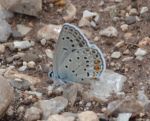
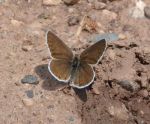
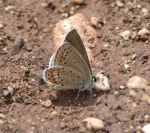
Two more Blues that were present in the Emli Valley I identified as Mazarine Blue and  Reverdin’s Blue, both of which (if correct) are welcome lifers. The first-named (pictured above) occurs very widely across much of continental Europe and into Anatolia and the Middle East. The second (below. top row) has a more restricted range from France through eastern and south-eastern Europe and into Turkey. Both are butterflies of grassy places in high summer.

The diminutive Osiris Blue was quite plentiful at this site. This was my second ever experience of a species that I recorded initially in les Cévennes in May 2016. Now I was able to obtain better pictures (above, lower sequence) including brown-toned female Osiris for the first time. Another second timer, elsewhere in this national park was Ripart’s Anomalous Blue (below) that I first experienced in Greece last July and self-found this week. Now I gained top side studies for the first time. Yes the anomaly is that these Blues are actually pale brown.


The following records have yet to be identified. I am open to advice from more experienced observers in the region as to these and also concerning any of the above featured blue butterflies if I have not identified them correctly

  • –  Click on any image to enlarge  –

Further along the Emli Valley I wandered away from the muddy track and into a bushy area to see what might be found there. Now I enjoyed only a second ever encounter with Blue-spot Hairstreak (pictured below), the first having been at Tavira, southern Portugal in May 2014. With this discovery I began to ponder returning to this region of Turkey and staying at the pension for a few days just to butterfly the valley properly. But cloud was beginning to build and so the butterflies disappeared and I thought it best to catch up with my birding group and find out what I had missed.

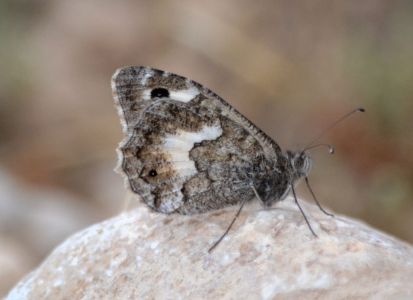
A third Collins range lifer for this trip, a day earlier on the other side of the Aladaglar Mountains, was Eastern Rock Grayling (pictured below). This south-east European butterfly extends into Anatolia and eastward as far as Iran, flying from early May to mid September. It inhabits dry, bushy places mostly in woodland and especially Pine forests.

eastern rock grayling.1901 turkey

Eastern Rock Grayling

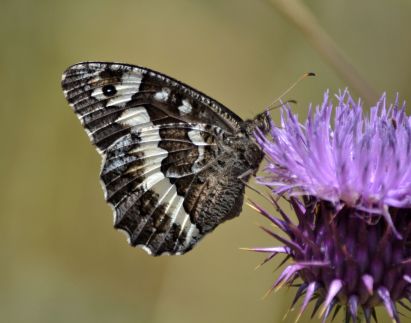
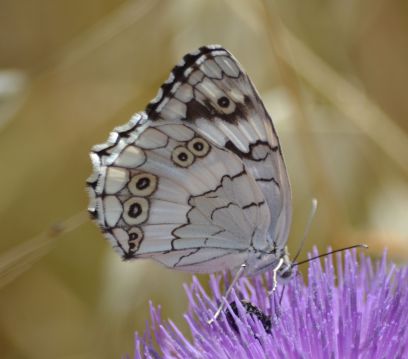
Great Banded Grayling was one of a number of larger species that were encountered in flowery places throughout this tour’s five days. Though there are a number of Marbled White species in the Turkish field guide I took those here to be Balkan Marbled White, as in Greece last July which members of this genus my pictures most closely matched.

great banded grayling.1901 turkey

Great Banded Grayling

balkan marbled white.1903 turkey

Balkan Marbled White

Cardinal is a majestic butterfly that I have so far found difficult to capture well pictorially. It’s more cryptic rust brown and green under-wing patterning than Silver-washed Fritillary serves to produce rather fuzzy images. To make things worse this individual (below) just would not come out from a shady, back-lit position so to make them more attractive my pictures have been edited for maximum Chernobyl effects.

This slideshow requires JavaScript.

Lastly this Knapweed Fritillary (below) produced some pleasing studies. I decided on the ID from the under-wing picture that closely matches illustrations in Collins, though there are some similar Fritillaries in the Anatolian region. There are a number of “Knapper” sub-species across it’s pan-European, north African and Middle eastern range; and these display marked variation between the different countries in which I have recorded them.
Turkey was a fascinating country to visit both for birds and butterflies, and one that has whetted my appetite to extend the range over which I might observe more of the latter. The Bulgarian wildlife tour operator Wild Echo runs a two-week programme (see here) in eastern Turkey offering the potential for many new species, and I am also attracted by the Caucasus and north-west Africa. So who knows, I may be coming out of retirement to earn the money for all this soon.
Trip report – Birdwatch Magazine / Wildwings tour of southern Turkey: 16 – 20th June 2019

My first ever visit to this country produced 21 bird lifers: Brown Fish Owl, Graceful Prinia, Eastern Bonelli’s Warbler, Krüper’s Nuthatch, Cretzschmar’s Bunting, Bimaculated Lark, Upcher’s Warbler, White-throated Robin, Asian Crimson-winged Finch, Pale Rock Sparrow, White-winged Snow Finch, Moustached Warbler, White-headed Duck, Caspian Snowcock, Red-fronted Serin, Radde’s Accentor, Finsch’s Wheatear, Syrian Woodpecker, White-throated Kingfisher and White-spectacled Bulbul.
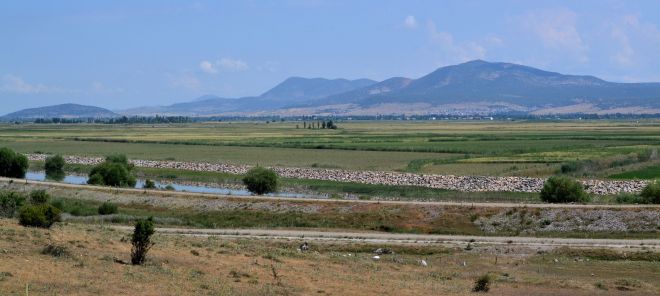
The full write-up is on this journal’s Trip Reports tab. To view it click on the image (below)

turkey.1901 landscape

Other notable birds observed through the five days included:

  • Isabelline and Black-eared Wheatears, Black-headed and Ortolan Buntings
  • Olive Tree, Rüppell’s, Barred, Great Reed, Eastern Orphean, Eastern Bonelli’s and Eastern Olivaceous Warblers
  • Greater Short-toed, Calandra and Horned Larks
  • Woodchat, Masked and Red-backed Shrikes, Chukar Partridge
  • Western Rock Nuthatch, Middle Spotted Woodpecker, Red-billed and Alpine Chough
  • Purple, Squacco and Black-crowned Night Herons, Pied Kingfisher, Spur-winged Plover
  • Lesser Spotted and Booted Eagles, Long-legged Buzzard and Egyptian Vulture

So the story goes, this is a tale that must be told … and all that. Enjoy (click here) …

Squacco Heron at Titchfield Haven, Hants – 9th June

With this addition my British bird list now stands just one short of the 350 mark. A Squacco Heron had been recorded on and off since 24th May in the Meon Valley between the village of Titchfield and the national nature reserve to the south (SU539047 – see here). Though it is a long-legged water bird I have seen often enough abroad, the opportunity to observe a first national one so close to home is one I would have been disappointed to miss.

DSC_0025

The lower right pale smudge in the centre of this picture is the Titchfield Squacco Heron

The circumstances were the reverse of when I first set out to see this Squacco three days after it first appeared at the site. Then I had travelled part of the way to find only negatives on RBA, and so went butterflying instead. Today I was trying for a special insect in the New Forest, the teneral female aurantiaca form of Scarce Blue-tailed Damselfly that is much prized by odo hunters. The drive down was mostly in sunny conditions, but upon my arrival grey cloud in variously ominous shades had stacked up ahead of me.

I nonetheless spent around three hours searching the valley mire site between Latchmore Brook and Hampton Ridge where I have observed adults of the species three times previously. But not one striking orange damsel, for such they are (see here) was to be found before dark rain cloud began to build up and I left around 2pm. That could have been a tad demoralising but on checking RBA the Squacco Heron had been watched all day so far. The heavens had now opened so I opted to head around the M27 and see if conditions improved.

DSC_0035

A little local history concerning the site visited today

Indeed they did and when I pulled into a parking area by a bridge over the Titchfield Canal (SU 54145 05473) about 45 minutes later, a departing birder said my quest was showing well from the tow path less than 800 metres south. As I approached the spot cited on RBA as Posbrook flood, a pool at the northern end of Titchfield Haven NNR, three observers signalled the bird was still on view. And there was my first British Squacco Heron standing and preening at the reed margin on the far side. Things were as simple as that.

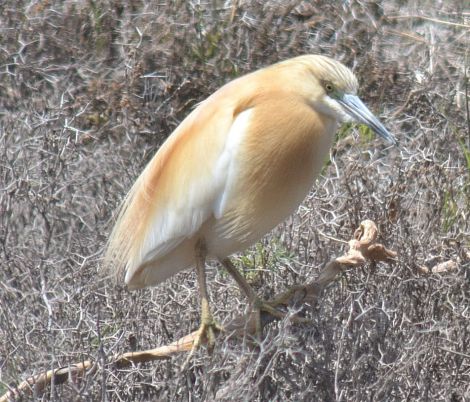
This completed the set for me of once infrequent European Herons in the British Isles, with Little, Great White and Cattle Egrets all having become regular; and scarcer Little Bittern, Purple and Black-crowned Night Herons also represented on my British bird list. Today’s Squacco was too distant to obtain pictures of, as throughout its stay here judging by the absence of images published online. So here are some of my past pictures from abroad. Even at today’s viewing distance they really are cracking looking little Herons.

squacco heron.1201 xeros delta

Squacco Heron in Cyprus (2012) above, and northern Greece (2017) below

After a while the other birders all moved on and then I noticed the Squacco take flight on being harassed by a Crow, to settle out of view in reeds a little to the south. But no matter, I had ticked this bird for Blighty and my day had not been wasted after all. On departing for home things were pleasantly sunny again. I caught up with the grey then the wet stuff on the road back to Oxford, but the warm glow of a successful twitch was with me the whole way.

The aurantiacae damselflies will have to wait until next year. The area of Hampshire that features again in this post has incidentally produced no less than 10 British bird list additions for me in the past decade. The other firsts were Velvet Scoter, Firecrest, Yellow-legged Gull, Mediterranean Gull (all Mar 2010), Red-breasted Goose (Jan 2011), Brown Shrike (Oct 2013), Siberian Stonechat (Oct 2014), Greater Yellowlegs (Apr 2015) and Roseate Tern (July 2018).

A guide to blue Damselflies from Radley Lakes and Barton Fields, Oxon – May & early June 2019

The first months of each new odonata season afford the opportunity to study and record different damselfly colour forms as newly hatched specimens begin to mature. That is now something of a motivation since I have observed every regularly occurring English insect of this group in the past. This year through May and into June I have spent time at two local sites in Oxfordshire, where some of the more frequent blue species and their various, often attractive forms did not disappoint.

My earliest visits to Orchard Lake, Radley (SU 519970) realised the first such reward, as large numbers of paler-toned male Common Blue Damselfly (below, centre top) were flying there. A month later it was noticeable how the still emerging males were of a drabber brown tone (centre bottom), though I expect this is a more immature form still. The latter appear quite ghostly and weak flying when disturbed. The right hand sub-adult male appears to be between the two in colouration and hence maturity.

The  sequences here illustrate how interest can be found in picking out all these forms of frequently seen damselflies and attempting to gain pictorial records of those I might not have captured before. There are both blue and drab forms of female Common Blue to complete the range of varieties to be identified and these go through stages of colouration as well. To complicate things further some individuals exhibit mixed colouring of both forms so maybe hybridisation occurs. This is all fascinating stuff, at least to an odo enthusiast and I hope I have got everything right.

Amongst the trillions of blue damselflies to be experienced at this time of year the other most frequent species is Azure Damselfly (pictured below). This is more straightforward to identify as it has far fewer colour forms than the as numerous Common Blue. The most obvious difference lies in the arrow shaped brown abdominal markings on Common by comparison with the slimmer, cleaner looking Azure.

Mixed in with both these will usually be the possibly more striking Blue-tailed Damselfly. Females of this species exhibit markedly different pink, purple or green colouration to the thorax; while in males that might be either green in sub-adults or blue in adults. So there is quite a colour spectrum involved in seeking out the various forms. These (below, both rows) are the ones I have recorded in this review period.

Red-eyed Damselfly (below) also exhibits quite striking forms and can also be colourful at its immature stage. So I look upon the two species described immediately above as the stand-outs when scanning any area of vegetation that might be teeming with all these insects.

red-eyed.1908 imm radley gp

Immature Red-eyed Damselfly (above) and adult forms (below)

The second local site by the River Thames in Abingdon is Barton Fields (SU511971) that in recent years has become a stronghold for the rather more scarce Variable Damselfly. This blue species is most easily identified by the “exclamation mark” stripes on the thorax and a “wine glass” pattern on abdominal segment two. I observed the insect here and secured pictures (below) twice during May 2019. Hairy Hawker and Downy Emerald dragonflies are also now regular at the location and Common Clubtail have been recorded very occasionally.

Teneral (newly hatched) damselflies are a further minefield to be negotiated, mostly appearing bland and ghostly upon emergence. But I am glad to have gained a better understanding of so many immature and sub-adult colour forms through the exercise presented in this post. It is also pleasing to have recorded most of these by returning over and again to the same areas of just two sites. All this is out there in the countryside awaiting those who go to look, and I hope this guide may be of use to less experienced observers who might care to do so.

Decoy Heath, Berks revitalised: early season Odonata there and at Oxon sites – 3rd June

I visit the small BBOWT reserve of Decoy Heath in most years and have been there many times in the past decade. This is a hidden gem of a place for dragonflies and damselflies at which 23 breeding species have been recorded historically. So with my evolved and hence motivational butterflying being on pause for a short while after the weekend, I opted to make my first visit of 2019 on the fair weather Monday of 3rd June.

There are three good sized ponds here, between which lies an area of regenerated scrubby heath on what was formerly a landfill site. I made my way first to the closest pond to the parking area (SU 61396 63487) on the road between Silchester and Padworth Commons. This “shady pond” (pictured below) in a wooded area is perhaps the most reliable for Downy Emerald, my day’s prime target. I have only ever gained three acceptable pictures of that species and each new season set out to try for some more.

decoy heath.1901 shady pond

Decoy Heath location one: the “shady pond”

The task is seldom easy since “Downies” patrol the same circuit over and over again and only usually settle away from the water. And though one or two were visible out above the surface as I approached things at once became more difficult still as Four-spotted Chaser were also present. I was pleased to capture an individual (below, left) in teneral colouring, but immature or not it was no less aggressive than all of it’s kind. But the real boss here was the right hand FSC, and needless to say any Downy that came near was at once chased off.

I therefore decided to re-acquaint myself with the rest of the reserve then come back with my chair to stake things out and seek my chance. The route taken passed another wet spot that I will call the “seasonal scrape” (below left). This is an area of shallow surface water which dries out in high summer but can be rewarding for odonata at this earlier time of year. Not much was flying there now with Four-spotted Chaser again the main interest.

As I moved onward some larger dragonflies escaped my approach. These I took to be Hairy Hawker and a probable Common Goldenring, both of which I have encountered at Decoy Heath in past years. A little further on was the “second pond” (above right), by the reserves’s north-eastern boundary and a road just beyond. And now it hit home that all was not quite as I remembered things at this favourite site, due to the extent of habitat management work carried out since my previous visit around 12 months ago.

In recent years it had become more and more difficult, indeed scratchy to move around Decoy Heath. But now, as I had been noticing up until this point, invasive scrub has been reduced by possibly 50 per cent or more. All this has given the “second pond” a more open aspect, with the possible consequence of reducing it’s attractiveness to Downy Emerald. This was indeed one of the three locations of my past pictures (below), but today (3rd June) there were none to be seen, this being a dragonfly that in my experience prefers shadier habitat.

So what was on the wing here? Not surprisingly Four-spotted Chaser were again the most numerous, but the biggest boss of all, Blue Emperor was also imposing its effortless and ever regal authority upon proceedings. I cannot recall ever having watched this pond without being granted such an audience with the Emperor, and these were now my first records for 2019. Teneral Black-tailed Skimmer is possibly one of my favourite dragonflies in its attractive yellow and black early colouring, and I came across them several times in more open areas of the heath, always low to the ground (below).

black-tailed skimmer.1901 imm decoy heath

Teneral Black-tailed Skimmer

My immediate reaction upon taking in the extent of the restoration work was to wonder if the third pond in the north-eastern part of the reserve might now be accessible. This had been impossible to reach for a number of years and on the one past occasion when I had reached the water views over it were very restricted. But historically this is a site where the iconic Brilliant Emerald has been cited and I am acquainted with two senior Oxon birders who have observed that special dragonfly there.

First though hunger pangs intervened and I returned to my car for a lunch break. My chair wasn’t in it so I shelved the plan to stake out location one and moved on to seek out the third “hidden pond”. Indeed a fairly discernible path led through a formerly overgrown area to the water’s edge, and from there it was possible to view much of this large enclosed  pool. This has been achieved by a superb piece of site management work that serves to rejuvenate this idyllic spot and hopefully might reveal some of its hitherto secrets.

decoy heath.1904 hidden pond

Decoy Heath location four: the “hidden pond”

Downy Emerald was indeed here, having been missing from the “second pond” earlier, as were more bullying, territorial Four-spotted Chaser. No picture opportunities were forthcoming though, not unusually so the only Downy images I have captured this season remain flight studies (below) from a site at Abingdon, Oxon. Today I remained in the atmospheric hidden location of my finding for some time enjoying the tranquillity and solitude on offer, before continuing my second circuit of Decoy Heath.

downy emerald.1901 barton fields

Downy Emerald at Barton Fields, Abingdon

The main interest now, other than more Black-tailed Skimmer, was one of the site specialities White-legged Damselfy. I regard this as one of the most enticing of the blue species because of the variety of subtly different colour forms it is possible to detect in the field. The individual at the top of the following sequence is the bluest-toned I have ever come across in England, and this was followed by several paler variations. A probable teneral was also present at the “hidden pond” though I am open to correction.

white-legged.1906 decoy heath

White-legged Damselfly (male)

Lastly I made it back to the first “shady pond” where finding a passably comfortable log pile to recline on I relaxed for a while as originally planned. The surroundings here were shared with many Azure Damselfly and some Large Red Damselfly (pictured below), but the Downy Emerald now seemed to be less active and at no time co-operative as earlier. Eventually as conditions became more overcast even the four-spotted enforcers were no longer on view and so I made my way home.
Through May, Clubtails at Goring aside, I had concentrated my dragonflying on two sites at Abingdon in Oxfordshire. Radley Lakes is where I now go each season to try for better pictures of Hairy Hawker, but still I am never quite satisfied. Here Orchard Lake (SU 51935 97052) is a good location for capturing mating pairs pictorially, since they often do so in scrub on the pond’s northern shore. This image (below) is from 23rd May.

hairy hawker.1910_01 mating pair radley gp

Mating Hairy Hawkers

The start of each new Odonata season also affords the opportunity to study and take pictures of different damselfly colour forms. Advancing my knowledge of this group while boosting my picture collection in the process was one item on my home wildlife agenda for 2019, and these new season experiences are presented in the next post herein.

2019 Small Pearl-bordered Fritillary at Bentley Wood, Hants and Marsh Fritillary too – 27th May

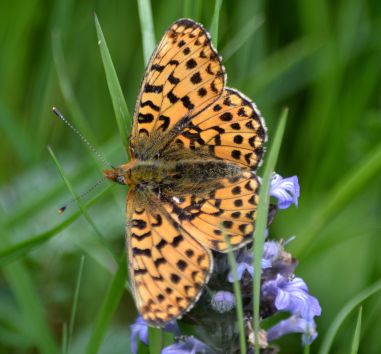
Circumstances on this bank holiday Monday led me to visit Bentley Wood for the first time in four years to re-connect with one of its specialities. In so doing, almost as a kind of insurance policy against not making it back to Wyre Forest or not seeing many Small Pearl-bordered Fritillary if I did, my picture collection became boosted by some more than acceptable results.

Over the weekend a Squacco Heron had been present in the Meon valley between the Solent village of Titchfield and the nature reserve to its south. I have seen that bird often abroad but still need it for my British list, and so opted to go down this morning then drop into Bentley Wood on my way home. As things transpired there was no sign by 9:00 am but by then I had the urge to just get out somewhere. So I decided to head south to the A34 / A303 intersection then check the news on RBA. That was still negative and so it was to Bentley Wood I headed.

small pearl-bordered fritillary.1908_01 bentley wood

Small Pearl-bordered Fritillary

Both Pearl species fly here in a part of the woodland known as the “eastern clearing” that is managed to cater for their needs. I had read this is a butterfly site in decline through difficulty in maintaining the preferred habitat, but upon my arrival mid-morning things looked much as they always had done on previous visits between 2011 and 2015 (see here). I first tried to seek out the spots where I had last observed SPBF here but was told they were being seen at the nearest end of the clearing to the on-site car parking area (SU 25901 29229 – see here).

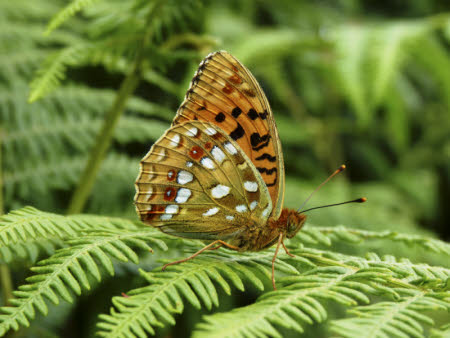
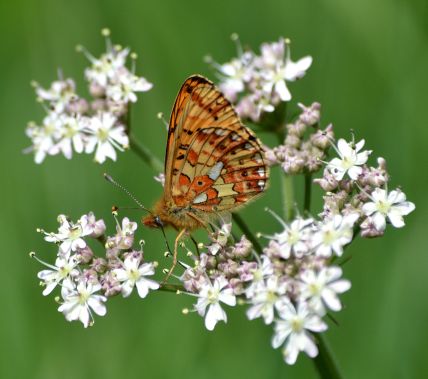
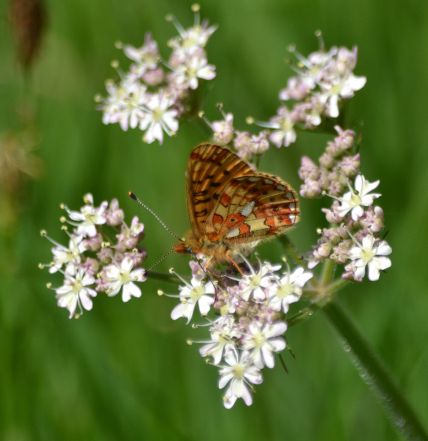
The Pearl-bordered Fritillary (pictured below, left) still on the wing here were all rather more faded than those I had encountered further north and west in Wyre Forest two days earlier, suggesting there might indeed be minor differences in flight periods between the two sites. And the Small Pearl-bordered Fritillary (below right) amongst them once again stood out by their richer brown tones and very apparent freshness. In every top-side SPBF picture I took today the diagnostic 730 marking beneath the leading edge of the left hand fore-wing is quite obvious, and the same pattern can be seen in reverse on the right hand side. The broader black outer edging and dark tip to the fore-wings are other distinguishing features.

As always at Bentley Wood there was plenty of company, and while this can assist in locating butterflies the inevitable competition for space around them most often makes gaining pictures of the quality I seek more difficult. Then there is the distraction of wondering what other observers are looking at and if they might be finding more than myself. All of this serves to underline why this was not my original site of choice this year and why generally I prefer to do my butterflying alone.

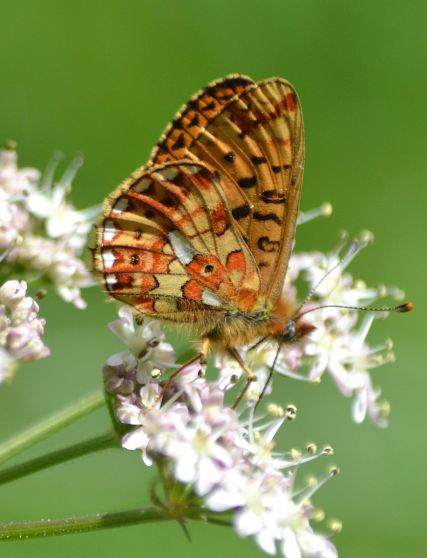
Eventually I did achieve better under-wing studies than two days ago by leaning in on a specimen that someone else had found. These (below) show clearly the diagnostic black chevrons that enclose each silver border pearl, the several pearls in the centre of each wing and the larger black dot than PBF has. The two butterflies really are quite different.

Small Pearls are said to favour damper, grassier areas than Pearls, which was certainly true of the brook side meadows at Wyre Forest, but here both species appeared to be flying together. My impression was there were just a few SPBF circuiting a wide area and locating them was seldom easy. This far into the season the eastern clearing habitat, which closely resembled that at Rewell Wood and Parkhill Inclosure, was plainly suffering from all the footfall it endures.

bentley wood.1901 eastern clearing

The eastern enclosure at Bentley Wood

In the early afternoon the number of people dwindled until in more sustained sunny intervals there were just four of us left. One couple seemed to be finding a lot more Small Pearls than I was, though they were less concerned than myself about keeping to already trodden areas and I could not tell how much clutter and light and shadow their many frames might contain. This was becoming frustrating so I decided to move on, but glancing back there they were again in close contact with another butterfly. So I walked across one last time and in doing so self-found a nicely posed, pristine SPBF basking open-winged in the sun on a thick blade of grass.

This (above) is the same individual whose portrait appears at the head of this post. Success at last and all the discontent drained out of me. I now had three good sequences of pictures and was satisfied with my day’s efforts. There did appear to be more SPBF on the wing by this time and I suppose it was possible that some might be emerging in the warmer conditions. But I resisted the temptation to continue jostling for access with my busier companions and quit while I was ahead. It was indeed now time to depart.

My sightings here meant I had observed and taken pictures of Pearl-bordered Fritillary at five different sites in May of this year. As a bonus, before coming across either Pearl species today a possibly newly hatched Marsh Fritillary was pointed out to me. I had heard over the years that a few fly here but this was the first I had seen in Bentley Wood. The under-wing macro studies in the sequence below are possibly the best I have ever attained. Later in the morning when it was relocated this individual attracted some attention.

This “threatened” species appears to be expanding its range in recent years. Over the weekend three were even recorded on the South Oxon Downs. Allowing for the possibility of them being releases this seems like quite a turn up, since MF is thought to have been extinct in my home county since 1996. So I will keep track of developments here with interest.

Bentley Wood holds more than 35 species of butterfly, including every woodland species occuring in southern central England. This importance for lepidoptera is recognised by the site’s SSSI designation. As well as the currently declining Pearl populations, other stand-out resident species here are Purple Emperor, White Admiral, Purple and White-letter Hairstreak and small numbers of Duke of Burgundy; while the above mentioned Marsh Fritillary are also holding on. For a site guide see here. Incidentally the Squacco Heron at Titchfield that had prompted this visit today was not reported throughout.

Pearl and Small Pearl-bordered Fritillaries at Wyre Forest NNR, Worcs – 25th May and 1st June

Well I did say I have developed a bit of a preference for Pearl-bordered Fritillary this year. Now the time has been reached in the butterfly season when their observation period overlaps with the later flying Small Pearl-bordered Fritillary. During the past week Sussex BC announced the latter were emerging at their managed sites of Park Corner Heath and Rewell Wood. Then one of the people I met yesterday at Goring had seen some the previous day at Bentley Wood in Hants. So today seemed a good time to explore my own SPBF site of choice, Wyre Forest NNR near the towns of Bewdley and Kidderminster to the west of Birmingham.

I had only seen the third item on my 2019 butterfly agenda previously at Bentley Wood. Not being static and liking to evolve, I wanted to go somewhere new and different this time, and also away from the attention the Sussex sites will inevitably attract following on from the recent surge in interest at Rewell Wood. The ancient Oak woodland of Wyre Forest is a long-established site for both “Pearl” species, being managed co-operatively for their benefit by Butterfly Conservation (BC), the Forestry Commission and English Nature. This is achieved through coppicing, path widening, some clearing of older areas and creation of glades.

Both these images (above) were captured by me in Wyre Forest today. The NNR information boards cite the visual difference between the two butterflies as follows:

  • Pearl-bordered Fritillary (above left): Mottled red and yellow underside hind wing (unh) with an obvious rectangular white pearl mark in the centre and a smaller pearl spot closer to the body. A small black dot in between these marks and a series of pearl spots around the edge of the unh wing.
  • Small Pearl-bordered Fritillary (above right): Black markings on the upper side are thinner and more clearly defined than in PBF (not shown above). Those on the leading edge of the left fore-wing resemble the figures 730 (visible above). Several pearl markings in the centres of the unh wings and a much larger black dot in the centre.

But once the observer has their eye in the two species are just different on jizz. Then they are really not so difficult to tell apart at all. SPBF is not necessarily the smaller of the two. Both have a typical wingspan of 4-5 cm, and as with many butterflies the size of individual adults can depend on how much the larvae found to eat.

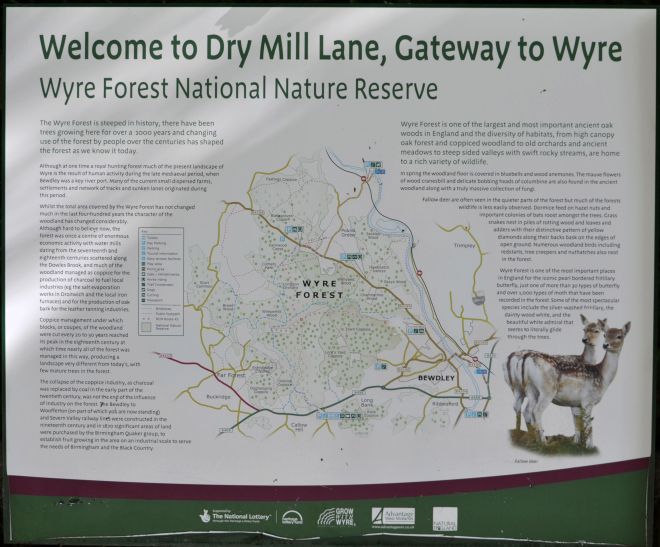
wyre forest.1901 info board

I arrived on site at 9:00 am at the Dry Mill Lane car park (SO771762) just to the north-west of Bewdley. In the medieval period that historic town was a port on the River Severn and Wyre Forest produced the charcoal that fuelled local industry. Much of the woodland was managed by rotational coppicing until coal succeeded charcoal in the early twentieth century, so in bygone times Pearl-bordered Fritillary would have thrived here.

From this entry point westward the now metalled route of a former single track railway line dissects the forest. As I walked along it the spinning coin calls of Wood Warbler were audible from either side and a first fading Pearl flew busily past. To the north terrain drops steeply to the ancient water course of Dowles Brook and its long redundant mills, down to which two permissive paths descend to foot bridges. In between those points there are several brook side meadows, and that was where a colleague from my recent Greece tour had advised me to seek out SPBF.

pearl-bordered fritillary.1922 wyre forest

Pearl-bordered Fritillary

On my reaching this area the sun went in though faded and often worn PBF (pictured above) were indeed active in those meadows. Then at just before midday in brighter conditions a butterfly appeared that stood out by its freshness. It was a richer, chocolate brown than those others I had noted so far, and upon settling revealed the distinctive under-wing patterning of Small pearl-bordered Fritillary. But it was in a cluttered position and into the sun so these images (below) are not of the best. This was the only one I encountered today, confirming the impression I had timed my visit too early. I suppose it is logical they might emerge a little later here than further south in Sussex and Hampshire.

I was then distracted by a perfectly posed PBF and the opportunity to acquire the good under-wing pictures that had eluded me in three other locations this season was not to be missed. It does not get better than what then ensued, especially since the images below are completely natural and as I found the butterfly, without wrangling or props. I had gone into the 2019 season wishing for such results and have possibly now succeeded.

pearl-bordered fritillary.1931 wyre forest

Pearl-bordered Fritillary (all pictures)

pearl-bordered fritillary.1936 wyre forest

pearl-bordered fritillary.1938 wyre forest

pearl-bordered fritillary.1940 wyre forest

Yes I rather like these images and the visit will for ever be memorable for the encounter that produced them. This was true communion of the purest quality. I was helped by the butterfly being completely unconcerned by my presence. I will admit to taking away grass stems from around the flowery perch, at which my subject did not flinch. So I went in point blank with my macro lens and still the little gem wasn’t the slightest bit bothered. Even when I grasped the flower stem to attempt bizarrely angled images the Pearl just carried on nectaring without a care in the world. Such an amazing degree of tolerance is something I have only experienced previously with Black Hairstreak.

pearl-bordered fritillary.1926 wyre forest

Pearl-bordered Fritillary (above and below)

Once I had done this small and surprisingly pristine individual’s under-wings justice it as obligingly opened up and so proceeded to offer premium top side studies as well (above). It was then time to relocate the Small Pearl but I was not successful and found no others. So when conditions became more overcast again in the early afternoon I left with the intention of giving my newest quest a little longer to start flying and then re-visiting.

More PBF (pictured below) were active along the railway line path as I walked back, which is where my site briefing had led me to expect to find them. Some of these were rather small individuals as well, underlining that size is not an indicator when distinguishing the two target butterflies observed today.

pearl-bordered fritillary.1923 wyre forest

Pearl-bordered Fritillary

On my second visit a week later on 1st June Small Pearl-bordered Fritillary were my priority, and indeed two (pictured below) stood out amongst the remaining PBF that were yet on the wing as I walked out along the old railway line. My spirits were in need of refreshment after a disappointing week in other respects, and I was looking to these evocative surroundings of Wyre Forest to provide it.

Upon reaching the meadows along Dowles Brook more SPBF were flying though not many. This time I walked a little further upstream into a new area for me that proved to be the most productive so far. But the three or more Small Pearls there were always flighty and intent on harassing one another so acquiring the pictures I desired was always difficult. Sunlight was at best hazy throughout my stay and though individuals could be found basking at intervals, I expect they were spending much of their time tucked away low in cover like the one in the right hand picture below.

Getting close to these butterflies or seeking more out would have involved wading into the meadow habitat rather more than I prefer to do. The meadows also appeared to hold quite a good selection of moths, which is an insect group I have little knowledge of and try not to become distracted by in the field. Occasionally though something grabs my attention and a number of Chimney Sweeper (pictured below) piqued my interest now. This fairly common day flying moth is more widespread in northern Britain than the south, occurring in the former in damp, grassy habitats such as this.

chimney sweeper.1901 wyre forest

Chimney Sweeper

The Small Pearl tally from this location was disappointing and so I decided to pay some more attention to the railway line path on my way back to the car. I came across no more SPBF this time, but there remained one further photogenic encounter with a still fresh and seemingly fearless Pearl-bordered Fritillary. This produced another good sequence of under-wing studies as it nectared on the track-side flowers. And so my dealings with this duo of scarce and appealing little butterflies across five different locations were over for the season, and it had all been on the whole enjoyable.

Wyre Forest, one of England’s largest and most diverse ancient oak woodlands, is undeniably a superb place to enjoy walking in and one that though much visited retains a wild and untamed character. The NNR holds more than 30 different butterfly species as well as good breeding populations of Wood Warbler, Common Redstart and Pied Flycatcher. Of those three birds the first-named was the most obvious and frequent, especially on the wooded slopes between the old railway line and Dowles Brook. So I might well return here in the future to pay proper attention to summer visiting birds as well.

This slideshow requires JavaScript.

After leaving the NNR I spent a little time by the riverside in Bewdley and it was plain that a lot of people had the same idea. The attractive and atmospheric town centre is a conservation area that remains little altered since the 18th century, and offers a wide choice of pubs, eating places and music venues; as well as parks, a museum and the Severn Valley Railway. All this makes it a popular place for a day out and I soaked up the ambience for a while and took some pictures before heading home.

Bewdley Town Council History

Emerging Clubtail dragonflies at Goring-on-Thames, Oxon – 19 & 24th May

I have paid some attention to English odonata again for the 2019 season, and one priority has been to re-experience Common Clubtail emerging from their nymph cases at the classic site of Goring railway bridge. A certain mystique always surrounds this dragonfly because though not rare it is so difficult to cross paths with, and a deal of luck is usually required to do so. I had been successful at the same site two years ago but not in 2018.

common clubtail.1901 goring

Newly emerged Common Clubtail drying off in reeds

Of Europe’s six Clubtail species, Common Clubtail (Gomphus vulgatissimus) is the only one that occurs in the British Isles and the Oxfordshire River Thames from Pangbourne upstream to the west of the county is a traditional stronghold. Last year I was invited to participate in a British Dragonfly Society survey of the population in this area, but declined because they are just so hard to come by. Numbers of exuvia (nymph cases) found on the river’s banks are often much greater than actual sightings of the relatively shy adults that either mature in nearby rough ground or relocate quickly to tree tops. So the best chance of observation is usually during or immediately after emergence.

At Goring they have for many years emerged on the abutment of a bridge carrying the main Reading to Birmingham railway across the Thames (SU606795). That (pictured below, left) was where I went to try my luck again on 19th. Since my last visit a boating club has appeared on the opposite bank (below right) so rather more was going on here than in previous years. But perhaps surprisingly no-one on that side of the river challenged me about what I was doing or assumed I must be pointing my camera at themselves. So no explanation that the Clubtails have been here for much longer was necessary.

Upon arriving with my chair at around 10:30 am, I found three exuviae on the abutment wall. My strategy is always to sit here and wait, checking the structure at around 15 minute intervals for signs of new activity. After an hour a fourth nymph had indeed appeared, with a pair of eyes sticking out of the top (below, left). But sadly this Clubtail failed to emerge fully and eventually expired. I retrieved it and placed in in the sun on a bank-side fir tree (below right) but there was no hope. Later, a little downstream I did see an adult that must have emerged in deep cover flying inland from the river, but these were the sum of my day’s results.

Five days later (24th) I made a second attempt. Arriving at about the same time another observer was there ahead of me, confirming there was nothing at one end of the abutment as I did about the other when we met in the middle. He soon moved on to be succeeded by a second person to whom I talked for a while before checking the concrete wall again. When I returned to his end he had found a newly emerged Clubtail in waterside reeds. A patient wait then ensued to see if this specimen would dry off successfully.

The second observer left after taking his pictures and I was next joined by the county odonata recorder for Essex, Neil Phillips. Being also a former education officer at Wat Tyler Country Park (of Blue-eyed or Southern Migrant Hawker fame) where I had met him previously, I took the opportunity to ask how such a large insect gets out of such a small nymph case. He explained how on emergence dragonflies pump out their abdomen and wings as part of their breathing function. This clarified why the failed emergence I recorded here two years ago was puny while the second Clubtail encountered then was so much larger and robust (see here).

There can be a 25 to 33% failure rate in this process and indeed all did not appear to be well with our particular Clubtail (pictured above). Despite flapping twice and altering position on its chosen perch, one wing appeared to be deformed and after two hours it had still not flown and was not moving at all. In such circumstances newly emerged dragonflies are vulnerable to attack by territorial males of other species, drowning from the wash of passing boats or being snapped up by passing wildfowl or other opportunistic birds. Alas, unable to fly this individual was most likely a goner and would remain where it was until starving or being eaten itself.

To quote a BDS guide, since dragonflies unlike other winged insects do not have a pupal stage transition occurs straight from a larva to an adult. This final larval moult takes place out of water being triggered by day length and temperature. Final-stage larvae sit in shallow water near the margins for several days, getting ready for their final moult and starting to breathe air. Most species leave the water during the morning, other than hawkers that do so under cover of darkness.

Larvae climb up emergent vegetation although some may walk several metres over dry land before finding somewhere suitable to emerge. After finding a secure support they redistribute their body fluids, pushing the thorax, head, legs and wings out of the larval skin. There is then a pause of about 30 minutes to allow their legs to harden enough for the next stage when the abdomen is withdrawn. The wings and then the abdomen are then expanded and start to harden. The whole process that leaves behind the cast skin of the exuvia may last for up to three hours and mortality during it unfortunately can be high.

common clubtail.1704 with exuvia goring

A successful emergence, how things should be

For a beginner’s guide to finding emerging Clubtail dragonflies and exuviae along the River Thames in Oxfordshire see here. Of the four emergences or newly emerged specimens I have observed at Goring railway bridge in 2017 and again now only one (pictured above) has so far been healthy. So I left site on 24th considering I am due a change in that respect.

More Pearl-bordered Fritillary in the New Forest and West Wood, Hants + 2019 Dukes – 20th & 21st May

While researching sites for the next butterfly on my 2019 agenda, Small PBF I became intrigued to learn that the New Forest national park holds undiminished populations of Pearl-bordered Fritillary. So whilst my recent visit to Rewell Wood in Sussex (see previous post) was enjoyable, it now appealed to experience longer established colonies of this heart warming little butterfly in possibly a less publicised and hence not such visited and pressured location.

pearl-bordered fritillary.1919_01 new forest

Pearl-bordered Fritillary

The Hampshire sites in question lie to the east of the A337 road between the two towns of Lyndhurst and Brockenhurst. They are known collectively as the “East Inclosures”, consisting of mixed deciduous and coniferous woodland with wide rides and a network of gravel tracks and paths. Through sympathetic management by the Forestry Commission to meet PBF’s very particular needs, this area maintains the county’s largest concentration.

The best access point is the Standing Hat car park (SU314036), north of which lie Pignal, Parkhill and Ramnor Inclosures that have all featured on the BC Hants & IoW sightings page this season. That was where I arrived at around 10am on Monday (20th) but conditions were lightly overcast and things did not look promising. I nonetheless set out to at least explore the area and just 300 metres along a track into Pignal Inclosure was rewarded by finding a first Pearl-bordered Fritillary nectaring on Euphorbia.

Pearl-bordered Fritillary (above and below)

That would have made a good picture but before I could get my camera setting sorted out the butterfly took flight. Despite the lack of sunshine I then encountered three more low flying Pearls in the next 100 metres, that when they settled adopted similarly grassy poses (pictured above) to those others in Rewell Wood. My attentions served to chase them further away from the ride margin, there being no-one else present to consider on this occasion, and so I did not try to follow them but moved onward.

After another 800 metres I reached an area that at once stood out as suitable PBF habitat, such as I can now recognise quite readily. This was Parkhill Inclosure, that from what I had read was the best location of all, and more butterflies were soon evident. As in the first hot spot these would from time to time be located basking with wings flat to absorb as much warmth as possible, and what attractive little sights such encounters were. The longer I was in this superb place the more I realised there was no need for sunshine because I was finding plenty of Pearls and they were proving even easier to capture pictorially than in Sussex.

parkhill inclosure.1901

PBF habitat in Parkhill Inclosure, New Forest

There was just a different, more open character to the ground level habitat in the two spots described above, and it was heartening to think this is being maintained as an integral facet within a commercial forestry operation rather than through intensive input by conservation charity volunteers as in Rewell and Bentley Woods. Of the three different sites at which I have observed PBF this latest one was the most pleasurable to be in, especially so since aside of an occasional dog walker, horse rider or hiker I had these woodlands largely to myself. The most meaningful butterflying is definitely best undertaken alone.

Walking up then back down the ride in Parkhill Inclosure I was able to capture some different treatments to the more usual grassy Pearl studies. The left hand picture below against dried fern is quite pleasing, while the right hand one and that at the head of this post achieve a reasonable balance of naturalness without too much clutter or light and shadow. More’s the pity about the damage to the individual’s right hind-wing. Once again acceptable under-wing studies showing the pearl-like markings of this species’ name eluded me on this day.

By midday there was still no brightening of the skies. I walked on to try to reach Ramnor Inclosure but couldn’t be certain whether I passed through it or not. Unsure of where exactly I was I enquired of two walkers to find I was almost back at the car park. Light rain was now setting in, so having some garden plants to collect from a nursery near Southampton and wishing to avoid rush hour congestion on the M27 I headed home. It had been an immensely enjoyable morning in the New Forest.

When Tuesday (22nd) dawned bright and sunny and stayed that way I completed the previous day’s intended agenda by visiting West Wood (SU424295) at Sparsholt near Winchester. This Forestry Commission owned, mixed broad-leaved and coniferous woodland is another Hants location for Pearl-bordered Fritillary, though their numbers are rather smaller here than at the New Forest inclosures. The most individuals recorded in a day this spring has been 11, but the site is also a reliable one for Duke of Burgundy.

west wood 1902 info board

Farley Mount Country Park site map comprising FC West Wood, Crab Wood LNR and Pitt Down

This time I left home after the Oxon rush hour, arriving on site just before midday. From the first car park reached I walked westward through the ancient woodland of Crab Wood LNR, then down a gravelled north / south ride on getting to West Wood. Along the next major track to the right I came upon a first Duke of Burgundy that settled on some Euphorbia. So this individual (below, left) atoned for my having missed a similar opportunity with PBF a day earlier. The pristine male in the right hand picture was one of two seen next in a recently felled and replanted clearing further along this track on the right, and there I also noted my first Pearl of this visit.

Continuing west along the track I met a Hants & IoW BC transect walker who told me the clearing I had just left is currently the prime location within West Wood for both species. So I went back and did another circuit, seeing three more Pearls all as fly-byes and one more Duke. So that was four of each which compares favourably with recent published counts. I don’t mind just exploring new sites and seeing what is there without knowing exactly where to look, so it was gratifying to have found both my day’s targets so quickly and in the right place.

west wood 1901

The PBF and Duke hot spot clearing in West Wood at approx SU 42457 29730

DoB having been my spring butterfly of choice for repeat study in 2018 (see here) I haven’t made any special trips to see them in this new season, but there is always a certain thrill involved in meeting the much sought little butterfly and especially in new locations. Possibly due to the current spring’s alternately mild then cold weather pattern Dukes appear to be enjoying a particularly long flight period in 2019. They were on the wing at the classic site of Noar Hill, Hants at the beginning of April but new emergences have been reported in both Hampshire and Sussex into mid-May. So far this year I have paid most attention to PBF and have to admit to becoming a little bit hooked on them.

I ended this latest quest by walking around the Pitt Down area, where the unimproved chalk downland habitat produced my first Common Blue, Small Heath and Dingy Skipper records of 2019. For a guide to the whole Farley Mount CP complex see here. This was a very interesting and butterfly friendly network of sites to explore, and well worth having made the effort to go back to on the sunnier second of this post’s two days.

Rewell Wood, Sussex re-visited for Pearl-bordered Fritillary – 1st & 4th May

On the final day of April I was alerted that the second item on my butterfly agenda for this year was ready to pursue. I had wanted to make further visits to Sussex Butterfly Conservation’s Fritillaries for the Future Project site at Rewell Wood (SU979074) to see how things were progressing, and large numbers of the insects had now emerged for the 2019 season. On my previous visit a year ago (see here) the land management of progressive coppicing had been explained by the project officer Neil Hulme, and it was fascinating to learn about.

My second aim was to obtain more pictures of Pearl-bordered Fritillary. Though I have near perfect images in my collection already, they were all of a cold wrangled specimen at Bentley Wood in 2015 so it would be good to gain some more natural studies. After the two warm, sunny days that had triggered the mass hatching Wednesday (1st) was more subdued. And so I reasoned the conditions could be right for achieving my purpose.

pearl-bordered fritillary.1911 rewell wood

Pearl-bordered Fritillary

These butterflies are hyperactive and fast flying in the sunniest conditions, so are not prone to settle and hence very difficult to capture pictorially. I arrived at the managed east-west ride early in the afternoon to find things lightly overcast as anticipated. But my BBC weather app, in so far as it can be trusted was predicting some sunshine later in the afternoon. Several people were searching along the ride and Pearls were being found.

I myself saw two fly pasts but conditions became cooler and all the butterflies went to roost. The number of people built up, since pictures had been published online in the previous two days when a record tally of 243 had been counted. Rewell Wood has now clearly taken over from Bentley Wood, Hants as THE place to see PBF. But on this day other observers were no more successful than myself and most gave up and left. At 4pm hazy sunshine did break out for a while, but the Pearls must all have gone to sleep by then since none re-appeared.

I took the opportunity to reconnoitre the length of the ride and appreciate the impressive nature of the rotational coppicing that has been undertaken here over the last few years (pictured below), all by BC volunteers. This of course replicates how such woodlands were harvested in centuries past, and it was the decline of the practice that caused Pearl and Small Pearl-bordered Fritillaries to struggle for survival themselves, with falls in number of more than 70% across their British range since the 1970s.

This slideshow requires JavaScript.

Weather over the next two days was not butterfly friendly, then Saturday (4th) was forecast to be sunny but with cold northerly winds. Plan A having failed I now set out to get pictures of the Pearls as the day warmed up, that being one of the more likely scenarios for success. This time I arrived at the ride’s western end at 9:45am but though the sun was out there was nothing on the wing yet. I had expected it to be quite crowded here, being a weekend but could see just one other person walking up ahead.

Things remained quite cool and big, threatening clouds were crossing the sun, though the strong wind kept the grey stuff moving. I engaged with the other observer, Adrian from Clacton in Essex and we carried on searching together. He was in just his second year of butterflying and looking for his first PBFs. Eventually we had brief views of maybe five Pearls during one sunny interval. My first three field priorities with any wildlife – namely see it, see it well, get any kind of picture – were all now gained.

By 11am the day indeed began to warm up and there were six of us now present. This proved to be a mannerly gathering since we all kept to a well trodden path at the edge of the coppiced habitat without walking in to its lush ground cover of wild plants. But inevitably we got in each others’ way at times. Once the blue areas of sky became wider and more prolonged warmth was on offer, we began to come across Pearl-bordered Fritillary (pictured below) basking open-winged on or near the ground.

The warmth from sunshine had needed to last a little while before the butterflies showed themselves, which explained their low profile three days earlier. Plan B was now working perfectly as the attractive little Pearls warmed up with the day. Over the next hour there were one after another such encounters, possibly of the same several insects. No doubt there were many more to be found had we steamed into the habitat but we remained respectfully on the margins and let our quests come to us, which is the most effective and eco-friendly policy.

My day’s results though grassy were indeed an improvement on last year’s upper side studies, and more natural than those previous premium treatments from Bentley Wood as desired. In time the Pearls became flightier and harder to capture again and one by one my companions went on their way. At 12:20 pm Adrian was the last to leave and I then enjoyed the wholly unanticipated luxury of having this place all to myself for another hour. And so field objective four, get better pictures was followed as conditions cooled a little again by five: go in with the macro lens. That produced the image at the head of this post.

Eventually my tranquillity was shattered by an interloper who asked if I was looking for Pearls then, without asking how long I had been on-site or what I had seen went straight into telling me I was in the wrong place. He boasted of seeing hundreds earlier in the week at the eastern end of the ride, with lots of egg-laying females; that being a conservation area and off limits to visitors. Though what this man recalled matches Neil Hulme’s account on the Sussex BC sightings page, I objected to being engaged with in such a way as if I must be having a bad time while the accoster does things bigger and better. I told him I only needed one PBF to get good pictures of, at which he said he didn’t have much time and that I was wasting my own. Perhaps he was a BC officer or volunteer going to do the daily count, who knows? But my morning had been perfectly fine, thank you and I opted to stay where I was, away from all the noise.

A few more PBF encounters were then enjoyed before I too headed home. This had been a largely satisfying exercise and my knowledge and experience of this species had grown meaningfully. In a couple of weeks these butterflies’ flight period will be over. The evidence of this visit was that the entire ride is being colonised as intended, as year upon year butterflies emerge from one coppiced area then move into and lay eggs in neighbouring compartments. And long may that continue.