A productive few hours at the Lake Mývatn visitor centre, Iceland – 15th May

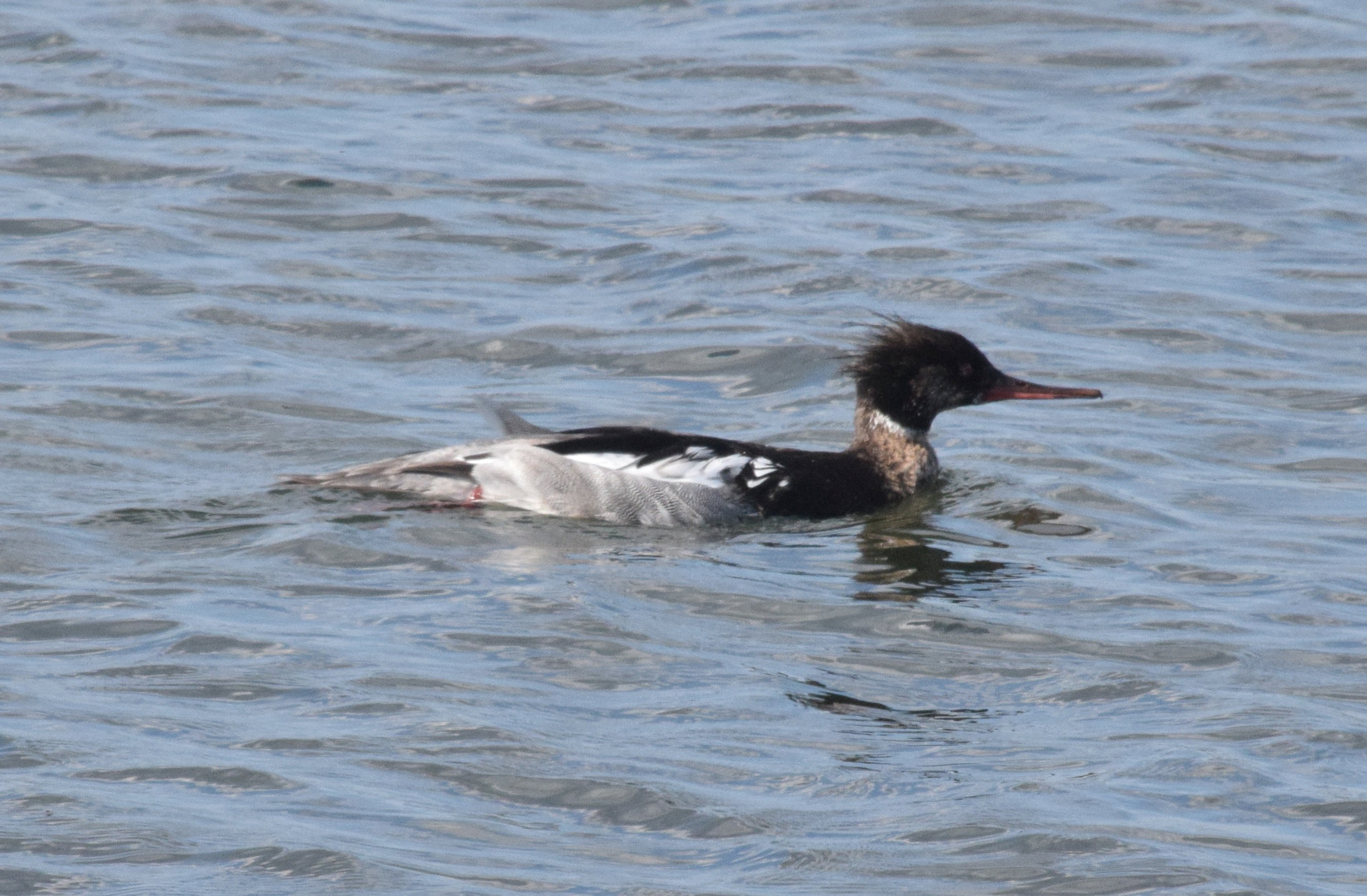
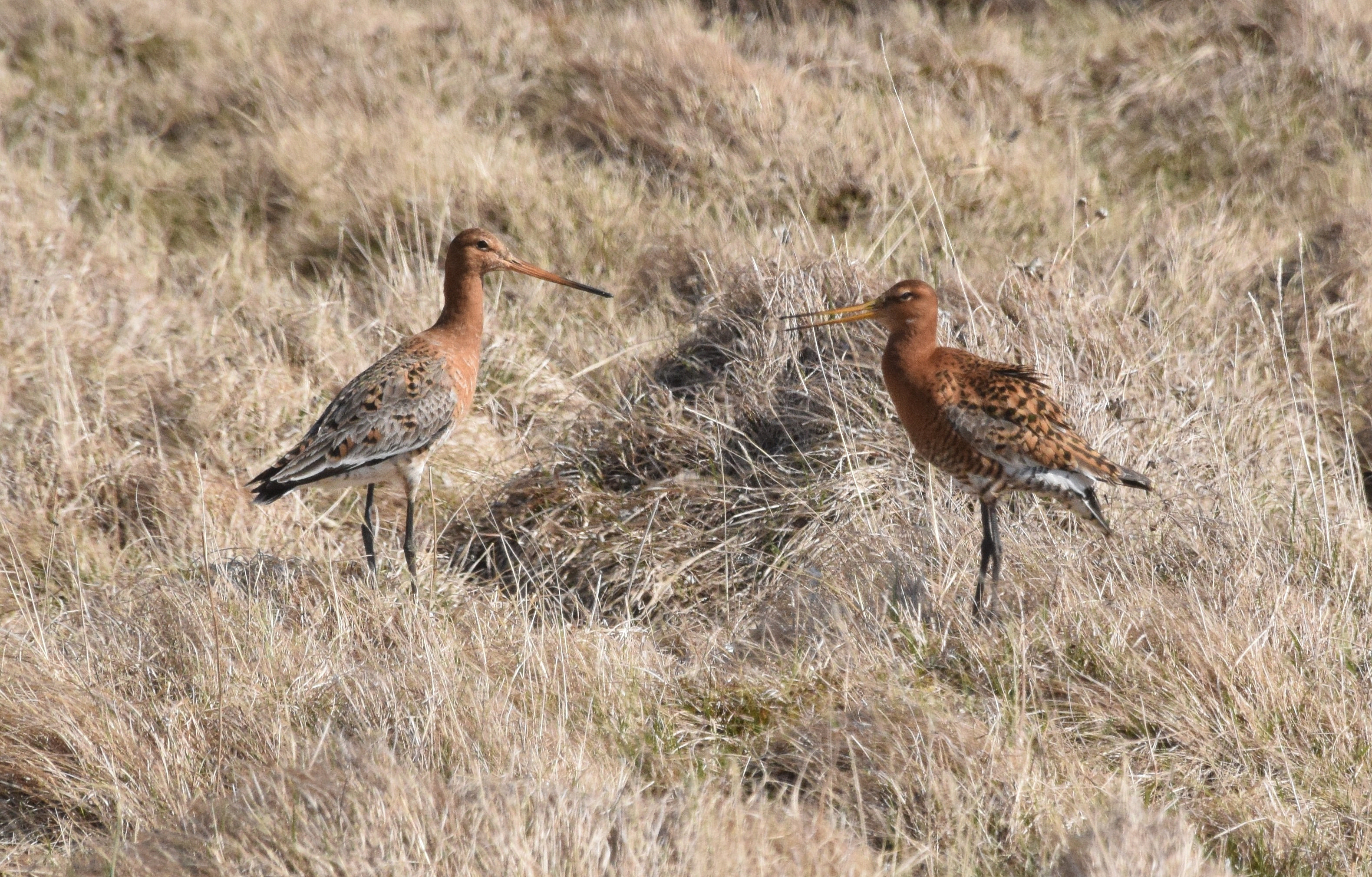
As well as it’s triple-lifer potential this trip also offered scope for observing some iconic birds – Diver, Grebe and Phalarope – in their full and colourful breeding plumages, that only pass through southern England on spring migration. After the previously recounted Harlequin adventure, I moved on to the Mývatn visitor centre at Skútustaðir (see here) on the lake’s western edge. There, with the aid of substitute binoculars loaned to me by the rangers, I realised more of those desired experiences.

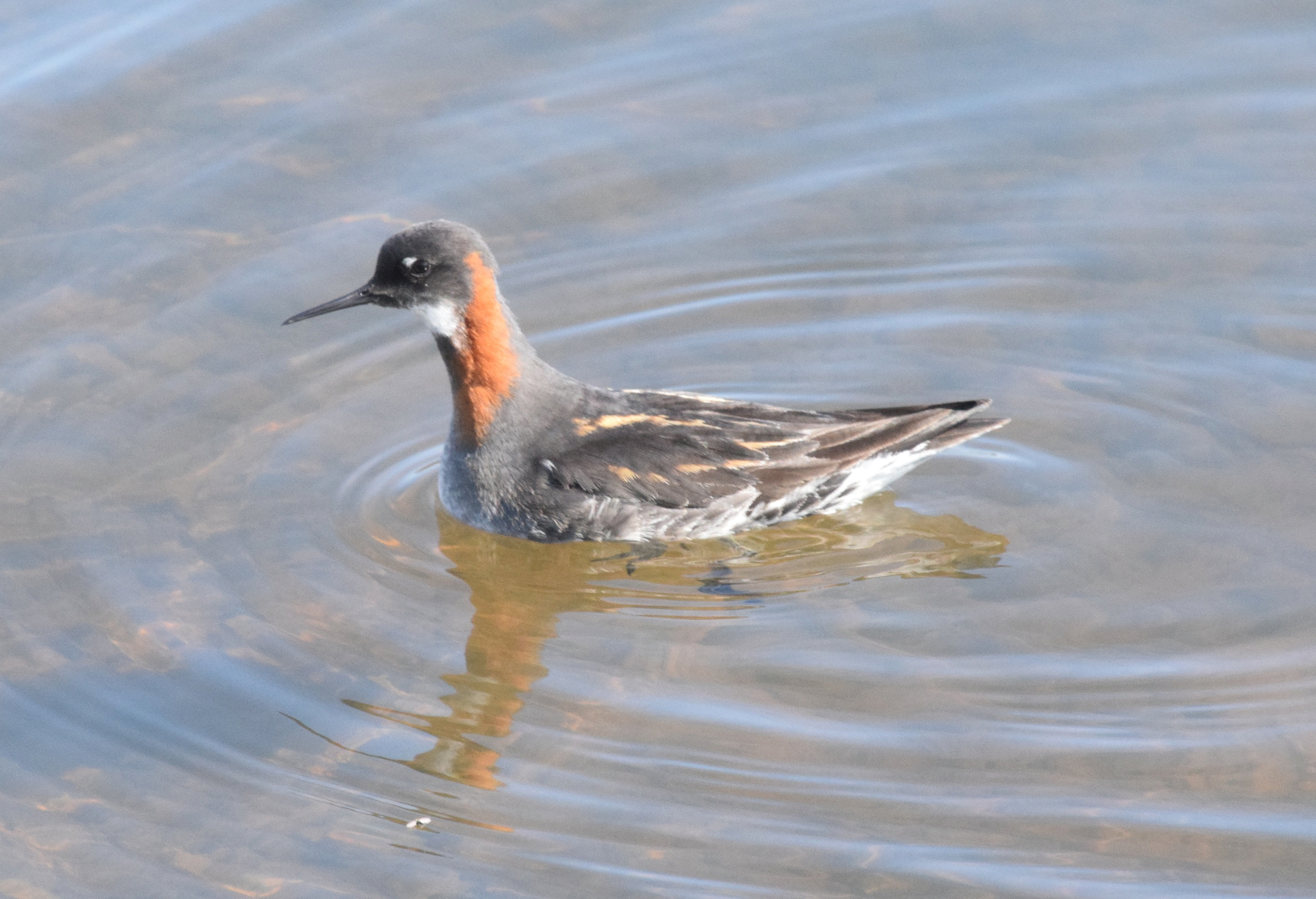
Red-necked Phalarope (female)

This Red-necked Phalarope (above) was the trip’s third stand-out close encounter, together with the subjects of the previous two posts. I had never observed a female in full breeding plumage until now. Like my three past Oxfordshire encounters – at Farmoor Reservoir (Nov 2013 and Sep 2017) and a male at Bicester Wetland Reserve (May 2015) – this individual fed with quick picking actions before me, moving busily forward as it did so and needing to be chased. The feeding technique is often by spinning in the water as I recall from an older record at Farlington Marshes, Hants (Oct 1987).

RNP is a fairly frequent May and June Icelandic breeder in wet marshes or pools such as here, where they nest in the tundra. Unusually, the less colourful males incubate the eggs. This population departs from early July to lead a pelagic life off the coasts of west Africa. Grey Phalarope (known as Red Phalarope in north America) is far less common in Iceland and does not usually occur at Lake Mývatn.

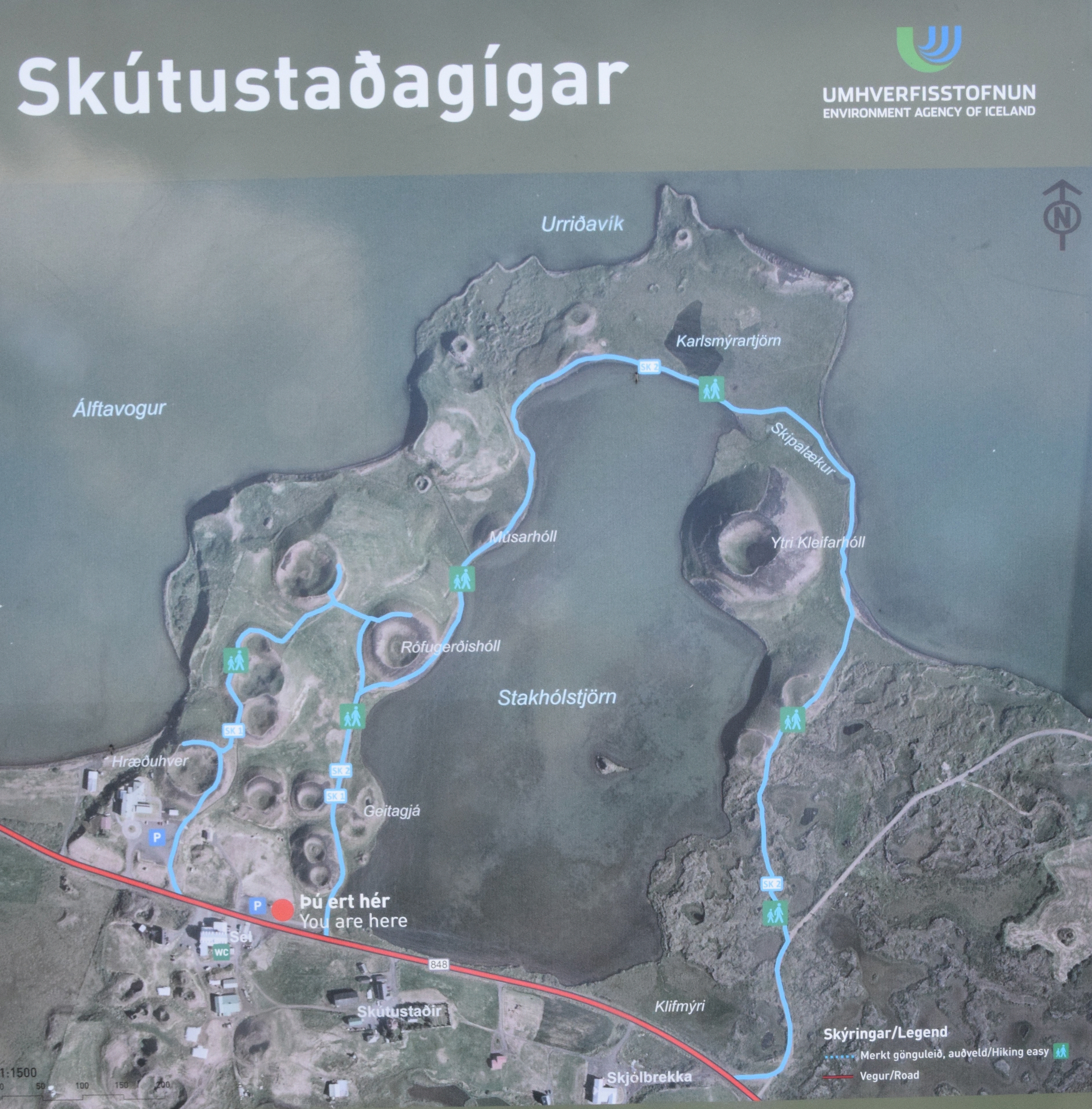
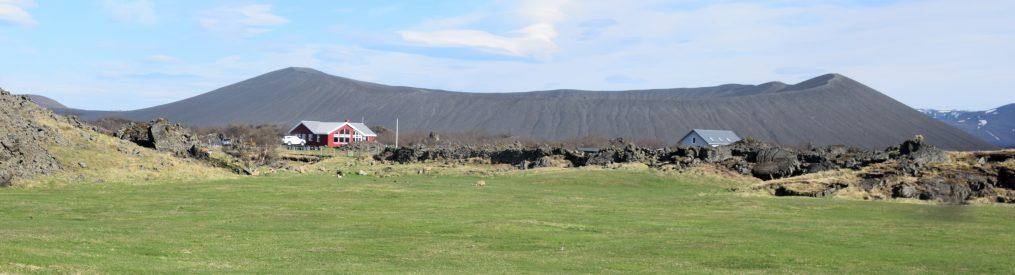
The visitor centre is situated amongst a cluster of craters (below), adjacent to an enclosed lagoon, Stakhόlstjörn that is cut off completely from the vast water body of the lake itself. A 2.3 km trail, from which the birds now presented were all observed, runs around the area.

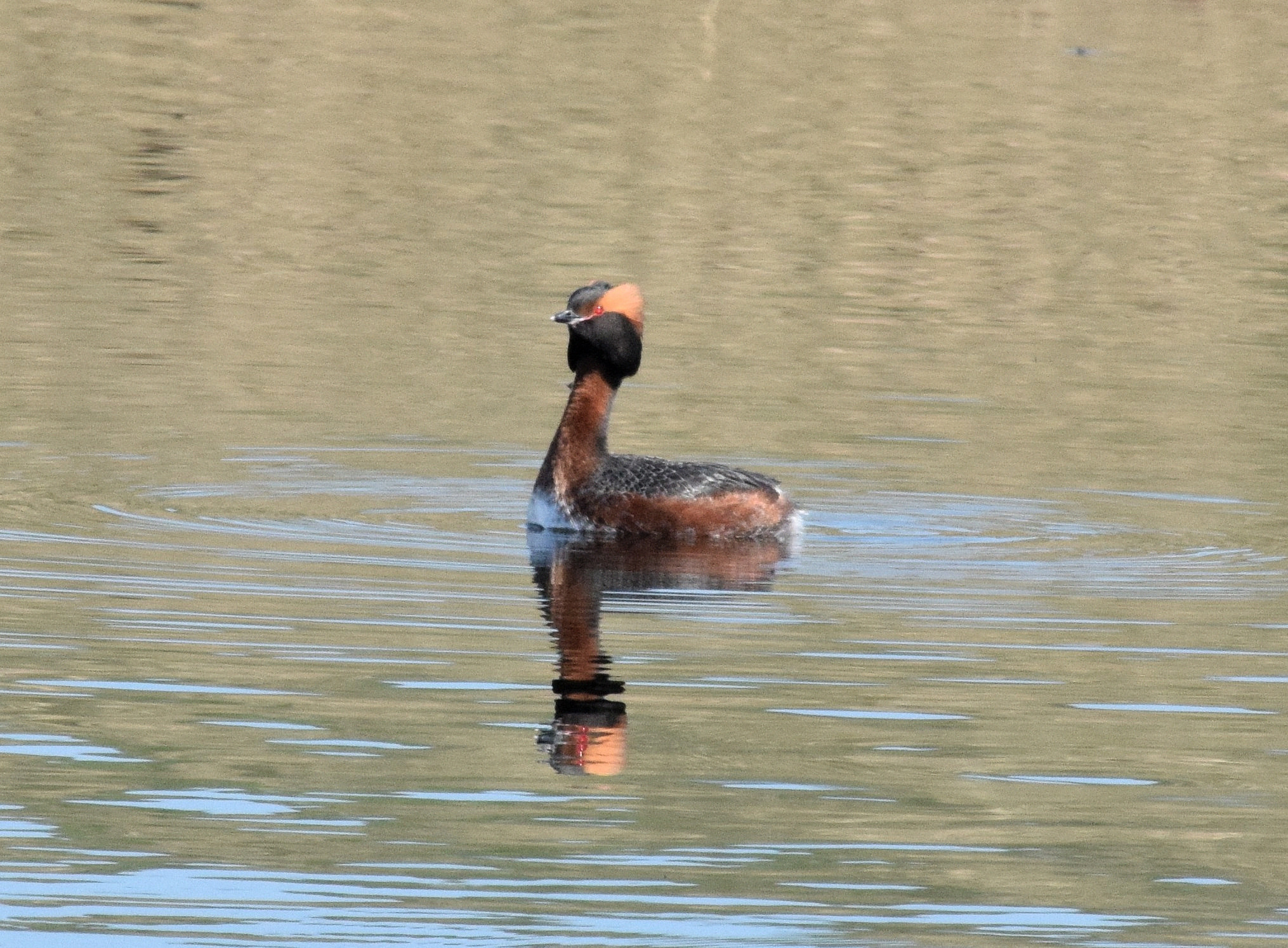
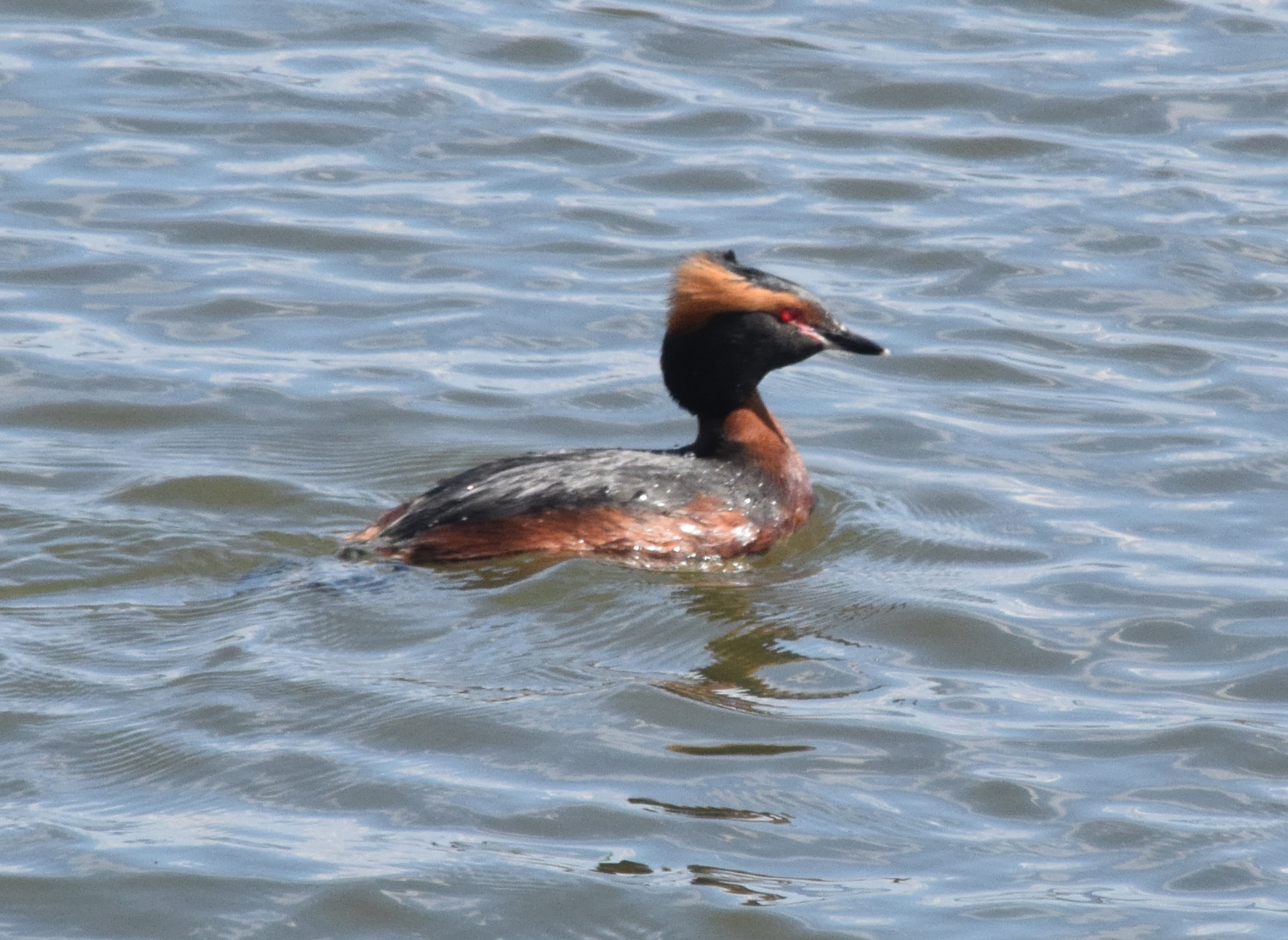
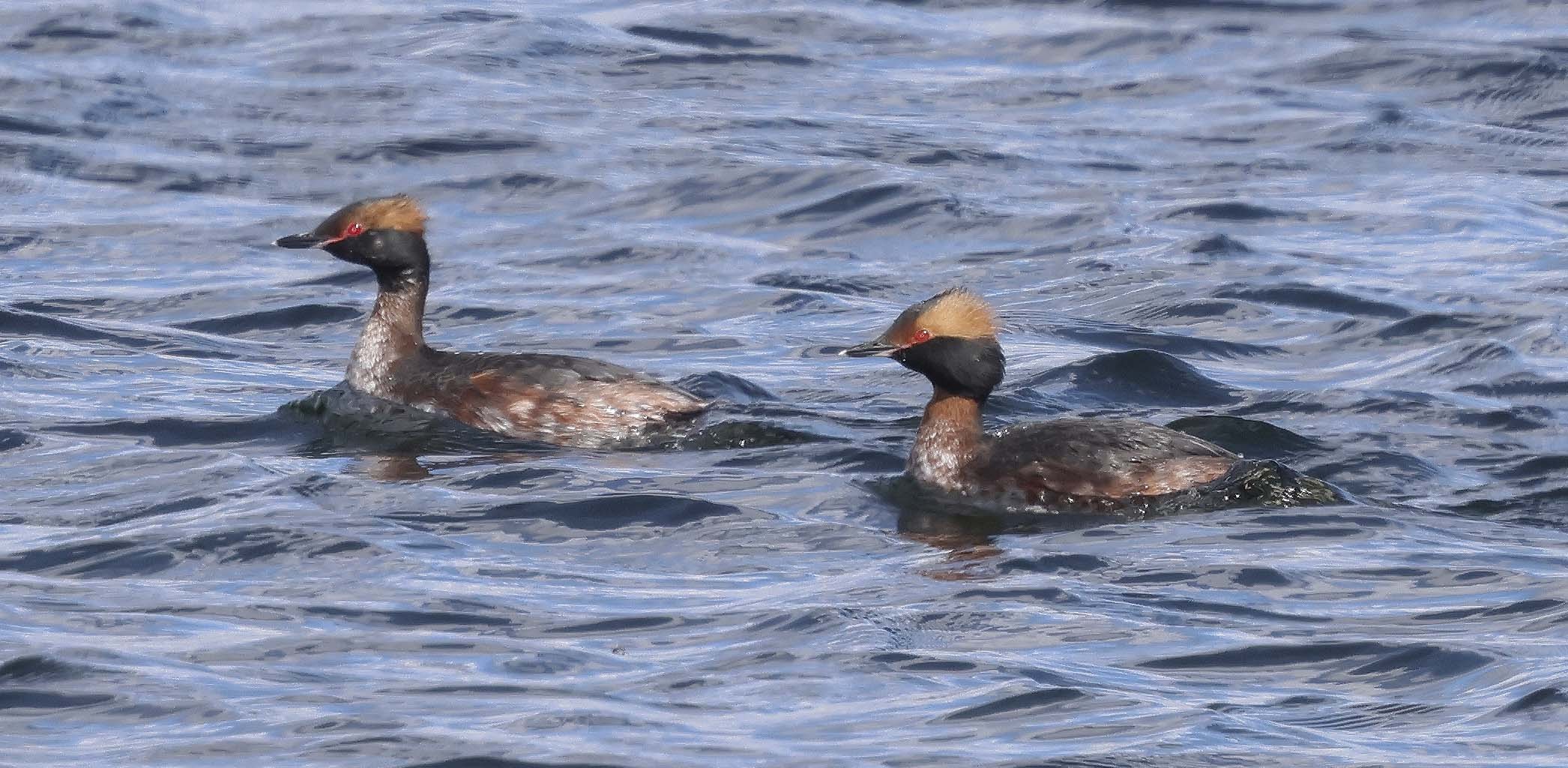
Slavonian Grebe is the sole species of its group to breed in Iceland, and is common only at Lake Mývatn. The now modest population is in significant long-term decline for reasons that are not fully understood. These birds winter on north-western European coasts, though a few may linger along the southern coastline of Iceland itself. I came across them in a number of locations during this trip, and several at this site. As at Farmoor Reservoir earlier in the spring (see here) their dark, bright colouring in prevailing glare didn’t aid the cause of picture taking. The following records are the only two I kept from many attempted.

Slavonian Grebe

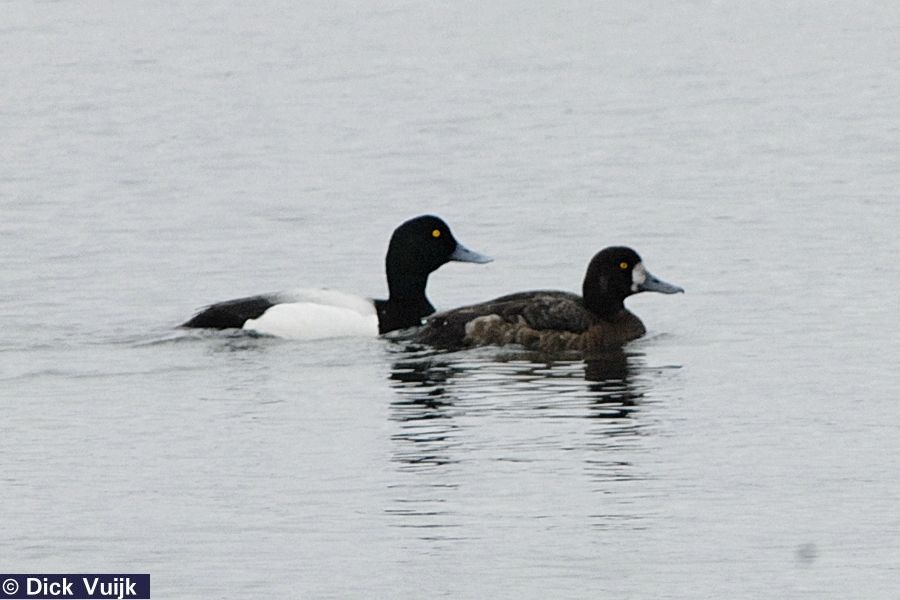
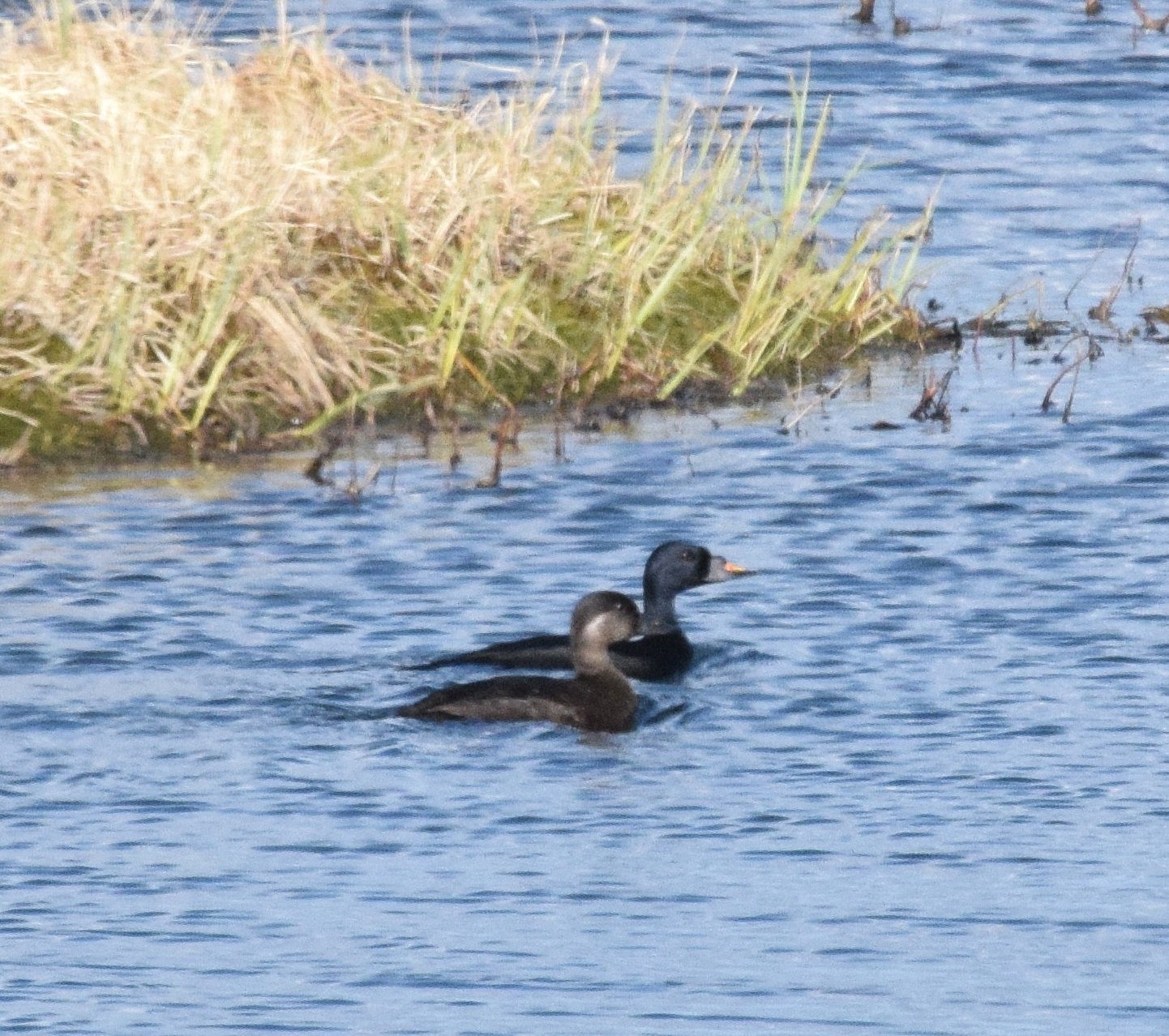
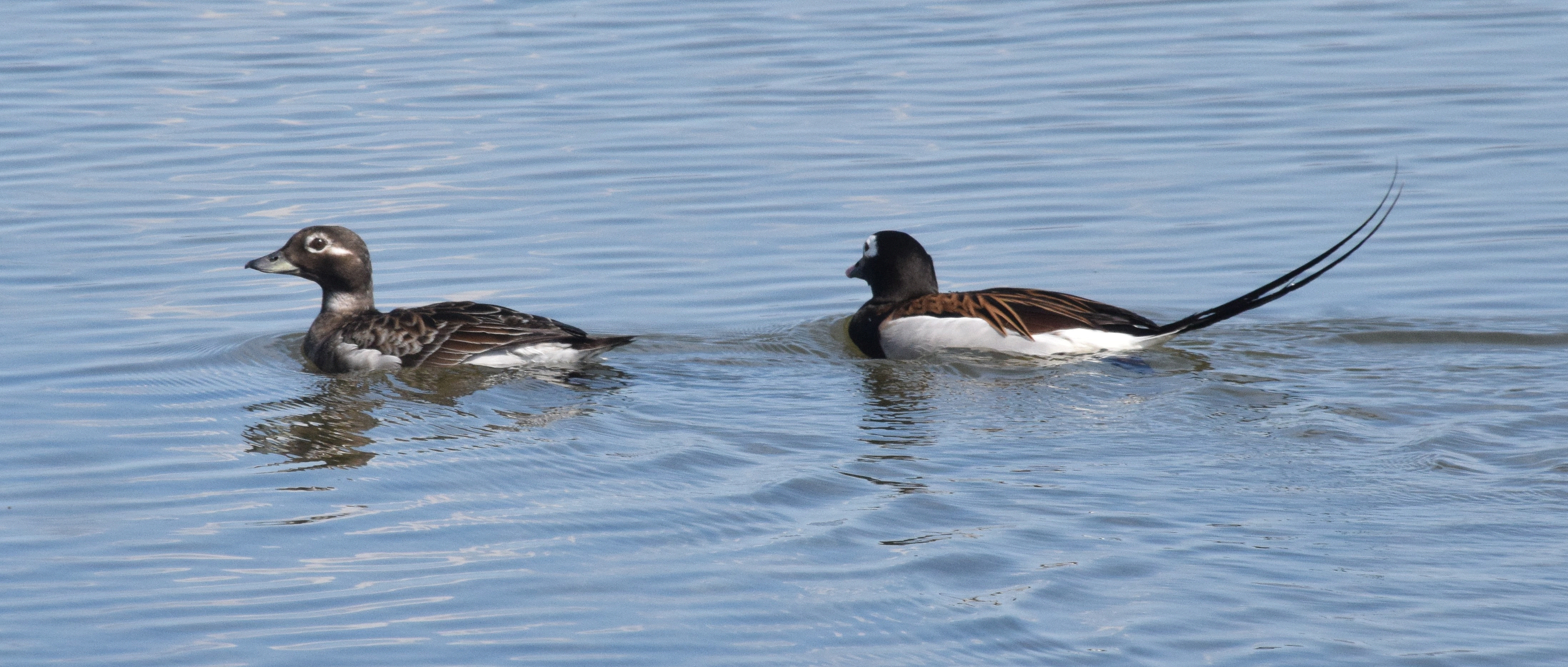
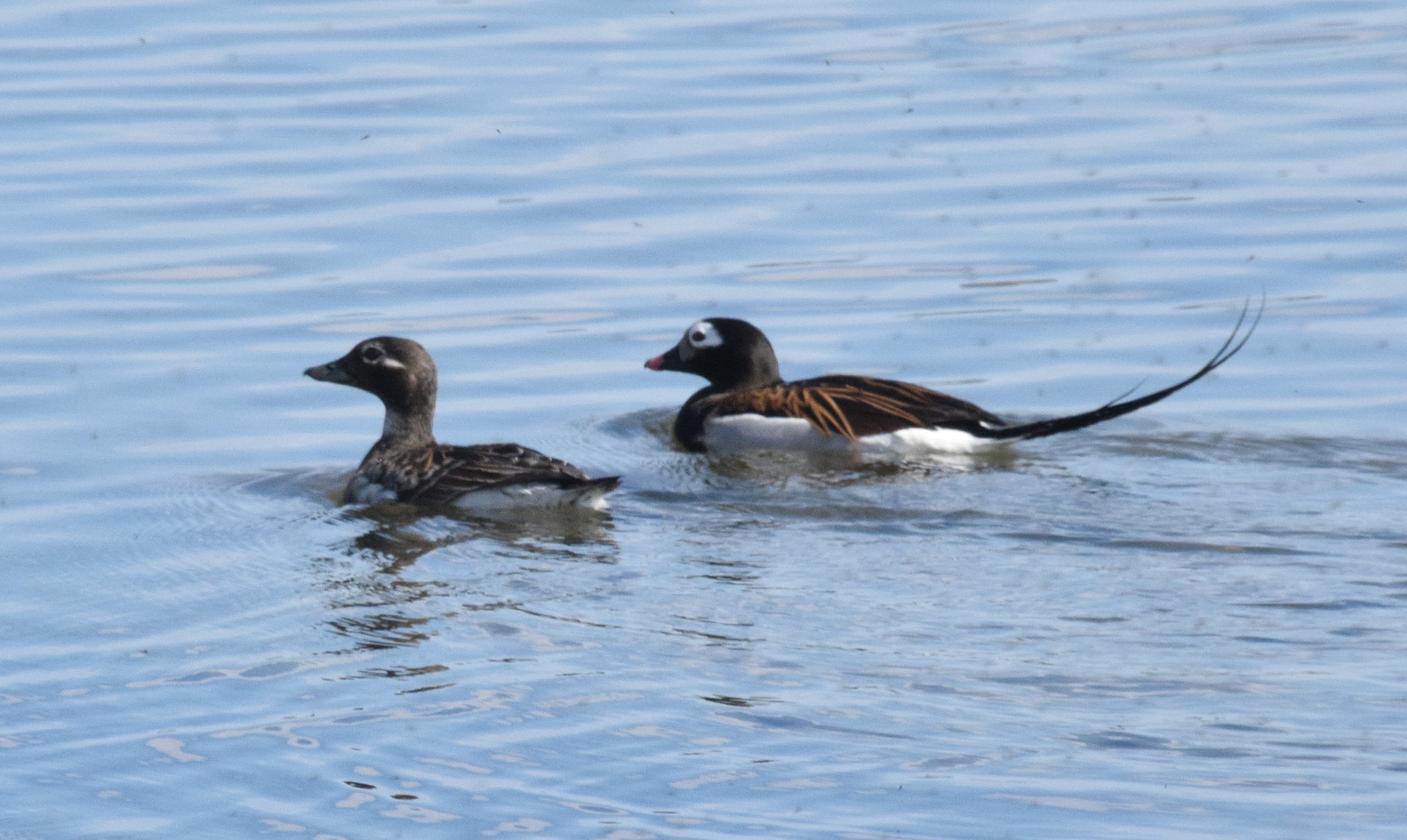
Long-tailed Duck, Scaup and Common Scoter all breed here, and I crossed paths with the threesome around Stakhόlstjörn. The first of those has an estimated breeding population of between 2 and 3000 individuals at Mývatn and across northern Iceland. Wintering numbers, swelled by migration from other regions, are in excess of 110,000. The other two ducks will be dealt with in the next post.

Long-tailed Duck (record shots)

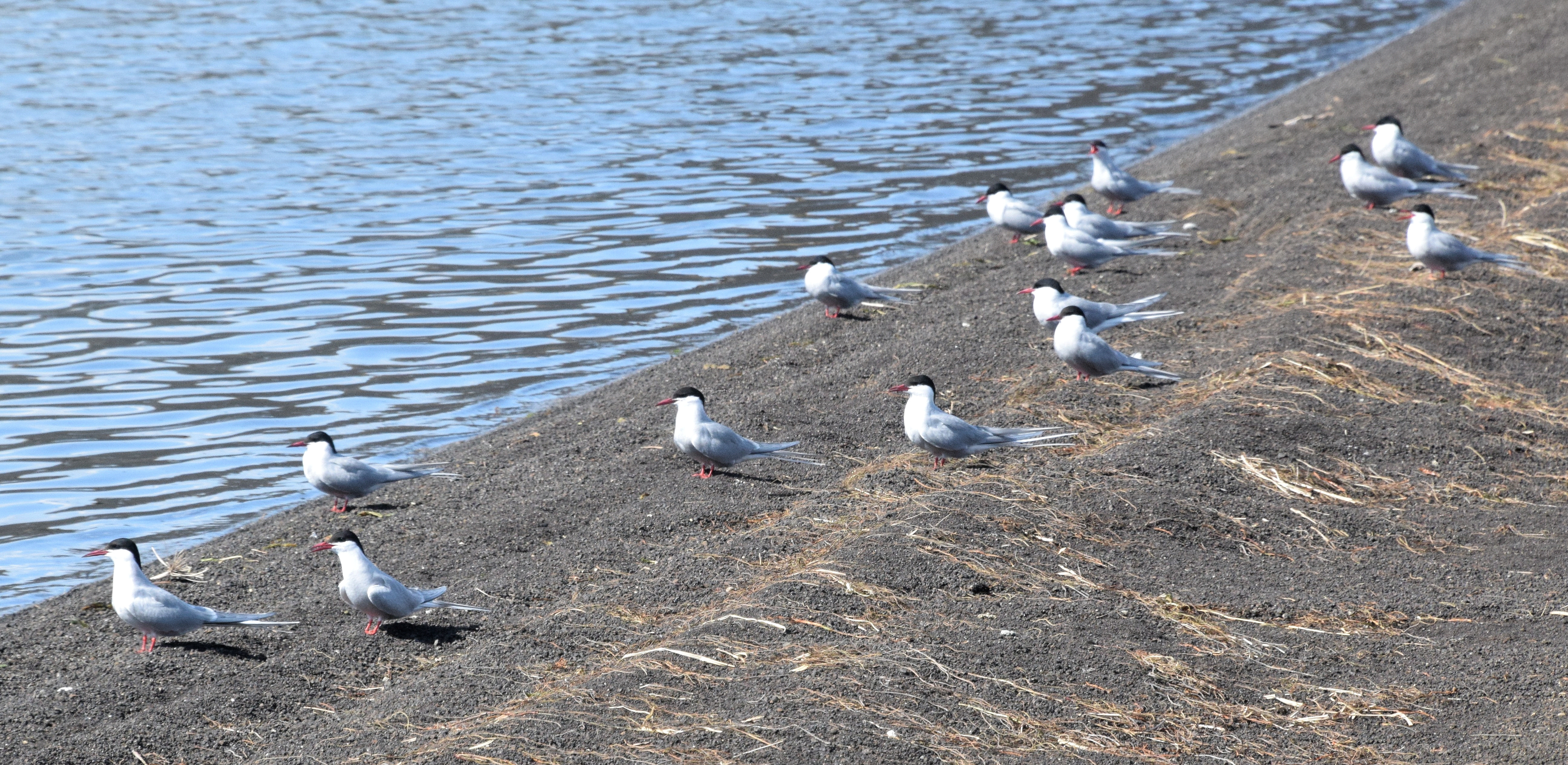
Arctic Tern arrive here at this time of year and remain until August. Since I am used to recording that trans-global migrant only when passing through southern England on their progress northward, it was now quite exhilarating to watch large numbers of the elegant and graceful item hawking for the super-abundant midges over the lagoon’s surface. Such sights only occur at my local Farmoor Reservoir when birds passing high overhead are driven down by foul weather, and usually involve a drenching. All the Terns in Iceland are Arctic.

Arctic Terns

Earlier in the day I had located another summer plumaged trip target Red-throated Diver at Laxárdalur, upstream from the rapids. The Icelandic breeding population is estimated at between 1500 and 2000 pairs. These birds mostly bond for life and re-visit the same nesting locations year upon year. The bulk of them winter in western Europe, though a small, sedentary population remains on the south-west coast. This (below) was my first ever record in the breeding plumage. Iceland’s other summer Diver, Great Northern or Common Loon, was one of two wish-list items that I failed to convert; the other being Gyrfalcon.

Red-throated Diver (record shot)

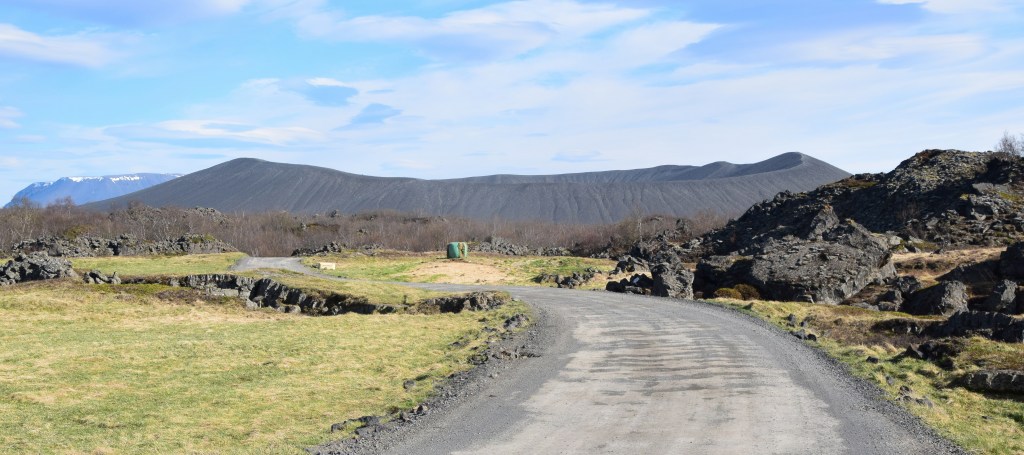
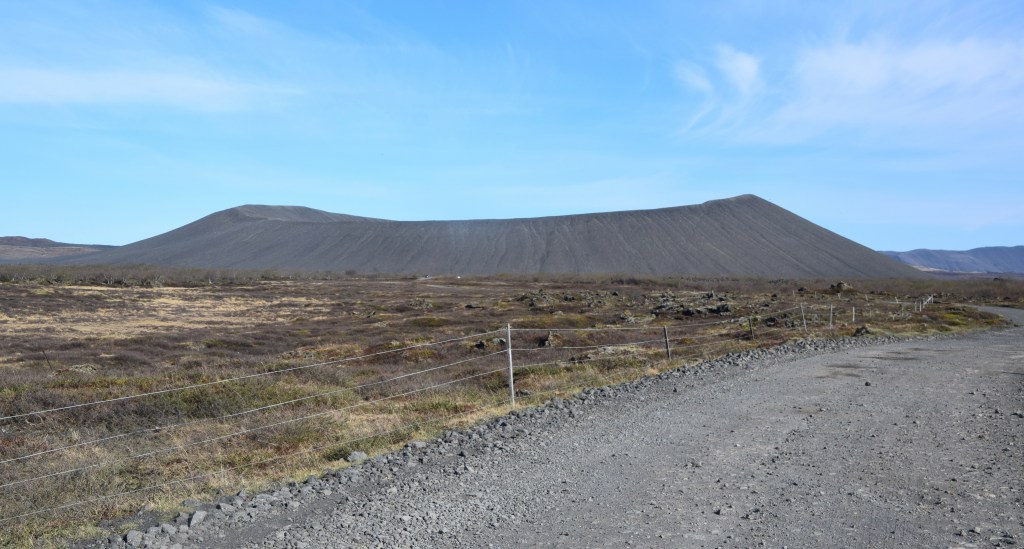
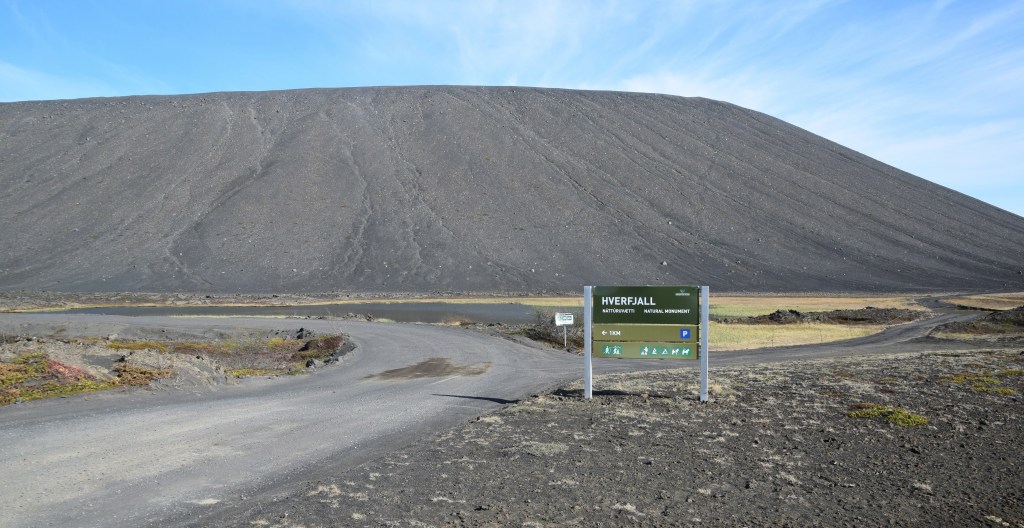
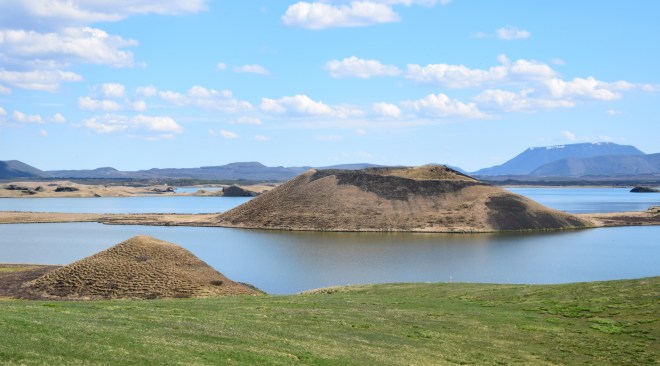
The Skútustaðagígar pseudo-craters are not magma-producing volcanic vents but were formed around 2300 years ago when molten lava from two nearby eruptions flowed over cool, wet surfaces here and pressurised the earth downwards. That trapped steam under the weight of the lava, and when the pressure became too great explosions were triggered creating depressions in the ground. The largest of these features is Ytri Kleifarhóll, on the lagoon’s eastern side (slide show picture 2); and for me the most imposing is Rófugerðishóll (picture 3). A smaller cluster closest to the visitor centre itself rather resembles a golf course as viewed from the road (picture 4). To my mind this landscape has a peculiar scenic allure that has formed a lasting impression, hence its inclusion herein.

This was a very rewarding and enjoyable few hours at what was the week’s best Mývatn location in which to connect with this post’s various described birds. And by the time of publication my binoculars had been repaired under warranty by the manufacturer, Opticron.

NB If visiting this site be sure to use insect repellent on all exposed skin

The Rock Ptarmigan of Kálfaströnd, Mývatn in Iceland: 14 & 16th May 2025

I think it is reasonable to state that recording the subject of this post in the British Isles must involve ascending above the snowline on Scottish Highland mountains at certain times of year. Indeed I recall when that appeared to be a popular pursuit amongst some fellow Oxon birders early in the previous decade. So when upon reading the gallinaceous item also occurs in the Lake Mývatn area I added a third potential lifer to my Iceland trip wish list.

One thing I overlooked in preparing for the featured May adventure is that it does not get properly dark so far north at this time of year. So there is potential to bird at silly o’clock from around 3am in the morning, and discover what is going on. On my final day at Mývatn I compromised ahead of the journey home with a 6am start at Kálfaströnd in the lake’s south-eastern corner. The intent was to re-connect with Ptarmigan, that I had first encountered there unsatisfactorily two days previously. Not so on this occasion.

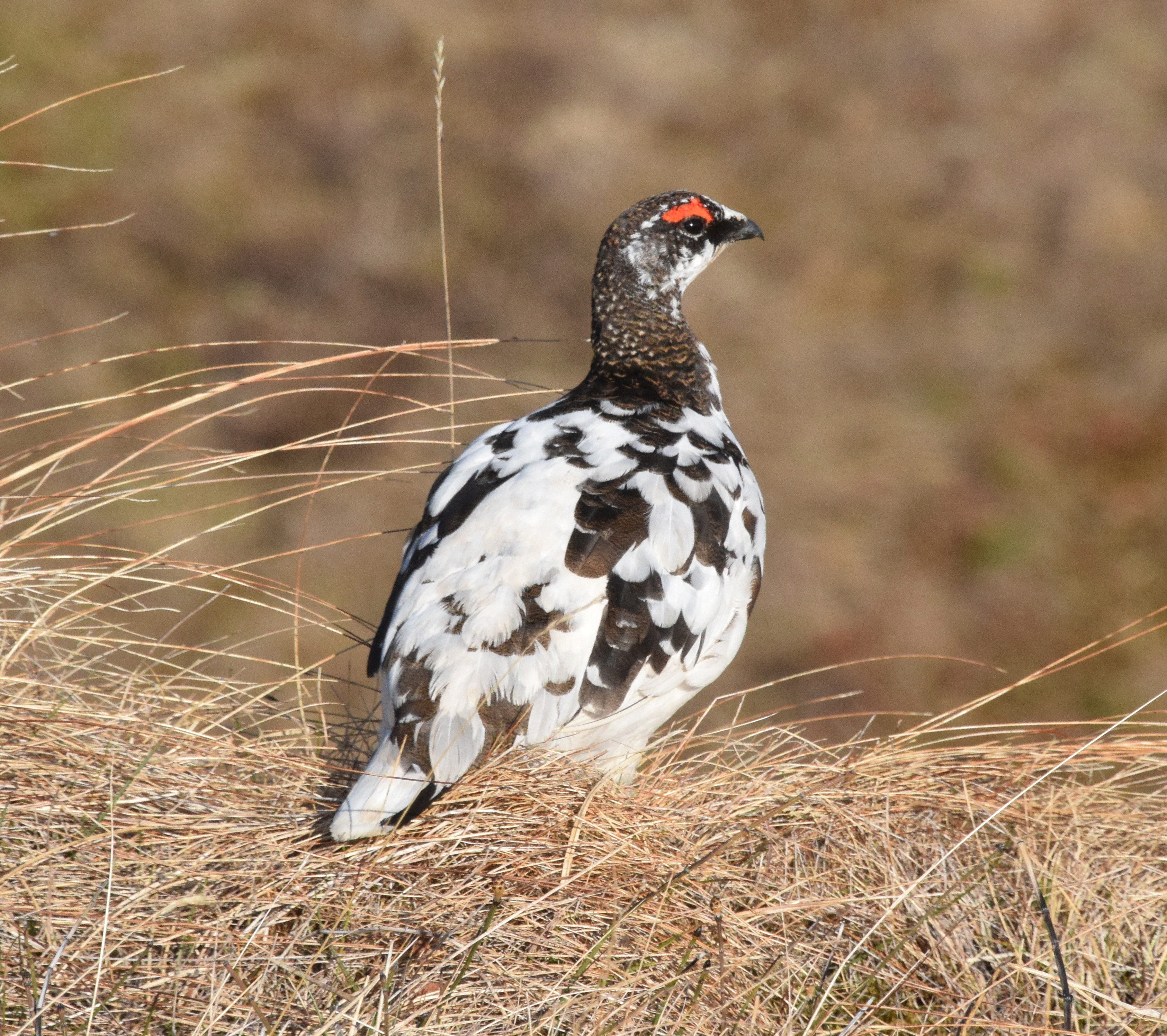
Rock Ptarmigan

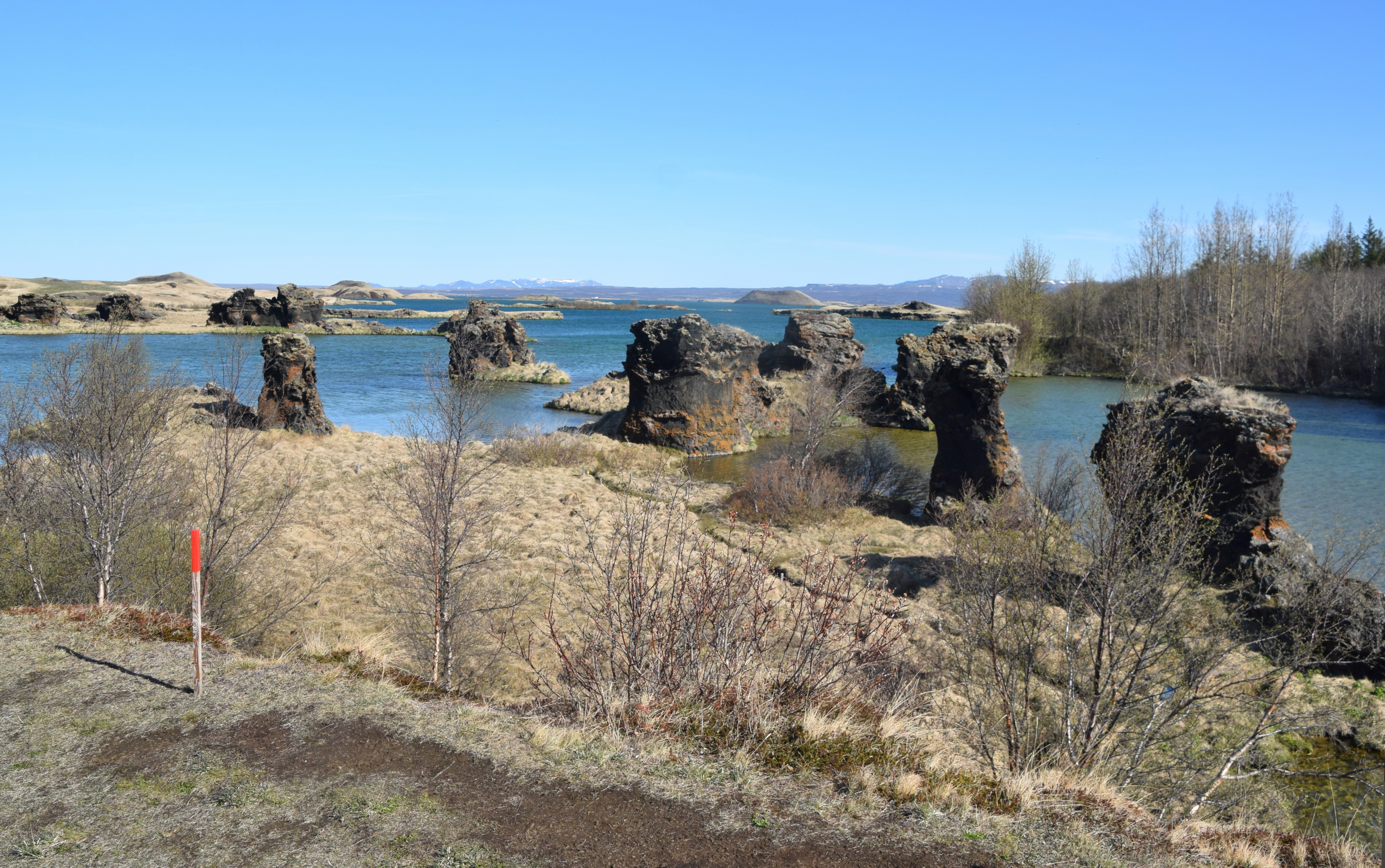
At Kálfaströnd a circular trail leads around an irregular shaped peninsula that extends into the lake, enabling viewing over secluded and in places enclosed waters. Then it crosses the area’s higher interior expanse. The tranquil location is noted for it’s volcanic rock formations (below).

Kálfaströnd

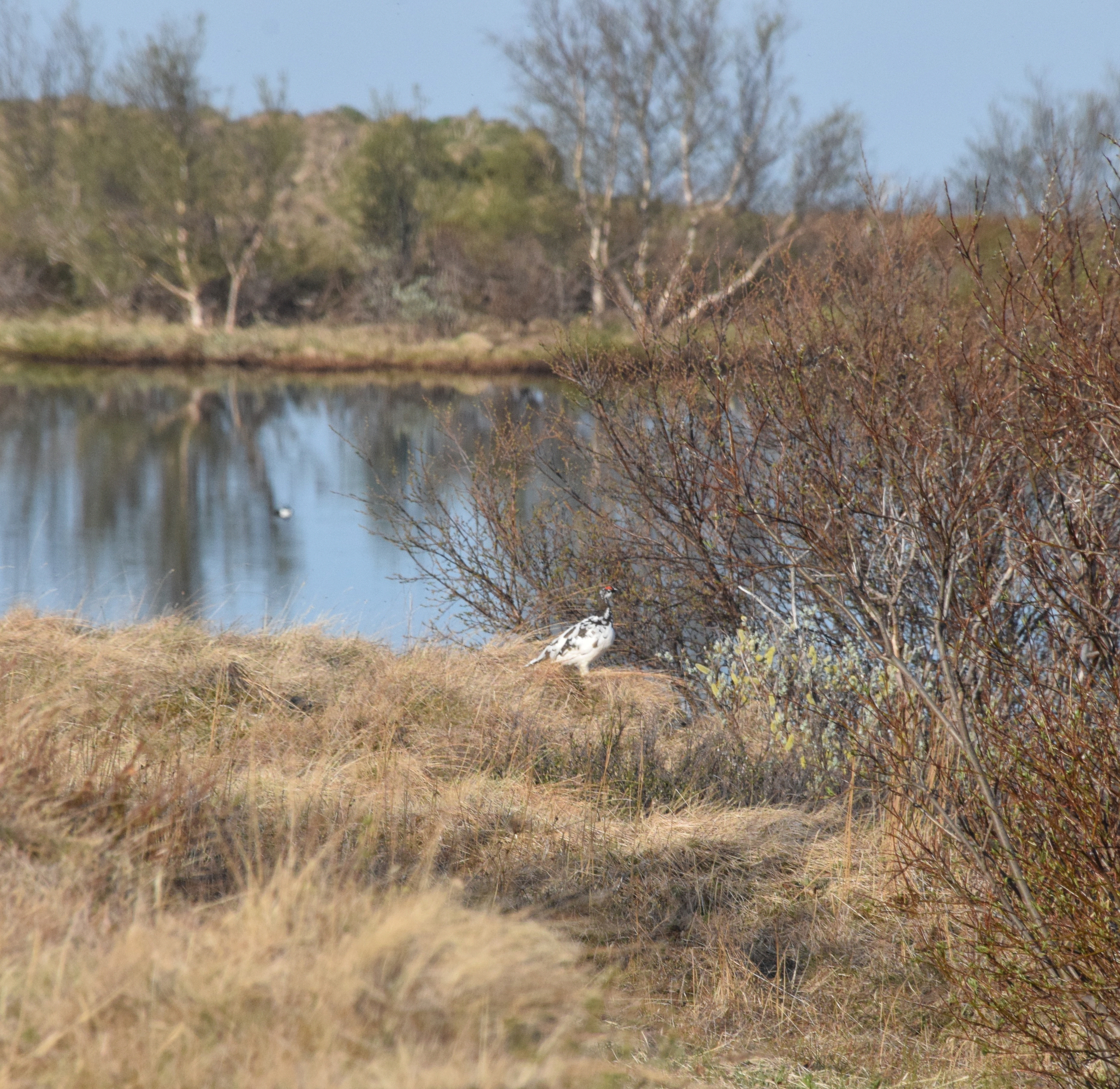
On 16th, as soon as I got out of my hire-car a cock Ptarmigan announced itself from the start point of the trail, but it flew off some distance upon noticing me. This time I made a complete circuit of the Klasar trail and the open, hilly land of it’s homeward stretch proved to be a prime location for encountering my quest. Being bright white these birds stood out readily in the landscape. The white dot in the centre of the next picture, for instance is one. I watched this almost pure white cock for some time, while it sunned itself in the early morning air. There was a nesting hen to its left in cover, then when I walked further along the track a second female flew up then across to join the other two birds. At that point the cock went out of view.

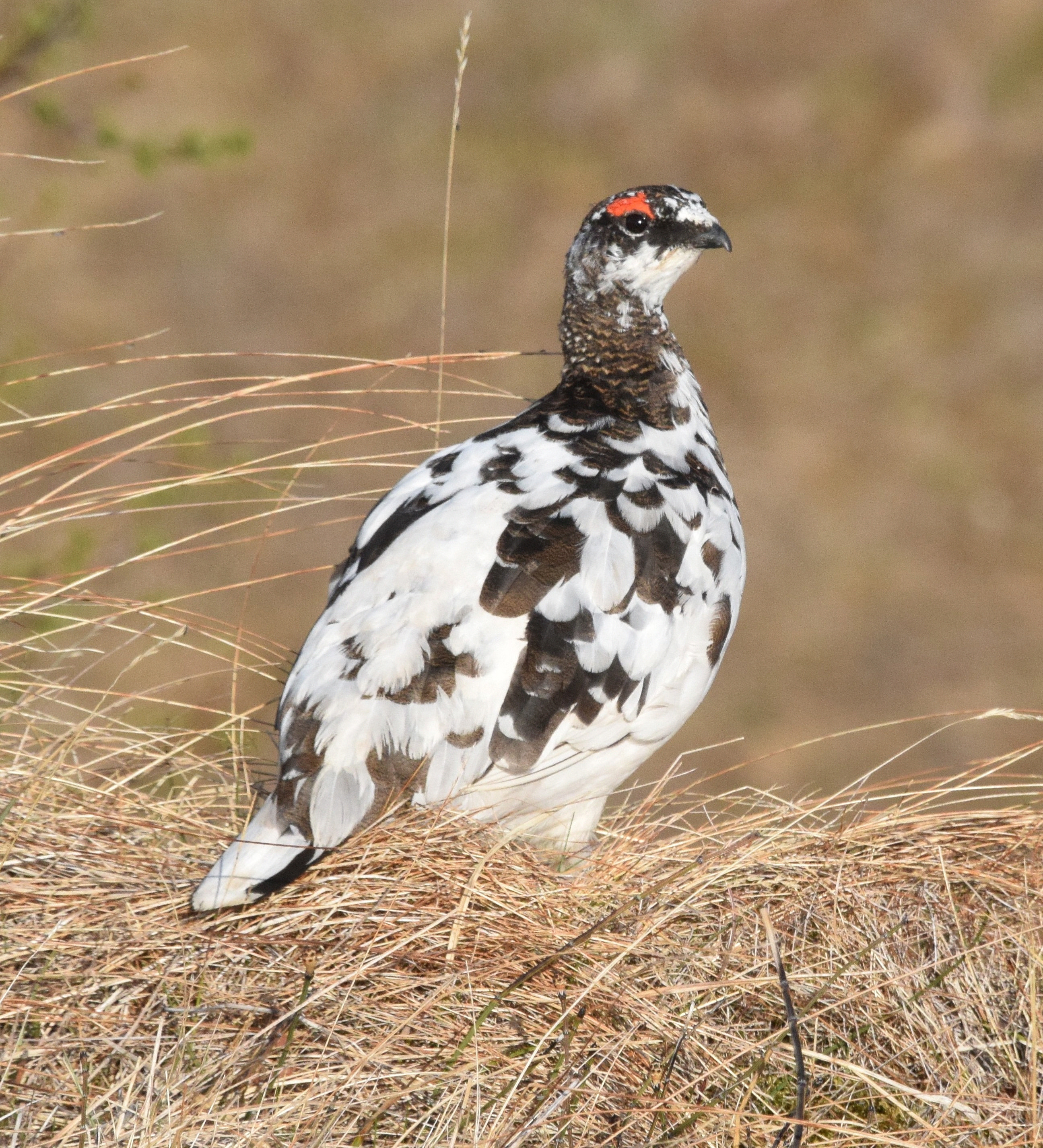
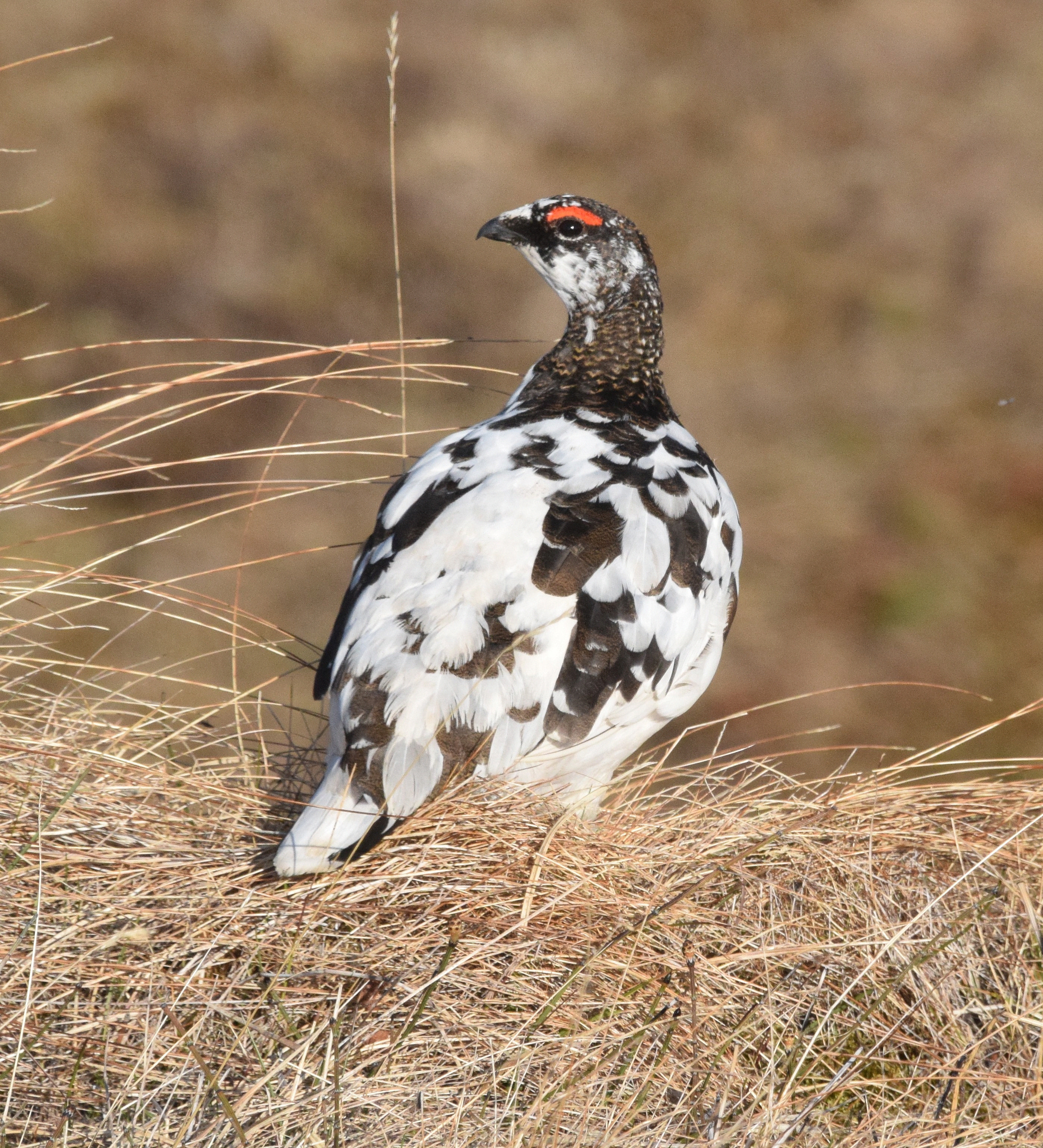
Then I noticed another cock further on along the trail (above right), and setting down my scope walked forward to see how close I could get to it, taking pictures all the while as I went. To my astonishment this bird let me walk right up to it. The lead image and the next two (below) were captured at just a few metres from the subject that even then kept stock still. I have never been able to approach Partridges in the same way, that invariably go up before I see them, but am told by a more experienced colleague that such confiding behaviour is not unusual in Ptarmigan. This was perhaps the ultimate close encounter of a week filled with such. The bird did not fly until I began to walk away.

Rock Ptarmigan is the only upland game bird of Iceland, with a sedentary population currently estimated at around 300,000 birds. Numbers have fluctuated greatly historically in relation to climatic factors, breeding success and hunting pressure. Due to long-term decline, the species is red-listed nationally as near threatened, but numbers can be significantly larger by the end of each breeding season. A hunting moratorium introduced in 2002 sought to address that decline, and since 2005 hunting has been permitted only within a set period through November for personal consumption. In Iceland Ptarmigan is a traditional Christmas dish. The population is monitored annually to ensure a sustainable harvest.

Cocks establish territories in spring on grassland and heathland, and research shows the gender distribution within breeding populations is roughly equal. Ptarmigan feed on berries, buds, germinating seeds and insects when available; and their chief predators have historically been Gyrfalcon and wintering Snowy Owl. In winter the plumage is all white, turning to that in this post’s close-up pictures from late spring.

Rock Ptarmigan on 14th

My initial sighting came two days previously while I was tracking Barrow’s Goldeneye. Suddenly a crackling sound I had researched issued from the middle distance where a cock Ptarmigan was standing on top of a rock stack (pictured above). I communed with this bird for some time from a distance, but during this the focus ring fell off my binoculars, which really shouldn’t happen on a birding trip. After it flew I crossed paths with the same bird while walking back to the car, then it went up again for some distance to high ground.

NB If visiting this site be sure to use insect repellent on all exposed skin

Rock Ptarmigan is now one less game bird I need to think about going to Scotland to observe; having recorded both Red and Black Grouse there in May 2023, and Capercaillie in Estonia in April 2017. Willow Grouse and Hazel Hen in Scandinavia remain on the wish-list that prompted this post’s trip. Having gained a third lifer for the week my career western Palearctic bird list now stands at 526.

The Harlequin Duck spring assembly at Laxárdalur, Mývatn in Iceland: 13 – 15th May

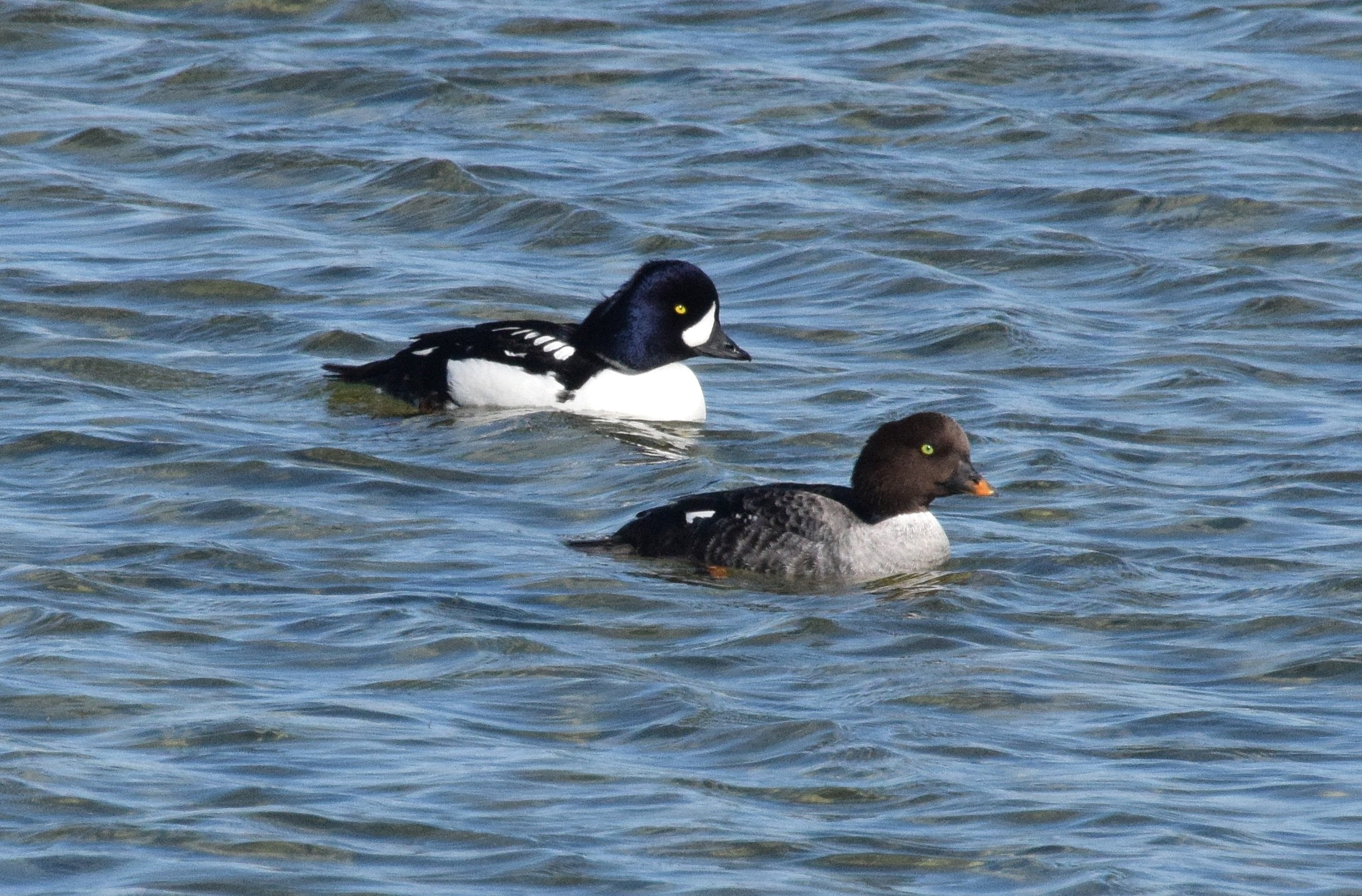
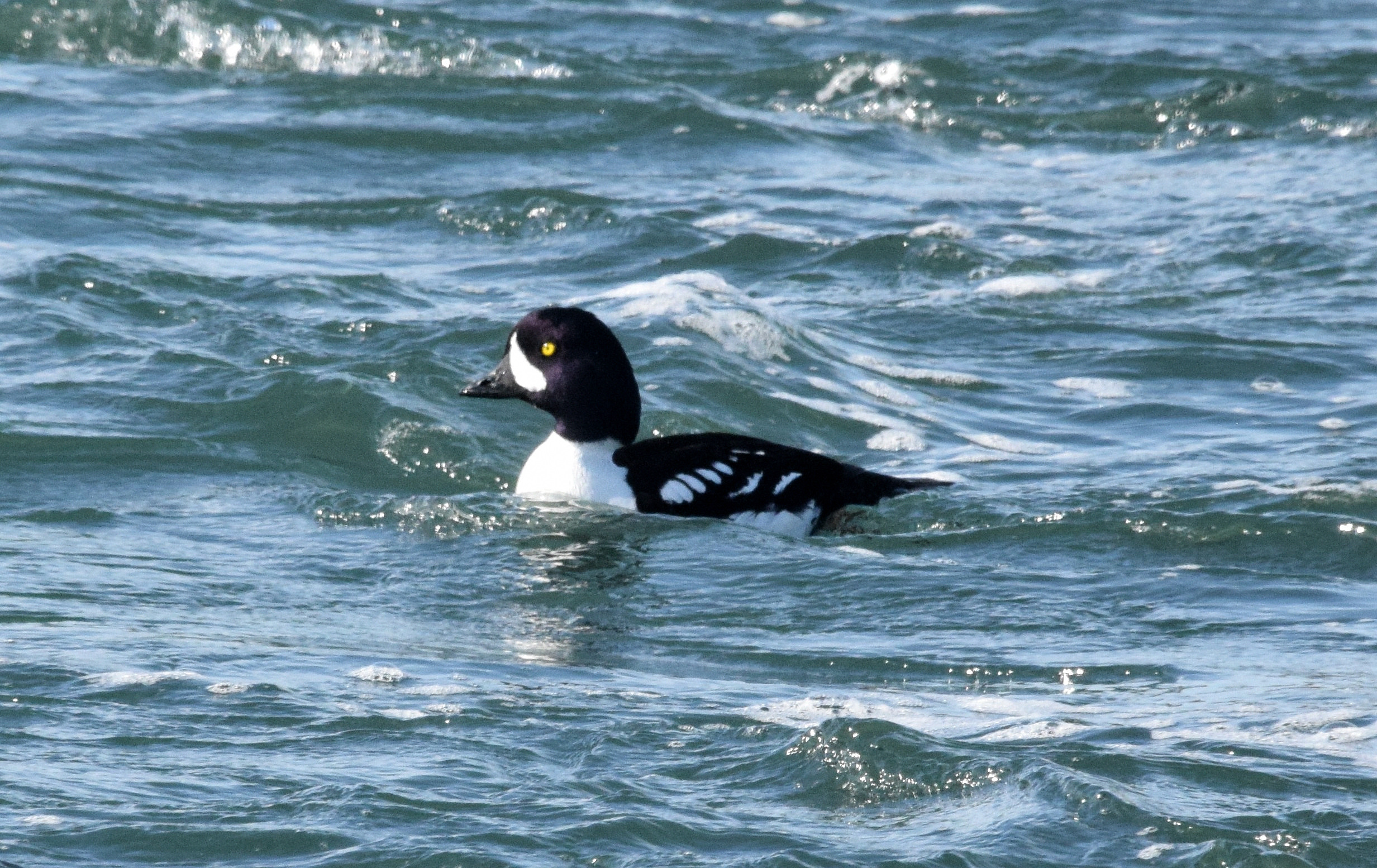
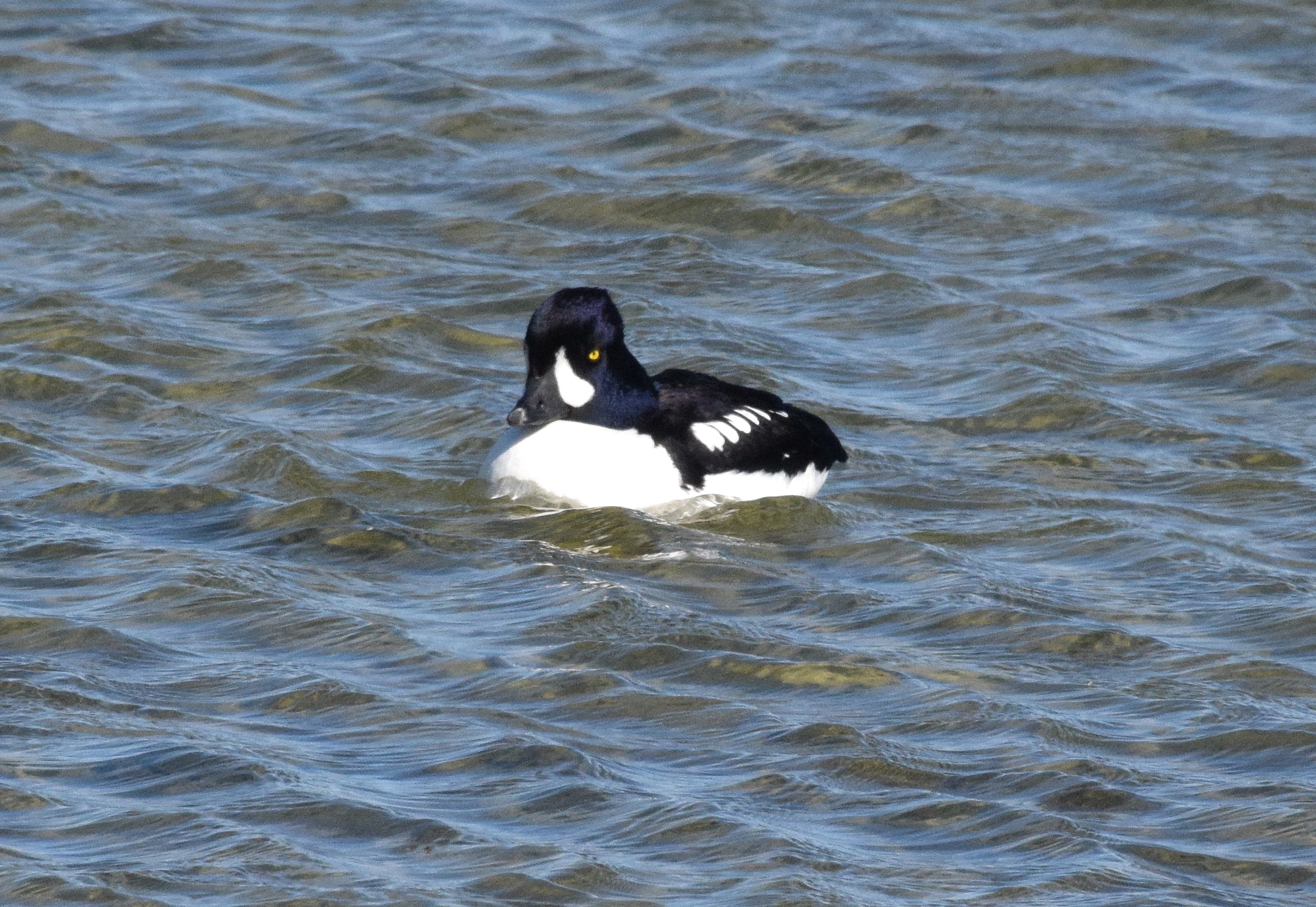
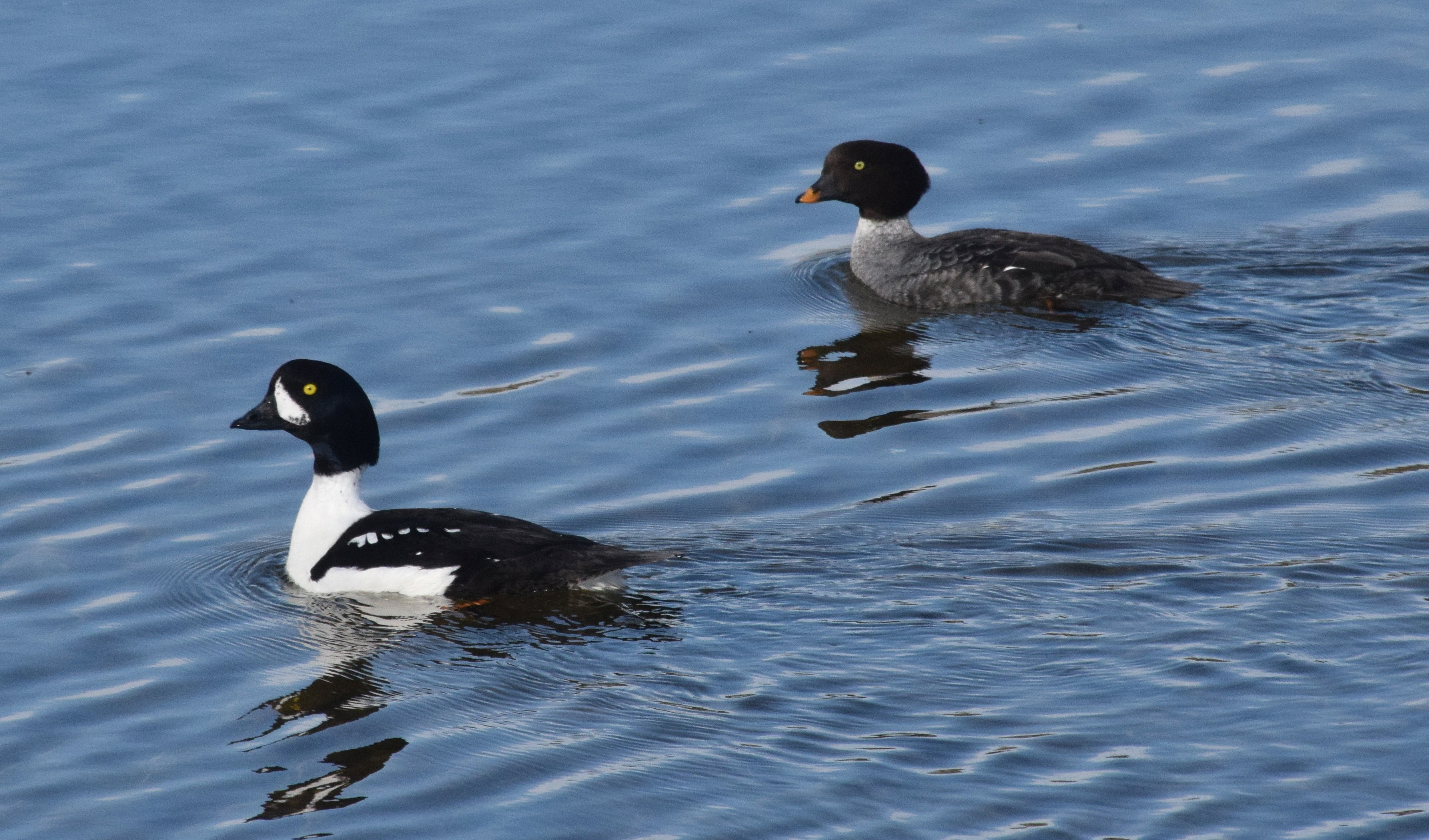
Earlier this year I learned from another OB listed blog that two residual items on my Westpal birding wish-list – Barrow’s Goldeneye and Harlequin – may be observed quite readily at Lake Mývatn in northern Iceland. So since recording either in British waters would almost certainly involve the sort of twitching I just don’t do, I at once planned a solo visit of my own (in the great Rn’S tradition) to their home ground.

In the event both these special ducks were converted on day one (13th), before I even reached Mývatn (pronounced Miir-vaagh with a Klingon emphasis on the second syllable) itself. That was at the point where highway 1 from Akureyri runs close by then crosses the river Laxá that drains the spring-fed lake from its south-western corner. First I noticed then crept up with the camera on two pairs of Barrow’s, then from the road bridge Harlequin were active in the river below. Reading things up that evening, I realised this spot is seasonally the prime option for observing the latter. And so I returned the next afternoon to attempt to do them justice.

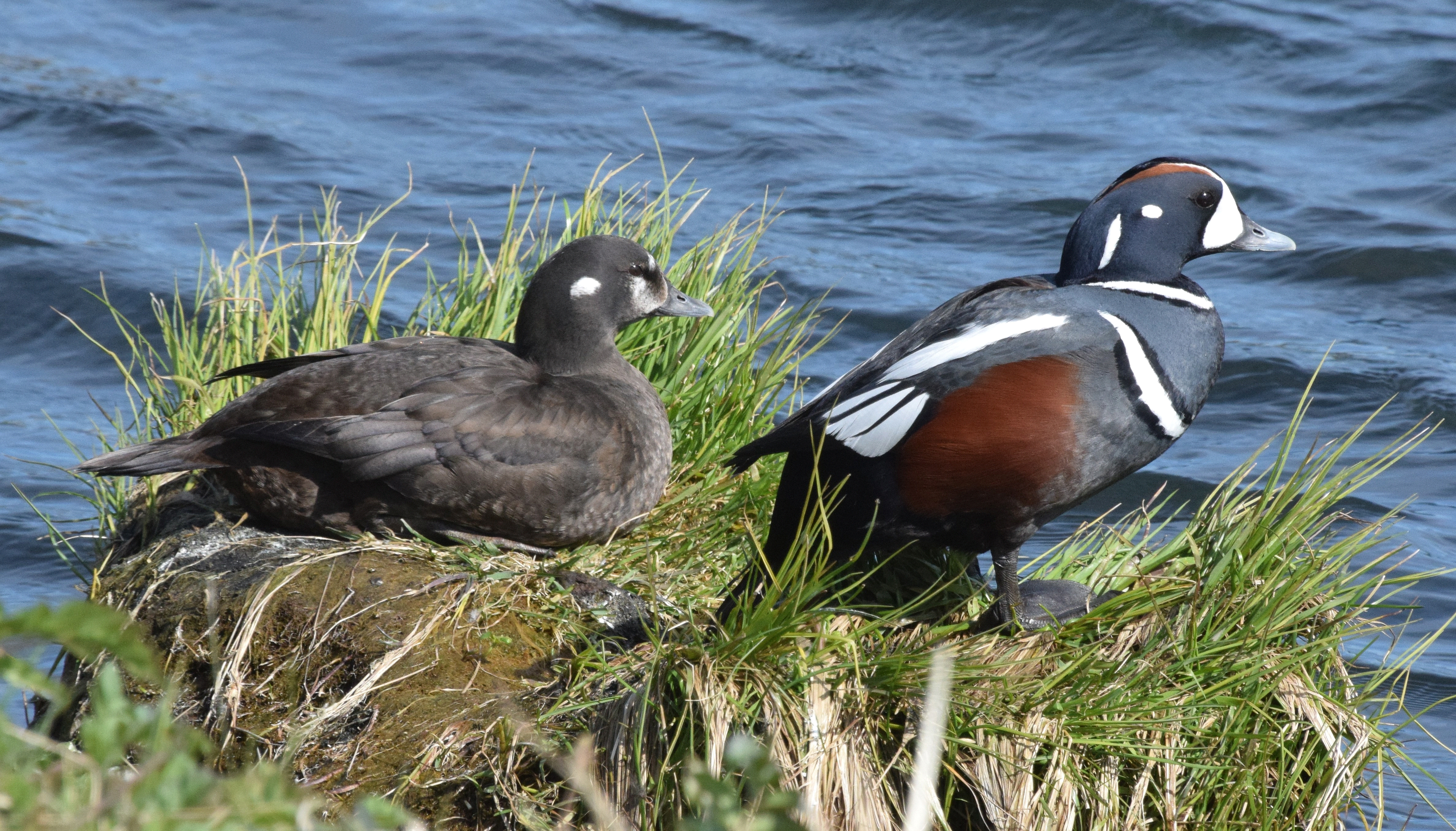
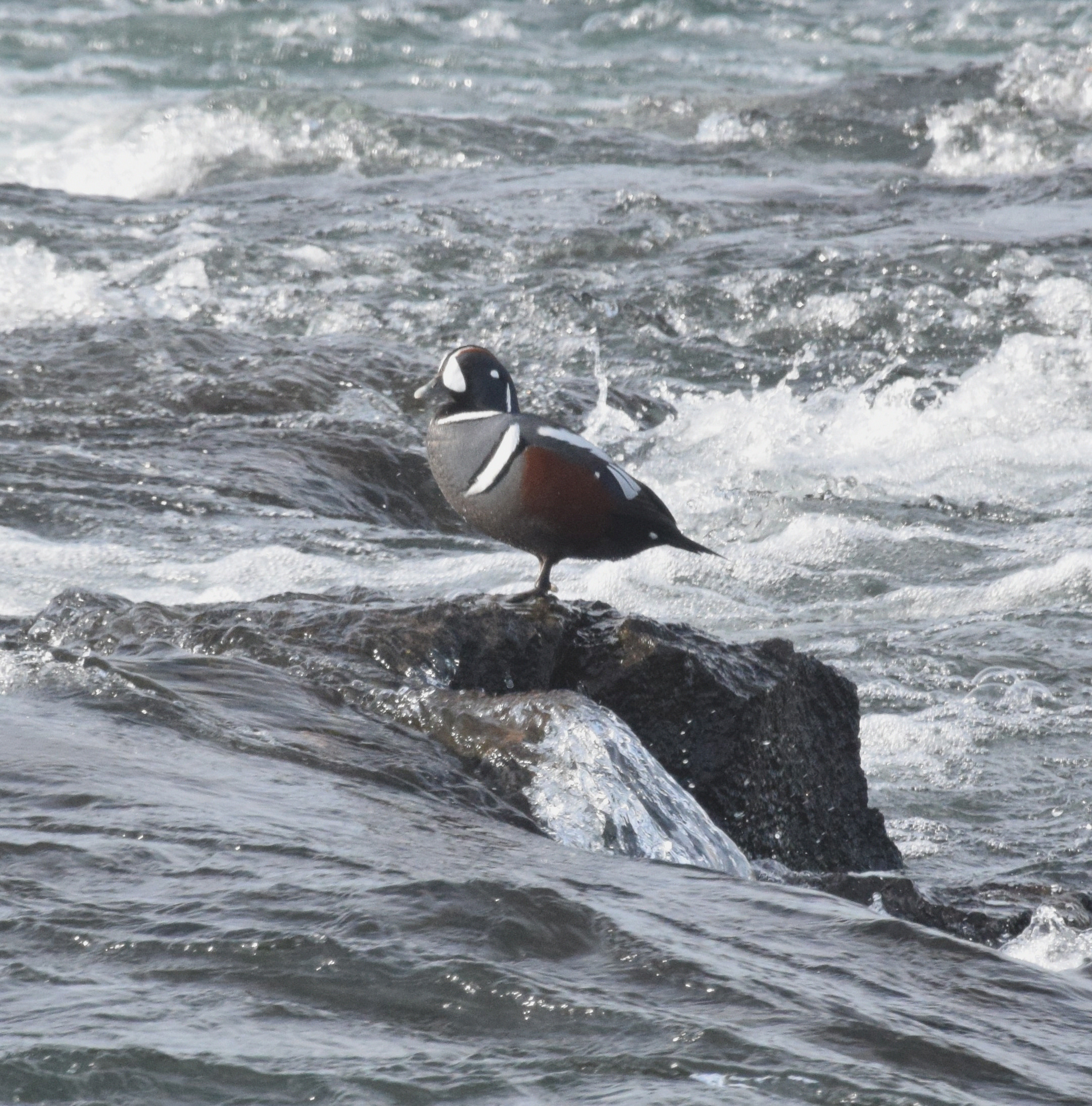
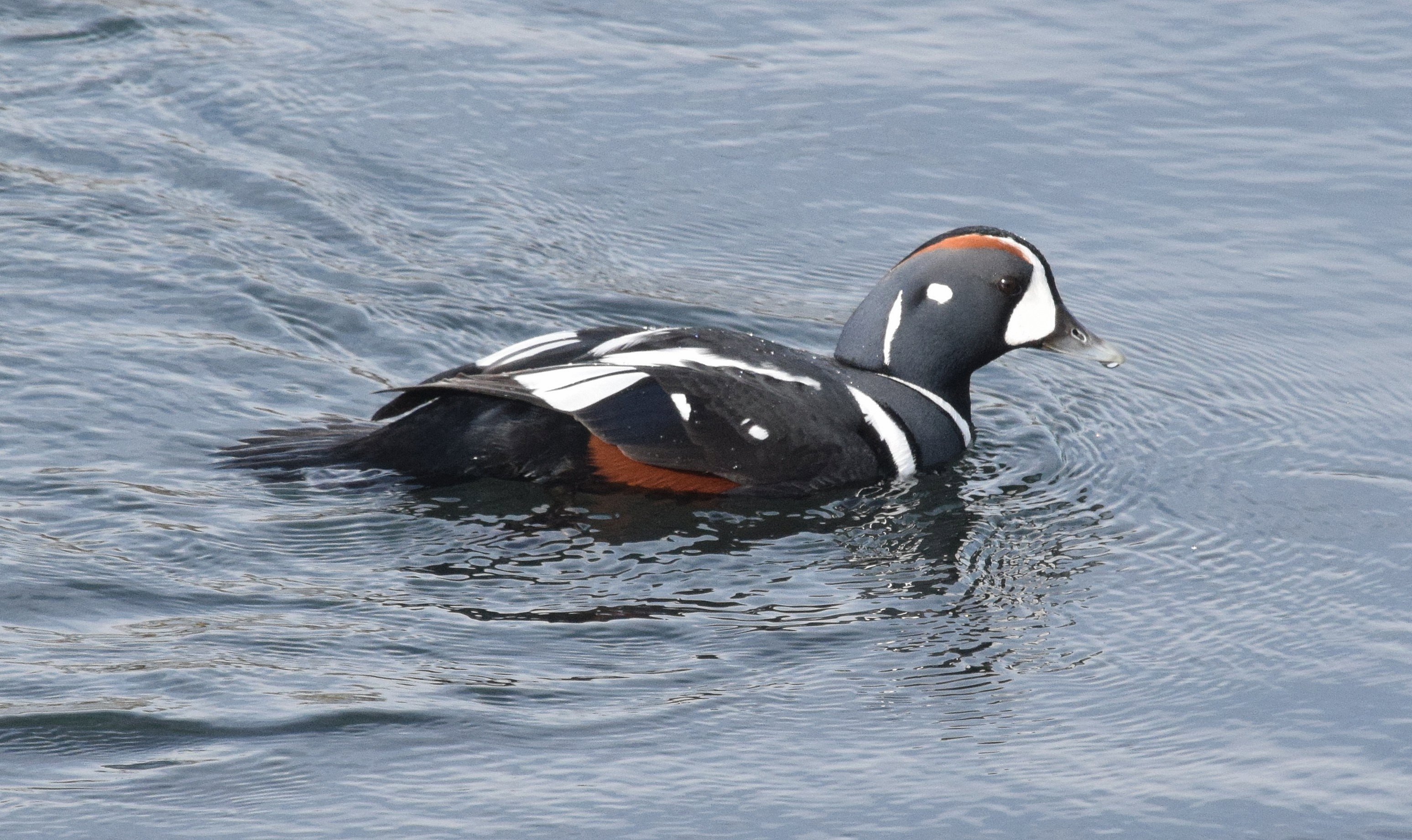
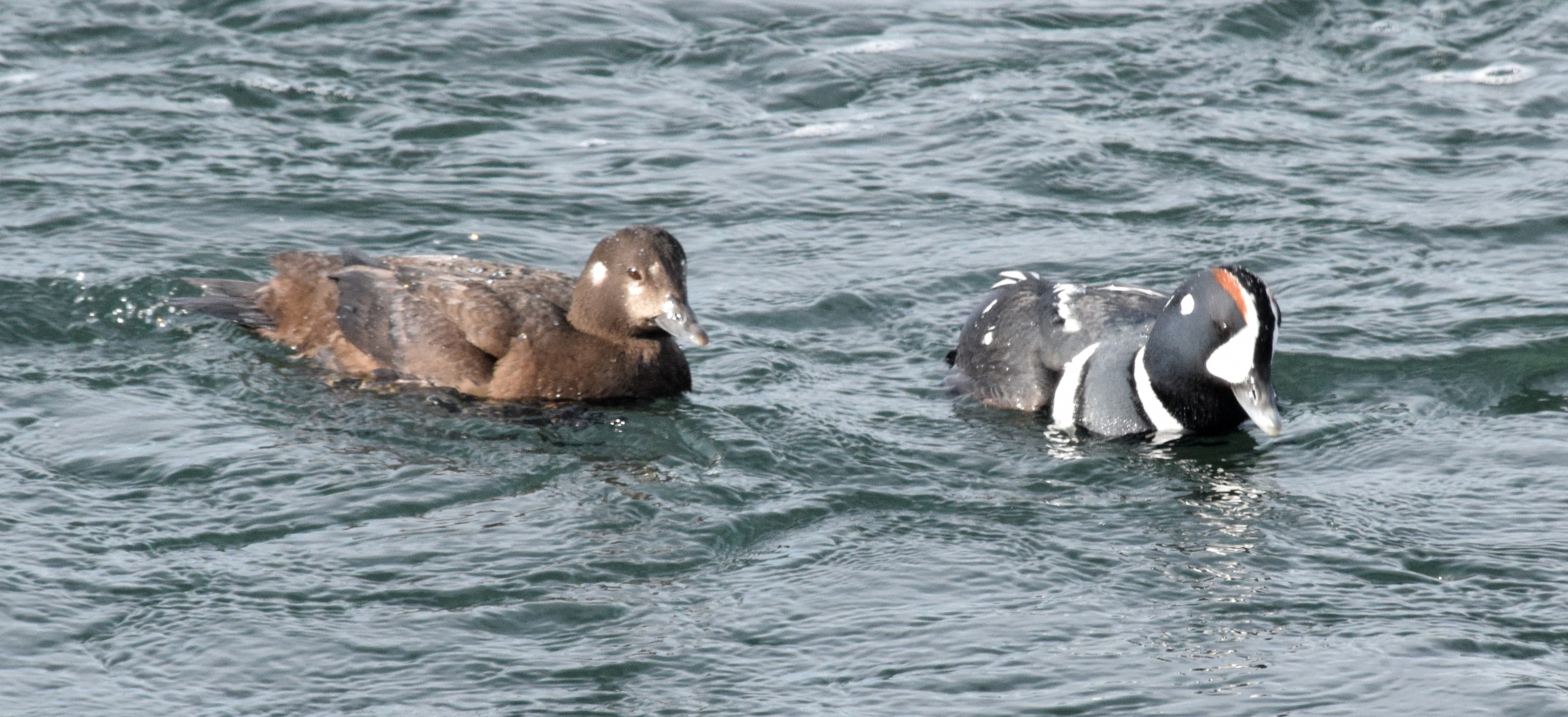
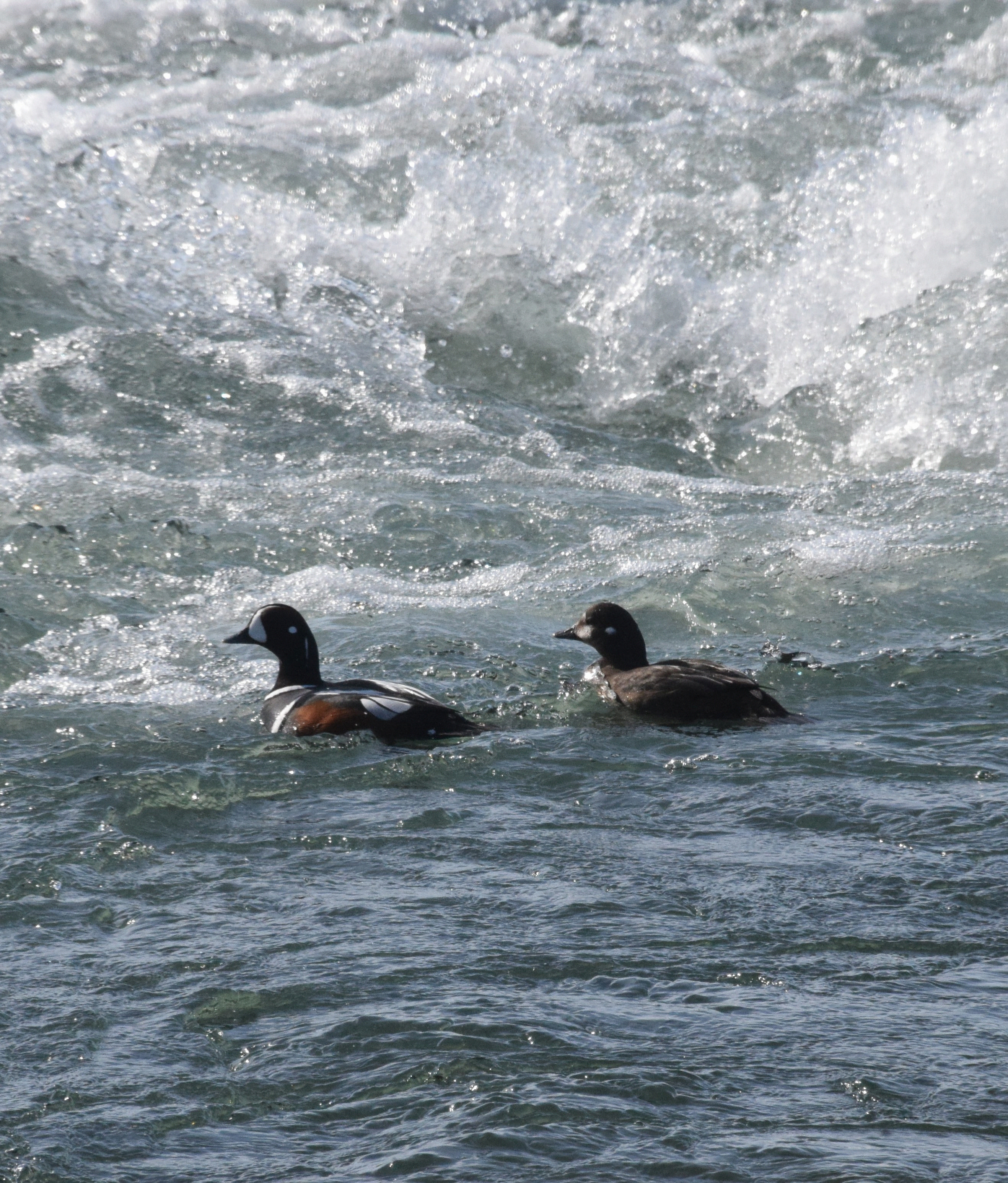
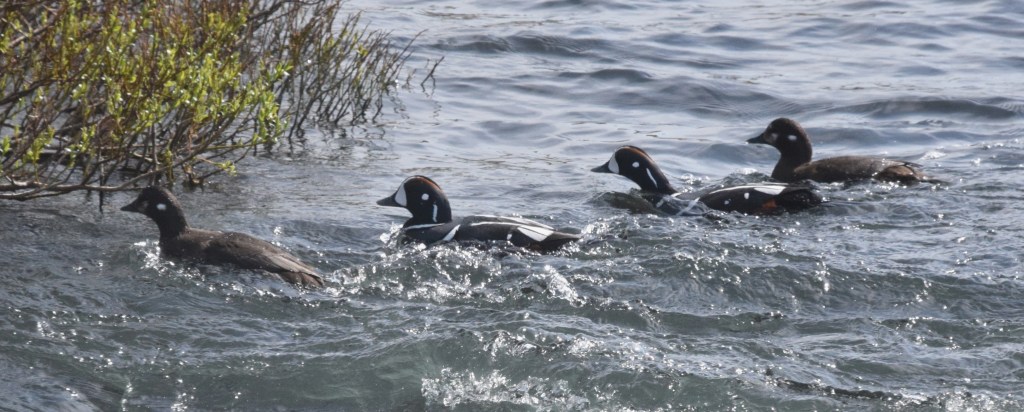
Harlequin Duck and drake

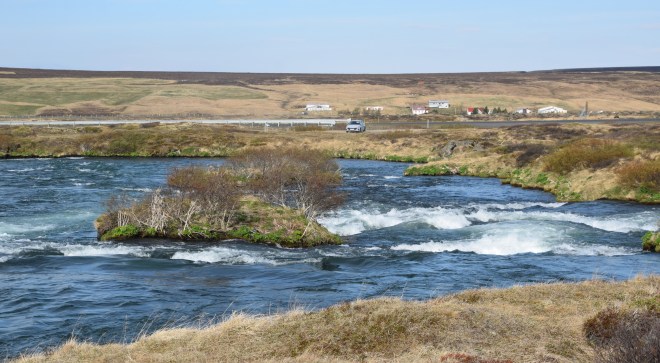
Immediately upstream from the bridge is a series of rapids marked on Google maps as Laxárdalur where my quest play out their days in May dabbling and diving in the fast-flowing, foamy waters, and resting in the lush marginal vegetation (pictured above). The River Laxá is exceptionally fertile since untold quantities of minute organisms drift out from the nutrient-rich lake to be filtered from the water by myriads of Blackfly (Simulium) larvae. Those in turn are feasted upon at this time of year by both the ducks of my intent, that move on when the adult insects emerge from June onwards. The biting, blood-sucking Blackfly migrate long distances upstream each year to lay their eggs in the lake outlet here. All is explained on the parking area information board.

I had not been aware of all that prior to self-finding this place, which made the wildlife spectacle I now witnessed over two visits all the more pleasing. The hot-spot may be accessed from a small parking area just across the bridge and to the right. Walking out I found three pairs of Harlequin sheltering at the water’s edge, so not knowing how skittish they might be or wanting to put them up, I sat down at a safe distance and waited to see what might transpire. More of these ducks were in view upon the river, on islands in it or perched on rocks in a low waterfall a little upstream.

Suddenly three more birds moved out from right below where I was sitting, and when those showed no fear of me I stood up and approached the initial group that were similarly unconcerned as I took this post’s lead and more pictures. Eventually they slipped into the water themselves but did not fly off downstream which is what I had wanted to avoid. The images I gained mostly suffered from being at least partially into the sun. In the morning the light would be behind me more and so I resolved to come back for another turn.

The elaborately patterned Harlequin is classed as a small sea duck, and has a sedentary population of up to 3000 pairs in Iceland. Otherwise it is distributed across sub-Arctic regions of north America and far-eastern Asia, and is always associated with fast-moving water. Inland it breeds in such tundra habitats, while when wintering it favours rocky coastlines in the Atlantic north-east and Pacific north-west Americas, Alaska and the far-east of Russia. It is an extremely rare vagrant to western Europe.

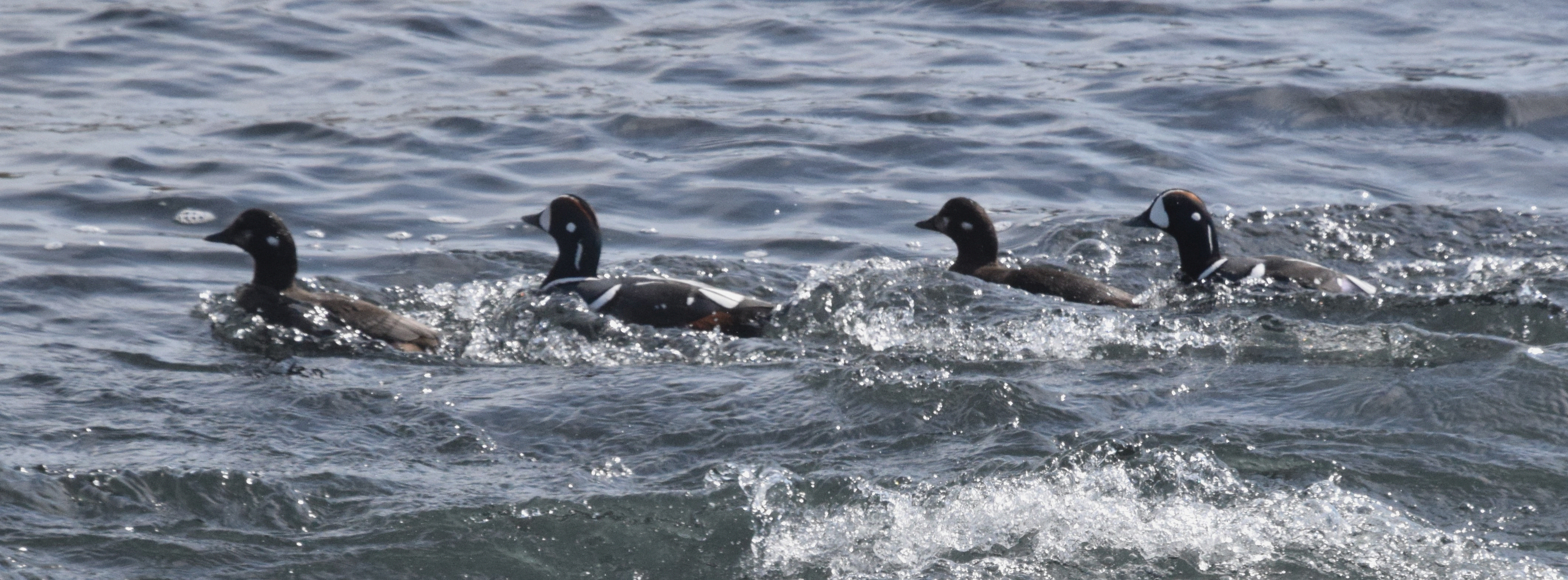
During my two spells of communion with this iconic species I noted various behaviour traits. Harlequins always swim busily and energetically, often into strong currents while diving, and such a dangerous lifestyle is said to result in frequent injury. Repeatedly they would ride the surf in small groups, or run across the water’s surface like the Red-knobbed Coots at El Fondo (see here). When interacting they squeak in a quite un-duck like fashion, and it was very noticeable how bonded pairs stick closely together while dabbling. This item has elected to lead lives of constant buffeting and being tossed around.

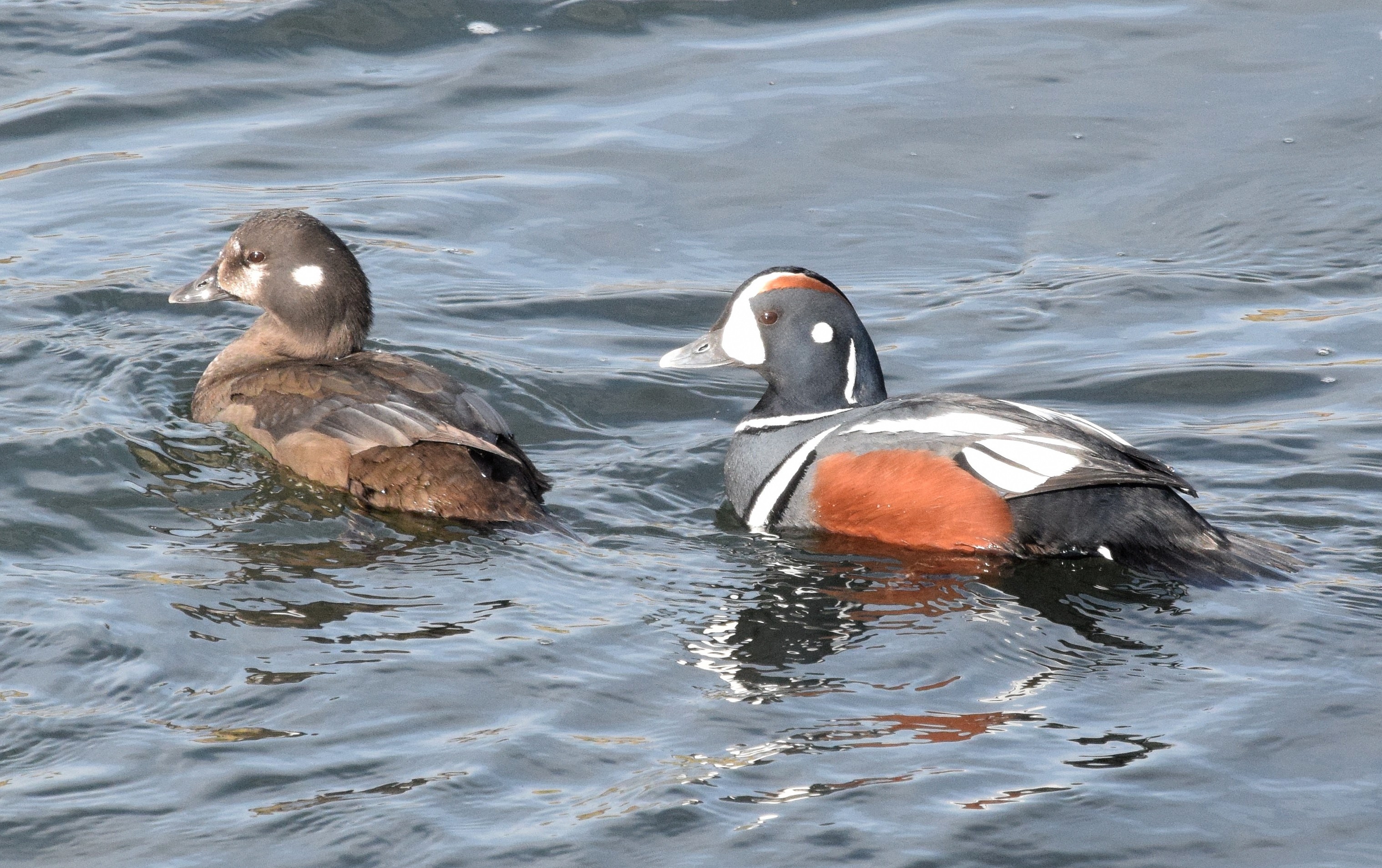
There but for fortune go any of us, perhaps? When I came back at 7am on 15th I was at first discouraged to find bright sunshine reflected on the water. The ducks were in just the same places as before, and I was able to gently coax one pair into a more favourably lit area (pictured below, top).

Then I walked upstream, encountering many more Harlequin, some in presumably bachelor groups, and their above-described antics were wonderful to behold. I had come all the way from England to see these ducks, and now here I was moving amongst them at close quarters. I remained completely alone here, just me and the birds in just the same way that I prefer to commune with insects in remote wild places. That scenario repeated itself throughout the five days of the trip and made its outstanding experiences even more fulfilling.

Some of the pictures selected herein suffer from bright sunlight on their subjects and glare on the water, but that is how these birds were experienced. I was visiting Iceland during an exceptional weather window for the country, with all day, wall to wall sun and temperatures in the high teens. I was told that normally: “We might get this in July if we’re lucky.” It was great for the locals, who would strip off and strut out in shorts while I yet donned an extra layer against the still cool wind, but quite difficult for picture taking. The sun was invariably in my eyes and there being no tall trees in the tundra landscape, there was no shade anywhere.

This trip was right up there with my best ever wildlife experiences, and what has just been described may take some ousting as the top one for 2025. I was birding once more and here was the way to do it. Time and again, alone in wild places, I self-found and recorded my various, new, different and exciting targets, often at very close quarters. This will all take some time to write up and picture edit. More of the highlights will be presented as separate posts.

NB If visiting this site be sure to use insect repellent on all exposed skin
A Purple Toothwort haven in Swaythling, Southampton – 10th Apr
When researching this journal’s post before last I decided I would also like to record the second Toothwort species that occurs in the British Isles. So I consulted a trusted, top quality source and soon learned of a location in a northern suburb of Southampton, conveniently close to the first eastbound M27 junction from the M3 interchange, and just 70 miles and a similar number of minutes from home. Hitting the road southward on the A34 from Oxford is always restorative, given the numerous past and meaningful wildlife experiences that have awaited me beyond its end. In mid-morning I arrived in a built-up area then walked out into unspoiled habitat alongside the River Itchen.

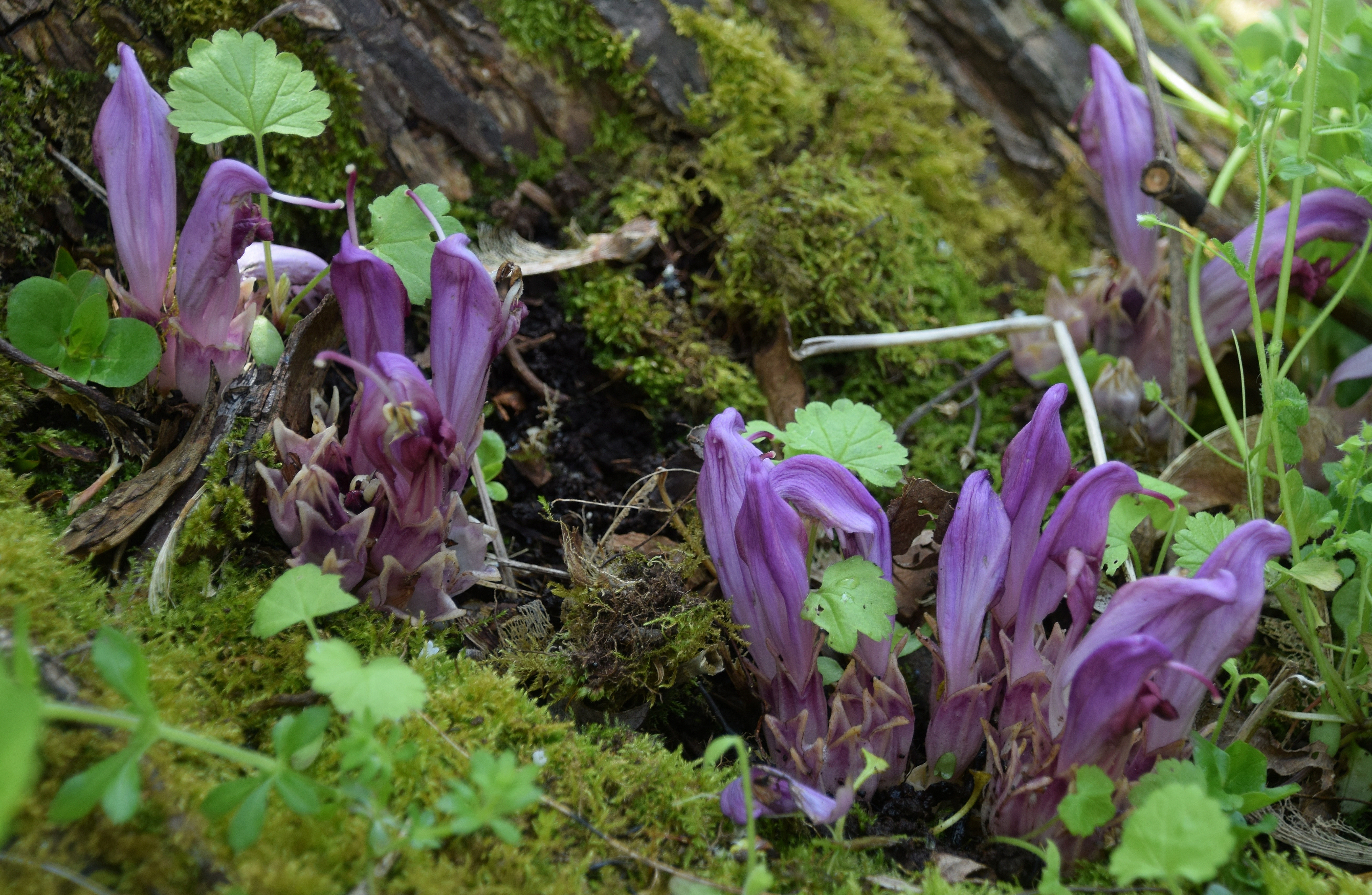
Purple Toothwart

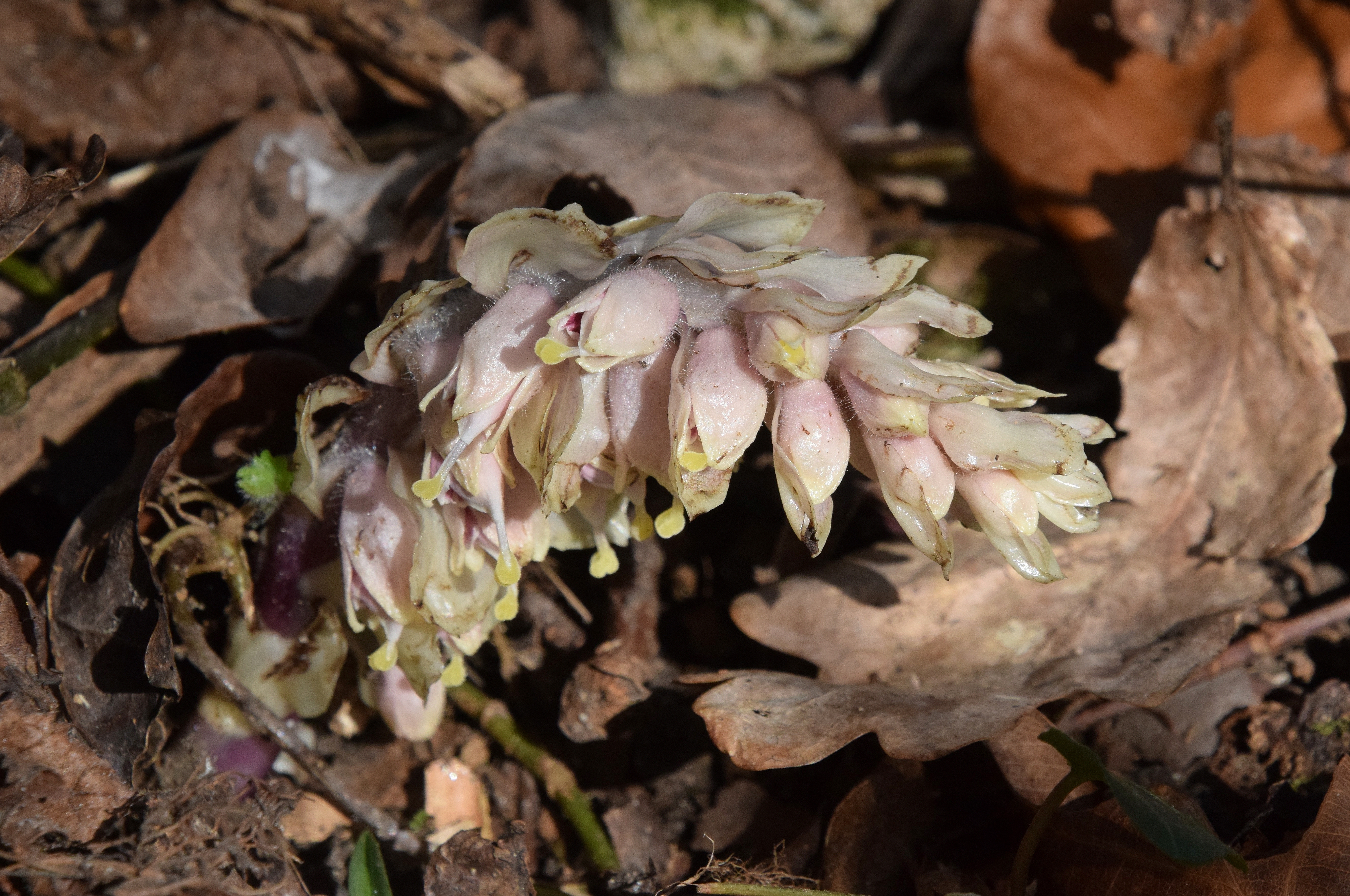
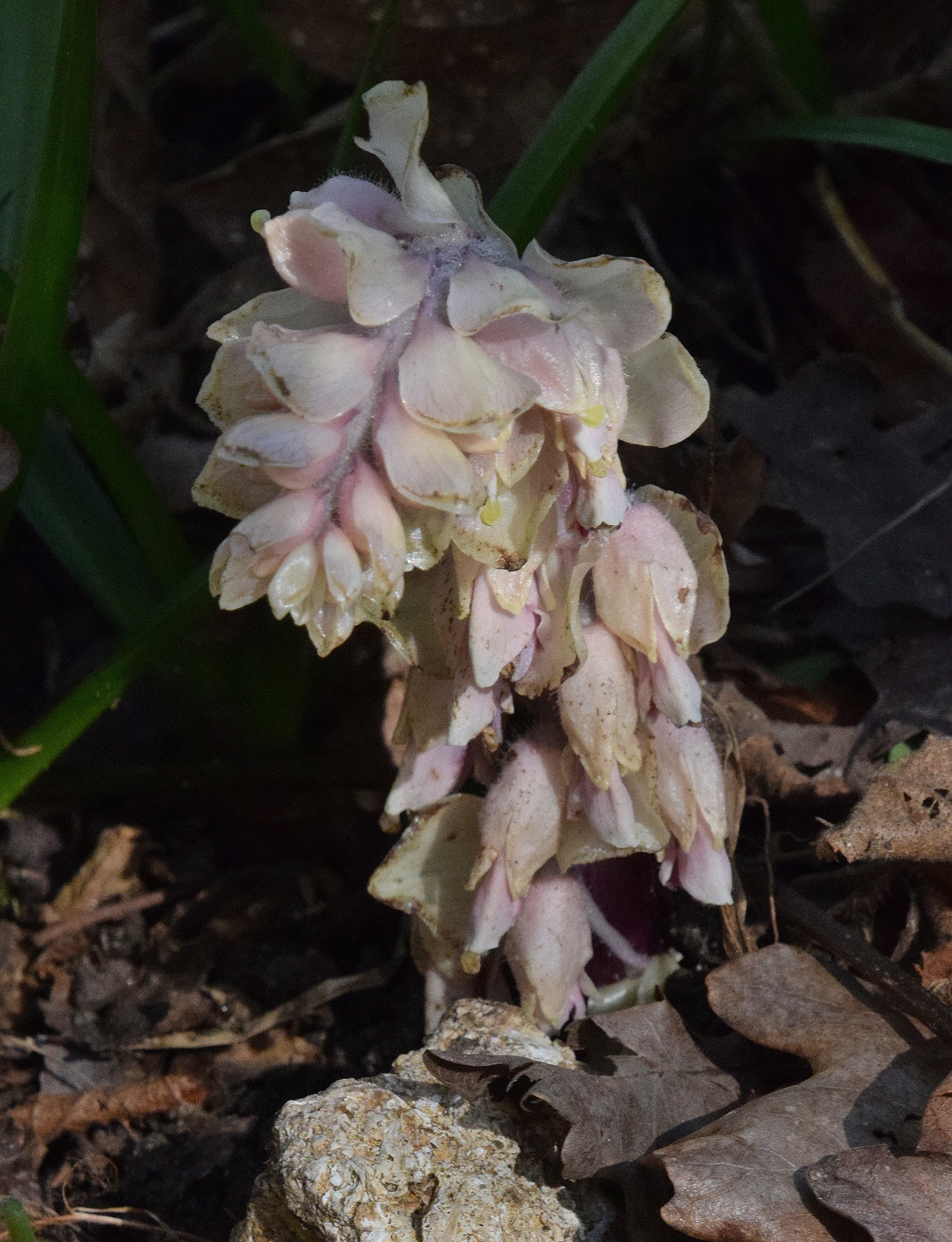
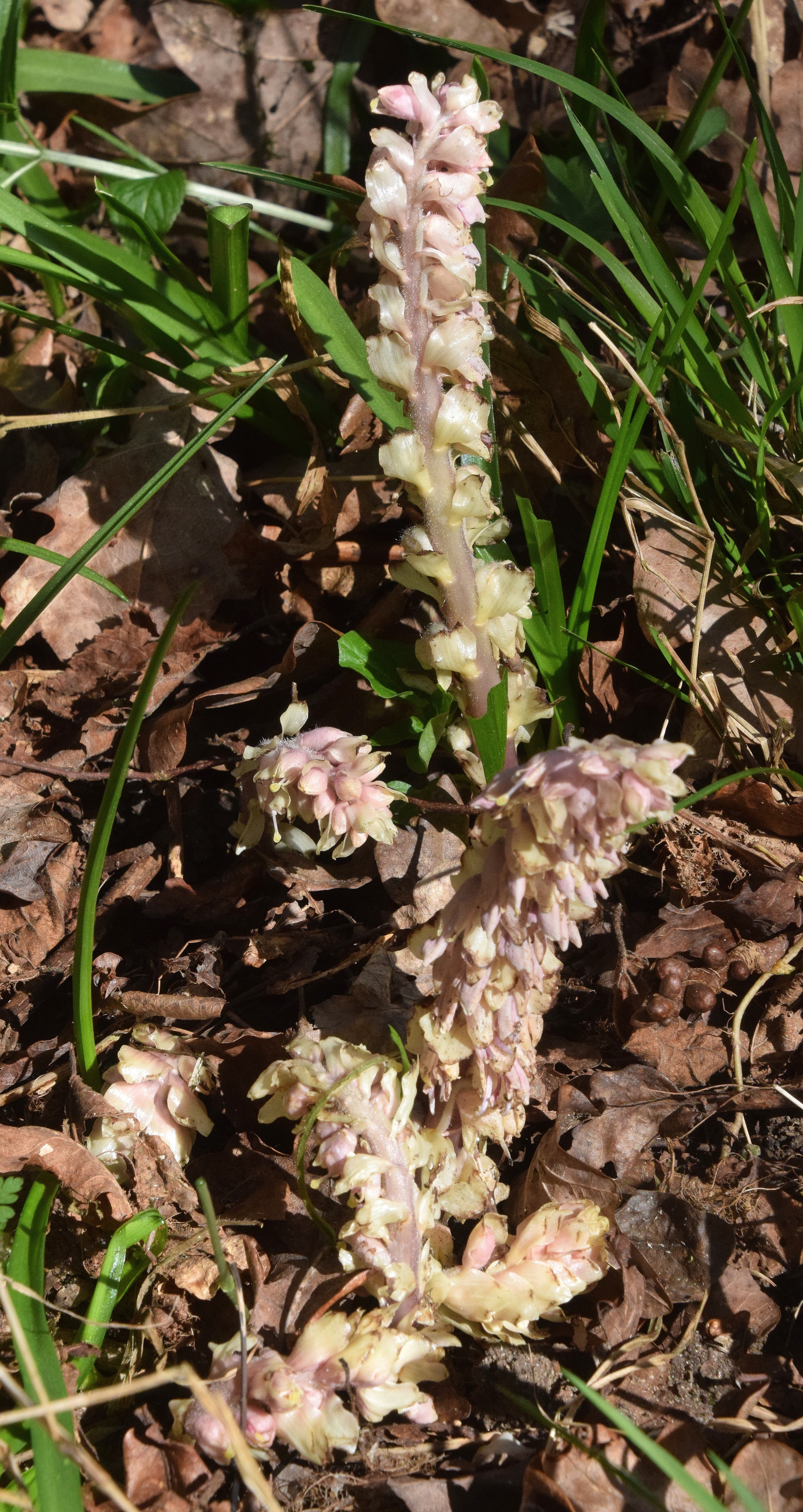
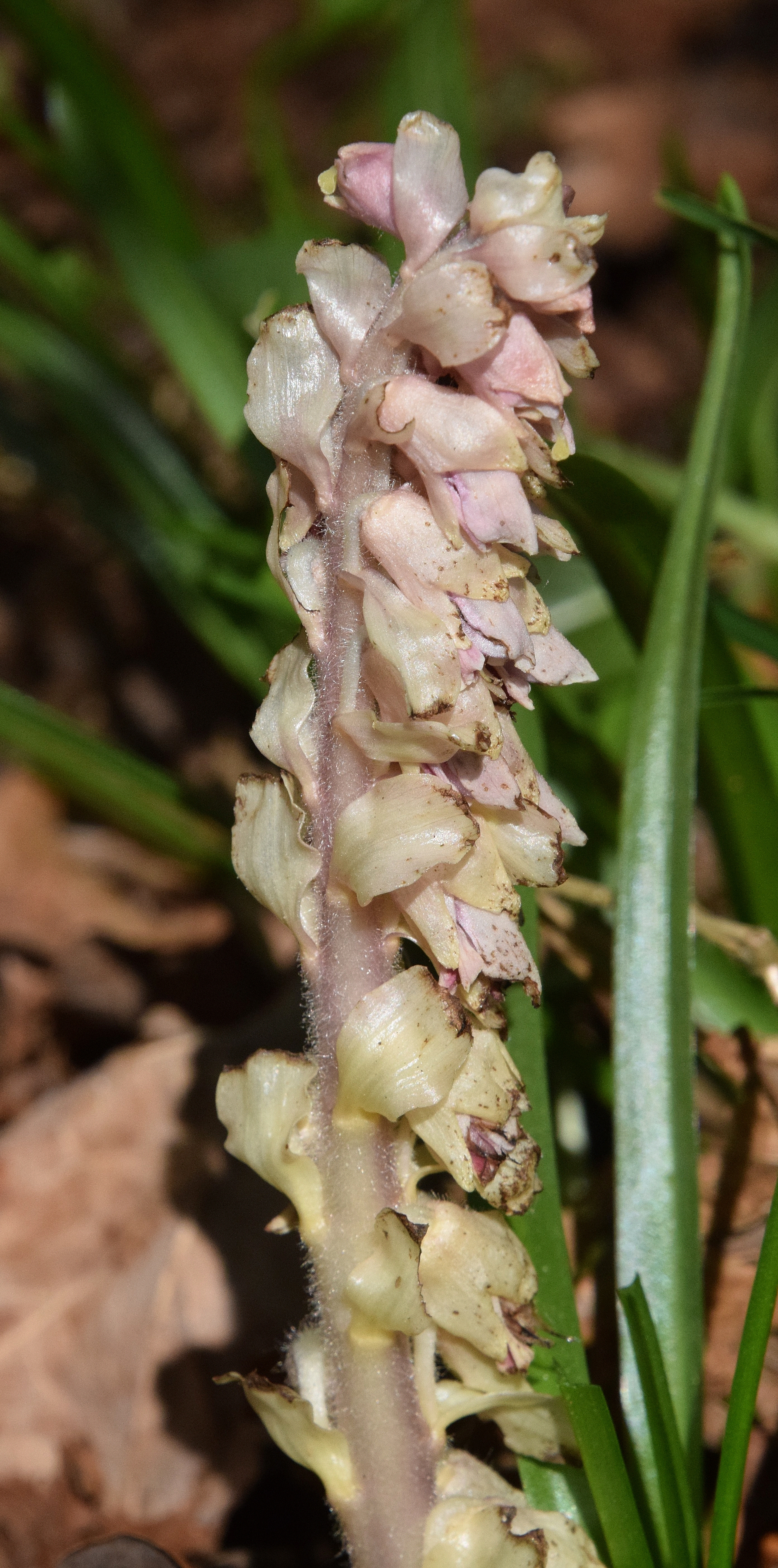
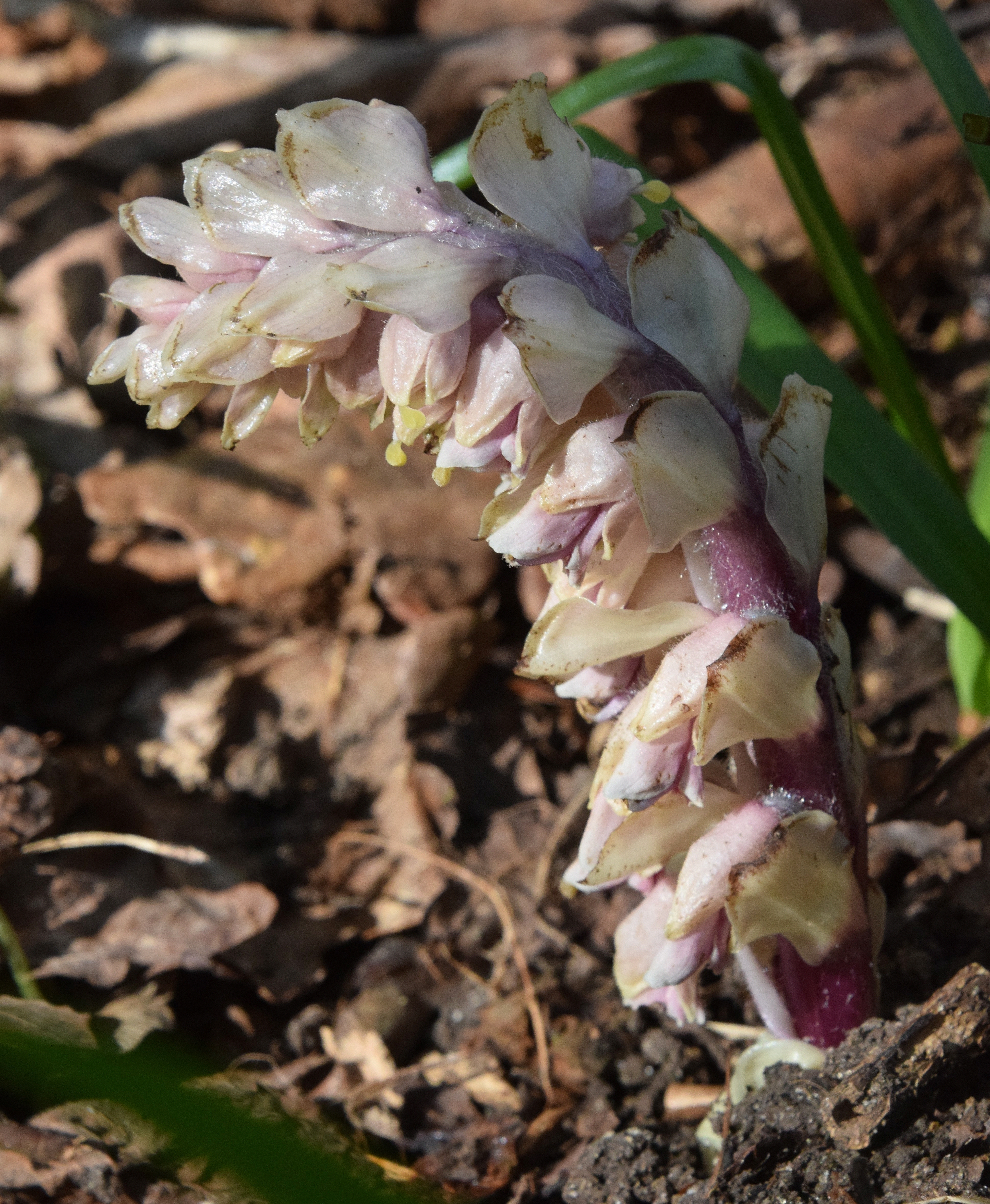
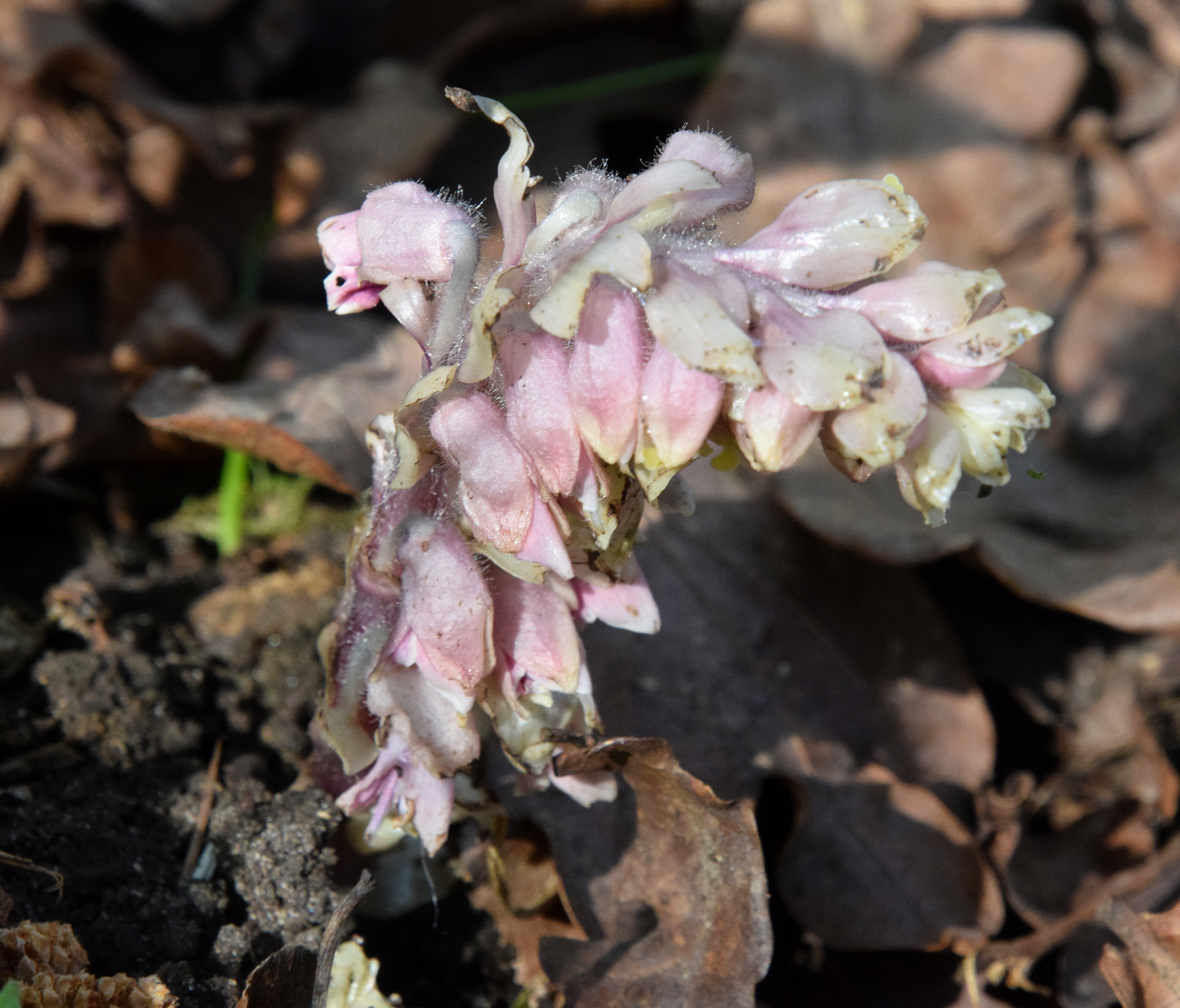
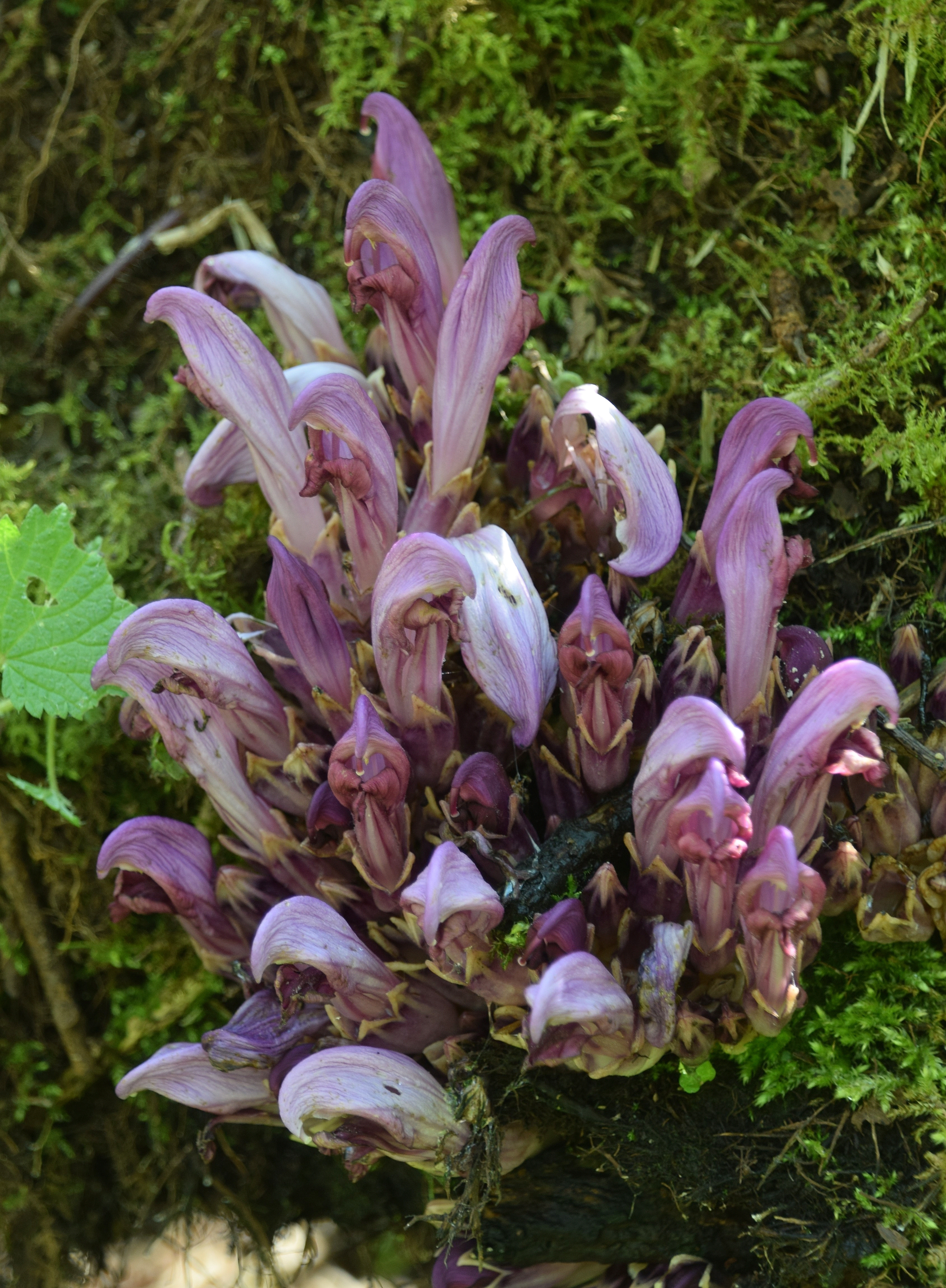
Purple Toothwort (Lathraea clandestina) was blooming in profusion beside a hard path alongside the tributary Monks Brook (SO18 2RS – SU441155), starting at /// leads.will.cove. There was so much of it here that I see no danger in revealing those site details that I believe are reasonably well-known in botanic circles, though less likely to attract the attention of passing general public. One regular walker here did tell me there have been other people taking pictures in recent days.

Like Common Toothwort (see here), this parasitic plant grows on host tree roots, in this case mainly Poplar and Willow, and only shows itself above ground in spring. But it has an entirely different character since the 40-50mm stemless, cowl-like, violet-purple flowers rise straight off the rootstock. Some clumps today were sprouting in fungal fashion from fallen, rotting wood (below left) and one even from the base of a low stone abutment (right). Clearing vegetation from protruding purple patches several times revealed large expanses beneath.

Native Purple Toothwort occurs across the west and south of Europe, from the Belgian Ardennes as far as northern Spain and central Italy, and is especially abundant in western and central France. In Great Britain it was originally introduced as a garden curiosity and planted at Kew Gardens in the late-19th century, then was first reported in the wild in 1908. Since then it has become locally naturalized in older parks and gardens, including both the Cambridge and Oxford University districts and RHS Wisley. The preferred habitat is damp woodland in valley bottoms, usually near streams such as in Swaythling. Several other Lathraea species occur around continental Europe.

The week’s earlier trip to Dorset hadn’t done it in re-humanising me after an exhausting prior working weekend, so this was a suitable opportunity to get out again by myself and draw the tranquility and renewal I seek from non-birding related wildlife activity. I couldn’t have had a better result, achieved with the aid of a precise pin drop in the best possible ambience, and returned home at least partially recovered.

Early Spider Orchids at Durlston NNR, Dorset – 8 & 17th Apr

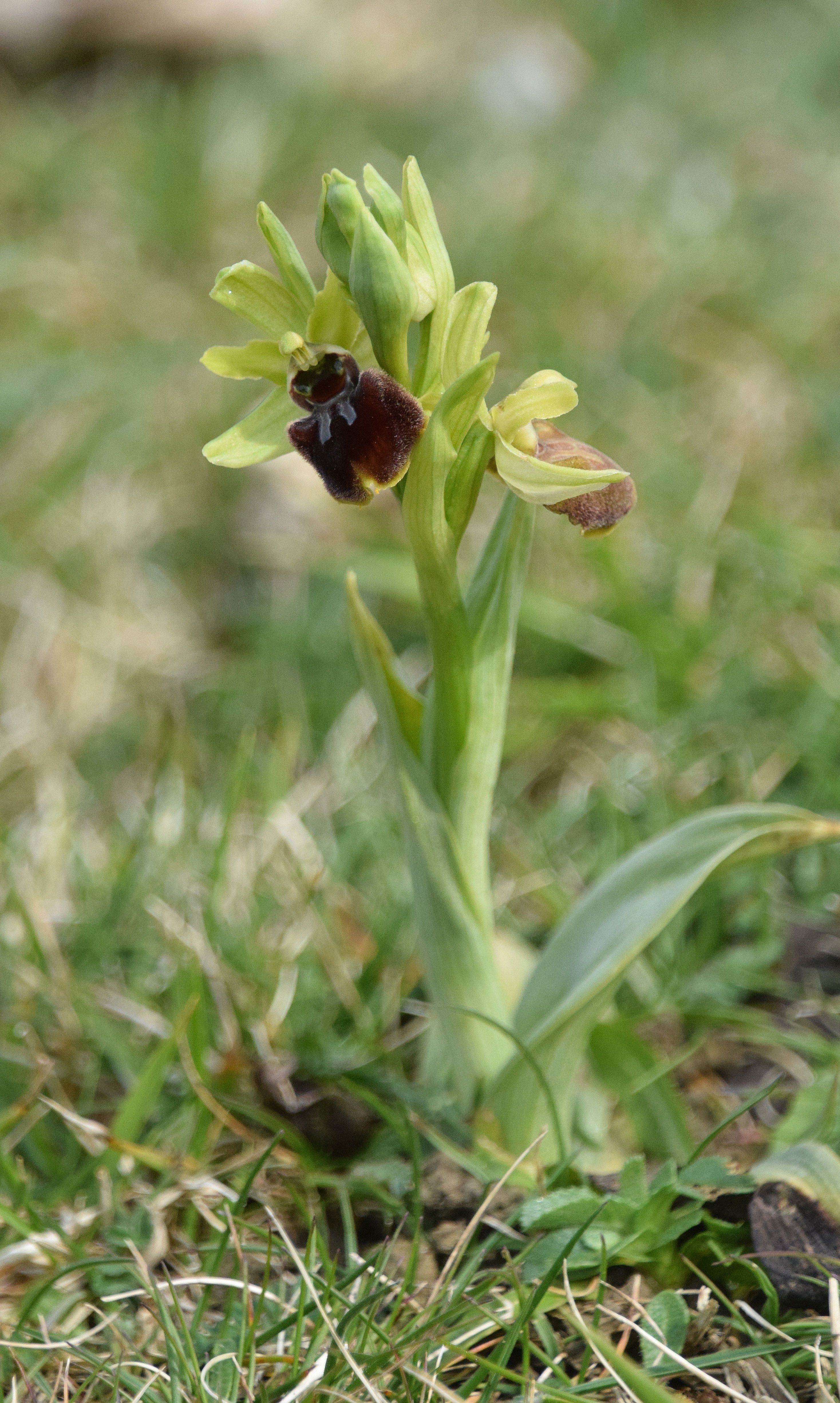
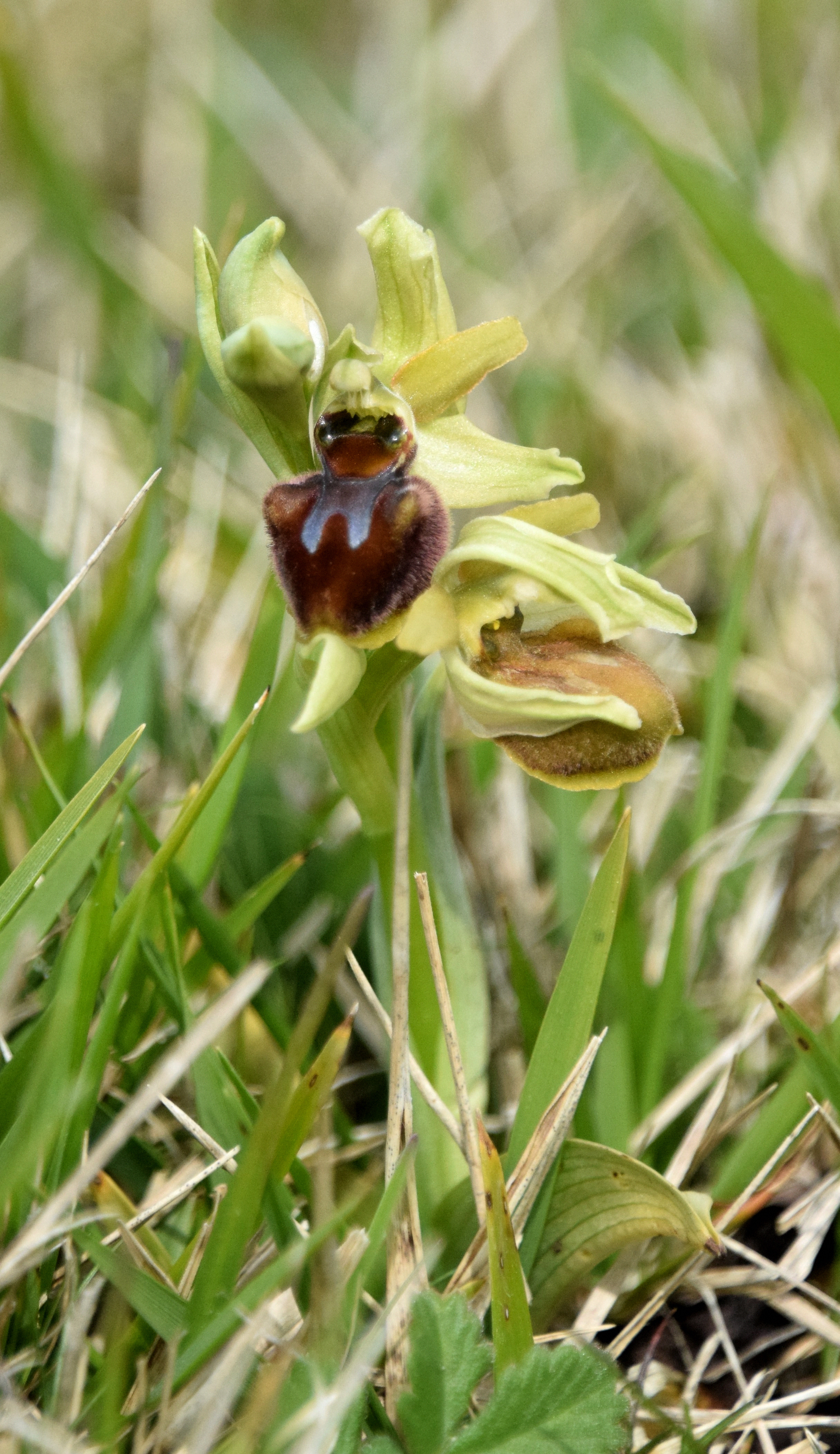
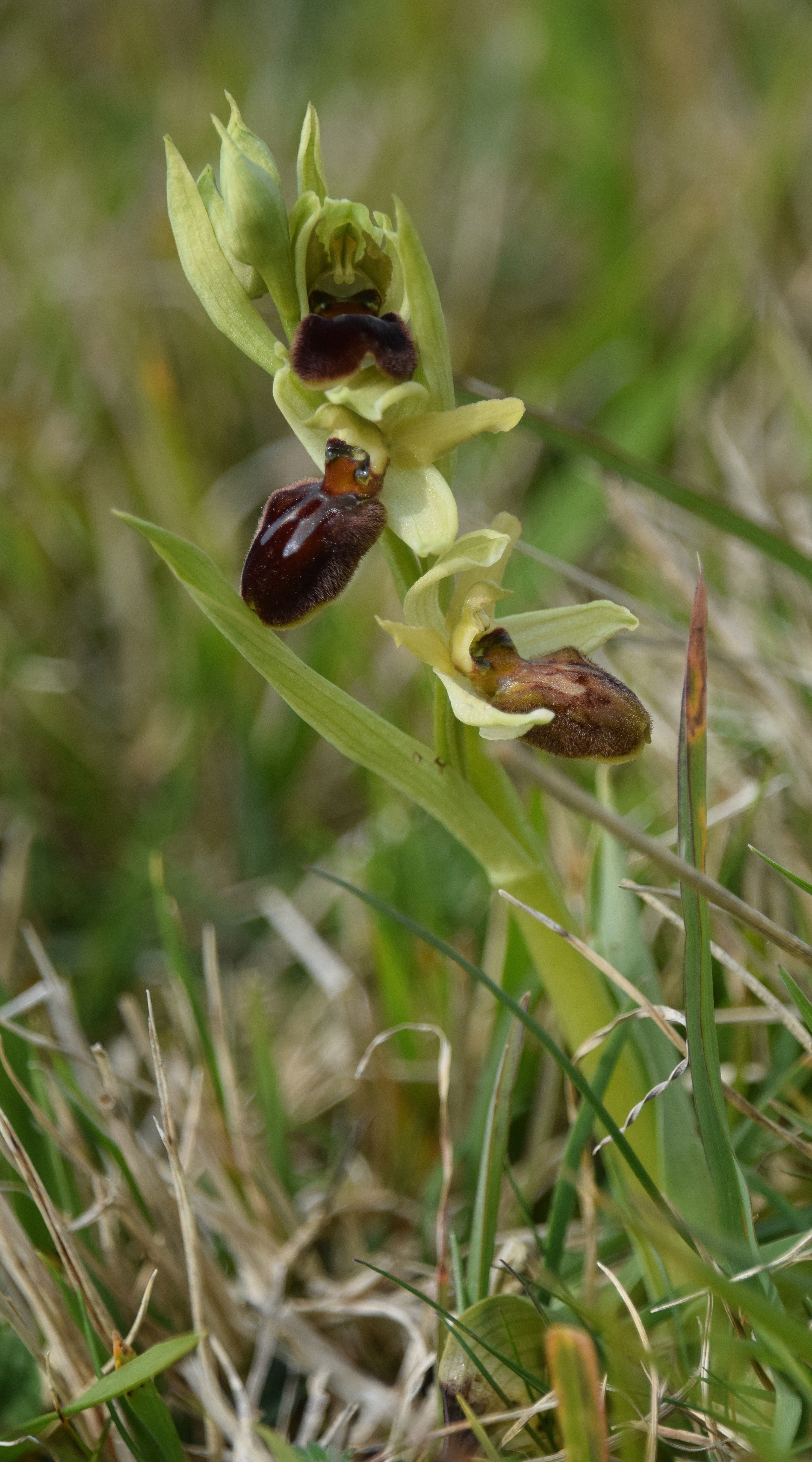
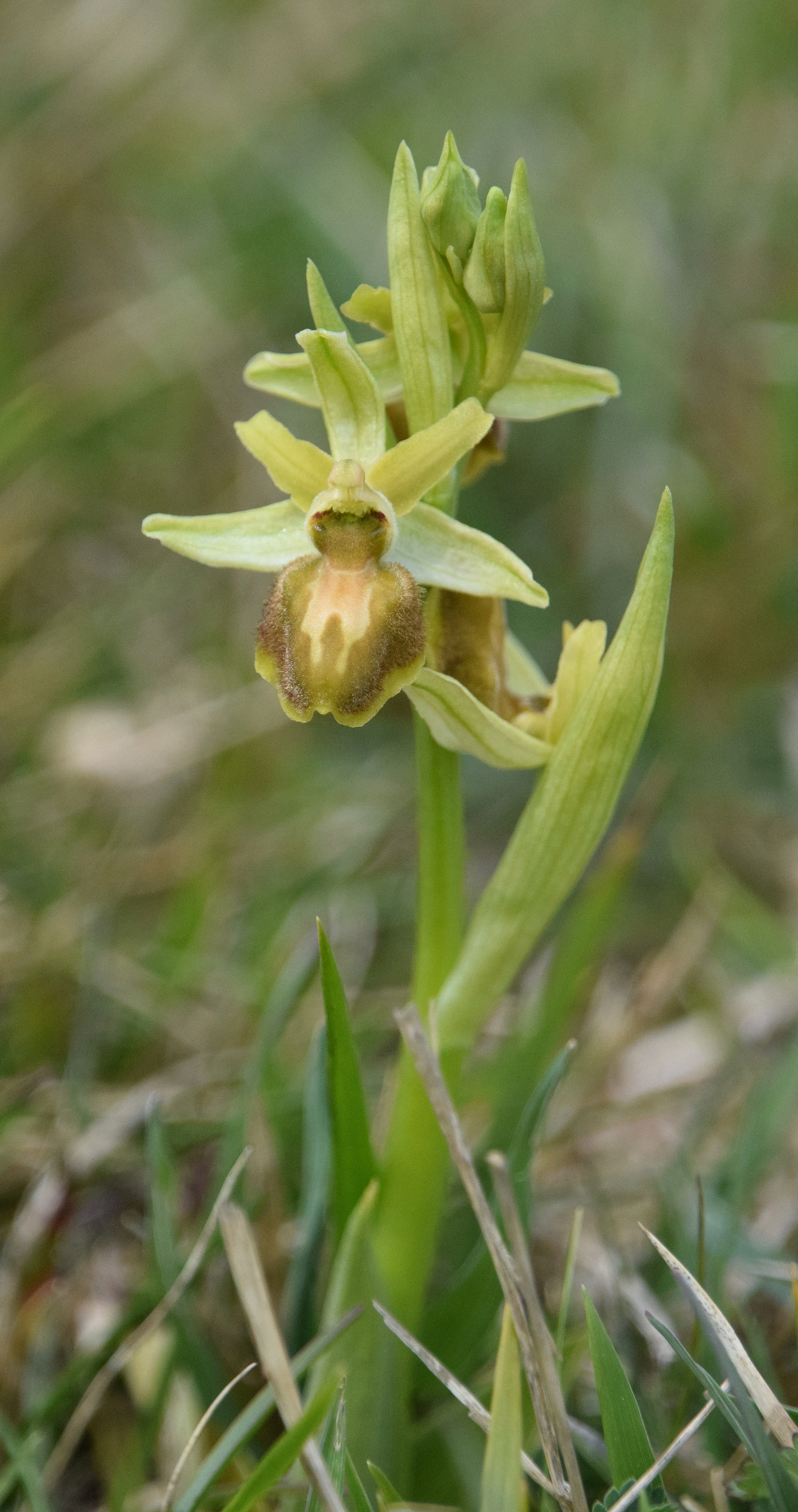
My interest in recording the more-localised British Orchids took off too late last year to include what follows. This post’s item occurs on the extremity of its European range at three south coast sites: today’s location, Castle Hill NNR near Brighton, and more recently Samphire Hoe SSSI at Dover. I had been told the older-established Dorset alternative is the most profuse, so after sightings began to be published in the last week of March, I opted to add this straggler as planned to my 39-strong career total.

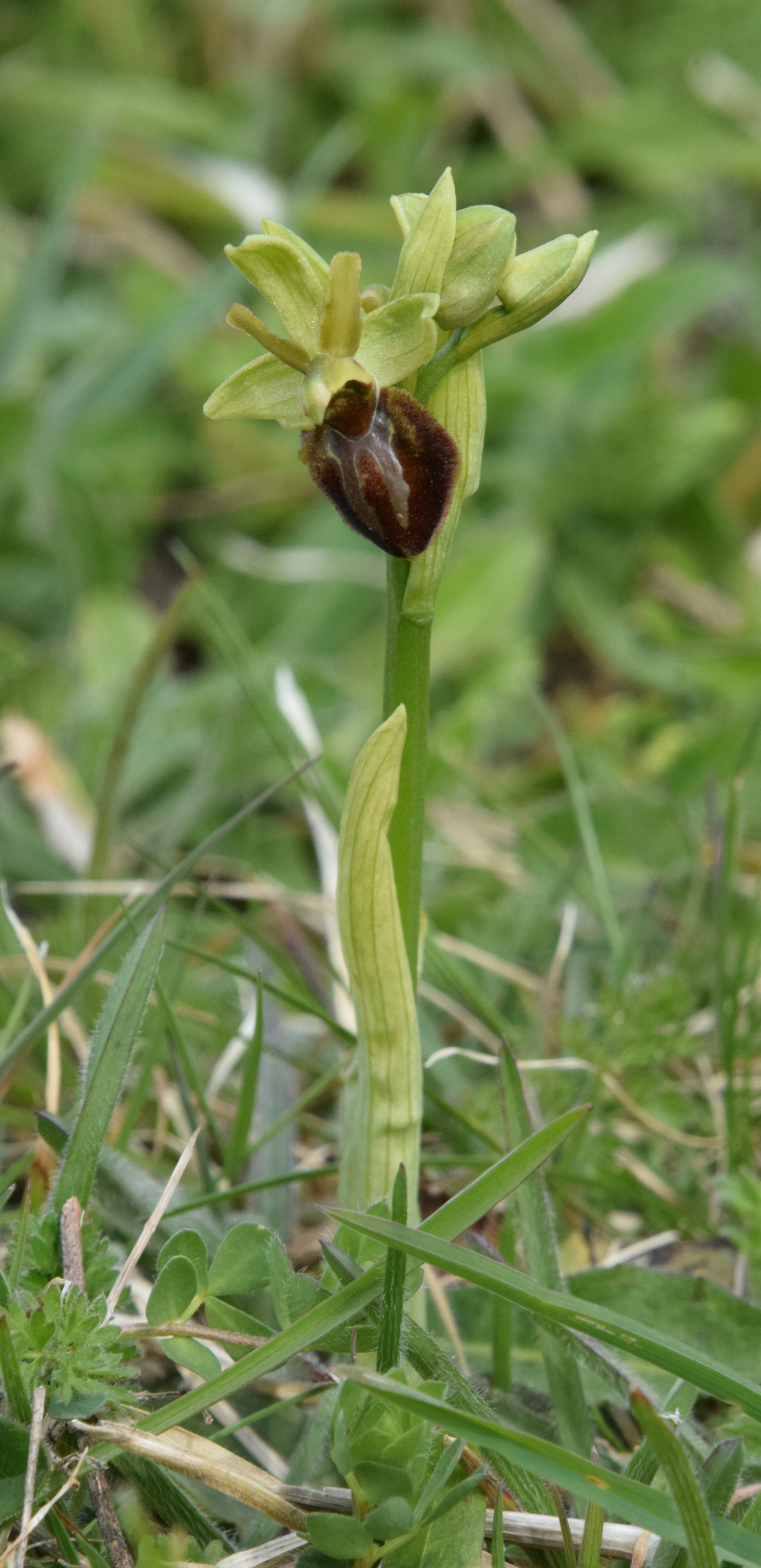
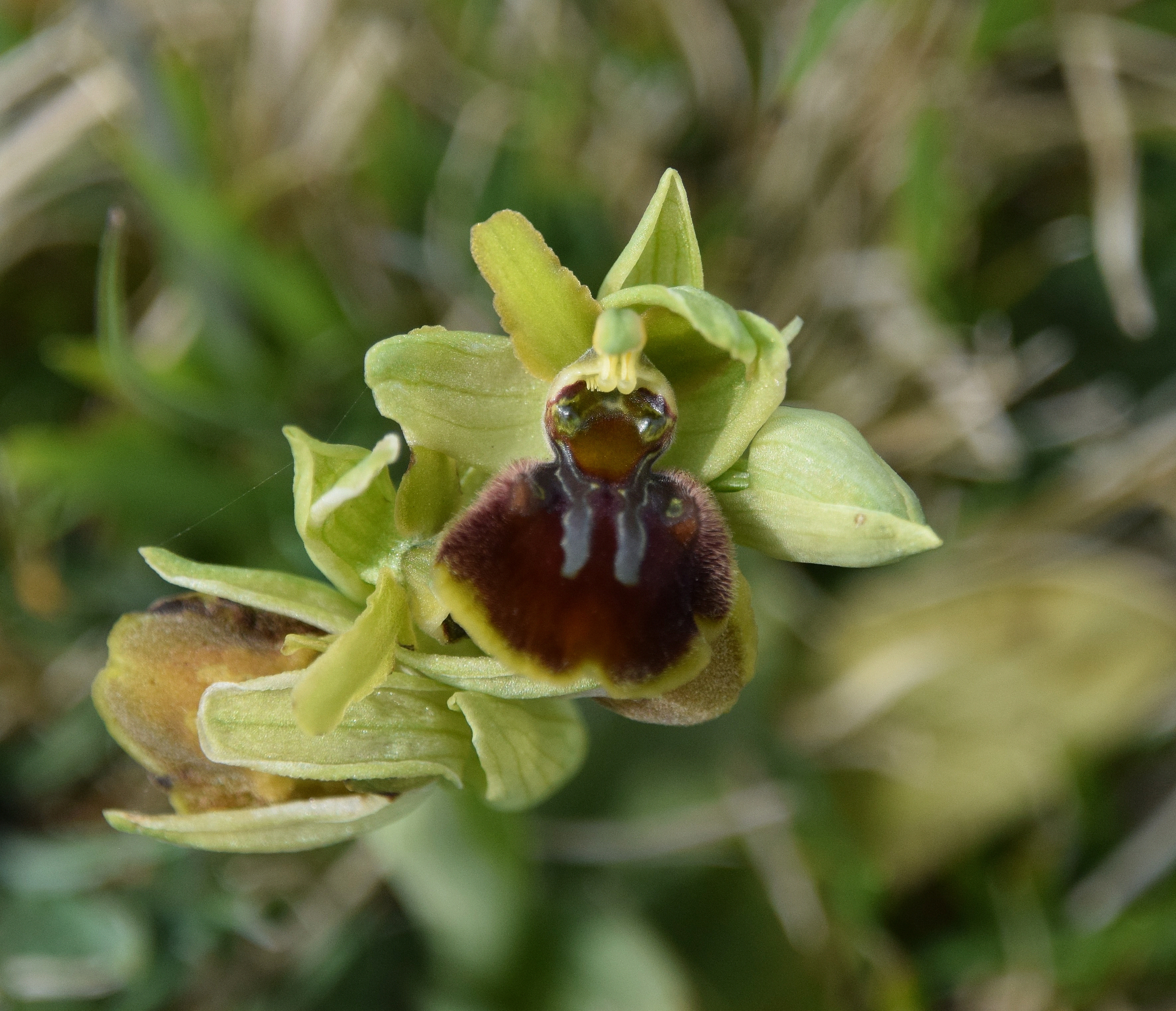
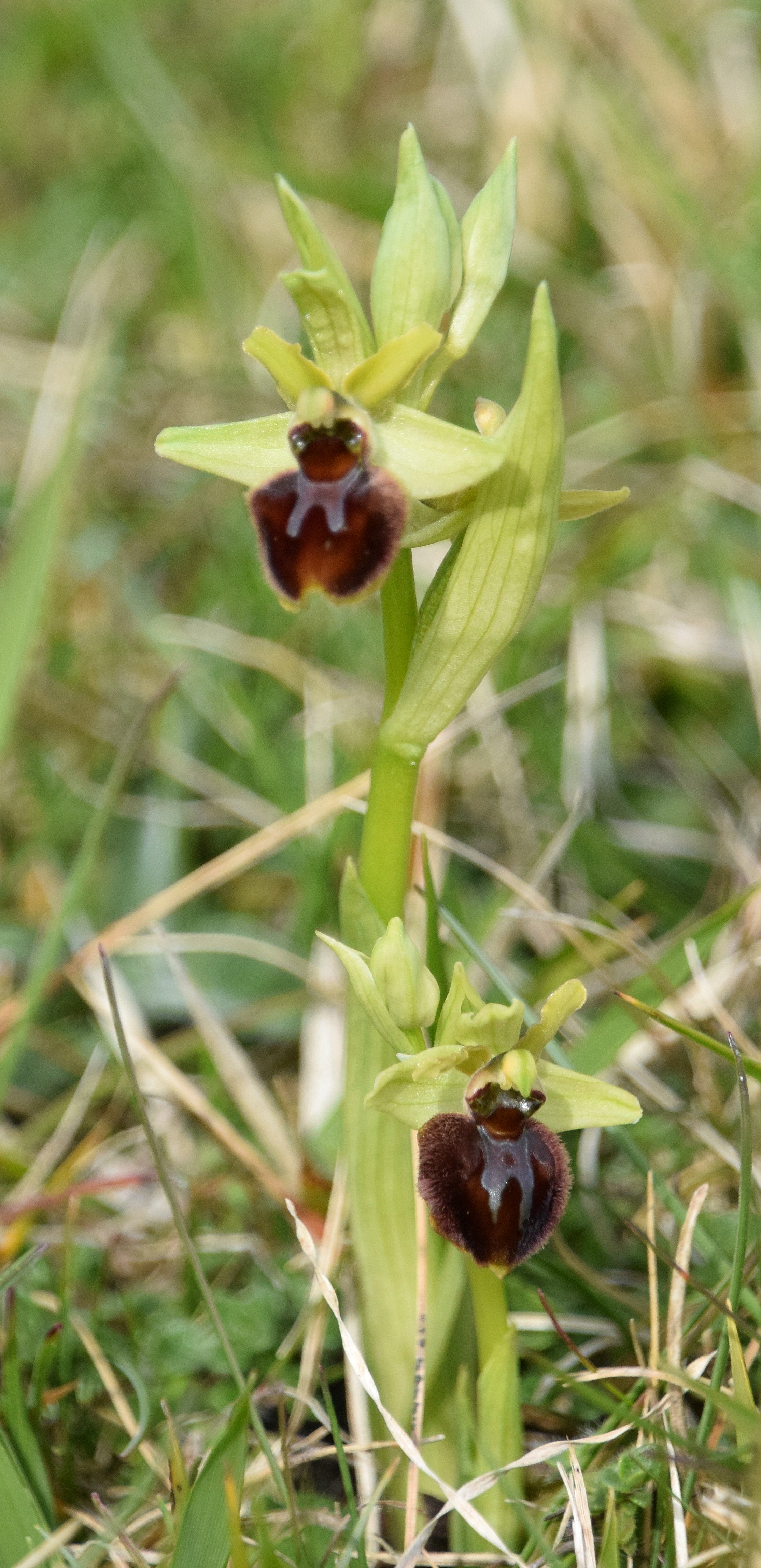
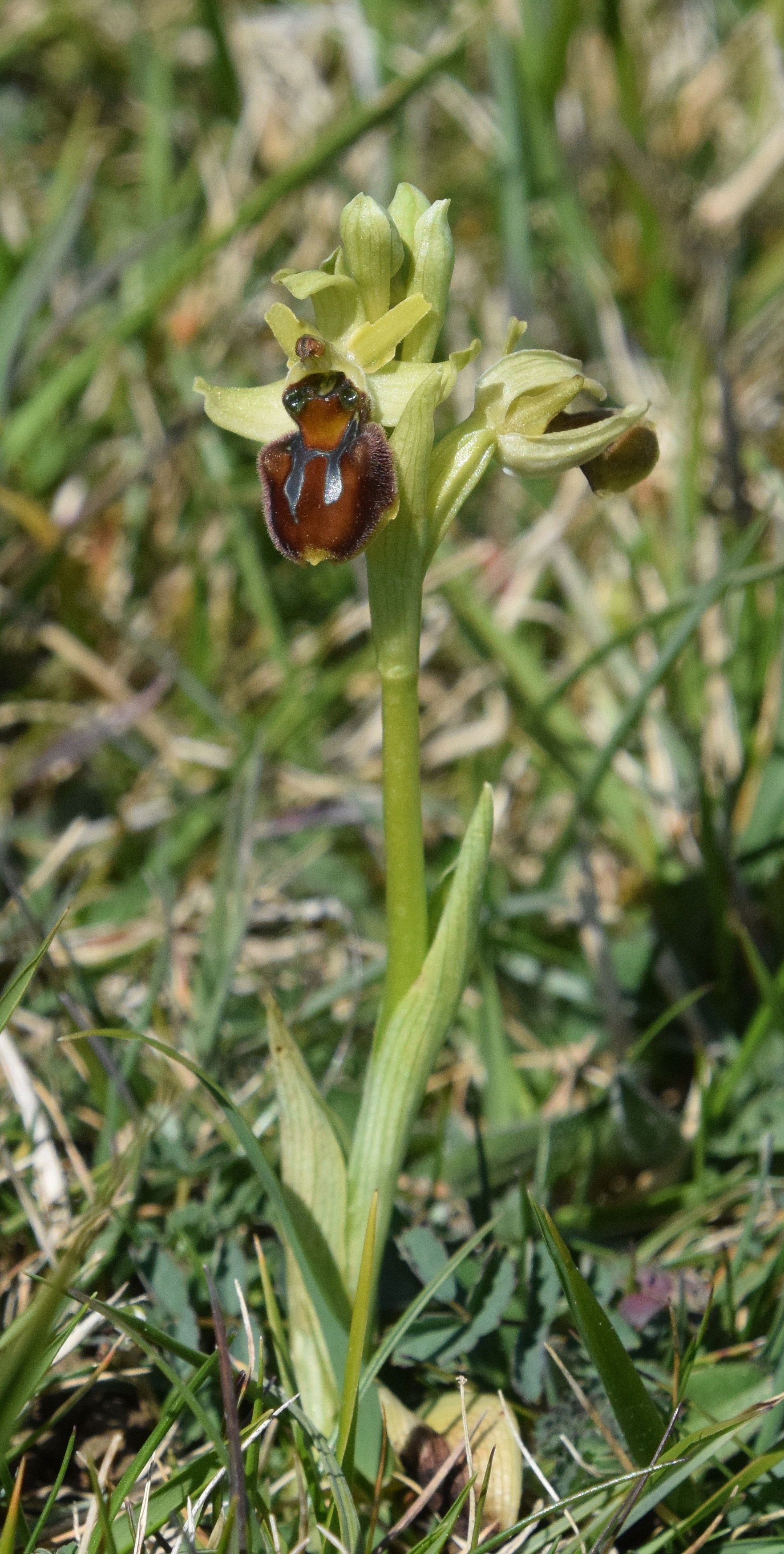
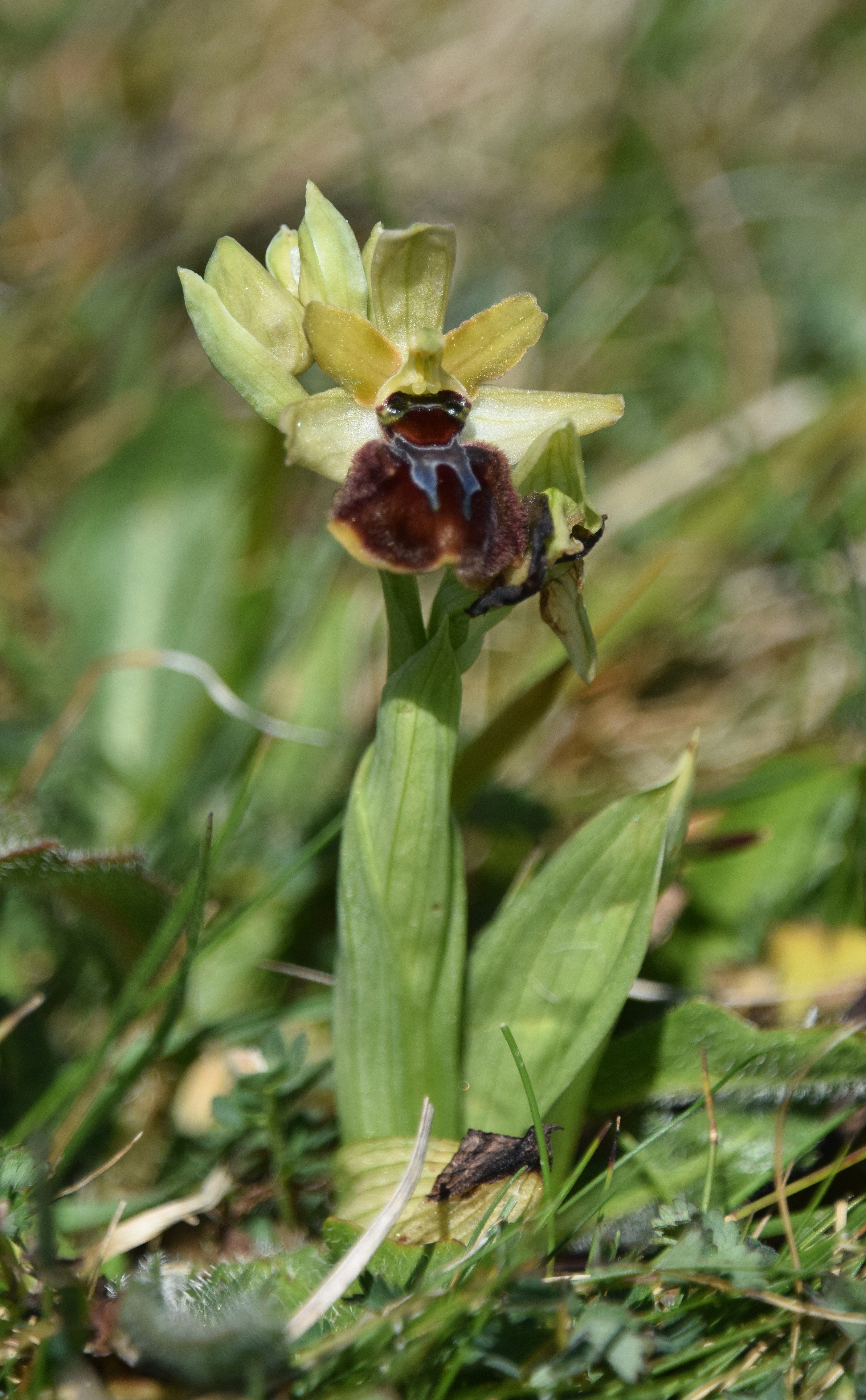
Early Spider Orchid (Ophrys sphegodessee here) was usually the first species to appear nationally in any new season, until Oxon’s famous Giant Orchids arrived upon the scene a few years ago. Similar in stature to the more widespread Bee Orchid, the former derives from the western Mediterranean and Aegean regions and is very variable with 12 or more recognised sub-species and two accepted British hybrids. It appears through April and into May in open areas of unimproved grassland or semi-shaded woodland edges, on calcareous substrates.

Early Spider Orchids, more spidery looking when viewed from above

When we arrived on-site at midday, we were at first directed in the country park visitor centre to an area where we located just two specimens. And so the above left became my first ever record. But as so often success depended upon getting our eyes in. After re-locating, with better instruction to fields immediately east of Anvil Point lighthouse (BH19 2JL – SZ 026770), there were plenty to be found.

Most of the blooming plants we observed today showed just two, occasionally three open flowers that by their mimicry (and like other Ophrys orchids) trick pollinators into trying to mate with them. A typical stem as it matures might grow to 20cm and carry up to 18 flowers, but I understand two to seven flowers are more usual in this particular colony. In other parts of ESO’s range inflorescences can reach 70cm in height. Across the cliff-top fields there were variously intriguing shapes, all in the early stages of flowering. These (below) are some of the day’s more pleasing pictures. I am advised that once pollinated the initially dark-red flowers turn to the orange / ochre tones that some of the images show.

The 129 ha (320 acre) Durlston Country Park and NNR is administered by Dorset County Council as a visitor attraction at the gateway to England’s Jurassic Coast World Heritage Site and 630-mile South-west Coast long-distance footpath. On the wildlife side of things (see here) the majority of the area is calcareous grassland upon underlying limestone. So its varied habitats support more than 500 wild plant species, 33 breeding butterflies and thousands of other invertebrates; not to mention the south coast’s second largest Guillemot colony and more breeding sea-birds on the coastal cliffs.

This was not such a relaxing day as I prefer when doing botany. The unchanging lack of major roads in much of Dorset is part of that enduring gem of an English county’s special charm. But the sheer volume of vehicles battling in and out of the Isle of Purbeck makes driving a chore, especially during a sunny school holiday such as this, which I suppose is an inevitable trade-off.

I returned to the slopes around Anvil Point alone nine days later on 17th during a day pursuing other interests on Purbeck. First time around I had thought it was still early days and there might be more to come here. But now almost all the ESOs had gone over, if not vanished entirely, and in their place were numbers of mostly very small Green-winged Orchids. So I realized things had probably already peaked by the time of that previous visit, and the sunny, dry flowering window had been quite brief from late March. But I did still find a few pristine subjects to add to my picture collection (above). Once again it took an hour to get back to the A31 to head home, a distance of just under 10 miles by the shortest route, though 40 minutes eastward to Ringwood is a more realistic assessment on a good day.

Common Toothwort at BBOWT Sydling’s Copse, Oxon – 1st Apr

When I heard about this from Wayne it appealed sufficiently to my current preference for the new and different to make me go to see for myself. This wild plant is not deemed rare in the British Isles, but is nonetheless considered a special find. It is strange, enigmatic and short-lived in bloom like the Aroids I have enjoyed cultivating at KCP BG; and I had not experienced it previously. The combination of those considerations certainly appealed.

Common Toothwort in deep shade

Toothwort (Lathraea squamaria) is an example of a “saprophytic” plant that having lost the ability to photosynthesize, becomes parasitic upon the roots of others; in this case Hazel, Alder and sometimes more trees. Further such examples are Bird’s Nest Orchid (see here) and Broomrapes (here), both of which Toothwart resembles in form if not colour. Upon finding the cluster I had been directed to today I was also at once reminded of the Violet Helleborines var rosea (here) I was taken to observe in the Chilterns last August. The very similar tones of both plants are due to their lack of chlorophyll, the green pigment that allows plants to farm energy from sunlight. As an inexperienced botanist I will welcome correction from more informed sources if I am not describing things quite accurately here.

Toothwort is a widely distributed perennial plant across Europe that occurs mainly in shady, deciduous woodland. The only time it is really visible is in April and early May when the flower spikes appear above ground. Otherwise it remains concealed, consisting of branched underground stems covered with thick, fleshy leaves that are bent over beneath the surface. But it can also produce self-fertilising below-ground flowers and regenerate from broken fragments of the hidden stem. By summer the milky-pink flowering suckers wither, having dropped seed, then withdraw to lie dormant for autumn and winter. The scientific name Lathraea is derived from the Greek for clandestine and secret. Weird and intriguing indeed!

This plant persists in the same locations year upon year, so I presume my guide knew full well where to look. He said he had only ever seen them here, and without his advice they would have been very difficult for me to locate. There could have been no better place to venture out again for the new season in the field than the enchanting other world that is Sydling’s Copse (OX3 9TY – SP559096 – see here). The open parts of this reserve were resplendent with Primroses, Violets and Hawthorn blossom; while Bee-flies and Bumblebees foraged here and there. And in amongst it all was this post’s “scarce and special find”.

A wild Grebe chase of the Slav kind around Farmoor Reservoir, Oxon – 28th Mar

I cannot recall ever having observed Slavonian Grebe in their very striking summer plumage, and definitely have no past pictorial record of one. So when at 8:30 this morning the Oxon WhatsApp scarcities alert announced an early Farmoor regular had found a pair in their full breeding finery, it was a “get out the door” moment. It takes something a bit special to draw me out birding locally now, but the buzz and sudden sense of motivation that at once seized me was just the same as it had ever been.

Not quite so when an hour later I arrived at the cited corner of F2 to find neither birds nor birders, just two boats manned by fee-paying anglers. My quest had clearly been flushed elsewhere and another alert at once revealed the new location, which was as far from the former as it could possibly be. Cue a stomp that doubled as a respiratory health check, until I met up with a small group that included both Ewan and Badger. They were watching the two drifting Slavonian Grebe as distantly as another birder who had shown them to me in his scope on my way, and I picked them up in my own bins. That proved to be the scenario for the ensuing five hours that I spent here today.

Slavonian Grebes © and courtesy of Ewan Urquhart

This initial gathering dispersed, while Ewan and I repaired to the sailing club café to await developments. Suitably revived we decided to tramp the opposite way around F2’s breezy two-mile perimeter, in the hope that now active wind surfers or other recreational activity might displace the birds into a safer and more sheltered corner. Eventually, with the help of another birder, we tracked them back almost to where they had first been reported. Then, after offering some quite reasonable views, they drifted back out to the middle of the reservoir.

These birds were noticeably fast swimmers, and at intervals would take flight from speedily approaching wind surfers and relocate even further away. But for a second time they did move closer inshore, though never near enough for the quality of pictures I or others were seeking. We managed to persuade passing less-experienced bird watchers and general public agreeably to keep back from the wave wall, but still the wary Slavs would only get so close before drifting quickly away again.

The pair would have been moving north, probably to breeding grounds in Scotland, Scandinavia or possibly beyond. The small and now declining British breeding population of Slavonian Grebe is restricted to a few lochs in the eastern highlands of Scotland. They winter either in more sheltered Scottish waters or around the English coast mainly from East Anglia to Cornwall. Further afield, the Eurasian sub-species is distributed over most of northern Europe and northern Asia. Range losses have occurred across much of Europe and this item is consequently listed as vulnerable on the Global IUCN Red List.

We must have walked over five, even six miles pursuing today’s birds, and the longer it went on the more mobile they seemed to become. I was surprised by how few of Oxon’s finest were present in the morning, but as we left in mid-afternoon a steady stream of birders was moving in the opposite direction. The above record shots are my own first of this plumage, to realize that ambition in kind. In the prevailing light conditions nobody seemed to be getting anything really good, but this post’s images do show how these scarce Grebes were actually seen. It was an enjoyable day doing something new and different in Oxfordshire, and overnight the birds went on their way.

Large Tortoiseshell at Orlestone Forest, Kent – 20th Mar

This is a “migrant addition” to my almost complete (bar one) British butterfly list. Large Tortoiseshell is one of a select group to have made inroads, with global warming into southern and south-east England and East Anglia over the last 15 years or so. Hence when I was invited by Ewan to observe a cluster of emerged hibernators from a small breeding colony in a Kent woodland, the opportunity was sufficiently evolved to arouse my interest.

Large Tortoiseshell occurs across continental Europe, being common in some regions though erratic in others. The species was once widespread nationally, mostly in central and southern English woodland habitat, particularly such containing the historic food plant Elm and where blooming Sallows and Cherries provided nectar sources in spring. But its numbers were always known to fluctuate and the butterfly became extinct here by the 1960s. There were various suggested causes for the decline including climate change, parasitism and the impact of Dutch Elm disease. As the species was disappearing in the UK, its numbers also decreased dramatically elsewhere in north-western Europe. 

My pre-trip research revealed that since then there have been sporadic national records annually, mostly in high summer from the south coast and Isle of Wight. It was always open to question whether those might be released by breeders from reared stock rather than genuine migrants. The spring of 2020 brought a marked influx by modern standards when sightings in Norfolk and Suffolk exceeded national totals over the previous 10 years. At the same time other European countries including Holland experienced their best emergences in 40 years. There have also been a few sightings of what are considered to be hibernators each spring since 2018 on the Isle of Portland in Dorset, and breeding has been confirmed there and at Sheringham in Norfolk.

Large Tortoiseshell today

I myself had recorded this butterfly pictorially, just once previously in Sardinia in 2018. Today the weather forecast that prompted our visit was for temperatures as high as 19 degrees, to match conditions earlier this month when my companion had first been alerted to our potential experience. That was certainly warm enough for Brimstones, my first for this season having been on 2nd March locally, and hibernators to be showing themselves. In the event this spring equinox was actually the warmest day of the year so far in southern England.

We arrived on site at 1pm to find a full car park, with butterfly people’s vehicles most likely outnumbering those of dog walkers. It wasn’t until meeting and listening to other observers here that I realised Forestry England Orlestone Forest (TQ 985347) is a further well-known (in informed circles) and established breeding location of some four-years’ standing. But there are thought to be around 12 individuals flying here at present, which to me suggested the colony is quite fragile. The first warm days of spring when hibernators emerge are said to be the most likely time to connect with Large Tortoiseshell, since the single-brooded insects in high summer are only on the wing for a couple of weeks and generally more elusive.

From near the parking area a long ride leads downward and into the woods. When we found and made our way along this we met a group walking up that contained some clearly very seasoned butterfly people, and a high-profile figure who was known to us. Soon someone located a Large Tortoiseshell on the ground and everyone got pictures of it (lead picture, above). We learned that our quest might be encountered anywhere along this ride, but the main concentration of observers was some way further along in a low-lying area that due to its warmth is especially attractive to the butterflies. Several specimens had been present there during the previous day.

Fortunately the gathering today was of genuine butterfly enthusiasts and not peripheral “butterfly tourists” as I term them, suggesting this site is not yet well known to that social-media generated underclass that always creates a circus around scarce species locations. When we reached the spot in question we further learned that as the sun begins to lower from around 2:30pm the LTs would settle open-winged against tree trunks. So this proved twice while we were there, the image below being the best I could manage in the circumstances, given the competition for camera angles. Ewan, through a combination of better position and equipment, fared a little better at this point (see here).

Large Tortoiseshell

These butterflies were quite like Purple Emperor in their behaviour, starting their day in the tree-tops then coming down to ground level as conditions warm up. They were at all times fast-moving and elusive. But their graceful, gliding flight set them apart from the numbers of Comma and Peacock that were on the wing here, while even more new-season Brimstone were nectaring on scattered forest floor carpets of Primrose and Wood Anenome.

In around three hours here today we encountered possibly five Large Tortoiseshell, while there are reputed to be more in other parts of Orlestone Forest. This is not of course my preferred mode of butterflying, which is alone when it is then possible to gain the confidence of and enjoy communion with individual subjects. I was unlikely to attain pictures that then arise of the standard I seek today, given the constraints of being in a jostling group; ie lack of free movement and not wanting to be the one who puts subjects up. Whenever they did go, LT would always fly high and a long way before settling again. But I would not have gained this conversion had I been alone, so that is the trade-off.

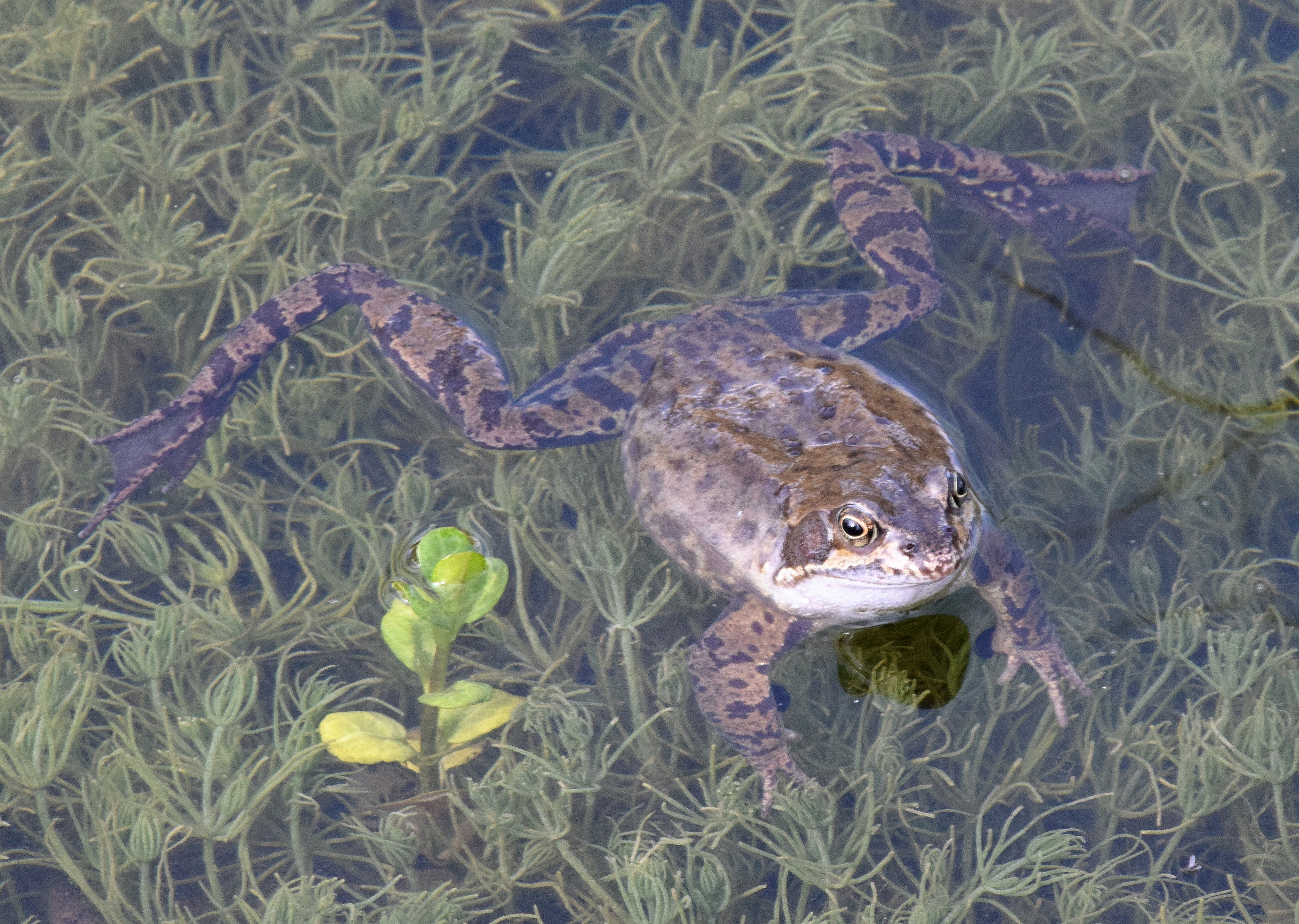
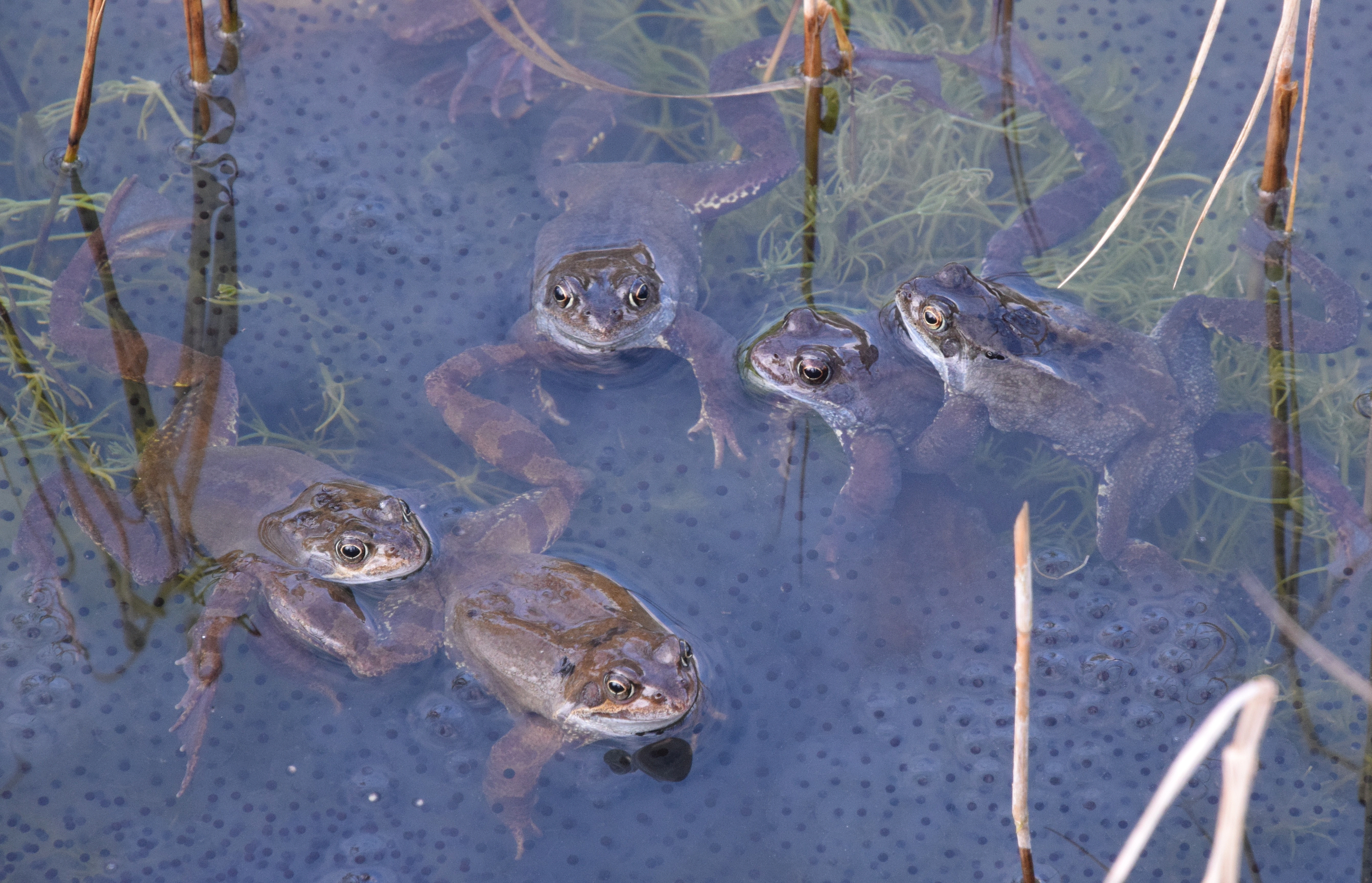
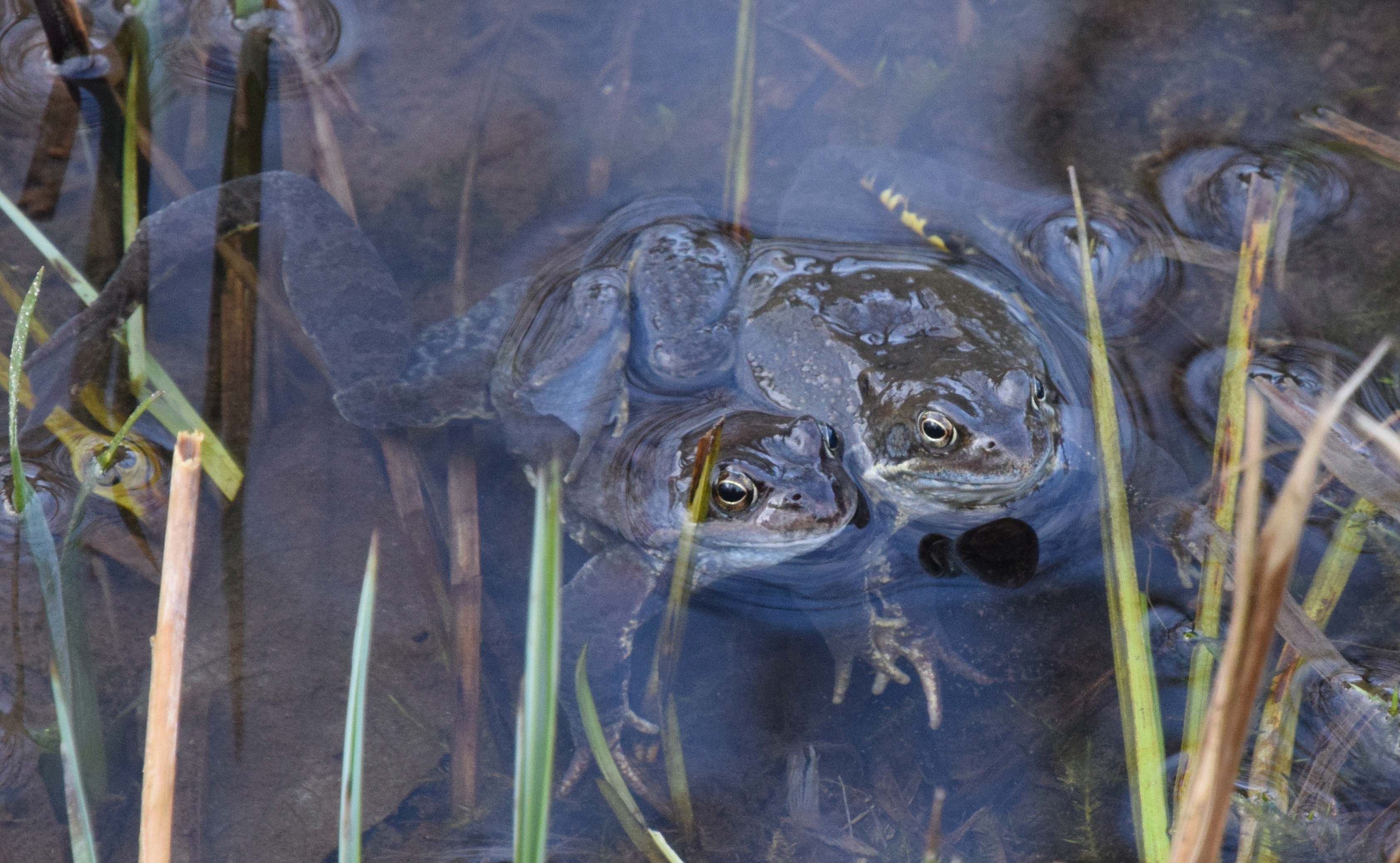
A false Froggy start to 2025 then I watch the Lye Valley, Oxford “spawn-tacular” again – 11th Mar

The end of February and first week of March offered at first a cold sunny, then exceptionally mild weather windows, and so my attention turned to re-experiencing the annual Common Frog spawning event at north-east Oxford’s Lye Valley LNR (SP547058). But the unseasonal conditions seemed to have caught the amphibians themselves unprepared.

Late February sunshine in an immaculately tended Lye Valley

The Friends of Lye Valley volunteer group that maintains this SSSI so excellently (pictured above) first reported frogs on 21st February. The site is just up the road from the supermarket where I shop most regularly, and so ensued four fair-weather visits that yielded just one frog first time around, then nothing further. I became disheartened. Where had they gone and what was happening? Then on 10th I received a call from Ewan saying the frogs had returned en masse over my prior working weekend. Game on!

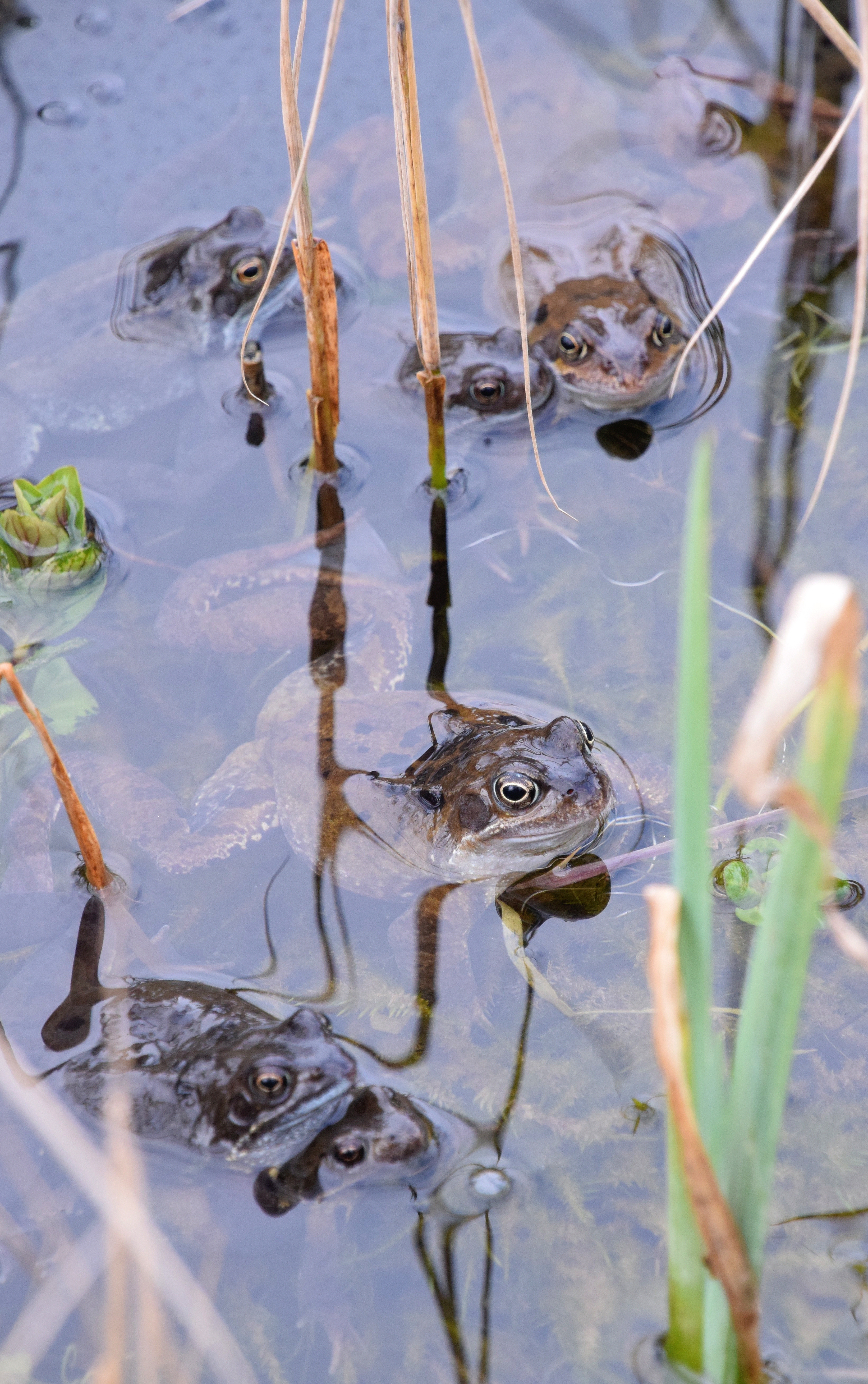
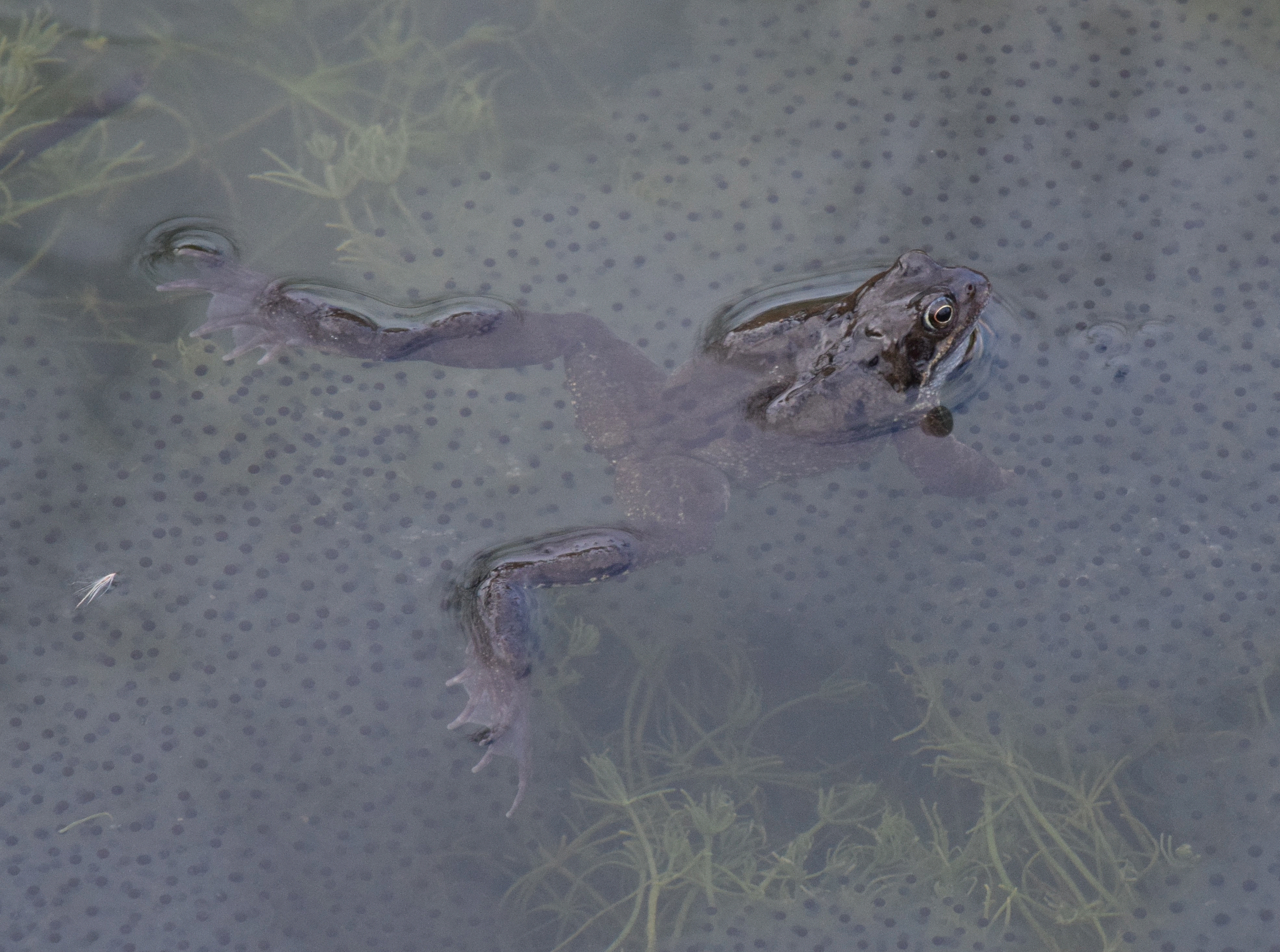
We met on site next morning. Weather conditions were now much colder again but no matter. There must have been 100 or more Common Frog in the usual ponds, all singing their intent upon propagating the species. The soft chorus of croaking that filled the air was somehow very soothing in what is always a tranquil setting. What a transformation! Last year things were all over when I visited at around this time, and I found only spawn. My previous post herein (see here), containing the complete guide, was rather earlier in the last week of February 2022.

I believe the top right picture is of a male Common Frog and the one below it a female

The above (click to enlarge) are my favourite pictures from today. All are edited, some with creative intent. There were large quantities of spawn in two of the ponds and the juxtaposition of frogs with it in some of the images was something I found quite engaging. Very soon all this will be over for another season. The frogs will disperse again to whence they came across suburban Oxford, while the spawn will remain and hatch. Visitors to Lye Valley are asked not to enter the ponds or allow their dogs to do so, and not to disturb or remove spawn.

A sunny Saturday in Texel, ft the lifetime’s opportunity Spectacled Eider – 1st Feb

“I’m here to see the duck.” Whenever I responded thus as to why I was there, local people all knew what I meant, most having suspected it anyway. It seems that everyone on Texel is aware of the great avian celebrity in their midst, and are a little in awe at the low season boost to the island’s hospitality trade it is causing. Now, on a holiday-paid weekend off from work with a fair weather forecast, I myself had joined the prior flow of more than 10,000 visitors from across the continent and beyond on what is being described as Europe’s biggest ever twitch.

On 13th January news broke of a near-adult (third winter) drake Spectacled Eider amongst a wintering flock of Common Eider off the east coast of the first Friesian island of Texel (see here). This high-Arctic species normally winters in the Bering Sea between Alaska and Russia, and is very difficult to connect with even in its restricted home range. So the freak occurrence in Holland is most likely a lifetime’s opportunity for any European birder. On the evidence of my own visit recounted herein, interest is unlikely to wane any time soon, and there seems little reason for the bird to move on before the spring. Will it ever get home, who knows?

Spectacled Eider © and courtesy of Richard Tyler

Not being one for nine-hour sea crossings, my itinerary was a brief evening BA flight from Heathrow, returning at Sunday lunch-time. After a night in a Schiphol airport hotel I collected my hire car early on Saturday morning, then it was a frosty 84km (52 mile) drive north to Den Helder where I took the 10:30 ferry. When I arrived on site (53.079906, 4.896607) a large number of cars were parked on the land side of Lancasterdijk, and upon reaching the crowd my quest was on view in the middle distance offshore.

For my first two connects I asked other birders to find the Spectacled Eider for me in my scope. But after that and with my eye in I relocated it for myself many times over the ensuing three hours, always with a degree of searching. Whenever I found it again the bird stood out from its companions, being noticeably smaller than Common Eider without that other’s elongated head and bill profile, and with it’s own distinctive head pattern. Everyone present was papping away but that did not mean they were getting good results in the morning mist and low sun. Fortunately I am once again indebted to the inestimable Richard (see here) for allowing me to illustrate this post with his own outstanding pictures from an earlier visit.

Reality check – what to expect if you go it’s the nearest bird

Common (left) and Spectacled Eider to separate at distance

To put things in perspective, the upper picture (above) is how things actually looked from shore, and that was with my own 300mm lens and a 2x converter. It would be a pity not to include my personal pictorial record of the occasion (above, right) if only to show I really was there. It cost an extra £80 to take my scope in a hold bag, padded out with warm winter clothing, and both were essential. The following image, an attempt to be creative, perhaps further conveys the difficulty of the viewing conditions, though in the afternoon the light was clearer. A constant stream of observers came and went throughout my time there.

Spectacled Eider (see here) breed on Alaskan and far eastern Russian coastal tundra, typically dabbling for food in shallow water. They move a little to the south to form large wintering rafts in gaps in the sea ice between the two continents, at which time they become quite deep underwater divers to 250 feet. The Alaskan population is estimated at between 3 & 4000 nesting pairs, while the Russian contingent is said to be much larger. It was not known exactly where they wintered until the 1990s, with the aid of satellite transmitters tracked by US Fish and Wildlife Service aircraft. With this gain, just the sixth and by far most southerly Western Palearctic record, I have now observed all four Eider species; the others being Common, King (see here) and Steller’s (here).

Spectacled Eider © and courtesy of Richard Tyler

On Saturday night I stayed at the most excellent Hotel de Lindeboom in Den Burg (see here), 10 minutes from the ferry terminal. The food there was so good I thought the people of Texel must be encouraging “duck tourists” to visit again. The island is of course a world-renowned birding location, and I myself went there a previous time on a group tour in 1988.

My March 2024 run-in with El Montezuma in Spain had rather stemmed my motivation for solo wildlife travel since. But this just seemed too good to miss. If these things are out there within accessible range I will still get up and go for them. I was amongst the first British birders on Fuerteventura for the Dwarf Bittern in December 2017 (see here), one of few to take advantage of the November 2019 Pine Grosbeak irruption in Oslo (here); and now I have done this. I believe I am also just the second Oxon birder to have gone to Texel this time. Little is more fulfilling than these near-continental adventures.

I made a £630 outlay on this experience, but if you don’t buy the ticket you don’t see the show. Over seven days a first county Green-winged Teal, first national Lesser White-fronted Geese (BOU category 5), and now this ultimate European and WestPal list addition have provided a welcome spate of new and different birding. If records like those are available … Woof!!