Allen’s Gallinule and Red-breasted Flycatcher at Costa Calma, Fuerteventura – 9 & 11th Jan

It was just a short, four-night mid-winter break for me this year with the aim of seeing whether re-visiting the locations of past wildlife adventures can still be motivating. The answer appears to be yes provided there is something new and different in the mix. The Canaries desert island of Fuerteventura is also very affordable in it’s low tourist season, as myself and other Oxon birders discovered on visiting at the time the now resident Dwarf Bittern first arrived 13 months ago. Since my week in Crete last October I have received regular mail-shots from lastminute.com and so am now aware of some good and agreeably priced packages that cater for solo travellers.

For my base this time I chose Costa Calma on the peninsula at Fvta’s far south west, as I had not reached that part of the island before and some good birds turn up there. After making the booking things became interesting when another Westpal rarity from sub-Saharan Africa, a juvenile Allen’s Gallinule turned up at Caleta de Fuste on the east coast. That bird, the island’s third remained from 13th to 24th December, then the plot took another twist. Just before my departure this week what was believed to be a second Allen’s was discovered in Costa Calma itself by birders no doubt searching for the Canaries’ ninth Red-breasted Flycatcher. This bijou tripette was by now seeming seriously meant.

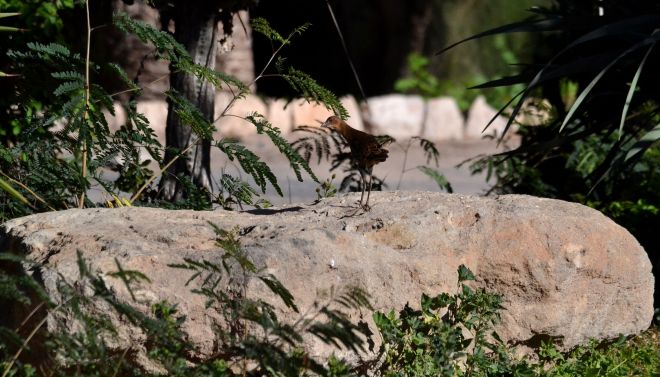
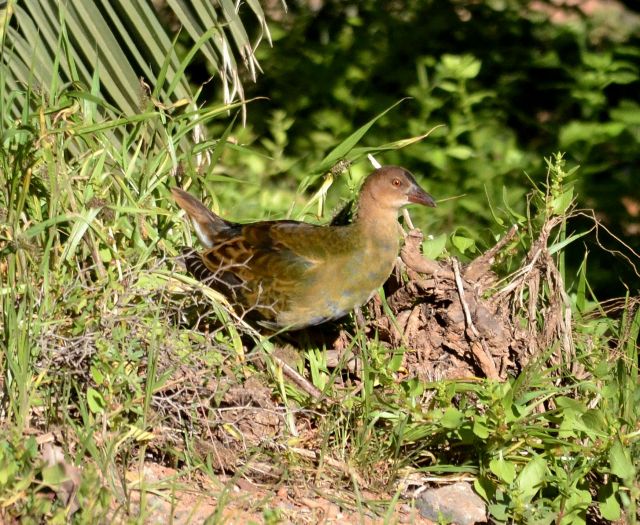
The Allen’s Gallinule (pictured above), a first winter had been frequenting a long and narrow forested strip that runs through the resort’s centre, at a spot between El Palmeral shopping centre and a communications mast opposite the Costa Calma Palace hotel. I arrived here at 11am on Wednesday (9th) armed with GPS co-ordinates provided by Dr Eduardo Garcia del Rey, president of the Sociedad Ornitologica Canaria who administers Canary Islands RBA on Facebook. And as soon as I walked in the bird flew up from one side of the path, a pattern that was to repeat itself over the next three hours.

Some other reports I had read suggested this lifer was approachable but that was not my experience. It was an easy bird to see but not to observe well. Whenever it caught sight of either myself or other people, the Allen’s would fly up into the tree cover overhead and that was what surprised me most. I have never thought of Gallinules or any other Rail or Crake as tree dwellers, but this one seemed totally at home up there (pictured below).

Stalking this bird while trying for acceptable pictures, I adopted a routine of sitting on an earth mound at the heart of it’s patch then walking a circuit at intervals. Occasionally I was joined by other birders there. Several more times the AG went up from close by always seeing me before I noticed it. From my impromptu base I also paid some attention to the small passerines that were active in the tree cover, as well as some rather more noisy and colourful characters.

The last-named were Red-vented Bulbul, (below, left) a native of the Indian sub-continent and parts of south-east Asia that has been introduced to many other countries. I knew there must be a reason for not coming across it in my pre-trip researches, and now learn this bird is regarded as one of the world’s most problematic invasive alien species. But it was still my second lifer of the morning and interesting to see here.

At one point the Red-breasted Flycatcher (above, right), also a first winter popped out and posed nicely, and I also noticed it from time to time darting about a very concentrated area in that species’ restless manner. But I did not find a Yellow-browed Warbler that had also been reported from this hot spot, seeing only Chiffchaffs and Spanish Sparrows besides the RBF. At one point I saw a Monarch butterfly, a resident species in the Canaries, but it did not settle.

At 14:00 pm I took a break, returning after an hour and in the late afternoon the Allen’s Gallinule became rather more confiding. A sequence of events next unfolded that turned my sojourn here into a very satisfying experience. First I spotted the bird right out in the open beside then atop a large mound (pictured below). And thereafter I was able to follow at a discreet distance wherever it went without it seeming concerned by my presence.

allen's gallinule.1908 costa calma

Just look at those legs … it should have been a supermodel

The Gallinule next began feeding in some longish ground cover and so I realised how I had put it up inadvertently a number of times earlier. This bird liked to keep in semi concealment in that habitat, but still seemed to allow a closer approach now than had been the case in the morning. I was all this time gaining a better understanding of its movements and habits and the end game was coming into sight.

When my quest relocated again to the spot that features at the top of this post I at last obtained pictures (below) to compare with all the others seen online. It had been a real privilege to spend five hours in this superb bird’s company and to gain such a variety of other images in the process.

allen's gallinule.1901_01 costa calma

Oh you beauty! This first winter is just beginning to acquire it’s blue adult colouring (per E G del R)

On Thursday evening (10th) I received a message from Eduardo asking if there was any further news on this rarity. I took that to mean the AG had not been reported again whilst I had been otherwise engaged with the Dwarf Bittern. So on Friday (11th) I returned to check out the same place from 15:45 to 17:20 pm, but without encountering the former again.

Instead, from my earth mound I followed the hyperactive antics of the Red-breasted Flycatcher (pictured below) through that entire interval. This tiny sprite was in exactly the same spot as two days previously, dashing about constantly, feeding in low trees and on the ground, and sitting up on a number of favoured perches. This trip’s individual was only my second record of what is a widespread central and eastern European breeder.

I wondered if I had observed the Allen’s Gallinule so well on its last day in Costa Calma, and even feared I might have spooked it, but there had been a sighting earlier on 11th and another again on Saturday (12th). Something different had indeed gone into the mix for this retro trip and my first day in Costa Calma had been a resounding success.

Note: On 18th January the Caleta de Fuste Allen’s Gallinule was re-found in it’s pre-Christmas location, confirming there were indeed two first-winter individuals on Fuerteventura through the period under discussion.

Great Northern Diver at Beale Park, Berks; and Black-throated Diver at Redditch, Worcs – 30th Dec & 2nd Jan

The opportunity to observe two wintering Divers (or Loons) within easy reach of home, both juveniles and both in public parks, has been a pleasing diversion either side of this turn of the year. I am at present finding myself going further afield to view mid-winter birds I might more usually hope to experience in Oxfordshire, but the birding scene has been unusually quiet in my home county in recent weeks. So quelling the dark season restlessness that set in after I stopped counting down to the shortest day this winter has involved more time on the road.

My previous records of both species have mostly come from Oxford’s own Farmoor Reservoir, where more recently three GND were present together in Dec 2015 but not since; and an injured BTD in full breeding plumage remained for several days in May of the same year before, sadly dying. The only exceptions were a GND in Portland Harbour (Jan 1992), and my first ever wintering BTD at a gravel pit site near Bedford (Nov 93).

The new sightings presented in this post both arrived at their respective sites on 22nd December. When I saw the GND was still just across the border with Berks last Sunday (30th), having done everything I needed to at home it filled the afternoon nicely to go and have a look. This bird was at Beale Park (SU618783), a kind of mini-zoo and visitor attraction in the Thames valley to the north-west of Reading.

I had been there previously a few times to search for Clubtail dragonflies in the adjacent riverside meadows. Unusually on-site parking appears to be free, or I have certainly yet to encounter either an attendant, ticket machine or CCTV installation; and on this occasion there was the added advantage of having the place mostly to myself. The juvenile Great Northern Diver was on view as soon as I arrived and it was certainly different to watch and enjoy one on such a small water body, a private fishing lake to one side of the car park.

I learned of the second Diver in the field whilst hoping for as iffy images of drake Smew north of Worcester on Monday (31st), by when those ducks had moved on. Then during a rather demotivated new year’s day off from birding I decided I would fill Wednesday (2nd) by making an easy trip to the end of the M40 motorway. There this bird had taken up residence at Arrow Valley Country Park (SP061673) in the town of Redditch, to the south of Birmingham.

When I arrived on-site just before midday, the juvenile Black-throated Diver was easy to pick out on the park’s main lake. It was drifting around while going through a preening routine that often involved sitting up in the water and flapping its wings. I recalled the 2015 Farmoor bird behaving in the same way. Then today’s bird began to dive again, and as with the GND two days earlier I was impressed by for how long a time it could stay under water before coming up again almost anywhere. Lastly it dozed for a while with head tucked over shoulder.

Several other birders were staking out various points around the lake’s perimeter, all hoping the bird would surface near them, just as I was. But for the most part it remained about two-thirds of the way across in water that appeared dark brown from the shadow of trees beyond the opposite bank. When it did at last pop up in the brighter-toned water near where I stood, my camera setting was then all wrong; cue a loud curse. It is at moments like that when I wish I could get my head around bird photography.

I kept 18 pictures from my two hours in the BND’s company and whilst fully appreciating how grainy and low-resolution they are, in my own way I like them well enough. Even were I a photographer I rather suspect it might become boring to always have to produce competition entries, and anyway I’m much better at insects.

So what was it like birding on the general public’s turf? I have to say things were rather more agreeable than the reverse situation of the previous post. As an often lone male of a certain age I seldom go to public parks for obvious reasons. But despite the constant procession of parents and children around Arrow Valley Lake, my motivation in standing around looking through optics was not queried at all. And I was only accosted once by someone who just had to talk at me about a Goldeneye when I was trying to get pictures of the Diver. Eventually he got the message and “left me to it”.

Enjoying prolonged encounters with the 2015 summer plumaged adult (pictured above, left) locally, and now this wintering juvenile leaves me feeling pretty well versed in things Black-throated Diver. This had been a pleasant enough and far from arduous day out.

A Snow Bunting flock at Holkham NNR, Norfolk – 28th Dec

This day was more about burning off pent-up energy on the road rather than any specific birding agenda. The period immediately following the winter solstice, when daylight hours seem barely to lengthen before the final week of January, is a tedious time for an outdoor person such as myself. So the as arduous seven hour round trip to the north Norfolk coast seemed not unattractive on this occasion, so long as it was undertaken in darkness.

In the interval since my last visit on 5th November (see here) there had been frequent reports of both Snow Bunting and Shorelark flocks in the dune area behind Holkham Bay (TF895455) that is a regular wintering ground for both species. I now arrived at the Holkham NNR car park along Lady Anne’s Drive shortly after dawn to seek them out, making my way to an area that has been cordoned off for these birds protection.

snow bunting.1810 holkham

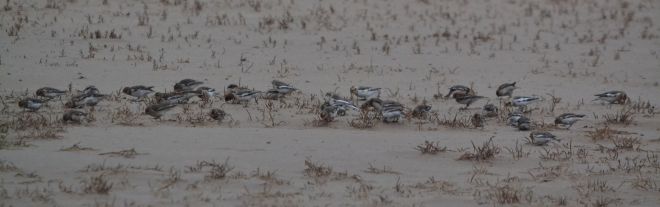
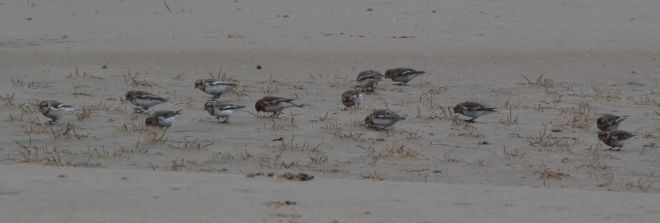
There were just several other birders and a few dog walkers present and all was pleasant and tranquil as the morning brightened. I soon noticed a ground feeding group of birds within the impromptu enclosure that indeed was the 50-plus Snow Bunting flock (pictured above), and at once became captivated by them. Their collective charm seemed to be augmented by the plumage variation amongst individuals; the warm, rusty tones of winter plumaged females contrasting attractively with the whiter colouration of males. Juveniles contributed in their more understated way to what somehow resembled an undulating patchwork quilt as the entire ensemble buzzed about feeding restlessly all the while and moving from place to place.

Snow Bunting is an annual winter visitor to Great Britain from Arctic and trans-polar breeding grounds, though a small number are resident in the Scottish Cairngorms. A fairly large and long-winged, ground dwelling Bunting, its breeding colouration evolves from a gradual wearing and abrasion of the feathers rather than a conventional spring moult. Having encountered this bird only in very small numbers previously this now was a very worthwhile experience to come across so many together and hence note the degree of plumage variation that exists.

I continued to enjoy the mini spectacle being played out before me for the next two hours while wandering about Holkham’s vegetated dune habitat and chatting to the other birders. There was also a larger flock of Twite here, another of Norfolk’s speciality winter passerines. Offshore there were Divers, Grebes and what looked like a raft of Scoter, though I am not a great one for identifying dark specks on the sea at distance. But of the reported Shorelark flock there was resolutely no sign.

The reason for that soon became clear. By 11am this SSSI began to heave with general public and their dogs. Though people kept out of the roped off area as requested the identical adjacent habitat, that it is not rocket science to realise is equally sensitive, was being roundly trampled. Even had any Shorelark been concealed in there somewhere they would hardly be sticking around now. Meaningful birding was over for the day.

That was merely a foretaste. By the time I reached the boardwalk leading back to the car park, the human and canine tide flowing in the outward direction was assuming near biblical proportions. Since I was in this place for a purpose, namely to observe wildlife, to my mind it seemed these crowds were mostly just walking about doing very little other than being out and about together. So why go to a national nature reserve that is meant to exist for the benefit of wildlife then do just what they would in a public park? I must confess to not actually getting it.

In retrospect I should perhaps not have been so taken aback. Holkham is Englands’ largest NNR and a significant contributor to the local economy, and whilst the Holkham Estate and Natural England take measures to protect habitats from visitor pressure they likewise have jobs and the regional tourism infrastructure to support. Everywhere now, though birders are a well represented group in the visitor total, conservation charities have long since decided that green clad optics carriers are a less ready resource than the general public when it comes to hands being put in pockets.

Whether we are less likely to go to forward slash gizyerdosh when we get back home, as appears to be reserve managers’ perception, I cannot say. But we travel long distances and so accrue that cost before arriving, we like to avoid paying to park if possible, we bring packed lunches, we spend our time in the field rather than in cafeterias or on-site shops, etc, etc. But might I ask quietly herein once again: “What about the wildlife, and is there not a better way than what just seems like a self defeating cycle where conservation is concerned?” These views are not intended as a rant but needless to say I headed out of there pretty sharpish.

Some other birders were still arriving as I left, and as throughout the morning all were asking one another if anyone had seen any Shorelarks. But during what must also have been two previous days of pressure and disturbance the prime reason for actual wildlife enthusiasts to visit this site must simply have gone elsewhere, just like before my previous visit. By contrast the Snow Buntings (below) seemed unconcerned by all the company and continued in their own busy and alluring way throughout.

snow bunting.1808 holkham

I had planned to spend the rest of daylight at nearby Wells Wood to try for two Coues’s Arctic Redpoll, but now thought better of even attempting to negotiate the car park there. Instead I moved part way home to a reservoir site in Leicestershire, finding nothing of note but re-attaining some peace and tranquilly while quietly watching birds until dusk.

December has been unusually uneventful nationally for notable birds. I have not been inactive in this mid-winter, having enjoyed good experiences locally of four seasonal finches – Common Crossbill, Siskin, Redpoll and Brambling – and gone a bit further afield to cover that most charismatic of winter wildfowl, Smew. But I do not assume people will wish to consult this journal if I am not presenting something of national or European interest. And though not a photographer I prefer to include pictures of some kind. Gaining my best ever experience of Snow Bunting, with pictures today seemed worth including here albeit with a certain degree of frustration over not observing more.

White-tailed Eagle in the New Forest, Hants – 16th Dec

The opportunity to experience my second British White-tailed Eagle at the far end of the A34 / M3 / M27 run from Oxford provided welcome respite from birding doldrums that have set in since my last entry in this journal. That 5½ week interval has been very quiet both nationally and so far in December locally too. Hence reading of this raptor on RBA upon rising this morning made it a fairly easy decision to get straight out of the door.

The site in question was quoted as Milkham Inclosure (SZ210100) lying to the north of the A31 trunk road between Cadnam and Ringwood in the New Forest National Park. But RBA had yet to give more directions. OS Explorer map OL22 shows a number of parking areas along a road skirting the forestry plantation’s northern side that I checked on arrival for assemblages of birders. But finding no signs of activity I returned to the first car park where two locals fed me information from a Hampshire source that I suspect was Going Birding.

The WTE, a juvenile had first been reported on RBA two days previously, but I now learned some reports were saying it had been in the area for up to 10 days. Also the bird was being encouraged to stick around by carcasses being put out in the area between the A31 and the plantation. The best viewpoint was cited as a lay-by on the A31. Though some birders were visible on foot between there and where I was, with the skies looking threatening I opted to follow that advice and drove on.

The right place had to be on the north-east bound carriageway, judging by the numbers of cars parked there. This meant turning back at the Picket Post Services junction, after which it was the second lay-by heading the other way. Once there I beheld a twitch line a short distance to one side of the road. Another birder then pointed out the White-tailed Eagle flying over the tree-line to the north, before going down into Roe Inclosure, just west of the first cited plantation. So priority one: “see the bird” was achieved immediately.

This was indeed an excellent spot from which to view the plantations to the north. After getting all my kit together I went over to join the other birders, though some were already walking away being satisfied with their views just gained. I soon wondered if they should have stayed a little longer since the Eagle re-emerged then perched in the top of a tall Pine tree. Priority two: “see the bird well” was quickly followed by priority three: “get any kind of picture”. But at that range in overcast conditions the distant records (above) were all I was going to gain. It was now about 11:35am.

When the WTE next flew further back and out of sight, more birders also moved on. But the location of the carcass in Buckherd Bottom having been pointed out I decided to stay and see if the bird might come closer to feed. I remained on-site for some time during which the twitch line built up again as RBA was now directing people to the lay-by. After a while our quest was relocated, perched very distantly in two more locations. Most of the later arriving birders had to make do with those views. At around 1:10pm, having noticed a squall approaching from the west I headed back to my car, reaching safety just before the weather turned foul. Priority four: “get a better picture” would have to wait for another day.

The New Forest has some past form where Eagles are concerned, with both White-tailed and Short-toed being recorded in this decade. English WTE records remain uncommon away from the east coast, and especially this far south. Though today’s bird appears to be ringed it is not yet known where it hails from, but across the North Sea the species now breeds as far south as Holland. My only previous record of White-tailed Eagle in Great Britain was in Suffolk in January 1989, much closer to when they began to be re-introduced into parts of Scotland. I have also observed this impressive raptor in Estonia but have yet to bird in Scotland where WTE is now a popular tourist attraction. Not a bad Sunday out then, all things considered.

King Eider at Sheringham, Norfolk – 5th Nov

This was an opportunity I thought over for a while but that ultimately needed to be taken. Not too many King Eider stray far south of Aberdeenshire where several, mostly drakes regularly winter, but for the previous seven days an immature male had settled offshore from the Norfolk seaside town of Sheringham. Twice in the last two years I had travelled to the Dyfi estuary in west Wales to try for a female that is reported there sporadically, without success.

Both places are a little beyond my usual range, but King Eider is a difficult bird to catch up with other than in Aberdeenshire; hence my willingness to push out the boundaries. Northern Norway, where it is possible to hire a floating hide expensively to get out amongst them, is of course even further. The Norfolk bird, that is described as a second winter drake, would not be as good as seeing the rather magnificent adults further afield, but also more distinctive than the drab Ceredigeon duck.

king eider

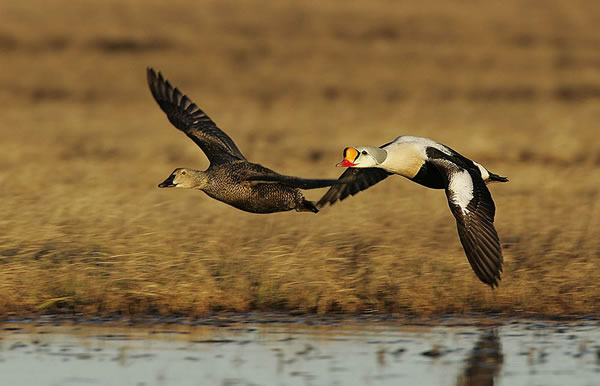
King Eider (male and female) © rights of owner reserved

King Eider (pictured above) is a common breeder in Arctic regions of Europe, north America and Asia, and mostly remains at high latitudes throughout the year. Adult males are as unmistakable as they are handsome, though females are not too dissimilar to the slightly larger Common Eider. This species is very rare in England, but I understand they are prone to over-wintering where they do occur south of the Arctic, so maybe this one might mature on-site.

Upon rising on Monday morning (5th) I decided to put things to the B&B test. If I could find reasonably priced overnight accommodation I would go to Sheringham. So when a last minute single room for £38 in nearby Cromer beckoned my mind was made up. The travelling distance was not actually as far as anticipated and I arrived on Sheringham’s seafront at 1:30pm.

sheringham.1805 promenade

Sheringham’s western promenade from where the King Eider was being viewed

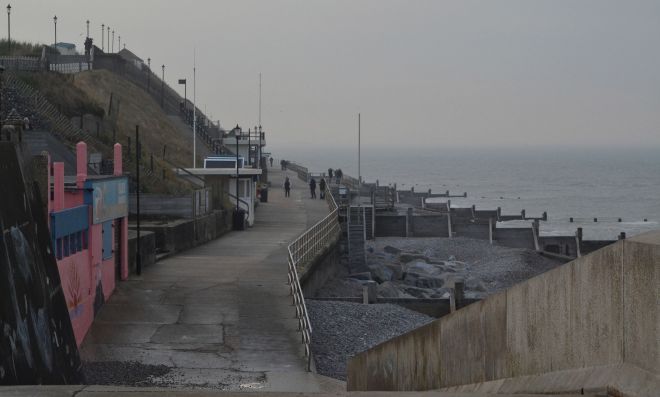
Most sightings on RBA had been from the lifeboat station that I now ascertained was at the far end of the rather nondescript promenade (pictured above) just to the west of the town. When I got there several other birders were already watching the King Eider out on the sea, and once I too located this much sought lifer things were as easy as that. There would now be a certain amount of time to fill so I stayed and watched my quest for some time.

In around 90 minutes on-site the KE didn’t come closer inshore, remaining at roughly the same distance bobbing in and out of view on the waves and diving in overcast light. There were hence the proverbial two chances of getting a picture, slim and none. These images (below) rather push “showing how the bird was seen” out to the limit, but were all I was likely to get. For the RBA gallery of this bird see here but this (here) on Bird Guides is better.

At just after 3pm I decided to explore the locality, and allowing for the season found “Norfolk’s premier seaside town” as Sheringham proclaims itself to be a dullish and faded sort of place from a former age, with an overall impression of rather too much ugly, weather-stained concrete. Necessary as those sea defences are, the place was hardly picturesque. Then, my parking time having run out, I moved on the few miles to Cromer and my B&B.

This slideshow requires JavaScript.

With this experience, I have now observed all three of Europe’s regularly occurring Eiders, the others being Steller’s Eider in Estonia (April 2017) and Common Eider a number of times in England. It would perhaps have seemed churlish to head straight home on Tuesday (6th) with the north Norfolk coast at my disposal, and so overnight I checked out what else was about. Amongst the various records on RBA, several Shorelark at Holkham Gap and Twite at Thornham Harbour stood out. And since these are both prime birding locations I reasoned those classic Norfolk wintering species might not be too difficult to find.

Hence, having raided a petrol station store of its end of day mark downs, I forewent a full English breakfast and set off fairly early west along the A149 coastal road. Arriving at 8:30am in the Holkham NNR car park at the end of Lady Anne’s Drive I fed the rapacious pay and display machine then walked east into the coastal habitat between Wells Wood and the sea. Here (TF895455) there is what is described as a regular wintering site for Shorelark and Snow Bunting.

holkham NNR.1801 shorelark habitat

Coastal Shorelark habitat at Holkham NNR

The previous day this had been cordoned off to discourage photographers and other people with cameras, presumably from chasing the birds around. The area in question is now an enclosure complete with notices appealing to visitors to give the birds space and keep a respectful distance. Everywhere now in birding there is that field underclass of people with little actual knowledge of wildlife, and far more technology than field craft, though all encouraged by conservation charities in their insatiable desire for new members. I say that because seasoned wildlife enthusiasts, whom the same organisations now prefer to disregard, do not generally do what was being described in the notices.

Unfortunately the disturbance created by the measures taken for these birds protection appeared to have caused them to relocate, at least temporarily and of either Shorelark or Snow Bunting there was no sign. As at Sheringham I felt constrained here by the amount of parking time I had purchased and so stayed for around 90 minutes again. I would have preferred the option to obtain a day permit, since I was after all visiting a national nature reserve. Back at the car park the seasonal Geese (pictured below) in the fields alongside made this visit worthwhile, especially the Pink-footed Geese that I always enjoy experiencing on any winter visit to north Norfolk.

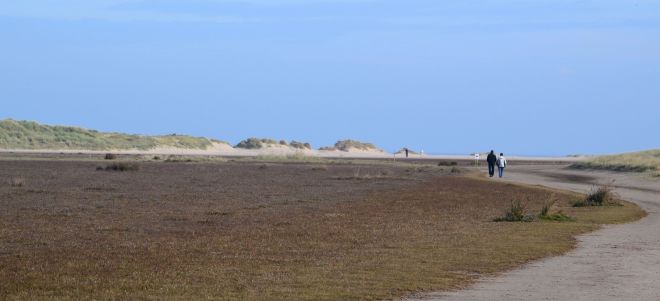
Then, filing the place with the enclosure away in my mind for future reference, I moved on to Thornham and another NNR, Holme Dunes (pictured below). There I came across a large flock of Twite feeding on the salt marsh at what is also a regular site for that winter Finch. Having filled the morning in this way I now felt better value for making the overnight stay.

thornham.1801

Part of Holme Dunes NNR looking towards Thornham

As weather conditions became more threatening I headed for home early to avoid rush hour traffic around Peterborough and Northampton. I left feeling it’s a pity Norfolk is up to four hours from home, since it always looks like there is lots to do there but on day visits such as this one I somehow never get enough time to do things justice.

Autumn butterflies and other wildlife in western Crete. Plain Tiger, Cretan Grayling, Cretan Wall Lizard, Red-throated Pipit and much more: 22nd – 27th Oct

I wasn’t expecting too much from a week long change of season break in Crete. The plan was more to experience another large Mediterranean island I had wanted to visit for some time, rather than to pursue an intensive wildlife agenda. Where butterflies were concerned there are two endemics, Cretan Argus and Cretan Grayling, the second of which ought still to be flying. Better pictures for my collection of Lang’s Short-tailed Blue and Cardinal would be very welcome. And then there are Plain Tiger.

The last-named is perhaps one of the world’s most widely distributed butterflies. Various sub-species occur throughout Africa and much of tropical Asia, as well as the southern Pacific region and Australia. In Europe it is found in the Canary Islands and sporadically around some coastal Mediterranean regions, including Crete from May to October. I had come across the species just once before in Morocco (Nov 2015) but did not get a picture.
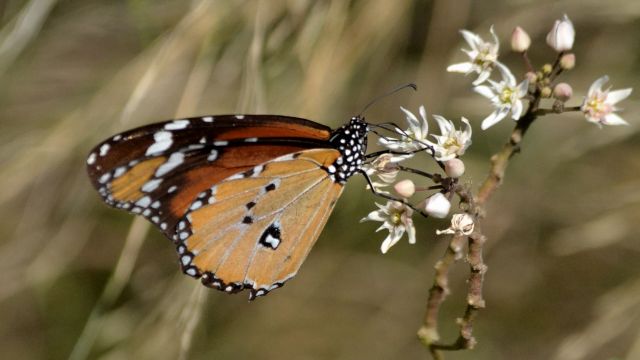
plain tiger.1811_01 georgioúpoli

Plain Tiger at Georgioúpoli … what a blurry beauty!

It took until the close of my trip’s final day to make this self-find. Visiting the seaside town of Georgioúpoli on the north coast I found it to be a nicely laid back and picturesque place, at least at this time of year, with an ambience of pavement tavernas and boaty promenades. I had read that the Almiros estuary along the western edge of the town was a good wildlife area, and so after buying presents in the main square headed out there.

This slideshow requires JavaScript.

As I strolled along taking landscape pictures (above) a first Plain Tiger flew over my head and kept going. Then I found a small colony and the serious beauty of this striking, continuously brooded insect did not disappoint. It is a member of the Danaidae order of large tropical butterflies which also includes another wide ranging migrant, Milkweed or Monarch and the colouring is similar. Those are the only two members of that family that occur in Europe.

In my on-site excitement I failed to notice how worn some of the butterflies were. The image below was earmarked for inclusion in my premium gallery (see here) until after viewing it on my desktop computer back at home I noticed the condition of the lower individual. But that does not stop Plain Tiger being my top insect sighting of the trip.
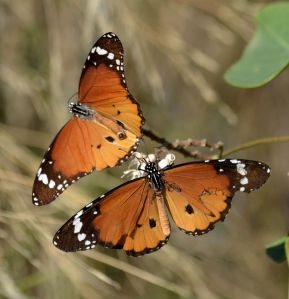
plain tiger.1813 georgioúpoli

The west is the not so commercialised and more natural end of Crete, with far less intensive development for mass market tourism. It is also where the wildlife tour operators go in both spring and autumn, but at this time of year their itineraries are botanical in bias. Crete is renowned for a mass flowering of bulbous plants after the first autumn rains, and is also a top grade hiking destination, both of which attract visitors more interested in the natural world than a beach holiday.

For my base I chose the excellent Galini Sea View hotel in Stalos, along the coastal tourist strip to the west of the regional capital Chania. What I most seek from a room is a good view, but I didn’t anticipate getting the one on the web page (below, left). I chose this hotel because it is on a hill and from Google Earth I could see there was undeveloped land nearby in which to search for butterflies and other insects. Oh, and it also offered an affordable all inclusive package.

Hence on day one (22nd) I set out on foot simply to explore the surrounding area (above, right), as I like to do at the start of a trip. With my particular motivation any piece of waste ground wherever I might be is potentially productive and interesting, and my choice of location this time proved to be a wise one. As that sunny morning warmed up I recorded 15 mostly multi-brooded and hence common Mediterranean species, but these included two that were either new to me or previously un-pictured.

This whole locality on the hillsides above Stalos was teeming with butterflies. Painted Lady and Clouded Yellow (pictured above) were everywhere, and I cannot recall having ever found so many Swallowtail in one place. The last-named offered some pleasingly creative picture opportunities (below). Lantana, the red flower is sold as a hanging basket plant at home. When I come across it abroad I always recall a South African in an English garden centre saying it is an invasive weed where he comes from. There is certainly plenty of it in this part of Crete, and always worth checking for butterflies. Click on any image to enlarge.

I was especially pleased to find a Southern Comma here. I had observed this butterfly for the first time in Delphi, southern Greece last June (see here), but only secured underwing pictures. The female in these new images (below) is certainly very different from the Commas we are familiar with in Great Britain. This species occurs across the northern Mediterranean region, from the south of France, through Italy, the Balkans, mainland Greece and into Turkey.

Geranium Bronze (below) is an introduced species I had read of many times but not come across in the field until now. This attractive little South African number is attributed with having arrived in the Mediterranean as eggs or larvae via the horticultural trade in Pelargonium plants. First reported in 1990 in Mallorca, it has since expanded its range quite vigorously and is regarded as a pest species, at least by people who cultivate ornamental Pelargoniums.

I only located one of the above, but Mediterranean Skipper (below) were quite abundant. This drab brown Skipper is fairly localised, ranging sporadically across Mediterranean coastal regions from May through to late autumn. I had noticed them before in Cyprus (Nov 2011) but not obtained any pictures worth keeping. That situation was put right on this trip.

I particularly wished to get better pictures of Lang’s Short-tailed Blue here in Crete. That diminutive and hyperactive little butterfly is very difficult to capture well, being constantly on the move and disinclined to perch openly. But here I achieved that aim when the sun went in temporarily and the individual in the image (below, left) kept stock still for quite some time. In these crops this common and widespread southern European blue may look larger than life size, actually being not much bigger than a Small Blue.

Other common species on the wing here were Wall Brown, Speckled Wood, Common Blue, Brown Argus, Small Copper, Large and Small White, and frequent Red Admiral. In the absence of an agenda to track down new must-finds, I found myself taking time, untypically to pay attention to some of these and perhaps picture them against new and different plants.

Initially I hoped the paler toned Argus (above, right) might be a Cretan. But on reading things up that endemic is confined to certain mountain locations and flies in high summer. So I think this particular butterfly is most likely a rather faded female Brown Argus.

Perhaps a case in point where stopping to bother with very commonplace butterflies is concerned were the myriad Small White here. Normally they are difficult to do justice to in bright sunshine. But on this occasion a pleasing light meant I added some good images to my collection. So here (below) is a mini-celebration of the humble Small White, proof perhaps that there is no such thing as a mundane butterfly.

By early afternoon conditions had become overcast. So I walked the seafront, quickly realising that most of the area had closed down for the winter already. In the evening I found out my hotel was following suit at the end of my stay. It was a slightly surreal experience being in such a large establishment with so few guests, but also reminiscent of the memorable three weeks spent in Tavira, southern Portugal in January 2014. The weather stayed unsuited to insects through to Friday (25th) which dawned clear and bright. Then, having hired a car in the interim I headed to Levka Ori, the White Mountains of Crete.
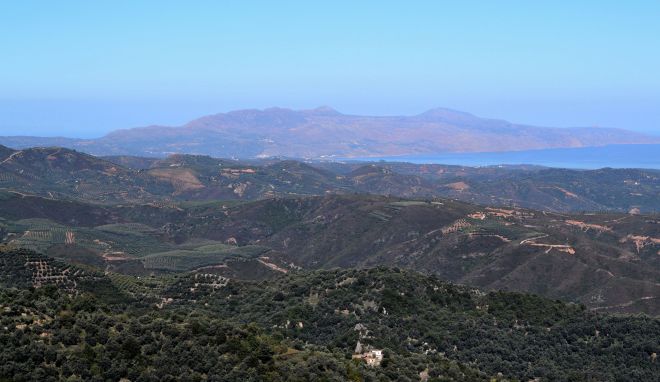
levka ori.1804 view north to coast

Northward vista on the mountain road above Fournés

As I wound onward and upward in my vehicle the same yellow-flowered shrub that dominated the hillsides above Stalos now lined the roadside verges. Once again I found time to devote to commonplace, late-brooded species if only because nothing else was available. Wall Brown is another butterfly not normally given to keeping still for the camera, but here in the cool light of morning they were far more docile than usual. Sure enough as the day warmed up, and after these images (below) were captured they became more flighty and difficult again.

Above the cultivation altitude the landscape changed dramatically, becoming now stony and scrubby. I stopped at such a roadside spot that looked good for Cretan Grayling and a short search duly produced one. The differences from regular Grayling (Hipparchia semele) are only slight (the proportions of the male genitalia aside!), but this endemic (Hipparchia cretica) is the sole Grayling to occur in Crete so I could be confident of the ID. The pictured individual (below) was the only one of the prime trip target I encountered all week.

The as ever cryptically patterned, endemic Cretan Grayling (above and below)
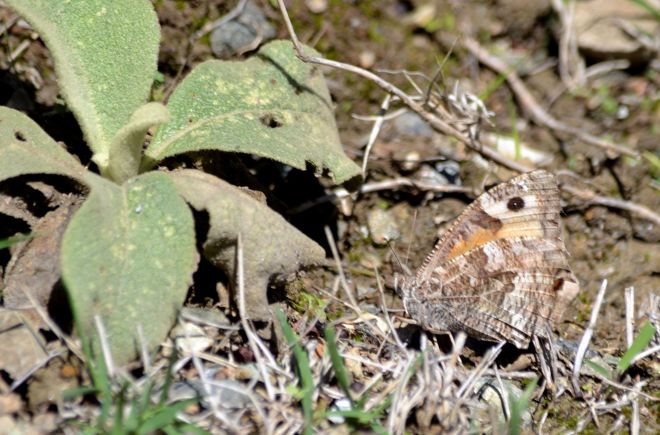
cretan grayling.1804 levka oriIn this rocky habitat I also began to encounter lizards, without which no Mediterranean trip report would be complete. The endemic Cretan Wall Lizard was separated as a species in 2008. This is a medium-sized lacertid reaching 20cm in length, though like all of that extensive genus there can be much variation in size and colouration. It is the only lizard to occur in Crete, being distributed throughout the west at altitudes up to 2000m.

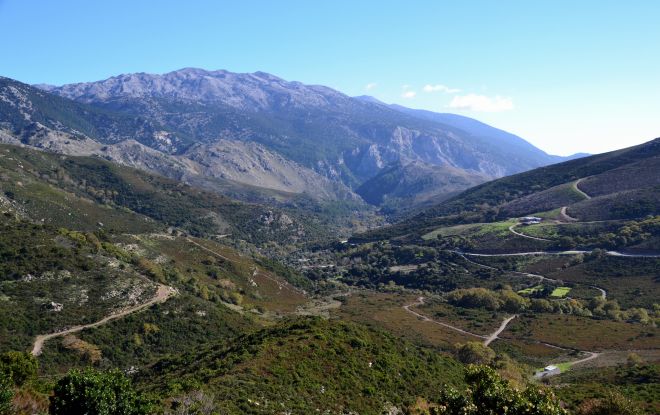
Following these sightings I continued up to the Omalos plateau that is said to be one of the more likely places in Crete where Lammergeier might be observed. I wasn’t lucky and there were very few butterflies up there either, the land being heavily grazed. In the afternoon I drove on to the idyllic village of Soúgia on the south coast, stopping where I thought there could be good butterfly habitat, but things were much more disappointing in that respect than the spectacular scenery (below). It is approximately 50 miles distance from the north to south coasts of western Crete.
levka ori.1810 descent to soúgia

Southward vista on the descent from Omalos to Soúgia

On the morning of my final day in Crete (27th) I paid a second visit to Lake Ayia, an ageing and partially overgrown man-made reservoir some 5km north of my base. Earlier in the week I had noted good dragonfly habitat here, and with sunshine now prevailing I came to see what might be about. There were a lot of Migrant Hawker, with a few Lesser Emperor mixed in that as ever did not settle, and some Red-veined Darter.

The only dragons to co-operate for the camera were some Violet Dropwing (above) that posed close to the barrage wall and hence not so directly into sunlight as the larger species. I had thereby observed this attractive, northward expanding African species in Portugal, Morocco, Sardinia and now Crete. A Common Bluetail at Lake Ayia (above, top right) was the only damselfly of the week.

Along the barrage-top path I came across a flowering shrub that was attracting Lang’s Short-tailed Blue and larger Long-tailed Blue (pictured below) butterflies, both of which are common and widespread in southern Europe. The same plant was being pollinated by several Carpenter Bee. I seem to find these big, buzzing, blue-toned beauties wherever I go in the Mediterranean and will admit to having a bit of a soft spot for them. They get their name from a habit of boring into wooden structures and hence might not be so well thought of locally.

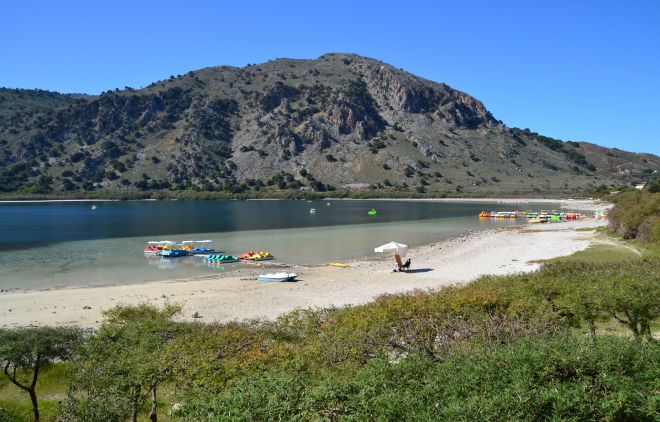
In the afternoon I moved on to Lake Kournas (below) some 30 miles to the east and just north of Georgioúpoli where this narrative began. Kournas is the only natural fresh water lake in the whole of Crete and also a popular playground with local people and holiday makers alike. So I drove past all the tavernas and paddle boat concessions to park at what looked like the quieter end of the site. This place must heave in high season.
DSC_0248

Lake Kournas

First I walked a track behind the lakeside tree-line, where more common butterflies (pictured above) were active and a female Red-veined Darter sat up nicely. Then I spent some time along the stony edge to the beach in the top landscape, away from all the boats where good and roughly equal numbers of Red-veined Darter and Violet Dropwing were busying themselves. Here I got into my element, just taking pictures with no special agenda. The over-mature male in the sequence below, a different colour form was actually seen on the hillside above Stalos earlier in the week.

Lastly, there must be a trillion trillions of Grasshoppers in Crete. Wherever I trod in the wild these attractive and fascinating insects would fly in all directions from my footfall, often displaying a flash of one or another bright colour as they went. I am possibly becoming a little more adept at noticing where they land now than the predators that strategy is designed to confuse, and as is my wont on a Mediterranean trip found time to take a selection of pictures.

Once again I couldn’t help but notice how the different individuals in the sequence above invariably seem to match the backdrop. And so I wondered once more if these creatures are changelings that can actually alter their tones to blend in with the habitat wherever they might be. I remain open to advice from any reader who might be able to offer it.

The butterfly list for this trip (with lifers in Bold) was: Swallowtail, Large White, Small White, Clouded Yellow, Cleopatra, Small Copper, Long-tailed Blue, Geranium Bronze, Lang’s Short-tailed Blue, Brown Argus, Common Blue, Plain Tiger, Red Admiral, Painted Lady, Southern Comma, Cretan Grayling, Meadow Brown, Speckled Wood (P a Aegeria), Wall Brown, Mediterranean Skipper – 20


Red-throated Pipit and Bearded Reedling near Chania – 25th Oct

Birds were not a high priority on this trip since there was little likelihood of seeing anything new unless I was fortunate enough to encounter a Lammergeier in the mountains. By all accounts that mythical raptor is just as scarce in Crete as in Corsica and Sardinia and it eluded me again as in those other islands. So my wait to experience one must go on.

The one full day I devoted to birding was Thursday (25th), starting at Lake Ayia that my pre-trip researches indicated is Crete’s best location. If that is so then I can only say it reflects why Crete is not a prime destination for dedicated birders. There were some highlights however that morning, as first a pair of Booted Eagle came in and out; then my third Lesser Spotted Eagle drifted over or so I was informed afterwards by another birder. That knowledgeable German gentleman who had been visiting Crete for 30 years confirmed that Lake Ayia in his view is somewhat past it’s prime.

He also told me of a site on the western edge of Chania (pictured above) where there were currently small flocks of Red-throated Pipit and Bearded Reedling, the latter being a very scarce bird in Crete. So that was where I went on to in the afternoon. One rather refreshing aspect of visiting Crete was the ease of parking for free and so it was again here. I crossed a bridge onto some undeveloped land across a small river and fairly quickly came upon several Pipits feeding busily on the ground.

I had self-found Red-throated Pipit once before in Cyprus (Nov 2011), an unmistakeable adult complete with red throat, and so needed to re-assure myself I had indeed located the birds I had been directed to on this second occasion. But having checked the grainy digiscoped images (below) against RBA’s gallery of winter plumaged birds seen in Great Britain, I am confident of the ID though still open to correction.

RTP is a tundra breeder that winters in Africa and locally in the Middle East. The Helm guide to confusion species describes this bird as colder and less buff than Meadow Pipit and much more heavily streaked. The lateral throat-stripe ends in a thick blotch on the neck-sides, joining heavy broad breast striping. The upperparts are strongly striped and the wings also strongly marked. I do hope I have got this ID right.

After a while on-site, and since there were no other birders present, I started moving around and getting closer to the Pipits to try for better pictures in the poor light, but without success. There were also Crested and Short-toed Lark here, and White and Yellow Wagtail. Then the Bearded Reedling flock flew over my head, pinging as they went, to land in vegetation by the river exactly where the German birder had advised me to look. My images are no better than those of the Pipits but still show what I saw.

This dual sighting was the birding highlight of the week. In the White Mountains the following day I twice saw Griffon Vulture overhead, but in general I majored on insects for this trip since my various southern European posts in this journal receive a good level of consultation from web searchers, and I am not really a proper birder after all. So I have now added another large Mediterranean island to my life’s experience. But six days was enough merely to scratch the surface in this so wild and scenic principality of Greece, and hence I may return.
Living the Dream: Rustic Bunting at Wanstead Flats, East London – 18th Oct

This was very welcome. While mulling over how to fill my day this morning, another ideal short distance twitch announced itself from the listings on RBA. A much sought autumn migrant, Rustic Bunting had been found in East London late on the previous day and was being watched again as I thought things over.

Autumn is said to have come alive this week with a number of outstanding vagrants turning up around the British Isles. The top draws were a first ever White-rumped Swift in East Yorkshire, only a second Gray Catbird in Cornwall, and a seventh Two-barred Greenish Warbler in Norfolk. But I have had very meaningful past experiences of the first two abroad and felt no inclination to perform feats of endurance just to see either in this country. The third is always difficult and was once again proving elusive in the unforgiving dip-trap that is Holkham Pines, at the end of a tedious drive to the north Norfolk coast.

Today’s Rustic Bunting was a different matter entirely, being a Siberian breeding drift migrant I had been tracking for some time, waiting for a suitable opportunity. If seen it would be my second new Bunting in Britain this autumn, and most importantly it was well within preferred range at just over 80 miles. Wanstead is in the suburbs of East London where I grew up, so would evoke its share of early life associations. And the fast motorway drive via the M40, M25 and M11 would be an opportunity to give a proper work out to September’s new Slash and Myles album on my in-car CD player – remember those? Just before 10am a further sighting was posted, and off I set.

rustic bunting

2016 Rustic Bunting at Kilnsea, East Yorks © and courtesy of Andrew Last

Rustic Bunting is an annual vagrant that has declined in this century from around 20 British records a year in the 1990s to far fewer now. This was one of several scarce drift migrants that clustered in Yorkshire in the outstanding autumn of 2016, and was seen (pictured above) by a number of Oxon birders. Since then I have been waiting for nearer occurrences of more annual autumn species to go after. Amongst them, available Olive-backed Pipit and Greenish Warbler have remained too difficult for my liking. But now patience has been rewarded again for he who waited with the appearance of this RB in such an unexpected urban location. Wanstead of course has a very well-known patch watcher and blogger (see here) who is not entirely unconnected with some of the better records that come from there.

I arrived on-site just after midday, feeling suitably uplifted by all those aforementioned new riffs and solos en route. Remembering the way from the end of the M11, I found much of Wanstead to be relatively unchanged and still a genteel, leafy suburb of mainly large mature houses. But I cannot recall the last time I visited the Flats. Using a car park by Centre Road I could see a lot of birders nearby, but they all seemed to be moving around and looking in different directions suggesting the bird was not currently on view.

I appreciated at once why birds should be attracted to Wanstead Flats (TQ409865) being a large open area of original habitat amongst the urban sprawl of East London. Moving around and listening to various conversations, the people I met sounded very knowledgeable, having between them been at many of this autumn’s major national twitches. A few had just got back from Corvo in the Azores and I learned one of those was none other than Bird Guides editor Dominic Mitchell, to whom I subsequently kept quite close thinking this might increase my chances of seeing the bird. I heard all about our quest’s movements through the morning and how it had fed on the ground for 40 minutes on Sunflower seed spread by the gathered birders before becoming more mobile. That food supply was now being consumed rapidly by a flock of Corvids and other birds.

It was hence a matter of watching and waiting for a shout to go up. I was joined first by fellow Oxon birder Steve Jennings then, inevitably Adam for whom also this bird would be a lifer. After about an hour the Rustic Bunting was called anew, and all the scattered birders hurried to a particular spot. I first glimpsed my lifer flying on from there to the baited location where it proceeded to perch prominently giving everyone present excellent views. The habitat here is recovering from a recent scrub fire, and so the bird stood out nicely as it moved between various still charred perches.

rustic bunting.02

Rustic Bunting © rights of owner reserved

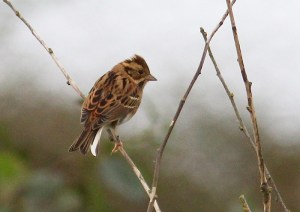
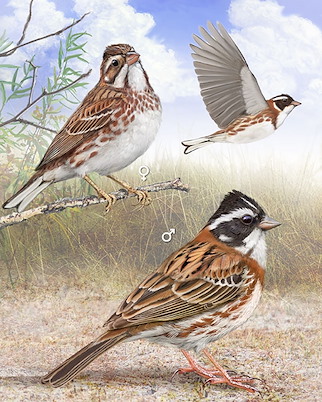
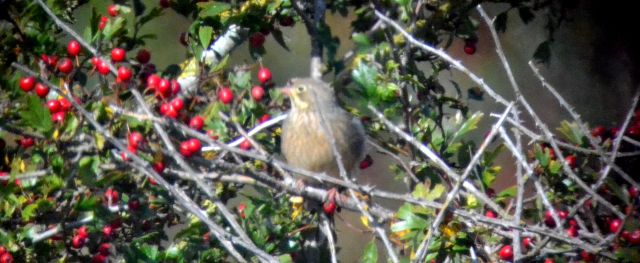
This bird certainly looked quite different from other brown Buntings – Reed, Little and Lapland – I had seen before, but I had not read up on the plumage (above) before departure. Having done so now I will not go into too great detail. But as I watched the rather peaked head pattern, with a broad, creamy buff supercilium and dark ear coverts stood out well. There is a generally more contrasting pattern overall than the common and widespread Reed Bunting, with darker upperparts and a whiter ground colour to the underparts. Since I did not get pictures I will not claim to have noticed more than that. For the RBA gallery of today’s bird (1w) see here.

When the RB flew again most of the gathering were pleased with having enjoyed such good views and began to disperse. I too moved on first to visit my grandparents’ grave (above left) in a nearby burial ground, then Wanstead Public Library where I had worked as a school leaver. After buying a sandwich and sitting to eat it in Wanstead High Street I once again felt that not too much has changed in all these years, if the giant trenches and tunnels of the modern road infrastructure are ignored.

This had been a most excellent excursion. I gained a much desired bird lifer, the day was filled pretty much to perfection, and the new disc was up to standard; the last of those being perhaps the most certain outcome of all. To make sure I played “Living the Dream” again on the way back to Oxford and home, then the best bits over and over.

Lastly, here (above) are some of the gorgeous Gray Catbirds across the car park from that dingy motel room in Homestead, Florida last January. To have jostled and competed with a field full of grumpy birders all desperate for a glimpse of just one of these at Lands End would simply have detracted from and demeaned this recollection. My only White-rumped Swift zipped past and onward in southern Portugal in May 2014, but hey I self-found it and that was a better view than most of British twitching’s finest got in Blighty earlier this week. Maybe waiting patiently to live the dream, on my own terms or especially within range, can be motivating after all.

Pectoral Sandpiper at NT The Vyne Water Meadows, Hants – 7th Oct

2018 has produced a plentiful autumn passage for Pectoral Sandpiper with more than 30 records in some weeks throughout the British Isles. This is perhaps the most frequently recorded Nearctic wader at this time of year, but has not featured before in this journal. One bird that caught my eye, due to its closeness to home, has been present at a National Trust estate, The Vyne just north-east of Basingstoke since 23rd September.

When first reported I feared this would be a difficult location to access since it looked like private land adjacent to the NT house and park. But subsequent posts on RBA mentioned a bird hide, which sounded promising. When the “Pec Sand” was still there a very wet day ago I resolved to go and explore the site this fine and sunny morning. So at 9am I parked by an entrance to the estate (SU 62476 57256) in Morgaston Wood near a village Sherborne St John.

The directions on RBA had been typically vague, merely saying walk through the woods. So I followed the only public right of way that was marked on the historical anachronism I prefer to take on any twitch (often to the mild amusement of other birders), an OS map print-out from Streetmap.co.uk. This route skirted the edge of the woodland but at a point from which it continued over open country there was no way across to the water meadows.

I then enquired of a jogger who said the entire wood is part of the NT estate and hence open access land through which a number of visitor trails run. My mind was thus set at rest over any potential trespass on my part and I followed one such path eastward through the wood. It led to a downward board walk at the foot of which was the bird hide. And before that rather well appointed facility stretched the said Vyne Water Meadows (pictured below).

vyne water meadows_01.1801

The Vyne Water Meadows: there’s a Pec Sand out there somewhere

For the next hour, looking into the light, I scanned the patchwork of glistening mud and sunlit water. I was the only person in the hide, hence finding this bird for myself held much appeal. There were a small flock of Lapwing, scattered Moorhen here and there, a few Gulls and two Grey Heron; but my quest was nowhere visible. Then at 10:25 suddenly, fairly close inshore to the left of the central small Willow in the picture was a small and bright looking buff and white wader: the Pectoral Sandpiper.

This was my third career record and I will admit the other two were more a name that I needed rather than a bird I knew much about. But this time I had read up thoroughly on the species a day earlier, and knew exactly what to look for and how to identify this Nearctic vagrant. Pec Sand is a medium-sized wader slightly larger than Dunlin, with a rather elongated, pear shaped stature and long primary projection. The legs are yellowish, while the bill is slightly de-curved.

Other diagnostics in passage juveniles are a weak split supercilium, a white V on the mantle edges; and the neat, finely streaked “pectoral” breast band that ends sharply against the white belly. The bird I was observing was too distant for much of this to be clear, but at all times the bright white underparts and clearly demarked border between the breast band and belly stood out. To continue quoting my sources, juveniles that make up the vast majority of autumnal vagrants are generally more finely patterned than adult summer birds, and the crown and upper parts are fringed chestnut, white and buff. Since the post-breeding moult takes place in the wintering grounds, adult winter plumage is rarely seen in western Europe.

These archive pictures (below), taken by Adam in Cornwall in the autumn of 2011, show the plumage detail described. My thanks are due to him for kindly allowing me to use them here.

I watched the Vyne bird for around 30 minutes. When amongst other waders such as Dunlin, Pec Sand feeds just like them in an active and mobile fashion. But solitary birds are often slow, furtive and inconspicuous, creeping around on flexed legs with the head down and a constant, rapid, vertical picking action. My bird remained alone for most of the time but would also wander amongst the Lapwing that were completely tolerant of it’s presence.

This is a very long distance migrant. The breeding range spans the far-northern Arctic tundra, being spread across Siberia and North America. The greater part of the population winters in South America, largely via a migratory route over the west Atlantic, though a small number of Siberian breeders head to Australia and New Zealand. Adults begin their southward dispersal in June, to be followed by juveniles from early August. Strong westerly winds in September and October bring juveniles regularly to western Europe.

Today’s bird seems settled at the site, and why shouldn’t it be given the habitat? Getting pictures of it was pretty much out of the question, given the distance and I was also looking into the sun. Indeed no pictures of this particular individual have appeared on RBA so far. For their gallery of Pec Sand at other British sites this autumn see here.

The exercise desribed here has been a good education on the species and I would now expect to identify Pectoral Sandpiper at once should I see more of them in the future. My previous experiences were at Keyhaven, Hants (Aug 1997); and Eton Wick, Berks (Sep 2012).

Pallid Harrier at Therfield Heath, Herts – 29th Sep

Since I was spending part of last week in Suffolk that presented an opportunity to go after my second British Pallid Harrier at a site on the journey to and from there. So at 8:30 yesterday morning I arrived at a car park by a sports centre (TL 34769 40459) just outside the town of Royston and set off south for half a mile or so along the Icknield Way trail. I knew exactly where to go having drawn blank here earlier in the week on my way over to Bury St Edmunds, where I was decorating a friend’s house.

On that day (25th) I had walked from another car park near the junction of the A505 and the old road into Royston. There I met a photographer from St Albans who had some kind of GPS app on his phone and a reference for the location where the bird had last been reported. That involved walking uphill and skirting a golf course and was at least twice as far. But this place, Therfield Heath was quite scenic for the Herts / Cambridgshire border and it was a lovely, cool and sunny autumn day.

4442_IMG_7927aanr

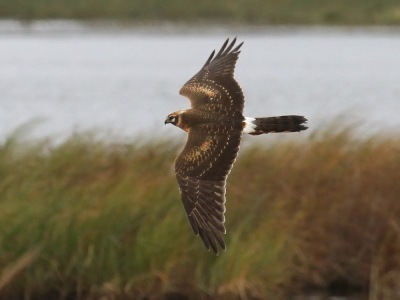
Pallid Harrier (outsourced) © RSPB

The Harrier, a juvenile female had arrived in the area a week earlier on 18th to be reported daily in various locations between the heath and the upmarket village of the same name about two miles to the south. Green-clad optics carriers and their cars were not welcome at that end of the trail, hence my decision to walk from Royston. We met two birders coming back the other way who said our quest had been showing well in a field just over the brow of the hill. When we got there it had been viewed about 30 minutes previously.

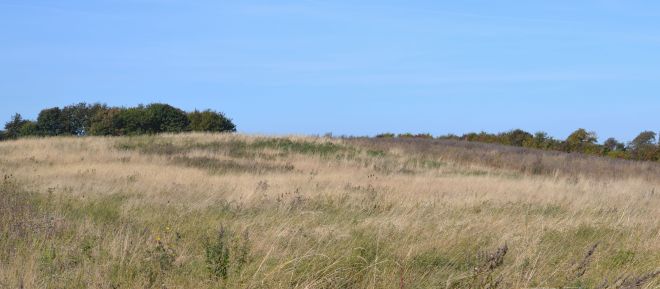
This spot (TL 34817 39440) was a very dry and stunted corn field, a testimony perhaps to the hot summer just gone, where some of the better pictures on RBA (see here) must have been taken. The five other birders we joined there said the Harrier came into the field close by Greys Farm as part of its circuit, and was last seen flying south across the arable land that sloped away to Therfield village. The landscape here rather reminded me of the South Oxon Downs.

I stayed for almost two hours from about 12:15 to just after 2pm before going on my way, but the bird did not reappear. It was reported again about an hour after I left. At the second attempt I was much better prepared and somewhat more fortunate. This time I was the only birder there and shortly after arriving decided to scan over the fields to the south from a gap in the hedge further along the Icknield Way. From there I picked out a large brown bird flying north, before going out of view behind the treeline away to the west.

This looked promising so I headed back to the corn field. Soon the Pallid Harrier flew from around the trees in the picture below, then low across rough vegetation just north of where I was standing. The diagnostic three primaries and boa were none too clear to see in the glary light, but just before vanishing over a hedge to keep on heading north-east she banked to reveal underwing plumage. I took that as sufficient to clinch the ID, but in any case this raptor was behaving in a very un-Buzzard or Kite and decidedly Harrier-like manner.

DSC_0042

Yes I know, there’s something missing in this one!

It was 9:10 am. Dashing across the trail to view the next field I once again saw a large brown shape disappearing over the skyline. So what does one do? Try to chase the bird around, that in this case would involve a lot of foot slogging, or wait and see if she came around again. Not surprisingly I chose the latter option since any sighting further afield would be distant and this corn field might provide the best back drop against which to attempt pictures should the Harrier return. Once more I stayed on site for two hours and once again she did not show.

In all that time I didn’t meet one other birder, but county listers would probably all have seen this Harrier by now, and with no reports having gone out on Friday (28th) people were perhaps less likely to come from further afield. But I had now observed my second Pallid Harrier in Great Britain and third all told.

In recent years Pallid Harrier has become a more regular autumn vagrant in this country as some juveniles disperse from Scandinavia, though their core European breeding grounds are in Russia and the Ukraine. They winter in sub-Saharan Africa, India and south-eastern Asia. A medium-sized raptor of open country, it is found on steppes and grasslands but also in semi-deserts, marshes and agricultural areas. My previous one was on the north Norfolk coast in November (see here) and December (here) 2015, when it took three attempts to get decent views of that bird.

The Therfield individual was one of four Pallid Harriers in East Anglia over the last two weeks, the others being another long staying juvenile female at Welney WWT, Norfolk; and two at Ouse Washes RSPB on 17 & 18th. English records have also come from Cheshire, Lancashire and Devon during September. Apologies for the absence of pictures but this one moved too quickly, I wasn’t ready and she didn’t come back. Perhaps those things all add up to being a lady’s prerogative. Should the opportunity arise I may go again to try for images, but this bird appears to be becoming more and more elusive.

Ortolan Bunting at Ports Down, Hants – 15th Sep

There has been a seeming glut of southern English records of Ortolan Bunting in the first half of September, but none of these birds stuck around for long enough to be twitchable from Oxford. Needing this passage passerine for my British list I kept an eye on things as more and more sightings came in from Kent, Sussex, Hampshire and Gloucestershire; but time and again a negative would go out on RBA after the initial report. And as some of these migrants were being noted at well watched coastal locations, they were being identified only as fly-overs on call and sometimes at night using sonogram equipment.

ortolan bunting.1804_01 ports down hill

Distant, blurry Ortolan Bunting, but hey I’ve ticked one for Blighty

Yesterday evening, I fixed on RBA postings from a site on the South Downs just to the north of Portsmouth, where an Ortolan (pictured above) was first reported at 2:45 and was still being watched at 6pm. This sounded like it could be my bird and I decided if it was still there in the morning I would go to see it. Today I noticed the first report at around 7:15 and 45 minutes later I hit the road. That’s quite quick for me!

portsmouth harbour.1801

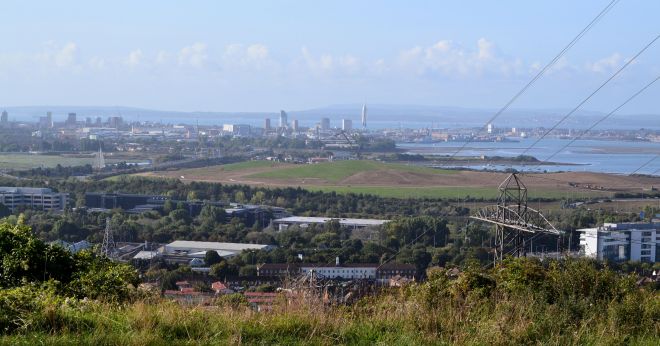
Portsmouth and harbour featuring the Spinnaker Tower (centre) and Mordor (top right)

From the M27 I drove through the Portsmouth suburb of Cosham then up a road to Ports Down (SU648067) from where the views to the south were worth capturing. Arriving on site at around 9:20 I made a reconnoitre of Pigeon House Lane, and on finding a sizeable group of birders all intensely focusing on a corner of the field in question, assumed they must be onto the Ortolan. So I parked on the end of the closest line of cars, to be told my quest had last been seen around 20 minutes previously, showing well on a Hawthorn beneath an electricity pylon.
Joining the twitch line I was greeted once more by Adam who this time had not arrived in the nick of time and so had yet to see the bird himself. A patient wait then ensued until after an hour with no views a group of birders made the decision to flush the bird with the approval of the gathering. Given this nudge the concealed Ortolan Bunting, an adult male (I assume) then broke cover from long grass on the far side of the field to perch prominently anew in the same Hawthorn to which the day’s earlier reports had referred.

Our bird remained there for some time, taking in it’s surroundings and all the attention it was attracting. In the right hand picture (above) it is just visible to the left of the hazard warning sign on the pylon (click to enlarge). I was hardly likely to gain good images but the digiscoped records below are still clear enough to present what I had observed today. The medium-sized Bunting’s diagnostic greenish-grey head, pink bill and pale yellow moustachial stripe and throat are all discernible.

Eventually the Bunting dropped down into the ground level vegetation below the pylon again, presumably to resume feeding on insects and seeds. I at once wondered if this behaviour could be the reason why so many earlier reported birds had not been seen subsequently, since they clearly spend a deal of their time keeping out of sight.

Ortolan Bunting breeds across much of continental Europe and parts of western Asia, but not in the British Isles. Across that range it is a not uncommon inhabitant of agricultural land, woodland and upland areas. Since Roman times the bird has been regarded as a culinary delicacy, especially in France, resulting in huge losses from the wild each season. Despite a 1999 EU directive banning hunting up to 50,000 birds each year continued to be slaughtered on autumn migration in that country alone, until at least 2007 when stricter enforcement was said to have been put in place.

The species, that I had recorded myself once before in Cyprus in April 2012, winters in tropical Africa. Closer to home I had tended until now to regard this passerine as a migrant reported mostly from remote offshore islands far beyond my preferred range, or heard flying over the Portland Bird Observatory. So to gain this very positive experience, my 345th British bird, just 90 miles from home was very pleasing.

This slideshow requires JavaScript.

Observing new birds in Great Britain remains a diminishing return, given my reluctance to travel very long distances. But I keep on chipping away, and three species – Roseate Tern, Marbled Duck (if accepted) and now Ortolan Bunting – within range in the 2018 return passage season so far is not a bad tally. Hopefully there will be one or two more long-sought British or even life list additions in the weeks ahead.