European Nightjars at Newtown Common, Hants – 17th July

This is something I have wanted to experience again for quite a while. Twice in the past at this time of year I joined mid-summer evening RSPB local group outings in the Newbury area: to Snelsmore Common in the late 1980s, then a site just north-west of Greenham Common’s former missile silos in 2013. I was taken to see a lone, south Oxon item in company with select county birders in 2015, and last but by no means least there was a memorable self-find abroad of Red-necked Nightjar along a dirt road outside of El Roccio, Spain in May 2012.

On our way home from the Basingstoke area last week, Ewan briefed me on a further location that currently holds three breeding pairs. Newtown Common (SU 476629 – see here) is one of several examples of lowland heath habitat in west Berks and north Hants that all attract migrant Nightjar in the summer months. I didn’t relish making an evening visit by myself, so enlisted the support of another Oxon birding colleague Sally, herself a seasoned Nightjar observer since they breed close to her second home in mid-Wales.

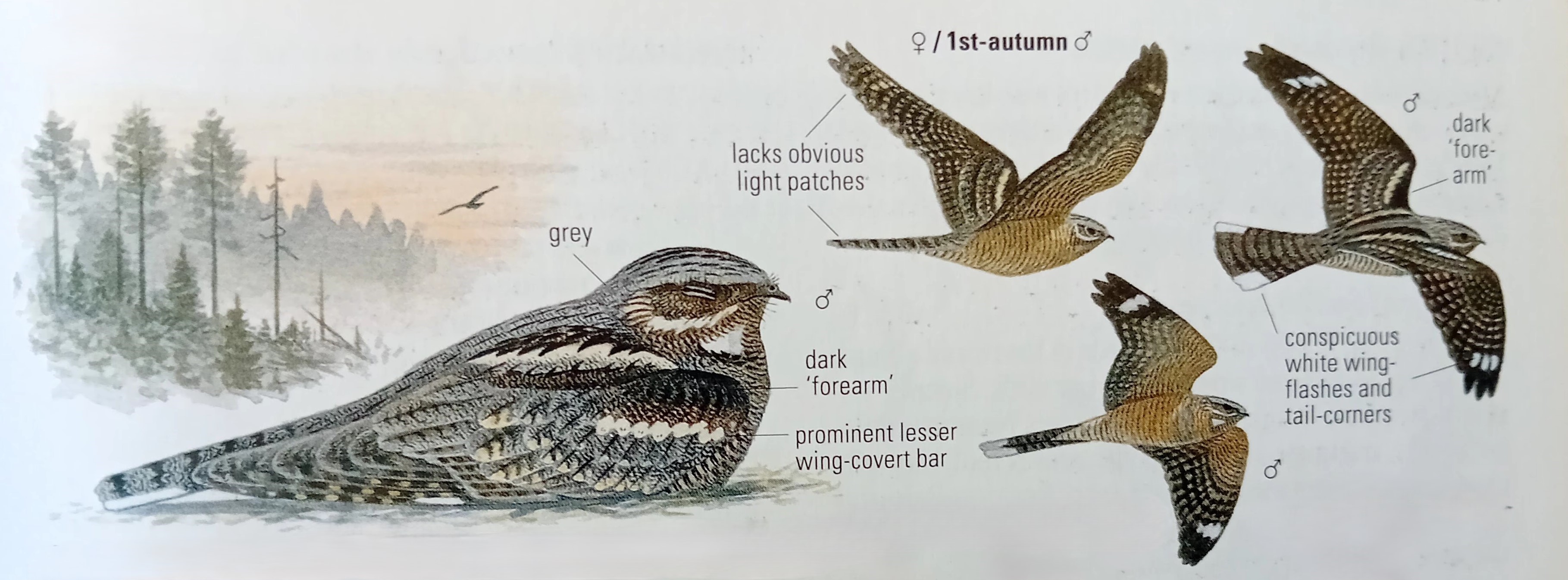
European Nightjar © Harper Collins Publishers

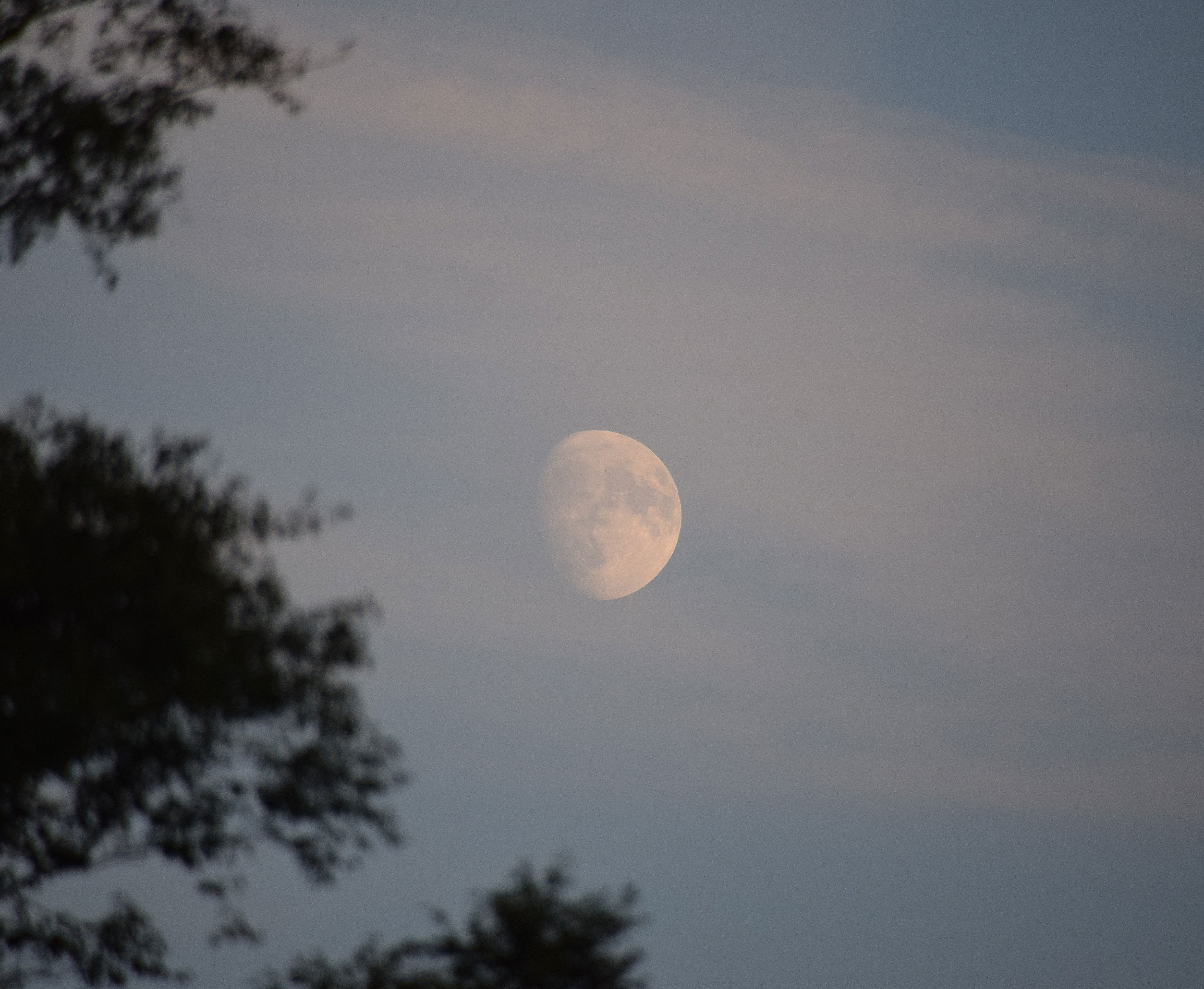
Arriving a little early at around 7:45pm we took a walk around to explore what is typical habitat for our crepuscular in daytime quest that flies at sundown. After crossing paths with two other Oxon birder/photographers, we set up our watch point at a spot near where Ewan had told me a Nightjar perches in a particular tree top. Before long six more people passed by on the same mission, then we waited and waited longer. As dusk drew ever closer, aircraft vapour trails cris-crossed the dimming sky and the subtly-toned moon rose then edged gently to the right. My sense of anticipation intensified to the verge of impatience as the light continued to dim.

More than once Sally said she could hear distant churring, then a “co-ic … co-ic” call announced itself around us. At 9:20pm a dark shape glided past swiftly, silently and banking as it went with a shadowy almost ghostly, hawk-like jizz. A thrill coursed through me as mission was thus accomplished. This first Nightjar of our evening made a few more passes, then from 9:30pm churring commenced in earnest from the middle distance. As night continued to draw in I became infused with a beguiling, almost primeval empathy with both the sound and its setting; and at intervals these Tolkienesque dark riders of the night would flash by again.

Newtown Common

Having not seen flying Nightjar at such close quarters before I now appreciated why American species are named “Nighthawks”. The back-curved wing and long-tailed profile is quite suggestive of a smaller raptor, as strong and deliberate wing-beats alternate with graceful sweeps and wheels with wings held motionless. Males typically lie or crouch along tree boughs when churring, but may also sing from a post or tree top such as the one we were staking out. Females usually incubate two eggs on the bare ground amongst bracken or stones.

It is said that by jumping about waving white handkerchiefs or something similar, observers can attract male birds that will take them for the conspicuous white wing flashes and tail corners of an interloping rival. So my experienced companion now began something akin to a Morris dance. Fairly quickly no less than three birds all came to take a look, appearing suddenly and out of nowhere through gaps in the trees, then flying around and above us in their mysteriously distinctive fashion.

The Nightjar Whisperer

If they were all territorial males this was the entire reported quota for the site, but seemingly they were not easily misled and soon went on their way. By 10pm their strange reeling song was rising and falling from various locations in the deepening gloom, and feeling we had seen and heard enough we headed back to the car, passing the camping seated group of six we had met earlier. They were enjoying wine after a good picnic, local “villagers” as they described themselves, who come here year on year to watch the Nightjars and socilaise. They described the spectacle enjoyed on this night as their “best ever”.

We thus learned of a second good vantage point, overlooking falling ground and complete with a bench, should it not be already taken in future. But our own pitch, though more obstructed by large trees, had been as satisfactory since we had it to ourselves with an excellent outcome. This was the best of my three Nightjar experiences to date in the Thames basin lowland heaths. The birds’ own idiosyncratic activity would continue all night, long after any possible “disturbance” by human visitors such as ourselves and the others ceased. And in each future season the mysterious nocturnal entities will hopefully return to this corner of England from African wintering grounds for the nightly July drama to be replayed.

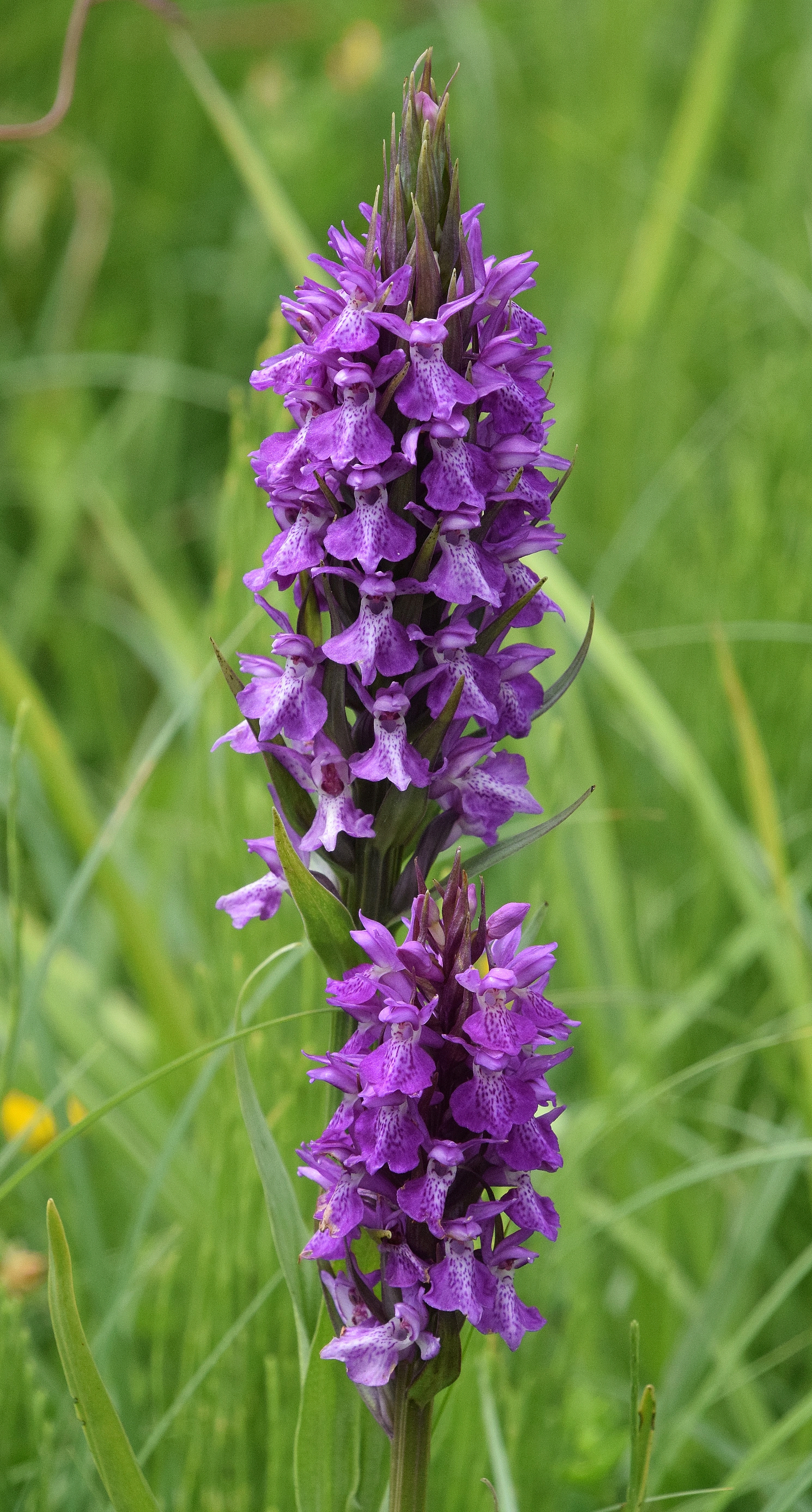
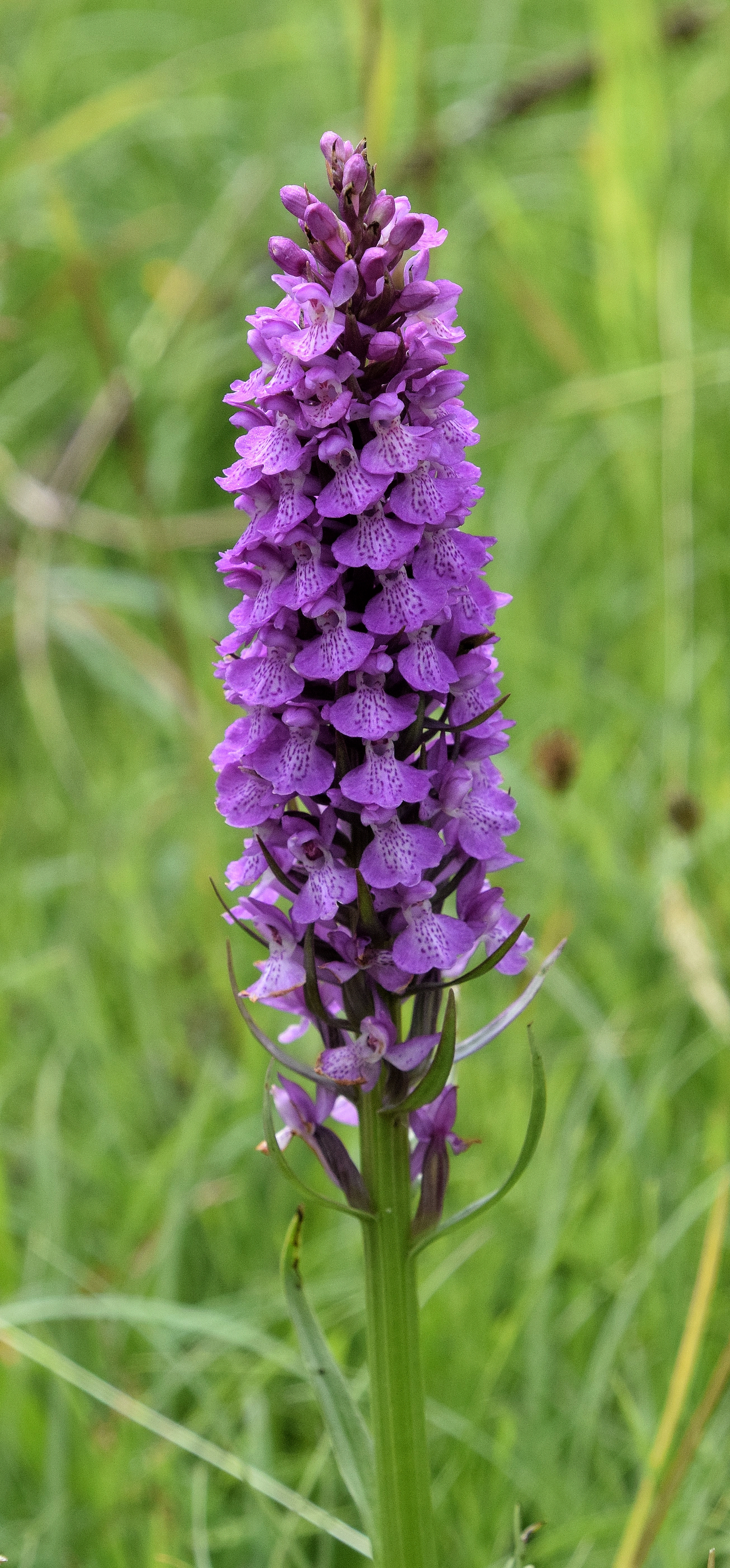
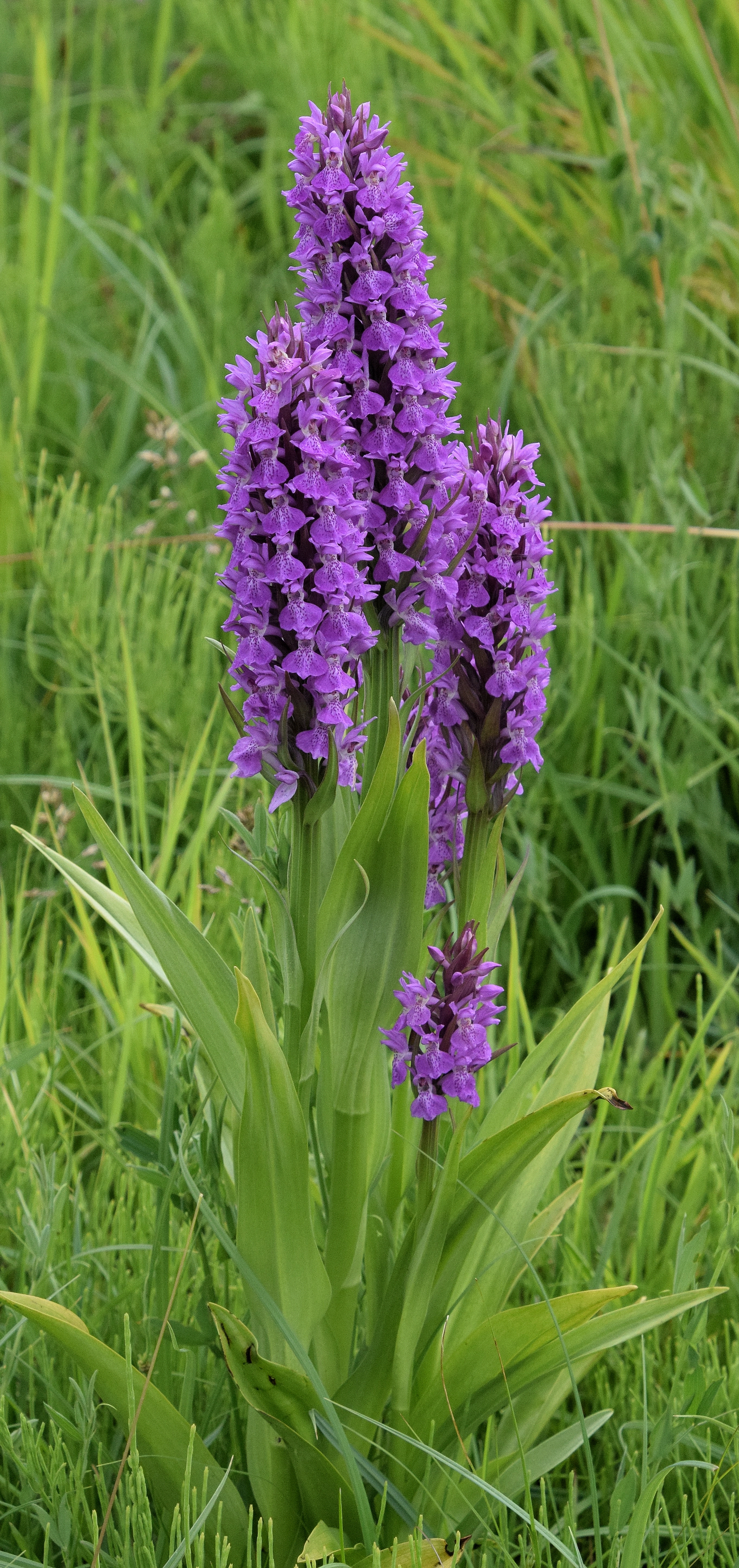
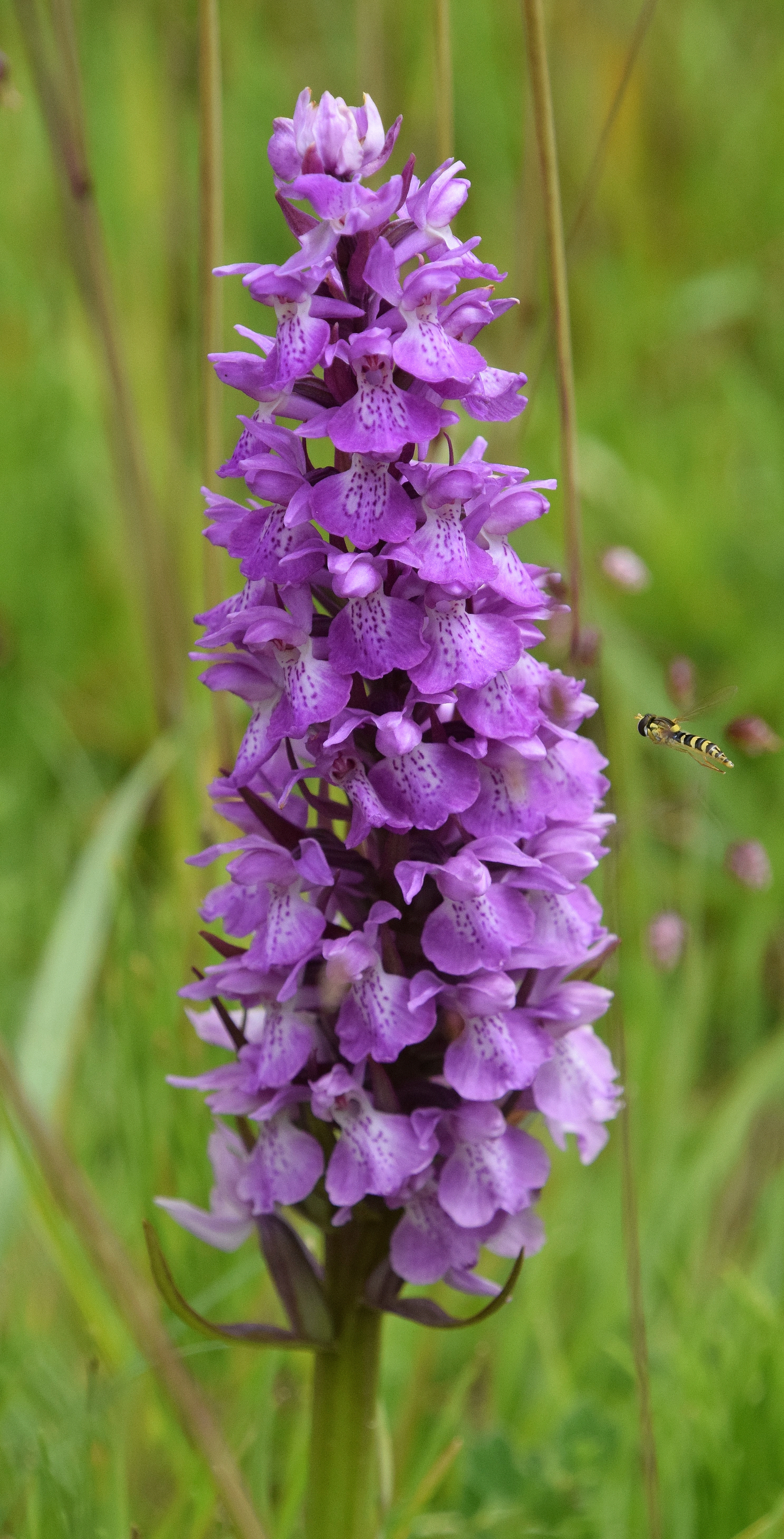
A Marsh Orchid bonanza in Hants ft Marsh Fragrant, Southern ssp schoenophila and scarce Helleborine forms – 11th July

The year’s wet spring and early summer has apparently been an exceptional season for Marsh Orchids at this post’s two featured sites. I had read that a tiny calcareous fen just outside Basingstoke was a hot spot for the first-named and a possibility for the second, and so applied for access to the permit only HWT reserve. The response breathed new life into what I was expecting to be a motivationally dwindling July. Not only did it offer good numbers of what were formerly regarded as the nationally scarce and much sought Narrow-leaved (or Pugsley’s), but a nearby site holds more than 100 of the new for me Marsh Fragrant option.

Having been thus informed I passed things on to potentially interested Oxon colleagues. Adam duly advised that all previously cited Narrow-leaved south of an arbitrary line from Anglesey across to the Humber estuary are now regarded as a fen sub-species of Southern Marsh (Dactylorhiza praetermissa). Researching things myself I learned the Marsh Orchid (Dactylorhiza) genus, of up to 60 species across Europe with four in the British Isles (see here), is notoriously tricky to separate for even the most experienced botanists.

Southern English colonies cited as Narrow-leaved Marsh (Dactylorhiza traunsteineriodes), including the Basingstoke one and another just outside Oxford at BBOWT Parsonage Moor, had been the subject of debate for several years prior to 2012. Then new evidence resulted in their re-classification as Dactylorhiza praetermissa ssp schoenophila (see here). Confused? I have now reached such a level of detail in this current enthusiasm, but studying the contentious plants for myself would nonetheless make for an interesting excursion whatever their exact nomenclature.
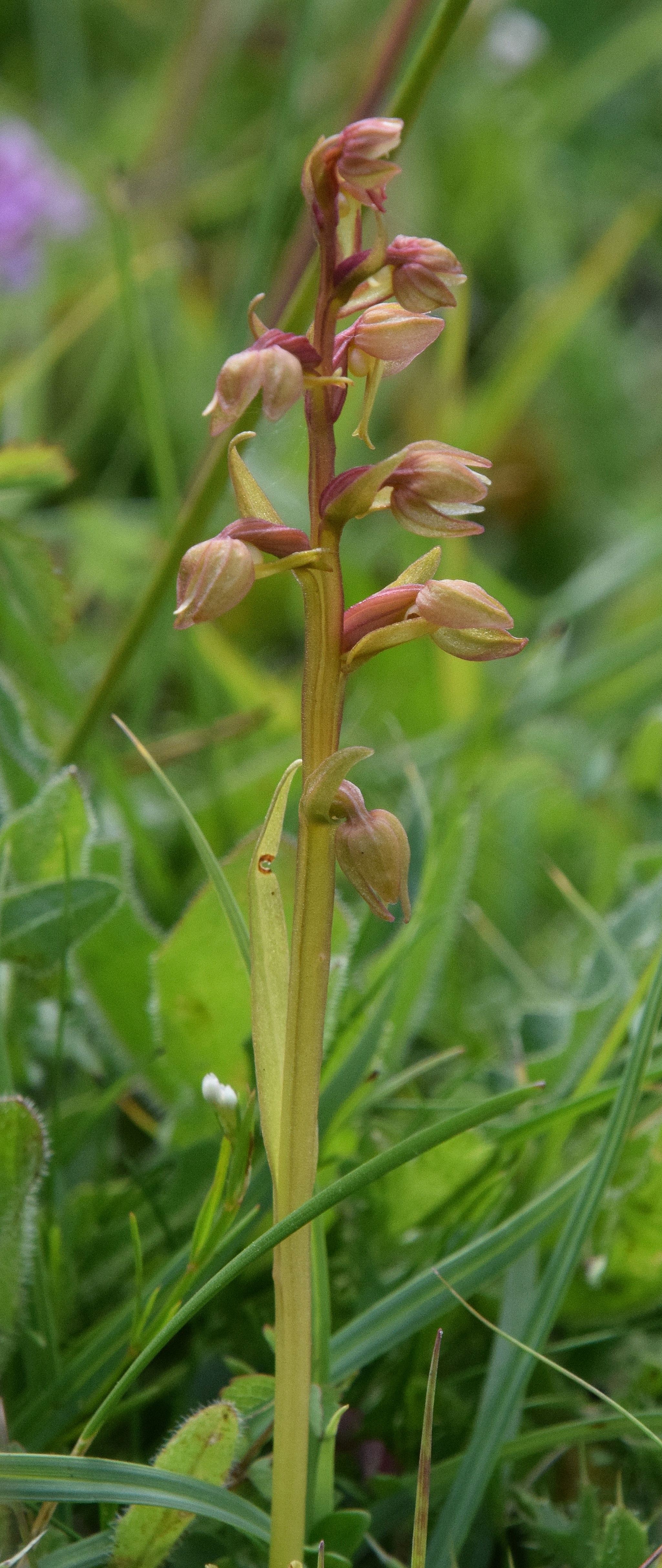
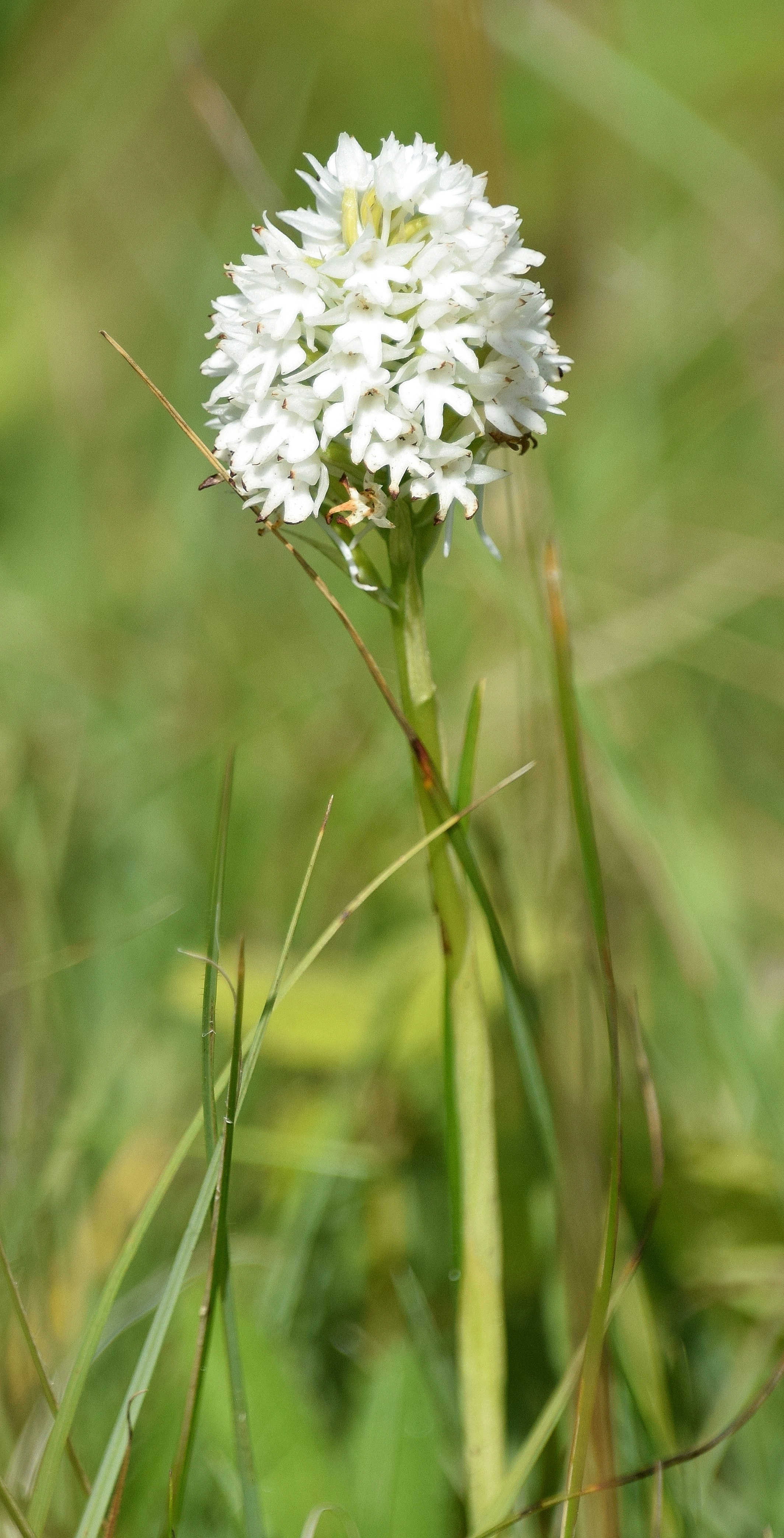
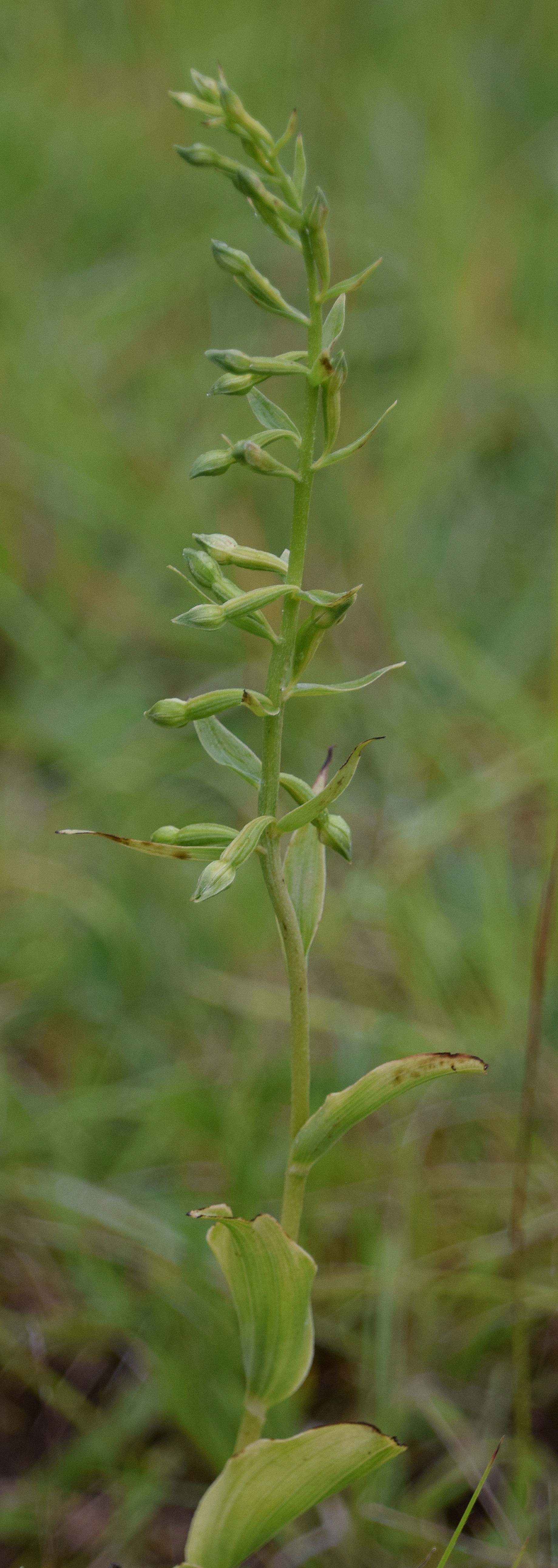
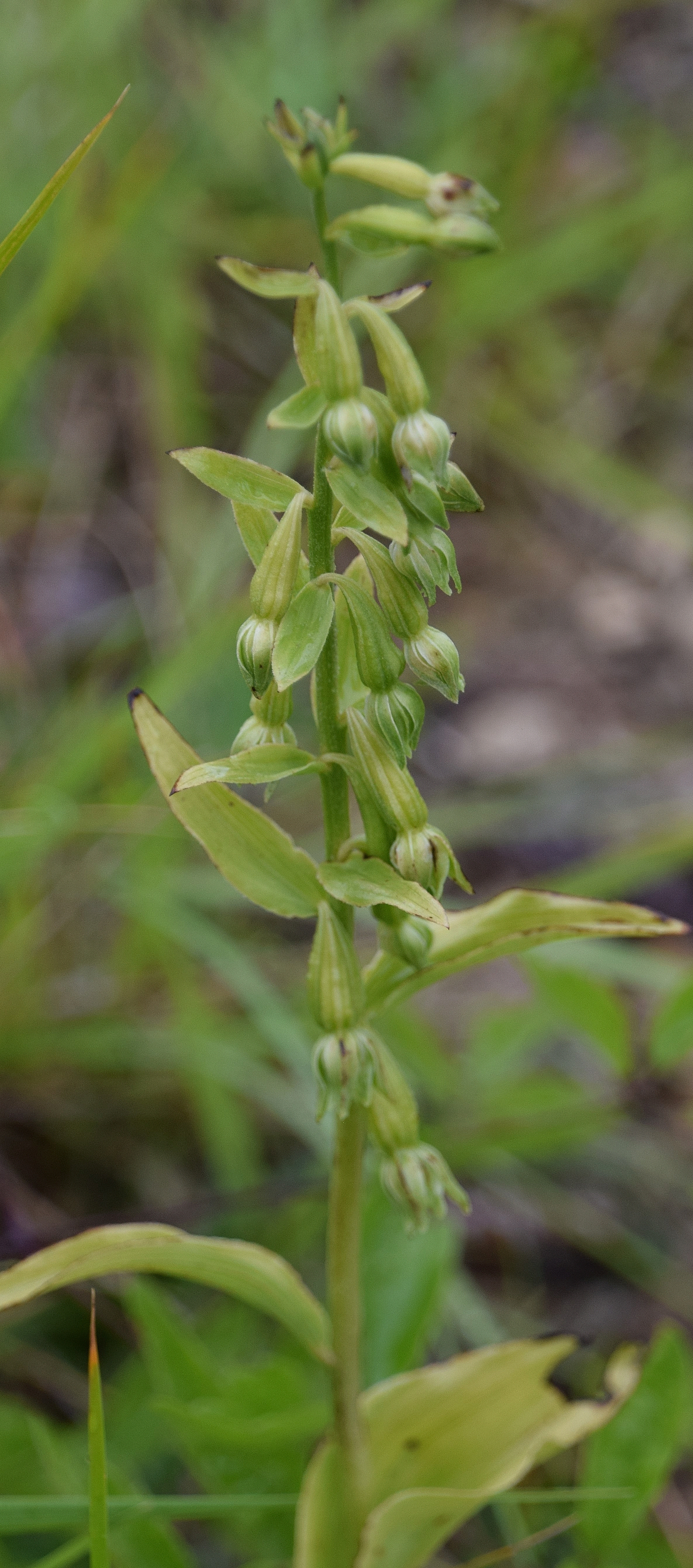
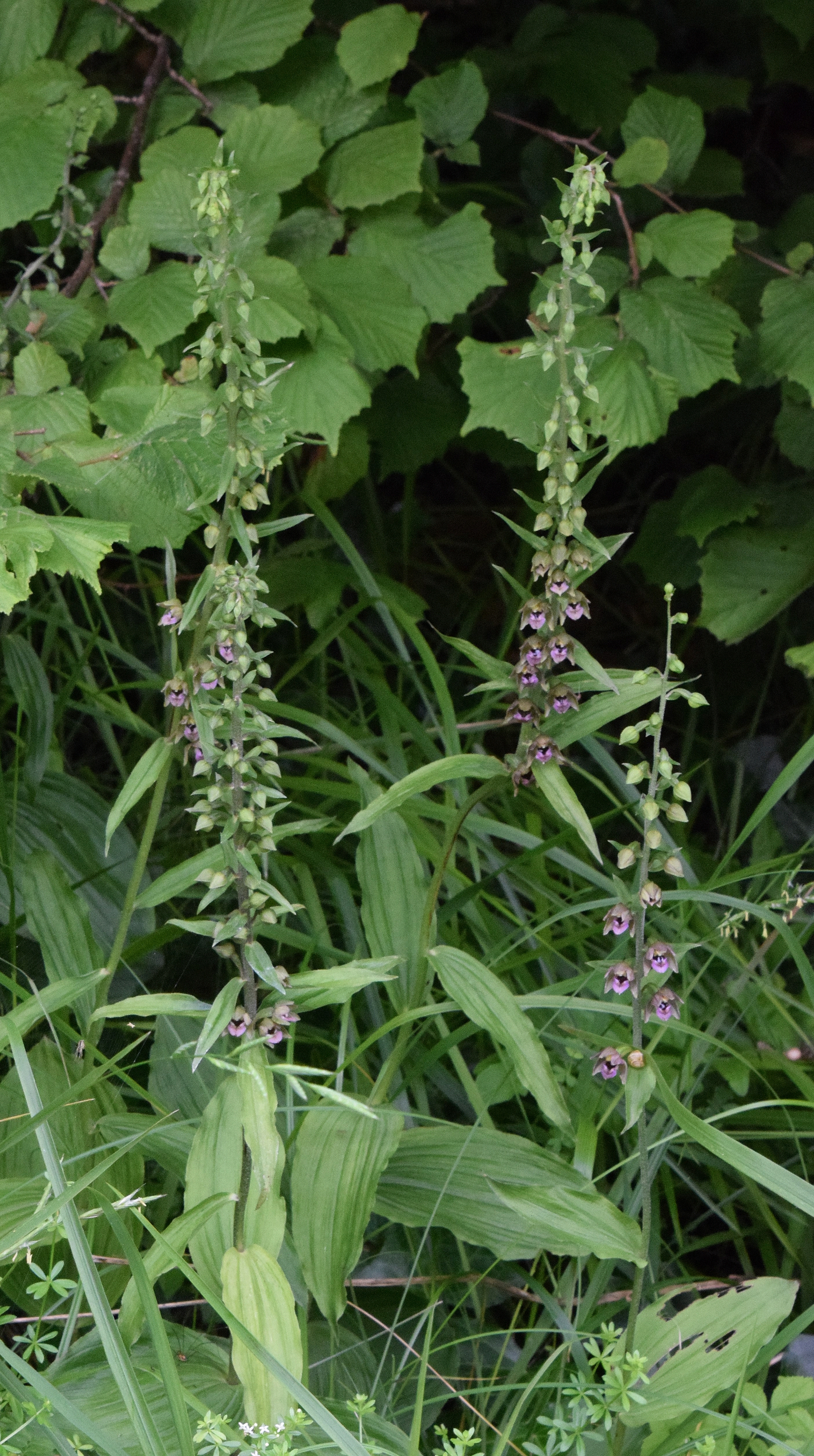
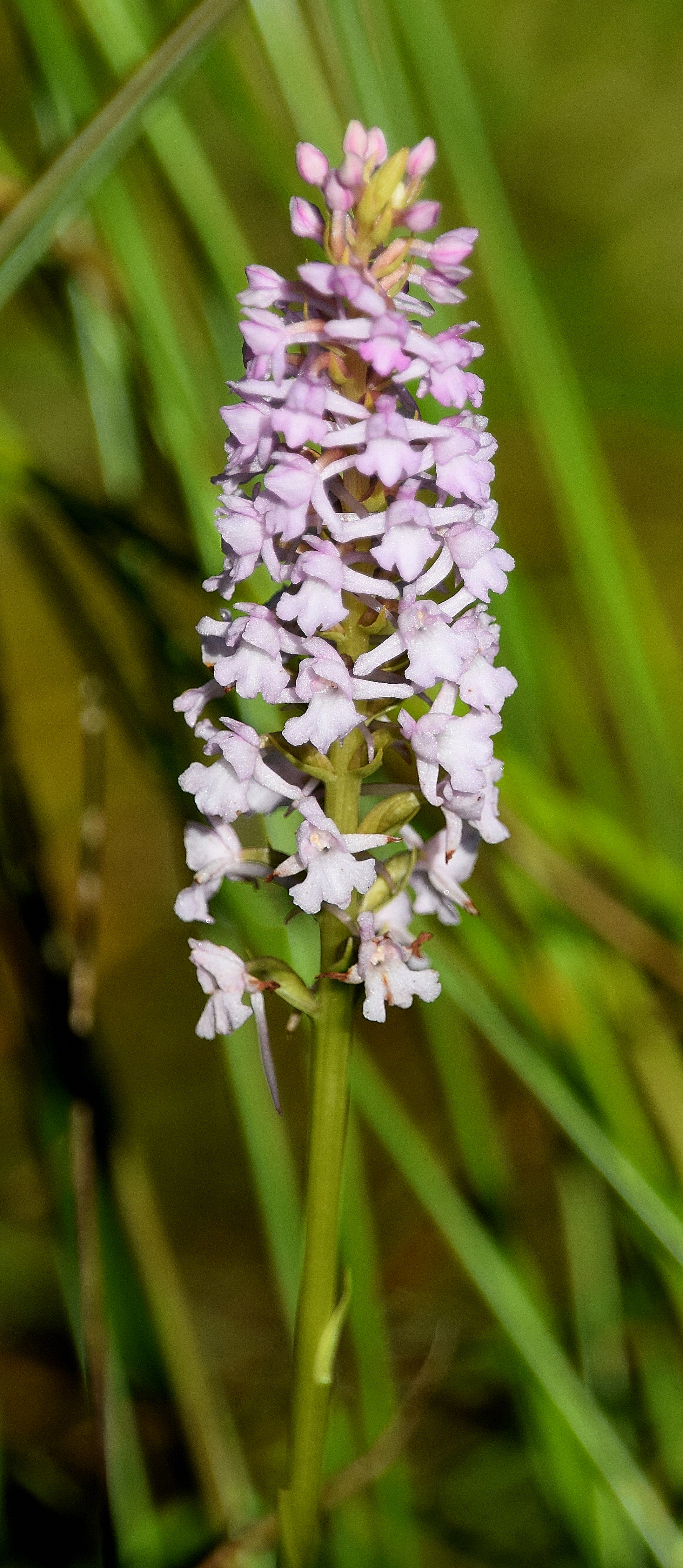
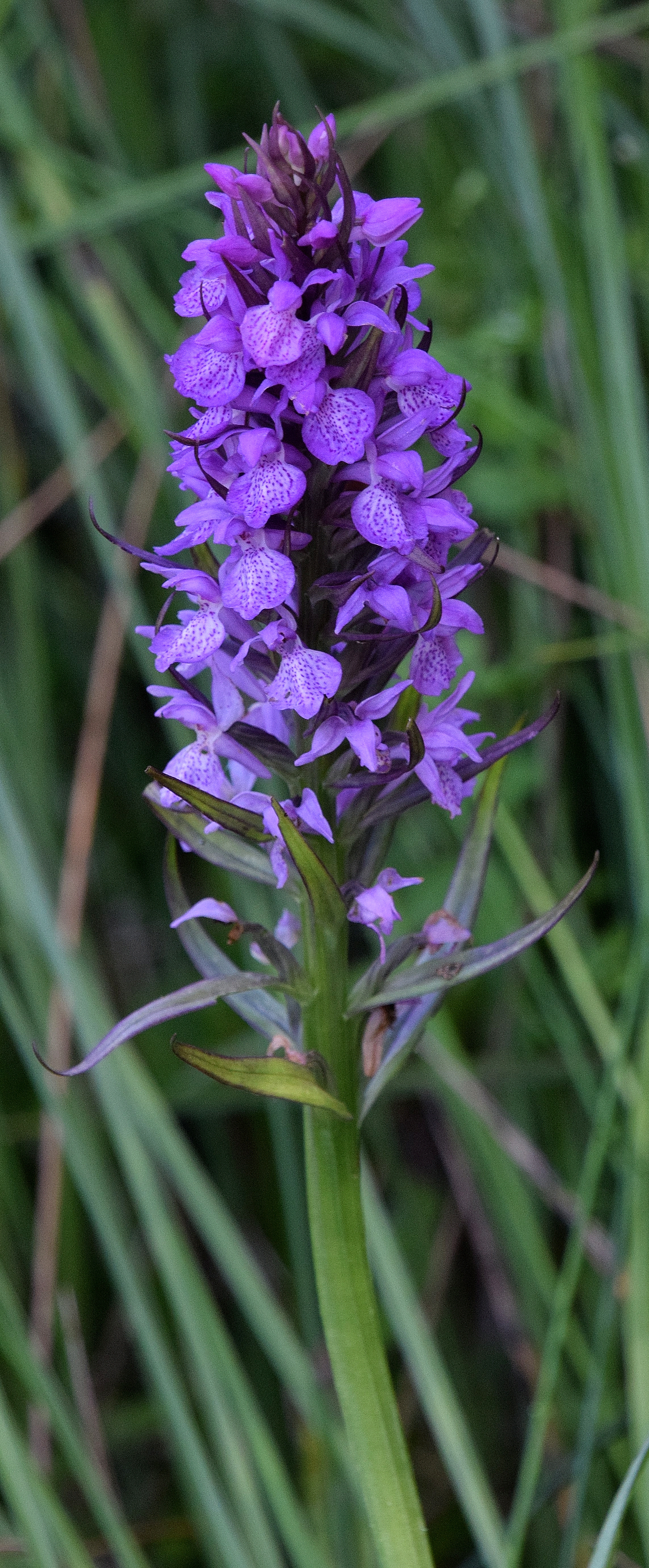
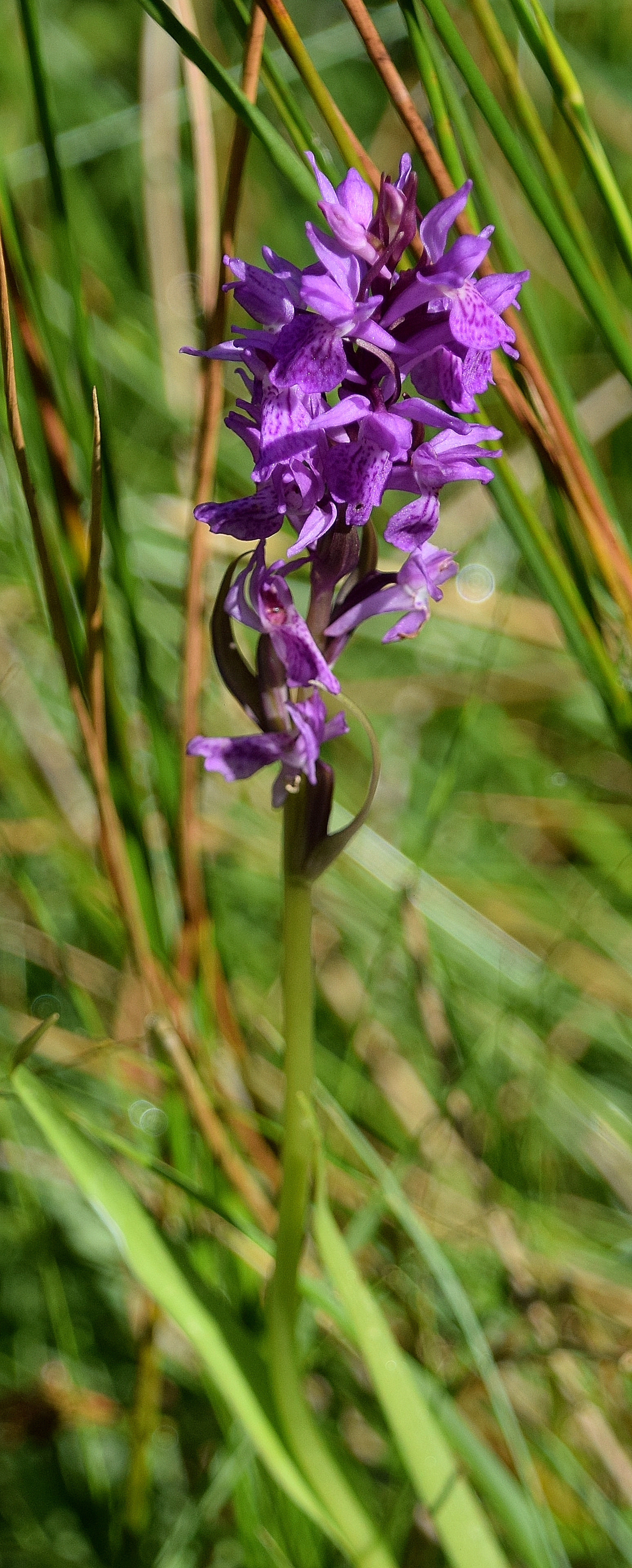
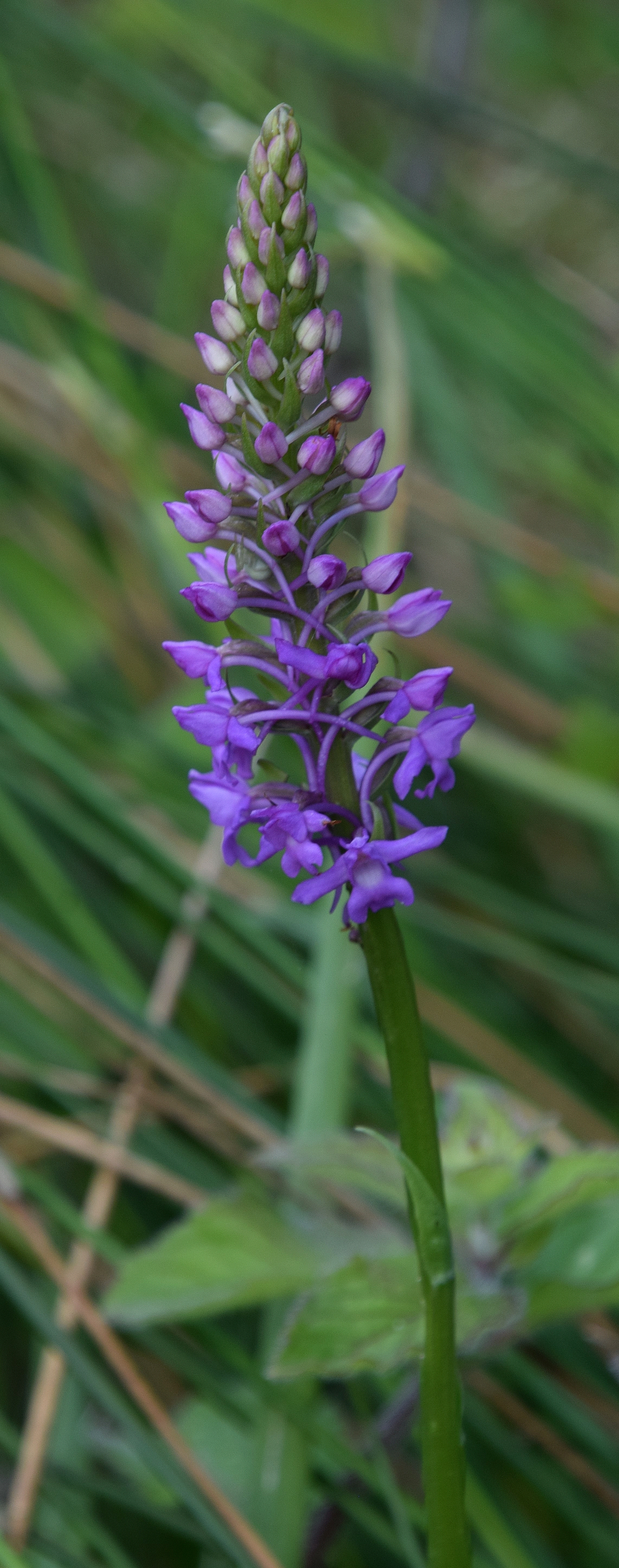
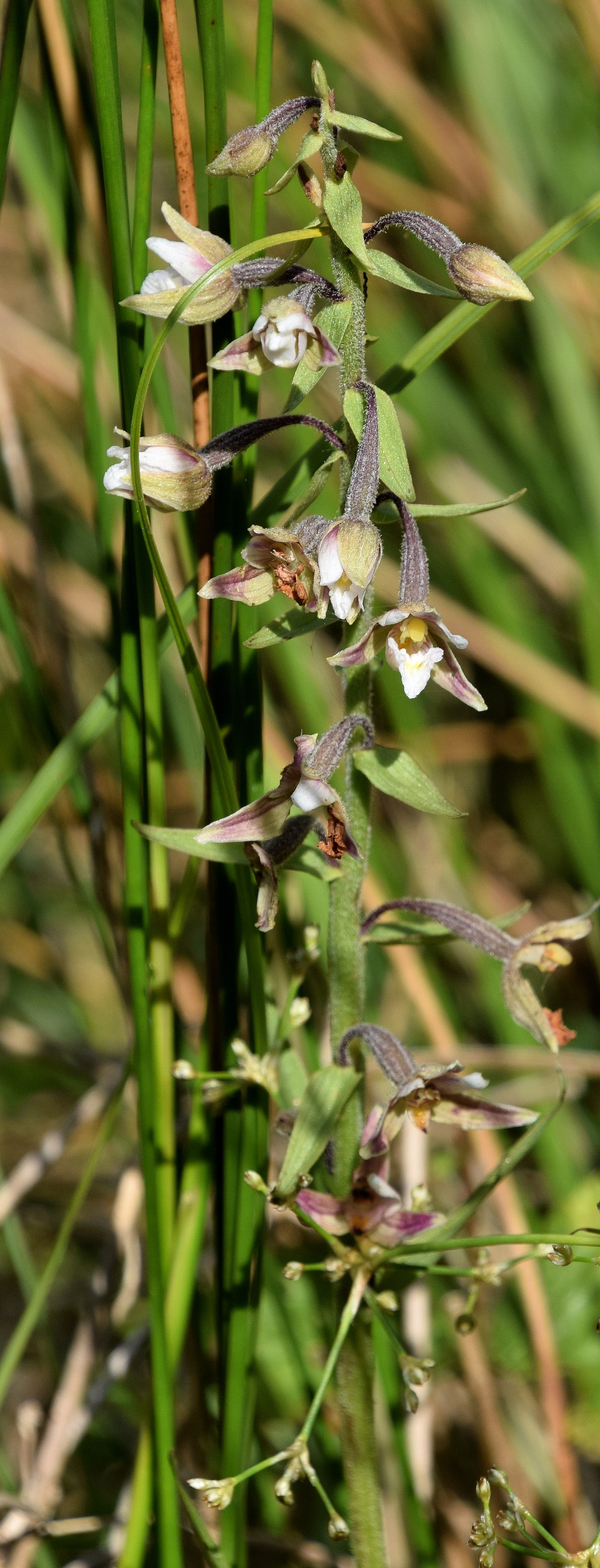
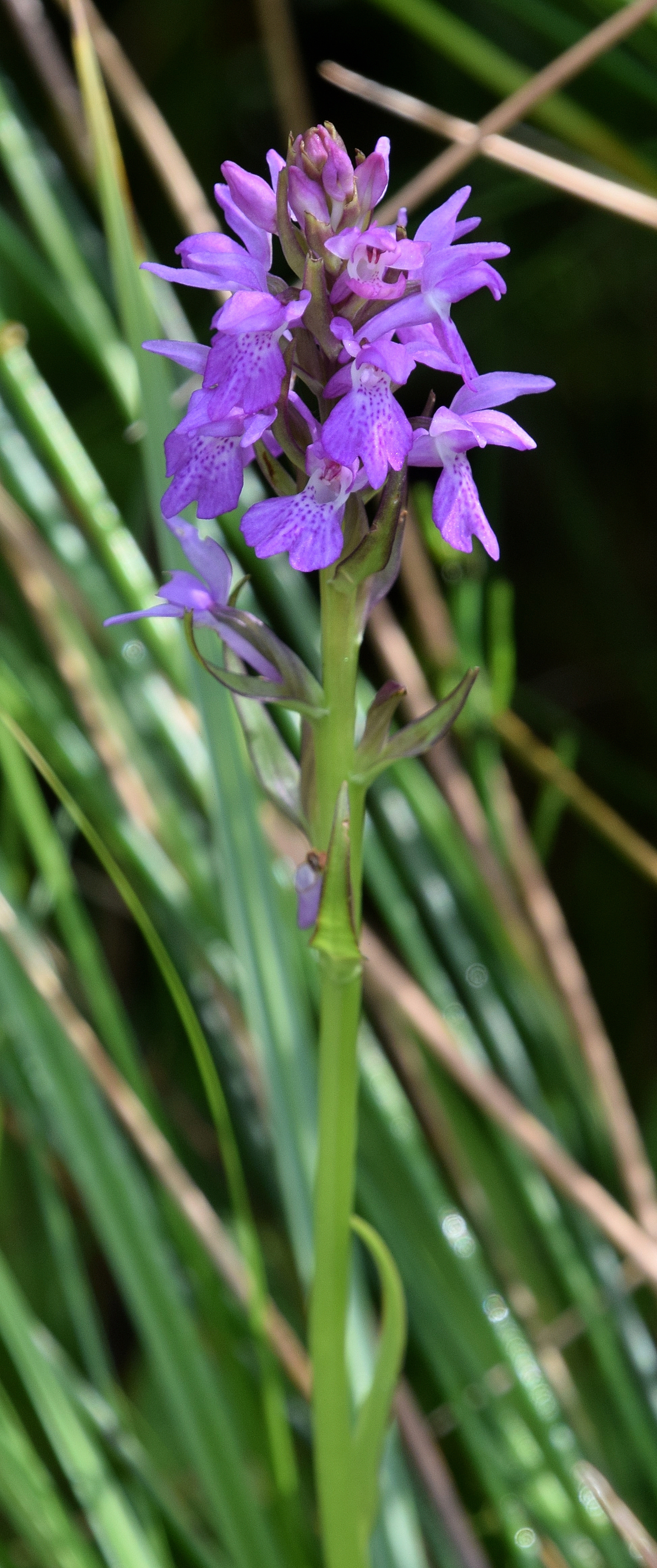
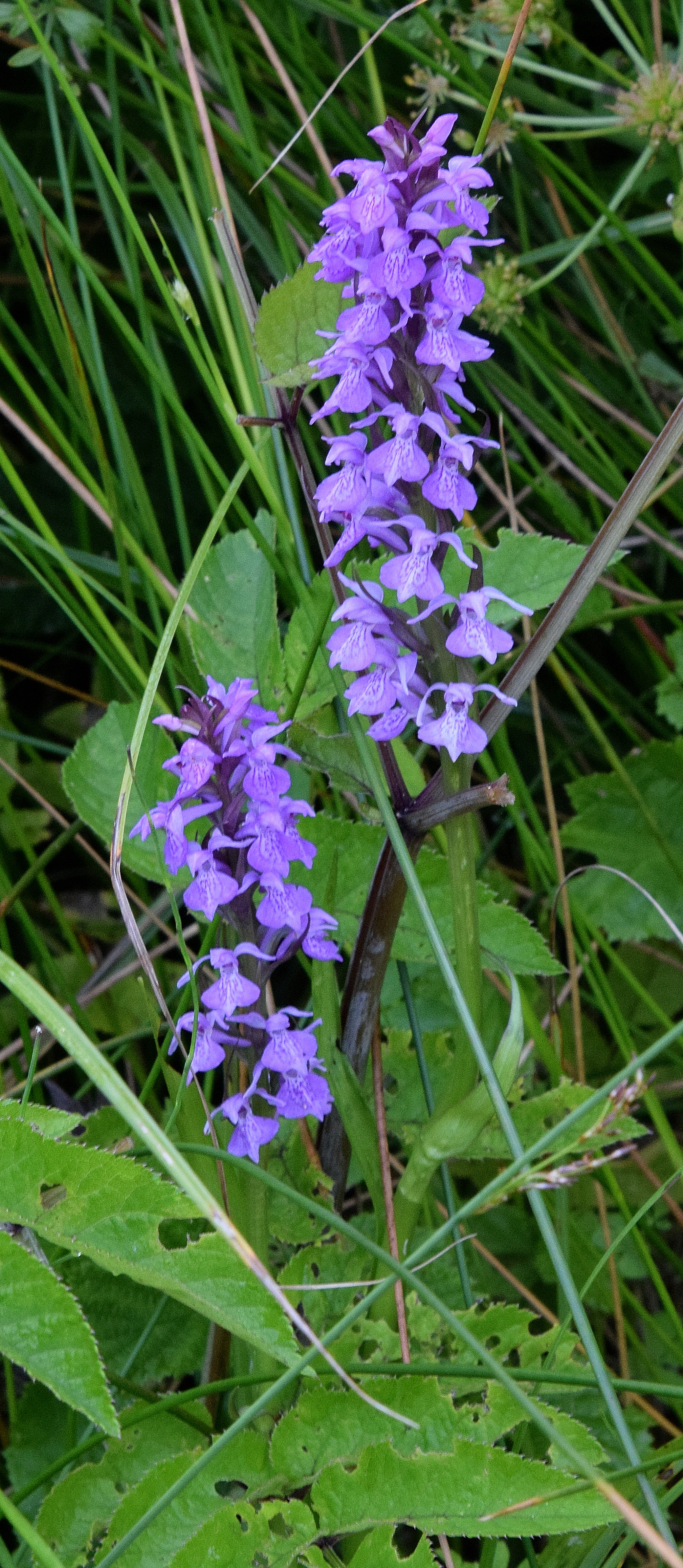
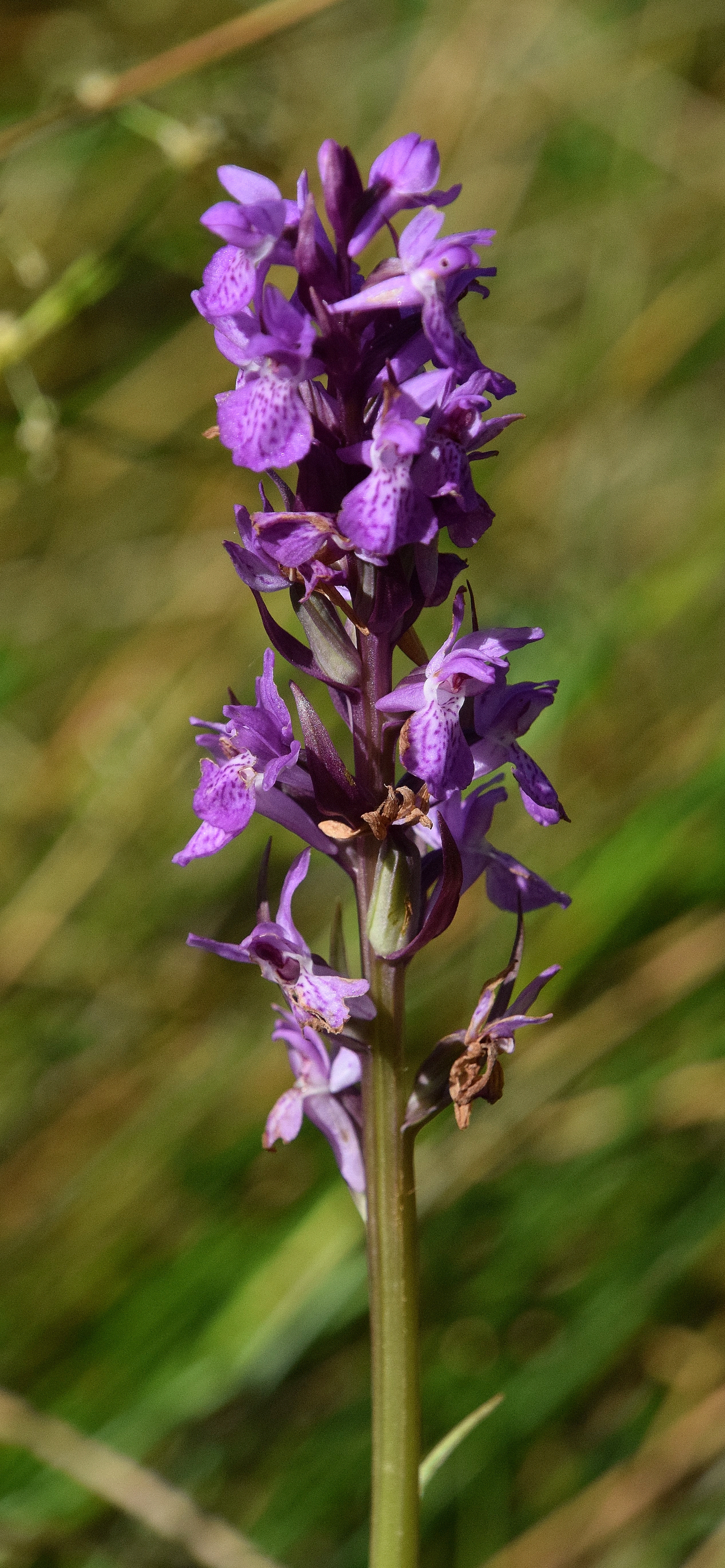
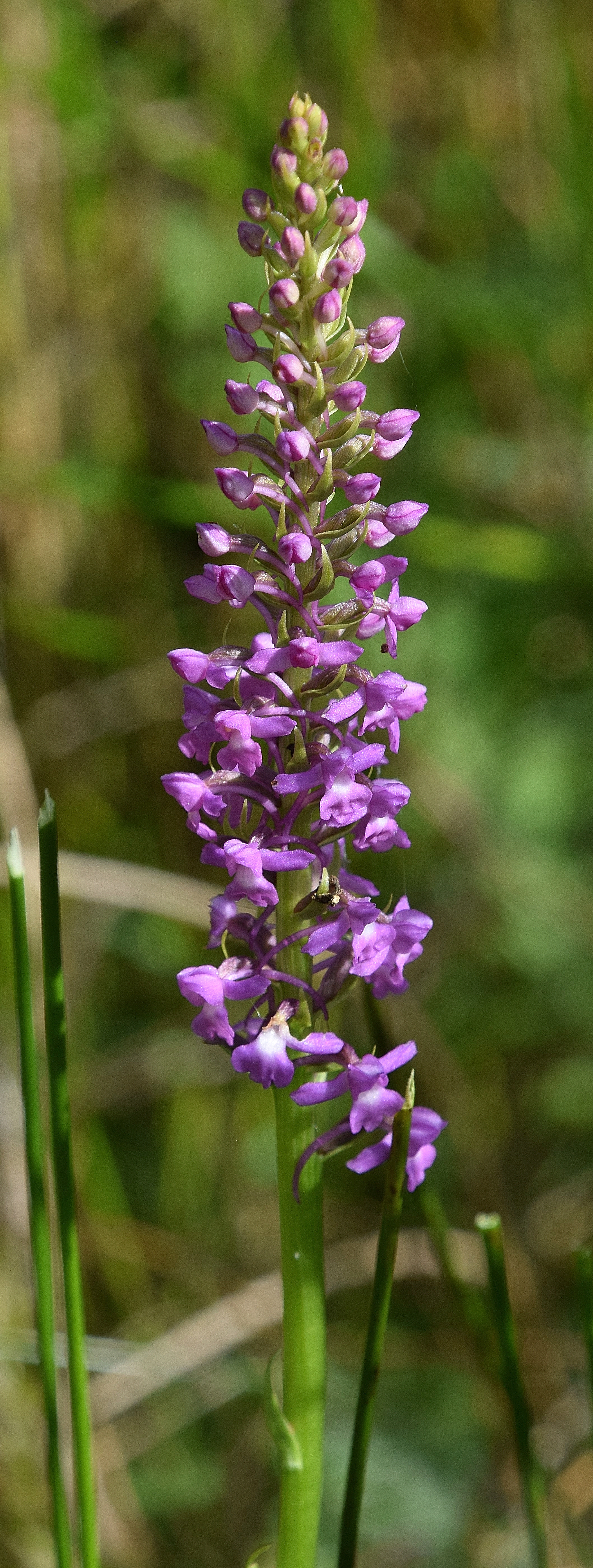
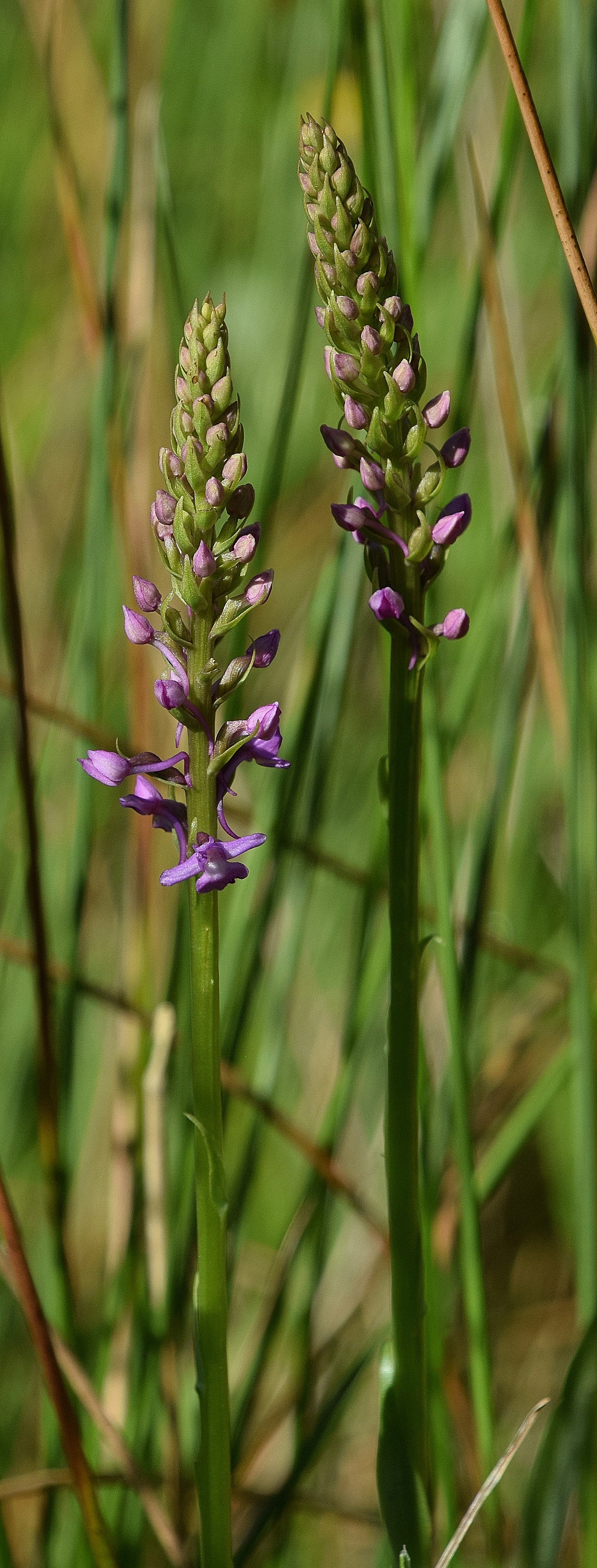
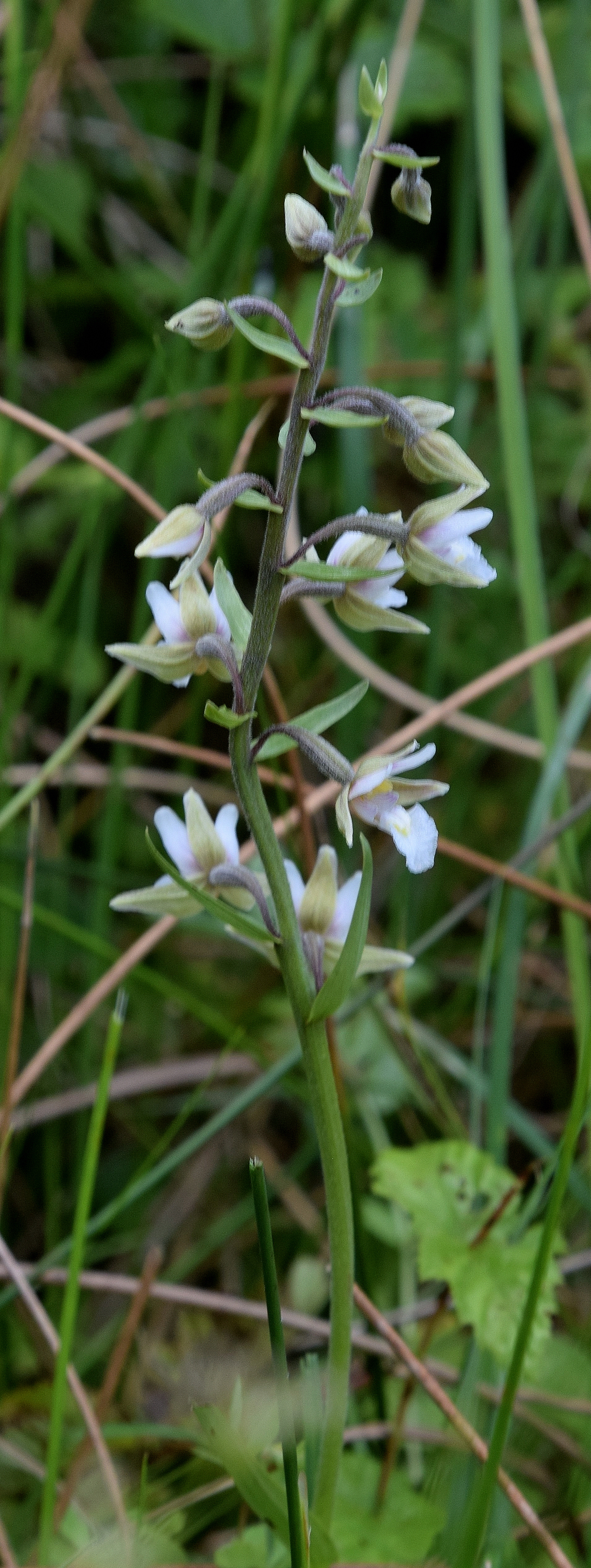
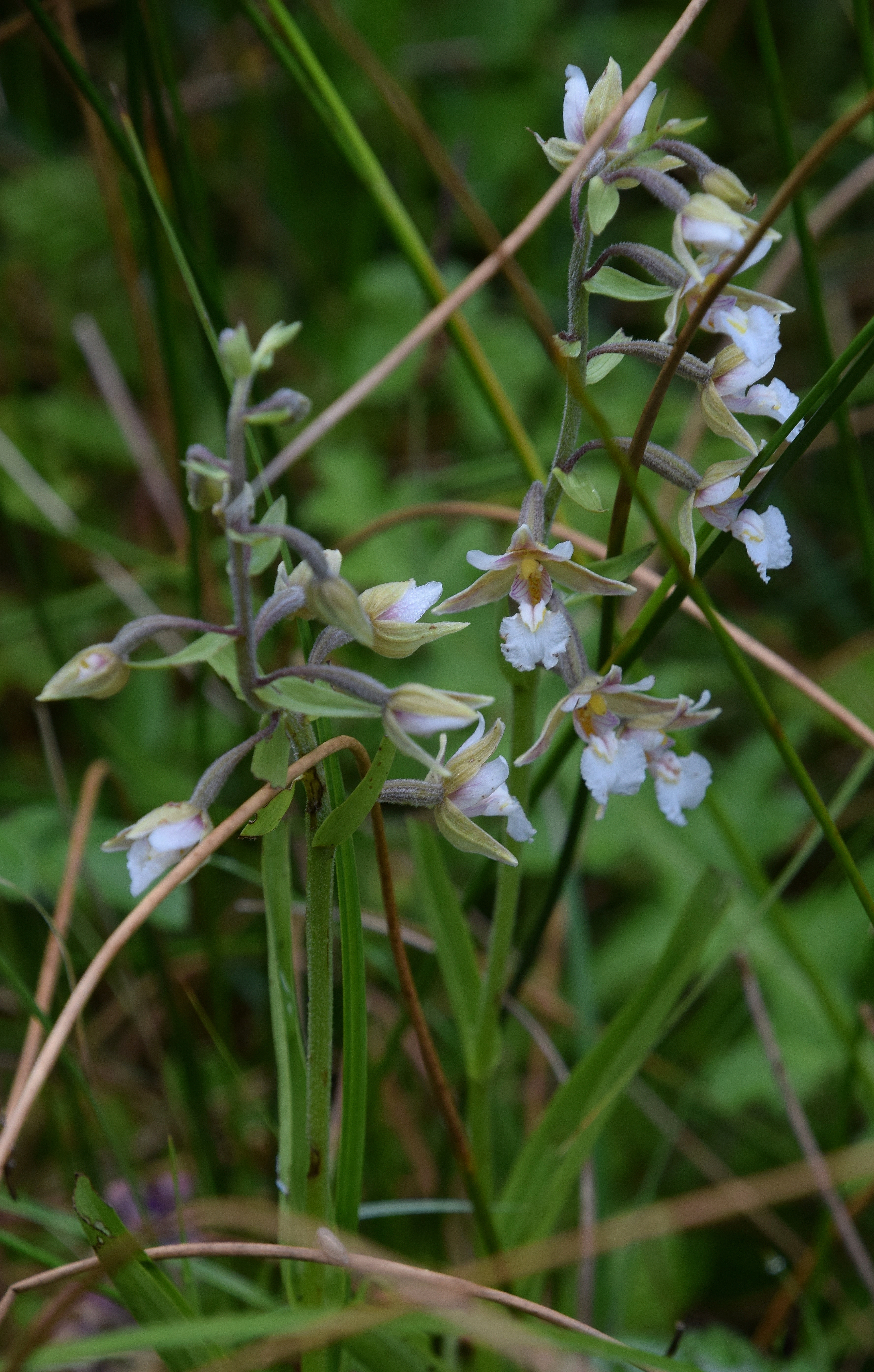
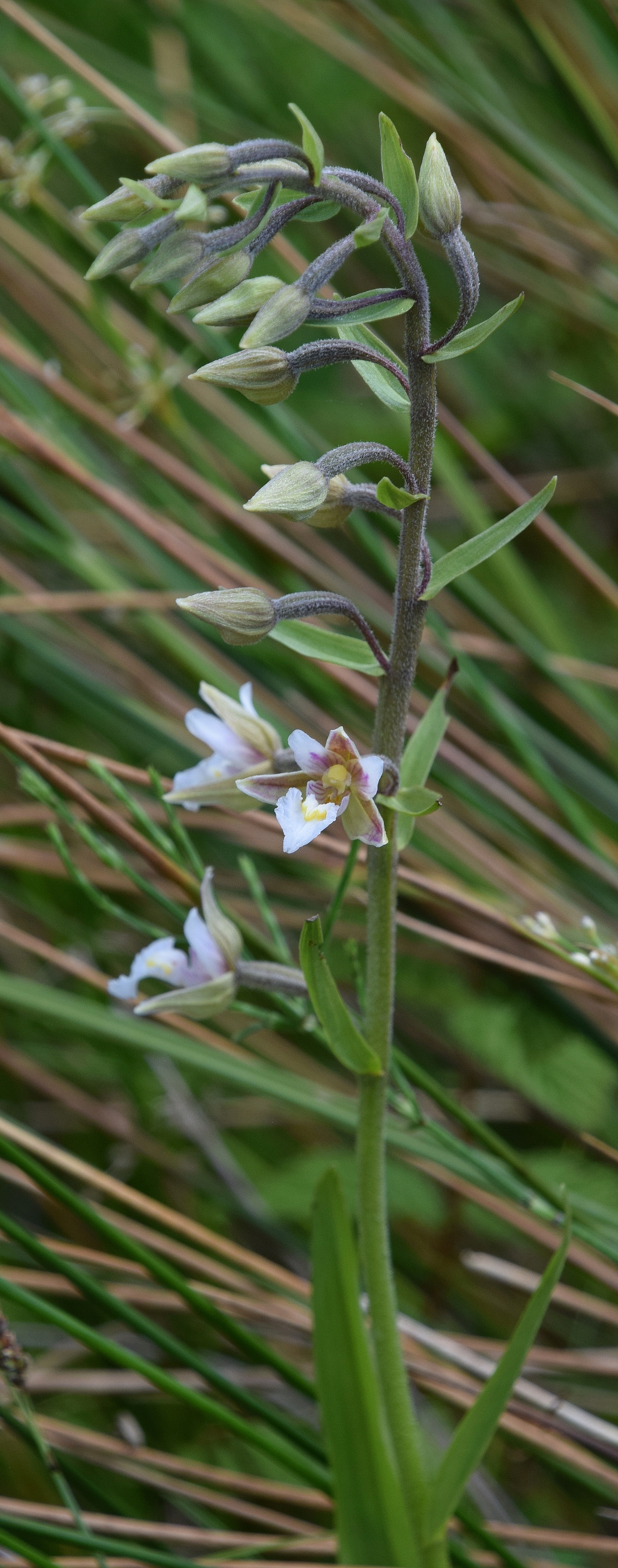
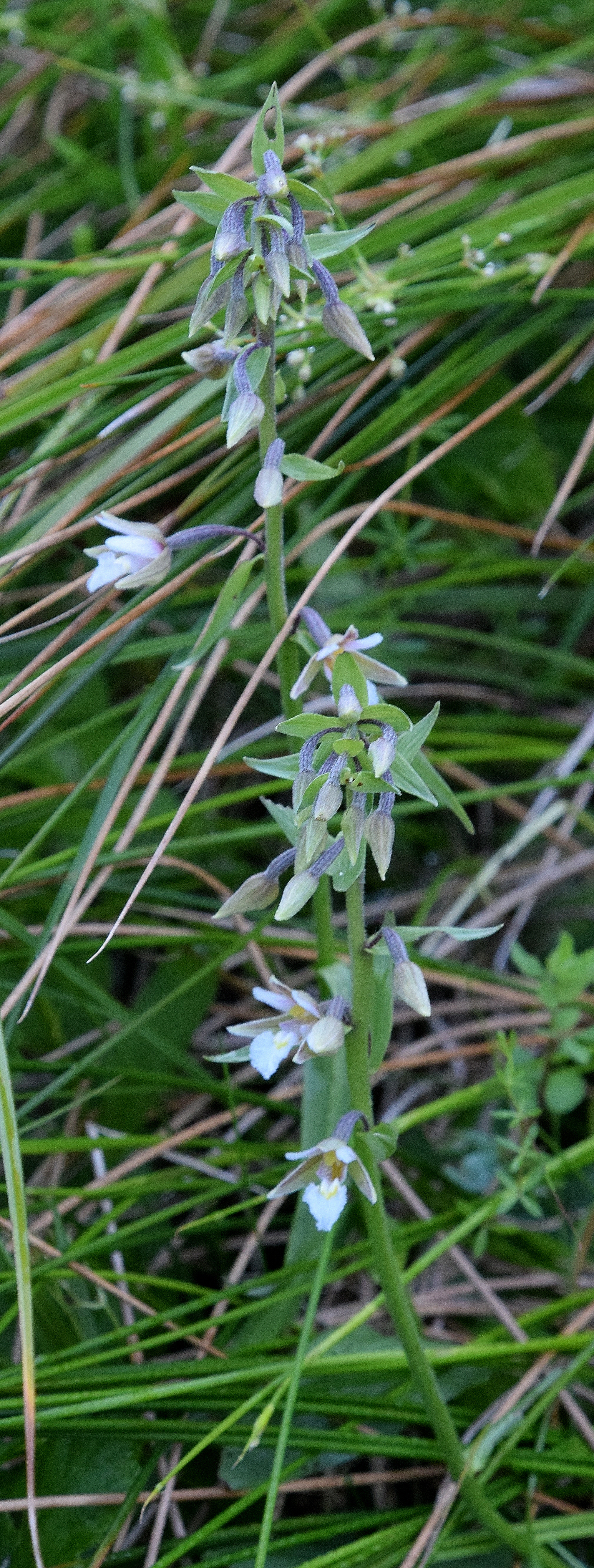
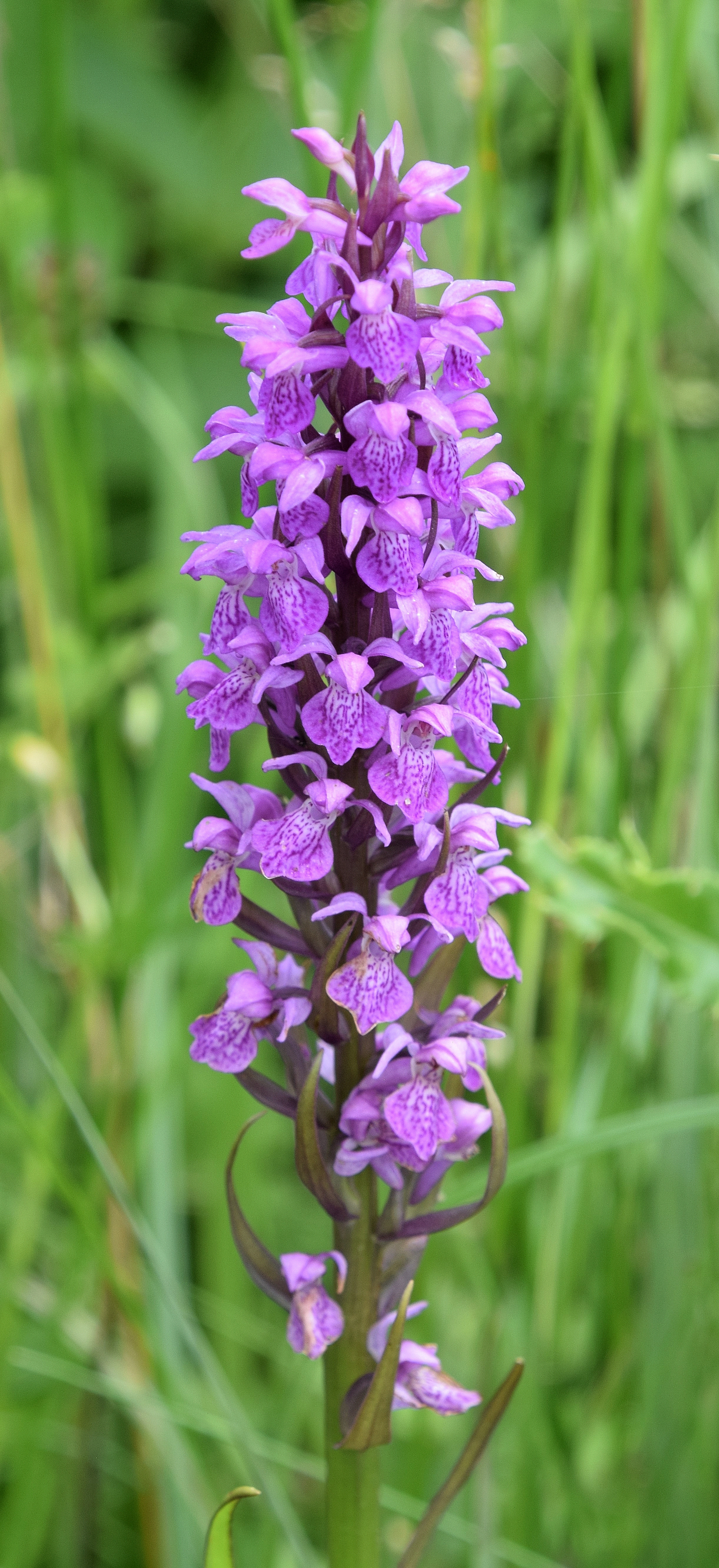
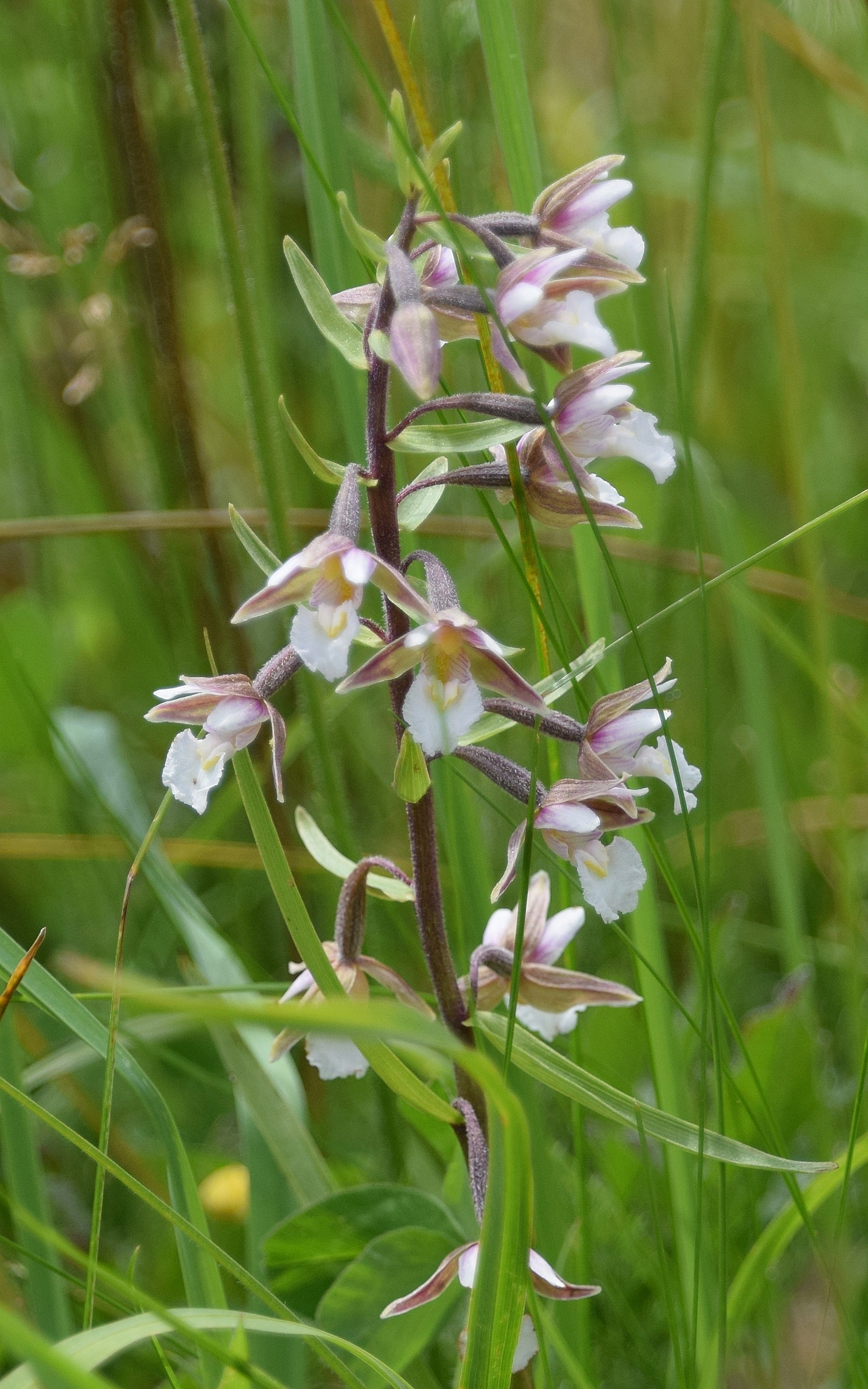
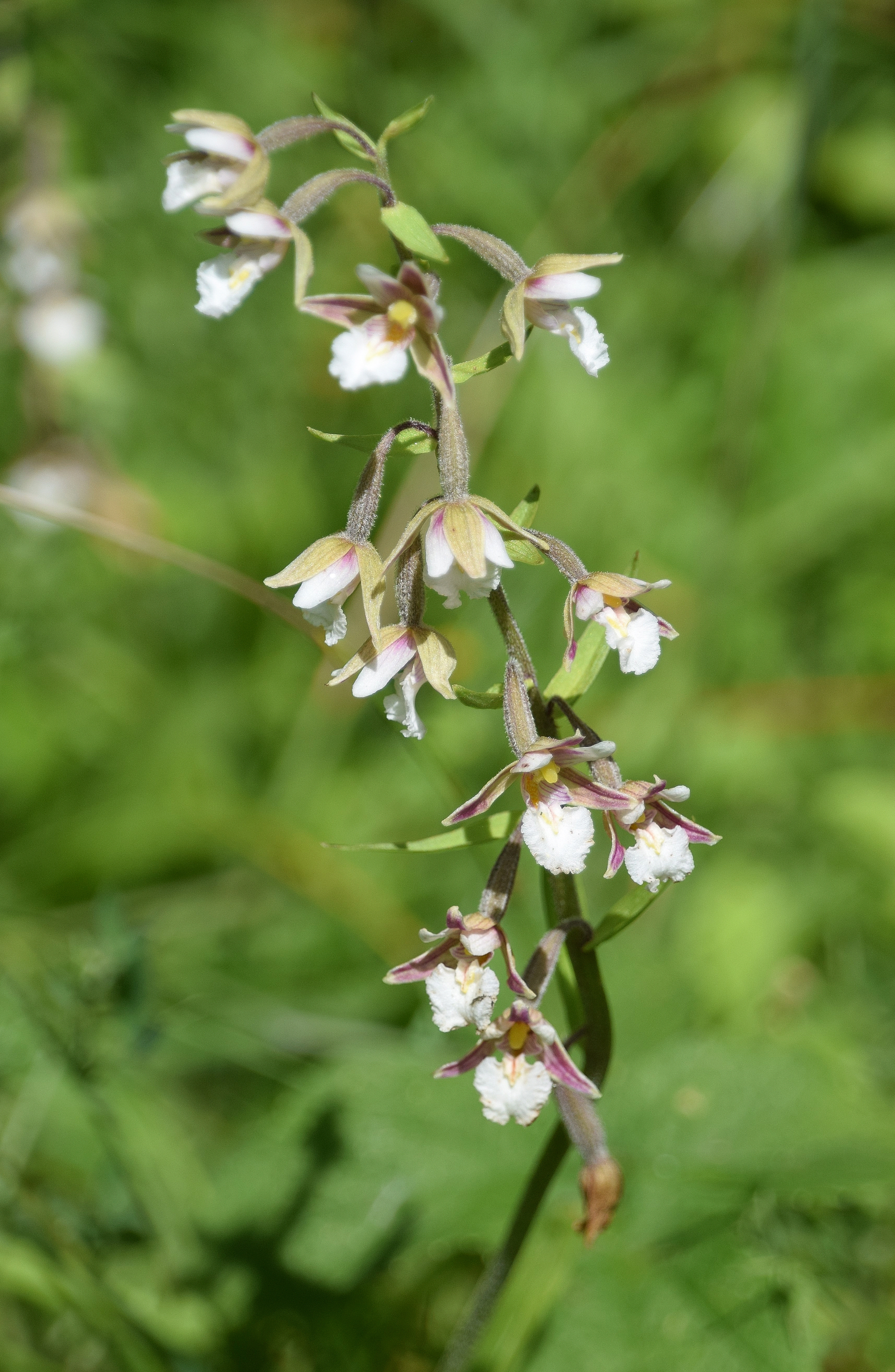
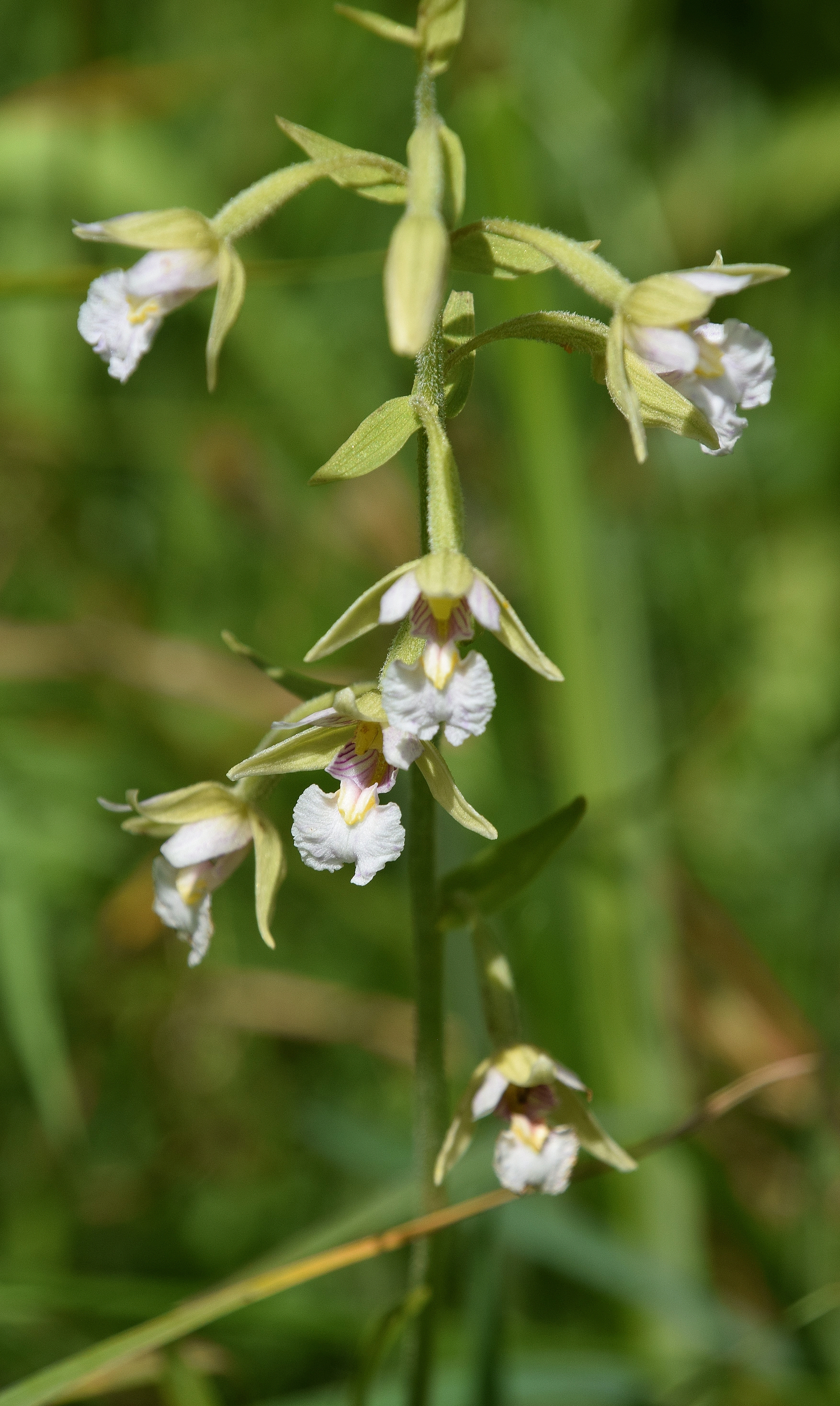
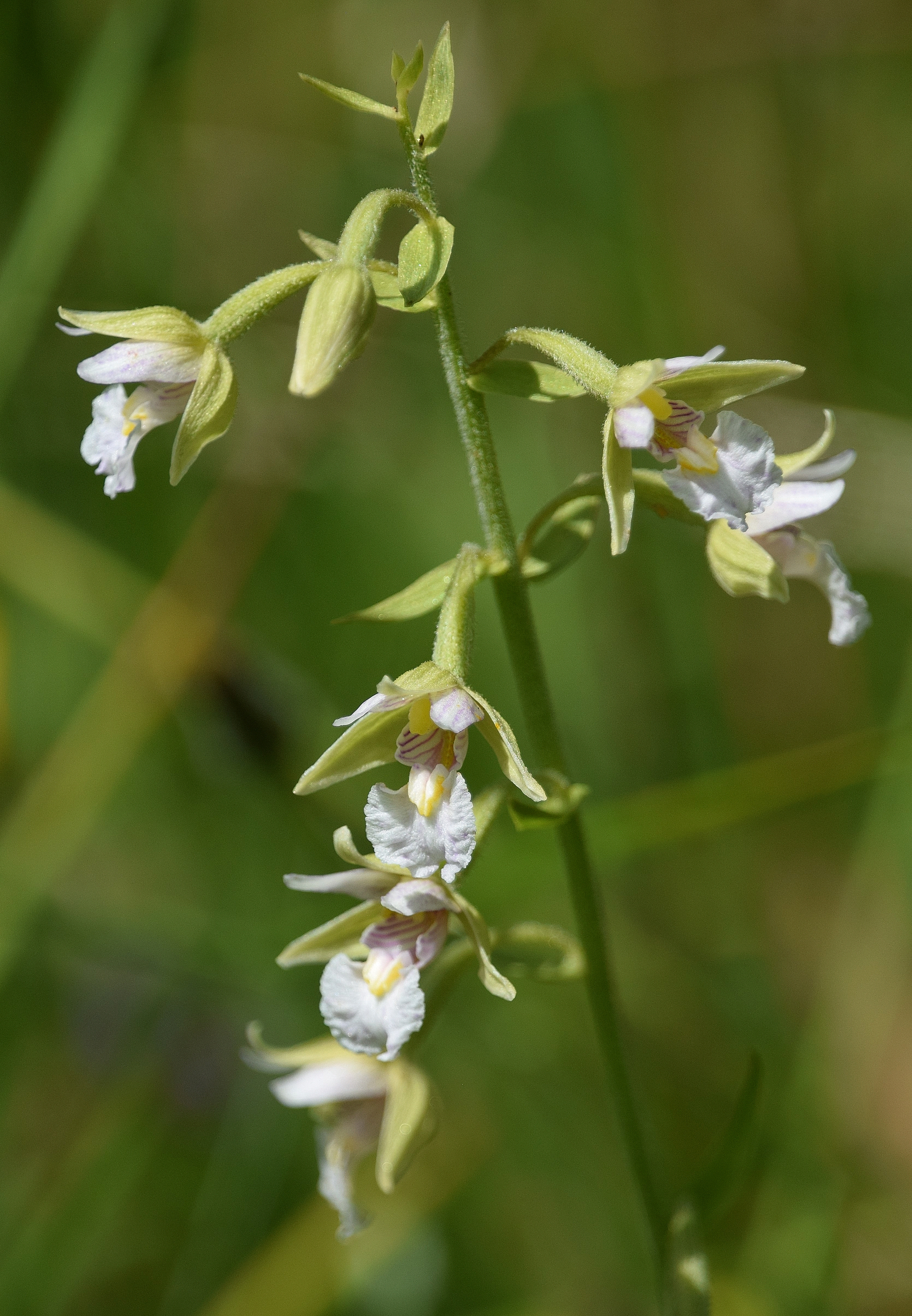
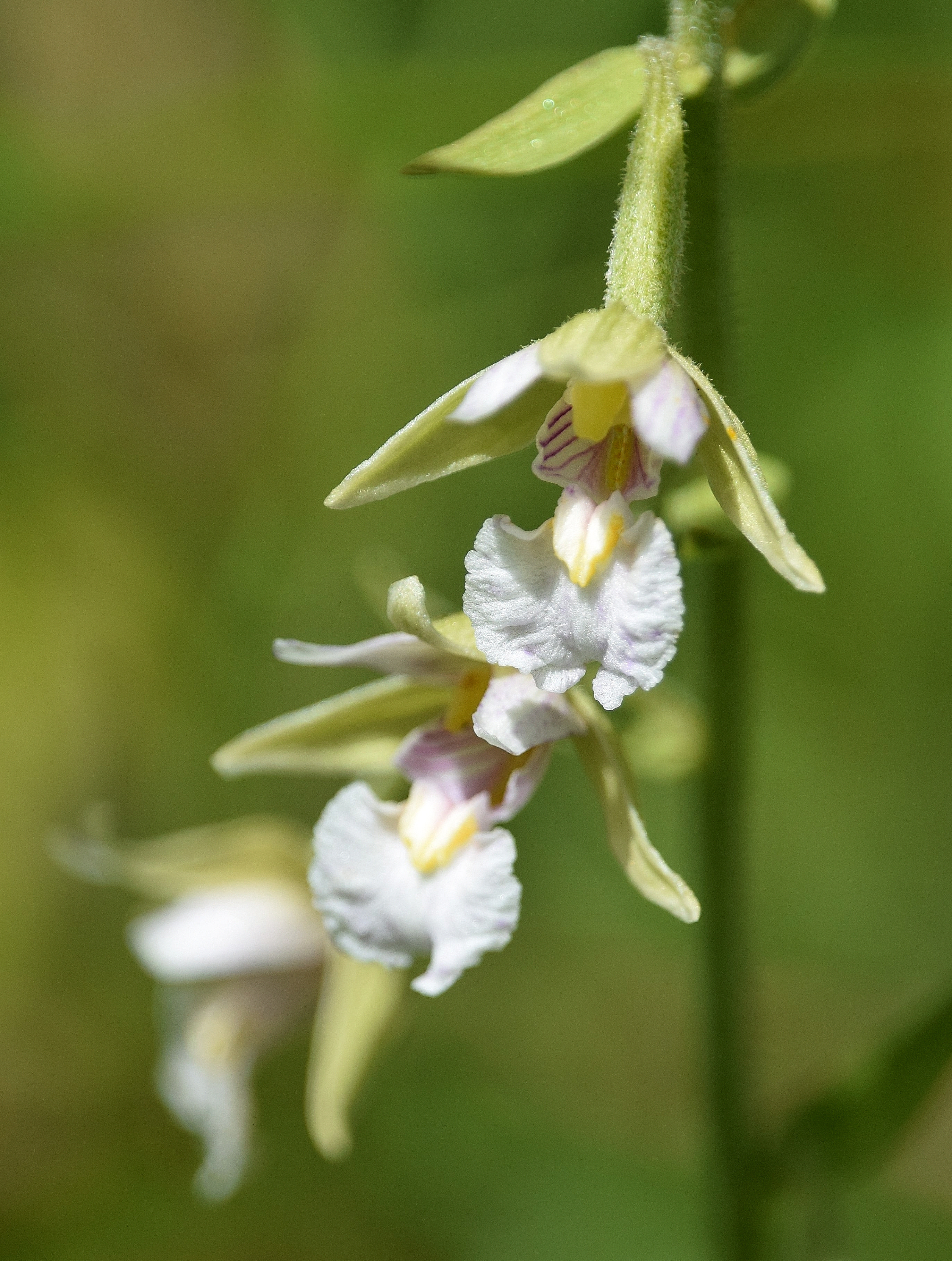
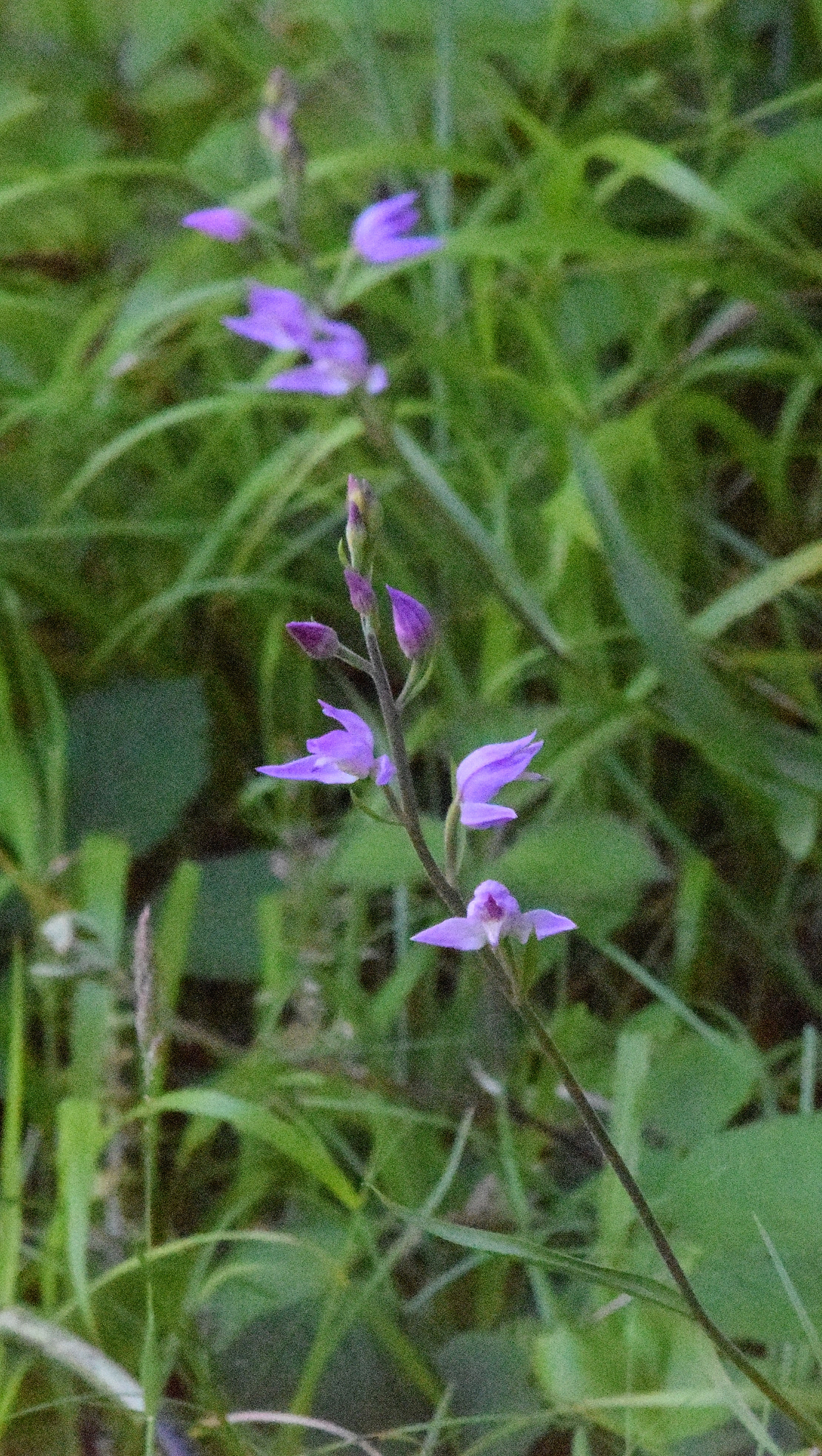
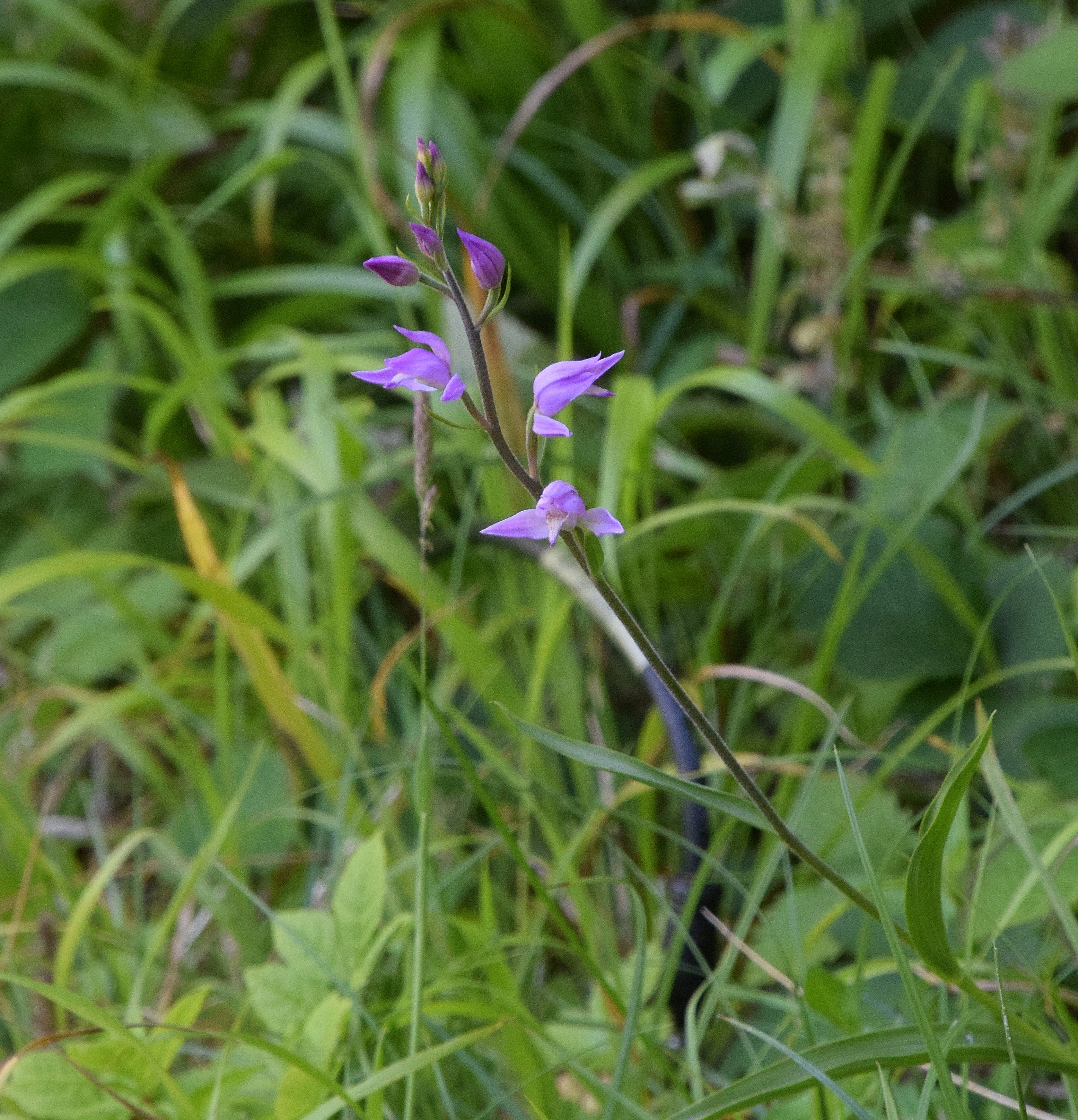
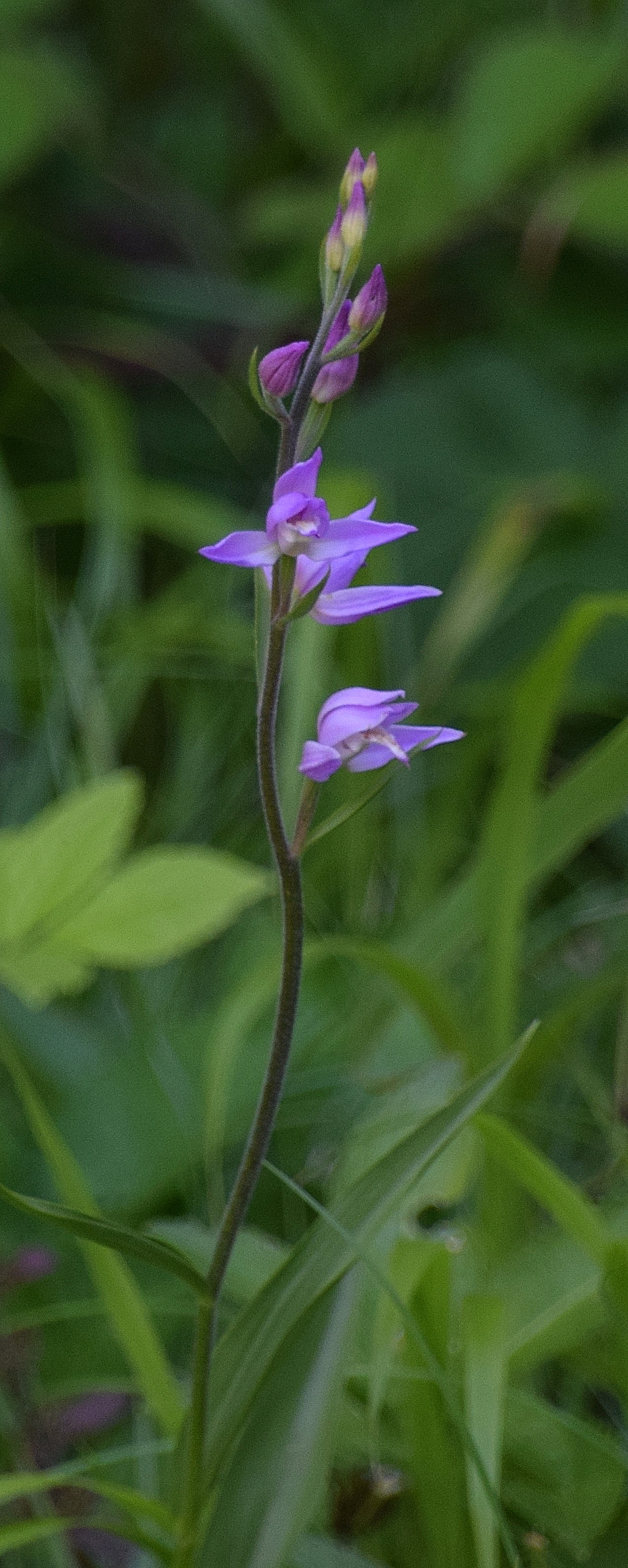
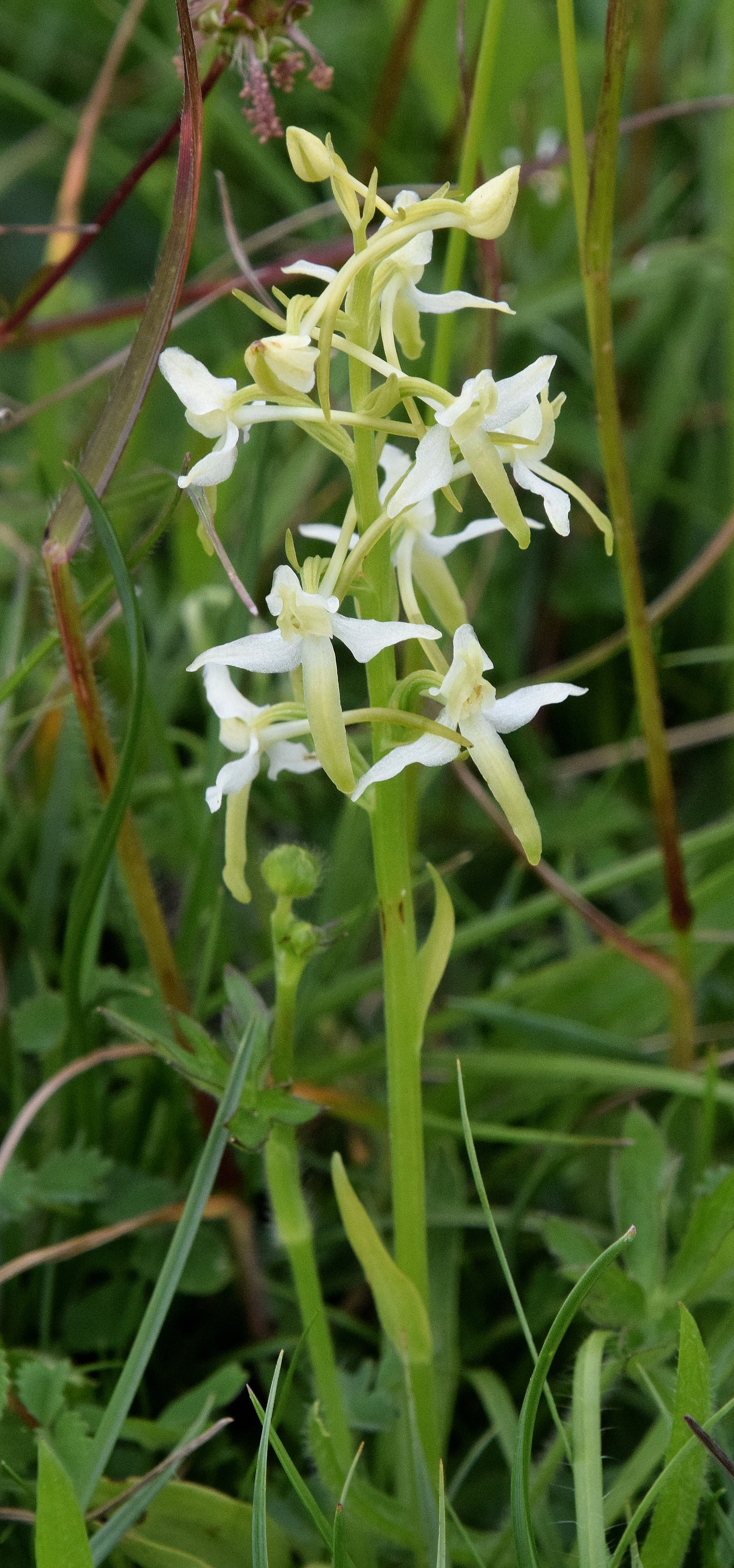
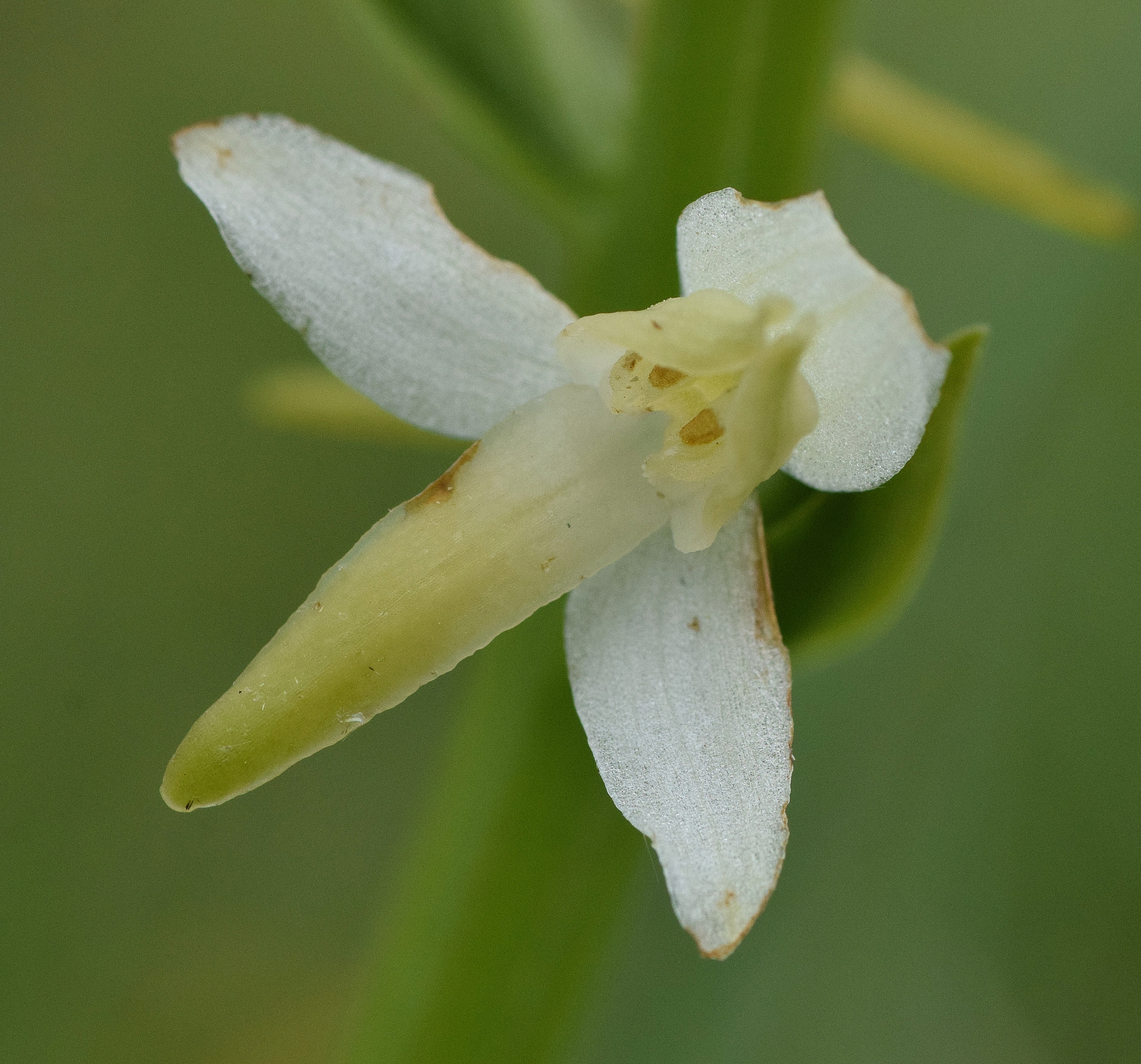
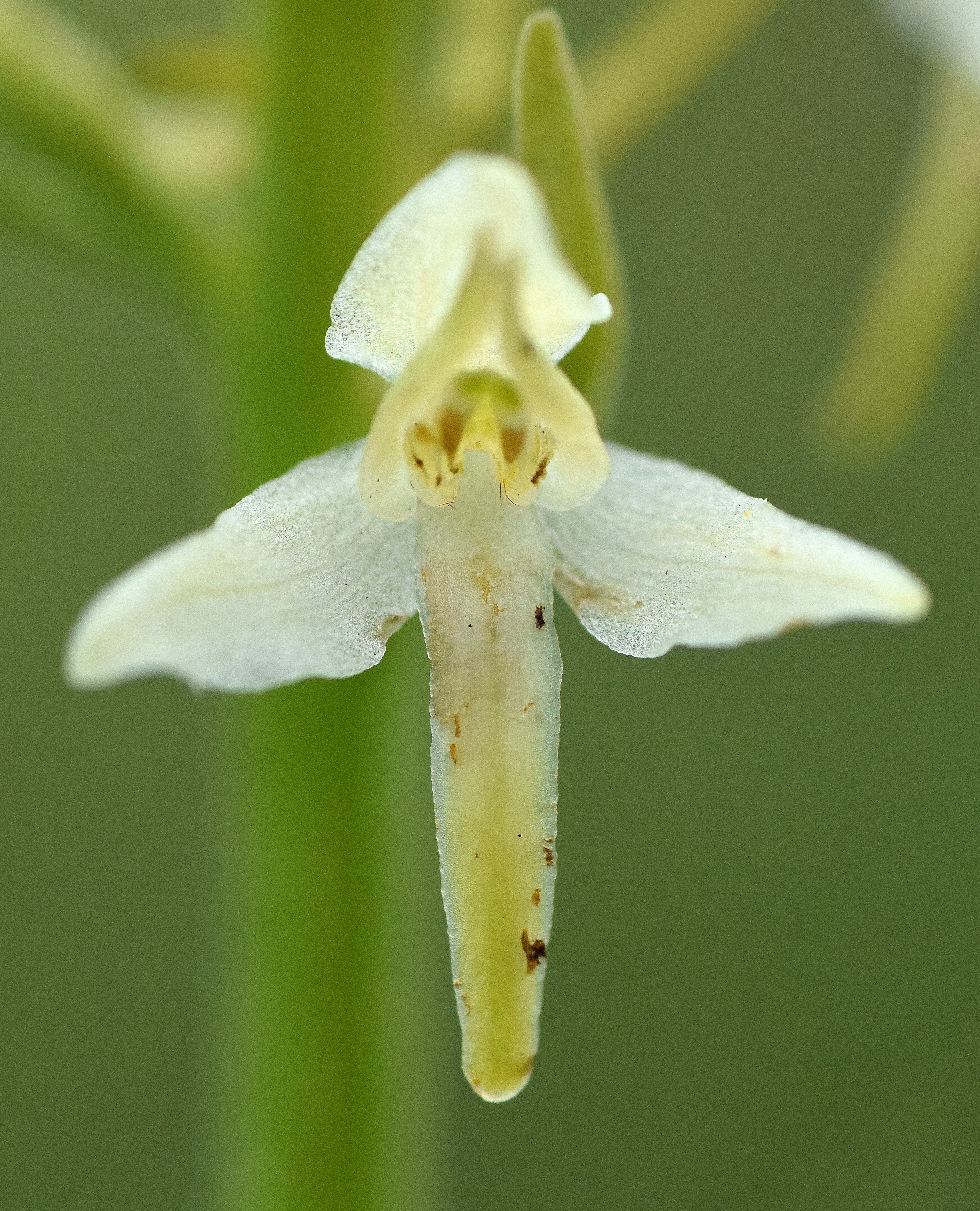
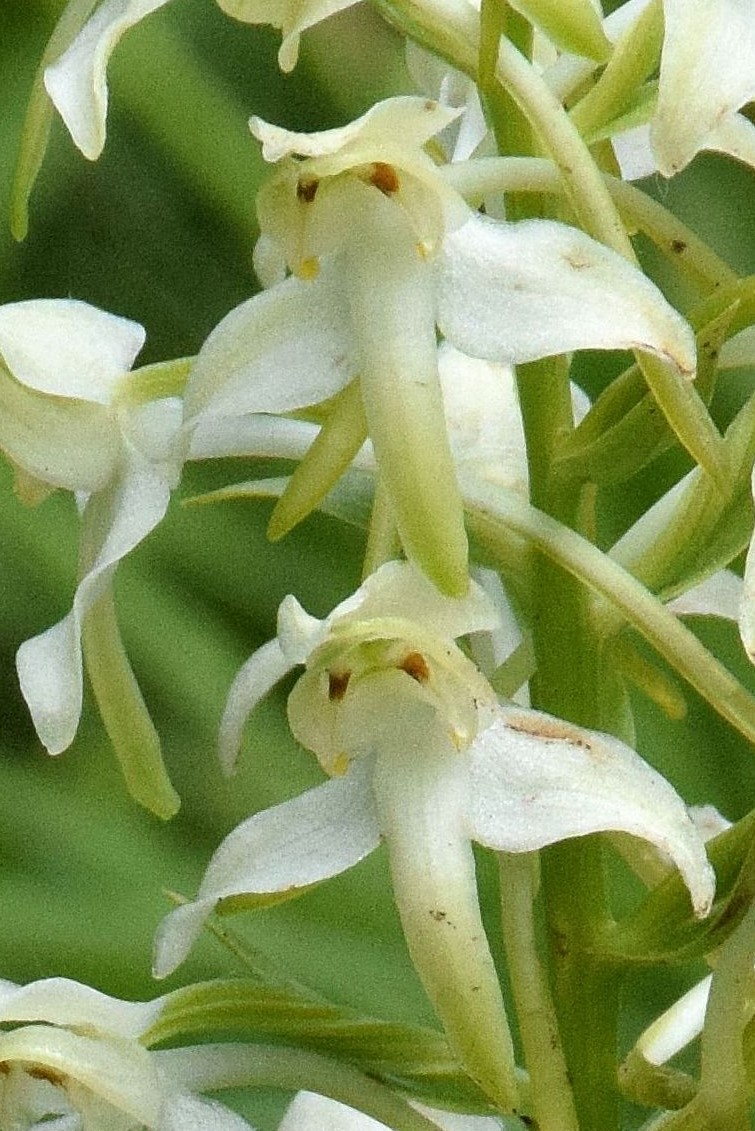
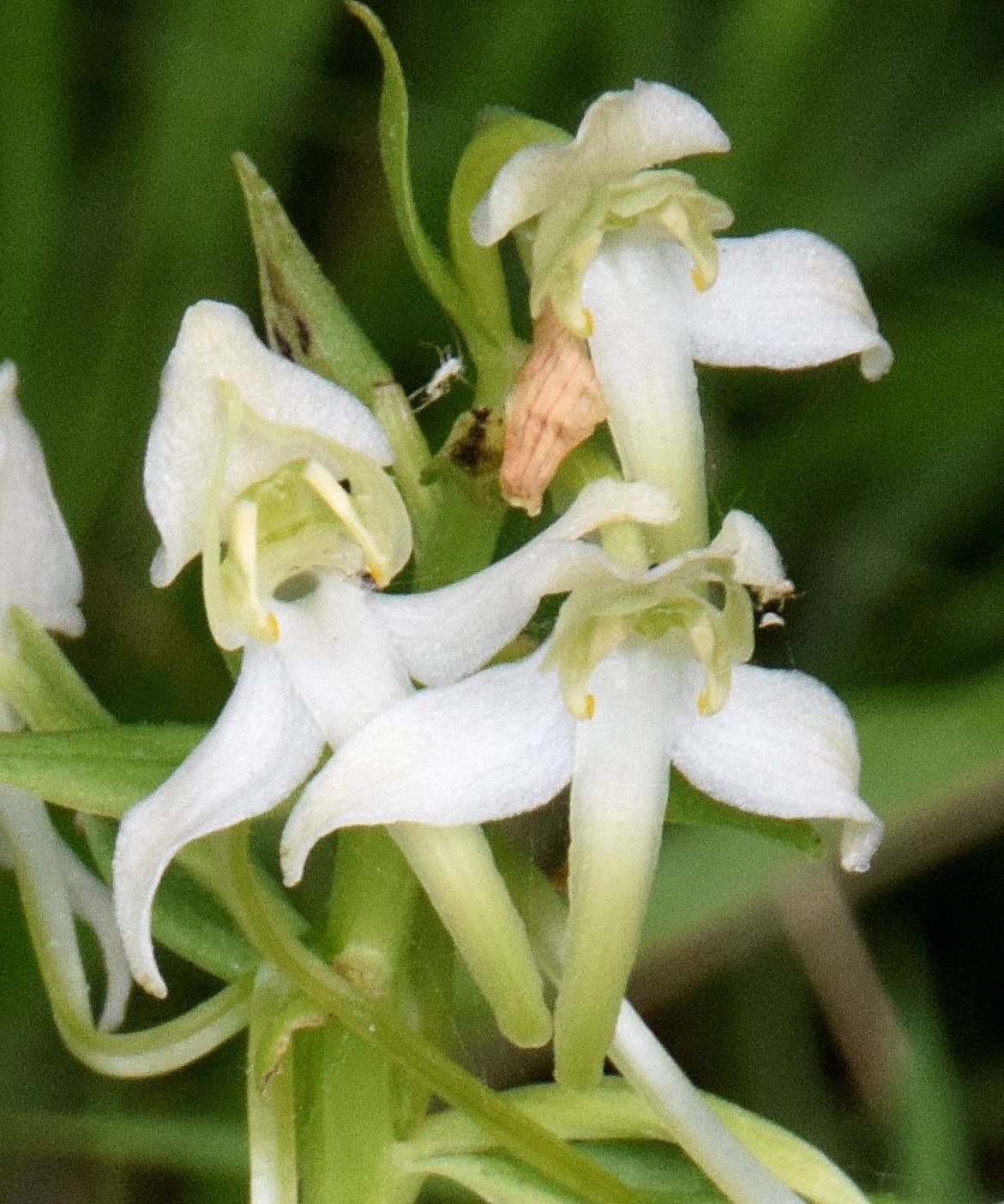
The Mapledurwell Fen Orchid package (from left): Southern Marsh, ssp schoenophila, Marsh Fragrant and Marsh Helleborine

Thursday duly arrived, and myself and Ewan set out to investigate. We would have the opportunity to identify and separate Southern Marsh, the sub-species and Marsh Fragrant Orchids in a single location. I was not expecting that to be a simple task. As a general guide my research suggested schoenophila is a thinner stemmed and more delicate looking plant than regular Southern Marsh with which it readily hybridises, while Marsh Fragrant can reach twice the height of its familiar Chalk Fragrant congener.

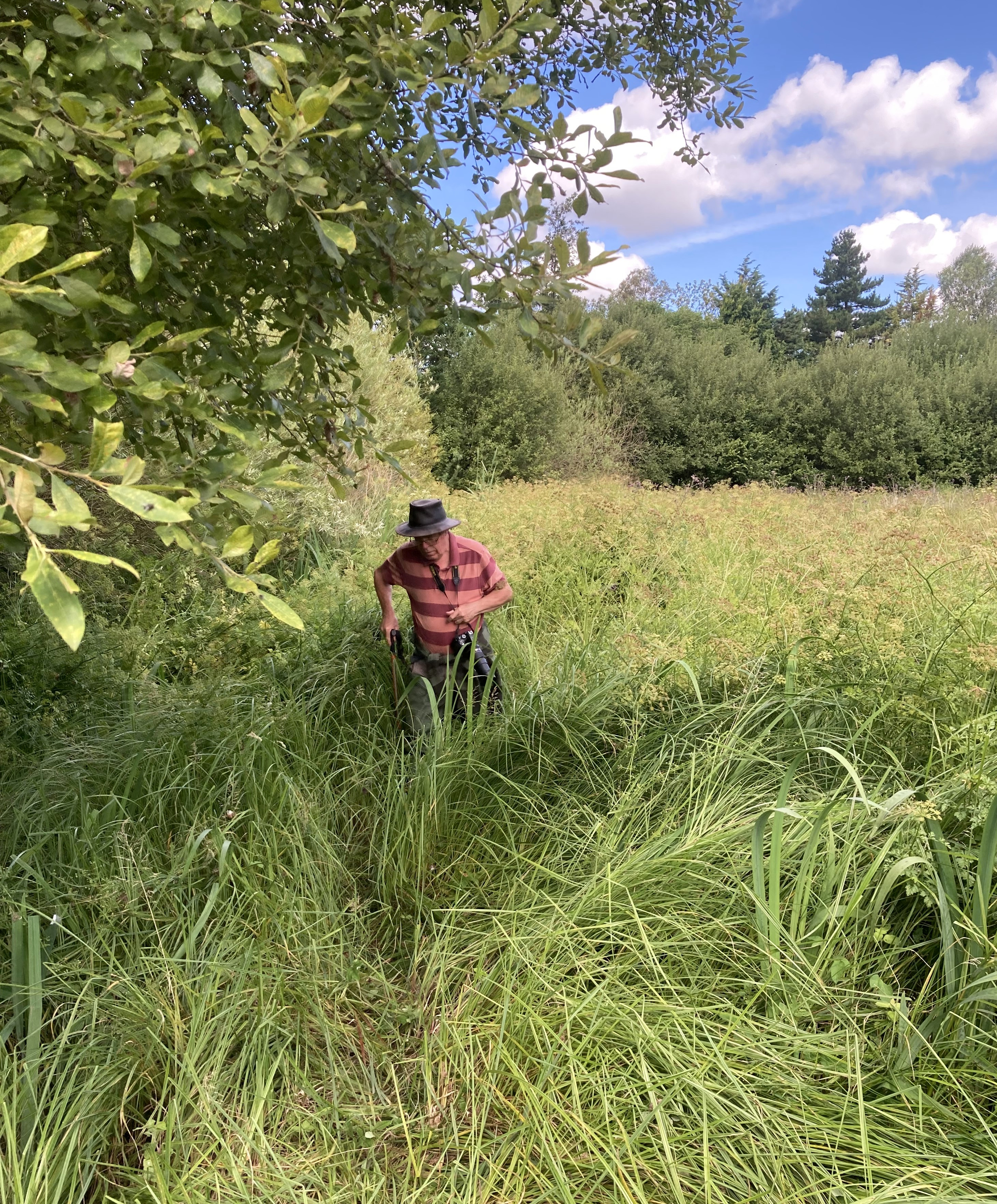
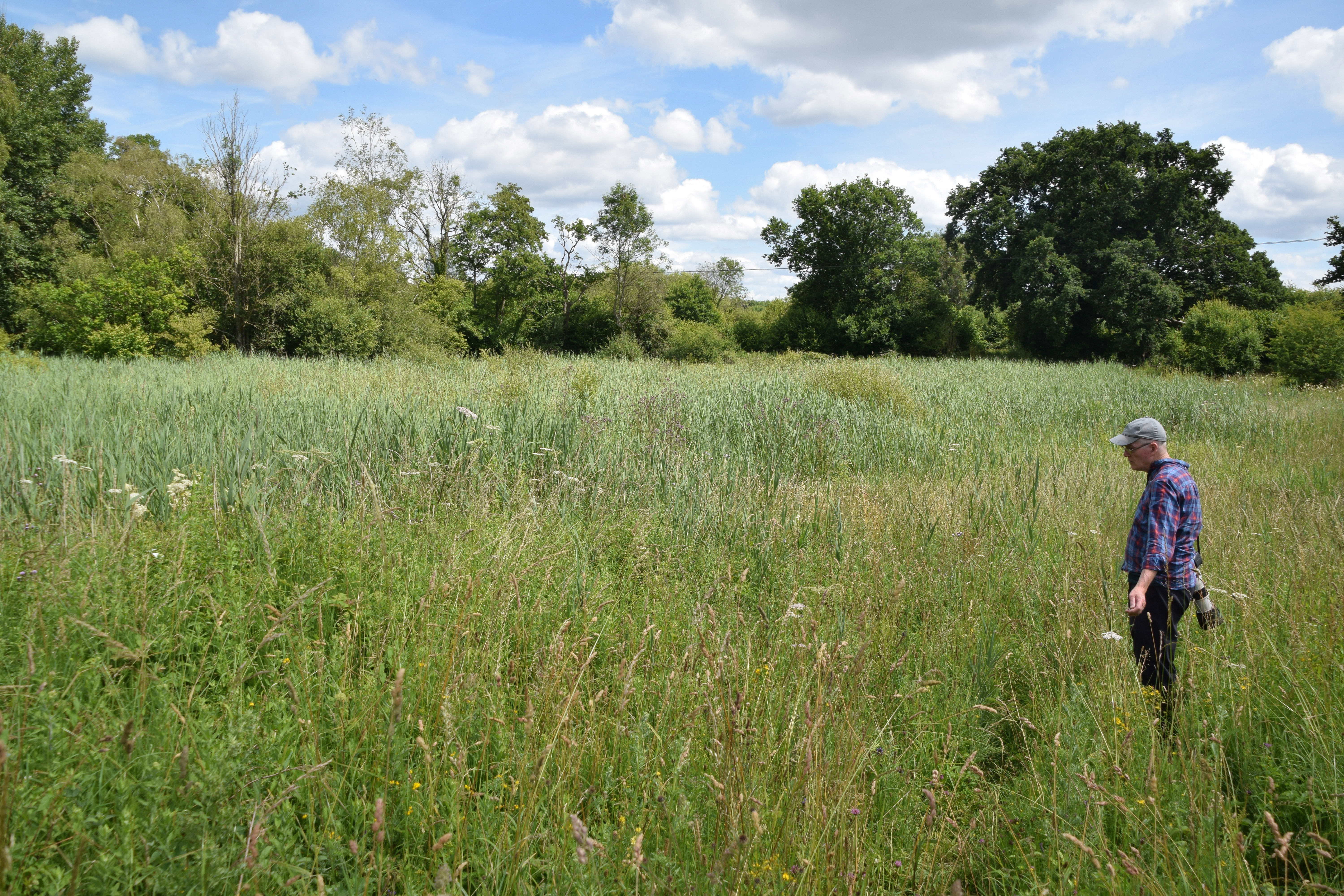
Arriving on site at Mapledurwell Fen (RG24 7JL – SU678523 – see here) the entrance was not easy to find. Housing development encroaches dangerously close, right to the protected area boundary, and the expected way in seemed to be up a private driveway. Then we noticed an iron gate behind the roadside hedge, that despite our having an access code for a supposed padlock we had to climb over. Ewan went to reconnoitre first, returning to say there were Orchids at the far end of the fen. Then I followed through trodden ways in the seriously off-piste habitat (pictured below), and there stretched out what we sought.

The first item I stooped to examine was recognizable from my researches and pictures seen online as the Marsh Orchid formerly known as Narrow-leaved, more of which could be picked out at intervals around. Southern Marsh Orchid ssp schoenophila appeared a thinner stemmed, more delicate looking plant than the more robust regular Southern. Those here were around 15 – 20 cm tall with shorter, typically angular flower spikes, and yes their leaves were narrower. In truly kosher Narrow-leaved the flowers are said to all face in the same direction, which I didn’t notice in any of today’s cluster.

Mapledurwell Fen Marsh Orchids including ssp schoenifila

In the field there was a “gut feel” about which plants were the sought sub-species that was no longer apparent when reviewing my pictures. I sometimes find this with other plants, insects or even birds. So I will not caption any of the above images as schoenophila, but given my brief from the HWT reserves officer at least some of them most likely are. More important was the opportunity to experience this complex mix of varying and hybridising plant forms, and appreciate the difficulty of accurate identification for myself.

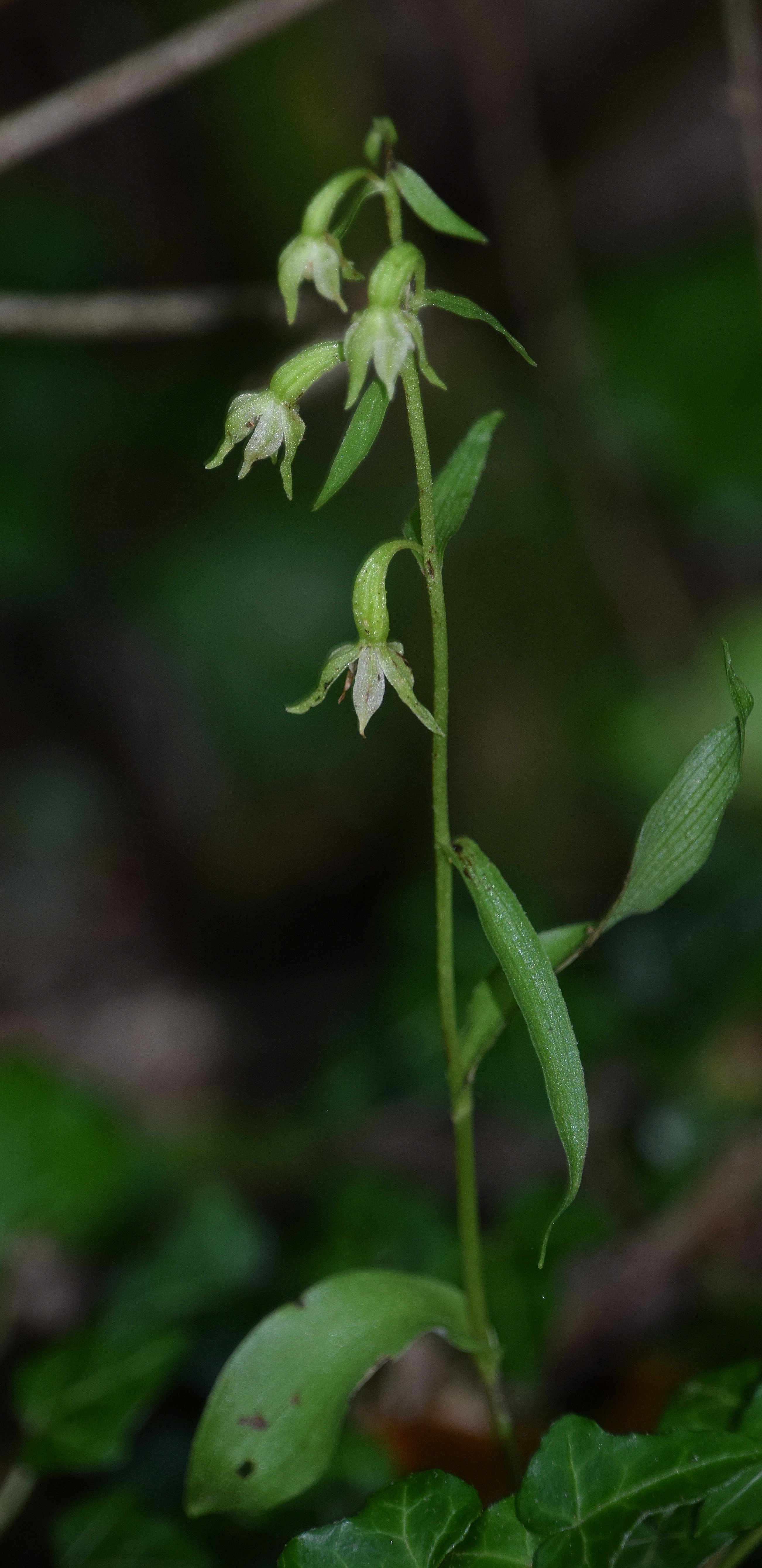
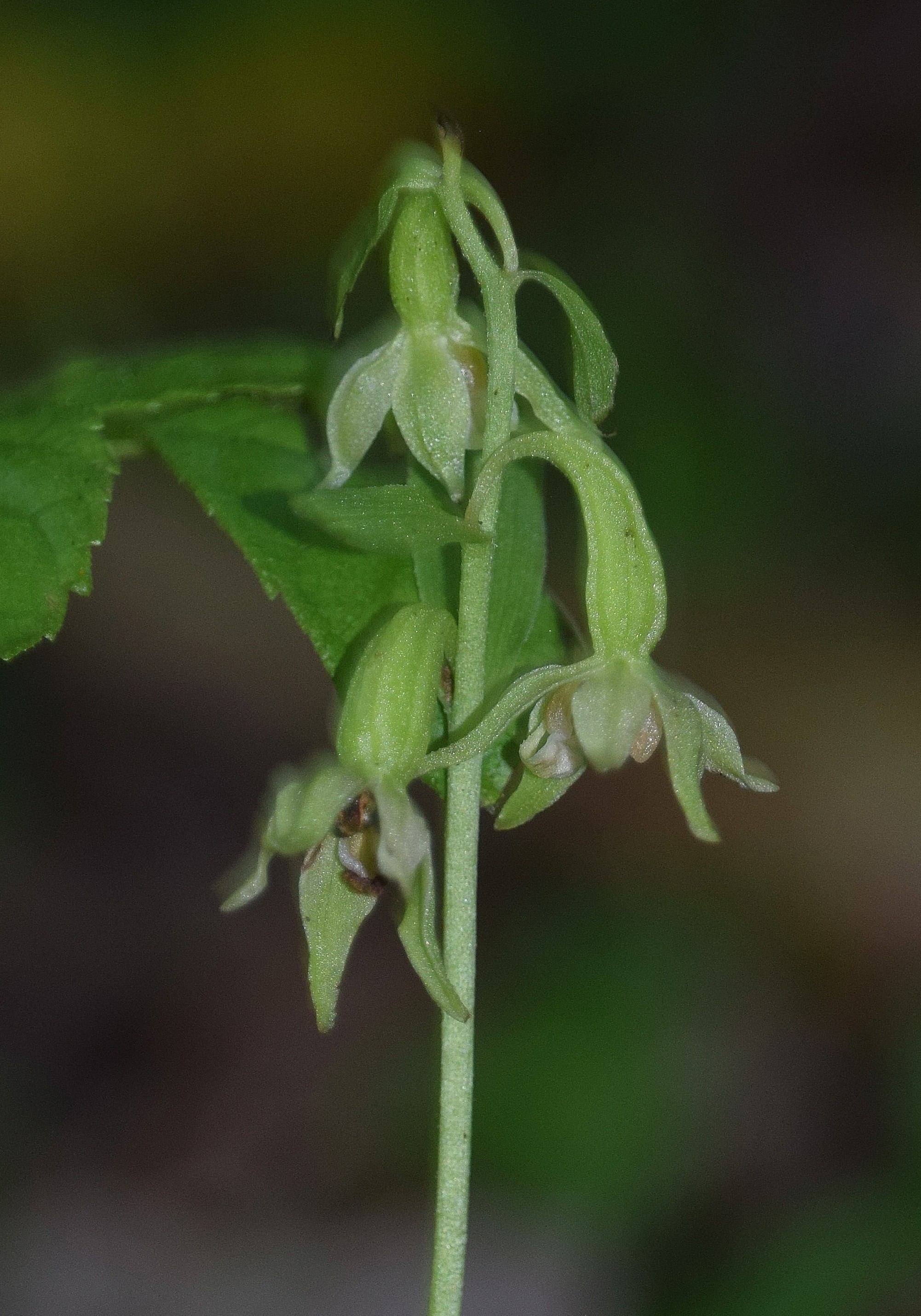
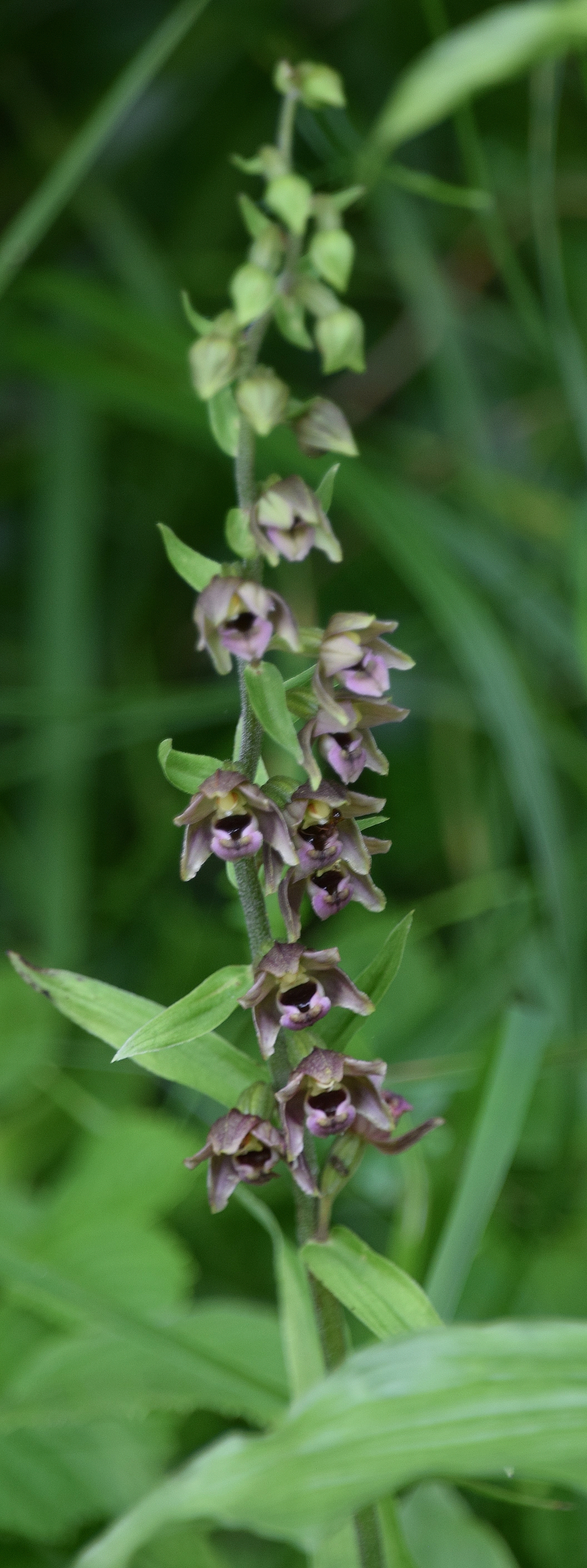
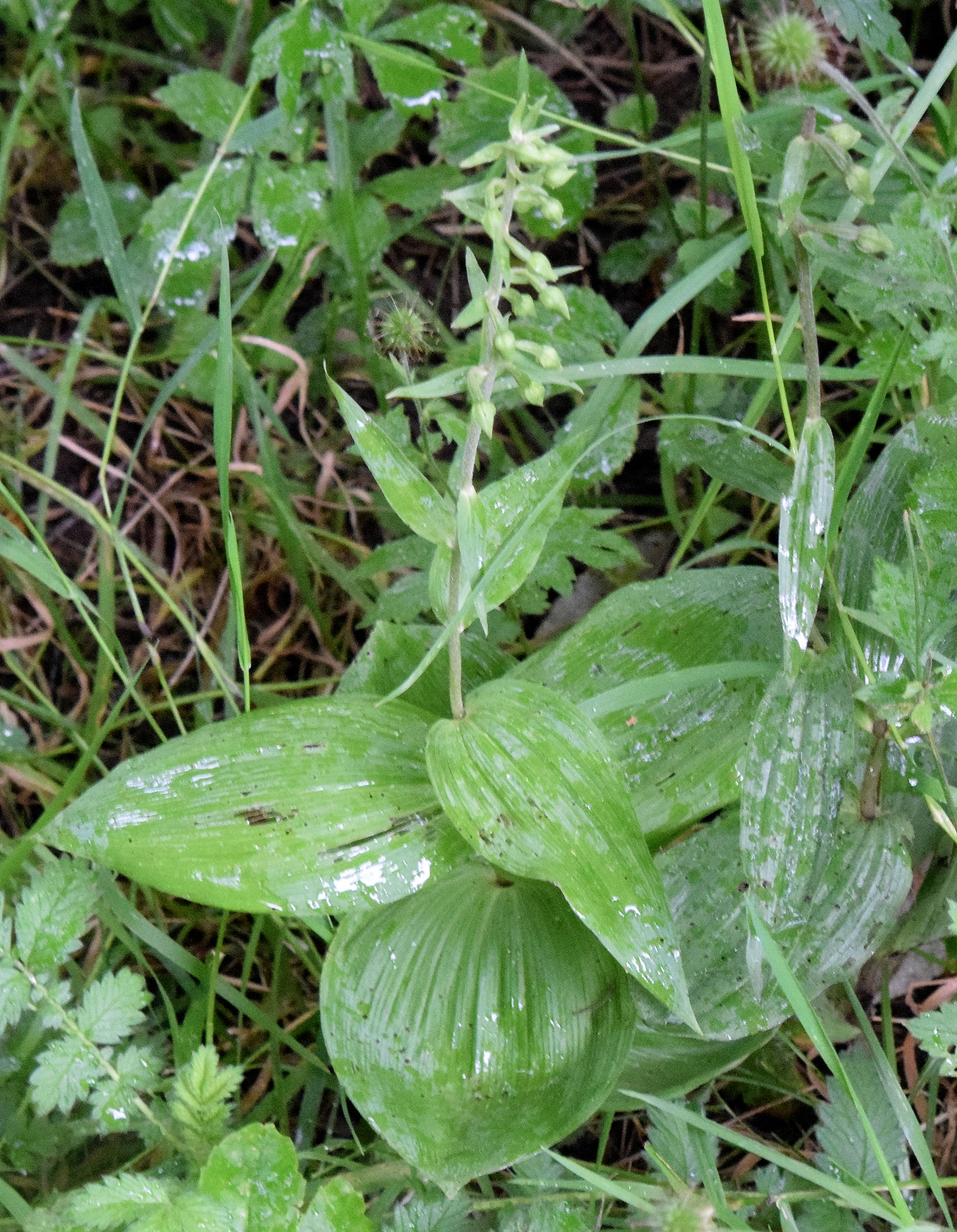
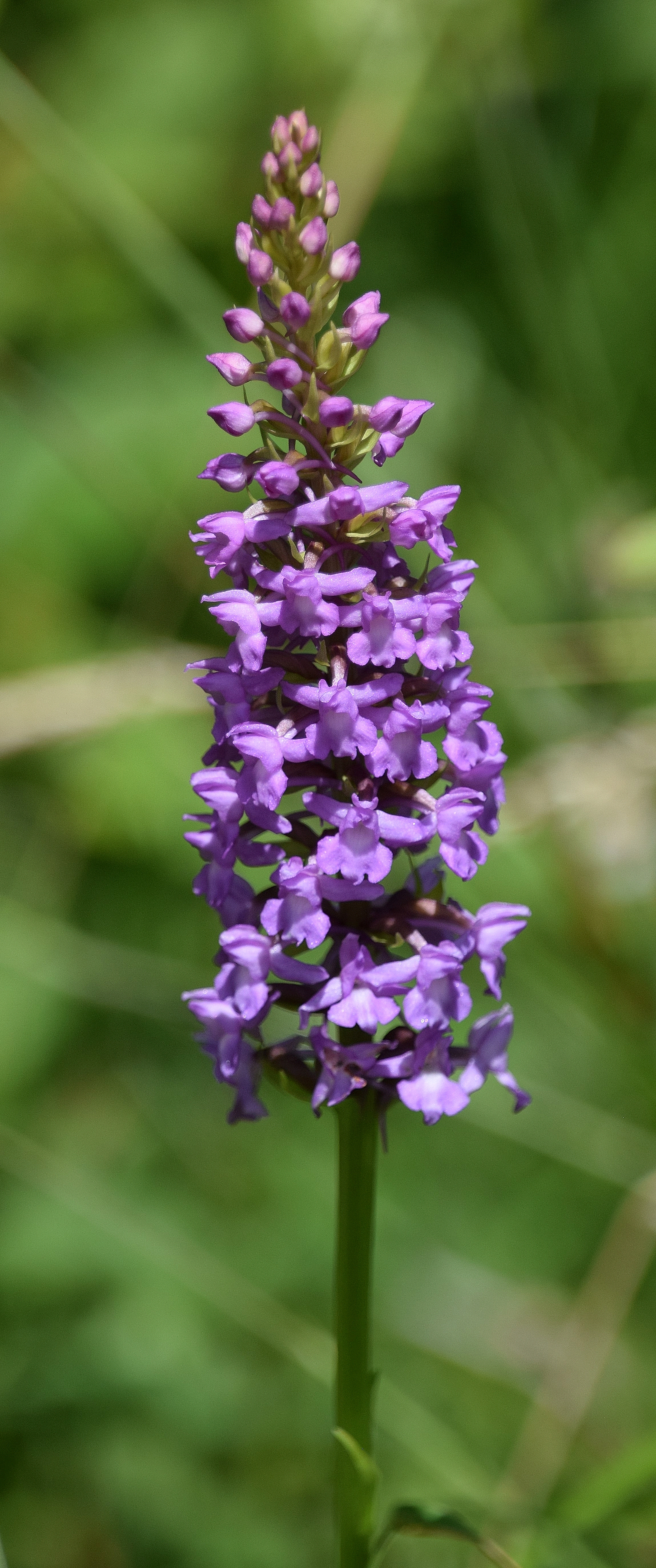
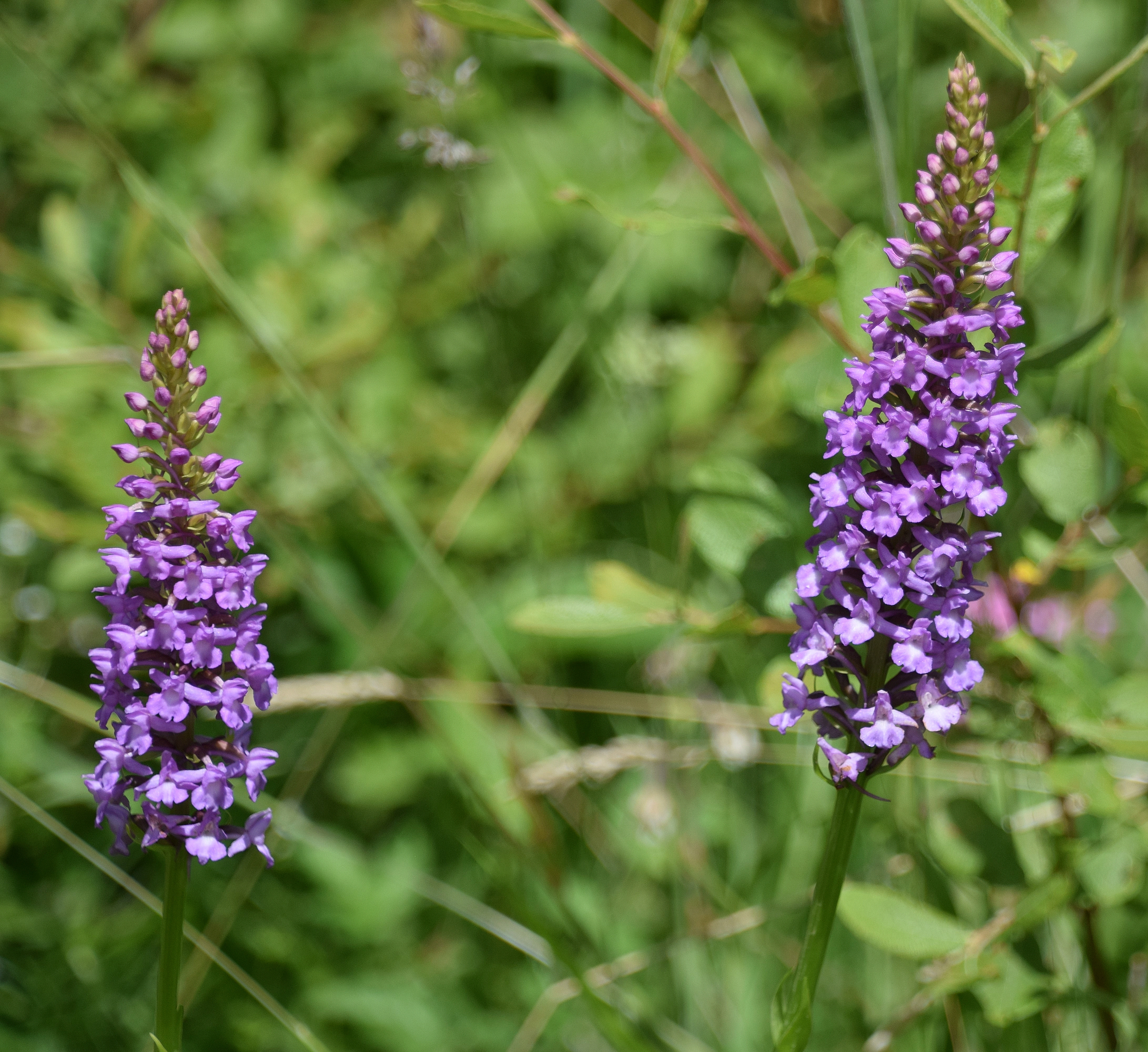
In a shadier area to one side, while my companion busied himself nearby, I noted the taller Marsh Fragrant Orchid that had brought me here in the first place. Then going over to look, good numbers of Marsh Helleborine announced themselves, some of which were a scarce pale form for which the site is noted. The full agenda for this exercise had thus been converted quickly and it remained to record the most photogenic specimens. Amongst the Dactylorhizae were shapes and sizes that allowing for hybridisation would have been virtually impossible to analyze accurately. In the following sequence the first two are particularly stately Southern Marsh. The third and fourth items are Marsh Fragrant. We were clearly in an intriguing place.

Some taller Southern Marsh specimens (left) and Marsh Fragrant (right)

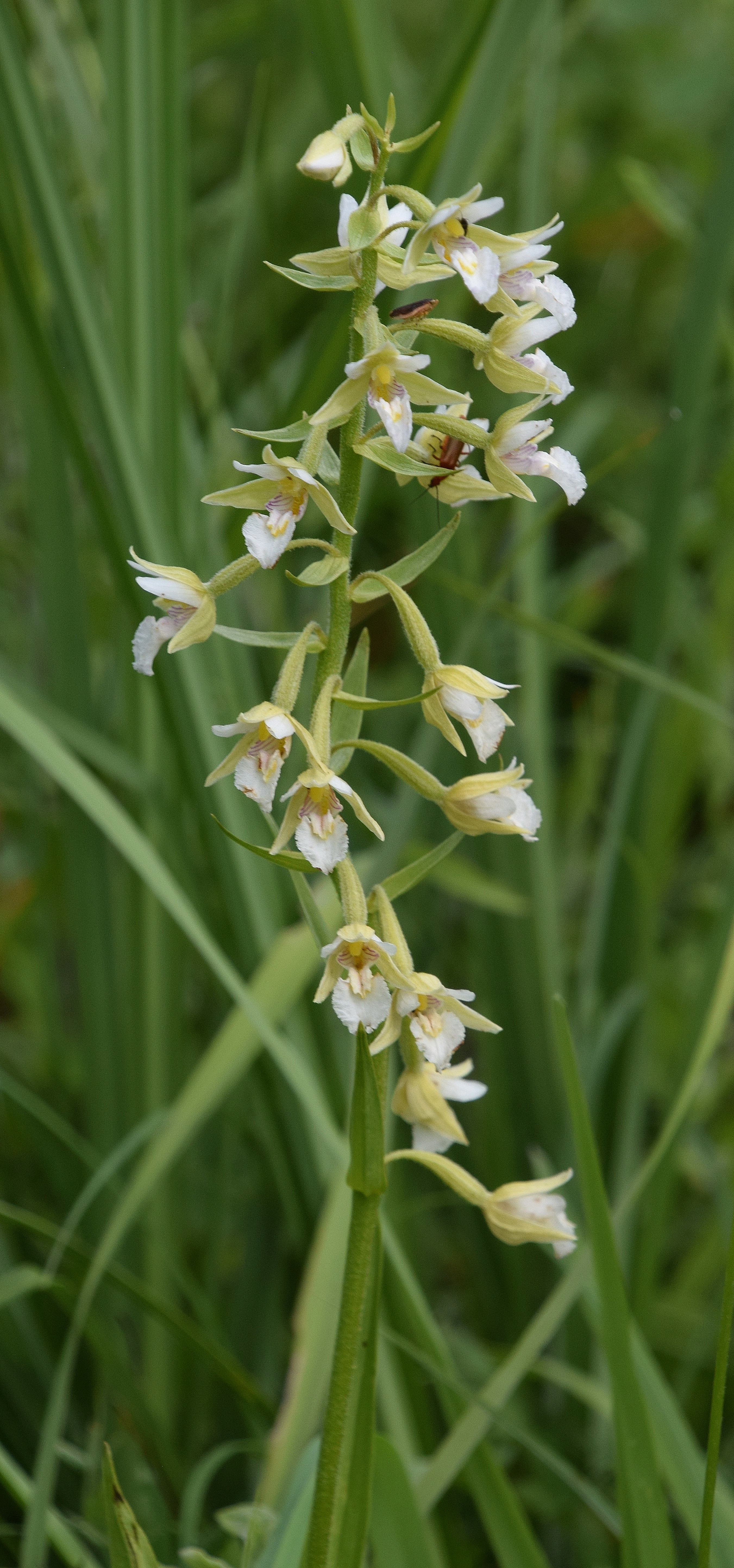
Marsh Helleborines, including the Mapledurwell specialty pale form (far right)

We moved on three miles to an area of HWT’s nationally important Greywell Moors fenland (see here), that is especially rich in Marsh Orchids at the moment. This particular site is noted for blending original, spring-fed calcareous fen with chalk grassland, due to the historic disposal of lime spoil on top of the chalk bedrock. That has given rise to an unusual mix of downland plants co-existing with moisture-loving fen species here. Access is by permit only, obtainable from the reserves officer who can advise the exact location.

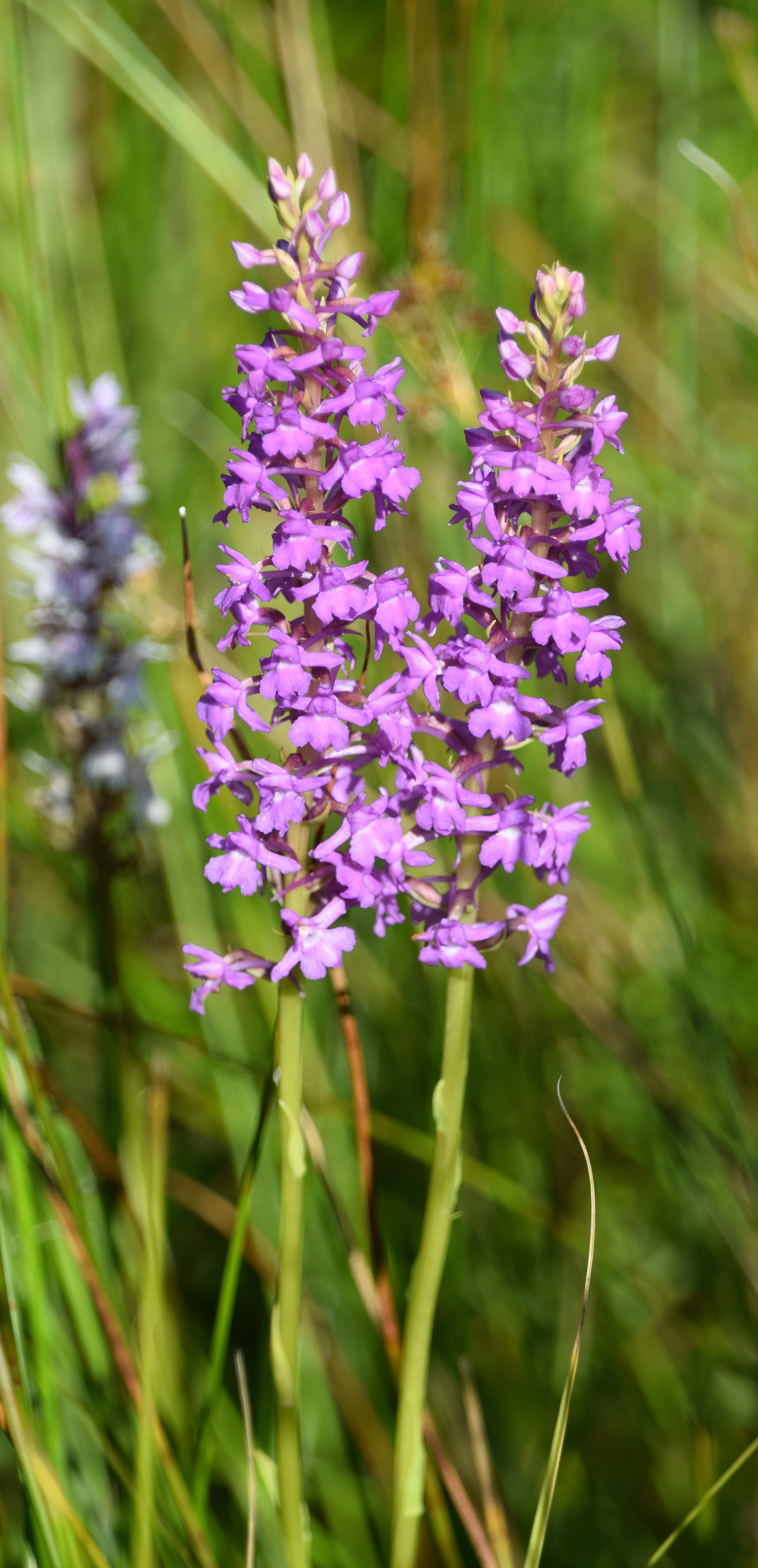
Greywell Moors, with Marsh Fragrant (below, left) and Southern Marsh (right) Orchids

Marsh Fragrant Orchid (Gymnadenia densiflora – pictured above) occurs only in alkaline marshy ground fed by calcareous water. It is thus more distinguishable from the two other British fragrant species on grounds of habitat rather than significant physical features. I have to say today’s plants appeared quite similar to the closely related Chalk Fragrant species. But the spikes are said to be more tightly packed, hence the botanical name. There can be up to 100 flowers in shades of pink on the tallest stems (up to 70 cm) from late June to August. But I understand infinite variation in supposed diagnostics render this group as difficult to separate reliably as the Dactylorhizae, without DNA analysis being employed. Today’s plants certainly lived up to their name as the fragrance when taking these pictures suffused the air.

Walking on past the best area for Marsh Fragrant, we came to an expanse of pure fen that was chock full of Southern Marsh Orchid. Now I became re-acquainted with the robust, round-topped forms that have so appealed to me over the past two summers, rather than the skinny and untidy looking things encountered earlier at Mapledurwell; sub-species, hybrids or whatever they were. I had been briefed that a very rare, pale green Southern Marsh individual was available to view here, but we didn’t find it. And everywhere we might look more and more Helleborines blended in their discrete, unobtrusive way with the other fenland vegetation. I have read the last-named is considered one of the most subtly beautiful of all British Orchids, and they certainly entail allurement.

Regular Marsh Helleborines with reddish stems and sepals

Amongst them were examples of the pale-flowered Marsh Helleborine variation epipactis palistris ochroleuca. With these especially attractive items (pictured below) the yellow-white toned flower is almost devoid of red and the three sepals are mostly a greenish-yellow. The hairy stems are likewise less reddish and more green. I understand this variation is more often found in coastal dune systems than fenland.

Marsh Helleborine var ochroleuca

It by now being early afternoon, tummies (mine especially) were craving sustenance and so we headed homeward, via first a nearby sandwich stop then a supermarket on the Basingstoke ring road. I usually got birding posts out soon after the event in past years herein, but required research and the quantity of pictures to review and edit when doing Orchids can make them more difficult topics to present. Given the previously stated complexity of this one that process has taken five days! What is recounted herein was one more superb episode in my current national Orchid odyssey, that has now almost run its course, but a little more still awaits.

Bald Hill, Oxon re-visited for not so fickle Frog Orchids – 4th July

I struggled with this item a year ago, before eventually experiencing some rather under-whelming examples with expert assistance (see here). Now, well into my second Orchid season, options for new varieties to see have dwindled moving into July. With the weather in Scotland again unfriendly for converting my last required British dragon and butterflies, and spur of the moment air fares too high for my liking, I resigned myself to seeking out two unencountered Helleborines – Green-flowered and Narrow-lipped – to fill the month ahead. I knew of historic Oxon sites for both of them but things were likely to be a challenge.

I began this British general election day at a woodland near Henley: itself a previously safe, one-party parliamentary constituency that I reside half a mile within, and so my own floating vote has not always influenced things. As in 2023 I failed to find the first of those Orchid targets though it would have been early to do so. Moving on to the south side of Aston Rowant NNR for my wildlife year’s first visit, as I walked out the phone rang. It was an invitation to a private viewing of both the still sought Helleborines in a neighbouring county later in the month. That at once dented my always fragile motivation for doing things the difficult way locally. But there were still Frog Orchids to re-acquaint myself with, and so I rambled on.

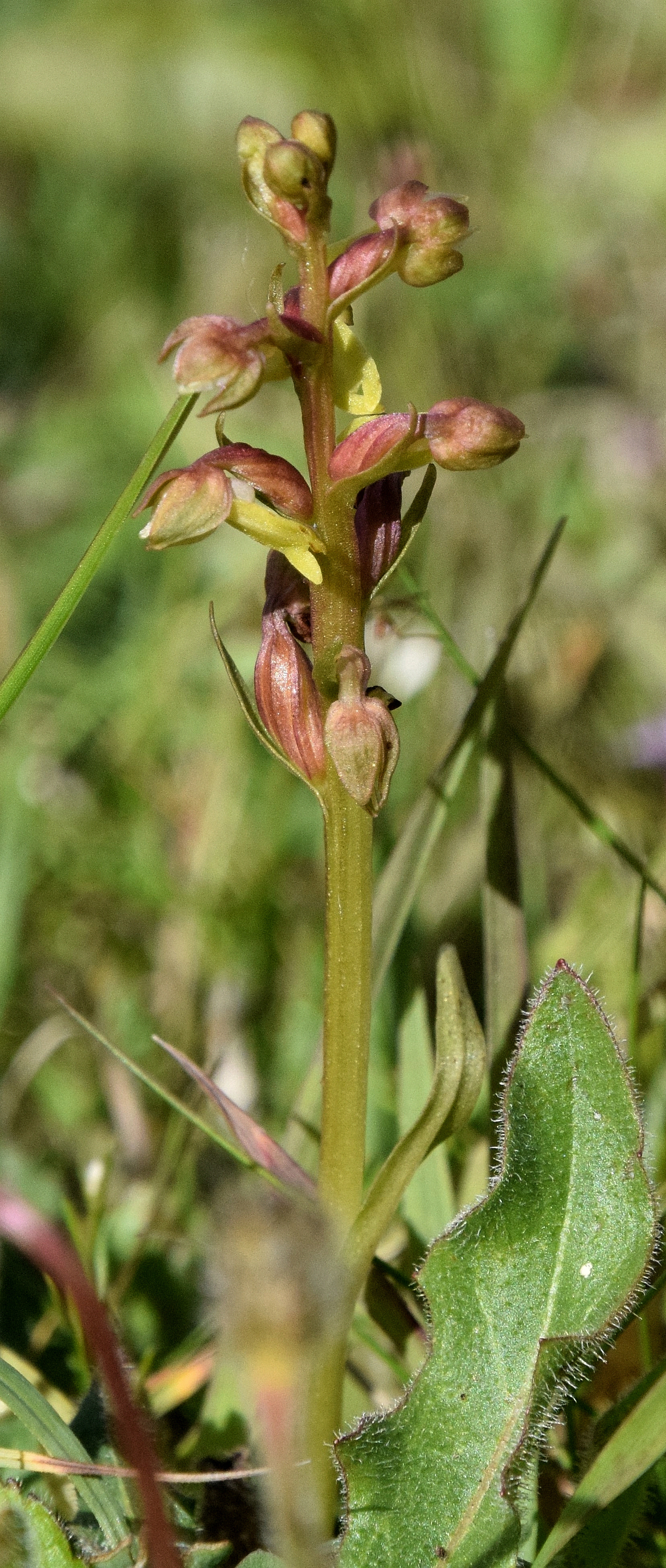
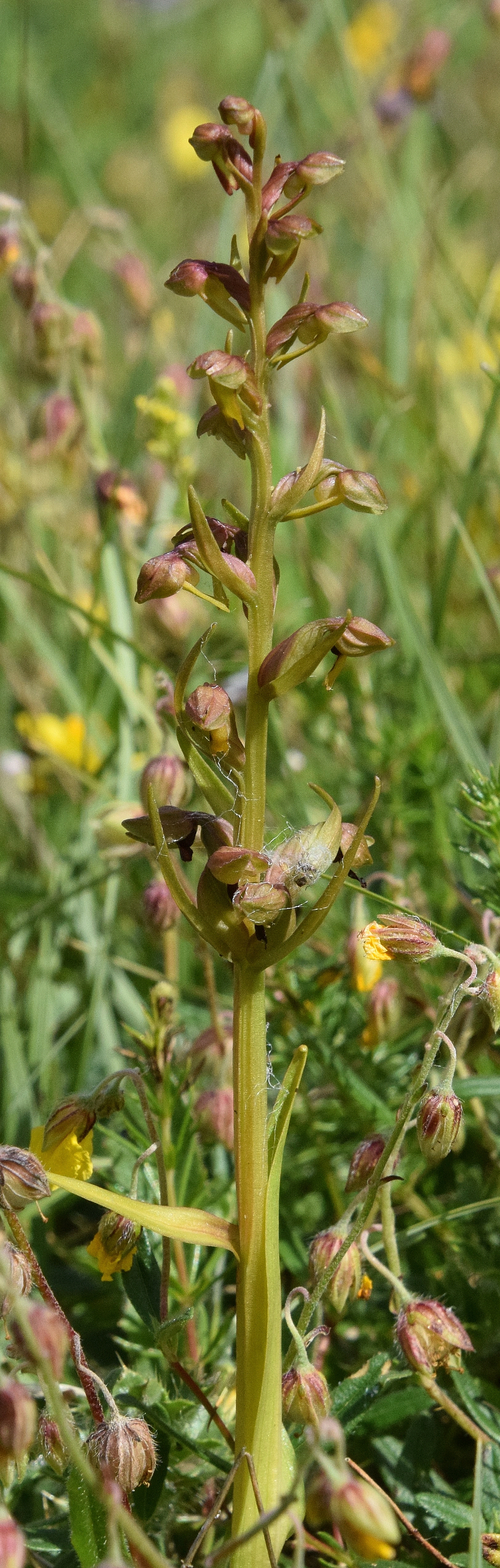
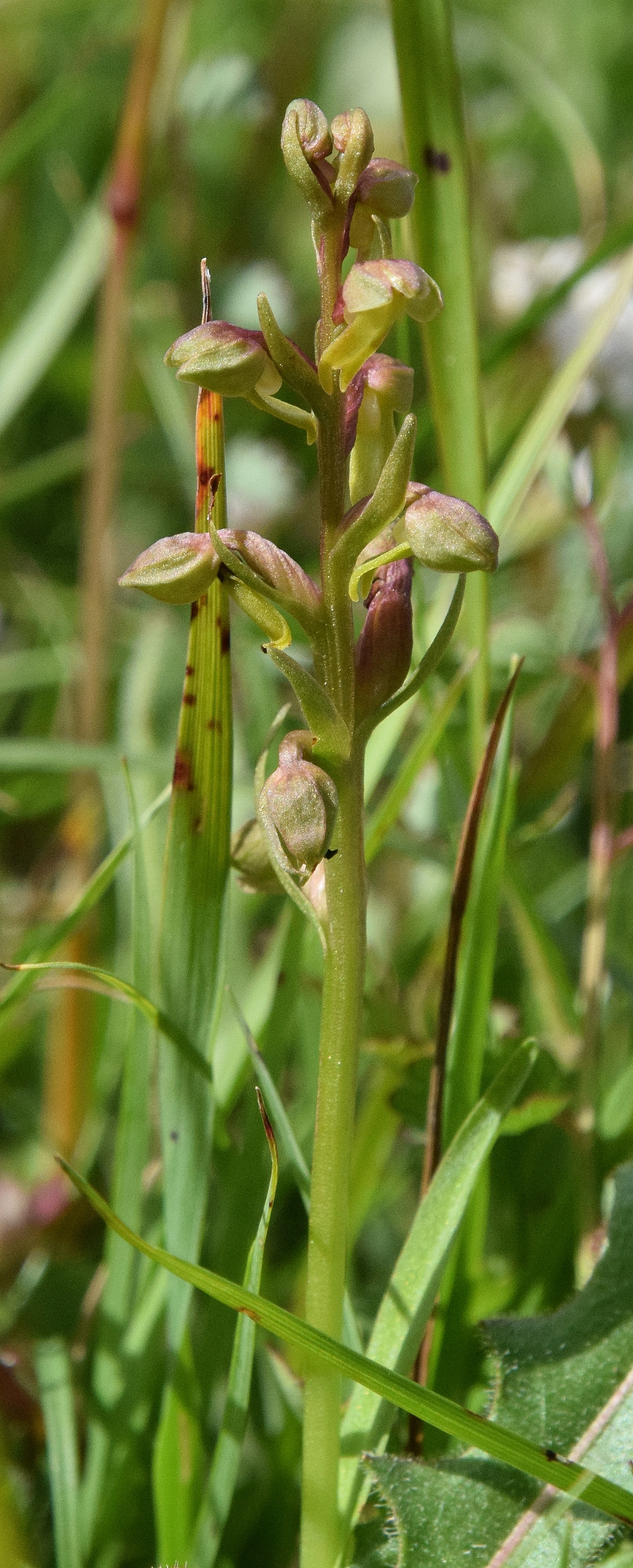
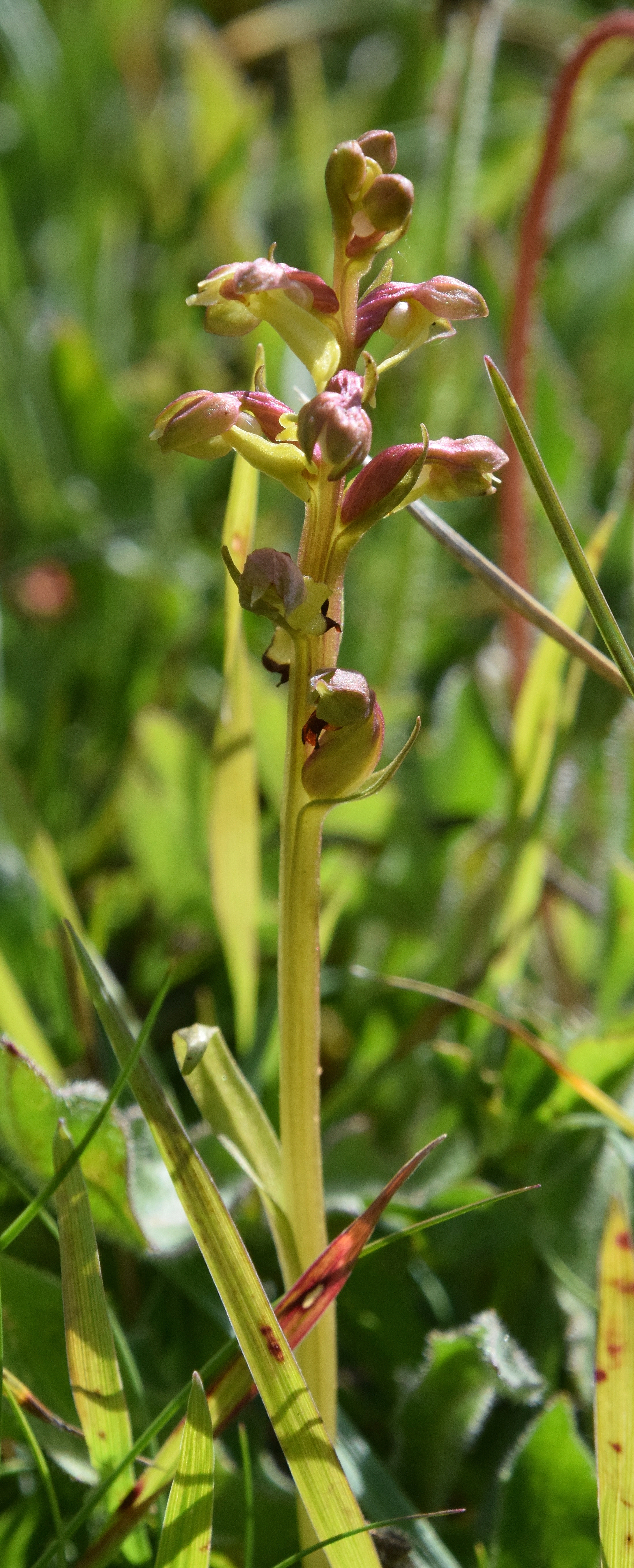
Frog Orchids

Having got my eye in properly with the tricky little things at Morgan’s Hill a week earlier (see previous post), I located some quite easily this time. I wanted to do justice today to these arcane entities that seemingly hold a capacity to intrigue that controverts their rather lurking physical presence. There were a number of enclosures along the south facing slope of Bald Hill (SU722960) but they were not for protecting Orchids, instead containing areas of weed-killed vegetation. Puzzled by that I eventually met a volunteer who was engaged in eradicating an invasive grass species with herbicides. I naturally hoped more sensitive plants would not be affected, then he went on his way.

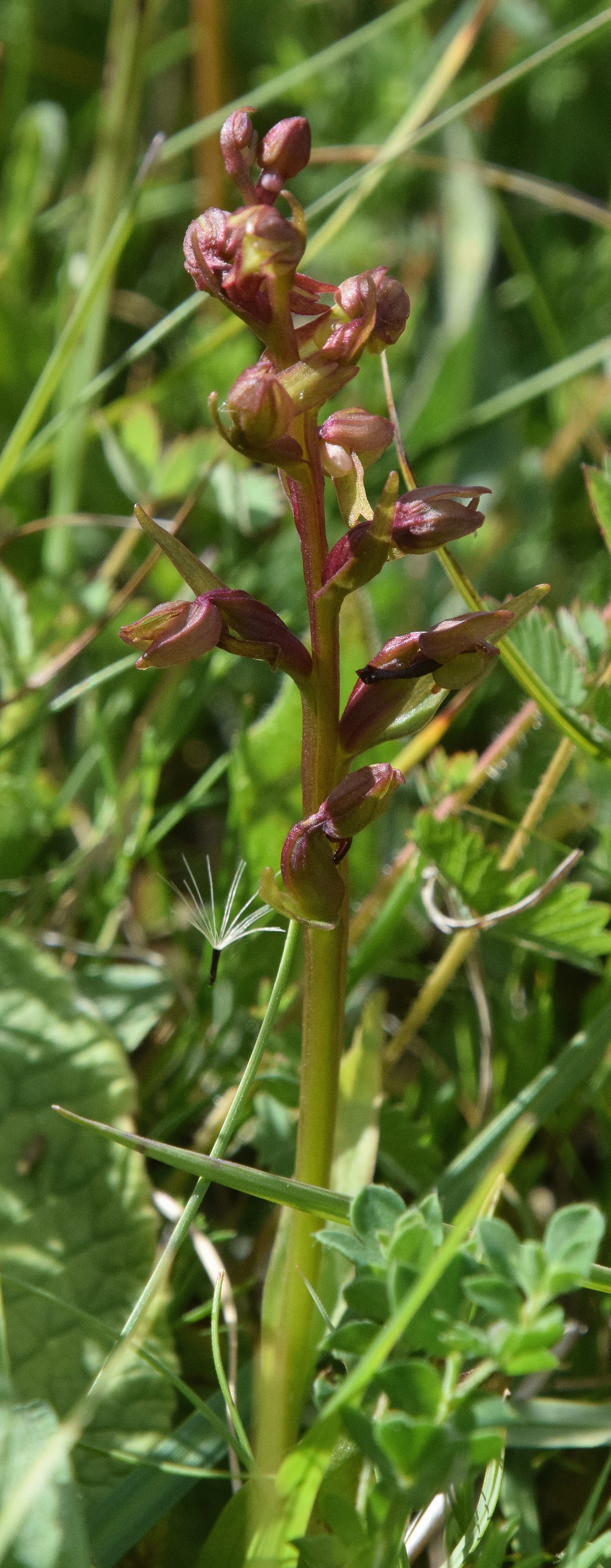
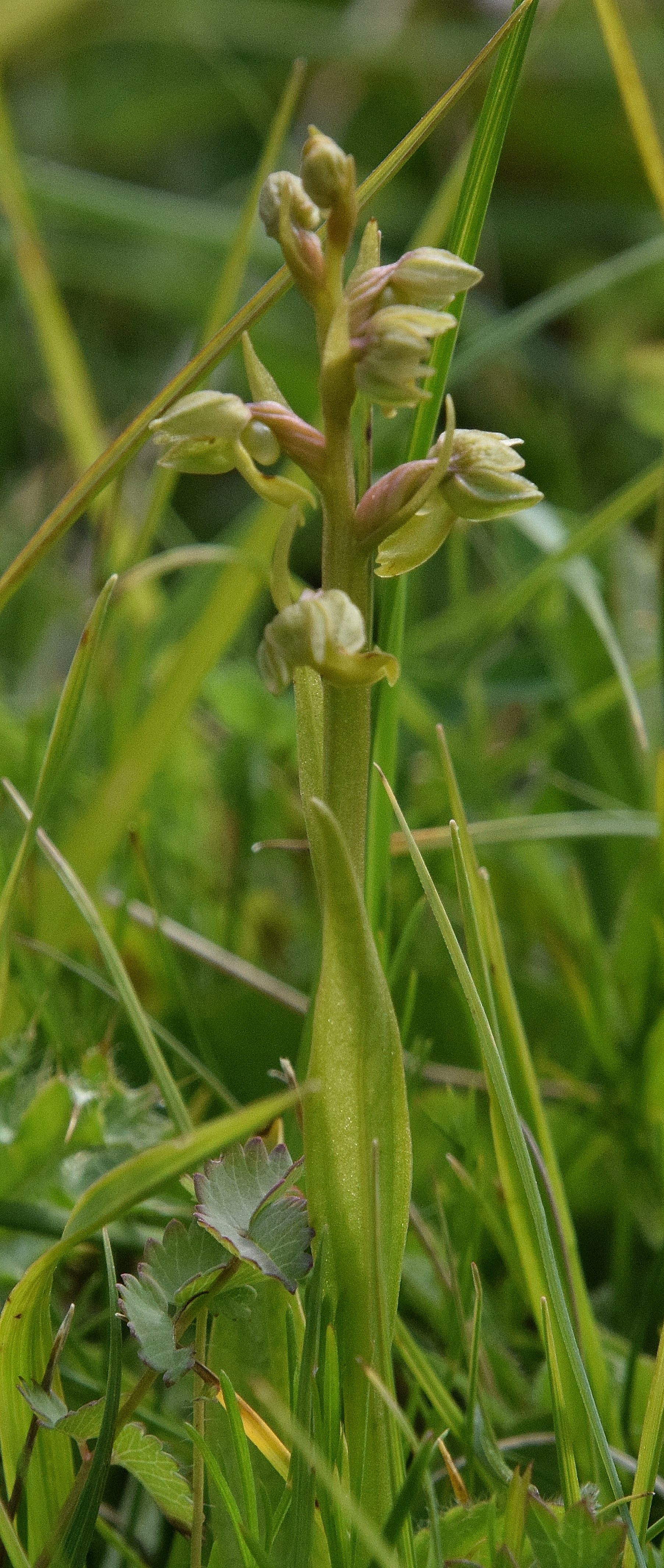
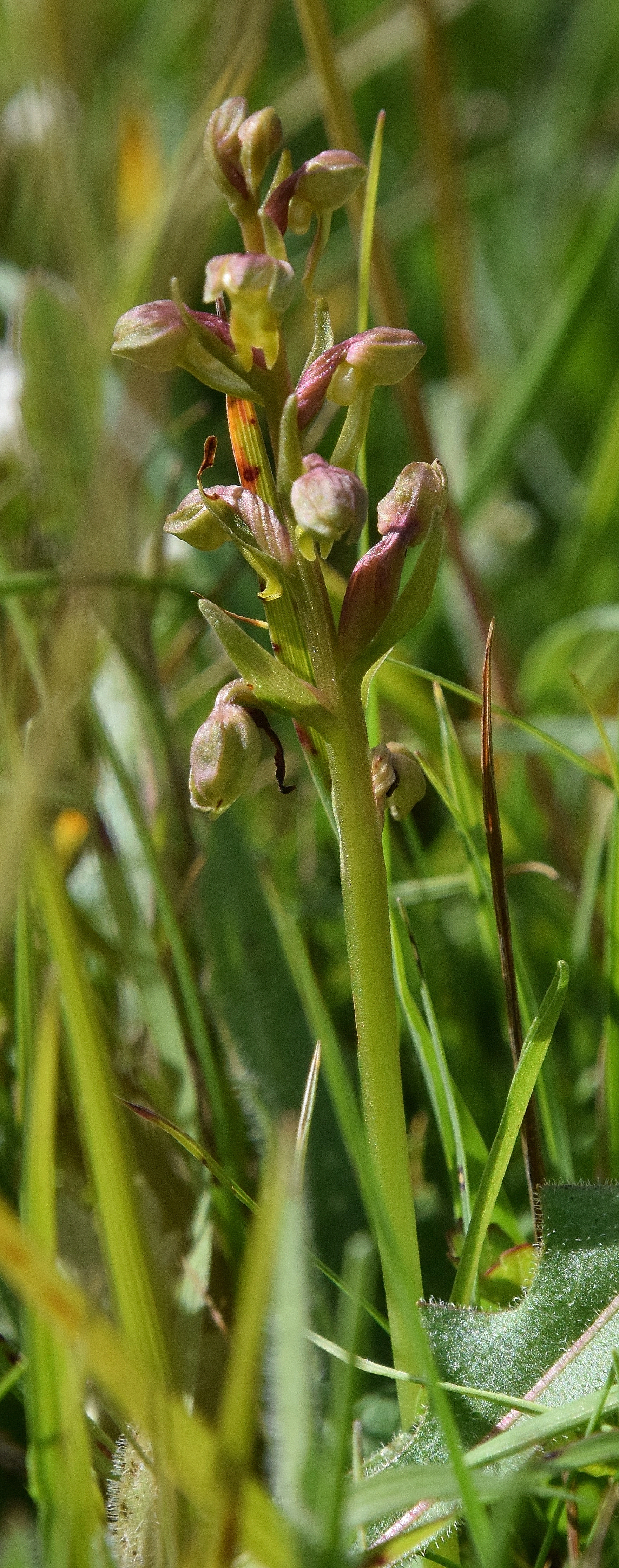
Surveying anew the area recalled from August 2023 I soon found a first diminutive Frog Orchid in good condition. It is often said that after the first one the observer will quickly pick out more. Looking all around as I knelt carefully to take pictures, I realised I was indeed not treading upon five more items in the immediate vicinity. Having often set out in fair weather to such Chilterns’ hillsides in the past to curse the grey stuff that would roll in upon my arrival when butterflying, I not for the first time this summer considered the irony of wishing bright sunlight away to gain better pictures of Orchids. These below, with editing are of higher quality than last year’s, and also of more attractive specimens, so that was mission accomplished..

This group exhibited both the yellow-green and red tones of the plant’s varied forms. Each of them was delicate, mysterious even; all were subtle and understated, and collectively they provided a quite satisfying, self-found experience. To my mind the flowers’ suggested resemblance to frogs remained tentative at best. Walking on a bit further I beheld the largest Frog Orchid I have ever encountered, an absolute stonker possibly 15 cm in height (lead sequence, left and right). After that I sought shade in which to assess back of camera results, at which the phone rang again and then I messaged different wildlife colleagues.

Before becoming thus distracted I had recorded nine target plants, but upon attempting a second pass my location sense dissolved as randomly as it had been to get my eye in originally. Stumbling around I just could not re-find the morning’s subjects, and so moved on. I decided against checking so early in its season for the second Helleborine, instead going to cast my vote then home to watch the tennis.

Incidentally, the re-named though geographically little altered Henley and Thame constituency changed hands for the first time in 118 years, so my tactical vote had counted. I support no political party ideologically, opting at each election for whatever I might consider has the lesser potential for harm.

Another week’s Orchid hunting in Wilts and Hants ft Frog X Common Spotted, pure Frog and Musk – 25 & 26th June

The level of referrals online to this journal’s current Orchid content is amazing me almost as much as my new enthusiasm’s own motivating quality. As it was for British butterflies in the now largely deleted early days, so it is at present for an entirely different specialism. Two such short haul places to go 10 – 15 years ago were Morgan’s Hill, Wilts and Noar Hill, Hants; both of which are also well-known Orchid locations that I have just visited again with evolved purpose.

Musk Orchids on Noar Hill, Hants

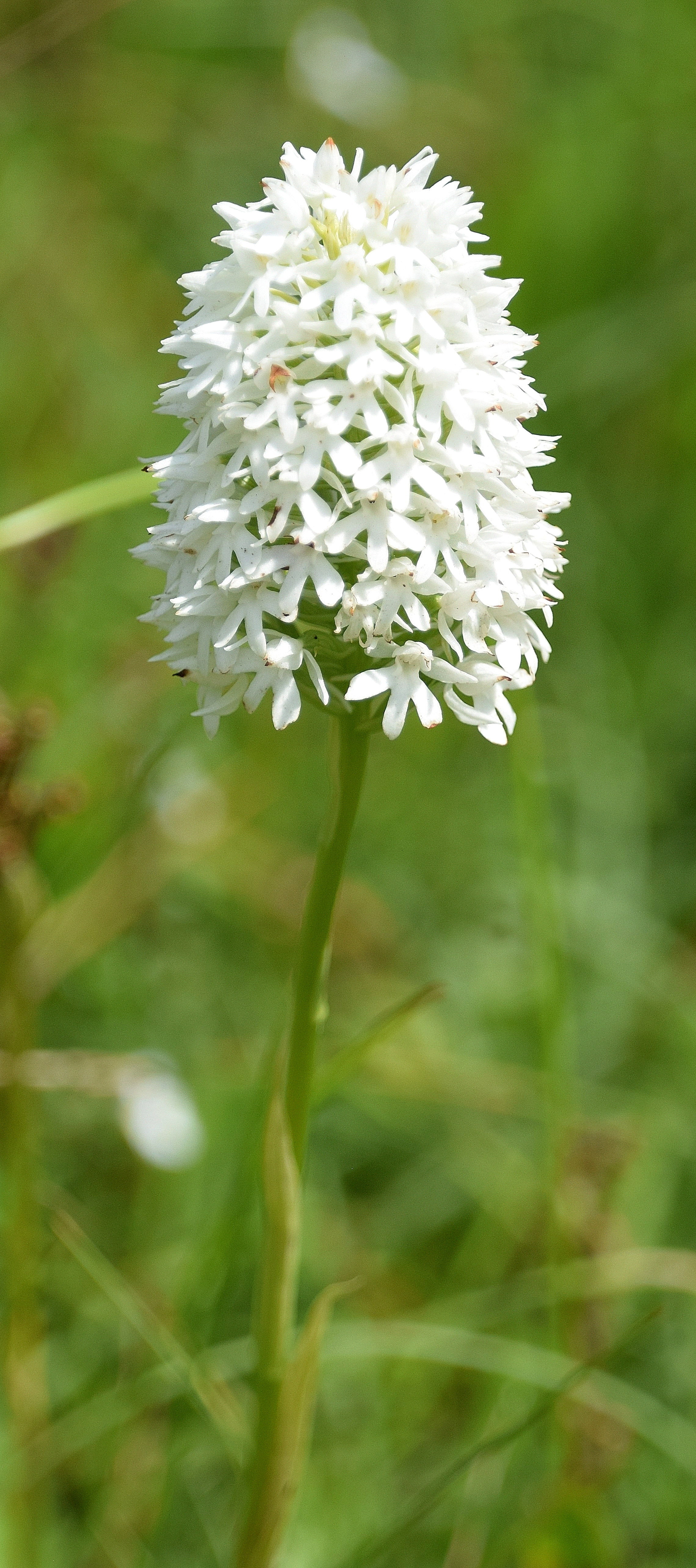
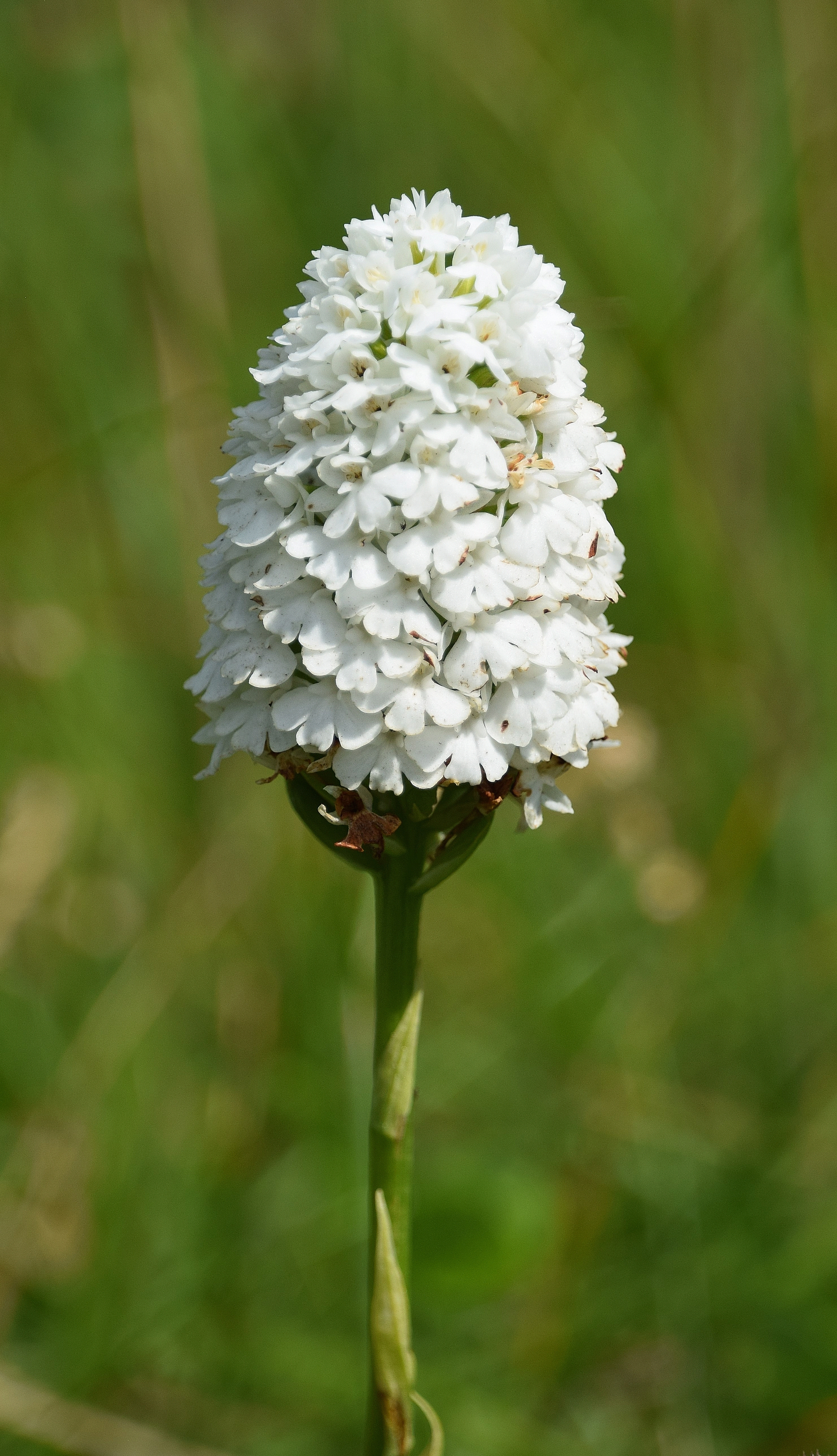
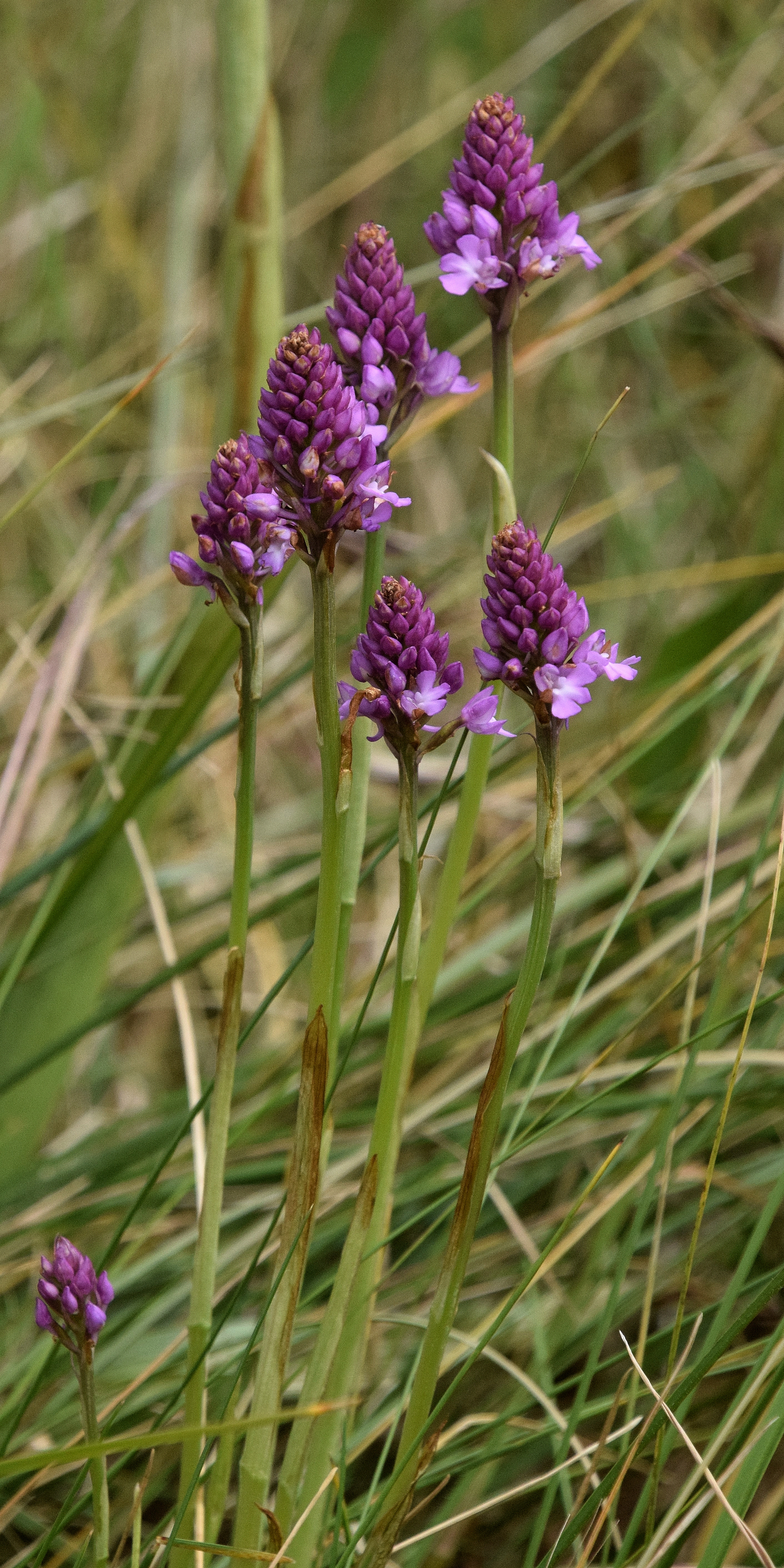
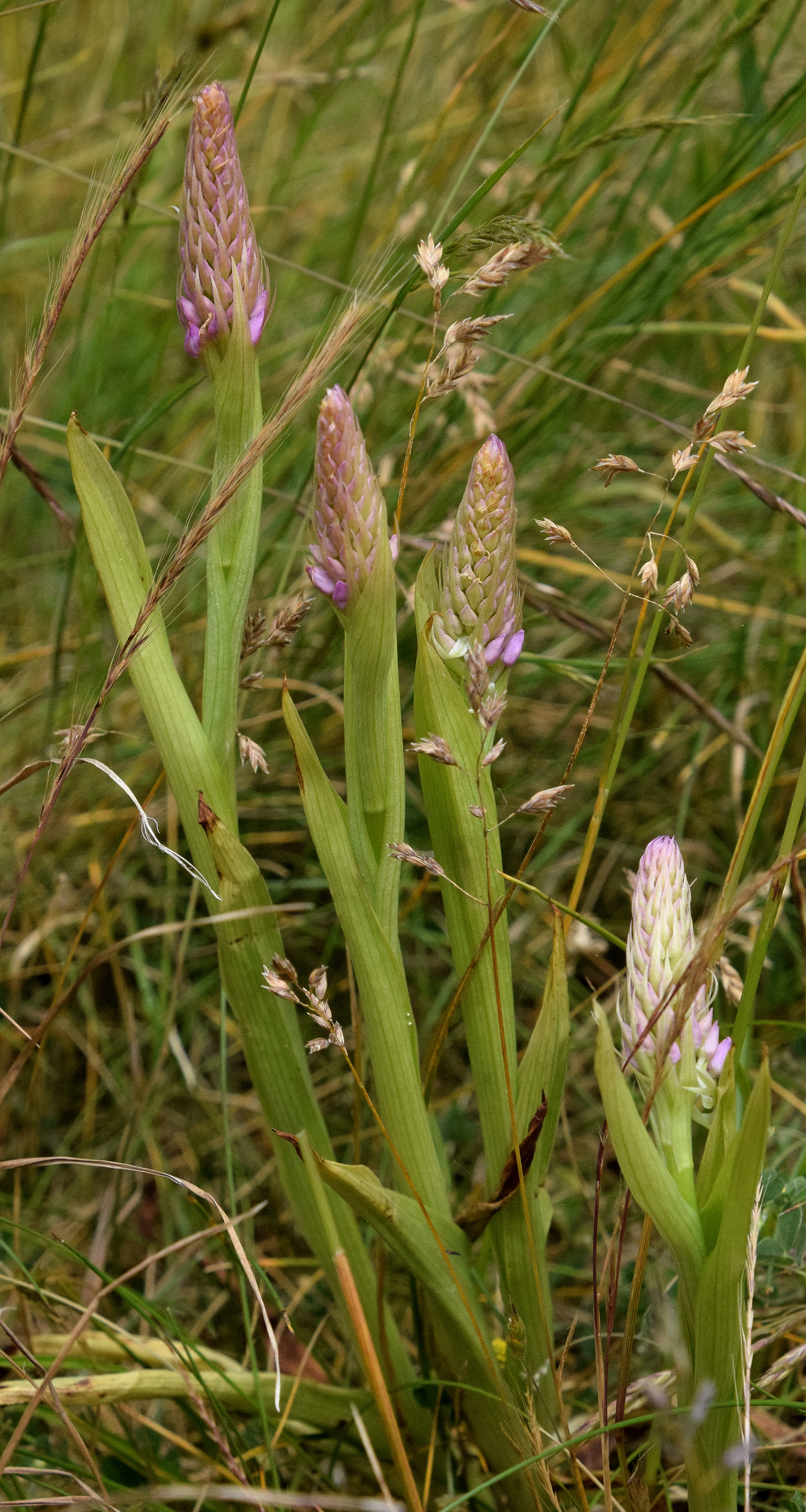
WWT Morgan’s Hill (SN11 8PZ – SU025672 – see here) is a 12.6 ha (31 acre) SSSI on account of its butterflies, Orchids and the general quality of its ancient chalk grassland. At this time of year there are thousands of Common Spotted, mixed in with which are Chalk Fragrant, Pyramidal, some Lesser Butterfly; and for the sharper eyed Frog Orchids. The last of those occur mostly around former chalk pits at the site’s eastern end, that used to be the best area for more notable butterflies too.

This reserve has gained attention recently for a rare hybrid Frog X Common Spotted Orchid being observed there as well as at other English sites. Ian visited last week and after he sent me pictures the opportunity to evolve myself within a re-visit to a fondly remembered wildlife location proved an attractive draw. Hence late morning on Tuesday (25th) found me striding out from a picnic area car park at 51.404030, -1.975187 to re-acquaint myself with the rather special place.

I was armed with precise GPS co-ordinates for each of the items Ian had recorded, but not being familiar with finding things in that way it took a while to acclimatise. As I tried to locate the first pin drop where three items could be found, another fieldsman approached and so we joined forces to make things easier. The best way to locate the exact spot was to look for trampled ground, and so the following records were gained, including an unexpected fourth.

Frog X Common Spotted hybrid Orchids, from left # 1-4

These hybrids were of the same stature as pure Frog Orchids, with either deep red or yellow-green stems. That parent plant is also prone to hybridise equally rarely with Heath Spotted, as well as Northern Marsh in particular locations, and more widely Chalk Fragrant Orchids. Two extra examples were said to be available about 250 metres from the first, and proved more difficult to convert. I was pleased to eventually self-find item 5 (below, left) after much stomping around on steep slopes. Neither of us could locate the sixth (centre) at an area of trampled ground coinciding with that pin drop. Then, walking away from there I spotted a seventh (right), which upon checking with Ian he said he had missed himself.

An awareness grew here that I was now engaged in what might be termed “hard core” Orchid hunting. The effort in scouring a complex site such as this for these seven stand-outs amongst it’s profusion of countless wild Orchids, on the part of those who had first discovered them, was quite frankly mind boggling. For myself I was further satisfied to have got my eye in with one of the parent plants, after my travails on the Chilterns escarpment last summer (see here). This day’s pure Frog Orchids surrendered higher quality studies (below) than those gained then, and some were also self found so this was a better experience all round.

Not such fickle regular Frog Orchids rising not falling

By the time I left site I could recall the distantly remembered topography of the entire hilltop. As alluded to earlier, it was especially motivating to have re-worked a favourite site from my early butterflying years in a new and different context. And the same was true a day later (Wednesday) when I re-familiarised myself with another outstanding, southern English SSSI, HWT Noar Hill, Hants. After last week’s Red Helleborine field trip I had failed again to find a tiny cluster of Musk Orchid in bloom at a nearby site in Bucks. So now I bit the bullet and went to seek out what is a nationally important colony of them.

As I walked into then around the former medieval chalk-pit complex of Duke of Burgundy renown (GU34 3LW – SU742319), the abundance of Common Spotted, Chalk Fragrant and Pyramidal Orchids all around was simply breathtaking. In amongst them were quantities of mostly gone over Twayblades, Frogs are said to be there again had I searched, while hundreds of Musk Orchid are spread out at the 20 ha (49 acre) HWT reserve’s eastern end. Morgan’s Hill was spectacular, but now I was witnessing the most intensely lavish Orchid landscape beheld since Aston Clinton Ragpits, Bucks (see here) a year ago. And on this day a whole squad of volunteer surveyors was engaged in painstakingly recording them all.

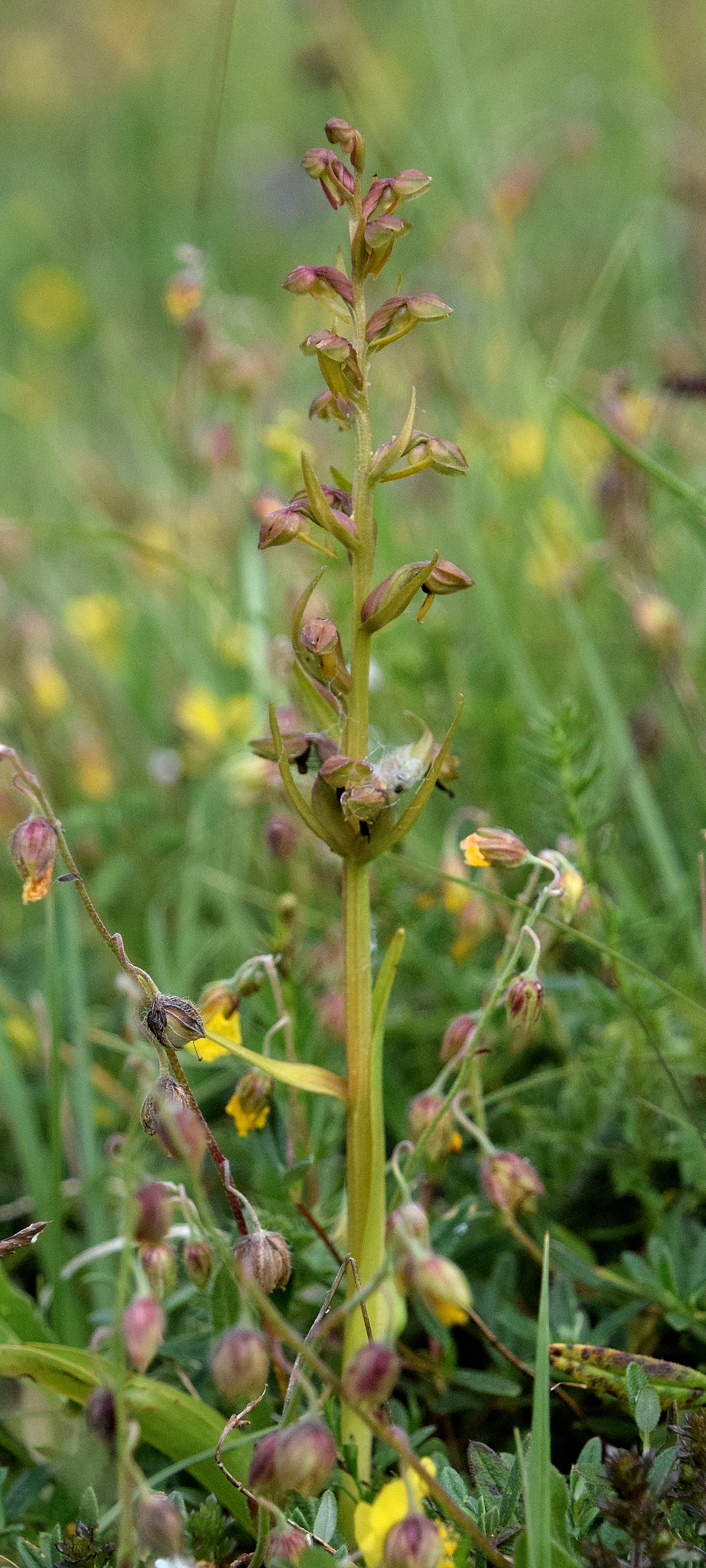
The delicate yellow gems that are Musk Orchid (pictured below) can only be described as diminutive, though they were easy enough to pick out in the flora rich sward, especially where they occurred in groups. This plant is only found on short-cropped chalk or limestone grassland, and has a southern distribution nationally. It grows from tiny rhizomes to around 15 cm in June and July, producing spikes of 20-30 greenish-yellow, bell-shaped flowers that hang downwards from darker green stems. Those emit a subtly sweet, honey-like scent to attract pollinators, hence their name.

The species has been lost from around 70 per cent of its historic range due to modern agricultural methods, is very susceptible to drought, and cannot compete with other plants amongst taller vegetation. Once tracked down, getting pictures of them to edit was quite tricky, especially as I only selected specimens I could focus upon from already trodden areas. It would have been criminal to walk into the habitat here, such was the density of the wild flower spectacle all around.

As my only previous Musk record at that Bucks site was of gone over specimens, this was virtually another new record to add to the second season tally. And the surroundings, again recalled anew from previous butterflying activity, were out of this world. Since I started doing all this last year, the locations visited have proven consistently to be as stimulating as the iconic group of plants themselves. So it was again with the two more historically unaltered, “unimproved”, chemical-free environments from times long gone of this post. Orchids occur where such settings survive, and that is such a meaningful part of observing them.

Red Helleborine at its Chilterns site – 20th June

I have observed this Orchid once previously in Greece but nationally it has long been restricted to just three places, one of which is conveniently close to home on the Chilterns escarpment. So when I became aware of this day’s Hardy Orchid Society (HSO) field meeting it seemed too good an opportunity to miss. The site is generally known within botanical circles and published online, but highly protected and not publicly accessible. Two flower stems are available to view this year, whilst in some past seasons there has been only one and in others none at all.

Though relatively commonplace in parts of mainland Europe, this much prized species has remained critically endangered and on the verge of extinction at its north-western range limit in the British Isles for the last 40 years. I have read it is a delicate and fussy item that requires exactly the right mix of light and shade in the as particular calcareous woodland habitat it prefers. Hence today’s site is very carefully managed by BBOWT to provide the optimal light levels and prevent damage from grazing deer, rabbits, or even ever-indiscriminate molluscs. Then there are dreaded and much reviled human “diggers up” to guard against, but I understand the plant stock has survived at this spot for much of my lifetime.

Red Helleborine

Red Helleborine (see here) is sinuous in form with up to 20 well separated flowers on each snaky stalk (20 – 70 cm). The species occurs from late May to July in light, dry woodland mainly of Beech, Pine and Spruce; and especially on calcareous ground. Flower tone is said to be an indicator of soil conditions, with deeper colouration suggesting more calcareous locations. But individual plants are known to lie dormant without blooming for years on end, which adds to their mythical status amongst British enthusiasts.

In the event the HSO operated staggered visits. Having expressed flexibility regarding start time I was invited to join the later and less in demand of the two at 1pm, which suited me after the previous day’s more distant excursion to Sandwich Bay. Gathering at a roadside location, our still large group of 16 was led through private woodland to a rather formidable double enclosure that protects these plants, the only two of their kind blooming in Great Britain this season. Here I learned the likely re-occurrence of a historic cluster in Hants is now in serious doubt, while the third in Glos is also dormant this summer.

At our destination the group spread out around two sides of the inner enclosure fence at the top of a steep hillside, while our BBOWT guide kept up a commentary on all things Red Helleborine with a clear passion for and dedication to these most vulnerable of charges in his care. Both blooms that curled subtly forward and upward from the underscrub within were in pristine condition. Seen through binoculars the plant exuded a quite elegant and graceful quality that my own camera was unable to capture adequately at the enforced distance. I favoured the side view that I felt was better lit. The above are my day’s pictorial records that with editing have turned out to be better than I had expected on site.

This was something I needed to do in my current wildlife enthusiasm, though I didn’t “shake with adrenalin” upon viewing the so supervised subject to quote another blog I consulted during my research. That is not to say I do not appreciate the very special quality of what I witnessed. I have now recorded one of the rarest of all national Orchids, though within an ambience that had little empathy with my previous, cherry-picking solo experiences at motivating locations in the past two months; or indeed the introductory stimulation of a year ago. I’ve now done national Red Helleborine though and need not consider it again.

Dainty Damselfly (or Bluet), European Marsh Frog and many more Lizard Orchids at Sandwich Bay, Kent – 19th June

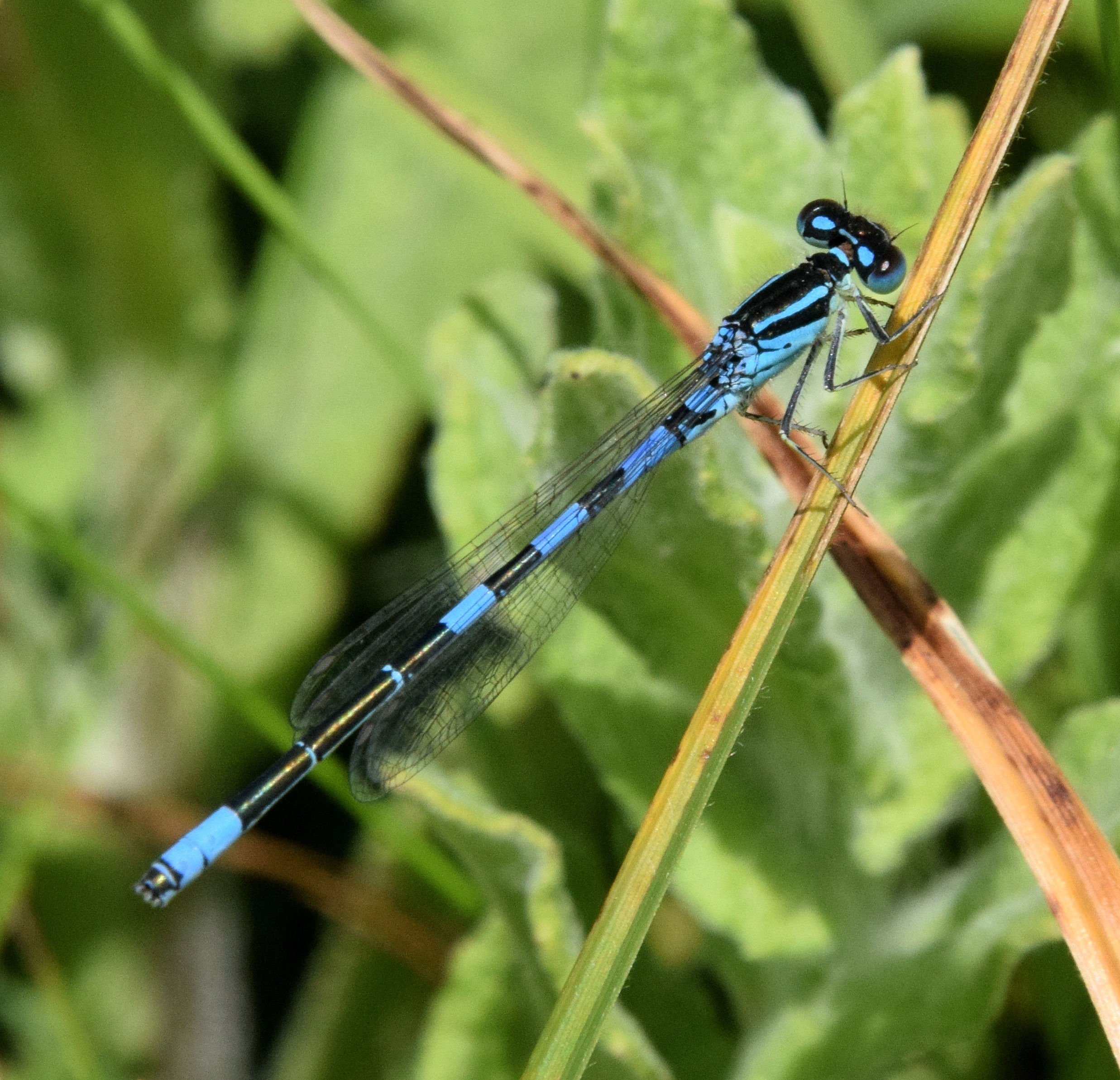
Today’s plan had begun by wishing to top up my national Damselfly list, the prime target of this post being one of the more recent additions from the south to the British Odonata fauna. Now thriving, since just 14 individuals were re-discovered at today’s location in 2019 (see here) after a 70-year absence from the mainland, the scarcity can be observed at field meetings arranged by Sandwich Bay Bird Observatory. Having got around to booking onto one this season I alerted Adam who did the same and now we made a joint effort. We had each recorded every other national damselfly previously.

I had experienced Dainty Damselfly (or Bluet) before in Sardinia in June 2018. This species remains rather localised in its historic range from the northern Iberian peninsula eastward to Iran; and has made further inroads as far north as the dune coasts of Belgium, Holland and this corner of England. The Kent Wildlife Trust now offers annual field trips at another site, Oare Marshes near Faversham (see here), while more county locations are reputed. There was also a small colony on the Isle of Sheppey in 2010/11 that has since died out.

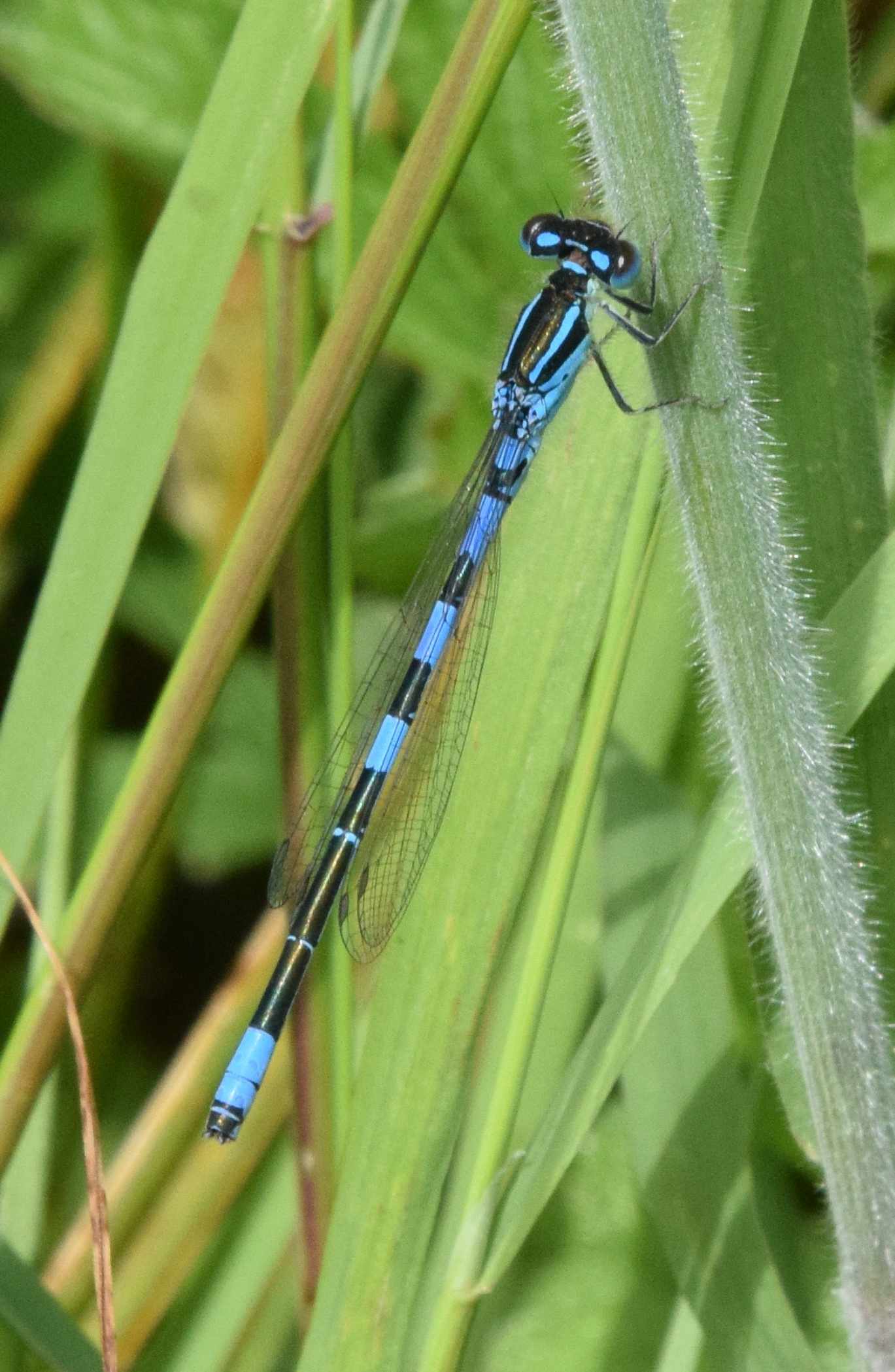
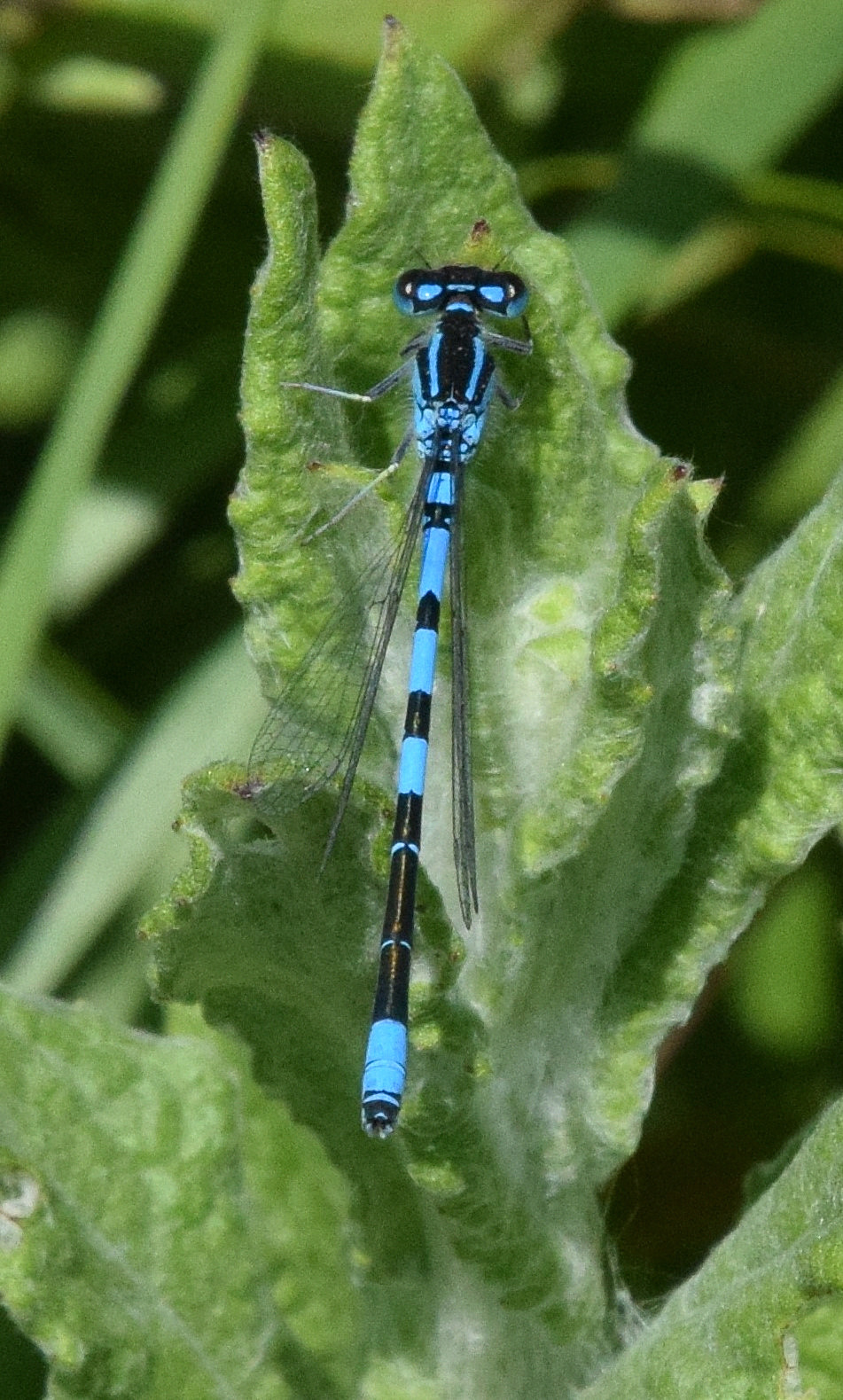
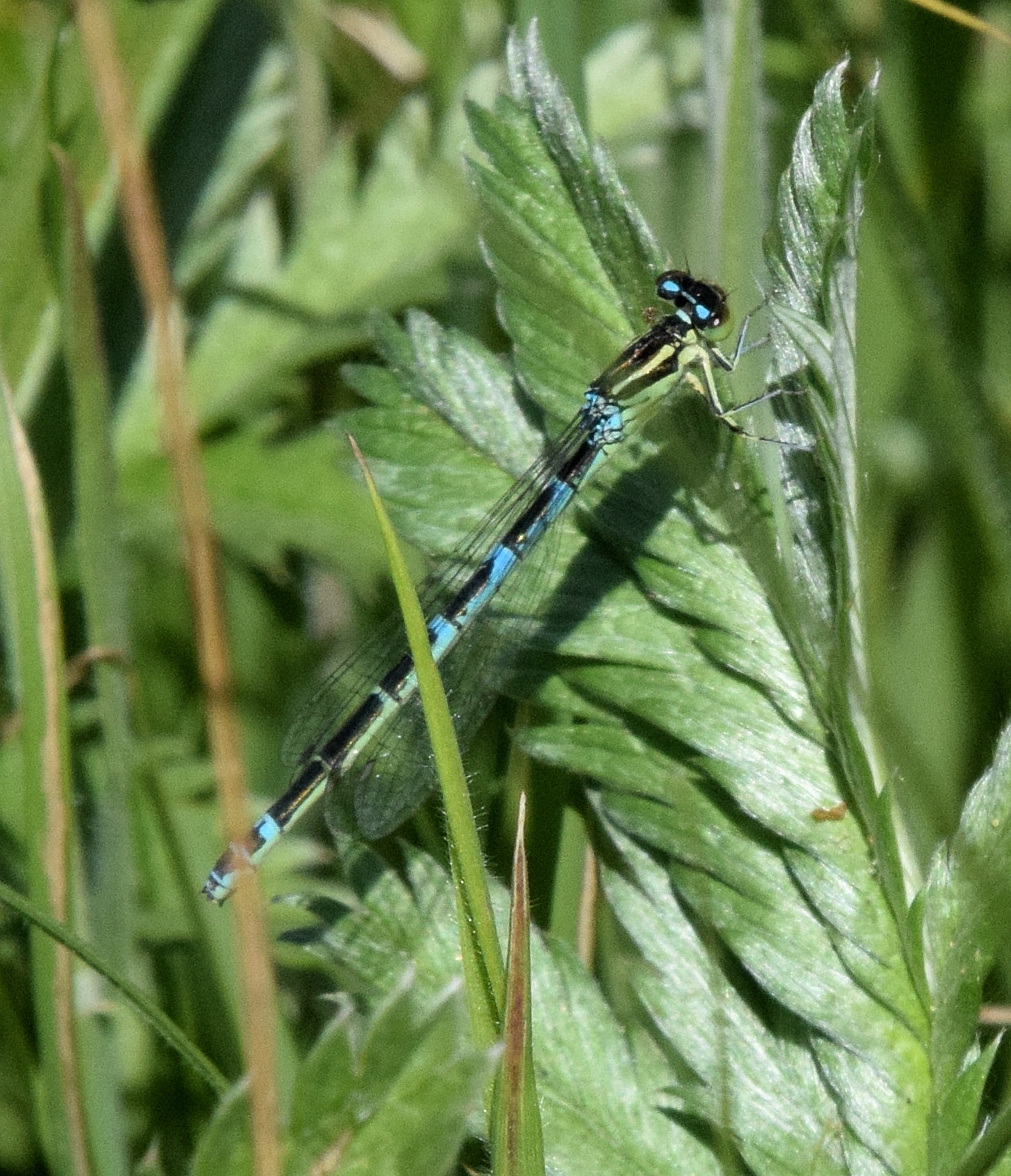
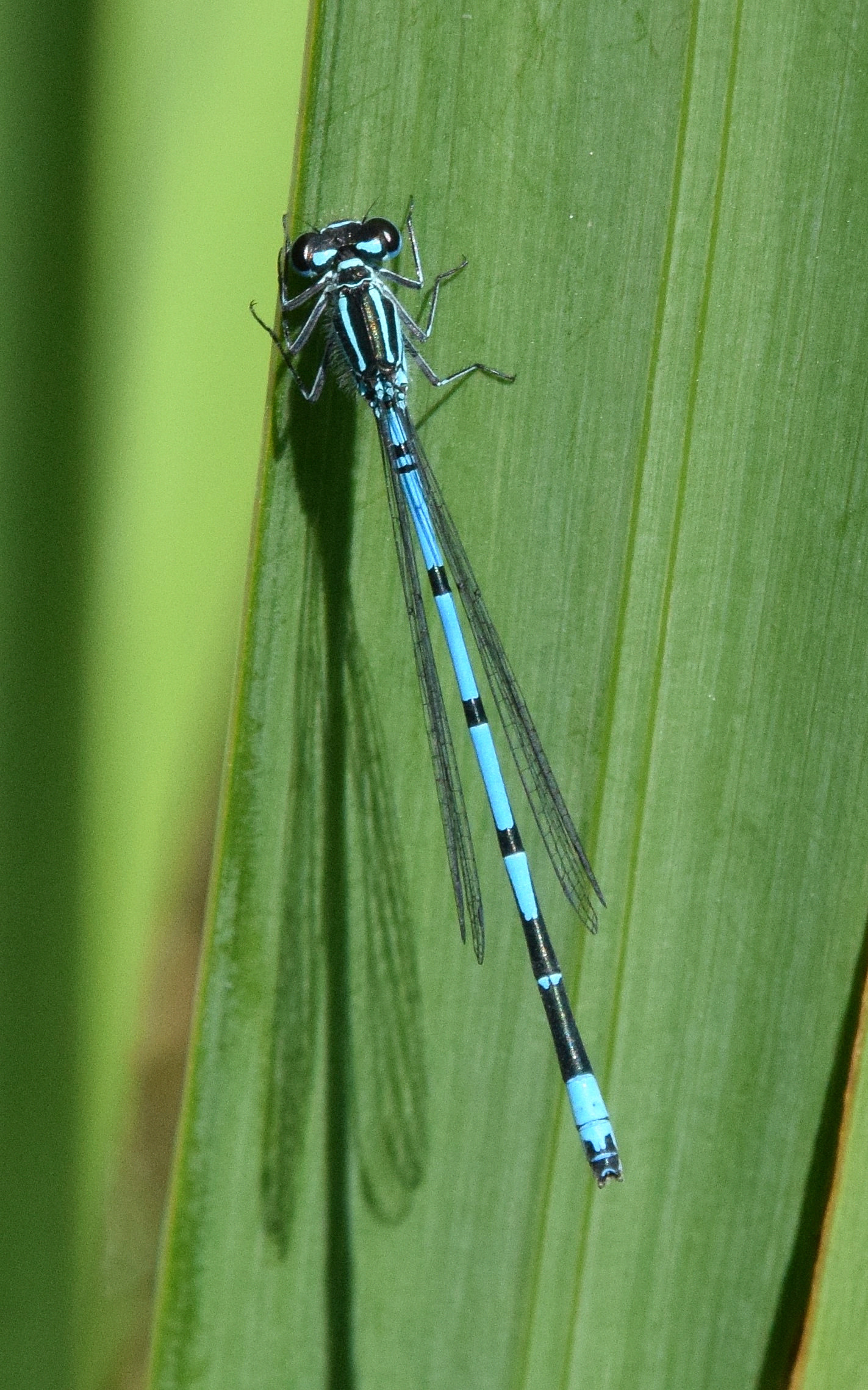
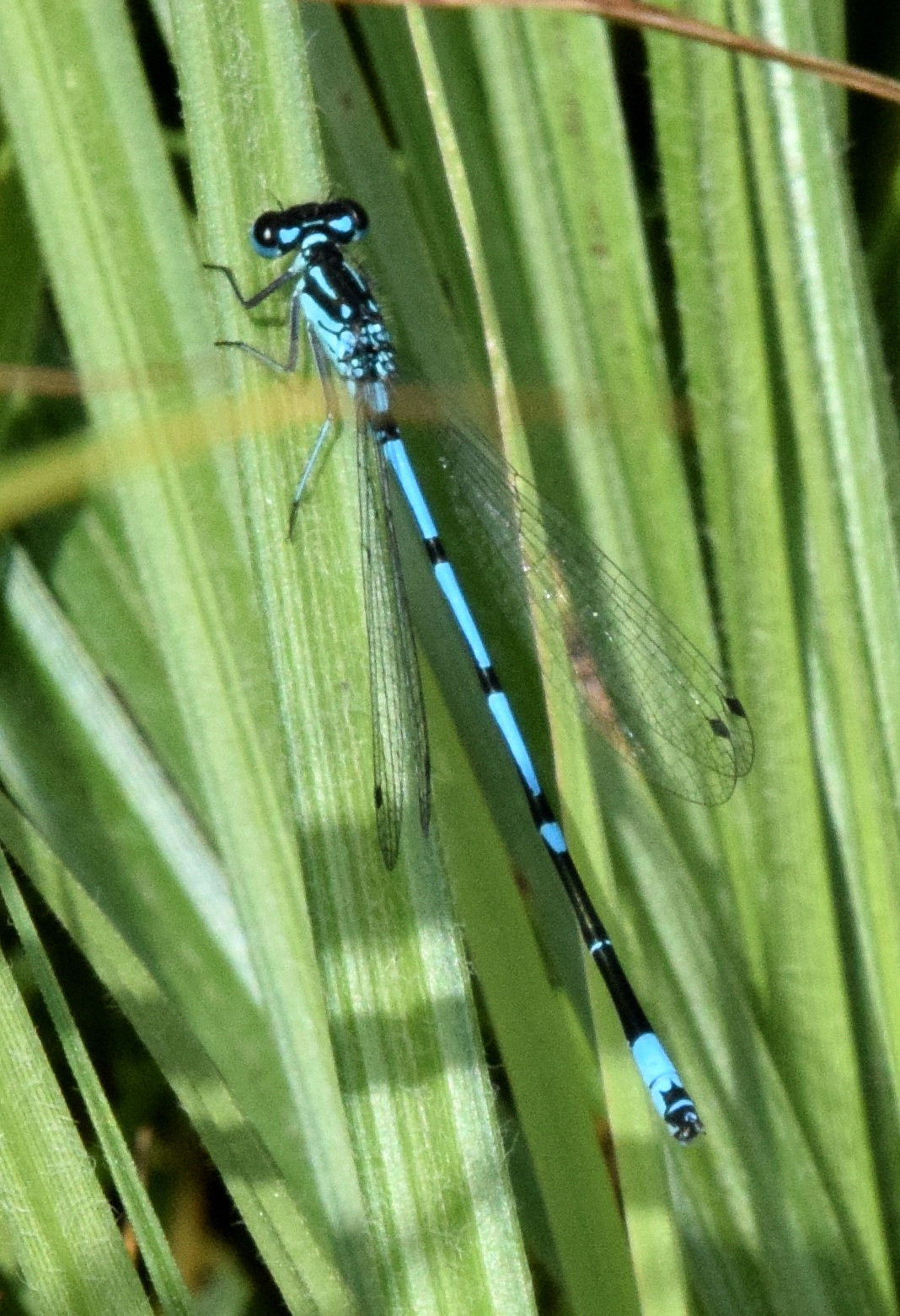
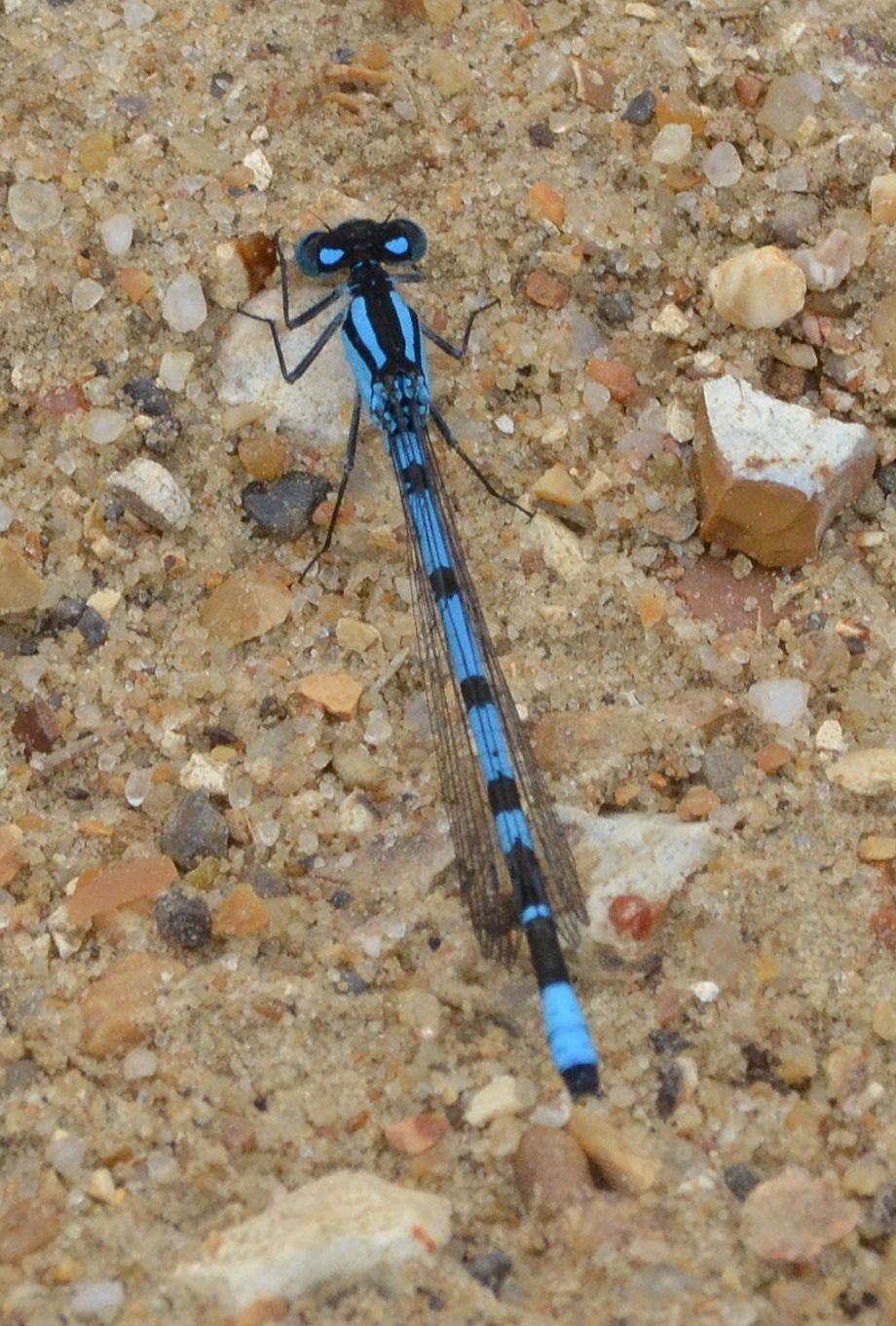
Dainty Damselfly (male) today

The Kent specialty (pictured above) exhibits similar jizz and flight style to Azure, Common Blue or Variable Damselflies amongst which it may occur, but males can appear slightly smaller and darker-toned. The following diagnostics separate Dainty from those more familiar others:

  • Greenish yellow colouring on the underside
  • Thin antehumeral stripes on the upper side of the thorax
  • Pterostigma (wing tags) almost twice as long as they are wide
  • “Wine-goblet” shaped marking on segment 2 in males below the wing base
  • “Rocket-shaped” markings in females on the abdomen

We arrived at the Sandwich Bay Estate (CT13 9PF – TR350578), within which the bird observatory and field study centre is situated, just after 12pm; two and a half hours ahead of the field meeting. We couldn’t have wished for better weather conditions in which to convert our quest, the current week having provided three consecutive days of the golden orb for the first time in a while in this idiosyncratic English summer, that has been most recently characterised by cold northerly June winds on top of the endless wet stuff. Things thus certainly seemed meant today!

I hoped for and also interested Adam in the opportunity to observe a third new amphibian for my current season, while this location is further noted for the profusion of Lizard Orchids that populate it’s golf courses. Volunteers on site assured us that both those aims would be attainable before the main business began, but more of that later.

Male (left and centre) and female (right) Dainty Damselflies (above), with (below from left) Azure, Variable and Common Blue for comparison

When we reached the pond of Dainty Dragonfly renown, two lingerers from the morning meeting were present and something-teen mating pairs, albeit directly into sunlight of the insects themselves (see here for Adam’s pictures). But good images of uncoupled males were obtainable in long grass away from the water’s edge, this post’s lead one being my best. The two and a half brown segments 5, 6 and 7 on the abdomen are the easiest way to recognise them in the field before back of camera pictures might confirm the already quoted diagnostics. I also now gained new studies of Azure and Variable subjects for comparison, and have included an archive Common Blue in the sequence (above).

Our early arrival had clearly been opportune in providing these picture opportunities ahead of the afternoon’s further participants joining in. This is the pool where the new coloniser was first found five years ago, and they are now far and away its most plentiful damselfly despite their national rarity, this habitat being managed to meet their specific requirements. Two more pools have just been created nearby. The warden told us Lesser Emperor, Red-veined Darter, and Scarce and Southern Emerald damselflies currently breed on other parts of the Sandwich Bay estate, though not all in publicly accessible areas. More potential colonisers are said to be not too far distant along the Normandy coast.

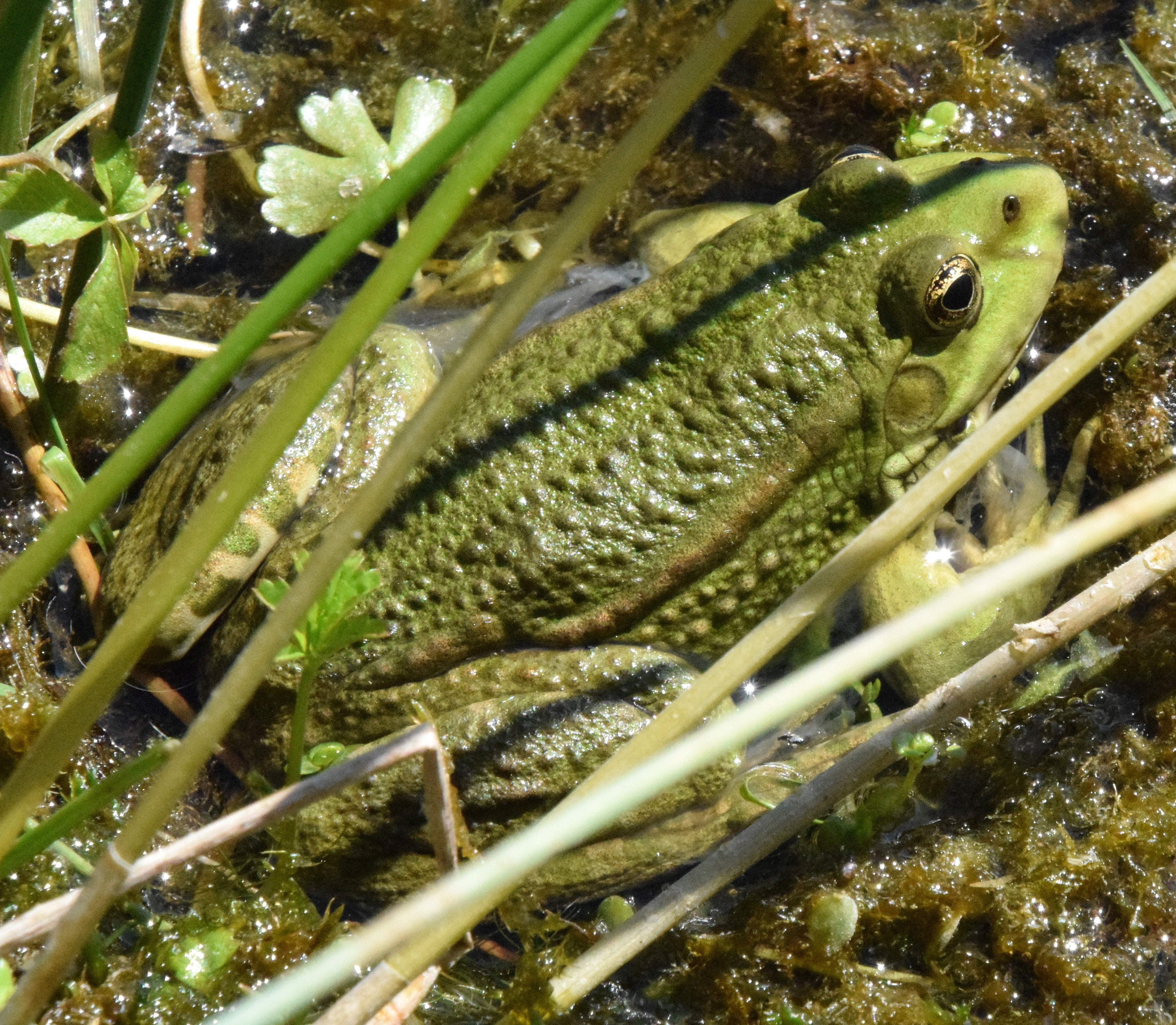
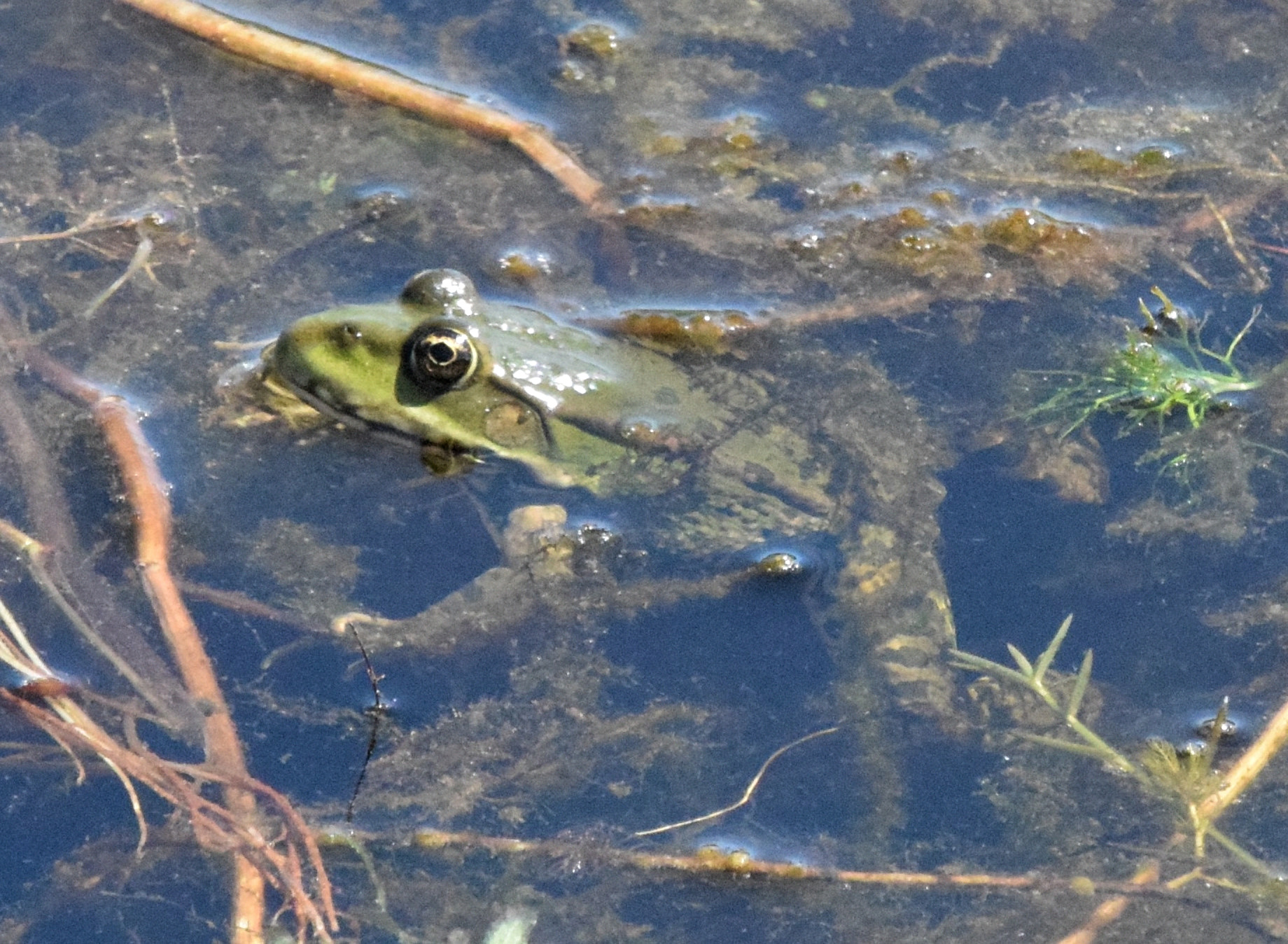
Marsh Frog

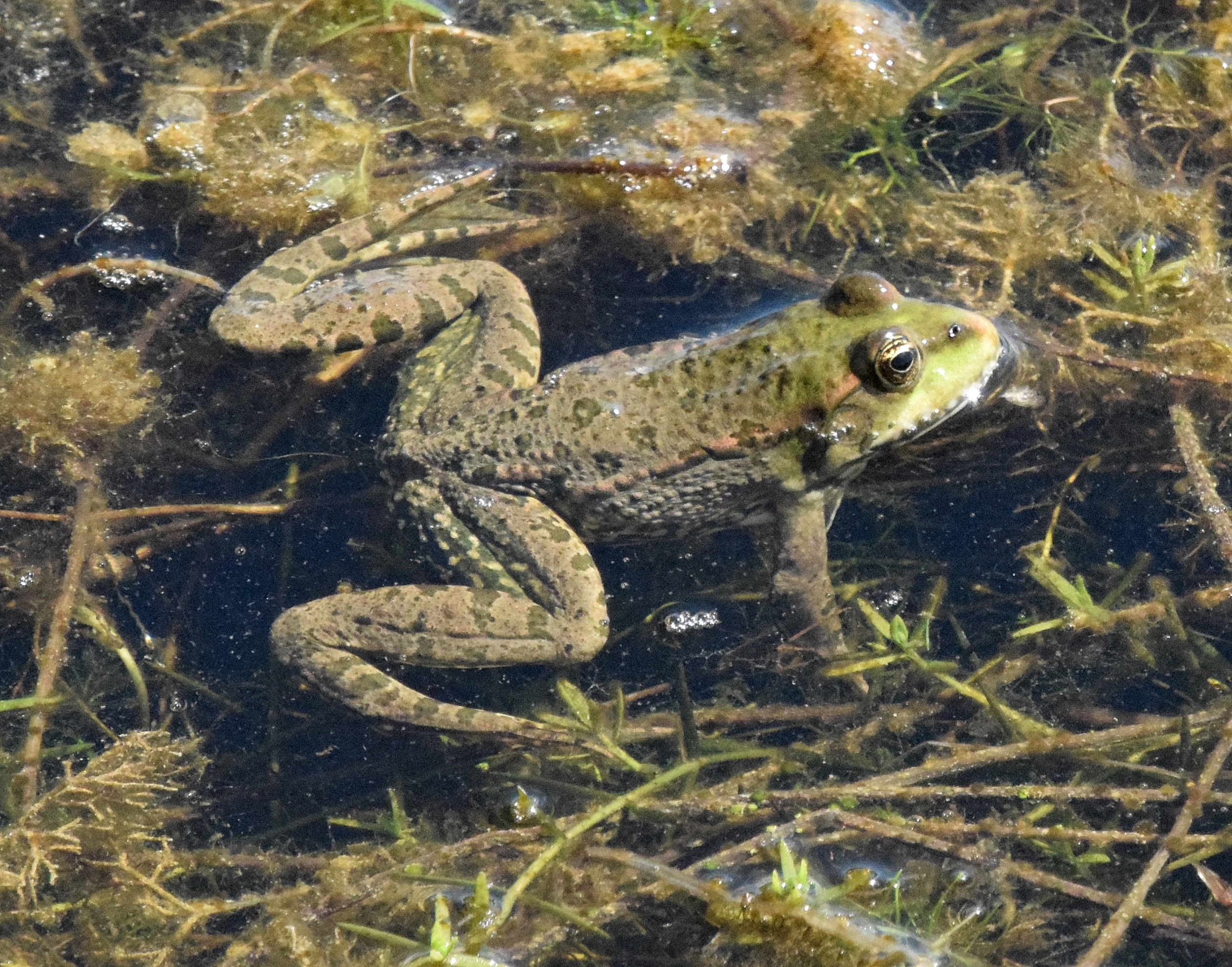
European Marsh Frog (see here) was introduced to Kent at Romney Marsh in the 1930s and has since spread throughout much of this and into neighbouring counties, typically inhabiting drainage ditches and shallow pools. I had therefore hoped the non-native species would be present today and indeed there were some in the Dainty Damselfly pond. The largest of the triple water frog group, these lack the green dorsal stripe of the Pool Frogs observed at Greenham Common earlier this season (see here). For me the stand-out feature was their rounded, bright green snouts, while the air sacs below the eyes were also quite distinctive. The dark stripe atop the specimen in the above study is in fact the shadow of an overhead stem.

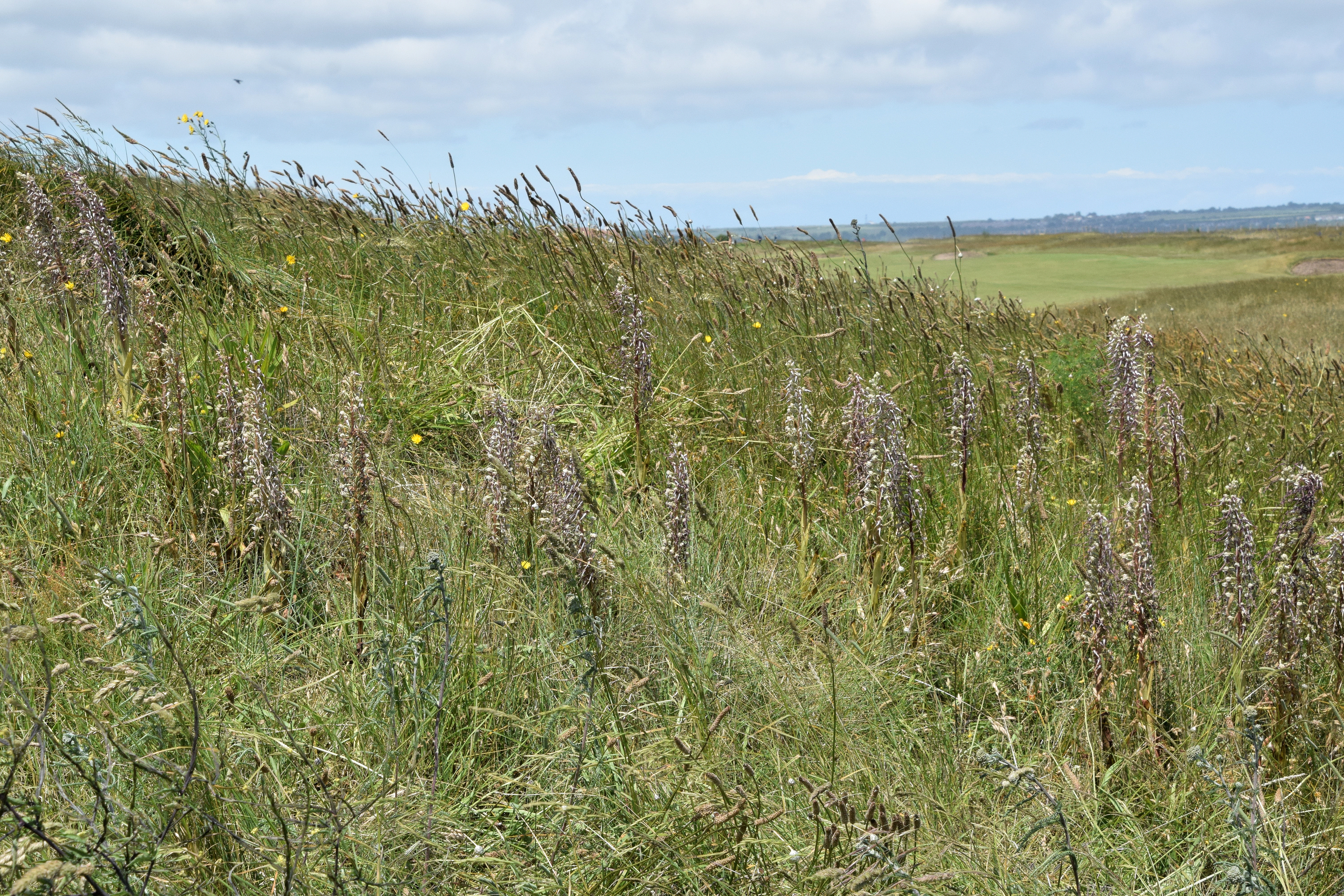
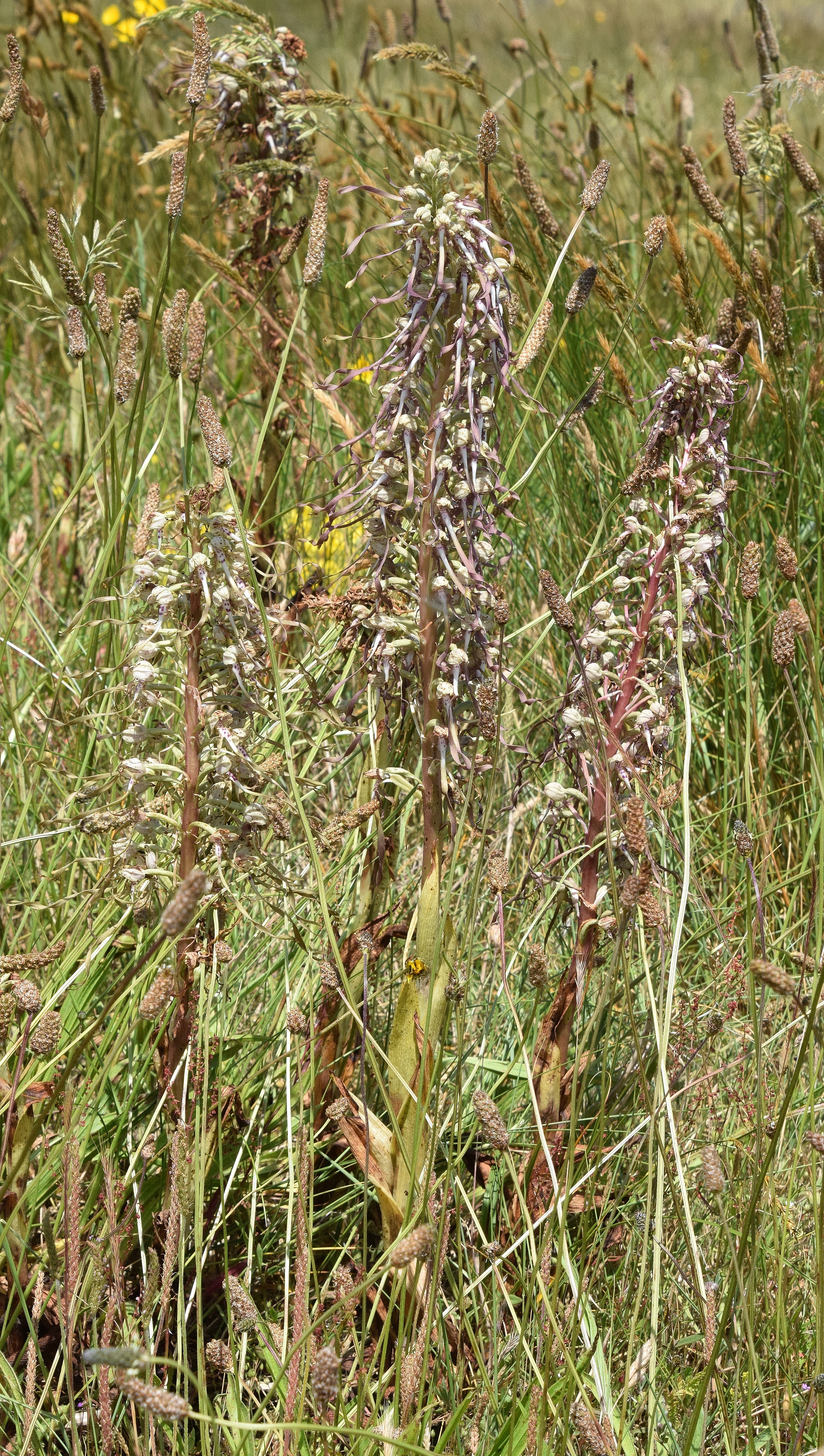
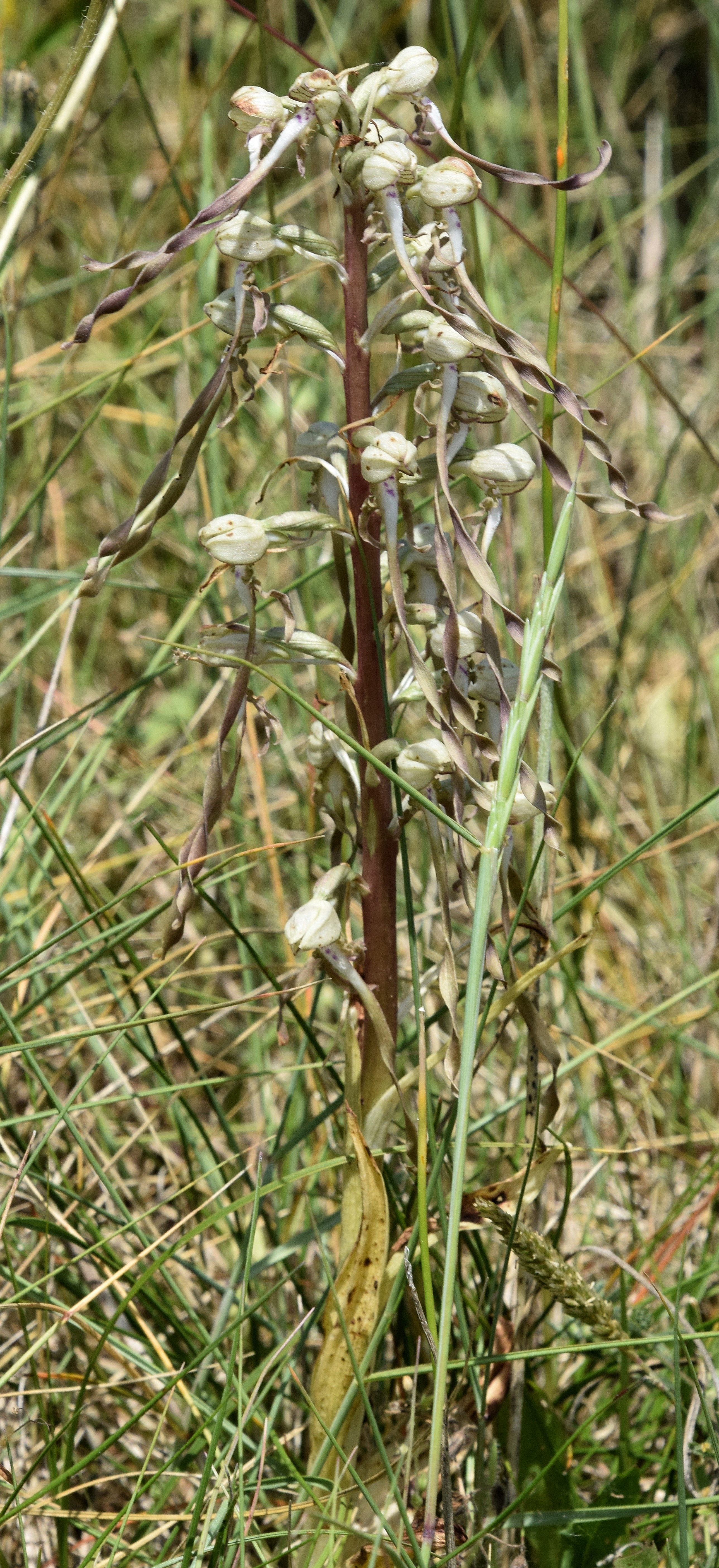
Before visiting the pool we followed a public right of way opposite the observatory entrance into coastal dunes and the Royal St George’s golf course. I was hoping for a better Lizard Orchid experience than the relative disappointment of Berrow Dunes, Somerset a week earlier (see previous post). This below is the sort of thing I had hoped to witness then. Here there were significant numbers of the plants swaying in the wind amongst long grass on and around the dune ridges. Some of them were huge, all of them weird, providing my third such encounter of this summer.

Lizard Orchids

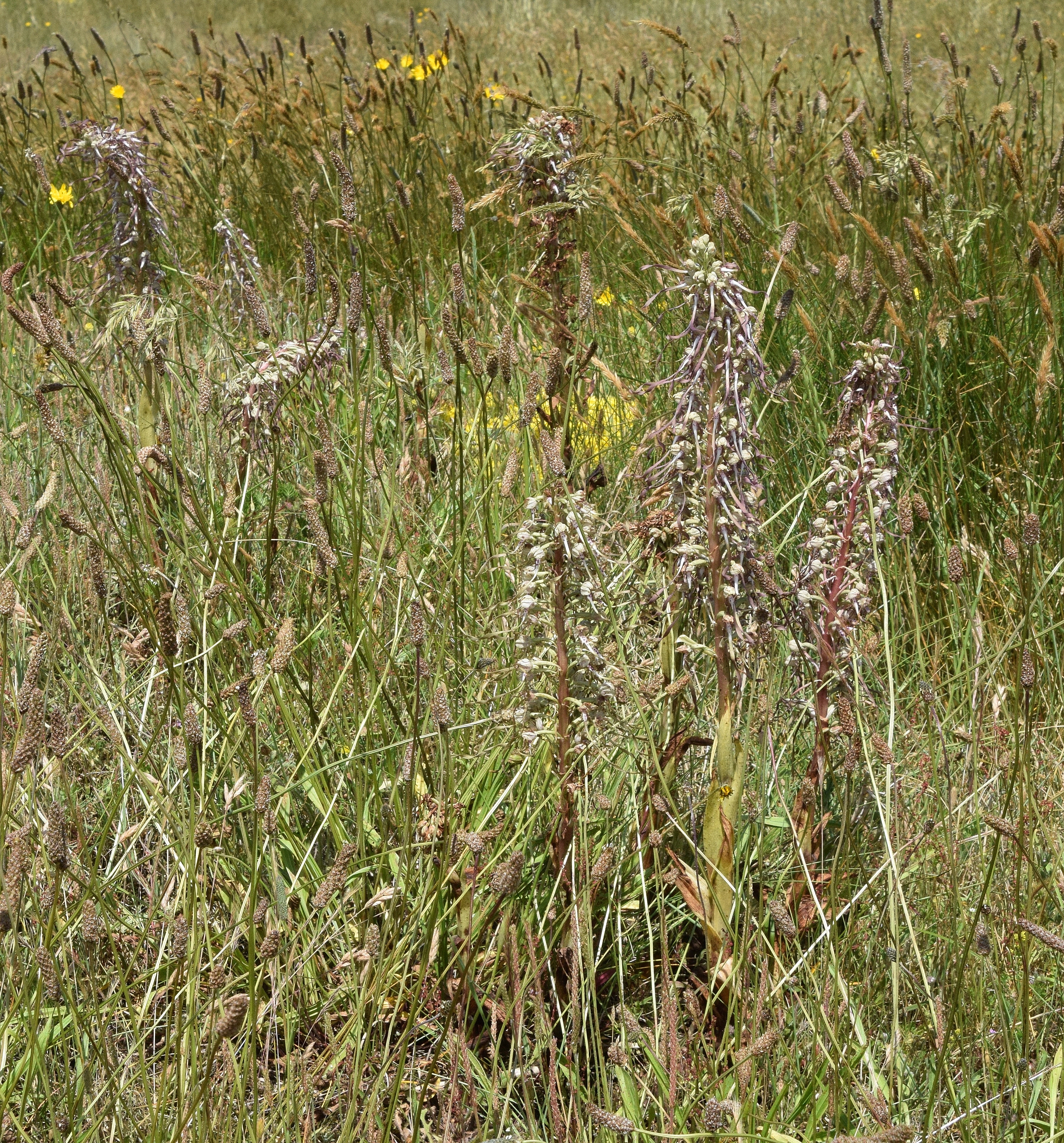
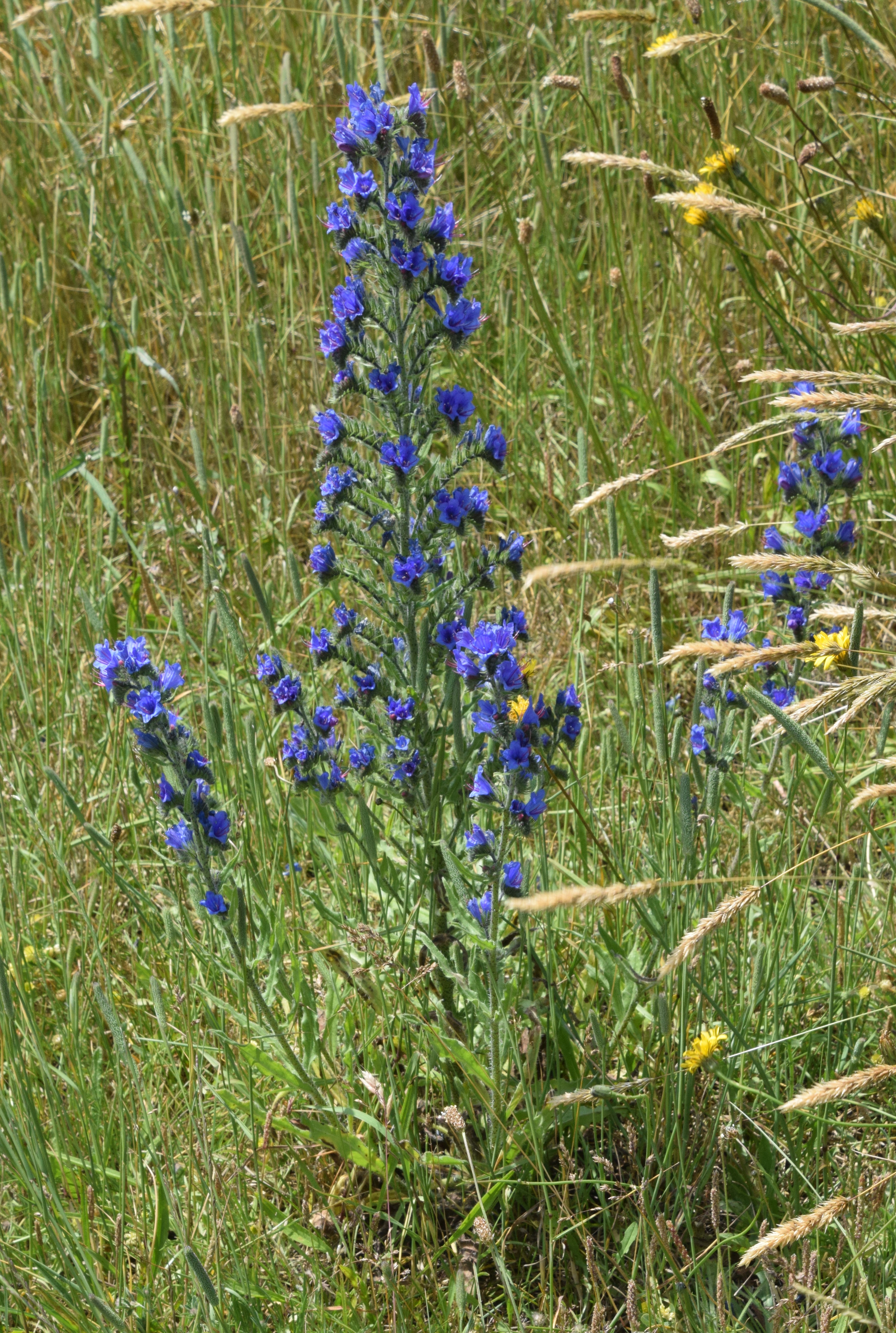
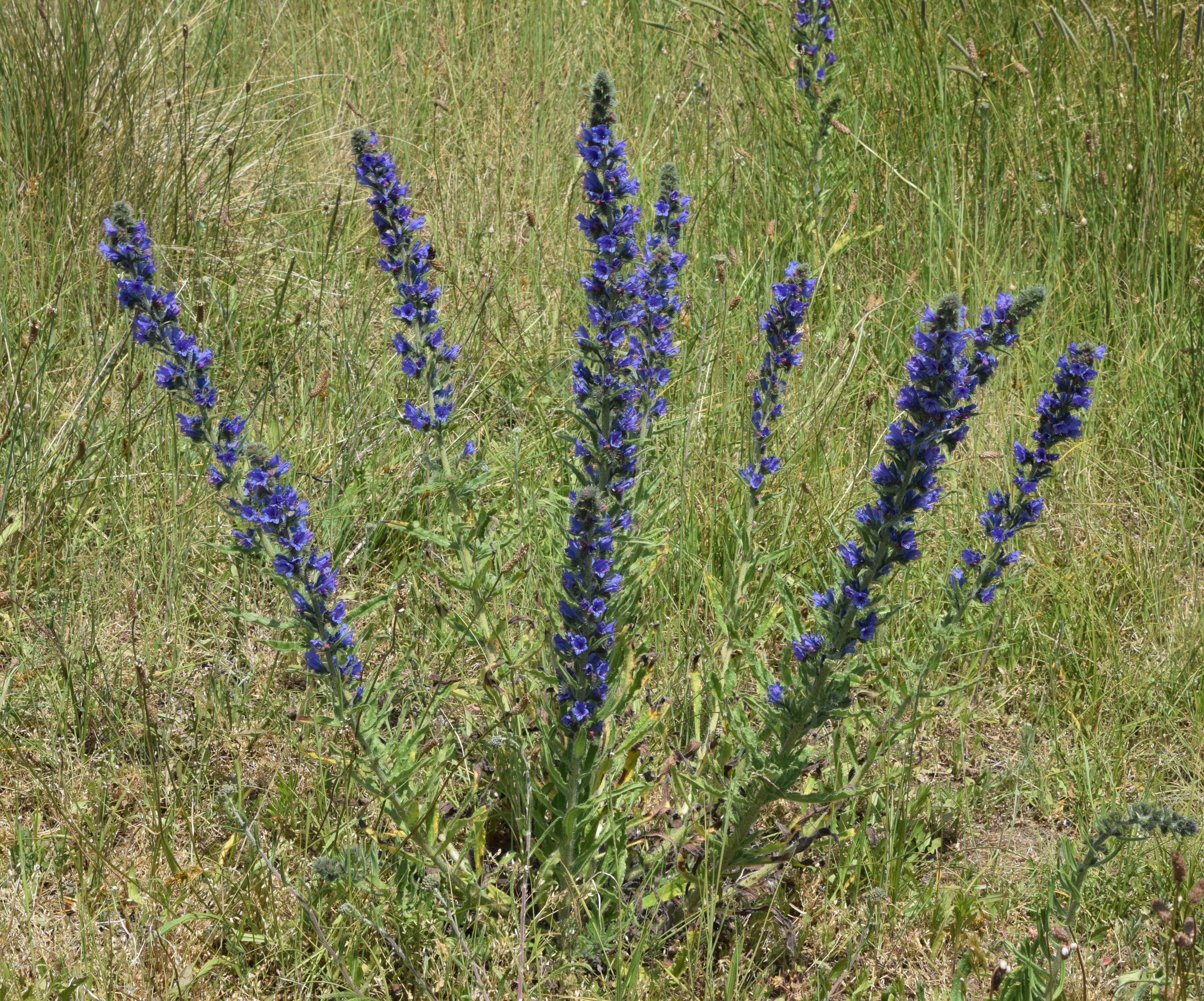
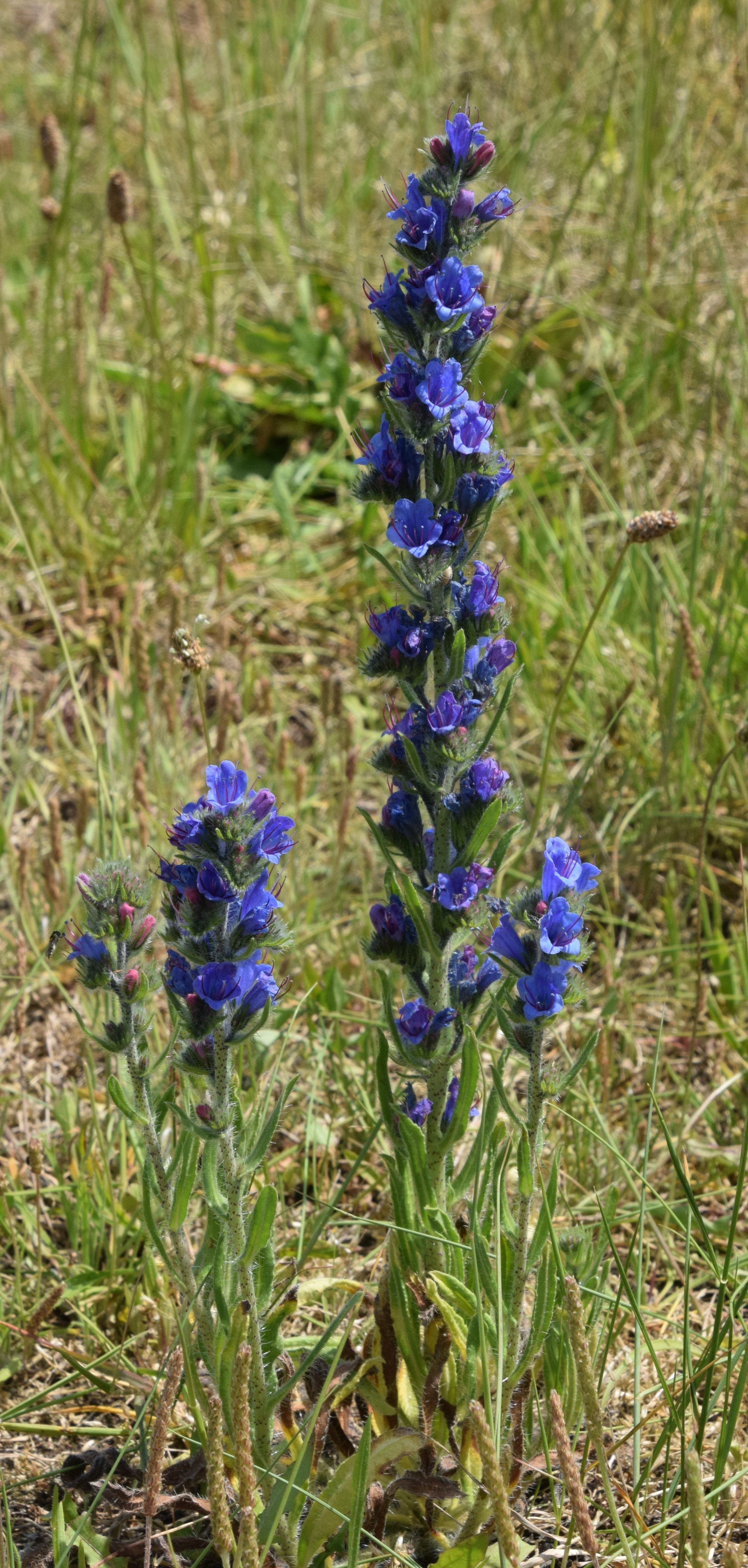
Viper’s Bugloss

An equally prominent plant here, dominating the botanical high ground in tandem with the less conspicuous Lizard Orchids was Viper’s Bugloss, a hairy, blue-flowered, stately biennial of sand dunes, chalk grassland and construction sites that has a scattered British and mainly southern distribution. The juxtaposed spectacle across the dune-scape of their vibrant blue patches with the subtly skulking Lizard Orchids completed a superb and varied wildlife triple bill within the Kentish coast’s increasingly apparent and ever open Odonata gateway.

Lizard Orchids, Southern Marsh and Broomrape at Berrow Dunes and environs, Somerset – 12th June

This was on my season’s wildlife agenda from the outset, after I saw quite spectacular pictures of multiple Lizard Orchids online last summer at the well-known national site now featured. So the previous post’s local record of the strange looking subject was intended as a hor’s d’ouevre to a rather more substantial main course today.

Berrow Dunes (see here) comprises just over two miles of flat, sandy terrain along the Bristol Channel coast that is part of a three times larger SSSI. The greater portion is occupied by the Burnham and Berrow Golf Club, which though a top-ranked links facility is also managed to cater for the 270 species of wild plant that it hosts. I was advised by fellow Hardy Orchid Society members that golfers and grounds staff here are used to and mostly sympathetic towards botanists scrambling around in the deep rough, provided those visitors are sensible in their movements. One had given me two good locations along a public right of way that crosses the course from an entry point behind a Co-op convenience store in Berrow Road, Burnham-on-Sea (TA8 2JQ – ST 299515).

Using a small public car park opposite that shop, I strode out at around 11 am, but as so often at first found difficulty in matching the Google Maps aerial views I carried to the actual lie of the land. Eventually I met two other observers who took me back to a spot that held three Lizard Orchid, two of which were starting to go over. After more wandering about I realised this was indeed the second pin-drop location I was seeking. Now I had my bearings, and on walking back to the first pin found two more newly arrived fieldsmen, one of whom lived locally, who had clearly already found what I was looking for.

The haystack in which to search for Lizard Orchid needles

This is a large hollow on the first dune ridge the right of way crosses (pictured above), just to the left of a sign post that is visible from the entry point. It is conveniently out of the way and sight of passing golfers on the fairways to either side. I include this detail so that readers unfamiliar with the site might locate this hot spot more readily than I did. Growing in long grass my subdued-toned quest at first could be difficult to pick out, but once we got our collective eyes in we counted more than 20 plants here at various stages of their blooming cycle: some pristine, others going over and more that were quite small (pictured below) and so presumably young. The local observer said there were a lot more of them here last year.

Less conspicuous Lizard Orchids skulking in the long grass

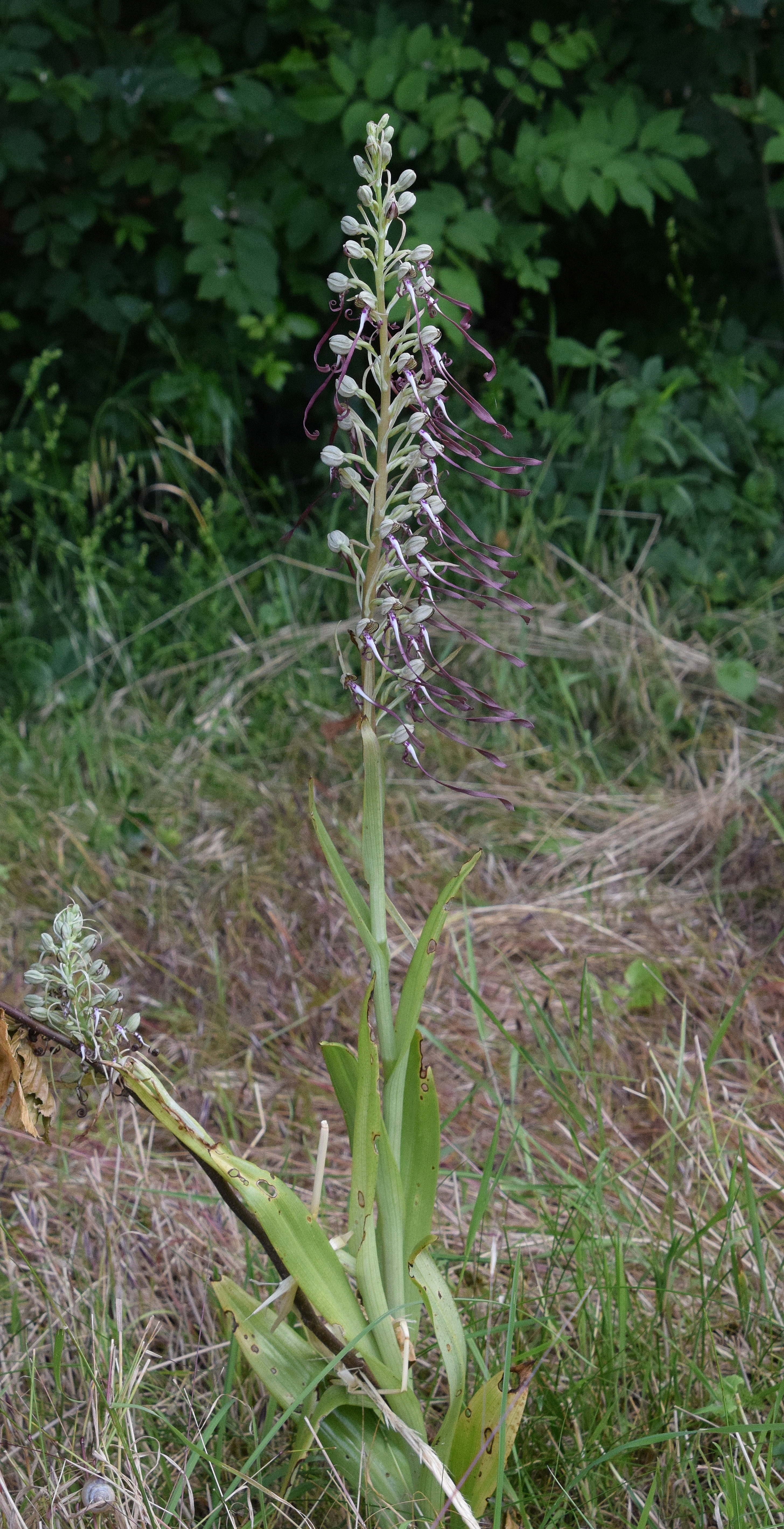
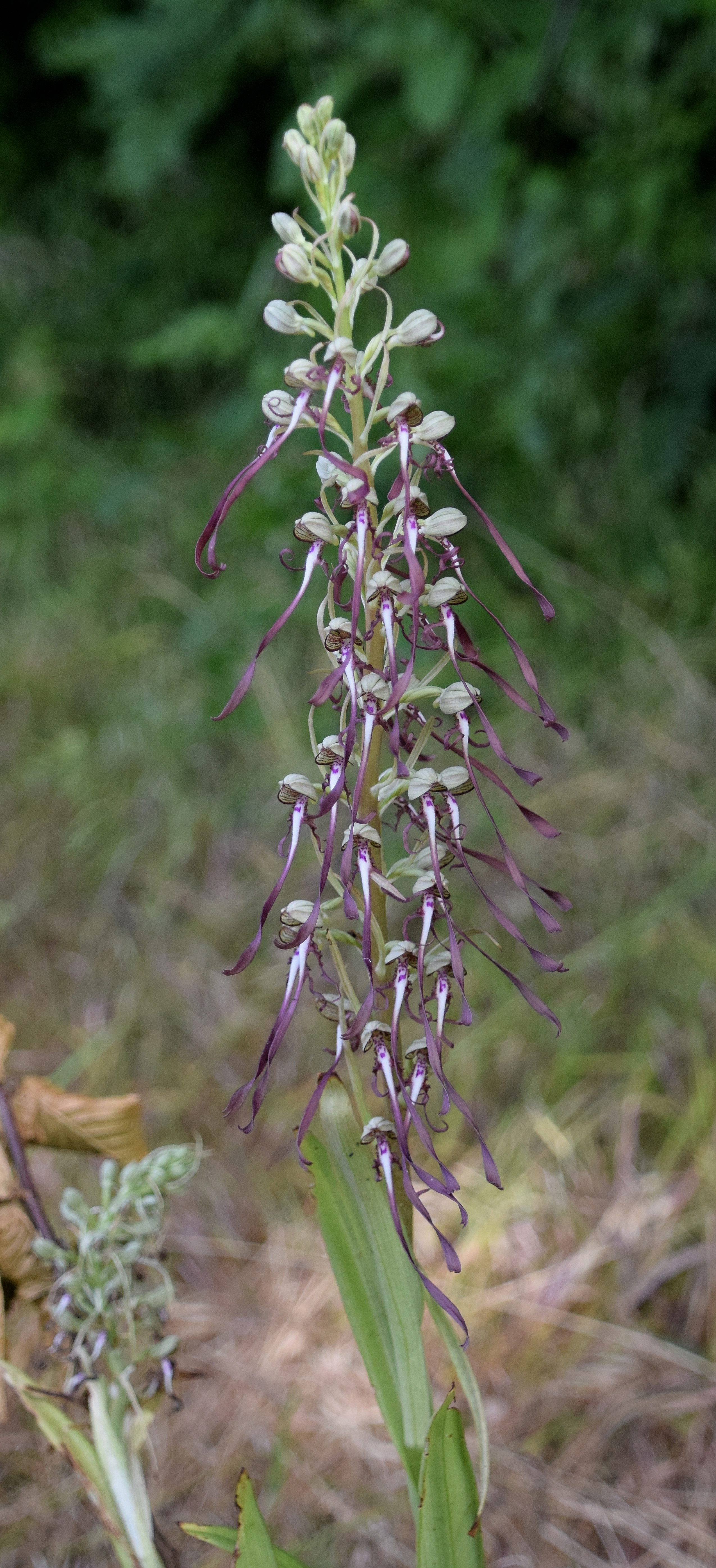
Scarce and localised nationally on the edge of its European range, the red-listed Lizard Orchid (see here) is also notoriously sporadic from season to season. Often occurring singly like Oxon’s sole representative, or in greater quantities such as here, the species favours roadside verges, woodland edges, old quarries, calcareous grassland and stable, coastal dune systems. It has an association with golf courses, most notably at today’s site and Sandwich in Kent.

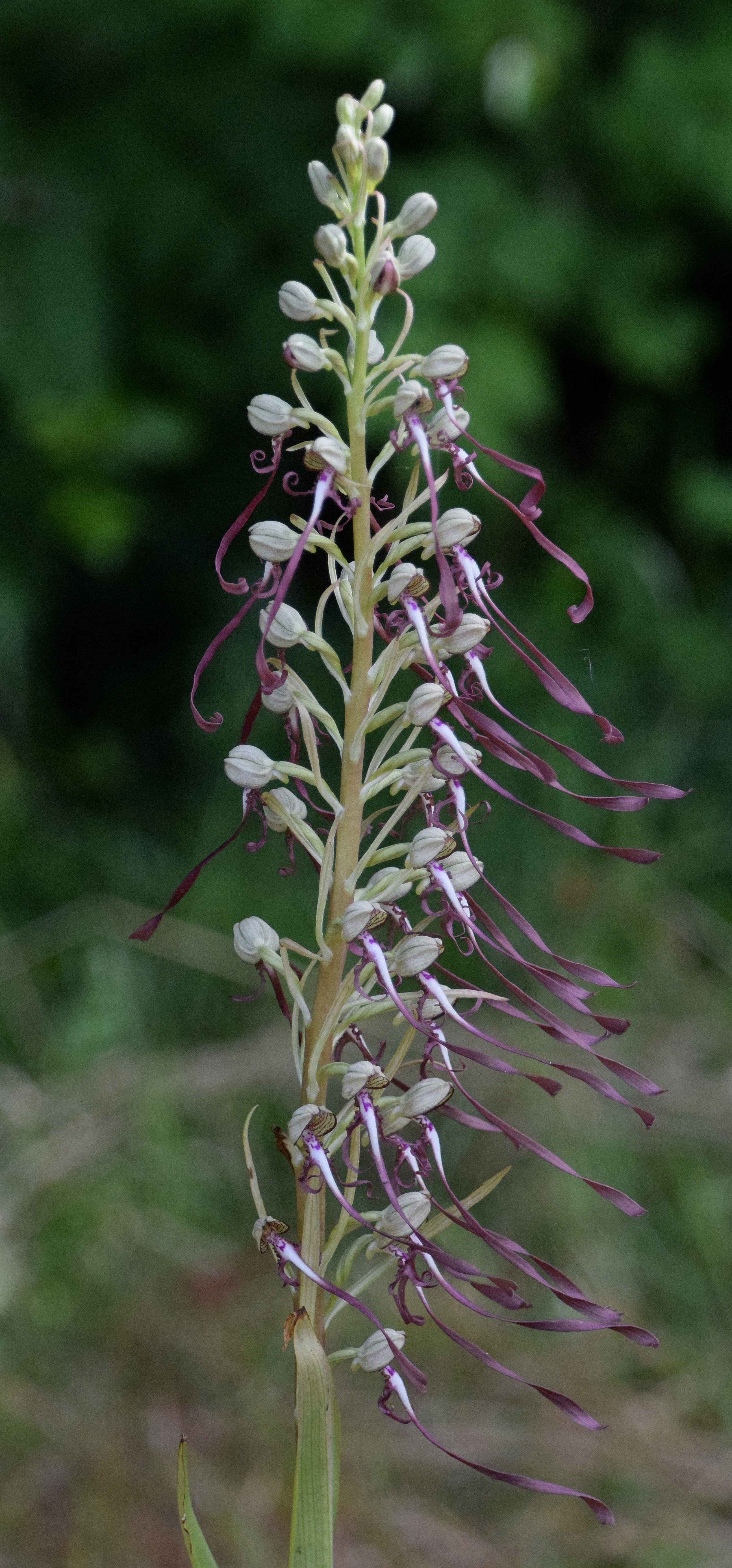
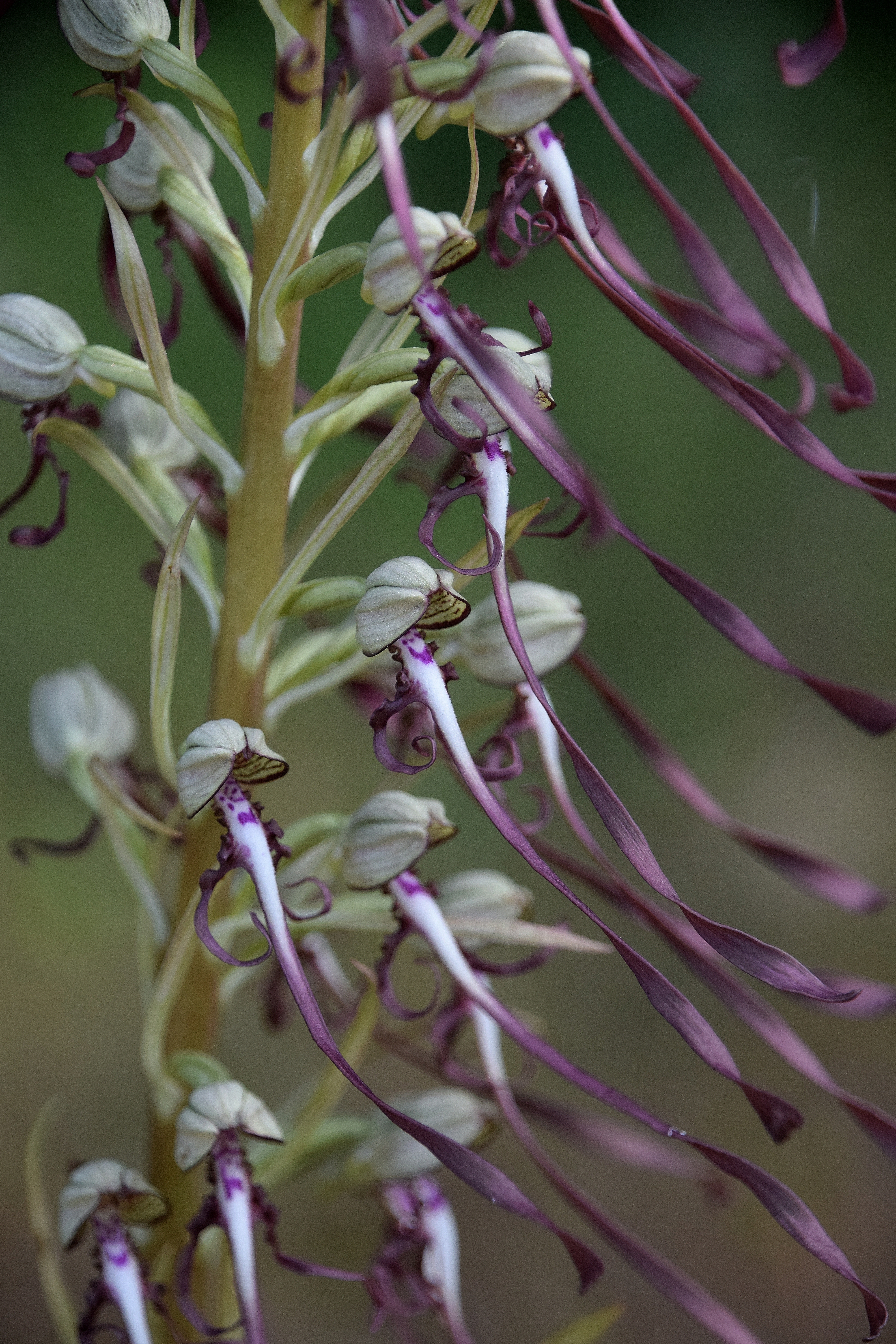
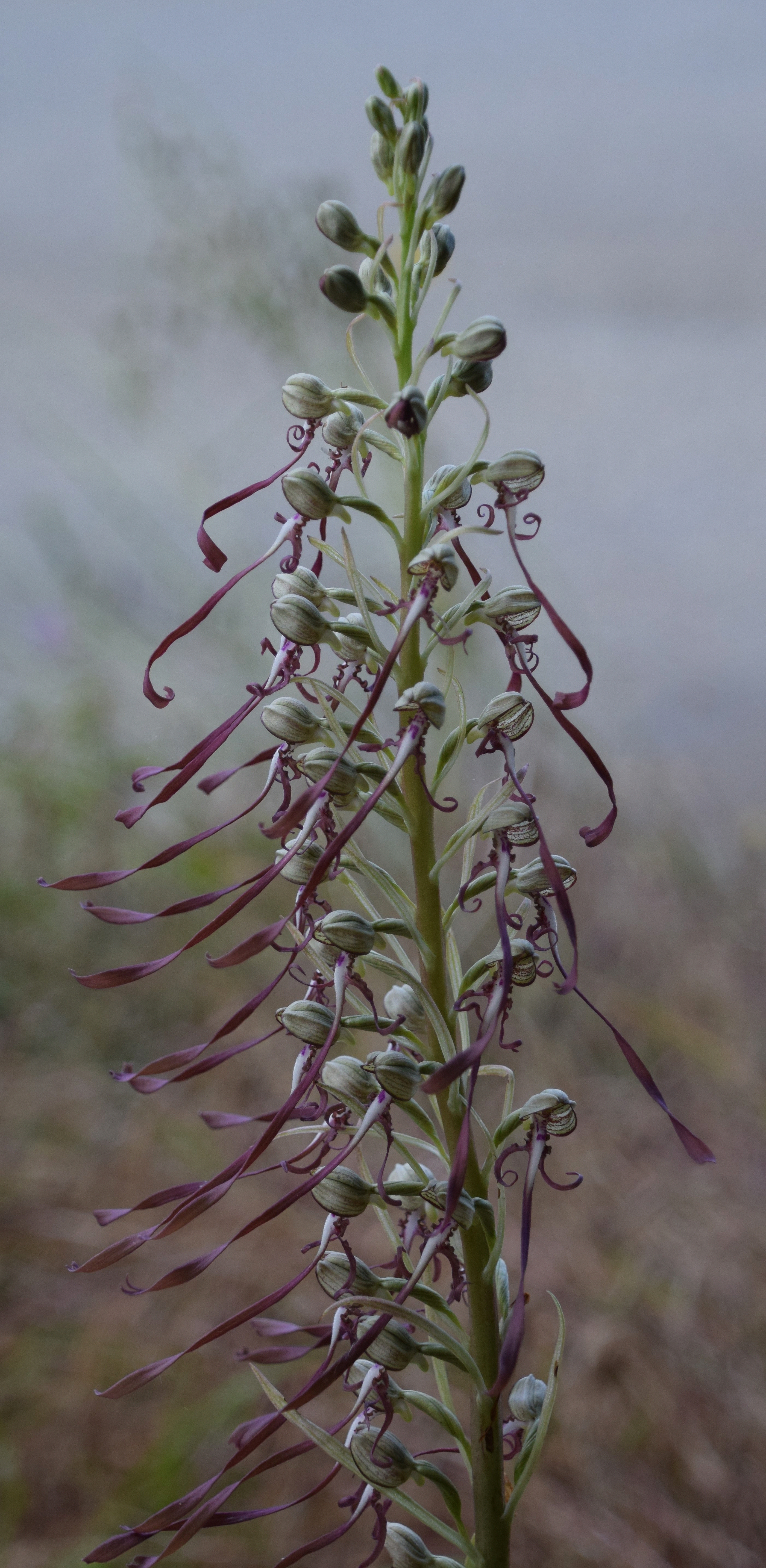
This is potentially Great Britain’s loftiest Orchid, capable of reaching a metre in height with as many as 80 densely-packed flowers in a spike, as well as one of the more bizarre. More usual dimensions range from 25 up to 70 cm tall. The pale greenish-white flowers with purple highlights are said to resemble the head, legs and tail of its reptilian appellation; while long, dangling, curled frills and delicate spots and stripes increase the exotic quality. This June and July-flowering plant is said to emit a distinct odour of goats to attract pollinators, but I neither know what exactly that might be or ever remember to sniff them to find out.

Other Berrow Dunes Orchids

Southern Marsh, Common Spotted, Pyramidal and Bee Orchids are also well represented at Berrow Dunes. I found some attractive examples of the first named (above, far left) along a boardwalk across an area of marsh at the far end of the right of way. Pyramidal Orchid (rest of sequence) were plentiful in the same spots as the Lizards, while more diminutive Bee were also present in the aforementioned hollow, requiring care not to be trodden upon.

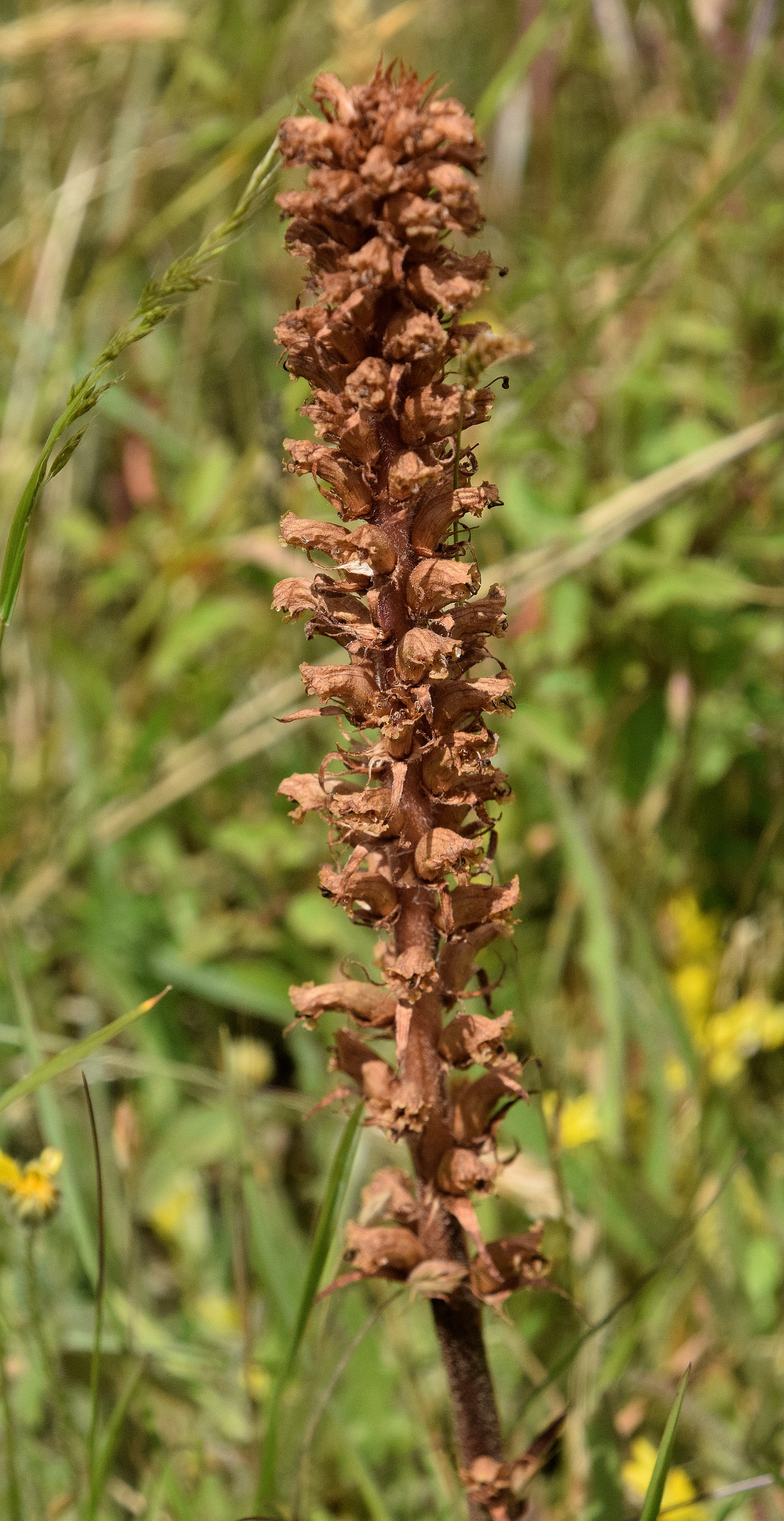
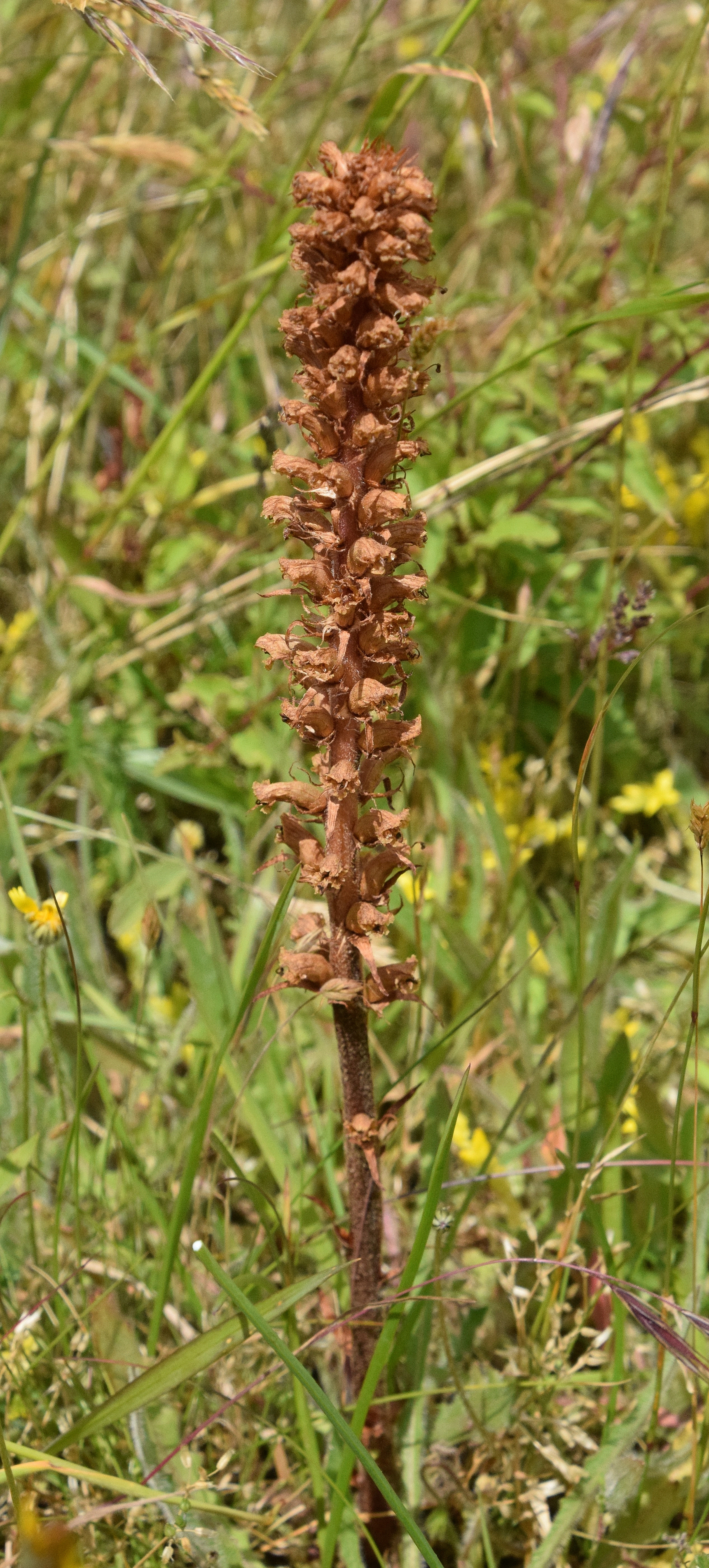
Another notable plant there in numbers was the enigmatic Common Broomrape (pictured below), that blooms from June to September and can be confused with Orchids by the less experienced including myself in the past. Those, like the similarly toned and sized Birds-nest Orchid (see here), have no green parts so do not photosynthesise, being instead parasitic upon the roots of various other host plants from which they take their own nutrients. Hence, rather like fungi they do not appear above ground until the flower spikes thrust upward.

Common Broomrape

I had noted two more possible Lizard Orchid locations in advance, a little further north from older records published online (see here); but they were not near the public right of way and we were present at a busy golfing time of day. So instead I followed my chance acquaintances by road to two meadows adjacent to the far northern end of the course, to witness their profusion of Southern Marsh Orchid (pictured below).

These and the closely related Early Marsh must be amongst my favourite Orchids, since they produce such robust, densely-packed flower spikes. The appropriately named Common Spotted Orchid seems bland and uninteresting by comparison. Today’s experience dwarfed my previous substantive one of pure Southern Marsh at Tuckmill Meadows, Oxon a year ago; and confirmed the great majority of those I then considered at Clattinger Farm, Wilts were hybrids (see here for both).

Southern Marsh Orchids

Lastly, I could only imagine the wildlife potential of a delightfully unkempt churchyard I wandered through in the village of Berrow itself (pictured below) before heading home. Here quite a few more Pyramidal Orchids were amongst the wild plants appreciating the apparent lack of mowing or strimming regime, but I had little time remaining in which to search out further biodiversity. If only more public spaces were managed in such a way!

Parish Church of St Mary, Berrow

It seems I had not visited Berrow Dunes and its golf course in a vintage year for their stand out botanical encounter of the Lizard kind. But today was another excellent episode in my current series of Orchid adventures. The much followed, often iconic plants have provided a similar capacity to fascinate now that summer butterflies and Odonata hold little more mystery given their own familiarity. But the still available returns are once again diminishing in difficulty and travelling distance terms, so how I might evolve for wildlife motivation next year I cannot tell.

Kite and Lizard: a local interlude – 11th June

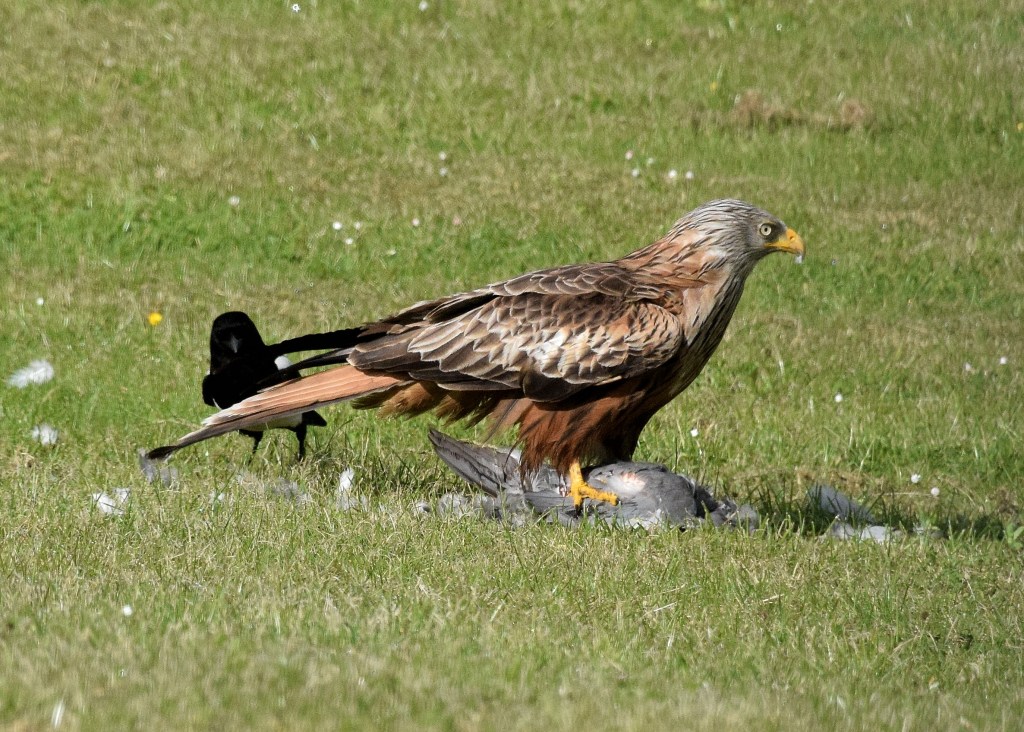
We take these birds so much for granted nowadays in Oxfordshire that it perhaps requires an experience such as what unfolded this morning to fully value and admire them. Somewhere in amongst breakfasting and showering I noticed a minor commotion in the perpetually mowed field behind my park home. A Red Kite was being harassed by Magpies, whilst something very clearly dead lay on the ground nearby. Once the raptor was driven off, perhaps surprisingly by its smaller antagonists, I went to look.

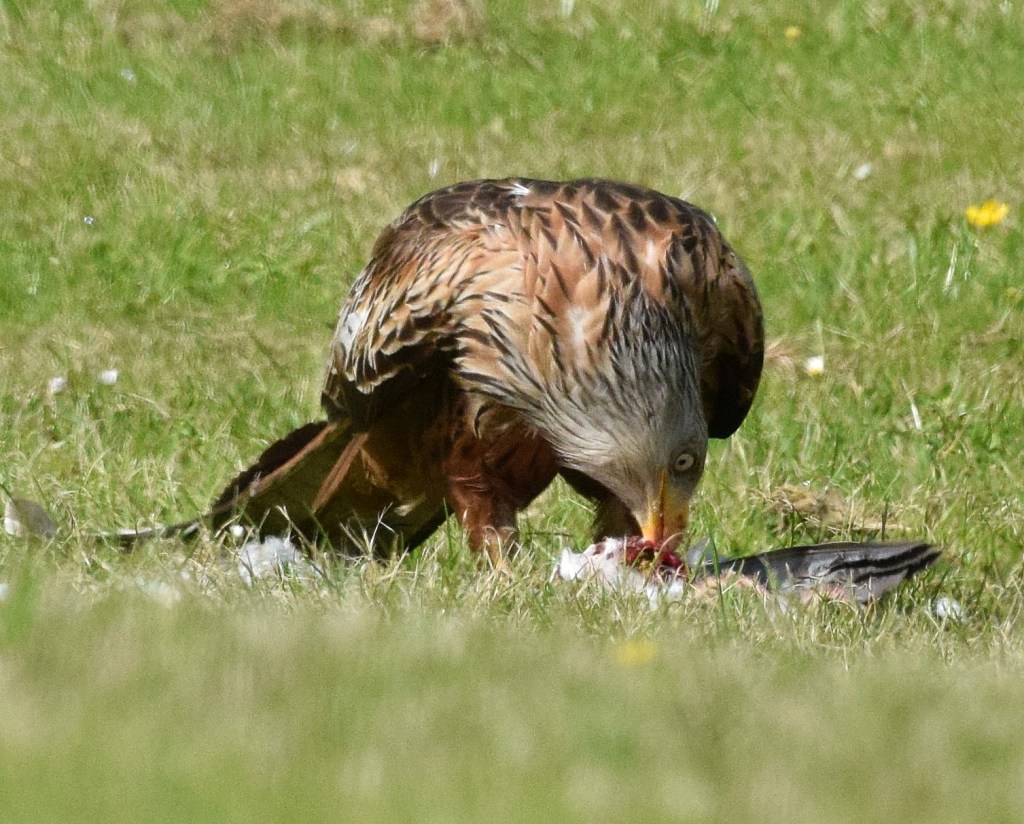
The corpse was indeed a Woodpigeon, though it had seemed bigger from further away, largely decapitated and with its belly ripped open. Gruesome stuff, but I didn’t linger for long. By the time the Kite came back I had retrieved my camera. Though I will never make any pretence of being a “photographer”, what ensued made me appreciate one of our most commonplace local, if re-introduced birds almost as much as when I travelled to mid-Wales to encounter the then great scarcity for the first time during the 1980s

Again the Kite took exception to the attentions of Magpies and Jackdaws, abandoning its meal, and so I decided it couldn’t be too bothered and continued with my morning’s ablutions. But when I went out on this day’s wildlife quest the first-named was again in the field and now without corvid interference. So I walked up to my back garden fence and took the pictures that follow. I read recently that blurred foregrounds are considered to be arty amongst my more competitive peers, while the subject itself looks OK to me in these next two studies. Just look at that imposing head and big yellow eye!

By now the remains of the Woodpigeon looked well and truly plucked, feathers littering the ground. Then the Kite suddenly flew off, carrying the partly consumed carrion in its talons, so I went on to my morning’s chosen wildlife task. Perhaps predictably in this current season that was another Orchid, the location for which is generally known in informed county wildlife circles, but which I cannot reveal more widely herein.

The twin-stemmed Lizard Orchid (above), is as far as I am aware the only known current example in Oxfordshire. It has suffered damage this season, possibly from molluscs or else something more substantial stepping upon it. But the good stem of the two was in pristine condition upon my check, offering some attractive pictorial records. I don’t usually do this sort of “what I did today” local stuff in this journal, but I just rather like both sets of images presented in this little post.

Footnote: I have subsequently learned of a further Oxon Lizard Orchid, also at a roadside location in the south of the county.

Lesser Butterfly and more Burnt Orchids at Pewsey Downs NNR, Wilts – 3rd June

The orchid adventures in this second season keep on getting better. This post’s lead item was one of four agenda failures in 2023, having died out at its last-known Oxon site. The red-listed as vulnerable Lesser Butterfly Orchid has also been lost from more than 60% of its historic national range due to changes in agricultural practice and consequent habitat destruction. I had seen just one before in Scotland and had to take that tour guide’s word for the ID, not knowing then what I do now. So today I visited an acknowledged lingering stronghold.

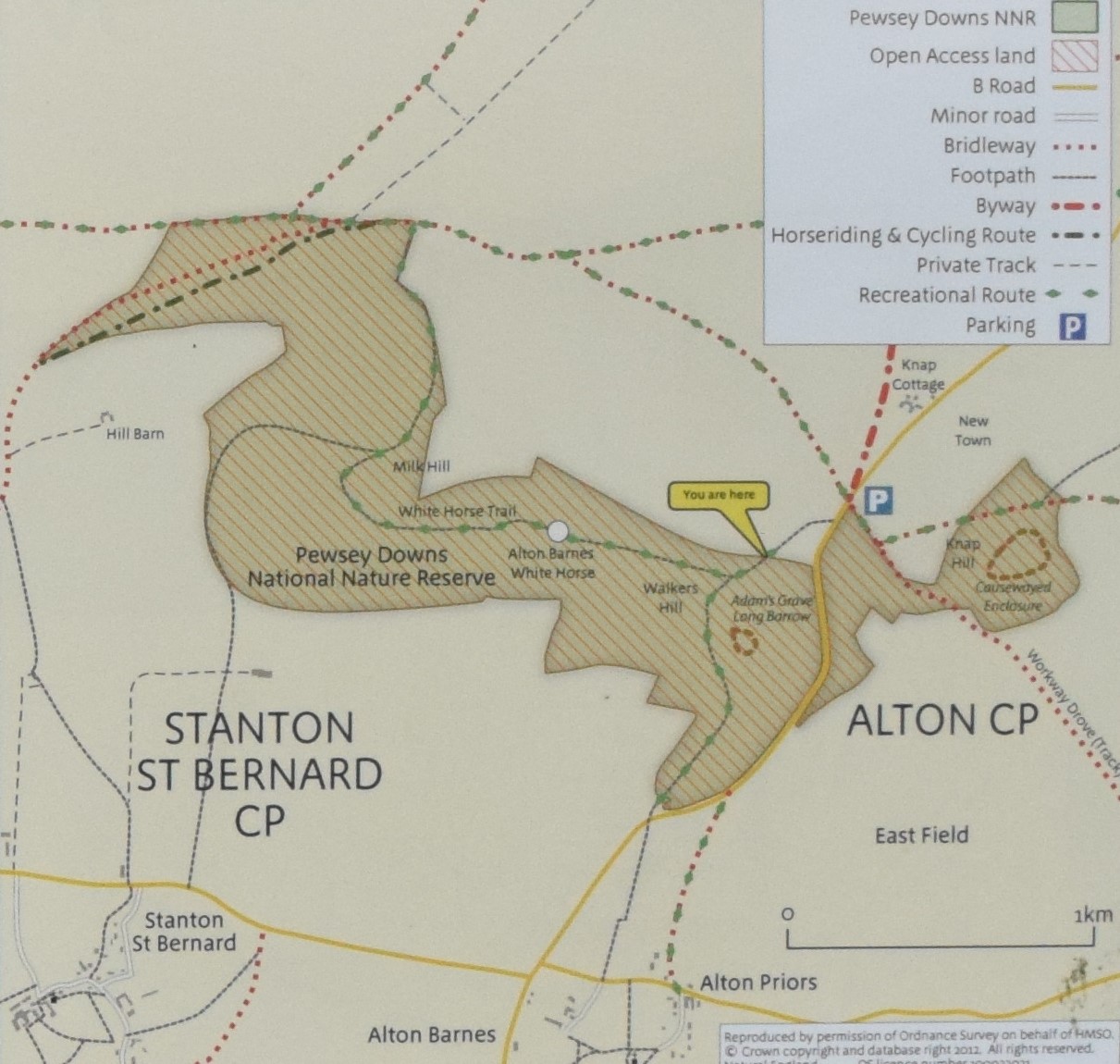
Pewsey Downs NNR (see here) is one of England’s finest remaining expanses of unaltered chalk downland. It is both a SSSI and Special Area of Conservation (SAC) due to its Orchid-rich grassland and associated 28 butterfly species. From a car park at SU115638 a right of way leads up Walker’s Hill, the central of the reserve’s three such features. On the summit sits a neolithic long barrow “Adam’s Grave” that was clearly meant to be seen from far and wide in its own time, beyond which more ancient earthworks announce themselves less dramatically.

On reaching that landmark I was engaged with by another wild-plant seeker who hadn’t heard of my quest, then began to locate LBOs before I did! I had read that the best Orchid area here is on the south-facing slope below the large barrow and around the next earthwork downward. Once left to my own devices again and back at my usual pace I found many more Lesser Butterfly Orchid (see here and here – pictured above and below), some in pristine condition and rather more going over. There are said to be hundreds in the eastern parts of this site, especially within and around the ancient ditches and enclosures that characterise it.

LBO grows to 30 cm tall in June and July; on fertile grassland up to 365 metres such as here, heathland in boggy ground, in woodland on calcareous substrates, and in open alkaline fens. It is thus able to benefit from a wider range of habitats than most Orchids, but within them is said to have particular requirements that are not yet well understood. The plants are described as being generally smaller and more delicate looking than the closely related and more widespread Greater Butterfly Orchid. But those are not reliable indicators, since GBO varies in such physical and other more minor respects.

I understand the only accurate way of separating the two is by closely examining the interior of the flowers, within which the pollinia are parallel in lesser, curved in greater. That said the top row central and right hand images (above) are of different flowers on the same stem. But those none-too sharp macro studies are sufficiently like others I have seen online to clinch the ID at today’s widely-cited LBO location. The barely better lower left-hand picture is taken from the Creed and Hudson Orchid guide (© rights of publisher reserved), for clarification. The GBO details in that row are from 2023 plants at Oxon’s Warburg reserve where LBO is now thought to no longer occur.

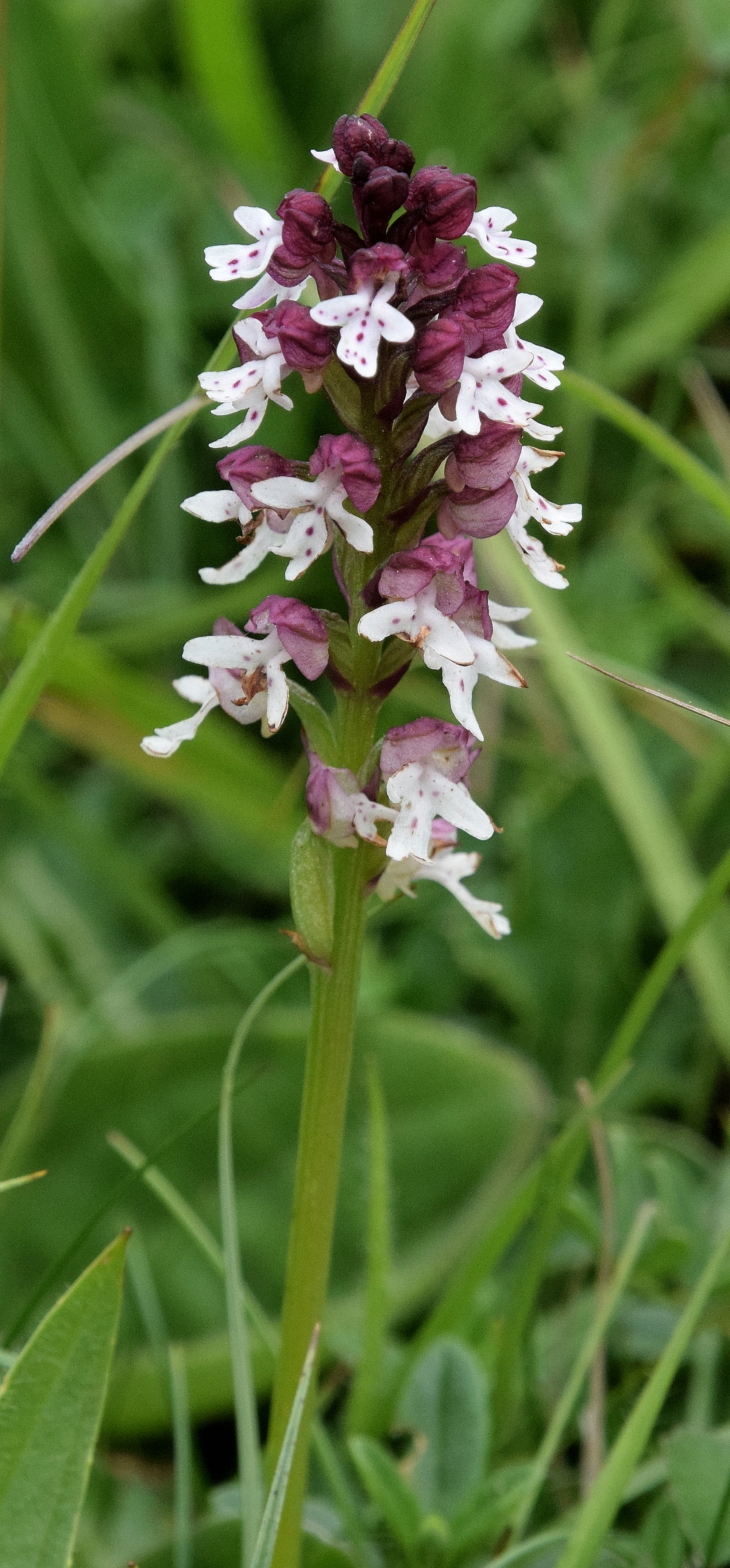
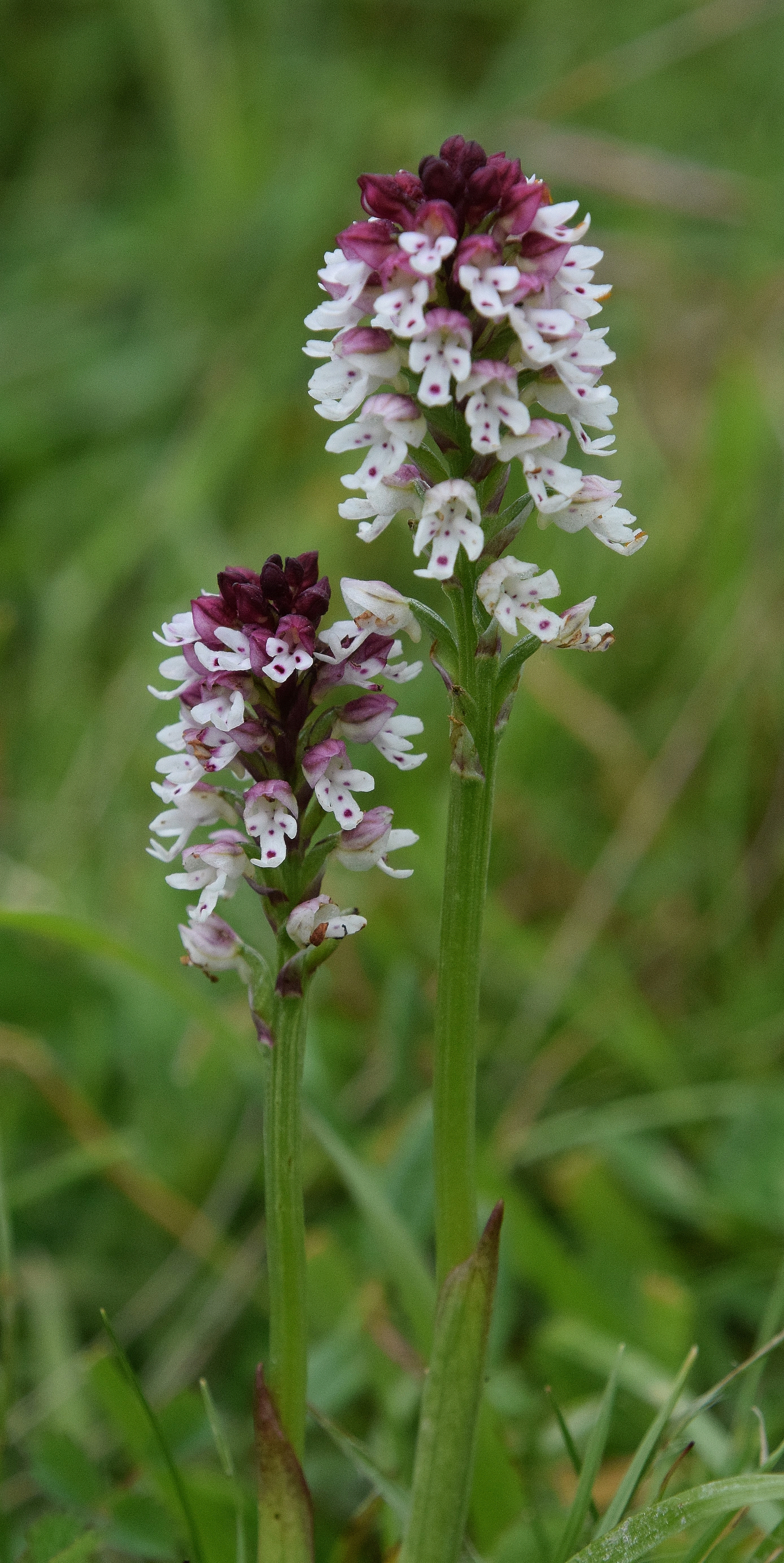
Burnt Orchids on Pewsey Downs

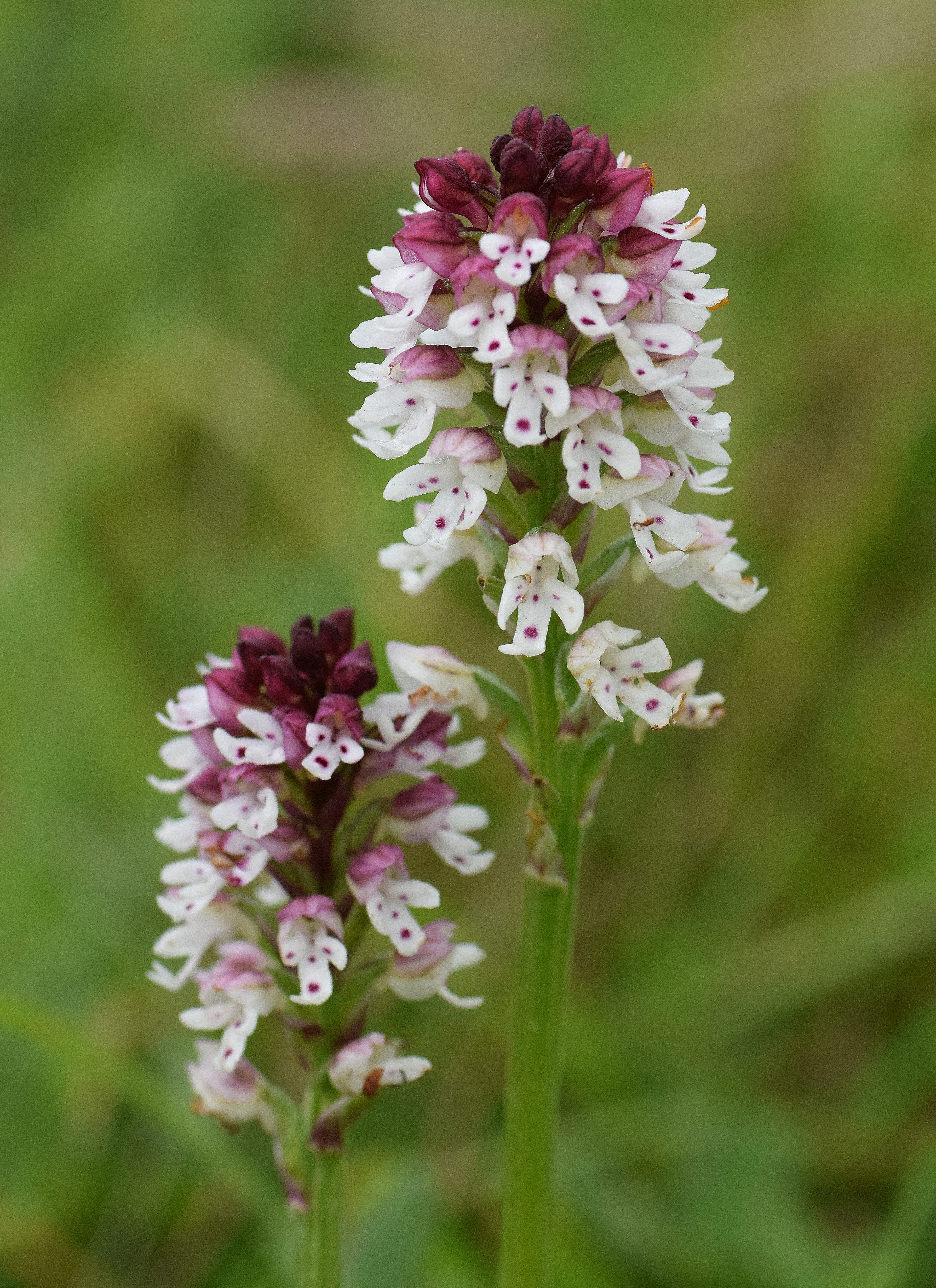
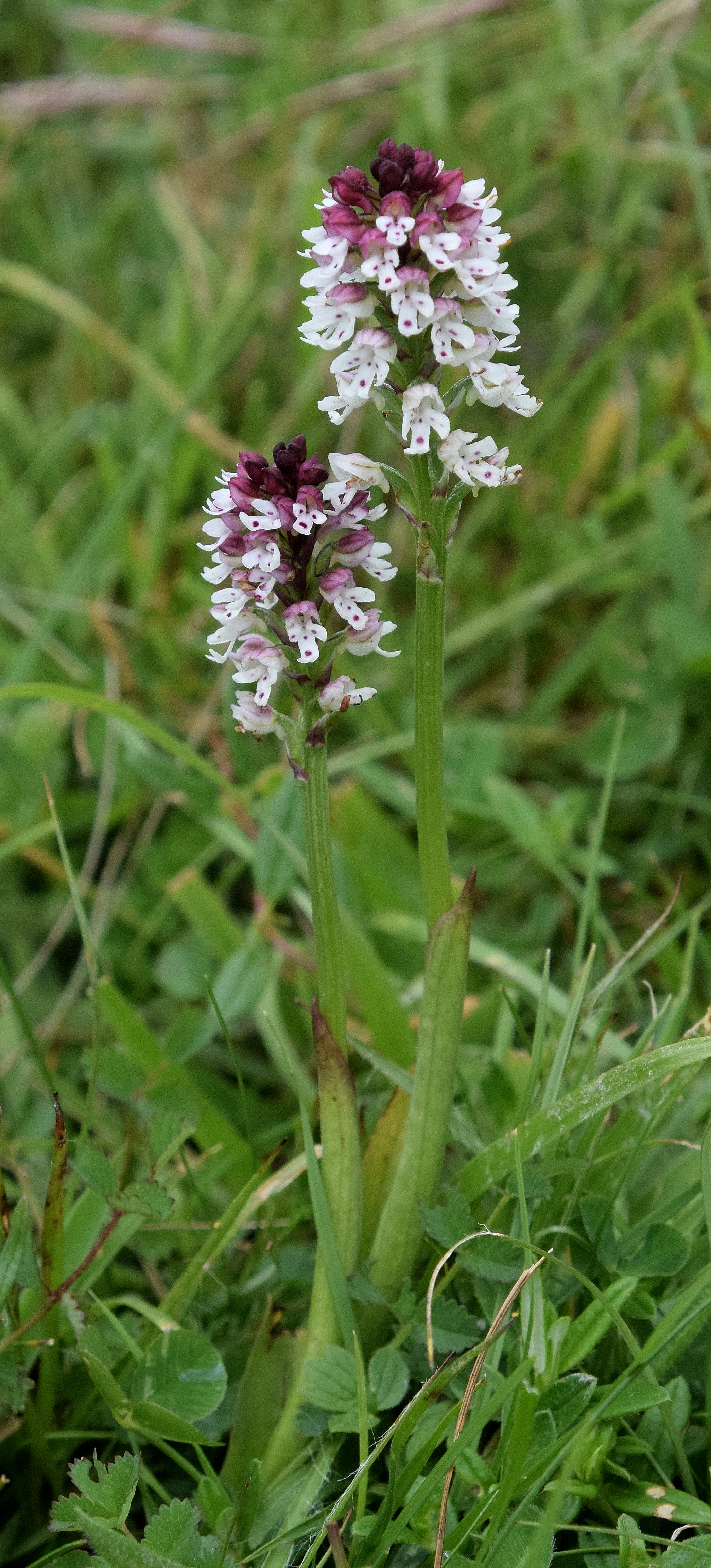
There were also Burnt Orchid here, my season’s fourth site for that so attractive variety. The double example in the preceding sequence is possibly my best ever subject. Chalk Fragrant and Common Spotted Orchid were both abundant. Musk and Frog are still to come and I expect both would be much more challenging to locate in the long sward than my first visit’s fayre. Like most of the places I have sought new (for me) Orchids in the current season, Walker’s Hill is also steep! Cue another recovery day during which to compile this post.

Pewsey Downs NNR site plan

In overcast conditions it was all too apparent that the vistas southward over the Vale of Pewsey and east and west along the escarpment I trod would be spectacular in fairer weather. The Wessex Downs have always held a fascination for me, be it the archaeological heritage of Salisbury Plain further south and Marlborough Downs to the north; or the butterfly-rich hills of Westbury, Cotley (see here), Scratchbury and Battlesbury (here) further south-west. But I had not visited this particular locale previously and like all those others the experience it produced did not disappoint.

Man Orchids at Barnack Hills & Holes NNR and Swaddywell Pit, Cambs – 24th May

This item was on my second season Orchid agenda as there are clusters within reasonable range. Of those, recent records suggested one near Dunstable is in decline, so I went a little further to just north-west of Peterborough and was not disappointed. My quest was in the same pale yellow-green colour spectrum as Common Twayblade and Frog Orchid; quite a contrast from the more striking fayre of a day earlier’s adventure.

The enigmatic Man Orchid (pictured above) is fairly common and widespread across southern Europe but less so further north, being rare in Great Britain where it is classed as endangered. The flowers resemble small human figures with dangling arms and legs beneath (to my mind) copious Gatsby-style caps. These skinny, understated though subtly alluring plants grow 20 – 40 cm tall, most usually on alkaline grassland, and they are known to colonise former quarries.

I was intrigued to visit one such location where there were said to be around 30 subjects. Barnack Hills and Holes NNR (PE9 3EU, TF076046 – see here) is a former limestone quarry that in medieval times provided building material for the great cathedrals of Peterborough and Ely, and other churches of the region. It was worked out by the early 16th century, since when it has come to support more than 300 species of wild plant. Those include large populations of Green-winged, Early Purple and Chalk Fragrant Orchids; and this post’s subject is the site stand-out. A designated SSSI managed by Natural England and the local Langdyke Community Trust, the hummocky expanse of its 23 hectares (57 acres) comprises half of the remaining such limestone grassland in Cambs.

Barnack Hill & Holes NNR

As a day previously, on entering the reserve I was faced with a large “haystack” in which to search for the needle of my quest. Wandering in and around at random, cordoned off enclosures fairly soon became visible. They were the reserve’s plant protection area that is marked approximately by the blue dot on the above plan. The most convenient parking place is therefore at 52.628294, -0.408247 in Walcot Road.

At the edge of one such enclosure I found a first two rather ragged specimens. Then I was approached by a local naturalist who led me to a more productive area with Man Orchid signage where we located another four better examples. The following pictures were all taken from the enclosure perimeters, so there were no doubt more plants further inside.

My chance acquaintance told me of a second former limestone quarry site three miles away, Swaddywell Pit (PE6 7EL, TF118034 – see here). Stone extraction at this outcrop of the lower beds of Lincolnshire limestone dates from Roman times and ceased in the 1920s. The greater part of the reserve is now a grassed-over former landfill site that must be crossed from a car park beside the Stamford Stone Company (52.614804, -0.353077). The managed area beyond, again by Langdyke Community Trust, contains a mosaic of habitats including open water, reed and scrub, limestone grassland and low cliff faces.

Inside I walked to its far north-western end, just before which cages gave away the presence of a good-sized group of Man Orchids. Some of the outliers were beautifully fresh (pictured below), while the majority were part concealed within the clutter of a fenced bank. The reserve also holds several other Orchid species, more rare wild plants,14 different Odonata and a nationally important cluster of Great Crested Newt.

Man Orchids at Swaddywell Pit

Like Knocking Hoe NNR a day earlier, both this post’s locations hold huge populations of the nationally rare Pasque Flower. My home county of Oxon has two sites entailing a handful of plants each, by contrast with which it seems my visited area of Cambs offers a second Pasque grand central of this week. The following pictures are from BH&H.

Pasque Flowers

The past two days in Beds and Cambs were truly stimulating and motivating. The intriguing wild places visited, and the specialty populations of their preserved habitats’ nationally rare plants are now set to dwell in my wildlife recollections for the season. A native Orchid checklist compiled after writing this post reveals I have now observed around two-thirds of the available total. How quickly another order reduces its required records to rare and more difficult stuff, as most of the remainder are! May 2024 has nonetheless been quite a statement month.