Catching up with two Essex Nearctics: Northern Waterthrush but not Canvasback – 9th Jan

I will admit to knowing nothing of the first of these two birds prior to one announcing itself in a residential area of the Blackwater port of Maldon six days ago. Being only the third mainland British record and a huge local mega, my first reaction was typically to wait for things to calm down a bit before deciding whether to go. But having worked several extra shifts over the festive period, during which the weather was very wet, I rather wished to hit the road for some welcome spirit cleansing going into the current cold and sunny midwinter week. And with this item’s reliability growing as the frenzy around it lessened over the weekend, it became at just over 100 miles from home the best candidate.

My quest though nominally a “Thrush” is actually a north American Warbler, common within its home range, that to my untrained eye resembles a miniature Redwing without the red bits, or perhaps a larger Pipit. I’ve never been one for plumage topography after all! Recent reports suggested early morning would be the best time to connect, so I headed off shortly before 6am, arriving on site just over two hours later. Viewing was said to have become easier once people learned not to approach the bird’s favoured spot too closely. This being a short distance away from the housing estate of the initial reports, in which visiting twitchers have been urged constantly not to park, my prior concerns over residential birding had dissipated.

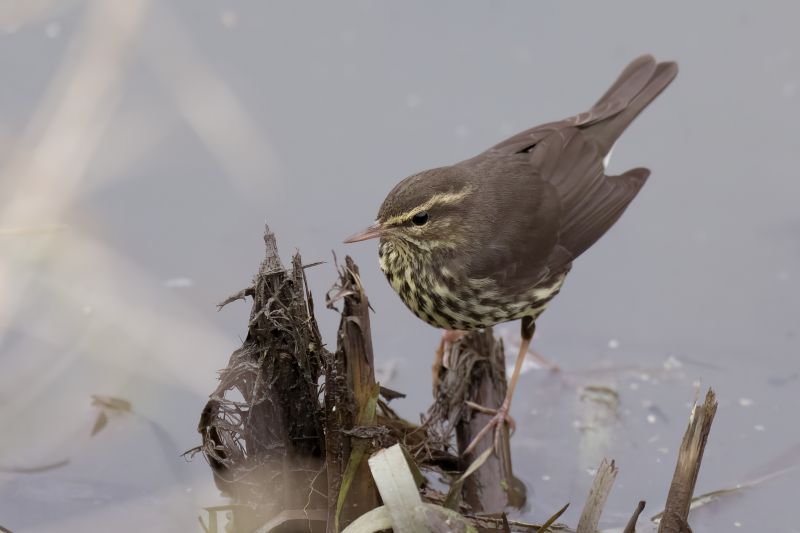
Plenty of roadside space was available in a neighbouring industrial area, from where it was a short walk down one side of Heybridge Creek (TL858076), then over a bridge and back up to the twitch site. On my joining one end of the line, the first man there put me onto the Northern Waterthrush (pictured below) foraging busily on one side of the creek before us. So this was an immediate connect. Further along, as expected was Adam (see here) who had stayed overnight locally, not being one for pre-dawn journeys himself, amongst a sizeable gathering of near exclusively male birders.

Northern Waterthrush © and courtesy of Richard Tyler

The object of our attention had been showing well since first light, and continued to do so for around 20 minutes more, working both sides of the creek (pictured below), before flying over our heads into small trees a couple of times, then back in amongst the adjacent houses. Such an early routine had become established over the previous few days, and I along with all those present now had clearly timed things correctly. The habitat and poses in which I observed the Waterthrush were just like in Richard’s excellent image from a day earlier, that he has very kindly allowed me to use. Yesterday the bird re-appeared at roughly two hour intervals through the rest of the morning, but then not again until late afternoon. Today that scenario was largely repeated, plus an early afternoon cameo.

There is some speculation over how long this Nearctic vagrant may have been here unnoticed before visiting the president of the Essex Birdwatching Society’s garden and being announced to the wider green clad optics carrying community. It could have arrived with last September’s un-precedented fall of north American passerines and stayed to over-winter, and there have been more trans-Atlantic storms since.

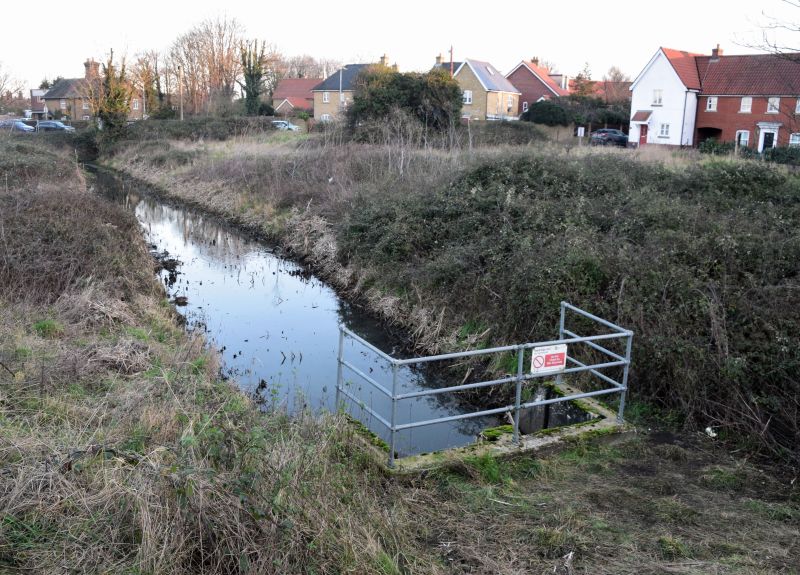
The Waterthrush’s early morning feeding location

Northern Waterthrush is largely a ground dwelling species, usually seen near still or stagnant water as today, feeding on insects and other small invertebrates at stream or pond edges. The jizz is characterised by walking not hopping, and constant bobbing of the tail. Warblers such as this spending the winter in the British Isles is by no means without precedent, if they can find suitable habitat with a food source such as the site pictured above must provide.

From Heybridge it was just 12 miles to Abberton Reservoir, where a Nearctic Canvasback duck of unknown provenance has been present since early December. I had not bothered previously due to its likely plasticity, but now attempting the insurance tick made sense to fill more of the day. Things were never going to be as easy as that earlier success. This was one slightly different individual amongst a large and mobile flock of Eurasian Pochard that is now mostly viewed distantly, given the water body’s vastness.

Enquiring in the visitor centre I was advised; with strong, freezing winds blowing east to west through the complex, to check two of it’s more sheltered areas. I drew blank in both, before being informed by a local birder at one end that the carrier Pochards were massed at the other, too far offshore to reliably pick out the interloper. Persisting wasn’t my idea of enjoyment, so I headed home ahead of the evening M25 peak.

Birding is now very much a diminishing return for me, given my self-punishing need for the new and different – or “evolution” – within a distance range and financial constraints. But quality episodes such as the early morning raid of this post, that still at intervals arise, may remain the most motivating wildlife experiences of all. They do keep on coming from time to time. I had never heard of Northern Waterthrush before, it being my 383rd national and 519th WestPal bird … I have now!

Footnote: The Northern Waterthrush remained faithful to the routine described herein until 22nd January. The Canvasback, having last been identified two days prior to my visit, was not reported again until 27th.

The mighty Stinkhorn at last rises in a pristine “Waxcap grassland” and Scarlet Waxcap falls – 28th Nov

Normally I talk about long-term wildlife targets “falling” upon conversion, but that doesn’t seem the most apt phrase in the first instance that follows. I spent this morning in a churchyard that has a reputation in my neighbouring county of Bucks for its variety and scarcity of fungi, especially wishing to observe the site speciality Scarlet Waxcap. Others of that genus were apparent immediately upon walking in, then I noticed something black and white and fairly large close to a boundary hedge.

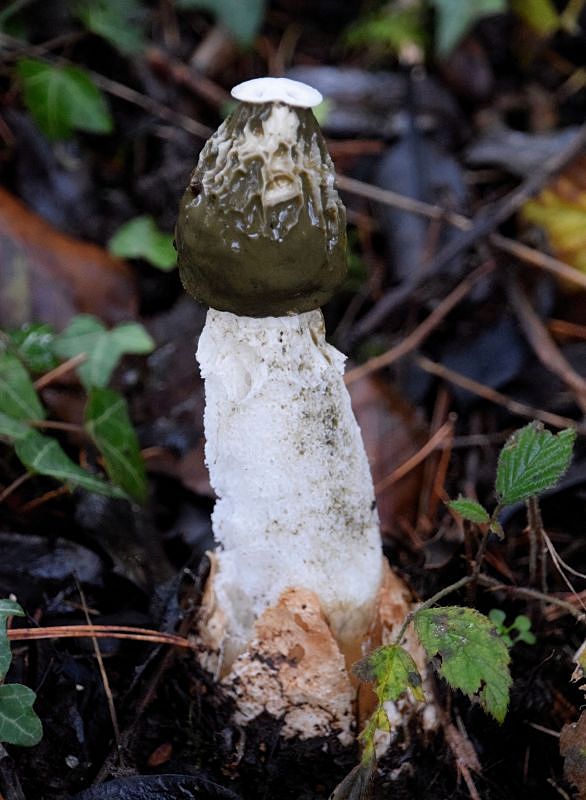
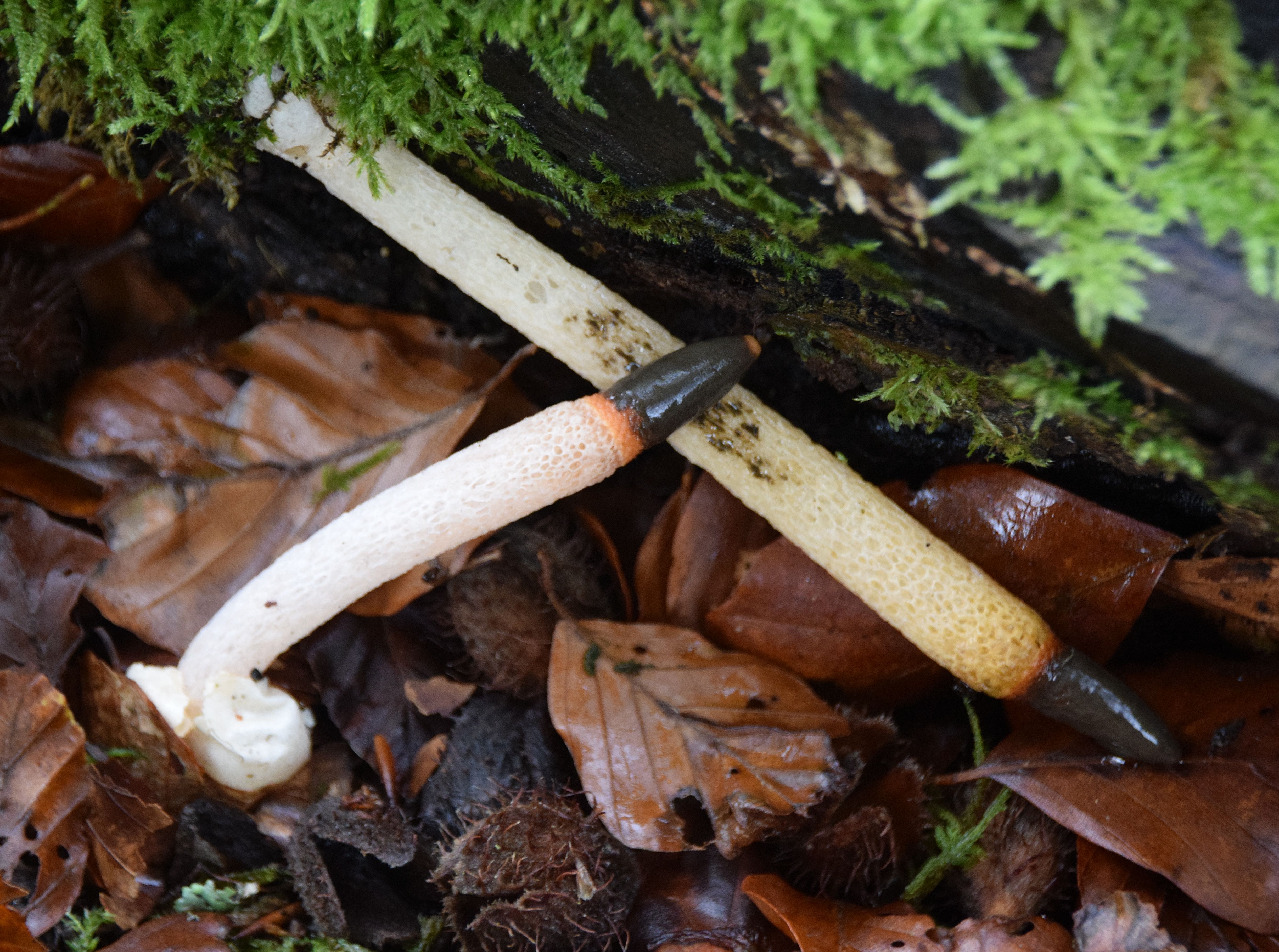
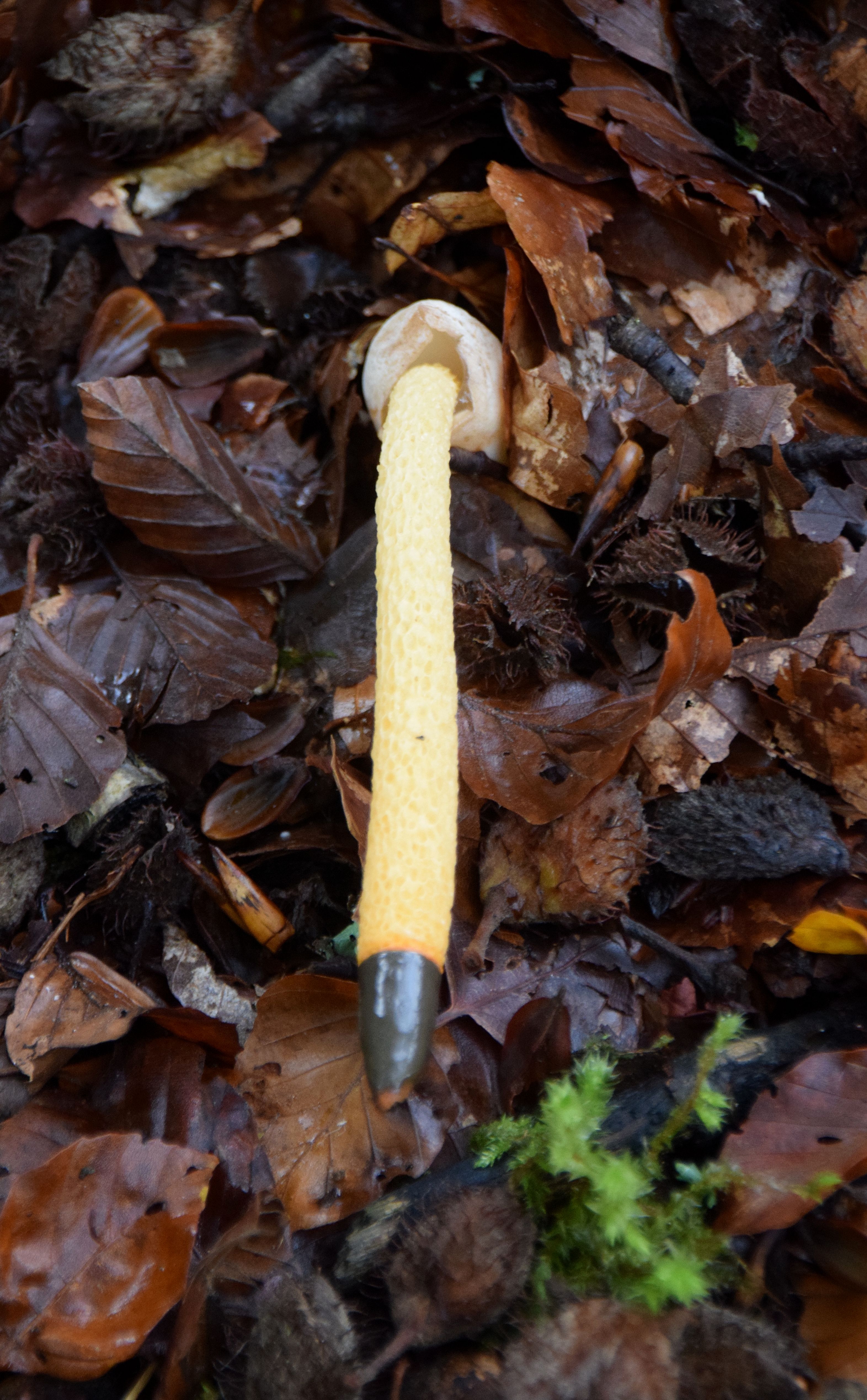
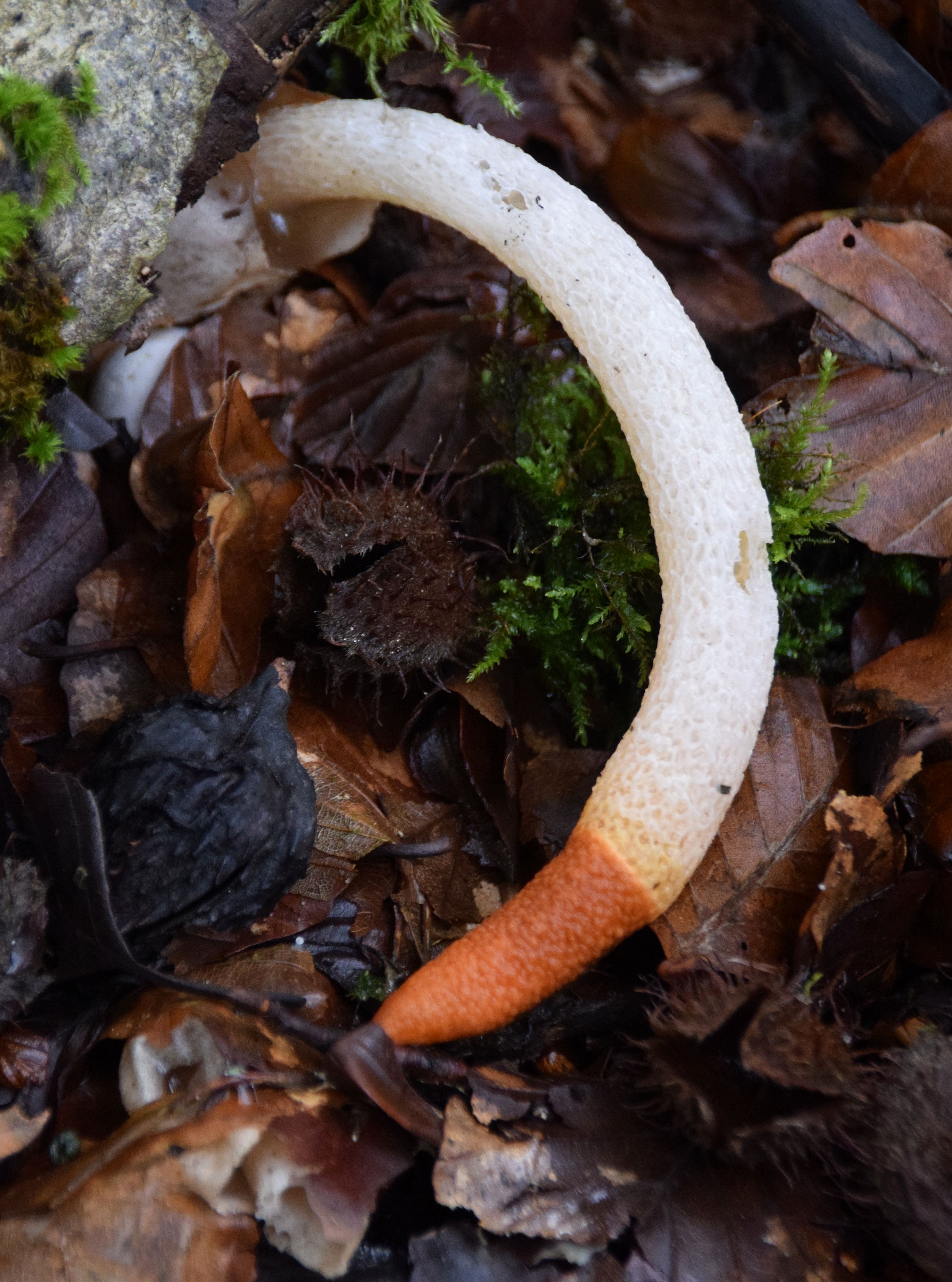
Walking over and realising what it was I exclaimed: “Oh, you beauty” upon beholding a prime Common Stinkhorn (Phallus impudicus). I keep an eye open for these must-sees every late autumn, and just three previous records to date were gone over, broken and puny in that order. This one (pictured below) was rather more the ticket. And there it was: brooding, moody and almost magnificent in the subdued light of its chosen surroundings.

Common Stinkhorn

I say “almost” because maybe nothing conveys the fragility of newly emerged mushrooms and their immediate attack by slugs more than the expanded polystyrene-textured stems of this small group. In that regard today’s around 14 cm tall specimen looks less striking now herein than it did in the field. But the dark olive, slime-covered tip shows it is still young. The partially buried, egg-like ball from which the erect stipe thrust upward was impressive indeed, being at perhaps 8 cm in diameter much more substantial than those of Dog (see here) and Devil’s Fingers (here) stinkhorns I have observed in the past.

This is a not uncommon fungus throughout the British Isles, continental Europe and parts of north America; but being so short lived they are difficult to locate at the pictured stage. Unfortunately, this late in the season there were no flies in attendance to attack and thereby pollinate today’s mildly smelly item as they quickly do, which could explain why the slime or gleba was still intact while the stem was already deteriorating. Dawn is said to be the best time at which to locate Stinkhorns that have burst from their eggs overnight in pristine condition, before either flies or slugs get to work, if you might know where to look for them. Once the gleba has been dispersed the white stipes may persist for several days.

I was very pleased to have stumbled upon this much sought item today. After walking on from the encounter I was engaged with by the vicar, who knows his mushrooms and is well used to mycologists being around the place. The location is Holy Trinity churchyard, Prestwood (HP16 0HJ – SU 874996) where fungi and wild plants survive that occur nowhere else in the region (see here). The site represents a rare remnant of original acid grass heath that was once prevalent on ancient Chiltern commons but almost all destroyed when enclosed in the mid-19th century. Here the combination of no agri-chemical fertiliser or pesticide use, regular mowing and removal of cuttings, creates ideal conditions for what is known as a “Waxcap grassland” in which that group of often diminutive mushrooms flourish. The number of species recorded here puts it amongst the best known sites.

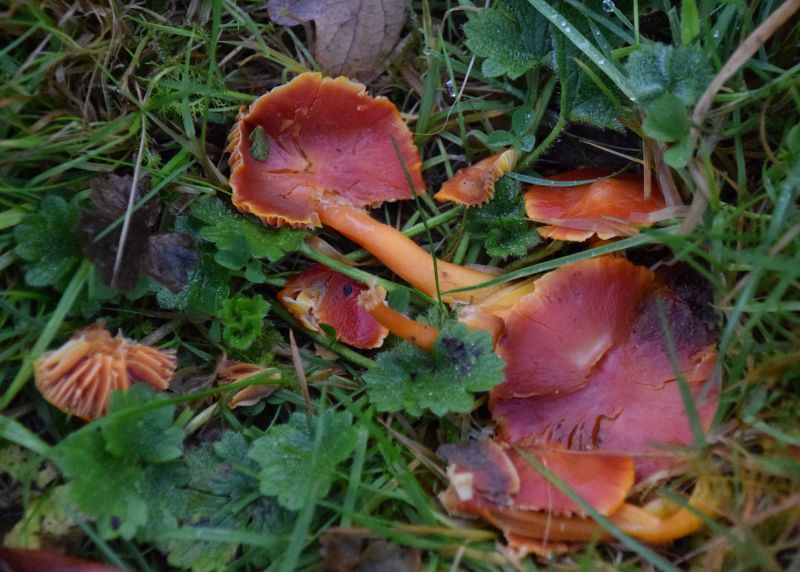
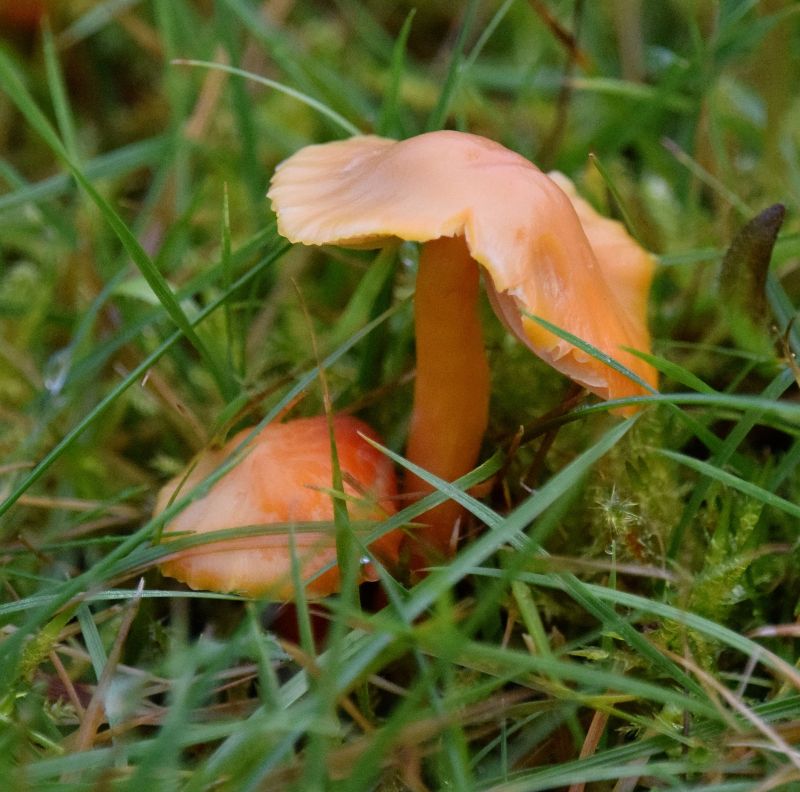
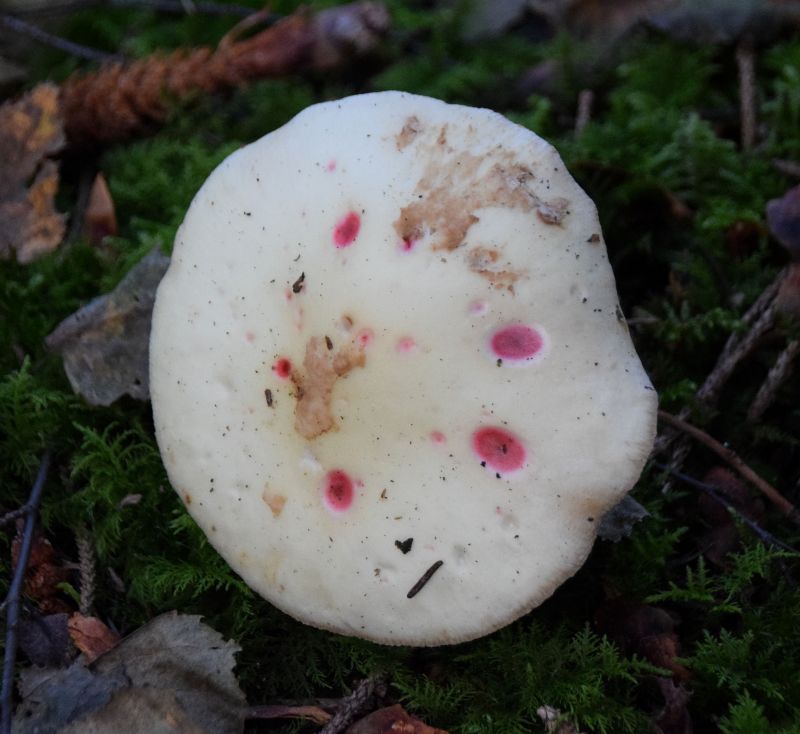
Scarlet Waxcaps, a colourful churchyard speciality

My host now showed me a cluster of Scarlet Waxcap (above left), my original reason for visiting, but they had unfortunately been run over, carelessly by something that had left a tyre mark in the turf. I nonetheless located a few intact specimens here amongst more Waxcap species and other habitat specialists that I do not feel experienced enough to discuss. Scarlet Waxcap (Hygrocybe coccinea), also known as Scarlet Hood is most usually found from September to November on cropped grassland, old lawns, parkland and churchyards with plenty of moss. The caps are 2 to 5cm in diameter and slimy when young, fading from blood red through orange to yellowish from the edge as they age. The stems and gills are similarly brightly toned.

My top target for today had thus been converted, and with the bonus of a truly stonking Stinkhorn this was a memorable foray in an environment that quite literally seemed from a former age. I will definitely be paying more attention to other churchyards and their fungi in the future.

Barrister’s bad hair days: more on the Shaggy Inkcap mushroom from Lane End, Bucks and elsewhere: 15 – 19th Nov

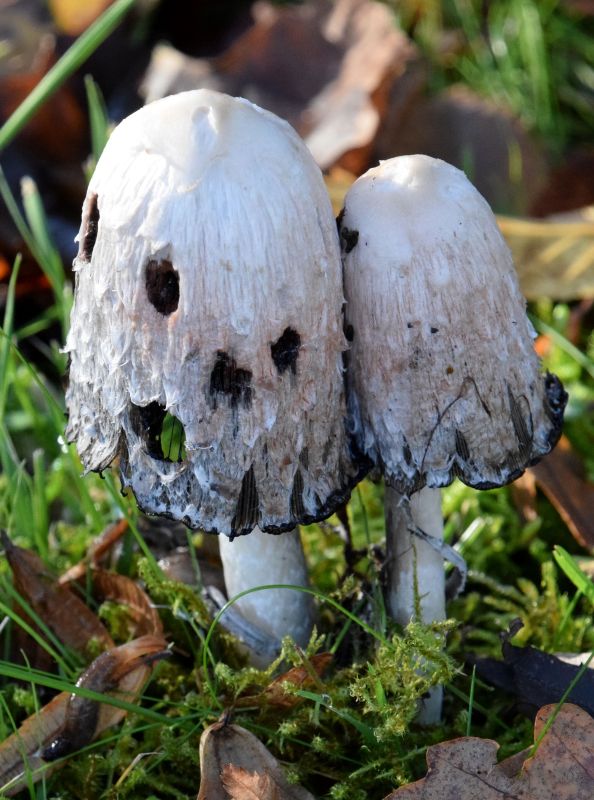
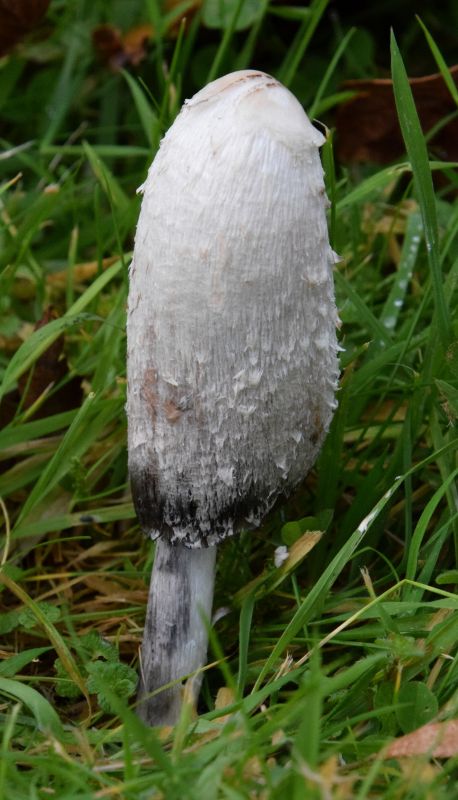
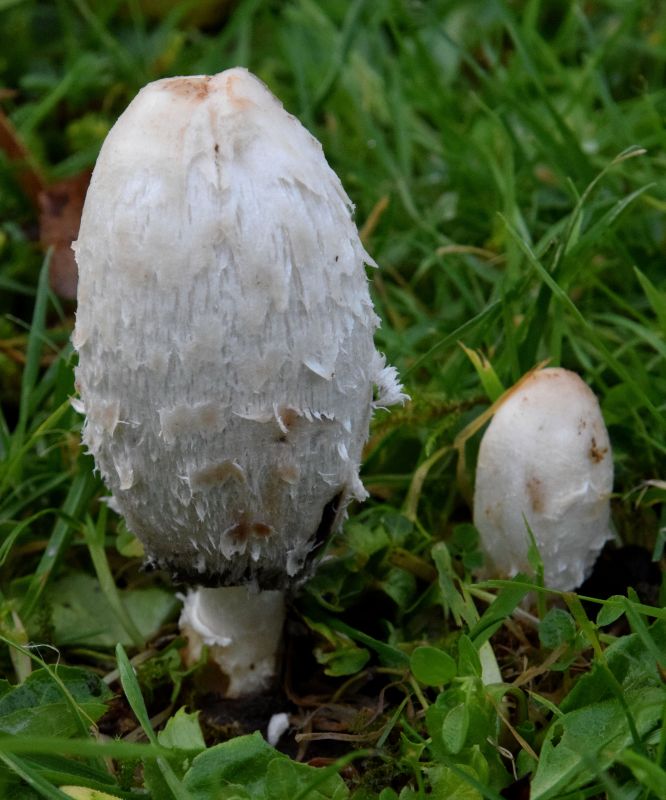
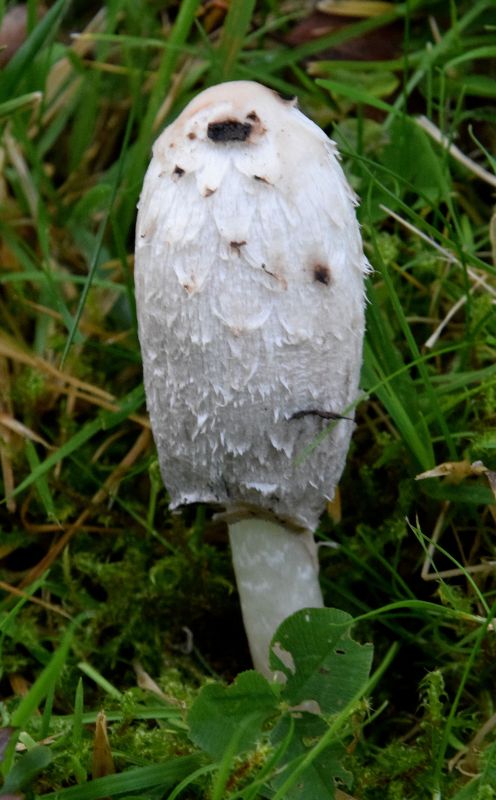
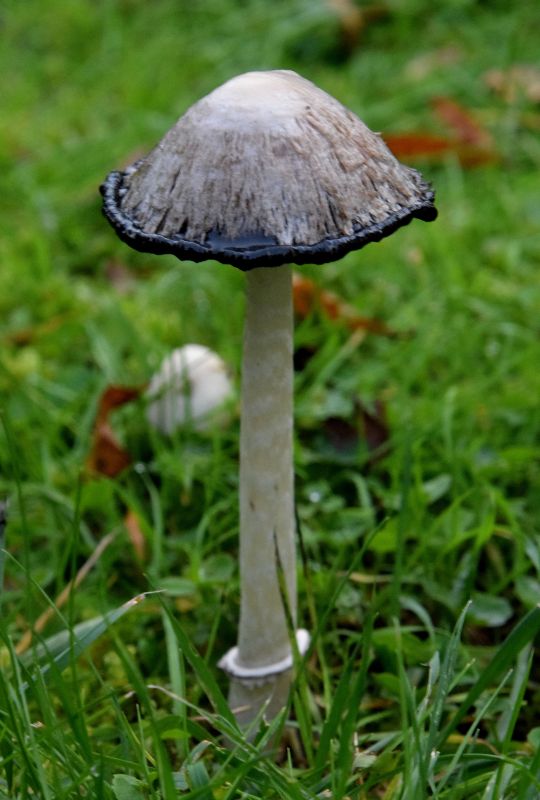
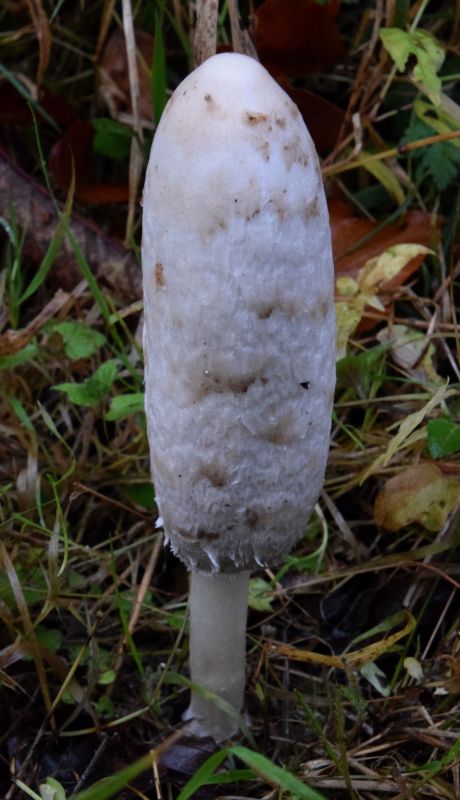
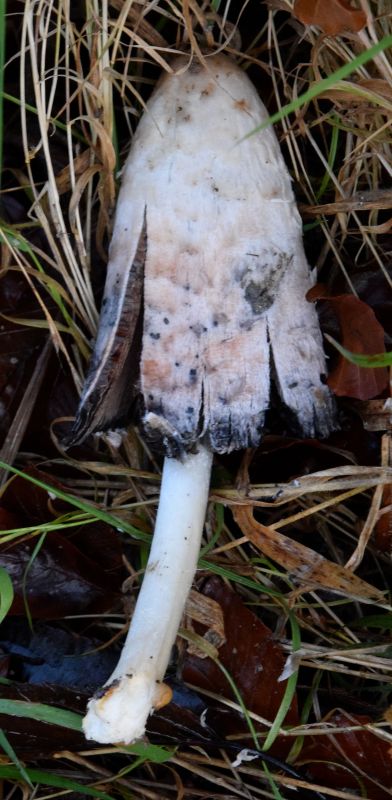
The posts herein on the fruiting cycles of Magpie and Shaggy Inkcaps have both had multiple referrals through the current fungi season. Since the former played its part in stimulating my initial interest in mycology back in 2020 (see here) I have encountered those iconic items year on year, needing to resist the temptation to take more pictures than the many I have already. But I had only recorded the latter once previously when I managed to capture the entire fruiting cycle amongst one cluster in October 2021 (see here).

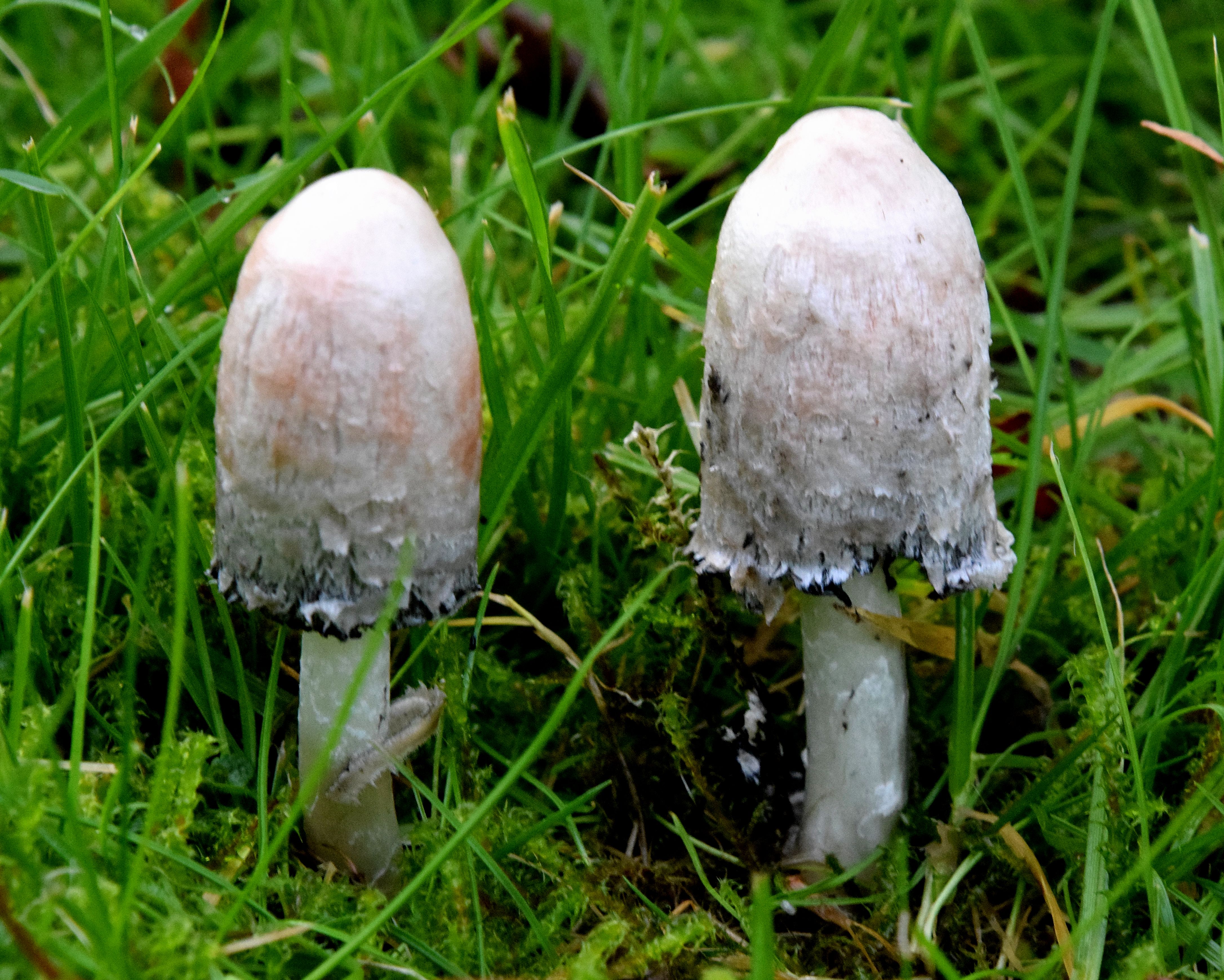
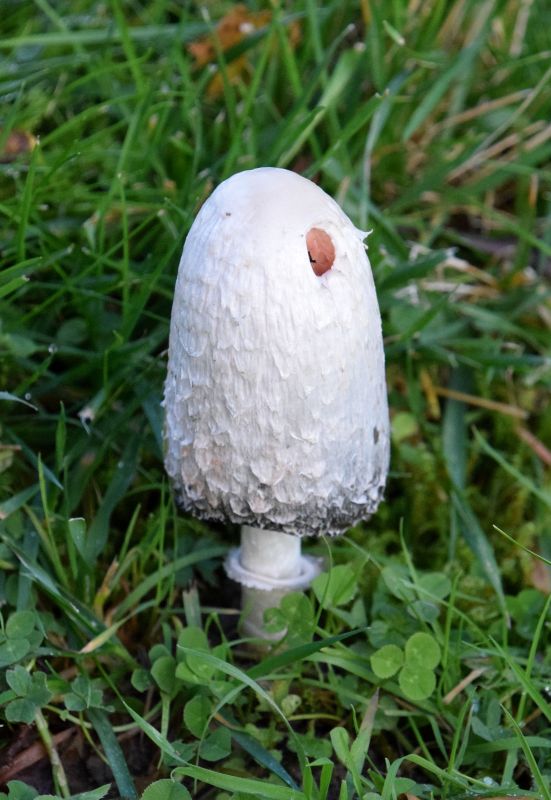
Shaggy Inkcaps in Holy Trinity churchyard, Lane End

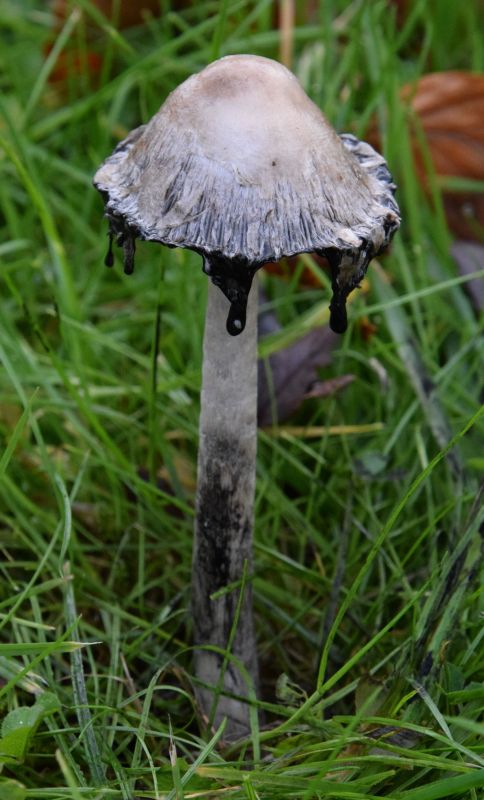
Alternative common names for this post’s subject are “Shaggy Mane” and “Lawyer’s Wig”. This year I have realised those must apply most aptly to stage three fruits when they are beginning to go over. Things began earlier this autumn when I found a darkly alluring duo (pictured below, centre) at Highmoor Common, Oxon that quite fired my imagination. Then this week on Wednesday (15th), visiting Lane End churchyard (SU 805915) to look for something else, I stumbled upon several Shaggies instead. Three were in the critical stage (outer items) but most were first day fruits, so this could clearly become an opportunity to gain further images of the more striking “barrister’s bad hair day” phase.

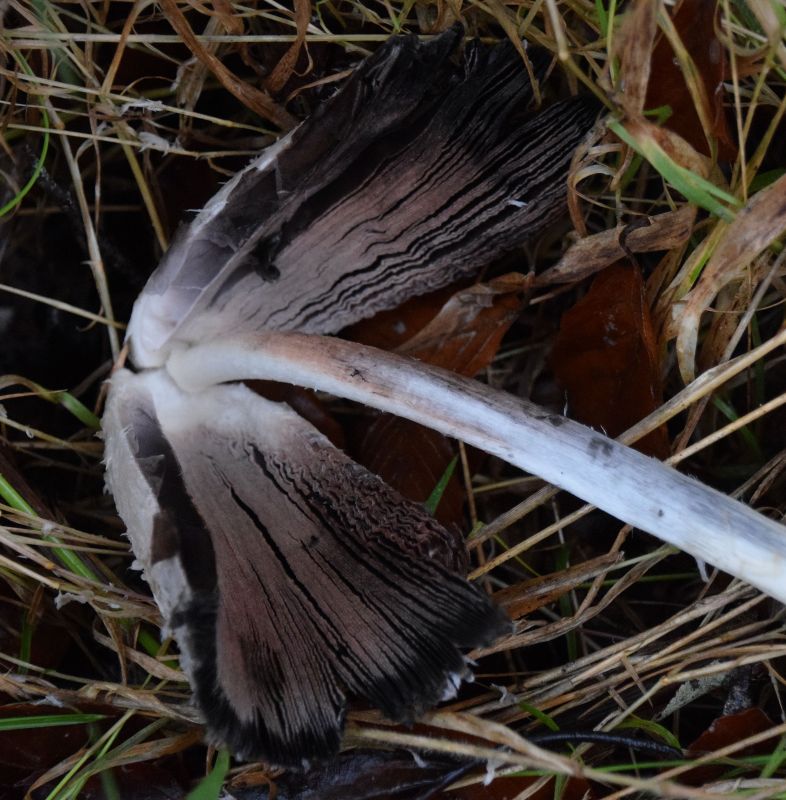
I returned to track the group on Thursday afternoon (16th), finding two items with black lower rims to their dissolving caps (below, left and right), but without the more wig-like quality of the Highmoor Common pair. The two barristers on the right of the first sequence were by now part way through summing up their cases (centre below). Some younger fruits had reached prime stage two condition, while more were emerging.

On Friday morning (17th) there was nothing new to record so I made a repeat visit in the afternoon that was very productive. Several Shaggies in the cluster of various sizes had by then reached their third stage that I most wanted to record (top row below and lead picture), while more dissolving fruits offered attractive studies (bottom row below, left and right). In this first serious workout, my new Nikkor all-in-one camera lens with its superior autofocus was performing much better than it’s predecessor.

Stage 3 (above) and 4 (below) Shaggy Inkcaps and a fine stage 2 in Mousells Wood

On 15th I had also found a large stage two specimen in nearby Mousells Wood (SU 789912). Checking things out on my way home on 16th it was still in that prime condition so this was my first port of call on Friday morning (17th). It appeared to be in no hurry, having barely progressed over the two days so far. By late afternoon it was just beginning to turn (second row, centre above). I now wondered if Shaggy’s fruiting cycle might be slower than Magpie, hoping so as I work all day on Saturdays. Alas on Sunday morning (19th) it and a second previously unseen specimen nearby (pictured below) had both collapsed.

The complete fruiting cycle of a quite beguiling, even dramatic mushroom had thus been recorded more graphically than first time around. Mission had likewise been accomplished and this was indeed a quite rewarding repeat visit exercise. As barristers on a bad hair day or otherwise might say: “I rest my case”.

Little Crake at Linford Lakes, Bucks – 10th Nov

At 48 miles from home this was an obvious British list addition to go for. I had recorded the bird just once before, it being one of my more memorable solo self-finds abroad at a remote location in western Cyprus in April 2012. But when news of one at a permit only reserve in Milton Keynes broke overnight on Tuesday (7th) I chose to wait for things to calm down a bit.

The hide in question would clearly be rammed for the first couple of days, which is not a situation I enjoy. Limited access times for non-members, with a queuing and rota system for viewing were off-putting constraints I didn’t want to deal with. When I twitched two of several available national Spotted Crake in the autumn of 2018 (see here) it was said migratory juveniles if in moult were likely to stick around for a while, so I hoped that would be the case again here.
By Thursday (9th) access had reverted to permit only that were purchasable online. This struck me as very sensible as it might serve to favour serious birders and deter more casual interest, quite apart from generating revenue for reserve upkeep and the work of the Parks Trust (see here) that manages it and other MK open spaces. So I decided to visit on Friday, needing to get out after a week spent mainly at home decorating. Linford Lakes NR (SP842428 – MK14 5AH) is a 37 hectare former gravel pit complex that was established as a wildlife research centre in 1970, and is described as the most bio-diverse site in the area.

I arrived just after 3pm to be greeted by friendly and helpful volunteer stewards, one of whom took me down to the Otter Hide. As we approached some birders came out who said my quest was showing close in. It seemed strange they should be leaving but that of course meant there would be more room inside. All seats were taken, with a few people standing behind and everyone was straining towards a spot in the lakeside vegetation where the Little Crake was said to be. I managed to secure a standing position with a clear view right in the corner of the hide, but couldn’t yet connect.

Todays Little Crake © and courtesy of Ewan Urquhart

Amongst the seated birders I picked out Ewan, who had been in place since 7am, and some other familiar faces. Within 15 minutes the bird was called again moving back into view and now I saw it clearly. Then it rose in the air, almost hovering as it flew quite slowly to one side in a very Crake-like pose with legs dangling. This item was thus well and truly ticked for Blighty. Given such a quick conversion and my previous experience in Cyprus it must be a lucky species for me. All Crakes are of course skulkers and there had been long intervals between other observers in the hide getting their pictures.

With the light fading people now began to drift away, while I stayed until 4pm obtaining another brief and more distant sighting. The lateness of this day’s excursion was due to having waited in for delivery of a new camera lens. The 18 – 250mm Sigma baby zoom I have relied on since my previous Nikkor telefoto expired had followed suit earlier in the week. Now for a very reasonable £385 I have acquired a vgc used Nikkor 18 – 300mm all-in-one that should be a superior product. I find such entry level equipment very suitable for gaining this journal’s close-up images of insects, wild plants and fungi; but take it along on bird twitches too and see if I can get anything half decent. The previous three lenses of the last 13 years all jammed eventually, which seems to be their fate.

Little Crake breeds in freshwater wetlands across much of eastern Europe and into western Asia, wintering in north and north-eastern Africa. At 17 – 19cm they are smaller than the more frequent Spotted Crake, with a short greenish bill showing a red base and long wings, green legs with long toes, and a short tail that is barred black and white underneath. Adults have mainly brown upperparts and plain flanks, and juveniles barred flanks compared to the similar Baillon’s Crake. Face and underparts are plain slate grey in males, and buff to whitish in females and juveniles.

This is a scarce vagrant to the British Isles. The Milton Keynes bird, a county first for Bucks also offered a rare opportunity at an inland location. Having bought the permit it would clearly be sensible to come back for more and stay for longer if the Crake lingered. But it was not reported again so as things turned out I was doubly lucky. With this record, my 382nd British bird, I have now observed nationally all three of the wetland Crakes listed in Collins, and also have Corncrake as a heard only record.

Footnote: This twitch raised £3855 for the Parks Trust (see here), £2820 from 141 new site permits and £1035 in cash donations from visiting birders.

The fruiting cycle of the False Deathcap mushroom from Oakley Wood, Bucks with notes on more toxic relatives – 3rd & 6th Nov

I have featured several Amantitae fungi previously in this journal and here is another one. Why such a bias? This genus comprises large, sometimes stately mushrooms that are often easy to recognise and hence I can present them with confidence. The subject of this latest post is no exception.

Back in August I speculated the fungi season might be underway early after such a wet July (see here), but not so as things turned out. There followed an exceptionally mild and dry “Indian summer”, succeeded by a wet late autumn. The result, moving into November is a luxuriant profusion of mushrooms wherever we go to seek them out. Everywhere that is but the Fly Agaric spectacle at North Leigh Common (see here), that for a second year running was wiped out at its peak by West Oxon District Council contractors; I suppose when the job sheet says bracken has to be cut … absolutely mindless!!!

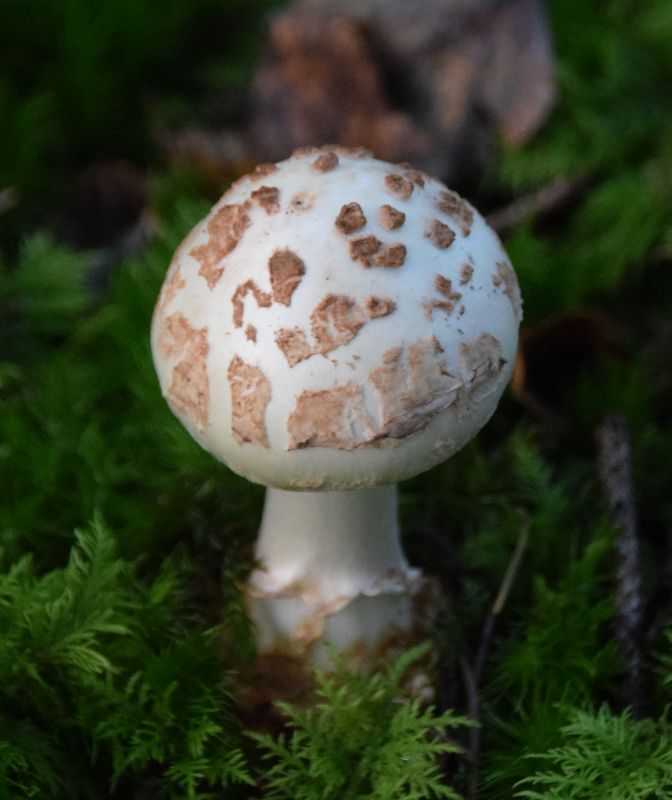
Citreous-tinged False Deathcaps

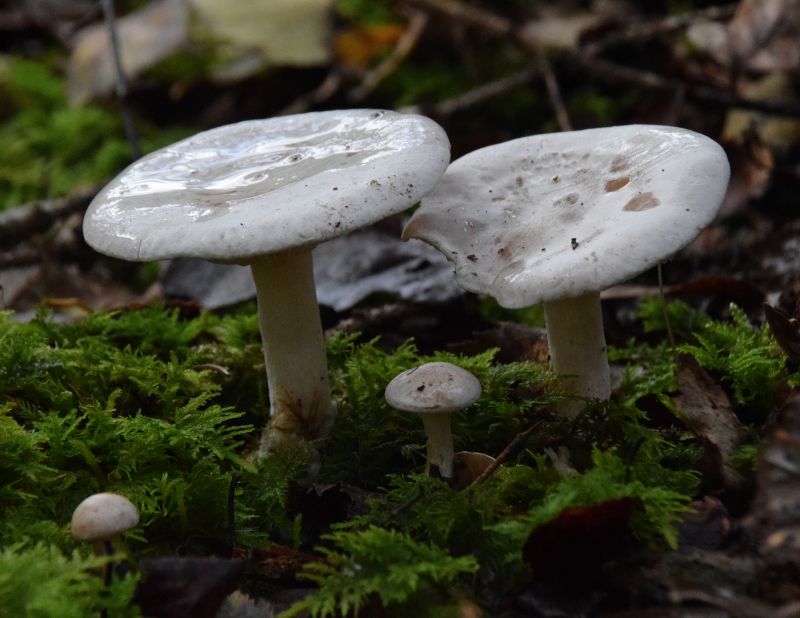
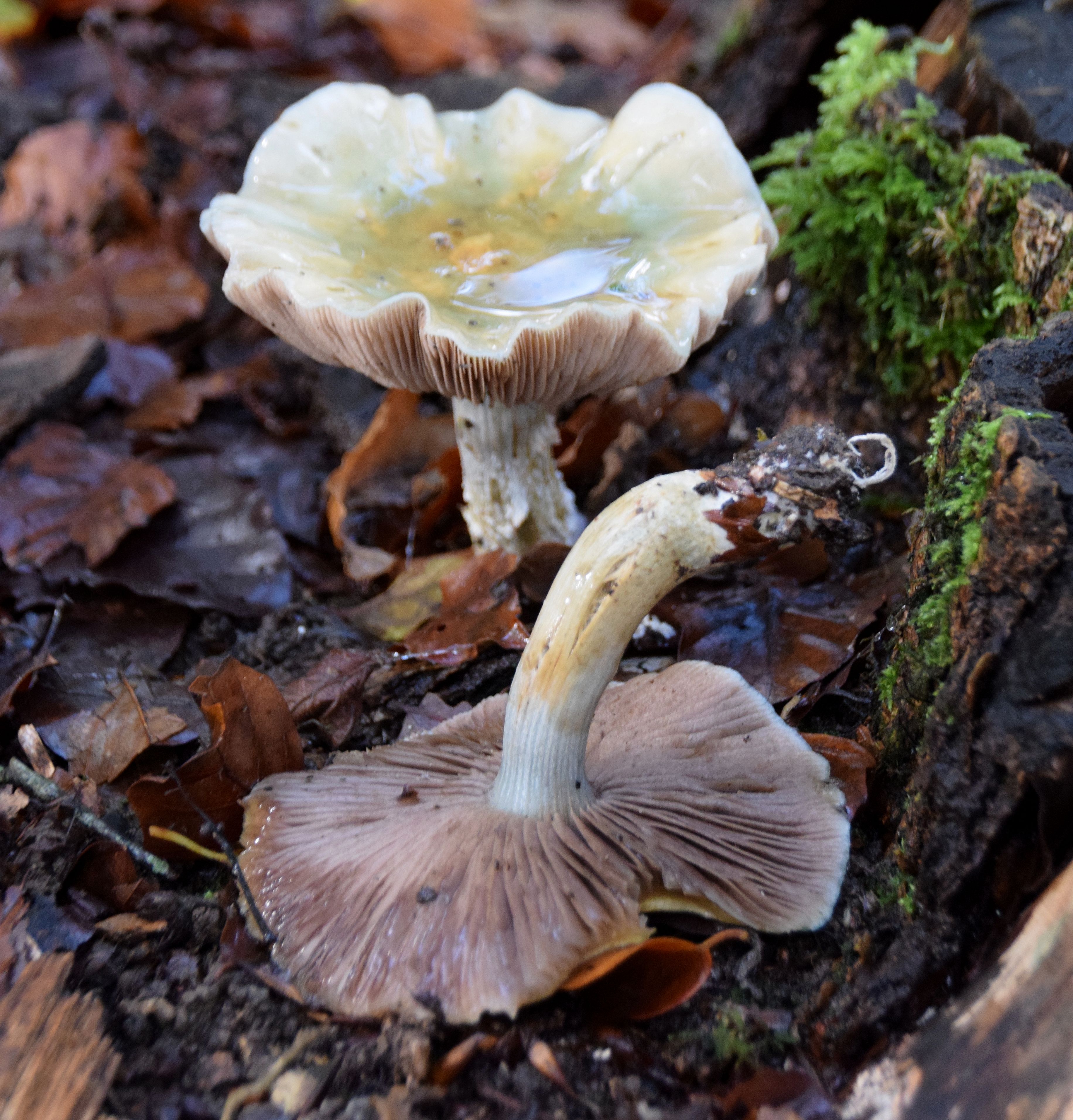
After tracking the Verdigris Agaric through its fruiting cycle in south-east Oxon (see previous post), I switched attention to Oakley Wood (SP612118) in the Bernwood Forest complex of butterfly fame that lies just across the county border around 20 minutes from my home. Here, amongst quantities of Milkcaps, Brittlegills and other unidentified mushrooms stood out even greater numbers of False Deathcap (Amanita citrinasee here). There were dozens of them in the areas closest to the Forestry England car park that I searched, perhaps hundreds or even thousands across the site as a whole.

A frequent Amanita from August to November across much of the British Isles and continental Europe, the Latin name signifies the citreous yellow tinge of the caps. That quality is not easy to capture pictorially in subdued light given the paleness of the subject, but in the field readily distinguishes this mushroom from Parasols (see here) that they superficially resemble. Rather than go into descriptive detail, herewith is more of the fruiting cycle.

As the name suggests this is not an edible mushroom but neither is it seriously toxic like the Deathcap (Amanita phaloides) itself (pictured below), one of my favourite finds when fungi hunting. Simply put if you should be unwise enough to consume one of the latter (see here) you are a goner … end of story … kaput! But the two are readily distinguishable in the field, the dangerous one being slimy and without universal veil fragments on the cap.

Potentially even more alarming is the aptly named Destroying Angel (see here) that a white form of A citrina is also said to resemble. The toxins both the above mentioned beasts contain at first cause severe diarrhoea, nausea and stomach pains. Cruelly the symptoms are said to fade away for a while, tricking the victim into thinking they are recovering. Then they return with a vengeance by when it is almost certainly too late. Kidney and liver failure are already advancing. These ultimate Amanitae have no known antidote, so coma and eventual death are pretty inevitable.

Fortunately the Destroying Angel is mostly found in upland regions so is unlikely to occur in Oxfordshire. I myself have yet to find one anywhere, though there were some similar looking items in Oakley Wood on these two days. Not to worry. I would in any case never consider eating a white wild mushroom. Identifying them as previously noted is an imprecise art. All of the fungi fruiting cycle posts herein have received greatly increased referrals this autumn.

Verdigris Agaric and Dog Stinkhorn at the Bix Warburg Reserve, Oxon: 16th – 26th Oct

Where stand-outs are concerned these two mushrooms certainly fit the bill. The first of them has been high on my wish list for some time, having seen records from Chilterns sites in each of the past two seasons but without being shown where to look for them. Then earlier in 2023 on visiting BBOWT’s Warburg Reserve (RG9 6BJ – SU721 878) for Orchids, the information boards and flyers for autumn fungus forays were both adorned with pictures of the must see. I switched attention to there this autumn from my usual mycology patch of Highmoor Common, that has been rendered vehicle unfriendly by the landowner, with converting the desired item at the top of my agenda.

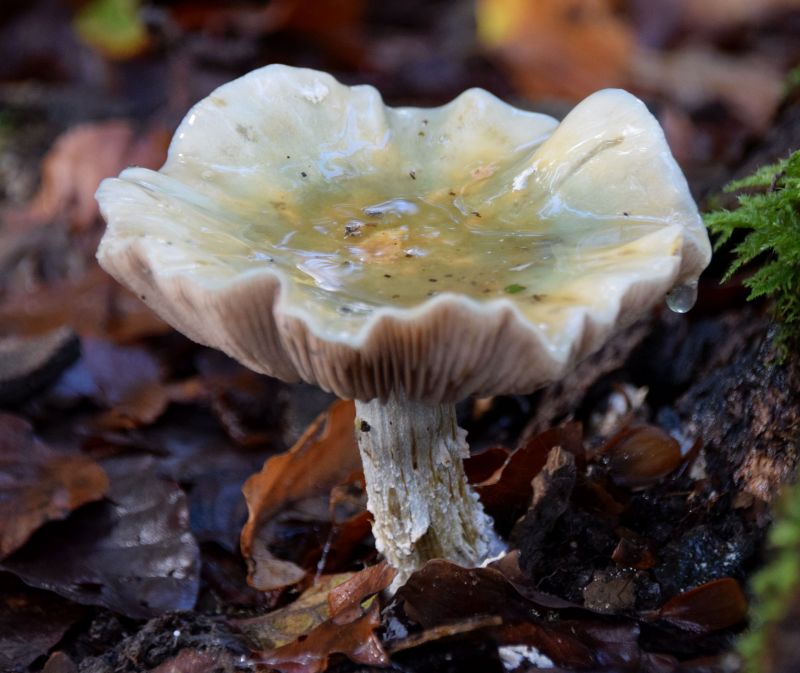
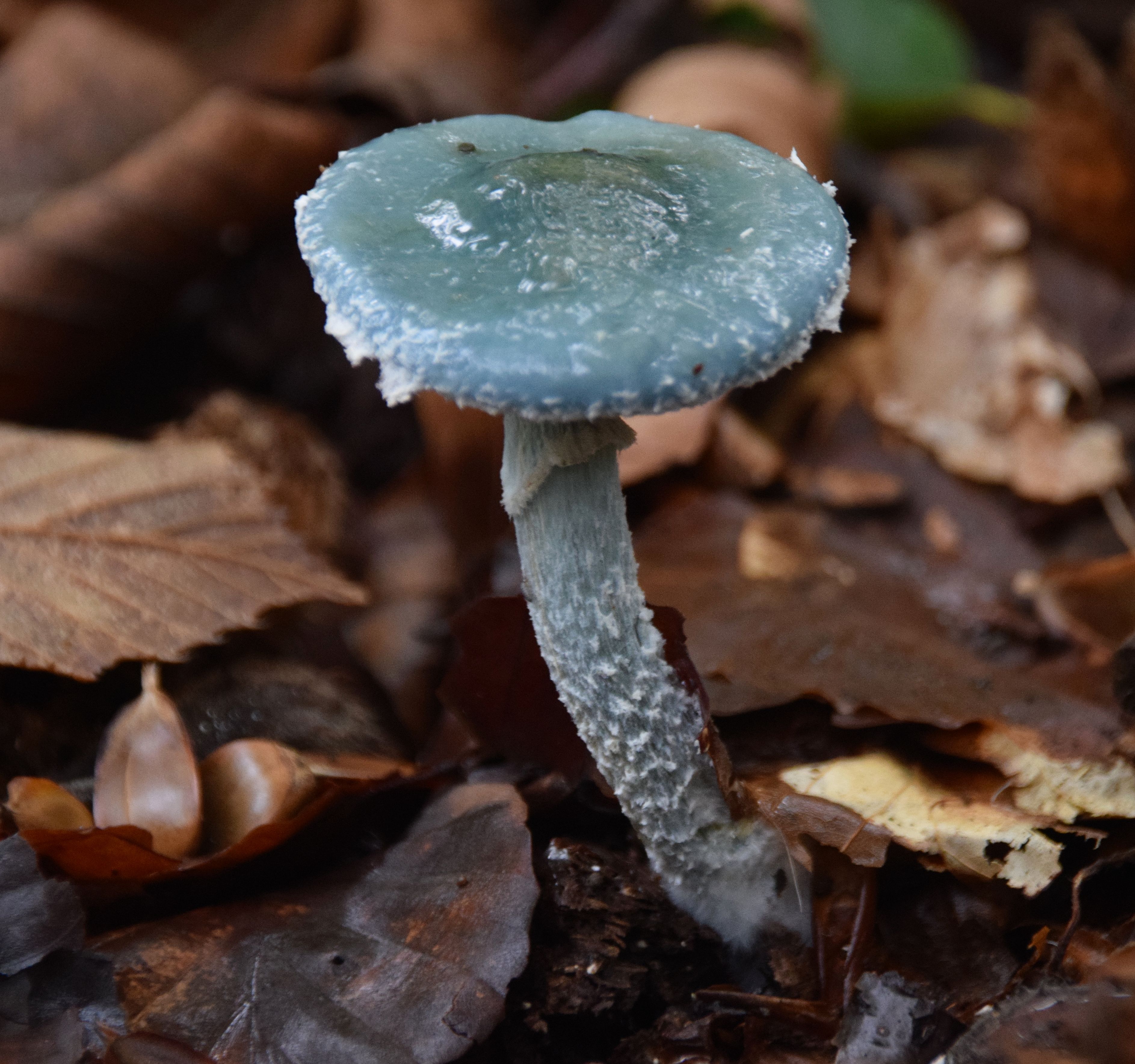
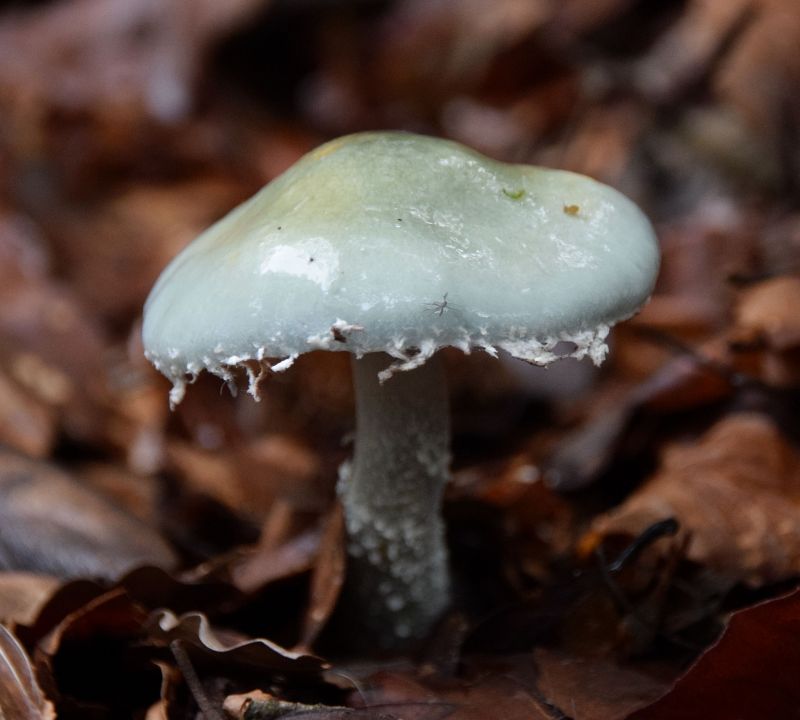
In this fourth mushroom hunting season I am learning more than previously how much accurate identification relies on cutting specimens to see how they bruise, dropping chemicals on them, smell and other levels of detail that do not especially appeal – not to mention spore measurement and DNA sequencing. Hence my preference for more distinctive species like Verdigris Agaric (Stropharia aeruginosa). This is one of very few blue / green mushrooms (see here), as well as being scarce and highly localised within its British range. The quite striking item occurs in alkaline areas of humus-rich Beech woodland such as abound in the Chilterns.

My first Verdigris Agaric

On my second site visit (16th) the quest was indeed listed on the visitor centre sightings board, and I was told the precise location by the warden. It (pictured above) was a mid-cycle, bell-shaped specimen but lacking universal veil fragments, and the only one located so far on the reserve. Also known as Verdigris Roundhead, they usually occur in small groups amongst grass and leaf litter from July to October. The young caps are slimy and reach between 2.5 and 8cm when mature. As the fruiting cycle progresses they assume a more greenish tone than the initially so attractive blue.

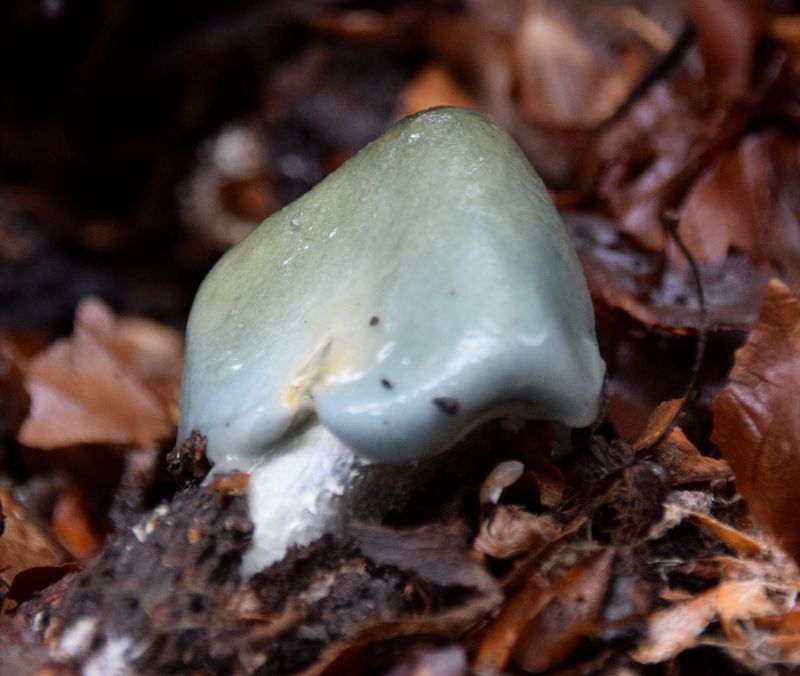
Four days later on 20th Ewan visited and found six specimens in the same location, some of which he described as small. That suggested there would be more to enjoy here in the days ahead, and opportunities to capture and record the full fruiting cycle. I myself re-visited on 23rd, counting 11 mostly young and slimy subjects thrusting themselves up from the forest floor in a variety of shapes (pictured below). White scales adorn their caps initially before congregating around the rim, and the stems of some also display a rather fluffy character.

Young Verdigris Agarics

On this occasion I was engaged with by two volunteers who directed me to a large clump of Dog Stinkhorn (Mutinus caninus). That was welcome news as I was sent pictures of the exotic in each of the previous two seasons, but had yet to find any in the field. I had observed common Stinkhorn (Phallus impudicus) just twice in the past. Today’s variety (see here) is slimmer (1 – 1.5 cm) and less smelly. Either is an intriguing find, looking exactly like the turnip in Blackadder III as they do.

These “thingies” are short-lived and very fragile, soon going over and rarely seen for more than a few days. Most of this clump had already collapsed. The honeycombed tips of the newly emerged fruit bodies are covered in sticky, foul-smelling, olive-black slime or gleba to attract and then coat pollinating insects. As flies move between different Stinkhorns so spore dispersal is achieved, then the tips of the white stems dry to reveal the orange base colour. Those 8 – 15cm “stipes”, with the texture and appearance of expanded polystyrene, are barely strong enough to support the fruit in the first place and soon disintegrate.

Prime Dog Stinkhorns (composed with camera angles for maximum suggestiveness)

In clearing the ground around the best specimens to take these pictures I became aware of how they erupt from partly buried egg-like balls, just like the Devils Fingers stinkhorns (see here) I observed in Sussex a year ago. The first Dog Stinkhorn in the above sequence is in it’s prime. I counted no more than five black-tipped subjects in all, while many more broken and fallen orange-tipped items (below) littered the area all around. This uncommon fungus is less widely distributed than the larger Stinkhorn, more often occurring in coniferous forests but also at sites around the Chilterns AONB.

Droopy Dog Stinkhorns (above) after pollination and spore dispersal

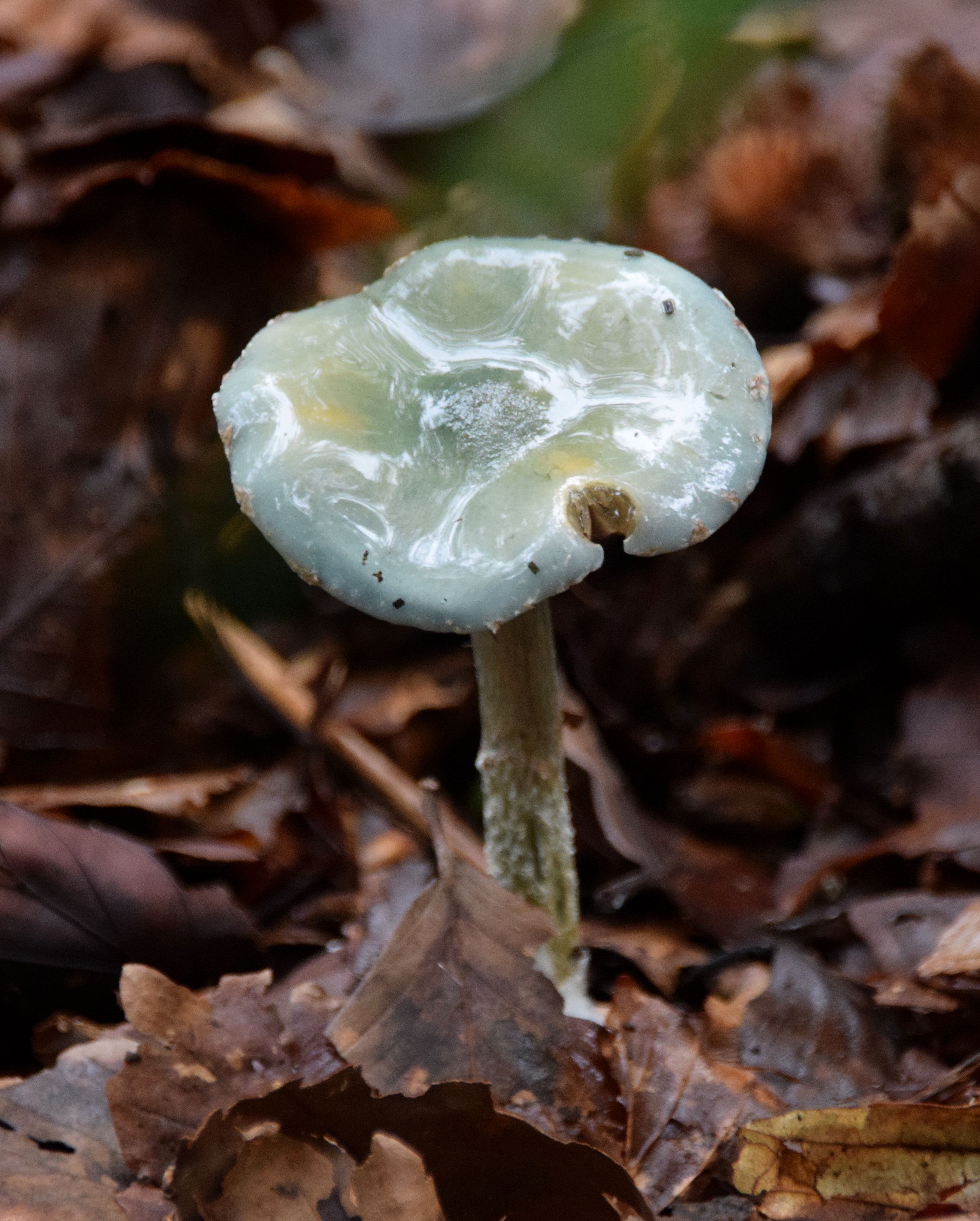
It remained to capture and record the later stages of Verdigris Agaric’s fruiting cycle, when like so many mushrooms the caps flatten then turn upward. As the slime dries and the universal veil fragments are lost the ageing items become greyer and pale tan from the centre outwards, while the initially grey gills turn purple-brown. Hence I returned three days later on 26th in company with Ewan and we soon found what I sought. The following image conveys perfectly what is described above.

Ageing Verdigris Agarics

The next sequence illustrates the complete ageing process of this intriguing fungus. There had been heavy overnight rain between the two visits, so the consequent mix of water and the mushroom’s natural slime served to give these and several other specimens we found today a luxuriant quality. We also located Dog Stinkhorns in a second area and a range of other fascinating and uncommon fungi. In all more than 900 species have been recorded over the years at the BBOWT Warburg Reserve.

Walking around we discussed what a totally absorbing pastime mushroom hunting can be, as well as peaceful and relaxing. There is none of the anxiety of birding since they don’t fly off, neither do they only come out when the sun shines like butterflies and dragonflies. And very importantly there is little of the social media generated crowd hysteria that surrounds so much wildlife watching these days. On the down side everything else has a nibble at mushrooms as soon as they appear, so they quickly deteriorate and commercial foraging is an issue at well known sites such as this post’s. The 11 days recounted above have been very rewarding.

The Magnolia Warbler known as MAG2 at Baglan, Port Talbot, Glamorgan – 26th Sep

In the normal run of things I am generally less motivated by North American than Siberian-breeding vagrant birds. But such has been the enormity of events currently stirring the national twitching world that I couldn’t resist getting involved in the end. The past seven days have brought what is now described as the biggest ever arrival of storm-blown, Nearctic migrant passerines and other birds around the British Isles (see here). And amongst 50 individuals of 15 species, an eye-catching British 1st-2nd-3rd record wood warbler cluster made landfall around Pembrokeshire and its offshore islands.

I felt tempted over the weekend to venture beyond range, having completed paying for 2023’s five tripettes abroad and various larger domestic bills, but the usual reservations over cost, fatigue and wearing out my car prevailed. Then matters were helped greatly by a second Magnolia Warbler, one of the earlier items to start all this at 210 miles, being confirmed on Sunday afternoon in Port Talbot just a little beyond where I travelled for the Pacific Diver in December 2021 (see here). Like a fortnight ago I should have paid more attention going into this week, but my present working weekends are invariably succeeded by a distracting stack of chores.

So it was not until late Monday morning that I realised how accessible, at 140 miles and close by the M4 motorway, the bird was. This was eminently do-able and I at once decided to mount a dawn twitch if MAG2 was reported into the evening. Indeed it was and I set off from home at just after 4am on Tuesday feeling confident that my quest would still be present without waiting for first news. After all there is really nowhere for these surviving storm, or in this instance hurricane blown waifs to move on to, though some do of course expire after landfall. Today the weekend’s star south-west Wales arrivals were all still being reported in good health, albeit mostly in limited access offshore nature reserves or on an active MoD firing range.

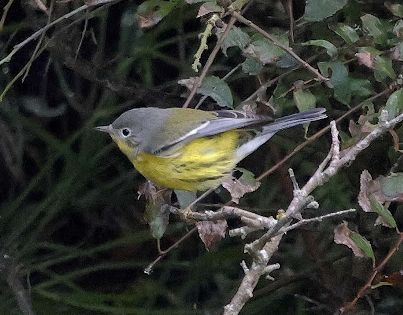
Magnolia Warbler © and courtesy of Ewan Urquhart

The earlier Magnolia Warbler (pictured above) at St Govan’s Head in Pembrokeshire was just the third for Great Britain, and so attracted a sizeable audience (see here). The second was a one-day bird on Fair Isle in 2012, and the first on Scilly back in 1981, so this new mainland opportunity was huge. These are fairly common breeders in coniferous forests throughout Canada and the US North-eastern and Great Lakes regions, migrating through the eastern and central US to winter in Mexico, the rest of Central America and around the Caribbean. On migration they are said to favour low trees and shrubs along forest edges and in parks, always showing a preference for denser habitat.

Presumably Baglan Energy Park (SS 73892 92244) is somebody’s patch. Though marketed by the owners as a premier Welsh business and industrial location, much of it remains undeveloped. First impressions upon arrival at 7am were what suitable landfall habitat for migrant birds this brownfield site of a past petrochemical plant also offers. My next sentiment was that with less than 10 other early birders present things could be hard work. But I was armed with precise directions from Adam (see here), who had done this on Monday and I remained in contact with, as to MAG2’s likely movements. As re-visiting birders also joined the gathering that picture was confirmed, and so the Magnolia Warbler was called for the first time at around 08:15.

Numbers of birders then swelled, including Oxon colleagues Colin Oram and Alan Peters, especially after news went out on the bird information services; and so my always elusive quest became less difficult to relocate. I myself gained three good views by 09:20 before going for a breakfast break, then a fourth afterwards. Like all Warblers this mega rarity was always hyperactive, moving around constantly in and out of cover. It was associating with a Tit flock and stood out when seen by the bright yellow breast, grey head and grey-green upperparts. The first winter bird was foraging low in the dense understory of a long line of trees to which it remained faithful throughout.

Today’s twitch site at Baglan Energy Park

The species (see here) has no connection with Magnolia trees other than owing its misnomer to having been found in one by the ornithologist who first described it in 1810. The dense, boreal breeding habitat is shared with other, similarly colourful wood warblers such as Bay-breasted (here), Canada (here) and Blackburnian (here); all of which have turned up nationally in the current trans-Atlantic fall. Although Magnolia commonly joins mixed-species flocks during migration and on wintering grounds, it is said to keep apart from others of its own kind and aggressively defend individual feeding territories.

Given the attention surrounding its St Govan’s predecessor, I wonder whether MAG2 was taken quite as seriously until today. After my own departure from site this bird was reported as showing well throughout the afternoon and offering splendid views, so it got very much on a par then, and over the two more days that it lingered. For me this outing was an opportunity to burn energy and cleanse the spirit such as a successful solo twitch provides, and it was good to hit the road again for only the fourth time in two years.

Aquatic Warbler at Beeding Brooks in the Adur Valley, West Sussex – 12th Sep

Some bird content at last! This was in conventional birding parlance a “blocker removed”, or in my own particular speak a fallen long-term straggler. By the idiosyncratic criteria by which I judge such things the much sought lifer of this post was until now one of a group of seven most likely British list additions within my preferred travel range. But converting Aquatic Warbler is not that simple.

How so? Formerly an expected item of any national autumn passage, the potential to experience Aquatic Warbler (see here) has shrunk in parallel with its more recent status as Europe’s rarest migratory and only globally threatened passerine. This medium-sized Acrocephalus winters only in Senegal and arrives on it’s European breeding grounds in April. Those are largely confined to Poland and Belarus that hold around 70% of breeders, and there is a fragment population in Lithuania. The global population is now no more than 21,000 pairs. The species reverted from BBRC scarcity to rarity description level in 2014, since when the annual handful of English records have almost all been trapped and ringed individuals that were not seen again upon release.

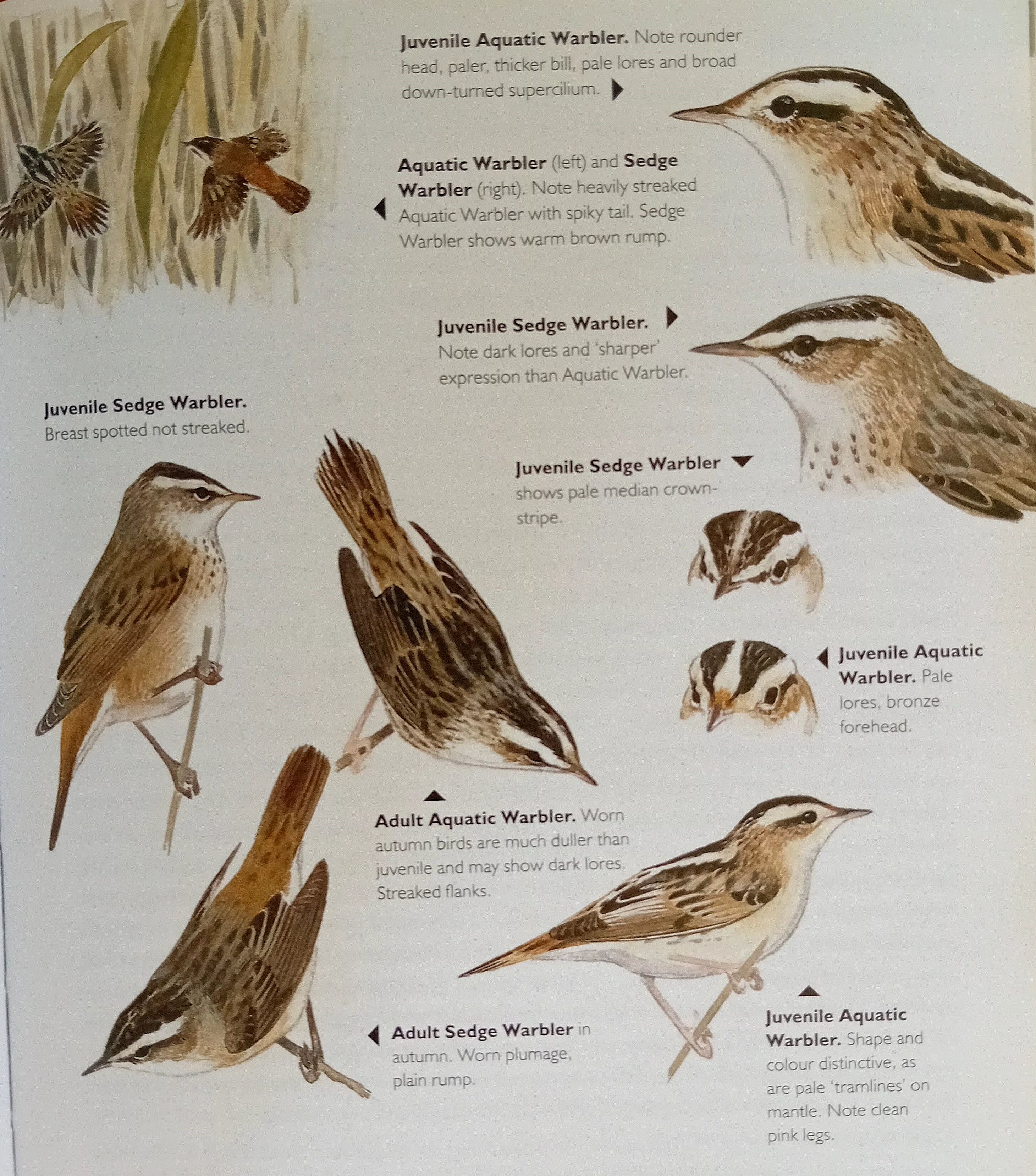
Aquatic Warbler © Hamlyn Publishing

It is dependence on a rather specialised and vulnerable wetland breeding habitat, prone to loss through drainage that has caused AW’s decline. This bird favours open, wet marshland with scattered bushes or trees, and has a requirement for sedge fen mires with a water depth of 5-10 cm. Conversion of coastal marshes to nature reserves, with habitat restructuring that does not suit AW, is said to have similarly contributed to reduced British sightings in recent times. Return passage begins in June with movement of juveniles such as today’s bird, south-west along the English coast peaking in late August and early September. In contrast with recent years the last two weeks have produced two twitchable items in south-east England. The first, also a juvenile at Landguard NNR in Suffolk on 30th Aug, stuck around for less than four hours in the afternoon and early evening.

When the second bird was reported inland in Sussex, to the north of Shoreham and the village of Upper Beeding (BN44 3WN – TQ 190113) on Sunday (10th), I assumed it’s stay would be similarly brief. But I really should have checked RBA on Monday morning. Instead I kicked myself after remembering to do so in the early afternoon, and found this must-see was still present and had been viewed at intervals to 12:40pm. That carelessness showed how out of the twitching habit I had become this year, but probably also that I must have been doing too much wildlife stuff alone again recently. And so I sought company for this venture, if it could be rescued.

As things transpired I was not the only Oxon birder to have been a little slow off the mark. Regular colleagues Adam and Ewan both said they were planning to go for the Aquatic on Tuesday’s first news, so we agreed to rendezvous near M40 Oxford services. Our quest was reported twice more through the afternoon and early evening, then again at dusk. With that my gut feeling grew that this was THE lifetime opportunity to convert an almost mythical straggler, and I was quietly confident of success.

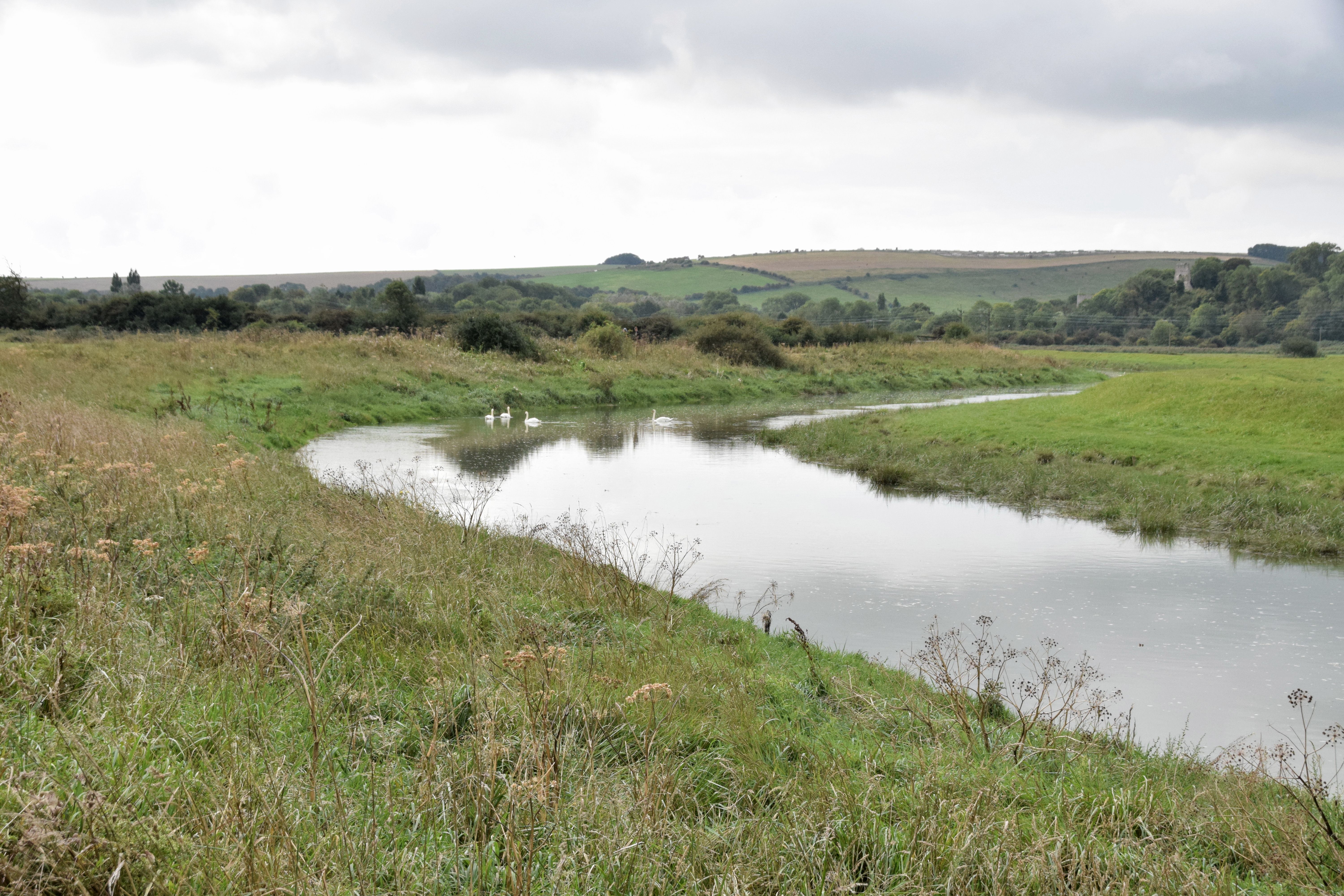
Setting off at around 08:40 on 12th, we were re-assured by further RBA, Bird Guides and WhatsApp alerts at intervals through our 110 mile journey; then arrived on-site around 11 am. The location was a sloping bank of the River Adur below a narrow footpath through long grass and sedge (pictured below), along which up to 30 birders were spread out at intervals. Adam called the Aquatic Warbler soon after we arrived and I too noticed the brief movement into deep cover he was referring to.

It’s in there somewhere … today’s river side site

At that everyone present converged upon the spot and almost total silence ensued for around 20 minutes as the gathering waited for the renowned skulker to re-emerge. When it did I saw clearly a second movement, then a thrill coursed through me upon picking out the Aquatic’s distinctive head pattern as it crept about low down in the habitat. That was mission accomplished personally, and as the bird flew up and away again everybody saw it so all the tension evaporated from the situation. Such to-ings and fro-ings continued for the rest of the morning and I was pleased with the repeated views gained.

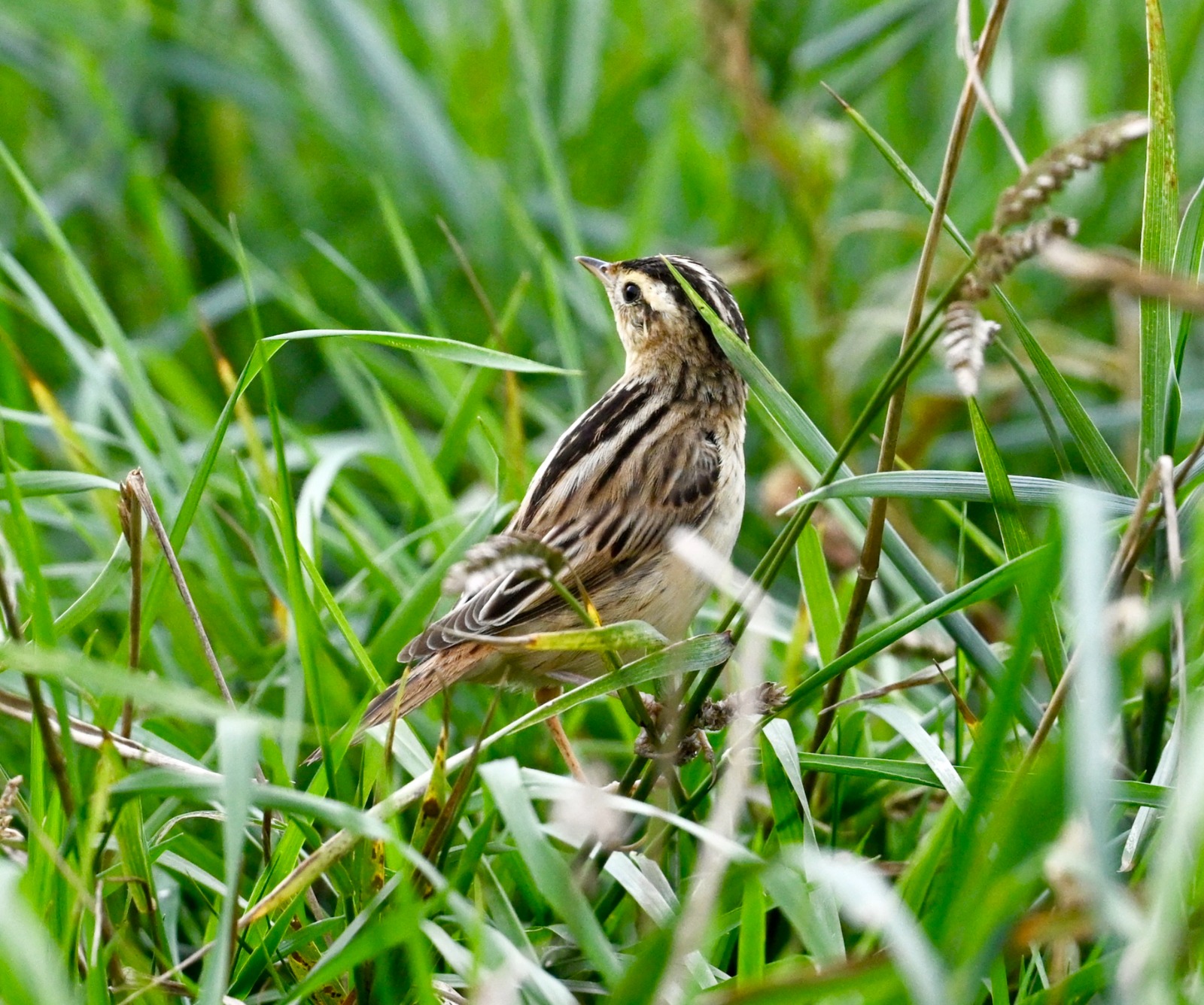
Today’s Aquatic Warbler (juv) © and courtesy of Joe Tobias

I had expected a typical warbler twitch of staring for long periods at dense vegetation waiting for the quest to come out. But this bird was quite mobile around its adopted patch, though always fast moving. The stand out features of Aquatic Warbler are a quite bright yellowish-buff toning and the very strong head pattern with a thick, pale supercilium and whitish crown-stripe. Both were readily apparent as our bird moved around today. A flattened forehead and strong, pointed bill also mark the species out, while the upper parts are more heavily streaked than the familiar Sedge Warbler. Juvenile AW do not display streaking on the breast.

Aquatic and Sedge Warblers © Bloomsbury Publishing

After an hour of activity on the bird’s part it went to deep cover again and was not seen for a similar period of time. So all three of us being satisfied with our experience we decided to leave. Neither myself or Adam, for whom this rarity was also a lifer, could quite believe how easily we had added it to our career lists in the end. But this instance was testimony to something I have faith in that sooner or later these things will turn up within range. It is just a matter of waiting, in this case for many years and I now feel hugely relieved and content to have converted such a prime target today. Aquatic Warbler is my 380th British bird.

The fickle Frog Orchid finally falls + Autumn and Chiltern Gentians at Aston Rowant NNR, Oxon – 21st Aug

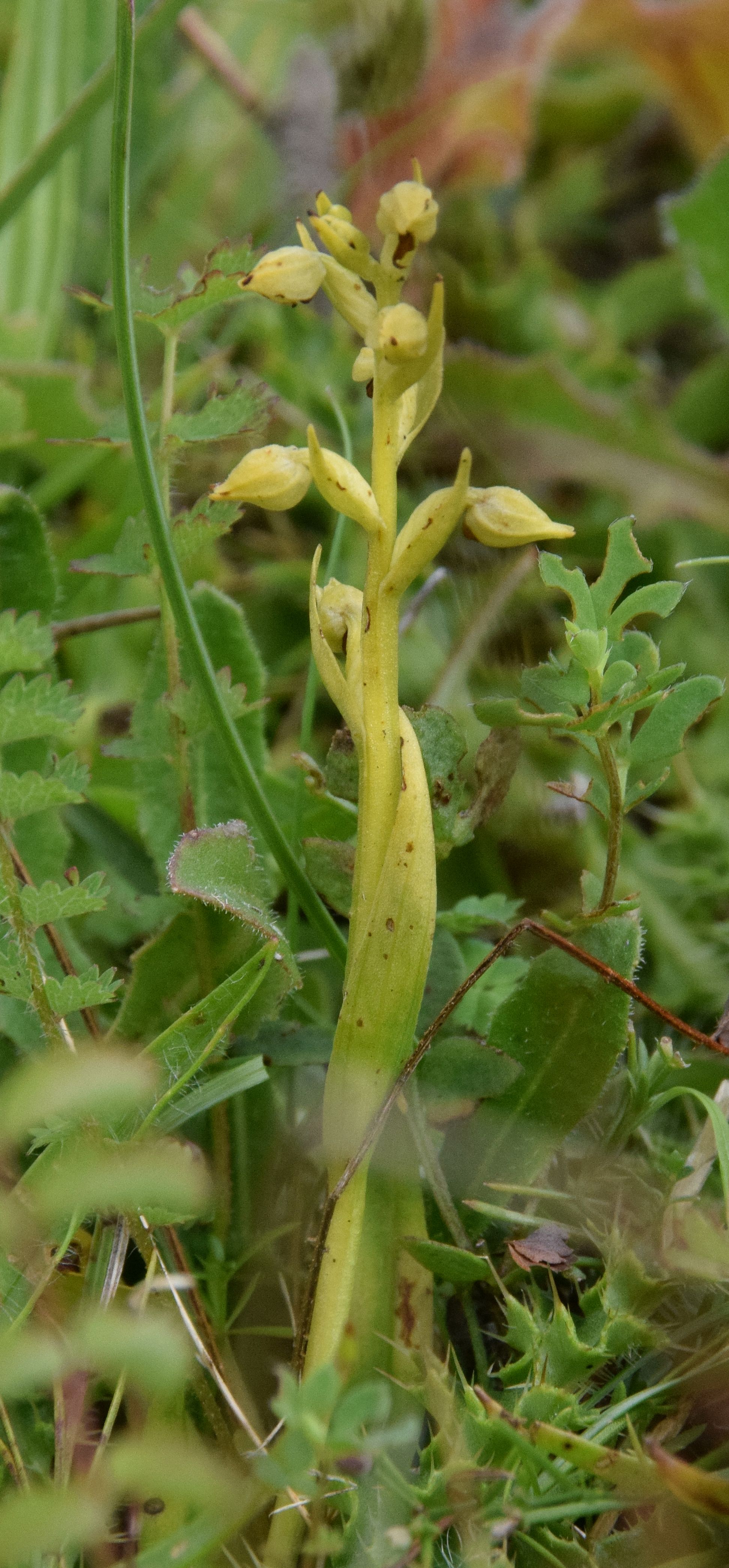
This debut season’s most difficult even frustrating subject is by some distance the miniature and inconspicuous Frog Orchid, that for the sharper-eyed may be found along the Chiltern escarpment on both sides of Aston Rowant NNR and also at NT Watlington Hill. I had seen one on a single previous occasion at the first site in 2021, and so possessed a picture to refer to. But my basic reference the 2013-published Creed & Hudson Berks, Bucks & Oxon guide (see here) recommends the second as the best place to find them from June to August.

Starting at the latter in early July, I was advised they are tricky little things that blend in with even short-sward surrounding vegetation, and rarely appear in the same place year upon year. Sightings online all seemed to stress how difficult they are to pick out, but that once spotted the observer may soon be rewarded with more. Cue those early evening stomps around Watlington Hill, without success that produced the rather more visible fungi of two posts ago. Oxon wildlife colleague Wayne at this point suggested I transfer attention to Bald Hill (SU722960) on the south side of Aston Rowant NNR, where especially small 3 – 7cm specimens may occur right through August.

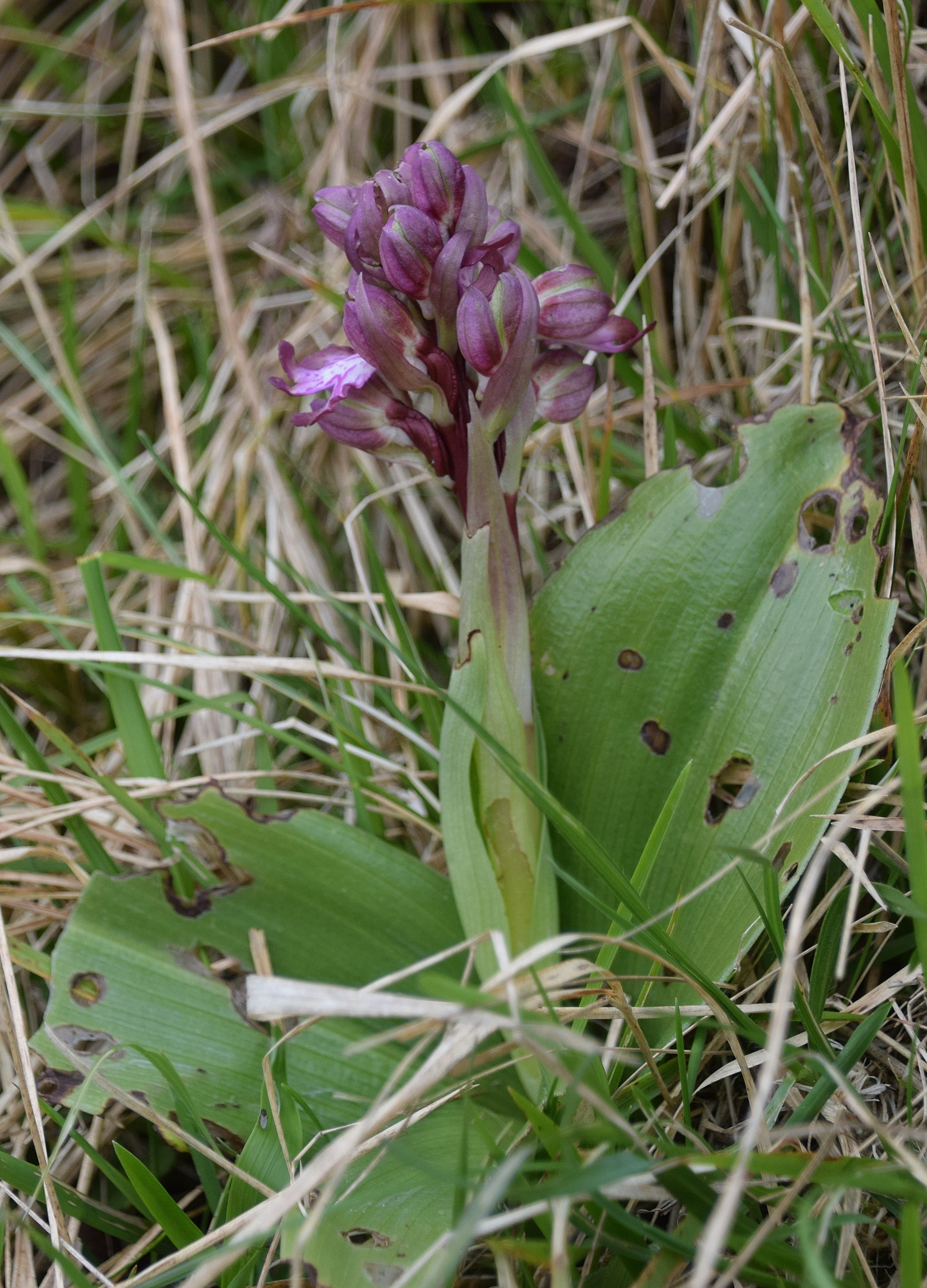
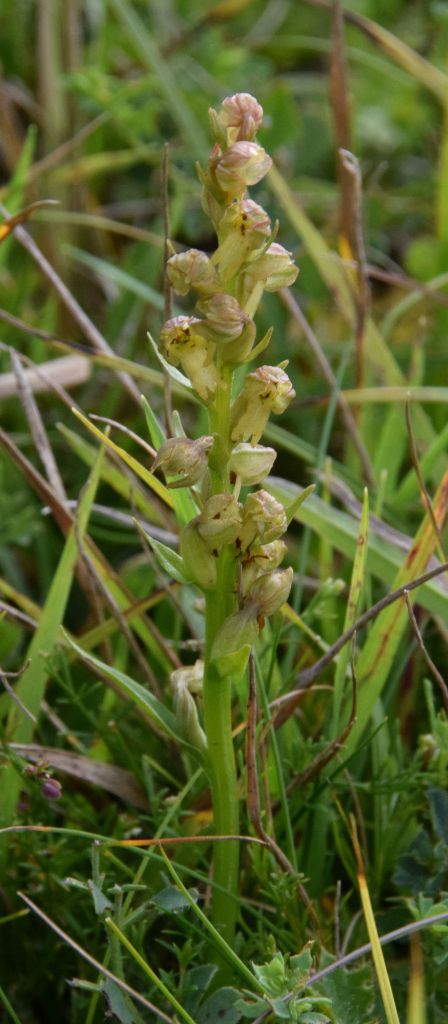
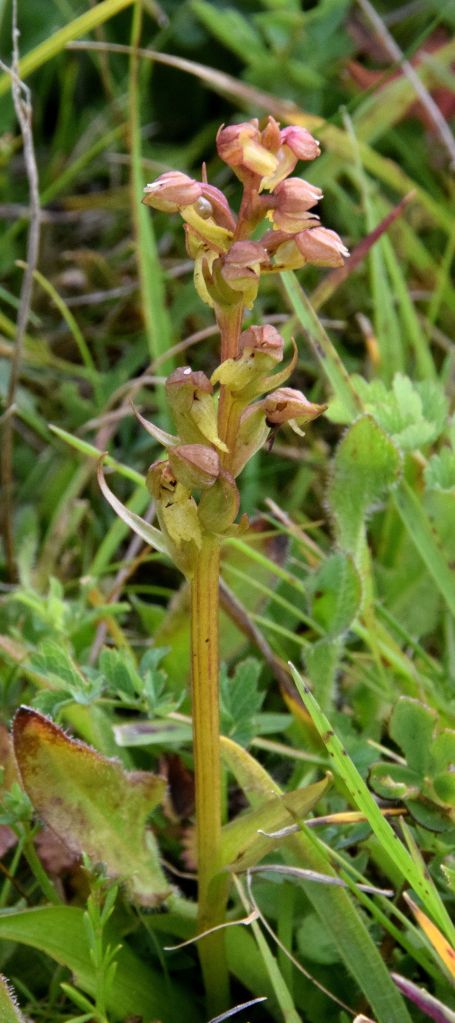
Two searches there on 15th and 17th left me none the wiser, though a person who follows this blog contacted me to say they were present. It was time to enlist expert assistance and so I arranged to meet Wayne on site this morning (21st). He enjoys a certain reputation for Orchid finding in county wildlife circles. Sure enough he had turned up four specimens by the time I arrived, and 19 were counted before we left, the best being pictured above.

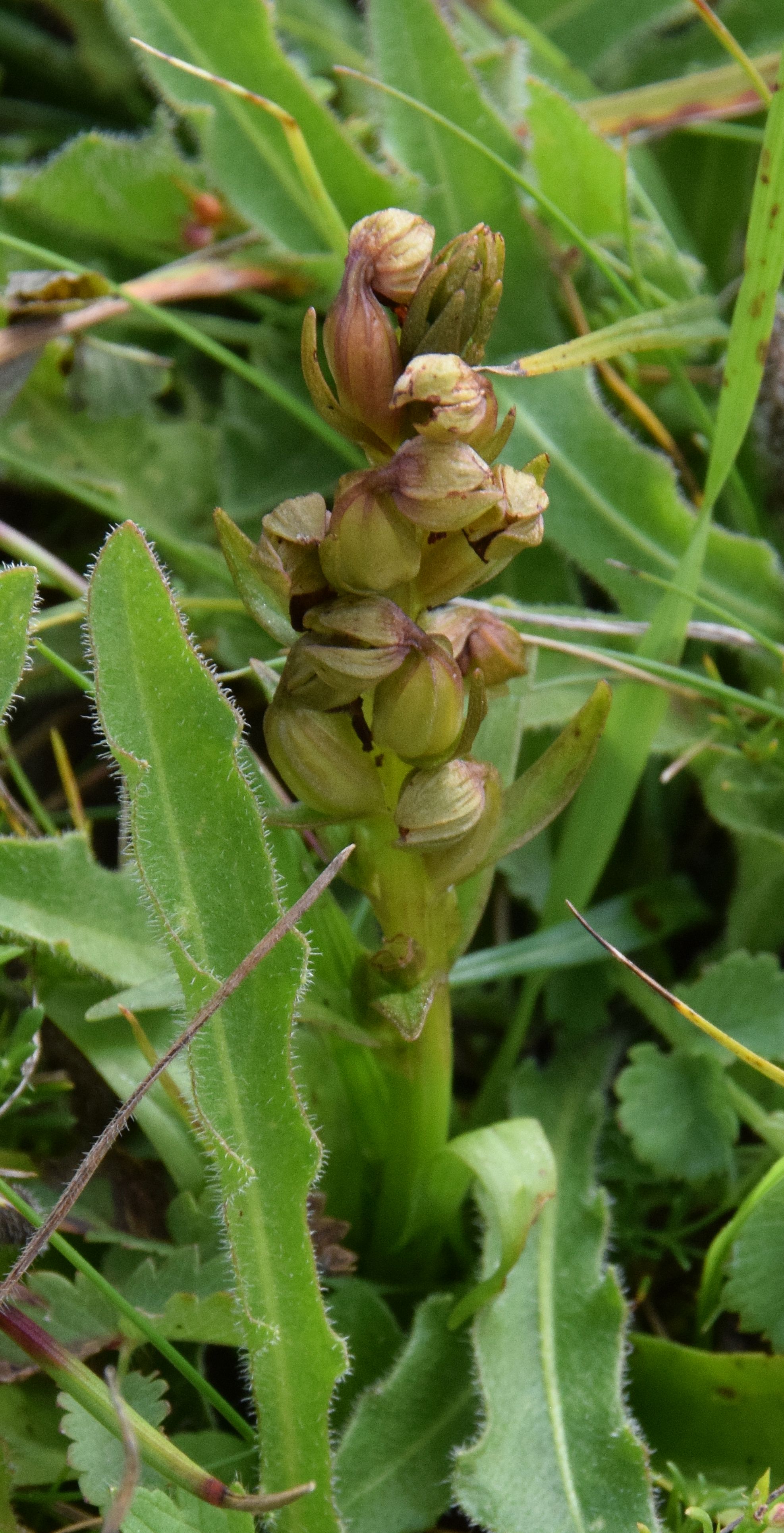
All were indeed small but I nonetheless felt I should have picked out some of the better ones on those earlier visits, even allowing for my companion’s prowess. The tone of the 5 – 25 flowers on stems up to 20 cm (in other places), varies from yellowish-green through pink to reddish brown, and these are said to suggest the hind legs of a frog. Sources I have consulted agree that a resemblance to those amphibians is a stretch of the imagination, but the left hand image (above) is possibly the most frog-like overall of those observed today. Here (below) are a few more.

This is a widespread but patchily distributed plant across the British Isles and mainland Europe, but in steep decline due to habitat loss from conversion of pasture to arable land, possibly more so than any other Orchid. Though tuberous it propagates almost entirely from seed with little vegetative spread, so the drought of a year ago would not have helped their cause. In southern England they favour chalk and limestone habitats, such as today’s location. As I was told at the start of their season it is a short-lived species of which many plants die out after just one year above ground. So all in all it is indeed a tricky, perhaps fickle little number and one I now feel very pleased to have recorded in my home county.

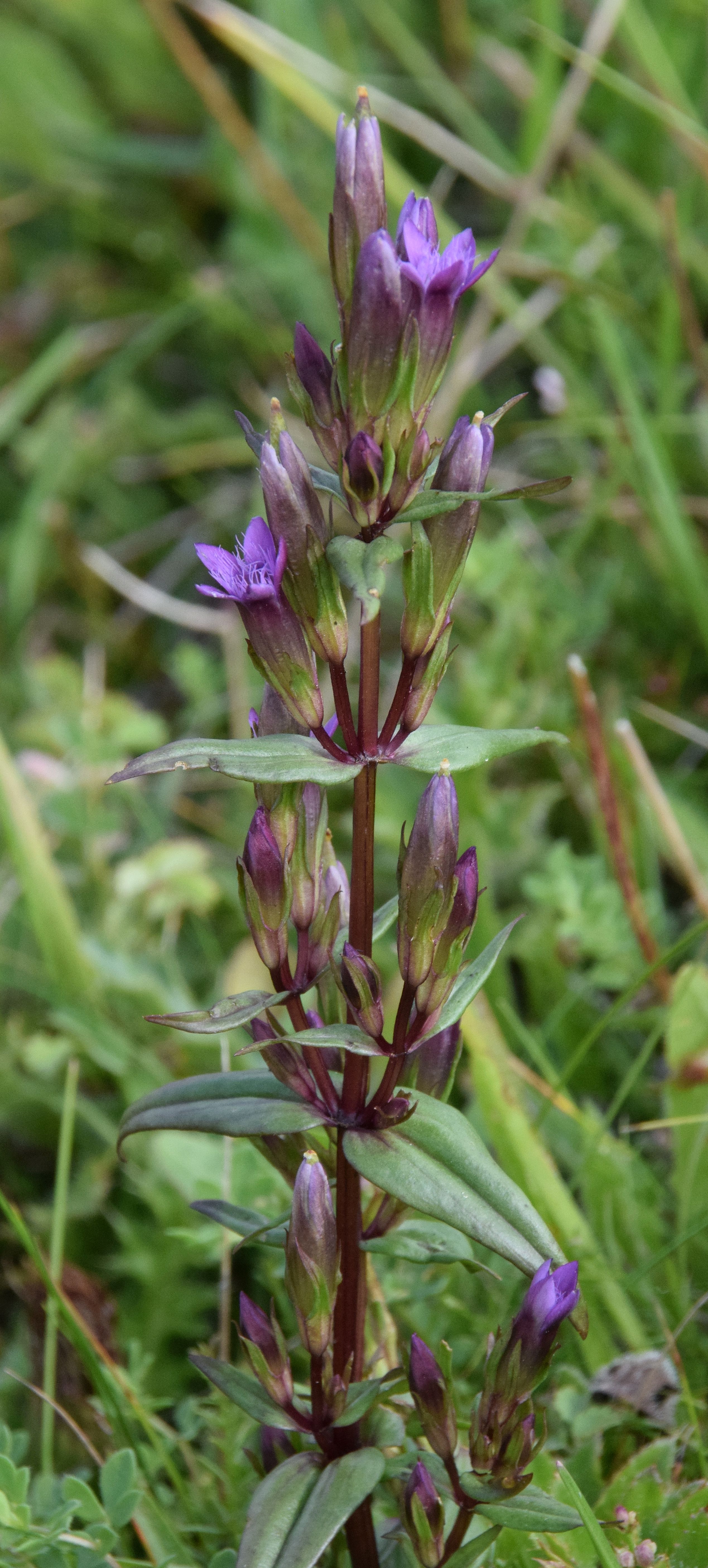
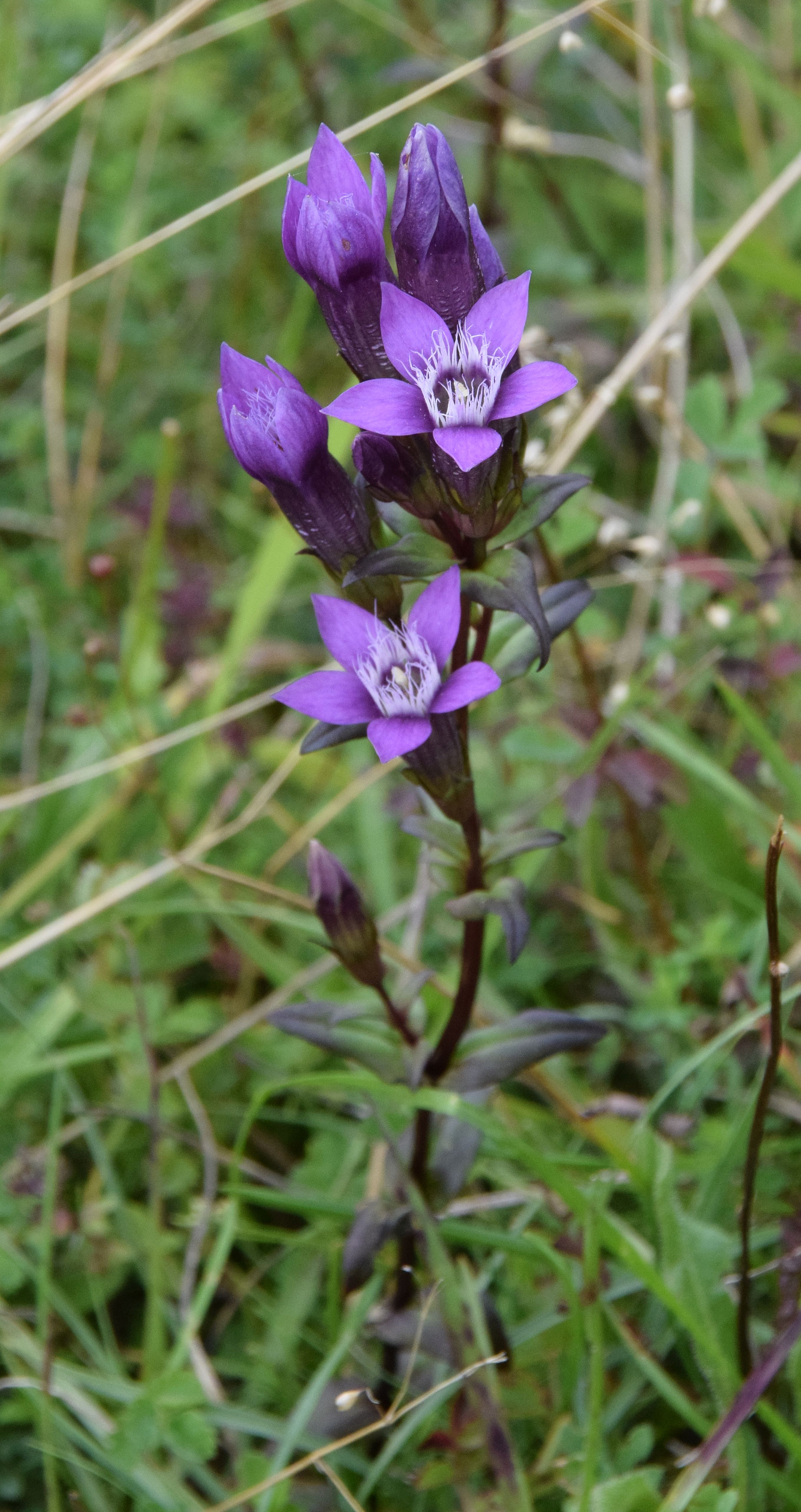
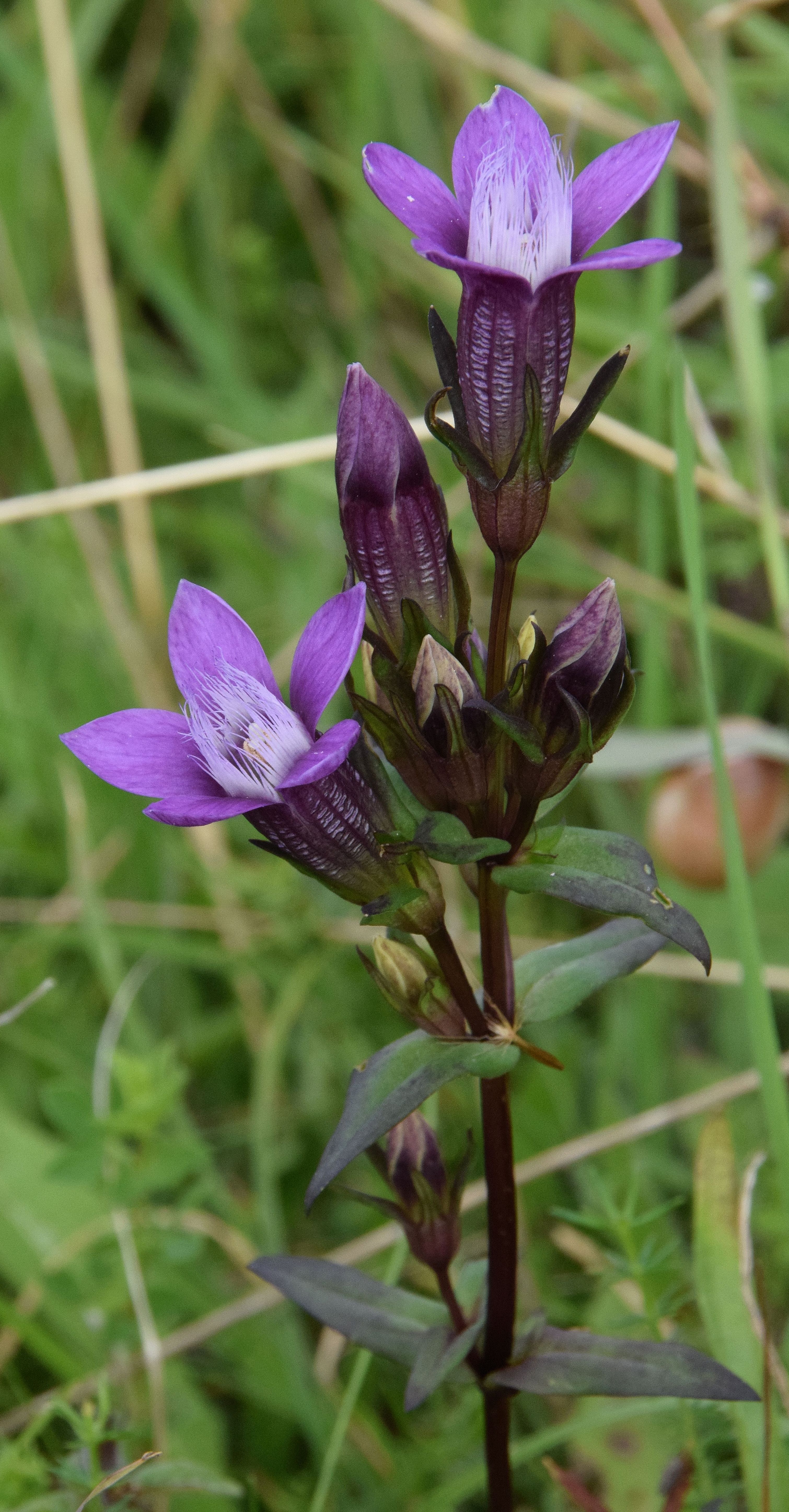
On the second visit my attention was caught by numbers of Gentian at the western end of the south-facing hillside here. My Seek app ID’d these variously as Field and Autumn Gentian, then failed to distinguish some scarce and much sought Chiltern Gentian further east along the slope. On reading things up I learned the paler Field Gentian is unlikely either this far south or in the habitat, and in any case has four petals per flower to the other two’s five. Erring on the side of caution I at first assumed all the plants I had seen were the commoner Autumn species, thinking the differences between it and Chiltern (see here) were subtler than they actually are.
With Wayne’s guidance I have now gained a proper education on these iconic plants that bring many wild flower enthusiasts to Aston Rowant NNR. Rather than go into detailed dissection of flower components I will let the above two pictures (taken on 17th) illustrate the difference as they clearly do. Surveying the hillside back from the Frog Orchid end on 21st we found good numbers more Chiltern Gentian, the highly localised county flower of Bucks, the blooms of which stand out as being larger and wider when open. In bud the brown and cream tones of Chiltern is also quite distinctive, as in the last two images of the following sequence. This wet summer is clearly a good season for both species.
The overdue conversion of Frog Orchid pretty much concludes this journal’s first serious Orchid hunting season. They really aren’t that much to look at, are they? But the satisfaction from such a difficult result is possibly in inverse proportion, so there’s another slippery slope! My year’s tally in approximate order of appearance is:

  1. Giant Orchid – undisclosed site (Oxon)
  2. Green-winged Orchid – Bernwood Meadows (Bucks), Asham Meads (Oxon), Wendlebury Meads (Oxon)
  3. Early Purple Orchid – Sydlings Copse (Oxon)
  4. Heath Spotted Orchid – Woodside Meadows (Oxon)
  5. Early Marsh Orchid – Lye Valley (Oxon), Parsonage Moor (Oxon)
  6. Military Orchid – Homefield Wood (Bucks)
  7. Fly Orchid – Homefield Wood (Bucks), Warburg Reserve (Oxon)
  8. Greater Butterfly Orchid – Homefield Wood (Bucks), Aston Clinton Ragpits (Bucks), Warburg Reserve (Oxon), Hornleasow Roughs (Glos)
  9. White Helleborine – Homefield Wood (Bucks), Grangelands (Bucks), Aston Clinton Ragpits (Bucks)
  10. Common Twayblade – Homefield Wood (Bucks), Aston Clinton Ragpits (Bucks)
  11. Common Spotted Orchid – Homefield Wood (Bucks), Grangelands (Bucks), Aston Clinton Ragpits (Bucks), Clattinger Farm (Wilts), Tuckmill Meadow (Oxon), Woodside Meadows (Oxon), Lye Valley (Oxon), Hornleasow Roughs (Glos), Parsonage Moor (Oxon), Sydlings Copse (Oxon), Dry Sandford Pit (Oxon), Watlington Hill (Oxon)
  12. Chalk Fragrant Orchid – Grangelands (Bucks), Aston Clinton Ragpits (Bucks), Woodside Meadows (Oxon)
  13. Bird’s Nest Orchid – Warburg Reserve (Oxon), Pulpit Hill (Bucks)
  14. Burnt Orchid – Clattinger Farm (Wilts)
  15. Southern Marsh Orchid – Clattinger Farm (Wilts), Tuckmill Meadow (Oxon), Parsonage Moor (Oxon)
  16. Pyramidal Orchid – Hornleasow Roughs (Glos), Grangelands (Bucks), Aston Clinton Ragpits (Bucks), Sydlings Copse (Oxon), Watlington Hill (Oxon)
  17. Lizard Orchid – undisclosed site (Oxon)
  18. Bee Orchid – Farmoor Reservoir (Oxon)
  19. Marsh Helleborine – Lye Valley (Oxon), Dry Sandford Pit (Oxon)
  20. Musk Orchid (gone over) – Grangelands (Bucks)
  21. Broad-leaved Helleborine – Aston Clinton Ragpits (Bucks), Warburg Reserve (Oxon)
  22. Violet Helleborine – Warburg Reserve (Oxon)
  23. Autumn Lady’s-tresses – Greenham Common (Berks)
  24. Frog Orchid – Bald Hill (Oxon)

Not found:

  • Marsh Fragrant Orchid – Lye Valley (Oxon), Dry Sandford Pit, Parsonage Moor and Cothill Fen (Oxon)
  • Lesser Butterfly Orchid – Warburg Reserve (Oxon)
  • Narrow-lipped Helleborine – Grangelands (Bucks), Warburg Reserve (Oxon), Aston Rowant NNR (Oxon)
  • Green-flowered Helleborine – Lambridge Wood (Oxon)

The Autumn Lady’s-tresses of Greenham Common, Berks + late season Oxon and Bucks Helleborines: 27th June – 15th Aug

The last Orchid to bloom in any season, just when most others have gone over is the diminutive and delicate Autumn Lady’s-tresses. After pictures of them began to appear on Facebook, I went to check out what is reputedly England’s largest colony at Greenham Common in neighbouring Berkshire on 15th, in company with Ewan. BBOWT directs visitors to an area 100 metres east of the site’s control tower car park (RG19 8DB – SU 499650), where upon our arrival these plants were not difficult to locate. Once our eyes were in there just seemed to be more and more of them, all around.

A sea of Autumn Lady’s-tresses

Thousands of this fascinating little number might erupt across short-sward areas of the former military airfield if conditions are right in August and September, but this Orchid is also prone to dormancy for seasons on end before re-appearing in even greater numbers. 2023 is as I expected in a wet high summer a prolific year, following on from the drought of 12 months ago. The sheer quantity of emergent plants here today matched my experiences earlier this year of Heath Spotted Orchid at Woodside Common, Oxon (see here) and Chalk Fragrant Orchid at Aston Clinton Ragpits, Bucks (here). Great care was required in selecting best items to take pictures of without trampling upon nearby, less photogenic subjects.

The tuberous Autumn Lady’s-tresses (Spiranthes spiralis) is characterised by up to 25 tiny bell-shaped white flowers splashed with pale-greenish yellow, growing spirally around 10 – 20 cm grey-green stems. The petals are covered in short white hairs. It is a resemblance upon close inspection to braids of plaited hair that gives the plant its name. This was the first British Orchid to be recorded in the 16th century, actually 1548 when braiding of men’s hair would no doubt have been less known than today.

Autumn Lady’s-tresses

ALT grows mostly in southern England, sporadically elsewhere in open, neither too dry or moist locations such as short-grazed meadows, heaths, dunes, cliff tops or calcareous grassland. The single, upright flowering stem appears from the side of a flattened rosette of pointed, bluish-green leaves. Those wither before flowering time, when the blooms’ delicate fragrance attracts pollinating, night-flying insects. The species also occurs across much of continental Europe and adjacent areas of north Africa and Asia.

The subtle, under-stated beauty of this old-fashioned plant, unchanged or hybridised over six centuries since those earliest English records, possibly needs to be beheld to appreciate properly. It is the spiral nature of the blooms and likeness to braided hair that is perhaps most alluring. Autumn Lady’s-tresses: what an evocative name! Such an enduring proliferation here and now on the site of a former cold-war military facility that will forever be associated with potential for mass destruction in the not so distant past, may be testimony that nature in the end and whatever the setbacks will prevail. And that is something I have faith in very firmly!

After my spring ramblings around local Orchid-filled, ancient flower meadows this year and the enlightenment that such places exist, I rather lost enthusiasm for searching out the residual species to record as June progressed. Most of those locally comprised five of the nine British Epipactis Helleborines that bloom from July into August. These subtly different Orchids grow in open spaces in woodland on calcareous soils and are often found in damp environments. All are characterised by long, skinny stems of small, subtly-toned flowers.

Marsh Helleborine

The first to announce themselves were Marsh Helleborine (pictured above) that I observed at both of Oxford’s calcareous fenland sites: the alkaline spring-fed Lye Valley LNR on 27th June, then BBOWT Dry Sandford Pit on 4th July. This plant, as the name suggests favours such wet, marshy habitats that may be flooded during winter and retain high moisture levels through summer. Described as scarce in the British Isles, they grow from 30 to 50cm tall with loose clusters of up to 20 whitish and pink or purple flowers facing mostly to one side suspended on reddish stems.

Broad-leaved Helleborine

After returning from my mid-July trip to Provence I saw on Facebook that Broad-leaved Helleborine (pictured above) was viewable at Aston Clinton Ragpits (HP22 5NF – SP888107). Having already recorded that favourite site of the season’s seven other Orchid species this one would complete the set. It is the most common and widespread member of the epipactis group, growing in and around deciduous woodland particularly of Beech. Individual stems can grow up to a metre tall with as many as 100 flowers that might range in colour between pink, shades of purple and pale green. I located them at the far edge of the wooded area adjacent to the site entrance, and finding the first-time sighting more interesting than I had imagined my motivation for this project became restored.

Violet Helleborine

It still remained to experience three more new Helleborines, of which Violet and Narrow-lipped have occurred historically at BBOWT’s Warburg Reserve (RG9 6BJ – SU721 878) near Henley, and the smaller Green-flowered at nearby Lambridge Wood (SU731843). I visited both sites on 7th Aug and several Violet Helleborine (pictured above) at the first one were impressive plants indeed. Closely related to Broad-leaved, these deep shade lovers may also grow to a metre high though the greenish-white flowers are less variable in colour. The stems and leaves may both be tinted purple, giving the plant its name. This once widespread, notably long-lived Orchid has undergone serious national decline over the past 160 years and now only survives in ancient woodland such as this.

The acting Warburg warden advised that though the reserve is still cited for Narrow-lipped Helleborine, few if any remain. Another site speciality, Lesser Butterfly Orchid has also not been recorded in 2023. And on 7th I also failed to find Green-flowered Helleborine where I had been advised to look in Lambridge Wood, though that last item is said to appear until early October. Finding these less profuse things in the field is clearly an imprecise art.