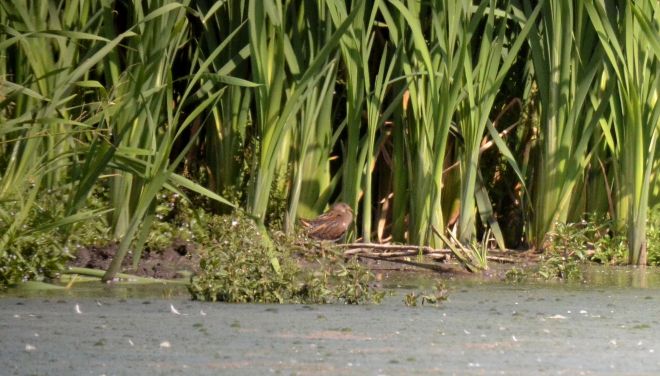
Two Spotted Crake at Willen Lakes, Bucks; and Eton Wick, Berks – 30th Aug and 1st Sep

August was a good month for Spotted Crake in England, with birds being reported on RBA from 10 different locations. In the last week two of those have been within easy reach and so I opted to take a look and hopefully update my personal experience of what is an easily overlooked, even enigmatic species. At this time of year immature birds often stop on migration to moult, sometimes rendering them flightless for up to three weeks

This secretive aquatic bird breeds locally in bogs and wet meadows across much of Europe and into western Asia, but is rare in Britain other than in northern Scotland. Further south most sightings occur on passage in marsh vegetation but Crakes are at all times difficult to view well. My only past sighting I can recall clearly was at Titchwell Marsh, Norfolk in August 1997. Then as now I also saw one two days previously at Dinton Pastures, Berks; and an even older record was in Holland in August 1988. So the presence of two Spotted Crake this week around 40 miles from home was a good opportunity to bring a little encountered scarcity into the present.

spotted crake.1801.eton wick

Spotted Crake at Eton Wick

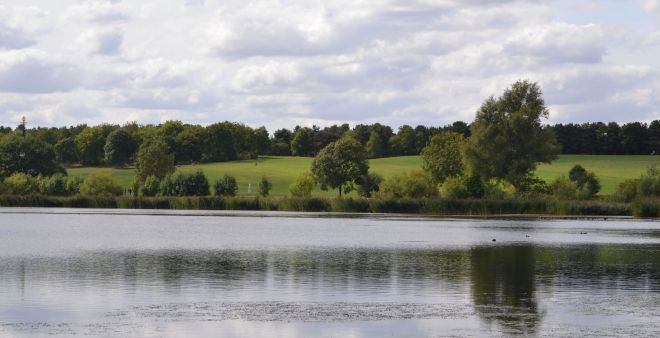
Last Thursday (30th) I opted for what seemed the more difficult of the two Crakes at Willen Lakes in Milton Keynes. There are two landscaped former gravel pits in this large public park, and I had visited the southern one before in November 2016 (see here) to see Velvet Scoter. This time my quest was being reported from the reed fringed side of the northern lake, close to the park’s Peace Pagoda and maze.

Arriving late morning in the Pavilion car park (SP 87658 41075) I first reconnoitred to find the area in question could be viewed from the opposite side of the lake where there were a number of gaps in the waterside vegetation. Then I retrieved my optics, chair and sandwiches before secreting myself in one of these spots away from any anxious enquiry of passing parents. Before me was a very open location (pictured below) and any views of the bird were going to be distant.

willen lake.1801

The Crake habitat at Willen Lake (N), Milton Keynes

In shallows at one point on the opposite shore there were several Green or Common Sandpiper, as well as a few Lapwing and Moorhen; the last of which would provide a good size reference for the other bird I sought. Spotted Crake is about 10cm shorter in length than a Moorhen, and a little smaller than Water Rail that it resembles in shape and habits. After a while I picked out a small brown form and this indeed was the Spotted Crake.

A very pleasing hour then passed in which this bird went through a full repertoire of Crake behaviour, alternately foraging busily in the open, moving through the reed edge, dashing back into cover on becoming alarmed, then reappearing from close by. Though always distant I could clearly discern it’s blue-ish head; short, straight bill and upheld tail with striking buff under-tail feathers. I was at all times struck by how small this bird seemed compared to the other species around it. The encounter was indeed an education in all things Spotted Crake.

Yesterday I went for the second bird at Dorney Common by Eton Wick, in company with fellow Oxon birder Sally who had not seen one before. There were a couple of pager reports while we began our day walking Oxford’s Farmoor Reservoir with other birding colleagues, suggesting the Berks’ Crake was receiving a little attention. Then upon our arrival on site we enquired of a departing birder who pointed out a group of observers in the common’s north-east corner.

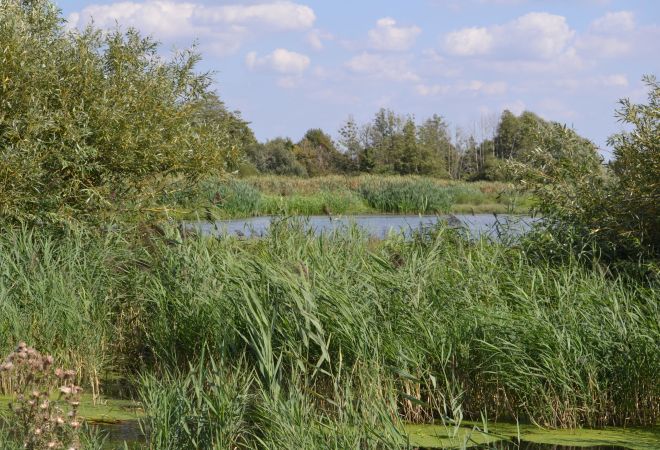
eton wick.1801

The second Crake location at Eton Wick

This was the same place (SU 94289 78986) where I had seen my second Pectoral Sandpiper in September 2012, though the habitat was now rather different with deeper water. The Spotted Crake was active in the paler green area between the two taller, darker areas of reeds on the far shore in the above picture. It would emerge from either end of the brighter vegetation, presumably spending most of it’s time concealed further back in the space in between.

Once again we came equipped with chairs and sandwiches. After a while the other birders all left and we continued to watch the Crake intermittently for an hour or more. I then realised there was another gap in the Willow fringe a little to our left, probably the viewing location described rather vaguely on RBA, from where there was a better view of the right hand spot the bird favoured. So I set up my digiscoping kit trained onto this place, while Sally continued to watch the left hand spot. Either side of 3pm the Crake emerged again in both places and I acquired these blurry records (below).

This second and closer encounter was as pleasing as the earlier one, and so my experience of a difficult species has been duly updated. Despite their reputed elusiveness, these birds were fairly easy to observe once located and with patience. Soon both will move on to their African wintering grounds and I am very glad to have spent a little time in their presence as they disperse south.

Marbled Duck at Grimley, Worcs – 27th Aug

August was in danger of passing without a blog post until upon my rising a little late today a British and European bird list addition leapt out at me from RBA. The previous evening a Marbled Duck, the first in Great Britain since 2014, had been discovered on gravel pits by the village of Grimley, near Worcester. At 85 miles this was well within my preferred range and so would offer an ideal day out after a weekend spent mostly at home.

This duck, also known as Marbled Teal, is a scarce and localised breeder in the southern Iberian peninsula, north-west Africa and western Asia. I had previously failed to find it in Spain, where there is a small and declining population, in May 2012. Later in November 2015 I enjoyed a very good experience of them in the Souss Massa national park on Morocco’s Atlantic coast (see here). I was now intrigued that this Worcs individual, a juvenile was not being treated as plastic by RBA. So I checked local birding resources to see what was being said about its provenance.

Worcestershire and West Midlands’ birders who had already filmed and gained pictures of the visitor (see here and here) described it as being un-ringed, fully-winged and wary; all good credentials for a genuine vagrant rather than an escape from captivity. Late August is also the right time of year for a juvenile to disperse from its breeding ground and in this case stray rather too far. But it remains to be seen what the BOURC will decide.

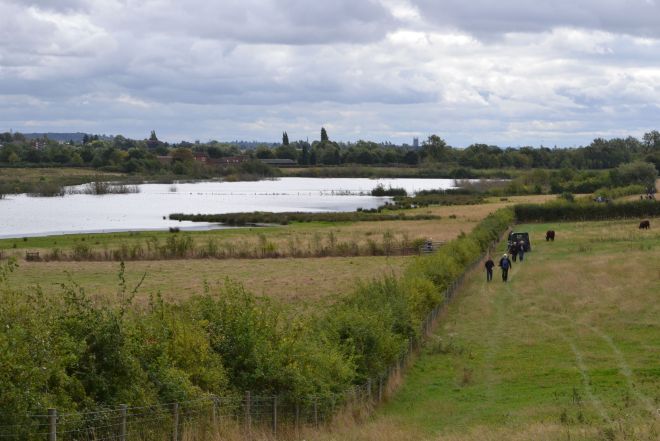
grimley GPs.1801

Camp Lane GPs, Grimley, Worcs

After a thankfully stress-free drive west along the A40 from Oxford then north on the M5 motorway, I easily located the site described as Camp Lane GPs (SO831598) about 10 miles from junction 6 north of Worcester. After following a public right of way out to where a group of maybe 30-something birders were gathered (pictured above), I was at once put onto the Marbled Duck that was sitting in the top of a shrub on the far side of the pit. Later arriving birders who I assisted all seemed as puzzled as myself initially to realise they were looking for a duck in such a situation rather than on the water.

Apparently the bird had barely moved from this position for an hour previously, and so it remained alternately dozing then preening and occasionally putting its head up to look around. This medium-sized, slender, pale sandy brown duck with a dusky oval eye-patch certainly stood out amongst the drab, eclipse-plumaged wildfowl with which it had settled. The body plumage is diffusely blotched with off-white spotting that is more prominent in juveniles. Marbled Duck also has a long-necked, large and round-headed appearance with a slim, dark-toned bill.

In the circumstances the digiscoped images (above) were as good as I was likely to get, and at least record that I was there and saw this bird, which is always my first priority. After around 30 minutes I was joined by fellow Oxon Birder Adam, who maintained his knack of arriving at just the right moment since shortly afterwards the duck hunkered down into the shore-side vegetation and was lost to view for a while.

We both scanned around hoping our quest would re-emerge onto the water and offer some better picture opportunities, but that was not to be. Eventually the MD sat up again in exactly the same spot, before stretching its wings with a brief fly around. After returning to the exact same place and climbing up to the favourite perch once again the former routine was resumed. In flight the wings appeared long and pale without a marked pattern (see here). When it next flew the duck landed in an area away to our right though still distantly, and two local patch watchers suggested we might get better views from other spots they knew.

We then followed those birders on a circuit of the site (pictured above) that struck me as a superb location for attracting migrants. It seemed difficult to believe these former gravel pits are not already managed as a nature reserve, such was their wildlife and visitor friendliness alike. But we could not re-locate the Marbled Duck that as a species is known for being secretive, often hiding in vegetation. So pleased with our views already we left after what had been a very satisfying bijou twitchette.

I haven’t been inactive in the five weeks since this journal’s last post, but have just not done anything that I can make a decent story of. So though my wildlife garden at home is looking rather more tidy, lethargy has been in danger of setting in. What a contrast a new and different bird to go and see, and the buzz that comes from it makes.

Southern Emerald: an unexpected extra English damselfly – 19th & 22nd July

Since 22nd June a newly revealed colony of Southern Emerald has been reported in the British Dragonfly Society (BDS) online sightings log. This is in Buckinghamshire close to the M40 motorway. I first heard about it a week ago when Adam told me he had obtained precise location details and invited me to go with him to check things out at the site. On Thursday (19th) his work commitments allowed us to do that.

Two years ago I wrote in this journal of finding my last regularly occurring English damselfly, Scarce Emerald at a site on the Thames estuary in Essex (see here). Then a year later I observed many more of that very localised species at Canvey Island in the same county (see here). Southern Emerald is much rarer in the British Isles, with (as I understand) just two established populations in Kent and the Isle of Wight and small numbers seen occasionally elsewhere. So the emergence of this new colony is attracting much interest amongst odonata enthusiasts.

southern emerald.1803 beaconsfield

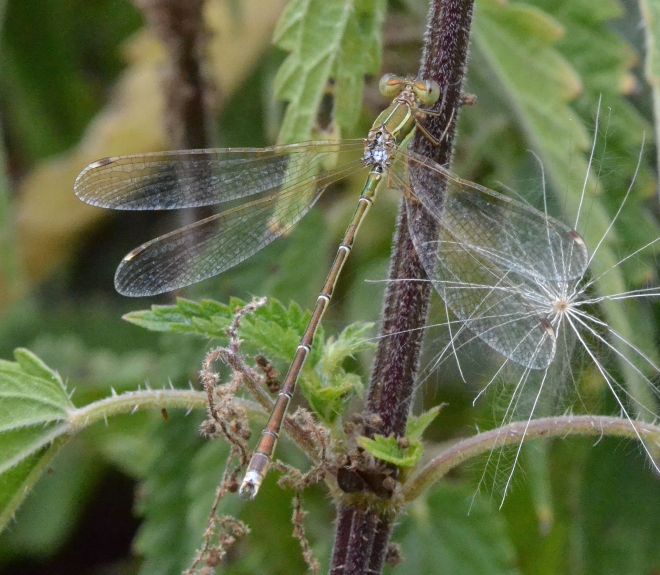
Southern Emerald (note the cream and brown two tone pterostigma)

We followed a public right of way towards a woodland where Adam had been advised to start looking for these insects, and once there it wasn’t long before he spotted a first damselfly in the trackside vegetation, then another and another. Yes they were Emeralds and yes they had bi-coloured cream and brown pterostigma (wing tags), the easiest diagnostic for Southern Emerald. Mission accomplished! Then we met another Oxon naturalist making his way back, who said there were many more of them a little further along the track.

At that hotspot I took the pictures in the next two collages. One entry on the BDS sightings page quoted 50+ and another 100+, and there were certainly plenty. Southern Emerald is about the same size as Common and Scarce Emerald, and smaller than Willow Emerald (see here); these being the four of their genus that occur in the British Isles. Southern is the only one of this metallic green quartet with bicoloured pterostigma. The lower rear of the head is entirely yellow, the thorax exhibits broad, pale anti-humeral stripes; and yes males can be distinguished by their diverging inferior anal appendages. Don’t forget that last one!

It was striking at this spot how many mating pairs were on the wing (pictured below). To quote Brooks and Lewington, eggs are laid by solitary females or tandem pairs into emergent aquatic plants or the branches of waterside trees and shrubs; and there was plenty of evidence of that. The egg is the over-wintering stage and larvae emerge the following spring.

This is a widely distributed species throughout central and southern Europe, except in Alpine regions. It is more common in the southern part of it’s range, but has been expanding north since the late 1980s. My own first record was in Sardinia in June of this year (see here). The discovery of a new colony so close to Oxford begs the question of how many more might be out there nationally, awaiting the sharp eyes of intrepid odo hunters.

The situation strikes me as another of those open secrets, that is meant to be kept quiet but which everyone with an interest knows about. The BDS requests that visitors respect limited roadside parking and public rights of way at the Bucks site, and pay due attention to personal safety. But the society is not consistent since in it’s log people are urged not to visit, then a few posts later a contributor gives away the exact location. So I have chosen not to do that, but working things out is a matter of common sense on consulting the BDS sightings page.

Three days later (22nd) I went back to this place to try to obtain less cluttered pictures. The two above were amongst my better results until the walk back, when I was able to capture Southern Emerald in the long yellowing grass by the trackside. The images below are more like what I seek in recording insects and made this return visit well worthwhile.

Far fewer insects were on the wing this time, so perhaps their emergence had peaked at around the time of our first visit and hopefully some of them might have dispersed. In the interim one contributor to the BDS sightings page had spoken of tandem pairs rising in clouds from his footfall. There were still some pairs propagating their species on this day, and I managed a few more pictorial records (below).

A few years ago a small number of Blue-eyed (or Southern Migrant) Hawker dragonflies arrived in Britain in the same area of Essex as the Scarce Emeralds referred to at the start of this post. That colony is now thriving, and as of today BEH has also been reported in 2018 from Kent, Sussex, Cambridgeshire, Hampshire, Dorset, Somerset, Gloucestershire and even as far south-west as Cornwall. I do hope this latest continental European migrant, Southern Emerald damselfly is as successful in expanding it’s own range and that before too long we might find them just up the M40 motorway in Oxfordshire.

Roseate Terns at Hill Head, Hants – 17th July

This is a bird I really should have connected with long before now, but one circumstances have always seemed to conspire against. One of only two regularly occurring migratory Terns in Europe I had not observed until now (the other being Sooty), there are good numbers of British records each year. So most seasoned birders will have it on their lists. These credentials all gave Roseate Tern “huge lifer” status.

My long standing ill luck concerning this species looked set to continue when on going away from home a week ago two adult Roseate were reported daily during my absence at a convenient location, the Solent by Titchfield Haven NNR. Mid-July is when failed breeders begin to move around, and birds were also reported from other places nationally. Then upon my return last Saturday the Hants Terns relocated to Poole Harbour though not for long.

roseate tern.1801 hill head

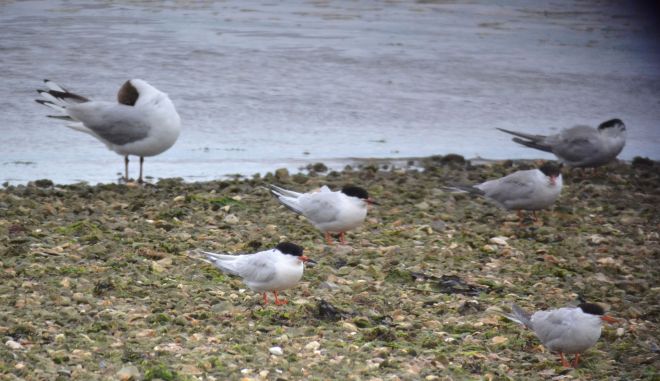
Two adult Roseate Terns (centre) with Common Terns (right)

Yesterday (16th) they were back on the Solent, resuming a routine of loafing with Common Terns and Gulls on mud and shingle by Hill Head Harbour (SU534023), then moving onto the adjacent reserve’s Meon Shore scrape at high tide. I didn’t hear about their return until mid-afternoon, and my first reaction was to go down the following morning. That thought lasted about five minutes before I upped and went, and didn’t the buzz that comes from a bijou twitchette such as this feel good.

I arrived 80 miles later at some time after 5pm to find the tide lapping against the sea wall and Titchfield Haven already closed to the public. It would be wrong to take issue with that, since the reserve is manned by volunteers and health and safety legislation no doubt rules against visitors entering out of hours, but such an early 5pm closure was still inconvenient. I checked through the Terns on the nearest lagoon, then explored further to ascertain there were indeed no viewpoints from where the scrape could be viewed from distance.

This slideshow requires JavaScript.

Returning to Hill Head Harbour at around 6pm I found the tide was going out again and Terns were beginning to congregate on the exposed “beach”. Two more birders joined me and for the next 90 minutes we watched the comings and goings on the falling tide, though all of the Terns present were Common. But this morning (17th) the Roseates were reported again first thing from this exact same spot and so I reverted to plan A.

The second attempt was at the opposite end of the fortune scale to the first. On re-arriving at around 11am I enquired of a departing birder, to be told the two adult Roseate Tern were out on the shingle and a few people were watching them from the sea wall. I parked (it’s free here) then hurried over, observing my usual priorities of see the bird first, get any kind of picture, then try for a better picture. Someone told me where to look and one Tern immediately stood out as being different. Then I found the second Roseate.

I had got here just in time since shortly afterwards the birds flew out into the Solent to feed. I then walked around the harbour to join more birders sitting on a breakwater and when the Terns came back I took all of the digiscoped pictures herein. One predictable outcome of this post’s return to bird matters is a reduction in image quality, but I can see what these birds are. I even learned to recognise their distinctive, high-pitched call as they came and went. When the tide came right in they flew off again towards the Meon Shore scrape.

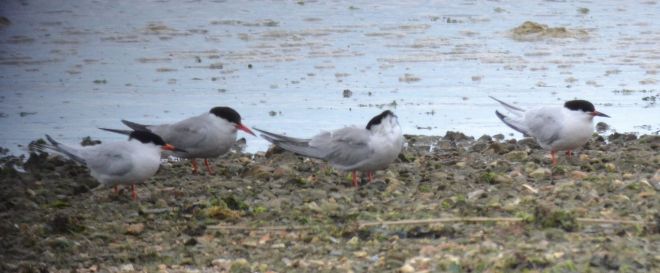
To quote the Helm guide to confusion species, Roseate Tern is slightly smaller and more delicate than Common with shorter, narrower wings; and even longer tail streamers than Arctic Tern. The previous evening I had concentrated on looking for more black in the bill. But having now read up on other diagnostics before setting out I at once picked out the pale upper side, lack of black in the tail and very bright legs that my earlier companions had discussed. All these features show fairly well in the picture that heads up this post and the two blurry crops above. The difference from the greyer-toned Common Terns was striking.

roseate tern.1803 hill head

In this picture the Roseate Terns are the paler-toned outer birds

Currently in 2018 there are around 116 breeding pairs of Roseate Tern in the UK (per RBA), restricted mainly to Coquet Island in Northumberland with a few pairs scattered elsewhere. A much larger population occurs in Ireland. The species takes its name from a pink tinge that is visible on the breast during the breeding season. Small post-breeding numbers are seen on migration in southern and eastern English counties, and it was an absolute pleasure to finally catch up with this very attractive Tern today.

Butterflies of Mount Parnassos, Greece: 20th – 22nd June

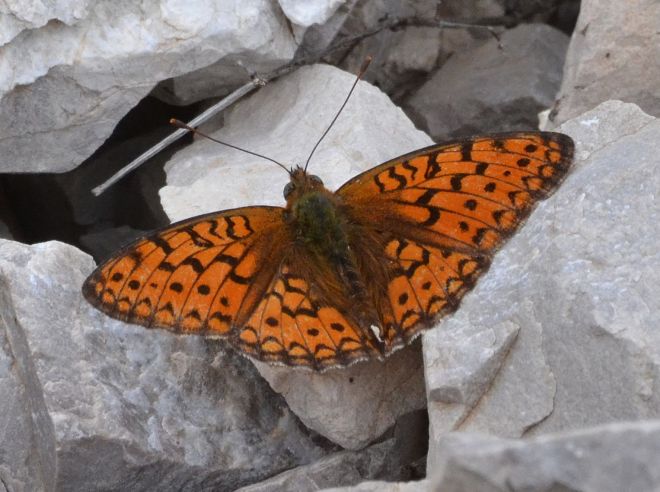
The second part of the Naturetrek tour to southern Greece I joined last month was to a further renowned location amongst lepidopterists, Mount Parnassos above the northern shore of the Gulf of Corinth. There we spent two days exploring several high meadow and roadside sites that were known to our tour leader as holding butterflies of interest. The outcome was 10 more life-list additions including Niobe Fritillary (pictured below), Great Sooty Satyr, Purple Shot Copper and various new Blues, Graylings and Skippers.
niobe fritillary.1803 mt parnassos

Niobe Fritillary

Our base was the hillside town of Delphi, a tourist trap that serves the nearby ancient site of the Sanctuary of Apollo. After arriving on 20th we walked down to some waste ground below the streets lined with hotels, eating places and souvenir shops to see what was about. Here I managed some pictures of Scarce Swallowtail (below) that in this part of Greece can belie it’s name by being more plentiful than continental Swallowtail. In my experience this big, floppy butterfly is difficult to capture well but reasonable results if obtained can be quite pleasing.

Another common Mediterranean species that yielded above average images here was Eastern Bath White (above, right). And in the town itself we came across the only certain sighting for the trip of Southern Comma (below). The latter has sparser black markings on the top side than regular Comma and the unh marking that gives this species its name is Y rather than C shaped. The latter’s European range is from south-east France through Italy, the southern Balkans and Greece.

Three new (for me) Blues were observed at higher sites. Members of this group can often look more similar in pictures than they do in the field where jizz comes into play. Then something will just look or seem different from what has been observed more commonly before, and it is then a matter of identifying exactly what the newcomer is. I felt that when butterflying alone in les Cévennes (see here), and again here in Greece amongst very knowledgeable, Lafranchis-equipped tour colleagues.

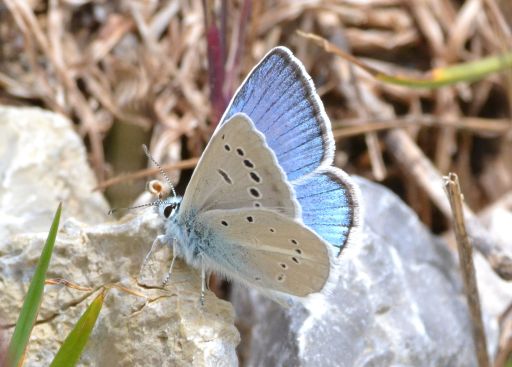
A roadside male Amanda’s Blue (below) really stood out in this respect. Its dark outer borders to the upper forewings and pale ones to the inner lower hind-wings were both very apparent, but do not stand out so much in my pictures. But the underside is more clear-cut in ID terms having less orange than related species, and the clean looking unf with no cell spot is characteristic. The female, found at the same bramble patch as the White-letter Hairstreaks of an earlier post (see here) was less difficult to confuse. This was also a pleasing sighting since like many Blues females tend to keep a lower profile than territorial males.

Amanda’s is distributed across much of central and eastern Europe from the Baltic southwards into more mountainous Mediterranean areas. Perhaps surprisingly we found the even more widespread Idas Blue at just one meadow location. This common European Blue is similar in size and appearance to Silver-studded but with narrower forewing borders and other subtle differences. A clearer diagnostic is the array of black dots along the bottom edge. I only managed to gain images of our specimen (below) in the tour leader’s jar.

The rather more scarce Blue Argus (pictured below), another resident of the Balkans, Greece and Turkey, was located at one stony, high altitude site. There we came across a mating pair (far right), in which the Chapman’s-like white patch on the unh stood out in the female. Otherwise this butterfly rather suggested a smaller version of Chalkhill Blue. And that is the last of this complex and fascinating group for these two trip posts.

Two more regional Graylings made up their own group’s quota for the trip. Unlike some of its very similar members that have featured in this journal recently, Freyer’s Grayling (pictured below) was unmistakeable due to it’s underwing pattern. The pictures below were taken at Galixidi on the Gulf of Corinth during our relocation from Kalavrita. But we also encountered this butterfly at the Sanctuary of Apollo and on Mount Parnassos itself.

The evocative sounding Great Sooty Satyr is one of those Graylings with a rather more interesting name, like The Hermit near Kalavrita earlier in the week. We recorded this larger species (pictured below) a number of times in dry, grassy places at medium altitude such as it favours. The butterfly exhibits a degree of variation between individuals in colouration and markings, especially in females.

The last new Skipper for the trip was Orbed Red Underwing Skipper (below, left and top right) that is also known as Hungarian Skipper. That brought the total of Grizzled-type species lifers from southern Greece to four and I can now tell the difference between all of them. So someone is bound now to tell me I have mis-ID’d Persian Skipper (below, bottom right) that was also observed on Mount Parnassos a number of times.

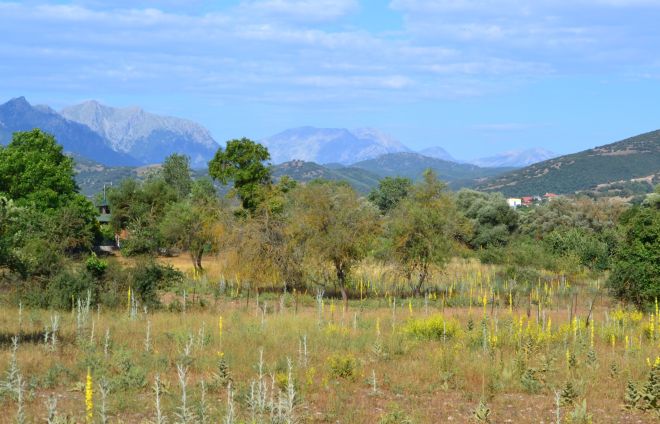
Two more familiar brown Skippers demonstrated the silliness of their parochial English names here. Essex and Lulworth Skipper (pictured below) were both encountered on Parnassos far from their attributed homes, but both species are of course distributed widely across Europe. “Norfolk Hawker” in the dragonfly world is another example of what must be some kind of historical anachronism, and I rather wish that like Green-eyed Hawker the two butterflies referred to above might also be accorded more sensible international names. Lastly, Mallow Skipper (below, bottom left) that crops up wherever I butterfly in Europe was observed here a number of times.

On 21st we were about to head back down the mountain in overcast conditions, but still stopped at one high meadow for a quick look around. The sun then broke through and the location gradually but steadily revealed its treasures. Heath Fritillary was plentiful, the first time I have encountered it outside England. Revisiting the species’ stronghold of East Blean Wood in Kent (see here) had fallen off my agenda this year because of these travels, so I was pleased to encounter it again on Parnassos. HF has pretty much a pan-European distribution apart from the southern Iberian peninsula.

Two more common and widespread continental Fritillaries also showed themselves in the meadow being discussed. I have yet to gain an acceptable top-side picture of Queen of Spain Fritillary (below left) but Spotted Fritillary (right) is often photogenic.

This was where I succeeded in recording Greek Clouded Yellow for the trip, having seen it fly by a few times on Mount Chelmos. Males have a deep orange upper side that really stands out in the field, though differences from other Clouded Yellows in the underside (below left) are not so obvious. The head colour in the picture does give some clue to the top-side colouring. A pale helice form of regular Clouded Yellow (top right), observed several times during this tour, also gave itself up to the camera here.

Two more Coppers for the trip were added in the same meadow. Having gained good images of male Sooty Copper in les Cévennes, I was pleased to add a female (below left) to my collection here. Still more satisfying was self-finding Purple-shot Copper (right), a butterfly I have wanted to experience for some time. What a pity about that unsightly tear in one upper wing. Both these Coppers range widely across continental Europe.

A last featured sighting from this place is Southern White Admiral (below) that a number of times in my butterflying past has provided excellent value. I already possess some premium top-side pictures taken in Provence (see here) and now I was able to add good underside images to my collection for the first time.

It remains to present four more butterflies of note. At one roadside location regular Marbled White were flying as well as Balkan MW. But these were of the M g procida form that occurs in the southern Balkans and Greece. They appear very black and white by comparison either with their Balkan cousins or the browner and most widespread Melanargia galathea that is a common sight in the English high summer.

On another mountain road we searched for Niobe Fritillary that features at the head of this post. This widely distributed larger Fritillary favours roadside Valerian and so was not difficult to locate. It is similar to the as widespread High Brown Fritillary but is distinguishable by black veins on the underside hind-wing and certain other diagnostics. I only managed acceptable pictures of the top side (below).

This Oriental Meadow Brown (below, left) was observed at the same ski resort bramble patch as the female Amanda’s Blue and White-letter Hairstreaks. By comparison with regular Meadow Brown the underside top wings have a rather cleaner look while the outer edges of the hind-wings are more scalloped. The upper side if seen is very different. This species occurs in the Iberian peninsula, southern Balkans, Greece and Turkey; as well as parts of southern France and Italy.

Lastly, on the afternoon of 22nd we drove up almost to the summit of Parnassos and walked into possibly the highest meadow of the trip. Conditions were overcast on our arrival but as soon as the sun came out the rocky slope before us became alive with Clouded Apollo (above right). Europe’s four Apollo species are butterflies I very much want to experience, but having been on the wing since early May those active here were all quite worn. We had encountered even more ragged individuals twice already.

The full species count for the two part tour of Mount Chelmos and Mount Parnassos, with life-list additions in bold, is: Swallowtail <P m gorganus>, Scarce Swallowtail, Clouded Apollo, Black-veined White, Large White, Small White, (Krueper’s Small White), Eastern Bath White, Greek Clouded Yellow, Clouded Yellow, Helice Clouded Yellow, Brimstone, Cleopatra, Eastern Wood White, (Purple Hairstreak), Sloe Hairstreak, Ilex Hairstreak, White-letter Hairstreak, Small Copper, Grecian Copper, Sooty Copper,  Purple Shot Copper, Lesser Fiery Copper, Long-tailed Blue, Holly Blue, Iolas Blue, Eastern Baton Blue, Zephyr Blue, Silver-studded Blue, Idas Blue, Brown Argus, Blue Argus, Chelmos Blue, Escher’s Blue, Amanda’s Blue, Chapman’s Blue, Ripart’s Anomalous Blue, Turquoise Blue, Meleager’s Blue, Adonis Blue, Common Blue, Southern White Admiral, Red Admiral, Painted Lady, Queen of Spain Fritillary, Small Tortoiseshell, Comma, Southern Comma, (Cardinal), Silver-washed Fritillary, Dark Green Fritillary, Niobe Fritillary, Spotted Fritillary, Lesser Spotted Fritillary, Heath Fritillary, Marbled White <f procida>, Balkan Marbled White, Woodland Grayling, Delattin’s Grayling, Freyer’s Grayling, The Hermit, Great Sooty Satyr, Great Banded Grayling, Meadow Brown, Oriental Meadow Brown, Small Heath, Speckled Wood <P a aegeria>, Wall Brown, Large Wall Brown, Lattice Brown, Oberthür’s Grizzled Skipper, Olive Skipper, Orbed Red Underwing Skipper, Persian Skipper, Mallow Skipper, Dingy Skipper, Lulworth Skipper, Essex Skipper, Small Skipper, Large Skipper.

(Butterflies in parentheses were seen by other group members but not myself).
Turkish Clubtail dragonfly and some other insects in southern Greece: 17th – 22nd June

After the relative failure of my recent week in Sardinia (see here) I was glad of securing a further dragonfly life-list addition on this second June trip to Greece. Just about the only odonata-oriented location on our butterfly dominated agenda was the Strimonas valley near Kalavrita and it was there that Turkish Clubtail (pictured below) was located.

turkish clubtail.1802 kalavrita

Turkish Clubtail (male)

This dragonfly (Gomphus schneiderii) replaces the far more widespread Common Clubtail (G. vulgatissimus) in the southern Balkans, Greece and as the name suggests Turkey. Its range also extends into the Caucasus, Lebanon and Iran. The overlap of the two species in Greece is poorly understood. Turkish Clubtail is generally smaller and more slender than Common, and in mature males the eyes are much bluer, not green as the pictures in this post show clearly.

The Dijkstra and Lewington field guide states that other differences between the two species are minor, but to me these Greek specimens looked much blacker than Common Clubtails at home in England. But that could be because I have only previously observed newly emerged individuals (see here). I also wondered if the Turkish variety is less prone to taking to the tree tops immediately after emergence, never to be seen again by frustrated odo hunters, since some of those in the riverside vegetation were quite ragged (pictured below).
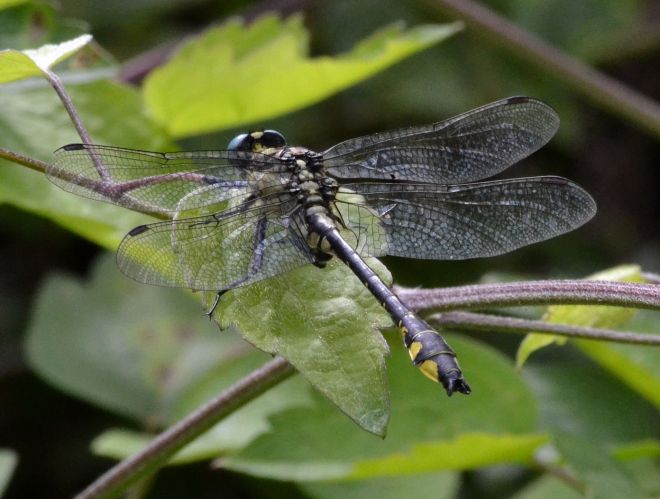
2018 was an above average year for Common Clubtail sightings in Oxfordshire (see here), but I myself only had time to look for them once and did not repeat my success of a year ago. Six more Clubtail species in Europe all have limited or highly localised ranges. But I have now experienced all of the three that occur more widely, having self-found Western Clubtail (below, right) in Portugal in May 2014. These (below) are both archive pictures.

The main other odonata interest along the River Strimonas in Greece was Blue Featherleg, or White-legged Damselfly as the species is known in Great Britain. I was pleased to capture images of some new colour forms here, since most of those I had come across before in England were immature or maturing males. The blue mature male form (below, left and top right) is really quite striking and just look at those splendid white legs. The immature female (bottom right) was another pleasing new find.

The default Demoiselle in the areas we visited appeared to be Beautiful Demoiselle (pictured below, top) that was abundant along both the Strimonas and Vouraikos rivers close to Kalavrita. This largest and darkest of its genus is always photogenic with entirely metallic cobalt blue wings in males and transparently greenish to dark ebony tones in females. Some Banded Demoiselle (below, bottom) were also present here. Both species are common and abundant throughout Europe.

A purely chance sample of other insects now follow that caught my attention during the week under review. I can always find space for Grasshoppers and Crickets in this journal. Greece is especially blessed with this order since the majority of its 17,000 known European members are confined either there or in the Iberian peninsula. Only around 250 species extend into central Europe while the British isles have just 30. Given those numbers I can rarely match what I find on my travels to field guides and so have no idea of what species the individuals pictured below actually are.

The top left picture is of the biggest Grasshopper I have ever encountered, while the colourful Bush Cricket was seen a number of times. I am intrigued as to whether some of these insects can alter their colouration to blend with their surroundings, having previously seen a red-toned grasshopper against red soil in Portugal (below left) and now this blue-toned individual (below right) here in Greece. The two do look superficially similar in size and shape.

Ant-lions, Ascalaphids and Lacewings are another complex order that no field guide appears to do justice to. These are soft-bodied flying insects with membranous wingspans ranging from about 3mm to more than 100mm. The large Ant-lion species pictured below left confused proceedings a number of times by resembling a dragonfly at first sight, but they are much narrower bodied and once settled pull their wings in tightly and so are then difficult to pick out from the vegetation in which they rest.

Lastly Ascalaphids provided variety on a number of times here as in Sardinia. The right hand picture is of the only one I managed to capture adequately. These fast flying relatives of the Ant-lions are generally shorter and stouter with long clubbed antennae. There are 15 European species occurring mainly in the south.

Butterflies of Mount Chelmos, Greece: 17 – 20th June

This (pictured below) is one of Europe’s rarest butterflies. Chelmos Blue flies only for a few weeks each year high on the mountain of the same name in Peloponnesian Greece. Collectors come from far and wide to steal it from the wild because though the species also occurs in Turkey and eastward into Asia they (the collectors) all covet a Chelmos from Mount Chelmos. Lying a little to the south of the Gulf of Corinth, this is one of Greece’s most well known butterfly locations in which the range of habitats can yield more than 50 species in one day.

chelmos blue.1801 mount chelmos

Chelmos Blue (male)

I now have Chelmos Blue in my butterfly picture collection, a rather more eco-friendly way of going about things, after self-finding this individual during a Naturetrek tour of two centres in southern Greece from 17th – 22nd June. As the group searched one gulley near the mountain’s summit, I walked back to the roadside after a while and noticed a different looking, fairly bright butterfly very close to our minibus. Nobody else was near and so I set about taking pictures without being sure what it was.

Chelmos Blue has a greyish underside with an arrangement of dark spots, and the broad white stripe on the lower hind-wing is a key diagnostic. On showing the above image to our tour leader on his return he confirmed I had indeed stumbled upon what was our top trip target. We then decided to stay at the spot for our picnic lunch and the butterfly appeared again so everyone got to see it in the end.

After lunch we moved on to search out Odd-spot Blue. This tiny species entails even more of a challenge since not only does it occur in Europe at just two Greek mountain top sites, but on Mount Chelmos only on a particular rocky slope, above a certain elevation where the larval food plant grows. Colonies are typically this small. Fortunately the tour leader knew exactly where to look, that after all is a pretty essential skill for a guide.

I am aware that the image cropping I employ often makes butterflies presented in this journal appear larger than life size. Odd-spot (pictured below) is a Small Blue-sized species that takes it’s name from the prominent arrangement of dark spots on the upper hind-wing. We had searched in vain a day earlier in rather too cool and damp conditions, but the second attempt was in sunshine. Having climbed all the way to the top once I opted to let others do the work this time and sat down to rest half way up.

When the sighting was called a sudden surge of adrenalin nonetheless propelled me to the higher elevation. There two males and a female had been located, this being a fast-moving insect that darts about and so tends to go out of view then appear again. The two species featured above were quite a double for our day, since no more than three of each had been found by Naturetrek groups in any previous year.

I joined this trip on the recommendation of its leader Philip Thompson, with whom I had been to the Macedonian region of northern Greece in May 2017. Noticing my interest in butterflies on that occasion he told me this June tour usually returns 80 plus species. In the event, despite untypically cool (by Greek standards) and showery conditions for the time of year, we found 86 different butterflies that for myself included a respectable 30 lifers. Happy bunny then! This tour delivered its itinerary.

This slideshow requires JavaScript.

The default Blue species at altitude here are Common and Silver-studded Blue (pictured below) that are both present in their thousands. In normal summer weather conditions of constant 35+ degree heat large concentrations of butterflies occur around water sources such as mud puddles, natural springs and livestock water troughs. Identification is then a matter of painstakingly picking out the specialities from the commonplace. But 2018 has been a wet summer in Greece and with much more damp ground available butterflies naturally disperse into it. In the event we still did rather well and were only actually rained off on the first day.

The other prizes high on Mount Chelmos are Pontic and Greek Marzarine Blue, but neither of these were found. It would be very unusual to record all four speciality Blues in one visit, since emergence times vary from year to year. A third new Blue for me here was Zephyr Blue (pictured below) that was present in good numbers, the easiest diagnostic being black dots along the hind-wing bottom edges. This butterfly occurs in dry habitats from Spain through Alpine regions and as far east as Iran. It is said to resemble Silver-studded Blue in appearance but is larger, and there are a number of sub-species.

Also encountered in similar numbers was Escher’s Blue (Agrodiaetus ainsae) that I had observed previously in Les Cevennes, France (see here). This largish Blue is patchily distributed across Europe south of the Alps, flying in flowery and often rocky places. But here in south-eastern Europe there is a different sub-species A e dalmaticus that appears brighter and more iridescent and that is what I saw this time. I also found my first ever female Escher’s on this trip that are encountered far less frequently than males.

The Blues are of course a highly complex group of often similar species, so I am open to correction if I have got anything wrong in this post. One lesson of this trip is that to continue to advance with butterfly identification I will eventually need a net, a lepidopterist’s jar with magnifying glass in the lid, and a copy of the out of print 2004 Lafranchis field guide. This after all is how things are done by true experts in the field, whatever some others might think about netting. Lafranchis details the exact fine diagnostics that should be matched to close inspection of every European species. Copies now change hands for large amounts of money and Naturetrek owns one that it issues to its tour leaders.

At lower elevation, in meadows and roadside habitat as we drove up to the summit, I was pleased to gain good underside pictures of Chapman’s Blue for the first time. This widespread central and southern European species is most easily distinguished by the large white patch mid-way along the array of orange sub-marginal spots. Their upper side is very similar to Common Blue, but to me the underside appears much brighter and for the Lafranchis devotee there is no cell spot. The top right hand picture is of a roosting individual on the day that was rained off, and I rather like the wet effect.

Moving on to some common larger butterflies of Mount Chelmos, one of the most plentiful encounters was with Balkan Marbled White (pictured below). I now have several European MW species in my picture collection and this south-eastern one has rather more smoky tones than the others. The often cool conditions gave rise to excellent picture opportunities of less flighty than usual and sometimes roosting individuals. Familiarity certainly didn’t breed contempt since this was one of my favourite butterflies of the trip and always good value.

Black-veined White was fairly frequent though not generally inclined to settle, as is their wont. For the first time I distinguished and captured pictorially females of this species that have a translucent quality, while some exhibited brown-toned veining by comparison with the males.

There are several Grayling species in Greece, the biggest and most often seen of which was Great Banded Grayling (below, left). Though this handsome butterfly might at first appear to resemble White Admiral in flight, upon settling the jizz and cryptic underwing patterning of the Grayling group is all too apparent. Our tour leader identified the right hand butterfly (below) as Woodland Grayling, one of three others of the genus that can only be separated reliably by close examination of the genitalia. Yes, a bits job!

On 17th, after poor weather had driven us down from the summit, I self-found another of the Graylings named simply The Hermit (pictured below) in a sunnier valley area that we headed for. This butterfly had a pale top side band like Great Banded but was smaller and when settled on stony ground the underwing pattern was totally different. I was told it was quite a scarce record for this Naturetrek tour, but like the Chelmos Blue it was relocated so all the group saw the Hermit too. That wasn’t always so easy since like all Graylings this one was a master of camouflage against both stony ground and leaf litter.

Having spent much of the first two days around the summit of Mount Chelmos, on 19th we turned our attention to some lower locations that held various species of note, closer to our base of Kalavrita. The first of those was Lattice Brown that I had seen just once previously in northern Greece in May 2017 (see here). This large and striking Brown has a long flight season from April to October, occurring locally across south-east Europe and the near East. It is known for concealing itself in dense shade so I was pleased that one individual here struck up a nicely back-lit pose before relocating to a metal gate (pictured below).

Later that morning we visited the monastery garden of Aghia Lavra that has already featured in the previous post about Hairstreaks. Amongst the mix of butterflies here were Lattice Brown again, Clouded Yellow, Southern White Admiral, Sloe and Ilex Hairstreak, Grecian and Lesser Fiery Copper, and Ripart’s Anomalous Blue; producing collectively one of the highlights of the trip. I have saved the best Ilex Hairstreak nectaring on Mint pictures (below) for this post, and things do not get much better.

That having been said, after the Ripart’s Anomalous Blue appeared it too set up as captivating poses on the monastery garden Mint. My insect pictures involve no props, no bait and with few exceptions are captured with entry level equipment in completely natural and uncontrived circumstances. What an absolute pleasure it is that butterflies and other insects allow for such an approach but then I do not regard myself as a photographer, merely a wildlife enthusiast who enjoys taking pictures as records of what I observe. To my mind that is the best sense of priorities, rather than an insect or bird being a subject for the complex technicality that is a “photograph”, and for this reason I now try to avoid using that last term altogether.

The Anomalous Blues are something of an enigma since both males and females are plain brown on the top side. Collins lists nine different European species, most of which are very tricky to separate and limited to highly localised geographical ranges. Three of these were on the wish list for this trip but Ripart’s was the only one we located. This butterfly is rather powdery in tone on the underside of both wings, has strong marginal markings, and males have a prominent white unh stripe very like the Chelmos Blue that headed this post.

The last of the “Mint specialists” was Grecian Copper (pictured above), the most frequent of the Coppers we came across through the week as well as the most vividly coloured. Our next stop after the monastery was a walk along the nearby River Strimonas where that fiery little native of the southern Balkans, Greece and Turkey was again present in good numbers. Females of this species tend to keep a low profile after pairing, so I was pleased to record one here (below, right). Another sighting of note in this location was egg laying Iolas Blue but I didn’t attempt pictures in the glary light and shade conditions, and in any case had captured the species well in Macedonia.

In the afternoon we headed higher up again, taking a very winding road above Kalavrita to a remote and scenic second home village, Souvardo. A walk onwards from there along a high track produced two more Blues for my life list and another Grayling. Meleager’s Blue (pictured below) is an attractive species with a bright blue top side and subtle, pale-toned marginal markings and dark grey spots on the underwings. It ranges fairly widely through eastern and southern Europe.

Having in the past self-found Baton and Panoptes Blues in France and Portugal, I was now pleased to record a third member of their diminutive group Eastern Baton Blue (pictured below) at this location and along a second lower track . This one is by far the most widely distributed of those three Small Blue-sized species, occurring across the eastern half of Europe from southern Finland down to Turkey then across southern Asia to China.

There are a number of very similar Grayling species in south-eastern Europe. This one (below) matches the Delattin’s Grayling illustration in Collins nicely, and I can see it is also different from the slightly smaller Southern Grayling that I observed in Corsica last autumn. Our group leader assured us Delattin’s is a good enough ID since separating it from Balkan Grayling that Lafranchis also lists (but not Collins) is another bits job.

Lastly there were the Skippers. Various Grizzled Skipper-like species were experienced during the trip but I thought of this group as too tricky to attempt to get my head around, especially as the illustrations in Collins are not of the best. Fortunately my tour colleague Paul Selby and our group leader were both very good at distinguishing them from one another. I am indebted to them both for the following IDs, and so am now getting my eye in too.

On 20th we took a walk around countryside just to the south of Kalavrita, following a track from the River Vouraikos through smallholdings and arable fields into the low hills nearby. Here butterflies of interest included Silver-washed Fritillary, Southern White Admiral and the third brood form of Small Copper. The last of those (below right) is much darker toned than the form seen at home, and some individuals can be smaller due to premature pupation.

I found Kalavrita to be a pleasant if touristy town, tucked into a verdant river valley below the slopes of Mount Chelmos in which the pace of life seemed unhurried and largely unchanged from times past. It lies at the head of a famous funicular railway dating from the late 19th century. Foreign visitors here mostly arrive by the coach load, not usually staying for more than one night so a longer remaining group such as ours was good trade for local hoteliers and restaurant owners.

kalavrita.1801

Landscape near Kalavrita with many Mulleins

After these three and a bit days described above we relocated from here to our second centre, the as notable butterfly location of Mount Parnassos across the Gulf of Corinth to the north. That second stage of this trip will be the subject of a further post in due course.

Four Hairstreak butterflies: Black, Sloe, Ilex and White-letter at home and abroad – 11th, 19th and 22nd June

Black Hairstreak has enjoyed an exceptional 2018 flight season in England, with much larger than usual numbers recorded at traditional sites and more at new locations where small colonies had probably gone undetected previously. In between my two trips abroad during June this was the one local butterfly that commanded my attention. Then I experienced Sloe and Ilex Hairstreaks for the first time in southern Greece, and gained my best ever pictures of White-letter Hairstreak there as well. So I will now take the opportunity to present these four Satyrium hairstreak species in one post.

When 11th dawned sunny I checked the BC UTB sightings page to find all the records while I was in Sardinia had been from Oxon’s Whitecross Green Wood. So that is where the butterfly tourists will have gone in 2018. For myself I headed off to a site further to the north in Bucks that Ewan and I had discovered a year ago and which thankfully is still tourist free. Here a path runs behind roadside Privet that attracts these butterflies from the woodland edge.

A stretch of this hedge had been cut to half height with a flail, serving to let more light into the narrow strip behind where only occasional patches of Privet had been sunlit on that previous visit. In one spot a tallish stand appeared to have been pushed over backwards by the cutting machine and was in full bloom at and just above head height This looked promising and indeed upon it were nectaring three Black Hairstreak.

At once I sensed a picture opportunity par excellence and began to record images using my usual 300mm telephoto lens. But it is well known that when nectaring this butterfly will allow a point blank approach, and so I changed to my macro lens for the first time in quite a while. The outcome was my best ever Black Hairstreak pictures and the communion enjoyed with these rare and precious gems was simply off the top of the scale.

I had to keep reminding myself that inches from my face was one of England’s scarcest and most sought butterflies that enjoys an almost mythical status amongst people who observe them, and I had them all to myself. As on many other occasions I am convinced that insects come to accept human presence so long as they are not harassed or chased around. At one point I was leaning over one BH to take pictures of another and the first butterfly was not in the slightest bit bothered. Even if they did take fright the BH would always come back again to nectar anew.

This observer too was enjoying a similar freedom from jostling and harassment. Every so often I would glance nervously along the path to see if any other person might be approaching, but in around an hour spent with the Hairstreaks I remained gloriously alone. After the previous week in Sardinia being in a group of 15 to seek out scarce insects with very mixed results this day was quite simply how things should be done.

When company did eventually arrive it was in the familiar form of Ewan, who like myself had gone out on the spur of the moment. Between us we must have seen between 20 and 30 BH at this spot, by the roadside and along another path into the woods; and my colleague saw many more after I left. We were both struck by how fresh the butterflies were compared to our visit a year ago, so we had timed things just right. For a fuller account of this species from June 2017 see here.

Two other members of the superficially similar but subtly different Satyrium genus of Hairstreaks were encountered several times during my week in southern Greece, often flying together. On 19th we visited a monastery garden, Aghia Lavra near our base of Kalavrita in the Peloponnese. There both species were active low down amongst the rather unkempt flowers as well as on marginal shrubs. The following pictures are all of these butterflies nectaring on Mint.

Sloe Hairstreak (pictured above) has larger and rounder red spots than other Satyriae on the underside hind-wing (unh), with internal black triangles on the margin and black edging externally. There are four of these markings limited to the areas around the tail. The thin white line that gives all Hairstreaks their name is usually quite strong and almost straight.

Sloe appeared paler in tone than Ilex Hairstreak (pictured below), in which the white band is better defined and black edged, also extending more faintly across the forewing. The array of red-orange and black spots in Ilex extends around most of the unh. Both these butterflies occur across much of central and southern Europe in June and July, usually in hot and dry scrub habitats in which they are more prone to nectaring openly than their English cousins.

On 22nd we commenced our exploration of Mount Parnassos that rises above the northern shore of the Gulf of Corinth. Driving up we passed through what appeared to be a large winter sports complex that had either fallen foul of the recent crash in the Greek economy, or else the many new houses were city dwellers’ second homes and not occupied in summer. Here there was a large bramble patch known to our group leader as a reliable hot spot for White-letter Hairstreak and this fourth species duly obliged in good numbers.

Why WLH should be present here was something of a mystery since there were no Elm trees anywhere in the vicinity. In England and throughout its range across most of Europe this Hairstreak is always associated with Elm. I had previously observed them mostly in tree tops at home, and close up only at one site in south-east Oxfordshire where I might typically encounter a few worn individuals. This latest experience and the pictures that came out of it were both much better.

White-letter Hairstreak (pictured above) takes its name from the letter W traced out by the white band on the unh. A further diagnostic is the tails are longer than in the other species described herein. This Hairstreak is probably under recorded in England. Every season records are posted on the BC UTB sightings page from new sites, always where there are Elm trees, and particularly so due to the diligence of the current species champion Peter Cuss. My advice to anyone with an interest is if you know where there are some Elms take a close look and see what you find.

A minor retrospective now. The other two members of the six-strong Satyrium genus are False Ilex and Blue-spot, both of which I self-found on waste ground at Tavira in the Portuguese Algarve in May 2014. False Ilex Hairstreak is very closely related to Ilex but confined in Europe to the Iberian peninsula and far south of France. Blue-spot Hairstreak is distinguished by the feature of its name at the lower unh tip, and is noticeably larger and more triangular than the others. These archive pictures below are for comparison’s sake.

So now I have observed all six of the Satyrium Hairstreaks. I would say Black Hairstreak is probably the most boldly marked and attractive of the group though all are very similar in terms of their behaviour. This year has been unusual, thanks to travel abroad, in allowing me to experience four of them in such a short space of time and so it seemed appropriate to describe and compare them here. Black Hairstreak are now almost over for 2018 in southern England, but White-letter will be out there for a little while yet before the never ending four-stage cycle of butterfly life begins all over again.

Butterflies and other insects in Sardinia: 3rd – 8th June

I wasn’t expecting much in the way of butterflies from a week in Sardinia and so was pleased to return home with four new life list and picture collection additions. My favourite for the trip was Corsican Heath because I had been to Corsica itself too late in the season for them last year and so had to find it this time. The species only occurs in the Tyrrhenian islands where it is widespread and locally common, flying from May to August.

I spotted this gorgeous individual pictured below on the island of Asinara from the Land Rover window, and so interrupted our local guide’s history lesson to get out and take some pictures. The attractive, rich brown underside hind-wing ground colour, white discal band and spotting are quite distinct in separating this from other Heath species. This was the only one of it’s kind observed all week.

corsican heath.1801 asinara

Corsican Heath

Another endemic I was pleased to record was Corsican Dappled White (pictured below). This species can be confused with the far more widespread and common Western Bath White, from which it is best distinguished by the underside mottling, so I hope I have got this right. Collins lists four different Dappled White species, of which the Tyrrhenian variety produces two broods in very early spring, then from late May through June. Our tour leader was asked why so many Tyrrhenian endemics bear the prefix Corsican. The reason apparently is that Corsican naturalists like to lay claim to things, while their Sardinian counterparts tend to be a more secretive bunch.

As in Corsica, the local race of Wall Brown (below, left) was a fairly frequent sight. These (Lasiommata tigellus) are brighter orange with bolder wing bars than the regular and more widespread L megera that occurs throughout Europe. The Tyrrhenian population is accorded full species status by some sources but is not a generally agreed endemic. As familiar throughout the trip were the southern European race of Speckled Wood (Pararge aegeria aegeria – below, right) that has an orange ground colour by comparison with the yellow and creamy white northern race (P a tircis) seen in Great Britain.

On to rather more stand-out things now and two much desired lifers. At one site I was pleased to encounter my first ever Large Tortoiseshell, a Nymphalid that has always seemed to be late emerging whenever I have been where it might be found abroad. This large species occurs through most of Europe, northern Africa and western Asia. Twin broods each season are usually on the wing from May to mid-June, then mid-July to mid-August, hence the ease of missing them in an atypical season. This butterfly disappeared from Great Britain in the 1950s and is now an extreme rarity at home if captive bred releases are ignored.

large tortoiseshell.1802 sardinia

Large Tortoiseshell

On 6th we visited Su Gologne, a gorge containing natural springs in the Gennargentu mountains of eastern Sardinia. There the most notable sighting was the enigmatic Nettle-tree Butterfly (pictured below), the only member of its family the Libytheinae in Europe. It has some striking physical features, notably a curious pointed snout, gently widening rather than club-shaped antennae and a hump at the top of the hindwing that breaks up the outline. All these contribute to excellent camouflage when settled in dead leaves and other ground litter as the good numbers here were prone to do. This butterfly produces a short-lived summer brood that emerges and egg lays in June, giving rise to a hibernating generation from August. It takes its name from the main larval food plant, the Nettle Tree.

Various colourful but commonplace southern European species also presented good picture opportunities and so I will include a few images here. Cleopatra is often fast flying and not inclined to settle, but this one (below, top) sat up for the camera just above head height for some time, also at Su Gologne. Clouded Yellow (bottom, left) were a frequent sight as everywhere abroad, while the continental European race of Swallowtail (bottom, right) is certain to be a popular draw with groups such as I had joined.

A yellow spectrum Mediterranean threesome (above and below)

Lastly a Two-tailed Pasha came to inspect our picnic lunch on Isla di S Pietro where we went to see the Eleonora’s Falcons on 8th. It was then enticed to stick around with some fruit before re-locating into nearby bushes. For many tour participants this was one of the week’s highlights, but I had enjoyed less contrived communion once before in May 2014 whilst totally alone on a track in the middle of nowhere in the Algarve hills. That sort of experience is difficult to better and so I was a bit more blasé over things on this occasion, but it was still good to be reacquainted with this magnificent insect once again.

Other insects

There follows a purely random sample of other insects that caught my eye through the week under review. I paid far less attention to grasshoppers and crickets here than in Corsica (see here), since this trip involved the much higher priority of scarce dragonflies to locate. But a Saddled Bush Cricket (below, left) on Asinara was worth recording, while the green grasshopper species on the right also prompted my attention.

I cannot recall ever having come across either a Stick Insect or Praying Mantis in the wild before, but both (pictured below, top) were amongst the weird and wonderful beasties that came out at dusk around our remote hotel at Su Baione. The gruesome detail I always recall about the latter is that during copulation females are said to eat the male from the head downwards while their mate continues to do the business undeterred from the other end, adding a whole new dimension to the term “ball breaker”. Worth thinking about, that one! These creatures are no wimps.

The rather more congenial flying insects that are Ascalaphids (pictured above) are always fun to see and I have encountered them in most places visited in the Mediterranean. There are 15 different European species in this group and many more worldwide. And so this two-part presentation on insects observed during my latest trip in the region is complete.

Long Skimmer, Dark Spreadwing and other Dragonflies and Damselflies in Sardinia: 3rd – 9th June

Having previously done justice to Cyprus, Malta and more recently Corsica it has been a further ambition to similarly explore the Tyrrenhian island of  Sardinia. The last-named has been fortunate in largely escaping the ravages of mass-market tourism and offers a range of interesting habitats for an extensive flora and fauna. The scenery is very varied with mountains and rugged limestone hills, extensive forests, farmland; and extensive coastal wetlands in which birds (see previous post) and particularly odonata thrive.

Dragonflies

Sardinia, the second largest island in the Mediterranean, can host several African dragonfly species that extend into southern Europe mostly here and in parts of the Iberian peninsula. But it soon became clear that some of these must occur in very small numbers and take some searching out. The Naturetrek tour itinerary cited a potential 35 different dragon and damselflies at this time of year, but I actually observed around 20. Most disappointing of all the exotic Green Hooktail and Bladetail, the odo-orientated participants’ top two targets for the trip, were not found.

My dragonfly of the trip was the seriously beautiful Long Skimmer, a large, elongated and powerful species that is common in tropical and north-west Africa and parts of south-west Asia. This was my third most important reason for joining this tour as it was not amongst some northward expanding dragons I had self-found in Portugal in 2014. LS was first recorded there in 1991, where it remains uncommon and highly localised in the south of the country.

long skimmer.1802 lago baratz

Long Skimmer (mature male)

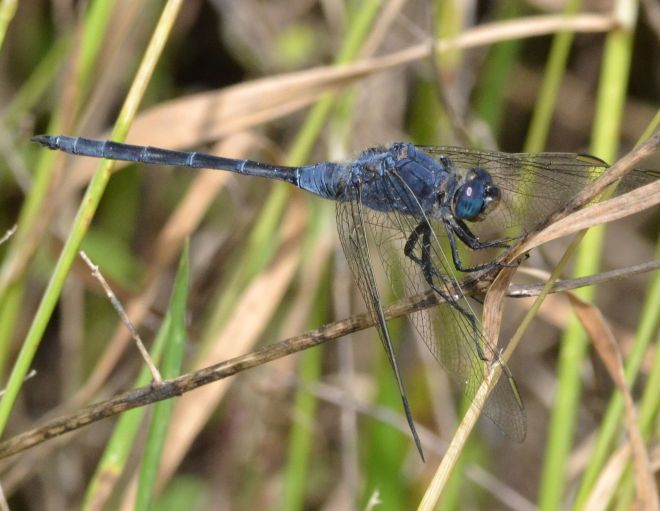
On 4th we visited Lago Baratz in the north-west corner of Sardinia, the island’s only natural fresh-water lake. For me this was the outstanding location of the tour, as the lakeside vegetation simply teemed with dragonflies whose exuvia littered the reed stems. There were thousands of Black-tailed Skimmer here, and fairly abundant amongst those were the highly attractive Long Skimmer (pictured above and below). The males are dark-slate coloured blue with a thin cylindrical abdomen of 38-44mm that is bulbous in segments 1 and 2. In mature males the abdomen can appear almost black, while immature males have an olive-yellow ground colour that turns gradually blue. The pale yellow females were more difficult both to locate and take pictures of.

Banded Groundling is another abundant and widespread African dragonfly that has colonised Sardinia and parts of Iberia very locally in recent decades. As the name suggests this species prefers to fly low over and to perch on bare ground where it is nicely camouflaged. They are often found around grazing animals and may even follow humans to catch disturbed smaller insects. The tour itinerary said “hundreds would be flying as we walked along, making the ground appear to shimmer beneath our feet”, which was something of an exaggeration. In the event we found rather more modest numbers first at Lago del Cuga in north-west Sarninia on 5th, then subsequently at various locations further south.

At emergence both genders are yellowish and lack wing-bands that develop gradually in extent and intensity. The male’s body and bands eventually become black, while females become brownish with less distinct brown bands. The twin-coloured cream and brown pterostigma are common to all forms and life stages. I had observed this species once previously in Morocco but had not come across the immature form (below, right) before. As with Long Skimmer, mature females were more difficult to locate and I only gained one poor shot of the latter.

Two more species self-found before in Portugal and Morocco also featured prominently on this trip. I had been delighted by the highly attractive Violet Dropwing upon first encountering it in the Algarve in 2014, and gained more good quality images this time around. Males are a small, pink and purple dragonfly with striking amber wing bases and veining, while the deep yellow females are similarly pleasing on the eye. Having expanded their range out of Africa since the 1970s, much of the northern Mediterranean margin has now been colonised. They tend to perch prominently and in one place I found male, female and immature individuals on the same shrub for comparison.

Broad Scarlet, also known as Scarlet Darter, was one of the week’s more frequent sightings wherever we went. Once common only in the Mediterranean region, the robust and aggressive, all-red males are becoming recorded ever more frequently further north. This species is also common and widespread throughout Africa and in western Asia. Young males and females are brown-yellow with pale stripes on the thorax and blackish lines on the abdomen. This species often makes a striking picture, but especially so against the resplendent swaying grass-heads of Lago Baratz (below).

broad scarlet.1807 lago baratz

Broad Scarlet (above and below)

As anywhere in the Mediterranean, Red-veined Darter was also encountered fairly regularly. This small red dragonfly is common and widespread across southern Europe and North Africa, though more sporadic further north including Great Britain. I should also mention Southern Darter, a new species for me that is quite difficult to distinguish from the more abundant Common Darter. Our tour leader Nicola Scatassi assured me the individual he is holding in the bottom right picture (below) is one. I can assure anyone who might be opposed to netting insects that none of the specimens he presented to the group in this way were injured. Southern Darter were called from time to time, but I probably paid insufficient attention to that particular lifer on the trip.

Red-veined, Southern and Common Darters (above and below)

The dragonfly list for the trip was completed by two medium-sized blue species that are familiar at home: Black-tailed and Keeled Skimmer. The first of those were plentiful in most places we went, while the latter were found first at Su Baione then at other locations in the south of the island. I always find the yellow and black newly emerged BTS especially attractive and photogenic and at Lago Baratz that was no exception.

Damselflies

Fortunately the trip’s damselfly content added a bit more in the new and different sense, with five life list additions. The most satisfying of these were two new Spreadwings, or Emeralds as they are known in Great Britain. The first, Dark Spreadwing is a Sardinia speciality and our tour was timed to coincide with their limited flight season there. This species is also highly localised across southern Europe from the Iberian peninsula to Turkey.

On our first day, 3rd we took a ferry to the island of Asinara off the north-west tip of Sardinia. Once a penal colony in centuries past, this place is now a national nature reserve and several local companies operate 4×4 tours there. It didn’t take long to find Dark Spreadwings that were active at the first brackish habitat we stopped at. I found their two-tone blue head and thorax and generally dark and metallic colouring very attractive, and the notably large and dark pterostigma are quite a striking diagnostic. More were found at a site near Cagliari in the south of the island on 8th.

I was also pleased to catch up with Migrant Spreadwing on this trip, that in Great Britain is known as Southern Emerald. At home I believe this rather pale-toned damsel has since 2002 occurred only at certain sites in Kent known to local odo royalty, hence my relief at having now observed it abroad. MS has increased dramatically in northern Europe since the mid-1990s, and also occurs eastwards as far as Mongolia. The yellow jowls, wide antehumeral stripes and bi-coloured pterostigma are all diagnostic. The pictures below were taken near Su Baione.

The commonest damselfly in Sardinia appeared to be Island Bluetail that we came across almost everywhere we went. This species is closely related to the Common Bluetail that is abundant in Great Britain, but has always a bright green face and thorax and a particularly vivid blue segment 8. IB is endemic to the Tyrrhenian islands, Sicily and Malta where it replaces CB in standing and running waters with rich vegetation.

Two more new (for me) blue damselflies were observed in various places. Dainty Bluet is rather localised throughout southern Europe but is expanding northwards, inhabiting slow-flowing waters with rich vegetation. We first found them on Asinara and only occasionally thereafter. The aptly named Blue-eye is a southern species that can be abundant in the Mediterranean region. The slender males have a diagnostic goblet marking on segment 2 and just look at those big blue eyes. These were seen at a number of locations throughout the trip, often perching horizontally on emergent stakes above the water’s surface.

Last but by no means least were the dark, metallic Copper Demoiselle that were observed at a number of sites in central and southern areas. This common larger damselfly occurs only around the western Mediterranean and north-west Africa. Disappointingly all those recorded were of the same blue form that I had seen previously in Portugal, whereas I had been hoping for the beautiful deep copper-red form that gives the species it’s name.

The lingering sentiment from this trip, with so few lifers gained is one of anti-climax. Sardinia on this occasion at least was not the dragonfly hunting mecca of its billing. It is said to have been the wettest spring in Italy for many years, which could have had some bearing on the dearth of exotics. I am not so sure of that, although much of the island remains unexplored and under-recorded in odonata terms. The most sought African species might perhaps have been hiding out there somewhere, but I will never know and feel little inclination to return.