A newcomer’s impressions of southern Florida 4 – Gulf Coast and Corkscrew Swamp Sanctuary: 20th – 23rd Jan

On my first day in Fort Myers I visited Sanibel Island that lay conveniently close to my hotel. This is clearly a popular weekend playground, chock full of people and cars, so much so that traffic marshals were out directing things at busy road junctions and shopping centres. But there is a relative oasis amidst all the human activity that offered up another feast of Florida wading birds and now I effectively completed my set.

On the north shore of the island lies the J D Darling National Wildlife Refuge (see here), that is administered by the US Fish & Wildlife Service. This is a large wetland site with a five-mile, one-way wildlife drive ($5 /day) offering views over several inshore lagoons. I was moving in convoy with many other vehicles the whole time, which was a novel mode of birding. At intervals whenever a birdy area came into view vehicles would all pull over and disgorge their occupants to jostle and chatter some more. It had to be tolerated.

The first wading bird I noticed was at last a confirmed Reddish Egret (above) for the trip, that once seen as I had expected was quite different from anything else recorded previously. This instantly became my favourite Florida heron, having a kind of dancing jizz as it ran through the water and often going into the posture of shading the water with its wings held aloft.

This was quickly followed by close encounters with each of the Little Blue and Tricolored Heron (pictured above) that I had been confusing Reddish Egret with up until now. A few Yellow-crowned Night Heron (below) soon followed, being new here and so the only herons I missed on the trip were the two Bitterns, American and Least. YCNH was a welcome life list addition since it is found only in the Americas, while I have previously recorded Black-crowned at home and in various countries of southern Europe.

I had had to be patient to gain publishable pictures of the exotically plumaged Roseate Spoonbill on this trip, and now at this site there were two good opportunities. Having suffered drastic declines due to plumes hunting in times past, this unmistakeable wading bird now breeds in several large Florida Bay colonies. The light pink wings and backs of immature birds deepen gradually over three years, then the much richer-toned adults display an orange tail, bright red rump, shoulders and chest patch, and black skin on the neck. These winter plumage birds (below) were active in rather contrasty light but were still a joy to behold.

Most of the ducks were Blue-winged Teal (below, left) with some Lesser Scaup, and there were several Pied-billed Grebe (right) sightings. The third of those is a widespread water bird in Florida and I found them at several sites. A large group of American White Pelican (bottom) stood out at one stopping place, all sleeping or preening and presenting an untidy jumble of limbs and bills in the same way that Flamingos do.


Just as I was starting to feel hungry shorebirds began to appear rather distantly. So after a sandwich break I went back and drove round again with those in mind. The commonest again was Willet, with Dowitchers mixed in that American birders confirmed were Short-billed. Other shorebirds seen were all the same species we get on our side of the pond.

Also at this location, the day’s second photogenic group of Roseate Spoonbill resembled a cast of backstage ballerinas getting ready in the dressing room (below). The pale pink and fluffy juvenile (bottom row) looked especially charming in its own particular tutu. Musing, I hoped the sleeping birds might wake up  before the performance begins.

On the next two afternoons I visited the National Audubon Society’s Corkscrew Swamp Sanctuary (see here) about an hour’s drive to the south-east. This preserves the largest remaining Bald Cypress forest in North America, having been saved from the logging trade that removed most of this habitat from Florida in times past. A 2½ mile boardwalk snakes its way through various mostly swamp habitats in which small birds were generally difficult to identify, as in the Keys and Everglades.

Red-shouldered Hawk (below, centre) are resident and announced themselves raucously at intervals, as did equally loud though considerably smaller Carolina Wren. The chuckling calls of Red-bellied Woodpecker, (below, right) the eastern US’ most common of the genus, issued from all around as I progressed. On occasion the louder drumming of Pileated Woodpecker (below, left) would pre-announce the appearance of these large black and red peckers that go by the affectionate name of “Woodies” after the cartoon character.

A lot of small passerines would move through at intervals, though due to my unfamiliarity with species and calls these were always difficult to distinguish from one another. Some that I did recognise were more Yellow-rumped, Pine and Black and White Warblers; Gray Catbird, Blue-gray Gnatcatcher, and most notably Summer Tanager that as it’s name suggests is a scarce sighting for Florida in winter. Great Crested Flycatcher (below, centre), being a widespread and common woodland resident in Florida, was a bird I came across many times on this trip.

This was a gem of a place in terms of habitat but ultimately the experience involved too much neck craning and unknowledgeable company to ultimately be satisfying. A few different snakes were listed on the sightings boards but the only one I actually saw here was Banded Water Snake, (pictured below) an inhabitant of freshwater habitats that is endemic to the central and south-eastern US. Though non-venomous this reptile is said to have a prickly disposition, and releases a foul smelling musk when threatened, but I didn’t get that close to find out.

My final image from this fascinating though rather too busy site is of an Anhinga nest (above) upon which a scope was trained at one point along the boardwalk. January is very early in the season for breeding to be taking place and so this attraction was manned by volunteers and a popular draw with passers by. Enough said.

Now, having done justice to wading birds but been so often frustrated by passerines, I needed to pay some attention to shorebirds. First light on 22nd found me at Bunche Beach Preserve on the landward side of the Sanibel causeway, that is said to be one of the better shorebird sites on this coast. There is a beach car park ($2 /hour) so it is possible to walk straight onto the exposed flats. It seemed like the wild and unspoilt end of the local beach district with off white sand that is characteristic of the region and an abundant litter of sea shells.

Here I quickly identified Semipalmated Plover and Wilson’s Plover (both above), that are like Ringed Plover with yellow / orange and dull pinkish legs respectively, and the latter has a thick black bill. Both are lifers with the first being especially pleasing since I didn’t bother to go for one that turned up on the Sussex coast a few years back, a decision I would not make now. Semipalmated is the most numerous small Plover of eastern North America, being the counterpart of Palearctic Ringed Plover.

DSC_0252_01

Western Sandpiper (central bird) amongst Sanderling (record shot)

A third lifer I had hoped to observe here and now found was Western Sandpiper (above), another important one since it is a fairly regularly occurring autumn vagrant in Britain that I had yet to record. These were often running around amongst Dunlin and Sanderling, emphasising just how small they are. All three of these life list additions are regular at the site.

Everywhere else I went further south in Fort Myers Beach it was developed holiday resorts, but I did see the trip’s only Bald Eagle flying over Hickory Island and got close to some more fearless Western Willet (below). It would hardly do to have come to the United States of America and not seen the former. The previously conspecific Eastern and Western Willet were split recently. The first of those is strictly coastal and winters in South America, being replaced in Florida by the inland breeding Western counterpart.

DSC_0347

Windswept Western Willet

A day later I visited Tiger Tail Beach Preserve on a third local playground, Marco Island. This has the reputation for being one of the best sites for viewing shorebirds on the entire Gulf Coast. After a tedious and congested drive out my spirits initially sank upon pulling into the almost full parking lot ($8 / day) of another public park. But boundless goodies were in store here and this was possibly the best single day of the entire trip.

The site has a long lagoon lying between an inner beach and an outer sand spit that runs to the north. The quick way out to the birding area is by wading through a shallow part of the lagoon, but I wasn’t dressed for that and so walked the long way around. On the inner beach I quickly began to see the three new shorebirds from a day earlier and also a first Least Sandpiper (above, left) for this trip, the last-named being a bird I have recorded twice previously at home.

These birds all seemed unphased by my presence, letting me walk amongst them with the camera, but this is a very popular beach area so they must be used to people. When I eventually reached the birding area on the far side of the lagoon things just got better and better and I ended up staying for about five hours. Semipalmated Plover and Short-billed Dowitcher were present in large numbers, putting into perspective the stir that occurs when just one of either turns up at home with rarity status.

Now there were two must-see shorebirds for this part of the world still to locate. Piping and Snowy Plover are both uncommon and localised in the region, though the latter is a resident along the Florida Gulf Coast. The world populations of these two lifers are just 10 and 25k respectively. They are typically encountered on open, sandy beaches such as this. Eventually there one of them was feeding busily along the lagoon edge, a dainty and diminutive Piping Plover (below, right) looking splendid in the midday sunshine.

On the return walk I came across a close group of eight Short-billed Dowitcher (below), the latter being a bird I had recorded just once previously in Great Britain. It was that good. This experience became a roll call of Nearctic shorebirds twitched at home in recent years, plus a few new species as well, which was exactly what I had hoped for during this trip. All the shorebirds in this post are pictured in adult winter plumage.

When I got back round to the inner beach, mid afternoon more Western Sandpiper (below, right) had joined the small shorebirds observed upon setting out earlier. It was good to get so close to Least Sandpiper (left), marginally the world’s smallest shorebird, here. Finally the easily distinguished Wilson’s Plover (centre) stood out as before by their impressive bills.

This whole exercise was very educational in terms of familiarising myself with numbers of Nearctic shorebirds in their own region. At home I would mostly have relied on other birders to point out the single vagrants being twitched, that is not so satisfying. What of other birds on Marco Island? All the while Brown Pelican fished the lagoon, Royal Tern were moving up and down offshore and Ring-billed Gull (below) loitered on the beach, but unfortunately no Magnificent Frigatebirds were passing by.

DSC_0333

“Gosport? Are you kidding me buddy?” … “Say fella, ain’t that some kinda English hell town?”

The site is also a hotspot for Reddish Egret and on the walk back I enjoyed a picture session with one that let me walk right up to it. This remains my favourite Florida wading bird. I just love their fluffiness, rakish demeanour and dancing jizz. And thus the post ends as it began with a second collage of this wonderful bird.

My spirit was lifted and my heart gladdened in this superb place. I say that because it was just so good to be approaching birds on foot that could be properly observed and photographed, without having to crane my neck, think about passing traffic or being jostled on boardwalks. Outside of the national parks it seems there is little walkable countryside in which to lose myself in Florida; more a flat, uninteresting landscape upon which trespass is not tolerated. Hence birding means being channelled into public facilities, typically with over-peopled boardwalks and trails. At least on this day Tiger Tail beach was one location where the right sort of balance could be achieved.

A newcomer’s impressions of southern Florida 3: Big Cypress National Preserve – 19th Jan

On Day 12 (19th) I headed back up the Miami Turnpike from Homestead. This giant eyesore of a toll road proclaims itself as “The Less Stressway” which it could be were it not for more or less constant construction works along it’s length. But after just one wrong turn into the Miami rush hour, though without actually getting lost, I found myself driving west along the US-41 road to Fort Myers, my base for the second phase of this trip.

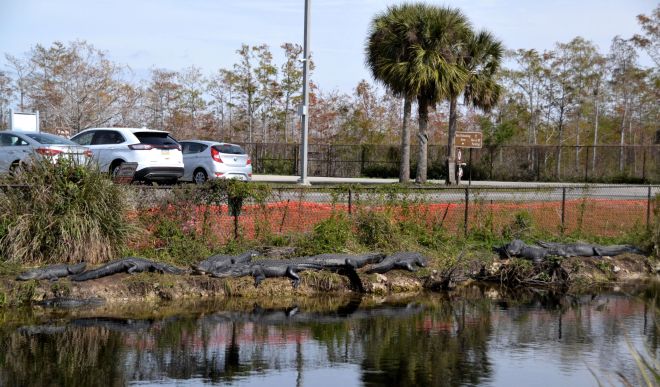
This road is the Tamiami Trail of birding legend, so called because it was built to connect Tampa Bay and Miami in 1928. The first part of US-41 skirts the northern edge of the Everglades. Access here is only possible by boat and there are numerous privately-owned roadside facilities offering air boat rides to tourists, and commercial “wildlife parks” guaranteeing Gators. Whilst I have no experience of air boats, rushing around in a noisy boat full of people does not suggest itself as an especially effective way of observing birds. And there was no need to pay to see semi-captive Alligators along this route where they more than matched the expected earlier scenario at Park Royal.

DSC_0163

Drive-past Alligators galore along the Tamiami Trail

So I drove stoically onward, also ignoring Shark Valley visitor centre that is administered by the National Parks Service. This location has the reputation for offering close encounters with the wading birds I wished to experience, but in the ambience of an open air zoo. I have read that on busy days it may be necessary to park a mile away and walk. Photographers might no doubt enjoy this, but for myself as a birder who takes pictures there would be plenty of opportunity to observe and record more naturally occurring wildlife further along the trail.

Just past Shark Valley I noted a first large concentration of Herons, around a pond by Bridge 512-A. For the first time on this trip the mix there included Black-crowned Night Heron. But this encounter, that surpassed anything experienced in the Everglades was a mere foretaste. Shortly afterwards the Tamiami Trail entered a second national park, the Big Cypress National Preserve. Around 10 miles on is sited the Oasis Visitor Centre, and at the western edge some 20 miles (approx) further still the Big Cypress Swamp Welcome Centre.

What transpired here was possibly the best wildlife spectacle I have ever witnessed. An overgrown canal that runs along the north side of the road, and the wall of vegetation behind it, just teems with Herons and other wading birds, Anhingas and dozing Alligators. Most of the large water birds were in there if I looked hard enough. On this day they included Great and Snowy Egrets, Great and Little Blue Herons, Tricolored Heron, Green Heron, White Ibis, Wood Stork, Roseate Spoonbill and the aforementioned Night Heron.

So this at last was a realisation of the ambition that brought me to Florida, and dwarfed anything experienced in the Everglades. If these birds are in decline there they are certainly thriving in Big Cypress. Numbers of Anhinga also put to shame the trail of the same name at Park Royal in the Everglades. This brown-necked female (below) was engaged in an exercise routine while drying her wings and practising her poses, as all Anhingas do.

This slideshow requires JavaScript.

I got into a routine of spotting a required or photogenic bird then doing a U-turn, parking on the opposite grass verge and seeing how close I could get. I was probably the only person on the trail who was behaving in this way, American motorists striking me as above averagely safety conscious. Perhaps I got spoilt in my previous wintering ground of Portugal, where mine was often the only vehicle on the road in wilder places.

Little Blue Heron and Tricolored Heron (above) soon took their places in the much desired celebration of Florida wading birds presented here, along with more White Ibis (below, left). Most of the time the birds co-operated, the exception being unrelated Belted Kingfisher that throughout this trip would always see me coming and fly off. It took until my return drive to Miami International Airport on 26th to secure the image below right.

One by one I was gaining close up picture sessions with all my key Florida birds. Indeed I was like a child in a sweet shop! The star performers this time were perhaps Wood Stork and Green Heron, though Roseate Spoonbill had to wait for the next post. The picture below, right was taken at Oasis visitor centre, the first of three good opportunities with that smallest of the Herons on this day.

There are several stopping places in Big Cypress, all administered by the National Parks Service. They typically had boardwalks from which it was possible to observe everything over again, away from passing traffic. And these facilities were where other visitors would stop. The most interesting of these locations was Kirby Shorter Roadside Park, where the day’s second Green Heron session produced these images (below).

At Kirby Shorter a half-mile long boardwalk leads first through dwarf Cypress forest and then swamp forest out to what is described as a Gator hole. The information boards here explain such depressions are actually excavated by the Alligators but my immediate impression was in that case it must have been a lot of work for those reptiles. This was a beautiful spot that I thought would repay inspection for small birds had I had more time in which to look. The image below, captured at the next site west, conveys the quality of encounter to be enjoyed here.

DSC_0395

Green Heron at H P Williams roadside park

As the birds were plentiful, so too were the Alligators. At Oasis I counted 42 of various sizes basking below a boardwalk along its length. Then I kept seeing the big reptiles along the canal and wherever I stopped to photograph the seemingly unconcerned birds. Here (below) are some of my better roadside pictures.

american alligator.1841 big cypress

American Alligator

Big Cypress owes its name to the hundreds of thousands acres of Cypress trees within its boundaries. The National Preserve was created by Congress in 1974 to protect the natural flow of fresh water through southern Florida from this largely inaccessible 725,566 acre swamp into the Everglades and on to the Gulf of Mexico. This followed the overthrow of a major airport proposal that would have had devastating consequences for the ecosystems concerned. The whole area has since remained true wilderness and is one of the most amazing, evocative and wildlife rich places I have ever visited.

Such a pity then that on getting back to “civilisation” I spent a wearing two hours moving slowly through Friday rush hour traffic along the US-41 into Fort Myers. Everything is traffic signal controlled here and they always seem to turn red against the main road and give priority to the cross routes. At journey’s end my accommodation was at the other end of the scale from the dingy motel that had been my base in Homestead, and six more days lay ahead.

A newcomer’s impressions of southern Florida 2 – The Everglades: 11 – 18th Jan

The Everglades National Park, established in 1947, is described as one of the world’s most unique and diverse ecosystems. Though the park has few speciality birds it is one of the state’s most visited birding locations. My preconception like many other people’s associated it with Florida’s wading birds and large reptiles. The habitat here and the wildlife it supports depends on the natural flow of fresh water that over the last 200 years has been impacted first by detrimental extraction schemes then more recently restoration projects. Various complex biodiversity issues remain to be resolved, that having visited and learned about I now have a better understanding of. And hence my perhaps uninformed prior vision has been more realistically altered.

On 11th, having spent the previous two days driving up and down The Keys in vehicle convoys, I opted to start exploring the various access points along the one metalled road into this vast wilderness. Much of the Everglades is accessible only by boat or canoe, then back country trails and camp sites suited only to the experienced adventurer. That was not for me. A national park permit here costs $25 for seven days and so I sought value for it on five of them by visiting most of the designated public access points and some hiking trails.

The SR-9336 road from my strategic junction in Homestead for the first 11 miles crosses farmland. There hawks, diminutive American Kestrel and gregarious Boat-tailed Grackle (above, right) the Florida equivalent of Jackdaw were noticeable perched on overhead wires. Of the two raptors pictured above, Broad-winged Hawk (left) winters only in the Everglades area in small numbers, so this was a good sighting. Red-shouldered Hawk (centre) was seen a number of times through this trip.

Once inside the park boundary the same flat terrain of Sawgrass prairie broken up by stands of Slash Pine, with islands or “hammocks” of hardwood woodland here and there, stretched as far as the eye could see on either side. A hammock is a grove of hardwood trees 90% of which are of tropical origin, a unique plant community found only in southern Florida and The Keys. More than 120 species of tree, shrub and other plants can be found in this habitat, many of which are listed as endangered or threatened with extinction, and a single hammock can contain 80 species. During my visits a lot of surface water was visible at the road side being farmed by numbers of Great and Snowy Egret, but this is by no means typical of all years.
DSC_0420

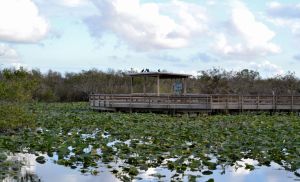
Anhinga boardwalk trail at Park Royal

My first stop was Park Royal, four miles inside the entry point, where there is a visitor centre and famous boardwalk, the “Anhinga Trail” as well as a second woodland trail. A few exotic and beautiful Anhinga were posing nicely at the trail head. My Florida reference guide to birds (see here) describes this graceful bird rather aptly as being “symbolic of the mysterious Spanish moss-draped interior of the deep south and Florida”. The Anhinga were certainly a magical sight as they stretched out their wings to dry in classic pose, while extending and withdrawing their snake-like necks at a succession of sometimes bizarre angles. The head and neck is black in males and tan in females, while juveniles appear mostly brown.

Shortly afterwards I came upon the trip’s first American Alligator, that was quickly followed by another. Some Red-winged Blackbird moved through and the US species of Purple Gallinule (below, top right) were splashing about on the lily pads. But things could only be described as disappointingly quiet. Another birder told me the wintering Warblers here were mostly Palm Warbler (bottom row, below), Florida’s next most abundant after Yellow-rumped.

This trail has the reputation for allowing close up contact with large concentrations of “wading birds” as Herons, Storks and Ibises are termed in the US, as well as Alligators but little of this was happening. Later in the day I learned water levels are unusually high this winter so the Alligators have spread out through the park. In more normal times there can be hundreds of them piled up like logs at Park Royal where there is a permanent water flow. I immediately thought the same would be true for birds.

By 11am three school bus loads had arrived so I went off to look for quiet places in which to locate insects instead. My first finds were some medium-sized yellow butterflies and a Scarlet Skimmer dragonfly, both along a nearby road to the historic Nike missile site. The second of those insects has been introduced to Florida from East and South-east Asia.

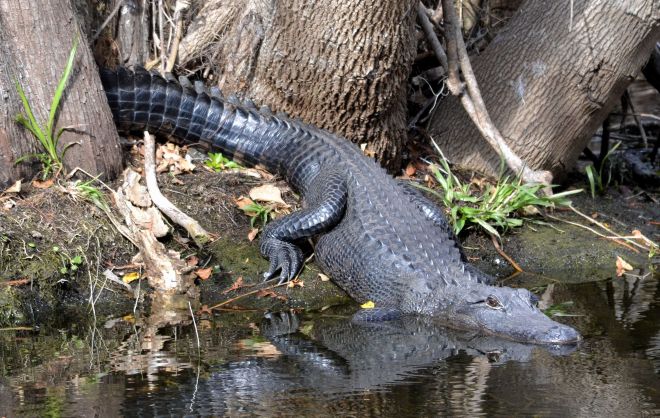
I was trying to photograph these when a passing jogger called out: “There’s a big Gator at the next water hole”. It seemed rude not to take a look and there by the roadside was the morning’s fourth and most impressive of those beasts. The official advice is not to approach within five metres but of course everyone walks right up to them. There was a kind of primeval thrill in quietly getting so close to this one as it lay slumbering in the morning sunshine. But touching or otherwise disturbing the creature was out of the question and in any case it is illegal to harass or feed Alligators. These pictures (below) were all taken from the same distance using my telephoto lens, and the subject didn’t stir.

After that I drove on three more miles to Big Pine campground, where there is a sleepy looking lake. Walking once around the water’s edge I found a lot of my must see dragonfly for the trip, Halloween Pennant. There are several odonata with patterned wings in the region and this is the most complex and hence beautiful of them. That was why I so wanted to see them in Florida, as well as for the sheer American-ness of the name. This species (pictured below) is native to eastern North America from Florida to Ontario, and in the southern part of its range flies all year round in wet habitats.

To end the day I went back to Anhinga hoping some wading birds might have flown in to roost, but saw all the same things over again. A number of Double-crested Cormorant were perched on the structure of a shelter at the centre of the boardwalk. This bird could only be described as super-abundant wherever I went on the trip. Florida’s resident breeding population is swelled by vast numbers of birds from further north in winter and they must be here in their millions. By comparison with the Eurasian Great Cormorant that does also occur in North America, Double-crested is smaller with a more refined bill and orange lores in place of Great’s yellow chin patch and white throat. This juvenile (below) did indeed allow a very close approach and even I can be deadly at that range.

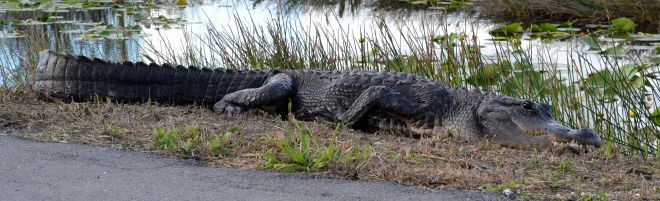
The morning’s first Alligator was still lying in exactly the same place at day’s end, while another big one that I christened “Smiler” was stretched out right beside the trail path and so drew a scrum of curious tourists. At one stage it went into the threat posture in reaction to all the attention, and from my this time safer range I counselled the mobile phone pointers to withdraw a little. The pictures below were all taken with a 300mm telephoto lens whilst keeping the recommended distance. What a beauty!
american alligator.1804 everglades park royal

The Alligator subsequently known as “Smiler”

And then came the smile (below) …

This slideshow requires JavaScript.

There are several stopping places along the 38 miles of road inside the park, all maintained by the National Parks Service. Through three more visits in as many days I gradually worked my way along these but had to wait for a reasonable showing of wading birds. Two short boardwalk trails at Mahogany Hammock (20 miles inside) and West Lake (31 miles) contained various passerines, but as in The Keys I didn’t get over involved to avoid frustration. I nonetheless invested $20 in a proper and portable field guide, Sibley Birds East the North American equivalent of Collins, to assist in my identification efforts.

Above and below are some of the easier passerines in these places to put names to. I observed Black and White Warbler in a number of locations through this trip but they were always difficult to capture as the pictures convey. I had become sure of Palm Warbler IDs by now, though why one appears to be in summer plumage I will not attempt to analyse. There are different morphs and regional populations that were all too difficult to get my head around as a first time observer, and movements might have been complicated by an unusual cold snap further north during my time in Florida.

The “Aaawwww” award for cuteness definitely goes to the rather unflatteringly named Blue and Gray Gnatcatcher (above, left), a tiny bird I also recognised on other occasions during this trip. On a different note the mangrove woodland at West Lake was draped everywhere with hundreds of thousands of the pictured spiders (above, right). For some reason these didn’t seem to spin their omnipresent webs across the boardwalk which was a relief as I didn’t know whether they were poisonous or not. Before going back I did check they were not Black Widow.

High over these boardwalks came often the sight and sound of resident Red-bellied Woodpecker. From the moment I viewed a small cluster at point blank range in a suburban garden on wandering out from my airport hotel the morning after arrival, this became one of my favourite birds of the trip. It is the commonest Woodpecker in the eastern US and they are absolute stunners. Had I not been so sensitive over carrying optics during the local school run on that first morning I might have captured equally stunning images. The following are the most interesting and unfortunately the sharpest I managed subsequently.

I am fully aware that most of the birds I am presenting in these posts are commonplace in the US, but it was all new to me so that is OK. And it strikes me as being much simpler to puzzle over them this way than to hack out to the remotest Scottish islands or clamber around jungle clad valley sides in the Azores to tick just one at a time closer to home. There’s nothing wrong with all that of course, I’m just stating a personal preference.

On 13th when I walked two hiking trails near the far end of the road butterflies and dragonflies reclaimed the main billing. The first location, the Snake Bight Trail is said to be the best though also biting buggiest in the park. Ahead of this trip I had bought a pair of very lightweight trousers, and whilst here also invested in tropical grade, UV-proof, long-sleeved shirts. That clothing combination proved to be very cool and spraying hands and neck with repellent kept the discomfort to a minimum. But on one occasion when I forgot to protect my neck the biters soon got inside my clothing by that route.

January is the Mosquito low season but by spring time it is said to be misery to walk in places such as this, though full Mosquito-proof suits are also available from the visitor centre shops. As a further word of caution the trail distances stated on the information boards are somewhat understated. Snake Bight was clearly much longer than 1.8 miles and Bear Lake was never ending until the hurricane damage along it eventually defeated me.

It seemed a fairly limited sample of multi-brooded butterflies is on the wing in January, as in southern Europe. Throughout the trip I came across mainly the same species including Gulf Fritillary and Buckeye (both pictured below), over and again. These medium sized Nymphalidae were both present in quantity along the Snake Bight and Bear Lake trails. The former has big populations in Florida and Texas and also occurs southward through Mexico, Central America and the West Indies to South America. Buckeye, named for its conspicuous eyespots, is another common southern US and Mexican resident and significant numbers migrate into Florida for the winter months.

I was pleased to also cross paths at Snake Bight with my must see, Zebra Longwing that in 1996 was designated the official state butterfly of Florida. They also occur southward through the rest of the Americas and the Caribbean. This unmistakeable insect had a very light and fluttery flight pattern and seemed almost impossible to lose for long whenever I became distracted by other things.

The range of dragonflies observed through the trip was similarly narrow. Great Pondhawk (below, left) and Banded Dragonlet continued to crop up in the Everglades as they had in the Keys. What I believe are the drab-toned female Dragonlets (to be confirmed) were the most abundant species throughout the trip, ghosting about wherever dragonflies were present. The Bear Lake trail also turned up a pleasingly coloured Roseate Skimmer (below, right).

On 14th my first stop was Paurotis Pond (c25 miles inside). I had previously noted its permanent Wood Stork colony, but on this day there was at last a good concentration of large wading birds. In two hours there I also watched though distantly Roseate Spoonbill, Great and Snowy Egret, Little Blue and Tricolored Heron, White Ibis, Double-crested Cormorant and Anhinga. Some Glossy Ibis and a Belted Kingfisher flew through, Black and Turkey Vultures came and went, there was a Virginia Rail on the water and a lot of Tree Swallow over it that look more like Martins.

It being Sunday there were also some American birders around to talk to. They had mostly worked their way back from road’s end and said this was the only such gathering of birds they had seen on any of the roadside water bodies. One discussed how in his experience there has been a dramatic decline of all birds in the Everglades over the last three years.

I then moved on to Flamingo, the main visitor site at the end of the road. It was about an hour from high tide and there was a roost on the last bit of unsubmerged land. This had good numbers of American White Pelican, hundreds of Black Skimmer and Gulls, and lots of shorebirds amongst which another birder did tell me how to identify the Willet.

DSC_0402

The offshore roost from Flamingo visitor centre (above and below)

American Pelican winter in coastal Florida from December to March and breed at inland lake sites in the north central US and central Canada, Unlike the Brown Pelican they do not dive for their food but fish co-operatively, swimming in groups to round up prey. This very distinctive and ponderous species has the second largest average wingspan (3 m) of any North American bird after California Condor, and at up to 1.8 m is also the joint longest with Trumpeter Swan.

Black Skimmer are resident along all of the Florida coast, nesting from March to September in large colonies often mixed with Tern species. They are are unique amongst birds in that the lower mandible is longer than the upper to snap prey upward from the water’s surface. I was a little disappointed not to witness the skimming feeding action anywhere on this trip. The above images, as evidenced by their clarity are both outsourced © rights of owners reserved.

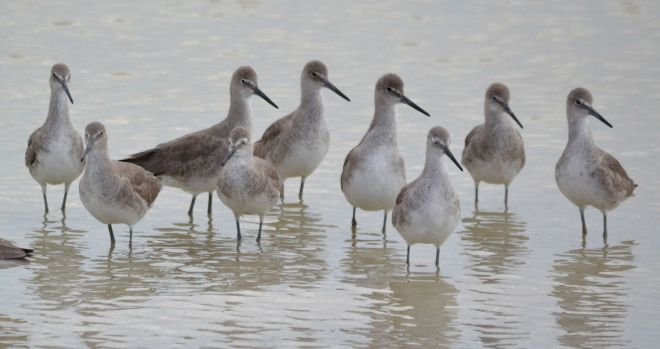
Continuing to the far end of the site, a nice flock of Western Willet with some Marbled Godwit mixed in landed on a beach and let me walk right up to them. The first of those lifers, a common taller and rather stocky wintering Florida shorebird, appears quite plain when at rest but displays striking black patches once the wings are flapped. Other noticeable characteristics were the generally greyish-brown winter plumage, stout bill and thick blue-grey legs.
DSC_0501

Western Willet (above and below)

There are two races. Many coastal eastern Willet move to Central and South American wintering grounds, being replaced in part by influxes of the inland breeding western race that is larger and longer-billed. They were certainly a frequent and quite charming sight throughout this trip. Marbled Godwit (below, left) is a less common, Whimbrel-sized species with long upturned bill, dark legs and attractive buffy colouration, barred beneath and mottled above. This was the only location in which I observed them.

On my return to the visitor centre public attention was divided between two attractions. The first was a Manatee (above right) in the water and the second an Osprey eating a fish in a tree. There are a lot of that charismatic fish Eagle in Florida and several nests around the Flamingo site. This bird (pictured below) guzzled the fish to a constant accompaniment of begging from its mate on a nest overhead, but showed no apparent inclination to share the meal. Below one or two opportunistic Snowy Egret waited for falling scraps.

This slideshow requires JavaScript.

But what of wading birds? The lady in the visitor centre agreed that improved water distribution could be affecting numbers at present but said there’s no real pattern. These birds can be at a particular pond for a few days and then disappear again. Yes the Everglades is huge, 1.5 million protected and mostly inaccessible acres, but birds are reputed to congregate at viewable sites where there is permanent water. Whatever the reason it was plain something is still very wrong in the Everglades’ ecosystem, but this day was much more like it from a birding point of view.

There are other issues impacting on the park’s bird life. I learned from two rangers who give talks on reptiles there is a huge problem with invasive introduced Burmese Python. These snakes are all descended from a few pets released in the 1980s and now number up to 200,000. They have decimated small mammal population’s, removing 97-99% of Rabbits and Racoons and are expected to turn to birds as that food supply runs out.

At the other end of the reptile scale, pretty much the only small lizard I encountered on this trip was Brown Anole (pictured below). A resident of the Bahamas and Cuba, this is another invasive and aggressive species that has been widely introduced elsewhere through shipboard transit and via the pet trade. Now the most abundant Anole over much of southern Florida, it arrived in major seaports during the 1940s and had become firmly established by 1980, inhabiting almost any inland or coastal habitat.

The lizard is capable of expanding its range very quickly and reaching high population densities, all at the expense or displacement of native species that it out-competes. This is something of a digression but further illustrates the kind of imbalances that occur when people release unwanted pets into what they think might be a nice place for them to live. The Florida Fish and Wildlife Conservation Commission lists no fewer than 40 different non-native reptiles on its website (see here).

On 16th I returned to Flamingo having acquired tide tables. First I stopped briefly at Paurotis pond again, where the Wood Stork and Roseate Spoonbill were still showing well but there were fewer other wading birds this time. In the car park there were Black and Turkey Vulture that I drove right up to and got close pictures (below) from the car window without them being at all concerned. As with Oxfordshire’s Red Kites I wonder just how so many Vultures in Florida find enough to eat. There are thousands of them everywhere, but when I occasionally passed landfill sites that did offer up one clue.

At Flamingo I engaged with a snake fancier who had found a harmless Florida Kingsnake. There is a good variety of snakes in Florida but I only saw two species on this trip, both of them being drawn to my attention by other people. This one (below) occurs widely in swamps, forests, farmland and other habitats, and like all Kingsnakes kills its prey by constriction.

The bird interest was much the same as on a day earlier but the pre-high tide Black Skimmer roost offshore (above) was very impressive. I arrived at low tide and watched the tide rising but there didn’t appear to be a marked difference between high and low. At high tide some of the seabirds would congregate in Flamingo’s marina where it was possible to get close to them.

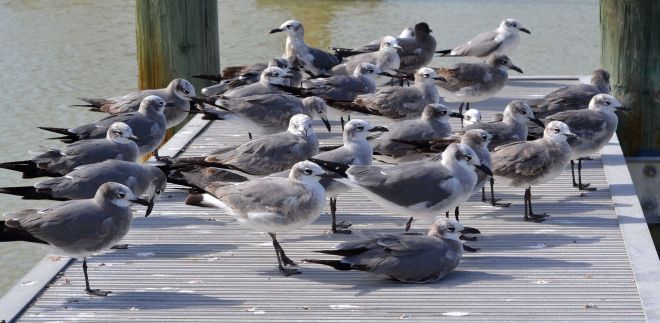
Laughing Gull (below) was my favourite Florida Larus possibly for the simple fact it was a lifer, whereas I had recorded Bonaparte’s and the always smart looking Ring-billed Gulls previously at home. This is the most frequently encountered Gull of southern salt water beaches and marshes, though less common inland, and the only one to undergo two complete moults each year. Perhaps that helps to explain the diversity of this group (below) but I am no Gull expert.
DSC_0430

Laughing Gull in various plumages (above and below)

From the visitor centre a ranger was setting off to do a talk on American Crocodiles. The Flamingo complex was created to save both these, that only occur around here in the Everglades, and the marine mammal Manatee. The latter are docile and ponderous, herbivorous creatures that grow up to 4 metres in length and can weigh as much as 590 kg. Much of their time is spent grazing or sleeping in shallow waters at depths of 1–2 metres, and they surface for air at roughly 20 minute intervals. They are a frequent sight in Flamingo’s marina. Personally I found them rather boring.

I tagged along and the ranger told me where to look for Crocodiles to one side of the marina before he started. There was a huge one lying in shade with the shadow of bridge railings across it. But after the talk I found another more photogenic individual a little further upstream and soon attracted another small crowd.

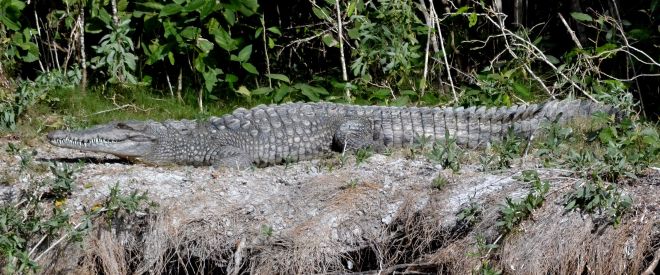
American Crocodile are salt water tolerant reptiles that require fresh water in which to lay their eggs. Hence the out flowing river at Flamingo was dammed to provide this habitat and the Crocs now thrive there. By comparison with the dark skinned, exclusively fresh water American Alligator, Crocodiles are much greyer in colouration and have a pointed not squared off snout and sharper looking more closely spaced teeth. They are by any standards imposing and magnificent looking beasts (below).
249

American Crocodile

Between the two Flamingo visits my attention was drawn to a 2017 report by the National Audubon Society (see here) that confirmed my own impressions and the view expressed by the American birder at Paurotis Pond. This cited almost a decade of below average wading bird nesting. Amongst the findings are:

  • Destroying wetlands and altering the Everglades for flood control and water supply have reduced the amount of quality foraging habitat available to wading birds.
  • Nesting of wading birds naturally fluctuates, but draining the Everglades has made it more difficult for populations to bounce back from poor nesting efforts.
  • Everglades restoration projects are not being constructed fast enough to stem the decline of key indicator species.
  • Key restoration projects must be built faster than the current schedule to benefit the Everglades before declines in wading bird populations hit an irreversible tipping point.

But I do not wish to quote selectively, as a press release by its nature must do. A PDF of the report may be downloaded by following the above link.

=======================

A short distance outside the national park entrance lies a small wildlife management area called Glenn Garrett Memorial Park (formerly Frog Pond WMA). On 17th I was going to try out the hammock trail next to Anhinga but a group of 20 people walked in ahead of me and so I beat a hasty retreat. Instead I decided to devote some time to the area between the park and my base, and so stopped at an interesting canal-side location that had been driven through on each day previously.
433

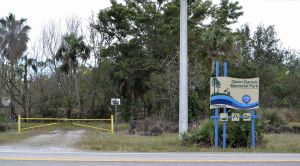
This was Glenn Garrett (above) where my attention was at once caught by two clusters of roadside butterflies. These were White Peacock and Barred Yellow that I had also encountered in several locations during the trip. The former is another Nymphalid that flies throughout the year in the US deep south, the Caribbean, Central and much of South America. It has a fast, low, erratic flight and the males are highly territorial in their behaviour, I noted a marked size variation between individuals, some of which at this site were the most attractive specimens of the trip.

Then a small group of shorebirds flew onto the roadside floods that turned out to be a Lesser Yellowlegs and four Killdeer (below, top). The latter is a common inland shorebird in the US, but this was the only place I saw them. Walking around I later put up an American Woodcock and had a photo-session with juvenile Tricolored Heron. The latter exhibits the captured plumage (below, bottom) between July and February .

The site was a partially dried out pond that had the air of a small oasis in the surrounding agricultural land. It was a gem of a place with a small variety of dragonflies including Halloween Pennant, Band-winged Dragonlet and Black Meadowhawk, as the trans-northern hemisphere Black Darter is known in North America. Other birds noted here were Yellow-rumped Warbler, Loggerhead Shrike, and White Ibis showing they can be attractive when observed in a natural setting.

I returned to spend more time here on the afternoon of the following day (18th) though didn’t find anything new. But I did enjoy a lengthy work out with a juvenile Little Blue Heron. In white plumage these are very similar to Snowy Egret but with greenish legs, a slightly thicker, bill with a pale base, and a distinctive foraging posture with neck extended forward.

I had been disappointed and frustrated in the Everglades by the lack of as good sightings of the wading birds I had most wanted to see here. But these seven days had offered up a rich variety of wildlife experiences, not least amongst them those exciting first encounters with the region’s large reptiles. Much more was still to come after I made my way on from here.
A newcomer’s impressions of Southern Florida 1 – The Keys: 9 – 13th Jan

It has been an ambition to bird the Sunshine State ever since some time in the 1990s when I watched a TV wildlife documentary about all the different Herons that are found there. So now the opportunity has arisen I have taken it with a three-week solo winter break. Since this is my first ever North American wildlife trip I came here with not much research and no particular agenda in terms of what to see. Almost everything would be new to me so everyday birds are just as interesting as scarcities and specialities. There is also some winter potential for butterflies and dragonflies, and of course Florida’s famous large reptiles to experience.

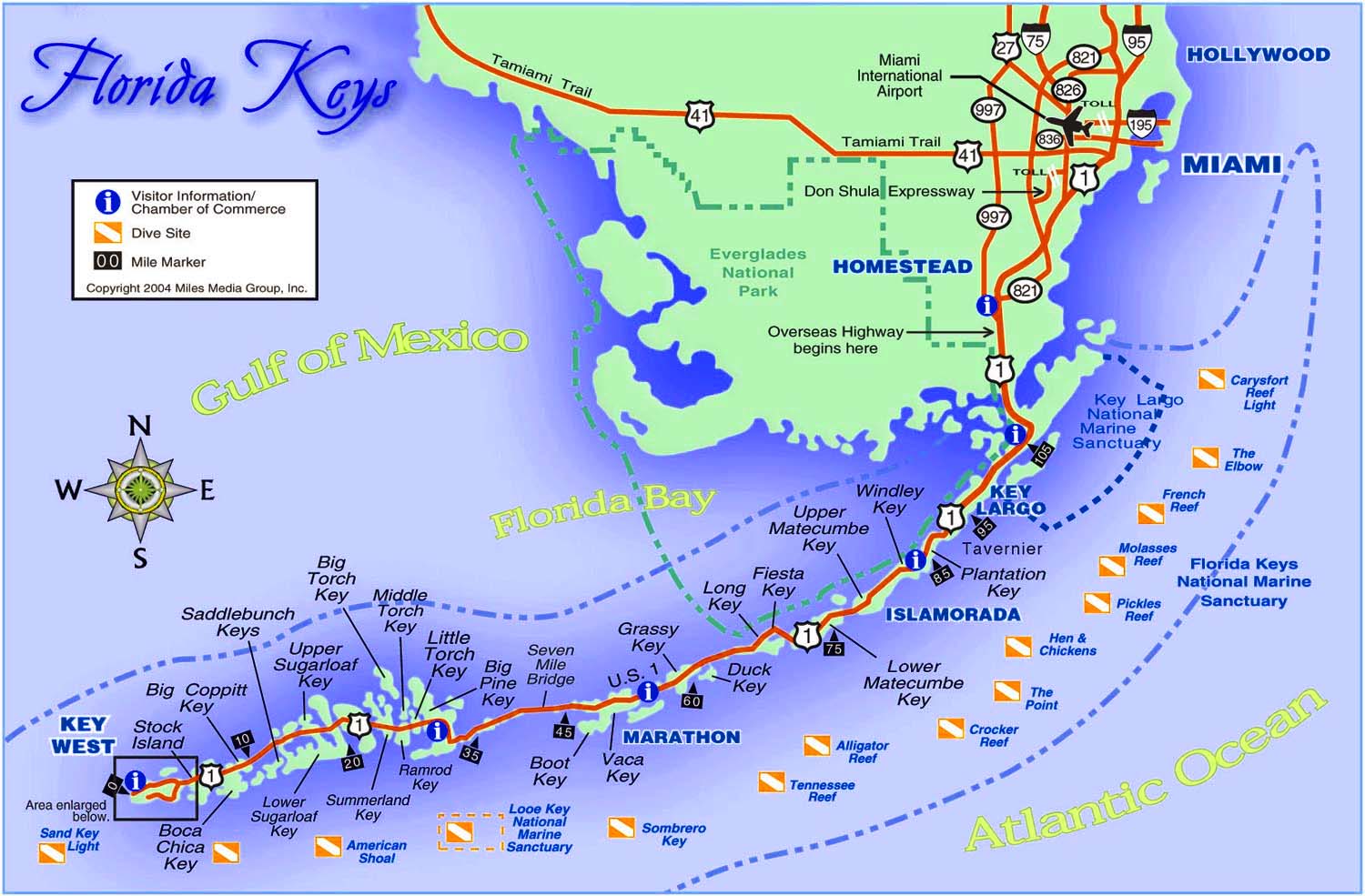
I adopted largely a site-specific approach, just seeing what might be found at each of them. To that end I did pre-research the various nature reserves and other birding places along the Florida Keys, the island chain running east to west from the southern tip of the mainland. The US-1 highway that runs through the Keys is 115 miles long with 43 bridges from Key Largo in the east to Key West at the far end.

Image result for Florida Keys

Wildlife sites in the Upper (eastern) Keys are mostly limited to State Parks (see here – same old populism). This end of the island chain is heavily developed. But extensive areas of two original habitats of tropical hammock and Mangrove forest remain and are now protected. The former comprises stands of hardwood trees with a dense under storey on higher land, usually no more than 100 metres above sea level that is firm enough to support this. The salt-tolerant Mangroves take over in tidal areas.

My base for the first part of the trip was the rather scruffy though fit for purpose Days Inn, Florida City. This large motel, currently under refurbishment lies very conveniently at the junction of the US-1 highway and the SR-9336 access road into the Everglades National Park. From here I set out south on Day 2 (9th) taking the Card Sound Road to Key Largo. Once on the island I drove on through several miles of undeveloped land collectively known as the Crocodile Lake Wildlife Management Area. The mind boggled as to what must be out there but there is no access as the outsourced image below shows.

thKEH5JME5

Crocodile Lake Wildlife Management Area

Just before the junction of this road and the US-1 lies the entrance to the elaborately named Dagny Johnson Key Largo Hammock Botanical State Park. This was the wildest of the parks I visited and is unmanned with no visitor facilities, so hence is the one I liked the best. There is a 2.5 mile figure of eight loop trail here through varied and interesting ecosystems. But the hardwood hammock habitat is very dense, with an often impenetrable tangle of shrubs and vines beneath a low canopy, and so birds are difficult to see. Neck craning is not my favourite form of birding,

The situation wasn’t helped by my unfamiliarity with a lot of the birds, and hence being reliant on getting recognisable photographs to check against a field guide. But that is why I have come to a new continent, to observe and learn. The stand-out birds at Dagny Johnson were a number of Northern Cardinal, Gray Catbird, Great-crested Flycatcher (all below) and as in most places I went subsequently wintering warblers that became rather irritating in their regularity.

I came across White Ibis for the first time here. This is a small, plain Ibis with a rather fussy and seemingly non-stop feeding action. They were a frequent sight throughout the trip in a great diversity of habitats. When encountered foraging in built-up locations I considered them a bit tramp-like and not especially attractive, though they became rather more appealing when observed in wilder settings.

Dagny Johnson is also known for it’s butterflies but conditions remained mostly overcast. So resolving to return on a sunny day I moved on after around four very enjoyable hours on site. The US-1 is a constant conveyor belt of traffic so stopping if something is spotted is not advisable. And since all the land with a water frontage is privately owned there was nowhere to watch sea birds before the next park. Most of the large fly-overs were either Brown Pelican or Turkey Vulture: there must be many thousands of each in southern Florida. The former is around 30cm shorter in stature than the White and Dalmatian Pelicans I had previously observed in northern Greece, and four plumages may be seen.

Next up came the slightly less lengthily named John Pennekamp Coral Reef State Park. This was much more of a public park than a nature reserve, with an emphasis on human activity particularly of the boatie kind. Some of the visitor facilities were still out of commission post-Hurricane Irma, as was the main nature trail. So the park was not too crowded though judging by the amount of car parking space it must be heaving in more normal times.

DSC_0463

Florida Keys’ seabirds

I nonetheless found some common Florida birds by getting into quieter areas. Brown Pelican and Double-crested Cormorant were much in evidence offshore, and one of the trip’s oft encountered Northern Mockingbird (below, bottom left) posed nicely for the camera. There were a lot of warblers here that I took to be Yellow-rumped Warbler (below, top) by their chipping calls. This is Florida’s most abundant wintering warbler between October and April, but there are various similar ones that had to be puzzled over before I became sure of the ID.

This site was also where I began to notice Great Pondhawk (pictured above, right), a widespread though not usually abundant dragonfly occurring in the southern US from Florida westward into Texas, and southward as far as Argentina. I found these very attractive with their bright green thorax and green and brown banded abdomen. After light initially catches their metallic greenness in flight they seemed to display an uncanny ability to vanish once settled, and it took a long time to do them justice with the camera. This insect was a frequent encounter throughout my first week in Florida.

On Day 3 (10th) I moved on through the Upper to the Middle Keys. The latter were more like I had hoped things would be with narrower islands and roadside stopping places from where I observed the trip’s first Laughing Gulls, as well as Bonaparte’s Gull and American Royal Tern. The first of those was an important lifer because I have rather regretted missing the last two that graced England’s shores, through not wishing to make the tedious journeys involved.

DSC_0101

Royal Tern and Laughing Gull along the Middle Keys (above) + close-ups from other sites (below)

I had seen the African race of Royal Tern once before in Morocco but here the American equivalent is commonplace. Why grind it out to Dungeness, Guernsey or worst of all the strange separate planet that is Merseyside to chance seeing these birds when there are so many of them here, all waiting to be fitted into a convivial winter break? Double-crested Cormorant adorned overhead cables in large numbers and Brown Pelican often perched on offshore or bridge structures as I continued westward.

The latter were simply everywhere. Brown Pelican are common along all parts of the southern Florida coastline, and more widely from Nova Scotia to the Amazon and along pretty much the length of the Pacific coast of the Americas. These birds were often seen flying in twos or threes or loose V formations to and from feeding grounds where they splash dive for fish. In the breeding season they nest typically in colonies of several hundred individuals in secluded areas and on offshore islands.

Two more state parks awaited my inspection, both being neither as wild as Dagny Johnson or as commercialised as John Pennekamp. Both were also functioning only partially following the devastation of 2017’s hurricane season. At Long Key State Park (brevity at last) on the island of the same name, the Golden Orb Trail leads out through various plant communities to the shoreline. There in a secluded cove I enjoyed photo sessions with the trip’s first close Great Blue Heron and a large white heron with a bi-coloured pink and grey bill, the latter being an adult white-morph Reddish Egret (below left).

By way of something a little different I also enjoyed watching a Hermit Crab (pictured below) going about its business. I have often seen these creatures in wildlife documentaries and so was intrigued by this real life encounter. Outside of their second hand sea shells the soft, spirally curved abdomen of these crustaceans is vulnerable and the tip is adapted to clasp tightly to the inside. As they grow competition for suitable larger homes can be fierce and rivals may fight to the death. There are around 1100 different species in the world, most of which are nocturnal so I was possibly lucky to stumble upon this one.

At the fourth site, Curry Hammock State Park two quite different birds each allowed a very close approach. The first was a Ring-billed Gull, a Nearctic larid I have recorded twice before in England; and the second was the trip’s first Little Blue Heron that was feeding along the shoreline, largely unconcerned by my attentions.

Other state parks beyond this held little bird interest, were either closed or recovering from hurricane damage, and at one I was even discouraged from going in at the entry gate. Just occasionally I did turn off the US-1 to try to access some viewable shoreline, always without success. In one residential area I spotted an amusingly photogenic group of White Ibis perched on overhead wires, then shortly afterwards a gathering of Mourning Dove in the same pose. The latter is a common and widespread suburban and farmland bird in Florida, easily distinguished at first sight from the most abundant Eurasian Collared Dove by their long pointed tails.

Perched White Ibis (above) and Mourning Dove (below)

On day 5 (12th) I returned to Dagney Johnson hoping butterflies would be active in the sunny conditions. I did come across a spectacular Dryas Iulia (below, left), a few huge yellow Sulphurs and a Monarch – all as fly pasts – but left feeling this is most probably the lepidoptera low season in The Keys. As on my first visit birds were very difficult to observe, but ghostly Great Pondhawk were frequent once again and Band-winged Dragonlet were also flying in numbers. The latter looks a quite similar species to the African Banded Groundling that is expanding into southern Europe.

Band-winged Dragonlet was the most frequently seen species wherever I found dragonflies over the ensuing days. Though mature males (above, top right) are unmistakeable there appears to be tonal variation in females and immatures that I have not researched, and do not intend to do so yet given the limited range of Odonata observed on this first visit to the new world. The bottom row images (above) nonetheless brought out a subtlety that was pleasing to record in what I suspect by the grey eyes are immature males.

On day 8 (15th) I made the long trip along the “Overseas Highway” to the Lower Keys, beyond the Seven Mile Bridge, but didn’t find any good birding sites despite checking all the locations in my dated bird finding guide, the one by Bill Pranty (see here). An alternative site guide that I saw in some visitor centre shops was equally dated.

The US-1 follows the route of a former railway and two derelict sections of the original rail viaducts survive. One running parallel with the concrete civil engineering achievement of the modern road bridge is an impressive sight indeed, though haunting in it’s suggestiveness of times past as the outsourced images below convey.

This slideshow requires JavaScript.

The further west I went the more hurricane damage was evident. Much of it seemed organised with debris piled up by the roadside and gradually being removed, but there is clearly a lot of fly tipping going on as well as if people are taking advantage of the allowable dumping. In the wildlife management areas I visited on this day there were piles of white goods and mattresses well away from any storm damaged property. I came across one huge official dump where an apocalyptic looking mound of debris the size of a small block of flats was being loaded into a convoy of huge waiting skip trucks, presumably destined for landfill. I wanted to take pictures but doubted whether the attendant sheriff would have appreciated my stopping amongst all the trucks. The whole place is in a bit of a mess.

The recovery period that the Keys is clearly going through aside, I concluded this is not an easy place to bird in winter. There are some unique habitats but it could take a lot of time and painstaking effort to find much in them. The area comes into it’s own during passage seasons and has some notable breeding birds, but even then I suspect expert local guidance as to where to look and what might be there would be beneficial.

I was especially disappointed not to locate any concentrations of Nearctic waders, but the tide always seemed to be in and access to beaches was invariably through the private property of condominiums and resorts. Hence not all the pictures in this post were actually taken in The Keys. But I wanted to explore this chain of islands, I devoted three and a half days to doing so and now moved on.

Penduline Tit in Gloucester and some turn of year sentiments – 30th Dec

For my final twitchette of 2017 I visited neighbouring Glos to re-experience a wintering scarcity that seemingly in Oxon fears to tread. An unusually quiet December has offered little in the way of either national or local birding. But paying a visit to the city of Gloucester’s third long-staying Penduline Tit of recent winters, and my own sixth in Great Britain filled a short Saturday nicely.

A pair of these birds wintered through the first three months of 2016 at a flood alleviation site just outside Gloucester by the northern by-pass (see here). Today I drove on a further couple of miles to the A40 / A38 Tewkesbury Road junction beside which another PT had set up home for the last 15 days. The site was very easy both to find and access, and upon approach several birders were visible to the left on land below the road embankment.

plock court wetland.1701

Plock Court wetland area, Gloucester

Plock Court Wetland (SO837204) is one corner of a playing fields area that is prone to flooding in winter. So faced with the difficulty of managing this site, the local authority instead fenced it off and turned it into a small wetland nature reserve. The information board tells how Green Sandpiper and Little Egret might be seen on the two scrapes here, so the present masked bandit is probably the most notable visitor to date.

Through my two hours on site from 12:20pm the Penduline Tit, a first-winter male divided its time between feeding in the reedmace of the scrapes and resting in the roadside hedge to the rear. When in the foreground the bird was always flighty and often difficult to pinpoint. But on repairing to the hedge it would often perch quite prominently, preening and surveying its surroundings. Fortunately those present all kept to the near side of the pools, so the PT was watchable for good periods of time. Nobody chased it around and this was certainly the easiest to observe of its kind that I have encountered.

I would not describe the camera images below as photographs. Perhaps in their all too obvious imperfection they more resemble paintings. Others might say they are out of focus or full of noise. But since I am seldom likely to gain pin-sharp and perfect competition entries with my equipment I might as well do what I can in the editing suite, then be as pleased as is possible with any “creative effects”. The bottom line is that how ever these pictures might be described I rather like them just as they are.

County birding in Oxfordshire has matched the national picture in rather fizzling out again towards the end of this year. A week hence I commence the next stage of my personal development through a three week, solo winter break on a new continent North America. So today will be my last at the petrol station where I have worked part-time for the last 16 months, instead cutting loose and heading off to experience an entirely new and different wildlife.

Dwarf Bittern on Fuerteventura and an early morning Houbara – 9 & 10th Dec

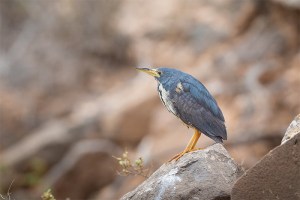
Yes really! Though this is a little further than my oft-cited preferred twitching range it was something that just had to be done. I feel in the mood for madcap adventure at present and the scenario that is about to be described ticks all the boxes. Since the start of December a Dwarf Bittern has been frequenting a Barranco (river valley) quite near Rosario airport on the Canary Island of Fuerteventura. After viewing the picture (below) on RBA my reaction was I would rather like to see this bird and so on a whim I checked air fares. At the head of the results list were return flights for just £65 provided I went out and back this weekend.

dwarf bittern.1701 fuerteventura

Dwarf Bittern (public domain © David Perez)

I next sounded out company but with the usual sort of complexities over matching schedules. Sometimes you just have to get up and go and this seemed like one such instance. When I then found a last minute apartment for £37 everything about this escapade was beckoning hard. So I upped and went.

Dwarf Bittern, one of the world’s smallest herons, normally occurs in much of non-arid Africa south of the Sahara but is uncommon throughout its range. It is a migratory species north and south within the tropical and sub-tropical zones and can wander further including the Canary Islands and southern France. But this particular bird is only the fifth recorded individual to have crossed the dividing line between the Afrotopical and Western Palearctic bird regions.

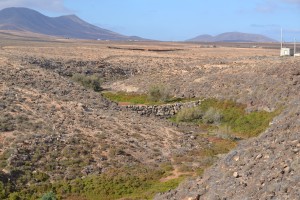
The outward journey was completed without a hitch and I arrived in Fuerteventura at around 1:30pm. This was my second visit here, the first being a five-day stay in February 2015 (see trip reports). After collecting my hire car I needed to drive around a bit to charge up my dodgy sat nav, but after a not too arduous diversion it got me to the GPS location (pictured below, left) cited on RBA. While looking for this site I encountered 10-12 Egyptian Vulture circling over a waste recycling plant. The latter is a raptor I have still seen only on this island of Fuerteventura.

The stretch of Barranco de Rio Cabras in question was set back from a minor road but I drove right out to the exact GPS N28.4758′ W13.9030′ across stony ground (above, right). I was soon joined by two Swedish birders who had parked back on the road. We scanned up and down the shallow gorge of the barranco, in which there were two dams with a lagoon in between, but there was no sign of the bird. Bitterns do after all spend much of their time keeping out of sight, so why should this one be any different? After 40 minutes or so we were joined by two groups of English birders, one of which had seen the bird here earlier in the day, while the other came in on a later flight than my own.

All of the Brits had like myself travelled here just to connect with the Dwarf Bittern, also taking advantage of exceptionally low air fares on this last weekend before the Christmas holiday season. These people sounded like they knew where to look and I followed them down into the barranco, but soon began to feel uncomfortable. Their tactics were none too subtle and they seemed intent on flushing the bird that eventually flew downstream over all our heads and disappeared into cover not to re-emerge. So at least everybody had now seen the bird, if briefly.

DSC_0108

Barranco de Rio Cabras at GPS N28.4758′ W13.9030′

My overnight accommodation at Apartamentos la Piramide in Costa Antigua was superb, a self-contained apartment in a poolside setting. The cheap and cheerful, as much as you like for €10 restaurant here catered for my sustenance needs. This struck me as a good base should I bird again solo in Fuerteventura, since the apartments are also fully self-catering but in a sociable ambience, and shops are nearby. This situation was far superior to the poorly furnished and dingy “studio apartment” in a rather tacky hotel that was my base for the 2015 trip.

I slept little though and so set off at 6am on Sunday morning, as planned to drive to El Cotillo plain at the north-west corner of the island hoping to find that special Fuerteventura resident Houbara Bustard. Daybreak found me heading out along the dirt road I had travelled twice in 2015, seeing one Houbara each time though rather distantly. This time I drove a little further south than previously, encountering virtually no birds at all other than a few Raven. Turning round after the sun had risen I hoped for better fortunes on the return drive.

At exactly the spot I was briefed on prior to that 2015 visit as the prime location for Houbaras here, I gained my prize. Having checked many likely looking objects in the middle distance up until this point, there suddenly was a backlit and beautiful Houbara Bustard of the offshore race staring straight back at me. I stopped the car, turned off the engine, stayed inside, reached for the camera and this bird remained completely unconcerned. It appeared to be warming up in the early morning sunshine, looking about itself and preening at intervals. What an absolute stunner! Eventually my willing subject began to peck whatever it eats from the surrounding shrubs, wandering away as it did so. And hence, mindful of the advancing time I moved on to a renewed appointment with the Dwarf Bittern 23 miles away.

Back on site, one of the groups of British birders was again down in the Barranco. When they got near I learned they had searched all over but found nothing yet. I elected to remain on the cliff top from where on this warm and pleasant morning a roll call of Fuerteventura bird life presented itself. White Wagtail, Chiffchaff and Berthelot’s Pipit were foraging on the rock faces, while Fuerteventura Chat and rather striking African Blue Tit came and went. Four Black-winged Stilt were present on the lagoon, a flock of Trumpeter Finch buzzed past, a pair of Ruddy Shelduck announced themselves overhead, and the kronking of Raven filled the air. This was all excellent entertainment but of the star visitor there remained no sign.

Then after about an hour, as if out of nowhere there was another fly past and the Dwarf Bittern settled on the rock face on my side a little upstream from where I was perched. The three birders on the opposite side of the gorge could all see it, but I stood no chance from my position. If this bird had been skulking hitherto it was suddenly well and truly out in the open. But everything else about this excursion had seemed meant so far, and so was this.

As I walked upstream along the cliff top the bird relocated again into the greenery just to one side of and in front of the second dam (pictured above, right). I was able to cross the gorge behind the dam where the river bed is dry, then move along the bottom of the opposite rock face back to the dam itself. That was where the collective experiences of this trip went off the top of the scale. The bird commenced to climb the opposite wall of the barranco, sometimes through the covering of green vegetation but often across the surface. Then it moved back downward again eventually to emerge at the water’s edge, behaving at all times in a very Bittern like way before eventually heading downstream once more.

This bird is an adult male, having dark blue-grey upperparts and upper wings with elongated head and tail feathers. The throat and upper breast are streaked pale buff darkening to tawny on the lower abdomen. The bill and legs are predominantly yellow. Dwarf Bittern are 25 to 30cm in length, with an average wingspan of 45 to 50cm. More than one source I researched said they are most often encountered when relocating or flying into cover, so to observe this one foraging openly was simply superb. Numbers of other birders have told of similar experiences at this site though, and this bird has most reliably been seen usually around the middle of the day between 11am and 2pm.

These (above and below) are my results

Everything so far on this escapade had gone just perfectly, but when I got back to the airport a four hour delay was announced on my return flight due to severe weather at home. When the outward flight arrived there was an attempt to turn it around quickly but no-one was allowed on board. People like to malign Ryanair but they boast the fewest delays and their flight to Leeds Bradford got away just an hour late. The issue with my Jet2.com flight was that the pilot had already worked his regulation flying hours. People were wondering why this airline didn’t know that when the flight left Stansted. I suppose low prices mean low overheads, as I tell moaners in the queues at Lidl, so maybe Jet2.com doesn’t have stand by crews.

Anyway I’m British so there’s no point making a fuss. Overnight accommodation was arranged quickly and efficiently, and the passengers were all put up at a large 4-star hotel in Caleta del Fuste with dinner and breakfast on the airline. The return journey went perfectly smoothly and the captain’s explanation of the previous day’s events was quite plausible, allowing for a certain amount of PR. The Jet2.com staff were all very pleasant and friendly throughout the unwanted part of this scenario. I eventually got home in the early evening of Monday after a weekend that will dwell in my memory for a long time to come. This was quite simply one of the best things I have ever done.

Parrot Crossbills at Wishmoor Bottom, Berks – 29th Nov

This is very welcome. A persisting cold, northerly airflow has brought about the most significant incursion of Parrot Crossbill into England since the winter of 2013/14. Over the past seven days up to 30 birds have been observed daily at Santon Warren in the Norfolk Brecklands. I had half a mind to visit them this week but on Sunday (26th) a second flock of 16 was found on military training land adjacent to Sandhurst Academy in Berkshire, just an hour from home. So today I went for the latter in company with Ewan and these birds put on quite a show.

It is unusual to find the species so far south. This is one of two Crossbills from north-west European Pine forests that reach Great Britain usually in small numbers during cold spells, the other being Two-barred Crossbill. Four years ago there was a minor irruption of both species into England. Then it took four attempts before I eventually nailed a Two-barred flock in the Forest of Dean, Glos in January 2014. But I connected with another long staying flock of Parrot Crossbill at the first time of asking in Sherwood Forest, Notts over the Christmas period that winter. Since then these hardy and stylish finches have held a special fascination for me and the opportunity to experience one of them again so close to home was not to be missed.

parrot crossbill_01.1715 wishmoor bottom.

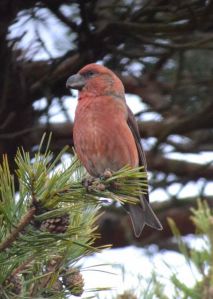
Who’s a pretty boy then? Parrot Crossbill on the Thames Basin Heaths

Parrot Crossbill resembles the more often seen Common Crossbill in plumage, but is 25 – 40% bulkier with a somewhat bigger head and larger, thicker bill. The former is described as front heavy and bull-necked and I think the individual pictured below, left today might well agree with that. They really do look like little Parrots and sometimes behave like them too, hanging upside down to feed on the seeds from Pine cones for instance. The call is less clipping and more mellow than Common Crossbill and we heard this several times as our birds moved as a flock from tree to tree.

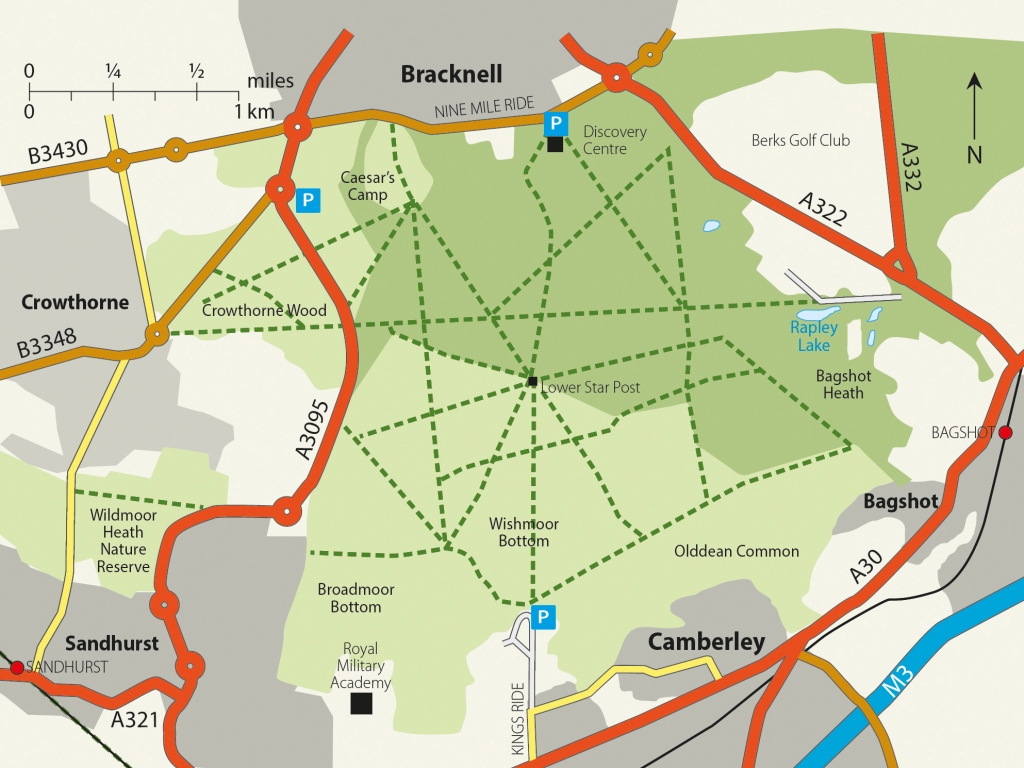
Wishmoor Bottom is part of Swinley Forest, a substantial area of the Thames Basin Heaths SPA lying between Bracknell and Camberley. The site, also known as Barossa reserve, is MoD owned and managed by the Surrey Wildlife Trust. Much of the habitat is Pine and native deciduous woodland interspersed with open lowland heath containing gorse, birch, mires and bogs. Though a training area for the nearby Royal Military Academy there is open public access to much of the site.

CS SWINLEY

The bird interest here, depending on the season includes heathland specialties such as Dartford Warbler, Firecrest, Nightjar, Woodlark, Stonechat and Common Redstart. And the habitat is just made for wintering Shrikes and Crossbills. So there is no reason why the present visitors should not remain for longer given the abundant food supply evidenced today. Pine seeds are these birds almost exclusive diet.

wishmoor bottom.1701

Birders watching Parrot Crossbill at Wishmoor Bottom

We reached site (above) at around 10:45am parking at the northern end of King’s Ride (SU875620), a MoD Housing Estate then walking due north. The directions from there on RBA had been quite precise and we soon located a group of around 15 birders in the area that the Parrot Crossbill were favouring. As we arrived the birds were gathered in an especially easy to view tree, after which they moved around the vicinity at intervals and the birders all followed. What unfolded offered a fascinating insight into the feeding habits of these alluring Scandinavian visitors.

We remained here for just over two hours. Over that period the birds relocated several times, showing well in the tops of Pine trees. It was noticeable how they snipped off the small cones they were harvesting with their powerful bills, sometimes then holding them aloft before pinning them down to extract the seeds from. When not feeding they would just sit calmly and watch, blending into their surroundings. This adult male (below) did so rather more openly, attracting all the lenses present. What an absolute beauty!

Adult male Parrot Crossbill surveying its surroundings (above and below)

The rust-red and grey males stood out more while the grey-green, smaller-billed females were well camouflaged. Viewed front on these birds have a distinctly broader head than Common Crossbills, while large-billed individuals seem to lack a forehead and display a flat crown. The beady eyes seem a little incongruous in such an imposing head.

Conditions were mostly overcast so not well suited to photography. Digiscoping is always a crude solution in the field and the images in this post were gained with a certain amount of cursing. My results were all what might be termed “soft focus” though they convey how these Crossbills were seen. As ever I make no pretence of being a bird photographer, merely a birder who takes pictures to record what I see. The number of photos included in this post, from 42 saved out of 330+ taken, perhaps serves to illustrate just how easy (relatively) these superb birds were to observe today, not something that can usually be said of Crossbills.

wishmoor bottom.1702

How will their pictures compare with my own?

This had been by any standards a superb experience and if the Parrot Crossbill linger I may well come back and spend more time with them this winter. This intriguing site also struck me as well worth checking out for insects in summer, not to mention speciality breeding birds. If only we had some of this habitat in Oxfordshire.

Hoyt’s Horned Lark (?) at Staines Reservoir, Surrey + more on Oxon Hawfinches – 26th Nov

This seemed worth a look. Not only is it unusual for a wintering Horned Lark to turn up at an inland location, but this particular bird is being cited as a probable north American sub-species. The 50-minute bijou twitchette involved was also an enjoyable way to fill a perfectly bright and clear Sunday morning prior to my 3 – 11 pm shift.

Horned Lark (Eremophila alpestris), of which Shorelark (E a flava) more usually occurs in Great Britain, are found worldwide across the northern hemisphere. My own researches having now seen the bird reveal there are no less than 42 recognised sub-species. The Staines bird is believed to be one of three migratory sub-species that make up the bulk of Canada’s breeding population. Normally these winter in the south of that vast country and the northern United States. Given a midweek change to a northerly air flow, RBA had predicted a Nearctic passerine would be the ensuing days’ likely prize and this bird was it.

If Oxford’s Farmoor Reservoir is a bleak concrete bowl as some deride it, then today’s location (pictured below, left) is rather more deserving of that description. In the late 1980s, when I worked for a marketing company near Heathrow, I would sometimes spend lunch breaks here as an escape from the office environment. My only visit since then was to record a first Wilson’s Phalarope in September 1997. Today I arrived on site just before 11am and joined a line of birders at the western end of the central causeway between two reservoir basins.

The bird in question is believed to be a Hoyt’s Horned Lark (E a hoyti). Today it was feeding along the western edge of the northern reservoir basin (below the pylon) in the habitat pictured above, right. Like previously experienced Shorelarks this bird was creeping in its habits and kept in cover of the dried out vegetation much of the time. Even at the range from which I was watching it stood out as being much darker toned than those past English east coast Shorelark records. This is also readily apparent in the limited number of photographs published so far on RBA (see here).

I will not attempt to go into plumage detail of the different alpestris sub-species, even supposing I possessed it. Suffice to say that in researching this intentionally brief post I have uncovered a vast amount of taxonomic data. In due course the great and good of the rarities committees will no doubt publish a decision as to this intriguing individual’s exact taxa.

In the circumstances getting a picture myself was impossible. But fortunately I know a man who had been here a day earlier at a time when the Horned Lark settled on the bank of the causeway beneath just a few birders. Ewan’s observations on the plumage detail are also highly pertinent, so I will refer my readers to his excellent post (here) rather than make second hand interpretations of my own.

Sunday was the fourth consecutive crisp and clear winter day since the prevailing weather pattern altered on 23rd. Much of November prior to that had been as dull as the birding that the mild westerly conditions produced. My immediate reaction upon the change was to check out thoroughly the Oxon location where I had come across my first Hawfinch of the current irruption at the start of the month (see previous post). I had been back to the Nettlebed Estate in the east of the county twice more in the interim, seeing three more Hawfinch on 10th.

This latest re-visit started well when the first Chaffinch flock I came across contained a splendid male Brambling, but that was the only winter finch encountered through five hours searching. I walked a circular route from SU707840, and then a shorter one within it to cover all the rights of way at the western end of this extensive parkland, but saw no more Hawfinches. This was very enjoyable walking country nonetheless.

barnard gate.1701

Hawfinch site near Eynsham, Oxon

Through last week the centre of attention in the county switched to another location to the west of Oxford. Up to 30 Hawfinch have been watched regularly at Barnard Gate (SP400106), the southern end of another estate Eynsham Hall Park. Like Nettlebed, and Great Hampden in Bucks where I enjoyed my best recent Hawfinch experience (see previous post), this Oxon location is an extensive area of parkland in which the birds feed in Hornbeam trees.

I went to Barnard Gate once late in the day on 20th seeing just one perched treetop bird. My heart sunk upon arrival as I realised the viewing distance involved. But at the weekend some Oxon birding colleagues obtained the best images yet to emerge during the current ongoing event (see here). The glut of Hawfinch sightings across southern England shows no sign of abating and looks set to remain the main feature of regional birding interest this winter. But the stray American Horned Lark has provided a most pleasant and interesting diversion.

Oxon and Bucks Hawfinches, and local listing matters: 28th Oct – 5th Nov

As anyone with an interest in birds is now aware, England and the south in particular is currently experiencing a remarkable irruption of migratory Hawfinch. The continued westerly weather pattern might have scuppered my national birding plans as October played itself out. But from the middle of the month what the overall picture lacked in terms of scarcities became offset in part by the opportunity to experience these charismatic but elusive finches in places where they are not usually seen.

The downside is the vast majority of the plethora of sightings on RBA have been fly overs, qualified by annotations such as “over to S” or “low SW”. Locating and viewing settled birds has been quite a different proposition. Surely they are out there somewhere since so many birds cannot be merely passing through. In Oxfordshire an initial trickle of records really took off on Saturday 28th. These were all from what I would term meticulous bird finders, dedicated patch workers realising the opportunity to record Hawfinch passing through their home villages, and those with the ability to identify specks in the sky on call.

hawfinch.1702 great hampden

“If you’re pointing that at me I don’t do in focus.” … “That’s OK Mr Hawfinch, neither do I.”

A very informative article has appeared on Oxon Birding (see here) explaining the practice of “vis-migging”, devotees of which scan the skies from one point for long periods to record over-flying migration. This is not a style of birding that has any appeal to myself but is clearly how most current observations nationally and in the county are being made. So when records began to snowball eight days ago I saw little point in chasing after other people’s sightings and set out to look for Hawfinch in my own village.

The old part of Garsington (SP581025) atop a geological ridge east of Oxford, seems made for Hawfinches. In particular there are good numbers of Yew trees around the place, especially in St Mary’s church yard (pictured below). I first made my way uphill from the shanty town at first light on Sunday 29th, my collar turned up and cap pulled down to avoid recognition as a “Parky”, and have ventured back twice since. But to date success has eluded me. The church yard is nonetheless quite a birdy place and always a relaxing spot to while away some time.

This slideshow requires JavaScript.

After drawing blank a second time on the misty morning of Thursday 1st I received a call from Tom, “The Wickster” who fancied an afternoon off work to search for Hawfinch in the Chilterns. This was the arrangement we enjoyed in the halcyon days of 2012 and 2013, me as driver and he as guide, that was in no small part responsible for my best ever county totals of those years. More recently Tom has preferred to do most of his county birding on foot, but had already added a flyover to his famed “walking list”. Hence it was game on and I knew this would be my best opportunity to find Hawfinch in Oxfordshire this autumn.

I had experienced the species previously at classic sites in the Weald, New Forest and Forest of Dean, as well as in Spain. Hawfinch was also on my Oxon life list, but one sighting at Stonesfield Common had been distant and the second at Blenheim Park fleeting. So this was the last county bird over which all doubt in my mind needed to be removed. There are large tracts of under-watched woodland in south-east Oxfordshire that I had already decided to make the prime focus of my local birding this coming winter, and this was also where Tom felt there must be settled Hawfinch flocks at present.

At the first selected site we found nothing. Tom kept saying we needed to find vantage points to scan over the surrounding woodland and I took the opportunity to enquire what an aerial specialist describes as flying “low”. The answer is apparently tree top height … hmmm! So we moved on and I headed up an unmade road towards a location with the intriguing name of Lower Highmoor (SU704850). When my passenger said this route would probably fizzle out I replied we could turn around if it did. Then he announced: “That would be a good point to scan from just over there.” And without those two inputs we would not have been successful.

First we saw a finch-like flock alighting into a conifer at around 300 metres distance. Tom hoped they might be Crossbill but careful inspection confirmed they were Greenfinch. My expectations having been thus raised then dashed I went for a comfort break, that after all can be one way of making something happen. Just as I was making the personal re-adjustment Tom called excitedly: “Hawfinch!”, and in his words I “almost ran” back to where he was standing. There in my scope, a little nearer than the conifers were three perched birds in a tree above the garden of an isolated house. Mission was thus accomplished in no uncertain terms.

When these birds disappeared from view we walked up to the house but there was no further sign of them. Tom then got back into his element scanning the tree line of Nettlebed Woods on the horizon where he picked out eight more Hawfinch in flight. But I was more than pleased, elated even with what we had already seen. On the way home we stopped at a site Tom knows to observe Grey Partridge that has been a bogey local bird for me this year. Hence, if I were to be Oxon year listing in 2017 I would have moved one ahead of last year’s total, and eight short of those 2012/13 figures. A Water Pipit at Farmoor Reservoir on Saturday 4th, by no means an annual county bird, reduced that deficit further.

We appear to have put Lower Highmoor on the local birding map, because a number of other Oxon birders visited over the next three days. But their sightings were mostly of distant, tree-top Hawfinch or more fly overs. For myself I preferred to go in search of further perched birds and so yesterday (5th) made a covert crossing of the county border into the murky reaches of neighbouring Bucks. Near Great Hampden, a little east of the Chilterns escarpment above Princes Risborough, a roving flock of up to 30 birds had been reported in the interval. These were said at times to be offering good views and so it turned out.

This was not an easy location to find. From a corner of a minor road a bridleway leads through the private estate of Hampden House and past a church, on the far side of which lies a kale field (SP843025) containing clumps of mature Hornbeam that the Hawfinch were frequenting. When I arrived on site other people were leaving, the birds they were watching having just flown off. That left me and one other birder to await their next circuit, then after around 15 minutes my companion pointed to the tree tops above where I was standing. There was the perched male that appears at the beginning of this post (thanks to Ewan for gender ID).

More self-found Hawfinch then flew into the tall Hornbeams in the top left picture (above) and a pleasant 20 minutes or so ensued as, now alone I observed them feeding. This second good experience in four days was an unusual opportunity to view what are generally known as shy and difficult birds going about their infrequently seen business just 20 miles from home. When several more birders arrived things at once became less enjoyable and in any case it was time to leave.


Hawfinch records from southern England, Wales and the Republic of Ireland, 25-31 October 2017. © BirdGuides.com

If Hawfinch are to be a continuing  feature of local birding this winter I will hope for more encounters such as those described here, and not least right here in Garsington. In the short hours of daylight I will be out there looking, though not too high in the sky.

A county find at last: Great Skua at Farmoor Reservoir – 19th Oct

In my last post I bemoaned a lack of local birding action so far this month, but the last two days have added two more species to my year’s Oxon total. Having reverted to three working days a week, Wednesdays and Thursdays are currently free again. In making that decision I had hoped to be spending some time on England’s north-east coast this October, but the current weather pattern has so far ruled out the need to do so. Instead events at Oxford’s Farmoor Reservoir have helped to fill in the time.

Working an eight hour evening shift alone handling an intensive customer flow at the petrol station still involves some recovery time and hence the two day break is welcome, especially if decent birds turn up. Yesterday a small party of Brent Geese stopped off there, a commonplace sight around southern and eastern coasts in winter but still a good bird to record in an inland county such as ours.

This morning I was expecting a BT engineer and then planned to drive down to Dorset to look for a Two-barred Greenish Warbler. By the time the engineer had left there was still no news of that bird but five Common Scoter had been reported from Farmoor, seeing which would break up the day nicely. As I walked clockwise around Farmoor 2 all the dark water birds were Tufted Duck or Eurasian Coot until at 12:50pm I reached the western end of the causeway that separates the two reservoirs. Then I picked up what must have been two drake Scoter about one quarter of the way back to start point.

I quickened pace and my attention was caught by a Herring Gull-sized brown seabird tearing a fish apart in the water of Farmoor 1. “That’s very dark and mean looking for a juvenile gull.” I thought. “Could it be a Skua?” I watched this strange bird briefly but my mind was still on the Scoters. When I reached where the latter should have been they had vanished, then turning around I saw the possible Skua had moved nearer to the western shore of F1, still guzzling its fish. So I moved to get closer but on my approach it began to be harassed by gulls.

great skua.1701 farmoor reservoir

Great Skua or Bonxie (record shot)

The interloper took off, revealing bold white wing flashes (pictured above). “That has to be a Great Skua,” I thought but the trouble was I had seen only one before, a sick bird here in the autumn of 2013. That had been no more than a distant blob in the water out in the middle of F2, viewed at first light from outside the site perimeter fence. As the Black-headed Gulls continued to chase and mob the larger bird today the conviction grew further that I could have stumbled upon what is a notable bird for the county. The 2013 “Bonxie”, as this species is also known, had been an Oxon tick for a number of more seasoned birders than myself. Then another was seen last year at RSPB Otmoor that I missed through having to get to work.

I now phoned patch worker Dai who from my description agreed this was probably a Great Skua. But I was still wary about possibly putting out erroneous news and so headed back to the car to check my field guide. At the sailing club another Oxon birder was walking towards me, to whom Dai had passed on the sighting. We checked my blurry photographs against his phone app and indeed the identity was confirmed. It was thus safe to inform the county grapevine, then as I left site a text went out saying more birders had relocated the Bonxie off the western shore of F2.

The closest to home Great Skua breed is in loose colonies on rocky shores in northern Scotland, Iceland and northern Scandinavia. They winter at sea in the north and south Atlantic. A large and heavy looking seabird, their main diet is fish, taken from the water’s surface, other birds or behind trawlers. Though good to see, I wish today’s Skua had been a Pomarine because that would have been a lifer, not to mention very unusual to find inland. All bar one of my previous Skua sightings, including Arctic (Nov 2013) and Long-tailed (Sep 1995) also came from Farmoor Reservoir.

This was only my second ever “county find”, that at the time of writing I am still being accredited with. The first was back in 2010 when, with the then enthusiasts’ reserve of RSPB Otmoor all to myself one evening, I was surprised and delighted to behold a Spoonbill by the Wetlands Watch Hide. My understanding is that local form dictates county year listing should always be denied. But were I to be indulging in the practice these past two days’ events would put me just one bird behind last year’s total. It would still be good to top my best ever tallies of 181 from 2012 and 2013, because I really cannot face starting all over again next January. But I say that every year!

Footnote: Three Common Scoter (two drakes and a female) remained at Farmoor Reservoir, on and off over the ensuing days. I eventually got proper views of these sea duck on the wet and windy evening of Saturday 21st, in company with Andy Last.