Alpine Accentor, Wallcreeper and Euro Eagle Owl at Les Baux de Provence + Spotted Eagle – 22nd & 23rd Jan

No trip to Provence would be complete without visiting the cliff-top fortress village of Les Baux. Here in winter it is reported that confiding Alpine Accentor may be encountered in the streets, while the south facing inland cliff on which the seriously spectacular heritage site sits is a reliable place to view Wallcreeper. I had been here on both of my previous Provence trips but not found either bird in March 2013.

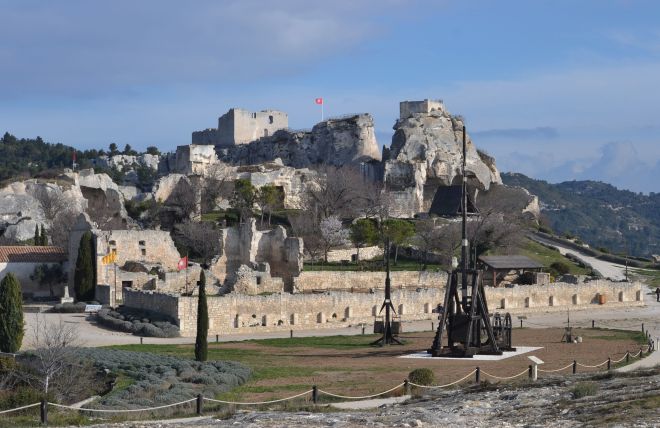
Having had such a good experience of Wallcreeper a day earlier, I focussed on the Alpine Accentors this time. Arriving at around 11am I walked the narrow cobbled streets for a while but decided the most likely place to find them would be within the castle (pictured below). I hadn’t been inside here before for fear of either the crowds or the Mistral, but now in January with few visitors the superbly landscaped tourist attraction impressed me. The entry fee is 8 euros. I met an English birding couple who had seen an AA and a few Cirl Bunting mixed in with a Serin flock 45 minutes earlier before the whole lot were flushed over the edge of the cliff.
DSC_0104

Medieval castle of Les Baux

Searching around the place and concentrating on the more open areas, there were only Black Redstarts, Sardinian Warblers and a Crested Tit. After two hours I started to feel despondent, deciding I might as well do the history and explore the castle ruins. Then around the foot of a stairway up to the highest tower, la Tour Sarrasine a first Alpine Accentor appeared, buzzing about around me and perching on various walls and ledges. I kept still and this bird came lower and lower as my camera went into overdrive. Before long it was joined by two others and I observed all three birds down to five metres at times.

These birds seemed to have no fear of my presence, flitting from perch to perch in between feeding busily on the ground. Eventually they seemed to have gone and I climbed up to the top of the tallest castle tower from where the vistas in all directions were stunning. When I came down again the AA experience got even better. There were now five birds feeding on the ground and totally unconcerned by my interest in them. I started to see just how close I could get, walking amongst them and getting better if not sharper pictures than I could have dreamed of. Excuse me if I indulge this a little.

alpine accentor.1602 les baux

Five Alpine Accentor seen down to 5 metres

alpine accentor.1620 les baux

Occasionally other visitors would approach and as quickly go on their way, totally unaware of these treasures in their midst. I left at around 3pm, stopping to tell the belle mademoiselle in the entrance hall that I had found the birds I told her about earlier. She took an interest so I explained that some people do come to the castle just to see the Alpine Accentors.

Time still remained for a quick walk along the path below the southern cliff face to try to spot a Wallcreeper. In the event this proved to be easy but then I am on a roll this week. A short distance along the path I picked up the now familiar pink and grey shape below the tallest tower. In 2013 I had sat and scanned the rock faces here with my scope for a long time while sheltering from the Mistral. Now I could see this bird with the naked eye. A young French couple stopped to ask what was there and were delighted by the bird too.
DSC_0225

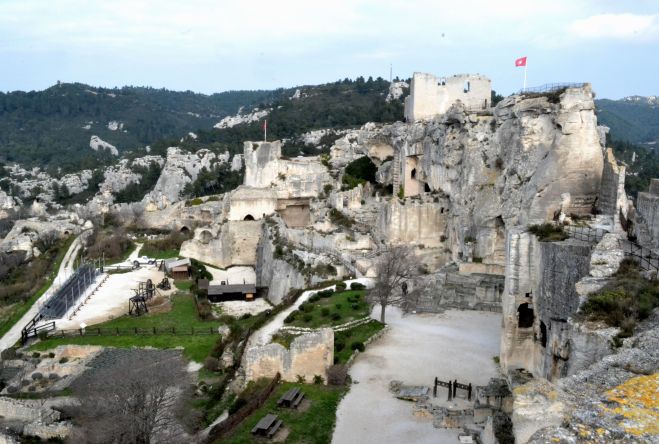
The Alpine Accentors were most active around the flat area with the stocks

It was very satisfying to have located a Wallcreeper at this classic site. After all, some English birders come down to Les Baux especially to see them. It now remained to try for the locality’s famous pair of European Eagle Owl and I moved on to the site 3km to the south west of Les Baux behind the Hotel Mas de l’Oulivie, that is visited by all the birding tour companies. Setting up here an hour before dusk I was joined by the English couple from the castle, and so we watched, chatted and waited.

I have seen this species once before, in Portugal with a professional guide, and so knew what to listen for. At 5:45pm a male began to call behind one of the two cliff faces that these Owls favour. Soon the quieter call of the female could also be heard but these sounds seemed to be coming from some way off. Then my day’s birding colleague spotted the female sitting on a boulder atop the right hand cliff face. There she stayed for some minutes, ears pricked in the failing light and turning her head from side to side. She was facing away from us, presumably in the direction of the male, then she dropped down over the far side of the cliff and out of sight.

This slideshow requires JavaScript.

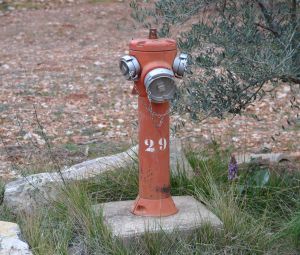
It would have been pointless trying to photograph the Eagle Owl at that distance in the gloom. But to prove I was there here’s a picture of the red hydrant of internet fame that marks the viewing place. To it’s right is a clump of orchids that my companion said were probably Giant Orchid. This is a very early flowering species but he had not seen them before in January.
DSC_0324

On my last day in Provence (23rd) I returned to the track north of Cacharel in la Camargue to seek the final trip target and third lifer, Spotted Eagle. Around midday I came across two French birders, one of whom confirmed this was the right location. For the next hour I sat in my hire car scanning to the horizon to the west of the track while keeping an eye on my companions’ body language. Then I engaged with the English speaker of the two to find out more about what I was looking for.

He said up to three Spotted Eagle or possibly greater / lesser hybrids are present here, as they were last winter too and that early afternoon is the best time to see them. While we talked the other birder was watching something intently in his scope that he then showed his colleague. When I too picked up these two distant raptors I was assured they were Spotted Eagle. Though usually reluctant to accept far off sightings on other birders’ assurance, in these circumstances it seemed rude not to. Being thus polite of course also meant a 100 per cent success rate with my trip targets. So that was everything!
greater flamingo.1601 camargue

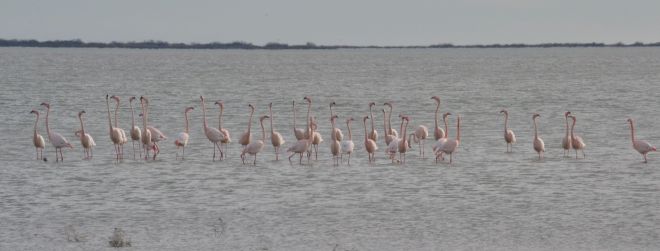
Yes I’ve been to the Camargue and seen the Flamingos

Goldcar eventually charged me 60 euros to clean up the Renault Captur. But it would have cost a lot more to have hired a 4X4 for the four days. As an extra cost of adding Provence’s difficult Pin-tailed Sandgrouse and Spotted Eagle to my life list it seems worth it though still irritating. This car was no dirtier than any other I’ve returned after a birding trip.
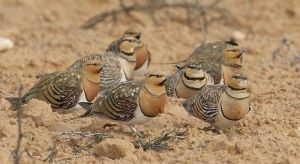
Pin-tailed Sandgrouse, Wallcreeper and Rock Sparrow in Provence – 20th and 21st Jan

Not many regularly occuring birds remain on my southern Europe wish list now but of the lingerers, three – Pin-tailed Sandgrouse, Rock Sparrow and (Greater) Spotted Eagle – all winter in Provence. Finding a £53 flight (luggage included) from Lisbon to Marseilles with the Portuguese airline TAP meant I could add a winter visit here to my Algarve break. And so the opportunity to find these birds has arisen.

My base is the cheap and cheerful, self catering Top Motel in Istres. I find this arrangement ideal because French breakfasts aren’t worth their cost and evening meals also become more affordable. Then there is the essential of tea and coffee whenever I want one, that isn’t possible in a budget chain hotel unless a kettle is smuggled in. Oh, and this establishment in a secure compound behind the 3-star Ariane Hotel is also hard by the Plaine de la Crau Sandgrouse site, and conveniently placed to visit birding sites in les Alpilles and la Camargue.

pin-tailed sandgrouse

Pin-tailed Sandgrouse © rights of owner reserved

The resident Pin-tailed Sandgrouse had huge lifer status for the usual reason that I had not found the species on two previous visits to Provence in May 2012 and March 2013. Doing so was my top priority this time. Trip research had revealed a hitherto untried access point to la Crau, at the north-western end near the town of St-Martin-de-Crau, that appeared to be a good PTS location. This is the reserve Peau de Meau, managed by a regional association for nature conservation, CEEP (Conservatoire Etudes des Ecosystemes de Provence). After getting a permit dutifully from CEEP’s Ecomusee de la Crau in Saint-Martin, I arrived on site late on Wednesday morning (20th), having first seen to buying provisions. Stomach again, call myself a birder?

After 2013’s visit I had concluded the best way to find PTS would be driving slowly around the flat, stoney “Coussoul” habitat of la Crau in a 4×4 seeing what goes up. This time my car hire company substituted a chunky, diesel-engined Renault Captur for the small car I had booked – almost a 4×4 then and at no extra cost. Their £12/day insurance package had no deposit and no excess, so if I wrecked the vehicle I’d be covered. “I won’t even look at it when you bring it back,” the lady said. Well, I needn’t be too squeamish about where I take it then!

Peau de Meau has a 5km waymarked trail around it’s perimeter, but first I set off in the car along a rough track for some distance beyond the reserve. After all I had been wanting to do that for the past three years and there was nobody there to stop me. Seeing only Pipits, Skylarks and corvids I returned to walk the full distance of the trail, but still no Sandgrouse. So I applied my usual solution to a no show, deciding to return early the next day. But first I took another drive through the rough roads of la Crau eventually reaching the N508 road that runs north-west between the Plaine and the neighbouring Camargue. Guess what? At track’s end was a roadside notice proclaiming access to this military land is prohibited. Oh well!

DSC_0027[1]

La Plaine de la Crau

Thursday 21st dawned cold and bright and I arrived back at Peau de Meau at 8am. For the sake of doing things differently I set off the other way around the trail, then took a track across the reserve towards the large barn in the picture. All that went up were Skylarks and frustration was setting in. Then continuing north-eastward along the main trail from the barn, two birdy events occured in quick succession. Buses!

First, away to my left four Little Bustard went up before seemingly vanishing into thin air. Quite an achievement for such a large bird but a not unusual experience for the species. That also maintained my 100% record for it at this site. Then away on my other side, five Pin-tailed Sandgrouse at last flew across the sunny morning expanse of the Coussoul. Mission accomplished! The middle distance flight view was pretty much what I had expected. I have seen some good birds in the past at la Crau: Little Bustard, Stone Curlew, Red-backed Shrike, Tawny Pipit, Melodious Warbler and a possible Spotted Eagle that I didn’t put on my life list. Now having gained the elusive top prize I felt very relieved not to have to re-visit this flat and otherwise dour landscape unless I choose to.

It was now mid-morning and my next target, Rock Sparrow was at a roost site. I felt little inclination to drive around the Plaine again illegally in the low sun, and so moved on to reconnoitre a previously unvisited area of la Camargue on the western edge of l’Etang’s de Malagroy and Vaccares. I found out about this location through an online trip report that said Greater and Lesser Spotted Eagle were both present in January 2014. From Cacheral on the D85A road I followed a rough track NNE all the way to the D37 that skirts the Etang de Vaccares’ northern side.

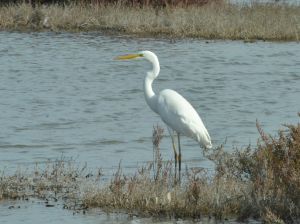
great white egret.1601 camargue

Great White Egret

It was now a perfect cold, sunny winter’s day and the abundant Greater Flamingo all looked very splendid in their finery. In places there were almost as many white Egrets: Cattle, Little and occasional Great White’s (pictured above), emphasising just what a concentration of large water birds dwell here. Where Eagles were concerned I came across a good candidate for Spotted and also observed two of the Buzzard-sized Booted species. There are extensive reed beds in this area and many hiking trail signs.

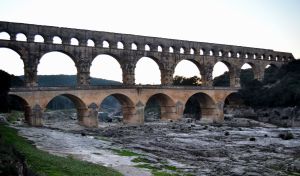
pont du gard.1601

Magnificent Pont du Gard at dusk

In the afternoon I drove north to the Roman aqueduct of Pont du Gard, a UNESCO world heritage site between Nimes and Avignon. This 360 metre long three tier structure is the tallest bridge in the Roman world at 50 metres. Straddling a gorge through which flows the River Gardon, it is a well developed tourist attraction and also a winter roost site for Rock Sparrow. I arrived early to get my bearings – there is a car park on either side – then after a sandwich break returned at 4pm

Stone staircases lead up to just below the top tier at both ends and the question was at which one to set up my scope. I decided the western one had the better views and watched and waited. At 4:45pm a Wallcreeper flew in three arches away that I watched foraging for food for the next 20 minutes. This delightful bird, my second ever proved quite a distraction but then I recalled what I was meant to be doing and scanned to the far end of the aqueduct.

DSC_0068

Slightly less blurry Wallcreeper than at Dinant

Small birds now appeared to be flying straight in to the structure but were actually entering cracks and cavities of any kind in the top tier. These were indeed the Rock Sparrow I had come to see. Some would fall out of their hiding places again, flying downwards while others perched on the parapets or clung Wallcreeper-like to the vertical surface. The head pattern was plain to see even at that range, then zooming in with my eyepiece on one bird I picked out clearly the yellow breast spot of a male.

There was still enough daylight time left to cross over to the eastern side but once I got there the activity had largely ceased. But the Wallcreeper was still busying itself, now on the upper tier as well. This experience was well worth the 12 euros admission money to the site and I felt very satisfied to have added Rock Sparrow to my life list at the first attempt.


Mount Foia re-visited – 12 & 13th Jan

With four days remaining of my stay in Lagos, the hitherto wintery weather turned sunny, cool and dry yesterday. So things were at last right for some walking in the Monchique mountains that was a high priority for this trip. I can see the twin summits of Foia and Picota from my apartment and the tops have not been cloud free until now.

The views from what is the Algarve’s highest land are said to be breath-taking when conditions are right. I had been up to reconnoitre anyway on Sunday to find things cold, grey and windy: the other side of the coin and true of mountain tops anywhere I suppose. But I had been very struck by this location in fair weather on my first visit three years ago and jumped at the chance to return now.

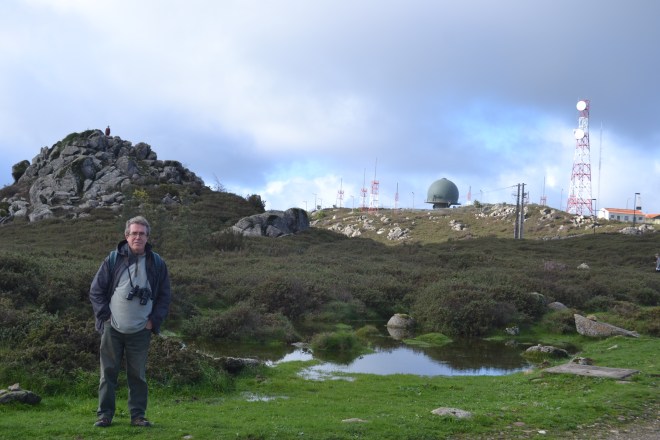
DSC_0045

Me at the summit of Mount Foia

There are also some good birds up there of course. Call me a fair weather birder if you will but I did come here to escape the English winter. My satnav took me up to the summit of Foia by a minor road that joins the broader one from the town of Monchique near the top. Along this route I disturbed a small flock of Rock Bunting at the road side, the first time I have seen more than one of these.

At what local birders call the “ugly coach stop and restaurant” small numbers of tourists were hanging about without venturing far from the car park. I walked around to scan the immediate vicinity, coming across another, rather approachable Rock Bunting (below) that was the morning’s highlight.

rock bunting.1601 mount foia

Rock Bunting

Then I walked along the metalled road across the summit where two English birders in a car stopped to talk to me. They had also had a close Rock Bunting encounter and seen some other good birds around the coach stop earlier. So I went back for another look, finding a Blue Rock Thrush on one roof and picking out a Dartford Warbler.

By midday the bird activity along the summit road seemed quieter. A lot of Wren and Dartford Warbler inhabit the scrub up here, the latter all intent on offering only glimpses of themselves. I heard more of them than I actually saw. The “oh no not another one” species was Stonechat of which there seemed to be almost as many as there are pictures of them on Oxon Birding.

As on my 2013 visit, southward towards the coast the outlook was very hazy. But tourists were still taking photographs with their phones directly into the sun. The views northward are altogether more pleasing and I fired off a lot of pictures as the light continually changed. This sequence (below) conveys the general impression.

This slideshow requires JavaScript.

Half way along the road I followed a way marked path downwards until it was blocked by a strategically placed dead tree. I could see where the continuation reached another road but opted for the easier climb back up and retraced my steps. That other accentor, Dunnock now provided this trip’s fifth Portugal list addition, yes really! The Alpine variety are said to favour the area around the car park. Indeed I have gained an impression that the best birding is to be had there and so today (13th) I returned early.

Tuesday was cut short by an allergy attack that in the afternoon turned into a real humdinger. When this chronic affliction strikes so badly the only thing to do is lie flat out and wait for it to see itself out. By morning the worst had passed and at dawn I could see that the mountain tops were clear. I set off a little reflectively after reading on my computer of another rock n’ roll death. They so often occur in threes and after Scott Weiland and Lemmy (Bless ’em both!) it was now the superstar David Bowie. Who would have thought it?

But I digress. Arriving on site at 8:30am I had the summit of Foia to myself, save for a person who I assumed to be the local herdsman. The first birds I saw were inevitably Stonechat. Then Dartford Warbler began to show themselves and I managed some shots (below) in which my camera’s autofocus clearly hadn’t fixed on the bird.

dartford warbler.1601 mount foia

Dartford Warbler

Though conditions were clear overhead, the vistas on all sides of the summit had a hazy blue uniformity with the sun still low in the sky. As I circled the ugly coach stop and its car park, the Blue Rock Thrush appeared in exactly the same place as a day earlier and eventually I spotted another Rock Bunting. So that was all the site specialties seen over again except for Alpine Accentor, though not necessarily better views than on my first visit.

Where the last named is concerned there’s a lot of habitat here in which they can conceal themselves. So if it had been difficult to locate them at Cabo de São Vicente it could be many more times so here. Hence I didn’t search too thoroughly. Feeling I had done Mount Foia justice both in birding terms and scenically, I left at 10:15 and returned to Lagos for the fun of a boat trip and just to relax in the winter sun.

DSC_0081

My location at Lagos


Alpine Accentor and Red-billed Chough on Sagres peninsula, Portugal – 5, 6 and 9th Jan

Should any regular visitors in God’s own English county, Oxfordshire have wondered at my silence in the past week, the answer could be a combination of iffy wi-fi, iffier weather and some difficult birds that I wish to add to my Portugal list. Prominent within the last-cited reason has been the tiny colony of Alpine Accentor that winter on the cliffs at Cabo de São Vicente, Europe’s south-western extremity. Local populations of Red-billed Chough and Little Bustard have also drawn me to the Algarve’s Sagres peninsula in an attempt to squeeze more meaningful wildlife experiences out of my wintering ground of recent Januarys.

DSC_0085

Lagos

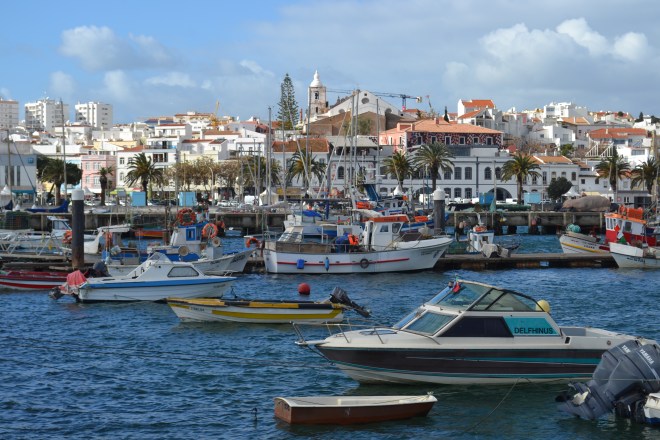
My base for this trip is Lagos where I have rented a studio apartment overlooking the bay. I can tell why tours come here from the Algarve’s concrete jungle resorts because this place has character, charm and most unusually history. The town centre has a pleasing ambience but there I would have the opposite side of a narrow street for an outlook. Investors in the neighbouring megabucks apartment complex in my location also look out on the next block. So where a holiday let is concerned this (below) is what I regard as landing on my feet.

DSC_0166

Room with a view

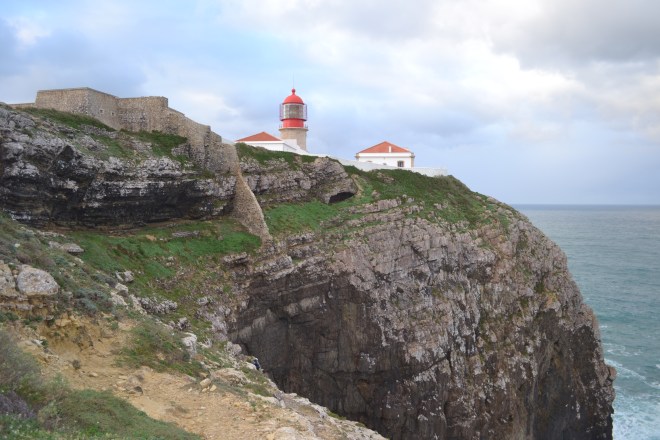
Having made a day one exploration of Lagos on Tuesday. in the afternoon I set out on a first reconnoitre of the Sagres peninsula 30 km to the west. After a cool, sunny morning the weather turned showery during this drive. Upon arrival at Cabo de São Vicente a gale was blowing as it often does there. The Alpine Accentors inhabit rocky bluffs on either side of a lighthouse, where they creep about unobtrusively in the montane vegetation and are generally difficult to locate. But I could see little reason why these birds should want to be here, given the disturbance from selfie-taking tourists clambering about the place. A dawn visit therefore suggested itself as offering the best chance of success.

Waking early on Wednesday I decided to go straight for that dawn attempt. Several fishermen were at Cabo de São Vicente before me taking up precarious perches on the cliff tops from which I learned subsequently they do occasionally fall to their deaths. But there was now no other disturbance and for the next hour I just sat or moved around the bluffs on the southern side of the lighthouse. There were birds here at this time – Sardinian Warbler, Stonechat and Black Redstart – and I just watched and waited. Kittiwake were amongst the gulls offshore and Northern Gannet were flying further out. But after mis-identifying a female Black Redstart for my target momentarily I gave up the quest.

DSC_0133

The Alpine Accentors winter here. Got a head for heights?

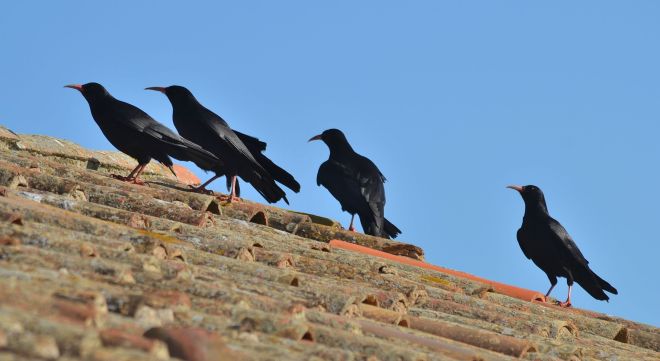
Next I crossed the road and car park to the north-west facing cliffs (above). Here the bluffs just below the lighthouse are less accessible to people and the habitat looks more promising. There are also good lower vantage points from which to scan the location but again I picked out no Alpine Accentors. Now it was time to explore the flat, rocky land to the cape’s north-east. Red-billed Chough proved as easy as the Accentors were difficult. At a restaurant on the N268 a short distance from the lighthouse three of these corvids were perched on overhead wires.

A little further along the road back to Sagres a narow metalled road runs north to a nature reserve Vale Santo and farm of the same name. This is the migration watch point that draws birders in autumn, lured by sometimes large numbers of west European soaring birds that pass overhead. The landscape here looked excellent for Little Bustard, that as in the Baixo Alentejo special protection areas were no doubt out there somewhere. But I didn’t find the Sagres fragment population this time.

red-billed chough.1601 sagres pemimsula

Red-billed Chough

I did locate four more Red-billed Chough feeding in the middle distance on the western side of the road, and watched these for some time. This was only my second experience of the species, having observed them in mid-Wales in the early 1990s. Consulting my Collins the field guide cited these birds as being “often fearless and approachable”, so I gave it a go. The Chough did allow me to get quite near before taking exception to my presence and relocating a short distance away. I attempted some digiscoped images without great success. I also saw or heard more RBC around the farm (pictured above) from where rough tracks lead in various directions.

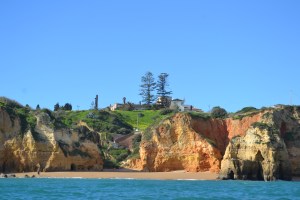
Returning to Lagos, in the afternoon I covered the area west of my apartment as far as a headland Ponta da Piedade. The coast here is characterised by orange-coloured cliffs, small coves, stacks and caves (pictured below); with little beaches to which steep staircases descend. Cliff top walks that start outside my door are both pleasant and birdy. The undeveloped parts hold local passerines such as Sardinian and Fan-tailed Warblers, Stonechat, Black Redstart and hybrid Sparrows. Crag Martin fly around the aforementioned apartment blocks, there is a Spotless Starling roost in trees behind my building, and large numbers of Azure-winged Magpie glide through at dusk presumably to their own roost sites. A lot of Northern Gannet are active offshore, being common around this stretch of coastline.

DSC_0176

Coastline west of Lagos

Success with Alpine Accentor came at the third attempt on Saturday. In the interim I had posted a request for information on Bird Forum and received guidance from a local expert. Two other Portuguese birders I met in the field on Thursday had also advised me to concentrate on the north-west facing bluffs. Arriving on site at 7:30 am I set up my scope on a rocky perch and began to scan the area below the lighthouse. This time there were no kamikaze anglers for company and I had the place to myself for the next two hours.

After 30 minutes an Alpine Accentor emerged from ground cover at reasonable distance and posed nicely but briefly on a rock. Then at 8:45 another movement caught my eye and possibly the same bird was visible again a short distance from the first sighting. On both occasions I could clearly make out all the plumage detail of this Skylark-sized passerine. I waited for another hour for it to re-emerge but was unable to obtain a photograph. Digiscoping is always a crude solution in the field and on this occasion proved totally inadequate.

In the interval between the two sightings a Merlin appeared overhead, a nice bird to see anywhere and another Portugal first. After leaving the cape I searched an area of Juniper scrub for wintering Ring Ouzel as I had been advised to do on Bird Forum. There is a lot of this habitat along the road to Sagres and I saw one likely looking candidate drop into deep cover behind the restaurant. From there I could see lots of corvids on the Vale Santo plain that had to be the Red-billed Chough again.

red-billed chough.1602 vale santo

Vale Santo with Red-billed Chough flock

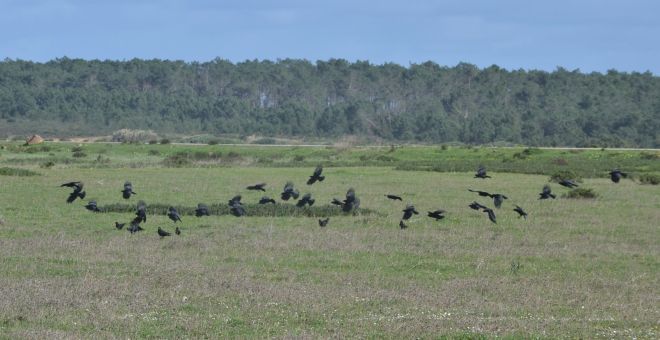
Driving along the same northward road as on Wednesday I caught up with a 50+ flock of Red-billed Chough and watched these sociable birds going about their business for quite a while. This species is very localised in Portugal where it has endangered status. The cereal fields around Vale Santo in which the Algarve’s only population congregates to feed are the easiest place to find them. A pair of Bonelli’s Eagle were also active here. The rest of the day was spent driving around scanning for the Sagres Little Bustard flock, that once again eluded me.

My Alpine Accentor sighting is apparently only the second at Cabo de São Vicente this winter. That must demonstrate the difficulty in finding them here; it isn’t something that birders can just turn up and connect with. So I feel a great sense of satisfaction at having done so and one that makes the at times loneliness of these solo expeditions all so worthwhile.

Twite and Horned Lark at Holme Dunes NNR, Norfolk + Pallid Harrier again – 29th Dec

I fancied an outing to the north Norfolk coast this holiday period, and chose a day that offered some calm and sunny respite from Atlantic weather. Having tracked what birds were about over several days I opted for Holme Dunes. Here the local winter specialities Twite and Horned Lark were being reported and Snow Bunting was a possibility. If time allowed I could also fit in another visit to the wintering Pallid Harrier, and maybe an Iceland Gull in King’s Lynn.

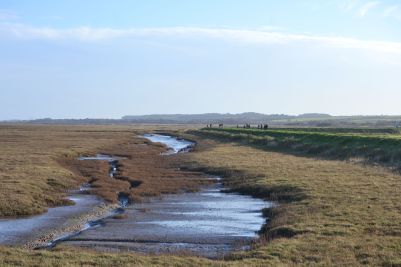
I approached Holme Dunes NNR from a car park outside Thornham (TF727443) around 10am. This stretch of fragile coastline, managed by the Norfolk Wildlife Trust, comprises a range of habitats: intertidal sands and mud, sand and shingle bars, saltmarsh, sand dunes, freshwater and salty pools and grazing marshes. Things felt like an uplifting spring day and there was a very pleasing light as I walked NW along the sea wall.

DSC_0053

View back along the sea wall

A flock of 20 or so small passerines bobbed past that I suspected must be the Twite, then I caught up with them feeding low down in the salt marsh a little further on. Always restless and mobile, these winter coastal finches for me have lovely subtle tones and are far more attractive to actually behold than they look in field guides. A few other birders were already watching them, then several more people stopped as well.

DSC_0027

Feeding Twite flock

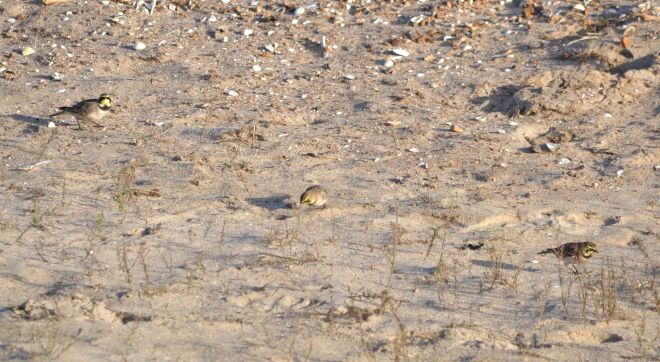
Everyone was heading out to the beach where three Horned Lark (or Shorelark) were said to be showing well. Northern breeders like the Twite, these distinctive yellow and black-faced larks had moved some way out by the time I caught up with the group observing them. I asked others to point them out at that distance, but then the birds flew in quite close again and like everyone else present I tracked them feeding busily on the ground for some time.

It was noticeable that the birders all kept to the edge of the dunes but three big lens photographers just had to go onto the beach, putting the larks up several times. Rather embarrassingly one of these recognised me from Oxfordshire. When I told him he wasn’t popular with the birders he just said he had been there first. They always have an answer. But the disturbance didn’t spoil what was my best ever experience of Horned Lark.

DSC_0127

Horned Larks on the beach

After midday I headed back to the car park. Whereas the company had been mostly birders on the way out, the general public was now treading the sea wall in their droves and there was no longer any sign of the Twite. After buying a snack lunch in a village shop, I stopped to eat it 13 miles SW at the famed Wolferton Triangle on the off chance that a Golden Pheasant might choose to show itself. There had been sightings again in recent days but I wasn’t lucky during my brief visit.

It was now time to complete some unfinished business with Norfolk’s juvenile wintering Pallid Harrier. This raptor has relocated from Snettisham RSPB to a village Flitcham that is alarmingly on shooting land. I arrived mid-afternoon to find several birders patiently waiting by a gap in a hedge for the raptor to appear. It had not been reported today since 9:30am. I debated whether to move on and go for the Iceland Gull but decided the best chance of seeing the Harrier again would be when it came in to roost here.

After 3pm some birders gave up and went, leaving just four of us. Then the Pallid Harrier flew in and for the next 20 minutes put on a show of aerobatics around the landscape before us.  I had experienced this bird distantly at Snettisham (see here) but this time could identify all the diagnostics: just four primaries, the neck boa (dark patch) and the generally orangey appearance in flight. The views here were superb.

DSC_0174

Pallid Harrier (juv)

At one point a Merlin, always a nice bird to see, flew in and interacted with the Harrier. Two Common Buzzard and a Sparrowhawk were also active. As I left site the local cattle man asked me what everyone was looking at. For fear of what he might say in the pub I didn’t name the Pallid Harrier, just saying it was a small raptor. Having heard of the Lincs (see here) Red-footed Falcon’s fate, I hope the unknowing juvenile visitor departs this shooting land soon. Over our three encounters it has provided excellent value and I have gained a better understanding and views of this bird on each occasion.

Dusky Warbler at Ham Wall RSPB, Somerset – 27th Dec

I’m on an end of year roll now. The very mild weather is producing some equally unseasonable birds nationally, most notably Britain’s first ever December record of Red-rumped Swallow in Norfolk this week. Also a few lingering Yellow-browed Warblers here and there, and for me a tricky little lifer: a Dusky Warbler on the Somerset levels. Whilst small numbers of the last-named Tundra breeder pass through annually on autumn passage, this year there have been records right through December.

So today, armed with my picnic chair and prepared for a long stake-out, I headed west to the RSPB’s Ham Wall reserve. The Avalon marshes are familiar to me, having twitched Pied-billed Grebe and Hudsonian Godwit here in the recent past and European Roller years ago. The re-generated peat workings either side of Ashcott corner are also an excellent site for wetland birds such as Great White Egret, Bittern and Bearded Tit; like Otmoor on a grander scale. Today a Glossy Ibis was seen flying over just before my arrival.

DSC_0005_01

Avalon

Shortly after midday I joined a group of birders near a path to Ham Wall’s Avalon Hide (ST461398), who had been tracking the Dusky Warbler for a while. Soon I too began to hear the bird’s hard clicking teck, teck call coming from the reed bed edge in front of me. Some amongst us were picking out the bird low down in cover, but I had to wait a little longer. Then some birders who had gone left called everyone else over. The DW was now moving around in trees to one side of the path, up to two metres off the ground. Here I gained good views of the plain-looking sprite going about its business.

My companions seemed more like locals on their patch than twitchers, and after 1pm someone said the DW stops calling in the afternoon so would be hard to relocate. The group then dispersed but I had nowhere else to go and was content just to chill out here, feeling glad of the dry if still grey conditions. For the few who remained our bird was heard calling several times more over the next two hours and seen occasionally.

I need not have brought my chair since there was a bench overlooking one spot favoured by the Dusky. I have a limited knowledge of calls but having learned this one a couple of weeks ago it just seemed particularly easy to retain. Then there had been a bird near Bognor Regis, Sussex for three days. But on 12th and 13th it wasn’t reported and Mike and I stayed with the Penduline Tits at Titchfield Haven, Hants seeing only the male at distance. Two females there eluded us.

On that occasion we had talked with a birder who had been the last to report the Bognor DW. He described how it was moving around calling all the while and today’s bird was just the same. The highlight came at 2:30pm when this Dusky Warbler moved around the lagoon edge in front of my bench, showing well at times but not for long enough to capture an image. So here I was tracking a rare warbler on call, not something I can boast of very often.

dusky warbler.01

Dusky Warbler © rights of owner reserved

The only pictures posted on RBA to date (see here) look much the same as I could have managed. So I have outsourced an image from the species’ usual wintering grounds in south-east Asia (above) to show what this is all about. The absence of big lens photographers at a twitch always separates the birders’ birds from the media stars. And though it is good to get close to birds and even obtain reasonable pictures myself, I know what ambience in the field I prefer. Not that I have anything against photographers of course!

This was a nice relaxed afternoon whiling away time observing a life-list addition and gaining an understanding of the species. I left around 3pm as large numbers of visitors were assembling to watch the local Starling roost. Then given what must have been post-Christmas congestion around Bristol it took almost four hours to get home.

Festive Goose: completing my Black Brant education in Sussex – Christmas week 2015

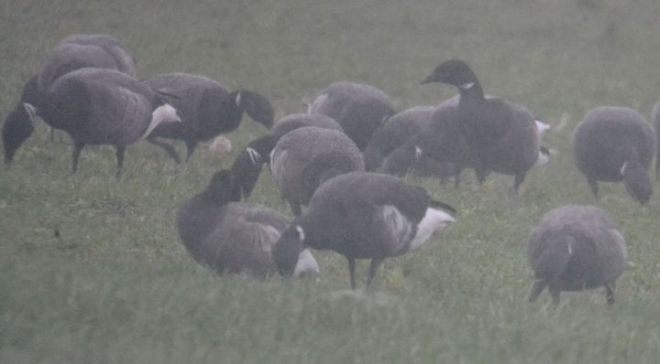
During a dull phase of national birding dictated by December’s mild Atlantic weather pattern, identifying the Brent Goose sub-species Black Brant has been a priority task for me. Individuals are dotted around the country every winter in Brent Goose flocks and I really should have seen a Brant before now. My first attempt was at Cley, Norfolk on 2nd Dec but I later realised I had not paid sufficient attention to the ID, my mind being more on getting to the Snettisham Pallid Harrier on that occasion.

wp9607fbef_05_06[1]

Black Brant (left) with Dark-bellied Brent Goose © rights of owner reserved

So needing to fill an umpteenth (since my Maroc experience) grey, damp and oppressive day, directly beneath the jet streams in England, I elected on 22nd to learn more about Black Brants by visiting another regularly reported goose (pictured above) near Chichester Marina. The location is about 4 miles SW of that Sussex town on the A286, along a road of the same name that my satnav doesn’t know about. I had stopped here once before during the interval since my last post, with fellow Oxonbirder Mike Kozniowski. But we had three difficult species on our agenda that day and ended up not getting any of them. Now I intended to devote the necessary time to tracking down one bird.

After first thinking I had identified that Black Brant at Cley, Adam advised that the whiteness in the flank is a more reliable diagnostic than the broad neck collar. Then after scrutinising more Brent flocks on that interim occasion I indeed felt the need to be sure of having seen this sub-species. After all, another Oxon birding colleague had called Brants “a birder’s bird that separates the men from the boys”.

Pre-visit research on Tuesday directed me to fields beyond Salterns Copse, a local nature reserve to the marina’s immediate north. Following a footpath “Salterns Way” I could see two smallish Brent flocks rather distantly and close by a lane to Dell Quay (SU835028). But first I tried to get nearer to these geese from where I was, crossing over to another path skirting Chichester channel. There attractive groups of Curlew, Oystercatcher and Shelduck were feeding behind the receding tide, but only 8 Brents awaited me at my waterlogged walk’s end.

DSC_0004

There’s a soggy Black Brant in there somewhere

Returning to the car I drove around to Dell Quay, finding at 1:45 pm what must have been the entire local Brent flock (pictured above). They were in a field on the far side of the lane I could see earlier. This was overlooked, rather conveniently by a muddy lay-by and the remaining hours of daylight were available to scan for the Black Brant using my car as a hide. Various candidates suggested themselves over the next 2 hours during which it rained quite steadily, but none that were obvious.

Some time after 3:30pm all the furthest away Brent Geese went up and flew to join those closer to the road. It had stopped raining and with the entire flock now in one huge and scannable group I set up my scope by a gap in the hedge. I picked out a whitish-flanked individual with a broad neck collar that I felt more confident about, but was this really my bird? In failing light I didn’t attempt a digiscoped photograph.

Over the Christmas period I managed a morning re-visit to the site, this time finding the Brent flock in the field between Dell Quay and Salterns Copse. Once again creamy flanked candidates suggested themselves as the Brant but then I would realise other geese nearby looked much the same. At first I kept my distance but when a jogger went through without consequences I moved a bit closer. Guess what? The whole flock went up, then resettled on the far side of the field close to Salterns Way by a farm. And that proved to be the turning point in my fortunes.

I next watched a dog walker getting closer and closer, fearing the worst as he did so. But with his impeccably behaved Labrador on a lead he stopped and took pictures with his phone, and the geese were not the slightest bit bothered. That was it, and I hot footed it over to that side myself. There I soon picked out a goose that relegated all those I had considered previously to mere possibilities. The Black Brant was fortunately at the nearest end of the flock to myself, and now the brighter whiteness in the flank was obvious. Checking the collar, and a clean diagonal line with the darker breast markings that Adam had advised me to look for, this was definitely my bird.

black brant.1505 dell quay

Black Brant (centre in front)

Conditions were quite wet again and this digiscoped image (above) was captured in poor light through a smeared eyepiece and front end. Having got my eye in I could now relocate the Brant over and again, eventually getting some grainy telephoto shots in the rain (below).

black brant.1502 dell quay

Black Brant (6th from right standing upright)

This has been an interesting and ultimately very satisfying exercise, since I solved the riddle of identifying the sub-species completely unaided in the field. So now I am a man separated from the birding boys where Black Brants are concerned.

Though glad I didn’t have to scan all these geese looking into low sun, the present weather pattern is making me feel I could gladly quit this country if the jet streams don’t move back soon to where they flowed prior to the present decade. A whinge this might be but I just yearn for the kind of cold, crisp winter days remembered so often and well from the 1990s. In the new year I’m heading for hopefully sunnier climes again and cannot wait to get out.

Pallid Harrier at Snettisham RSPB, Norfolk – 28th Nov

Over the last 12 days a juvenile Pallid Harrier has been observed on salt marsh at the southern end of the RSPB’s Snettisham reserve on the Norfolk coast of The Wash. Once a rare vagrant to Britain but now more regular, this raptor got onto my life list in Cyprus in April 2012. That was based on seeing a Harrier in the spot where I had been told to look, so the species has been amongst those about which all doubt needs to be removed. Today’s objective was to do that.

Snettisham RSPB is a wild and windy place famed for its mass high-tide wader and Pink-footed Goose roosts. Pre-visit research found there will not be a daylight high tide until February, and today also lay within the period either side of a full moon in which the geese are less likely to provide a dawn or dusk “spectacular”. So there seemed no point in getting on site too early, especially as the Harrier was being seen most often in the early afternoon.

In the event I arrived just before midday. Judging by the car park’s fullness as I donned an extra layer of warm winter clothing, the star visitor had attracted a large weekend audience. The trail out to the observation point is just over a mile’s walk and those coming back the other way were all wearing as many layers as myself. One birder walking ahead of me was stopping everyone he met and then he pulled in alongside me. Rain was forecast for the afternoon apparently and the Harrier had been showing well yesterday. I was interested only in the here and now, so hurried on to join the assembled group watching the southern marsh.

I walked along the line doing an inanity check and set up beside three birders whose conversation was agreeable. Soon a ring-tailed Harrier was spotted on a distant post, then this bird flew to one side and back before going to ground. My chosen companions were confident it was the Pallid Harrier. Around 20 minutes later the bird came up again, interacting with a Marsh Harrier for comparison. It’s smaller size and much slimmer build, similar to Montagu’s Harrier, were now clear to see.

Andy, who had been keeping in touch, texted me the plumage diagnostics at this point but the bird had been too far away to make them out. So assuming those around me were competent I ticked Pallid Harrier for my British list. But at home as abroad all doubt still needs to be removed, and I left thinking if the bird sticks around I’ll try to make a return visit in clearer weather conditions. The following pictures, posted on RBA today, were taken in the morning according to the photographer’s own blog (see here).

37290

Pallid Harrier (juv) at Snettisham © Robin Stokes

37289

At 2pm I took a sandwich break in the shelter of the southernmost hide, during which a further sighting was posted on RBA. Good old sod’s law! Most of the birders then dispersed and so I began the return walk. Looking out over the vastness of The Wash, a lot of Shelduck were active on the mud flats. There were also large concentrations of Wigeon mixed with Pintail, many gulls and a huge flock of Golden Plover. Everything was in a very murky light though, but I could imagine the spectacle as the incoming tide pushes all the birds close to the shore here. And that is something that one day I will hope to witness. On my reaching the car park as dusk set in, skeins of gently murmuring Pink-footed Geese were flying overhead to their roost sites, making a pleasing and fitting end to this day.

Addendum

I was able to return four days later on 2nd Dec after a work project in Suffolk finished a day earlier than expected. Though the temperature was milder the wind was still just as strong as I walked out to the southern marsh. Large flocks of Golden Plover, standing in line again on the mud flats, took to the air in spectacular “murmurations”. And aerial swirls of other waders could be seen from time to time further out.

At the southern marsh I took up the same position where everyone had been on Saturday, but other birders kept to higher ground behind me. Several Harriers were active out over the salt marsh but everything was as distant as on my previous visit or even more so. The closest bird was a dark and obviously broad-winged Marsh Harrier complete with yellow head, and none of the others had the slim profile of Saturday’s probable Pallid. I stayed here for around 90 minutes, at one point going over to join the group but they appeared not to have PI’d the Pallid Harrier either.

Then an Oxon text alert came in about a Great Northern Diver at Farmoor Reservoir, which unsettled me. Though there was no chance of getting home before dusk, I started to become bored by myself and at 2pm wandered over to join another group at the wader watch point. They were a very knowledgeable bunch and one of them picked out a ring-tailed Harrier flying inland from the salt marsh. I watched as the bird passed close to where I had been standing before perching in the top of a bush. Sod’s law had struck again as this was indeed identified by my companions as the Pallid Harrier.

Though views were good from that distance I naturally regretted having moved when I did. The bird next flew right over the people who had been behind me earlier, before going down in some long grass. My group then walked over to the others and everyone waited for the Pallid Harrier to come up again. When that happened I picked it up moving along a line of Pines that had been mentioned on RBA. The narrow-winged profile was plain to see and being with 12 other birders who agreed on the ID all doubt was now removed. These two visits to Snettisham had given me a complete education in Harrier identification as well as a British tick.

Maroc dragonflies – 1st to 7th November

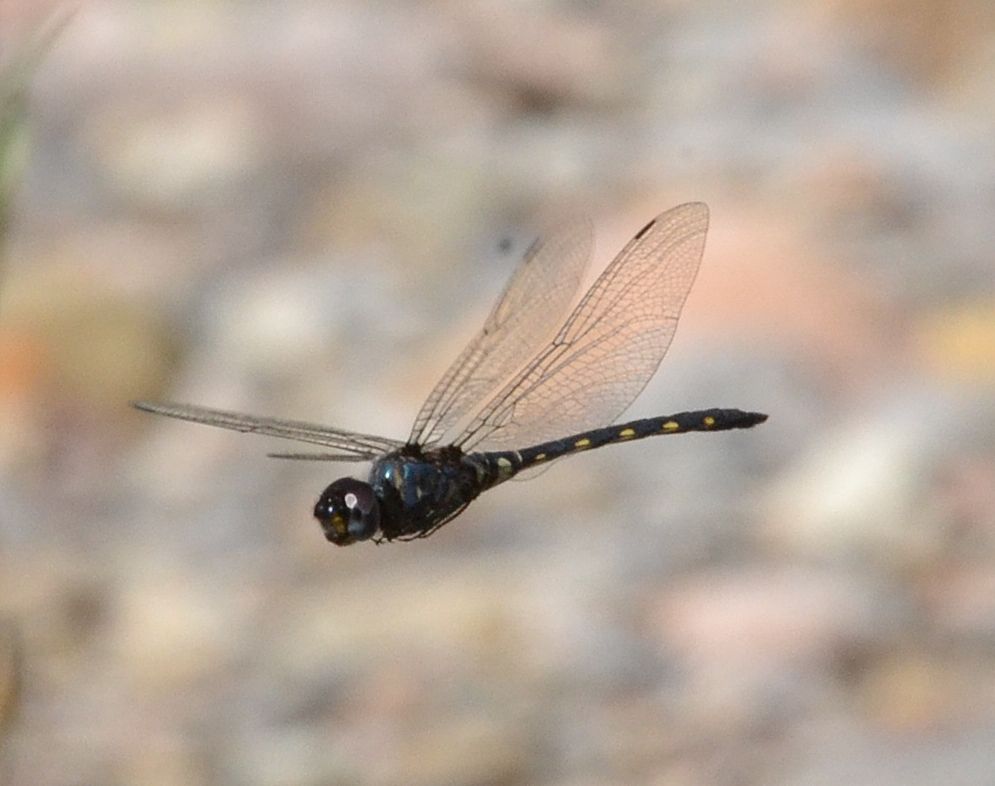
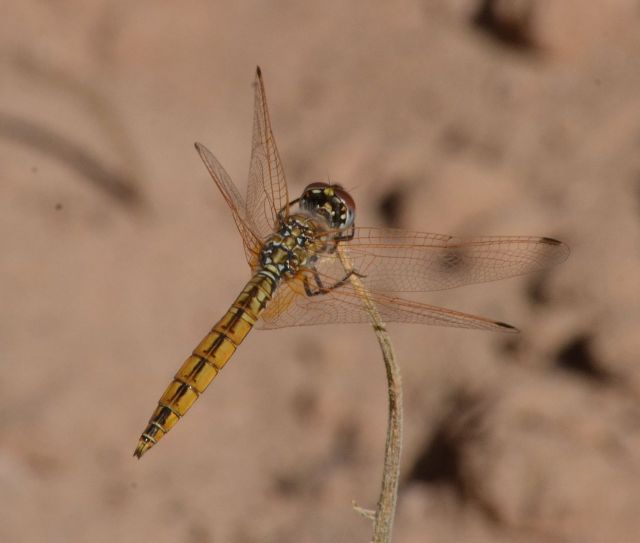
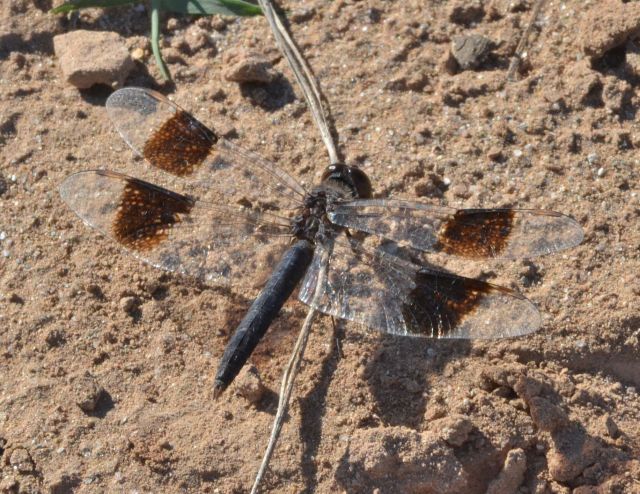
During my trip to Morocco’s Atlantic coast last week, in addition to the 16 bird lifers recorded I was pleased to find some new dragonflies. The weather was sunny throughout my stay and these insects were encountered in several locations, flying in good numbers at some. Four common African dragons: Orange-winged Dropwing, Red-veined Dropwing, Ringed Cascader and Banded Groundling were all added to my life list.

On Thursday 5th November I drove a popular tourist route through the western end of the Atlas Mountains, north of Agadir that is known as Paradise Valley. This runs from the small coastal town of Tamrhakh on the N1 for 50 km to a village Imouzzer Ida Outanane. At route’s end an information board says Imouzzer nestles at the foot of the western High Atlas, but it had seemed a long way up to me, not to mention higher and higher. Part way along this ascent the road enters a steep sided gorge in which it has been washed away then patched up in places. And that was where I lost interest in birding for the day.

Paradise Valley

Paradise Valley

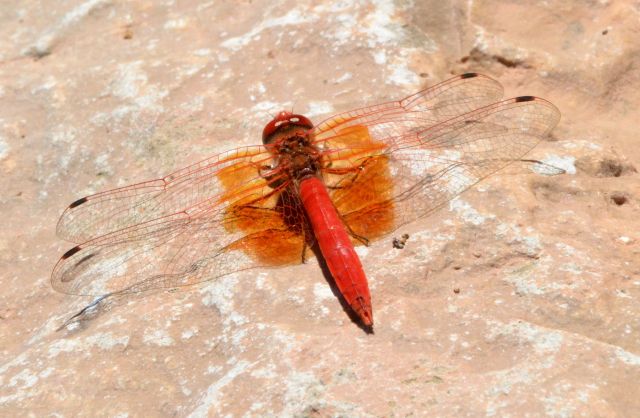
Investigating three different locations I got quickly into southern Portugal upland watercourse mode. At my first stop the most numerous dragonfly was Orange-winged Dropwing (pictured below), a species that I had expected to come across on this trip. These typically perch on waterside rocks or gravel to absorb sunlight, and here they were mixed with slender blue Epaulet Skimmer, one of the most common dragonflies of tropical Africa. The latter’s range extends to southern Iberia and I was familiar with them from Portugal in May 2014.

Orange-winged Dropwing

Orange-winged Dropwing

Epaulet Skimmer

Epaulet Skimmer

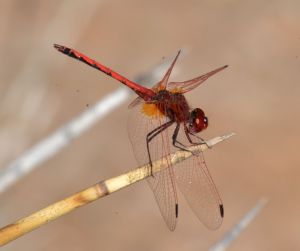
At the next stop the Orange-wings were competing for space with a much slimmer red Dropwing with black edges to its abdomen. These were Red-veined Dropwing, another of the most numerous African dragonflies.  I also saw the last named the following day at the wadi upstream from the N1 Massa bridge, where the pictures below were taken.

red-veined dropwing.1506 massa valley

Red-veined Dropwing (male)

red-veined dropwing.1511 fem massa valley

Red-veined Dropwing (female)

Though November lies outside the European flight period stated in Dijkstra and Lewington, the medium-sized species in the picture below is a male Ringed Cascader. I watched two of these for some time at my third Paradise Valley stop. According to The IUCN Red List of Threatened Species web site (see here), this is a vagrant species in Morocco where there are several recorded breeding sites from which individuals disperse widely. The fast-flying males patrol endlessly and rarely perch. A common dragonfly in tropical Africa, it favours swift-flowing permanent water-courses with rapids and waterfalls. So the habitat here is exactly right.

Mystery dragonfly

Ringed Cascader (male)

My thanks to KD Dijkstra (see here) for confirming that ID. At the Massa bridge wadi I finally caught up with Violet Dropwing, that I also knew well from Portugal. The yellow dragonfly (pictured below), seen near the royal palace south of Agadir is the female of that species.

Violet Dropwing (male)

Violet Dropwing (female)

Violet Dropwing (female)

Banded Groundling, another abundant tropical African species that extends to southern Iberia, was encountered on both my visits to the Souss-Massa national park. These are found typically on rough ground close to grazing animals.

Banded Groundling

Banded Groundling

Lastly, Lesser Emperor were seen at several locations but as is the wont of all Emperors they were not on any day inclined to stop and pose. And at Agadir’s kasbah a bold yellow and black banded number flew past. Female Ringed Cascader or a Goldenring species perhaps … I shall never know.

Moroccan Sahara south of Guelmin – 9th Nov

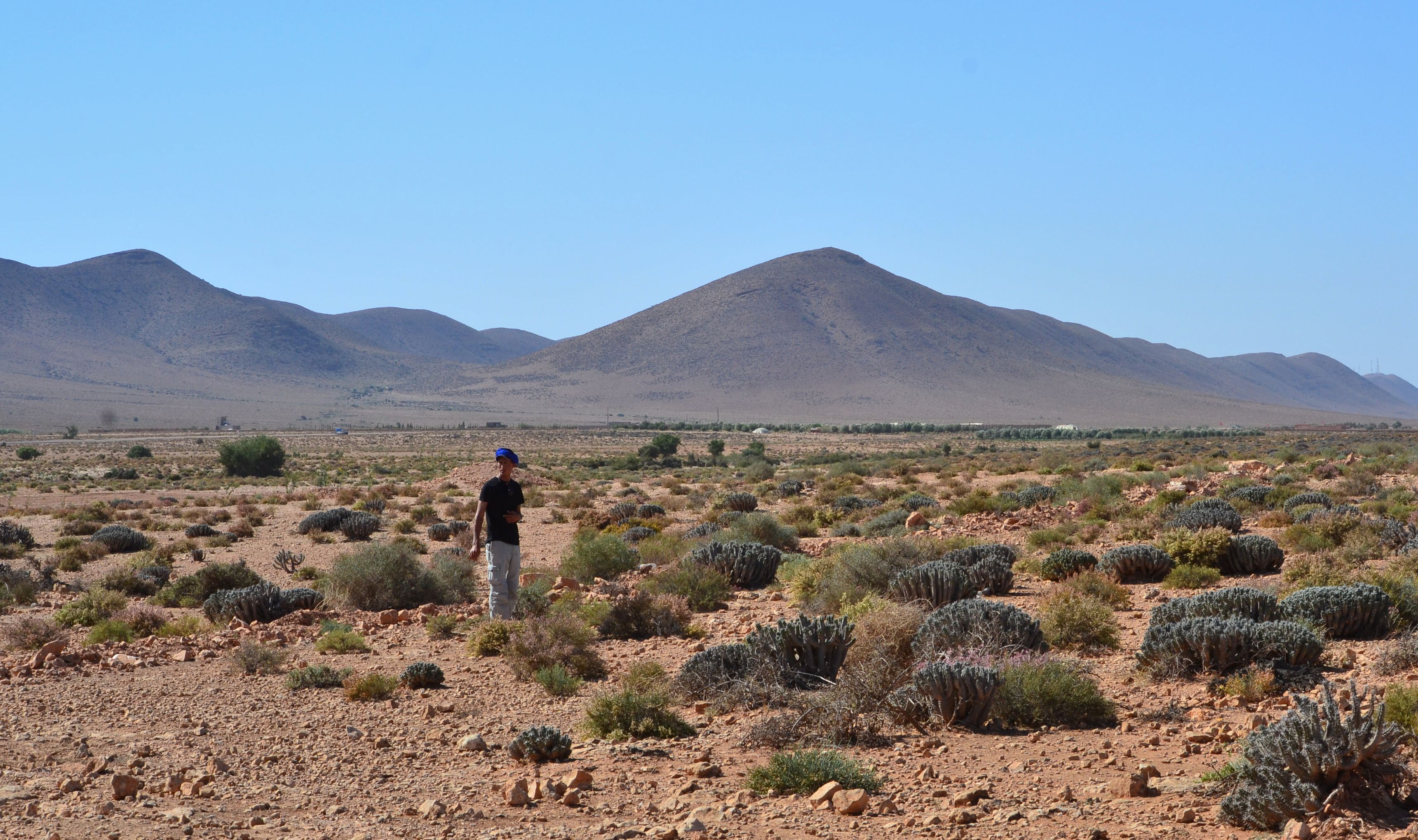
For my final day in Morocco I ventured a little further afield to experience the semi-desert around 240 km south of Agadir. I met my guide Rachid in the Souss-Massa at Arhbalou shortly after 8:30am and we set off further along the N1. First we drove through the old walled city of Tikrit then through the upland of the Anti-Atlas. As the road ascended the slopes of the latter this (below) was the view northward.

Landscape south of Tikrit

Landscape south of Tikrit

Anti-Atlas landscape

Anti-Atlas landscape

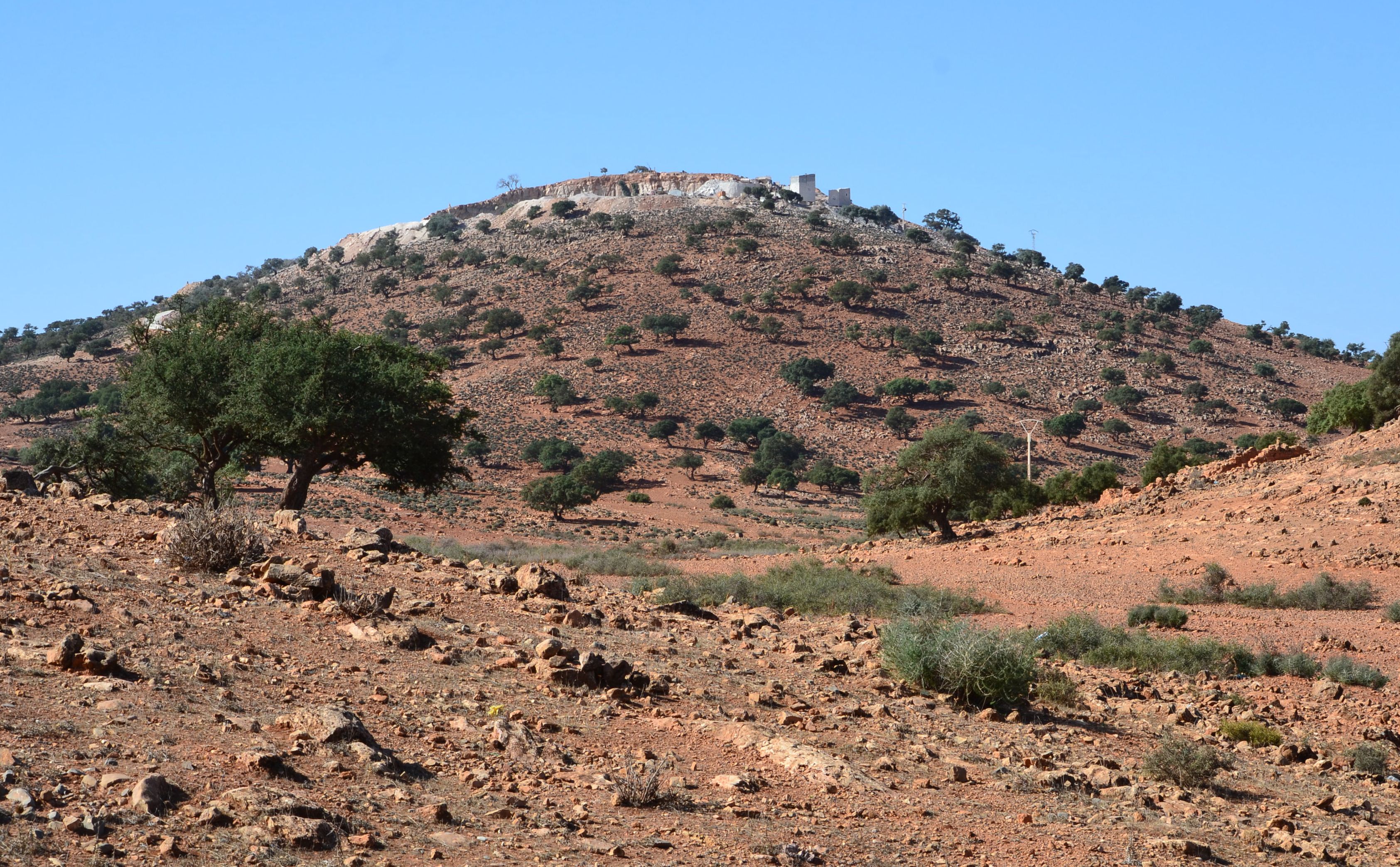
I found the anti-Atlas scenery (above) very pleasing. Its character of rounded hills reminded me of southern Portugal, but the tones here were more golden. And instead of Holm and Cork Oak the trees were mostly Argan, thorny with gnarled trunks and growing up to 10 metres in height. This endemic is mixed in places with tracts of Eucalyptus, introduced by the former French colonists to add life to the desert. South of this upland the flatter land became more arid, then we passed through the military town of Guelmin (or Goulimine). Now it was time to search for some desert birds.

Rachid at work finding desert birds

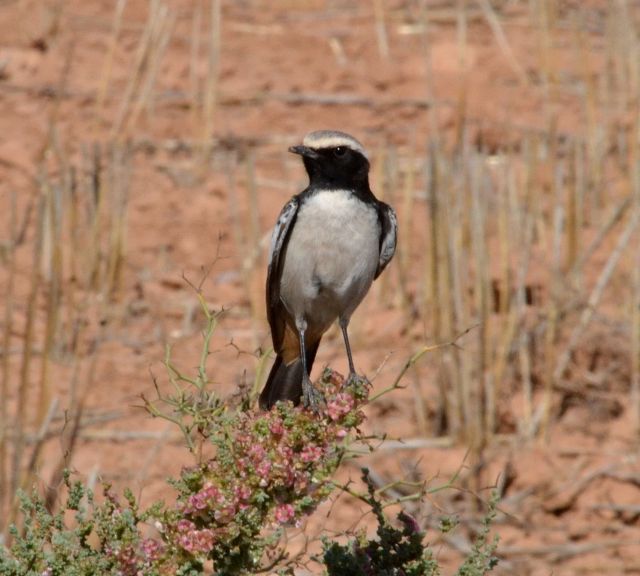
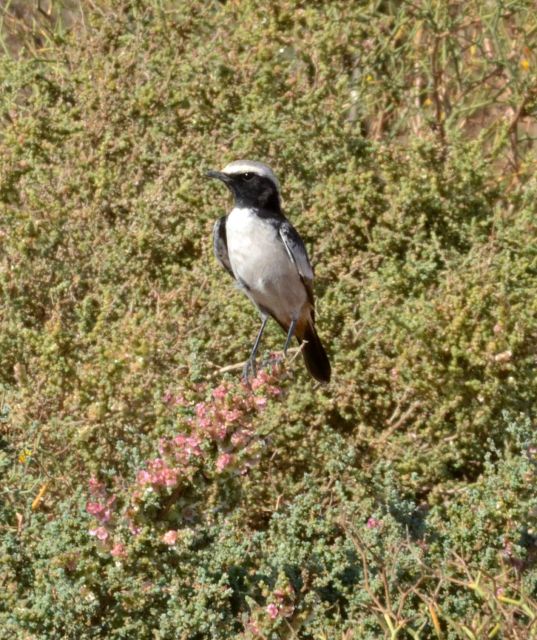
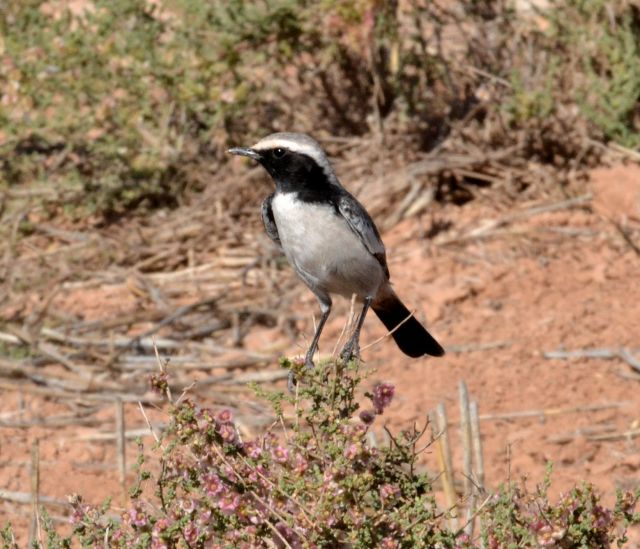
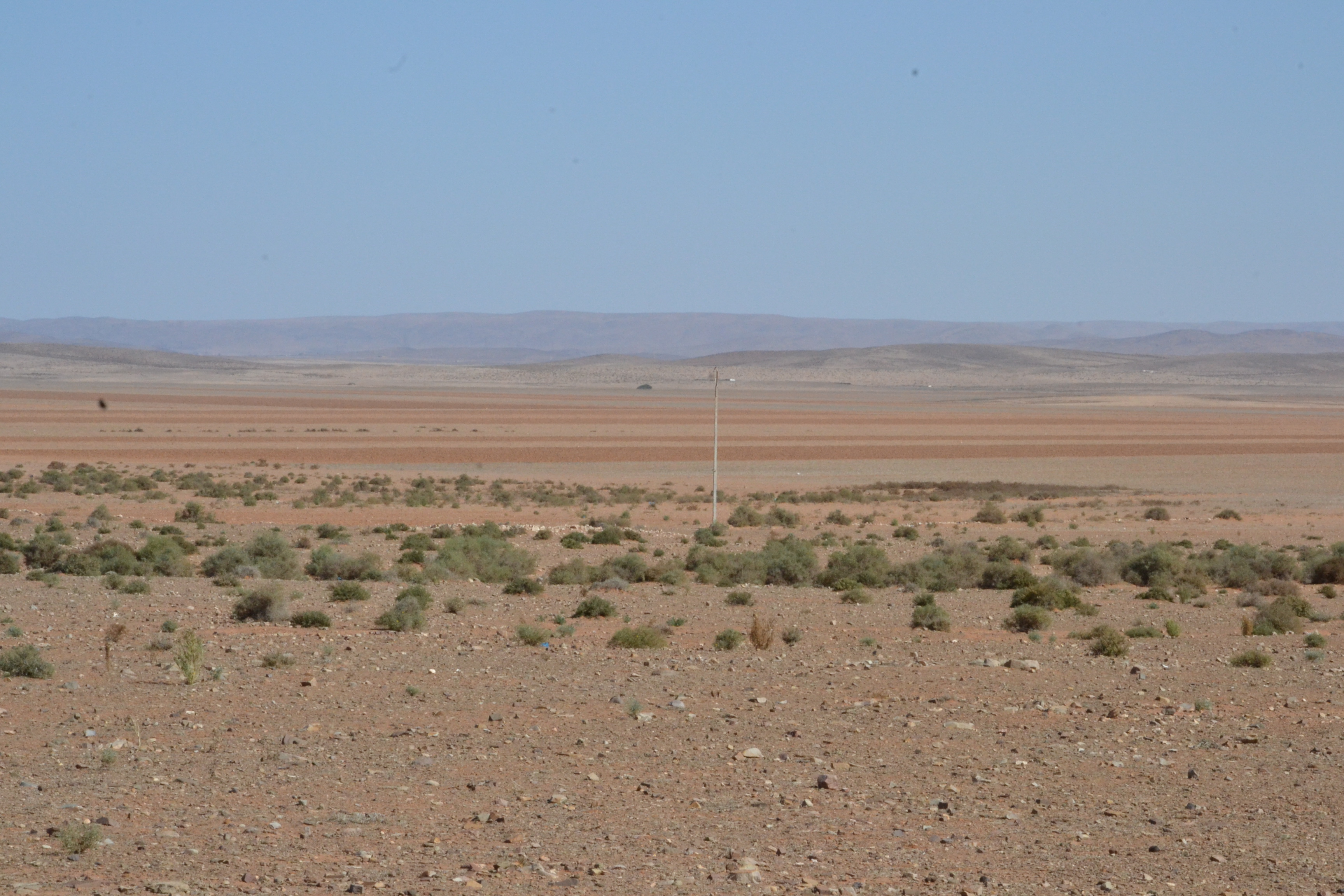
Rachid’s ability to pick out birds in the stony desert landscape was impressive. First he spotted another Black Wheatear, then the first of today’s several Red-rumped Wheatear (lifer), and two raptors Bonelli’s and Booted Eagle. But I evened things up at one stop by self-finding a female Tristram’s Warbler, an extra lifer for the trip. The last named was buzzing about low in some scrub and the pale blue head alerted me to the local equivalent of Dartford Warbler.

Red-rumped Wheatear

Red-rumped Wheatear

red-rumped wheatear_01.1508 guelmin sahara

red-rumped wheatear_01.1502 guelmin sahara

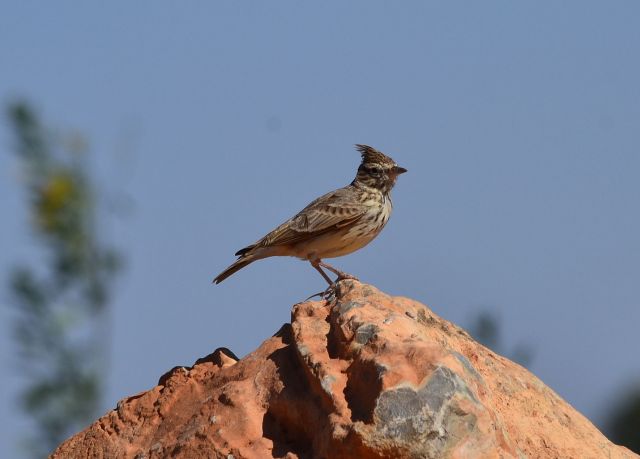
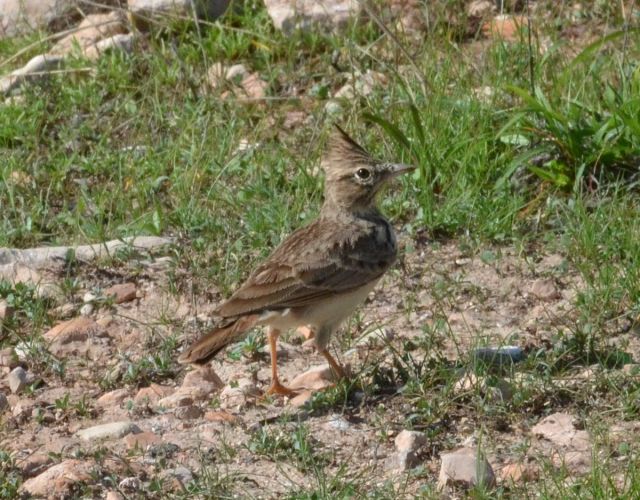
Red-rumped, Morocco’s commonest desert Wheatear at once became my favourite of the genus. I am fond of all Wheatears and have seen quite a few different species abroad now, but the subtle tones of this one seemed particularly attractive. Separating Crested and Thekla Lark in the field was explained to me again today and now I have pictures to refer to. I hope I have got this right: the easiest diagnostic is the Thekla’s smaller, darker bill.

Thekla Lark today

Thekla Lark today

Crested Lark at Agadir

Crested Lark at Agadir

Where river valleys crossed the landscape there were wadis in places, and in one we observed a Great White Egret and a Purple Heron competing languidly for the same space. Lastly we encountered a soaring Long-legged Buzzard, an important lifer because it is missing from my Cyprus list, and that brought the total new birds for this trip to 16. The only inland birds on my wish list to have got away were hence Barbary Falcon as in Fuerteventura, and Tawny Eagle.

Just after 3pm we began the return journey, and wishing to avoid the HGV traffic on the N1 Rachid opted for another route through the Anti-Atlas via the coastal town of Sidi Ifni. Though a longer way around, the scenery along this route was even more pleasing than in the morning. Today aptly demonstrated how laborious it is to cover even one region of Morocco from a single centre, because we were on the road for more than seven hours for around three hours birding. Sensing my unease at having to drive back to Agadir in the dark, Rachid got out near Massa to take a taxi home, and I completed my journey without mishap.

A grand day out in the desert, Grommit!

A grand day out in the desert, Grommit!