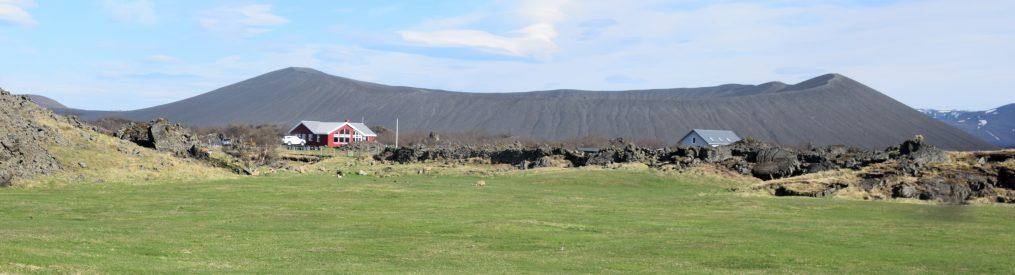
Southern Turkey: 16 – 20 June 2019
Lifers do not come any huger than Rufous-tailed Scrub Robin (pictured below). This long sought bird was my top pick amongst 21 WestPal list additions gained on the five-day 2019 Birdwatch Magazine / Wildwings tour of southern Turkey.
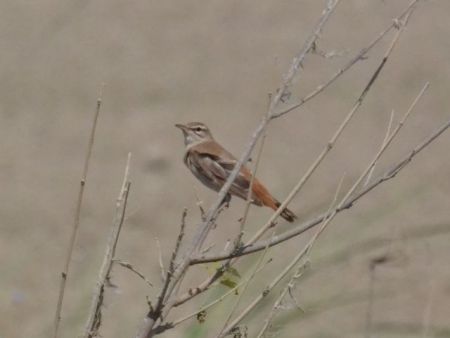
Rufous-tailed Scrub Robin
The others, in order of appearance were: Brown Fish Owl, Graceful Prinia, Eastern Bonelli’s Warbler, Krüper’s Nuthatch, Cretzschmar’s Bunting, Bimaculated Lark, Upcher’s Warbler, White-throated Robin, Asian Crimson-winged Finch, Pale Rock Sparrow, White-winged Snow Finch, Moustached Warbler, White-headed Duck, Caspian Snowcock, Red-fronted Serin, Radde’s Accentor, Finsch’s Wheatear, Syrian Woodpecker, White-throated Kingfisher and White-spectacled Bulbul.
This tour was devised and is led by the Turkish bird authority Soner Bekir, who with two colleagues trades as Birdwatch Turkey. There are not many birders in the country and this dedicated group of enthusiasts are between them responsible for maintaining national records and guiding foreign visitors. Birding tour company groups and smaller private parties are both catered for.
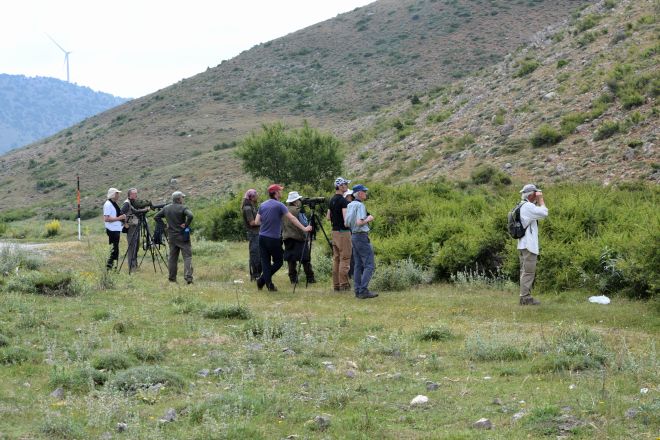
The tour group (from left): Stuart Greer, Ian Moig, Andy Davis, Soner Bekir (leader), Tom Hanson, Gordon Cox, Andrew Emmerson, Andy Middleton (hidden), John Hanson, Peter Reay
Much of the bird life described herein was observed fleetingly or distantly, but I have included some images I was able to gain. These make no pretence of being “photographs” but convey how the birds were actually experienced within the constraints of available time and the limitations of my equipment. My thanks to tour colleague Andrew Emmerson for providing more pictures of other birds that we observed.
Day one (16th): Oymapinar Lake (a) – Manavgat beaches (b) – drive to Akseki (c), Cimi village (d) and valley beyond (e)
a – Brown Fish Owl (1), Western Rock Nuthatch, Red-rumped Swallow
b – Graceful Prinia (2), Rufous-tailed Scrub Robin (3)
c – Eastern Bonelli’s Warbler (4), Eastern Olivaceous Warbler, Collared Pratincole, Krüper’s Nuthatch (5 – lunch stop)
d – Olive Tree Warbler, Middle Spotted Woodpecker, Sombre Tit
e – Black-eared Wheatear, Woodchat Shrike, Masked Shrike, Rüppell’s Warbler, Black-headed Bunting, Ortolan Bunting, Cretzschmar’s Bunting (6), Eastern Orphean Warbler
– lifers are denoted in bold type –
==============================
After flying in to Antalya late on the previous afternoon we stayed overnight at the town of Manavgat around 40 km to the east. The tour opened with a first-light start at Oymapinar Lake, to the north on the River Manavgat. Here there is a large water body behind a hydro-electric dam (pictured below) that is described as the only realistic site west of India where Brown Fish Owl may be encountered.

Oymapinar Lake © rights of owner reserved
Our extremely rare and localised target was re-discovered in southern Turkey from 2009 (see here). For many years this enigma was thought to be extinct in the Western Palearctic. There had been historic records from Iraq, Israel, Jordan, Syria, and Turkey that indicated a larger presence, but no firm sightings until two breeding pairs were confirmed at today’s location. Since then visiting birders and our guide’s own team have tracked down breeding BFO at several more sites, but Oymapinar remains the only readily accessible one. These Owls are active by night and roost on cliffs through the day. We were taken out to see them by boat, long before Turkish general public arrives at what is also a popular recreational attraction.


The first individual seen was a juvenile (above, centre) that stood out readily on it’s exposed perch in a canyon at the eastern corner of the lake. Then the parent birds (above, left and right; and below, left) were located in deeper shade on the opposite shore. These are largish (L 50 – 58cm, WS 1.25 – 1.40 m), broad-headed Owls with horizontal ear tufts. The strong protruding bill completes a characteristic profile. Flight feathers are brown with darker barring and the tail is strongly barred brown (per Collins).


We then moved on to the big canyon at the lake’s northern end. The historic breeding pair there relocated elsewhere in 2018, but one of that year’s fledglings remains on site. This individual provided my visit’s best pictures (above, right and below, left). On the drive back down after leaving the lake, Western Rock Nuthatch (below, right) and Red-rumped Swallow were both active below the dam itself. This was my fourth record of the former after others in Greece in 2017 and 2018. It was seen a number of times during this trip, while the latter were regular. There is also a local company that takes visitors to Oymapinar Lake (see here).


After breakfast back at our hotel we drove east from Manavgat along the coast in search of Rufous-tailed Scrub Robin and Graceful Prinia. I was at once impressed by how quickly these birds were located, a scenario that repeated itself time and again throughout the tour. Soner is a superb guide. He had locations to which we were taken for each trip target, one after another and they were mostly found within minutes.
The first-named bird’s importance to me as a lifer derives from being a much sought species amongst birders visiting southern Portugal, that had eluded me during my solo trip there in May 2014. Then I concentrated my butterfly and dragonfly searches on areas where RTSR might also occur, but without success (scroll down this page for the trip report).
Also known as Rufous Bush Chat, with various derivations of the two names, this is a summer visitor across north Africa and the Middle East, as well as the southern Iberian and Balkan peninsulas; wintering south of the Sahara. There are two races, with birds in Turkey and Greece differing subtly from those occurring elsewhere. This is a bird of skulking habits that favours dry, open habitats. It may be found flitting amongst dense shrubbery but also more openly on trees, the tops of bushes and posts.


When seen on the ground RTSR hops about, flaring and bobbing its long tail that is often held in cocked and spread profiles. When perched the bird also displays the tail in these ways and also may droop the wings before giving them a little flick forward. It feeds mainly on the ground taking insects, their larvae and worms; turning over the leaf litter to find such prey.
Now, one individual, doing most of those things as it moved around, gave itself up to my camera quite nicely (pictured above). These images are all the more satisfying for having been captured during a full-blown allergy attack that unusually abated after I stuffed serviettes up my nose then slept during the drive to our next location. But the affliction is not so easily suppressed and I eventually paid for attempting to do so as things played out their course right through my first weekend back home.


Graceful Prinia was no so co-operative, being observed rather more distantly, but the profile (pictured above) was unmistakable. This small, active, variable grey-buff warbler is a resident breeder in north-east Africa and southern central Asia, of which one sub-species extends into this coastal region of Turkey. It nests low down in tall grass and dense shrubby habitats, often along ditches, water courses or pools such as at this site. The wings are short and rounded and the long tail is often cocked or sometimes held in a fanned position.
After these successes we drove on north-eastward through the Taurus Mountain range towards the town of Akseki that would be our overnight stay. During stops en route both Eastern Bonelli’s and Eastern Olivaceous Warbler were encountered. The first of those was a welcome lifer as it meant I have now seen both species of Bonelli’s, the western variant having been recorded in les Cévennes, France in May 2016. Collared Pratincole was also observed during this relocation.
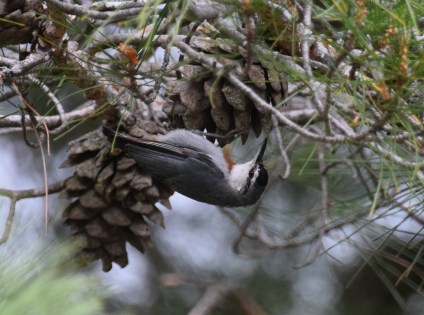
Krüper’s Nuthatch © and courtesy of Andrew Emmerson
Upon reaching our destination we headed up into the hills and made a lunch stop at a small burial ground in a wooded area. Here a Krüper’s Nuthatch (pictured above) was located, the tour’s only sighting. This coniferous forest dweller is sometimes described as being near endemic to Turkey, though there are lesser numbers in Georgia and Russia, and also a small breeding population on the Greek island of Lesvos (see here). Krüper’s is smaller and quieter than Eurasian and Rock Nuthatches with a distinctive head pattern, and rusty brown breast patch and under tail feathers.


We next moved on to a village called Cimi, where stopping the minibus our guide declared: “The target here is Olive-tree Warbler.” After walking no more than 50 metres he pointed to one side, saying: “Olive-tree Warbler calling over there,” and thus things continued throughout the tour. But this species, which I had recorded before in Cyprus and Greece, is seldom easy to see well. OTW (above left) was encountered a number of times subsequently but I only caught glimpses as these hyperactive birds moved around. Sombre Tit (above right) was similarly difficult at Cimi, though I did get a recognisable picture of Middle Spotted Woodpecker.
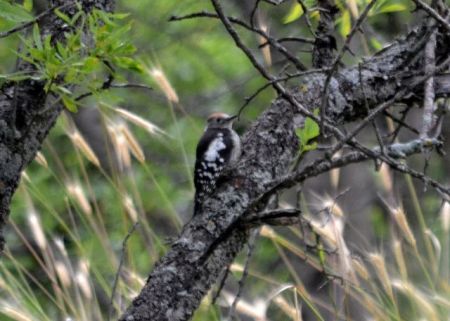
Middle Spotted Woodpecker
A rain break then ensued, and this was the weather pattern throughout the tour. Each day there was a thundery build up before heavy showers at unpredictable times. But the interruptions didn’t last for long and we lost no sightings to inclement conditions. Soner’s strategy this time was to drive on and sit out the rain, then enjoy the re-emergent bird life once the sun came out again. That was exactly how things transpired. Around an hour parked in a scenic upland valley gave way to a very pleasant evening session during which I appreciated just how different the birdscape is in the region.
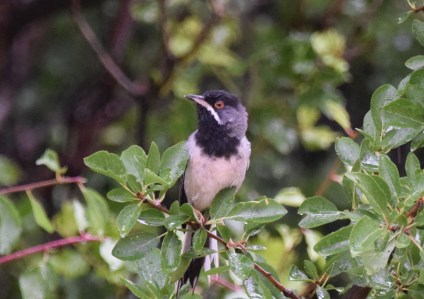
Rüppell’s Warbler © and courtesy of Andrew Emmerson
It helps of course to be travelling with an expert who knows exactly where to find all the best birds. First we watched a pair of Rüppell’s Warbler (above) feeding young, only my second ever record after one on Paphos headland, Cyprus in April 2012. Then a Black-eared Wheatear put in an appearance. Woodchat and Masked Shrike were both active, along with Ortolan and Black-headed Bunting (pictured below, left). All these species except for the Rüppell’s were seen fairly regularly through the tour, especially the last-named.


The prime targets at this site were Cretzschmar’s Bunting (pictured above, right) and Eastern Orphean Warbler. To attract the former our guide played a recording as we walked along and after maybe 20 minutes a pair duly flew in. This is another very important lifer being a regional Bunting that is absent from my Cyprus list. CB is a summer visitor to Greece and Turkey, southward to the Red Sea, beyond which it winters. Now I can even spell the name without thinking too much though that still might be difficult after a few beers.
Distant Eastern Orphean Warbler (record shot)
With this record duly gained the next target was Eastern Orphean Warbler, that when located was another second ever for me after one in Greece in May 2017. The smudge amidst the yellowish vegetation in the above image indeed is one. Now a very long day’s agenda had been completed with aplomb, and I was set to sleep well whilst still being ready for a 5:30 am start in the morning. Naturetrek this tour was not!
Day two (17th): Overnight in Akski (a), Cimi village and valley beyond (b – pre breakfast), through low lying area to Sugla Lake (c), Bozkir (d – lunch stop), drive through steppe landscape to Karaman then via Lark sites to Eregli (e – overnight)
a – Laughing Dove, OTW and EB and EO Warblers again
b – Middle Spotted Woodpecker, Red-backed Shrike + Woodchat & Masked, Woodlark, Nightingale, Ortolan and BH Bunting
c – Black and White Stork, Black-crowned Night Heron, Purple Heron, Egyptian Vulture, Lesser Spotted Eagle, Booted Eagle, Steppe Buzzard, Long-legged Buzzard, Great Reed Warbler, Spanish Sparrow
d – Isabelline and Black-throated Wheatear
e – European Roller , Greater Short-toed Lark, Bimaculated Lark (7), Calandra Lark
==============================
Before breakfast we visited Cimi and the valley beyond that village again, seeing mostly the same birds again. The Olive Tree Warblers that interested our guide were again elusive, and Eastern Bonellis and Olivaceous Warblers were encountered as fleetingly. A Red-Backed Shrike showed itself amongst Woodchat and Masked cousins, while the song of Nightingale and Woodlark was carried on the air.
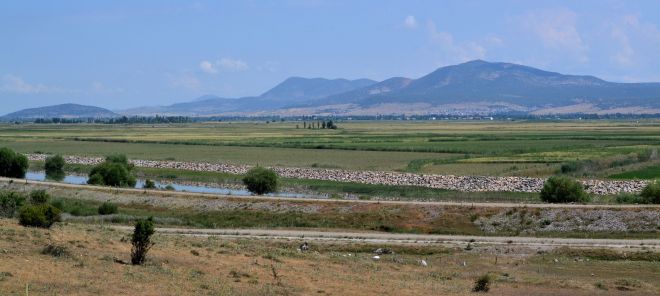
Landscape to the north-east of Akseki
The tour then moved on to the north-east, leaving the Taurus Mountains behind. We had been primed to look out for Laughing Dove in Akseki and one was spotted as we left the town. Our route next crossed low lying agricultural land (pictured above) towards the wetland site of Lake Sugla. We made several stops along the way, scanning for passerines and raptors. Booted and Lesser Spotted Eagle (below, left) were both noted along with a first Egyptian Vulture, Steppe and Long-legged Buzzard (below, right).


Long-legged is the default Buzzard in much of Turkey and occurred regularly through the remainder of the tour. This is a raptor that had been pointed out to me either briefly or distantly in the past, so I was pleased to gain a full understanding of how to identify it (see here) through some closer encounters now. Steppe Buzzard, the regional sub-species of Common Buzzard was also noted a number of times.
In one village where we stopped to check out the hirundines and Swifts, a White Stork nest (pictured below) also hosted many Spanish Sparrow as they commonly do. Somewhere in the landscape pictured higher above a Black Stork was foraging. Drainage ditches along our route and Lake Sugla itself held Purple and Black-crowned Night Heron, and Great Reed Warbler. All this was a very different birdscape indeed!


In the afternoon we drove on eastward through steppe landscape, to seek out more birds of that habitat. The main trip targets here were Larks, of which Bimaculated, Greater Short-toed and Calandra Lark were all located. The second of those was a bird I had recorded just once before in Portugal, but a respondent to that trip report queried my ID so it was pleasing to confirm its place on my life list here. Calandra is a Lark I have previously found difficult to pinpoint whilst knowing they are out there somewhere, while Bimaculated was entirely new. All three were seen well now. At one Lark stop we also came across the tour’s first White-throated Robin, but more of that lifer later.
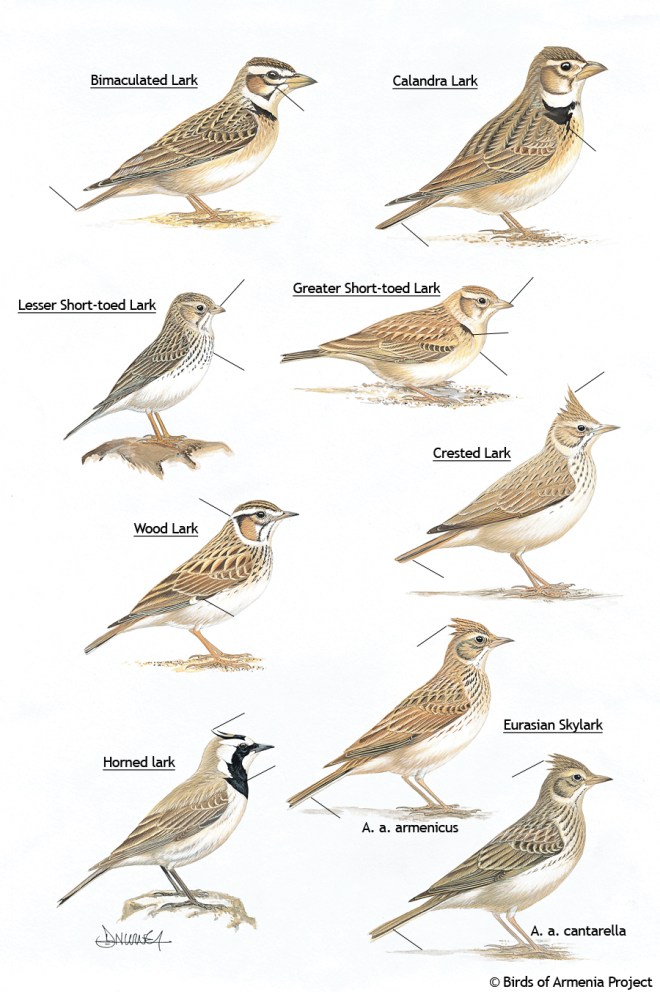 Bimaculated Lark is similar in appearance to Calandra but around 10% smaller and relatively longer winged. It occurs from west-central Turkey through the Middle East and Central Asia. Calandra has a more western distribution but is also resident across parts of the migratory Bimaculated’s range. Both species are largish, robust Larks with thick bills, broad wings and short tails. Greater Short-toed is a summer visitor throughout the Mediterranean region and eastward into the Caucasus and Middle East.


Further notables during this leg of the tour were a pair of European Roller on roadside telegraph wires, Black-throated and Isabelline Wheatear (pictured above, right). The latter was observed a number of times again over the next two days. After a lot of driving through this day it didn’t rain until the evening. Our overnight stay was in the town of Eregli.
Day three (18th): Aladaglar mountains (a), Sultan Marshes (b)
a – Upcher’s Warbler (8), Barred Warbler, Isabelline Wheatear, White-throated Robin (9), Asian Crimson-winged Finch (10), Pale Rock Sparrow (11), White-winged Snowfinch (12), White-throated Robin, Black Redstart, Egyptian Vulture, Red-billed Chough
b – Long-eared Owl, Moustached Warbler (13), Great Reed Warbler, White-headed Duck (14), Bearded Tit, Ruddy Shelduck, Squacco Heron, Purple Heron, Glossy Ibis flying, Little Bittern, BCN Heron, Little Egret, Spur-winged Plover
==============================
From Eregli we drove north-east to visit Sultan Marshes National Park, a major wetland site. But the weather was looking threatening so to beat the rain we headed up into the Aladaglar Mountains to convert some montane passerine trip targets. There would be no shelter up there whereas the first location had hides and an on-site restaurant. Between them these two sites yielded an impressive seven life list additions.


Our first stop in these mountains was for Upcher’s Warbler (pictured above) that was soon located. This is a medium-sized, rather plain and drab looking Hippolais that breeds from Turkey south and east to Pakistan, wintering in eastern Africa. So we were observing the species right at the western end of it’s range, where it frequents scrubby areas especially favouring Tamarisk thickets. The supporting cast here comprised Barred Warbler, Isabelline Wheatear (below, left) and White-throated Robin.


The last-named (pictured below) was observed on the next two day’s as well, but were always fast moving and hyperactive so difficult to get pictures of. Male WTR are unmistakable and very attractive. During a nature break at this site a juvenile (above, right) dropped out of the next bush and so I was able to capture an image of sorts.
This is a summer visitor to south-eastern Turkey and countries to the south and east, wintering in East Africa; and so is another speciality of the area covered by this tour. Our guide recalled how in June 2011 his group were watching the bird when news broke of the famous individual in Hartlepool, north-east England at which some participants headed straight for the airport. Now that is hard core!


White-throated Robin ↑ and Asian Crimson-winged Finch ↓ © and courtesy of Andrew Emmerson

The second stop here was at a spot where Asian Crimson-winged Finch (pictured above) are attracted to a particular rocky slope by salt put out by shepherds for their goats. There was a bit of a wait this time before a pair flew in and again I was unable to obtain pictures. This generally shy Finch also occurs from this area of Turkey south-east to Pakistan in montane habitat. It inhabits rocky slopes often at high elevations, nesting in crevices and ravines, but moves lower down in winter. A separate population in Morocco’s Atlas Mountains was formerly considered to be con-specific but in 2011 the two were split into separate species.


That montane speciality was soon followed here by another in White-winged Snowfinch (pictured above). This was a very welcome lifer indeed as I have not previously visited likely places for them. The best chance of seeing them closer to home is said to be around rubbish skips in Alpine ski resorts. The species ranges at high altitude from the Pyrenees across southern Europe and into the Middle East.


Black Redstart, Red-billed Chough and Egyptian Vulture were also noted at this site. Our guide was then excited to locate a bonus bird Pale Rock Sparrow / Finch (pictured above), the first one ever seen on this tour. It is a summer visitor to parts of the Middle East and Central Asia that is rarely found so far west. And this sighting completed a to say the least, rather special morning session.
Now we visited the aforementioned Sultan Marshes, taking lunch under cover as the heavens opened. After the downpour ceased we braved the sodden board walks and soggier wet meadows into and around a large reed-edged lake in search of what for me were two further huge lifers. Moustached Warbler and White-headed Duck owed that status to being two of just six remaining stragglers on my south-western Europe wish-list. Now that number is four: those being Eastern Olivaceous and Orphean Warblers, Crested Coot and Lammergeier.


I had previously failed to find Moustached Warbler in areas where they were said to be in Cyprus and la Camargue, France. Now I fully appreciated why as they are easy to hear but extremely difficult to set eyes upon. As tour colleagues called the bird all around me I remained optimistic or naive enough to assume they must actually be showing, but of course it was only no longer visible glimpses that were being referred to. This was all very frustrating and as we walked on to hides at the boardwalk’s end my tolerance level deteriorated.
There are two pairs of White-headed Duck at this site, and after a short wait a female was spotted on the far side of a large lagoon. Gradually but steadily she moved towards our hide. There is a very small population in southern Spain that I didn’t get around to visiting on my only solo birding trip there. The Spanish cluster was responsible for the English Ruddy Duck population being eradicated earlier in this decade, since it was considered males of the latter persuasion were rather too intent on holidaying on the costas and inter-breeding with the native White-headed females. It was a culling programme that remains a matter of great controversy amongst British birders.


Now I had my opportunity to record this long sought item, but when our individual was only half way across the lake my fellow tour participants decided to move on. It was now that I rebelled against the group as I have been told I am wont to do, and no problem there. I am not a photographer either but I did want at least half-decent pictorial records as well as a trip list addition. So I stayed behind and the female WHD edged nearer and nearer before crossing in front of the hide and the above images were gained. But neither resident male chose to show itself on this occasion. I must confess to not quite getting it why anyone would have wished to leave in the circumstances.
Satisfied with the experience, I moved back along the boardwalk to where the Moustached Warblers had been active, enjoying my re-established independence. Hanging around there for some time I gained just one diagnostic view that revealed the boldly striped head pattern, such as I wanted. That had to suffice and at length I strode on to catch up with the group. In the wet meadows Squacco and Purple Heron both stood out in places. The latter is a water bird I had managed to take pictures of just once previously, on Cyprus’s Akrotiri peninsula in April 2012. These digiscoped images (below) are a little better.
When I eventually re-joined the group I had apparently missed Citrine Wagtail and distant Lesser Short-toed Lark, neither of which I needed on this tour. But I had noted an unusual Wagtail of some kind as well as Spur-winged Plover. After leaving Sultan Marshes behind we drove on to our overnight stay at the excellent Pansiyon Safak (see here) in a village Çukurbag on the other side of the Aladaglar Mountain range from where we had been earlier. In the morning we were to be taken up Mt Arpalik Çukuru (below right) for the climax of this tour.


Day four (19th); Aladaglar mountains (other side – a), Emli Valley (b)
a – Caspian Snowcock (15), Chukar Partridge, Crimson-winged Finch, White-winged Snowfinch, Red-billed and Alpine Chough, Crag Martin, Red-fronted Serin (16), Radde’s Accentor (17), Ortolan Bunting, Horned Lark, Finsch’s Wheatear (18)
b – Syrian Woodpecker (19), Scops Owl, European Bee-eater, Red-backed Shrike, Blue Rock Thrush, Chukar, Isabelline Wheatear, Alpine Accentor
==============================
Pensions are family run guest houses offering basic but wholly adequate accommodation at low cost to travellers with outdoor interests. I thought the ambience was entirely suited to a trip such as this. Our host Hasan (of apparent Gosney fame) owns a tractor and trailer with which he transports his birding, trekking and mountaineering guests to high elevations. It was an exhilarating ride, our mission being to observe one of the rarest and most tricky to observe birds in the Western Palearctic, Caspian Snowcock when they become active on the mountain tops at dawn around 5:00 am.
Soner was impressed by nobody being late for the tour’s pre-breakfast sessions, though he did warn that any transgressor would not be waited for. Today’s was the earliest start of all at 3:30 am and wearing our extra packed layers we duly reached the darker and lighter dividing line in the preceding picture to scan the towering rock faces above. I was actually the first to locate our quest, just about the only bird I called all week.

The group scanning for Caspian Snowcock on Arpalik Çukuru
Caspian Snowcock are hefty grey-buff toned partridges that are native to scattered mountain areas from this part of Turkey eastward, and from Armenia and Azerbaijan to south-western Iran. They favour steep, inaccessible locations at altitudes from 1800 to 3000 metres, in which they are very wary and difficult to approach. Further north the related Caucasian Snowcock is endemic to the Caucasus region.
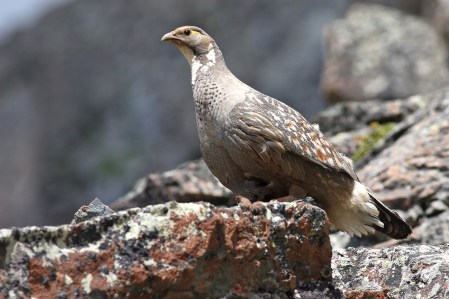
Caspian Snowcock (above) © rights of owner reserved


We gradually became aware of these birds’ far carrying, ascending, whistling calls, that are said to resemble Curlew, from around five locations. The plumage is patterned grey, brown, white and black, but looks pale grey from distance. The Snowcock were very well camouflaged against their rocky habitat but through scopes it was not difficult to discern their movements. Chukar Partridge were also calling in places, while Red-Billed and Alpine Chough and Crag Martin were active overhead.
I was able to send and receive texts from this elevation despite being outside my network’s EU range. Having converted the early morning’s prime target so successfully we then turned our attention to the montane passerine life of these high slopes. Crimson-winged Finch (pictured below, left), White-winged Snowfinch and Ortolan Bunting were all active here; as were two more important target species of the region.


Radde’s Accentor (above right and below left) is resident here and in the southern Caucasus, and a short distance migrant in between. This is a lively and restless little bird, that flies between low bushes and scampers on the ground, rarely staying in one spot for long. Dunnock sized, it more closely resembles Alpine Accentor but with a striking head pattern of broad, cream, supercilium, whitish throat and dark crown and cheeks. It inhabits boulder strewn, scrubby areas between 2500 and 3000 metres, and is prone to wing flicking as it darts around.


Red-fronted Serin (above right) was as restless and mobile but the males stood out by their very dark, sooty head pattern. I nonetheless gained only several glimpses and could not get pictures. This little finch is a breeding resident in mountain regions across Turkey, the Caucasus and Iran, occurring between 2000 and 4000 metres. And thus my set for the tour of small regional passerines that are unlikely to be encountered further west was complete. It had required a deal of effort and determination to acquire all these early morning sightings on this day, but we had been almost totally successful.
On the drive back down the mountain we encountered first Horned Lark then a further absentee from my Cyprus list, Finsch’s Wheatear. The latter is most easily told apart from the similar Black-eared and Pied Wheatears by a broad white band that runs all the way down its back. Here we came across an adult and juvenile together.


One species that had eluded us so far was Syrian Woodpecker, the last European member of that genus I needed for my life list. After a late breakfast back at the pension we set out to find one in nearby orchards such as the species favours over denser wooded areas. I was able to gain a good view of the perched bird that is very difficult to tell apart from Great Spotted Woodpecker, so I am just taking our expert guide’s word for the ID.
The other peckers we found on this tour were all Middle Spotted. Having read things up I understand the clearest diagnostics for Syrian by comparison with GSW are an incomplete black cheek band and lack of black at the base of the bill, as this outsourced picture (below) shows. The “tick” call is also softer in Syrian, whose drum roll has longer pauses. European Bee-eater was also located at this site.

Syrian Woodpecker © rights of owner reserved
This location opposite the Safak pension is on a track that leads up into the Aladag National Park via the very scenic Emli Valley (pictured below) which we now explored further. Our guide said conditions were not good for Lammergeier, my only remaining trip target. So upon coming across concentrations of mud puddling blue butterflies containing several new species (for me) that I just could not walk past, I followed my own agenda for a while. When I rejoined the group I had apparently missed Golden Eagle and a distant Rock Sparrow, but no matter.
A short afternoon rain break then ensued after which we walked back. Alpine Accentor, Blue Rock Thrush, Red-backed Shrike, Isabelline Wheatear and more Chukar Partridges were all now recorded, and we inadvertently disturbed my second ever Eurasian Scops Owl. But the Red-throated Serin that we hoped for better views of here were just not playing ball. After that pre-dawn start to the day and having foregone lunch we returned to our accommodation early for rest and relaxation. It had been a memorable day.
Day five (20th): Turla Wetland (a), drive to Adana and airport (b)
a – Cattle Egret, Pygmy Cormorant, White-throated Kingfisher (20), Black-crowned Night Heron, Squacco Heron, Pied Kingfisher, Graceful Prinia, Kentish Plover, Little Stint, Spur-winged Plover, Avocet, Caspian Tern, Little and Sandwich Tern, Booted Eagle
b – Collared Pratincole, White-spectacled Bulbul (21)
==============================
Our return flight from Adana was not until late afternoon, which allowed plenty of time to visit some coastal sites en route to that town’s airport and add some wetland birds to the trip list. Regional favourites Squacco and Black-crowned Night Heron, Pygmy Cormorant and Cattle Egret were all observed in drainage ditches and along canals while raptors including Booted Eagle soared overhead. But the real prize here were the Kingfishers.
White-throated Kingfisher, my 20th trip lifer that occur here at the far western end of an extensive geographical range, are impressive looking beasts indeed. The size of a large thrush, this lively, vividly coloured bird is not strictly associated with water but can also be found on drier farmland and in woodland or town parks. We observed them mainly on overhead wires.


After a heavy though thankfully brief shower we moved on to a site Turla Wetland for a three hour stay. There we soon located the as wide ranging Pied Kingfisher that was especially satisfying for me. The status of Greater Short-toed Lark on my life list having been clarified earlier on this trip, PK was probably the last bird therein about which all doubt needed to be removed. Of the several records I submitted to the Cyprus bird recorder following my first trip there in November 2011 this was the only one I wasn’t sure about, but also the only one that was accepted. I have been known to mention that in this journal from time to time. Now I had a nailed-on, unmistakable sighting.


The bird we watched here was in exactly the pose replicated in the outsourced picture (above, left), and also treated us to a display of hovering as this Kingfisher is wont to do. Graceful Prinia were observed here for a second time on the tour, offering better views than the first but still beyond camera range. Waders included Kentish Plover, Little Stilt, Avocet and Spur-winged Plover (above right); while Caspian, Little and Sandwich Tern were all noted.


It remained to do justice to White-spectacled Bulbul. Also known as Yellow-vented Bulbul this resident species across coastal regions of southern Turkey, then south to the Red Sea and around the Arabian peninsula, is especially plentiful in the Adana area. We had noticed them dropping off roadside wires or landing in trees from time to time during the tour, but without ever seeing them well. Now, on the final drive to the airport that situation was rectified (pictured above); and that was my 21st lifer for this trip.
Conclusion
This was quite simply a fantastic tour. I was attracted by the potential for upwards of 17 lifers and in the event 21 were delivered. The majority of those were western Palearartic species on the edge of their range such as birding this region affords the opportunity to experience. But I also knocked eight lingerers off my dwindling south-west and south-east European wish lists, albeit that these were recorded outside those political boundaries. My only trip target to evade us was once again the elusive Lammergeier … one day, maybe I will see one.
It was also an agreeable group, free from non-stop talkers, wisdom dispensers or stand-up comics; and with a good range of ages. As a party of 10 we travelled in a comfortable and spacious 16-seater minibus instead of the cramped and vision restricted 8-seaters used by so many other wildlife tour operators. Turkey was an interesting and scenic country to visit, especially in the mountain areas. The food was good, healthy and never too much of it; and I found Turks on the whole to be friendly and hospitable people who do not seek to exploit foreign visitors to their country.
In short I can thoroughly recommend Wildwings’ package and especially our leader and guide, the incomparable Soner Bekir and his trusted Captain who did all the driving. Thanks again guys, you were superb. My WestPal bird list now stands at 489.
For the full species list of 161 birds for this tour see here.
Estonia: 5 – 10 April 2017
Having experienced most regular (ie non-vagrant) birds in south-west Europe over the last five years, my attention in 2017 turned to new countries in which I might gain multiple life list additions. One of these is Estonia, the most northerly and least populated of the Baltic states. Hence I joined this group tour by a Dutch operator BirdingBreaks.nl that was featured in Birdwatch magazine. The trip targets were mainly woodland species: three Grouse, three Owls, Nutcracker, and very importantly four new Woodpeckers; as well as Eagles and the sea duck Steller’s Eider.
One landscape predominates in northern and western Estonia: flat, mostly yellow-toned fields and tracts of predominantly pine, silver birch and spruce woodland. This region, having been shaped by the ice ages is further characterised by peat swamps, lakes and river flood plains, and nowhere exceeds 50 metres above sea level. The pictures below give the general impression. It is endlessly samey, dour even but very wildlife rich.


About half of the country’s surface area is wooded. 25% of this is protected with a larger proportion given over to commercial forestry. But timber was not exported during the 20th century Soviet occupation so there are a lot of trees to go round. All of this poses the question of just where to start looking for the required woodland birds. I think it would be very difficult to bird this country alone, or even in a group without a local guide.
Day 1: We set off from Tallinn airport by minibus at around 2:30pm on 5th April, our destination being the island of Saaremaa. The first stop along the way was Kasari floodplain meadow, one of the largest extant open meadows in Europe. Flooding is caused here by snow melt in the catchment area and strong south-westerly winds that push sea water onto coastal lowlands. At the time of the spring flood thousands of migrating wildfowl stop over here, and as the waters subside the meadow attracts large numbers of waders.
Scanning the Barnacle and White-fronted Geese we found two Red-breasted Geese in amongst them. This was a good scene setter for northern birding I thought.A White-tailed Eagle made a long and languid fly past, then another one drifted through at greater distance. These huge raptors that have a front-heavy, large-billed, long, broad-winged profile with deeply fingered primaries, were seen on every day of the trip.


From time to time along our route Common Crane would adorn roadside fields, almost always in pairs and sometimes dancing. A lot of these long-distance migrants pass through Estonia in spring time to breeding grounds further east. But Estonia’s bogs, swampy forest openings and wetlands are ideal breeding habitat so a proportion remain here. They were a frequent sight throughout this trip. The calls of these stately, long-legged birds as they approach in the air was also the week’s most evocative sound.
On the ferry crossing to (and from) Sareema what seemed a roll call of northern wildfowl would drift by on either bow, or fly busily from one spot to another. Long-tailed Duck were everywhere. There are thousands of them in the northern Baltic. Common Scoter were well represented, while the white eye and wing patches of a few Velvet Scoter could also be picked out in some of the rafts that rode the waves in the middle distance. Also seen in varying numbers were Scaup, Common Eider, Common Goldeneye and Red-breasted Merganser. It was impressive to see all these ducks in such numbers and a different birdscape from other parts of Europe certainly.
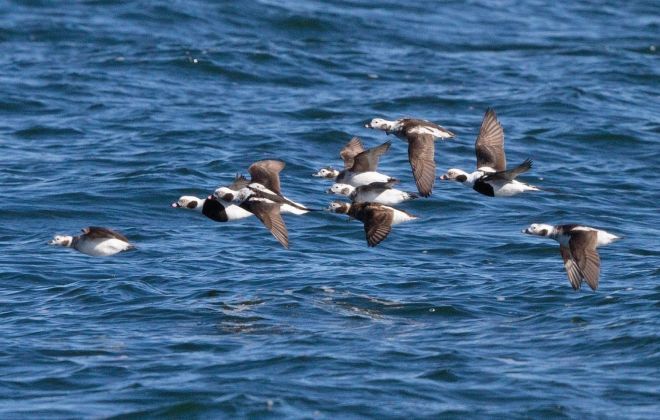
Long-tailed Duck courtesy of Richard Stansfield
Before reaching Saaremaa the road crosses a smaller island Muhu. Between the two is a narrow strait which is traversed by a causeway. Offshore here were very many Bewick’s Swan and also numbers of the larger Whooper Swan, as well as Mutes. In amongst these were more familiar wildfowl such as Tufted Duck, Wigeon, Teal, Gadwall, Northern Pintail and Mallard; and also Smew here and there. But the must-see attraction of this island is the wintering flocks of Stellar’s Eider which grace it’s western seaboard that is ice free all year round, Those would have to wait for the morning.
Day 2: Our overnight stay was in a former manor house dating from the German occupation of Estonia in centuries past. These facilities, once the homes of foreign nobility, are now state owned and leased out to local hoteliers. On Thursday morning we headed for the coastal national park of Vilsandi that covers a total area of 237.6 km sq comprising many islets, peninsulas and relatively sheltered bays.
It is the last-named that attract around 2000 Stellar’s Eider from December to mid-April. They have to be picked out from amongst their Common cousins and the ubiquitous Long-tailed Duck here, as well as the assortment of wildfowl noted on day one. The tundra breeding Stellar’s prefer shallow coastal waters in winter, especially with in-flowing fresh water, and they often come quite close inshore.
Our guide checked out a number of likely locations without success, before we arrived at a rather remote and deserted jetty location in Kudema Bay. This internationally Important Bird Area (IBA) is an important staging and wintering area for many water fowl. Here we scanned through the by now familiar assortment of offshore duck until from right at the end of the jetty a raft of about 80 or more Stellar’s Eider (lifer) were located bobbing in and out of view towards the far side of the bay.
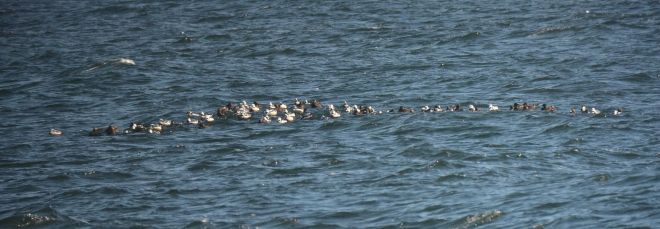
Raft of Stellar’s Eider in Küdema Bay
These birds are about two-thirds the proportion of Common Eider, roughly the size of Common Goldeneye. Steller’s have a square head and spatulate, not wedge-shaped bill. The body appears elongated and the tail is cocked upwards like a Scoter when at rest. The stunning males are intricately patterned though at a distance stand out as almost white amongst the dark, chocolate-brown females.
We all observed them for some time before it was time to move on. I was one of the first back to the minibus but was then called back. Our raft of duck had relocated much closer inshore and so the diagnostics were plainer to see, especially with the pale-toned drakes. And so we watched a litle longer before departing.
There was now a long drive south-eastward to Soomaa National Park. On the way we stopped at a woodland site where the first of the trip’s woodpeckers was located. Grey-headed Woodpecker (lifer) occurs across much of northern, central and eastern Europe, southern Russia, China and south-east Asia. This medium-sized woodpecker feeds mainly on ants and other insects, and so requires habitat with plenty of insect-rich decayed, deciduous trees. Hence this species has declined in areas where old natural woodland has yielded to commercial coniferous forestry. Plumage is similar to the larger European Green Woodpecker with the obvious difference of a grey instead of green head and a red forehead patch in the male. It has a shorter neck, slimmer bill and slightly rounder head than Green Woodpecker, and lacks the latter’s black and white bars on the tail sides.


“Soomaa” in Estonian means land of bogs. 80 per cent of the park’s 390 sq km area consists of raised bogs, swamp forests and seasonally flooded meadows that are largely untouched by human activity. This area’s river system cannot hold all of the waters flowing down from neighbouring uplands in spring, and so roughly half of it floods in what is known locally as “the fifth season”. At this time the steep-sloped raised bogs of what is Europe’s largest intact peat bog system stand like islands in expanses of water.

The map above shows the main raised bog areas between which run roads on higher ground. Western Capercaillie lek in the early morning at the bog margins and then frequent the roads where they take grit into their gullets to aid digestion. Hence these large gallinaceous birds can be rather easier to experience here than has been suggested to me by other Oxon birders’ accounts of their Capercaillie encounters in the Scottish highlands. And the swamp forest habitat holds eight species of Woodpecker.
Day 3: Our accommodation for the next two nights was a guest house where each participant (we all travelled solo) had a very pleasant, twin-bedded chalet room with splendid bathroom. There are clearly very good low season deals to be gained in Estonia and the food is superb. Setting off early to explore the national park on 7th April, we stopped to survey a flooded area holding large flocks of Eurasian White-fronted Geese and Bewick’s Swan with some larger Whooper Swan mixed in too. I regard this sequence (below) as possibly the most evocative images that I brought home from Estonia and those most suggestive of birding here.
Our second stop was with the express intent of observing woodpeckers. At this location we were rewarded with good views of three species: White-backed, Lesser Spotted and Black Woodpecker. The biggest one and the little one were each found once more later in the week, but this was the only trip sighting of White-backed Woodpecker, the second of the four Picidae lifers that I so wished to gain in Estonia. This species has a similar range geographically to Grey-headed Woodpecker. Since it feeds on wood boring insect larvae, large tracts of wet deciduous forest with plenty of standing or laying dead or dying wood are required. The biggest of the spotted western Palearctic woodpeckers, its plumage has the same colours as the slightly smaller Great Spotted Woodpecker but with stand-out white bars across the wings and a white lower back. The head profile is more angular and the bill longer. Males have a red crown and females a black one.


I had seen a Black Woodpecker once before, in Belgium two years ago (see here). This largest of the Palearctic peckers inhabits mature pine, beech and mixed forest throughout mainland Europe. It is a bit of a brute of a bird with a rather clumsy, flappy flight pattern, though what to me is a slightly comical jizz and engaging manner. Crow-sized, it flies on a straight course with head held up and mostly downward beats of broad, rounded wings. Being inquisitive in nature, this bird can be called up easily using recordings. I will admit that most of the woodland trip targets were attracted in this way. I appreciate that not all birders agree with such practice, but our guide’s view like my own is that not much disturbance can result if things are done in moderation. When the second of our two Black Woodpeckers was summoned it made several passes of the group and one of my colleagues captured the image above right.
We next took a road between two adjacent areas of peat bog in the east of the park. This is a known morning location from about 8am for Western Capercaillie, and we were rewarded with good views of three hens. I had made sure I got the front passenger seat of the minibus and so was able to capture possibly my best image of the week (below). Everyone remained inside the vehicle as is essential when observing large grouse.
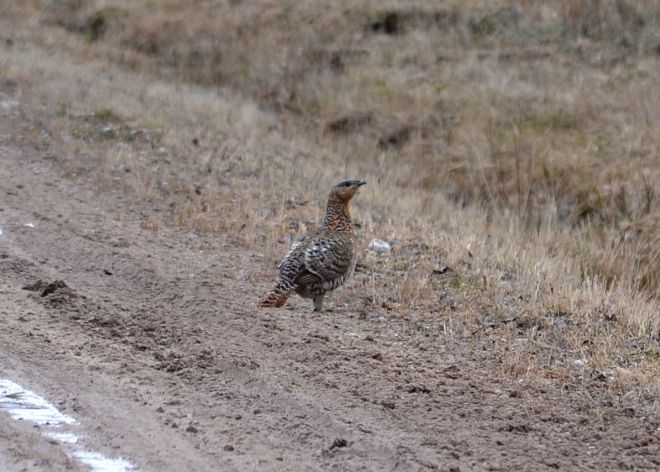
Western Capercaillie (fem)
This is the world’s biggest grouse species, though hens typically weigh about half as much as the cocks. Our guide told how they are a familiar sight on or beside roads through suitable habitat, mature coniferous forest in Estonia. At one time this species could be found across all of Europe’s northern taiga forest. But they have declined in proportion to woodland with diverse tree composition and a relatively open canopy structure being converted to dense, commercial forestry plantations.
Later in the day we explored more swamp forest sites, including the Beaver Trail from the Sooma National Park visitor centre that takes visitors into areas containing Beaver lodges and dams. Here I gained what for me was an important lifer and a bonus bird for the trip: Lesser Spotted Eagle. This medium-sized migratory raptor winters in sub-Saharan Africa and breeds across central Europe including the Baltic states. They prefer undisturbed, well-structured deciduous forests mixed with wet meadows and swamps such as Estonia offers. But only small numbers occur here.


This sighting’s significance is that I had encountered the related (Greater) Spotted Eagle wintering in France’s La Camargue just over a year ago (see here). Local birders there explained how hybridisation occurs between the two species, about which there are very detailed taxonomic issues. So now I have expert assurance of having observed examples of each.
Day 4: Leaving the swamps of Soomaa behind we now headed for the north-western coast of Estonia, west of the capital Tallinn. Our first stop on the road was a manor park Elurikkus Parkides that has a resident pair of Middle Spotted Woodpecker. There is even a picture of one on the information boards here. Our guide succeeded in calling up the male at the first attempt. This noisy, inquisitive bird buzzed about for a while before seeming to suss out that there was no intruder on his patch, just a bunch of tourists with a recording. Then he flew disdainfully away. So that was the third of the Picidae lifers gained. © rights of owners reserved for each of these outsourced images (below).


This insectiverous bird feeds mainly in the canopy, moving constantly and so is usually difficult to observe. It is only negligibly smaller than Great Spotted Woodpecker but the size difference is accentuated by Middle Spotted’s more rounded pale head and slender bill. The main plumage differences are a red crown, lack of black moustachial stripe, a pink vent and dark streaks on the flanks. This species occurs across central Europe and is at the northern edge of its range in the Baltic states. It favours deciduous woods with a mixture of clearings, pasture and denser parts.


Goosander (pictured above) were encountered often throughout this trip and one pair at this location provided a good photo opportunity. I rather like the flight shot (bottom left), one of my better and luckier efforts of the week. The small passerines here included Crested Tit and the northern race of Long-tailed Tit (both pictured below). Hooded Crow (right) are also common in Estonia.


No birds of significance to me were encountered through the rest of this day during which we visited coastal wetlands and more forest sites. Late afternoon we arrived at our third base for the trip Roosta Holiday Village, where the standard of accommodation went off the top of the scale. Each participant had a holiday lodge to themselves, that for me was like a park home from home. Then in the evening we finally caught up with Eurasian Pygmy Owl (lifer) after four nights of trying.
Our guide had seen this first of the Owl trip targets often during March but explained that they were breeding early this year and so the males fall silent. The likelihood of seeing them is also affected by the age mix of owls occurring in the field, since younger males seeking mates are more vocal than more mature, established individuals. Tonight’s bird was also attracted by a recording, making several passes of the group and perching in tree tops; a diminutive, Starling-sized silhouette, round-headed and diamond shaped in flight.


Day 5: On our final day in the field we set out early to search for the three Grouse trip targets. There are multiple Black Grouse leks in the area around our base and we viewed some of these rather distantly. Hence this was a rather watered down experience compared with my observation of lekking Black Grouse in north Wales a year ago (see here). What I hadn’t seen before was the females waiting to avail themselves of the winner. These hens (below top right) had chosen a grandstand view of proceedings.


En route to viewing these leks we encountered two male Western Capercaillie along one road, by any standards impressive birds. Cocks typically range from 74 to 85 cm in length and an average weight of 4-1 kg. The largest wild cocks can attain a length of 100 cm and weigh up to 6-7 kg. They are strongly territorial occupying a range of 50 to 60 hectares. The fuzzy picture below was taken through the dirty, tinted windscreen of the minibus but conveys the general impression.
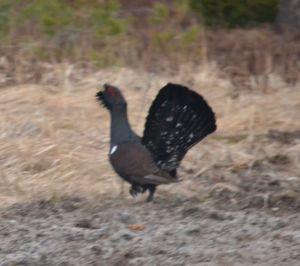
Western Capercaillie (male)
The third gallinaceous bird on our wish list was the Jackdaw-sized Hazel Grouse. These occupy the same geographical range as Capercaillie in taiga forest across northern Europe and western Asia. They prefer damp and densely undergrown areas with old tree species, spending much time on the ground, but may walk along the limbs of trees. Hence they are usually difficult to see and we were unsuccessful in our two days here, merely hearing the whistling call of a Hazel Grouse once. This bird is most likely to be seen flying across the road ahead.


While searching suitable habitat for the elusive Hazel Grouse we came across two more trip targets. Spotted Nutcracker (pictured above) is a bird I have seen once before in Liechtenstein in 2009. This Jay-sized species occupies an extensive range in taiga forest from Scandinavia across much of northern Europe, as well as mountain conifer forests further south. The voice is loud and harsh. Once called-up by our guide, today’s pair took a good look at the group from several fly-pasts, before seeming to decide that we posed no threat and moving on.
Next we gained the fourth and final trip Woodpecker that I came here to put on my life list. Three-toed Woodpecker (pictured below) is resident in coniferous and mixed forest across northern Eurasia. This shy, dark looking species is insectivorous, feeding mainly on wood-boring beetle larvae. Just a little smaller than Great Spotted Woodpecker, Three-toed is black on the head, wings and rump; and white from the throat to the belly. The back, flanks and tail are barred black and white. The adult male has a yellow cap.


A second birding group from Germany was also staying at our base, and their guide knew of a Ural Owl nest site in the vicinity. So having been briefed, our guide went to reconnoitre then took us to see the bird in the evening. This is a very large owl though not as big as European Eagle Owl, that breeds in old bog forests. All we could see at the nest site was the top of the female’s round head quietly contemplating her surroundings, and her tail protruding from the rear of the nest. Keeping an appropriate distance at all times we waited for around 90 minutes for the male to return and do a changeover but this didn’t happen. Being a breeding site there was no question of using a recording to further our objective. Eventually our guide advised that the male’s absence could be due to him being aware of our presence, and so we left.
We had now gained almost all of the trip targets. The exception was Tengmalm’s Owl that has suffered a recent population crash in Estonia. As we left our base to return to Tallinn a Hazel Grouse flew across the road in front of the minibus, almost colliding with the windscreen. I didn’t see it being seated behind the front passenger seat that was occupied by one of the biggest of my tour colleagues. He said the bird could have been anything. So I had gained nine life list additions over these five days: Steller’s Eider, the four new Woodpeckers, Pygmy and Ural Owls, Western Capercaillie and that Lesser Spotted Eagle.
Fuerteventura: 22 – 28 February 2015
I was inspired to do this trip by Oxonbirder Peter Barker who made me aware of the destination a year ago. This most arid of the Canary Islands offered 12 possible life list additions (denoted by *), many of them North African species that occur offshore here. I gained 9 of them. Fuerteventura is fairly well documented in on-line trip reports and I consulted some of the more recent of those on Fat Birder to research sites to visit. Peter also lent me his copy of Clarke and Collins that though published 19 years ago is still regarded as the best available guide book.

Fuerteventura landscape
Caleta de Fuste area
As I envisaged, my chosen base for the trip is a purpose built, high density tourist resort surrounded by much emptier arid land. I set aside day 1 on 22 February to explore the immediate area and see if I could find any of the trip targets here. I first walked around the nearest open space to my hotel without seeing any birds at all, and then explored the resort itself that took just half a day. I usually like to start a trip with a walking day but it was clear that the landscape here would be too vast and samey to see much wildlife on foot.
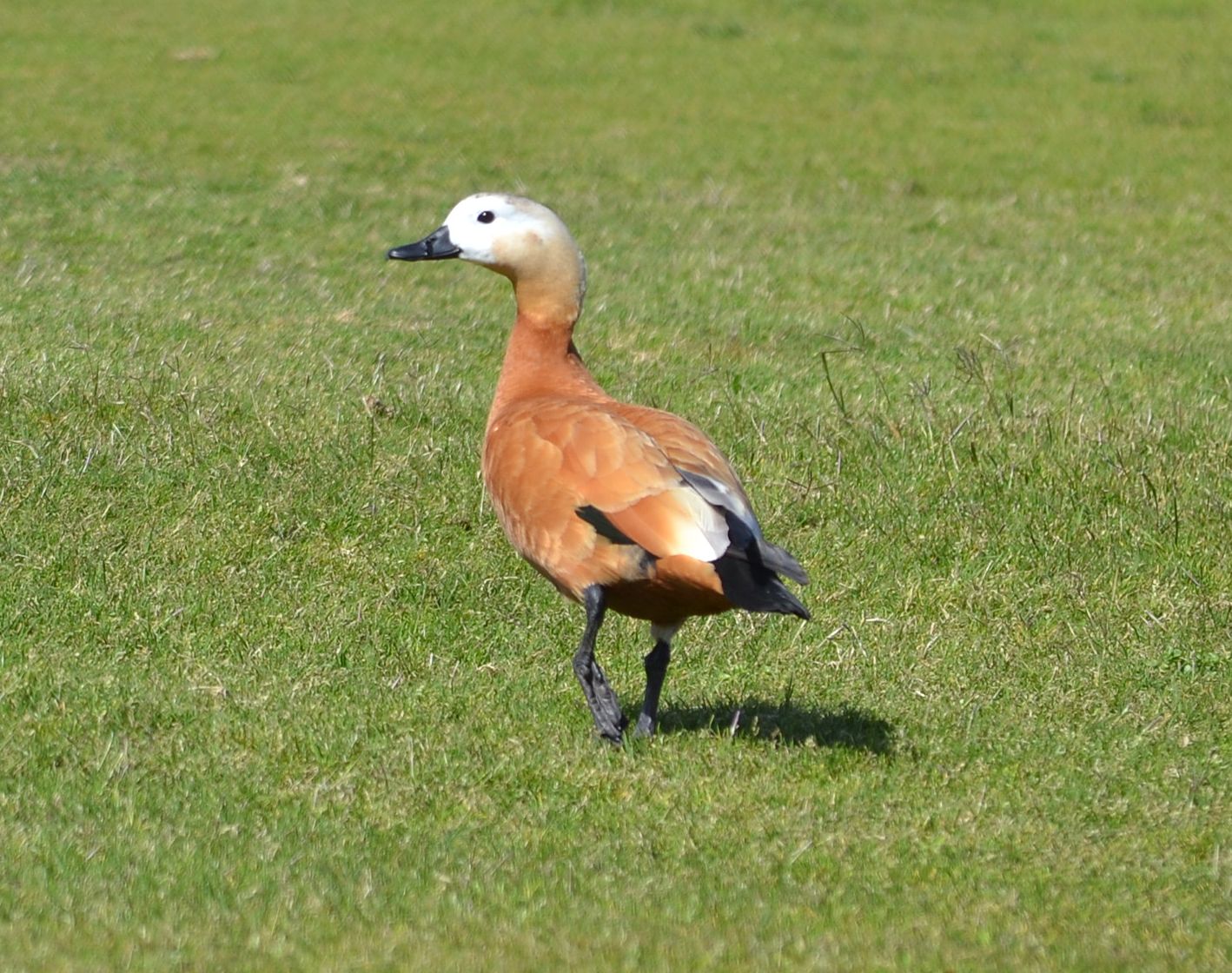
Proper, tickable Ruddy Shelduck
After lunch I took a longer walk to the south-west. Southern Grey Shrike * was the first of the trip targets gained and there were Ruddy Shelduck on one of the golf courses. After heading inland a little I cut across dry stony land back towards the FV-2 coast road and soon began to see Berthelot’s Pipit *. This Canary Islands and Madeira resident became a common sight throughout this trip.
I walked out as far as Salinas del Carmen where there is a salt pan museum but not much in the way of birds. A lot of Barbary Ground Squirrel were active there, running right up to me since they must be used to people feeding them. The entire island population is apparently descended from two animals imported as pets in the 1960s.
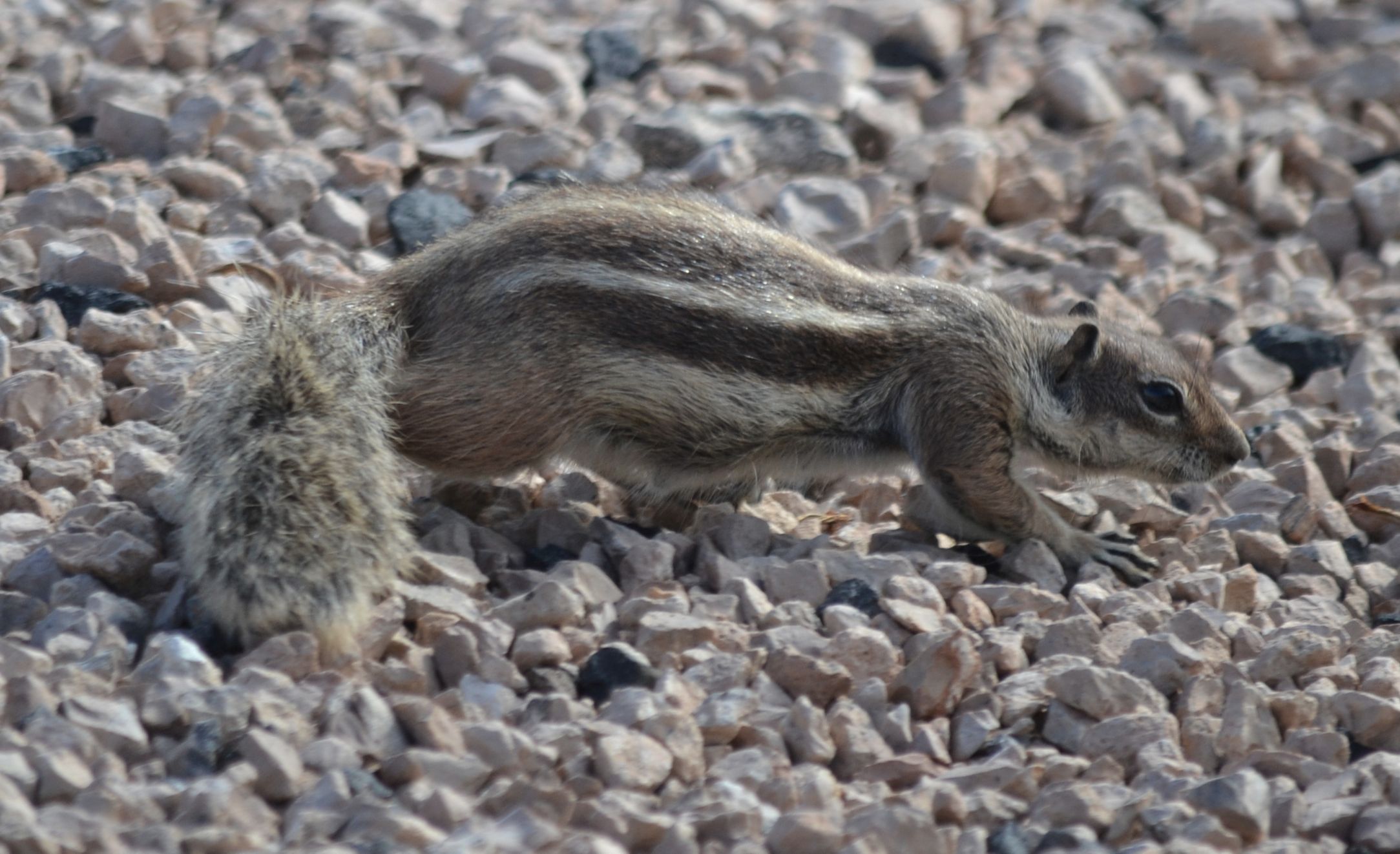
Barbary Ground Squirrel
On the homeward walk I found a very smart Little Ringed Plover, then met a couple birding who pointed out more common waders – Redshank, Greenshank, Whimbrel and Common Sandpiper – in a drainage gulley alongside one side of the Elba hotels. I revisited this spot on my final morning 28 February, photographing a new (for me) dragonfly Lesser Emperor at the coastal end of the same gulley.

Lesser Emperor
Barranco de la Torre
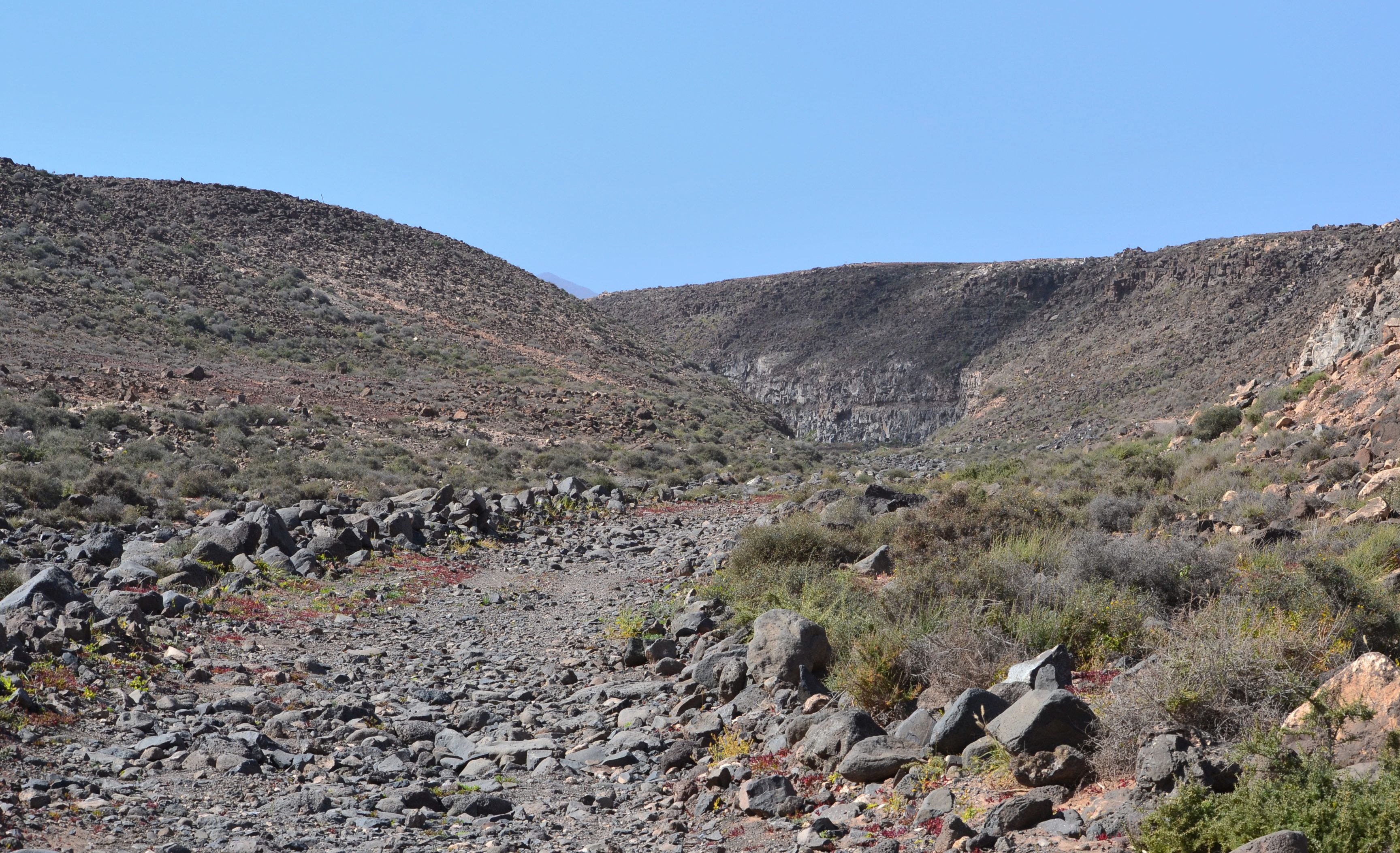
This site, just to the south-west of CDF is in all the sources I researched, particularly as a reliable location for the endemic Fuerteventura Chat. Clarke & Collins cites an access track on the FV-2 beyond Las Salinas so on 23 February I looked for that first. It is now a metaled road leading to a dam construction site. There were unwelcoming notices around the works entrance so I found a relatively easy descent into the barranco to the north-west (pictured below) and walked upstream from there.
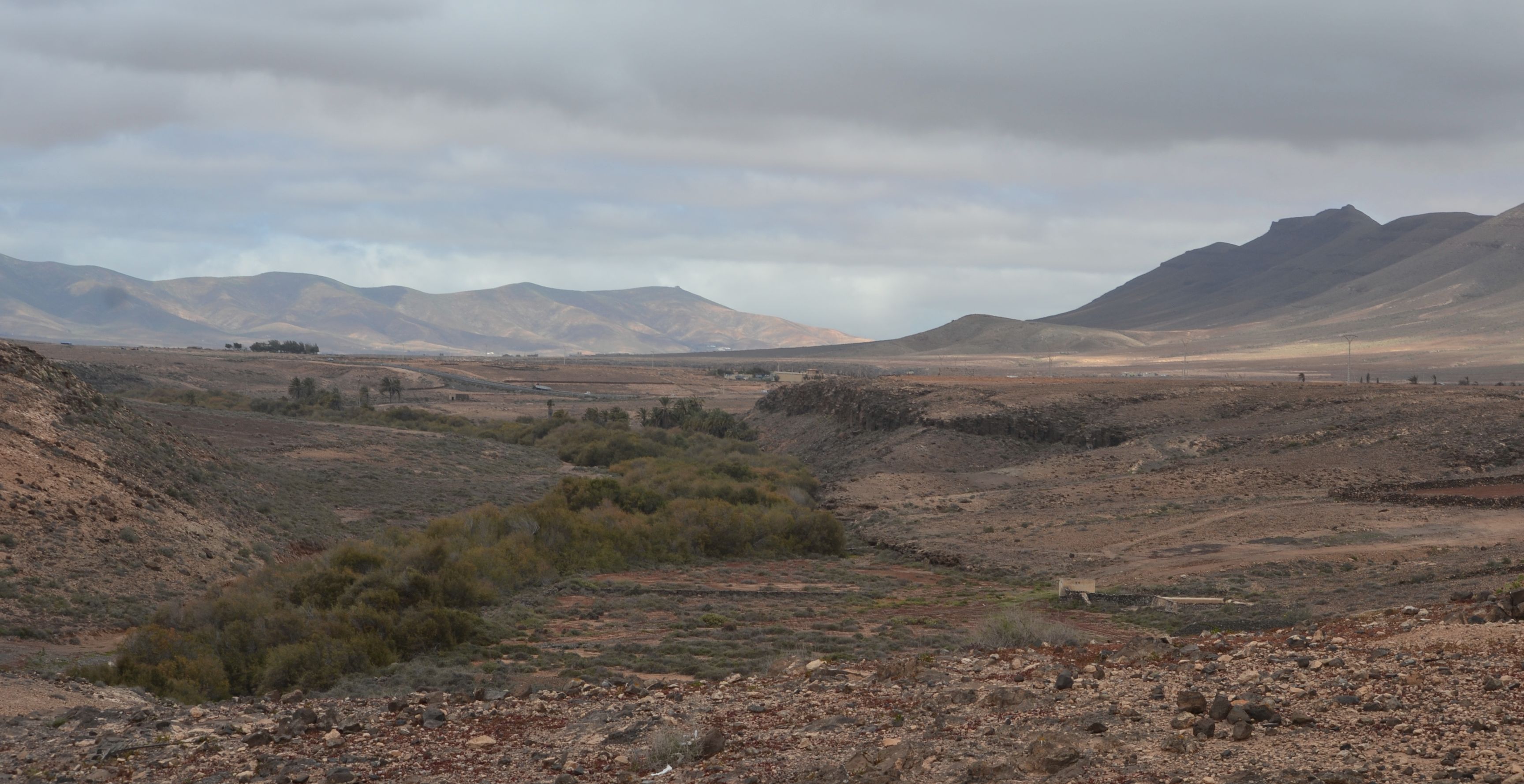
The dried out water course held the chat breeding habitat of Tamarisk scrub, but although there were plenty of bird sounds coming from cover most of those visible were Spanish Sparrow. That abundant species became the “oh no not more of them” bird of this trip but they were always fun to watch. I sat in a promising looking spot to see what might emerge and heard the sound of raptors calling from the southern side of the gorge.
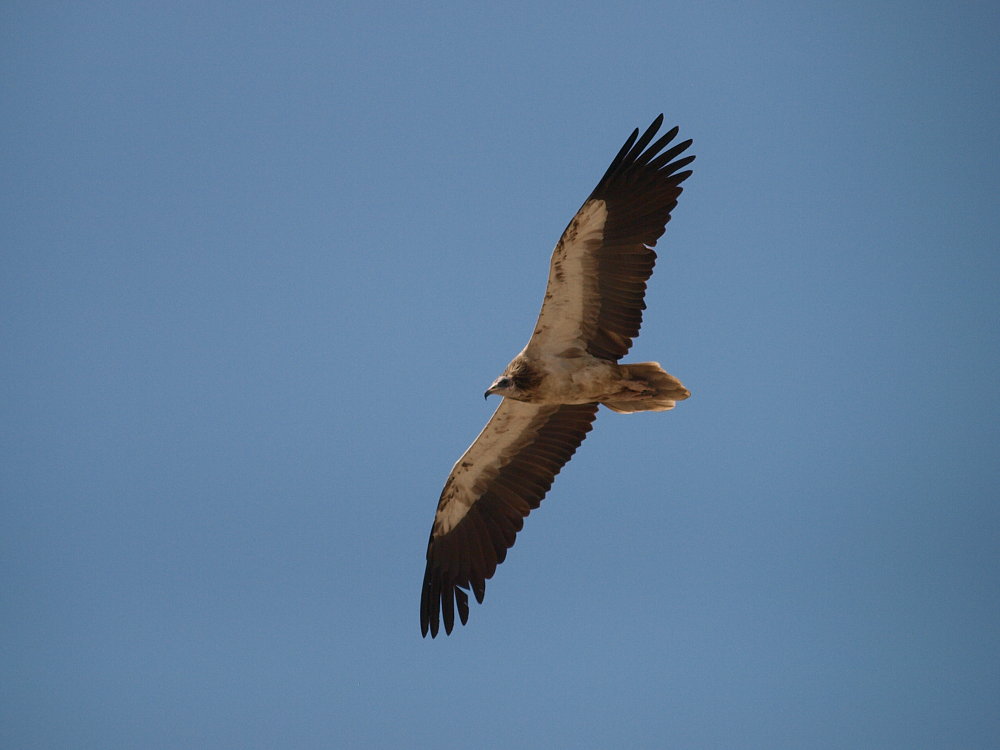
Egyptian Vulture
© rights of owner reserved
Two Egyptian Vulture * then drifted right over my head, circling above me showing their colours well before continuing northwards. I could not have hoped for better views of what is a huge lifer, this bird having been missed on both my South of France trips in recent years. On the return walk to the car I encountered a first pair of Trumpeter Finch * amongst more Spanish Sparrow around a ruined building. Ruddy Shelduck flew overhead a number of times.
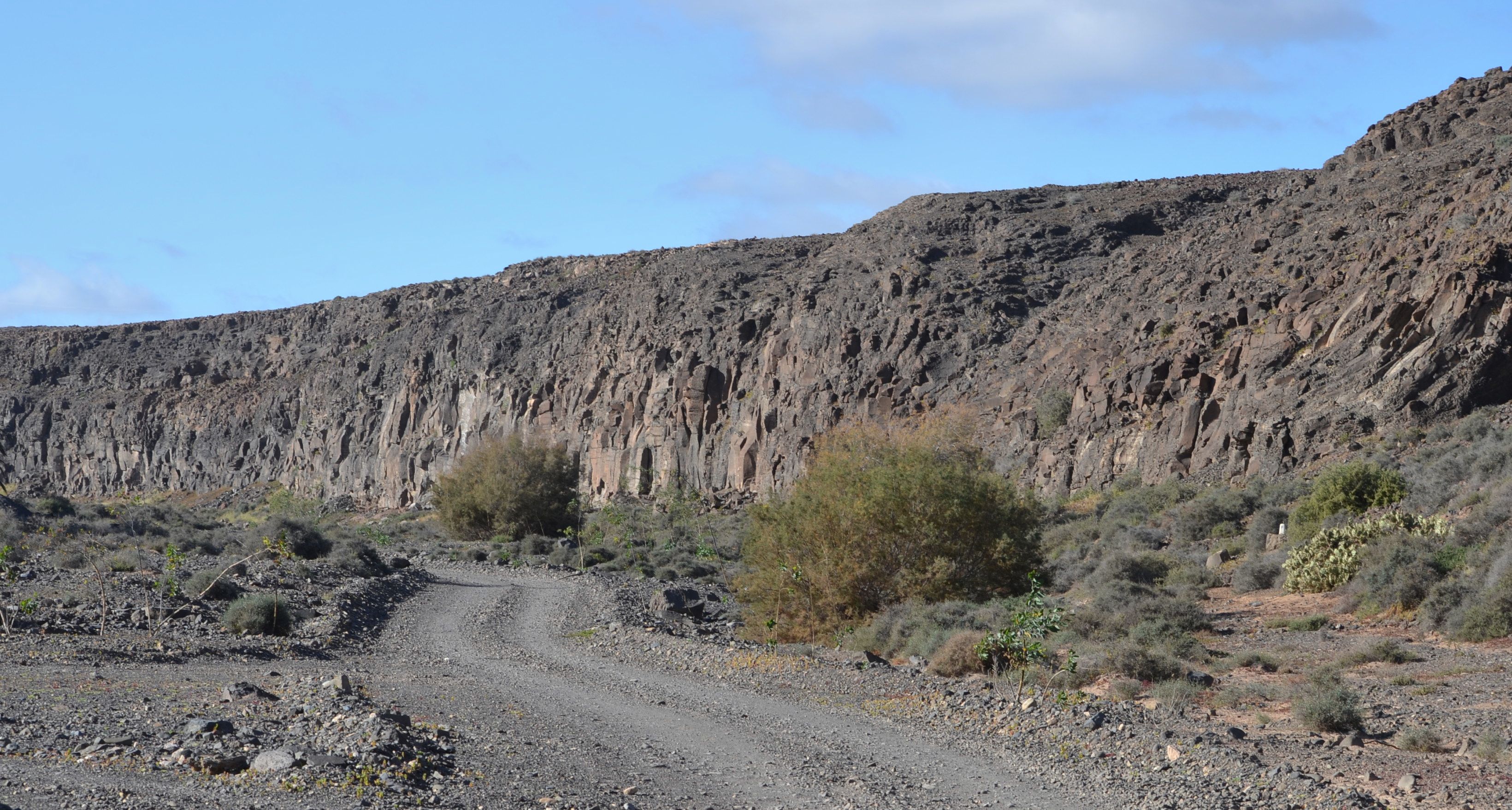
In the afternoon I investigated the southern end of Barranco de la Torre, into which a dirt road runs from the coastal track south of Las Salinas. This was a pleasant walk below a cliff face (pictured above) and I was quickly into the same habitat as in the morning. There was a lot of sound coming mostly from cover again until I reached an area teeming with bird life especially around one enclosure. There were lots of Spanish Sparrow and Trumpeter Finch here, a few Spectacled Warbler, Berthelot’s Pipit; and briefly and into the sun a perched good candidate for Fuerteventura Chat. I hung around here for some time but didn’t see the last-named again to remove all doubt.
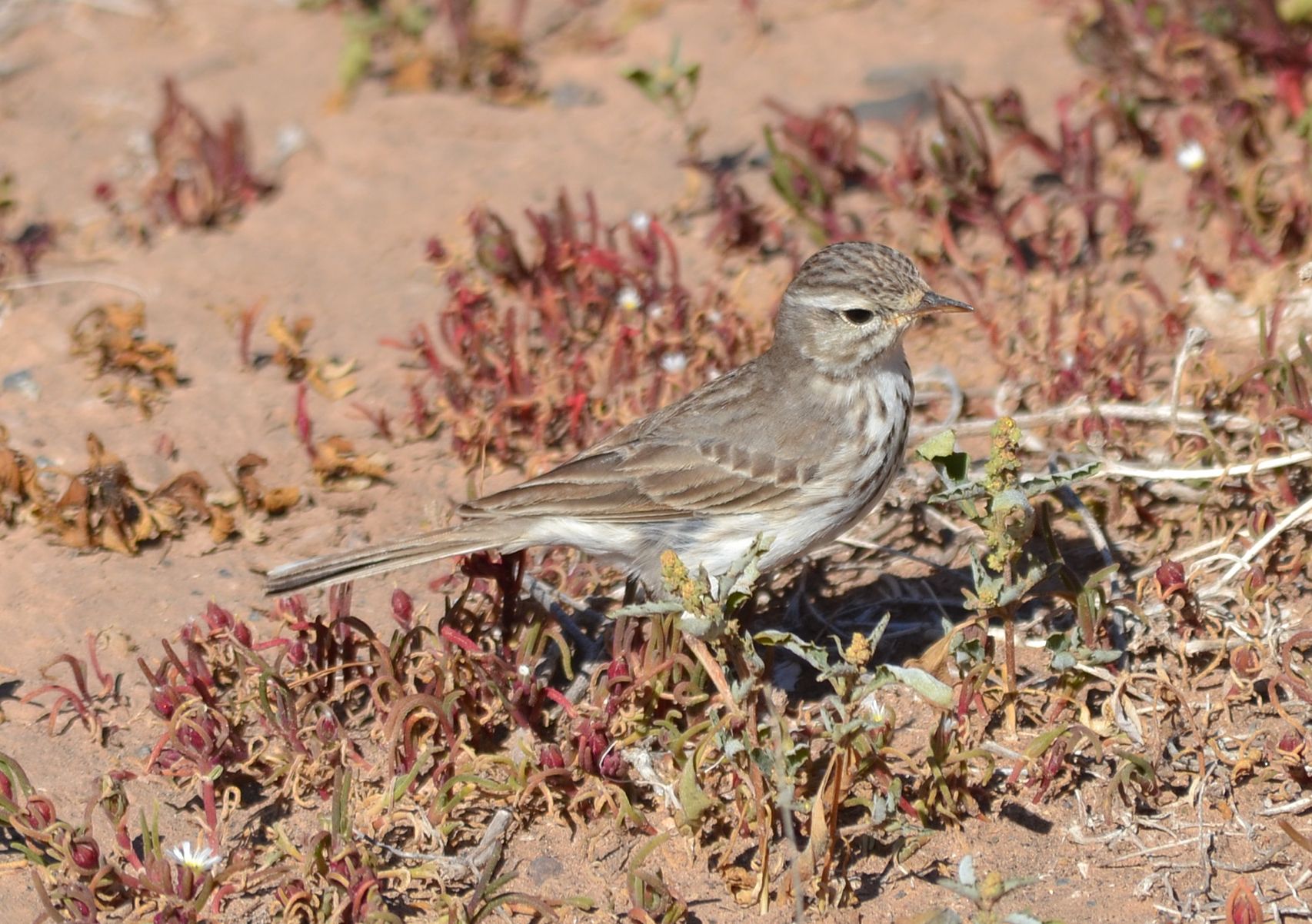
Berthelot’s Pipit
When this burst of activity subsided I continued along the Barranco. The dirt road fairly soon turned up to a farm, and at the start of a northward track was a notice saying the next stretch of the Barranco is closed to the public during the bird breeding season commencing 15 February. I was respectful as usual and turned back, which was a pity because that must have been the best area for birds. On the return walk I spotted a Southern Grey Shrike on the cliff top, PI’d Lesser Short-toed Lark for the first time and picked out another distant Vulture to the north.
On 26 February in the late afternoon I checked out the upper part of this barranco where it is crossed by the FV-2. I walked along the dry river bed back towards the construction site, finding a dragonfly that looked like an Epaulet Skimmer. There was a lot of bird activity in the dense Tamarisk scrub here with Spectacled and Sardinian Warbler and Blackcap all active.
Barranco de Rio Cabras
Clarke and Collins describes this second barranco where Fuerteventura Chat occurs, immediately north of the airport. The book says in the past twitchers have been known to fly to this island just to see its only endemic in this location then go on their way. It is reached by leaving the NV-2 at Playa Blanca then turning back along a dirt track to close to where the NV-2 crosses the ravine. I first went here on 24 February.
At this Barranco’s eastern end (pictured above) there was little bird activity but I kept walking right up to an old dam. Immediately before the structure there was standing water and things began to get more birdy, starting with several White Wagtail. At the dam itself a pair of Fuerteventura Chat * were active: mission accomplished but much more was to be revealed.
The presumably disused and partly overgrown reservoir at the top of the barranco was a hidden gem of a place and teeming with wildlife. There were Black-winged Stilt, Greenshank, more Ruddy Shelduck, Southern Grey Shrike and numbers of the familiar small birds of the trip so far. What I took to be Barbary Partridge* were calling from the cliff faces, one on either side. And in the late afternoon sun large numbers of Sahara Blue-tail, the Canary Islands’ only breeding damselfly were flying.
-

- Fuerteventura Chat
-
- Above the dam
-
- Fuerteventura Chat
-
- Southern Grey Shrike
-

- East Canary Skink
-

- Trumpeter Finch
This was the sort of location in which I feel in my element: remote, way off the beaten track and only me and the wildlife there. The nice warm feeling grew in me that I had enjoyed so much in many southern Portugal locations last May. On finding it was 5pm I started a brisk return walk and one of the Chats was back on territory as I passed the dam wall again.
Having found this place so fascinating I returned the following afternoon. The Chats were once again active at the dam but things were generally less birdy than a day earlier. I was hoping to get better views of the Barbary Partridges but didn’t hear any this time. But in the afternoon sunshine I did find the trip’s first dragonflies: first a fly-by Emperor species and then some Scarlet Darter in the highest part of the barranco. The SBTDs were flying in their hundreds.

Barranco de Rio Cabras (view back from dam)
In each of the barrancos that I visited to the south and north of CDF there were many small, fast flying and mostly very worn yellow butterflies. These were Greenish Black-tip, a species that ranges from the Canary Islands across north Africa and the Middle East as far as Turkmenistan and Pakistan. I also saw this insect in most parts of Fuerteventura that I visited.
-

- Worn Greenish Black-tip
-

- Sahara Blue-tail Damselfly
-
- Broad Scarlet (imm)
El Cotillo
A stony plain between Tindaya and El Cotillo in the north-west corner of the island is reputably one of the most reliable spots for Houbara Bustard *. This Fuerteventura must see is a race of a much declined desert species that occurrs across north Africa and as far east as Jordan. On my first visit here on 24 February I was accompanied by English birders Chris and Rowan Whiffin from Basingstoke, who were staying in my hotel.
Near the start of a dirt road from El Cotillo a notice bearing an image of a Houbara requests that visitors keep to the main track. Using the car as a hide is the recommended strategy in all published sources. We saw just one Houbara at reasonable distance, located by myself about 500 metres before a high point that I understood to be a hot spot for them. It is said that with luck birds may cross the road in front of observers, but we were not so lucky.

Houbara Bustard
© rights of owner reserved
Shortly after the Bustard sighting two Black-bellied Sandgrouse flew around the area in which we were parked offering several excellent views. Once they flew right above the car, such a contrast to my failed attempts to find Pin-tailed Sandgrouse on the plain of La Crau in Provence. Both this day’s birds were lifers for my companions who were very pleased with their morning out and guide. But we could not find Cream-coloured Courser here despite much scanning, just a succession of rocks impersonating this further must see. We followed the dirt road as far as the Barranco de Esquinzo and then turned back, though it was possible to continue as far as Tindaya.
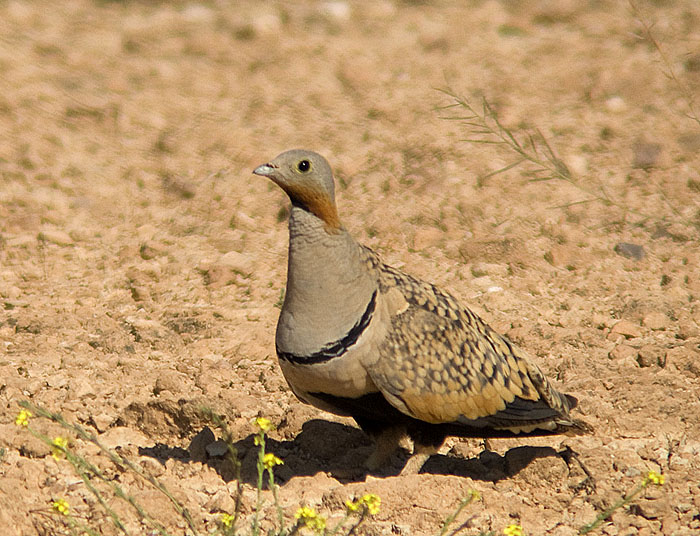
Black-bellied Sandgrouse
© rights of owner reserved
I returned here two days later on 26 February at dawn when the speciality birds are said to be more active. Driving slowly southwards along the same rough coast road, I saw nothing in the first hour. When the sun rose at 8am over the hills to the east Berthelot’s Pipit and Lesser Short-toed Lark immediately became active. Whilst trying to locate some of the latter on the ground I picked up what looked like a big white feather duster being blown through the steppe. Then it became still and turned into a blob. This had to be a displaying male Houbara so I retrieved my scope from the car. The blob then raised its head showing the long dark neck stripe of the Fuerteventura race, while the white display feathers hung down to one side. I had indeed seen what visiting birders seem to regard as a prize: a displaying male Houbara Bustard, but only briefly before the bird disappeared once more into the steppe.
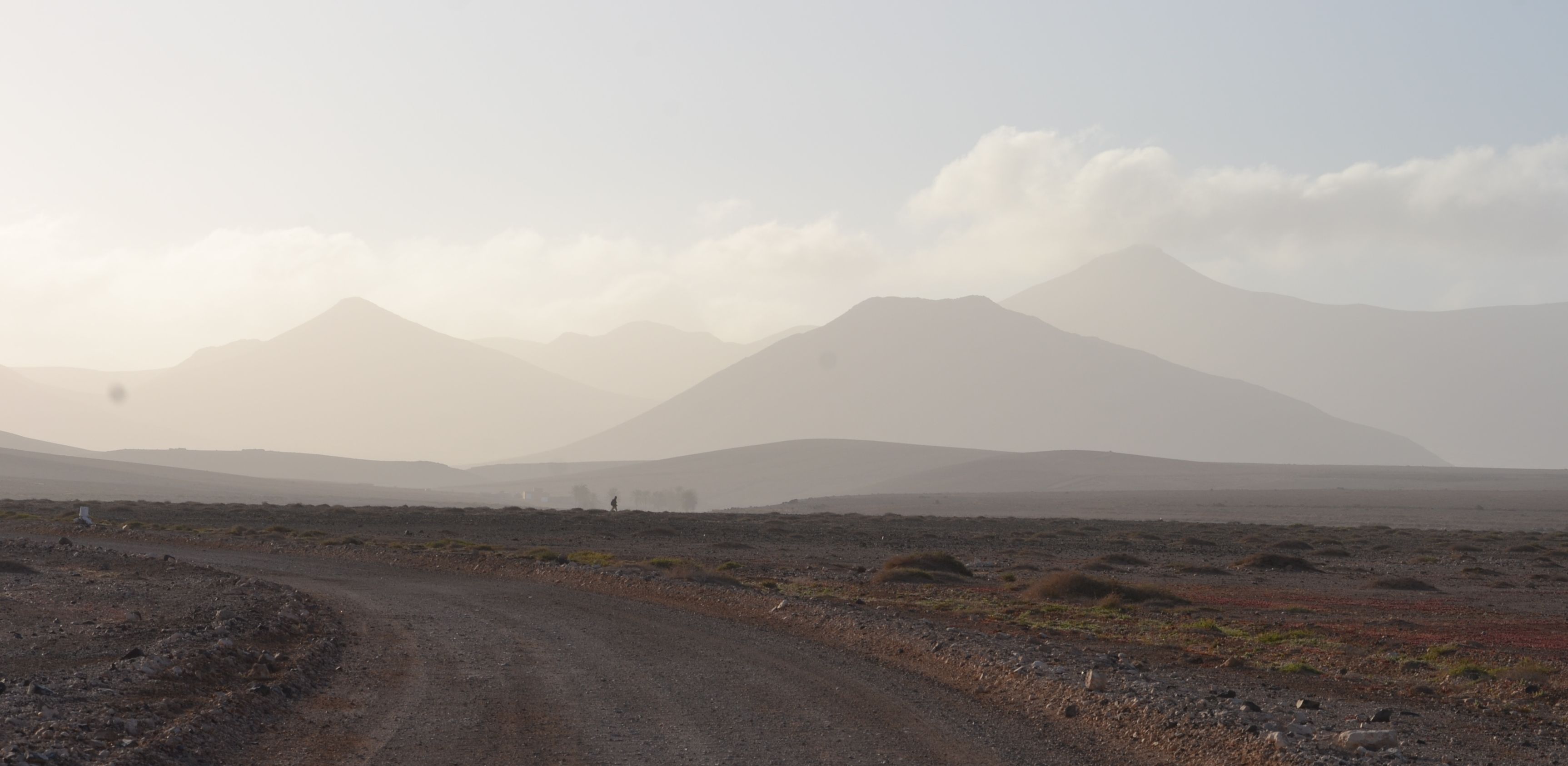
Early morning on El Cotillo plain
… it’s a desert out there
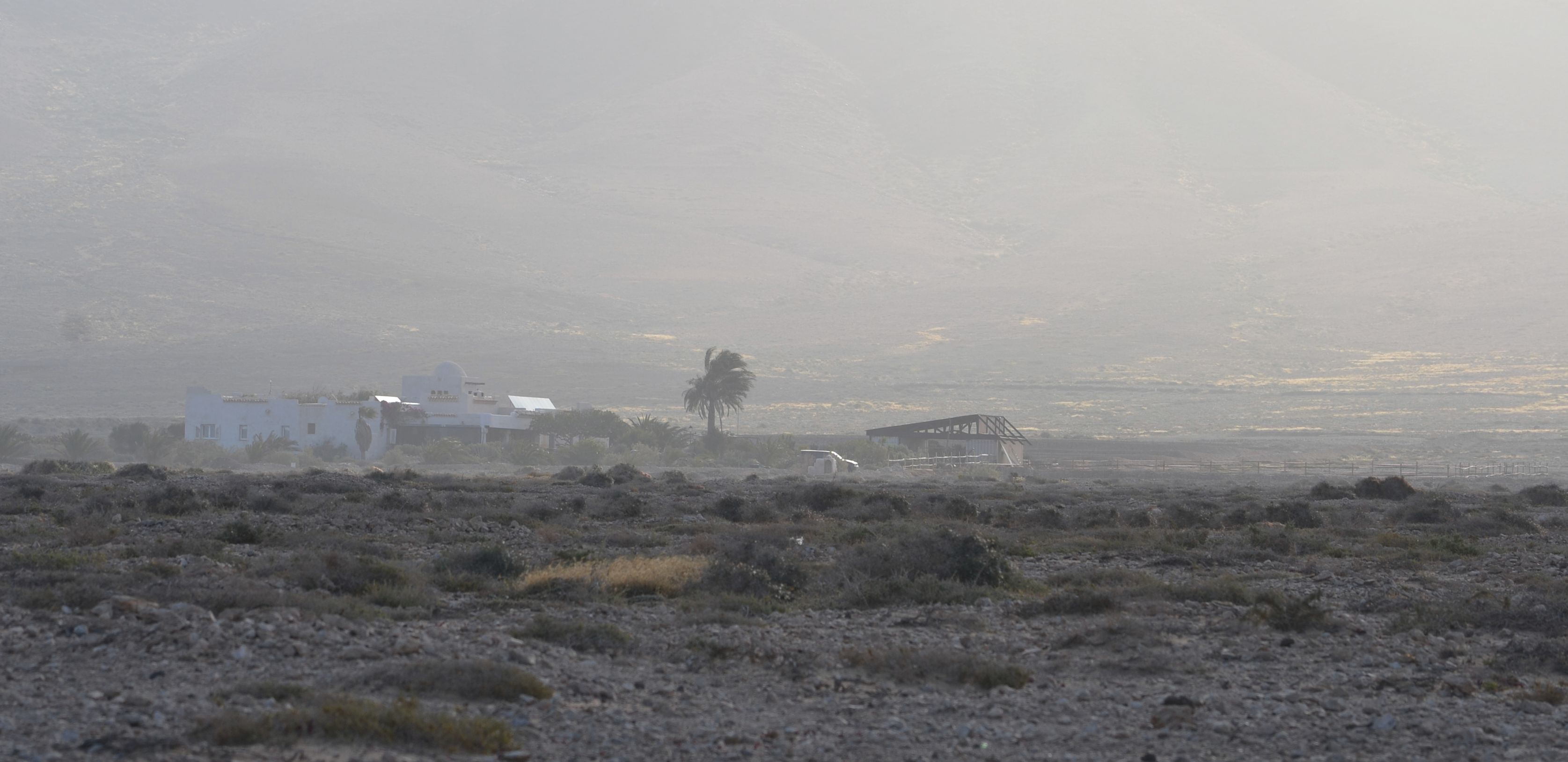
At just after 9am on the return drive to El Cotillo I suddenly saw a pale shape running through the steppe to one side of the road. This was at last my Cream-coloured Courser * for the trip and a wave of relief swept over me. After much time in the previous two days spent checking piles of rocks randomly to see if anything was moving, I was surprised by how easy this bird was to see in the end. It stood out plainly from the habitat as it continued to move about, standing with head cocked at times. In terms of hugeness as a lifer, CCC was second only to Egyptian Vulture for this trip. That’s because it was absent from my Cyprus list, and a couple of years ago I considered a golf course in Shropshire too far to go to see one that turned up in blighty. I would not make that decision in the latter instance now.
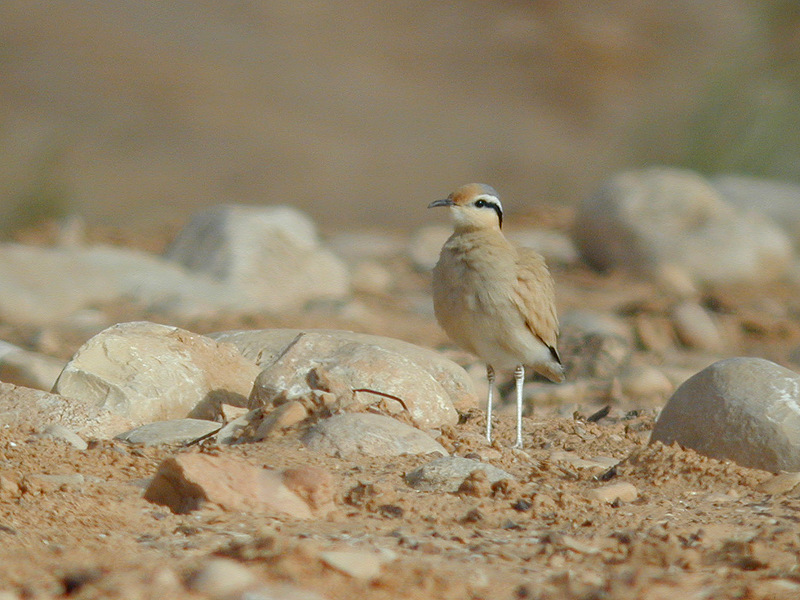
Cream-coloured Courser
© rights of owner reserved
I left site at 9:30am without having met another car on the track. I could have stayed here all morning just driving around slowly hoping for more sightings but having achieved a double result decided to content myself with it. These birds are clearly difficult to find and I was also mindful of being in a hire car that was not insured on dirt roads. Chris and Rowan who hired their own car on this day said they came here again in the afternoon and saw nothing. With such a good CCC sighting after so much searching I felt little inclination to scan more stony plains at random across the north of the island.
Other sites and missed birds
A reservoir at Los Molinos on the western side of the island is cited as a prime birding location in all the sources I researched, being the only one with permanent water. Visiting here on 25 February I couldn’t find the southern way in as described in Clarke and Collins. I then drove to the dam end along a rough road from a village Las Parcelas on the FV-221 road. All I could see from the dam were gulls, some Ruddy Shelduck and Eurasian Coot. A school party engaged in what appeared to be a botany lesson had probably seen off any passerines in the vicinity.
Access tracks beyond this point were fenced off so it was not possible to get down near the water’s edge where common waders may be seen. In short I couldn’t see why other birders bother to come to this site, unless they want to build a trip list. Plainly I would not see anything new here, and so I drove slowly back along the access road scanning around fruitlessly for Cream-coloured Courser. This was very noticeably the most arid area of Fuerteventura I had experienced (pictured below).
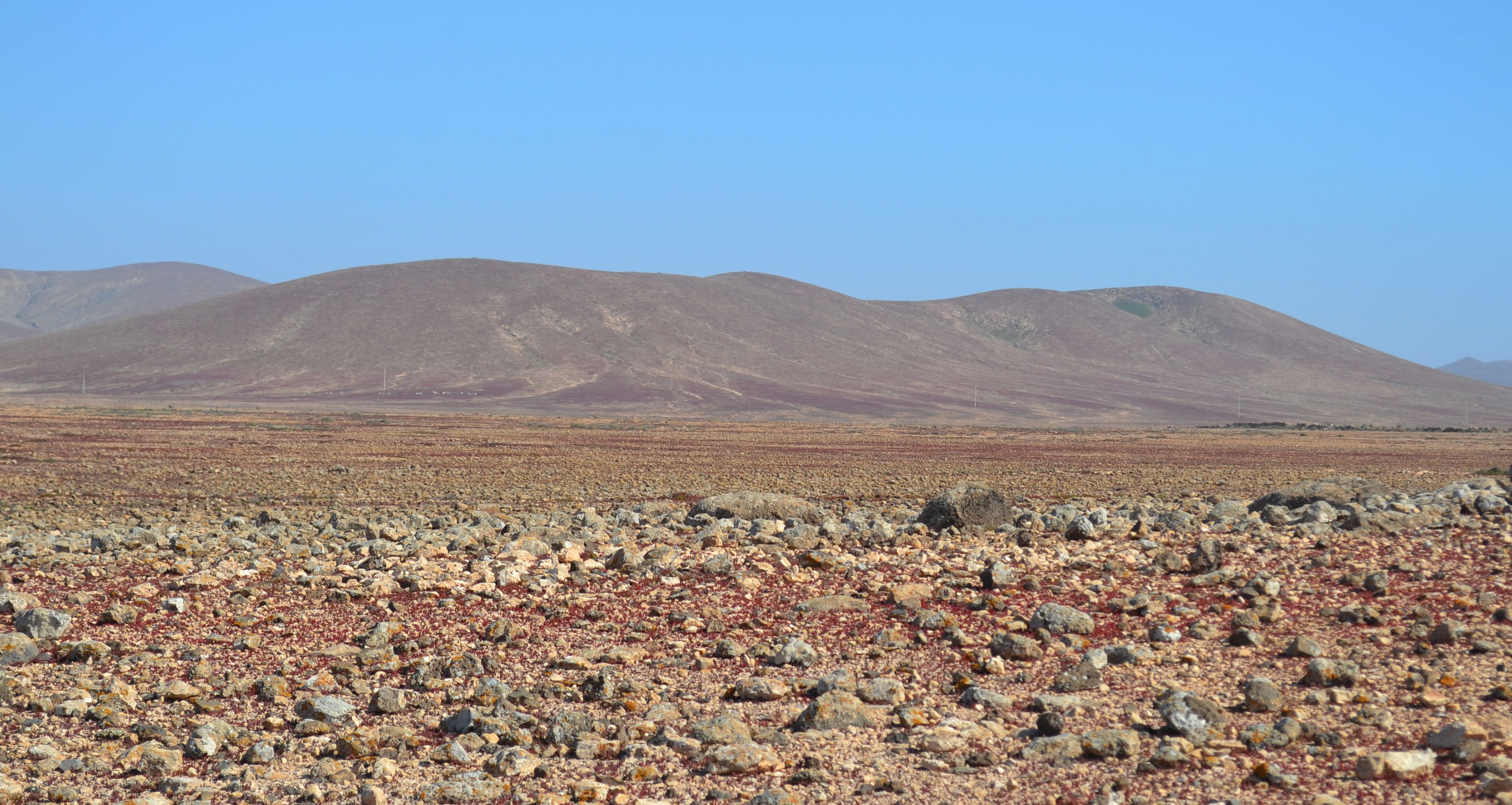
After nailing CCC the following day, I consulted my sources to see where the remaining four birds on my wish list might be found. Laughing Dove and African Blue Tit were described as garden and forest birds. Returning homeward via La Oliva I drove through an area just north of that small town that looked ideal habitat. So I spent a hour walking around an area of gardens and small enclosures that was a pleasant contrast to the wild and arid areas most of this trip had involved.
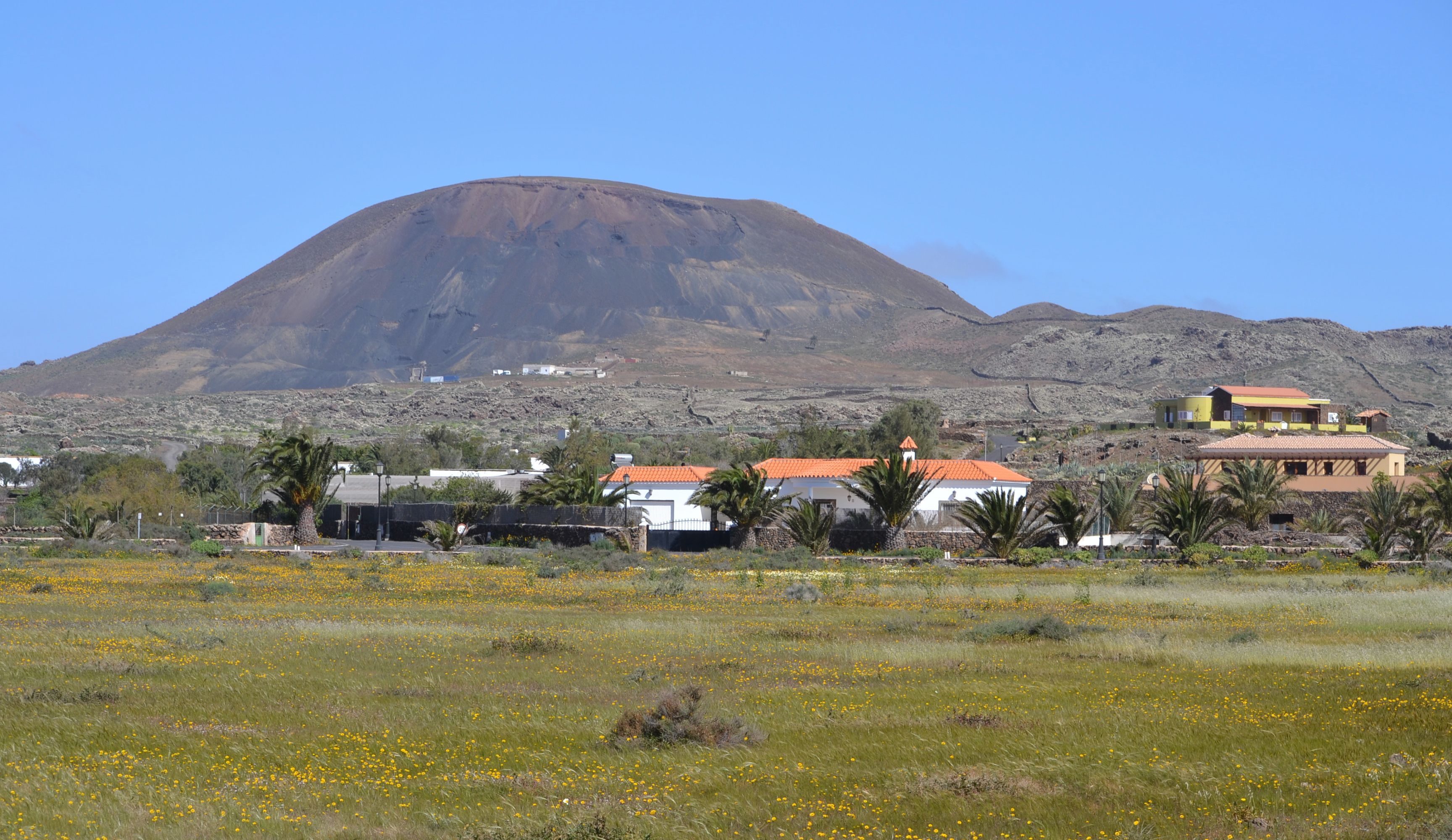
Mount Oliva
There were a few Tits flying around here, so I ticked African Blue Tit * on the grounds of it being the only Tit species in the Canary Islands. Corrrect me if I was wrong to do so anyone. Other birds seen here were Hoopoe, Blackcap, another pair of Fuerteventura Chat and the inevitable Spanish Sparrows. Also in La Oliva I encountered this rather handsome lizard (pictured below). I just love ‘em!
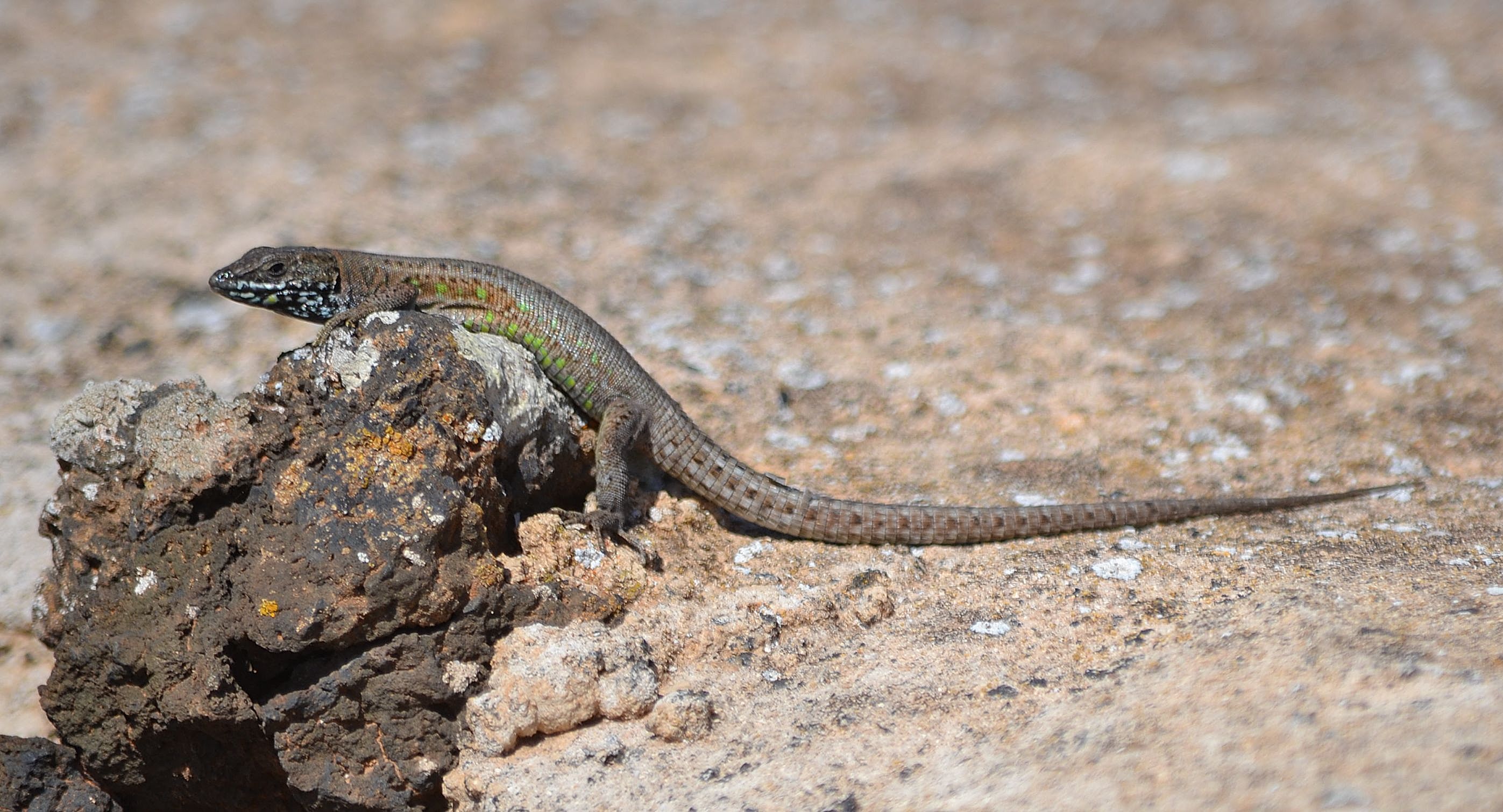
East Canary Skink
On 27 February, my last day with the car I checked through the trip reports and two things stood out: the prospect of Plain Swift around the CDF golf courses, and an Egyptian Vulture site along a dirt track east of a village Tiscamanita to the south-west. I started with the golf courses, seeing no Swifts of any variety. Then I drove on to Tiscamanita that is on the FV-20 road south of Antigua. I followed the dirt road into a scenic area (pictured below) until it became a bit too rough for my liking then turned back. Above the village itself I did gain a third Vulture sighting for the trip.
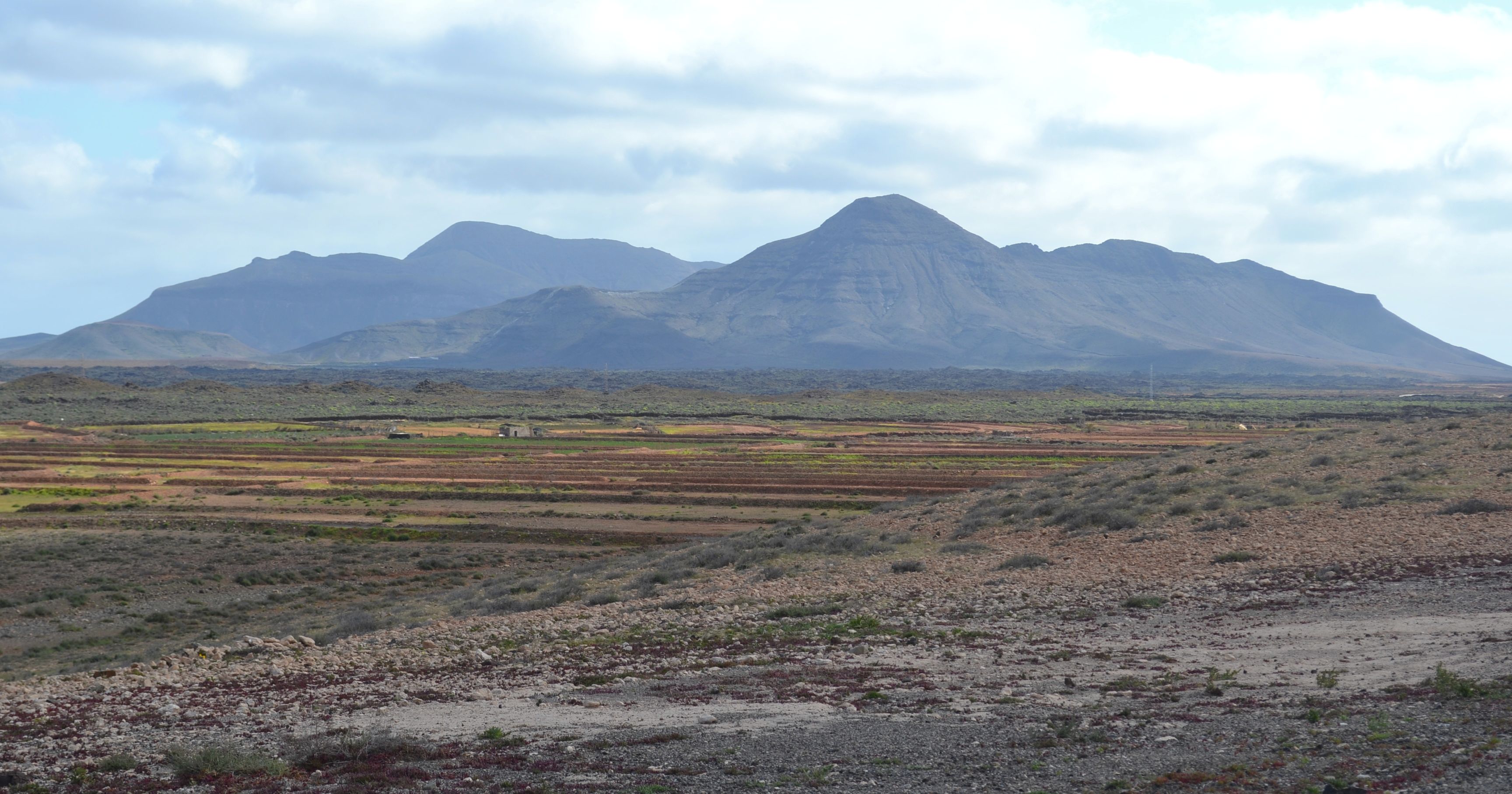
So what of the trip targets that I didn’t gain? Barbary Falcon was always likely to be the most difficult, requiring I suspect a knowledge of territories in remote upland locations. Plain Swift arrives mainly from March though some are said to over-winter. And I doubt if there are as many Laughing Dove on arid Fuerteventura as perhaps other Canary Islands. Well those are my excuses anyway!
Conclusions
Well organised and fully informed birders could probably cover Fuerteventura in three days. The passerines are easy to see pretty much anywhere, and it is worth noting that of the 9 lifers I gained on this trip 5 were close to my chosen base. I had good to excellent views of the most important birds, if only once or twice in some instances. But all it takes is one published report of Houbara Bustard walking across the road in front of one observer for that to become the expectation, and life and birding “ain’t like that, is it?”.
The mass-market ambience of Caleta de Fuste was a trade-off for me, but a necessary one since the all-inclusive package at my bearable but rather tacky hotel catered for all my sustenance needs. And I was pleased to have made friends with other birders there. On returning home, as usual what I recall from this trip is the wildlife and fabulous scenery experienced, and that translates into a warm glow until the next one wherever that might be.
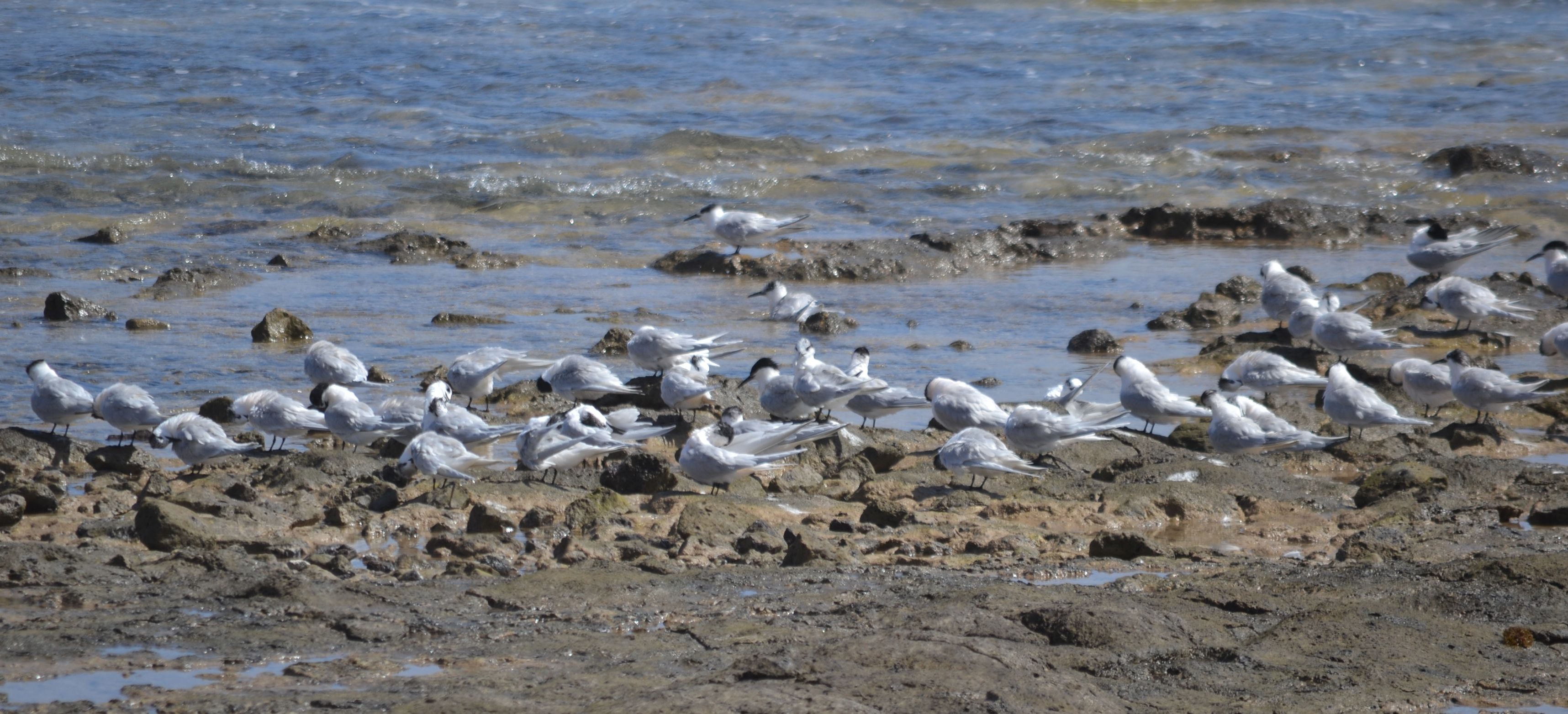
Sandwich Terns at Caleta de Fuste
Southern Portugal: 6 – 26 January 2014
Eastern Algarve and Baixo Alentejo
This was my second visit to the area following a 10-day taster in the concrete jungle of Albufeira 12 months previously. This time I chose as my base Tavira at the eastern end of the Ria Formosa, because it is picturesque and characterful by Algarve standards and retirement market holiday specialist Mercury Direct’s best value package also happened to be there. It was an hour’s drive to the coastal reserves west of Faro, so I chose not to go further west than there. Inland to the Vale do Guadiana natural park and Castro Verde SpAs took a little longer, depending on my route.Tavira marsh
Turismo de Portugal’s pdf Birdwatching Guide to the Algarve, that I used as my basic reference for this trip, lists three birding sites (A, B and C) around Tavira. On setting out to explore it became clear that all of these were around 20 minutes walk from the town centre. I therefore decided to defer hiring a car until I had done the local area justice on foot. All of the regular west European waders, by which I mean those not considered scarcities in the UK, winter here in huge numbers.
Site C: Santa Luzia (western) marshes – I visited this site first on 6 January since the pdf guide describes it as the best for Audouin’s Gull. That species was a major trip target since I hadn’t found it anywhere in the Algarve a year earlier. From a housing estate on the western edge of Tavira, a dirt road leads out from Rua da Santo Antonio to a large salt works where the gulls are said to perch on the walls of the salt pans. I didn’t see any at the mid-afternoon time of my visit, but encountered an array of waders (notably Greenshank) and herons that would burst out of ditches as I came near, other gulls and various small birds. On the walk back I wandered out into the marsh along tracks between the worked out salt pans, and found this trip’s first Caspian 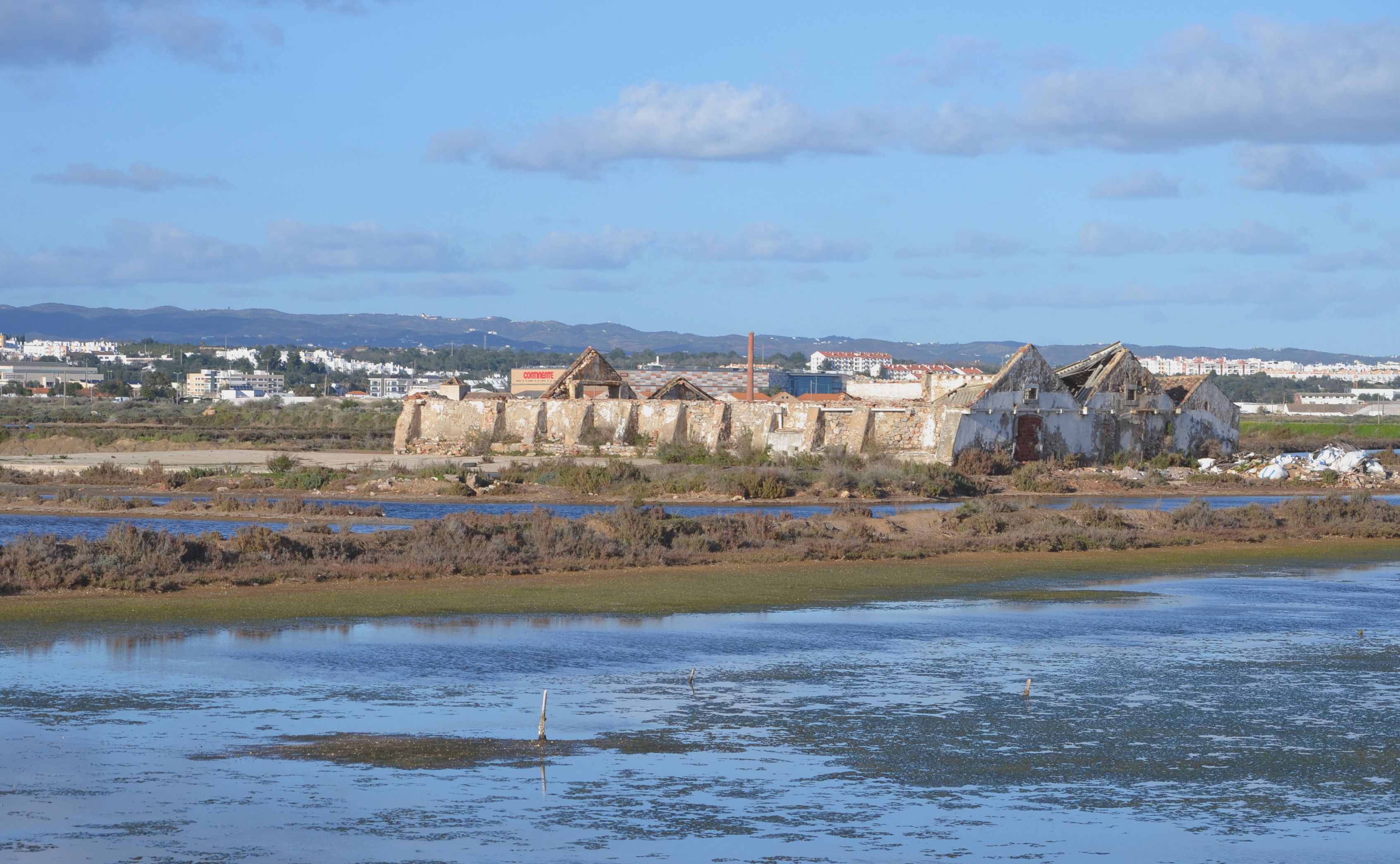 Tern amongst the increasing numbers of birds that were coming in with the tide.
I revisited this site on the afternoon of 19 January, approaching from the village of Santa Luzia itself. Arriving at around 2pm I again checked the salt works for Audouin’s Gull but once more it seemed like the wrong time of day. Little Stint were present here amongst various small waders. Walking along the track towards Tavira then out through the salt pans, I found more marsh to explore (left) and by 4pm it was filling up with roosting waders and gulls, amongst which I did pick out five Audouin’s.
Site A: Forte do Rato and Arraial Ferreira Neto (eastern marshes) – On 7 January I thoroughly explored this area that I visited by car during my January 2013 trip. The road into it runs from a 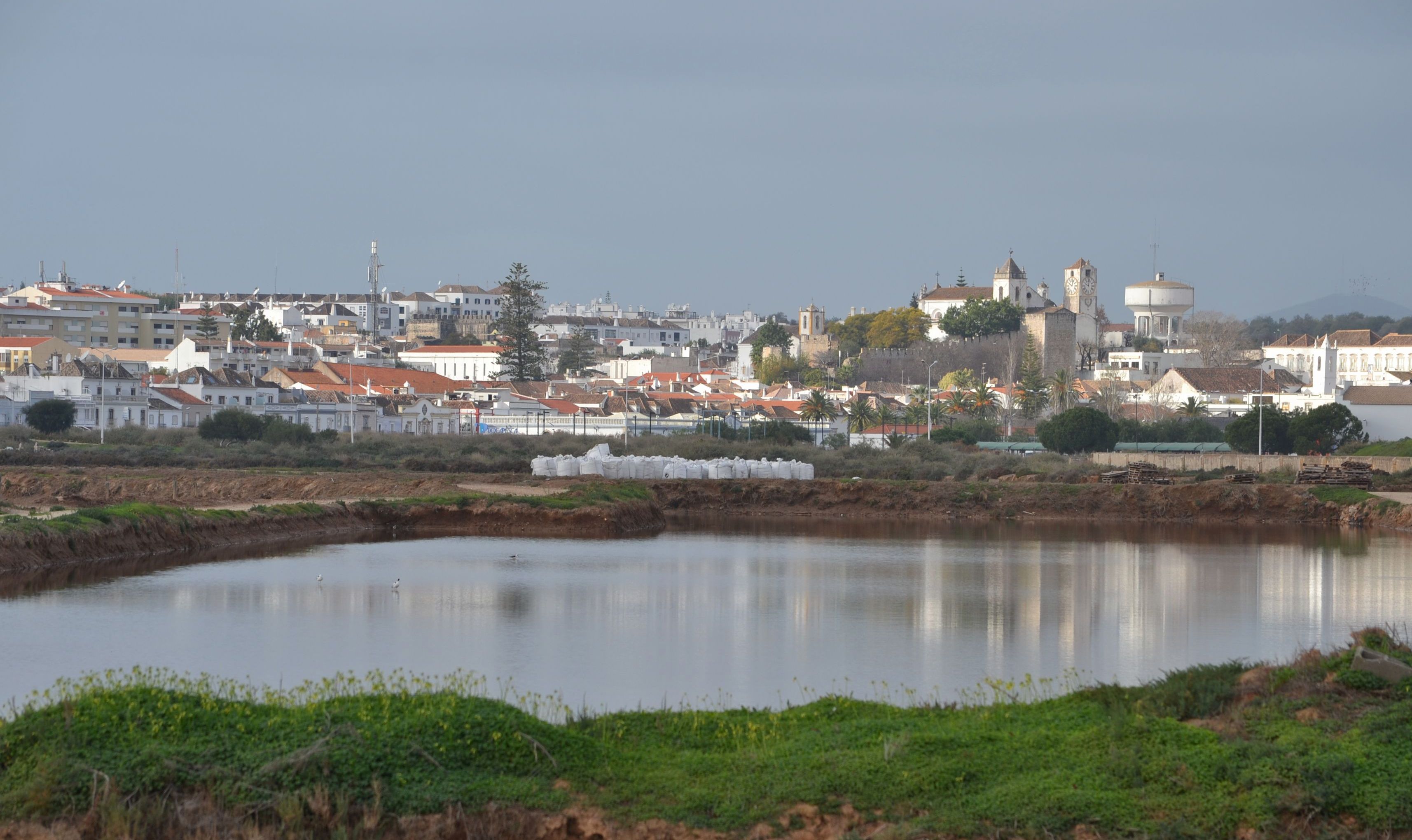 junction beside Tavira’s main shopping centre, and after a short distance the tracks out into the salt pans begin (right). Stand out Mediterranean species like Black-winged Stilt, Greater Flamingo, White Stork and Avocet were all immediately apparent, along with Common Sandpiper and small birds such as Zitting Cisticola, Sardinian Warbler and Serin.
Re-joining the road, I walked out as far as it was possible to go, to the mouth of the Ria Gilão by the Ilha de Tavira, where there were a good variety of common waders and numbers of Sandwich Tern, but no Audouin’s Gull. On the walk back, the trip’s first Iberian Grey Shrike (right)  allowed me to walk right up to and under its overhead wire perch. This bird was in exactly the same place when I passed it again on 17 January. On that rainy day I also found a lone Slender-billed Gull on the beach at the end of Arraial Ferreira Neto, another species that had eluded me a year earlier.
Along the river through and just north of Tavira town centre on different days, I noted various waders including Redshank, Grey Plover and Green Sandpiper.
Site B: Sitio das 4 Águas (central marshes) – First visited on 8 January, this was the most productive of the three birding areas in the pdf guide, though being there at high tide probably helped. From the town centre a road leads below a concrete flyover and out to the mouth of the 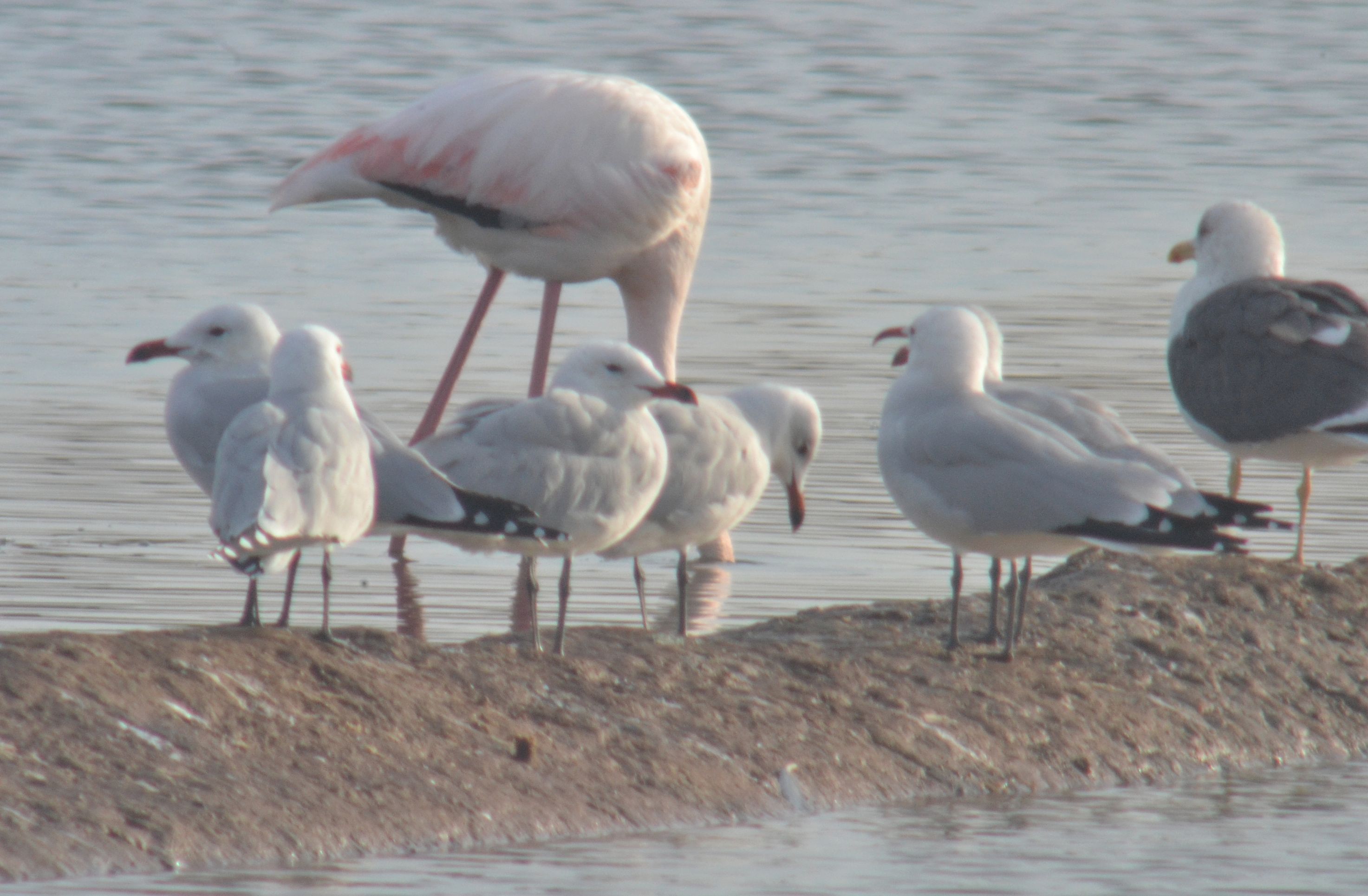 Ria Gilão on the other side of the estuary from site A. After drawing blank on the two previous days, I had a hunch this would be where I would find Audouin’s Gull. At the first big salt pan I came to, where the road bends sharply to the right, I recognised one flying in to join a group of several others. I could see at once they are unlike any other gull (left), absolute beauties that I immediately installed as my personal favourite gull species.
I then went out to just before a quay on the Tavira channel between the marshes and the Ilha de Tavira, where a dirt track led westwards. With the sun low behind me over the island, I could scan inland in a superb light and it was teeming with bird life. Huge numbers of waders were either feeding or roosting in the flooded salt pans, with both Godwits well represented and lots of Ruff. An impressive group of Spoonbill and some Spanish Sparrows were also noteworthy. At the end of the track a narrow path led further into the marsh as far as an un-crossable creek, the other side of which was Santa Luzia marsh (site C). I sat on a rock to rest and watch, and an Osprey passed overhead out towards the island. At 10:50am an interesting procession passed along this creek of swimming Cormorant and flying Egrets, Spoonbill and Sandwich Tern; all moving out towards the Tavira channel together. I realised that the birds were leaving the marsh and started to walk back soon afterwards.
The salt pans were now less populated, with waders feedig on the exposed mud of the channel, 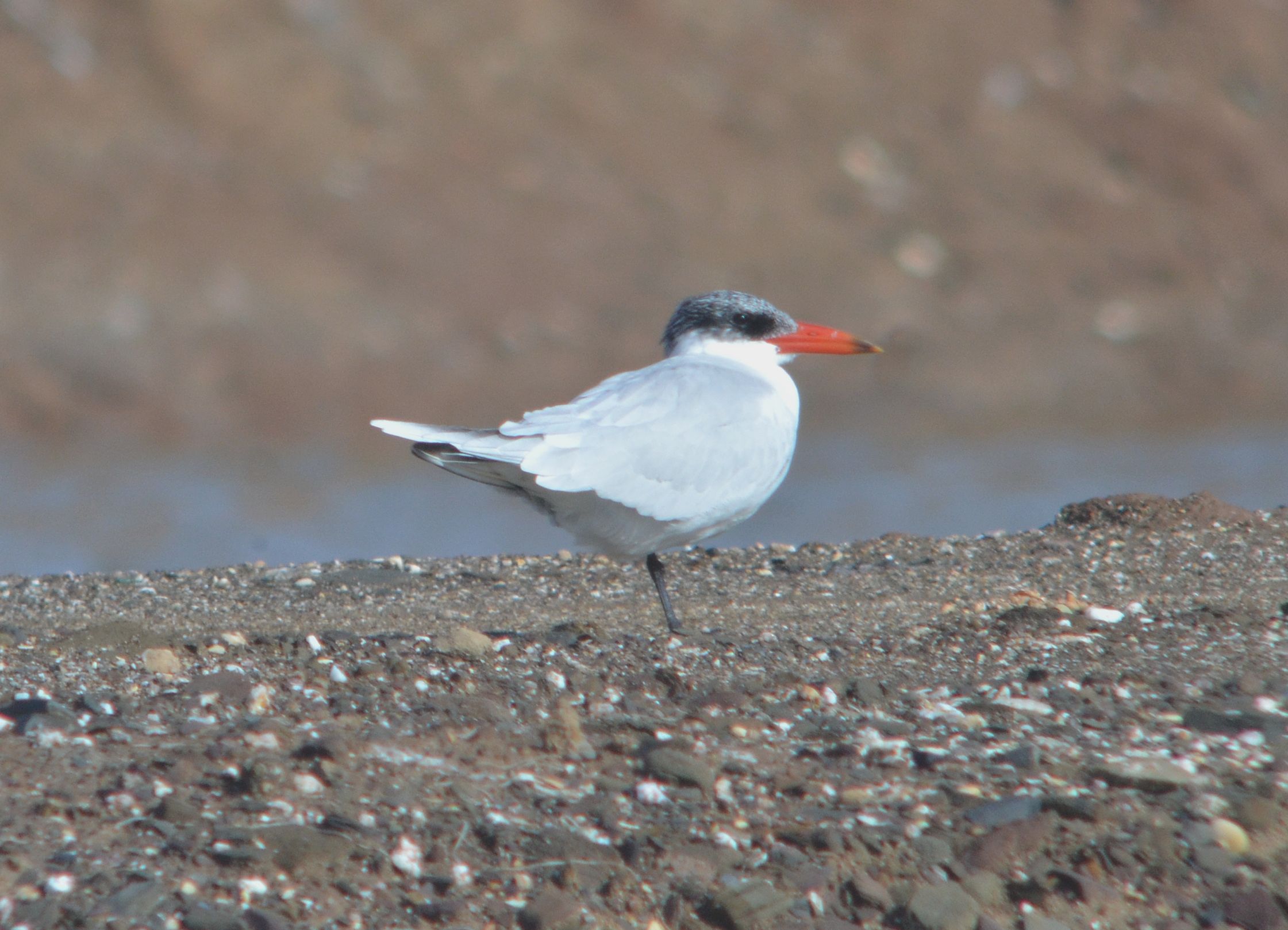 amongst which I picked out numbers of Knot amongst the Ruff. Back at the start point two Caspian Tern (left) were loafing amongst the Gulls, and seven Audouin’s were still there dozing the day away. I stopped by at this spot, that is opposite a derelict mill with a tall chimney, several times during the rest of this trip. Audouin’s Gull were always present in varying numbers, with around 50 birds present on 17 January.
On 26 January I came back to Quatro Águas for a final look around. There were plenty of Audouin’s Gull and two Caspian Tern roosting again. As I walked out to the quay the Osprey was sitting on a telegraph pole surveying the scene. Then on the small path off the track from the quay and out to the creek, a female or first winter Bluethroat jumped up and posed close in front of me, a perfect sighting with which to end the trip. This bird then flew back along the path a little way and walked ahead of me with tail cocked as I followed it. Along the return walk to town. the Osprey was back on its pole eating a fish.
Cerro do Bufo area of Castro Marim wetlands
After that thorough 3-day exploration of the Tavira marshes on foot, I decided to do the next two nearest sites by public transport. On 9 January I chose the closer option travelling by the coastal rail service to Vila Real de Sto António, where the station was about 20 minutes walk from the Castro Marim marshes. With Audouin’s Gull already seen, there was no particular purpose to this visit; I just remembered having enjoyed going there a year earlier.
I stopped first to scan the area on the edge of the town described in the pdf guide as Barquinha, where a Caspian Tern came in and dived for a fish with a big splash. This was the first time I had seen one in flight, the others all having been loafing on the ground. I then walked along the N122 northwards to the “salt pan trail” that follows the northern side of Carrasqueira creek. This was Coot grand central and also held many Little and Black-necked Grebe. A lot of Sandwich Tern were also flying about. The trail then leaves the creek and skirts Portugal’s largest salt pan complex, that unfortunately has to be viewed looking into the sun. It was nevertheless a great 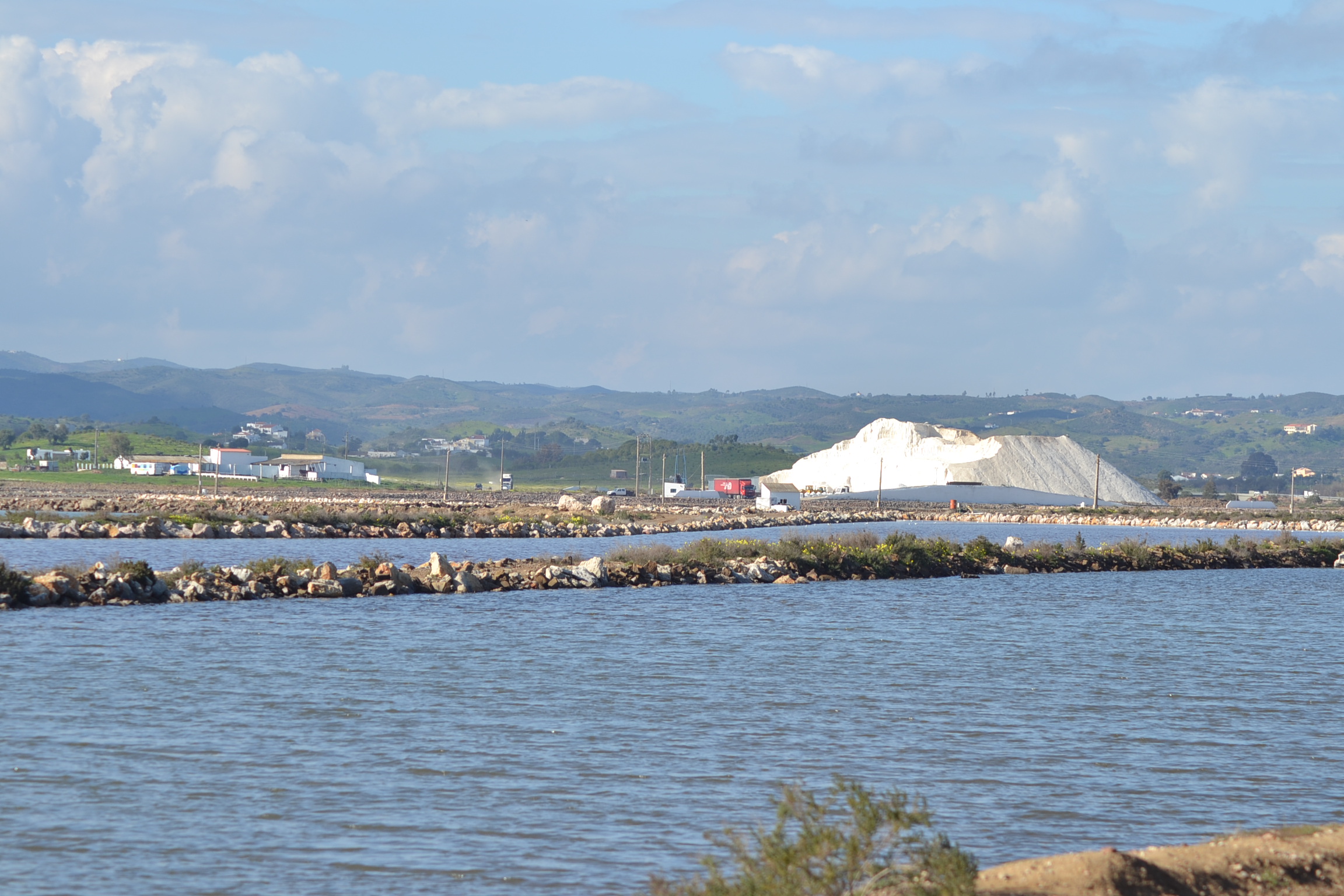 wildlife spectacle with large groups of Avocet, Spoonbill and Greater Flamingo here and there; Black-winged Stilts going about their business everywhere, and a few Shelduck.
I walked further than in 2013, all the way round to the salt works (left) from where the trail continued to the Ponte Estevera bridge on the N125-6. This is said to be a reliable location for both Audouin’s and Slender-billed Gull, but as in 2013 I didn’t see either. All along the winding trail there were endless waders on the pans and in the various channels. It was quite a walk and as ever the re-tracing took much less time, though glancing back it still looked a long way.
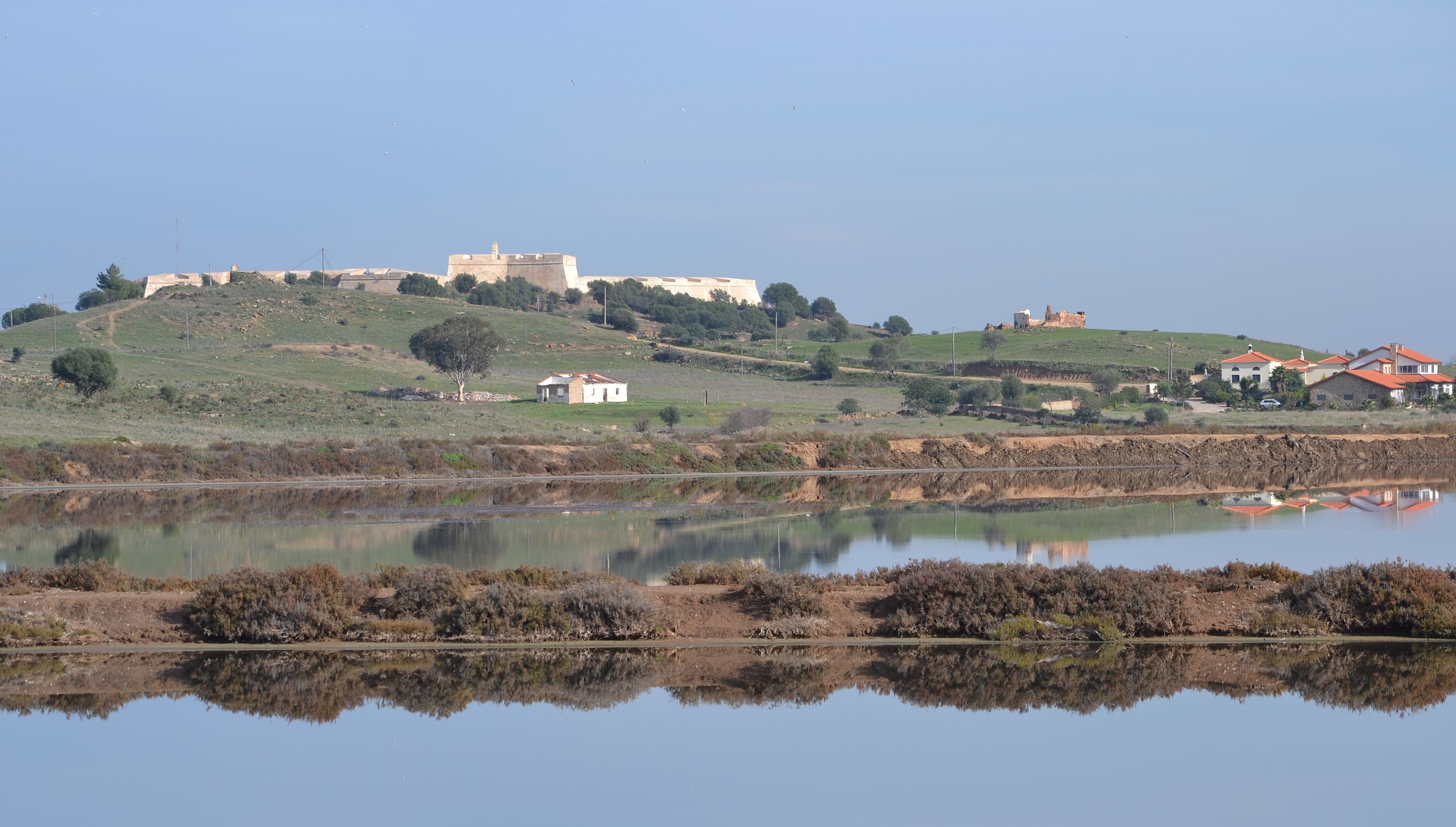 So I covered this major and evocative site (right) as thoroughly as I had done Tavira marshes, and that vindicated the decision to do things on foot as much as possible in the first week. Going by car I think there is a tendency to walk a certain way and then re-locate if not much is being seen. On foot I got a better appreciation of these areas as a whole and their general “birdscapes”. There was the issue of getting round in time to catch the train home, but in the event I timed it perfectly. The railway line skirts the southern edge of Cerro do Bufo so the return ride afforded views of the site from another angle.
Quinta de Marim
On 10 January I completed the coastal sites east of Faro by visiting the reserve just outside Olhão that is the headquarters of the Ria Formosa National Park. The walk out from the rail station was once more around 20 minutes. This reserve is managed to provide as many habitats as possible within its boundary.
As I walked in there were a lot of Azure-winged Magpie gliding about, as they do. There was a flock of Common Waxbill moving around and a bigger one of Serin. By placing the latter’s tinkling call here I realised I had heard them a lot already in various places. There were two hides overlooking a freshwater lagoon and an area of salt marsh adjoining the Ria Formosa, and it was good just to sit in these and observe after all the foot slogging of the previous four days. A largish group of Mediterranean Gull was moving between the two areas, my first in Portugal. I spent some time scanning the lagoon for Purple Gallinule and Water Rail, but didn’t see either.
Ultimately I felt disappointed at not seeing more common woodland species here, or perhaps Penduline Tit. The pdf guide says it is best to visit early morning when birds are most active, which is probably true, but I also wondered if there is so much habitat crammed into a relatively small area that it attracts fewer birds than larger areas of each habitat would. I had also hoped to make contact with local conservation workers here, but the visitor centre was closed and there was only one helpful security man on site in reception. By early afternoon the waders had left the salt marsh and things generally seemed on the quiet side, so I left.
Algarve hills north of Tavira
From 11 January I hired a car for the next 14 days, during which I drove through the area inland from Tavira a number of times, either en route to the Baixo Alentejo or on days when I needed a 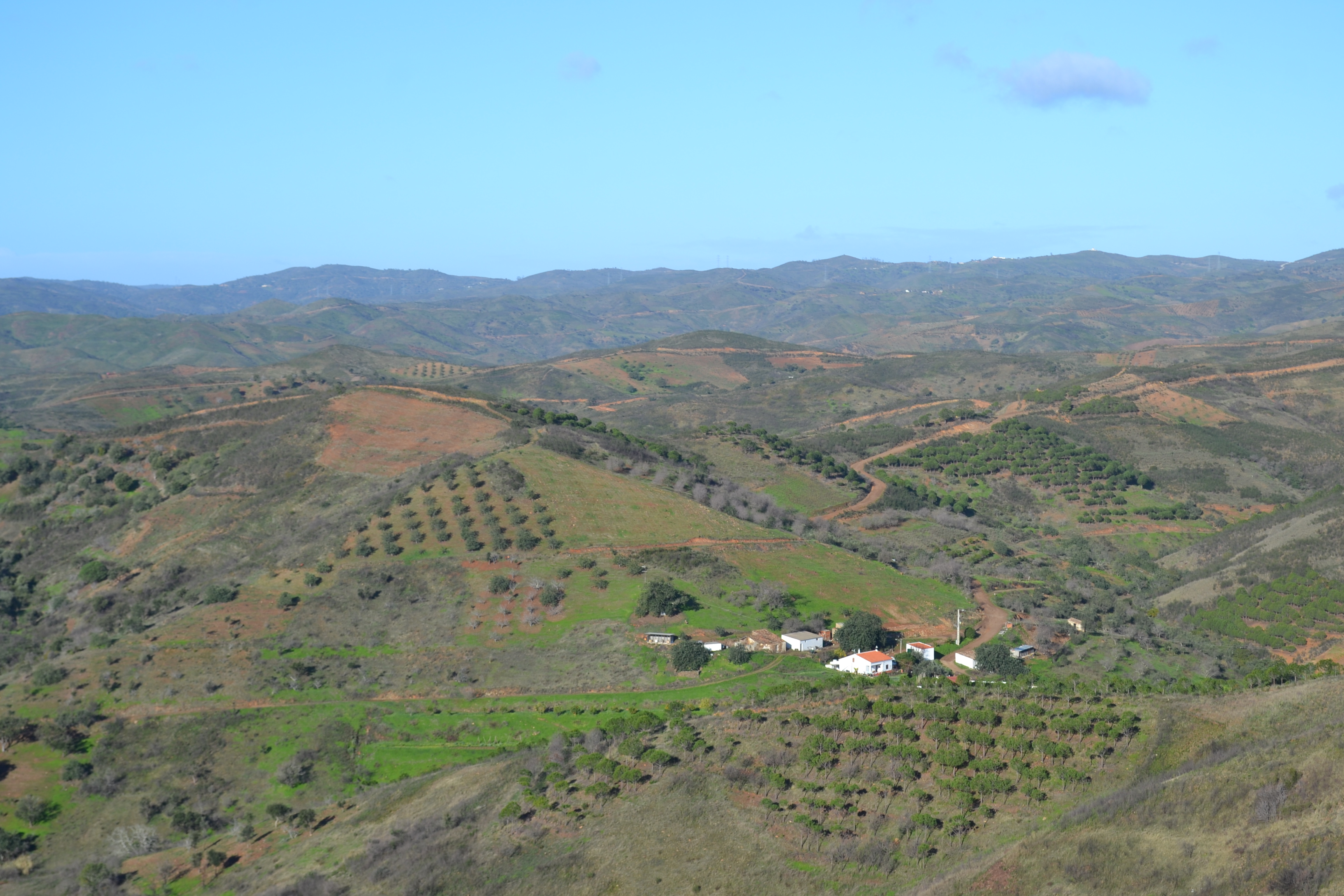 rest from walking. The rolling landscape here (left) is typical of the Serra do Caldeirão, the range of hills running from the Monchique mountains to the Spanish border where the underlying rock is a mixture of Carboniferous shales and gritstone.
The stand-out birding moment here was an encounter with a juvenile Spanish Imperial Eagle on my first day with the car. 10.8km from Cachopo on the N397, this beautifully marked raptor flew across the road in front of me just above car height, its coverts the colour of milky tea. Another pleasing sighting was Blue Rock Thrush on 19 January, whilst driving westwards from Alcaria do Cume, the highest point in these hills. At a village Bemperece a pair flew across the road and the splendid male settled in rocks at watchable distance giving my best ever views of the species.
The Cicerone guide “Walking in the Algarve” says the Cachopo area has the best walking in the Algarve hills, and the book contains eight walks either side of the N124 road that runs from the N2 to the IC27. On 20 January I did Cicerone walk 29 near a village Feiteira, from where a trail goes into what is described as “a reserve with a wonderful variety of bird and plant life”. The habitat here is “a mixture of eucalyptus, cork oak, pine and typical Mediteranean scrub”.
As soon as I turned south-west from Cachopo on that day, I recognised the habitat of well-spaced cork oaks with scrub and fire damage in which I had been advised to look for Rock Bunting. At this time of year the trail was not as birdy as the Cicerone guide had led me to expect, but I saw my first Woodlark in Portugal here and realised the ambition of finding a Rock Bunting by myself in the Algarve hills. Both those sightings were off the marked trail, and the Bunting landed then perched nicely in a tree close by me. I also heard Dartford Warbler and Wren here, but not much else broke cover except for Blackbirds and a pair of Great Spotted Woodpecker.
Coastal lagoons west of Faro
On 12 January I checked out two small sites between Faro and Vilamoura that the pdf guide calls the Loulé coastal lagoons. I was pleasantly surprised by both locations. This area has very good beaches and so is crowded with holiday home and tourist resort developments, some more tasteful than others. But it was interesting to see a patchwork original landscape of dunes and pine woods scattered amongst all that modernity, and how the two blended together often quite successfully.
The first site Dunas Dourados looked almost as if it the freshwater lagoon had been landscaped into the surrounding neighbourhood of empty holiday homes. Arriving at about 11am I walked across the dunes to an observation tower, disturbing some colourful residents: a pair of Hoopoe and a flock of Common Waxbill. I realised that like Serin I had been hearing the latter’s calls a lot on this trip so they must be numerous in the Algarve. The lagoon itself held a pair of Glossy Ibis and some Pochard, while Sand Martin were hawking overhead. Cetti’s Warbler were calling here and there and a Black Redstart put in an appearance.
 The second site Foz D’Almargem is a larger freshwater lagoon (left) cut off from the sea by a sand bar, and is a popular spot with the general public. Being fringed with reed beds, it immediately struck me as a likely place to find Penduline Tit, since it is much smaller than Lago do Salgado but still an impressive size. There were Pochard here again and several Red-crested Pochard . A lot of Cetti’s were calling and I walked along the fringe to the coast searching the reeds as I went, but all the small birds I could see were Chiffchaff. At the end of the track I was engaged in conversation by a Brit in a motorhome who pointed out a raft of Common Scoter offshore. He said there had been a lot of birders there the previous day because there was one Velvet and one Surf Scoter amongst them, but I didn’t attempt to find them at that range.
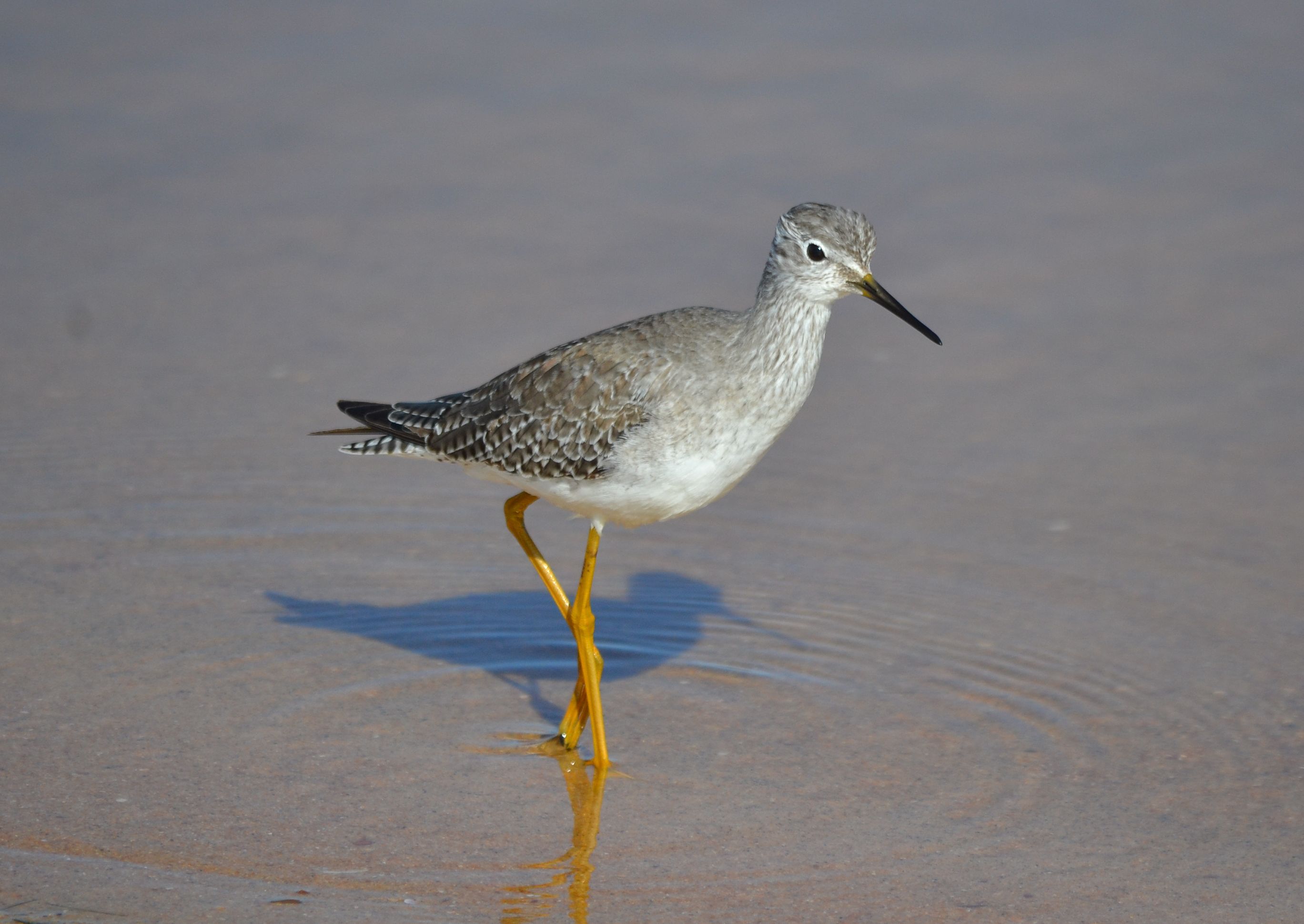
I came here twice more on 15 and 24 January. On the second occasion I did a full circuit of the lagoon for the first time, actually seeing Cetti’s Warbler and searching the reeds for Penduline Tit but without success. Crested Tit were active though in the adjacent pine woods. I also scanned all the Coots fairly carefully but couldn’t find a reported Crested Coot. The Scoter were still offshore on both days, while the stand out bird was a splendid Lesser Yellowlegs (right) that I found out had been present in the area for some time.
On 22 January I visited Lagoa de São Lourenço in the Quinta da Lago resort complex. The lagoon and reed beds here are overlooked by a large two-storey hide. My first impression was just how many Purple Gallinule were here, all going through their repertoire of pig-like noises. The second was how beautifully this natural feature was landscaped into the Quinta da Lago development. A golf course runs in a fairly narrow strip all around the lagoon, and beyond it are very expensive, superbly designed houses that blended into the scenery very tastefully. There 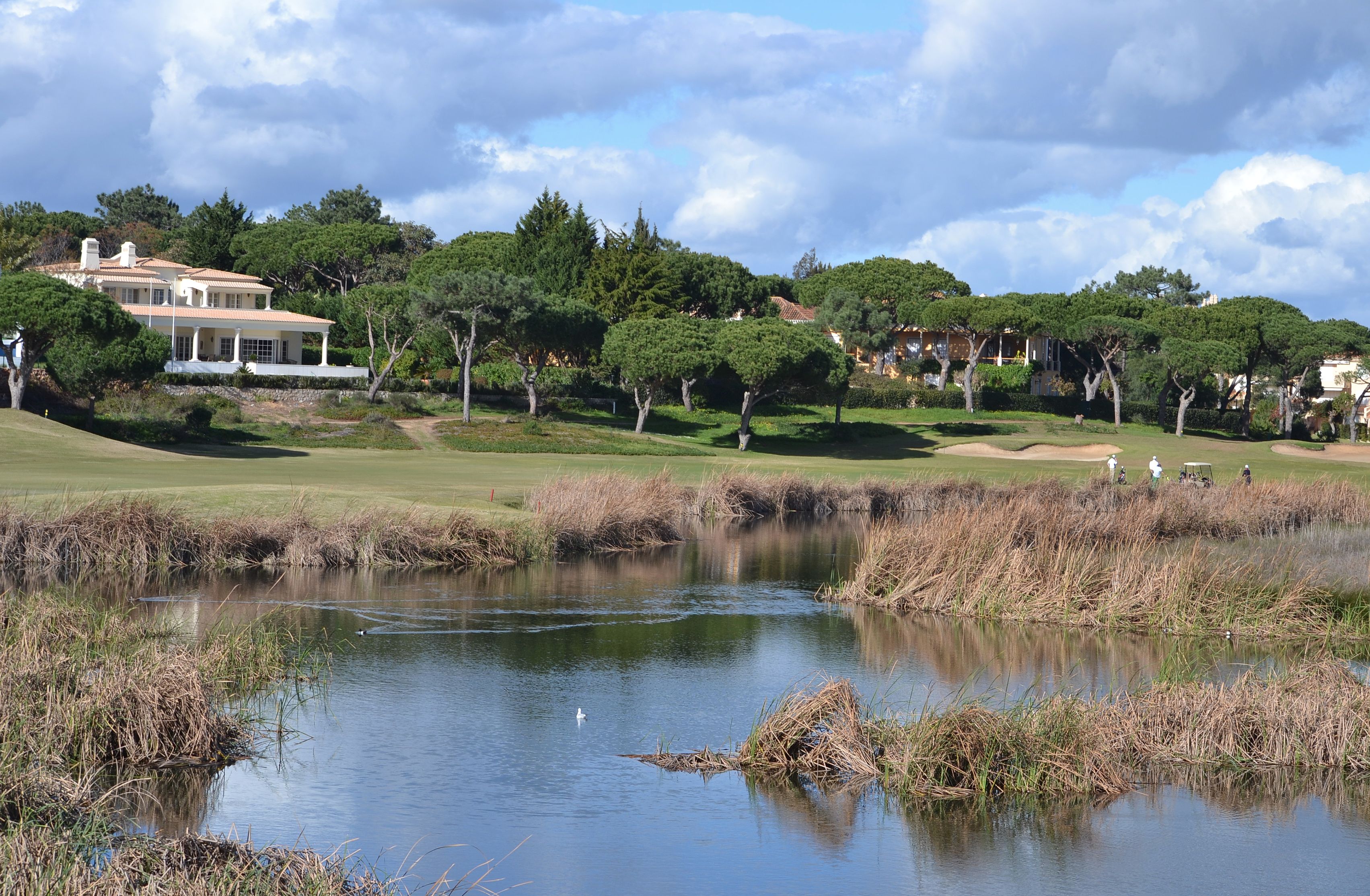 was real money here (below left) and I sensed a rare harmony between nature and wealth in which golfers and birders could both enjoy their preference in an easy co-existence.
After about an hour a professional guide came into the hide. He soon pointed out the resident Little Bittern, then Black-headed Weaver in the reeds, three Glossy Ibis on the golf course and more Audouin’s amongst the gulls. The Weavers were females or immatures, which showed the benefit of being with a local expert because I had only seen a picture of a male in breeding plumage. They were bigger than I had expected, and I recalled possibly having seen one previously at Foz d’Almargem without realising what it was.
Vilamoura Parque Ambiental
On 13 January I re-visited this reserve west of Faro aiming to cover it more thoroughly than in 2013, but this day was perhaps less productive than then. Once again, the hedges were stuffed full of small birds, but 90 per cent of them seemed to be Sparrows with huge concentrations in places. There were also large numbers of Blackcap singing in cover and a lot of White Wagtail on the ground. The Sparrows would all burst out of the trees and move ahead of me as I walked.
Looking over farmland before the first reed bed, an Iberian Grey Shrike was atop some bushes in the middle of that area. From the first hide I watched two Purple Gallinule for some time. I remembered being more impressed by the second reed bed last year, but not this time since the hide there had a limited outlook into the sun. Two Marsh Harrier were active during my stay, and two more Gallinule close to the hide. I decided there might be a better chance of Penduline Tit at the first location, and after about an hour returned there but a strong cold wind had blown up so I didn’t stay for long. Lastly I walked around the edge of the reeds to look into other areas, and a total of five Gallinule were active.
It was a bit of a low-key visit really, without 2013’s Booted Eagle, Black-winged Kite or Ferruginous Duck; and no sign of Bluethroat or Black-headed Weaver either. I once more got the impression that a lot of patient scrutiny would be required to do this location justice. It is worth mentioning that the only sign to the reserve is on a corner of the Avenida de Albufeira that runs westwards from the Avenida Vilamoura XXI thoroughfare through the resort. This part of the Algarve is difficult to navigate with a satnav.
Ria Formosa west of Faro
I made three visits here during this trip, the first on 15 January starting from a little parking spot next to the estuary hide at Quinta da Lago. From there I saw Mediterranean Gulls in the roost and picked out six Audouin’s. It was good to see the latter at distance because they really stood out as different again. The tide was rising and the outlook was generally less birdy than Quatro 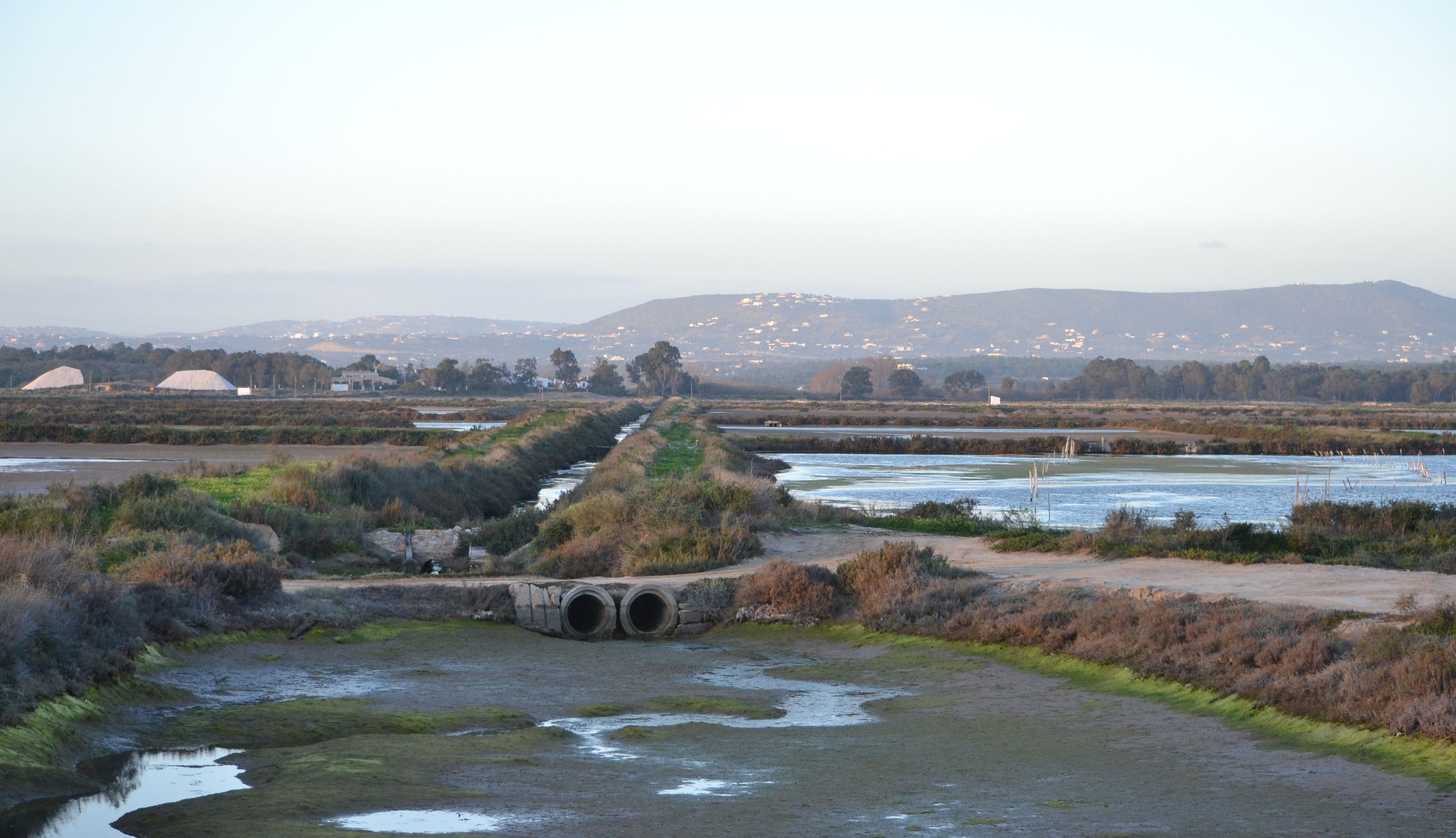 Águas in Tavira at high tide. I walked along the causeway to the Ludo area, then did a complete circuit of those salt pans (right) where the best birds seen were Little Stint and the trip’s second Osprey. On the freshwater lagoon inland from the causeway there was a large concentration of Wigeon. The small birds were mostly the same species over and over again, and it became boring when so many of them were Sparrows.
On 22 January I walked west from the beach car park at Quinta da Lago as far as and a bit beyond Ancão beach, finding Crested Tit in the same stand of maritime pines as in 2013. There are large expanses of this coastal dune and pine wood habitat west of Faro, and the sandy beaches continued all the way past the built-up resort of Quarteira to Albufeira.
The professional guide I met at Lagoa de São Lourenço tipped me off that a Black-winged Kite came into Ludo Farm in the late afternoons, so I went to look for this bird on 24 January. A Booted Eagle was active when I arrived and at around 4:30pm I picked up a smaller raptor perched in a dead tree at some distance that looked a good candidate for Black-winged Kite. When I got as close as I could to the spot it had gone, but a bird of the right profile glided past and I saw it twice more over the salt pans.
Vale do Guadiana and Castro Verde SpA
The Baixo (lower) Alentejo is the province of Portugal immediately north of the Algarve. I made four excursions on this trip in search of the Eagles, Vultures and various steppe speciality birds that may all be observed here.
On 11 January I visited the Parque Natural do Vale do Guadiana, north-west of the town of Mertola. I had read somewhere on Birdforum that the best strategy for seeing large raptors is to 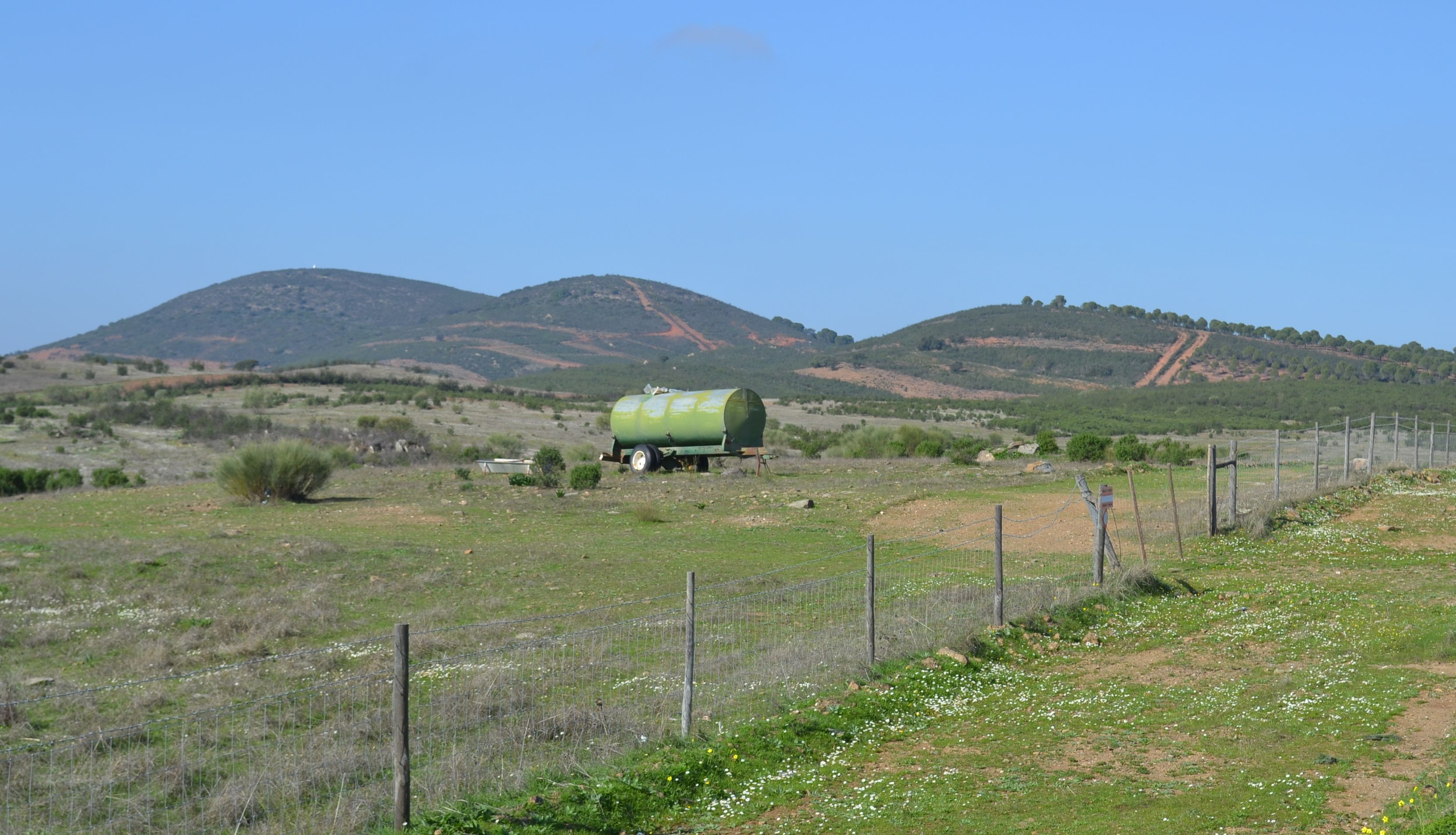 head into the hills here, reach a high point and just scan around. From the N122 I chose an access road (right) to a village Corte Gafo de Cima then on towards Mosteiro. Things quickly became birdy along this route where I first came across a group of Crag Martin hawking near a farm. From that point I could see two large raptors and so drove on.
One of those birds was a Red Kite but the other was major trip target and lifer Golden Eagle, a juvenile. Having parked and set up my scope the Eagle came back twice more, giving superb views. I hung around at that spot for some time, during which an adult Spanish Imperial Eagle also flew through. It was a tremendous lift to have self-found both Portugal’s large wintering Eagles. Several Iberian Grey Shrike were also seen through the afternoon.
In 2013 I had not been aware of the Vale Gonçalhino environmental education centre just outside of Castro Verde on the steppes. Having researched it this time, I made visiting a priority in the hope of getting local information on where to find more difficult species. When I arrived late morning on14 January, the weather was overcast with occasional light rain and strong wind; the first time I had experienced the steppes in that mood. A lady who answered the door confirmed that it is indeed a place to see Black-bellied Sandgrouse and Calandra Lark, but that the former would be difficult in the day’s weather conditions and the latter much easier in spring when they are singing and displaying.
In about three hours at this reserve, I saw a lot of Corn Bunting and Meadow Pipit, but neither of those trip targets. I did get two Portugal list additions in Little Owl and Golden Plover. After leaving I took a drive around the steppes, going first along the road between Entradas and Carregueiro that had been so productive a year previously. I found four Great Bustard in more or less the same place as on that trip.
Next stop was Monte Salto off the N123 Castro Verde to Mertola road, where I was advised at 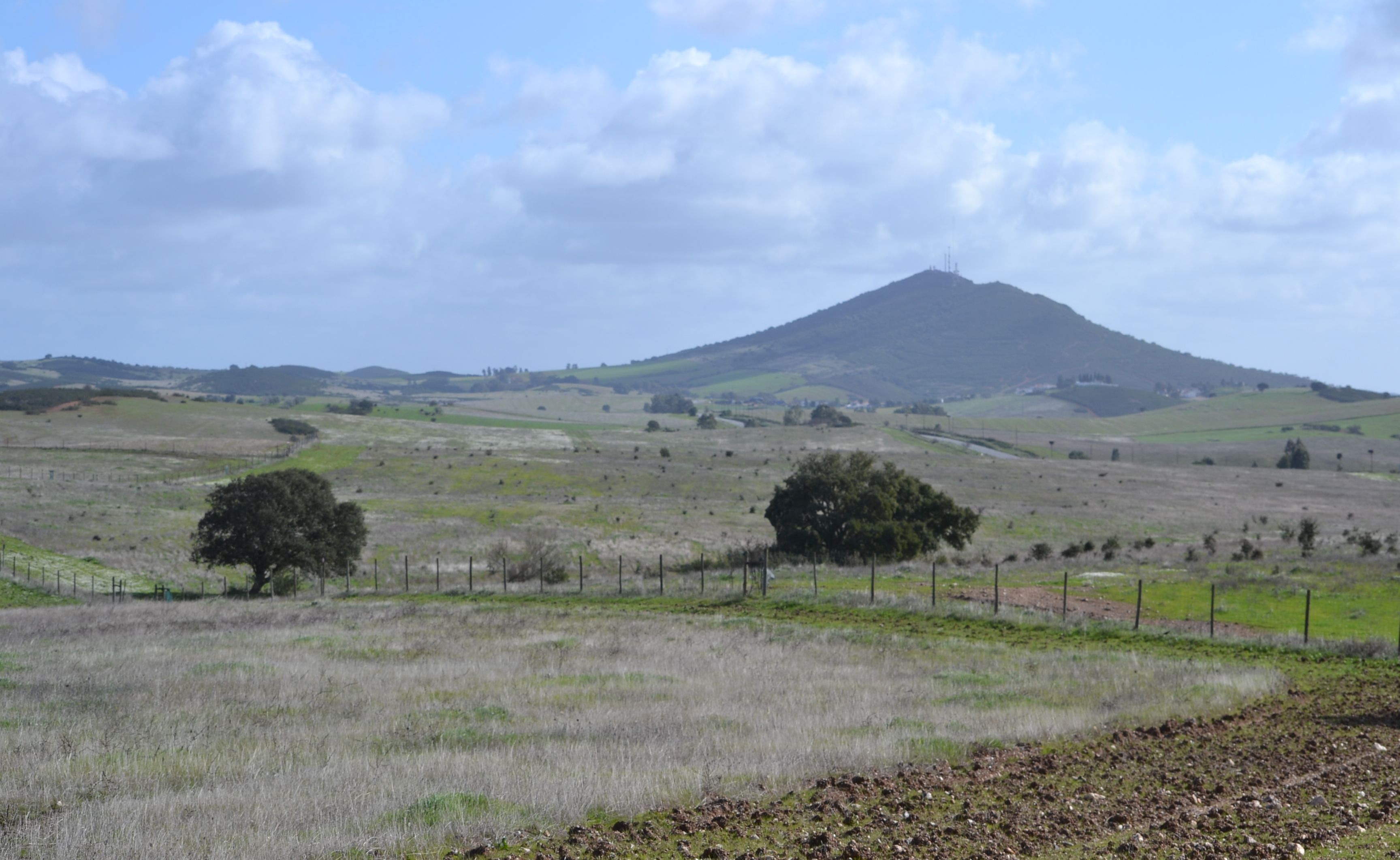 the centre to look for Common Crane. I didn’t see any but did find another 13 Great Bustard along the minor road to the village. The centre said a good spot for Black and Griffon Vulture is Alcaria Ruiva (left) on the IP27, just inside the Vale do Guadiana park. But the very overcast conditions didn’t exactly make for thermals for large raptors to soar on, so I kept going.
I revisited the Castro Verde SpA on 18 January. The first thing I noticed on this day was the huge number of wintering regular Starling, mixed in with the Iberian Spotless species, and there were huge numbers of Corn Bunting everywhere. All the action came at one site along a dirt track north of the N123. A Griffon Vulture gliding fairly low to one side of me put up a group of Little Bustard, and on scanning around for those once the Vulture had gone, there on the ground below the horizon was a big flock of Black Bellied Sandgrouse.
I watched the Sandgrouse for a while by standing on my car’s sill, with a foot on the arm rest and my tripod extended to its full height. The birds were at the top of rising ground and I was in a fairly sunken position so I assume they could not see me as I had been told they normally go up at 400-500 yards. I suppose it was luck finding this lifer when scanning for something else, since I was only expecting to get flight views.
With the afternoon to fill, I decided to cover some Great Bustard country south of the N123. Part of this area is a large reserve with guided access only on application to Vale Gonçalhino. The gate was nevertheless wide open so anyone could go in, but I was respectful and did not do so. I then drove a loop starting from the second major turning east of Castro Verde. I had heard this is where many visiting birders go to look for Great Bustard though it’s not necessarily the best  area. I too didn’t see any here, though I was experiencing the steppe landscape in all its glory and came across a Bonelli’s Eagle near a village Rolᾱo.
Heading back east, I checked out a location opposite a turning to a village Benviuda for Calandra Lark, but that species continued to elude me. The wire fences along this track were lined with Corn Buntings, with a few Linnet and Stonechat mixed in. I did see plenty of Theklas though, as a professional guide had explained to me all the larks with crests here are. Later I confirmed a previously seen roadside Eagle along the N123 as Booted (right), before it moved to sit with a second bird of paler marking. So that was an excellent day on the steppes after which I felt I was getting to know the Castro Verde SpA quite well.
My final visit to the Baixo Alentejo on 21 January yielded more good results. At 10am between a 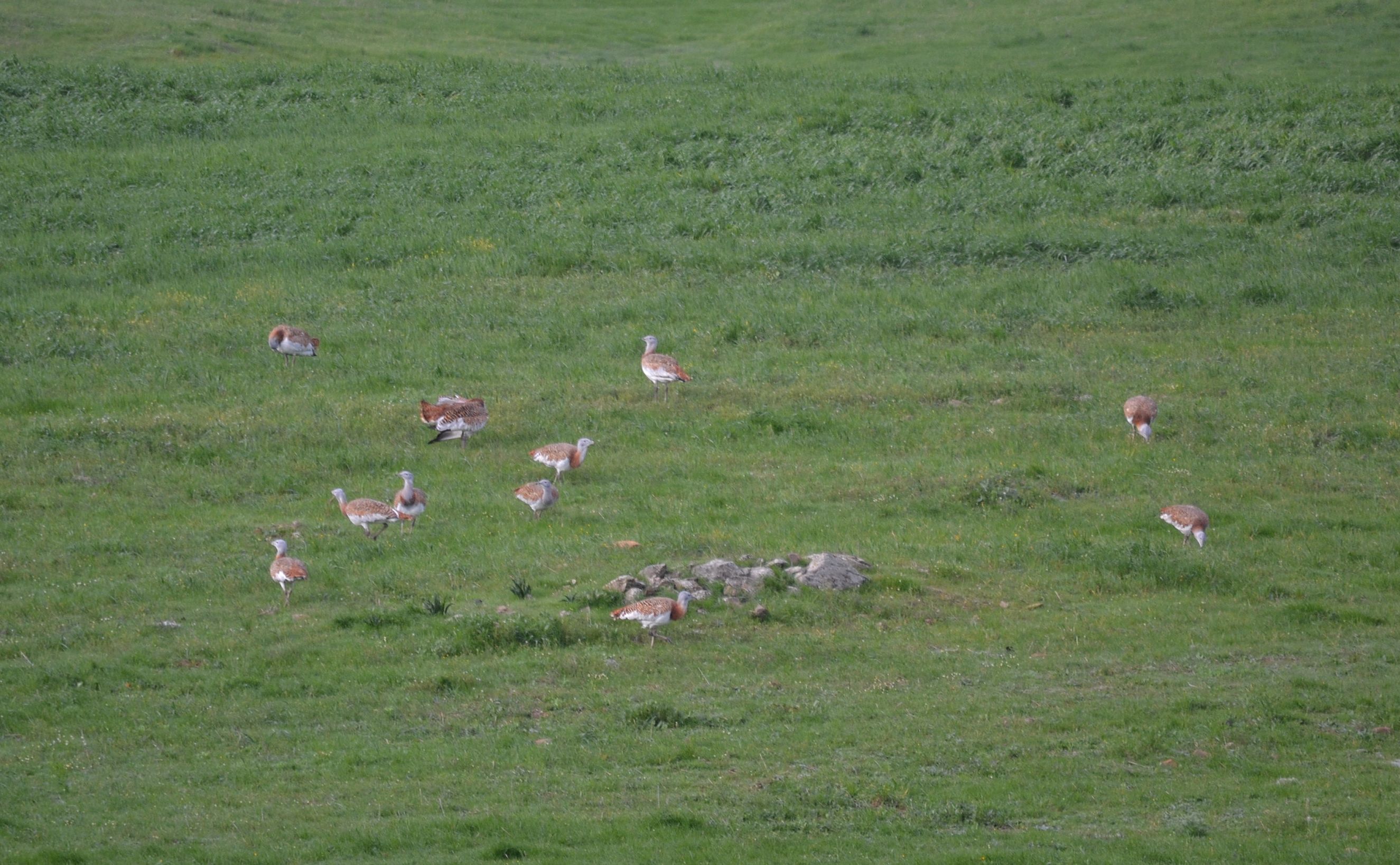 village Joᾶo Serra and the N123, I came across 16 Great Bustard (left) fairly close to the road and got some reasonable pictures before they strode off majestically over the brow of some rising ground. That was the day’s only sighting, so considering how many there are here they are surprisingly tricky to find. I suppose in an undulating landscape they are more likely to be out of than in view.
At the site north of the N123 opposite Benviuda, I finally picked out a Calandra Lark by its black breast band in a stony field. From there I went on to an area west of the N122 Mertola to Beja road where I had been advised to look for Common Crane along dirt tracks. Turning left to a village Camelos, I followed a well-made dirt road as far as the river Cobres that was not crossable. Turning back across fairly high ground, I scanned a likely looking area and picked up three Crane flying along the horizon.
Through the afternoon along the N123 I came across four separate Booted Eagles, none of which appreciated my stopping and watching them even though I stayed in the car. At the location where all the action had been three days earlier, the Sandgrouse were in the same field again but quite close to the track. Hence I put them up, hearing their distinctive call and getting good if brief flight views as they headed for the horizon. I staked out the big hill at Alcaria Ruiva for half an hour without seeing Black Vulture. Lastly I went for a drive in the area of Vale do Guadiana where I had seen the large Eagles, but found only two more Booted.
Southern Portugal: 28 April – 19 May 2014
Eastern Algarve and Baixo Alentejo
After my visit here in January I wanted very much to see the countryside in the spring, when wildflowers are in bloom, butterflies and dragonflies on the wing, birds singing and displaying etc. I again used the picturesque coastal town of Tavira as my base. Whereas my first two Algarve trips had been out-and-out birding experiences, I timed this one for when the hills would be walkable in comfortable temperatures with wild plants at their peak. The priority was to see what butterflies, dragonflies and other wildlife I came across, but in areas where as yet unobserved though difficult southern European birds might be encountered too. At this time of year with the local insects and flora to enjoy, any location can become fascinating and rewarding; and thus there is no hurry to do anything.
The two areas that I concentrated on were the central limestone hills of the Serra do Caldeirᾶo, and the lower (river) Guadiana region adjacent to the border with Spain. The former holds some outstanding wildlife locations, while the latter’s several tributary valleys perfectly matched the trip rationale stated above. Seven days into this trip every one of them had been exceptional, and after that the experiences just kept on coming and there were always new things to see. I felt little inclination to repeat what I did in January, and this time it was all fabulous locations in remote places way off the tourist track. As on my two previous Algarve trips I also devoted some time to birding further north in the Baixo Alentejo province.
The two basic references used for this trip were Turismo de Portugal’s pdf Birdwatching Guide to the Algarve (again); and Moore, Elias and Costa’s new Birdwatcher’s Guide to Portugal.
Tavira area
The first intention on my return was to check out for butterflies a pocket of wasteland north of my hotel. There were masses of wildflowers in places here but on 28 April butterflies were rather sparse. The second one I saw was nevertheless the day’s top target Spanish Festoon that I somehow just expected to see here. I was also pleased to find a colony of False Ilex Hairstreak on some Cistus bushes, and Green-striped White was a third new species. Male and female Red-veined Darter dragonflies and some rather colourful Iberian lizards, Large Psammodromus were also seen.
-
- False Ilex Hairstreak
-
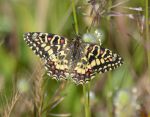
- Spanish Festoon
-
- Red-veined Darter (female)
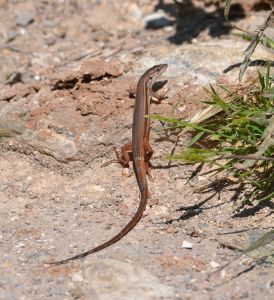
Large Psammodromus
I re-visited this rest day “patch” twice more. On 11 May much of the wildflower cover had gone to seed in the areas I walked, and so butterflies were correspondingly fewer. Ones and twos of Common Blue, Spanish Gatekeeper, Small Skipper, Small Copper and Cleopatra were seen. I also came across a lark without a crest that didn’t call like a Skylark, and when I checked my record shot against Collins it was indeed my first Short-toed Lark for Portugal.
On my third stroll around here on 17 May I found wildflowers still in bloom on the more sheltered north-facing slopes and hence greater numbers of butterflies. This time I found Blue Spot Hairstreak in two places; also Swallowtail and Cleopatra
-
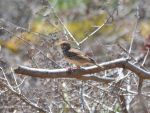
- Short-toed Lark
-
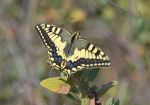
- Swallowtail
-
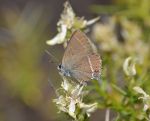
- Blue Spot Hairstreak
On the afternoon of 28 April I walked out to Quatro Aguas to see how bird life on the marshes compared with January. There were still good numbers of Black-winged Stilt, Little Egret and Avocet; and a few Greater Flamingo and Spoonbill. Common wader numbers were greatly reduced as expected, but a good variety were nonetheless present. The stand out summer species on the marsh was Little Tern. Audouin’s Gull were present at their regular spot.
I made another comparison with winter on the afternoon of 5 May, driving out to the Sapal Venta Moinhos area of Tavira marsh. The answer was quieter for birds and busier with people, but spending some time trying to photograph European Bee-eater and the many Little Tern here was a pleasant enough diversion. By now the feeling was growing in me that the local area is more interesting in winter when it is also in a better light.
On 4 May I went for a drive in the hills above Tavira to see how the landscape there compared with January. Lower down it didn’t really look too different but there was more colour higher up. Roads are marked on my Michelin map to the east of the N397 to Cachopo, but there were actually only rough roads and dirt tracks connecting tiny villages. I turned right on the first one of these with a hard surface, that led into the upper reaches of the Beliche valley and followed that river. A random stop produced more butterflies in Spanish Festoon, Long-tailed Blue and Brown Argus. At a village Umbrias de Camacho, Woodchat Shrike got onto my Portugal bird list, and from there I followed a road back to Tavira.
Bird trip targets
I went into this trip with just a small wish-list of birds. These were Lesser Kestrel, White-rumped and Pallid Swifts, Collared Pratincole, Black Vulture and Rufous Scrub Robin; of which I found the first four. There were also a number of previously unseen warblers that might be encountered if I was lucky, but I felt no inclination to spend time getting hot and frustrated by prioritising them when there were new insects to enjoy and beautiful landscapes to explore.
Lesser Kestrel at Mertola
29 April was quite a day, on which I drove north-east to the hill-top town of Mertola to track down Lesser Kestrel. The IC27 road north of Castro Marim was as empty as in winter but the countryside was now carpeted in wildflowers and shrubs. At the river Vascᾶo bridge on the Algarve / Baixo Alentejo border, I heard then saw the trip’s first of many Golden Oriole, and a Black Kite glided through. A little further on Raven was a third new bird for Portugal.
Just before Mertola I stopped at a second river crossing where I at once heard European Bee-eater, Turtle Dove and Nightingale, the first two of which were seen. Crag Martin were nesting under the road bridge. I arrived in Mertola just before midday and walked up to the castle ruins. From there I could see Kestrel flying out from the town hall above the Guadiana and hawking over the river. It was too difficult to ID these with binoculars so I walked back down to get my scope, finding a number of vantage points on the way. The lady in the tourist office didn’t know much about birds though she did have a nest at home in her garden.
Armed with my scope I returned to the town hall that is built on a large buttress on the river cliff. A lot of nest boxes on the roof were being used by Pigeons and Spotless Starlings as well as the Kestrels. The street along the cliff-top is very scenic, containing a number of public buildings, and there were stone staircases down the cliff in places offering good vantage points. This was a stunning setting (below) in which to stake out the breeding site.

Watching the Kestrels in flight it was too difficult to tell which type they were. With no previous experience of Lesser Kestrel I needed to see a perched adult male to PI the species. So I found a staircase that provided a perfect vantage point and enjoyed the beauty of my surroundings. Some four hours after my arrival in Mertola, one then another male sat up and posed on the roof ledge of the town hall: the first one having a look round and the second one a preen. With perfect scope views I picked out the Lesser Kestrel diagnostics of plain blue-grey cheeks, lightly spotted upper breast and the blue-grey wing panels that had been unclear in flight.
The new bird watching guide to Portugal only mentions Lesser Kestrel at a convent outside of Mertola and stresses that disturbance is not tolerated. So it was very satisfying to find these birds in the town and there was no likelihood of disturbance from where I was watching them. The warm glow of a successful twitch also made me appreciate the setting all the more: the hilltop town of Mertola (below) really is a heritage site extraordinaire. I let the tourist office lady know that two of the birds on the town hall roof were indeed what I had come to see, in case anyone else asked her since people do visit Mertola just to see them. Whether or not she thought I was a crazy forasteiro (non-local) I couldn’t tell.
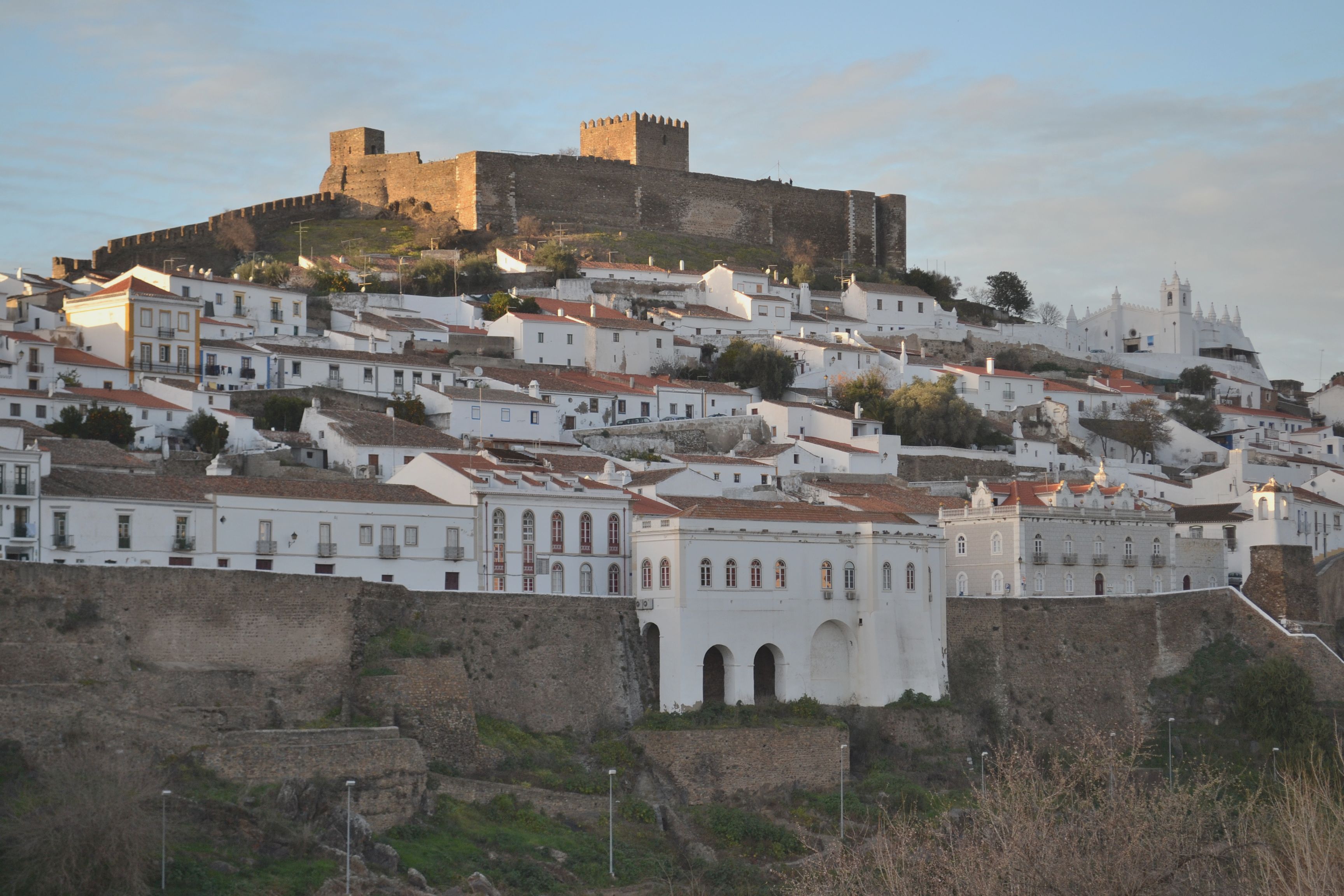
White-rumped Swift at Mina de São Domingos
The only publicised site for this species in Portugal is a ruined open-cast copper mine near the Spanish border. It’s in all the published guides so I wonder if that is a diversionary tactic to keep visiting birders away from more sensitive sites.
Mina de São Domingos is not an easy place to locate. There is a village of the same name nearby that I set my satnav for, but on arrival I thought the likelihood of the ruins being signposted from there were slight. So on 7 May I followed the advice in Moore, Elias and Costa and went to a village Santana de Cambas, from where a rough track leads out to the mine. The ruins are visible from where this track starts but soon disappear from view, and the track itself (below) is only negotiable in a 4WD. I drove along it as far as I dared before getting out of there for safety’s sake and returning to the start point.

It being a pleasant 20 degrees I parked up and walked back out. As I expected the distance seemed less on foot than during those nervous moments in a hire car, and around 90 minutes later I arrived at the moonscape of what must have once been a major industrial facility. This was an arid landscape with drying out watercourses and larger bodies of water in places, some of it stained deep yellow, red and purple from sulphate deposits. The same hues were in the rock litter that was everywhere and the wider geology.
At the mine, Red-rumped Swallow, and some Crag Martin were nesting on the ruins but there were no Swifts of any kind. Several Black-eared Wheatear were active along the access track and at the mine itself. I appreciated that it could still be early for the target, and while I was on site a minibus came and went by a northerly track suggesting there was an easier way in. Hence I made a post on Bird Forum asking for directions. A Portuguese birder replied with GPS co-ordinates for the start point and where he had observed a WRS the previous weekend. Apparently only two had been seen so far in 2014 and nine bred at the ruins in June 2013.
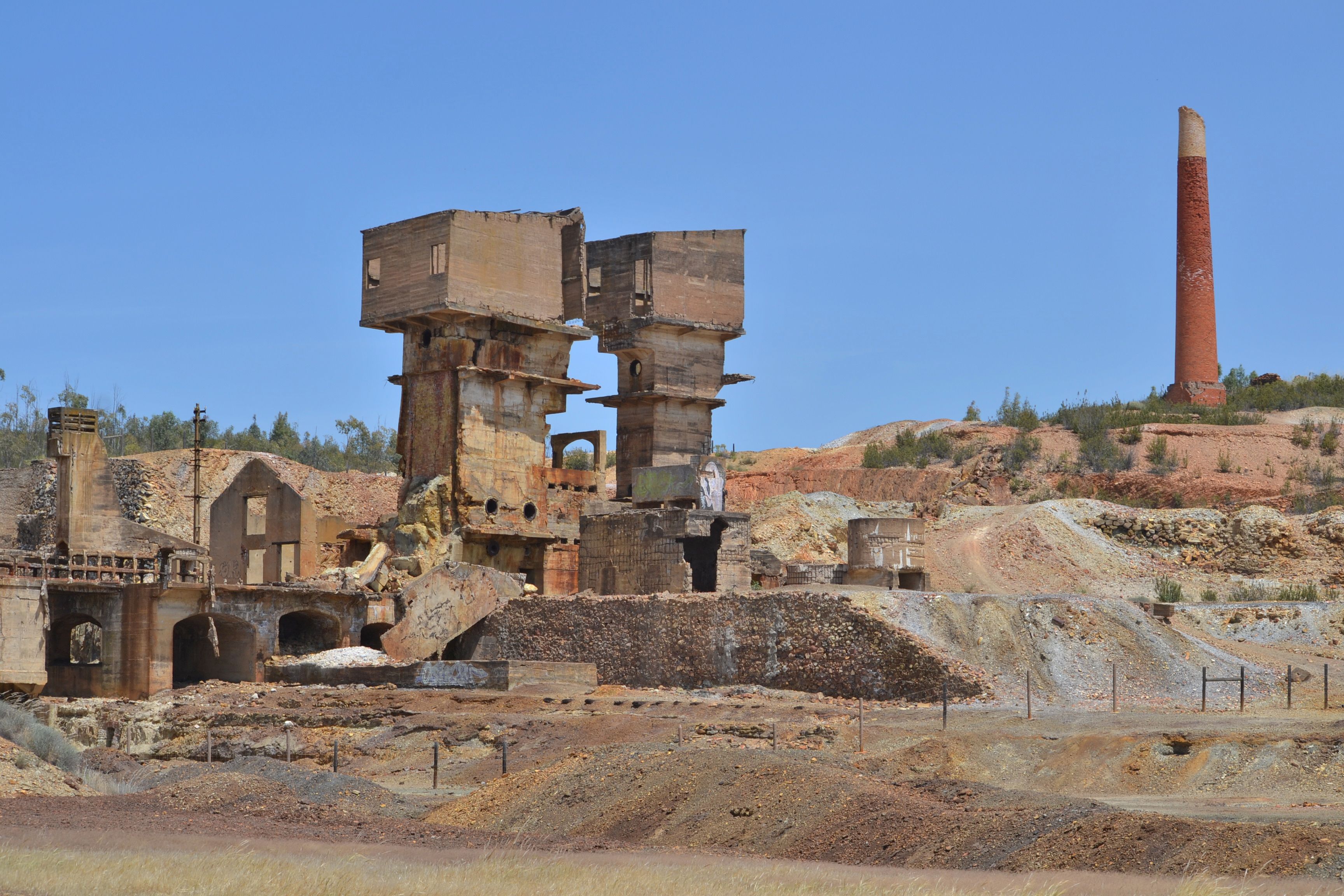
I left a second attempt at White-rumped Swift until 16 May. The northern track started just into the village of Mina de Sᾶo Domingos, where there were a lot more ruins, and led for about 3km through a vast area of worked out open cast mining. The birder’s co-ordinates that I reached at around 10:00 matched where I had been on my first visit. At 11:20 a small dark Swift with a bright white rump flew right past me. It stood out as being different from the many Red-rumped Swallow and Crag Martin that I had been watching up until then, but that brief encounter was the only conclusive sighting in two hours on site. Nonetheless it was mission accomplished and a second trip lifer.
Collared Pratincole at Castro Marim marshes
I paid two visits here to locate a species that I had seen before in France and Spain but only at distance. First stop on 9 May was the Cedro do Bufo salt works where Collared Pratincole are said to nest within the walls of the complex. As on Tavira marshes things were generally less birdy than in January, though there were still good numbers of birds about.
Summer species were represented by more Little Tern, Common Tern and the blue-headed race of Yellow Wagtail. Small waders – Dunlin, Sanderling and Ringed Plover – were dotted around all over the salt pans, but I had a good scan around and saw no Pratincoles. There were no Audouin’s Gulls either for the third trip running, and this made me wonder whether the salt works is an overrated or historic location for them. Lack of access, heat haze and viewing into the sun much of the time (below), all make it a difficult site to search for birds at the distance from the trail that is involved.
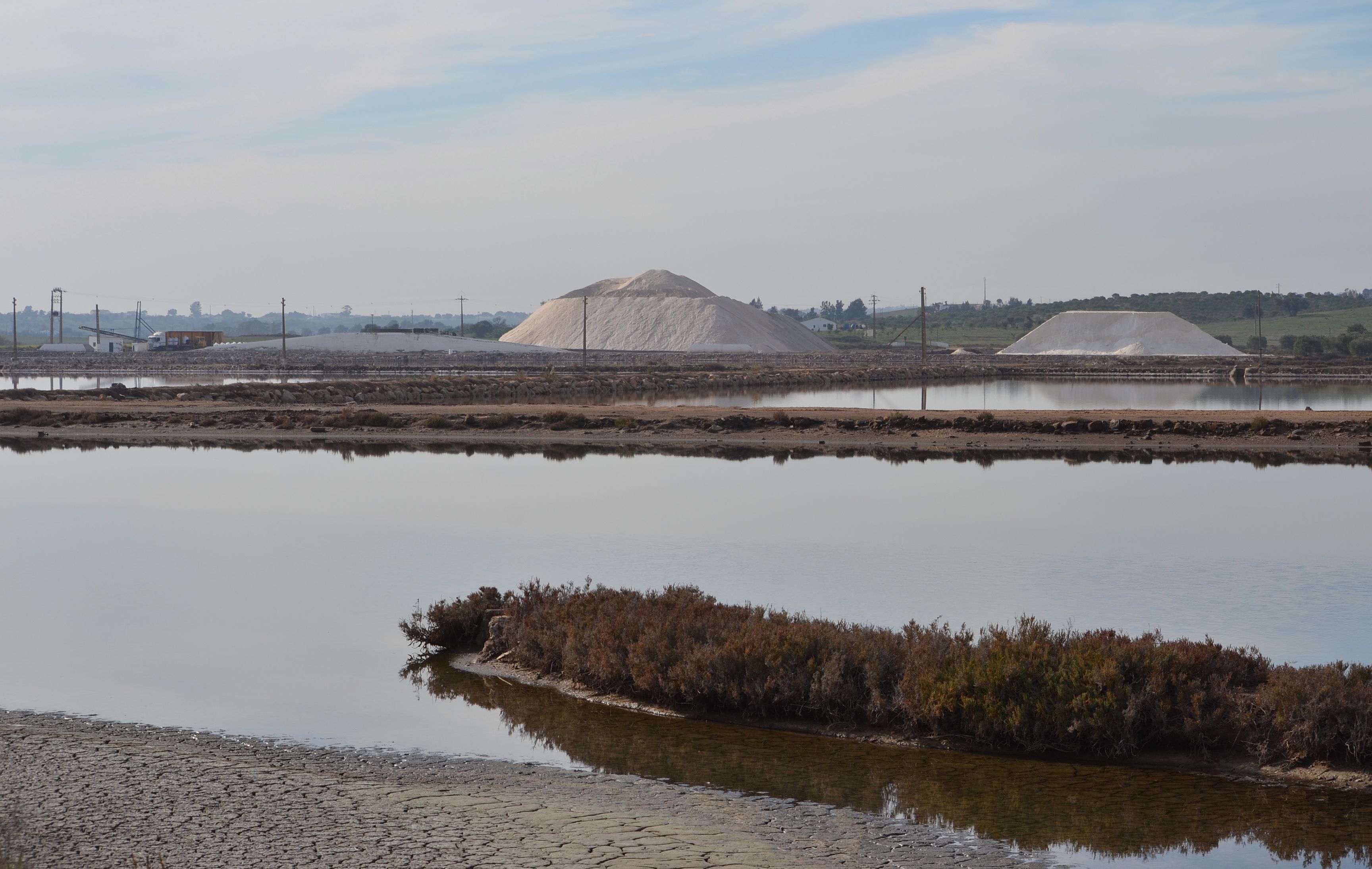
I next drove on to just the other side of Vila Real de Sto Antonio, parked on the roadside verge and scanned the area of marsh between the IC27 and the Guadiana estuary. In this flat, dry habitat I quickly picked out Pratincoles in flight, identifying the first one by the wing shape. At distance they looked plain brown with a more vivid white rump than other small waders, and what other wader hawks for flying insects? All doubt was removed when one landed fairly close to the road and beside a second one on the ground, both offering good scope views.
Driving home on 10 May I went through Castro Marim at around 7:00pm, and so took the opportunity to scan the marshes east of the IC27 with the sun behind me; something I had wanted to do on this trip. I watched the Pratincoles again and got some record shots, but couldn’t pick up any Little Bustard that are also said to be viewable here.
Pallid Swift in Faro
Lesser Kestrel and White-rumped Swift had been on my Portugal wish-list since I first researched things here, so it was very satisfying to have observed them at the first attempt in season. An unexpected bonus came when my flight home was delayed overnight and the stranded passengers were accommodated by the scheduled carrier Monarch. Fortuitously I stepped onto a coach bound for a hotel right in the centre of Faro beside the marina. In the morning, 19 May what should be flying past the fifth floor restaurant windows but a third lifer Pallid Swift. I knew that large colonies of this bird summer in Faro but hadn’t fancied looking for them in a city, and now here they were. When I went outside the Swifts were swooping down so close that I could match them to my field guide with the naked eye.
Serra do Caldeirᾶo
The pdf guide highlights three locations here: Rocha da Pena, Fonte de Benémola and Parises; all of which produced stimulating and evocative wildlife experiences. I also revisited Fonte Férrea, and re-traced walk 29 in the Cicerone guide Walking In the Algarve that had first prompted me to want to see the Algarve hills in spring
Rocha da Pena
On 30 April I visited this imposing limestone escarpment (below) that is a protected site due to its great diversity of flora and fauna. From a village below the ridge I followed a five mile way-marked trail that is also Cicerone walk 20. From below the site looked just like le Petit Luberon and les Dentelles du Montmirail in France, but once on the plateau top the diversity of flora was breathtaking. More than 390 plant species have been identified here though most of the bird and animal life is hidden in dense Mediterranean forest scrub.
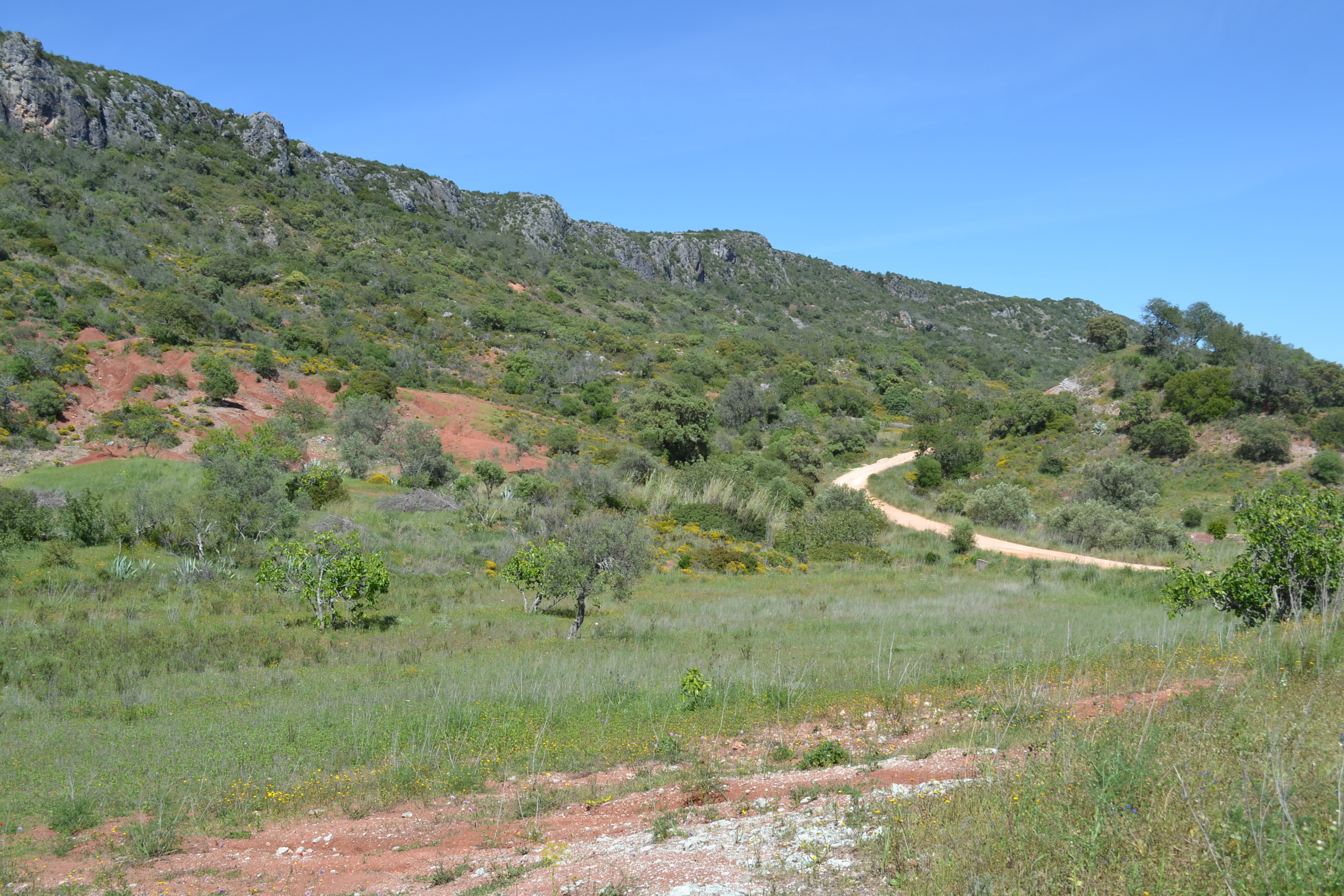
There were large areas of dry scrub carpeted with flowering shrubs, and here and there more open grassy areas that held the most butterflies. This is also a popular hiking destination, and to allow a coach party to pass I sat in a rocky area where I photographed Spanish Marbled White. This species, with a series of small red eye patterns on the under-wings, was the most numerous butterfly on the plateau top. A Scarce Swallowtail was also coming and going, before eventually posing perfectly. Then while eating my sandwich, six Griffon Vulture put in an appearance a short distance away. This is said to be a good spot for them in the migration season. Fortunately they didn’t see my sandwich!
-

- Scarce Swallowtail
-
- Spanish Marbled White
-

- Panoptes Blue
Limestone pavements are not easy to scrabble about on, so I mostly stuck to the trail that itself was very rocky. In one particular butterfly-friendly area there were a lot of tiny blues that I identified from Collins as belonging to the Panoptes / Baton Blue group of three closely related species. This was perhaps the most difficult butterfly to photograph that I have ever experienced, since they perch very low down compared to Small Blue and the habitat of hot dry soil and prickly plants was not suited to using a macro lens while wearing shorts. Eventually I got passable results with my 300mm telephoto.
This day perfectly encapsulated the trip rationale of exploring the Algarve countryside in fair weather: small villages, beautiful landscapes, wildflowers and insects. Its total butterfly list was: Meadow Brown, Bath White, Small White, Clouded Yellow, Swallowtail, Small Skipper, Small Copper, Spanish Marbled White, Scarce Swallowtail, Wall Brown, Small Heath, Panoptes / Baton Blue sp, Lang’s Short-tailed Blue, Knapweed Fritillary and Red Admiral. All along the trail, Emperor Dragonflies were on the wing despite a total absence of water.
Fonte de Benémola and Fonte Férrea
Fonte de Benémola is another classified site created to protect its varied flora and fauna and outstanding natural beauty. It lies west of a village Querença, in a river valley around which is a 4.5km trail out and back. Water is a permanent feature here due to numerous springs and dams, so the pdf guide describes it as having a large presence of riverine and woodland birds. But the valley floor is filled with forest scrub and giant reeds, making the bird life very difficult to actually observe. Not so the insects, however.
The trail out on 2 May was the more interesting half of the walk, because in places it was possible to follow little side tracks down to the riverside through wildflower meadows. Here I found and photographed a good presence of Western Club-tail dragonflies. At the far outward turn in the trail I enjoyed a photo session with a perched Copper Demoiselle. The wings of this western Mediterranean speciality look very brown compared to Beautiful Demoiselle, and my individual was of a dark blue-bodied sub-species as opposed to the more usual copper red.
-

- Western Clubtail (male)
-

- Scarce Swallowtail
-
- Copper Demoiselle
The trail back to the start point was higher up the hillside and there was a profusion of wildflowers along it. This site as a whole wasn’t generally good for butterflies, though I saw a Panoptes Blue sp again and had a photo session with a Scarce Swallowtail (above) that produced exceptional results.
There was still plenty of time to go somewhere else, so I chose the Parque Fonte Férrea on the N2 just north of Alportel that I had visited in January. The valley bottom was what I wanted to see again and it was another beautiful setting with spectacular wildflower meadows and a good variety of butterflies. Here I came across Wood White, Holly and Long-tailed Blues, Spanish Festoon and several of the Iberian race of Marsh Fritillary.
-
- Long-tailed Blue
-
- Marsh Fritillary (race Beckeri)
-
- Holly Blue
In both this day’s locations there were abundant singing Nightingales. At Fonte Férrea some of these were so close that I managed to observe one deep within its chosen cover, as is their wont. The first time I drove through the Serra do Caldeirᾶo during my January 2013 trip, I wrote that it was a vast samey area in which I wouldn’t know where to start walking. I was certainly finding some beautiful locations this time.
Feiteira PR5 trail (Cicerone walk 29)
On 5 May I re-visited the trail on the N124 south-west of Cachopo that the Cicerone guide calls “The Reserve”. The difference between January and now was spectacular. I had walked in some very beautiful places in the previous eight days but where wildflowers and shrubs were concerned this was the best of all, with whole hillsides of Cistus ladanifer a stand-out feature.
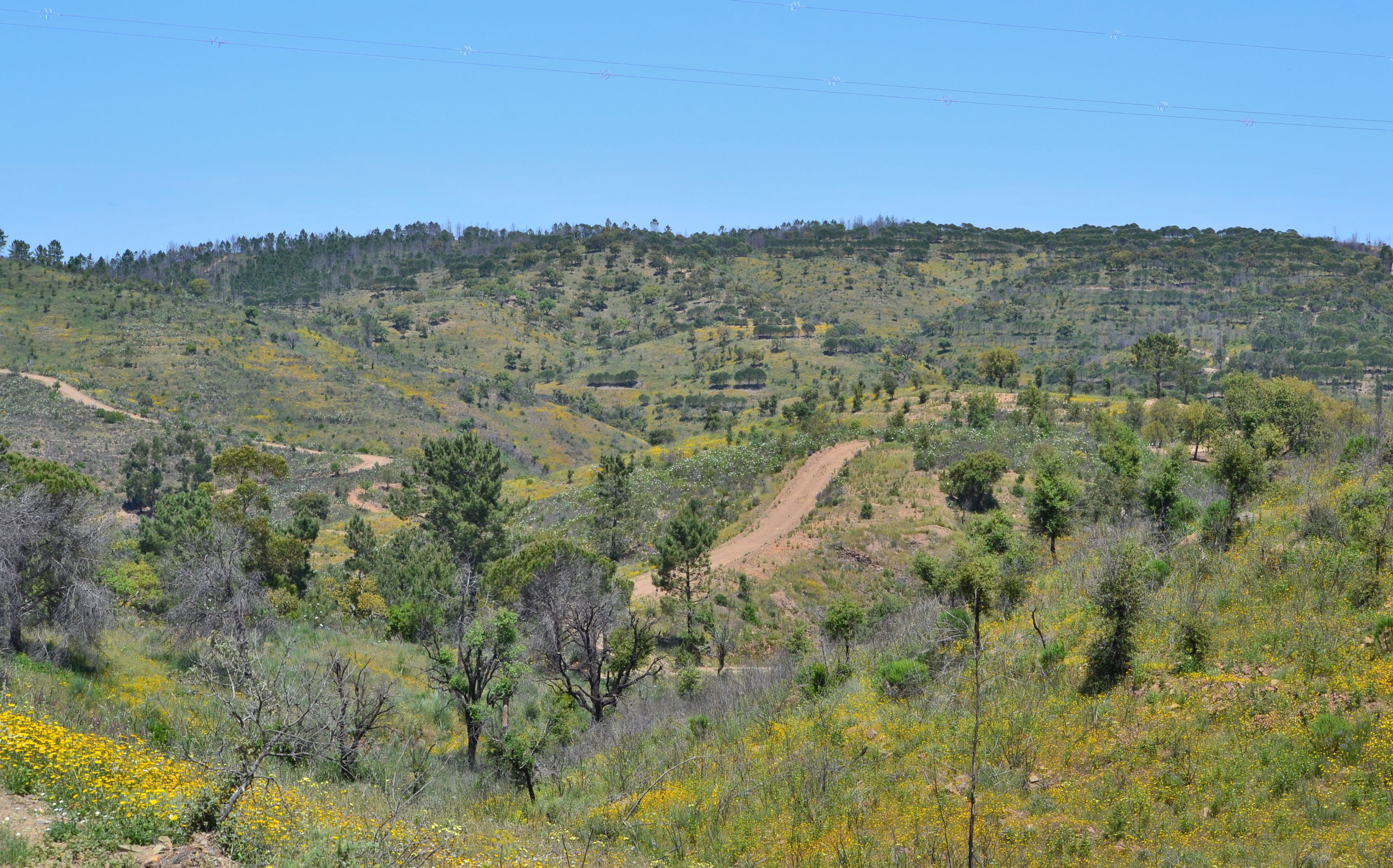
In terms of birds the reserve was disappointing once more with only Cuckoo being added to my Portugal list. There was a certain amount of song but in glary sunlight and with the distraction of much more visible insects, I still felt no inclination to spend time searching for concealed passerines in cover. There were many butterflies here though, with a lot of Spanish Festoon around the trail.
I stuck to the waymarked route as far as the first crossing of the River do Leitejo, where I decided in the heat not to follow the high part of the trail that climbs up to Cerro Alto. Provençal Fritillary and Lorquin’s Blue were both seen around the crossing, then on the far side the trip‘s first Mallow Skipper was engaged in a territorial contest with a Sage Skipper (for comparison). A lot of white butterflies were congregating on soft mud near the water’s edge.
-
- Provençal Fritillary
-
- Lorquin’s Blue
-
- Sage Skipper
From there I re-traced my steps before turning right onto the trail’s return leg and walking down to the second river crossing. I remembered this was exactly what I had done in January. This stretch was where the colour in the landscape was at its most beautiful. I could gladly have stayed here all day just pottering about with the camera, but after long hot days in the field earlier in this trip I was now pacing things more and stayed for three hours.
The day’s butterfly list was Scarce Swallowtail, Spanish Festoon, Large White, Small White, Bath White, Clouded Yellow, Brimstone, Small Copper, Small Blue, Panoptes Blue sp, Brown Argus, Meadow Fritillary, Spanish Marbled White, Meadow Brown, Small Heath, Wall Brown, Mallow Skipper, Sage Skipper and Small Skipper.
Parises area
The third of the Serra do Caldeirᾶo locations highlighted by the pdf guide was as stunning as the other two. From Sᾶo Bras de Alportel a good road just to the east of the N2 climbs into the hills and winds its way to a hilltop village Parises, where a network of hiking trails runs from either side of the road. I hadn’t envisaged being here for too long on 8 May, but ended up staying for most of the day such was the richness of the area’s biodiversity.
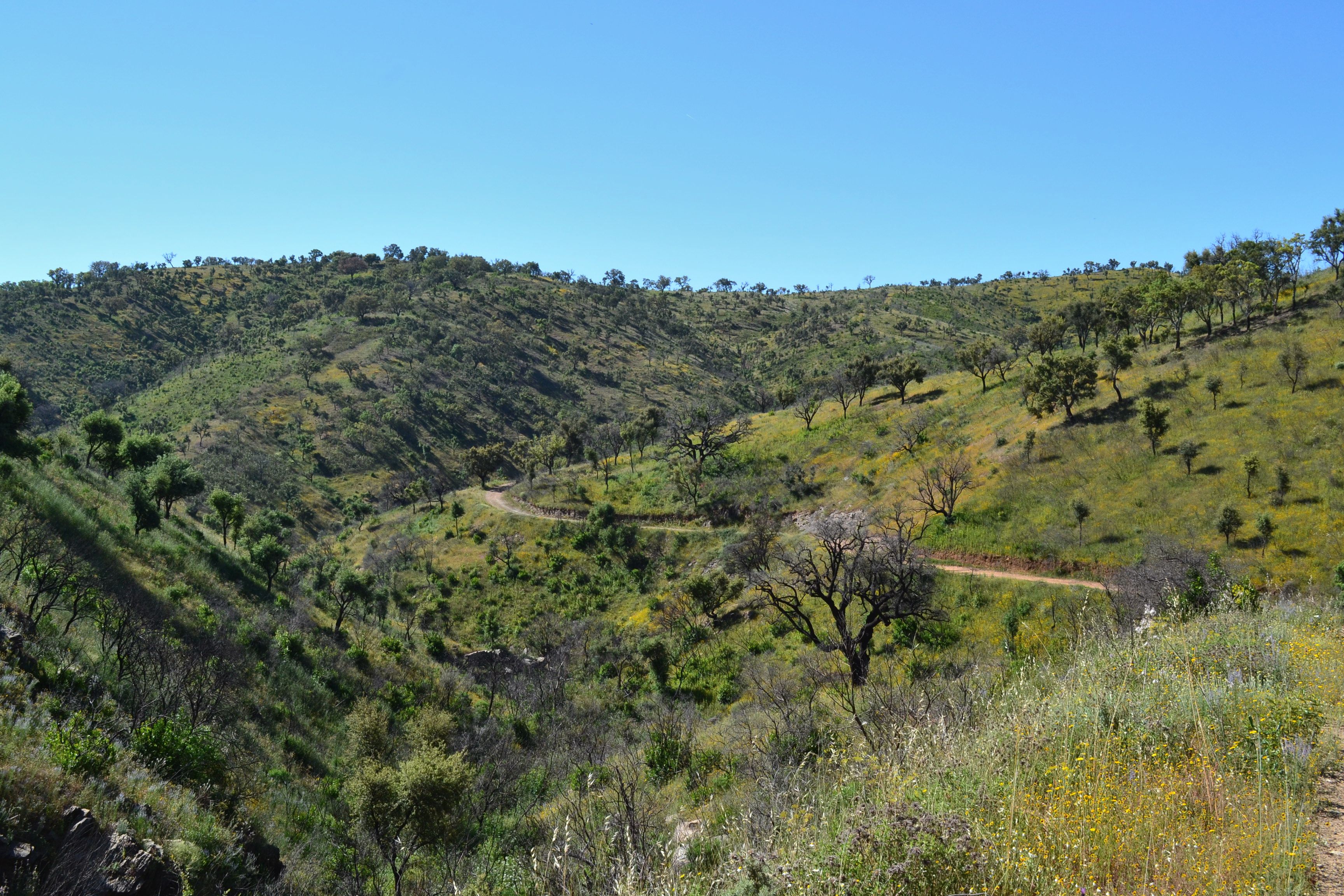
I took the southern trail signposted the PR2 along a rough track towards Javali. It descends into a deep, unspoilt valley (above) filled with a luxuriance of natural vegetation growing amongst regenerating burned trees. There were good numbers of smaller Berger’s amongst the Clouded Yellow butterflies and a lot of Adonis Blue, some of the latter being of a south Iberian race with black spots around the hind wing edges. Then a tiny Red Underwing Skipper and a male Orange-spotted Emerald dragonfly each made their trip debuts. Lizards and at one point a snake escaped my approach here and the trail was also rich in moths.
-
- Red Underwing Skipper
-
- Adonis Blue (spotted form)
-
- Orange-spotted Emerald
Everywhere the sheer number and variety of all sorts of insects was simply amazing, fit to make me sound like a RSPB publicist. Eventually the PR2 veered off to one side of the rough track and reached a fairly deep stream crossing with a soft bottom, so I turned back there. The highlight of the return leg was an encounter and photo session with a weird and wonderful looking Mantis species (below) that resembled exactly the grasses in which it lived.
Mantis (empusa pennata)
Almost back at the village there was a certain amount of bird activity in the trees. A female Rock Bunting perched openly and in the same place unconcerned by my presence, and a Redstart put in an appearance. The day’s butterfly list was: Small White, Bath White, Berger’s Clouded Yellow, Clouded Yellow, Cleopatra, Small Copper, Lang’s Short tailed Blue, Adonis Blue, Spanish Marbled White, Meadow Brown, Southern Gatekeeper, Small Heath, Wall Brown, Red Underwing Skipper, Mallow Skipper, Sage Skipper and Small Skipper.
-
- Mallow Skipper
-
- Southern Gatekeeper
-
- Red Underwing Skipper
On 13 May I returned to Parises to explore the area on the other side of the road to my first visit. The northern trail crosses more open country, gradually descending into a valley with higher ground beyond. There were a lot of Spanish Gatekeeper and Green-veined White here. Just outside the village I photographed a dull green and brown Western Spectre dragonfly of which others had been seen on this trip. Then at the first water I reached a couple of Two-tailed Pasha were flying up and down the stony track. I thought I had caught glimpses of large butterflies on the southern trail, now here they were.
-
- Spanish Gatekeeper
-

- Spotted Fritillary
-
- Two-tailed Pasha
This is a seriously beautiful butterfly, about the size of Purple Emperor and similar in its behaviour. The whole experience reminded me of watching Emperors in Bernwood Forest at home, except that these Pashas were a lot less inclined to sit still. A little further on at a stream crossing the stand-out sightings were a regular, copper-coloured Copper Demoiselle that I didn’t manage to photograph, and Spotted Fritillary that obliged perfectly for the camera. I walked on up to higher ground from where Parises was visible again, but the trail just kept going onwards with no sign of circling back, so I turned round.
-
- Cricket sp
-

- Southern Skimmer
-

- Cricket sp
There was a narrower path back that I could have taken to complete a circular route, but my choice proved to be more interesting with further stimulating observations on the return leg. There were more Cleopatra, Red Underwing Skipper and Two-tailed Pasha here, the last-named typically perching in trees in between their territorial jousting. I lingered for some time back at the stream crossing where there was an all blue skimmer that just seemed different from Keeled Skimmer. I identified this from the field guide as Southern Skimmer. There was an encounter with a swimming snake, and Melodious Warbler was also seen.
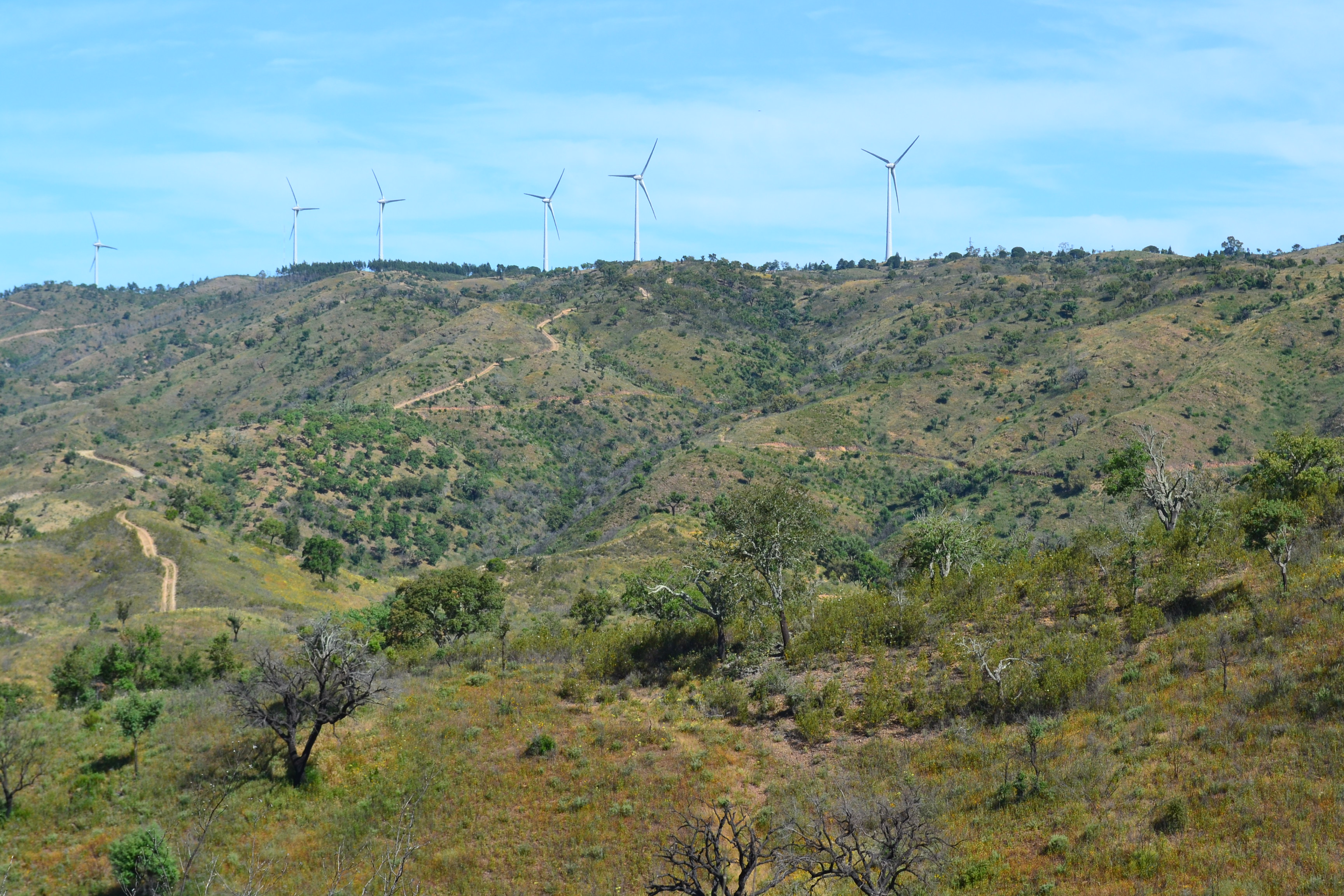
Parises northern trail
Lower Guadiana area
The pdf guide devotes a whole section to the area between the IC27 road and the Spanish border, but is vague about where to actually find birds. It also says the tributary valleys of the River Guadiana are a good location for Rufous Scrub Robin, in which case my experiences on this trip confirmed there is a great deal of inaccessible habitat that might contain them. My preference was to get into beautiful locations in which I might find new dragonflies, but where that very difficult bird might be encountered as a bonus.
On 1 May I walked a trail from Odeleite to Foz da Odeleite in the Lower Guadiana region. This is described in the pdf guide as a “riverside” trail, but that is a misnomer since it is barely possible to get down to the river Odeleite itself. This was a stunningly beautiful setting (below) with a great diversity of habitat along the length of the trail. The western end was characterised by a mosaic of smallholdings, vine plots and beds of giant Mediterranean reeds, while further east the flood plain was almost entirely covered by wildflower meadows.

As soon as I set out from Odeleite, I could hear Golden Oriole and Bee-eater. Along the length of the trail this colourful bird-scape was further augmented by Hoopoe and Azure-winged Magpies, all to a backdrop of numerous singing Nightingales. I counted about 10 Orioles in all but there could have been more. At one stage I had good flight views of two males, standing out like bright yellow flares against the hillside behind them. The wildflower meadows also held good numbers of calling Quail.
The trail was a little over three miles long, ending close to the confluence of the Odeleite and Guadiana rivers (below). With an abundance of wildflowers along its length there were moderate numbers of grassland butterflies here: Meadow Brown, Spanish Marbled and Small Whites, Small Skipper, Common and Panoptes Blues, Brown Argus, Small Copper and Knapweed Fritillary. Perhaps the most numerous was Spanish Gatekeeper, that like the local Meadow Browns had a tendency to settle in deep shade and cover rather than on flower heads. I noticed on this trip that in the hot climate various butterflies would shoot out from their dark hidden places on my approach, then be very flighty before disappearing again.
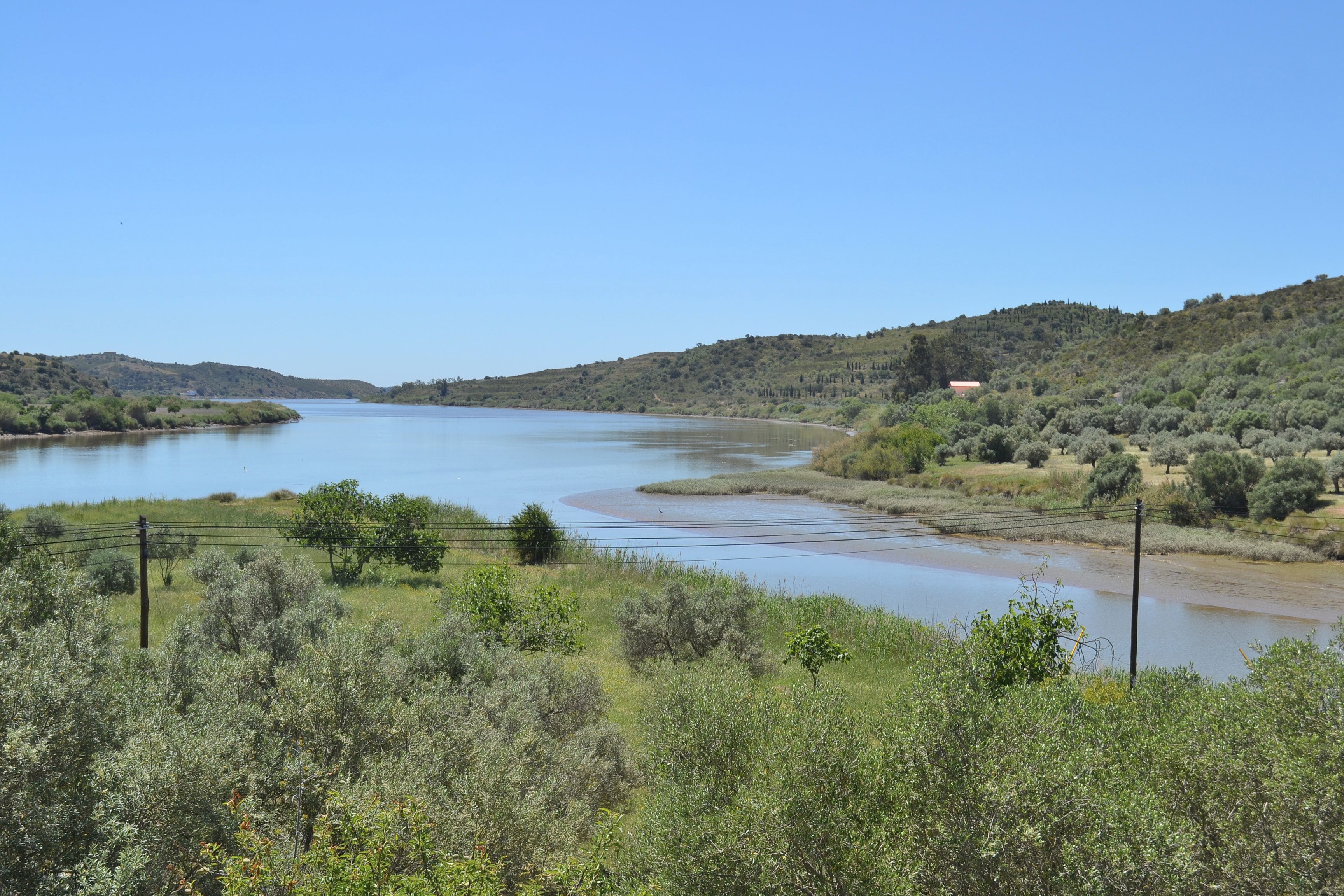
On 3 May I followed minor roads north-west from Castro Marim to where the first tributary, the River Beliche is dammed. Just before a village Cerro do Enho I found a water hole that was clearly good dragonfly habitat. Here there were Black-tailed Skimmer, Broad Scarlet and the most beautiful small species I have ever seen, Violet Dropwing. With pink and purple thorax and abdomen, bright red eyes and orange translucence in the wings, the last named is an abundant tropical African species that is expanding its range in the Mediterranean.
The next tributary north is the Odeleite that I knew already, then the third one the Foupana is not dammed. My Michelin map showed a good looking crossing on a road close to the IP27, so I headed for that via a circuitous route. In a village Almado de Ouro there was an information board showing a network of hiking trails in the area. That made me think there seems to be a good hiking infrastructure in the Algarve, but also a big trade-off between cool enough times of year for walking and being able to observe wildlife. In early spring there would be few insects and summer birds; and by autumn all the colour will have gone out of the countryside.
-
- Broad Scarlet
-
- Small Pincertail (male)
-
- Epaulet Skimmer (imm male)
-
- Violet Dropwing
-
- Knapweed Fritillary (Portugal)
-

- Orange Featherleg
From that spot I drove on through Foz de Odeleite, then turned left at Guerreiro do Rio to the Foupana crossing. This was exactly what I was looking for: a decent crossing where I could walk in both directions across the stony habitat of the river’s wider bed. It was the best Odonata site of the trip in another stunning location with more Broad Scarlet, Emperor, Small Pincertail, and Orange Featherleg damselflies. Everywhere I went there were calling Golden Oriole and the sound was becoming so familiar that it just seemed part of the backdrop.
I went back to the Foupana river crossing the following morning and pottered about for three hours. The same dragonflies were present again plus Epaulet Skimmer, another African species that is not uncommon in southern Iberia. Two Raven flew over kronking loudly, and later in the morning two male Blue Rock Thrush put in an appearance. Butterflies were as pleasing as the dragons: Small Skipper, Long-tailed Blue, Knapweed Fritillary, Cleopatra and the trip’s first of several sightings of Sage Skipper. It was a lovely spot and I had it all to myself.
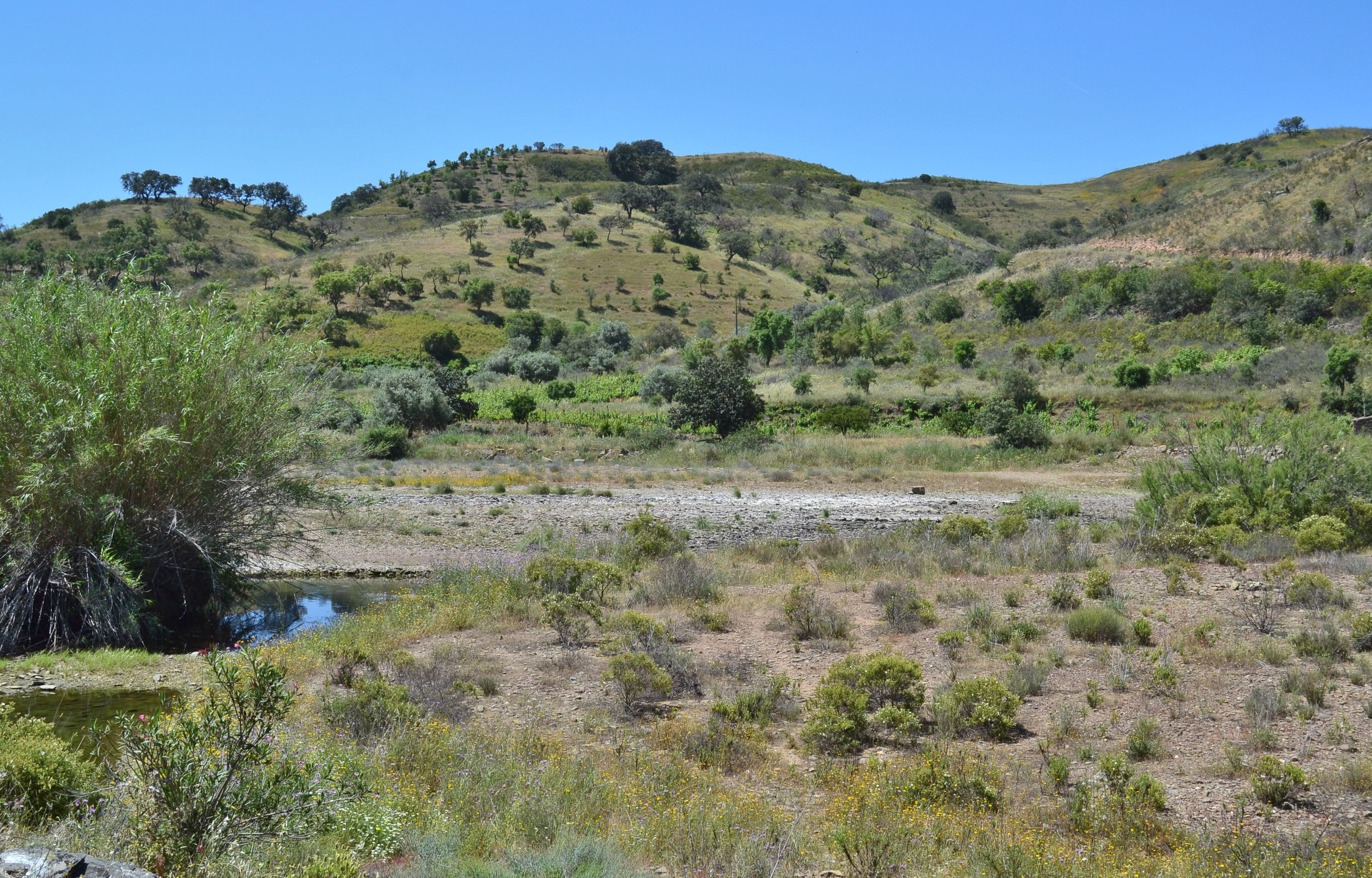
The Odeleite river crossing on the N397 looked like another good location, so I set out to explore from there on 6 May. Upstream from a village Monte de Ribera (above), Little Ringed Plover were moving about and everywhere I trod frogs of all sizes would leap into the nearest water with a splash. The river soon began to dry out with only patches of water here and there until eventually I reached an area of more permanent looking water where the stand-out encounter was a swimming snake with a red and black check pattern.
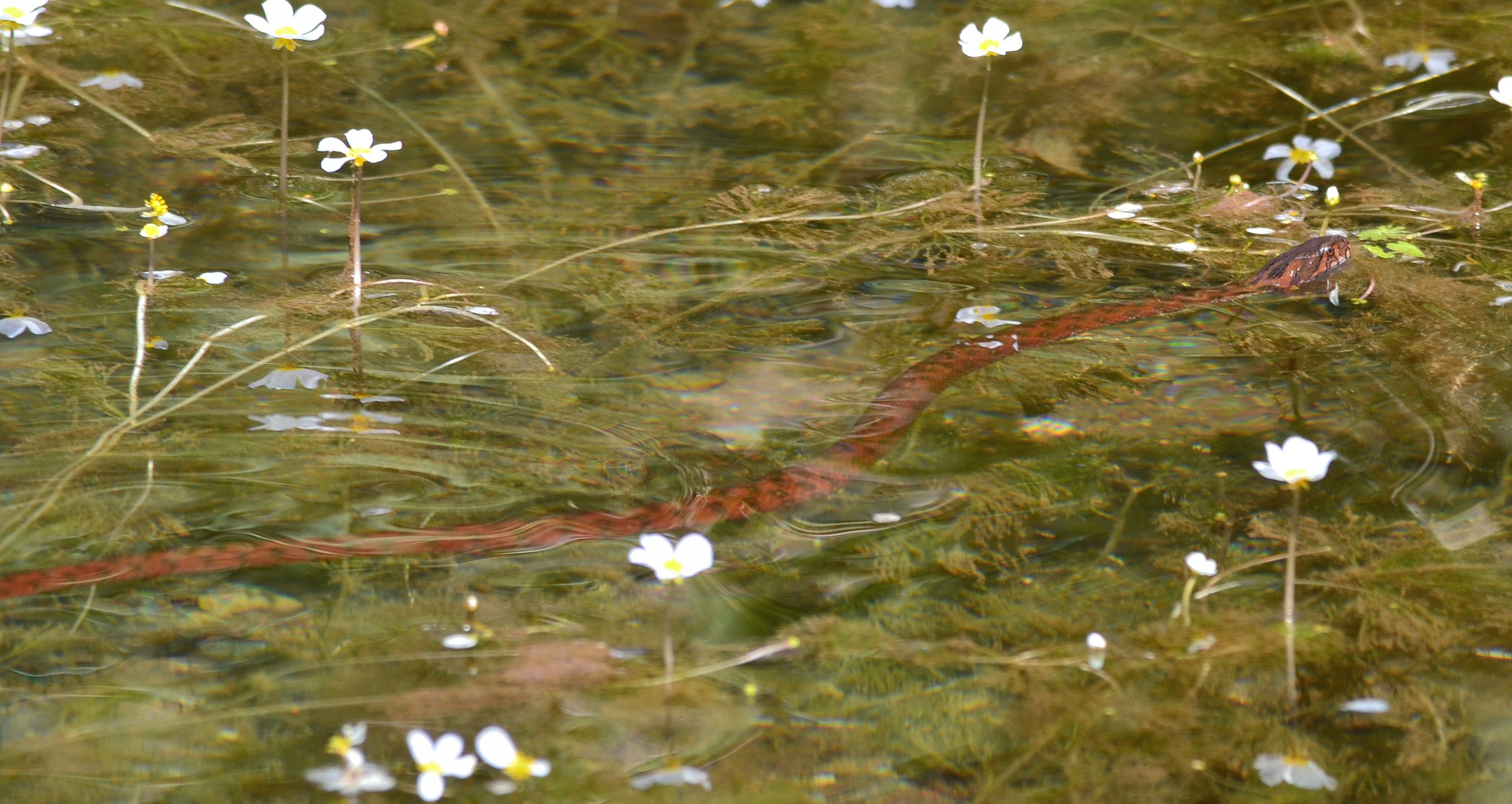
Swimming Viperine Snake
From here I drove on to a little reservoir along a turning signposted Grainho, capturing my best pictures of Broad Scarlet (below) at this spot. Driving back along the N397 through the upper Beliche valley, a Golden Oriole flew across the road and right into the middle of a bush, Nightingale like which probably explained why I was hearing Orioles all the time but only having occasional flight views. Just before the village Umbrias de Camacho I heard an unfamiliar bird song from across the road and went to investigate. My reward was a singing male Rock Bunting that I photographed into the sun.
-

- Broad Scarlet
-
- Rock Bunting
-

- Iberian Green Frog
-

- Grasshopper sp
-
- Epaulet Skimmer (maturing)
-
- Violet Dropwing
For my last day in the hills on 15 May I chose the area north-east of Cachopo, where two good looking crossings of the River Foupana were marked on my Michelin map. The first of these on the N124 was a nice spot where I got my best pictures of Violet Dropwing (above). The second, a little to the east was noteworthy for a photo session with an Epaulet Skimmer that let me sit down right next to it. These sort of locations in the Guadiana tributary valleys are said to be where Rufous Scrub Robin occurs, so I kept an eye open at all times though that species was always going to be a long shot.
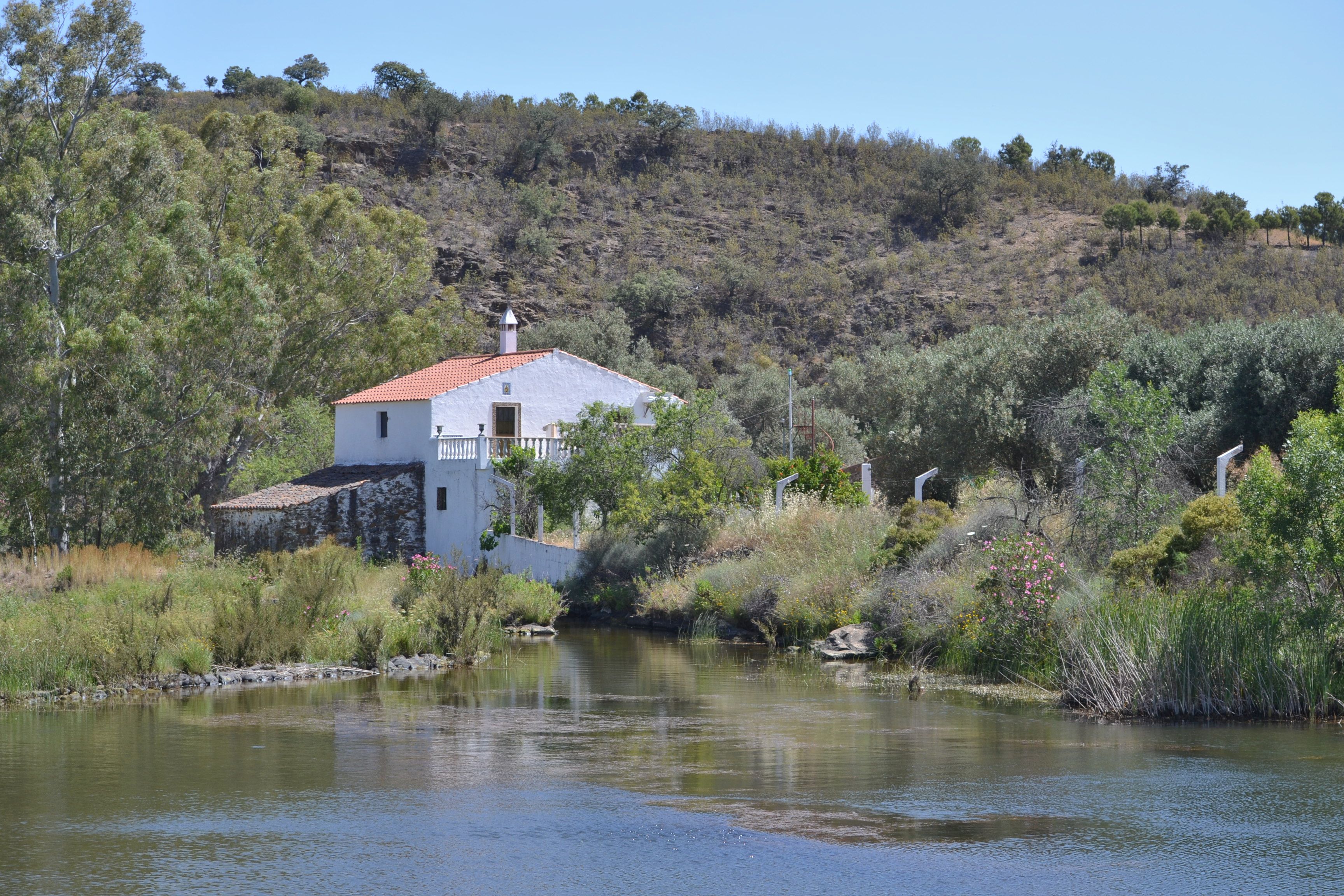
Foupana valley and mill
Baixo Alentejo
Towards the end of the trip’s second week I was finding the same insects over and again in the Algarve hills and the plant life was past its seasonal peak. So now I devoted time to birding further north in the Vale Guadiana Parque and Castro Verde SPA.
On 10 May I visited Pulo do Lobo that I followed signs to in January on the day I saw the Eagles, but decided against doing the PR9 trail on that occasion. The information board at the start point stresses this a difficult and in places dangerous trail to negotiate. Here the River Guadiana flows through a gorge that legend says is narrow enough to be jumped by a wolf. It is in reality much wider than that (unless I just didn’t reach the narrowest part) and very scenic. The trail led quickly downhill into the valley bottom, where the rockiness of the Guadiana’s flood plain was on an altogether grander scale than its tributaries. When I reached the point that the warnings are about I decided that continuing would be too dangerous by myself. It would have involved scrambling over huge rocks with deep spaces between them, and the spring vegetation made the trail’s course indistinct from that point on, so I turned back.

This was an interesting place to visit (above) but I didn’t see much wildlife, though Woodlark were singing and I had another good Golden Oriole flight view. Re-consulting the information board back at the start I must have got about half way to the trail’s focal point, a waterfall. It was now 12:30 leaving the afternoon to search for large raptors and steppe birds.
I first drove across country to the focal point hill of Pico de Alcaria Ruiva (below), hoping to spot Black Vulture. I didn’t see any, the start of a disappointing afternoon’s sequence, and so decided to check out what Moore, Elias and Costa terms a likely Rufous Scrub Robin site on a minor road between Sᾶo Marcos da Ataboeira and Entradas. That meant heading west on the fabled N123, and on reaching the track along which I saw Black-bellied Sandgrouse in January I couldn’t resist another look. The precise spot was now a wheat field, and ground cover in neighbouring fallow fields was also much higher. The feeling started to grow in me that just as birding is much easier in the coastal marshes in winter, likewise the steppes.
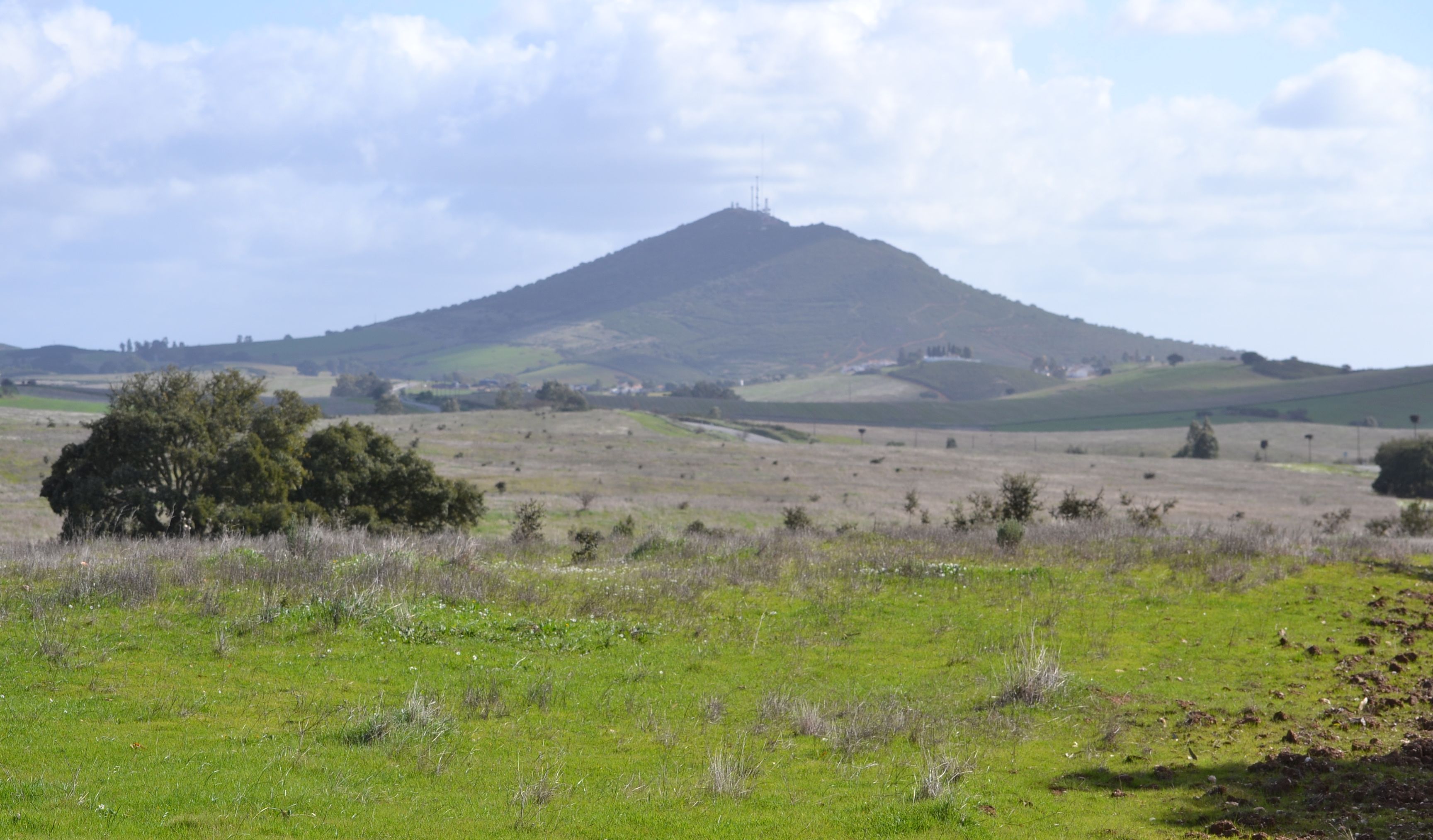
The Scrub Robin site was at a crossing on the River Cobres, where I thought there was a small amount of habitat in which the species could be visible and so didn’t linger too long. After that I went from place to place without seeing any raptors or steppe-speciality birds, just endless larks and Corn Bunting. The heat and glary light were adding to my frustration, justifying why birding was this trip’s lowest priority. I decided to head homeward via minor roads south of the N123, via Joᾶo Serra and Penilhos to Sᾶo Joᾶo dos Caldeirreiros on the N267. Things did get more interesting now, starting with picking up Tawny Pipit at one random stop.
The N267 Almodovar to Mertola road lies south of two chains of hills running east from Alcaria Ruiva. Stopping to scan a promising looking area I did pick up two large soaring raptors. The rocky hilltops here looked like ideal Vulture habitat, so I began a reconnoitre ahead of a return visit. Between that stop and the junction with the IC27 just south of Mertola there were several more viewing places that the nearer hills could be scanned from
I returned here two days later and on arrival picked up several Griffon Vulture circling against the hillside in my view. Some of them did look dark from a certain angle, but the two-tone brown appearance would always become apparent. I next drove back eastwards checking each of the other viewpoints as I went, and at the second of these counted 13-15 birds in the group. I had clearly found the local Griffon grand central, but it was the other vulture species that I most wanted to see.
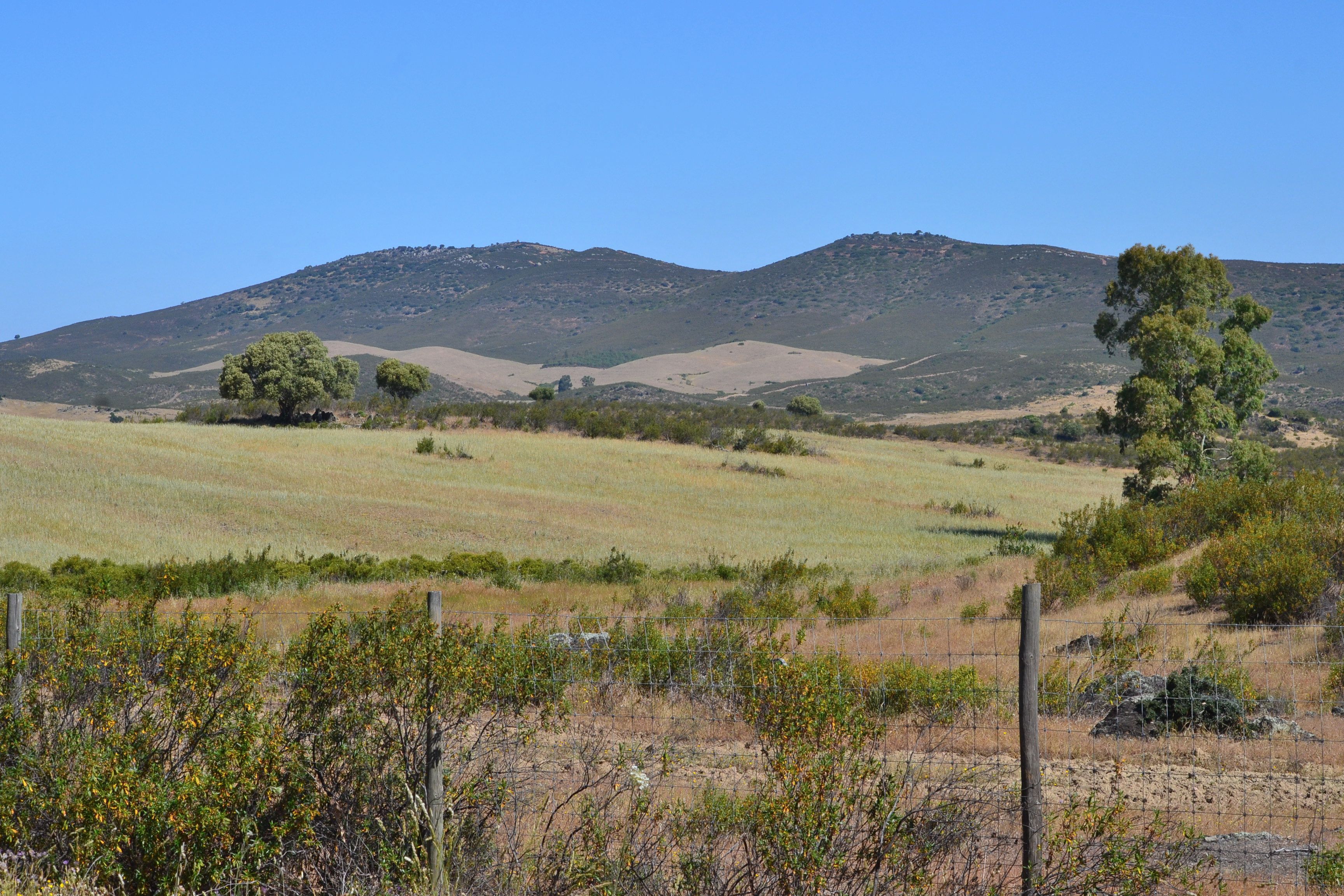
At Namorados I took a minor road signposted Circuito entre Serras, that as the name suggests runs between the two lines of hills (above). I stopped and scanned every available viewpoint without PI-ing any more large raptors, but I did see a sub-adult Black-winged Kite at one spot. On reaching Alvares I took a rough road south along which a Spanish Imperial Eagle flew close by. Then the trip’s first pair of Montagu’s Harrier put in an appearance before going down into the long ground cover. A little further on I came across a dapper little female perched on a fence post by a water hole that held several Collared Pratincole and other small waders including Little Ringed Plover. Quail were also calling here. On reaching a metalled road again and turning right towards Penilhos, more Harriers flew up out of the fields.
This area (below) is actually outside of the Castro Verde SPA, and is not within the Parque Natural do Vale do Guadiana either, but it was certainly a very good location. When I reached the steppes proper, things immediately began to assume a more difficult air. I drove west along the N123 as far as the LPN reserve, its gates ever open and relying on people’s goodwill not to go in as instructed. But there was no sign of Bustards this time and I also could not locate Calandra Lark that is meant to be very common here.
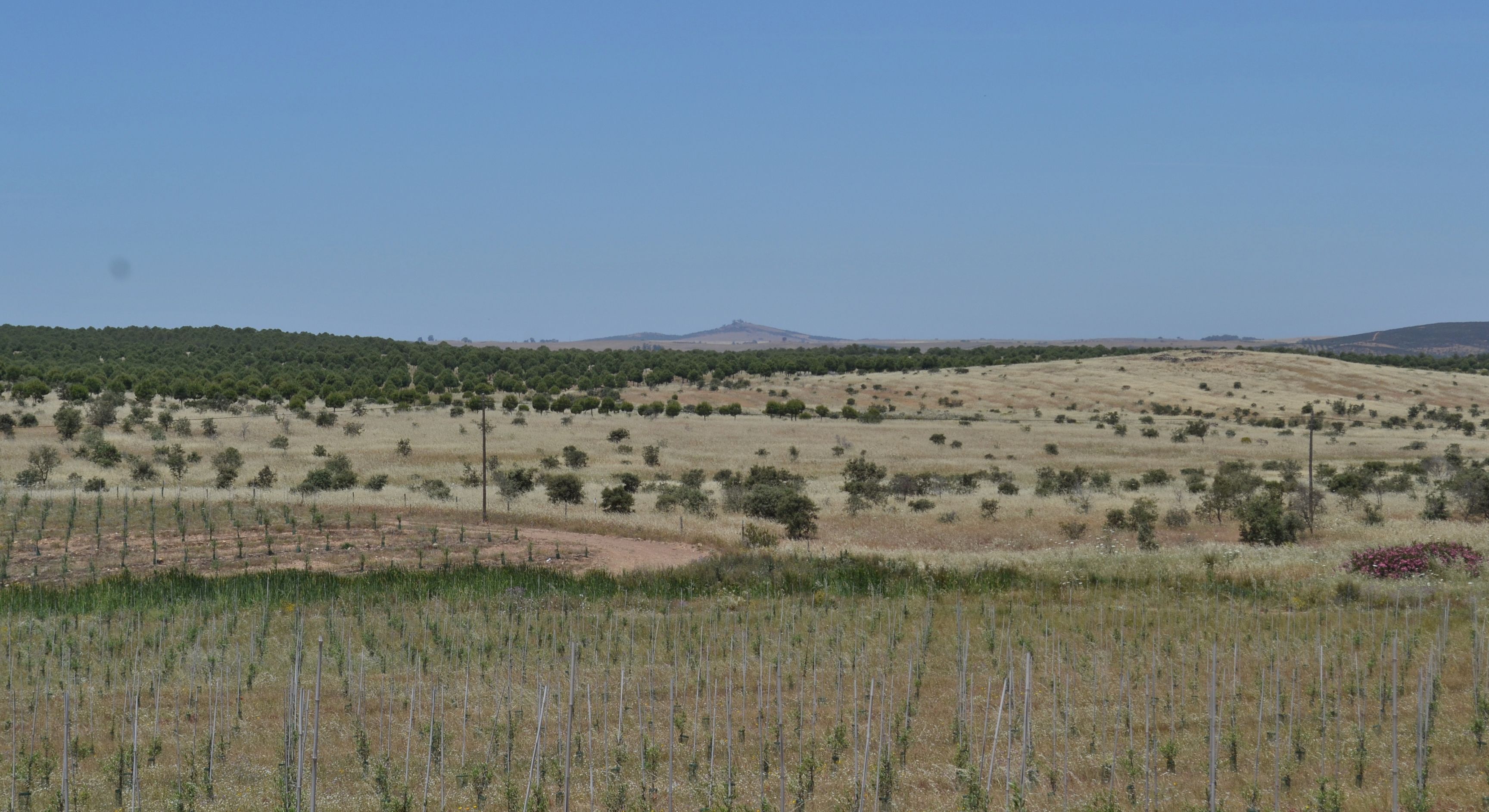
I returned roughly by the way I had come but taking a more northerly route to Alvares from Joᾶo Sera. LRP were seen again at one river crossing and the day’s raptor-fest was completed by a Bonelli’s Eagle between Agua Santa and Namorados. I stopped to check out another rather scenic river crossing at Agua Santa, and though both crossings looked like suitable Scrub Robin habitat I still didn’t find one. This was an interesting day and certainly much more productive than my first visit.
On 14 May I completed three planned days on the steppes with a three-hour visit to the LPN centre Vale Gonçalinho near Entradas. Lesser Kestrel were easy to see on the nesting tower here that was also being used by European Roller. I observed several of the latter across the reserve to more or less complete the roll call of summer steppe birds, unless I include Stone Curlew. Other than that I didn’t see a lot, and walking out to a ruined farm building and back wasn’t grabbed by this reserve due to the sameness of the habitat. Once more I just couldn’t find Calandra Lark, that are meant to be common and easy to see. But none were perched on posts or wires, or taking off and singing like Skylarks, so they must have been keeping in the long grass. I have since learned that the third option is what this species does.
The experience recalled how on my first ever visit to the Castro Verde SPA I recorded that it would be possible to spend hours walking without seeing much and so it is better just to drive around. After leaving I checked out the Entradas to Carregueiro road along which I saw Great Bustard on both January trips, but not this time. Then I stopped at the Scrub Robin site and walked upstream a bit, again without success. Perhaps ironically since it is a bird I would expect to search for at home, Montagu’s Harrier were active wherever I went today, while Spanish Imperial Eagle and Griffon Vulture were both seen again. But after three days on the steppes I had not seen a single Bustard or indeed Calandra Lark, confirming the impression that birding is generally easier here in winter.
Following my successful White-rumped Swift twitch on 16 May, the afternoon was free to drive around the Vale Guadiana area one last time hoping to cross the path of a Black Vulture or even Black Stork. I first drove a little further north-east from Mina de São Domingos beyond a village Corte Pinto, until a new and expensive looking piece of road building just ended in the middle of nowhere with rough roads only from that point on. Turning back I stopped at a river crossing where it was possible to walk for some way in one direction. This was classic Cistus and Oleander habitat that Scrub Robins are said to favour, but there was still no joy with that species. Heading home via Alcaria Ruiva, on approaching that landmark I could see raptor activity and watched six Griffon Vultures on a rocky cliff (below). There was also a Bonelli’s Eagle along the approach road, but once more Black Vulture eluded me.
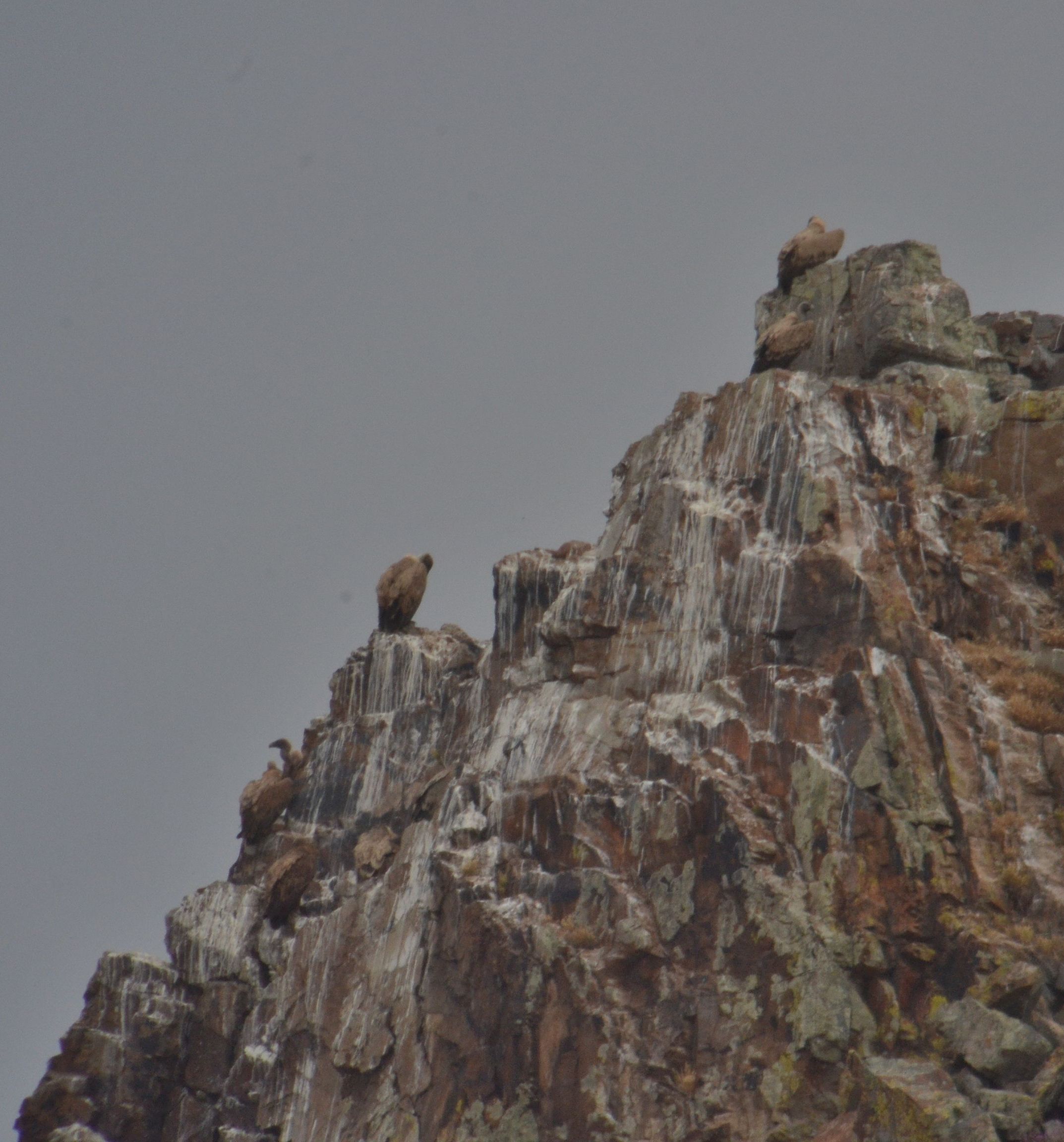
Griffon Vultures at Alcaria Ruiva
 Ramblings and Scribblings