Two days ago, having paid very little attention to downland butterflies this season, I made only it’s second visit to the Chilterns escarpment. Feeling confused and fragile in spirit after two gruelling shifts at work over the weekend, I needed to clear my head and spending more time extracting weeds from my wildlife garden wasn’t going to achieve that. So I went out to do some butterflies instead.
Conditions were lightly overcast as I walked out onto the noisy hillside above the M40 motorway at BBOWT’s Aston Rowant NNR (N) (SU733967). But plenty of butterflies were still active and I was at once reminded of the wealth of wild plants at the reserve. In the early years of this decade I would spend many days in summer wandering sites such as this, making counts of every species and taking bad, grassy pictures. But there are only so many British butterflies to record and hence more recently that enthusiasm has waned. Last year it had been difficult to get motivated at all, but it would have been a pity to pass by the late summer specialities in 2017.
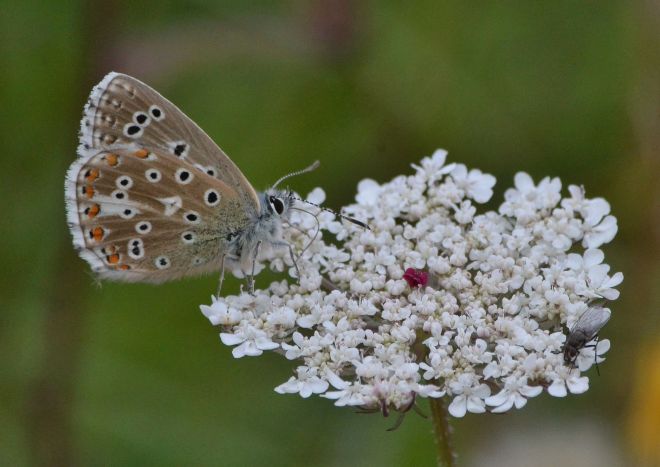
Adonis Blue (male) on Parsley sp
The pale, floppy forms of Chalkhill Blue were immediately apparent, keeping low to the ground and striking up many a grassy pose that I ignored. The objective now is always better, premium pictures but flower-head studies of this downland specialist were less likely in the cool breezy weather. All around tiny Brown Argus (pictured below, right) ghosted about in the long grass as they do, always hyperactive and fiercely territorial. And a few fiery Small Copper (centre) stood out in places. Meadow Brown numbers are now waning but here some were still in good condition (left).


Before long I began to come across Silver-spotted Skipper, one of the August specialties at this and other Chilterns escarpment sites. This diminutive, moth-like butterfly is often first seen buzzing about the downland sward in a blur or darting sideways from the observer’s footfall. When settled they have a pleasing penchant for intriguing poses on flower or grass heads and are always photogenic. Having many good pictures of SSS in my collection I tried to find new angles or back drops, without great success. Here (below) are my day’s better results, with some concession to grassiness.


But my heart still wasn’t in it, having done all this so often before. As I continued I pondered how when abroad I can become immersed totally in experiencing new and different (for me) butterflies and dragonflies so all else becomes unimportant. If it was possible to dwell all my existence alone in beautiful wild places, luxuriating in such communion with nature I could remain very contented. But the human psyche doesn’t work like that. Ultimately there is always the need for company and unsatisfactory involvement with one’s own kind; and so all the frustration, conflict and hurt that goes with it. More’s the pity but thus is life.
And so I walked on, the traffic noise from below being a constant reminder of that downside to life’s mix. Having crossed the prime SSS area I climbed back to the top of the hillside then walked all the way back down, directly through the hotspot for Adonis Blue but without finding any of the latter. It was now around 4:30pm and conditions were becoming duller and cooler with the imminent onset of light rain. Then an episode unfolded that illustrated most aptly why indeed I still do this, and made the afternoon out worthwhile after all.


In a sheltered spot near the foot of the hillside I first noticed a nicely posed female Brown Argus (pictured above) in a large clump of Knapweed, then became aware of other roosting Blues in the vicinity. Brown Argus is indeed a species of Blue. Was she aware of the smaller male behind her? I expect so and also that he had things on his mind. A kind of dance then ensued as the pair seemed to assess one another tentatively, but then she flew to one side leaving the male to his own devices. A case perhaps of faint heart ne’er winning fair lady.
I next became aware of various Common Blue all roosting in the straggly, swaying vegetation. And the more I looked the more there were to find. This is a butterfly that in my experience is difficult to capture pictorially well, too often appearing fuzzy somehow in top wing and washed out in underwing studies. But on this occasion they just seemed to stand out in the failing light, and with the right exposure compensation I was able to gain my best ever premium pictures of the species (below). Hence I remained here for some time, re-motivated once more and relishing a reminder that insects can and will deliver new variations on the old experience if sufficient time and patience is expended in the field.


A photo-celebration of roosting Common Blue butterfly


Here and there butterflies were concerning themselves with rather more than roosting. The rhythm of insects actually pumping away is always sensuous to behold, well it is sex after all. This mating pair of Common Blue (pictured below) were getting things on with gusto and loving it. Images as good as this cannot be planned or anticipated, they just leap out and happen now and again. And so the picture opportunities continued to improve.


Having done Common Blue justice I next went in search of other roosting Blues, capturing first a male Chalkhill Blue on an enticing flower head (below, left) and finally a male Adonis Blue (right). The full set of Blues for the site had thus all contributed to what was ultimately a rewarding exercise, and I returned home to the editing suite feeling partly refreshed but still world weary.


At the petrol station last night I was back on form behind the counter. Pleasant to deal with customers made a comeback against the inky grunters and pushing, impatient obnoxiae; and there were no technology issues that I couldn’t deal with. And so I awoke this morning with a different kind of warm glow from that other essential communion with people. But thank heaven for butterfly therapy!
 Ramblings and Scribblings