I wasn’t expecting much in the way of butterflies from a week in Sardinia and so was pleased to return home with four new life list and picture collection additions. My favourite for the trip was Corsican Heath because I had been to Corsica itself too late in the season for them last year and so had to find it this time. The species only occurs in the Tyrrhenian islands where it is widespread and locally common, flying from May to August.
I spotted this gorgeous individual pictured below on the island of Asinara from the Land Rover window, and so interrupted our local guide’s history lesson to get out and take some pictures. The attractive, rich brown underside hind-wing ground colour, white discal band and spotting are quite distinct in separating this from other Heath species. This was the only one of it’s kind observed all week.
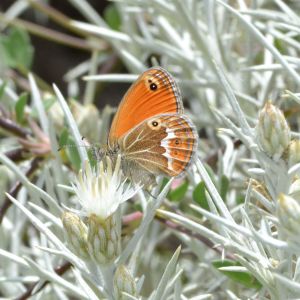
Corsican Heath
Another endemic I was pleased to record was Corsican Dappled White (pictured below). This species can be confused with the far more widespread and common Western Bath White, from which it is best distinguished by the underside mottling, so I hope I have got this right. Collins lists four different Dappled White species, of which the Tyrrhenian variety produces two broods in very early spring, then from late May through June. Our tour leader was asked why so many Tyrrhenian endemics bear the prefix Corsican. The reason apparently is that Corsican naturalists like to lay claim to things, while their Sardinian counterparts tend to be a more secretive bunch.


As in Corsica, the local race of Wall Brown (below, left) was a fairly frequent sight. These (Lasiommata tigellus) are brighter orange with bolder wing bars than the regular and more widespread L megera that occurs throughout Europe. The Tyrrhenian population is accorded full species status by some sources but is not a generally agreed endemic. As familiar throughout the trip were the southern European race of Speckled Wood (Pararge aegeria aegeria – below, right) that has an orange ground colour by comparison with the yellow and creamy white northern race (P a tircis) seen in Great Britain.


On to rather more stand-out things now and two much desired lifers. At one site I was pleased to encounter my first ever Large Tortoiseshell, a Nymphalid that has always seemed to be late emerging whenever I have been where it might be found abroad. This large species occurs through most of Europe, northern Africa and western Asia. Twin broods each season are usually on the wing from May to mid-June, then mid-July to mid-August, hence the ease of missing them in an atypical season. This butterfly disappeared from Great Britain in the 1950s and is now an extreme rarity at home if captive bred releases are ignored.

Large Tortoiseshell
On 6th we visited Su Gologne, a gorge containing natural springs in the Gennargentu mountains of eastern Sardinia. There the most notable sighting was the enigmatic Nettle-tree Butterfly (pictured below), the only member of its family the Libytheinae in Europe. It has some striking physical features, notably a curious pointed snout, gently widening rather than club-shaped antennae and a hump at the top of the hindwing that breaks up the outline. All these contribute to excellent camouflage when settled in dead leaves and other ground litter as the good numbers here were prone to do. This butterfly produces a short-lived summer brood that emerges and egg lays in June, giving rise to a hibernating generation from August. It takes its name from the main larval food plant, the Nettle Tree.


Various colourful but commonplace southern European species also presented good picture opportunities and so I will include a few images here. Cleopatra is often fast flying and not inclined to settle, but this one (below, top) sat up for the camera just above head height for some time, also at Su Gologne. Clouded Yellow (bottom, left) were a frequent sight as everywhere abroad, while the continental European race of Swallowtail (bottom, right) is certain to be a popular draw with groups such as I had joined.


A yellow spectrum Mediterranean threesome (above and below)


Lastly a Two-tailed Pasha came to inspect our picnic lunch on Isla di S Pietro where we went to see the Eleonora’s Falcons on 8th. It was then enticed to stick around with some fruit before re-locating into nearby bushes. For many tour participants this was one of the week’s highlights, but I had enjoyed less contrived communion once before in May 2014 whilst totally alone on a track in the middle of nowhere in the Algarve hills. That sort of experience is difficult to better and so I was a bit more blasé over things on this occasion, but it was still good to be reacquainted with this magnificent insect once again.


Other insects
There follows a purely random sample of other insects that caught my eye through the week under review. I paid far less attention to grasshoppers and crickets here than in Corsica (see here), since this trip involved the much higher priority of scarce dragonflies to locate. But a Saddled Bush Cricket (below, left) on Asinara was worth recording, while the green grasshopper species on the right also prompted my attention.


I cannot recall ever having come across either a Stick Insect or Praying Mantis in the wild before, but both (pictured below, top) were amongst the weird and wonderful beasties that came out at dusk around our remote hotel at Su Baione. The gruesome detail I always recall about the latter is that during copulation females are said to eat the male from the head downwards while their mate continues to do the business undeterred from the other end, adding a whole new dimension to the term “ball breaker”. Worth thinking about, that one! These creatures are no wimps.


The rather more congenial flying insects that are Ascalaphids (pictured above) are always fun to see and I have encountered them in most places visited in the Mediterranean. There are 15 different European species in this group and many more worldwide. And so this two-part presentation on insects observed during my latest trip in the region is complete.
 Ramblings and Scribblings