I feel on a roll now. After two days taken up largely by writing, picture editing and housework following my Fuerteventura trip, I was ready for the road again by Tuesday (15th). The excess energy and inner tension that arise from a preference to stay active had built up again upon my return. To relieve it there was a choice of going for a tricky little lifer, Hume’s in East Sussex or trying again for the Norfolk Shorelarks. I opted for the former since they were nearer (115 cf 150 miles) and the latter were likely to stick around for longer.


Hume’s Leaf Warbler (also known as Hume’s Yellow-browed Warbler – pictured above, left) is one of three autumn drift migrant Warblers that still occur in Britain into mid-winter. The others are the closely related Yellow-browed and Dusky, both of which are on my British and hence Westpal and life lists. I had previously dipped Hume’s twice in Dorset exactly seven years ago, an experience that entailed staring at a dense bank of vegetation for hours for no reward.
That served to put me off going for another one until now, and so Hume’s lingered amongst three other regular drift migrants – Greenish and Marsh Warblers, and Olive-backed Pipit – that I still need and really ought to have gained by now. I anticipated today might be a necessary chore, involving getting through the most perennially traffic choked section of the M25 motorway (between the M40 and A3), then another unforgiving stake-out on site. But in the event I cannot recall the south-western M25 being so un-congested, and the connect was surprisingly simple as well.
A fortunate feeling grew further when upon my arrival on the northern edge of the port of Newhaven, around nine miles east of Brighton, a parking space awaited rather invitingly in the access road to the Hume’s site (TQ 44299 02192). There I did my credentials for becoming a proper birder typical harm by polishing off a particularly delicious pasty from Pease Pottage services on the A23, rather than running for the target. Thus sated, I then “sauntered” as is my wont into Riverside Park, a former landfill site and the location quoted on RBA.
Those directions said opposite a waste incinerator (that is actually on the far side of the river) and as I approached two other birders were walking away unsuccessfully. They advised me to listen for a call not unlike Pied Wagtail. Setting up my chair I next saw off an as tasty M&S Wensleydale and carrot chutney sandwich (more food!) before at last starting to go about things more seriously.
The young tree scrub habitat here on the re-generating landfill site looked excellent for warblers, but though less dense than that previous Dorset location there was also a lot of it in which the Hume’s might be skulking. Two more birders had now arrived and we all began to search in different places. Ever incorrigible, I moved my chair to a clearing from which I could scan a good area of habitat, Googled the bird to check on it’s diagnostics, then sat and waited. That seemed preferable to walking around and risking the bird flying off ahead as I went. Five hours in that forest park in Costa Calma had clearly had some influence on my mind set.
Blue Tit, Robin and Chaffinch all moved through, before after maybe 20 minutes I indeed heard a call such as had been described to me. A small and very different passerine, the Hume’s Leaf Warbler had landed in the top of the nearest clump of saplings, rather like in the outsourced picture below. Oh that I could always enjoy such luck, but on this occasion at least my laid back approach had paid dividends. It was now 13:25pm.
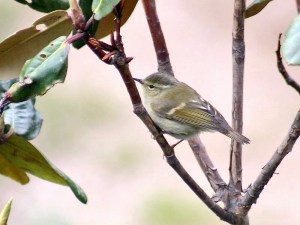
Hume’s Leaf Warbler © rights of owner reserved
Over the next 40 minutes the Hume’s came and went several more times, always announcing itself with a pronounced dsu-weet call. In this period more birders also congregated here and all got to see the Warbler well. I understand that vocalisation is the easiest way to identify Hume’s, since for non-expert observers such as myself the plumage closely resembles Yellow-browed (whilst being generally drabber). The species breeds in central Asia and the most extensive wintering area is the Indian sub-continent. Yellow-browed, from which Hume’s was separated by the BOURC in 1997, has a more northerly Siberian breeding range.
At 14:15pm it began to rain and most of the birders dispersed. Mindful of avoiding rush-hour traffic on the dreaded south-western M25 I now headed home, feeling immensely relieved at having laid this long-avoided and difficult lifer to rest. This day had been a hugely satisfying experience at the opposite end of the birding scale to those boring and frustrating 2012 sojourns in Dorset. Apparently I had made a wise choice of location as there have been six previous occurrences of HLW along the 18 mile stretch of coastline from Brighton eastward to Beachy Head since and including the first accepted British record in 1966.
========================
For a very informative guide to migrant leaf Warblers in Great Britain see here. And for a detailed, scientific paper on separating Hume’s and Yellow-browed in the field see here.
========================
Two days later on Thursday (17th) I made a third attempt at the Holkham NNR Shorelarks on the north Norfolk coast, since missing them twice previously this winter still rather rankled. Given my current run of good form it seemed now might be the time to belatedly nail those too. Since my abandoned visit on 28th December (see here) a 20+ Shorelark flock, and up to 50+ Snow Buntings that I observed then, have been recorded regularly on RBA. Like the Buntings, the main attraction of the Larks for me was the comparatively large numbers involved, since I had only come across single figure groups in the past.
When I arrived at Lady Anne’s Drive just after 9.00 am a bitterly cold gale was blowing along the coast, which I suppose I should have anticipated. But I was wearing just about enough layers and so strode out defiantly to the roped off area at approx TF895455. There several other birders were already watching the Shorelark flock, so the connect was immediate this time and my luck was holding. At first the birds were too far away to get pictures of but then they moved quite close in … which was when I found my camera battery was flat. Oh dear! Cue a sinking feeling.
Back at the car park, having watched the Shorelarks for a while, I retrieved my camera charger and the on-site cafeteria proprietor very kindly rescued the situation while I warmed up again with a coffee and local pasty. Meanwhile a Lapland Bunting was discovered out at the sharp end, presumably amongst the Snow Bunting flock. On my walking out for the second time, the conditions had if anything deteriorated further with light snow flurries in the mix. But the Shorelarks were still present so today’s result despite my earlier faux pas was definitely meant.


Again the flock was mobile around the roped-off area, then once more they moved closer. Given the circumstances any sort of records would suffice, and the images (above, top row) purport to be no more than that. Local birders arriving now were naturally far more concerned with locating the Lapland Bunting. I neither picked it out nor came across anyone else who had seen it since that original report, but I did speak to the finders. The today 30+ Snow Bunting flock (above, bottom row) was active throughout.
My carelessness with the camera battery had at least ensured I spent all of my four hours parking time on site, but by the end of it I was glad to head back home. I think I might have had my fill of Holkham for this winter season, but I am taking the “arduous journey” to north Norfolk in my stride now, and those aforementioned Greenish Warbler and Buff-bellied Pipit perhaps seem a little more reachable.
 Ramblings and Scribblings