While researching sites for the next butterfly on my 2019 agenda, Small PBF I became intrigued to learn that the New Forest national park holds undiminished populations of Pearl-bordered Fritillary. So whilst my recent visit to Rewell Wood in Sussex (see previous post) was enjoyable, it now appealed to experience longer established colonies of this heart warming little butterfly in possibly a less publicised and hence not such visited and pressured location.

Pearl-bordered Fritillary
The Hampshire sites in question lie to the east of the A337 road between the two towns of Lyndhurst and Brockenhurst. They are known collectively as the “East Inclosures”, consisting of mixed deciduous and coniferous woodland with wide rides and a network of gravel tracks and paths. Through sympathetic management by the Forestry Commission to meet PBF’s very particular needs, this area maintains the county’s largest concentration.
The best access point is the Standing Hat car park (SU314036), north of which lie Pignal, Parkhill and Ramnor Inclosures that have all featured on the BC Hants & IoW sightings page this season. That was where I arrived at around 10am on Monday (20th) but conditions were lightly overcast and things did not look promising. I nonetheless set out to at least explore the area and just 300 metres along a track into Pignal Inclosure was rewarded by finding a first Pearl-bordered Fritillary nectaring on Euphorbia.


Pearl-bordered Fritillary (above and below)


That would have made a good picture but before I could get my camera setting sorted out the butterfly took flight. Despite the lack of sunshine I then encountered three more low flying Pearls in the next 100 metres, that when they settled adopted similarly grassy poses (pictured above) to those others in Rewell Wood. My attentions served to chase them further away from the ride margin, there being no-one else present to consider on this occasion, and so I did not try to follow them but moved onward.
After another 800 metres I reached an area that at once stood out as suitable PBF habitat, such as I can now recognise quite readily. This was Parkhill Inclosure, that from what I had read was the best location of all, and more butterflies were soon evident. As in the first hot spot these would from time to time be located basking with wings flat to absorb as much warmth as possible, and what attractive little sights such encounters were. The longer I was in this superb place the more I realised there was no need for sunshine because I was finding plenty of Pearls and they were proving even easier to capture pictorially than in Sussex.
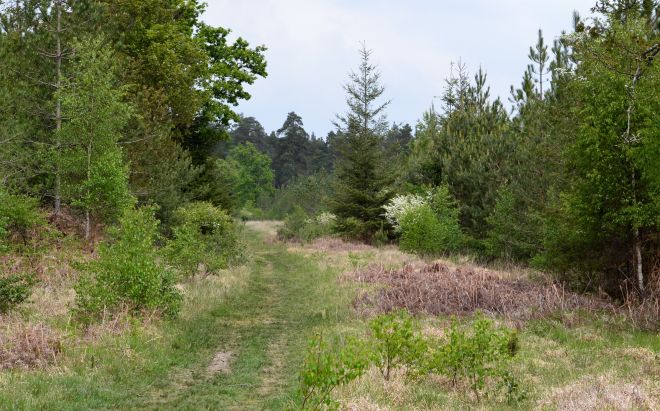
PBF habitat in Parkhill Inclosure, New Forest
There was just a different, more open character to the ground level habitat in the two spots described above, and it was heartening to think this is being maintained as an integral facet within a commercial forestry operation rather than through intensive input by conservation charity volunteers as in Rewell and Bentley Woods. Of the three different sites at which I have observed PBF this latest one was the most pleasurable to be in, especially so since aside of an occasional dog walker, horse rider or hiker I had these woodlands largely to myself. The most meaningful butterflying is definitely best undertaken alone.
Walking up then back down the ride in Parkhill Inclosure I was able to capture some different treatments to the more usual grassy Pearl studies. The left hand picture below against dried fern is quite pleasing, while the right hand one and that at the head of this post achieve a reasonable balance of naturalness without too much clutter or light and shadow. More’s the pity about the damage to the individual’s right hind-wing. Once again acceptable under-wing studies showing the pearl-like markings of this species’ name eluded me on this day.


By midday there was still no brightening of the skies. I walked on to try to reach Ramnor Inclosure but couldn’t be certain whether I passed through it or not. Unsure of where exactly I was I enquired of two walkers to find I was almost back at the car park. Light rain was now setting in, so having some garden plants to collect from a nursery near Southampton and wishing to avoid rush hour congestion on the M27 I headed home. It had been an immensely enjoyable morning in the New Forest.
When Tuesday (22nd) dawned bright and sunny and stayed that way I completed the previous day’s intended agenda by visiting West Wood (SU424295) at Sparsholt near Winchester. This Forestry Commission owned, mixed broad-leaved and coniferous woodland is another Hants location for Pearl-bordered Fritillary, though their numbers are rather smaller here than at the New Forest inclosures. The most individuals recorded in a day this spring has been 11, but the site is also a reliable one for Duke of Burgundy.

Farley Mount Country Park site map comprising FC West Wood, Crab Wood LNR and Pitt Down
This time I left home after the Oxon rush hour, arriving on site just before midday. From the first car park reached I walked westward through the ancient woodland of Crab Wood LNR, then down a gravelled north / south ride on getting to West Wood. Along the next major track to the right I came upon a first Duke of Burgundy that settled on some Euphorbia. So this individual (below, left) atoned for my having missed a similar opportunity with PBF a day earlier. The pristine male in the right hand picture was one of two seen next in a recently felled and replanted clearing further along this track on the right, and there I also noted my first Pearl of this visit.


Continuing west along the track I met a Hants & IoW BC transect walker who told me the clearing I had just left is currently the prime location within West Wood for both species. So I went back and did another circuit, seeing three more Pearls all as fly-byes and one more Duke. So that was four of each which compares favourably with recent published counts. I don’t mind just exploring new sites and seeing what is there without knowing exactly where to look, so it was gratifying to have found both my day’s targets so quickly and in the right place.

The PBF and Duke hot spot clearing in West Wood at approx SU 42457 29730
DoB having been my spring butterfly of choice for repeat study in 2018 (see here) I haven’t made any special trips to see them in this new season, but there is always a certain thrill involved in meeting the much sought little butterfly and especially in new locations. Possibly due to the current spring’s alternately mild then cold weather pattern Dukes appear to be enjoying a particularly long flight period in 2019. They were on the wing at the classic site of Noar Hill, Hants at the beginning of April but new emergences have been reported in both Hampshire and Sussex into mid-May. So far this year I have paid most attention to PBF and have to admit to becoming a little bit hooked on them.
I ended this latest quest by walking around the Pitt Down area, where the unimproved chalk downland habitat produced my first Common Blue, Small Heath and Dingy Skipper records of 2019. For a guide to the whole Farley Mount CP complex see here. This was a very interesting and butterfly friendly network of sites to explore, and well worth having made the effort to go back to on the sunnier second of this post’s two days.
 Ramblings and Scribblings