Today I gained my best ever experience and pictures of one of the regular wintering passerines that occur around the East Anglian coast. Whilst staying with friends in Suffolk for a couple of days, my birding time out at this site was to try a little late for what by now was a long staying Eastern Yellow Wagtail. That bird wasn’t seen but an attractive flock of Snow Bunting coming and going continuously during my 4½ hours on site was a pleasing diversion.
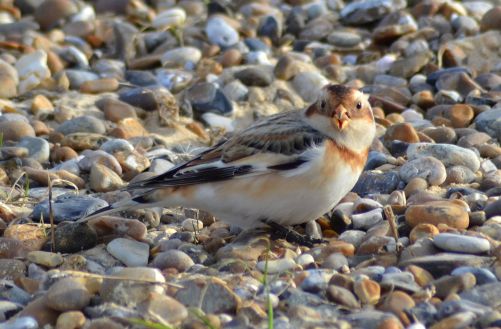
Winter male Snow Bunting
The 20-something Buntings were particularly attracted to a patch of grass on the shingle beach (pictured below) where seed must have been put down for them by birders twitching the EYW on previous days. Some of my pictures indeed show them eating what doesn’t look like a natural food source.
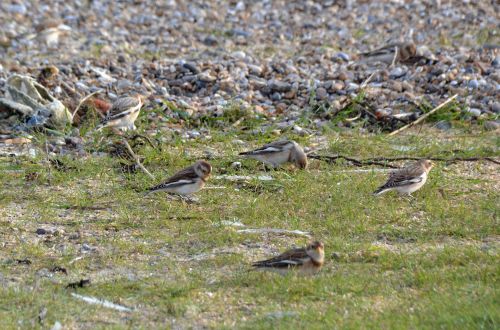
These birds tolerated a very close approach and I was able to get within feet of them at times without causing them to scatter. I hope I have identified the various individuals correctly as to gender and age (below), but if not am open to correction.


Last winter I had twice observed a Snow Bunting flock in very windy conditions on the north Norfolk coast at Holkham Bay (see here). Due to the closeness of today’s encounter I enjoyed it that bit more. Other past personal records were from Reculver in Kent (Nov 2014), Cley in Norfolk (Oct 2014), locally at Farmoor Reservoir (Feb 2012), Walberswick again (Feb 1986); and twice as a teenager in the family home back garden in eastern Greater London – yes really!
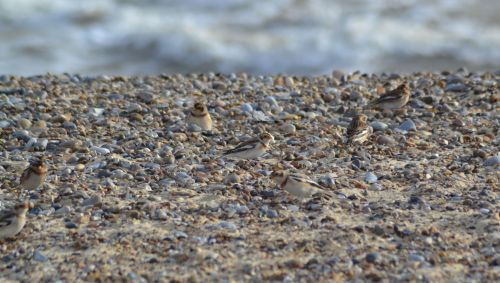
Today’s Snow Bunting flock at Walberswick
Where the Eastern Yellow Wagtail was concerned, I agree with the day’s only post from the site that it was not seen. But others amongst the observers present kept calling it confidently from the briefest of glimpses, something that not being a proper birder myself I am always dubious about. Some trusted Oxon birding colleagues had been here before me so I knew exactly what to look for (see here), and also came armed with a printed picture. It is mostly only possible to make subjective judgements about how knowledgeable people I meet in the field are, but some of the things being said here just did not tally. And when the bird being called eventually showed itself clearly mid-afternoon it was a first winter regular Yellow Wagtail (pictured below). Neither bird was reported on the following day (21st).


I am not greatly enthused by new splits that might only be distinguishable on call or by DNA analysis of faecal samples. But these are “tickable” and so in my current low state of national birding motivation this one seemed worth a look. The Eastern Yellow Wagtail had been present at Walberswick Corporation Marshes on the Suffolk coast since 28th October, and was confirmed as such from a sound recording on 9th November.
I expect there will be more opportunities since, as familiarity with the new species grows, proper birders are likely to identify others. That will have to wait, but here and now the wintering Snow Buntings at this site had made for a worthwhile visit. I nonetheless returned home thinking it may have to be something a bit special to tempt me out again nationally this winter.
 Ramblings and Scribblings