I had not visited this classic Wood White site for five years since the previous, brief post in this journal as part of my 2015 British butterflies series (see here). Indeed I have not recorded the species nationally during that interval, so given my current re-working of the British list, when Ewan asked me to accompany him there today I opted to join him.
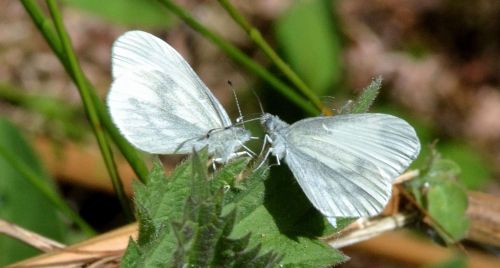
The courting dance of springtime Wood White today
My own access point to Bucknell Wood outside the village of Silverstone has been along a track at its southern end (SP 65882 44750), from where I have usually found this butterfly immediately. But on arriving there at around 10am my colleague was in the main Forestry Commission car park a little to the north, and neither of us knew of the alternative locations. So through the course of this exercise we both became aware of a second option, which was perhaps apt at the present time with many times the usual numbers of people visiting the countryside and parking areas being under pressure.
At first I set out along my usual past route, but as it was overcast and windy it was plain I would not find any butterflies yet. So I went up to the other access point and belatedly our paths crossed. The conditions remained distinctly butterfly unfriendly for the next hour, and then we had to shelter as best we could from a minor soaking. But as that weather front drifted eastward across the wood, extensive clear blue sky followed behind it. Such a scenario seemed perfect for accomplishing our mission as butterflies would emerge again as the late morning warmed up, and so things transpired.


Though the site was now sunlit strong wind was still afflicting the main rides, but along a more grassy and sheltered track I eventually came across a first roosting Wood White on an exposed perch. This was presumably a female since a second butterfly arrived on the scene and proceeded to dance around the first (pictured above, right). But the latter appeared to be getting the old cold shoulder and so presumably “he” flew off. Before too much longer we were encountering several of these ghostly waifs (pictured above) and two maturing Broad-bodied Chaser dragonflies (below) across the same area.


The Wood White displays a noticeably dainty jizz compared to Small or Green-veined Whites, having one of the slowest and most delicate flights of any British butterfly. The smallest of those three, they indeed flap their oval wings so under-statedly as they glide about that the distinctive faint patterning is readily visible, and always rest with wings closed. Unlike other whites these live in self-contained colonies of a few dozen and largely remain faithful to their breeding area in English woodlands.
Adults in southern sites typically begin to emerge in late April, peaking in May and lasting into June before dwindling through that month. The average life-span is eight days, though some individuals can last for up to three weeks. There is usually then a second brood in which males display smaller, darker wing tips. Numbers can then be as high again after a warm spring such as the present one, flying from mid-July to late August.
Males spend their time patrolling up to a metre above the ground in their search for mates, checking out any white object they come across. If that turns out to be a newly emerged female they begin the distinctive head-to-head courtship dance captured in this post’s lead image. Our first sighting today must have been less fresh as she appeared to reject the suitor concerned. Females fly only half as much as males and when observed are usually nectaring on plants such as Bugle, Ragged Robin or Birds-foot Trefoil. Males may nectar less on flowers and supplement their diet by mud-puddling for mineral salts if the conditions are right.


Wood White was one of the fastest declining native butterflies over the last 30 years of the 20th century, and in 2007 became a priority species in the UK National Biodiversity Action Plan. Mounting concern over its plight led to the development of a recovery project led by Butterfly Conservation. By 2010 only 50 extant sites were identified, of which 13 were thought to have already lost their colonies.
Bucknell Wood is one of a complex of six forest sites in Northamptonshire and north Bucks that hold 20% of the species’ national total. The others are Hazelborough Forest, Whitefield Wood, Sywell and Hardwick Woods, and part of Yardley Chase. Five of those are managed by the Forestry Commission which has worked with BC staff and volunteers to create the sunny rides and clearings that Wood White requires to survive.
After leaving here we paid a brief visit to nearby Hazelborough Forest (SP659431) where in the area we accessed the difference in habitat to that required by Wood White was quite apparent. The next heavy rain belt was also approaching and so we did not linger. But I returned here two days later and indeed found more butterflies in suitable habitat along the main ride and a side track from it. The second brood of the enigmatic Wood White is one I have yet to experience in Great Britain, so a further visit to this area seems quite likely.
 Ramblings and Scribblings