My present national butterfly agenda includes one site visit for each of the early season Fritillaries, so today I returned to the ancient Oak woodland of Wyre Forest at Bewdley that I first visited in this same week 12 months ago (see here). Meeting Ewan at the usual start time of 10am in that site’s Dry Mill Lane car park (SO771762), our quest was Small Pearl-bordered Fritillary of which this NNR hosts a healthy population.
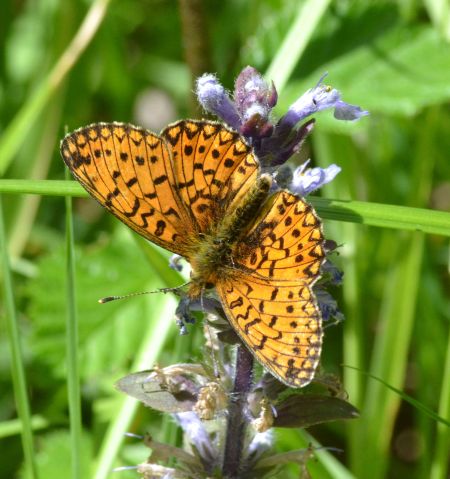
Small Pearl-bordered Fritillary
We first walked westward along the hard-surfaced access route of a former railway line. This was being very well used by family groups, dog walkers and cyclists, and every day in the countryside seems like a Sunday at the moment in the still surreal post lock-down climate. In track-side areas that must be managed for them we soon began to notice Pearl-bordered Fritillary, amongst which some individuals (pictured below) were still quite fresh. But how aware of this local treasure the human footfall all around us may have been I cannot say.


Those butterflies are now nearing the end of their flight season, but that of Small PBF is just beginning. So we turned off this busy thoroughfare and took a path steeply down into the valley of Dowles Brook that adjoins the northern edge of the reserve. In the rather idyllic setting of stream-side meadows at our trek’s end we encountered much richer brown and faster flying Fritillaries that at once stood out from the still present Pearls, and that was what we had come here to find.


The easiest way to separate Small Pearl-bordered Fritillary through binoculars on first encountering them is to pick out the black chevrons surrounding both underside wing edge pearls, a prominent black dot near the centre of the hind-wing, and markings along the top-side edge of the fore-wing that appear to spell the letters 730. The two sequences above illustrate those diagnostics quite clearly.
The two butterflies are also quite different on jizz once the observer has their eye in. On this sunny morning the presumably male Small Pearls we found here were all very hyperactive, patrolling endlessly in search of mates. On settling they would most usually keep tumbling around their flower heads of choice which made gaining acceptable images of them quite difficult to achieve. But I persevered and there were quite a few more butterflies to choose from here today than during my previous 2019 visits.


A year ago I did rather better for top-side than underside studies, but today that situation was reversed. The above collage presents my better results. We remained at this place for around an hour and for much of that time had it to ourselves. I would fear for the lush habitat here if this tranquil spot ever acquired the popularity for SPBF of Bentley Wood in Hants, hence my vagueness as to the precise location. My better top side studies are presented below.


After moving on in the early afternoon we birded the woods on the valley sides, encountering two Pied Flycatcher and finding a Great Spotted Woodpecker nest. Common Redstart and Wood Warbler also breed on this reserve but we did not find any today. Lastly we walked back along the main access track, and some Small Pearls were now also active amongst the Pearls in the managed areas viewed in the morning. The under-wing images herein featuring Horseshoe Vetch were all captured in that second location.
I dealt with SPBF in detail in the two posts published in this journal in 2019, so this account of a follow up visit is a briefer, picture-based treatment. Much of the specific wildlife agenda I went into this present remarkable year with has had to be abandoned, but re-experiencing these two little treasures of any British spring was always going to be part of the plan.
 Ramblings and Scribblings