A window of fair weather over these dates has seen a change in my wildlife focus. With the butterfly season now past its peak (at least for me) and being an authorised contributor to Oxon Dragonflies, I have decided to repay the county Odonata recorder’s faith in me by getting out and doing some local surveying. That will also provide an evolved way of progressing through a season of mainly repeat exercises where insects are concerned.
2020 has been a quite notable Odo year in my home county. Following exceptional numbers of Common Clubtail sightings in the spring, June brought Oxfordshire’s first ever Blue-eyed Hawker records (see here), then the first reported Scarce Blue-tailed Damselfly (or Small Bluetail) this century. Observing Aurantiaca-phase teneral females of the last-named species in the New Forest (see here) is still the only item on my original agenda for this year that I have converted in the ongoing Covid-19 situation. So when these were photographed twice in recent days I relished the possibility of experiencing more locally.
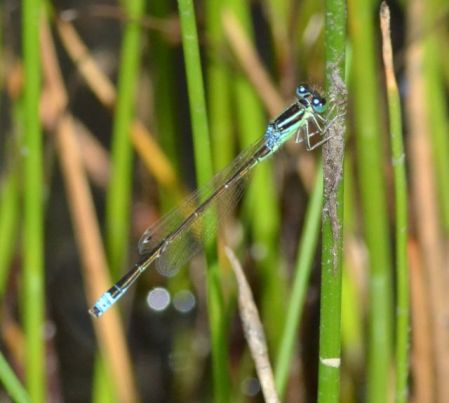
Scarce Blue-tailed Damselfly (Small Bluetail – male)
The new SBTD colony was discovered by a local wildlife enthusiast on the outskirts of Banbury on 13th June. The site (SP469390) is described as a “storm water pond” adjacent to a large new housing development part of which is already landscaped as a public park, and also close to the Oxford Canal. Fortunately, upon my arrival another county wildlife colleague drew up behind me who knew the exact location and we walked out to what at once struck me as a superb piece of naturally occurring Odonata habitat.
Small Blue-tailed Damselfly are said to favour shallow water habitats such as here that might occur in the transient situations of active construction or earth extraction works. Three observers from Lancashire were there ahead of us, such is the interest this discovery is arousing nationally. They had located several individuals already that we soon picked out too. These stood out amongst the more numerous regular Blue-tailed damsels by their slighter appearance and weak flight jizz.
The lead picture in this post shows the diagnostic black dots on segment 9 more clearly than those I gained this year in the New Forest, while the “blue-tail” also extends over a portion of segment 8. The sequence below shows regular and Scarce Blue-tails for comparison.


I soon realised welly boots would definitely be an advantage both to wade in a little from the pond margin and get the light behind me, so I went back to retrieve my own. Thus equipped I found the ground below the shallow surface water to be firm, quite unlike a valley mire in the New Forest, and so became more than usually adventurous. But most of the insects then encountered were regular Blue-tailed Damselfly (or Common Blue-tail). The sequence below shows some of the Odo observed at this site. There were no Aurantiacae on the day … done that this year anyway though more would have been welcome.


Another item being reported more widely in Oxfordshire this season is White-legged Damselfly (or Blue Featherleg). On 10th I surveyed a stretch of the River Thames upstream from Clifton Hampden (SU546952) finding seven individuals of different colour forms in lightly overcast conditions. In late June, 19 were recorded downstream from here and 17 upstream so what I find an attractive species clearly has a presence in the area. Part of that allure for me is the subtle array of colour forms in which WLD may be encountered (pictured below).


This (below) is a picture opportunity I have been wanting for years. Wherever I come across them Brown Hawker invariably see me approaching first and fly off out of cover. But on my home patch at Stadhampton Meadows (SU594987) on the afternoon of 10th I found a seemingly unconcerned male just hanging in the riverside vegetation to one side of where I was standing. I look back on the spring national lock-down as a meaningful time now because of it’s opportunities for re-evaluating perspectives, developing friendships and appreciating my local countryside. Continuing to walk the right of way network where I took daily exercise then is something I do not wish to lose sight of, especially if it produces rewards such as this.


On 11th I paid my second visit this year to Decoy Heath (SU 613634), near Aldermaston in neighbouring Berkshire. Though one of my favourite Odo sites, it can be quite variable in terms of the rewards offered and on this occasion it was not on form. A year ago (see here and here) I was pleased to find impressive habitat management work undertaken by BBOWT, but now the hidden gem of a reserve is becoming more difficult to move around again. One thing that never changes is the grey stuff will roll in on my arrival at site a proportion of the time when going to observe insects, and this was such an occasion. The following images once edited eventually made what at the time seemed a frustrating visit more meaningful.


Something that especially intrigues me about Damselflies is the array of colour forms in which images of them might be captured. Birders often deride these insects to me as boring, while disregarding their own blather concerning tertiaries, scapulars and coverts that apparently isn’t. I of course cannot get my head around plumage topography in birds so perhaps am biased, but I never tire of seeking out variations in Odonata. Here (below) are two more of the different forms observed over this weekend.


So although I have recorded every English species of Damselfly and Dragonfly it still seems there is always scope for witnessing something a little different. Throughout this post I have cited the British Dragonfly Society names for Damselflies with which visitors will be more familiar, with standard international names in parentheses.
 Ramblings and Scribblings