
As of today Kings Copse Park Botanical Gardens (KCP BG) is the proud custodian of a good-sized Helicodiceros muscivorus tuber. This seriously weird Aroid is a must have for collectors, involving as it does scope for imagination above the median and a reputation for producing amongst the world’s top 10 foulest smelling flowers. If planted in autumn tubers make foliage through the winter months before blooming in spring. Then the foliage wilts and the plant goes into semi-dormancy until the cycle begins again.
Not surprisingly yours truly wanted one too upon seeing pictures when I first started collecting Aroids in the spring of 2018. So on finding the plant offered for sale a few months later by Adventurous Plants at what seemed a very low price of £4.50 I took the plunge. Though described as being a few years from flowering size that tuber was puny and did not put on any bulk at all in its first two seasons, but I nonetheless resolved to make cultivating and bringing it to bloom a life’s ambition.
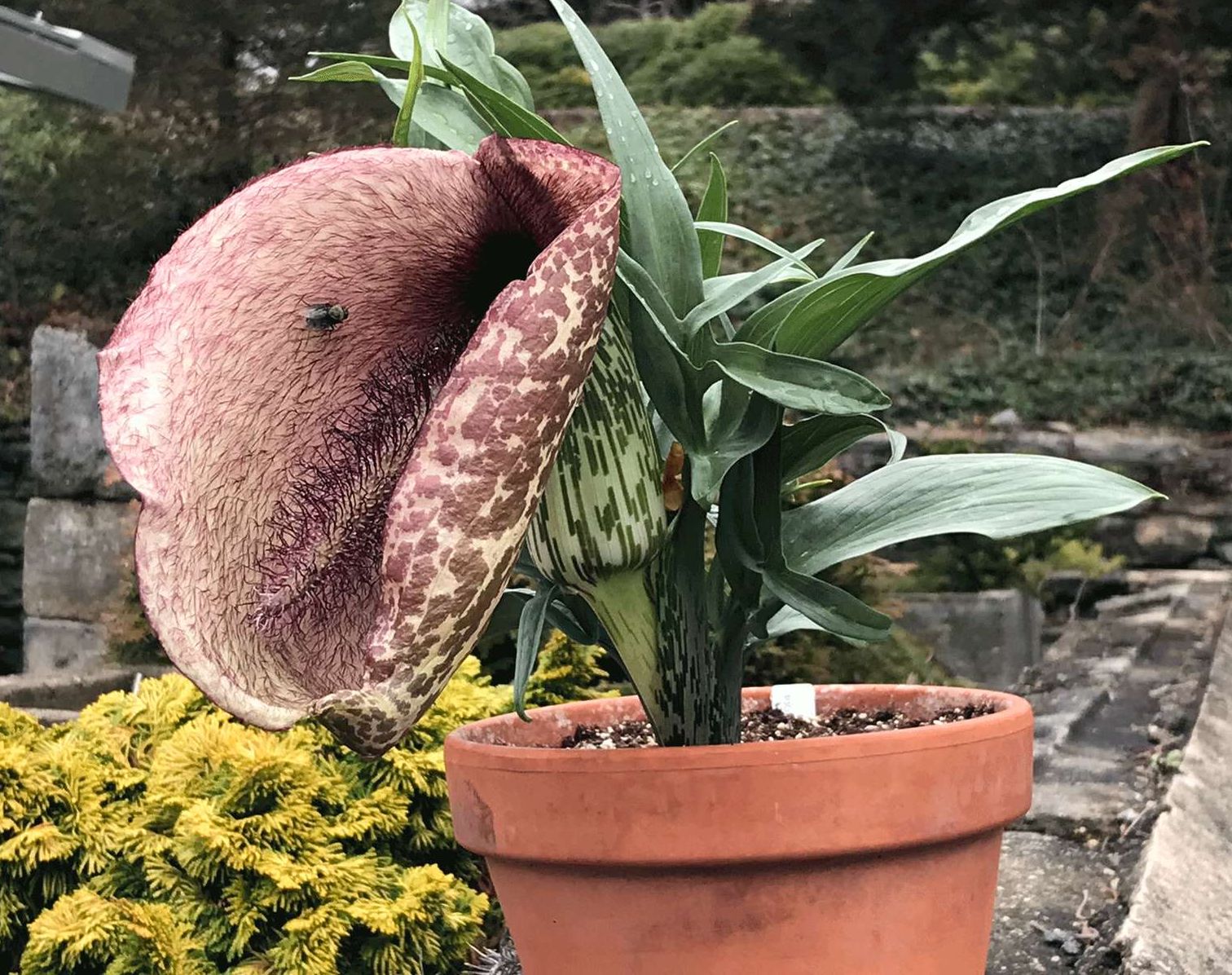
All that changed earlier this month when on resolving to join the wait list at RarePlants.co.uk I found rather more substantial H muscivorus actually available for sale, this time for £21.50. Imagine the thrill when on snapping one up the wait list was immediately re-instated and the plant again became listed as out of stock. To put things another way I must have got the last un-reserved one. A number of other suppliers have similar waiting lists. Obtaining one is not easy as they are such a sought after item.
This is the only plant of the Helicodiceros genus, known colloquially as the “Dead Horse Arum” and also “Pig Butt Arum” or “Ass Plant” on the other side of the Atlantic. Those anal American associations no doubt arise from the way it looks as much as the infamous smell. The foliage is a pale matt-green and in my view the remarkable inflorescence, perhaps depending on the angle from which it is viewed, has a beguiling suggestiveness some way beyond animal rear ends: large, flesh coloured and covered in hairs.
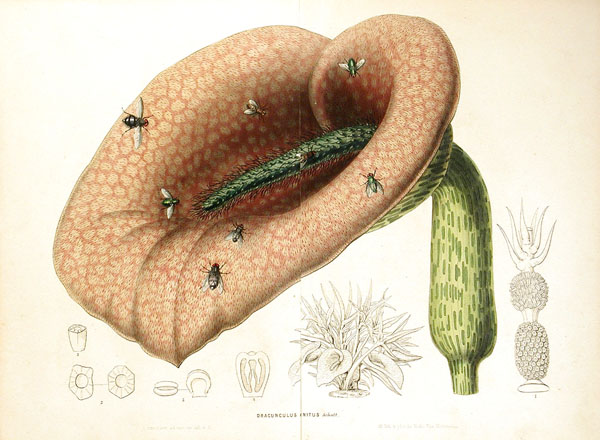
The above 19th century illustration possibly conveys that observation more than published pictures. My own supplier prefers a rather more polite resemblance to an Aardvark’s ear “in shades of flesh-pink and jade-green blotched all over with purple and emerald”. Take your pick. “Dragon’s Mouth” is another, less well used common name.
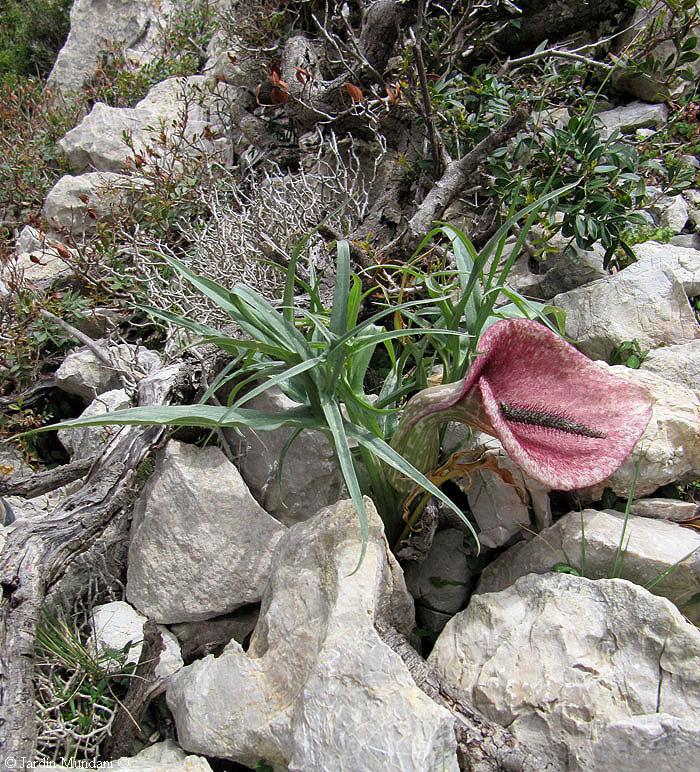
In the wild this Aroid grows only on rocky, coastal cliff tops in the Tyrrhenian and Balearic Islands of the Mediterranean (pictured below). But responsible suppliers such as I have sourced mine from grow their own from cultivated stock, and judging by the number of pictures on-line there are plenty of Helicos in circulation both in Europe and the USA.
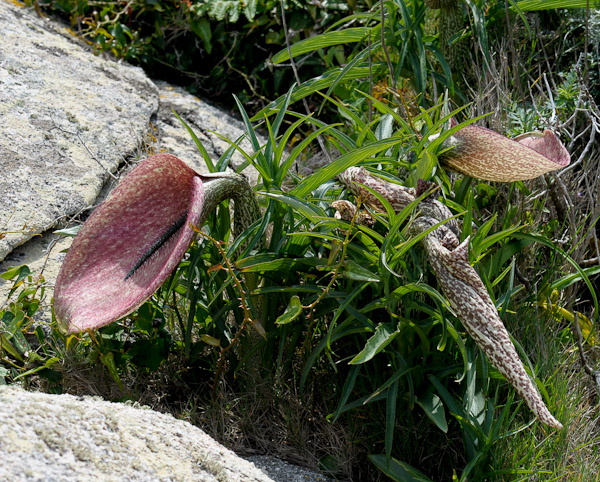
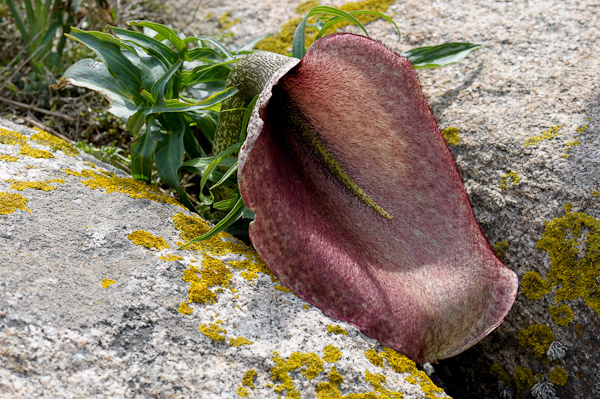
This is one of a rare group of plants with the ability to raise their own temperature above that of the surrounding air through thermogenesis. This simulates the warmth given off by the biological functions involved in decomposition, while emitting a strong putrid odour of rotting meat to lure pollinating flies into the inflorescence. The spathe waits for a warm and sunny day before unrolling so the smell spreads far and wide, but blooming is short lived since the pollination process lasts for just two days.
The flesh-toned bloom’s resemblance to a natural animal orifice also assists in pollination as blow flies are drawn right into the floral chamber where they become trapped and in trying to escape transfer pollen between the male and female flowers. On the first day only the female flowers are receptive, peaking at around midday in tandem with the odour. The pollinators remain trapped until the following day when the male flowers become fertile. Then the plant loosens its constriction allowing the flies, well dusted with pollen, to escape only to be trapped again in another plant, ensuring cross-pollination.
But it is not only insects that assist in the propagation of H muscivorus. In the Balearics this most curious plant has developed a specialised relationship with an endemic reptile. Liford’s Wall Lizard (Podarcis lilfordi) is known to be attracted to the odour of rotting meat and also for exploring any potential source of its small invertebrate, plant matter and carrion diet.

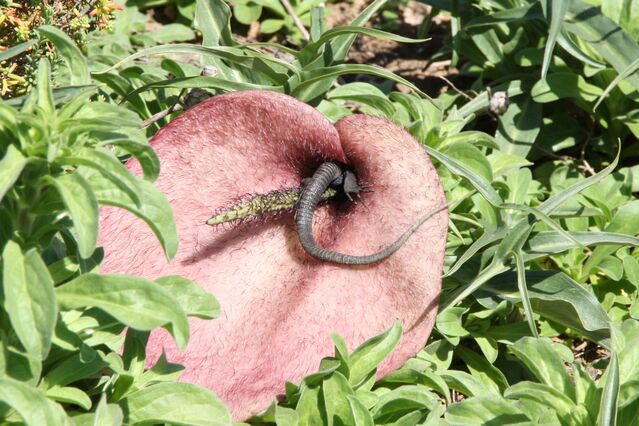
Once drawn by the Dead Horse Arum’s stench they enjoy basking on the warm spathes (above left) while taking advantage of the abundance of flies. And attracted by the amplified buzz of trapped flies from within they will actually enter the floral chamber (above right) to catch them. In doing so this lizard has learned to also eat the plant’s berries (pictured below), and hence it has become a major seed disperser. Studies indicate that seeds which pass through the reptile’s digestive system are twice as likely to germinate.

My article earlier this year on the English Cuckoo Pint (see here) has been well referred to in this journal. So I have also searched for anecdotes and folklore concerning their exotic Mediterranean cousin of this post, but without success. Likewise I have uncovered no Helico medicinal or culinary uses. But the “Dead Horse Arum” appears to have been quite a focus for scientific study, particularly concerning mimicry in plants to attract pollinators, which is true of many Aroids. And in all the published material it is difficult to get away from THAT smell.
Anyway I now have one, the most costly and perhaps challenging Aroid acquired here to date. My new acquisition is supplied as being two years from flowering size (FS2). I shall cherish and nurture this latest addition to my currently 29 species strong collection indoors through the coming winter and beyond until such time as it HAS to go outside.
 Ramblings and Scribblings