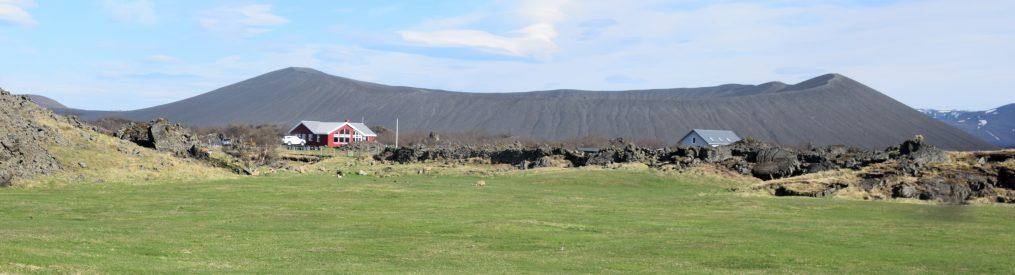
This is an opportunity I wasn’t anticipating any time soon. River Warbler is one of just over 50 regularly occurring European lifers I still required. It usually summers from eastern Europe through the former Soviet Union into Siberia – inhabiting dense deciduous growth close to water at swamp edges, marshland or along rivers – and winters in sub-Saharan Africa. This is a scarce visitor to western Europe and very rare vagrant to the British Isles. So when news broke early on Friday afternoon (4th) of a stray migrant singing and showing well at a very accessible location on the Somerset Levels it was a must see.
The species is described in Collins as shy and elusive except when singing. So I looked it up on Xeno Canto (see here) and needed to listen only once, the sound that is normally delivered from exposed shrubs or small trees being so distinctive. My immediate impression was of a Grasshopper Warbler reeling through a stack of Marshalls. Other, perhaps more conventional descriptions I have read this weekend were “a fast shuttling sewing machine rhythm with well-separated syllables” or “a low-frequency but very loud wart-biter cricket”. Not to be messed with then whichever interpretation you might prefer!

So what would be the best timing? Major dawn twitches as seemed inevitable on day two are not my scene, especially in what I knew to be a long, narrow location in which only the earliest arriving observers might get decent views. So I stuck with my plan A to start Saturday doing odonata near Bournemouth, intending to visit Ham Wall early on Sunday. But when the previous post’s assignment was completed so soon and successfully, I opted to drive the extra 60 something miles to Avalon.
In the event that was a novel experience in my Bluetooth-equipped new transport as Google Maps took me across country by a scenic route, alerting me as I progressed to incoming texts and WhatsApps, reading them out and offering to reply. Well it was all new to me anyway … perhaps I might even get around to acquiring an up-to-date camera before long.
On reaching Ham Wall (ST458398) at around 1:30pm there was indeed plenty of space in the car park. I then walked out along the familiar former railway line on which I had converted previous lifers Pied-billed Grebe (Feb 2013) and Dusky Warbler (Dec 2015), plus British list addition Collared Pratincole (Jul 2016). Being at a Royal Society for Populist Birdwatching (RSPB) reserve, I felt my usual unease with the ambience of general public supervised by over-earnest volunteer wardens. But on this occasion there was fortunately none of the over-officiousness that can accompany the scenario and I was able to proceed un-accosted. The exact location of my intent was obvious, across a drainage ditch to one side of that route.
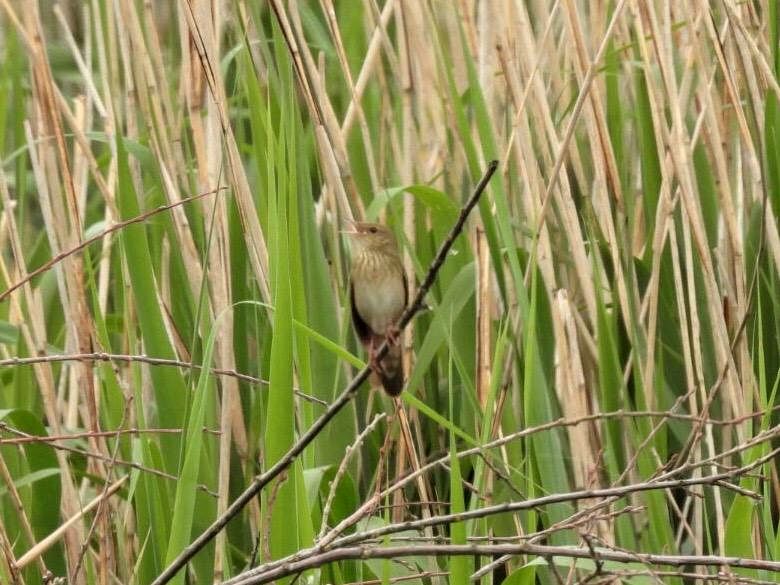
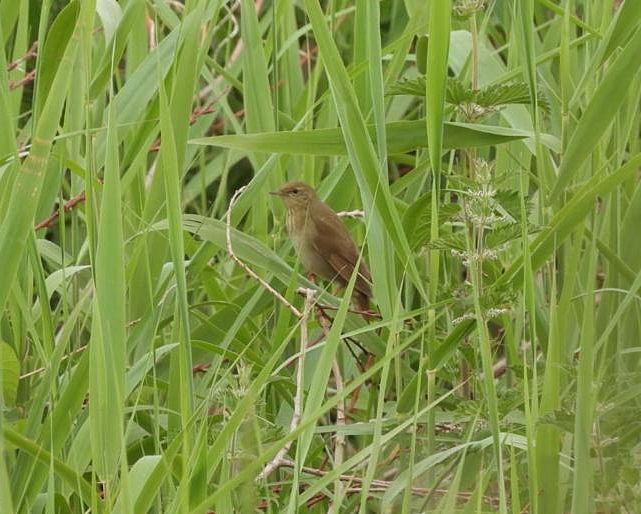
Now the potential downside of my day’s decisions kicked in. River Warbler is said to sing mostly at dawn and dusk. I had opted for early afternoon, to be greeted by advice that the bird had not been seen for some time but was “due again soon”. A lady standing next to me pointed out the spot of the last appearance, then an edgy 30 – 40 minute wait ensued. From time to time movements low to the ground before us stirred the gathering but nothing actually showed … and so things went on.

This bird was nonetheless a consummate virtuoso. Having kept the audience waiting this long he duly sat up in his own time and delivered. First he sung very close to where I had been advised to look, then moving left to an exposed perch threw back his head and poured forth with gusto. Everyone present was captivated by the volume and delivery before us. The artiste was a large, elongate looking Warbler with a noticeably streaked breast pattern; broad rounded tail with distinctive patterning on the underside, and a quite amazing gape … no plumage topography in this journal as always. Ultimately having tantalised us all just enough but not too much the performer exited stage right. Most birders present were thus more than sated and moved on, myself included.
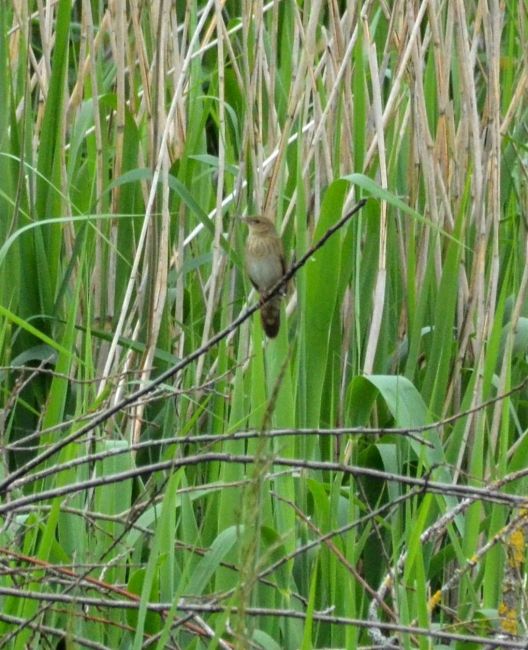
Pictures 2 and 5 in this post are my own, but the other three were sent afterwards by the birder alongside me who requires no acknowledgement. My thanks are due to her anyway. For the RBA gallery see here. This had been a superb experience of a mega rarity that until now had been just a name and illustration in the field guides. I didn’t ever expect to experience this bird nationally … but one never knows.
 Ramblings and Scribblings