British bird list additions are always welcome, especially when national lifers are now at such a premium within my preferred driving distance. This one had been in place for 12 days in which I had felt tempted to go for it but imagined the journey would be more arduous than has turned out to be so. But with a number of hot days forecast ahead this cooler, cloudy Friday seemed like a good one on which to convert the record.
Motivation is always fragile for someone such as myself who prefers evolution in what I do. On waking early this morning, feeling a little too lacklustre to think in terms of “rising today”, I set about my usual tasks on the computer, then remembered this bird. Checking the distance, the shortest route was 126 miles and the day ahead at once assumed a purpose. That after all is what going on the road is for.
Mid-morning found me arriving at Notts WT’s Besthorpe nature reserve (SK818640), a restored gravel extraction site on the east bank of the River Trent (see here) a little north of Newark. On clearing my head sufficiently to find the exact location as cited on RBA – it had been an early start after all – eight other birders were there ahead of me. And as I approached the “north-west corner of Mons Pool” I could hear plainly the Great Reed Warbler singing. This is one of three in England recently, the others being in Cambridgeshire and Northumberland.
We are talking of course an out-sized, very loud Reed Warbler – still no plumage topography in this journal – that breeds across much of mainland Europe. I have encountered them a number of times on my southern European travels of the past 10 years, and recall on first hearing the strident, jangly-croaking song issuing from deep cover in Cyprus (2012) wondering what on Earth it could be. But this is usually a quite showy songster, as I first experienced later that year in Spain, then subsequently in Greece (2017) and Turkey (2019).
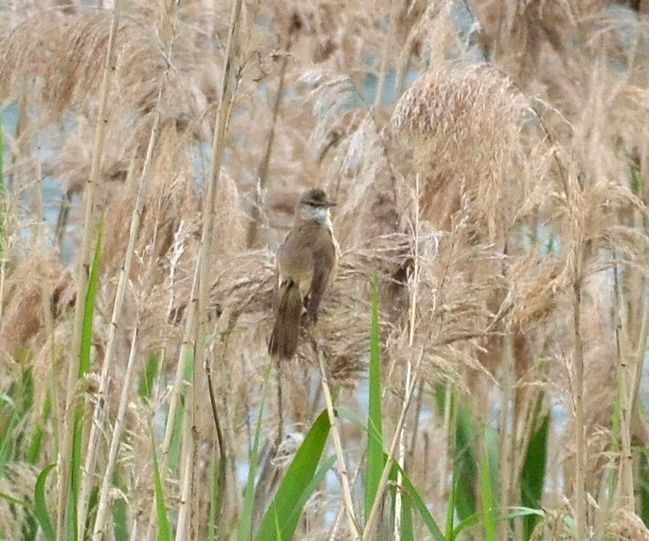
Not so on this latest occasion. The consensus amongst the gathering I joined was that windy conditions were keeping our quest further down in the reeds than its RBA gallery (see here) suggests. A wait of some 30 minutes then ensued until at around 11am, when the wind dropped a little it was myself who called the bird as it sat up to sing in view. That doesn’t happen too often with me, and I was thanked profusely by everyone present. Then around 15 minutes later the performance was repeated and this (below) was my best effort at a record shot to show I am not making all this up.

The original group of birders then drifted off, leaving myself and three hopeful toggers still in place, then the next shift began to assemble. But with conditions becoming windier and only having needed to tick the bird for Blighty, I opted to go back to the car park and put my head down before heading home. On starting awake some of my day’s companions were returning to their own vehicles, reporting that the GRW had sat up and sung for a further five minutes as I dozed. The bottom line here is that I feel more motivated as I write up this post than at the outset this morning, which is why I do all this.
 Ramblings and Scribblings